Devotional – Psalm 4.4

Devotional:

Psalm 4.4

When you are disturbed, do not sin; ponder it on your beds, and be silent.

Weekly Devotional Image

I like going to the gym. It’s one of the few places I can go without being spotted as a pastor (and therefore can avoid of all the Christianisms that often occur like, “I haven’t been to church in a long time,” and “What do you think heaven is like?”). There is a peace I experience while running on the treadmill in that I can be alone in my thoughts, with just enough distraction in running to actually relax.

On Monday afternoon, while about halfway through my run, my mindful journey was interrupted by the person running next to me. When I quickly glanced over it was clear that he was deeply disturbed by something on the television screen and I could hear him cursing under his breath. For 15 minutes I continued to run in silence, but I could not stop listening to, and worrying about, the man next to me. With every passing minute his face grew redder, his volume increased, and his anger became even more palpable until he could no longer stand it, he shut off the machine, and he walked away.

1280-treadmill

I honestly left the gym feeling pretty good about myself. Not only had I taken the time to be mindful about my physical health but also I wasn’t nearly as angry or ridiculous as the man running next to me. I know I left on Monday afternoon with a sense of pride. At least, I did until I got in the car, started listening to the news on the radio, and saw my tight knuckles gripping the steering wheel as I listened to all that is going on in the world. By the time I got home I realized that I was no better than the man from the gym, the only difference was he let out his emotions in front of everyone and I did it in the solitude of my car.

How do you respond to difficult information? Do you pick up a nearby object and hurl it across the room? Do you mutter words of anger under your breath? Do you lash out on those around you? Do you clench your fists in concentrated frustration?

It is impossible, and frankly unhealthy, to keep everything bottled up. Whether it’s a response to what you witness on the news or learning something disturbing about someone you know and love, we can’t avoid how we feel. But, as the psalmist puts it, we can at least take the time to ponder it in silence before reacting.

If the Lord we worship responded to our many failures with knee-jerk reactions, this world would probably not exist. But God is patient and contemplative when it comes to how God’s creatures act. Sometimes God is silent specifically such that we might come to realize who we are and who we need to be.

We all live and move in a world predicated on knee-jerk reactions. The 24-hour news cycle bombards us with information designed to elicit responses from us. We check our emails, and social media accounts with a regularity that is frightening (myself included). But God shows us a different way; a way in which we can ponder the events of the world in silence before jumping into the fray.

Don’t Make Jesus Hangry

strangely-warmed-spreaker-header

This week on the Strangely Warmed podcast I speak with Teer Hardy about the readings for Easter 3B (Acts 3.12-19, Psalm 4, 1 John 3.1-7, Luke 24.36b-48). Teer is the associate pastor of Mt. Olivet UMC in Arlington, VA and he and I help share the responsibilities for editing the Crackers and Grape Juice Podcast. Our conversation covers a range of topics including tee-ball, the challenges of returning to church after paternity leave, looking at the verses before the lectionary text, offensive evangelism, the elect and the reject, MLK’s legacy, the absence of silence, hol(e)y hands, and Jesus’ immoral teaching. If you would like to listen to the episode or subscribe to the podcast you can do so here: Don’t Make Jesus Hangry

th

Witnessing By Listening

strangely-warmed-spreaker-header

This week on the Strangely Warmed podcast I speak with Tim Ward and Sarah Locke about the readings for the Easter 2B (Acts 4.32-35, Psalm 133, 1 John 1.1-2.2, John 20.19-31). Tim is the pastor of Restoration UMC in Reston, VA and Sarah is the pastor of Christ UMC in Staunton, VA. Our conversation covers a range of topics including red Christianity, the “perfect” church, God’s agency, unity vs. uniformity, witnessing by listening, the failure of statistics, BBT’s Learning To Walk In The Dark, reclaiming Eastertide, and hanging on to sins. If you would like to listen to the episode or subscribe to the podcast you can do so here: Witnessing By Listening

Art-of-listening_v1

Yet

Psalm 22.1-11

My God, my God, why have you forsaken me? Why are you so far from helping me, from the words of my groaning? O my God, I cry by day, but you do not answer; and by night, but find no rest. Yet you are holy, enthroned on the praises of Israel. In you our ancestors trusted; they trusted, and you delivered them. To you they cried, and were saved; in you they trusted, and were not put to shame. But I am a worm, and not human; scorned by others, and despised by the people. All who see me mock at me; they make mouths at me, they shake their heads; “Commit your cause to the Lord; let them deliver – let them rescue the one in whom he delights!” Yet it was you who took me from the womb; you kept me safe on my mother’s breast. On you I was cast from my birth, and since my mother bore me you have been my God. Do not be far from me, for trouble is near and there is no one to help.


Last night we gathered to remember Jesus’ final night with his friends. We, like they, broke bread together and shared a cup in order to remember what Jesus did.

And while we were together we talked a lot about memory – What stories do we hold on to – What stories do we want to forget?

Part of our memories, what makes them such, is our ability to have something memorized. Think, for instance, of a beloved story you like to tell, or even one you like to hear. Think about a favorite song or movie. Can you remember the words? Can you repeat them just like the singer or the actor? We memorize that which is valuable and important to us. We internalize particular words or phrases from those whom we love and we cherish the memories they become.

I have memorized many anecdotes from my family. I could stand here tonight and fill the evening with hilarious stories from just one of my grandmothers, and come back tomorrow and do it again without repeating anything twice. Those stories are important to me, and because they are part of my family’s history, they are all the more important. Such that at any given moment, should it be required, I can pull the avenues of the narrative to the surface, and I could share the story.

During the time of Jesus life, people had profound memories of well. Some things, regardless of the sands of time remain the same. Get people together today, or 2000 years ago, for a meal and the stories start to flow. But there was a level of memory present during the time of Jesus that has all but disappeared these days.

Jesus, and his contemporaries, knew the scriptures.

And when I say they knew them, I don’t mean they could open up a bible and find the book of Malachi, or they could list of the books of the bible in order at any given notice. No, they had scriptures memorized.

As a young Jew around the first century Jesus, like many others, would pray the psalms out loud once a week. All of them. From 1 to 150. The psalms were the spoken word of the people, they were on their hearts, minds, and lips, all day long. Praying through the psalms was as natural to them as watching bad sitcoms are to us. It was part of their collective identity.

Such that when Jesus was hung on a cross to die, his final words were these: “My God, My God, why have you forsaken me?”

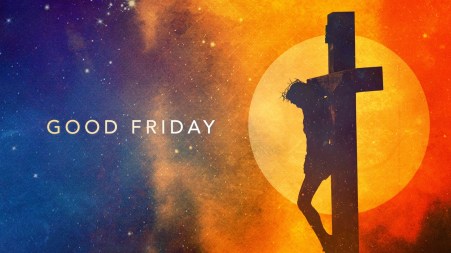
GoodFriday

It is difficult and challenging to contemplate our Lord saying those words from the cross. We might be a little more comfortable with John’s story (It is finished) or even Luke’s version (Into thy hands I commit my spirit). But according to Matthew and Mark, Jesus’ final earthly words were “My God, my God, why have you forsaken me.”

When I need to offer a grieving family a hopeful word, I often turn to Psalm 23, that beloved collection of verses that some of us have memorized. The Lord is my shepherd, I shall not want, he maketh me to lie down in green pastures, he leadeth me beside still waters, he restoreth my soul. They are comforting words. But rarely, if ever, have I pulled out Psalm 22.

It’s difficult just to get past the first verse. My God, my God, why have you forsaken me? We are pulled to the cross, to the torment and to the agony of Jesus yelling out into the void moments before his death.

Jesus suffers. It is both disconnected and disconnecting. In suffering on the cross he was made completely alone. Entirely and utterly alone. In this moment we are welcomed into the divine in a way not parsed out in other places of the bible. Here on the cross, in the cry of dereliction we experience the duality of Jesus’ divinity and humanity, we experience the abyss of fear and the hope of things unseen, we confront the elect and the reject.

And yet here, on the cross, with his final moments, Jesus turned to prayer. Not a final sermon on the marks of a faithful life, not a moment of divine healing. Jesus prays.

Prayer corresponds with experience. It is the way we process the moment we are in with something larger and more enduring. Prayer is what enables us to scale the impossible mountains of torment that threaten to close us off from all we have known, and prayer is what enables us to see the truth of our lives in terms of what has gone before and what is yet to come.

Of all the things we do as disciples, worshipping the crucified Jesus is possibly the strangest. It is only something we can do through the power of prayer. It is also why tonight’s worship is usually the least attended of all the worship services in a year. Tonight we glorify the Son of God who was degraded by his fellow human being as much as it is possible to be, by decree of both church and state. We worship the one who died in a way designed to subject him to utter shame and to be erased from human memory.

It is a story realer than real. It cannot be spiritualized away, nor can it be fully comprehended by we finite people. The climax of the gospel takes place in the midst of political and economic life, it is shocking and violent, it threatens the prevailing authorities, and it results in people two millennia later worshipping God nailed to a cross.

Good-Friday-Image

There is a paradox in our worship tonight, a paradox as difficult as Jesus’ final words. The paradox is that the generosity of God means the crucifixion of the Son. In Him both the godly and the ungodly are justified.

According to the strange and mysterious wisdom of God, it is in the crucified death of Jesus that all of the cosmos is altered (and altar-ed). This death makes our lives possible. This death is what makes the Christian experience intelligible. This death is at the heart of who God is.

If you’re anything like me, you’re eager to jump to Easter. Enough with the crucifixion! Give me resurrection! But you can’t have one without the other.

We cannot ignore the challenging words of Jesus from the cross. We cannot imagine away, or explain away, the overwhelmingly jarring nature of the Son of God crying out to the Father in fear.

But of course, that’s not where the Psalm ends.

Psalm 22 contains what it possibly the greatest “yet” in scripture… “O my God, I cry by day, but you do not answer; and by night, but find no rest. Yet you are holy, enthroned on the praises of Israel. In you our ancestors trusted; they trusted, and you delivered them.”

On that “Yet” hangs both the Old and New Testament. In that “Yet” we confront the true paradox of the crucifixion: that Jesus is both elected and rejected, that he knows sorrow and hope, that he dies and will rise again.

Jesus knew the power of “yet.”

But we must wait for Easter. We have to take the terrible time to sit in the shadow of the cross, to see in this first century man all the fullness of God, to recognize our sin in him nailed to the tree.

Good Friday, unlike just about anything else we do as a church, cannot be tied up neatly in a bow. We can’t fast-forward to Sunday morning. We, like the disciples in the distance, have to look at our Lord on the cross and wait. We have to wait for God to do a new thing. We have to recognize that this is what God did for us, and not the other way around.

We will leave this place tonight under the cover of darkness. And yet… Jesus is the light of the world.

The words of our prayers and hymns will fall silent. And yet… God cannot be silenced.

The shadow will feel darker than ever. And yet…

Devotional – Psalm 118.1

Devotional:

Psalm 118.1

O give thanks to the Lord, for he is good; his steadfast love endures forever!
Weekly Devotional Image

Holy Week is easily the busiest week in the life of most churches. While the palm branches are still resting on the floor of the sanctuary, pastors and lay leaders are frantically putting together the last minutes items for Holy Week services. Meanwhile, families are frantically planning Easter Sunday meals, and making sure they have enough eggs and goodies for all the children. And because we are so busy this week, we often forget to think about, and reflect on, Jesus’ final week:

It was early in the morning when Jesus sent two of his disciples to a village atop the Mount of Olives to find a donkey. The day had come for Jesus to enter the holy city of Jerusalem during Passover, a time when the city’s population would balloon up to 200,000 people entering to celebrate. On a Sunday morning, while the crowds gathered with palm branches, Jesus entered Jerusalem. Five days later he would be killed on a cross.

holy-week

The two disciples procured a donkey and Jesus prepared to make his triumphal entry. Riding on a donkey was a richly symbolic act, one that can be traced back to the time of David. To arrive in the holy city on a donkey calls back to the prophet Zechariah who declared, “Rejoice greatly, O daughter Zion! Shout aloud, O daughter Jerusalem! Lo, your king comes to you; triumphant and victorious is he, humble and riding on a donkey.”

As he rode toward Jerusalem, droves of people arrived on the streets and they began to waves palm branches while he passed. They were so enraptured by Jesus that they took off their cloaks and placed them on the road with their palms in order to create a royal pathway for their king. They shouted things like “Blessed is he who comes in the name of the Lord!” and “Hosanna!” which means “Save us!”

At the same time, on the other side of the city, Pontius Pilate (the Roman Governor of Judea) entered Jerusalem with at least 1,000 soldiers to demonstrate the power of Rome during the Jewish celebration of the Passover. It was a show of force to prevent the people from revolting against their imperial rulers while they remembered that time when God had delivered them from captivity in Egypt.

But with Jesus, there was no show of force. Instead of armor and swords, the people took off their cloaks and waved palm branches. Instead of cowering away in fear they rejoiced in the humble man on the back of a donkey.

While the distance between the Lord and the city grew closer and closer, while the crowds were dancing and shouting, he began to cry. He looked out over the holy city and he wept for Jerusalem. He wept knowing that he was entering as the prince of peace, and within the next few days the very people who were begging for his salvation with their palm branches would reject him and call for his crucifixion.

And there was evening and there was morning, the first day.

On Monday, Jesus made his way to them Temple with countless other Jews. With the episode that had transpired the day before, all eyes were on the humble man with expectation of deliverance. As his feet walked over hallowed ground, Jesus encountered the moneylenders and changers who were taking advantage of all the Jews in Jerusalem. The prices for clean animals necessary for sacrificial rituals were vastly inflated to the benefit of the merchants and the religious elite.

Jesus, who had spent the better part of three years berating the elite for taking advantage of the poor and outcasts, Jesus, who had told the rich young ruler to sell everything he had and give it to the poor, became incensed when he saw the poor being ripped off in the name of God. He walked straight over to the tables and he lifted them off the ground and disrupted everything in the temple. He threw the merchants out of the Temple and declared that his Father’s house had been turned into a den of robbers.

The elite and powerful, who had heard about this mysterious man claiming to be the Son of Man, now had their attention on Jesus. It was one thing to have a crowd with palm branches welcoming him into the city, but to disrupt the economic scheme they had established was going too far. From this point forward, the tides began to turn against Jesus. The leaders started looking for a way to discredit him, or to remove him completely. For as long as Jesus stayed in Jerusalem, their power would be in question, and they would no longer make the money they had planned on.

And there was evening and there was morning, the second day.

On Tuesday, Jesus once again entered the Temple and he began to teach. If people were excited to see him after his entry in Jerusalem, they were now even more eager to listen to the one who had throne the merchants out of the sacred space. The Pharisees and religious leaders began to interrupt his teaching and demanded to know whom he thought he was to speak with such authority. Jesus, the one who shared parables with his disciples and followers, used parables to respond to their accusations. Over and over again he used examples to show how the powerful and lost sight of their responsibility to take care of God’s creation and he labeled them “hypocrites.”

He accused them of neglecting to practice what they preached, he called them “snakes” and a “brood of vipers” and he told them they had failed to do the one thing required of them which was to love the Lord their God with all their heart, soul, mind, and strength and to love their neighbors as themselves.

Jesus had a following, he had entered with a display of peace, but he had removed the leaders’ economic disparity, and now he had called them hypocrites. They tried to trap him in his words, but he continued to point to the love of God in all times and in all places.

And there was evening and there was morning, the third day.

On Wednesday Jesus left the arena of the Temple and continued his teaching on the Mount of Olives. Some of the disciples made comments about the beauty and the magnificence of the Temple and Jesus responded by foretelling the destruction of the temple and his own body. He revealed images of God’s cosmic plan for the world made manifest in Jerusalem and called for his disciples to stay vigilant no matter what.

He used parables to describe the call of his disciples and ended by saying that his followers would be blessed in the end if they had fed the hungry, gave water to the thirsty, welcomed the stranger, clothed the naked, cared for the sick, and visited the prisoner.

Word about Jesus continued to spread fast throughout Jerusalem and the leaders learned that he was now prophesying the end of their rule and the destruction of the temple. Gone was the joy the people felt on Palm Sunday. Fear was present with the leaders and the elite.

And there was evening and there was morning, the fourth day.

On Thursday Jesus continued to teach and gathered with his twelve disciples in the upper room for the Passover celebration. Around the table they remembered God’s great work in the delivery of the Hebrew people out of slavery in Egypt to the Holy Land; they remembered God’s actions in the lives of God’s people including themselves. But before the supper was over, Jesus did something radical. He took a loaf of bread, gave thanks to God, broke it, gave it to his friends and said, “This is my body, and I’m giving it for you.” Later, he took the cup, gave thanks to God, passed it to his friends and said, “This is my blood, and I’m pouring it out for you and for the world.” Even though he knew that in short time his disciple Judas would betray him he still shared this incredible meal and gift with his friend.

Later that evening, they arrived in the Garden of Gethsemane, and Jesus urged his disciples to keep awake while he prayed. He knelt on the ground and he communed with his Father and prayed about what was about to happen. But he ended the prayer by saying, “Lord, with you all things are possible; remove this cup from me; yet, not what I want, but what you want.” In essence he prayed, “Let thy will be done.”

When Jesus finished praying, Judas arrived with soldiers. They grabbed and arrested Jesus. The disciples fled into the distance. Jesus was dragged back into the city to be tried for blasphemy.

And there was evening and there was morning, the fifth day.

On Friday Jesus was brought to the Roman leader Pontius Pilate. The leaders demanded that he be crucified and executed, but Pilate could find no fault with Jesus. He then brought Jesus before the Jewish people and they chanted with loud and bellowing voices, “Crucify him!” The same people who had gathered on the road with palm branches yelling “Save us!” were now demanding Jesus’ death. In order to appease the crowds and the Jewish leaders, Pilate sentenced Jesus to death by crucifixion.

The soldiers whipped and beat Jesus nearly to the point of death and then, to mock him, they placed an opulent robe on his soldiers, and they made a crown of thorns for his head. They forced Jesus to carry his torture device, a cross, on his shoulders all the way to the place called The Skull. The crowds berated him on either side while he marched forward to his death. “If you really are the Messiah, save yourself!” “Where are all your disciples now?!” “Some King of the Jews you are!”

He arrived at the top of the hill and the soldiers nailed his hands and feet to the cross and hung him in the sky. For six hours Jesus’ life slowly slipped away while the crowds continued to mock him from the ground. With some of his final breaths he offered a prayer that has haunted the world ever since, “Father, forgive them, for they do not know what they are doing.” With two thieves on either side hanging on crosses, while some of his disciples watched from the distance, he died.

And there was evening and there was morning, the final week.

Jesus rode into Jerusalem on the back of a donkey proclaiming and inaugurating a time of humility and peace. Jesus rebuked the elite for preying on the poor and weak. Jesus confronted the hypocrites in leadership. Jesus called his followers to love God and neighbor. Jesus shared his final meal with the one who would betray him. Jesus was crowned with thorns and enthroned on a cross in the sky. Jesus forgave his murders from the moment of his death. And Jesus died so that we might participate in his kingdom and salvation.
Jesus is Back, Jack!

strangely-warmed-spreaker-header

This week on the Strangely Warmed podcast I speak with Teer Hardy and Jason Micheli about the readings for the Resurrection of the Lord [Year B] (Isaiah 25.1-9, Psalm 118.1-2, 14-24, 1 Corinthians 15.1-11, Mark 16.1-8). Teer serves as the associate pastor at Mt. Olivet UMC and Jason is the executive pastor of Aldersgate UMC (both in Northern Virginia). Our conversation covers a range of topics including bad impressions, shout outs to Scott Jones, bible translations, Easter as NOT the celebration of spring, God’s time, the challenges of recording live, Paul’s little Easter, female preachers, and God as an iceberg. If you would like to listen to the episode or subscribe to the podcast you can do so here: Jesus is Back, Jack

jESUS AND EASTER BUNNY


Devotional – Psalm 118.24

Devotional:

Psalm 118.24

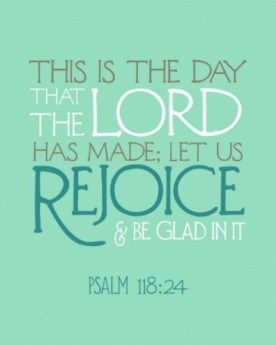
This is the day that the Lord has made; let us rejoice and be glad in it.

Weekly Devotional Image

Depending on where you grow up in church, there are some hymns that are so familiar you just know them deep down in your bones. All you need to hear is the first note, or the first word, and before you know it the rest of the hymn comes floating out. And, more often than not, you get the hymn stuck in your head all day long after worship.

However, for as many hymns as we know deep in our bones, there are an equal number of hymns that are so unfamiliar, that if we were to hear the entire song, we’d wonder if it was in our hymn book at all.

Throughout my life I went to church on Sunday; I prayed when I was supposed to, I listened when I was supposed to, and I stood up to sing when I was supposed to. There are hymns in our hymnal that immediately draw me to a particular time and place when I can remember it being used in worship. But prior to becoming a pastor, I had never heard the hymn “This Is The Day.”

I’m not sure how’s it possible, but I can remember being at one of my first clergy events having just been assigned to my first church, and everyone started singing it together and I had no idea what was going on. Embarrassed, I started opening and closing my mouth as if I knew the song, and spent most of the rest of the session looking for it in the hymnal and pondering how I could’ve missed it.

this-is-the-day-360x450

Fast forward to Sunday, when our choir both began and ended worship with “This Is The Day.” After half a decade of ministry I’ve used “This Is The Day” to start more worship services than I can count, but yesterday was the first time I ever heard the hymn at the end of a service.

And it was perfect.

This is the day that the Lord has made! Let us rejoice and be glad in it! What a wonderful way to be sent out into the world to be God’s people. The words are not meant for our orientation to worship alone. They can be a tremendous blessing and reminder that God has made each day, that we can rejoice and be glad in it.

Can you imagine how differently we would live if we started and ended every day with these words? Can you picture how wonderful it would be to contemplate the blessing of life every morning, and express gratitude for the joyful day every evening?

As we take steps closer to the end of Lent, as we prepare to enter into the darkness made manifest in the shadow of the cross, as we wait for the promised joy of the first Easter morning, let us give thanks to the Lord our God for each and every day, knowing we can rejoice and be glad.

An Exodus For The Rest Of Us

strangely-warmed-spreaker-header

This week on the Strangely Warmed podcast I speak with Teer Hardy and Jason Micheli about the readings for the The Liturgy of the Passion [Year B] (Isaiah 50.4-9a, Psalm 31.9-16, Philippians 2.5-11, Mark 14.1-15.47). Teer serves as the associate pastor at Mt. Olivet UMC and Jason is the executive pastor of Aldersgate UMC (both in Northern Virginia). Our conversation covers a range of topics including talking about ourselves as little as possible, the freedom to fail, memorizing scriptures and prayers, an accursed way to die, shame, the gospels as television channels, the nude dude, and disappearing from the story. If you would like to listen to the episode or subscribe to the podcast you can do so here: An Exodus For The Rest Of Us

J

God’s Engagement Party

strangely-warmed-spreaker-header

This week on the Strangely Warmed podcast I speak with Rev. Ben Maddison about the readings for the Fifth Sunday of Lent [Year B] (Jeremiah 31.31-34, Psalm 51.1-12, Hebrews 5.5-10, John 12.20-33). Ben is an episcopal priest who serves as the rector of Holy Trinity Episcopal church in Wenonah, NJ. Our conversation covers a range of topics including Where The Red Fern Grows, new covenants, the Law on our hearts, gifts for high school graduates, the sinfulness of email, mirrors at the altar, Jesus as priest, and the problem with loving your life. If you would like to listen to the episode or subscribe to the podcast you can do so here: God’s Engagement Party

BM2

Look At It And Live

strangely-warmed-spreaker-header

This week on the Strangely Warmed podcast I speak with Rev. Ben Maddison about the readings for the Fourth Sunday of Lent [Year B] (Numbers 21.4-9, Psalm 107.1-3, 17-22, Ephesians 2.1-10, John 3.14-21). Ben is an episcopal priest who serves as the rector of Holy Trinity Episcopal church in Wenonah, NJ. Our conversation covers a range of topics including serving a church in a post-Christian context, clergy collars, fiery serpents, the temptation of allegory, healing and scars, God’s agency, backsliding, and Fleming Rutledge’s The Crucifixion. If you would like to listen to the episode or subscribe to the podcast you can do so here: Look At It And Live

BM