Christmas In The Room – Christmas Eve Sermon on John 1.1-5

John 1.1-5

In the beginning was the Word, and the Word was with God, and the Word was God. He was in the beginning with God. All things came into being through him, and without him not one thing came into being. What has come into being in him was life, and the life was the light of all people. The light shines in the darkness, and the darkness did not overcome it.

_the_holy_family__nativity_scene___another_commiss_f6de659b784c8c14ecc1ee8b95fa4fa8

Merry Christmas! To me, there are few things as wonderful as gathering together to celebrate the birth of Christ. This is what church is all about; a community coming together to rejoice in our Savior.

Have you noticed all the lights around the neighborhoods? The different decorations throughout Staunton? Have you seen all the wonderful manger scenes displayed in front yards and on coffee tables?

One of the things I love most about Christmas is that every year we try new things to make Christmas real again. Many of us are very familiar with the story; we can imagine the angel Gabriel appearing before Mary, we can picture the manger scene with all the animals gathering close to baby Jesus, we can almost hear the angelic host proclaiming the Good News to the shepherds. This story has so captivated our hearts, minds, and imaginations that every year we gather to remember it in new and exciting ways.

This year our Preschool chose to remember the story by putting on a Christmas pageant. Now this wasn’t your simple and typical pageant; almost every one of our students had a line to perform in the microphone in front of a packed sanctuary. We practiced for weeks in the chancel area, rehearsing our lines, standing in our spots, and getting the story exactly right. On the morning of the big show, the kids and I were all here going through every bit one last time. However, this was the first time that they were all in costume.

10413358_742665702476413_2082989571026907176_n

Some of our precious three years olds were sheep, though they looked more like pillows as they walked to the microphone and quietly whispered: “I shared my wool with baby Jesus.” We had a manger mouse with big ears and a tail who said with a smile: “I peeked at baby Jesus!” We even had an angel choir of two-year olds who started from the back and walked all the way down carrying electric candles to guide the wisemen.

When it came time for Mary and Joseph to appear I was so pleased with how well everything was going. This was going to be a great performance for all of the friends and family. Our little Mary came up to the microphone to sweetly say, “A baby will soon be born.” And then Joseph, one of our most precocious four year olds, said with loud emphasis: “I MUST FIND A PLACE FOR US TO STAY!

Everything was perfect. The kids were sitting quietly in place, they had all nailed their lines, and I could just imagine all of the tears that would be spilt watching these precious lambs of Jesus Christ. I even found myself getting emotional. I remember thinking: “this is what Christmas is all about.” Look at these children retelling the story centuries later. They embody the sweetness that just have been felt in the manger. Their child-like innocence is why God came into the world for us. Those little kids made Christmas real for me.

That was, until I noticed our little Mary fidgeting around by the crib. We continued with the pageant but Mary was far more focused on the little baby-doll Jesus than anything else. “Well,” I thought, “she’s just being attentive like any good mother would be” when all of the sudden she picked up Jesus by his ankle, dangled him back and forth and then dropped him on his plastic head!

The realness of Christmas was quickly replaced with the reality of Preschoolers being dressed up like animals and adults acting out the story.

Every Christmas we strive to reimagine the story so that we can reconnect with it’s incredible message.

There is a church somewhere in the midwest that REALLY believes in retelling the story. On Christmas Eve they invite people from the community into their sanctuary, but they don’t just listen to a pastor in the pulpit, they don’t just pray in their pews, they bring in all sorts of animals and actors to make it come alive.

Animal trainers help guide the donkeys and sheep into the space and lead them up to the altar near a newborn baby being cradled by his mother. The church has a full orchestra and light show to go along with the actors and animals; they have no limitations when it comes to fully immersing the people in the story.

However, a few years ago the church became responsible for a viral video that made its way across the internet. At the height of the production, as the human-angels were hung by wires to sing Hallelujah, as the majestic magi were making their way up to the altar, as people were completely captivated by the story, a camel was being led down the center aisle.

It was at that precise moment, at the paramount of the Christmas production, the camel decided that he no longer wanted to be part of the story. The video shows the trainer in the middle of the church struggling to guide the camel forward, the camel ignoring his suggestive movements, and deciding that he should take a break on top of all of the people sitting on the right hand side. Like a tree falling in the woods, the camel fell to his side and quickly buried a few people under his girth.

The realness of Christmas was quickly replaced with the reality of what happens when you bring the zoo into a church.

Every Christmas we strive to reimagine the story so that we can reconnect with it’s incredible message.

Years ago I went to church on Christmas Eve and experienced a service unlike any other. Instead of a typical sermon, the pastor decided to make it into a drama with particular characters acting out the story.

Mary and Joseph stood on opposite sides of the altar, wearing robes from the days of old. The gazed off into the distance pondering the incredible messages the the angel Gabriel had shared with each of them.

While the pastor described the man named Joseph, he began to remove his robes, shedding the costume from the past, and revealed a middle age man wearing a business suit. The pastor was attempting to make the story real again by showing what it would look like if it happened today. Joseph was a respected man and much older than Mary. Can you imagine how he would have reacted when he found out that she was pregnant? Can you picture how embarrassed he must have been by her?

While the pastor described the woman named Mary, she began to remove her robes, shedding the costume from the past, and revealed a teenage girl wearing a cheerleading uniform. Mary was a young woman with future full of potential. She was much younger than Joseph, and was told by the angel that she would conceive a son by the power of the Holy Spirit while still a virgin. Do you think she believed this was Good News? Can you imagine how her family would have regarded her for becoming pregnant before getting married?

There stood Mary and Joseph, not the couple from the manger scenes kneeling quietly over the new born king, but a business man and a cheerleader who would be ridiculed by the community.

The realness of Christmas was quickly replaced by the reality of social relations that develop when an unwed teenage girl becomes pregnant.

Every Christmas we strive to reimagine the story so that we can reconnect with it’s incredible message.

I always look forward to this season because it affords me the opportunity to ask others what they love about Christmas. I often hear about the joy of opening gifts, the wonder of putting up all the decorations, and even the changed behavior of children in response to the elf on the shelf. Yet all of those things don’t make Christmas real. Yes they make it feel like Christmas, but they do not fully convey the depth of what it means for God to have come into the world as a baby in Bethlehem.

For me, Christmas is at it’s realest when we light our candles as we sing Silent Night. Some of my earliest memories are standing in a dark sanctuary on Christmas Eve while people around me are singing. In mere minutes the darkness is replaced by a brilliant light, made remarkable by the God who took on our flesh to dwell among us, to be God with us.

candlelt

Jesus is the light of the world who shines in the darkness. Whatever that darkness might look like for you, whether it be an uncertain future, fears about your children, frustrating family members, the loss of a loved one, a heavy diagnosis, or the lack of love in your life, Jesus stands in stark contrast as the one who brings the light into our lives.

Christmas Eves always mean the most and convey the most when we feel the depth of the  darkness. Because new life always starts in the dark. Whether it is a seed in the ground, a baby in the womb, or Jesus in the tomb, new life starts in the dark. 

At the end of our service we will turn out all the lights, from the one candle, the Christ candle, we will light all others as we sing Silent Night. As we do so let us open our eyes the different forms of darkness in our lives and give thanks to the light of the world who shines in the darkness.

It will feel like Christmas in the room, when we hear the familiar words that have been sung for centuries exclaiming the great joy of the newborn king.

It will feel like Christmas in the room, when we gather as God’s table to feast on the bread of life and drink from the cup of salvation.

It will feel like Christmas in the room, when we see the light of Christ shining in one another.

Merry Christmas. Amen.

Devotional – Isaiah 9.2

Devotional:

Isaiah 9.2

The people who walked in darkness have seen a great light; those who lived in a land of deep darkness – on them has light shined. 

Weekly Devotional Image

This Wednesday (at 3pm and 7pm) our church will welcome a number of people for whom church attendance is limited to Christmas Eve and Easter. In the church community these people are often referred to as “Chreasters” or the “C and E crowd.” I can remember as a child how wonderful it felt to be at church on Christmas Eve and see all sorts of people from the community worshipping together who never attend for any other occasion. Christmas Eve is one of the profound worship experiences that brings all sorts of people together to praise God for coming into the world as a baby in a manger.

flat,550x550,075,f.u2

One of my friends, and former pastor, Jason Micheli has this to say about the “Chreasters” who only attend church on a limited basis: “The dirty little secret is that often the way preachers and church people talk about ‘Chreasters’ makes them sound like the bad guys, like we want to make them feel guilty for not being regular church-going people. Which doesn’t make any sense to me because I gotta think ‘Chreasters’ are exactly the sort of people Jesus would prefer to hang out with… So rather than looking down on them with guilt-inducing contempt. We should, like the Lord we adore, simply welcome them in the thrill to be with them.” (you can read more of Jason’s thoughts about ‘Chreasters’ here: Tamed Cynic)

For this one night, we have the privilege to sit beside weary travelers on the roads of life who, for whatever reason, have decided to worship the Lord. It is nothing short of a blessing to find churches filled with people on Christmas Eve because it is a time for us to proclaim that wonderful and great truth: God is with us. Many will come because they feel suffocated by the darkness of life’s burdens, and we will be there with them as they experience the light of the world.

This Christmas Eve, wherever you worship, I encourage you to open your eyes to ALL who gather to celebrate the new born king. Do not look down on the “Chreasters” with contempt for their limited worship, but instead give thanks to God for putting them in your life. Above all, be fully present with those around you and rejoice knowing that the light of the world shines in the darkness.

Merry Christmas.

Faith Hall of Fame – Hebrews 11.32-40

Hebrews 11.32-40

And what more should I say? For time would fail me to tell of Gideon, Barak, Samson, Jephthah, of David and Samuel and the prophets — who through faith conquered kingdoms, administered justice, obtained promises, shut the mouths of lions, quenched raging fire, escaped the edge of the sword, won strength out of weakness, became mighty in war, put foreign armies to flight. Women received their dead by resurrection. Others were tortured, refusing to accept release, in order to obtain a better resurrection. Others suffered mocking and flogging, and even chains and imprisonment. They were stoned to death, they were sawn in two, they were killed by the sword; they went about in skins of sheep and goats, destitute, persecuted, tormented — of whom the world was not worthy. They wandered in deserts and mountains, and in caves and holes in the ground. Yet all these, though they were commended for their faith, did not receive what was promised, since God had provided something better so they would not, apart from us, be made perfect.

1357372800

Today we conclude our Advent Sermon Series on “New Beginnings.” This is the final Sunday leading up to Christmas day, and over the last few weeks we have prepared our hearts and minds for the coming of God in Christ. We began with Abram being called into a strange land. Next we looked at Samuel being called by name in the temple. Last week we explored Paul’s conversion on the road to Damascus. This morning we conclude by looking at the Faith Hall of Fame from Hebrews 11.

_

And what more should I say? For time would fail me to tell of Fletcher Swink, Sam Stanley, Zig Volskis, Patricia Meadows, and the other pastors — who through faith endured frustrating congregations, proclaimed God’s presence, fought for justice, became mighty in honor, and brought people to the Lord.

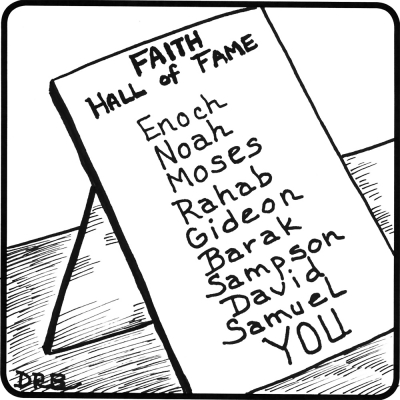
Hebrews 11 contains what I call the “Faith Hall of Fame.” The entire chapter is devoted to the great leaders and prophets from the Old Testament and their willingness to stand up for God even when it meant certain doom. They so fervently believed that God was with them, that they were willing to embark on new beginnings when others refused to obey.

The closest thing we have to a Faith Hall of Fame here at St. John’s can be found in our parlor next to the narthex. Inside you will discover a picture of every pastor that has had the good fortune to serve this church since 1954. From Fletcher Swink to yours truly, every pastor has been framed and dated, hung with care, and honored with a spot on the wall.

Have you ever taken the time to look through the pictures? It was one of the first things I did when I was newly appointed, and frankly the room terrifies me. Whenever I sit in the parlor with a group of people, I feel the heavy gaze of the pastors, they look down from their Faith Hall of Fame, and I can’t help but wonder what they think of me.

Marshall Kirby begged me my first week to give him a picture so that he could put me up with everyone else. I hesitated. For weeks he bugged me about getting the picture, about having it be just the right size and tint to blend in with the others. But I continued to put it off. I kept making excuses about how busy I was, or about the priorities I needed to focus on, but the truth is, I didn’t feel worthy of going on the wall. I had been here for such a short amount of time and felt that I hadn’t done anything that earned me a spot in the Hall of Fame.

When I’m in the parlor, when I experience the St. John’s Hall of Fame, I think about all the things they must have gone through to bring this church to where it is. I think about Fletcher Swink starting the church down the road at the Auto Parts store. I imagine that it required a tremendous amount of faith to believe that God had call him from Durham, NC to Staunton, VA to start a new church; to make something of nothing. How many nights did he pray for God to send him people, how many afternoons did he spend worrying about the new building project, how often did he confront frustrated parishioners about his sermons?

When I’m in the parlor, when I experience the St. John’s Hall of Fame, I think about Patricia Meadows being appointed as the first female pastor. I wonder about how hard she had to work to gain the trust of the people, what lengths she had to go to to reignite the flame of faith. I imagine the deep prayers she offered to God about sending new sheep to her flock, the lonely days of sermon preparation, and the terrifying moments of standing by the graveside with friends and family from the church. How often did she wrestle with her call when she felt persecuted, how many days did she spend praying for the people of our community when they were no longer able to offer their own prayers, how did she feel standing up against the injustices around her?

I wonder about all the pastors of this church, and what they went through for God’s kingdom. What was it that set them apart? What did they do that helped to grow and nurture faith in this community?

Last week I was standing in the parlor, admiring the past, when I realized how similar our Faith Hall of Fame is to the one listed in Hebrews 11.

faith

The people of Israel’s past were not of special value. Gideon was hesitant and timid when he was called by God; Barak had to be shamed by Deborah into fighting for the Lord; Jephthah is remembered mostly for his rash oath; Samson was weak of mind and conscience.

Similarly, there is nothing particularly special about those who have served our church. Though undoubtedly unique, they contained no special powers that set them apart from other clergy. Each of them had strengths and weaknesses that became manifest while they served the church.

Our pastors, and the heroes from Israel’s past, were set apart because they did all things “through faith.” They worked knowing that the real significance of what they had done would never be seen in their own time, but something that would come much later. They suffered through persecution and injustice because they believed in God’s goodness even when the world claimed the contrary.

We remember the ways our pastors have suffered: Angry emails/letters about inappropriate sermons, knowing glances and whispers from the committee members in the parking lot (where the real meetings happen). Shouts and finger pointing during counseling sessions. Years of loneliness serving a church full of people who cannot see the pastor as anything other than pastor. Doubts when preparing funerals for people in the community.

We read about all the ways the faithful of Israel suffered: torture, mocking, flogging, chains and imprisonment. Stoned to death, sawn in two, killed by the sword, wandered about in the skins of sheep and goats, destitute, persecuted, and tormented.

This is what evil does to the good. It attacks at the core of our being, shakes our faith, and  encourages us to doubt. Yet, reading these words and remembering our church’s past should bring us courage and hope. We see in them the willingness of people to go and risk it all for God. Pastors who remained brave and faithful when others tried to break them down. Prophets who spoke the truth when others sought to kill them. We see in them the true courage that faith can develop. 

It only takes a moment to see this tremendous faith in the world today, people standing up against injustice when the world argues the contrary. Consider the droves of people standing with their hands up and holding signs that say “Black Lives Matter” in response to Ferguson. Consider the droves of people standing shoulder to shoulder with the LGBTQ community during Pride marches in response to fanatical attacks against sexuality.

pic_related_120114_SM_Black-Lives-Matter-G_1

We remember and read and see the ways people suffer for God’s kingdom and we commend them for their willingness to go and be grace for the world. God sends into our confused and cruel humanity his messengers and prophets. God sends them into the midst of the wolves so that we might not be left to our evil ways, that we may see in them hope for tomorrow, and in response turn back to the God of mercy.

Yet all these, though they are commended for their faith, did not receive what was promised, since God had provided something better so they would not, apart from us, be made perfect. Whether Gideon, Barak, Fletcher Swink, or Zig Volskis, their completion depends on us. Their faith rested in God who would fulfill his promises. They served the Lord as an anchor cast into the days ahead; faith is built on hope for the future.

Abraham’s faith would have been in vain if his descendants never made it to the Land of Promise. Samuel’s faith would have been in vain if he had not responded to God calling him by name in the temple. Paul’s faith would have been in vain if the resurrected Christ had not appeared to him on the road to Damascus.

Apart from us they cannot be made perfect. The completion of those from the Faith Hall of Fame depends on us. We can fulfill their faith even today by going out and being Christ’s body for the world.

We remember the past of scripture, and the past of our church, but we are not to idealize it. We cannot be blind to the mistakes of those who came before us, or allow the past to fasten its dead hand upon us, binding us down to fruitless ideas, ancient prejudices, and old failures. We look back so that we can look forward. Just because “thats the way we’ve always done it” does not mean “thats the way we must do it now.”

Yet too often we forget how indebted we are to the past. We neglect to remember how faithful Abram, Samuel, and Paul were. We brush aside all the pastors who worked with every fiber of their being to bring about God’s kingdom here on earth. Every good thing that we have and enjoy was consecrated by the sacrifices of the past. We have faith because the people of the past passed it along to us. So today, we in our turn cast our anchors into the future. Without those who are to come after us, without the youth of our church and without the children of our preschool, we shall not be made perfect.

We are who we are because of the past. We will become what God intends for us because of the legacy we pass on to the future. Our new beginning comes when we cast our hope into the future of God’s kingdom, when we stand up for something new and different that breaks from the past, when we take steps in faith knowing that God is with us.

God is with us. In a few days we will gather again to celebrate Christ being born into the world to be God with us. We will look to that lowly manger and remember that God came to dwell among us and encourage us to be brave people of faith who remember the past and cast our hope into the future. Our purpose does not depend on our own power, but on the strength of love that comes from the Lord and in community with one another.

I still feel uncomfortable whenever I’m in the parlor. Sets of eyes follow me from the past, and I see in them everything they went through to bring our church to where it is. I believe in their hope cast into the future. In all of you I see the seeds that they planted long ago that are blossoming into true discipleship today.

I see my picture on the wall and feel unworthy. But that’s when I remember that it’s not about me and it’s not about what I do. It’s about what God does through me. It’s about what God does through you. Amen.

Devotional – Luke 1.37

Devotional:

Luke 1.37

For nothing will be impossible for God.

Weekly Devotional Image

Our parsonage is beautiful. One of the many blessings of serving as a pastor for a United Methodist church is the fact that the local church often provides a parsonage for their pastor and family. I’ll freely admit that I was slightly nervous before arriving in Staunton for the first time because I would have no say about where I was living. Whereas other families can pick and choose a residence based upon their proclivities, I would be stuck with whatever St. John’s provided. However, when I began moving my belongings in, I realized how very fortunate I was.

Providing a parsonage is an incredible act of grace and generosity, one that I try to not take for granted. Whenever I pull into the driveway after a particularly stressful day at the church, I give God thanks for the people of our church community and their willingness to provide such a wonderful gift for my family. I am proud of the parsonage and I look forward to the changing seasons as an opportunity to adorn the house with different holiday elements.

Yesterday afternoon, my wife and I invited everyone from the church community for an open house at the parsonage. Part of our decision was born out of the fact that the parsonage belongs to the church, and we wanted to express our thankfulness for their generosity. (The other part of our decision was born out of the fact that Lindsey talked me into purchasing two Christmas trees this year, and she wanted to show off all of our ornaments.) We worked hard last week to clean and organize everything, prepare an abundance of food, and open our house to those near and dear to us.

Youth playing "Just Dance" during the Open House

Youth playing “Just Dance” during the Open House

At some point during the open house, I was struck by how remarkably blessed we are. In such a short amount of time Lindsey and I have been so welcomed into the local community, and to be surrounded by our church family was a humbling experience. I looked around and saw the people I have prayed with, and for, on a regular basis, I saw the children I have baptized, I saw the individuals I have counseled, and I saw God’s love manifest in the gathered people.

I have known for a long time that I felt called to be a pastor, but I never imagined that it would feel this incredible and graceful. I thought that being part of a loving community to this degree was impossible. But nothing is impossible for God.

The feelings that I experienced yesterday were only possible because of the incredible gift that God gave us in Jesus Christ. Without the impossible possibility of God coming in the form of flesh as a baby in a manger we would not have such a loving community. Without the impossible possibility of God’s unending love and grace, we would not see one another as precious gifts.

In these few remaining days of Advent, I encourage you to look around at the blessings in your life, give thanks to God for the gifts that you have been given, and remember that nothing is impossible for God.

The Advent of Paul – Sermon on Acts 9.1-9

Acts 9.1-9

Meanwhile Saul, still breathing threats and murder against the disciples of the Lord, went to the high priest and asked him for letters to the synagogues at Damascus, so that if he found any who belonged to the Way, men or women, he might bring them bound to Jerusalem. Now as he was going along and approaching Damascus, suddenly a light from heaven flashed around him. He fell to the ground and heard a voice saying to him, “Saul, Saul, why do you persecute me?” He asked, “Who are you, Lord?” The reply came, “I am Jesus, whom you are persecuting. But get up and enter the city, and you will be told what you are to do.” The men who were traveling with him stood speechless because they heard the voice but saw no one. Saul got up from the ground, and though his eyes were open, he could see nothing; so they led him by the hand and brought him to Damascus. For three days he was without sight, and neither ate nor drank.

paul-road-to-damascus

Today we continue with our Advent Sermon Series on “New Beginnings.” These few weeks of Advent are integral to the life of our church community in the sense that we are preparing our hearts, minds, and souls for the coming of God in Christ on Christmas day. We began with Abram being called to go to a strange land, and then we looked at Samuel being called by name in the temple. Today we continue by looking at the Advent of Paul.

Most pastors love to talk. They spend their Sundays standing before the gathered people proclaiming the Word of God with the hope of it becoming incarnate. It takes hours of preparation, study, and prayer to craft a sermon and many pastors find excitement and fulfillment when they are speaking. Whether they are preaching from a pulpit, leading a bible study, or huddling together in prayer, words are at the foundation of what we do.

Most pastors love to talk, and when you get a group of us together, sometimes the talking never stops…

I was at Licensing School, a required element to become a Pastor in the United Methodist Church, but frankly it could’ve happened at any clergy gathering. The routine is typical, everyone tries to size one another up based upon appearances, we try to guess what kind of churches are represented; Is this their first career, second, or third? What kind of call story do they have? Did she have all that gray hair before she became a pastor? We are usually forced to sit with people who we have yet to meet and then comes the ice breaker questions that will hopefully move us from strangers to friends.

The familiar questions focus on our ability to share our call narrative. I like to call it the elevator speech. In the time that it takes you to get from the lobby to the top floor, can you share how God has called you to ministry?

Here is my elevator speech:

“Born and raised as a United Methodist in Alexandria, VA, I began wrestling with a call to ministry when I was in high school. There were a number of formative experiences that led me to believe that God was calling me to ordained ministry including: being the crew chaplain for a Boy Scout High Adventure trip in Philmont, New Mexico, creating and leading a youth band for my home church, and helping to organize a weekly youth bible study. However, my awareness of the call truly came into focus when one of my dear friends died in a car accident right before Christmas. As we mourned her death I found myself comforting those around me with words that were not my own, and one night I was pulled to my knees on the sidewalk along Ft. Hunt Road to pray. I prayed and prayed and when I stood up, I knew there was nothing else in my life that I could do other than proclaim the Word of the Lord through ministry.

I have had to tell it so many times that I have learned how to include just the right amount of details in just the right amount of time.

For others, this process can take multiple elevator rides. They go on and on about the ways God has called them, and when I was at Licensing School I learned a lot about the people I would be serving with for the rest of my life.

You call that a call story? My husband left me right before the cancer came back. My children had grown up and moved off to different places with their own families and I was all alone. I went to support groups, and tried to keep a positive attitude but nothing was working. It was then that I accepted Jesus Christ as my personal Lord and Savior and put my whole trust in his grace. Later, when I beat the cancer, Jesus told me to become a pastor and share the Good News like he had done with me.”

You call that a call story? I was killing more brain cells than Paul was killing Christians when God called me to a new life in Jesus Christ. The bottle was my bible. Jose Cuervo and Jim Beam were my best friends and were with me through the important moments of life, though I could never remember any of them. It was deep in the trenches of one of my worst benders that Jesus told me it was time to live a new life, that he had a mission for me, and I haven’t had a drink since.”

These call stories went on and on with every new story going deeper and farther than the last. The more I sat and listened, the more I realized that I was doing the same thing, and that we were trying to “out-Paul” one another.

Now, don’t get me wrong — I love the story of Paul on the road, but sadly, we have too often used it to judge what Christianity is supposed to look like.

Flannery O’Connor, the American writer, once said “I reckon the Lord knew that the only way to make a Christian out of that one was to knock him off his horse!” Her statement gets at the heart of the matter for Paul’s conversion, but oddly enough there is no horse in the story.

But that helps to show how “well” we think we know the story. It has been told so many time in such a variety of ways. Most of the art depicting this scene has Paul falling off his horse, when this is a detail missing from the scripture. Regardless of equine presence, the story is one that captivates us even today.

The first detail we learn about Paul is that he was a young man who watched over the garments of those who stoned Stephen. But he was not just any young man, not just an innocent bystander. He not only approved of Stephen’s death, but also led a violent persecution of the budding Christian community.

Paul was enemy number one to the church, and God would turn his life around to become evangelist number one.

While he was threatening and murdering the disciples of God, Paul went to the high priest and asked for letters to the synagogues in Damascus, so that if he found any Christians on the way, he might bring them bound to Jerusalem. He was not just a concerned citizen, Paul was an active go-getter against the subversive community, willing to go above and beyond his duty.

It was on the way to Damascus that a light from heaven flashed around him. He fell to the ground and heard a voice saying, “Saul, Saul, why do you persecute me?” He asked, “Who are you, Lord?” The reply came, “I am Jesus, whom you are persecuting. But get up and enter the city, and you will be told what you are to do.” Paul’s companions that were traveling stood speechless because they heard the voice but saw no one. After being helped up from the ground Paul could see nothing, so his friends had to guide him the rest of the way to Damascus.

UnappLightGod

Some have subjected this story to psychological reflection about the inner-turmoil bubbling within Paul’s soul regarding his willingness to kill Christians. They see the Damascus road experience as an inward struggle that results in a changed life.

However, the details of the narrative argue the contrary. This is not an account of what was going on within Paul, but rather a story about a man who was encountered by something outside of himself. Conversion has to do with being approached by God, and being changed in the process of the encounter.

Paul was helpless and totally dependent on others after encountering Christ on the road. God, meanwhile, spoke with a disciple named Ananias in Damascus. He was commanded to go and meet the man from the road, Paul from Tarsus, lay hands on him so that he might recover his sight. Ananias hesitated knowing the kind of wrath and destruction that Paul had brought on his fellow Christians, but the Lord insisted “Go, for he is an instrument whom I have chosen to bring my name before Gentiles, and kings, and before the people of Israel; I myself will show him how much he must suffer for the sake of my name.

So Ananias went and laid his hands on Paul to restore his sight. Paul was then filled with the Holy Spirt, was baptized, and regained his strength. Through the power of God made manifest in Ananias, Paul went from being an enemy to being a brother; his life was completely turned around.

When pastors get together we can attempt to “out-Paul” one another. We strive to substantiate our call stories by comparing it with the one who was confronted on the road to Damascus. I have seriously heard people begin their stories with, “It was like I was on my own road to Damascus when God called me to a new life…” This story has become the prototype for many Christians, and we use it as a lens by which we judge others’ calls to different forms of discipleship.

This is a problem.

It is a problem because we forget that the radical kind of change worked in Paul is something that Christ does, not us. Sometimes we become so concerned with the desire to convert others that we foolishly put all of the responsibility on our shoulders when God is the true agent of change. We can show people the door of faith, but God is the one who gives them the strength to walk through it.

It is also a problem because it is not universal. The story of Paul on the road to Damascus is wonderful and miraculous, but it should not lead us to conclude that every conversion is basically the same.

Different people come to Jesus along different routes. When we consider the wealth of conversion stories from scripture, in addition to the tales of fellow Christians in our lives, it become self-evident that God calls individuals according to his will, not a singular story by which all others should be judged. Paul was called in a way that was proportionate to the life he was living – he needed to be knocked down in order to start a new life. But not all of us have lived like Paul. 

The one thing that is universal regarding the story of Paul on the road is that meeting God changes the way we see everything. When we encounter the divine we become dependent on those already versed in the faith, we need Ananiases to help guide and nurture us when our vision has been turned upside down.

God met Paul on the road to Damascus and changed his life forever. God brought me down to my knees on a cold December evening when I was sixteen years old and changed my life forever. God spoke through Gabriel to a virgin named Mary about her bringing a baby into the world which changed her life forever.

Paul’s story is a great. It is full of beautiful details and demonstrates God’s power to change lives. But his story is not the only one. The Old and New Testaments are filled with stories about people whose lives were changed by God in incredible ways. Our church is filled with people who have encountered the good God in ways that are beyond our imaginations.

Whenever we meet God, whether through a particularly poignant moment, the reading of scripture, or the deep thoughts of prayer we embark on a new beginning. Like Paul, everything gets changed and we see the world a little more clearly, we see God’s grace manifest through the friends and family around us and we realize the deepest truth about Christmas – that God does not leave us to our own devices. Amen.

Devotional – 1 Corinthians 15.57

Devotional:

1 Corinthians 15.57

But thanks be to God, who gives us the victory through our Lord Jesus Christ.

Weekly Devotional Image

Favorite Thanksgiving food? Mashed Potatoes (or as we call them in my family: Mashed-for-Taylors). Favorite Thanksgiving tradition? Getting together with a number of friends and family the day after thanksgiving for a giant kickball tournament (Kids vs. Adults, and I’m still young enough to be considered for the kid team!). Strange Thanksgiving memory? The year my grandmother kept praying for God to take care of the people in Siberia, when she really meant to say Syria, and none of us could figure out why she was so adamant with her prayers. Favorite Thanksgiving pastime? Standing outside with my Dad in the cold while he prepares to fry one of our turkeys.

I love Christmas and I love Easter, but Thanksgiving is equally wonderful in my opinion. There is just something so special about all the traditions coming into focus with incredible people on an annual basis. I look forward to this week with eager anticipation because I will get to see family for the first time in a long time, I will get to laugh with my sisters at the expense of our parents, and I will get to enjoy my mother’s incredible cooking.

Of all the Thanksgiving traditions, my favorite is the moment after the prayer, once we have finally sat down in our seats, when I have the privilege of inviting everyone to go around the table and share what they are most thankful for this year. At our house, tears are always inevitable. During the time of thankfulness I witness my cousins maturing to an age when they can truly appreciate some of the blessings in their life, I witness family members break down in the recognition of how wonderful their lives really are, and I witness friends and acquaintances truly become part of the family. Expressing our thankfulness at the table is, without a doubt, my favorite moment during the Thanksgiving experience because you get to share in God’s glory made manifest in the lives of those gathered together.

e7c80227417cbf56f73bfd47c64f9541

Over the last few months we have had too many funerals at St. John’s. Too many times have I stood in the pulpit and proclaimed the life, death, and promised resurrection of someone in our community while friends and family wept in the pews. For every funeral I have used the words from Paul: “But thanks be to God, who gives us the victory through our Lord Jesus Christ.” Even in the midst of horrendous suffering and loss we give thanks to God for the gift of those persons we have lost, we give thanks to God for His continual and abiding presence, and we give thanks to God for the great victory over death through Jesus Christ.

No matter who we are and no matter where we are, we have something to be thankful for this year. It might not be a new job, or a loving spouse. It might not be a lucrative career, or perfect children. But there is one thing that we can all be thankful for: the gift of God in Christ.

May God’s grace and presence be with all of you this week as we give thanks back to God for our blessings.

Think of the Children! – Sermon on Psalm 78.1-8

Psalm 78.1-8

Give ear, O my people, to my teaching; incline your ears to the words of my mouth. I will open in my mouth a parable; I will utter dark sayings from of old, things that we have heard and known, that our ancestors have told us. We will not hide them from their children; we will tell to the coming generation the glorious deeds of the Lord, and his might, and the wonders that he has done. He established a decree in Jacob, and appointed a law in Israel, which he commanded our ancestors to teach their children; that the next generation might know them, the children yet unborn, and rise up and tell them to their children, so that they should se this hope in God and not forget the works of God, but keep his commandments; and that they should not be like their ancestors, a stubborn and rebellious generation, a generation whose heart was not steadfast, whose spirit was not faithful to God.

kids-in-church

I love when scripture is straight-forward. With the amount of passages in both the Old and New Testaments that remain ambiguous, it is remarkably refreshing to encounter a text that is so simple with its claims and expectations.

Listen up! Open your ears to what I’m about to say regarding the mighty acts of God. I will remember for us the forgotten sayings from the past, we will not hide them from the children, we will share with them all the wonders of God. The Lord commanded our ancestors to teach our children, so that they would indeed teach their children, so that none of us would forget what God has done. Above all, let us not fall back into the rhythms of our distant ancestors, a stubborn and rebellious generation, a generation whose heart was not steadfast, nor was their spirit faithful to God.

What follows our reading from this morning is a record of history in song. The psalmist sets up his challenge: to remember the mighty acts of God for the future generations; and then declares the history of God with God’s creation. The tradition, the narrative, is so strong that the psalmist will not depart from it, since his purpose is to instruct rather than to entertain. That old old story has become so important to him, that he will tell it to the best of his ability for the sake of God’s people.

As I read the words to Psalm 78 this week, I couldn’t help but wonder about what we are teaching our children. If our desire to instruct the future generations regarding the mighty deeds of God is as strong as this Psalm claims, then how are we living that out today in our faith and in our church?

3rnvk6

On Tuesday morning, with the words from scripture percolating in my heart and soul, I made my way down to the Preschool to welcome our children into the building. I’ll admit that opening the door for our students is one of the things that I look forward to most during the week. The children are always so excited about entering the classrooms for the activities and learning that will enrich them. Whereas many parents have to drag their high-school students out of bed, banging pots and pans, even dumping water on them to wake them up, the Preschool students see school as something worth celebrating and waking up for!

It brings me so much joy to see their smiling faces every morning, to hear them shout “Pastor Taylor!” and run over to give me a hug as if they thought that they had lost me forever, to see them walking with their parents or guardians hand in hand hopeful for the day ahead. When I look at them in the morning I can’t help but think about the future generations of the church, and our community. In the basement of our building, we have the privilege of shaping, molding, and nurturing those who will one day take care of us.

Anyway, when the children arrived on Tuesday morning they came in with their normal excitement and made their way to their respective classes. I usually try to sneak back down around snack time for the selfish purpose of receiving some carrots with ranch dressing, or pretzel sticks, and I often ask each of the children what they had been learning about that morning.

“Pastor Taylor, I learned about the letter “G.” Goofy, Girl, Grass, and Grapes!”

“Pastor Taylor, I learned that spiders have eight legs and make a web to catch their food!”

“Pastor Taylor, I learned that we stole the land away from the Indians and forced them to move across the country!”

On Tuesday morning, every one of those children looked at me when I walked in, and shouted, “Pastor Taylor, we learned how to vote!” The teachers had set up a voting booth in the yellow room, and each child had the opportunity to vote on their snack for the day: Pringles Chips, or Oreo Cookies (obviously Oreos were victorious). Every child had the opportunity to go behind the curtain, place their vote in secrecy, and then received an “I Voted!” sticker.

10629408_721542274588756_4548535686040301173_o

Downstairs in the basement we work on educating the future generation on the important things: Letters, Shapes, and Numbers; Animals, Plants, and Weather; Hygiene, Responsibility, and even Civic Duty. However, sometimes we get so caught up in the education of our youth, that we lose sight of what God has called us to do. Because right now I know that every child from our Preschool can tell you why we vote, and how we vote, but I know that only a few of them can tell you who Jesus is, and what he came to do. What does it say about our culture when more people now recognize the McDonald’s Golden Arches than they recognize the cross of Jesus Christ? What does it say that we train our children regarding voting procedures, but we do not teach them how to pray?

I have very fond memories of growing up in church. I loved the change in the liturgical seasons, and the different colors around the altar. I loved getting invited up to the front of the church once a month to receive communion. I loved getting to hear the choir sing with passion on a regular basis. I loved church because it was fun.

Yet, I can’t really remember what I learned. I know that when I was much younger, we, the kids, were only allowed to stay in the sanctuary until the “children’s sermon” and then we were escorted out of the sanctuary to the classrooms to work on arts and crafts as if whatever was happening in worship was for adult audiences only; Aldersgate UMC Rated PG-13

I remember learning about the big stories, the ones that everyone knows: Noah and the Ark, David and Goliath, Jesus and his disciples. But there are so many things about church that I never learned. 

My grandmother remembers her mother placing a coin in her hand every Sunday so that she would place it in the offering plate. From a young age she was habituated into the practice of giving back to God out of the abundance that she had. But by the time my mother came around this was not something that was instilled in her, and therefore it was not instilled in me. I have no idea whether or not my parents ever gave money to the church because it was not something we ever talked about.

What I do remember is a story that one of my pastors told about receiving a letter from a young boy in the congregation. The boy had been mowing lawns in the community and his parents had talked to him about the importance of tithing so that boy collected 10% of his lawn-mowing earnings, and placed them in the offering plate inside of a ziplock bag. The way my pastor told the story was so powerful that it got many of the adults crying. Look at the faith of this young boy and his willingness to give back to God!

Photo of a Collection Plate

But when I think about that now, I don’t see it as something special, in fact I see it as something rather ordinary. The fact that it was something so deeply celebrated as a rarity is another testament to the fact that we have neglected to tell the story of God’s mighty acts to the coming generation. They recently did a study at my home church and they discovered that only 25% of the people who attend worship give money to the church. That means that 3/4 people in the pews let the offering plate pass right over them. What are we instilling in the future generations that allows them to witness the incredible acts of God in the world today? How are we sharing the story with others so that we remember who we are and whose we are?

Instead, we hope and expect that others will just figure it out on their own and that they will know to give 10%, that they will know how and when to pray for their enemies, that they will place their hope in the resurrection in the midst of death. We so desperately want to privatize everything in our lives that we don’t want to talk about our prayers, we don’t want to talk about how much we give to church, and we don’t walk to talk about when and how we doubt.

When I was in seminary we were required to take a class on preaching. For weeks we gathered in the basement of the Divinity School listening to our professor lecture on the importance of proclaiming the Word, and then we were asked to preach in front of our peers on assigned texts so that they could critique our style and form. One day however, our preaching class went on a field trip to one of the local funeral homes in Durham, NC. The point of the visit was to help prepare us for the sermons that we would be preaching at funerals, offer advice on how to interact with funeral home directors, and talk about the theology behind death.

We walked through the facility from the basement where they did the embalming to the chapel where they held smaller services. And when we passed through one of the rooms, I noticed that a coffin had been prepared and opened for a viewing that would happen that afternoon. I stopped to pay my respect and offer up a brief prayer when I saw one of my friends frozen in place with her gaze locked on the casket. At 27 years old, she had never seen a dead body. Even with all the training and reading, the practice and focus, she was completely shocked by the sight, and I had to physically help her out of the room to continue the tour. I can remember her muttering under her breath as if she was unaware that she was actually speaking “death is so real.” I learned later that she had never been to a funeral and seeing that embodiment of death for the first time came as a frightening and almost overwhelming dose of reality.

What does it say when we keep our young people from experiencing death through funerals? Are we so afraid of death that it blinds us from the hope of the resurrection? Are we so concerned about how it might affect the coming generation that we neglect to instill in them the story about how God conquered death through Christ on the cross?

Of course, this isn’t just about teaching children the stories. It’s about all of us, whether we’re nine or ninety. We gather here in this space to remember, over and over, the great acts of God in the world. We move from creation, to redemption, back and forth, to remind one another what God did for us, and what God continues to do through us.

The psalmist, so long ago, believed in retelling the story to help shape the people of God. The psalmist believed that in going back to their origins, by remembering who they are and whose they are, they would always find the living God. When we retell the story we become a people of habit and pattern, we become shaped by the Word to be Christ’s body in the world today. 

We tell the story to open our eyes to how God has provided us with so many blessings that we respond by giving back to God our tithes and offerings. We tell the story so that we can open our hearts to the ways that we can love God and love our neighbors as ourselves. We tell the story so that we can open our souls to the great cosmic victory over death and remember that we have the hope of the resurrection.

If we want the coming generations to be steeped in the Word of the Lord, if we want them to remember the glorious deeds of God, and his might, and the wonders that he has done, if we want them to be a people of hope, then its up to us to share the story with them.

Amen.

What’s Love Got To Do With It? – Sermon on Matthew 22.34-40

Matthew 22.34-40

When the Pharisees heard that he had silenced the Sadducees, they gathered together, and one of them, a lawyer, asked him a question to test him. “Teacher, which commandment in the law is the greatest?” He said to him, “You shall love the Lord your God with all your heart, and with all your soul, and with all your mind. This is the greatest and first commandment. And a second is like it: You shall love your neighbor as yourself. On these two commandments hang all the law and the prophets.”

1304770_orig

Teacher, which commandment in the law is the greatest?

What a great question. The bible is full of teachings, so many in fact that a number of passages contradict. It details the history of God with God’s people from the beginning of creation, through the patriarchs, politicians, and prophets. The law is complex and detailed at times with provisions for how to treat one another, and behave faithfully. Are we to live by all of the commandments equally or is there one that stands alone? “Teacher, which commandment in the law is the greatest?

Jesus is asked about the greatest commandment, the one that stands alone as a beacon under which all the other laws pale in comparison. The lawyer is looking for a solitary answer, yet Jesus refuses to name only one; for Christ the love of God and neighbor are inseparable.

Jesus said to the lawyer, “You shall love the Lord your God with all your heart, and with all your soul, and with all your mind. This is the greatest and first commandment. And a second is like it: You shall love your neighbor as yourself. On these two commandments hang all the law and the prophets.”

What I want to know is this: What does it actually mean to love God and neighbor?

A number of years ago I was flying back from Guatemala after a week-long mission trip when I had one of the strangest encounters with love. In order to save money the church had purchased tickets from all over the aircraft and none of us were sitting together. Frankly, after a week of building stoves in the remote highlands of Guatemala I was perfectly fine sitting away from everyone; we smelled, we were irritable, and we were tired. When I boarded the plane all I could think about was the thrill of falling asleep and waking up back at home. My seat was located toward the front of the coach section on the left side, the middle of three seats. I arrived before my seat-mates, and when it was clear that they were a married couple, with me in the middle, I offered to move to the aisle so that they could sit next to one another. Big mistake.

Don’t get me wrong, they were remarkably kind and in good spirits. They had been vacationing together in Guatemala at a resort and were full of joy and happiness. I think they were in their early sixties, and though they had been probably married for a few decades, they looked like the trip had helped them to fall in love all over again.

From what I remember our conversation was pleasant, they told me about their resort, I told them about the stoves we built, they talked about the exquisite food, I told them about my Peanut-Butter and Jelly sandwiches. They asked me about my calling to ministry, and I asked them about their family. Without a doubt the funniest moment occurred when the steward came by and asked what we would like to drink; I was prepared to ask for a ginger ale but they insisted on purchasing me a glass of wine. When I told them that I was not yet old enough to drink alcoholic beverages they giggled and and exclaimed, “well sweetie, we won’t tell anyone,” right in front of the steward. Needless to say: I did not have a glass of wine.

Anyway, when the inflight movie started up on the headsets in front of us, I was dismayed to discover that the entire plane would be watching the romantic comedy “P.S. I Love You.” Now even if you’ve never heard of the movie, thats fine, suffice it to say that it is a romantic comedy with apathetic acting and a very limited narrative; within the first five minutes you know exactly how the movie will end. I decided to rest my eyes and catch some Zs but the couple next to me were hooked. With their headphones plunged deep into their ear canals they kept asking each other questions out loud, “Wait was he her husband?!” “Oh poor thing, what will she do now?!” “Do you think he’s right for her?!” Try as I might, I was unable to fall asleep. When the movie finally ended I muttered a quick prayer to God, thanking him for delivering me from the captivity of the couple sitting next to me, but that’s when the kissing began.

I’m not talking about your simple peck on the lips of affection, but full-on “sitting in the back seat of a car at a drive in movie” kind of kissing. All I can remember is forcing myself as far away as possible in my seat in order to clear myself from being hit by a wayward arm or leg. It was awful. I tried listening to music, I tried reading from a book, but there was nothing that could distract me from the love fest happening to my left. Suddenly however the husband stopped kissing his wife, pulled her away from his face and said with completely sincerity, “PS I Love You honey” and they commenced kissing to an even higher degree.

How are we supposed to love God and neighbor? Are we called to be filled with the Romantic-Comedy-kiss-your-spouse-on-an-airplane kind of love?

Love, in my opinion, is one of the most over-used and underwhelming words that we use on a regular basis. We teach our children to be careful with their hearts and affection unless they are in love. We wait to value a romantic relationship as something with a future only when we love and feel loved by the other. Even in our preschool I witness our children hugging one another and talking about love as if it is a prerequisite for friendship.

DO-YOU-LOVE-YOUR-NEIGHBORS

In the church, sadly, the call to love God and neighbor has become so routined in Christianity that we have become numb to it, or only view it superficially. When we hear that we are called to love our neighbor as ourselves, we don’t ask what it means to love, we just want to know who are neighbors are supposed to be!

In a time when the word “love” is greatly abused, it is important to remember that the fundamental component of biblical love is not affection, but commitment. Warm feelings of love and gratitude may fill our souls as we consider all that God has done for us, but it is not a warm and fuzzy feeling that Christ demands of us. Instead, love for God and neighbor is a stubborn and unwavering commitment. We do not have to feel affection for our neighbor, nor for God; to love our neighbors is to imitate God by taking their needs seriously.

It is true that God loves us in an affectionate and sweet way. He has called us by name and breathed life into us. But most of God’s love for us can be summarized as putting up with us in spite of all our faults and shortcomings. God has stayed with us when we no longer deserved his presence.

Pre-marital counseling is a privilege in my profession. I must admit that in the beginning I was afraid of pre-martial counseling sessions, but now I really enjoy them. I used sit with couples without having been married myself, but now with 6 months of married life experience, I am an expert! There is something indescribably precious about getting to meet with a couple before their wedding to talk about the deep realities of life-long commitment. When we gather together, it is a time of holiness and vulnerability that, I hope, will help them in the days, weeks, months, and years to come.

I also greatly enjoy those counseling sessions because I get to ask questions that would otherwise be completely inappropriate in any other circumstance. If I’m feeling particularly gung-ho I begin with the zinger: “tell me about your last fight.” Couples upon stare back at me in disbelief, or claim that they have never fought. Or I begin with a standard question turned upside down: “Why in the world do you want to get married in the church?” I inform them that we could get in the car and drive down to the courthouse and they could be married that afternoon; it would be easier and cheaper. So what is it that makes you want to get married in a church?

All of the questions I ask are aimed at trying to get them to start thinking about life beyond love. Because when I ask why they want to get married, I almost always hear “because I love her” or “because I love him.”

Love is nice, but love is not enough.

At least not the kind of love that we have been habituated into through Hallmark, Romantic-Comedies, and Trashy Novels. Love, to us, often has more to do with lust and affection than it does with commitment and patience.

Love is not enough because she is not going to look that good in ten years, and nor will he. Whatever physical love you feel for each other, it will change. You think you know each other? You think that love is enough? Just wait till you wake up next to them every morning for an entire year, or he starts snoring every night, or she forgets what you asked her to do week after week.

Are we supposed to love God and neighbor the way we are called to love our spouse? Yes, but it is a type of love that we often lose sight of. It is not the way the world tells us to love, but a love that we learn from God.

For centuries Israel disobeyed the God who brought them out of Egypt, the God of their ancestors, yet God’s love remained steadfast. For centuries the church has disobeyed the Word of the Lord and let sinfulness run rampant. When we act on behalf of the Lord for our own selfish purposes, when we make a mockery of this beautiful thing called the church, when we refuse to go to God in our prayers, we neglect to love the God who loves us in spite of what we do. God has put up with people like you and me for centuries, he has be stubbornly present with us, and thats what love is all about.

LoveNeighbor

Christ calls us to be stubbornly loving with our neighbor, who, by the way, is everyone, with unwavering commitment. Christians, Jews, Muslims, Atheists, Agnostics, Catholics, and even Baptists. Blacks, Whites, Heterosexuals, Homosexuals, the rich, the poor, the strong, the weak, the elderly, and the youthful. Loving the neighbor must teach us how to love God. Jesus has radically pushed us into a way of being where we are told to love all our neighbors, even our enemies, and we can only do so when we imitate the kind of love that God has for us.

Someone this week put it this way: It is often easier to love someone than to like them.

Truly to love God is to love the neighbor; truly to love the neighbor is to love God.

You might not like what God is doing in your life right now, you might want to cry out with clenched fists in anger about God’s presence, you might feel that God has abandoned you. You don’t have to like God to love God.

You might feel like the people closest to you have ignored your needs and have stopped listening to you, you might feel like the outcasts in our community don’t deserve any of your time or energy, you might feel like your neighbor has done something to you that is beyond forgiveness. You don’t have to like your neighbor, to love your neighbor.

It sure is a strange thing to follow Christ. How bizarre is it that he has turned the world upside down and called to the first to be last and the last to be first? How weird is it that he has shattered the world’s vision to be replaced with God’s imagination?

My friends, let us be stubborn with our patience, unwavering with our commitment, and radical with our love toward God and neighbor. 

Amen.

Why Do We Pray? – Sermon on Psalm 19.7-14

Psalm 19.7-14

The law of the Lord is perfect, reviving the soul; the decrees of the Lord are sure, making wise the simple; the precepts of the Lord are right, rejoicing the heart; the commandment of the Lord is clear, enlightening the eyes; the fear of the Lord is pure, enduring forever; the ordinances of the Lord are true and righteous altogether. More to be desired are they than gold, even much fine gold; sweeter also than honey, and drippings of the honeycomb. Moreover by them is your servant warned; in keeping them there is great reward. But who can detect their errors? Clear me from hidden faults. Keep back your servant also from the insolent; do not let them have dominion over me. Then I shall be blameless, and innocent of great transgressions. Let the words of my mouth and the meditation of my heart be acceptable to you, O Lord, my rock and my redeemer.

use-me

There were two men. The first lived his life perfectly and blamelessly; everything was coordinated and examined. He never wasted a moment and did his utmost to plan for every contingency and minor catastrophe. If he could live his life in consistent repetition, he believed he could achieve perfection. Every morning he awoke to eat the same breakfast and spend precisely 15 minutes reading from his bible, offering up the same lifeless prayer. He wasn’t sure that he actually believed in God, but he wanted to be safe. He took the same roads to work, ordered the same lunch, used the same pencil brand. Everything was accounted for. He made his money, invested in the right companies, provided for his family. On the surface he had everything you could want. Except he did not have life.

The second man lived a life of apparent chaos as he tried desperately to cling to something solid as the world continued to spin around him. Every morning was a new and exciting, though sometimes terrifying, adventure. He would often oversleep leading him to rush off to work without his breakfast or morning coffee. He was a faithful Christian, he somehow was able to make it to church every week, his bible was often found in different places throughout his house with ear marks and underlined passages in the Old and New Testament. He believed deeply that God was a living and loving presence in his life and looked forward to his moments of silence during the day when he felt he could best commune with the divine. Speaking with God was not about rhythm or repetition, but a life-giving and humbling experience. He made his money, tried to invest, but believed that spending time with his family would be more rewarding than a large portfolio. On the surface he was missing some of the things that make up the American dream. But he had life.

It has taken me a long time to learn how to pray; and I’m still not satisfied with my prayer life. I go through waves of devoting time everyday to sitting in silence and talking with God, and then there are days when I have realized that I felt too busy to pray. I have spent weeks praying prayers that have been written in books, and I have spent months praying extemporaneous prayers from my heart and soul. I have experimented with numerous spiritual disciplines, and I’m not sure that I have found the one that is just for me, perhaps I never will.

Prayer is one of those things in the life of Christian discipleship that we expect, but rarely talk about. Whenever we get together as a church, before an activity begins, all eyes fall on me to lead us in prayer so that we can start. Sometimes those prayers feel life-giving, but oftentimes they feel like an expectation. When I am asked to pray before a meal, there are times that I feel truly genuine in expressing my thankfulness to the Lord, but there are also times when I feel that I am just going through the motions.

prayer

There was a long period in my life where I felt like the first man. I would wake up early and ride my bike to Duke Divinity School just so that I could be there for Morning Prayer with the Anglicans and Episcopalians. I even started to lead the daily worship service. But there was a time when in meant very little to me. It became so routine that I stopped listening to the words, and felt that it was more important for me to be there in body, than it was for me to be there in heart and soul.

Last week I asked us to examine a simple, yet profound, question: What is the point of Church? Why do we spend time each week gathering in this place? I attempted to proclaim God’s Word in such a way that we could begin to move away from a maintenance model of Church, to a missional model where we live as Christ’s body for the world.

Today I would like to ask an equally simple, yet profound, question: Why do we pray and read scripture? Why do we take the time to halt the busyness of our lives to read God’s Word and commune with him?

The psalmist writes that the law of the Lord is perfect, it revives the soul, it makes us wise, it allows us to rejoice in our hearts. The commandments are clear, they open our eyes. The fear of the Lord is pure and endures forever. The ordinances of the Almighty are true and righteous. The psalmist even goes on to claim that the Word of the Lord is to be desired more than gold and sweeter than honey.

You could give me a biscuit with honey on it right now, and I would tell you that is the sweetest thing in the world. Yet, as I have grown older, as I have spent more time deep in God’s Word, its sweetness has been revealed to me. In a conversation with someone during bible study, or deep in prayer about someone’s life and suffering, a new vision and understanding is presented to me out of God’s Word. It truly is a sweet gift, one that speaks to us, even today, from God.

The difference between the two men, is that the first saw his responsibility to prayer and scripture as simply that – a responsibility. He sets aside the time to read and pray, but the words on paper and the words on his lips are lifeless. He believes the first part of the psalm but expects that so long as he maintains his regular practice it will be enough. The second man, however, recognizes that he can do more, that speaking with God can be different and casual and faithful.

Psalm 19 begins to answer our question: Why do we pray and read scripture? It refreshes our souls.

When we spend time reflecting on God’s Word and going to him with our thoughts, desires, hopes, and fears we honor the living Lord who refreshes our souls for a new day. It simplifies the way we envision the world, and reminds us who we are following and why. It humbles us and rewards us.

However, even with the benefits and warnings in scripture, we cannot completely avoid hidden sins and mistakes nor can we control others around us and prevent them from doing the same.

God’s Word operates as a warning about the transgressions of life. It has not only the green light of “allowed”, and the red light of “forbidden,” but also the yellow light of “caution.” Ordinary and humble people do not normally go plowing through the red lights of life. Deliberate and precise sins come with practice and committed degeneracy. But we are all constantly taking chances with the yellow lights of behavior.

That is why the end of the psalm is so important: Who can detect all of their own errors? Who can look at their life and faithfully say I was wrong? Great God, cleanse me from my hidden faults, keep me from those who would do harm to my soul.

The greatest test of our faith is found in our willingness to seek forgiveness from our sins, particularly those no one knows about except us. When we have committed a wrong against someone, and everyone else knows about it, I believe we are more inclined to seek forgiveness. But when we do something wrong in secret, when we sin while no one is watching, I believe we are less inclined to ask for forgiveness, because it is entirely on us. God’s word and a life of prayer are therefore the ways by which we might have the strength to admit our faults, as we read about so many who have sinned before us, and seek forgiveness as we commune with the Lord in prayer. Reading and praying are as essential for us as are eating and breathing – they all give us life.

If you want to become a United Methodist Pastor, there are a number of requirements you have to meet. One of the most stressful is planning a full worship service, leading it, preaching, and having the entire thing videotaped. I was still in seminary when I asked my home church if I could “take over” for one Sunday in order to film the service and send it off to the people who would determine whether I should become a pastor or not.

I fretted about the service, overanalyzed the bulletin, worried about the hymns I selected, stressed about the scripture, and never felt the sermon was good enough. After all the weeks of planning and communication I showed up at my home church Sunday morning, and prepared to put it all on the line. I remember standing in the back, and giving my father the “thumbs up” to start recording when Jason, my friend and pastor, walked ahead of me to address the congregation.

“For those of you that don’t know,” he began “we have one of our very own here this morning to lead us through worship. Taylor is applying to be considered for an appointment in the United Methodist Church and everything we do this morning is being filmed. You and I all know that he is not really that funny, but if you could try to laugh at his jokes, I’m sure that it will help him out with the Board of Ordained Ministry.

The service was oriented around a reading from the end of James about sharing our sufferings with one another. The role of disciples in the church is to rejoice with one another at times of happiness, and weep together during times of sorrow. We are called to love one another through the good times and the bad, but we can only begin to find healing and reconciliation if we share our struggles.

When I was finally able to offer the benediction at the end of the service I breathed out a huge sigh of relief, a sigh that was so loud that you can hear it in the recording! I had made it through the whole thing without tripping and embarrassing myself, without stuttering through the scripture reading, and I even got a few laughs during the sermon though I could never tell whether they were genuine or not…

I made my way out of the sanctuary proud of the service and hopeful that it was good enough for the Board that would be viewing it. But while my mind was caught up in my own selfish reflections about the service, I saw a member of the church, someone I knew very well, crying in her pew.

She shared with me that her daughter had been suffering with bulimia through the last six months and she had refused to share it with anyone. She was embarrassed that she had failed as a mother and she felt as if she was carrying the whole world on her shoulders. She said that after hearing the scripture read, and the words of the sermon, she prayed in her pew, and she realized (for the first time) that the church was the place that she could share her burden. And while others were preparing to leave she reached out to the stranger in her pew and asked if she could share with him her struggles and pray together. With tears flowing down her face she said that this was the best she had felt in months.

prayer-bible

The Word of the Lord is greater than gold and sweeter than honey. In the moments of our reading and praying we are opened up to the strange new world of the bible and of faithful living that can change everything.

We pray and read to cleanse our souls and to give us life. It is not something that has to be strictly observed with militaristic expression, but instead something that we believe can change our lives.

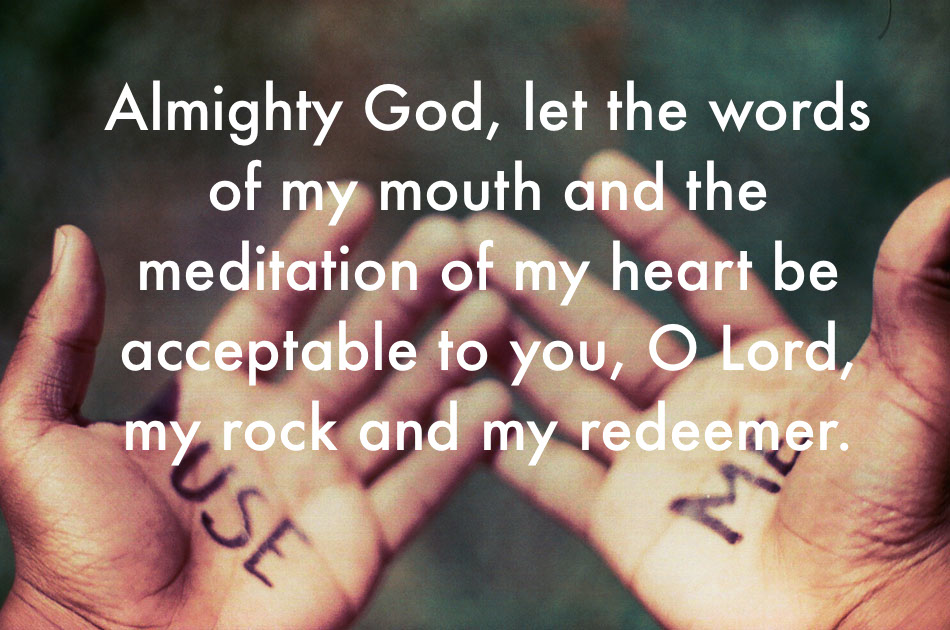
The final line of the Psalm 19 is a beloved and permanent aspect of worship; they are the words I pray before preaching every single Sunday. If our words and thoughts are acceptable in the Lord’s sight we are on the path toward renewed spirits and discipled living. When those words become our truest prayer and hope then we are speaking and thinking as if Jesus was at our elbow which, after all, is the whole point of prayer.

Amen.

Devotional – Matthew 18.21-22

Devotional:

Matthew 18.21-22

Then Peter came and said to him, “Lord, if another member of the church sins against me, how often should I forgive? As many as seven times?” Jesus said to him, “Not seven times, but, I tell you, seventy-seven times.

Weekly Devotional Image

In October of 1735 John Wesley and his brother Charles left England and sailed to Savannah, Georgia where John would be the minister in the newly formed Savannah parish. Part of his religious upbringing had already instilled a desire for holiness of heart and life and Wesley believed that his new appointment provided a wonderful opportunity to hone his craft and enrich his faith. During his time serving as the pastor attendance at the church services steadily increased though he was disappointed by the lack of lived-out faith outside of worship.

John Wesley

John Wesley

Even with the growth in worship, many in the community disliked Wesley’s high church background and it proved to be a continual element of controversy. During this same time Wesley began to fall in love with the young and beautiful Sophia Hopkey. They courted for a period of time but after a brief visit to preach the Good News to the local Native Americans, Wesley was remarkably disappointed to discover that Sophia had married William Williamson. Wesley was devastated by the news and took out his frustration in a rather inappropriate way; he denied Sophia communion during church services.

Wesley, of course, had “reasons” to justify his actions (he believed that her zeal for living out her Christian faith had declined and he followed the guidelines from the Book of Common Prayer in prohibiting her sacramental participation) but he was also fueled by his heartache and anger in withholding the bread and wine. It quickly became quite the controversy and legal action was taken against Wesley eventually leading to him fleeing the colony and returning to England.

One of the highest, and most difficult, callings of Christian disciples is to forgive. When confronted with the question of forgiveness in the community Peter ventured forth the idea of forgiving someone seven times when Christ augmented the proposal to seventy-seven or seventy times seven times. Forgiveness, it would seem, is not something to be measured and checked off the list, but instead something that is deeply entrenched within the life of the community. Wesley let his personal feelings get the better of him, and he foolishly barred a young woman from Christ’s table. Christians, both clergy and lay, are called to the difficult task of everlasting forgiveness, even when it hurts.

Is there someone that you are still holding a grudge against? Who do you need to forgive in your life?