Devotional – Romans 12.9

Devotional:

Romans 12.9

Let love be genuine; hate what is evil, hold fast to what is good;

Weekly Devotional Image

By 1743 the “Methodist” movement within the Church of England was taking off and growing considerably. John Wesley was suddenly responsible for checking in with the numerous societies he had helped to establish in order to continually encourage them in their faith and love. On one such occasion (in February of 1743) Wesley traveled to Newcastle to check on a particular society and was dismayed to discover a lax of discipline within the group.

Though harsh by our modern standards, Wesley examined every member of the society and found it necessary to expel 64 people from the group for the following offenses: “2 for cursing and swearing, 2 for habitual Sabbath-breaking, 17 for drunkenness, 2 for retailing spirituous liquors, 3 for quarreling and brawling, 1 for beating his wife, 3 for habitual and willful lying, 4 for railing and evil speaking, 1 for idleness and laziness, and 29 for lightness and carelessness” (Heitzenrater, Wesley and the People Called Methodists, 138). The offenses were so grave that Wesley believed it was detrimental for the whole if these offenders remained.

Within the week Wesley wrote what we now know as the General Rules. The terms of membership were simple: “a desire to flee the wrath to come, and to be saved from their sins.” But in order to continue in the society, members were required to live out their faith by, “First, By doing no harm, … Second, By doing good, … Thirdly, By attending all the ordinances of God.” (ibid.) These General Rules became foundational for the Methodist movement that eventually led to the creation of the contemporary United Methodist Church.

6a00d8348e805369e2014e5f5f2a3c970c-500wi

Paul wrote to the church in Rome a similarly simple list about what it means to be in Christ: “let love be genuine; hate what is evil, hold fast to what is good.” These principles of Christian discipleship are like the compass of our faith, guiding us to new and continual life in Christ. Wesley truly believed in renewing the Church of England by creating a standard by which the Christians could dedicate their lives. Faith, for him, was serious and worth working hard for. Today we are responsible for renewing our faith through discipleship and our commitment to love God and neighbor.

How do you live out your faith? Has following Jesus become boiled down to showing up for church once a week? Do you follow any guidelines or responsibilities for discipled-living on a daily basis?

Perhaps today we are all being called to a life of dedicated and disciplined faithfulness by simply letting our love be genuine, hating what is evil, and holding fast to what is good.

With Buttocks Uncovered – Sermon on Isaiah 20.1-6 & Mark 14.51-52

Isaiah 20.1-6

In the years that the commander-in-chief, who was sent by King Sargon of Assyria, came to Ashdod and fought against it and took it – at that time the Lord had spoken to Isaiah son of Amoz, saying, “Go, and loose the sackcloth from your loins and take your sandals off your feet,” and he had done so, walking naked and barefoot. Then the Lord said, “Just as my servant Isaiah has walked naked and barefoot from three years as a sign and a portent against Egypt and Ethiopia, so shall the king of Assyria lead away the Egyptians as captives and the Ethiopians as exiles, both the young and the old, naked and barefoot, with buttocks uncovered, to the shame of Egypt. And they shall be dismayed and confounded because of Ethiopia their hope and of Egypt their boast. In that day the inhabitants of this coastland will say, ‘See, this is what happened to those in whom we hoped and to whom we fled for help and deliverance from the king of Assyria! And we, how shall we escape?’ “

Mark 14.51-52

And a certain young man was following him, wearing nothing but a linen cloth. They caught hold of him, but he left the linen cloth and ran off naked.

081910-barefeet

This morning we conclude our sermon series on Strange Stories from Scripture. As I have mentioned previously, this series came to fruition through a desire to proclaim some of the more bizarre texts in church, particularly those that are rarely discussed. There is a wealth of biblical treasure just waiting to be uncovered; this series is our attempt to begin unearthing some of the great moments from the Bible. Our first week we talked about a young man named Eutychus who fell asleep while Paul was preaching, last week we learned about the incident with Elisha and the she-bears, today we conclude by looking at the prophet Isaiah’s naked faith.

Prayer

The Lord spoke to Isaiah son of Amoz, saying, “Go, and loose the sackcloth from your loins and take your sandals off your feet, “ and he had done so, walking naked and barefoot.

On the outside it looks like your typical chapel: painted white with a perfectly trimmed and manicured lawn. When Sunday morning comes the parishioners lazily make their way to the pews in order to prepare their hearts and minds for worship. Located in Ivor, Virginia worship attendance has steadily increased over the last few years as the church has taken very seriously its commitment to “come as you are.” No judgments are made as people enter the sanctuary, they see one another as God’s children, and the community has benefited from this focused ministry.

Whitetail Chapel rests as an example for other churches. They continue to serve the Lord their God with all their hearts, minds, and souls, while other churches are just trying to figure out how to stay open. The people who attend the church are excited and jazzed up about their faith, and are known for their willingness to invite anyone they meet to attend.

If any of you were privileged enough to attend one Sunday I believe that it would be a tremendous experience. The preaching would open your hearts to God’s kingdom in the world, the fellowship with other parishioners would cement your importance and vitality to the body of Christ, and you would have a new vision of what the church can be.

However, even with all these accolades, I am positive that the one thing you would remember most about attending Whitetail Chapel is the fact that they worship in the nude…

whitetailresort04

Those in attendance in worship do not have to worry about finding something special to wear on Sunday mornings because they strut their stuff in their birthday suits. “Come as you are,” indeed. When asked about why they choose to worship in the nude, the pastor replied, “Some of Jesus’ most important moments happened when he was naked: he was born naked, he died naked, and when he arose he lefts his clothes in the tomb so that he could be naked. If God made us that way, how can that be wrong?”

Some churches take the ministry of the prophet Isaiah a little too seriously.

During a time of revolt, when the people began to act our against the imperial ruling of Assyria, the prophet Isaiah was called to do something very dramatic. Ashdod, a city of strength, began the internal campaign against Assyria and urged for support from the surrounding nations including Judah with the promise that Egyptian and Ethiopian forces would soon come to help. As is common throughout scripture, and even in our lives today, the will and desire of the people did not match up with the ways of the Lord.

The Lord spoke to the prophet Isaiah, “Go, and loose the sackcloth from your loins and take your sandals off your feet,” and he did so, and began to walk around naked and barefoot. For three years Isaiah rid himself of the clothing and footwear that he had grown accustomed to and continued to embody, nakedly, the calling of the Lord.

December-Series-Image

Then the Lord said, “Just as my servant Isaiah has walked naked and barefoot for three years as a sign and a portent against Egypt and Ethiopia, so shall the king of Assyria lead away the Egyptians as captives and the Ethiopians as exiles, both the young and the old, naked and barefoot, with buttocks uncovered. And when that day comes to pass the inhabitants of the land will say, ‘See, this is what happened to those in whom we hoped and to whom we fled for help and deliverance from the king of Assyria! And we, how shall we escape?’”

During the timespan of the revolt, Isaiah walked around naked to symbolize the captivity that would soon overtake Egypt and Ethiopia, thus warning his people not to trust these allies nor join in the rebellion.

I know we’ve talked about some strange stories recently: A young man falls asleep under the warm glow of lanterns during a late night church service, only to fall out a window, die, and then be brought back to life. A young bald prophet overreacts to a group of young hoodlums and curses them in the name of the Lord to which 2 females bears maul 42 of the young men from the crowd. But today’s reading takes the cake for one of the strangest examples of faith in the bible.

From our modern sensibilities we find it difficult to imagine and believe that a prophet of the Lord, particularly one like Isaiah, would ever do something such as this. Certainly today, no members of the contemporary church would expose themselves to such embarrassing tactics.

This week, in preparation for the sermon, I asked a simple question of the Christians in my life: What’s the craziest thing you’ve ever done for your faith? At first I heard nothing, a fearful sign that perhaps we are not pushing the boundaries for our faith, but eventually some people began to respond. One woman on twitter said, “I took a sabbatical, packed up all my “stuff,” became homeless, and traveled the world for a year following Jesus daily. My mother answered with, “I received Ecoli poisoning while on a mission trip to Guatemala.” And still yet another man said that he had to spend two and a half years in prison before figuring out that God loved him, and had a plan for him.

The craziest thing I have ever done for my faith was carry our confirmation cross over my shoulder throughout Staunton on Good Friday. I arrived at the church around noon, picked up our cross, and began walking. For 3 hours I explored our town by foot with the hope of marking our hallowed day and reminding those in Staunton what Christ did for us. I will freely admit that part of my desire was to upset people, to disrupt the common expectations of a normal Friday afternoon, and to challenge the vision of the church simply being a place where you gather for one hour every week.

IMG_1279

However, I will also admit that I was being selfish while carrying the cross around Staunton. I know that I felt led and called to do so by God, but I recognize that it was something I had been thinking about for a long time, and looking forward to for a number of years. Some small part of me desired that people would recognize that I was the one carrying the cross.

Notice however that the prophet Isaiah had a complete lack of self-consciousness. He was a man with a mission and did not hesitate to accept scorn or derision in following his duty. When the Lord called upon Isaiah to do something bizarre and strange, he did not wait for awhile and weigh the pros and cons of his calling. He did not wait to see if any other opportunities came knocking at his door. He did not fret over what his reputation would look like after his prophetically naked embodiment. Instead, he immediately stripped off his clothing and began to do what the Lord required.

The counter to our story this morning takes place at the end of the scene in the Garden of Gethsemane. Jesus has already been arrested and is being brought to Pilate for questioning, the disciples have all fled for their own safety, when the captors discover a young man who was following them. Wearing nothing but a linen cloth the young man continued to follow Christ even after his closest friends had abandoned him, but when the guards caught hold of him, he left the linen cloth and ran off naked.

The young man was sharing in the experience of Jesus. Even when the disciples had left, the young man remained. Yet when the calling got too dangerous, he was ready to run off completely naked. It seems to make sense for the young man and the disciples to flee in order to preserve their own lives, but the followers of Christ are called to lose life for the sake of Jesus and the Gospel.

The nude dude from Mark’s gospel is naked and afraid. Isaiah, in stark contrast, is naked and prophetic. Rather than run away from the situation, instead of merely looking out for his life alone, Isaiah was willing to go to extreme measures in order to warn God’s people against putting too much faith in the other nations, rather than the almighty God.

Even with this dramatic and captivating imagery from the life of Isaiah, I believe we can ask about Isaiah’s effectiveness. Remember: we’re talking about a man who walked around naked and barefoot for three years. Isaiah, to all the people, must have appeared crazy and deranged. He must’ve looked like one of those people we are often tempted to ignore in our lives, people who are so zealous and outspoken to the degree that we can pretend they do not exist. But he did what the Lord required.

Even with all the dramatic and captivating elements of our worship service, I believe we can ask about the church’s effectiveness. I am comfortably standing behind a protective barrier surrounded by people who chose to be here this morning. In worship we are caught up and part of the body of Christ who willingly woke up this morning, who decided to come to church, and who yearned to hear God’s Word spoken.

Isaiah’s ministry confronted the fundamental elements of peoples’ lives, he shook everything up with his prophetic vision, and left them with something they would never forget.

Proclaiming the Word of the Lord is not something that can be left up to church worship and preachers alone. This space is sacred for us to gather and be reinvigorated for living out our faith until next Sunday. True transformative ministry takes place out there.

Isaiah’s actions, his willingness to remain naked and barefoot for three years to protect God’s people, ought to shame us into wanting to do more and live out our faith in strong and incredible ways. If we are passionate for Christ to be known, for the kingdom of God to reign, then we must ask how far we are willing to go for our faith.

Not let me be very, very, very clear: I am not saying that we need to loose the sackcloth from our loins and take the sandals off our feet. I am not saying that we need to roam around the hills of Staunton naked and barefoot for the next three years. That was Isaiah’s calling, not ours.

But if Isaiah was willing to go that far for his Lord, how far are we willing to go? Perhaps this morning we are being poked and prodded to be naked with our faith, to be vulnerable with those around us about what the Lord has done for and through us.

What would it look like this week if you asked one person if you could tell them about your faith? Who would you share your faith with? I’m not talking about trying to save someone, or trying to tell them the whole story of both the Old and New Testaments. But what if you sat down and told them what God has down for your life?

I know that for some of us to share our faith in that way would be very uncomfortable. We might rather walk around naked and barefoot for three years than sit down and be vulnerable and open about how God has changed us. 

But if God could save his people from making a terrible alliance through Isaiah, if God could save us from death through Christ on the cross, just imagine what God can do through you.

Amen.

Hairs, Prayers, and Bears (Oh My!) – Sermon on 2 Kings 2.23-25

Strange Stories from Scripture Part 2

2 Kings 2.23-25

He went up from there to Bethel; and while he was going up on the way, some small boys came out of the city and jeered at him, saying, “Go away, baldhead! Go away, baldhead!” When he turned around and saw them, he cursed them in the name of the Lord. Then two she-bears came out of the woods and mauled forty-two of the boys. From there he went on to Mount Carmel, and then returned to Samaria.

091812_elisha

This morning we continue with the second part of our sermon series on Strange Stories from Scripture. As I mentioned last week, the drive for our sermon series comes from the wealth of scriptural treasure begging to be preached, in addition to my desire to not fall into a rut of preaching the same, favorite, and familiar texts over and over. Last week we talked about the fate of a young man named Eutychus who fell asleep during church. Today we are exploring the story of Elisha and the she-bears.


And while he was going up on the way, some small boys came out of the city and jeered at him, saying, “Go away, baldhead! Go away, baldhead!”

In my opinion, this is one of the most troubling passages in all of scripture. I can look into both the Old and New Testaments and find scriptures that challenge my faith, passages that require me to pray for understanding and discernment, there are even passages that I would rather ignore than affirm from a place such as this, but there are few stories as dramatic and frightening as the one we have read this morning.

While Elisha was on his way to Bethel, sweating under the heat of the sun, some young boys came out from the city ahead of him and began to make fun of him. “Get outta here baldy! We don’t want you and your shiny head around us!” Perhaps he tried to ignore them at first, but when the taunting became so distracting and loud, Elisha turned around to face the crowd of young boys and cursed them in the name of the Lord. As if on cue, two mama bears came barreling out of the woods and mauled 42 of the boys. From there Elisha continued on his journey to Mount Carmel, and then he returned to Samaria.

pucktoon64

Before we can even begin to address what happened on the road we need to go back, we need to get a larger picture of the story.

Elisha followed the reign of the prophet Elijah. Elijah is remembered for bringing a widow’s son back to life, for finding God in the sheer silence, and for confronting idol worshippers. Elijah was a favorite prophet for the New Testament writers who often drew the connection between the prophetic life of Elijah and the messianic life of Christ.

At the end of Elijah’s time Elisha followed him to the Jordan and watched him ascend on a whirlwind into heaven after having received a share of Elijah’s spirit. Elisha took up Elijah’s ministry, he literally took Elijah’s mantle with him, and continued to be a messenger and example of God’s Word for the people.

The story of Elisha and the she bears is one of the first things that took place during Elisha’s time as a prophet. As a young and novice messenger, he is making his way to Bethel and other parts of the land to bring the people back to their Lord.

What do you make of this passage? Is it one that you, like me, would rather ignore and pass over? Does it challenge your understanding of God and the role of the prophets? 

For centuries theologians, scholars, pastors, and Christian-disciples have attempted to make sense of this story; they have worked hard to explain what is really going on.

I could begin by telling you that there is more at work in this story than appears on the surface. In Hebrew, the designation for the “small boys” is more akin to “young men” and more particularly young men who do not want the prophet coming to their town to tell them what they have done wrong.

I could continue by showing you that, though Elisha was bald, he was in fact probably only 25 or 26 when this transpired; he was my age when he was taunted for being bald and cursed the young men!

Similarly the point can be made that the harmless teasing was in fact very troubling. They were not merely making fun of his shiny head but were denying his prophetic ability. After taking up his former prophet’s mantle, Elisha was being accosted; in so doing the crowd of young men was not only attacking a young prophet but denouncing the Lord as well.

Moreover I could share with you the simple fact that Elisha did not call out the she bears, he just pronounced judgment on the demonstrators and God decided the form of response. And even when the bears came out of the woods they did not kill 42 of the young men, they simply mauled them. Perhaps God was using the bears in a way that none of the young men would perish, but so that they would all be punished.

Yet, even with all these new details, the story still troubles me.

As I prepared for the sermon this week I consulted numerous commentaries on 2 Kings and I was shocked to discover some of the reflections regarding this passage.

One commentary claimed that Elisha was not the kind of man to summon bears from the woods. The “irreverence, lawlessness, and hoodlumism of youth are sure to result in moral disaster.” The bears function as symbols of the punishment that overtakes vicious behavior. It went on to state that the boys in the story are the prototype for thousands of youth today. Only if they are educated at home, in school, and in church will they be able to avoid the punishment of the Lord that will surely come in one form or another. (The Interpreters Bible, vol. 3)

Another commentary made the same point, but in a shorter and more direct way: Rich and poor, high and low, young and old, ALL must be punished for their transgressions… (Word Biblical Commentary, vol. 12)

I went on to consult numerous sermons on the passage and was frightened to discover that most of them, few that they are, articulate a theology that the kids got what they deserved. They might have all ended by saying, “our children, your children, will wind up like those boys because we have failed to train them as polite young people. We need to bring our children to church, and encourage them to bring their friends, so that we can shape their future to avoid the bears of God’s wrath.”

Breathe.

I am now going to do what many of my professors warned me about in seminary, I am going to preach against this text.

Whereas many scholars, pastors, and Christians believe that the children are at fault, (I agree, they are) I believe that Elisha is just as at fault for his quick curse of the bullying boys.

In 2007 Duke University did a study and found that 85% of seminary graduates leave the ministry within five years and 90% flee before retirement. Many of these pastors that run away from the ministry never return to church. (Read more here: Keeping Your Pastor)

With the rise in expectations of pastoral ministry, coupled with dying churches and lowered pay, its no wonder that many pastors abandon their flock. When many churches are running on financial fumes, while also expecting their pastors to continually go above and beyond their call, the result is a collection of pastors who are burned out and have lost sight of the Lord and their calling.

ynk22

I imagine the Elisha felt a lot like ministers in the first few years of their appointments. After all, Elisha found himself following in the steps of the renown and powerful prophet Elijah who no doubt cast a great shadow for the young prophet. Most of the people would be evaluating this young man based on the actions of his predecessors.

This wasn’t something that Elisha inherited but was called into. He could have remained a farmer, tending to the plows with the oxen, but instead he was called out of his life into something new, strange, and at times, terrible.

As a bright-eyed and bushy-tailed prophet, Elisha had everything to prove. And here in 2 Kings 2 Elisha find himself at the beginning of his ministry filled with passion for the Lord when a crowd of youngsters attack him for that very call.

I think that Elisha’s pride got the better of him when he was walking to Bethel. Unlike the Son of Man who would one day tell his disciples to turn the other cheek and love those who persecute you, Elisha immediately cursed the youngsters and they were mauled.

If this story is about what it means to be a prophet who speaks the Word of the Lord, then I would argue that the biggest take away is that we must be very careful with our prayers. God listens to our prayers and He answers them, sometimes in ways that we do not want and sometimes in ways that we do not expect. Be careful what you pray for.

When I arrived at this church I felt very much like what I imagine Elisha felt like at the beginning of his prophetic ministry. I was following in the footsteps of countless pastors who have shaped and nurtured this congregation into what it is today. I recognize that I will always live in the shadow of the likes of Fletcher Swink, Zig Volskis, and Patricia Meadows.

I sat in my office the week before my first sermon and thought about everything I had to live up to. I stewed over what my reputation would be at this place. I over-analyzed every word and sentence for that sermon, fearing how I might be received. 

I stood in this pulpit over a year ago, afraid of how all of you would respond. And, if I’m being honest, I stand here this morning still consumed by thoughts of what you think about these words, my delivery, and the connections with scripture.

Being a pastor is, at times, terrifying. Many weeks pass when I feel like I did not get enough done. There have been a number of Saturday nights that I lay awake in bed rehearsing in my head what I will be saying on Sunday. I have had many tough conversations with families, couples, and individuals about the sins in their lives. There have been countless visits when I wonder if I have actually helped at all.

And its when I reflect on all of these elements of ministry, that I realize how difficult it must have been to be Elisha. I begin to understand why he was so quick to curse those young men who spoke against his calling.

And the more I think about it, the more I see connections not only between Elisha and pastors, but also between Elisha and all of us.

How quick are we to curse those who speak against us? How inclined are we to forget our discipleship the minute our calling is called into question?

I know of an older gentleman who had not exchanged a word with one of his sons in years because of a foolish argument they had in the past. I know a woman who refuses to shop at certain stores in our town because of the color of some of the employees. I know neighbors that never wave or acknowledge one another because one of them went to Virginia Tech and the other went to UVA.

In today’s world it is too easy to put a tremendous amount of pressure on ourselves to shine brightly in the darkness. We set goals for ourselves that are lofty and unreachable. We expect greatness from our lives and the lives around us on a daily basis.

When we get caught up in the expectations of the world that we place on ourselves, we fall into the trap of quickly cursing others around us. When we fail, we jump to blame someone else. When we miss the mark we can come up with a list of excuses faster than we can come up with better solutions.

Being a pastor is hard, but being a disciple is harder. We are called to walk in the world as prophets, seeing this created place through God’s eyes. We have the unenviable task of reaching out to the last and the least and the lost. We have been baptized into a new order where the world has been turned upside down.

When we are accosted for out faith, when we are judged for our Christian allegiance, it will manifest itself in different forms. 

Elisha was made fun of for being bald.

You might be attacked for praying in public, for wearing a cross around your neck. You might be made fun of for offering up your gifts and tithes to a place like the church. You might be judged for praying to a God who often responds in silence.

But nevertheless, we are not called to respond to these threats by cursing on enemies. We have been commanded to love them.

What a crazy and wonderful thing it is to be a disciple of Jesus Christ. Amen.

God’s Garden – Sermon on Matthew 13.24-30, 36-43

Matthew 13.24-30, 36-43

He put before them another parable: “The kingdom of heaven may be compared to come one who sowed good seed in his field; but while everybody was asleep, an enemy came and sowed weeds among the wheat, and then went away. So when the plants came up and bore grain, then the weeds appeared as well. And the slaves of the householder came and said to him, ‘Master, did you not sow good seed in your field? Where, then, did these weeds come from?’ He answered, ‘An enemy has done this.’ The slaves said to him, ‘Then do you want us to go and gather them?’ But he replied, ‘No; for in gathering the weeds you would uproot the wheat along with them. Let both of them grow together until the harvest; and at harvest time I will tell the reapers, Collect the weeds first and bind them in bundles to be burned, but gather the wheat into my barn.’” Then he left the crowds and went into the house. And his disciples approached him, saying, “Explain to us the parable of the weeds of the field.” He answered, “The one who sows the good seed is the Son of Man; the field is the world, and the good seed are the children of the kingdom; the weeds are the children of the evil one, and the enemy who sowed them is the devil; the harvest is the end of the age, and the reapers are angels. Just as the weeds are collected and burned with fire, so it will be at the end of the age. The Son of Man will send his angels, and they will collect out of his kingdom all causes of sin and all evildoers, and they will throw them into the furnace of fire, where there will be weeping and gnashing of teeth. Then the righteous will shine like the sun in the kingdom of their Father. Let anyone with ears listen!

wheat180708_03

The best sermons reflect their scripture. If you preach on a Psalm then the sermon should be poetic and prayerful. If you preach on a genealogy then sermon should be historic and cover the breadth and trajectory of time. If you preach on a narrative, then the sermon should contain stories to help enlighten the scriptural narrative. And if you preach on a parable, then the sermon should leave people scratching their heads on their way out of church.

Jesus put before his disciples yet another parable: The kingdom of heaven is like a gardener who planted good seeds in his field. However, while others were sleeping someone else came and planted weeds among the wheat. So when the plants began to grow the weeds appeared with the wheat.

The workers of the garden were confused and worried, “Master, what kind of seeds did you plant? Where did all these weeds come from? Would you like us to go out and remove the weeds from the field?” But the gardener replied, “No; if you remove all of the weeds you would uproot the wheat along with them. Instead, let both of them grow together until the harvest.

Parables are strange things. They are often found on the lips of Jesus, told in such a way that a point of a lesson can be illustrated from the narrative. For those of us familiar with Jesus’ parables we might think of the Prodigal Son or the Good Samaritan or The Mustard Seed. In the parables, Jesus uses a simple and memorable story to convey a deeper and important theological point. He refers to common and everyday things that can find connection with the crowds as he shares with them the beauty and mystery of God.

Though told with a simple style, parables often left the disciples scratching their heads while Jesus addressed the crowds. In our scripture today it was only when they retired to the house that the disciples were finally given the opportunity to ask Jesus what this parable was all about.

The gardener is the Son of Man; the field is the world, and the good seeds are the children of God; the weeds are the children of the evil one, and the enemy who planted them is the devil; the harvest is the end of the age, and the reapers are angels.

The beauty of the parable, its mysterious quality, has been explained and presented to the disciples succinctly and clearly. 

wheat

This morning we are going to do things a little differently. Instead of just standing up here proclaiming the Word, instead of just sitting our there absorbing the Word, we are going to live it out in our worship. 

Let us pretend that this sanctuary is God’s Garden and all of us are the crops. At first we are planted by the Son of Man and are nurtured in this place to grow into disciples of Christ. Whereas a true garden needs sunlight and water, we are sustained through the Word of God and through the Bread and Wine of communion. As we make it through the weeks, months, and years we continue to grow into our faith and become the beautiful wheat of the field. So, as you are able, would you please demonstrate this growth by standing up.

As any good gardener I am now going to inspect our crops… It is clear that we have some incredible wheat this morning!

Leah Pack! I see your growth and am reminded of your dedication to our lectionary bible study, feeding those who are in need at the free clinic, and your willingness to visit those from our church community.

Marshall Kirby! I see your stature and it is definitely clear that you are strong in your faith! I am reminded of your willingness to serve the needs of our church through your leadership with the men’s club, your stupendous diction while reading the scriptures for worship, and your chiseled muscles from years of Christmas tree sales.

Grace Daughtrey! Though still young and maturing into a wonderful wheat it is clear that you are full of faith. I see you standing and I am reminded of your challenging questions during confirmation, your desire to serve our church by carrying in the light of Christ for worship, and the future of our church as you blossom into a remarkable Christian.

Brothers and sisters we have a garden full of God’s wheat, full of faith and trust! To God be the glory! (You may be seated)

But you know, the more I think about it, maybe I wasn’t looking at God’s crops close enough…

Leah Pack, for as strong as your faith looks on the outside I know that you become frustrated with others in the community who do not live out the tough calls of our faith, I know that sometimes you wish you could ignore certain parts of the bible. Leah I’m sorry to say this, but when I look closer it seems that you appear more like a weed than a wheat (Remove Leah from the pew and bring her to the front).

Marshall Kirby, who could argue with your faith? But I know that sometimes you listen to the voices of the world more than the voice of God and you might be too weedy for our garden. (Remove Marshall and bring him to the front)

And Grace, sweet sweet Grace, still so young in your faith, I know that there are times when you would rather sleep than come to church. I’m not sure we can let you stay in our garden (remove Grace and bring her to the front).

I quickly see two things for us to learn from the pruning of God’s Garden:

Before too long I’m sure that we would be able to find a sin in every person sitting in the pews this morning, and eventually we would have to remove all of the weeds. We might have good days, even months, or perhaps years where we can fully live into our discipleship of Jesus Christ, loving God and neighbor, serving the needs of the community, but all of us eventually fall short of His glory. We look at someone and we lust for what they have, we lie to protect ourselves, we love our possessions more than God; whatever the sin is we quickly move from being one of God’s wheat to one of God’s weeds.

God’s Garden is imperfect. Even with all of the proper nurturing, good preaching, splendid teaching, and holy eating, it will never be enough to prevent us from sinning. We can have mountaintop experiences here at church but before long we are tempted to fall back into the familiar rhythms of evil. On the outside we want to look like God’s perfect crop of wheat, fully matured, and ready to be harvested for the kingdom, but in reality, when we look inwardly, we see that all of us at some point or another appear more like one of the weeds in God’s Garden.

The other element of this Garden that strikes at our hearts this morning is that we are not the ones who are called to judge. Lets pretend for just a moment, if we can, that Leah, Marshall, and Grace truly were weeds within this community of faith. Can you imagine what would happen to us if we uprooted them? 

Leah has taught so many over the years about the way God has interacted with God’s creation. If we removed Leah, all of her students in the ways of faith, myself included, would begin to wonder what this thing called faith was all about. At some point many of the people connected to Leah’s life would stop coming to church at all when they realized that she was the one who embodied the love of God for them and their lives. Without Leah being here, they would miss getting to experience God’s grace.

Marshall lives out his discipleship everyday. He it absolutely committed to following Christ here at St. John’s and in the community. Even with his big and tough exterior, he is one of the sweetest men I have ever met. If we removed Marshall, our community would suffer. All of us that have been encouraged by Marshall over the years would lose our sense of identity when he is no longer able to affirm our worth. Without Marshall being here, many of us would miss getting to witness God’s grace.

Grace sees the world the way that God wants us to see one another. Without judgments, without preconceptions, without fear, Grace loves the people around her with a pure heart. Even though Grace is very much a part of the church right now, she also embodies for many of us the hope of the church in the future. If we removed Grace, our vision would suffer. All of us that have been touched by her singing, or her discipleship, or even just her smiles, would no longer see the joy of worship and faith. Grace gives us the hope for committing ourselves to the ways of God. Without Grace being here, we would fail to enjoy God’s grace.

church

I’m sure that God’s Garden would suffer if any of them were removed, and I am sure that God’s Garden would wither and disappear if any of us were removed. We are not the gardener, that role can only belong to the triune God. When we look out on the abundance of produce in this church we are called to see one another the way God sees us, as the great grains of discipleship.

In Jesus’ parable of the wheat and the weeds there is a tremendous emphasis on patience: let them both grow together until the harvest. Our church is made up of sinners and saints, weeds and wheat, and God has called us to grow in faith with one another. As we make our way through the years of communal living, we must be patient with one another.

On the surface level, Jesus’ parable can sound frightening and even disconcerting. The idea of the weeds being gathered at the harvest to be thrown in the fire scares me. But when I look out on God’s Garden here in our church, I am reminded that this is a story all about grace. In the strange world of the parable, in the strange world of being a Christian today, God prohibits our separation and calls us to live in love.

In the strange world of faith it may even be possible for weeds to become wheat.

Thanks be to God that Jesus Christ is the risen Lord who sows the good seed that becomes the church. Thanks be to God that we are nurtured and fed by the Word and the Spirit growing everyday in our fruitfulness for the kingdom and one another. Thanks be to God that we have been raised in faith, surrounded by such a wonderful community of witnesses, and rooted in the deep and rich soil of God’s grace.

Be patient with one another. Do not judge by outward appearance, or inward behavior. Look around at God’s Garden this morning and see the good seed that is growing, see the wheat of faith, see your fellow disciples that will one day shine like the sun in the kingdom of their Father!

Amen.

Getting Stoned With Stephen – Sermon on Acts 7.54-60

Acts 7.54-60

When they heard these things, they became enraged and ground their teeth at Stephen. But filled with the Holy Spirit, he gazed into heaven and saw the glory of God and Jesus standing at the right hand of God. “Look,” he said, “I see the heavens opened and the Son of Man standing at the right hand of God!” But they covered their ears, and with a loud shout all rushed together against him. Then they dragged him out of the city and began to stone him; and the witnesses laid their coats at the feet of a young man named Saul. When they were stoning Stephen, he prayed, “Lord Jesus, receive my spirit.” Then he knelt down and cried out in a loud voice, “Lord, do not hold this sin against them.” When he had said this, he died.

the-stoning-of-stephen

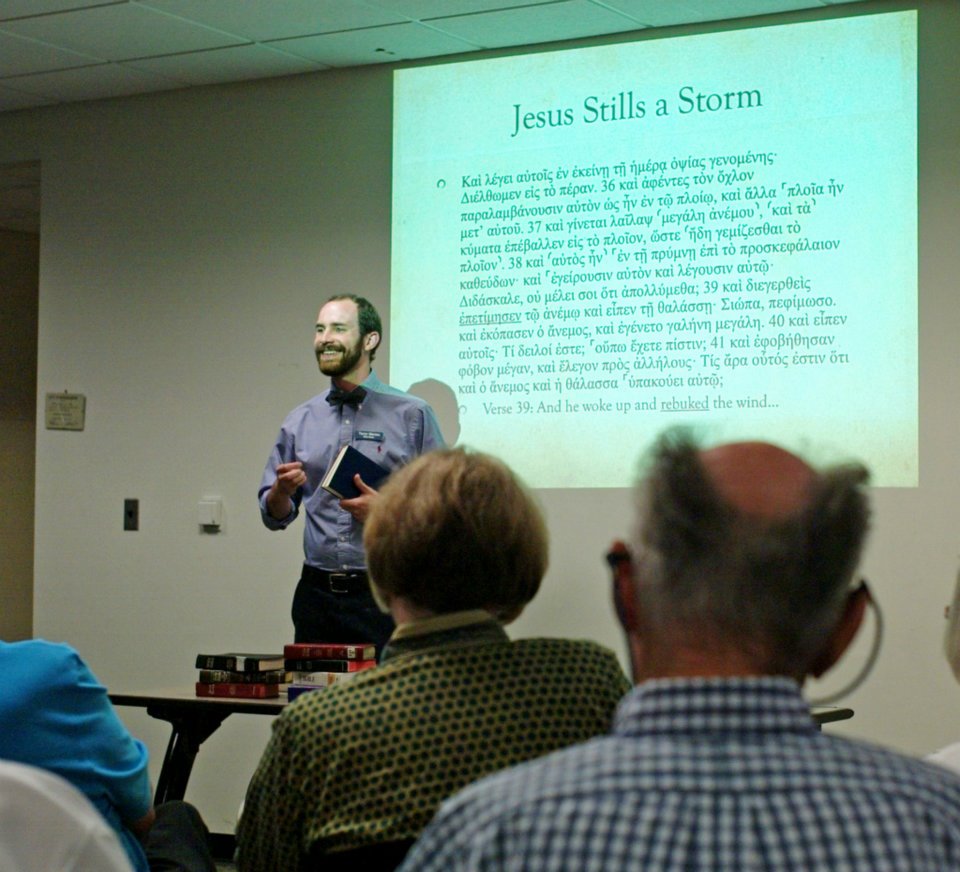
I was standing in front of a packed lecture hall, talking about Jesus according to the gospels, when I began to notice that the crowd was turning against me. For the previous three weeks I had stood in the front of that same room, a brilliantly bright powerpoint displayed on the screen behind me, making my way through the original Greek text of the gospel according to St. Mark. Each week we focused on a different element of Mark’s writing, comparing his gospel with the others, and generally reflecting on how this gospel still speaks fresh and new words into our lives.

It had seemed as if everyone was on board with what I was talking about, until the conversation moved to the cost of discipleship. I recognize now that I probably went to far, but at the time I felt the truth was worth exploring.

531711_3548371078945_1217125254_n

This is what I said: “In the gospels, particularly Mark, Jesus makes it very clear that following him, taking up our own crosses, being a disciple, will cost us our very lives.” Many people in attendance nodded. But then I continued, “Most of us here have no idea what that means. We sit in the comfort of our homes here in Michigan, sure we hear about all the bad things happening in the world, and even the bad things happening down the road in Detroit, but our lives will never be taken for our faith. We exist in such comfort with our faith that we can no longer even imagine what it would mean to give our lives for Christ, the cost of discipleship for us doesn’t cost very much at all.” “Well excuse me young man,” one of the women began, “but I go into downtown Detroit every week to serve food and give away clothing. My life is on the line for Christ every seven days. Don’t lecture me about the cost of discipleship.” This is when I should have stopped, apologized, and moved on, but I couldn’t help myself. So I asked her, “Do you go downtown every week because you believe thats the most and the best you can do as a disciple? Or do you go downtown with food and clothing every week because you feel guilty?


The early church had a problem. While the disciples were increasing in number, an argument developed over the distribution of food. Like us modern Methodists, a major conflict erupted not over proper theology, or reverence, but instead who was getting the appropriate amount of food. The twelve got together and asked for seven leaders to come forward in order to help with the organization of the early church, and to faithfully distribute the food among all the people. Stephen, described as a man full of faith and the Holy Spirit, was one of those chosen seven. 

In a short amount of time Stephen began to do great wonders and produce signs among the people. Once he stepped into the limelight of the early church, he rested under the microscope of many leaders and elders of the synagogues who argued with him. The leaders instigated some others to raise charges of heresy against Stephen and he soon found himself standing before the high-priest in order to defend his words and actions.

What followed is one of the most concise and deliberate retellings of the entire salvation story of God with God’s people. Stephen’s speech contains remembrances of Abraham, Isaac, Jacob, Joseph, Moses, and the prophets. He weaves the story in and out of the major moments; the beginning of the covenant, the flight to Egypt, Moses’ calling, the delivery from slavery to the Promised Land, the commandments being given on Sinai. In just a few short paragraphs Stephen perfectly encompassed the Old Testament for the high priest.

Though very descriptive, Stephen committed no blasphemy in his speech. He fairly repeated that which we have detailed for us in the scriptures, but before he finished speaking he had one final message to deliver: “You stiff-necked people, uncircumcised in heart and ears, you are forever opposing the Holy Spirit, just as your ancestors used to do. Which of the prophets did your ancestors not persecute? They killed those who foretold the coming of the Righteous One, and now you have become his betrayers and murderers. You are the ones that have received the law as ordained by angels, and yet you have not kept it.

It was only after hearing these words that the people became enraged and ground their teeth at Stephen. While they began to torment him, he looked up and saw the glory of God and Jesus standing along the right side, and he declared this triumphantly to the people. But instead of listening, instead of looking up to see what he could see, they covered their own ears and with a loud shout rushed forward to grab him and take him out of the city. While they stoned him, he prayed, “Lord Jesus, receive my spirit.” And with his final breath he cried out in a loud voice, “Lord, do not hold this sin against them.” When he had said this, he died.

saint-stephen-the-martyr-23

Stephen’s speech to the high priest and those gathered sealed his doom. Did he speak the kind of blasphemy against Moses and God like he was accused of? Nope. But Stephen went too far when he claimed that Jesus was at the right hand of the Lord, ready to rule. Stephen merely affirmed the same thing we claim every week when we stand and affirm the Apostles’ Creed, yet when he did it, it cost him his life. 

Some scholars and theologians claim that the climax of this episode in the book of Acts is Stephen’s death, when in fact the defining moment is the exaltation of Christ. Surrounded by his accusers and killers, Stephen continues to assert that Jesus is sitting at the right hand of God, that he is the long awaited Messiah already changing the world.

Jesus is there with Stephen at the final moments of his life, and how fitting considering the fact that Stephen utters the same words that Christ did at his own death. While the stones were flying through the air, Stephen’s prayer was not for deliverance, but a declaration of trust. Not, “Lord, save me!” but “Lord, receive my spirit.” His prayer is one that looks forward, not backward. His prayer was for his enemies, and not himself.

At his death, Stephen did what all of us are called to do in every moment of our lives: he acted like Jesus. He was serene while everyone else was going crazy; he was forgiving while the crowds were vindictive; he prayed while the people acted as if God was not among them; he loved when he saw nothing but hate; he trusted the Lord when everything was claiming the contrary; he kept on hoping when there seemed nothing left to keep hope alive. All of this to tell the truth to the high priest and the crowd. All of this to die for what he believed in. All of this as the cost for his own discipleship.

What happened to Stephen is paradigmatic for what the church was like. Thousands upon thousands of Christians have given their lives in order to speak the truth of God’s reign in the world.

In the United States we have “freedom of religion.” This was instituted during the foundation of our nation and has secured the right to practice religion, regardless of orientation or denomination. For Christians, the freedom of religion means that we are free to exercise our faith in whatever ways necessary so long as we do so within certain limits, as long as we do not become fanatical. We can pray as a family at public restaurants so long as it is not too loud to disrupt the other patrons. We can teach our children to turn the other cheek and love their enemies so long as we are still willing to let them serve in the military. We can talk about controversial issues in church so long as we limit those conversations to this building.

Yet the story that we read today, the remembrance of Stephen’s final moments, reminds us practitioners of polite, civil, and calculated religion that once there were Christians who readily and joyfully parted with possessions, family, friends, even life itself to remain faithful.

Some might call Stephen fanatical and crazy (after all he was willing to give his live for his faith) but he is presented as a very rational person who died for the same faith by which he lived.

When I stood in front of that crowded lecture hall, talking to the Methodists of Birmingham, Michigan, I could sense their desire to be affirmed in their faith. They wanted me to believe that they were willing to give their lives for Jesus, but the truth is, most of them, and most of us here, will never be in a situation like Stephen’s. Christianity has become so complacent and accepted within our culture that we no longer feel the need to be radical and controversial when considering the ways of the world versus the ways of God.

Our faith used to be a movement. The early church used to be attacked, arrested, and silenced for their dedication to the Word. The first methodists used to be ridiculed for their methodical dedications to spiritual disciplines, feeding the poor, and befriending the outcasts.

What would it take for someone to ridicule you in your faith? I’m not saying that we are all called to stand trial for our God and give our lives like Stephen, but instead we need to ask ourselves if we are living up to the potential of faith that God sees in us.

Not all of us can be Stephens, but we can all be Christians. We can all speak the truth of what God has done for us. We can reclaim our commitment to changing the world for the kingdom of God. We can discover our faith in God by opening our eyes to the kind of faith that he has in us. How far would you go to demonstrate your faith in the world? What would it take to start ruffling people’s feathers here in Staunton by living as Christ’s body?

Speaking the truth can be the most difficult thing in the world, but at the same time it can also be the most faithful thing in the world. Perhaps you know someone who has, for too long, relied on alcohol to fill an emptiness in their lives but you’re too afraid to saying anything. Maybe you know someone who treats their spouse horribly and you’re unsure how you can help the situation. Perhaps you’ve seen someone embarrass or harass their children in public. Or maybe you need to be honest with yourself about something you need to change in your own life.

Stephen was willing to speak the harsh truth to a people who desperately needed to hear it. Stephen was prepared to give his own life for a man he barely knew that died on a cross and was raised again. How far are you willing to go? Amen.


Devotional – John 14.18-19

Devotional:

John 14.18-19

“I will not leave you orphaned; I am coming to you. In a little while the world will no longer see me, but you will see me; because I live, you also will live. 

Weekly Devotional Image

Two of my favorite people in the world made the choice to adopt two Guatemalan boys and raise them as their own. I don’t know a lot about the conversations and planning that took place before both of the adoptions, but I do know that they would tell you it was the best decision they ever made. Gabriel and Alexander are two of the finest young men that I have the privilege of calling my friends; Jason and Ali (their parents) are responsible for their strong and dynamic character. Whenever I travel home to Alexandria I make a point of stopping by their house just to catch up with the boys and have my mind blown by how much they have grown and changed.

10310117_10152423618803879_7313295905510655067_n

When Jason and Ali first brought each of the boys home they had to make the deliberate effort to spend as much time as possible with the boys. Though only children, the parents could sense that they were afraid of being let go and sent somewhere else. Without the mental faculty to fully grasp the depth of their adoption, they could experience the fear of being abandoned. For many nights Ali and Jason would stay with their boys in their rooms just so they would know that they were loved, that they were known, and that they would never be abandoned. I love those two boys more than I can describe. I love their parents more than I can describe. (Jason presided over Lindsey’s and my wedding ceremony; Gabriel was our ring-bearer; Alexander did the Old Testament reading)

Millions.Front

Before Jesus’ crucifixion and resurrection he assured his disciples that he would not leave them orphaned. Even though he knew he would have to leave them, the Holy Spirit would be poured out to never leave them. Much like Jason and Ali staying with their boys night after night, God in Christ has not left us to be orphaned. Our Father is with us so that we can know we are loved, that we are known, and that we will not be abandoned.

The call of all Christians is to combat the plague of loneliness in the world. It is through many of our actions that God’s love is manifest in the world so that people may know what it means to come within God’s loving embrace. Do you know someone who feels abandoned right now? Have you noticed anyone retreating into their own isolation? Our challenge today is to reach out to those who feel orphaned and help them to see God’s presence in their lives.

My Cup Runneth Over – Sermon on Psalm 23

Psalm 23

The Lord is my shepherd, I shall not want. He makes me lie down in green pastures; he leads me beside still waters; he restores my soul. He leads me in right paths for his name’s sake. Even though I walk through the darkest valley, I fear no evil; for you are with me; your rod and your staff – they comfort me. You prepare a table before me in the presence of my enemies; you anoint my head with oil; my cup overflows. Surely goodness and mercy shall follow me all the days of my life, and I shall dwell in the house of the Lord my whole life long.

mycuprunnethoverwater

The 23rd Psalm. Many of you know that I am far more eager to preach on the lesser-known texts of scripture, than I am to preach on those that are remarkably familiar. I decided months ago that after my wedding and honeymoon, Psalm 23 would be the first text I preached on, precisely because it was familiar. All things considered, I have been very busy the last few weeks, and I thought that it would be easy to prepare a sermon on this beloved text; I was so wrong.

When we proclaim one of the best known texts from the Bible, there is an incredible amount of baggage that comes with it. If I wanted to preach on something from Obadiah or Nehemiah, I could say a whole lot about whatever I wanted because so many of us are unfamiliar with the texts, myself included.

psalm23-lg

But when you hear Psalm 23 read aloud, many of us immediately have a memory or a determined understanding of what the text means. Its familiarity makes it challenging to proclaim because we’ve all heard it before; The Lord is my shepherd, I shall not want…

What is it about this psalm that makes it so beloved? Perhaps many of us were taught to memorize the psalm when we were younger. Maybe some of us can remember our mothers and grandmothers whispering it by their bedside before they went to sleep. Is it the simplicity, the ease for memorization? It the use of this psalm in contemporary pop-culture? Besides the Lord’s prayer and John 3.16, this is perhaps the best known of all the Christian scriptures.

I believe what makes this psalm so compelling is not so much its brevity, but instead its realism. This is no happy-go-lucky, “everything is awesome,” kind of passage. Rather, it faithfully faces the dark realities of what life is really like, while at the same time calls us to honestly remember the delights of life. It has become so popular and beloved that many of us can recite it from memory, but have lost touch with what the passage is saying. Every verse contains a wealth of theological treasure waiting to be uncovered and enjoyed.

Good

The Lord is my shepherd, I shall not want. We of course remember immediately that Christ is the good shepherd, as our wonderful stained glass window portrays. God in Christ is the guardian of the church. The great I AM shepherded the Israelites through the wilderness, delivering them from slavery and captivity to the promised land. The Lord was the shepherd to the prophets who proclaimed the Word to the lost Israelites. God helped shepherd Christ throughout Galilee, even to the cross. Our Father was the shepherd to the disciples as they spread the gospel throughout the world. The great shepherd is now with us, guiding and keeping watch over all that we do as we witness to God’s love in the world.

God guards the flock as a whole, the sheep have been brought into the fold. Each of us are one of God’s sheep; we are safer if we stay connected with one another. If the church begins to stampede in one direction, some will be inevitably lost. If the church divides into factions, we will be like a panicking flock of sheep. We listen for the great shepherd who leads us.

He makes me lie down in green pastures; he leads me beside still waters; he restores my soul. In our modern lives we seem to have lost the power to relax; we no longer know what it means to observe sabbath time in our lives. We succumb to the power of stress that overcomes us regularly, and lose the energy to live vibrant and fulfilling lives. So, God, father of all mercy, bids us to relax, to observe some sort of sabbath in our lives, and to find rest. However, notice that rest is not a end in itself, God restores our souls through rest so that we can continue on our faithful journeys. Life is filled with movement, following the paths of righteousness.

He leads me in rights paths for his name’s sake. Even though I walk through the darkest valley, I fear no evil; for you are with me; your rod and your staff – they comfort me. God leads us, as the shepherd, on the right paths. So much of the vital moments and decisions in our lives do not come from our choosing; we do not determine the time of our birth, the kind of parents that we will have, the culture in which we find ourselves, the opportunities that “come our way.” At times life is beyond our control, and that is a good thing! To so desperately seek control of our lives will eventually end in disappointment. In order for God to be the shepherd of our lives, we have to let him into our hearts to shepherd us and guide us on the paths of righteousness. We need to let God be in control. It is only when we let go that we can faithfully proclaim, “even though I walk through the valley of the shadow of death, I will fear no evil.” It is only when we let go that we can know that God is with us.

You prepare a table before me in the presence of my enemies; you anoint my head with oil. Like any good shepherd, God has brought his flock back home to safety, brought us to his table, just like the table that has been prepared for us here. Some of our truest enemies might be with us here in church this morning, but God has prepared the table for you so that you can feast with friend and foe. 

lord__s_supper_by_bclary-d37hhzp

And so now we come to an incredible collection of words that encompass God’s goodness in our lives: my cup runneth over

How often do we take time to look back and reflect on what God has done for us? How much time do we spend in prayer thanking God for all that he has done? Can we faithfully declare “my cup runneth over…”?

10256438_10203577672981569_6139148774861837965_o

Today, of course, is Mother’s Day. I am blessed and privileged to have a mother who has cared for, and loved me, every day of my life. A mother who is still so accustomed to attending swim meets, baseball games, and band concerts, that she will drive two and a half hours to attend church with us here at St. John’s. A mother who participated in my life and activities, but gave me the freedom to grow and experience life independently. A mother who sacrificed her own needs again and again because she loved me. My cup runneth over. 

Some of you might not have had a mother like mine, some of you may have lost your mother, some of you might have grown up without a mother, but look around you. The call of the Christian is to be motherly to all that have gathered here. Though your mother might not have been like mine, I know that each of you have mothers in Christ that are here with us today. Our cups runneth over.

980415_10201896436508405_1440994831162466171_o

On April 27th I stood at the front of Aldersgate UMC in Alexandria, VA, waiting for Lindsey Rickerson to walk down the aisle with her father. I cannot tell you how nervous I was. I know that I was leaning from side to side, standing before all of my family and friends, my nerves attempting to get the better of me, but the moment Lindsey appeared at the back of the sanctuary I felt God’s presence surround me with a sense of calm I have rarely experienced. I covenanted with God and Lindsey to love, honor, and keep her with all that I am for the rest of my life. I am blessed to be her husband. Lindsey has changed my life for the better on numerous occasions, she challenges me to be a better man, and lives out God’s call on her life every single day. My cup runneth over. 

Some of you might not have a spouse like mine, some of you may have lost yours, or never felt called to be married in the first place, but today and for all days I get the joy of sharing Lindsey with you. We are all called to love one another in such a tremendously wonderful way that people like Lindsey can be and live for those that have gathered as the body of Christ. Our cups runneth over.

1610046_10152482968867577_1866027851814592445_n

After the wedding, while Lindsey and I celebrated at the reception. I had countless staff members continually refill my glass to the degree that I literally learned what it meant for my cup to runneth over. I looked around the reception hall and saw joyful faces that conveyed endless memories of how much my life has been shaped by others. In that room I witnessed God’s incredible goodness manifest in the lives of so many that I have been blessed to call my friends. My cup runneth over.

Some of you might not have the opportunity to sit in a room surrounded by droves of friends and family to congratulate you on the newest development in your life. You might feel lonely and isolated in your current life situations. But look around the sanctuary. Being one in Christ means that we discover our newest and greatest friendships here at church. Christian friendship and fellowship is what made the church so appealing in the beginning, and it rests at the very fabric for what it means to be the church today. I look out from this pulpit and I see the friendships that will sustain all of us through the coming years. Our cups runneth over.

The 23rd psalm is filled with such vivid and realistic imagery, applicable for our daily living. The great shepherd tends to his sheep, keeping them close and protecting them from harm. Our God compels us to find rest so that we can continue on our journeys of faith. The Lord invites us to this his table so that we might feast on heavenly food and meet the divine. But today, the Lord asks us to look on our lives and remember our blessings.

10172672_10104460766255513_8430566301283982547_n

Because our blessings are everywhere; from the tiniest details of a perfect sunset, to a incredible wedding and the joining together of two people. God has blessed our lives over and over again. We have the choice to reflect on his goodness, or remain in our suffering. Today we remember what God has done, we remember our mothers, and the call of the church to be motherly toward everyone, we give thanks to the Lord our God for shaping us through those we call our friends.

It’s only when we look at our lives and faithfully say, “my cup runneth over” that we can begin to proclaim the final verse of psalm 23: “Surely goodness and mercy shall follow me all the days of my life, and I shall dwell in the house of the Lord forever and ever.” Amen.

Devotional – Psalm 31.3-5

Psalm 31.3-5

You are indeed my rock and my fortress; for your name’s sake lead me and guide me, take me out of the net that is hidden for me, for you are my refuge. Into your hand I commit my spirit; you have redeemed me, O Lord, faithful God. 

Weekly Devotional Image

I love making scripture jokes. This is not to say that I believe scripture is a joke, I just love to drop lines from the Bible in daily conversation in such a way that it will make people smile, chuckle, and (rarely) laugh. While in seminary this became commonplace among my friends and we always tried to out-do one another.

For example: I would ask what time a lecture was supposed to start and someone would reply “about that day or hour no one knows, neither the angels in heaven, nor the Son, but only the Father” (Mark 13.32)

normal_LaughingJesus

Behind every joke was a knowledge of scripture that allowed one of us to use verses whenever we needed to. We did not sit around in the library memorizing specific verses to use as we saw fit, but instead we so steeped ourselves in God’s Word that they naturally became a part of our regular conversations.

Becoming a Christian is like learning a new language. In order for us to learn the language of faith we must become immersed in the cultural practices of lived Christianity. Over the last century scripture has been relegated to the private sphere of our lives, resulting in the biblical illiteracy so very apparent in churches today. To rediscover the vibrancy of faith, we have to return to the beauty of the Word as it becomes our new language; not just by memorization, but by appreciation.

512ifkGrOGL

Jesus knew his scripture. If you read through the 4 gospel accounts it becomes very apparent that Jesus used phrases and images from the prophets and the psalms in his daily life. Moreover, while hanging on the cross Jesus cried out, “Into your hands I commend my spirit” using the same words from Psalm 31. If we are to be a holy people, then recovering the beauty of scripture for our lives rests at the heart of the future of the church.

Perhaps using scripture in ironic and joking ways is not the best way for learning the language of faith, but its a start. Let us all learn to take the time to value scripture, let it soak into the fabric of our lives, and become incarnate in the way that we live out God’s Word in the world.


Devotional – 1 Peter 2.21

1 Peter 2.21

For to this you have been called, because Christ also suffered for you, leaving you an example, so that you should follow in his steps.

Weekly Devotional Image

The argument broke out during a discussion on the Philosophy of Religion with a few of my peers in college. “Dying for someone is the ultimate sacrifice!” someone yelled. “Don’t be such a martyr!” someone ironically interjected. The conversation started politely enough; I made mention of a passage from Ayn Rand’s The Fountainhead and was curious what others thought about it: “I could die for you. But I couldn’t, and wouldn’t, live for you.” Before too long an argument had erupted regarding the necessity of physical sacrifice for others. A few of my friends adamantly believed that our ultimate call was to give our life for others so that we completely mirrored Christ’s life in our lives.

10330-i-could-die-for-you-but-i-couldnt-and-wouldnt-live

However, one young woman was unconvinced. She stayed quiet for much of the fight but eventually, with a calm and collected voice, she said, “I think dying for someone else is easy. Not that Christ’s death was easy; but his death is not our death. Christ died for the salvation of the world, so that we would not have to. I think the far greater challenge is to live for one another. Living for someone else requires us to love the way Christ did. It would be so easy to sacrifice my own life for someone else. But to live for someone that I despise? Thats what Christianity is all about.”

living-life-to-the-fullest

“For to this you have been called, because Christ also suffered for you, leaving you an example, so that you should follow in his steps.” For those of us living in the comfort of Christianity in the United States, our faith will probably never require us to give our lives. Christianity has become such an accepted reality that faith rarely frustrates or disrupts our society. However, we have been called to so much more than just sacrificing ourselves for others in death. The call of Christ on our lives is to sacrifice ourselves for others in the way we live. Just like the young woman proposed during our argument, to love someone that we despise is precisely what being a Christian is all about.

In this Easter season, a time of new faith, new beginnings, and new realities I wonder how we are all sacrificing ourselves for others? Today might be the best day to ask ourselves whether or not we are really following in the steps of Jesus.

Devotional – Psalm 18.1-2

Devotional:

Psalm 18.1-2

Protect me, O God, for in you I take refuge. I say to the Lord, “You are my Lord; I have no good apart from you.”

Weekly Devotional Image

5 days. In 5 days I will be waiting at the altar of my home church, watching a beautiful bride walk down the center aisle to stand next to me as we enter holy matrimony. It has been more than a year since I asked for her Father’s blessing and placed a ring on her finger; I cannot believe the wedding weekend is so close. Words do not do justice to the love and joy that Lindsey has blessed me with, and I am so excited for us to stand before God, our families, and our friends, as we covenant together.

741111_4136006929474_543179185_o

Our journey to the wedding has been filled with both wonder and trials. At first, Lindsey did not like me nearly as much as I liked her. My planned and executed dates were met with platonic affection. As I began to back away, she stepped forward and the tables had turned. Our relationship began out of a willingness to be honest with one another and find harmony in our time spent together.

We dated throughout our time in Durham, North Carolina surrounded by friends who helped to cultivate and nourish our relationship. We were spoiled rotten by our peers from work and school who went our of their way to include us and make us better than we were.

431201_673719668650_364622628_n

When we moved to Staunton we lost the familiarity of seminary/work in addition to our social network of friends. For months Lindsey and I had to live into a community that was very different than what we left. Lindsey had to find work, and I had to adjust to the work of St. John’s. Learning and appreciating the culture of our new home has been difficult, but with the wedding so close in sight I can say, without a doubt, that we are exactly where we are supposed to be.

1012326_10151692266377840_921328894_n

From the very beginning of our relationship we have tried to keep God at the center of our focus. Some of our first conversations were about how God has revealed himself in our lives and we have strived to keep that at the forefront of our minds. As I prepare to join Lindsey in wedded life I believe that I am only where I am because God is my Lord, and I recognize that the good in my life has come from Him.

This week I encourage each of you to take a look at your lives. When have you had your trials and tribulations? When has God been revealed to you? Do you take refuge in the Lord? Do you see the goodness of your life as a gift from God?

If we are an Easter people, a people of resurrection, then God can make all things new. No matter where you are, may God bless you as he has blessed us.