You Are NOT The Good Shepherd

strangely-warmed-spreaker-header

This week on the Strangely Warmed podcast I speak with Alan Combs about the readings for Easter 4B (Acts 4.5-12, Psalm 23, 1 John 3.16-24, John 10.11-18). Alan is the Lead Pastor at First UMC in Salem, VA. Our conversation covers a range of topics including the beauty and wonder of Twitter, bad television, preaching Acts during Eastertide, breaking down stained glass language, sacrificial/sanctified love, knowing the sheep, and pastor shopping. If you would like to listen to the episode or subscribe to the podcast you can do so here: You Are NOT The Good Shepherd

AC

Devotional – Psalm 4.4

Devotional:

Psalm 4.4

When you are disturbed, do not sin; ponder it on your beds, and be silent.

Weekly Devotional Image

I like going to the gym. It’s one of the few places I can go without being spotted as a pastor (and therefore can avoid of all the Christianisms that often occur like, “I haven’t been to church in a long time,” and “What do you think heaven is like?”). There is a peace I experience while running on the treadmill in that I can be alone in my thoughts, with just enough distraction in running to actually relax.

On Monday afternoon, while about halfway through my run, my mindful journey was interrupted by the person running next to me. When I quickly glanced over it was clear that he was deeply disturbed by something on the television screen and I could hear him cursing under his breath. For 15 minutes I continued to run in silence, but I could not stop listening to, and worrying about, the man next to me. With every passing minute his face grew redder, his volume increased, and his anger became even more palpable until he could no longer stand it, he shut off the machine, and he walked away.

1280-treadmill

I honestly left the gym feeling pretty good about myself. Not only had I taken the time to be mindful about my physical health but also I wasn’t nearly as angry or ridiculous as the man running next to me. I know I left on Monday afternoon with a sense of pride. At least, I did until I got in the car, started listening to the news on the radio, and saw my tight knuckles gripping the steering wheel as I listened to all that is going on in the world. By the time I got home I realized that I was no better than the man from the gym, the only difference was he let out his emotions in front of everyone and I did it in the solitude of my car.

How do you respond to difficult information? Do you pick up a nearby object and hurl it across the room? Do you mutter words of anger under your breath? Do you lash out on those around you? Do you clench your fists in concentrated frustration?

It is impossible, and frankly unhealthy, to keep everything bottled up. Whether it’s a response to what you witness on the news or learning something disturbing about someone you know and love, we can’t avoid how we feel. But, as the psalmist puts it, we can at least take the time to ponder it in silence before reacting.

If the Lord we worship responded to our many failures with knee-jerk reactions, this world would probably not exist. But God is patient and contemplative when it comes to how God’s creatures act. Sometimes God is silent specifically such that we might come to realize who we are and who we need to be.

We all live and move in a world predicated on knee-jerk reactions. The 24-hour news cycle bombards us with information designed to elicit responses from us. We check our emails, and social media accounts with a regularity that is frightening (myself included). But God shows us a different way; a way in which we can ponder the events of the world in silence before jumping into the fray.

Don’t Make Jesus Hangry

strangely-warmed-spreaker-header

This week on the Strangely Warmed podcast I speak with Teer Hardy about the readings for Easter 3B (Acts 3.12-19, Psalm 4, 1 John 3.1-7, Luke 24.36b-48). Teer is the associate pastor of Mt. Olivet UMC in Arlington, VA and he and I help share the responsibilities for editing the Crackers and Grape Juice Podcast. Our conversation covers a range of topics including tee-ball, the challenges of returning to church after paternity leave, looking at the verses before the lectionary text, offensive evangelism, the elect and the reject, MLK’s legacy, the absence of silence, hol(e)y hands, and Jesus’ immoral teaching. If you would like to listen to the episode or subscribe to the podcast you can do so here: Don’t Make Jesus Hangry

th

Witnessing By Listening

strangely-warmed-spreaker-header

This week on the Strangely Warmed podcast I speak with Tim Ward and Sarah Locke about the readings for the Easter 2B (Acts 4.32-35, Psalm 133, 1 John 1.1-2.2, John 20.19-31). Tim is the pastor of Restoration UMC in Reston, VA and Sarah is the pastor of Christ UMC in Staunton, VA. Our conversation covers a range of topics including red Christianity, the “perfect” church, God’s agency, unity vs. uniformity, witnessing by listening, the failure of statistics, BBT’s Learning To Walk In The Dark, reclaiming Eastertide, and hanging on to sins. If you would like to listen to the episode or subscribe to the podcast you can do so here: Witnessing By Listening

Art-of-listening_v1

Yet

Psalm 22.1-11

My God, my God, why have you forsaken me? Why are you so far from helping me, from the words of my groaning? O my God, I cry by day, but you do not answer; and by night, but find no rest. Yet you are holy, enthroned on the praises of Israel. In you our ancestors trusted; they trusted, and you delivered them. To you they cried, and were saved; in you they trusted, and were not put to shame. But I am a worm, and not human; scorned by others, and despised by the people. All who see me mock at me; they make mouths at me, they shake their heads; “Commit your cause to the Lord; let them deliver – let them rescue the one in whom he delights!” Yet it was you who took me from the womb; you kept me safe on my mother’s breast. On you I was cast from my birth, and since my mother bore me you have been my God. Do not be far from me, for trouble is near and there is no one to help.


Last night we gathered to remember Jesus’ final night with his friends. We, like they, broke bread together and shared a cup in order to remember what Jesus did.

And while we were together we talked a lot about memory – What stories do we hold on to – What stories do we want to forget?

Part of our memories, what makes them such, is our ability to have something memorized. Think, for instance, of a beloved story you like to tell, or even one you like to hear. Think about a favorite song or movie. Can you remember the words? Can you repeat them just like the singer or the actor? We memorize that which is valuable and important to us. We internalize particular words or phrases from those whom we love and we cherish the memories they become.

I have memorized many anecdotes from my family. I could stand here tonight and fill the evening with hilarious stories from just one of my grandmothers, and come back tomorrow and do it again without repeating anything twice. Those stories are important to me, and because they are part of my family’s history, they are all the more important. Such that at any given moment, should it be required, I can pull the avenues of the narrative to the surface, and I could share the story.

During the time of Jesus life, people had profound memories of well. Some things, regardless of the sands of time remain the same. Get people together today, or 2000 years ago, for a meal and the stories start to flow. But there was a level of memory present during the time of Jesus that has all but disappeared these days.

Jesus, and his contemporaries, knew the scriptures.

And when I say they knew them, I don’t mean they could open up a bible and find the book of Malachi, or they could list of the books of the bible in order at any given notice. No, they had scriptures memorized.

As a young Jew around the first century Jesus, like many others, would pray the psalms out loud once a week. All of them. From 1 to 150. The psalms were the spoken word of the people, they were on their hearts, minds, and lips, all day long. Praying through the psalms was as natural to them as watching bad sitcoms are to us. It was part of their collective identity.

Such that when Jesus was hung on a cross to die, his final words were these: “My God, My God, why have you forsaken me?”

GoodFriday

It is difficult and challenging to contemplate our Lord saying those words from the cross. We might be a little more comfortable with John’s story (It is finished) or even Luke’s version (Into thy hands I commit my spirit). But according to Matthew and Mark, Jesus’ final earthly words were “My God, my God, why have you forsaken me.”

When I need to offer a grieving family a hopeful word, I often turn to Psalm 23, that beloved collection of verses that some of us have memorized. The Lord is my shepherd, I shall not want, he maketh me to lie down in green pastures, he leadeth me beside still waters, he restoreth my soul. They are comforting words. But rarely, if ever, have I pulled out Psalm 22.

It’s difficult just to get past the first verse. My God, my God, why have you forsaken me? We are pulled to the cross, to the torment and to the agony of Jesus yelling out into the void moments before his death.

Jesus suffers. It is both disconnected and disconnecting. In suffering on the cross he was made completely alone. Entirely and utterly alone. In this moment we are welcomed into the divine in a way not parsed out in other places of the bible. Here on the cross, in the cry of dereliction we experience the duality of Jesus’ divinity and humanity, we experience the abyss of fear and the hope of things unseen, we confront the elect and the reject.

And yet here, on the cross, with his final moments, Jesus turned to prayer. Not a final sermon on the marks of a faithful life, not a moment of divine healing. Jesus prays.

Prayer corresponds with experience. It is the way we process the moment we are in with something larger and more enduring. Prayer is what enables us to scale the impossible mountains of torment that threaten to close us off from all we have known, and prayer is what enables us to see the truth of our lives in terms of what has gone before and what is yet to come.

Of all the things we do as disciples, worshipping the crucified Jesus is possibly the strangest. It is only something we can do through the power of prayer. It is also why tonight’s worship is usually the least attended of all the worship services in a year. Tonight we glorify the Son of God who was degraded by his fellow human being as much as it is possible to be, by decree of both church and state. We worship the one who died in a way designed to subject him to utter shame and to be erased from human memory.

It is a story realer than real. It cannot be spiritualized away, nor can it be fully comprehended by we finite people. The climax of the gospel takes place in the midst of political and economic life, it is shocking and violent, it threatens the prevailing authorities, and it results in people two millennia later worshipping God nailed to a cross.

Good-Friday-Image

There is a paradox in our worship tonight, a paradox as difficult as Jesus’ final words. The paradox is that the generosity of God means the crucifixion of the Son. In Him both the godly and the ungodly are justified.

According to the strange and mysterious wisdom of God, it is in the crucified death of Jesus that all of the cosmos is altered (and altar-ed). This death makes our lives possible. This death is what makes the Christian experience intelligible. This death is at the heart of who God is.

If you’re anything like me, you’re eager to jump to Easter. Enough with the crucifixion! Give me resurrection! But you can’t have one without the other.

We cannot ignore the challenging words of Jesus from the cross. We cannot imagine away, or explain away, the overwhelmingly jarring nature of the Son of God crying out to the Father in fear.

But of course, that’s not where the Psalm ends.

Psalm 22 contains what it possibly the greatest “yet” in scripture… “O my God, I cry by day, but you do not answer; and by night, but find no rest. Yet you are holy, enthroned on the praises of Israel. In you our ancestors trusted; they trusted, and you delivered them.”

On that “Yet” hangs both the Old and New Testament. In that “Yet” we confront the true paradox of the crucifixion: that Jesus is both elected and rejected, that he knows sorrow and hope, that he dies and will rise again.

Jesus knew the power of “yet.”

But we must wait for Easter. We have to take the terrible time to sit in the shadow of the cross, to see in this first century man all the fullness of God, to recognize our sin in him nailed to the tree.

Good Friday, unlike just about anything else we do as a church, cannot be tied up neatly in a bow. We can’t fast-forward to Sunday morning. We, like the disciples in the distance, have to look at our Lord on the cross and wait. We have to wait for God to do a new thing. We have to recognize that this is what God did for us, and not the other way around.

We will leave this place tonight under the cover of darkness. And yet… Jesus is the light of the world.

The words of our prayers and hymns will fall silent. And yet… God cannot be silenced.

The shadow will feel darker than ever. And yet…

Jesus is Back, Jack!

strangely-warmed-spreaker-header

This week on the Strangely Warmed podcast I speak with Teer Hardy and Jason Micheli about the readings for the Resurrection of the Lord [Year B] (Isaiah 25.1-9, Psalm 118.1-2, 14-24, 1 Corinthians 15.1-11, Mark 16.1-8). Teer serves as the associate pastor at Mt. Olivet UMC and Jason is the executive pastor of Aldersgate UMC (both in Northern Virginia). Our conversation covers a range of topics including bad impressions, shout outs to Scott Jones, bible translations, Easter as NOT the celebration of spring, God’s time, the challenges of recording live, Paul’s little Easter, female preachers, and God as an iceberg. If you would like to listen to the episode or subscribe to the podcast you can do so here: Jesus is Back, Jack

jESUS AND EASTER BUNNY


Devotional – Psalm 118.24

Devotional:

Psalm 118.24

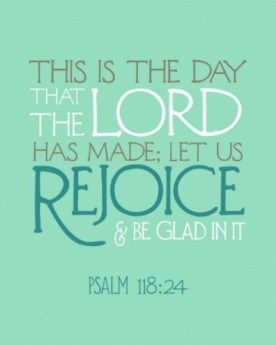
This is the day that the Lord has made; let us rejoice and be glad in it.

Weekly Devotional Image

Depending on where you grow up in church, there are some hymns that are so familiar you just know them deep down in your bones. All you need to hear is the first note, or the first word, and before you know it the rest of the hymn comes floating out. And, more often than not, you get the hymn stuck in your head all day long after worship.

However, for as many hymns as we know deep in our bones, there are an equal number of hymns that are so unfamiliar, that if we were to hear the entire song, we’d wonder if it was in our hymn book at all.

Throughout my life I went to church on Sunday; I prayed when I was supposed to, I listened when I was supposed to, and I stood up to sing when I was supposed to. There are hymns in our hymnal that immediately draw me to a particular time and place when I can remember it being used in worship. But prior to becoming a pastor, I had never heard the hymn “This Is The Day.”

I’m not sure how’s it possible, but I can remember being at one of my first clergy events having just been assigned to my first church, and everyone started singing it together and I had no idea what was going on. Embarrassed, I started opening and closing my mouth as if I knew the song, and spent most of the rest of the session looking for it in the hymnal and pondering how I could’ve missed it.

this-is-the-day-360x450

Fast forward to Sunday, when our choir both began and ended worship with “This Is The Day.” After half a decade of ministry I’ve used “This Is The Day” to start more worship services than I can count, but yesterday was the first time I ever heard the hymn at the end of a service.

And it was perfect.

This is the day that the Lord has made! Let us rejoice and be glad in it! What a wonderful way to be sent out into the world to be God’s people. The words are not meant for our orientation to worship alone. They can be a tremendous blessing and reminder that God has made each day, that we can rejoice and be glad in it.

Can you imagine how differently we would live if we started and ended every day with these words? Can you picture how wonderful it would be to contemplate the blessing of life every morning, and express gratitude for the joyful day every evening?

As we take steps closer to the end of Lent, as we prepare to enter into the darkness made manifest in the shadow of the cross, as we wait for the promised joy of the first Easter morning, let us give thanks to the Lord our God for each and every day, knowing we can rejoice and be glad.

An Exodus For The Rest Of Us

strangely-warmed-spreaker-header

This week on the Strangely Warmed podcast I speak with Teer Hardy and Jason Micheli about the readings for the The Liturgy of the Passion [Year B] (Isaiah 50.4-9a, Psalm 31.9-16, Philippians 2.5-11, Mark 14.1-15.47). Teer serves as the associate pastor at Mt. Olivet UMC and Jason is the executive pastor of Aldersgate UMC (both in Northern Virginia). Our conversation covers a range of topics including talking about ourselves as little as possible, the freedom to fail, memorizing scriptures and prayers, an accursed way to die, shame, the gospels as television channels, the nude dude, and disappearing from the story. If you would like to listen to the episode or subscribe to the podcast you can do so here: An Exodus For The Rest Of Us

J

Make The Church Weird Again

Jeremiah 31.31-34

The days are surely coming, says the Lord, when I will make a new covenant with the house of Israel and the house of Judah. It will not be like the covenant that I made with their ancestors when I took them by the hand to bring them out of the land of Egypt – a covenant that they broke, though I was their husband, says the Lord. But this is the covenant that I will make with the house of Israel after those days, says the Lord: I will put my law within them, and I will write it on their hearts; and I will be their God, and they shall be my people. No longer shall they teach one another, or say to each other, “Know the Lord,” for they shall all know me, from the least of them to the greatest, says the Lord; for I will forgive their iniquity, and remember their sin no more.


I’ve been in ministry for roughly 5 years and I’ve finally figured it out. After all the sermons and all the meetings, after all the prayers and preparation, I know how to fix all the church’s problems.

It’s time to do a new thing.

Now, before we get to the solution, we need to talk a little bit about the problem that needs fixing. Churches everywhere, not just here at Cokesbury, are suffering under what I will call the paralysis of analysis. We spend far too much time looking at what we’ve done, evaluating past strengths and weaknesses, such that we don’t spend enough time looking forward. We don’t even ask if God is doing a new thing. Instead we assume that God did all the things God was going to do, and if it worked in the good ol’ days then it should certainly work now.

Here’s an example: Communion

Two weeks ago, on the first Sunday of the month, we had communion like we usually do. I stood here at the front of the sanctuary, and I prayed for God’s anointing on the bread and the cup. We all prayed together, we stood together, and we began feasting together.

One by one you came forward with outstretched hands recognizing the incredible gift that you were receiving. I took the bread, placed it in your hands, you dipped it in the cup, partook of the meal, and returned to your pews.

It was a holy thing.

However, there was a young family with us in worship two weeks ago, a family who has never ever been to church. They sat patiently during the service, though I’m sure that a lot of what we did must’ve sounded and felt strange. But nevertheless, when the time for communion arrived, they stood up like everyone else, walked to the front, and prepared to celebrate the joy of the Lord’s Supper.

I reverently handed a piece of bread to the mother, who bowed penitently before dipping the bread in the cup. I then knelt down close to the floor to hand a piece of bread to her son, but the longer I held it in front of him the longer he stared at it. I motioned for him to take it, which he eventually did, but before dipping it in the cup he frantically looked between his mother’s eyes and the brim of the chalice back and forth, back and forth.

When finally I said, with every bit of pastoral bravado, “My son, this is Jesus’ gift for you.” To which he said, “Yeah, but you said this is his blood, and I don’t know how I feel about drinking it.”

            And he promptly swallowed the un-dipped piece of bread, and jogged back to his pew.

communion_elements

            We have been doing what we do for so long that many of us neglect to think, at all, about what we are doing.

We, in many ways, are exactly like the Israelites during the time of the prophet Jeremiah. The days are surely coming, says the Lord, when I will make a new covenant with the house of Israel and the house of Judah. It will not be like the covenant I made with their ancestors when I took them by the hand to bring them out of the land of Egypt – a covenant they broke.

God had to do a new thing, not because there was anything inherently wrong with the first covenants, but there was something wrong with the participants within the covenant. Their faithfulness, their days of living as the people of God, had become so repetitive, that the Law God offered them was nothing more than a clanging cymbal, instead of the lifeforce it was meant to be.

Many of them followed the Law, they ate the right food at the right times in the right places, they abstained from foreign worship, and they wore clothes without mixing fibers, but it was done simply because that’s what they were supposed to do.

They were going through the motions.

They, to use God’s analogy, were like a spouse who no longer remembered what drew him or her to the marriage in the first place. They were waking up every morning to make breakfast, rushing to get the kids out the door, and maybe even stopping to give their beloved a kiss on the cheek, but without love, without intention, without grace.

For the people of God during the time of Jeremiah, it was all about the external and rarely about the internal. It was assumed that if you did all the right things, life would work out accordingly. Day to day experience was rationalized through objective realities – children exist to help the family, the community exists to maintain order, the worship of God exists to move life along.

There was no “why?”

But this is the covenant that I will make with the house of Israel after those days: I will put my law within them, and I will write it on their hearts; and I will be their God, and they shall be my people. No longer shall they teach one another, or say to each other, “Know the Lord,” for they shall all know me, from the least of them to the greatest, says the Lord; for I will forgive their iniquity, and remember their sin no more.

God looked out on the people, a people for whom the law was written on stones and parchment, a people who did what they were told without it providing life, and decided the time had come for a new thing.

The days of laws written on stone came to an end. There would be no need to write them down for all to see and few to follow.

Instead of attempting to adhere to a code of do’s and don’ts, instead of the Law being the thing they worshiped, instead of the marriage dissolving into routine rather than romance, God writes the law on their hearts, on our hearts.

No longer would the people need to shout at one another until they were blue in the face, “Know the Lord!” No longer would the marriage partner scream at the spouse, “Do your duty!” No longer would the people walk around as if God wasn’t there with them all the while.

This was the beginning of a new day, one in which all people would no longer know about God, with the right words and right theology. Instead they would know God, with all the intimacy needed, in which the “why” would become more important than the “what,” in which a new covenant was established.

            So now to the solution… The time has come to embrace the weird.

WEIRD

If you take a step back from all of this, from the pageantry and the pedagogy, from the liturgy and the lighting, being the church is a pretty weird thing. We take time out of our schedules every week to sit in a strangely decorated room, to listen to somebody wearing a dress talk about texts that are far older than even the country we’re in, and then we do the even weirder practice of pouring water on people’s heads and eating a poor Jewish man’s body and drinking his blood.

We are pretty weird.

But, because Christianity has become so enveloped by the world, we often see and experience what we do as being normative. We make assumptions about ourselves and others based on the fact that this is “what we do.”

But if we only focus on “what we do” instead of “why we do it” then we neglect to encounter the weirdness of who we are.

The time has come to make the church weird again. To embrace all that separates us from the expectations of the world. In no other place, in no other gathering, do we willfully consider how far we have fallen from what we could be. In no other arena of our lives do we say, and believe, that there is something inherently powerful about gathering even just to sit in silence for a few moments. In no other community can we find the power and the bravery to tear down injustice and overthrow corruption and evil.

28575700_10155147927847797_2581309506758064640_n

The time has come for us to re-evaluate our “whats” and begin to shore up our “whys.” Instead of going through the motions of our faith, instead of taking the church for granted, we have to ask ourselves “Why are we doing all of this?” “What does this have to do with the kingdom of God?” “How does the church make tangible the new covenant of God?”

If we can’t answer those questions, then we need to dive deep into the “why.”

            Better yet, we should, at the very least, start with our “why.”

Why are we here? Are we here because we don’t have certainty about anything else and we’re looking for answers? Are we here because we’ve always gone to church and we don’t know how to live any other way? Are we here hoping to get something out of church?

Or, are we here because we know God is getting something out of us? Are we here not for ourselves, or our families, but for the Almighty Father, Son, and Holy Spirit? Are we here because God found us when we were lost and showed us a better way?

The people during the time of Jeremiah were lost. They were lost in themselves, lost in their exile, even lost in the Law. They were a people of “what.”

            God saw their suffering, God saw their heartless practices, God saw their injustices, and ultimately saw it fit to do a new thing. The new covenant was inscribed on the hearts of God’s people, such that they would remember the “why.”

Perhaps God’s Spirit is moving again in such a way that the new covenant will break our hearts of stone and we might know that God is ours, and we are God’s. Maybe the time has come for us to question every little thing we do as a church so that we break free from our bondage to doing what we’ve always done such that we can ask why we do what we do and start over with God’s new covenant.

Perhaps the time has come to make the church weird again. Amen.

To My Youngest Sister On The Occasion Of Her Engagement

Jeremiah 31.31-33

The days are surely coming, says the Lord, when I will make a new covenant with the house of Israel and the house of Judah. It will not be like the covenant that I made with their ancestors when I took them by the hand to bring them out of the land of Egypt – a covenant that they broke, though I was their husband, says the Lord. But this is the covenant that I will make with the house of Israel after those days, says the Lord: I will put my law within them, and I will write it on their hearts; and I will be their God, and they shall be my people.

20293024_10155585934242840_1460480852449788428_n

I answered the phone yesterday afternoon to the delightful news of your engagement. You shared the where, and the how, and the when. I listened with my imagination and tried to picture the scene as it all unfolded. I contemplated the beginning of your relationship and all the mountains and valleys that led to the proposal.

And as soon as you hung up to call the next person on the list, I gave thanks to God.

I gave thanks to God not because you’ve found your partner, or that you were asked in accordance with your romantic desires; I gave thanks to God because your engagement is a sign (and reminder) of God’s covenant with all of us.

When the day of your wedding arrives, I will stand with the two of you by the altar, and I will ask you to make promises (read: covenants) with each other about the future. A future that you cannot possibly imagine. And I will save more theological reflections for that particular moment, but until that holy time, I will share this – there is a difference between the promise that is now present on your finger, and the promise that marks our hearts.

For centuries the people of God abandoned the ways of God. Rather than rejoicing in all the good gifts they received, they (just like us) wanted more. They wanted more power, more wealth, more esteem at the expense of their faithfulness, holiness, and convictions. They worshiped other gods, they rejected the covenant, they assumed that they could make it through this life all on their own.

And for that reason God established a new covenant.

It was a new covenant not because the first was flawed, but because the partner of the covenant was flawed. The covenant became a list of dos and don’ts such that they worshiped the Law rather than the One who gave the Law. Moreover, they began to see one another not as fellow brothers and sisters set apart by God, but as objects to be manipulated for individual gain.

In the fullness of time God saw fit to establish a new covenant through water and Spirit, the covenant of baptism, through which we are incorporated in Christ’s church. It is a sign of a promise written on our hearts that God will be our God.

It is not a ring on a finger.

That is a different sort of promise. That promise (of which you sent a picture to me minutes after the proposal) is a promise made between two of God’s people in anticipation of God’s promise being made manifest.

That’s not to say that God’s wasn’t there on the mountaintop when you shouted “yes!” with gleeful joy. God certainly was; just as God has been with the two of you in every moment of your relationship. But there is a new covenant coming, one made between the two of you in the sight of God, and in the sight of the community that will promise to hold you accountable to the covenant you are making.

What I’m trying to say is this: the covenantal moment on the mountain is a reminder of the power and necessity of the church. The church (for all of her warts and bruises) makes intelligible the kind of promises that you and your beloved have made, and will continue to make, with one another. The church itself is a covenant from God to us. The church is the bride to Christ as bridegroom. We make promises with the Lord to live in this life in a way that is in accordance with the grace made manifest in the manger and exemplified in the empty tomb.

You two are now on a path that Christians experience every Sunday in worship, through every clasped connection of hands in prayer, in the breaking of bread, in the baptism by water, in the singing of hymns, and even in the occasional sermon.

Your engagement is a reminder of God’s engagement (covenant) with us. And for that I give thanks to God.


Sincerely,

Your Big Brother