Devotional – Isaiah 42.1

Devotional:

Isaiah 42.1

Here is my servant, whom I uphold, my chosen, in whom my soul delights; I have put my spirit upon him; he will bring forth justice to the nations.

Weekly Devotional Image

I need to apologize. At least, I need to apologize to the people of St. John’s who were present in worship on January 1, 2017. We started a new sermon series on “Dumb Things Christians Say” and I decided it would be good to start with “Everything Happens For A Reason.” It is one of those trite and cliché Christianisms that are forever being flung around without anyone thinking about the consequences of such a statement.

I began the sermon with a story and a quote from Franklin Graham, son of Billy Graham, who recently said that “It wasn’t Russia who intervened in the election of Donald Trump, it was God.” I then went on to theologically proclaim the strange tension Christians live in between and all-powerful God and a free humanity; God rules this world but gives us the freedom to act in the world.

The thrust of the end of the sermon went like this: “Sometimes there are reasons things happen, people feel tempted to go faster than they should and it means they run through red lights, they neglect to check their blind spots, or they run into icebergs. Sometimes people feel disaffected and forgotten by their government and they come out in droves and subvert the majority of polls and elect a political outsider to the most powerful position in our earthly world.

But that doesn’t mean that God made a car accident happen, or that God willed the sinking of the Titanic, or that God had a reason for making Donald Trump the next president of the United States.”

everything-happens-for-a-reason

Upon listening to the audio of the sermon, and rereading it before posting it online, I realized that I was very heavy-handed with my language about President-Elect Trump, and that I inadvertently compared his election with the suffering of innocent people in car accidents.

What I should have said was that even though Donald Trump was elected by the people of the United States of America, and not by some divine act of providence, God still uses people like Donald Trump to make God’s will incarnate on earth. The beautiful wonder of the Lord is that God works in and through individuals in ways that we can scarcely imagine; a chance conversation, a fleeting dream, a subtle nudge in the right direction. We can have hope in the Lord regardless of who sits behind the desk in the Oval Office because we know that God is the one who has the final Word. God came into the world in order to free us from the last vestige that had a hold on us, death. God broke the chains of death’s dark shadow in order to guide us into the light of resurrection.

Jesus is the servant who God upholds, the chosen one in whom the Lord delights. Jesus is the one who brings forth comfort to the afflicted and afflicts the comfortable. Therefore, as disciples of Jesus Christ, we are called to pray for our president in order that he may discern how to bring peace and justice to this world in a way that resonates with Jesus’ peace and justice.

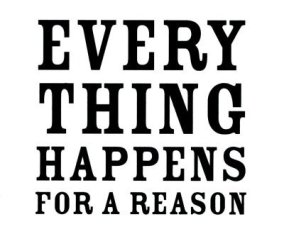
Everything Happens For A Reason

Deuteronomy 30.19-20

I call heaven and earth to witness against you today that I have set before you life and death, blessings and curses. Choose life so that you and your descendants may live, loving the Lord your God, obeying him, and holding fast to him; for that means life to you and length of days, so that you may live in the land that the Lord swore to give to your ancestors, to Abraham, to Isaac, and to Jacob.


Since Thanksgiving, I have been at a lot of tables with a lot of people and talked about a lot of things. That’s what the holidays are often about, and frankly what we remember the most; we might forget the first present we opened, or who was the first person to arrive, but we can almost always recall those table side discussions.

A lot of things happened in 2016 that warranted conversation at those particular tables. The deaths of celebrities, cultural icons, and transformative leaders; the rise in popularity of strange things like Pokemon Go, the Netflix hit Stranger Things, and Bruno Mars’ 24K Magic; the never-ending saga of suffering in Syria, the increase in terrorist related events throughout the world, and the ever thinning ice like situation in the middle east; the incredible Rogue One, the magical Fantastic Beasts and Where To Find Them, and vibrant color palette of Trolls.

But do you know what was talked about more than anything else?

Politics.

Politics. Politics. Politics.

And then when you throw a pastor into the fray at the tables, you start mixing together the real forbidden topics of conversations.

So I have learned, over the years, to keep my mouth shut. Whether I agree with a political policy or not, I nod my head along with the speaker regardless of their position and then reign myself to sit in silence.

In the last few months I have been at tables where people bashed the political rhetoric of the Republican Party, I listened to people re-imagine a new Democratic platform with notes hastily written on cocktail napkins, I watched people force index fingers at others while berating the likes of Bashar al-Assad and Vladimir Putin, I’ve heard people place bets over how long it will take Donald Trump to build a fence at the border with Mexico, and I’ve seen people cry with tears of pain, and people cry with tears of joy, while talking about the political future of the United States of America.

But I heard something the other day that I can’t get out of my head, one theologically politicized statement that has rattled through my brain ever since.

It went like this:

“Did you hear what Franklin Graham said?”

            “You mean the son of Billy Graham?”

            “Yes, him.”

            “No, what did he say?”

            “He said that it wasn’t the Russians who intervened in the presidential election, it was God.”

Now, before we really get into this, I want to be clear. Donald Trump is going to be the president of the United States. That’s a fact. Even though we now live in the so-called time of “post-truth,” the truth is that Donald Trump will be president.

But how Donald Trump became the president elect is something we should talk about. Particularly when one of the leading Christian evangelists in this country can say something like “God made Donald Trump president.”

dumb-things-christians-say-sermon-series-idea

Everything happens for a reason. This is true, of course, in the sense that actions have consequences. If I step down from this pulpit and walk to the back and flip the switch in the breaker box, all of the lights in the sanctuary will turn off. If plants do not receive enough moisture and sunlight they will not grow. If I give my wife a mop for Christmas, I’m going to get in trouble.

In our scripture from Deuteronomy, Moses offers the Israelites a similar reflection: if you choose life and love the Lord you may live in the land the Lord promised. Actions have consequences. However, the problem with “everything happens for a reason” is that we almost always imply that God is the reason that everything happens.

So, to take the recent election as our example, if it was God who intervened to make sure that Donald Trump became president, why wasn’t the victory more lopsided? Or, does it mean that everyone who voted for Clinton is a sinner for doing so because they went against God’s will? Did God choose not to “show up” for the Obama elections in 2008 or 2012? If everything happens for a reason, then why did God choose to have Donald Trump elected as president while all sorts of other things (like the situation in Syria, Police shootings, etc.) are still happening?

And this logic can also be applied to a number of things: If everything happens for a reason, then why did one of my best friends die in a car accident when she was a teenager? What is the reason for men who beat their wives, or women who abuse their children, or children who assault their parents?

When we throw out a trite and cliché sentence like “everything happens for a reason” it removes all responsibility from us and puts it all on God. And yet, we do believe that God is in control, that God is the author of our salvation, and that God continues to move and act in this world of ours.

everything-happens-for-a-reason

This is fundamentally at the heart of the strange mystery of what it means to be a disciple. On one side we affirm that God rules, and on the other side we affirm that God has given us perfect freedom to live and act in this place that God rules.

God has given us the freedom to make choices, for better or worse. From the Garden of Eden to the sanctuary of St. John’s on this first day of 2017 we are free. When we do something right or wrong, we can’t blame it on God. It is our freedom to choose who we are to be, that allows this world to be as strangely beautiful as it is, but it makes it strangely broken and flawed as well.

We are not marionettes being strung along by a divine puppeteer. God gives each of us, his creatures, a brain, a heart, a soul, to make choices and act in this world. We use things like prayer and the reading of scripture to help us determine how our choices can coincide with God’s will, but the choices are fundamentally ours to make.

All of us know that terrible things happen that cannot be explained. They are a part of life. But we also know that those terrible things do not have the final word. We know that God is working through us, helping us to see and to know who we are to be in order to transform this world into his kingdom. And we know that God is the one who has the final Word, thats what Jesus’s birth and resurrection changed. God came into the world in order to free us from the last vestige that had a hold on us, death. God broke the chains of death’s dark shadow in order to guide us into the light of resurrection. We know that even though terrible things happen, and will continue to happen, God’s love in Jesus Christ is the final Word.

Living in this tension of God’s perfect sovereignty and our perfect freedom is one of the things that makes being a Christian so challenging. For when we encounter those terrible things that happen in the world we often vacillate between “everything happens for a reason” or “life is meaningless.” Whereas Christians, people like us, are called to live somewhere in the middle.

In the early hours of April 15th 1912, more than a hundred years ago, the infamous ship named the Titanic sank in the Northern Atlantic Ocean. 1,500 people were lost at sea when the ship ran into an iceberg and it is still one of the worst maritime disasters to have ever happened.

Much like other events that grab the attention of the world, many pastors felt called to speak about the disaster the following Sunday in order to make sense of the tragedy. In a small sleepy Swiss village was a young pastor named Karl Barth who regularly bored his congregation with long theologically dense sermons, but the Sunday after the sinking of the Titanic called for something a little more meaningful.

He used the beginning part of the sermon to outline the power of the almighty from creating the cosmos to bringing life to all creatures. He referenced heavily from the book of Genesis and went on and on. But at the end he said something that grabbed their attention.

It went like this: God most certainly put the iceberg in the water, but God did not make the captain feel pressured to beat the record time across the Atlantic and thereby neglect to pass slowly and safely through a region filled with large icebergs.

1101620420_400

Barth’s simple reflection is by no means perfect, but it points toward a better way of thinking about, “Everything happens for a reason.” Sometimes there are reasons things happen, people feel tempted to go faster than they should and it means they run through red lights, they neglect to check their blind spots, or they run into icebergs. Sometimes people feel disaffected and forgotten by their government and they come out in droves and subvert the majority of polls and elect a political outsider to the most powerful position in our earthly world.

But that doesn’t mean that God made a car accident happen, or that God willed the sinking of the Titanic, or that God had a reason for making Donald Trump the next president of the United States.

And sometimes things happen for no reason at all. Fathers in perfect health and in the prime of their lives die of sudden heart attacks. Natural disasters like tsunamis and hurricanes come out of nowhere and devastate entire communities. Marriages fall apart for no particular reason other than the build up of tiny disagreements that never get settled.

And still there is hope. There is hope because God can work through people like you and me to bring about the kingdom on earth. God still speaks through the ancient scriptures to remind us of the importance of ministering to the last, the least, and the lost. God places opportunities in our lives that we can choose to respond to, and in so doing, we can become the reason good things happen.

God has set before us life and death, blessings and curses. We have the choice to choose life so that our families and friends may live to love the Lord and obey what he has taught. If we choose the good we may all live in the peace that God promised to God’s people from Abraham, to Isaac, to Jacob, to David, to Isaiah, to Jesus, to Peter, to Paul.

So it is good and right for us to start this New Year in this place, where God makes all things new. At this table we receive the spiritual food necessary for the journey of life. We break bread knowing that strange things are afoot in this world, but that God moves in and through people like us to shine as a light in the darkness. We surround the cup together knowing that Jesus’ sacrifice opens up the glory of the resurrection and gives us the strength to do incredible things here and now.

Not everything happens for a reason. But sometimes God calls us to be the reason something good happens to someone else. Amen.


The Humanity of God – Christmas Eve Sermon on Luke 2.1-7

Luke 2.1-7

In those days a decree went out from Emperor Augustus that all the world should be registered. This was the first registration and was taken while Quirinius was governor of Syria. All went to their own towns to be registered. Joseph also went from the town of Nazareth in Galilee to Judea, to the city of David called Bethlehem, because he was descended from the house and family of David. He went to be registered with Mary, to whom he was engaged and who was expecting a child. While they were there, the time came for her to deliver her child. And she gave birth to her firstborn son and wrapped him in bands of cloth, and laid him in a manger, because there was no place for them in the inn.

Colorful holiday lights background, defocused

Christmas Eve! No matter how old or jaded we may be, no matter what kind of year precedes this night, Christmas Eve never fails to brighten our spirits. I look forward to Christmas Eve with a kind of painful excitement: I know there are people here tonight who will not be here the rest of the year, I know this holiday carries with it more meaning than can be contained in a 15 minute sermon, and yet to share the story of salvation is one of my greatest privileges.

But then the question must be asked: Why are you here tonight? Some of you were raised in this church and can’t imagine being anywhere else. Some of you have come alone; others are with large families taking up an entire pew. Some of you have been planning to come here for weeks and some of you decided on a last-minute impulse. Some of you have been dragged here against your will, out of loyalty and guilt. And some of you are here for the first time in a very long time.

Some of you are young and are full of hope and anticipation; most of your Christmases are still in front of you. Some of you who are older are filled with memories of Christmases past that will never come again. Some of you are looking forward to getting back home to the fireplace and the presents and the tree; others dread going home. Whoever you are, and whatever you’re feeling, I’m glad you’re here tonight.


On April 26th, I woke up to the sounds of my excited wife declaring, “I think it’s happening.” The due date for our son had come and gone and each day we waited with anticipation of his coming arrival. So, being the incredible husband that I am, I started offering Lindsey all kinds of things: “Do you want me to make you breakfast? Can I massage your feet? Would you want me to call the doctor?”

She, however, was distracted from my offers by the pain she was starting to experience.

As the day progressed I must’ve checked our hospital bag no less than 42 times, I made sure we had enough clothes and snacks, I went through the 3 birthing playlists (one for calm, one for happy, one for pushing), and I asked Lindsey how she was feeling every fifteen minutes. While I was frantically going through my list over and over, Lindsey was on the couch trying to find a comfortable position to sit in until things really got going.

Mary and Joseph spent the day before their son’s birth traveling over harsh terrain while Joseph led the donkey that was carrying his pregnant fiancé. With every bump and slip, the pain Mary experienced increased and she hoped against hope they would find a place to stay in Bethlehem.

When my wife’s contractions started coming at a regular interval we called the doctor’s office and they told us to come in. Under the caring gaze of the nurses and medical staff Lindsey went through a number of tests before they told her, as kindly as they could, that it was still too early to go to the hospital, so we went home instead.

Mary’s contractions must’ve started to really ramp up as they arrived in the sleepy little town of Bethlehem. All the people they encountered were busily talking about the census that the emperor had required, how they all had to be there in Bethlehem without a choice. To the degree that no one even noticed the man escorting the pregnant woman on a donkey as they passed through the outskirts of the town.

We waited all day and finally at 9pm, the contractions we regularly occurring at such intensity that we knew the time had come. Being the good husband that I am, the car had been packed with our hospital bags for hours and all I had to do was gingerly walk Lindsey to the car and drive to the hospital with care and focus. When we were given a room time seemed to increase in speed dramatically. With every passing minute the contractions were intensifying and the nurses came in at a higher frequency to check on Lindsey and the baby.

Mary and Joseph wandered through the town at a snail’s pace hoping to find somewhere to stay, or a relative to encroach upon. But the farther they walked, the less hope they had of finding a place for the night.

At some point, my beloved wife was breathing strongly through a particularly rough contraction when the nurse said, “Honey, I think it’s time to talk about pain management.” I, watching her go through this thought to myself, “Gee, I think its time for me to have some pain management.” But, being the good husband that I am, I knew not to speak that thought out loud.

Joseph guided the donkey to their last hope, the inn, while his wife was breathing heavily through a particularly rough contraction. The innkeeper saw them walking up and went to the door to announce: “We’re full.” Being the good man that he was, Joseph then led the donkey and Mary to a stable, the only place left and helped her down into some crinkly hay.

At 7am on April 27th, Lindsey started to push. She was surrounded by a team of medical staff, machines monitoring every heartbeat and contraction, and by me trying to figure out what I could to do help.

When Mary could tell that the time had arrived, she started to push. She was surrounded by dirty animals huddled together for warmth, hay that was covered in dirt and hair from the animals, and a man who was trying to figure out what he could do to help.

And with a final push, a son was born into the world. The baby was quickly placed into his mother’s arms and for a fleeting moment nothing happened. In our hospital room the medical team waited with blankets and devices, in the stable the animals watched as the miracle of life came to fruition.

And then, with what sounded like a rush of wind, the baby sucked and breathed in air for the very first time.

From a dirty barn house to an immaculately clean hospital delivery room, the first breath of Jesus and my son Elijah highlights the fragility of this thing we call life. And don’t we take it for granted? All of us have been breathing throughout this sermon without even thinking about it, but we can only live because we can breathe.

In the beginning God’s breathed the breath of life into Adam, God breathed life into Jesus, God breathed life into my son Elijah, God breathed life into every one of you.

It is something worth celebrating because it is a miracle.

But this service, what we’re doing here tonight, is not a mere celebration of a mother and her newborn child’s arrival into the world. It is about more than the miracle of life. This is the unique story of God in the flesh. The baby placed in the manger is not us and we are not Him. He is totally other.

And yet – and this is the real mystery of Christmas – Jesus is the incarnation of the living God, but at the same time, though he is entirely other than us, he has become one of us. Nothing less than God himself has become Emmanuel, God with us.

In Jesus’ birth, God entered history in a new and strange way with the promise that in the kingdom that has no end, sadness will be turned into joy, sin will be destroyed by righteousness, and death will be defeated by resurrection.

But it all started in a tiny little stable with a couple all-alone in the world. That is the true miracle of Christmas – the fragility and humanity of God in a breath. For it is in our breathing that we constantly encounter the one thing we have to do to survive and the one thing we have from the beginning to the end of our days. And that is where God is; with every single breath we inhale the Spirit of the Lord who first breathed life into us. And in our breathing we connect with the one who breathed for the first time in the manger long ago…

And through that first breath, God emptied himself of all power and reign and might and majesty, leaving it all behind to enter our corrupted, polluted, and tragic world. Gone were the days of abandonment, gone were the times of uncertainty, and gone was the power of death. For God came into the world through a baby in a manger to save us from ourselves; to be with us in every single breath; to offer us the true gift of Christmas: God with us.

Merry Christmas. Amen.

christmascandle

The Tyranny of Titles – A Christmas Pageant Homily

Matthew 18.1-5

At that time the disciples came to Jesus and asked, “Who is the greatest in the kingdom of heaven?” He called a child, whom he put among them, and said, “Truly I tell you, unless you change and become like children, you will never enter the kingdom of heaven. Whoever becomes humble like this child is the greatest in the kingdom of heaven. Whoever welcomes one such child in my name welcomes me.”

img_2120

A father was with his four year old daughter last Christmas, and it was the first time she ever asked what the holiday meant. He explained that Christmas is all about the birth of Jesus, and the more they talked the more she wanted to know about Jesus so he bought a kid’s bible and read to her every night. She loved it.

They read the stories of his birth and his teachings, and the daughter would ask her father to explain some of the sayings from Jesus, like “Do unto others as you would have them do unto you.” And they would talk about how Jesus teaches us to treat people the way we want to be treated. They read and they read and at some point the daughter said, “Dad, I really like this Jesus.”

Right after Christmas they were driving around town and they passed by a Catholic Church with an enormous crucifix out on the front lawn. The giant cross was impossible to miss, as was the figure that was nailed to it. The daughter quickly pointed out the window and said, “Dad! Who’s that?”

He realized in that moment that he never told her the end of the story. So he began explaining how it was Jesus, and how he ran afoul of the Roman government because his message was so radical and unnerving that they thought the only way to stop his message was to kill him, and they did.

The daughter was silent.

A few weeks later, after going through the whole story of what Christmas meant, the Preschool his daughter attended had the day off in celebration of Martin Luther King Jr. The father decided to take the day off as well and treat his daughter to a day of play and they went out to lunch together. And while they were sitting at the table for lunch, they saw the local newspaper’s front-page story with a picture of Martin Luther King Jr. on it. The daughter pointed at the picture and said, “Dad! Who’s that?”

“Well,” he began, “that’s Martin Luther King Jr. and he’s the reason you’re not in school today. We’re celebrating his life. He was a preacher.”

And she said, “for Jesus?!”

The father said, “Yeah, for Jesus. But there was another thing he was famous for; he had his own message and said you should treat everyone the same no matter what they look like.”

She thought about it for a minute and said, “Dad, that sounds a lot like do unto others as you would have them do unto you.”

The dad said, “Yeah, I never thought about it like that but it’s just like what Jesus said.”

The young girl was silent again for a brief moment, and they she looked up at her dad and said, “Did they kill him too?”

img-wallpapers-christmas-eve-omohit-158401

Kids get it. They make the connections that we’re supposed to make. And even though 2016 has been a rough year with the political rhetoric and partisanship at its worst, and all the culturally significant individuals we lost (David Bowie, Leonard Cohen, Prince, Gene Wilder, John Glenn, etc.), and with the migration of refugees from the Middle East to Europe at the highest levels since the Second World War… our preschoolers have had a tremendous year.

Today, we adults live under the tyranny of titles. We want to label individuals based on a crazy assortment of criterion. He’s a Republican, she’s a Democrat, that family is poor, that family is rich, that woman is black, that man is Hispanic, that couple is gay, that couple is straight.

But the Preschoolers who gather in our basement don’t see the world and one another the way we see the world and one another.

Instead they see each other as Cruz, and Hadley, and Charlie, and Ellie Rose, and Owen, and Maddie, and Graham, and Henry. They, unlike us, do not view the world through the cynical lens that so many of us have adopted over the years. They, unlike us, see the world like Jesus.

Like that little girl with her father, they understand the cost of discipleship in a way that few us can.

I’ve been here long enough to have spent a lot of time thinking about what the Preschool should be teaching the children. I’ve had consultations with the teachers about curricula and paradigms. I’ve even met with some of you to discuss the growth and transformation of your children in response to the nurture and education they receive in the basement.

I’m guilty of the same cynicism that treats young people like objects to be molded in a factory to come out prepared for the world. When Jesus is the one who calls us not to make children into adults, but to change adults into children.

This Christmas, I have a challenge for you. Instead of being consumed by the desire to transform your little ones to fit into one of the labels of society, try to let them transform you. Try to look at the world the way they do. Try to love one another the way they do.

For it is on Christmas that we celebrate the birth of God in the flesh, born as a baby in a manger to a young couple all alone in the world. God did not come to change the world through political power or through economic wealth or through militaristic might. God changed the world through a baby, not unlike the ones we are celebrating with tonight. Amen.

Devotional – Romans 15.7

Devotional:

Romans 15.7

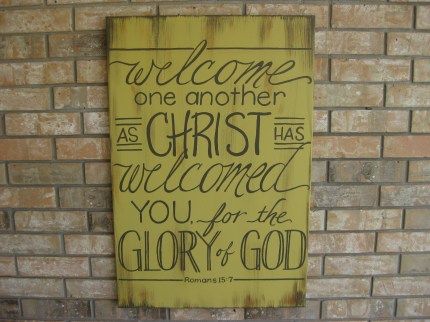
Welcome one another, therefore, just as Christ has welcomed you, for the glory of God.

Weekly Devotional Image

It is hard to welcome one another, until we ourselves know what it means to be welcomed. We can imagine what we need to do and how we need to behave, we can get out the best silverware and the matching dinner sets, we can fill everyone’s cups to the brims, but until we have experienced being welcomed, we will struggle to welcome others.

I spent the last week in Orlando, Florida with my in-laws for the Thanksgiving holiday. They were forced to practice a new type of welcoming and hospitality because they hosted their 7-month old grandson for the first time. In addition to the normal preparations for people visiting, they had to procure a stroller, pack-n-play, diapers, wipes, and an assortment of other necessary items. Moreover, they had to adjust their schedules to the sleeping habits of our son and reorient all of their plans around his general disposition and mood.

And while we sat around the dinner table on Thanksgiving I was struck by how welcomed I felt throughout the week. They could have made assumptions about what we needed and then acted on it, but instead they approached us and asked what they could do to help. They could have become quickly frustrated with Elijah changing their plans but they adapted and made us feel comfortable. They could have expected us to change to fit into their way of life, but instead they changed to fit into ours.

img_9511

One of the most brilliant aspects of the Advent season is our anticipation of the way God fit into our way of life by taking on flesh and being born as a baby in a manger. Rather than giving up on humanity’s inability to repent and turn back to God, God comes down and meets us where we are. God, in Christ, welcomes us into the kingdom of God by connecting with us in ways that we can perceive and understand.

The same holds true for the life of the church, and for us as individual Christians. We welcome one another just as Christ welcomed us, for the glory of God. When we encounter those for whom the church is a strange new world, we don’t just wait for them to “catch up,” instead we adapt our ways to meet them where they are. When we welcome people into our homes for food and fellowship, we don’t dominate the conversation with whatever we want, instead we seek to invite all present to shape what we talk about. When we discover new people sitting in the pews near us, we don’t make quick judgments about who they are based on their appearance, instead we remember how the Lord welcomed us and we do the same toward others.

Devotional – Philippians 4.7

Philippians 4.7

And the peace of God, which surpasses all understanding, will guard your hearts and your minds in Christ Jesus.

Weekly Devotional Image

How do you think people would respond if there was something that, if consumed once a week, would improve mental and physical health and reduce mortality by 20-30% over a 15-year period? What if this miraculous elixir was in reach of millions of people in America and research has proven that it truly does make a tremendous difference in the lives of people who consume it? How quickly do you think it would become the most popular remedy in the country?

Last week, under the “Breaking News” tab on USA Today Online, was a story detailing the availability of this particular product and the research to back up the claims. And, believe it or not, the “miracle drug” is regular church attendance.

Generic Background Image

After 20 years of research, a group of colleagues from Harvard University published their work suggesting that regularly attending religious services brings about better physical and mental health. Regarding physical health, the researchers claim that, “Adults who attend a service at least once a week versus not at all have been shown to have significantly lower risk of dying over the next decade and a half.” Beyond physical health, participating in regular worship leads to “greater optimism and lower rates of depression.”

After reading the article, one would think that every house of worship would be filled to the brim every weekend!

However, the article begs the question: Why do people worship?

Do we gather together because we want the physical and mental health benefits? Are we so consumed by the fear of death that we will sit in uncomfortable pews once a week just so we can live longer? Do we understand and value worship the same we that we understand and value the prescriptions in our medicine cabinets?

Or, do we worship because in worship we encounter the living God? Are we so consumed by the love of God that we cannot understand a way of life without gathering together once a week? Have we been transformed by the Lord who knows us and calls us by name?

The peace of God, which surpasses all understanding, will guard our hearts and our minds in Christ Jesus. We encounter the peace of God whenever we gather together, whenever we proclaim God’s Word, whenever we respond to that Word, and whenever God’s sends us into the world to be the light that shines in the darkness.

Worship, though apparently beneficial for our mental and physical health, is not about what we get out of it. Instead, worship is about what God gets out of us.

Devotional – Psalm 145.1

Psalm 145.1

I will extol you, my God and King, and bless your name forever and ever.

Weekly Devotional Image

On Saturday afternoon, the United Methodist Churches of Staunton, Virginia hosted our 2nd Trunk or Treat at Gypsy Hill Park. Over the last few months we collected monetary donations and countless bags of candy in order to distribute candy to all the children who would come to the park. Each trunk was uniquely decorated and when it was time to begin you could see the excitement in the volunteers and the children snaking in a long line around the lot.

For the better part of 2 hours we gave out candy to over 2000 children. I saw Annas and Elsas, at least 7 Marshalls (from Paw Patrol), a bunch of Darth Vaders, every princess you can imagine, and enough football players to make two full teams. Most of the children were remarkably polite, thanking each and every person as they made their way from trunk to trunk. And through it all we, as the church, lived into the reality of the body of Christ and loved our community through candy and fellowship on Saturday afternoon.

img_1982

When the line finally dwindled down to the last few families, we started to clean up our respective areas and prepared to leave. I had a few bags of candy left and my wife suggested bringing them over to the older boys who were skateboarding in the park. Too old to trunk or treat, most of them had watched us over the last two hours and were still skating as we were leaving. So I drove the car over to the skate area, and carried the largest bag of candy right up to who I imagined was the leader of the group (FYI I was still wearing my Hagrid costume). I handed the bag over and said, “Hey, I’m a pastor from town and we just finished this big trunk or treat and I’ve got some extra candy. I know you don’t know me, but I want you to know that God loves you.” To which the skater replied, “That’s like, righteous, man.” And I said, “You have no idea how appropriate that word is in this situation.”

How often do we extoll our God and King? Many of us are willing to take an hour out of our busy weeks to sit down in a sanctuary to praise the Lord, but how do we praise the Lord from Monday to Saturday? Some of us proclaimed the love of the Lord in each little piece of candy we distributed on Saturday afternoon, and even some skateboarders experienced our willingness to praise the Lord. After all, we learn to be generous from the One who is ultimate generosity. But extolling the Lord does not, and should not, be a rare occasion.

If we extoll the Lord, we do so knowing that the Lord is the giver of all gifts, including the gift of life. We praise the Lord because the Lord is the one rightly to be praised. We bless the name of the Lord forever and ever because the Lord has blessed us again and again.

Candy and Trunk or Treats, in and of themselves, can never bring us closer to God. Only when we extoll the name of the Lord, only when we realize that we are making the Word incarnate by becoming the body of Christ for our local communities, will those ordinary things become extraordinary avenues by which others can experience the powerful grace and mercy of the living God.


img_1985

Devotional – Luke 19.1-2

Devotional:

Luke 19.1-2

He entered Jericho and was passing through it. A man was there named Zacchaeus; he was a chief tax collector and was rich.
Weekly Devotional Image

In a few weeks many churches will celebrate All Saints Sunday. In the United Methodist Church we use it as an opportunity to prayerfully give thanks and reflect on the lives lost in the local church over the last year. Some churches will ring bells and read off the names of the dead, others will cover their altars with belongings from the deceased, and others will invite grieving family members to come forward and offer thoughts on those who died.

But when we think of the Saints of the church, we tend to think about incredible figures from church history: Augustine, Francis of Assisi, Mother Teresa, etc. We think that to be saintly requires a life of such profound faithfulness that most of us will never come close to it. Therefore, the saints we daydream about are the ones also found in stained glass windows and famous paintings.

Saints, however, are the people who inspire us to be totally different. And more often than not, the truest saints are those who were once a lot like us, and were radically changed by an encounter with the living God.

zacchaeus-1

Zaccheaus is a beloved and often overlooked person from scripture. The wee-little tax collector, despised by the town, wanted to catch a glimpse of Jesus, so he climbed a tree. Jesus, upon seeing the man up above, called him down and invited himself over for dinner. This interaction fundamentally transformed Zacchaeus’ life and propelled him to return what he had taken “even four times as much.”

Some of God’s truest and most peculiar saints are much more like the little tax collector who recognized his weakness enough to climb a tree to catch a glimpse of the Messiah. Zacchaeus was a strange man and his interaction with Jesus was equally strange. The result of sitting together for a meal was enough to radically transform his life forever. But even in his strangeness, we catch glimpses of the truth; we begin our journeys of faith by recognizing our need, but doing something in response to that recognition, and then discover that the love and power of Jesus has transformed our lives in ways that we never could have anticipated.

Zacchaeus is the kind of saint who could inspire us to change our lives precisely because he is so much like us. If we were only inclined to confront our brokenness, climb a tree to catch a glimpse of the Lord (or walk into a church on Sunday morning), we might just hear Jesus say, “I’m going to your house today,” and our lives would be transformed.

Devotional – Luke 18.9

Devotional:

Luke 18.9

He also told this parable to some who trusted in themselves that they were righteous and regarded others with contempt. Weekly Devotional Image

Jesus knew how to use his words. When he was surrounded by day laborers, he used parables about seeds and vineyards. When he encountered the wealthy and the elite, he used parables about banquets and wedding feasts. Even when he called the first disciples (fishermen) he knew to use imagery about fishing for people to drive the point home.

The stories and parables of Jesus are magnificent in their ability to convey a greater point about the kingdom of God in a way that is approachable and applicable. This is why some of the most memorable sermons we hear (even today) are those that confront and reimagine Jesus’ parables for our time.

However, the beauty and applicability of Jesus’ parables are also a fundamental challenge in that Jesus often used specific parables for specific people. The day laborers heard about seeds and fields because it would make sense to them in a way that it wouldn’t to someone so wealthy they ever had to enter the fields. Similarly, what Jesus says to the rich young man (sell your possessions and give the money to the poor) was meant for the rich young man. Yet, today, many of us preachers apply Jesus’ parables generally for all with ears to hear and not necessarily in the same specific manner that Jesus did.

The parable of the Publican and the Pharisee is one that receives a pertinent introduction: “He also told this parable to some who trusted in themselves that they were righteous and regarded others with contempt.” This is to say that Jesus used this particular parable for a particular set of people because they needed to hear it. Yet, this Sunday, many preachers will take the time to preach these words to their congregations whether the people trust too much in their own righteousness or not.

1020

Jesus knew how to use his words, and sometimes we do not. In this particularly vitriolic political season we post Facebook statuses as if we hope someone who disagrees with us will read it and be transformed. We send snide emails to family members and friends with the belief that we are right, they are wrong, and our email will fix everything. We speak down to the people around us with mixed metaphors and problematic parables because we are so consumed by judgment that we forget what it means to “be” with others.

It is good and right for us to remember to listen when Jesus speaks whether Jesus’ words were meant for a particular group or not. For it is when we immediately assume that Jesus meant his words for someone we are bickering with, that Jesus is actually talking about us.

On Homosexuality

Leviticus 20.13

If a man lies with a male as with a woman, both of them have committed an abomination; they shall be put to death; their blood is upon them.

Colossians 3.12-15

As God’s chosen ones, holy and beloved, clothe yourselves with compassion, kindness, humility, meekness, and patience. Bear with one another and, forgive each other; just as the Lord has forgiven you, so you also must forgive. Above all, clothe yourselves with love, which binds everything together in perfect harmony. And let the peace of Christ rule in your hearts, to which indeed you were called in the one body. And be thankful.

000

Preachers can fall into the rut of preaching on whatever keeps the congregation pleased; keep them happy and they’ll keep coming back, or something like that. This sermon series has been different. Instead of falling back to the familiar narratives that keep us smiling on our way out of the sanctuary, we have confronted some of the greatest controversies facing the church. There is a better than good chance that I have said something from this pulpit during the series that you don’t agree with, and I am thankful for the vulnerability and honesty that has been present in our conversations following worship. We can only grow as Christians in community, and that requires some honesty and humility and dialogue. Today we conclude the series with the topic of Homosexuality.


When someone rings the doorbell at St. John’s, you can hear it throughout the entire building. More often than not our wonderful church secretary will answer the door with a smile on her face and direct the person to their particular destination. We regularly have people down on their luck knock on our door looking for a little bit of financial help, sometimes we have people in the midst of a crisis who want to speak with a pastor, and every once in a while we have someone who is just interested in learning more about the church.

A couple months ago I was sitting in my office working diligently when the doorbell rang. I listened for the echoes down the hallway to discern what kind of interaction I was about to have when the secretary called my office and said, “Someone needs to talk to you.”

The visitor was an older woman, recently to Staunton, dressed to the nines with a gold cross hanging across her neck. When she offered her hand in order to introduce herself she had a subtle grandmotherly smell about her that immediately elicited visions of old books with tattered dust covers, prescription pill dispensers, and Vicks VapoRub.

She said, “I’m a United Methodist.”

            I said, “How wonderful, so am I.”

            She said, “I’m new to town, and I was just driving by and saw the sign out front and I thought I’d like to know more about the church.”

For the next thirty minutes we sat in the front pews of the sanctuary and I gave her the elongated elevator speech about St. John’s UMC. I pointed to the particularly pertinent aspects of our Christian architecture here in the sanctuary. I shared with her about the hilarity and joy of our Preschool that meets in the basement. I offered her reflective stories about the intellect of our Circle group of youth who are regularly more faithful than their pastor. I talked about our lectionary bible study that meets on Thursdays and how they contribute more to the sermon on Sunday mornings than they get credit for. And then I started to tell her about how we worship, how we let the Lord speak to us through scripture, hymns, prayers, and even sometimes the sermon.

When she asked about our attendance and giving, I proudly proclaimed our Sunday average and told her that we are about to pay our apportionments in full for the third year in a row. When she asked about the kind of people who participate in the life of the church, I told her the truth: that on Sunday mornings this placed is filled with the most beautiful and brilliant people Staunton has to offer.

For thirty minutes we discussed the ins and outs of the church, and for thirty minutes I watched her fall in love with the descriptions I shared. With every anecdote and short story I could see her seeing herself becoming a vital part of our worshipping community. Honestly, it was one of the best conversations I’ve had in a while and when it ended she said that she was eager and excited to join us in worship on Sunday morning.

We shook hands and said goodbye, but right before she made it to the door she turned around and said, “Just one more question… What do you think we should do about the gays?”

            Without hesitation I said, “I think we should love them.”

            “Well then,” she said with a sigh, “I won’t be coming back.”

Human sexuality, and in particular homosexuality, is one of the most polarizing issues in the United Methodist Church today. Like all of the controversies we have confronted over the last month and a half, it requires a tremendous amount of vulnerability and patience whenever it is discussed.

The controversy regarding homosexuality and the church is made manifest in a number of ways. For many, like the woman I met in the sanctuary, it is the defining question that determines whether someone joins a church or not. That specific conversation is not the only time I have been asked about the church’s stance on homosexuality in the middle of a conversation about joining or participating in the life of the church. In fact, during my second week at St. John’s, I received a phone call from the Newsleader inquiring whether or not I, as the pastor, offer sessions to counsel individuals out of their gayness. Which is to say, our local newspaper wanted to know if I could turn a homosexual into a heterosexual.

            But beyond church participation and local media questions, the controversy is one at the heart of what it means to wrestle with being a Christian today.

The United Methodist Church has a governing document called The Book of Discipline that is edited and republished every four years. In it we receive our organizational structure, the means by which individuals can become ordained clergy, and a host of other relevant church matters. In that book you can find the following statement regarding homosexuality: “The United Methodist Church does not condone the practice of homosexuality and considers the practice incompatible with Christian teaching.”

The language in the Book of Discipline about the incompatibility of homosexuality has led the church to also assert that any bishop, clergy member, or local pastor may be tried (as in a church trial) when charged with the following offenses: being a self-avowed practicing homosexual; or conducting ceremonies which celebrate homosexual unions or performing same sex wedding ceremonies.

So, to summarize, according to the United Methodist Church to be gay is to be incompatible with Christian teaching; you cannot be a clergy person if you are in a gay relationship, and clergy can be punished for marrying a gay couple.

When it comes to the bible, the witness of scripture is explicit regarding homosexuality. In Leviticus, God proclaims that anyone engaged in homosexual behavior is an abomination and should be put to death. In Paul’s letters, the sin of homosexuality is listed along the likes of envy, murder, deceit, gossip, slander, and faithlessness.

It is no wonder, therefore, that the United Methodist Church has taken the stance it has, and that many a preacher proclaim the incapability of homosexuality from the pulpits in the churches they serve.

At this point, I could point out that the few texts that do speak about homosexuality in scripture have been overly emphasized again and again whereas other biblically prohibited behaviors are tolerated. For instance, some of us like to eat shellfish, some of us have tattoos on our bodies, and some us have let our hair become unkempt (all worth punishment in scripture).

Or I could talk about how our country guarantees the rights of its citizens to not be discriminated against because of their sexuality, and how it has affirmed the constitutional right of its gay citizens to be married.

Or I could mention how many scientists and geneticists believe that one’s sexual identity is not a choice and is instead fundamentally wired into who they are through a particular gene.

Or I could bring up the fact that God, rather than condemning the marginalized and calling them incompatible, commands us to go to those on the fringes of society to be present with and for them.

Or I could make mention of the fact that Jesus [remember him?] says absolutely nothing about homosexuality in any of the four gospels.

But I won’t talk about that.

            Instead, I want to talk about repentance. Not the repentance the church thinks someone from the LGBTQ community should confess because of their identity. But the repentance the church desperately needs for singling out a particular community and denigrating them for decades.

175 years ago, many pastors across the United States preached sermons from their pulpits about how the bible reveals a divine sanction of slavery. There are plenty of verses in the Old and New Testaments that seem to affirm the subjugation of one people by another. We, as a church, were wrong.

60 years ago, many churches across the United States believed that scripture makes it clear that white churches should remain white. There are scriptures in the Old and New Testaments that can be interpreted to proclaim that society needs to be segregated and that birds of a different feather are not supposed to flock together. We, as a church, were wrong.

50 years ago, and still today, many Christians throughout the country believe that a literal reading of the bible makes plain God’s design for women to be submissive toward men. There are verses from the Old and New Testaments that can be understood to advocate for women to not have the same rights as men. We, as a church, were wrong.

And for all the wrongs we have committed, we confess and repent. We look back on the days long gone and shake our heads about how foolish we once were. We dig up old dusty sermons and can’t believe that a pastor would be so filled with hatred to single out a particular group of people and label them as property, or unworthy, or subordinate, or incompatible. We see the scars that are still very present in our society because of what the church once believed and for that we pray for God’s forgiveness.

            And we need to do it again today.

For too long, the church has abused its power to dominate and condemn particular people out of fear and bigotry. Pastors all across this land use pulpits like this one to isolate the LGBTQ community and tell them they are incompatible, they have no worth, and they have no value.

            Can you imagine what it would feel like to bravely take a step in faith to attend a Sunday worship service at a church only to hear that you are incompatible with Christian teaching?

Can you picture the pain and agony that would come if you felt God calling you to ordained ministry and the church said you’re wrong because of who you are?

Can you imagine the anger that would percolate inside you if you found someone you wanted to spend the rest of your life with and the church told you it would not be a part of your wedding?

If we’re honest, our answer is probably “no, we can’t imagine.” We can’t imagine what it would be like because we sit comfortably in our ivory towers of heteronormativity, assuming that the world would be a better place if other people looked like us, thought like us, and acted like us. But the beautiful and wonderful diversity of humanity is part of God’s divinely created order, and it is one that we foolishly try to fix on a regular basis.

Months ago, a woman wandered into this sanctuary to ask about the church, but what she really wanted to know was what we should do about the LGBTQ community. In her question, and response, I experienced the fear and loathing that is fundamentally disconnected from the love and grace and mercy of the living God. And I wish could go back and change my answer. Not because the answer I gave her was wrong, but there’s a better one.

“What do you think we should do about the gays?”

As God’s chosen ones, holy and beloved, we are to clothe ourselves with compassion, kindness, humility, meekness, and patience. We are supposed to bear with one another and forgive each other just as the Lord has forgiven us. Above all, we are called to clothe ourselves with love, which binds everything together in perfect harmony.

If can’t agree that the least we can do is love them, then we have no business calling ourselves Christians.