Godly Play

1 John 3.1-3

See what love the Father has given us, that we should be called children of God; and that is what we are. The reason the world does not know us is that it did not know him. Beloved, we are God’s children now; what we will be has not yet been revealed. What we do know is this: when he is revealed, we will be like him, for we will see him as he is. And all who have this hope in him purify themselves, just as he is pure.

Families are complicated. There was a time when “the family” meant a husband and wife, 2.5 children, a dog, and a white picket fence. But frankly, that time never really existed. Regardless of Leave It To Beaver and the Andy Griffith Show, the family has never been normative for everyone, and it certainly isn’t today.

Families have, and always will, constitute a difficult and confusing set of relationships. There are families with children and without children. There are families with two dads and two moms. There are families that represent different races, different languages, and different cultures. The family is anything but ordinary.

And somehow we believe that we become a new family as the church.

godly-play

We might spend most of our lives debating who is in and who is out, whether its in regard to our family units, or our communities, or even our country. But here in 1 John we are offered a corrective: in the church we are all children of God, regardless of our community or culture or race or ethnicity or sexual orientation or just about anything else. Here in this place we are family.

We are in the middle of Eastertide; that time when the glory of Easter is still shining bright. And we have scriptural texts all about how to be in relationship with people we do not know in addition to the people we do know – we are God’s children. But that doesn’t mean it’s easy.

Particularly when we say things like, “our church is a family” while we all act like we’re the adults and we forget what it means to be children.

The images of children are pervasive in scripture. And for good reason! Children live and work and play together with energy. They are not consumers sitting in pews waiting for something to happen. They are drawing in their bulletins, climbing over the pews, wandering around the altar area.

And even outside of the church, in the schoolyards and playgrounds, that’s where children live out their identities. They learn to communicate when something has gone wrong, they joyfully tug at one another, they make up new games, and they play.

Everything children do is about navigating a world in which their identities are still being formulated. They are not content with being labeled and placed in any kind of box. They live lives based on a fluidity that most of us have lost.

For some reason, as we mature into adulthood, our joyful play begins to fade and for some of us it completely stops. We just accept things the way they are, we make peace with the labels placed on us by society, we accept the love we think we deserve. We do all of this without ever asking, “Why?”

We are comfortable with our current relationships instead of forging new ones. We come home most evenings not with thoughts of what went well, but instead with thoughts about how everything fell apart. And, more often than not, we’d rather relax than play.

But not today.

The children of God, that’s us, work out their identities and relationships with energy and commitment and patience and intensity. They do it through play.

1 John 3, the text read for us this morning, compels and encourages us to see one another as children. It begs us to imagine a world in which we are still those joyful playful versions of ourselves.

So, I could fill this sermon with stories of how children play and come to inaugurate new visions of reality. I could call on each of you to remember your childhood games and imaginations. I could even ask us to think about the importance of being inclusive in the midst of playing with other and end with some sort of egalitarian vision of the church.

            Or, we could just play…

(For the next fifteen minutes everyone in worship had the option to play with play-dough, percussion instruments, blocks, coloring books, and an assortment of other activities.)

The Gloves Come Off – David Bentley Hart vs. NT Wright

Translations of the New Testament, and the Bible as a whole, are a dime a dozen. In most United Methodist Churches you’re likely to find copies of the New Revised Standard Version in the backs of the pews. In other denominations you might find the New International Version, or the New Kings James Version, or the Common English Bible, etc. And every once in a while a theologian will undertake creating his/her own translation based on the original Greek/Hebrew.

Whenever someone produces a translation it is important to remember that a translation is also always an interpretation. The translator makes important choices on how a particular word or phrase should be rendered in contemporary English, and because this has been done again and again, there are certain verses in certain translations that are very different from one another.

lead_960_540

Back in October (2017) the well known theologian David Bentley Hart released his translation of the New Testament. Unique to his translation is a willingness to keep the strange (and sometimes confusing) nature of the original Greek in an English form. Comparing it to something like the NRSV results in a difficult endeavor, however what Dr. Hart accomplished is rather remarkable when one considers how the original Greek actually reads.

And, of course, other theologians began to weigh their opinion over the recent addition to the fray. Some said that Dr. Hart revolutionized the way we will read the Bible for years to come, while others dismissed it as yet another unnecessary addition to the great pantheon of translations.

But one particular review stood out regarding its negative tone and all around language: NT Wright’s.

80652

For months Dr. Hart has remained silent regarding his colleague’s review… until now. My friend and podcast partner Jason Micheli was fortunate to have a conversation with Dr. Hart regarding his translation and his thoughts about NT Wright’s negative review. The following episode covers a range of topics including lots of stained glass language, the Easter story, biblical grammar, spirits and souls, the worst translation of the New Testament, and an ax to grind in Revelation. If you would like to listen to the episode, or subscribe to the podcast, you can do so here: The Gloves Come Off


Devotional – Psalm 4.4

Devotional:

Psalm 4.4

When you are disturbed, do not sin; ponder it on your beds, and be silent.

Weekly Devotional Image

I like going to the gym. It’s one of the few places I can go without being spotted as a pastor (and therefore can avoid of all the Christianisms that often occur like, “I haven’t been to church in a long time,” and “What do you think heaven is like?”). There is a peace I experience while running on the treadmill in that I can be alone in my thoughts, with just enough distraction in running to actually relax.

On Monday afternoon, while about halfway through my run, my mindful journey was interrupted by the person running next to me. When I quickly glanced over it was clear that he was deeply disturbed by something on the television screen and I could hear him cursing under his breath. For 15 minutes I continued to run in silence, but I could not stop listening to, and worrying about, the man next to me. With every passing minute his face grew redder, his volume increased, and his anger became even more palpable until he could no longer stand it, he shut off the machine, and he walked away.

1280-treadmill

I honestly left the gym feeling pretty good about myself. Not only had I taken the time to be mindful about my physical health but also I wasn’t nearly as angry or ridiculous as the man running next to me. I know I left on Monday afternoon with a sense of pride. At least, I did until I got in the car, started listening to the news on the radio, and saw my tight knuckles gripping the steering wheel as I listened to all that is going on in the world. By the time I got home I realized that I was no better than the man from the gym, the only difference was he let out his emotions in front of everyone and I did it in the solitude of my car.

How do you respond to difficult information? Do you pick up a nearby object and hurl it across the room? Do you mutter words of anger under your breath? Do you lash out on those around you? Do you clench your fists in concentrated frustration?

It is impossible, and frankly unhealthy, to keep everything bottled up. Whether it’s a response to what you witness on the news or learning something disturbing about someone you know and love, we can’t avoid how we feel. But, as the psalmist puts it, we can at least take the time to ponder it in silence before reacting.

If the Lord we worship responded to our many failures with knee-jerk reactions, this world would probably not exist. But God is patient and contemplative when it comes to how God’s creatures act. Sometimes God is silent specifically such that we might come to realize who we are and who we need to be.

We all live and move in a world predicated on knee-jerk reactions. The 24-hour news cycle bombards us with information designed to elicit responses from us. We check our emails, and social media accounts with a regularity that is frightening (myself included). But God shows us a different way; a way in which we can ponder the events of the world in silence before jumping into the fray.

Don’t Make Jesus Hangry

strangely-warmed-spreaker-header

This week on the Strangely Warmed podcast I speak with Teer Hardy about the readings for Easter 3B (Acts 3.12-19, Psalm 4, 1 John 3.1-7, Luke 24.36b-48). Teer is the associate pastor of Mt. Olivet UMC in Arlington, VA and he and I help share the responsibilities for editing the Crackers and Grape Juice Podcast. Our conversation covers a range of topics including tee-ball, the challenges of returning to church after paternity leave, looking at the verses before the lectionary text, offensive evangelism, the elect and the reject, MLK’s legacy, the absence of silence, hol(e)y hands, and Jesus’ immoral teaching. If you would like to listen to the episode or subscribe to the podcast you can do so here: Don’t Make Jesus Hangry

th

Walking The Walk

1 John 1.1-2.2

We declare to you what was from the beginning, what we have heard, what we have seen with our eyes, what we have looked at and touched with our hands, concerning the word of life – this life was revealed, and we have seen it and testify to it, and declare to you the eternal life that was with the Father and was revealed to us – we declare to you what we have seen and heard so that you also may have fellowship with us; and truly our fellowship is with the Father and with his Son Jesus Christ. We are writing these things so that our joy may be complete. This is the message we have heard from him and proclaim to you, that God is light and in him there is no darkness at all. If we say that we have fellowship with him while we are walking in darkness, we lie and do not do what is true; but if we walk in the light as he himself is the light, we have fellowship with one another, and the blood of Jesus his Son cleanses us from all sin. If we say that we have no sin, we deceive ourselves, and the truth is not in us. If we confess our sins, he who is faith and just will forgive us our sins and cleanse us from all unrighteousness. If we say that we have not sinned, we make him a liar, and his word is not in us. My little children, I am writing these things to you so that you may not sin. But if anyone does sin, we have an advocate with the Father, Jesus Christ the righteous; and he is the atoning sacrifice for our sins, and not for ours only but also for the sins of the whole world.

Here, on the other side of Easter, I’ve been doing some thinking. On Easter we were singing the hymns, and praising the Lord; we were on the mountaintop. But here on the other side, though we still walk in the light, we have to confront reality. And as I’ve been thinking, and confronting, I’ve come to realize some essential truths.

Our country is pretty messed up.

We can listen to the talking heads talk about how politically divided we are, and how we just need to reach across the aisle, and all that sort of stuff. But I’m talking about brokenness on an entirely different level.

We are so obsessed with financial gains and economic prosperity, that we’ve allowed capitalism to become our religion. It is what we worship. And the evils of capitalism, of which there are many, are as real as the evils of militarism and the evils of racism.

As a nation, we spend more money on national defense each and every year than we do on programs of social uplift, which is surely a sign of our imminent spiritual doom.

We perpetuate a culture in which 1 out of every 3 black men can expect to go to prison at some point in their lives. The price that we must pay for the continued oppression of black bodies in this country is the price of our own destruction.

There is so much injustice in this country: racial injustice, economic injustice, gender injustice. And they cannot be solved without a radical redistribution of political and economic power.

            Something must change.

Pause: how do you feel about all that I just said? Do you agree? Do you disagree? Are you clenching your fists in anger about the problems we have and are ready to do something about it? Are you clenching your fists because you’re angry that I’ve criticized our country and our culture?

            Most of what I just said did not come from me, but from another preacher, one by the name of Dr. Martin Luther King Jr. And it was because he was willing to say things like what I just said that he was murdered.

martin_luther_king_jr-_and_lyndon_johnson_large

This past week saw the 50th anniversary of Dr. King’s assassination. 5 decades have come and gone since he stood on the balcony of his motel and was gunned down. 5 decades of wondering whether his dream will ever become a reality. 5 decades spent holding up his quotes and remembering his speeches.

But what do we actually remember?

Perhaps the two most remembered passages from Dr. King’s great collection of speeches and addresses are his “I Have A Dream” speech which he offered in Washington DC, and the quote that I saw again and again this week: “Darkness cannot drive out darkness; only light can do that. Hate cannot drive out hate; only love can do that.”

It’s a great quote. And it fits perfectly with out scripture today: “This is the message we have heard from him and proclaim to you, that God is light and in him there is no darkness at all. If we say that we have fellowship with him while we are walking in darkness, we lie and do not do what is true; but if we walk in the light as he himself is the light, we have fellowship with one another, and the blood of Jesus his Son cleanses us from all sin.”

There’s a nice and easy sermon there in which you can use Dr. King’s witness, and his quote about darkness and light, to describe and point toward the kingdom of heaven. But that sermon would leave us walking out of here with our chins held high, and perhaps would encourage us to pat ourselves on the back.

But Dr. King’s life and witness was about a whole lot more than one quote or one speech or even one issue. Just as Jesus’s life was about far more than just being kind to everyone.

Here in 2018 it’s hard to remember that a year before Dr. King was killed, he was one of the most hated men in the entire country. Contrary to what we see displayed every January when we celebrate his legacy, when King died he was not an icon of freedom and equality. In 1987 a poll revealed that almost 75% of Americans had a favorable rating of Dr. King, and Americans named him as the person they admired and respected more than any other person in the country’s history. And yet shortly before his death, in late 1966, 63% of Americans were vocally opposed to his words and work.

It’s hard to remember this, or even acknowledge it, because today everybody loves Dr. King. We celebrate his transformative work in documentaries and school projects. But it’s easier to celebrate someone when they’re no longer challenging, and upsetting, the status quo.

It’s easier to love a hero when they’re dead.

Dr. King was not only an activist for the Civil Rights movement, but was also a frustrating voice (to the powers and principalities) in regard to the Vietnam War, capitalism, and poverty. In fact he was shot the night after deliver a now infamous speech, not on securing the right to vote for black individuals, not on dismantling Jim Crow Laws, but on establishing a union for sanitation workers in Memphis, Tennessee.

We have so sanitized the legacy of his life that we forget he was once one of the most hated men in the country, we forget that he pushed an entire nation into places of discomfort; we forget that he was killed for challenging the way things were.

martin-luther-king-jr---mini-biography

Our sinfulness overwhelms our ability to remember and to be rational. We hear about godlessness and we immediately pull to our minds all those we believe who have fallen away, we encounter the challenges of God in scripture and immediately think about people in our lives who need to hear those words, and in so doing we forget that we are broken people, and that we need to hear those words as well.

If we say that we have no sin, we deceive ourselves, and the truth is not in us. We continually participate in a world in which people are battered, broken, and bruised over and over again. We, to use the language from our hymnal, do terrible things, and we leave things undone that we should’ve changed.

We hear about a young black boy in California who was shot for holding a cell phone, and we think there’s nothing we can do about it and after a few weeks we stop thinking about it all together.

We see images of families being literally ripped apart as mothers and fathers are sent back to countries they fled from and are forced to leave children here to fend for themselves. And we feel bad, but if don’t see it happening to our families, or in our neighborhoods, we just move on.

We drive by people in our community standing on the street corners begging for financial assistance, pleading for food, yearning for help, and we roll up our windows and lock our doors.

But the light of the resurrection shines out of the darkness of the cross and the tomb! That light pushes us into realms of discomfort as we are forced to reckon with our on sin and say, “no more!”

Talk of sin makes us uncomfortable particularly because we are far too comfortable in our sins. We don’t want our boats rocked; we don’t want to wrestle with what needs to change. And yet we worship a God who was nailed to a cross for challenging the expectations of the world.

All of this, the church, the faith, they exist because they have been handed down to us. Just as they were handed to Dr. King. His life was a testament and witness to the power of Jesus’ resurrection from the dead, it is what gave him the confidence to say and believe that something needed to change.

He walked the walk.

When we remember Dr. King, just as we remember Jesus, we celebrate their convictions and challenges, and we give thanks for their joy. But we must not forget the scars they bore for us. Dr. King was repeatedly beaten and arrested and eventually murdered. Jesus was berated, arrested, and eventually murdered.

We are here on the Sunday after Easter, the banners are still raised high, the “hallelujahs” still feel fresh on our tongues, and we are getting back to our routine, whatever that is. And we are reminded here in the glory of Eastertide, in the words of 1 John, in the witness of Dr. King, that we all sin. If we say we are without sin, we are contradicted by the reality of sin.

However, we also receive forgiveness in the risen Lord, a forgiveness experienced by the very first disciples who struggled under the weight of a new world in which God gave life to the dead. They, the disciples, heard, saw, and touched the Word. And in so doing they began the delicate walk of faith in which they recognized their sin and their forgiveness together.

The sinfulness to which we are so bound is made present in our individual lives, in our communities, and in our institutions. No person, no gathering, no organization is without sin. Which makes it all the more vitally important to remember the truth of Jesus’ life, to remember his words of conviction, and to remember that he died for both the godly and the ungodly so that we, all of us, may not sin.
1-John-Web

One of my professors loved to tell a story about his roommate from college. They were going to school in South Carolina during the height of the Civil Rights movement when my professor’s friend decided to travel to Washington DC in order to participate in a Civil Rights March. Upon returning back to school, the friend relayed what had happened during the trip:

He described that everything was about as normal as you could imagine. he arrived, met up with the people he needed to, marched where he was supposed to, handed out flyers. By the time it was over he was exhausted while waiting for his plane to bring him home. As he sauntered onto the airplane, he sat down in my seat and, you’ll never believe this, he was sitting next to Martin Luther King Jr.

It was the craziest thing. He had gone all the way to DC and here he was, sitting on an airplane, next to his hero.

“So,” my professor asked, “what happened?!” Well, he got so nervous, and he was sweating, and fidgeting, and rehearsing what he might say, but there was a small problem. Martin Luther King Jr. was asleep. I mean what was he going to do? Wake up the leader of the Civil Rights movement? So he just waited, sitting there, staring at him, watching him sleep. After the flight had nearly reached its destination, he finally opened his eyes. “Dr. King I don’t know what to say. You are my hero. I just traveled all the way to DC to help march for Civil Rights, you are such an inspiration, I am so impressed with…” “Thank you. God Bless.” he interrupted, seemingly ending the conversation.

But the young man was undeterred. “Dr. King you don’t understand, you have changed my life, you have opened my eyes to the many opportunities that are not available to others… “I appreciate your kind words son.” Dr King interrupted again. However he was was not finished, “Dr. King, you don’t understand. My father is a racist. I left home because of him and his prejudice. He offered to pay for my college, but I have cut all ties with him. We have not exchanged a word in years because of his racial bigotry.” At this point Dr. King’s eyes widened, he turned his body to face this young college student and he reached out and grabbed him by the collar, “You have got to love your father. Whether hes racist or not, loving him is the only thing you can do.” And with that he let go, closed his eyes, and promptly fell back asleep.

All of us, particularly those of us with a self-righteous leaning, are sinners in need of God’s grace. From the racists to those who abandon their racist family members.

One of the harshest realities this side of Easter is that most of us believe we are without sin, and we deceive ourselves.

Here at the table God invites us into fellowship. At this place the truth is laid bare; we are sinners in need of grace. But God does not just invite me, or you… God invites all into community with God and with one another. If we walk alone, then we walk in darkness, but if we walk together with God, then we walk in the light. Amen.

Devotional – Acts 4.33

Devotional:

Acts 4.33

With great power the apostles gave their testimony to the resurrection of the Lord Jesus, and great grace was upon them all.

Weekly Devotional Image 

A father was with his four year old daughter last Christmas, and it was the first time she ever asked what the holiday meant. He explained that Christmas is all about the birth of Jesus, and the more they talked the more she wanted to know about Jesus so he bought a kid’s bible and read to her every night. She loved it.

They read the stories of his birth and his teachings, and the daughter would ask her father to explain some of the sayings from Jesus, like “Do unto others as you would have them do unto you.” And they would talk about how Jesus teaches us to treat people the way we want to be treated. They read and they read and at some point the daughter said, “Dad, I really like this Jesus.”

Right after Christmas they were driving around town and they passed by a Catholic Church with an enormous crucifix out on the front lawn. The giant cross was impossible to miss, as was the figure that was nailed to it. The daughter quickly pointed out the window and said, “Dad! Who’s that?”

He realized in that moment that he never told her the end of the story. So he began explaining how it was Jesus, and how he ran afoul of the Roman government because his message was so radical and unnerving that they thought the only way to stop his message was to kill him, and they did.

The daughter was silent.

A few weeks later, after going through the whole story of what Christmas meant, the Preschool his daughter attended had the day off in celebration of Martin Luther King Jr. The father decided to take the day off as well and treat his daughter to a day of play and they went out to lunch together. And while they were sitting at the table for lunch, they saw the local newspaper’s front-page story with a picture of Martin Luther King Jr. on it. The daughter pointed at the picture and said, “Dad! Who’s that?”

“Well,” he began, “that’s Martin Luther King Jr. and he’s the reason you’re not in school today. We’re celebrating his life. He was a preacher.”

And she said, “for Jesus?!”

The father said, “Yeah, for Jesus. But there was another thing he was famous for; he had his own message and said you should treat everyone the same no matter what they look like.”

She thought about it for a minute and said, “Dad, that sounds a lot like do unto others as you would have them do unto you.”

The dad said, “Yeah, I never thought about it like that but it’s just like what Jesus said.”

The young girl was silent again for a brief moment, and they she looked up at her dad and said, “Did they kill him too?”

bl-martin-luther-king-jr

50 years ago today, while standing outside St. Joseph’s Hospital, Assistant Police Chief Henry Lux announced, “Martin Luther King is dead.” Rifle-armed police were blocking the front entrances and immediately had to hold back a crowd that gathered quickly. The city of Memphis quickly went into a state of emergency as news of Dr. King’s assassination became public.

Dr. King was in Memphis to help organize a strike of sanitation workers for higher pay and the right to union representation. Though known for his work in the Civil Rights movement, Dr. King was active in regard to a number of subjects including the Vietnam War, capitalism, and unjust economic practices. And because he was so vocal in turning things upside down (read: the first shall be last and the last shall be first), he was murdered.

Dr. King’s legacy is one filled with hope and, at the same time, frustration. He certainly left the country better than he found it, but few would argue that his dream has truly come to fruition. We are still a racially broken country, we are still held captive to the drama and economics of warfare, and the income inequality is higher now than it has ever been.

Part of what made Dr. King’s words and work so powerful is that he did what he did as a testimony to the virtues made real to him in Jesus. The Lord he met in the pages of his bible spoke decisively to him about the need to be prophetic in a time such as his. Jesus was a savior concerned with those on the margins, and therefore Dr. King believed it was his duty to be concerned with those on the margins during his lifetime.

When you look through the old speeches, the videos of the marches, and you weigh out how much he was able to accomplish in his 39 years of life, it is clear that grace was with him. But Dr. King’s vision of a better world, Jesus’ vision of the kingdom of God on earth, did not die with them. Those visions are now part of our responsibility, whether that means providing voice to the voiceless, or being in solidarity with those without power, or simply befriending the friendless, there is still work to be done.

Today we give thanks for the life and the witness of Martin Luther King Jr., we reflect on the last fifty years since his assassination, and we are bold to pray that God might use us like God used Dr. King knowing full and well what might happen to us in the end.

Witnessing By Listening

strangely-warmed-spreaker-header

This week on the Strangely Warmed podcast I speak with Tim Ward and Sarah Locke about the readings for the Easter 2B (Acts 4.32-35, Psalm 133, 1 John 1.1-2.2, John 20.19-31). Tim is the pastor of Restoration UMC in Reston, VA and Sarah is the pastor of Christ UMC in Staunton, VA. Our conversation covers a range of topics including red Christianity, the “perfect” church, God’s agency, unity vs. uniformity, witnessing by listening, the failure of statistics, BBT’s Learning To Walk In The Dark, reclaiming Eastertide, and hanging on to sins. If you would like to listen to the episode or subscribe to the podcast you can do so here: Witnessing By Listening

Art-of-listening_v1

Three Words

1 Corinthians 15.1-11

Now I would remind you, brothers and sisters, of the good news that I proclaimed to you, which you in turn received, in which also you stand, through which also you are being saved, if you hold firmly to the message that I proclaimed to you – unless you have come to believe in vain. For I handed on to you as of first importance what I in turn had received: that Christ died for our sins in accordance with the scriptures, and that he was buried, and that he was raised on the third day in accordance with the scriptures, and that he appeared to Cephas, then to the twelve. Then he appeared to more than five hundred brothers and sisters at one time, most of whom are still alive, though some have died. Then he appeared to James, then to all the apostles. Last of all, as to one untimely born, he appeared also to me. For I am the least of the apostles, unfit to be called an apostle, because I persecuted the church of God. But by the grace of God I am what I am, and his grace toward me has not been in vain. On the contrary, I worked harder than any of them – though it was not I, but the grace of God that is with me. Whether then it was I or they, so we proclaim and so you have come to believe.

Ah, the strange and bewildering day we call Easter. All of the Bible, all of the church, all of Christianity hinges on this day: Easter, Resurrection, out of death into life. If this story were not in scripture, we would’ve thrown our bibles away a long time ago. If the Bible does not tell us this story, it tells us nothing.

Easter is the one day when all of the hopes of the past are made manifest in the present. Today we are a church unlike many of the other Sundays in the year. On Easter our pews are filled with those deeply rooted in their faith, with those filled with questions, and with those filled with doubts. So, what does one say on a day like today? How might I meet each of you where you are and provide words of truth and challenge and grace? What can I say today?

The truth: He is risen! Hallelujah!

Graveside funerals make me nervous.

If we have a funeral in the sanctuary, most things can be taken care of and are under control. We can set the temperature, clear the parking lot, and truly celebrate the many ways in which God moved in and through the person now dead.

But when you’re at the graveside, everything is out of control. You might be driving in the sunshine while in the funeral procession, but the minute you hit the cemetery the clouds roll in and the rain begins to fall. You might have your bible open to a particular passage but then the wind will blow and you’ve gone from 1 Corinthians to Exodus. Or, as has happened to me far too many times, you’ll stand over the casket with dirt in your hands and ask everyone for a few moments of silence only to hear the faint but nevertheless decisive moo of a cow from a nearby farm.

Cemeteries are often in the strangest places. I’ve buried people in perfectly manicured military compounds where you’ll never get lost because there is always a solider ready to lead you out. I’ve buried people in cemeteries stuck in the middle of residential neighborhoods, next to a playground, and across the streets from a cow farm. I’ve even buried someone’s ashes in the backyard of a beloved family member.

And because they are often in the strangest places, they can be difficult to find.

Years ago, a young pastor was asked to do a burial service for an older man from the community who had no friends, and no family. The pastor was unable to speak with anyone about the man’s life, but he wrote a decent funeral sermon nonetheless, and when the appointed day arrive he got in the car and headed out for an old country cemetery out in the middle of nowhere.

He drove and drove, and though he did not want to admit it to himself, he was lost. He tried searching for the address on his phone, and he eventually stopped at a gas station to ask for directions. When he finally pulled up he was over an hour late.

As he drove across the open and barren landscape, the hearse was nowhere in sight, but the backhoe was next to the open hole, and there was a group of men resting under the shade of a nearby tree. The young pastor parked his car and walked over to the open grave and embarrassingly discovered that the lid was already in place and dirt had been already been sprinkled across the top.

The guilt welled up within the young preacher and he opened up his bible and began preaching like he never had before. He cried out to the heavens with clenched fists, he proclaimed the promise of resurrection, and he did so with a conviction rarely found in his Sunday delivery.

After his final “amen” he returned to his car while still sweating from his passionately delivered sermon. And just before he opened the door, he overheard one of the men under the tree say to the others, “I ain’t never see nothing like that before, and I’ve been putting in septic tanks for twenty years.”

holy-week-easter-title-still

Today is Easter and it is also April Fools’ Day. This is the first time both days have fallen together in 62 years. And for months I’ve been reading articles, and listening to other pastors, expressing the importance of incorporating humor in today’s worship service. And, of course, Easter is a joke – the greatest joke God ever played on the devil. But to trivialize this day, of all days, does a disservice to the decisive change made possible by this day. It belittles the death of Jesus to graveyard jokes about septic tanks. It makes the resurrection optional instead of essential.

If God didn’t raise Jesus from the dead, if the bodily resurrection isn’t real, then we are wasting our time. It’s as simple as that. The resurrection of Jesus from the grave is the vindication of all his teaching. It is what makes the sermons and the stories intelligible, it is the light in the darkness, it is the way we follow the way.

Without the resurrection, we have no business loving our neighbors, or enemies. Without the resurrection it would be absurd to teach our children the call to turn the other cheek. Without resurrection everything in the New Testament falls apart.

The world does not recommend doing any of this Christian stuff. It is strange and bizarre to give clothes to those who are naked, and to feed those who are hungry, and to befriend the friendless. We don’t do these things as Christians not simply because God tells us to, or because it’s the right thing to do. We do them because God raised Jesus from the dead!

The empty tomb is everything. It is funnier than any joke, it is more serious than any death, it is more majestic that any mountain, it is deeper that any valley. It is everything.

Without resurrection, I’ve got nothing to say. Without Easter, nothing that Christians do makes any sense.

“He is risen!” are the three precious words found at the heart of our identity. They changed, and continue to change, everything. They are the three words handed to Paul, and Paul to the Corinthians, and eventually to us.

Some of you know that I have an annual tradition of taking this cross out of the sanctuary on Good Friday, throwing it over my shoulder, and walking through town. I started this because years ago I was struck by often we keep our crosses tucked away in our sanctuaries, hidden among the altars and rafters. And so, for the last five years, I’ve marched around town with a cross on my back, beckoning all who encounter to remember that Christ died for them, and for the world.

On Friday I made my way across our parking lot with the cross thinking, somehow, it was heavier than last year, and eventually I made it to Route 1. I began by heading north, politely waving at cars and passers by, and I think it freaked some people out. There were many open mouths and puzzled expressions in regards to a bearded young man, all dressed in black, with a cross on his back.

But I kept walking.

After about twenty minutes there was a car to my left that slowed down as it came closer, and eventually pulled in front of me and into the closest parking lot. A man quickly exited his car and started walking toward me. After 20 minutes of walking I felt like God’s was giving me the opportunity to share the gospel story. In the man’s eyes I could sense a deep need and longing, and I was just the pastor to provide. So when he stood in front of me and said, “Can I ask you a question?” I replied: “Of course, my son, ask away.” To which he asked, “Do you know where the post office is? I can’t find it.”

“Yeah,” I said, “Its back a few blocks on the left… right across the street from my church.”

Another 20 minutes of walking passed by as a few drivers kindly honked their horns in support. When all of the sudden I noticed a car full of teenagers on the other side of the road, in which they were pointing at me. The driver’s made a quick u-turn, and then they stopped in the middle of Route 1 so that half of the kids could lean out their windows to take even more pictures. As they began driving away I heard one of the girls say, “Imma put him on my Instagram!”

Eventually, after walking for more than an hour, I started heading back toward the church, wondering if carrying the cross had really made any difference. I thought about all of the people who saw the cross and whether or not it made them reflect on what Jesus did for them. I wondered about how many of them even knew what I was doing.

Shortly before I got back to the church property, I saw a young man running toward me in full workout gear. He had headphones on that were clearly pumping some serious music and he was bopping his head back and forth. I assumed that he would run right past me, but he stopped briefly on the sidewalk, gave me a double index finger point, winked, and then said, “He is risen!” and then he kept running.

He said, “He is risen!” like it was a joke.

When the event of the resurrection comes upon us, like it did Paul, when we are encountered by the living God, raised from the dead at Easter, our world is rocked and we are changed forever.

resurrection-Easter-edit[1]

It’s no joke. The resurrection is a reminder that we can never go back the same way we came. Those three words are the beginning of God’s in-breaking in the world, they are the witness to God’s unending love, they are nothing short of grace.

Easter is world shattering. It is deeply disruptive. It changes everything, now. Easter is the totality of the Good News. The story of the empty tomb is what radically reshaped Paul’s life, and, hopefully, it’s what has reshaped ours as well.

On Easter we celebrate the great power and mercy of God. In Easter we see how God took something like the cross, a sign of death to the world, and made it into the means of life. On Easter God transformed the tomb the same way that he did on Christmas in a virgin’s womb; God made a way where there was no way. On Easter God changed the world.

And all it took was three words.

So come and taste the goodness of God in the bread and in the cup. Listen for the truth of salvation in the songs we sing and the prayers we pray. Witness the power of Easter in the people in the pews next to you. Hear the Good News, the best news. Hear the three most important words you will ever hear: He is risen!

Hallelujah!

Are You Afraid Of The Dark?

Mark 16.1-8

When the Sabbath was over, Mary Magdalene, and Mary the mother of James, and Salome bought spices, so that they might go and anoint him. And very early on the first day of the week, when the sun had risen, they went to the tomb. They had been saying to one another, “Who will roll away the stone for us from the entrance to the tomb?” When they looked up, they saw that the stone, which was very large, had already been rolled back. As they entered the tomb, they saw a young man, dressed in a white robe, sitting on the right side; and they were alarmed. But he said to them, “Do not be alarmed; you are looking for Jesus of Nazareth, who was crucified. He has been raised; he is not here. Look, there is the place they laid him. But go, tell his disciples and Peter that he is going ahead of you to Galilee; there you will see him, just as he told you.” So they went out and fled from the tomb, for terror and amazement had seized them; and they said nothing to anyone, for they were afraid.

I was hiding in the tomb for what felt like hours, but in reality it had only been 30 minutes, on Easter Sunday more than a decade ago. It was the church’s Easter Sunrise service, out on the lawn, much like ours, though we had a fake tomb, with a fake stone, around which everyone had gathered.

I arrived particularly early that morning because it was my job to dress like an angel and hide in the tomb until the right moment, in which I would break down the stone and declare the resurrection of Jesus. The pastor and I had concocted this plan together, and nobody else knew.

So there I sat crumpled up in the corner while failing to keep my wings nice and clean. I hadn’t anticipated the walls being so think which made it difficult to hear the pastor, and more importantly to hear the keyword that would be my signal.

When he said something approximate to what we had agreed upon, I turned on the fog machine. You know, we wanted to create the right sort of atmosphere. But I was in a very small and tight space, and the space filled with smoke far sooner than I had anticipated, and I misheard the pastor and he was not yet ready for the theatrics.

So I did what anyone would have done, I tried to keep quiet. But the more the smoke billowed around me, the more I felt the need to cough until I could no longer hold it in, and like a drunken fool I kicked down the stone blocking the entrance, and fell into the mud, while hacking up a lung.

While the smoke dissipated, I took in the scene around me. The sun was just peaking above the tree line, a few dozen dedicated Christians were huddled together for warmth, the pastor was standing off to the side with his sermon in his hands, and all eyes were on me. I don’t know quite what I looked like, but I’m sure I looked more like a vagrant who slept in the tomb overnight than an angel prepared to make the greatest declaration in the history of the world.

For a few moments of silence I panicked – I was supposed to offer a brief monologue pertinent for the occasion, but I couldn’t remember any of it. So I just stammered something like, “He’s alive!” And then I ran.

If anyone left that day feeling anything but bewilderment, I’m sure they were afraid.

Much has been made about the women fleeing from the tomb in fear. Some say that the gospel writer did not intend to end the story this way but that he either died mid sentence, or the page was ripped at this exact place. Others have remarked that many people fear the divine in the bible, and the women are just living into the reality of what it’s like encountering something greater than yourself.

We don’t know exactly. All we know is that they left in fear.

crosses-sunrise-690x353

But why fear? For many of us, fear is the last thing we think about on Easter. Instead Easter is about the lilies, and the eggs, and the giant bunny. Easter is about color coordinated children, and big lunches, and the good ‘ol hymns. You know, like Christ The Lord Is Risen Today, and In The Garden. Those hymns are about joy and hope and praise and glory. Nothing about fear.

But the little we know of the first Easter, is that the very first people to experience news of the resurrection responded in terror.

We are told that in life there are only two truths: death and taxes. And if we’re honest, both of those truths scare us. Jesus tells us what to do about taxes – give unto Caesar what belongs to Caesar. But death, death is still an absolute. Or at least it was until Easter.

And that’s why the women are afraid.

If Jesus, the one crucified by colluding governmental and religious leaders, the one who had been crushed by the forces of evil, if this Jesus was now raised from the dead, now vindicated by the mighty act of God to bring new life, if God stepped in and reversed all of time and history, then the women at the tomb knew enough to know that everything in the world had been turned upside down, and that nothing would ever be the same again.

If the one truth you knew to be true was no longer true, how do you think you’d respond?

When you take the time to think about it, being met by a man who was once dead is a truly frightening proposition. It seems more like a horror movie than a polite Sunday sermon.

If Jesus was beaten, crucified, dead, buried and nothing more, then the world is right: Evil is all powerful. Violence wins. All life concludes in cemeteries.

But if Jesus is raised, if the tomb is empty, if God has the final Word, then there is reason for the women to run in fear, there is reason for all of us to be afraid. God is on the move! Everything about what we think we know to be true is wrong. He’s alive!

The frightening truth about the resurrection is that we, like the women that first Easter, will not leave the same as we arrived. Every Easter we are confronted by the scary truth: God really is in control.

That’s a frightening thing to accept because in the resurrection we discover God’s truth; that our dependence on all sorts of earthly things mean nothing. Life, beauty, security, wealth, power, our careers, property, even our families – they pale in comparison to the promise of the empty tomb.

Everything has been made new!

It is good and right for us to be here in this space at this time to celebrate Easter. Don’t get me wrong, I love worshipping in the sanctuary, but here, right now, we are participating in an even deeper truth. Jesus’ resurrection happened in the dark, when no one was around. Jesus was given new life in the tomb just like he received life in his mother’s womb. It happened in the scary mystery of darkness.

Easter was, is, and forever shall be the height of joy, it is God’s love and majesty made manifest in a new reality. Death has been defeated. We have reason to celebrate.

            But Easter is also a reminder that God has inaugurated a strange new world, one in which all of our priorities have been flipped upside down.

So the question remains: Are we afraid? If not, then perhaps we should be. Amen.

Yet

Psalm 22.1-11

My God, my God, why have you forsaken me? Why are you so far from helping me, from the words of my groaning? O my God, I cry by day, but you do not answer; and by night, but find no rest. Yet you are holy, enthroned on the praises of Israel. In you our ancestors trusted; they trusted, and you delivered them. To you they cried, and were saved; in you they trusted, and were not put to shame. But I am a worm, and not human; scorned by others, and despised by the people. All who see me mock at me; they make mouths at me, they shake their heads; “Commit your cause to the Lord; let them deliver – let them rescue the one in whom he delights!” Yet it was you who took me from the womb; you kept me safe on my mother’s breast. On you I was cast from my birth, and since my mother bore me you have been my God. Do not be far from me, for trouble is near and there is no one to help.


Last night we gathered to remember Jesus’ final night with his friends. We, like they, broke bread together and shared a cup in order to remember what Jesus did.

And while we were together we talked a lot about memory – What stories do we hold on to – What stories do we want to forget?

Part of our memories, what makes them such, is our ability to have something memorized. Think, for instance, of a beloved story you like to tell, or even one you like to hear. Think about a favorite song or movie. Can you remember the words? Can you repeat them just like the singer or the actor? We memorize that which is valuable and important to us. We internalize particular words or phrases from those whom we love and we cherish the memories they become.

I have memorized many anecdotes from my family. I could stand here tonight and fill the evening with hilarious stories from just one of my grandmothers, and come back tomorrow and do it again without repeating anything twice. Those stories are important to me, and because they are part of my family’s history, they are all the more important. Such that at any given moment, should it be required, I can pull the avenues of the narrative to the surface, and I could share the story.

During the time of Jesus life, people had profound memories of well. Some things, regardless of the sands of time remain the same. Get people together today, or 2000 years ago, for a meal and the stories start to flow. But there was a level of memory present during the time of Jesus that has all but disappeared these days.

Jesus, and his contemporaries, knew the scriptures.

And when I say they knew them, I don’t mean they could open up a bible and find the book of Malachi, or they could list of the books of the bible in order at any given notice. No, they had scriptures memorized.

As a young Jew around the first century Jesus, like many others, would pray the psalms out loud once a week. All of them. From 1 to 150. The psalms were the spoken word of the people, they were on their hearts, minds, and lips, all day long. Praying through the psalms was as natural to them as watching bad sitcoms are to us. It was part of their collective identity.

Such that when Jesus was hung on a cross to die, his final words were these: “My God, My God, why have you forsaken me?”

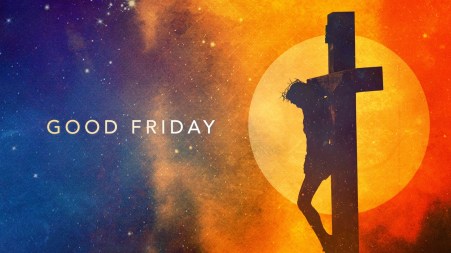
GoodFriday

It is difficult and challenging to contemplate our Lord saying those words from the cross. We might be a little more comfortable with John’s story (It is finished) or even Luke’s version (Into thy hands I commit my spirit). But according to Matthew and Mark, Jesus’ final earthly words were “My God, my God, why have you forsaken me.”

When I need to offer a grieving family a hopeful word, I often turn to Psalm 23, that beloved collection of verses that some of us have memorized. The Lord is my shepherd, I shall not want, he maketh me to lie down in green pastures, he leadeth me beside still waters, he restoreth my soul. They are comforting words. But rarely, if ever, have I pulled out Psalm 22.

It’s difficult just to get past the first verse. My God, my God, why have you forsaken me? We are pulled to the cross, to the torment and to the agony of Jesus yelling out into the void moments before his death.

Jesus suffers. It is both disconnected and disconnecting. In suffering on the cross he was made completely alone. Entirely and utterly alone. In this moment we are welcomed into the divine in a way not parsed out in other places of the bible. Here on the cross, in the cry of dereliction we experience the duality of Jesus’ divinity and humanity, we experience the abyss of fear and the hope of things unseen, we confront the elect and the reject.

And yet here, on the cross, with his final moments, Jesus turned to prayer. Not a final sermon on the marks of a faithful life, not a moment of divine healing. Jesus prays.

Prayer corresponds with experience. It is the way we process the moment we are in with something larger and more enduring. Prayer is what enables us to scale the impossible mountains of torment that threaten to close us off from all we have known, and prayer is what enables us to see the truth of our lives in terms of what has gone before and what is yet to come.

Of all the things we do as disciples, worshipping the crucified Jesus is possibly the strangest. It is only something we can do through the power of prayer. It is also why tonight’s worship is usually the least attended of all the worship services in a year. Tonight we glorify the Son of God who was degraded by his fellow human being as much as it is possible to be, by decree of both church and state. We worship the one who died in a way designed to subject him to utter shame and to be erased from human memory.

It is a story realer than real. It cannot be spiritualized away, nor can it be fully comprehended by we finite people. The climax of the gospel takes place in the midst of political and economic life, it is shocking and violent, it threatens the prevailing authorities, and it results in people two millennia later worshipping God nailed to a cross.

Good-Friday-Image

There is a paradox in our worship tonight, a paradox as difficult as Jesus’ final words. The paradox is that the generosity of God means the crucifixion of the Son. In Him both the godly and the ungodly are justified.

According to the strange and mysterious wisdom of God, it is in the crucified death of Jesus that all of the cosmos is altered (and altar-ed). This death makes our lives possible. This death is what makes the Christian experience intelligible. This death is at the heart of who God is.

If you’re anything like me, you’re eager to jump to Easter. Enough with the crucifixion! Give me resurrection! But you can’t have one without the other.

We cannot ignore the challenging words of Jesus from the cross. We cannot imagine away, or explain away, the overwhelmingly jarring nature of the Son of God crying out to the Father in fear.

But of course, that’s not where the Psalm ends.

Psalm 22 contains what it possibly the greatest “yet” in scripture… “O my God, I cry by day, but you do not answer; and by night, but find no rest. Yet you are holy, enthroned on the praises of Israel. In you our ancestors trusted; they trusted, and you delivered them.”

On that “Yet” hangs both the Old and New Testament. In that “Yet” we confront the true paradox of the crucifixion: that Jesus is both elected and rejected, that he knows sorrow and hope, that he dies and will rise again.

Jesus knew the power of “yet.”

But we must wait for Easter. We have to take the terrible time to sit in the shadow of the cross, to see in this first century man all the fullness of God, to recognize our sin in him nailed to the tree.

Good Friday, unlike just about anything else we do as a church, cannot be tied up neatly in a bow. We can’t fast-forward to Sunday morning. We, like the disciples in the distance, have to look at our Lord on the cross and wait. We have to wait for God to do a new thing. We have to recognize that this is what God did for us, and not the other way around.

We will leave this place tonight under the cover of darkness. And yet… Jesus is the light of the world.

The words of our prayers and hymns will fall silent. And yet… God cannot be silenced.

The shadow will feel darker than ever. And yet…