On the Impossible Possibility of Karl Barth or: Why God is God

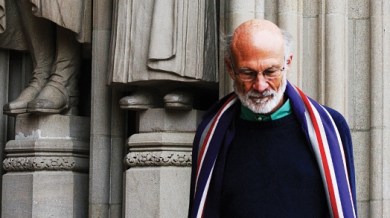
Many years ago, Karl Barth was invited to give a lecture on theology during his visit to the United States. After waxing lyrical in his high-pitched Swiss accent, he spent some time answering questions and mingling with those in attendance. A young man who was able to snag a chair in the back mustered up the courage to walk to the front and shake the hand of the man who he believed had changed his life. After waiting and waiting he finally reached out his hand and said, “Professor Barth I want to thank you for all that you’ve done. I’ve read everything you’ve ever written and it has changed my life.” Barth looked inquisitively at the young man, took his hand and said, “Son, not even I have read everything I’ve written.”

barth-bw

Or so I was told long ago. Stories about Barth are like great myths that you can never really prove, but they wonderfully add to what we imagine he was like. That simple story of his interaction with a young man was my first introduction to Karl Barth prior to purchasing my copy of The Epistle to the Romans. From the story, and from my first reading, I quickly learned that to read Barth’s work is work. He held a long time motto that what really matters is “to say the same thing again and again in different words.” This is true of his writing, his preaching, and his influence in the world of theology today.

1101620420_400

In The Epistle to the Romans there is a great passage where Barth juxtaposes the law with faith: “The truly creative act by which men become the children of Abraham, by which stones are transformed into sons, does not lie in the possible possibility of the law, but in the impossible possibility of faith.”[1] His expression of the impossible possibility of faith is one that, I believe, is indicative of Karl Barth’s greater contribution to theology. His writing is some of the most difficult to comprehend but, like Joyce’s Ulysses and Wallace’s Infinite Jest, it will change you.

About a month ago I set out to write a number of reflections on what I consider are some of Barth’s best exegeses from Church Dogmatics. In preparation I pulled out my heavily earmarked and notated copies of the different volumes and dove back into the strange new world of dialectic theology. To do theology dialectically is to think in unresolved contrasts. It means that Barth can write, “God is God” which looks like a sentence that is an explanation, but it actually really does not explain anything at all. Barth, unlike so many theologians, rejected the temptation to explain, and thereby limit, God. Instead, Barth leaves it at “God is God.”

This kind of theology is powerful and it is frustrating. We are so conditioned to expect explanation and clarity that when reading Barth we are left reeling and waiting for the notes to resolve, but they don’t. Like any great jazz improvisationalist, Barth leaves us wanting more because the work of theology is never finished.

Just as it is hard to read Barth, it is hard to write about Barth. When I first read his reflections on Creation, the Tower of Babel, the Doctrine of Election, and the Strange New World within the Bible, it fundamentally changed me as a person and as a Christian. When I returned to those works over the last month I experienced the same excitement of transformation once again but when I opened my computer to write, I stared at a blank screen for a long time. How could I adequately reflect on explaining the unexplainable? How could I limit a 44-page exegesis to a 2,000-word blog post? How could I share my thoughts on something that gives me theological whiplash (in the best way)?

Writing about Barth’s writing is difficult precisely because Barth is impossibly possible.

God is God. Three words that say everything and nothing at the same time. God is God; an impossibly possible statement. To say, “God is God,” is to affirm that we cannot control God. We cannot start with “God is…” and fill in the blank with whatever we want God to be. God is what God is, and we are not. (Hence the instruction to Moses: “Tell them ‘I Am” sent you.”)

249525.501

“God is God” in its frustrating impossible possibility, reminds us that God can only be known through God. This does not mean that God is somehow hidden from creation, or completely unknowable, but that God is revealed to us according to God’s will. We cannot go digging for God throughout the bible, we cannot go out into the peaceful wilderness to find the divine; it is God who finds us. Or, as Barth puts it, “[the grace of God] is like an arrow from the other side of a shore on which we will never set foot, yet it hits us.”[2]

What Barth’s impossibly possible theology sets forth is a theology that is never finished. Like the shorter ending to the gospel according to Mark, we are left in God’s great ellipses. We are now part of God’s great story being told until God makes all things new. There is no end to the work of theology because there is no end to God. Faith, similarly, never concludes because every moment is a new opportunity to be met by God and to be transformed over and over again.


[1] Barth, Karl. The Epistle to the Romans (London: Oxford University Press, 1933), 138.

[2] Ibid., 98.

In or Out? – Karl Barth and the Doctrine of Election

Election is a dirty word in the United Methodist Church. In this particularly problematic political season we like to keep people happy so we generally avoid talking about politics and elections. We want people to think for themselves and pray for the Spirit to guide them in such matters. Otherwise we leave the topic at arms length. However, even more divisive than American Politics has been the church’s response to the Doctrine of Election.

The topic of God’s divine election is one that we often get hung up on in our weekly Bible studies at church. We can be talking about any number of things from scripture when all of the sudden the conversation moves to whether or not God ordained a specific tragedy to occur, or why would a loving God elect some for salvation and some for damnation. Then we tend to travel down the deep rabbit hole in arguments about free will and God’s sovereignty.

To talk about election is to take steps into mystery. We like to have answers to all of our questions, we like things to be neat and orderly, and God often gives us the opposite. Only God, in God’s infinite knowledge and power, could elect certain individuals and only humanity, in our sinfulness and selfishness, could spend centuries arguing about what it means to be part of the elect.

quotescover-JPG-52-300x300

Even on the UMC’s denominational website there is a long essay about whether or not United Methodists believe “once saved, always saved” or can we “lose our salvation.” And in the essay, a good amount of space is spent address Calvin’s so called “TULIP” theological principles (Total Depravity; Unconditional Election; Limited Atonement; Irresistible Grace; and Perseverance of the Saints). For Calvin, God has chosen, based on God’s own criteria, whom to save and whom not to save, long before anyone was born. Moreover, Jesus’ act of “atonement” from the cross is efficacious only for those whom God has elected for salvation.

John Wesley however, influenced by Jacobus Arminius, believed that only God can save and God does so unconditionally for all. There is no pre-selected list in the mind of God about who will be rewarded with salvation and who will be punished with damnation. Instead God’s grace is offered preveniently to all, and humanity has the capacity to respond to this grace. We have the ability (through free will) to reject God’s grace and in so doing we remove ourselves from the equation of salvation.

These types of distinctions about divine election or rejection have been debated throughout the history of the church and have played a primary role in the propagation of the seemingly endless amount of Christian denominations. We disagree about what we believe God is up to with election and therefore we create schisms in the church that result in the mosaic of churches rather than dwelling together in unity.

Karl Barth saw the Doctrine of Election differently.

barth-bw

In Church Dogmatics II.2 Barth sets out to confront what it is that makes one “elect.” He begins with a general answer that those who are elect are elect without reference to their person or in recognition of any special attributes or achievements. There is nothing that one can do to earn their elect status. To be elect is to enter into a way of being that corresponds with election; those who are elect are what they are.

Barth then, in a profound and wonderful excursus, compares the elect and the rejected throughout the Old Testament as a means by which to point at what it means to be elect in Jesus Christ. He begins with the dualism of Cain and Abel from Genesis 4. The difference between the brothers is not based on any prior mark of distinction, but from a decision of God’s concerning them. However, even though one is clearly favored and the other is not, this does not mean that God has abandoned or rejected Cain in the way we so commonly assume. It is true that God does not accept Cain and his family for the murder of his brother, but he is not abandoned by God because of this. Instead he receives the promise that God will protect his life.

1101620420_400

Thus begins a great trajectory throughout the Old Testament of mutually intersecting differences between people. Esau is the older and favorite son of Isaac, but it is Jacob (the younger brother) who receives the birthright and the true blessing. Yet, God does not abandon him. Jacob loves Rachel more than Leah but Leah is the one the Lord makes fruitful. And yet Rachel does not remain barren and eventually gives birth to Joseph. And Joseph, though rejected by his older brothers and sold into slavery is intimately connected with the future of God’s people and the brothers (though treacherous) are not abandoned to the famine but are instead forgiven and brought into the land of Egypt.

The same holds true for the dynamic between Saul and David (Saul is actually blessed far more than David even through the Lord moves the blessing from the former to the latter), and other figures from the Old Testament scriptures. Barth demonstrates again and again that though they appear rejected by the Lord, they are in fact blessed and intimately involved in God’s great story that culminates in Jesus Christ.

And it is here where Barth shines a light on the darkness of our understanding of election. For it is precisely in the person of Jesus Christ that we discover not only the elect but also the reject. “According to His divine nature, Jesus Christ is the (elect) eternal Son who reposed in the bosom of the eternal Father, and who coming thence took our flesh upon Him to be and to offer this sacrifice, for the glory of God and for our salvation, and by taking our place to accomplish our reconciliation to God. But as such and in the accomplishment of this reconciliation He is, necessarily, the Rejected. Like the (scapegoat) He must suffer the sin of many to be laid upon Him, in order that He may bear it away… out into the darkness, the nothingness from which it came to which it alone belongs.”[1] In the humiliation of the cross, Christ was also exalted. In the rejection of the Son on the cross (who cries out ‘My God, my God, why have you forsaken me?”), Christ was also the elect who shares the beauty of reconciliation.

In Christ we discover one who is reject and elect. In the incarnation of God in the flesh we encounter the mystery of what it means to be chosen by God and what it means to respond to that call.

In the one man on the one cross (as reject and elect) we see all of the dualisms of the Old Testament, all of the people who were either elected or rejected. But through the resurrection, all who are either elect or rejected remain in Him, and in Him the Word of God conquered death which shall be proclaimed through eternity.

For Barth, it is not so much that God began the mysterious work of creation with a list of all who will be elected for salvation and all who will be rejected for damnation. Instead, God remains steadfast even with those who move away (by their choice or the Lords – only God knows), God offers the grace forever even if it is rejected over and over again, and God provides the means by which all can be saved through the life, death, and resurrection of Jesus Christ.


[1] Barth, Karl. Church Dogmatics II.2 (Peabody, Massachusetts: Hendrickson Publishers, 2004), 365.

Devotional – Hebrews 13.8

Devotional:

Hebrews 13.8

Jesus Christ is the same yesterday and today and forever.

Weekly Devotional Image

I try hard to read some theology every week that has nothing to do with the sermon for Sunday. I do this in order to learn more about what it means to follow Jesus without it being intimately connected with whatever will be proclaimed from the pulpit; discipleship is something I need to work on outside of the work required for the vocation.

Last week I opened up Tripp Fuller’s Homebrewed Christianity: Guide to Jesus – Lord, Liar, Lunatic… Or Awesome? and started to read. (I discovered the book through a podcast that mentioned the title and I decided to check it out.) The premise is straightforward in that Fuller wants the reader to confront the totality of Jesus’ identity, but I had a hard time getting through the first few pages. Fuller writes, “The full humanity of Jesus is something every Christian affirms, but when it comes to discussing his journey through adolescence, we like to keep it vague – “He grew in wisdom and stature” is the only mention in the Bible of his teen years. Of course, we don’t spend much time thinking about Jesus having lice in his hair or pooping, even if he did such things in the holiest of ways.”[1]

img_6935

I understand that Fuller wants the reader to encounter the depth of Jesus humanity, but today we seem to emphasize his humanity over and against his divinity. In church and in theology we hear so much about how Jesus is just like us that we sometimes forget he is also completely unlike us. We want to know that Jesus knows our struggles and is there alongside us when we are going through the valleys of life. But in so doing, we’ve made Jesus out to be a good teacher or an ethical leader, and not God in the flesh.

In Hebrews we read about how “Jesus Christ is the same yesterday and today and forever.” Jesus remains steadfast to love and forgiveness and Jesus remains committed to grace and mercy. We, on the other hand, neglect to love and forgive others. We forget what it means to give and receive grace and mercy. We change each and every day like the blowing of the wind. But Jesus is the same yesterday and today and forever.

Jesus is like us and totally unlike us. Jesus is fully human and fully God. Jesus went through his own angst-filled teenage years and shows us the light of the Lord in the midst of the darkness.

For as much as we want to identify with the humanity of Christ, we also do well to remember that Jesus, like God, never changes.


[1] Fuller, Tripp. Homebrewed Christianity: Guide to Jesus – Lord, Liar, Lunatic… Or Awesome? (Fortress Press: Minneapolis. 2015), 2.

Karl Barth and The Strange New World Within The Bible

When I was in seminary, Dr. Stephen B. Chapman told a remarkable story about a survey that had been done in past. All of the faculty and doctoral candidates at Duke Divinity School were once asked to name the top 3 books or articles that had shaped their call to ministry or academia. Though many were quick to respond with something like “The Bible” or “1 Corinthians” the survey challenged people to think more specifically about works outside of the bible that had shaped their lives.

Some of the greatest works from Christian History were all named such as Calvin’s Institutes, Aquinas’ Summa Theologica, Wesley’s Sermons, and Augustine’s Confessions. Others were quick to name works from more contemporary writers like Schweitzer, Bonhoeffer, Merton, Yoder, Hauerwas, and Nouwen. The survey demonstrated that there were an abundance of texts from a variety of traditions that had shaped the minds of those called to serve the church. However, even with all the variations of answers and all the different denominations that were represented, there was one article that was mentioned more than any other: Karl Barth’s “The Strange New World Within The Bible.”

barth-bw

Barth’s article can be found in chapter 2 of his seminal work The Word of God and The Word of Man originally written in 1928. When I read the article for the first time I underlined so many sentences that it was difficult to read it a second time. The margins are now covered with thoughts, exclamation points, and asterisks. It is nothing short of transformative.

1101620420_400

In it, Barth attempts to answers the following questions: What is there within the Bible? What sort of house is it to which the Bible is the door? And What sort of country is spread before our eyes when we throw the Bible open?

Like most of Barth’s writing, it cannot be explained but only proclaimed. The best way to experience it is by reading the thing itself. Therefore, I have attached a PDF of the chapter to end of this post for anyone to read.


But after rereading the article again this week, and looking through all my old notes and markings, I decided to write my own version of the chapter relying on Barth’s original to guide my thoughts…


The Strange New World Within The Bible

We are to attempt to find an answer to the questions, What is there within the Bible? What sort of house is it to which the Bible is the door? What sort of country is spread before our eyes when we throw the Bible open?

We are with Adam and Eve in the Garden. We hear the Lord warn them about the tree of knowledge of Good and Evil. We hear the slithering serpent calling them (and us) to rebel against the One who loves us. And Adam and Eve reach for that forbidden fruit inevitably driving them away from the Lord and into the unknown. We can feel that there is something of ourselves in these two standing at the edge of Eden looking back to what they once were and unsure of what would come in the days ahead.

We are with Noah kissing the ground after the Flood. We see the rainbow cast across the sky and we feel the colors reflecting off the pools of water around Noah’s feet. We hear the promise from the Lord to never abandon creation again. We believe that Noah is the new beginning, another chance for humanity to get things right. But then we see him tilling the ground, preparing the vines, and eventually getting drunk from the wine. In him we see the failures of the past reaching forward into the present and we know that there is something behind all of this.

We are with Abraham in a strange land. We hear a call from the Lord, which commands him to go to a land that has been prepared. We hear a promise to Abraham: “I will make of you a great nation and your descendants will be more numerous than the stars.” And we see that Abraham believed the promise! We feel the Spirit moving through the space as the story moves ever forward.

We are with Moses on a rocky hillside. We feel the warmth of a bush burning but not being consumed. We hear the voice of the Lord speak to the wandering shepherd: “Tell them I AM sent you.” We experience the calling that will forever define an entire nation of people, a delivery from slavery to Egypt, and freedom in the Promised Land. We hear these strange words and promises and we know that they are unlike anything else we have ever read. We know that it is a story, but it is a story about us.

We are with Joshua at the edge of the new land. We remember the painful journey and the years of struggle that led to this moment. We experience fear and excitement with the other sojourners, as they are about to cross the threshold into God’s promise. We hear about Rahab and what she was willing to do for God’s people and it gives the people confidence to actually be God’s people.

We are with Samuel asleep on the floor. Again we hear a call three times “Samuel, Samuel!” We see the young man run to the priest Eli to share his experience and we begin to connect this call with others. We know that Samuel has heard the Lord and that he must obey. We know the journey will not be easy, but it will be good.

We read all of this, but what do we experience? We are aware of some greater power beneath the word, a faint tremor of something we cannot know or fully comprehend. What is it about this story that makes our hearts beat with such tempo? What is opening up to us through the words on the page?

We are with David when he puts the rock into the sling and takes down the mighty Goliath.

We are with Solomon when he prays for the Lord to give him the gift of wisdom.

We are there when Isaiah feel the coal being placed on his lips.

We are with Elijah when he hears the Lord not through the wind, not the storm, nor the fire, but through the still small voice.

Then come the incomprehensible days when everything changed; that strange and bewildering moment in a manger in Bethlehem when the Word became flesh. When a man and a woman fled to save their child’s life. When that baby grew to be a man who was like no other man. His words we cause for pause and alarm and delight and fear. With unending power and resonating grace he calls out: Follow me. And they do.

Through him the blind begin to see. The lame begin to walk. The hungry are fed. The powerful are brought low. The poor are made rich. The deaf hear. The blind see.

And then we are there when the sky turns black. We hear his final words and we feel a faint echo from those first words so long ago. But that echo continues for three days until it reaches a triumphant crescendo in an empty tomb, in resurrection.

We are there with the disciples in the upper room. We watch the Holy Spirit fill their mouths with the words to proclaim. We go with them across the sea and over the dry land. We watch them use water and word to bring new disciples into the faith. We smell the bread being broken and we can taste the wine being shared at the table. We can feel the parchment of letters sent to church far away in our fingers.

And then it ends and The Bible is finished.

Open-Bible-Religious-Stock-Photos

What is it about scripture that makes it different from everything else we read? What is so important about the connections from Adam to Jesus? What are we to make of the prophets and the apostles? What do we do with statements like “In the beginning God created the heavens and the earth” and “Forgive them Father, for they do not know what they are doing”?

These are difficult and dangerous questions. It might be better for us to stay clear of the burning bush and the coal for our lips and the call to the cross. Perhaps we would do well to not ask because in our asking is the implication that The Bible has an answer to every question. Yet it does provide something just as the Lord provided for Abraham.

It is not merely a history or a genealogy.

It is neither a myth nor a fable.

What is there within The Bible? The answer is a strange, new world, the world of God.

We want The Bible to be for us. We want to mine it for all its precious metals. We want it to answer our questions. We want to become masters of the text.

But The Bible is itself and it drives us out beyond ourselves to invite us into to something totally other. We are invited regardless of our worth and our value, regardless of our sin and failures, to discover that which we can only barely comprehend: a strange new world.

Reading The Bible pushes us further through the story that has no end. In it we find the people and places and things that boggle our thoughts. We read decrees that shatter our understanding of the real. We experience moments of profound joy and profound sorrow. We find ourselves in the story when we did not know we had a story.

And it causes us to ask even more questions: Why did they travel to this place? Why did they pray this way? Why did they speak such words and live such lives? And The Bible, for all its glory, rejects answers to our Why.

The Bible is not meant to be mastered; instead we are called to become shaped by the Word. And this is so happen in a way we cannot understand. For the heroes of the book are seldom examples to us on how to live our daily lives. What do David and Amos and Peter have to teach us except to show us what it means to follow God?

The Bible is not about the doings of humanity, but the doings of God. Through the Bible we are offered the incredible and hopeful grain of a seed (as small as a mustard seed), a new beginning, out of which all things can be made new. This is the new world within the Bible. We cannot learn or imitate this type of new life, we can only let it live, grow, and ripen within us.

The Bible does not provide us with simple tools on how to live like a disciples, or what to do in a particular situation. It does not tell us how to speak to God, but how God speaks to us. Not what we need to do to find the Almighty, but how he has found they way to us through Jesus Christ. Not the way we are supposed to be in relationship with the divine, but the covenant that God has made with God’s creation.

The strange new world within the bible challenges us to move beyond the questions that so dominate our thoughts. Questions like “What is within the Bible?” and “Who is God?” Because when we enter the strange new world within the Bible, when we discover ourselves in the kingdom of God, we no longer have questions to ask. There we see, we hear, and we know. And the answer is given: God is God!


Strange+New+World

On Evangelism or: Why The Church Needs Crucifixion

Matthew 28.19 – Go therefore and make disciples of all nations, baptizing them in the name of the Father and of the Son and of the Holy Spirit.

Evangelism

We sent out hundreds of post-cards over a month ago inviting the entire neighborhood to join us on the front lawn of the church for a free Community Cook-Out. The post-cards were well designed and inviting with all of the necessary information. For a modest price we were able to reach a whole group of people who we would otherwise miss.

This will be our third annual gathering and it has been largely successful. Half of the people in attendance are usually not from the church and we want them to know that we care about the neighborhood we are in. However, on some level, we also want them to know that we love them enough that we would love to have them join us in worship on Sunday mornings.

IMG_1642

Yet, evangelism is not the goal of our gathering. We have not specifically identified key lay people to go around asking people if Jesus Christ is their personal Lord and Savior. We have not prepared pamphlets to hand out describing the eternal fires of hell if someone does not get saved. We have not invited the neighborhood to our front lawn to get them into heaven.

Instead, we hope that by showing them our love, it will somehow draw them into church to discover where that love comes from: God.

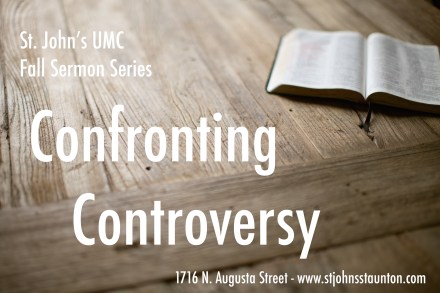
Next week we are going to send out even more post-cards to the local community about our upcoming sermon series titled “Confronting Controversy.” After speaking with a few nominal Christians from the neighborhood about what they want to hear about in church, we synthesized this series to be approachable and life-giving to people who are not currently in the church. The post-card has been well designed with a catchy image and all of the necessary information on the back. We hope that by sending them out, people from the community will join us in worship and discover that what the world thinks about the church may not be the same thing as what God thinks about the world.

controversy

Both of these ventures, a Community Cook-Out and a Controversial Sermon Series, are about trying to grow the church in some way, shape, or form. Many of us call this “evangelism.” But that’s not what evangelism means.

In David Fitch’s recent work Prodigal Christianity, he highlights a moment from his ministry where the church tried to grow and failed:

“When our church, Life on the Vine, was new, we sent out ten thousand postcards to people in our neighborhoods. We artfully displayed a collage of various depictions of Jesus (classical paintings, icons, and European, African, and Asian portrayals) with the question in bold print running across it: “Who is Jesus?” On the back, we invited the neighborhood to have a discussion with us about the question. We were playing off the cultural curiosity around Easter and hope that we could welcome a constructive conversation around the question. The card was not well received. Local “Bible-believing” Christians accused us of straying into relativism with so many different depictions of Jesus. They worried we were losing the truth of Jesus. Meanwhile many others accused us of being intolerant. Were not other religious leaders just as worthy of discussion? We got nasty phone calls asking, “Why are you focusing only on Jesus?” No one, and I mean NO ONE, came to any of our gatherings from this postcard.”[1]

Out of ten thousand postcards, no one came to any of the gatherings. I think a lot of this has to do with our false assumption that just by offering something people will show up. We believe that if we give them an interesting sermon series or bible study people are bound to show up in droves. And if we let them know about it through a postcard we can reach even more people!

These types of evangelism largely fail because we’ve confused evangelism with filling the pews instead of sharing the Good News.

I cringe whenever I encounter an “evangelist” in the midst of life who abruptly asks, “Have you confessed Jesus Christ as your personal Lord and Savior?” Because with their question is the assumption that we have the power to save ourselves, and that they are playing a fundamental role in our salvation. However, Jesus does not command the disciples to go out convincing people to confess him as Lord. Instead he tells them to go and make disciples.

Discipleship formation is primarily about relationships and less about post-cards and Main Street confessions. We become evangelists not when we beg or convince someone to confess Jesus as Lord, but when we intentionally create relationships with individuals through the love that Jesus taught us to live by. We can use sermon series and community events to first bring people into the church, but those types of things will never be enough (by themselves) to evangelize. It takes a willing and loving disciple who sees others not as pew fillers but fellow brothers and sisters in the kingdom of God.

As a gathering church we are called to be confident in God’s love for us, and for us to share that same love with others; “We love because he first loved us” (1 John 4.19). We will grow and bear fruit in the kingdom when love becomes our first priority instead of growth. We have failed to grow not because we have been doing things unworthily, but because we’ve grown bored and unhappy. With churches all across the American landscape floundering under the pressure to grow and remain sustainable, the church falls back to the common tropes of Vacation Bible Schools and Sermon Series assuming they will grow the church.

Can you imagine what the church might look like if Christians were actually happy and excited about being the church? That’s where and when evangelism happens – not in the boredom of another series or bible study, but in the community transformed by joy and sharing that joy.

Evangelism (1)

Evangelism is our call as Christians. We are commanded by the Lord to share the Good News in order to make disciples and transform the world. If we want this kind of dynamic and life-giving evangelism to take place, then we have to be willing to crucify some of our current practices and programs; you can’t have resurrection without crucifixion.

We need to crucify our boring and lifeless activities that we assume will grow the church. Is the annual Cook-Out really sharing the good news with others, or are we doing it to feel good about seeing a lot of people on our property?

We need to ask difficult questions about our programs and whether or not they are designed to evangelize. Are our monthly meetings really about branching out to the community and transforming our cultural landscape, or are we meeting to keep the people already in the church happy?

We need to confront our budgets and demand that they reflect Jesus’ mission. Are we spending our resources according to the great commission, or are we neglecting to be good stewards by wasting our resources of lifeless avenues of ministry?

We need to take a look at our own families and reflect on how we evangelize those closest to us. Are we so consumed by raising our children to choose whether to be Christian or not for their own good, or are we afraid of telling them what we really feel and believe?

What can we crucify in our hearts and in our churches to be resurrected into the kind of evangelists that God is calling us to be?


[1] Fitch, David and Geoff Holsclaw, Prodigal Christianity: Ten Signposts into the Missional Frontier (Jossey-Bass: San Francisco, 2013), 32.

Babbling Grace – Karl Barth and Genesis 11.1-9

Professors in seminary can make all the difference. Some can call you into the strange new world of the bible through their passionate lectures and you will never be able to look at scripture the same way again. Some can refers to moments of history in the church that decisively reshape the way you understand the church today. And still yet others can turn your entire understanding of the kingdom of God upside down through just a few lines in one lecture.

Stanley Hauerwas is one of those professors.

Hauerwas

In 2013, I had the good fortune of participating in his last ethics class before he retired. In it, he did his best to make us Christians more Christian. By highlighting problems that the church is facing, and has faced for a long time, he helped to provide a better grammar for what it means to be a Christian in the world.

During one of his lectures on the remarkable importance of the gathering community, he briefly mentioned a sermon he once wrote on the story of the Tower of Babel from Genesis 11. At the time, the story of Babel was one that I remembered from my youth; the pictures we drew of people attempting to build a tower to God, the lesson it conveys about why there are so many languages on the earth. But I honestly hadn’t thought about it having much to do with my life as a Christian.

Dr. Hauerwas said, “The divisions at Babel are healed and reconciled at Pentecost. The language divisions were still present, but within the gathered communal identity of the church was a common Lord in Jesus Christ. Pentecost was a new day of creation, not unlike those we read about at the beginning of Genesis.”

In just a few sentences, Hauerwas jumped from Genesis 11 to Acts 2 and it blew my mind. Now it seems so obvious, that the Lord would bring together God’s people through the power of the Holy Spirit therefore redeeming what had happened at Babel. But when Hauerwas connected them in that lecture, it was like I was given a new lens by which I could read scripture.

For a time I attributed this new way of thinking and reading to Dr. Hauerwas, and it was only later that I realized he got it from Karl Barth.

barth-bw

In Church Dogmatics III.4 Karl Barth uses the story of the Tower of Babel to evaluate the problem of nationhood in the modern period. For Barth, Babel contains every bit of the human desire to remain self-reliant and focused on pride, which has resulted in our divisions as a species. It is a story, not unlike Adam and Eve’s first sin, that reminds us of the brokenness in our world.

I have always seen Babel as a kind of means by which we can teach a lesson to children or young Christians about the dangers of pride. I have seen Babel as a shadow of what the church is supposed to be. But for Barth, Genesis 11 is all about grace.

Barth is quick to note that, “A Christian people is one in which heathenism and national egoism are broken, judged, and purified by the Spirit of Christ… As we are warned in Genesis 11, rebellion against God leads to the forceful disintegration rather than the organic development of national identities.”[1] Babel should frighten us, as a people, about what happens when we rebel against the Lord to such a degree, but the story is about much more than the Lord’s “punishment” at the end.

The Tower of Babel, for Barth, contains elements of both divine wrath and divine blessing. The story begins with: “Now the whole earth had one language and the same words” (Gen. 11.1). As a unified people, they settled into the land of Shinar and decided to use bricks to make themselves a city and a tower, “otherwise we shall be scattered abroad upon the face of the whole earth” (Gen. 11.2-4). In response to this, the Lord goes down to examine the city and tower and eventually confuses humanity’s language to remind them of the divide between Creator and creature.

Tower_of_babel

Barth immediate questions the supposed sin within the story: What is inherently wrong with building a city or a tower? The constructions of such objects were not completed against God; attempts at civilization are never formally wrong.[2] For Barth, the thing itself, the object built, is not the fault but rather when a people want to create something for themselves in order to reach an attempted equality with God there lays the sin. The depth of humanity’s sin is the “arrogance of thinking that man himself can and must take himself as he takes the brick and mortar, and make himself the lord of his history, constituting the work of providence of his own work.”[3]

In light of humanity’s over-determined arrogance, God must respond with punishment. If God let humanity build the tower to completion, just as if God had let Adam and Eve stay in the Garden after eating of the tree of knowledge of good and evil, humanity would further perpetuate itself as a sinful people. The scattering of the nations at the end of the story is an example of God’s divine wrath, and usually where I would let the story finish, but for Barth (and Hauerwas) we cannot understand Babel without the rest of the Bible.

Barth sees grace at Babel through, of all things, Jesus’ parable of the sower: “The constant sowing of the seed of the divine Word will always find soil even if there is no true harvest in one place. Even in this passage we must not fail to see the Gospel in this sense. Even in the terrible decree of v. 7 (“Come let us go down, and confuse their language there, so that they will not understand one another’s speech.”) we must not miss His grace.”[4]

Important for Barth’s understanding of God’s grace in his exegesis is the fact that God could have easily used an earthquake or another divine miracle to achieve God’s condemnation. But rather than destroying creation, as had been done through the flood in Genesis 7, God merely divides humanity and confuses their language. Instead of raining destruction upon humanity, God limits the punishments to linguistics.

Additionally, God does not abandon humanity to their own devices even after their construction. Regardless of the self-righteousness employed by humanity, God will remain faithful even when we are not. Babel could have been the end of the relationship between the Creator and the creature, but God remained steadfast.

Morever, Barth’s final move regarding the babbling grace of Genesis 11 comes in the recognition that, as Christians, we are aware that God has more in store for his creatures than the end of the story in Genesis; we know what happens at Pentecost. What transpires at the end of the Babel narrative is not the ultimate decree on the matter but rather, “only a penultimate word, and that the curves of the separated ways are so ordered in advance that they will finally come together again.”[5] Here is where Barth shines the light of God’s glory the brightest: even though the main emphasis of the Tower of Babel in on how the separation and division of people was right (at the time), God’s original desire is for humanity to be in unity.

For Barth, we cannot read Genesis 11 outside of, or in spite of, Acts 2. These two different stories, separated by thousands of years, though different in form and content, contain the beginning and the next step of God’s action toward creation. God intended for humanity to remain in unity, and through our own self-righteousness were have rejected the divine unity for our own division. And yet, according to Barth, we are to remain grateful to God’s out-pouring of grace which simultaneously remaining discontent until there is a total reunification of God’s creation.

1101620420_400

Barth, time and time again throughout Church Dogmatics, refuses to read particular texts as isolated witnesses. To read the bible is to read it canonically. Narratives from different places help to inform one another and the Old Testament reads into the New just as much as the New reads into the Old. Babel and Pentecost are connected. Eden and Revelation are connected. David and Jesus are connected. Exodus and Acts are connected. And so on.

As Christians reading scripture, we have the benefit of knowing how the story “ends.” We know that in the person of Jesus Christ the previously divided nations have come together. In the Holy Spirit of Acts 2 the conclusion of Genesis 11 takes place: “The miracle of Pentecost tells the us how the decision is take to look and break out from the nations to the one people of God, how the divine disposition of Genesis 11 is rightly understood as a teleological divine purpose, and how it is recognized in the form of the corresponding orientation from the near to the distant, the narrower sphere to the wider.”[6]

Barth’s reading of scripture, and in particular his exegetical work in the excurses of Church Dogmatics has directly influenced the work of Stanley Hauerwas and a whole mosaic of theologians over the last century. To be a Christian is to read, and to read well; to look for the connections from book to book; to identify the thread that God pulls through seemingly unrelated stories; to see ourselves as characters in God’s great narrative.

And for Barth, the story of Babel is not one for us to leave for children’s Sunday School rooms and flannel-graphs. It is one that we must read with conviction knowing full and well how the story ends. Just as with the construction of Babel, humanity still consistently places brick after brick of our own presumed infallibility in direct contradiction to the One in whom we live and move and have our being. Barth’s work reminds us that we have divided ourselves against God’s original and good intentions, and to complete the end of the story we must take seriously God’s mighty acts in Jesus Christ, desiring for humanity to one day be made perfectly one.


[1] Barth, Karl. Church Dogmatics III.4. (Peabody, Massachusetts: Hendrickson Publishers, 2004), 306.

[2] Ibid., 314.

[3] Ibid., 314.

[4] Ibid., 316.

[5] Ibid., 317.

[6] Ibid., 323.

The Cross in Creation – Karl Barth and Genesis 1.1-2

Genesis 1.1-2

In the beginning when God created the heavens and earth, the earth was a formless void and darkness covered the face of the deep, while a wind from God swept over the face of the waters.

barth-bw

While I was in seminary I spent one of my summers helping Bryson City UMC in Bryson City, North Carolina. Bryson City is surround by the Great Smokey Mountains and is easily one of the most beautiful places I’ve ever been in my entire life. It was an incredible experience that directly shaped the way I do ministry today.

During my time at the church I was invited to participate in a weekly lectionary group with local clergy. Every Monday morning the pastors and priests of Bryson City would get together to talk about the scripture readings for the following Sunday. We met at the large Baptist Church, ordered breakfast to be delivered, and then we would take turns reading from the bible and shared what we thought we would preach about on Sunday.

Week after week I heard from clergy of all different denominations (Presbyterian, Baptists, Catholic, Methodist, etc.) as they wrestled with God’s Word and how to proclaim it from very different pulpits to very different people.

On one hot morning in the middle of July I found myself surrounded by those familiar pastors and priests as we read the texts aloud. The lectionary always had four prepared readings for each Sunday on a three-year cycle: a reading from the Old Testament, the Psalms, an Epistle, and a Gospel. I don’t remember what the other readings were that morning, but I do remember that I was asked to read Genesis 1: In the beginning when God created the heavens and the earth…

When I finished, as was our custom, we waited for individuals to speak up about what they planned to do with the test during worship. Silence filled the room. So I decided to ask the obvious question, “I anyone planning to preach on Genesis 1?” The silence remained. I remember thinking to myself, “How strange is this? We’re talking about the first lines of scripture in the bible and no one is preaching on it in Bryson City this week.” It was obvious that most of the clergy wanted to move on to a different reading, but I felt compelled to ask another question: “Have any of you every preaching on Genesis 1?” One by one they confirmed my suspicion; not one of those pastors, priests, ministers, or preachers had ever proclaimed a sermon on the beginning of creation.

While they moved on to a different reading and a different conversation, I silently began calculating from my chair: In that room we had over 100 years of preaching represented. Over 100 years of preaching, more than 5,200 sermons, and not one of them had ever preached from Genesis 1.

Why do we ignore Genesis 1? What is it about the text that makes us afraid to bring it up in worship or in bible study?

On some level I think it is good to be afraid of God’s Word; that fear reminds us that God is God and we are not. But Genesis 1 is not something to be ignored or forgotten.

557046

Of all the writing I’ve read on Genesis 1, it is Karl Barth’s exegesis of the text that gives me hope for its return to the pulpits and congregations of our churches.

Barth, unlike so many modern theologians and pastors, rejects the fear and presumption that there is dissonance between creation as recorded in scripture and the scientific method. Instead of attempting to rationalize the theory of the Big Bang with the details of Genesis 1, and instead of struggling to line up Darwin’s Theory of Natural Selection with the order of creation in scripture, Barth rejoices in the knowledge that the earth was in a hopeless situation of chaos and utter darkness and God chose to transform reality through the Word. The “how?” and “why?” of creation is simply answered with “Word” and “love.”

Writing and reflecting from this vantage point gives Barth the ability to freely respond to the words contained in Genesis 1 with a freshness that is often lost in the church today; his exegesis of Genesis 1 is a worthy read for clergy and laity alike.

In §41.2 “Creation As The External Basis Of The Covenant” (III.1 The Doctrine of Creation in Church Dogmatics) Barth begins his exegesis with the very first words of God from the Word of God.

The first word in the Hebrew Bible is bereshith, which roughly translates to “start” or “beginning.” In English we render this as “In the beginning…” but for Barth the distinction is important. To begin with “beginning” tells us “that this history, and with it the existence and being of the world, had a beginning, i.e., that unlike God Himself it was not without a beginning, but that with this beginning it also looks to an end.”[1] There is no other word that can quite compare with the one that inaugurates God’s holy scripture. From the beginning of all things God created a beginning to have an end. The Lord did not create the world like a watchmaker and then step back to see how it would run. God was intimately involved in the creative act knowing full and well that there was a necessary end, or conclusion, to the creative act. Unlike an author who begins a story without knowing how it will come to close, God created from beginning with an ending.

For years I’ve read the creation account from Genesis 1 and thought of it just like that: an account of creation. The words were there on the page, though they hardly jumped out at me. Like those pastors in Bryson City, Genesis 1 is one of those chapters in the bible that I have not so subtly avoided because of the difficulty of rationalizing it with modern science. And yet Barth writes about the first two verses of scripture with such conviction that it challenges me to re-engage with the text and see the beauty of what God did, and is doing.

Verse 2 (the earth was a formless void…) has been similarly read with haste and overlooked for the richness it holds. Everything else, which is to say everything neutral or against God’s will, ceased to exist when time began with God’s action and accomplishment. The whole of creation was worked into being and order by God in time. In God’s freedom to create was the earth brought into meaning through God’s action and through God’s word to create.

1101620420_400

The challenge of verse 2 has vexed theologians and Christians alike for centuries regarding the chaos, whether or not God created it, and if God willed a reality of chaos into existence. This, I think, has factored into the disappearance of Genesis 1 from pulpits because we are unsure of how to speak about evil in the world, and whether or not God ordained it.

The question of God’s role in the creative act resulting in, or presupposing evil, is usually limited to two answers: God either did create the darkness and evil, or God did not.

Barth totally rejects this dualistic presumption.

Instead, Barth begins by confronting what is actually stated: “In verse 2 there is absolutely nothing as God willed and created and ordained it according to verse 1 and the continuation. There is only “chaos.” … that which is absolutely without basis or future, utter darkness… According to this phrase the situation in which the earth finds itself is the very opposite of promising. It is quite hopeless.”[2]

For Barth the question over evil and whether or not the violent and chaotic state of the world is self-originated or willed by God pales in comparison to the fact the earth was in a hopeless situation of utter darkness and God chose to transform reality through the Word. Verse 2 therefore posits a world in which the Word of God had not been uttered. The “nothingness” of creation is utterly destroyed and rendered impossible by the possibility of God in the creative act.

The ugliness of the existence prior to the Word of God did exist almost like a shadow of the actual creative act of God. And because it was like a shadow, in the freedom of humanity we can look back and return to that past and bring forth the shadow of verse 2. In so doing, by rejecting the Word of God, the past defies its own nature and becomes present and future. However, God totally and utterly rejected and rejects the shadow and speaks forth the Word to shine in the darkness.

The temptation of humanity to return to the shadow is ever present. Whenever we deny mercy to God’s creatures, we are retreating to the moment precisely before the Word of God. It is in our broken and sinful nature that we reject God’s Word and substitute our own. The shadow of darkness is around us whenever we encounter death and destruction. But no shadow can compare with the one of the cross: “This – this moment of darkness in which His own creative Word, His only begotten Son, will cry on the cross of Calvary: ‘My God, my God, why has thou forsaken me?’ – will be ‘the small moment’ of His wrath in which all that is indicated in Genesis 1.2 will become real. For all the analogy to other kinds of darkness, there is no other moment such as this.”[3]

In the death of Jesus Christ, in the shadow of the cross, humanity encounters the true and total darkness prior to God’s Word. But it is through Jesus Christ (as the Word) that God will reconcile creation to God’s self. In the one incarnate creature, at that particular moment and time in the cosmos, the Word will again become the Light over all creation. The brilliance of the empty tomb shines like the first light hovering over the darkness in Genesis 1.2.

The “old things” of creation prior to the Word have radically passed away in a dynamic and divine act of the Lord speaking the Word and through the death and resurrection of Jesus Christ.

The first two verses of scriptures contain the fullness of all God’s scripture. In beginning we see the ending. In the darkness we see the cross. In the light we see the empty tomb and resurrection. What Barth does with scripture is like what a Jazz musician does with the form of a tune; Barth improvises over the lines and draws connections to melodies that we have scarcely imagined.

To reclaim the brilliance of Genesis 1, to jump into the strange new world of the bible like Barth, will give us the strength to encounter creation and believe that it is worthy to be preached and proclaimed. But more than anything, it will give us the vision to see creation and declare, like the Lord, “it is good.”


[1] Barth, Karl. Church Dogmatics III.1 (Peabody, Massachusets: Hendrickson Publishers), 99.

[2] Ibid., 104.

[3] Ibid., 110.

On Why Christians Should Not Read The Bible

A reflection on Stanley Hauerwas’ Unleashing the Scripture:

I was 9 years old and sitting in one of the front pews at Aldersgate UMC in Alexandria, Virginia when I was called up to the altar and given a red hardback copy of the New Revised Stand Version of the Bible. I can remember feeling the thin pages in my fingers while I flipped between the Old and New Testaments and ignored whatever the preacher was preaching about. I knew it was the same bible as the one sitting on the back of the pew in front of me, but there was something different about it being my bible. From that point forward, whenever I grew tired or distracted by whatever was going on in the pulpit, I always knew I could open up the book in front of me and enter the strange new world of the bible.

I still have that bible that was given to me almost 20 years ago; it sits on one of my shelves next to the never-ending row of different translations that I have accumulated over the years. I had it with me in college when I grew frustrated with different campus ministries, I had it with me in seminary while I was helping multiple churches, and I still have it now while pastoring a church. For years I came to rely on that bible’s words to reveal something to me about the nature of God, particularly when I felt like worship was not making the cut.

This is why, according to Stanley Hauerwas in Unleashing the Scripture, we need to take the bible away from North American Christians.

Hauerwas

Most American Christians believe they have a right and obligation to regularly read from the bible. Ask almost anyone in the church I serve and they will tell you about how important it is for them to start their mornings by reading scripture. As Protestants we celebrate the great availability of the Bible and regularly call for individuals to read it on a daily basis. But through the privatization of scripture we have transformed our understanding of the bible into it being treated like any other book, rather than the living Word of God.

The scriptures we affirm as the holy and living Word of the Lord cannot be properly understood outside of the church community that gathers around the Word every week. Or, to put it another way, to read scripture in isolation without the community of faith assumes that the text of scripture makes sense separate from a Church that gives it sense.

Reading in isolation, or believing that having a personal relationship with Jesus Christ revealed through scripture alone (sola scriptura) is enough, has led to some of the most profound abuses of scripture through a practice called proof-texting (Cherry-picking particular verses to make a singular argument).

Inductive-PF

The collection of both the Old and New Testaments contain a remarkable number of stories and teaching that make it difficult to treat as a whole. Whenever someone makes the comment, “The Bible says…” I am always thinking of another place in the Bible that says something contrary to the first point. The bible is a strange and beautiful thing that cannot be limited to a handful of verses.

However, this is exactly what many Christians do when they want to argue a very specific position. For instance, there are passages in both the Old and New Testaments that advocate for the subjugation or lower status of women (ex. 1 Corinthians 11.8-9), but these verses can only be properly understood in the light of scripture as a whole and within the worshipping community. Because only in a worshipping community can the scriptures be read, debated, and proclaimed. Only in a worshipping community can a differing opinion be brought forth and used to consider the first scripture at hand. Only in a worshipping community that gathers at the table are we forced to confront the deep and profound truth that we (men and women) have been created in God’s image, that we (men and women) are invited to partake without cost, and we (men and women) are offered the body and the blood of the Lord.

Similarly, proof-texting has been used to advocate for the horrific treatment of members of the LGBTQ community by reading verses from the likes of Leviticus and the letters of Paul without confronting the fact that Jesus never says anything about homosexuality in the four gospels. It is only in the community of faith that we are challenged to read the scriptures that go against our opinion and then, through the power of the Holy Spirit, are we able to take steps forward in faith.

The temptation to read our bibles in isolation results in the Scripture being broken up as separate texts, commandments, and opinions. The Church, as the body of Christ, is the corrective to this temptation and is the place where scripture lives and becomes incarnate in the way we live.

It is good and right for us to have our own bibles and to read from them from time to time. I’ll admit that to call for the Bible to be taken away from individuals who wish to read the Word of God is an absurd proposition. Yet, in the Church’s current situation, the overwhelming opinion that every person has the “right” to interpret scripture has led to the fractured and divisive nature of the Church.

Instead, we are most faithful when we turn in our bibles together in the midst of worship, when we pray for the Lord to speak to us once again through the Word, and when we wrestle with what God is saying as a community.

On How To Read Barth or: Why The Tamed Cynic Is Wrong

Back in February of 2013, Jason Micheli (The Tamed Cynic) proposed an invitation to read Karl Barth’s writings over the following two years. Throughout this time Jason periodically reflected on what he read for the whole world to read on his blog. I like Jason a lot. I’ve written about him here on the blog, I’ve used him as an example in a number of sermons and devotionals, and I genuinely believe he is one of the most faithful followers of Jesus I’ve ever known. Because I like Jason, and I grew up listening to his sermons, I like Karl Barth.

barth-bw

Barth is most well known for his writings in the theologically shattering Epistle to the Romans and his dialectical approach in his Church Dogmatics. Reading his work over the last few years has profoundly shaped the way I understand what is means to be a Christian and how to read scripture.

When Jason invited me to start reading Barth from afar I was already familiar with The Epistle to the Romans, I had read sections from Church Dogmatics, and had read a number of his sermons from other compilations (Deliverance to the Captives and The Early Preaching of Karl Barth). Though relatively familiar with Barth’s style and larger project, I was excited to read Jason’s “Tips for Reading Karl Barth”:

  1. Barth is the opposite of the social media, fast food age. Read slow. Barth’s thought frequently unfolds in long clauses and sentences that double back almost like music. It’s better to focus on a page or a long paragraph and understand it than try to read everything I’ve scheduled in the given week.
  2. Barth uses the term “being” a lot. IT’s a freighted philosophical term that would be better translated for you as “character.”
  3. Whenever Barth speaks of the “Word of God” he’s usually referring to Jesus NOT scripture. This will be obvious in the next sections.
  4. The footnotes. Skip over them. You can read them if you want but don’t let them slow you down or intimidate you.


Jason’s “tips” are on point when the daunting task of reading Barth is open on the table. Barth’s Church Dogmatics is divided into fourteen volumes and takes up the entirety of one of my bookshelves. I fully agree with his first three “tips” but I respectfully and wholeheartedly disagree with the fourth: “The footnotes. Skip over them.”

If theology is like jazz, then Barth’s footnotes are his greatest improvisational work over the larger melody.

1101620420_400

Reading Barth is challenging and requires patience. There are times when you will come to the end of a long paragraph and have no recollection of what you just read. There are times that you are sure you know what he is driving at only to have him turn the whole topic upside down and address it from a different angle. But it is in his footnotes (or excurses) that he exegetes the biblical texts that brought him to the conclusions in the rest of the text. The excurses are where Barth does the true work of theology.

For example, in part III.1 The Doctrine of Creation, Barth makes the claim that “Creation is the external basis of the Covenant.” He breaks down arguments for the watchmaker analogy as if God created the Earth like a watch and is not sitting back and watching the hands go round and round and instead posits that God, as the divine creator, created freely in love and is forever bound with creation. This is all good and true, but it is the long excurses on Genesis 1 that the brilliance of Barth’s theology comes to light.

In it he goes through the scripture with a fine-toothed comb and provides reflections on each day of the creation story. He looks at the presence of light and darkness: “The best analogy to the relationship between light and darkness is that which exists between the elected and the rejected in the history of the Bible: between Jacob and Esau; between David and Saul; between Judas and the other apostles. But even this analogy is improper and defective. For even the rejected, even Satan and the demons, are the creation of God.”

He spends a great amount of space analyzing the power of created water and its relevance throughout the entirety of scripture: “The Old Testament ranks a sea voyage with desert-wandering, captivity and sickness as one of the forms of extreme human misery; of the misery from which it is the gracious and mighty will of God, which we cannot extol too highly, to redeem us. It is thus the more note-worthy that the most striking Messianic deeds of Jesus are His walking on the sea in royal freedom, and His commanding the waves and storm to be still by His Word.”

All of this and much more can only be found in the places that Jason suggested skipping over. The more I have read Barth, the more I am convinced that the most important parts to read are his footnotes where he dives deeply into the strange new world of the bible.

Therefore, over the next few weeks, I will be posting reflections on some of my favorite excurses from Church Dogmatics including Barth’s thoughts on Creation, the Tower of Babel, and the Doctrine of Election.

Jason’s proposal to read Barth was a great challenge, and I am grateful for his “tips”, but the ripe fruits of Barth’s work should not be skipped over.

249525.501

10 Things I Learned From My Third Year Of Ministry

10 Things I Learned From My Third Year Of Ministry

Screen Shot 2016-06-20 at 3.19.17 PM

  1. The Holy Spirit Moves in Mysterious Ways

At the end of last summer our youth leaders resigned from their position and we were in need of new leadership. After putting out the job description in a number of places, and receiving zero responses, I decided to take over the position for a limited basis. We restarted the youth group as a discipleship adventure whereby we would meet every Wednesday night from 7-8pm for communion, fellowship, and bible study. Each week I planned out activities for the bible study, and prayed over bread and grape juice, but the youth taught me more about God than I ever taught them. Throughout the year they wrestled with topics like being Christian and political, violence, bigotry, and identify; and not because I brought the subjects up, but because they initiated the dialogue. I often make the false assumption that I am bringing God to other people as a pastor, but the youth reminded me that the Holy Spirit moves in mysterious ways. I never anticipated leading the youth at St. John’s UMC, but now I can see that it has been one of the most rewarding parts of my ministry.


  1. Time = Trust

After 3 years in ministry, I am starting to feel the trust that has formed because of the amount of time we’ve had together. Of course I felt trusted from the beginning, but we are now at a place in our relationship as church and pastor whereby we can move in new and exciting ways because of our history. At first it was a hard sell for the church to participate in something like a free community cookout, but because we have seen the fruit that comes from providing food and fellowship for the community, the church is now pushing for the event to grow. Similarly, the church has a preschool that went underappreciated for too many years. Because I have taken the time to work with the preschool, and share stories about it in worship, the church now believes in the importance of connecting with the preschoolers and their families. The trust within the church has grown because of the good time we have spent growing together in faithfulness.


  1. The Job Is Big

The list of things I’ve had to do under the auspices of being a pastor gets longer every week. In seminary they prepare pastors for the work of preaching, teaching, praying, and visiting, but they are a fraction of what I actually do. On any given day I am: an office manager answering phones and responding to emails; a property manager changing light bulbs, working on the plumbing, tinkering with the boiler, and climbing up into the attic for the HVAC system; a sound technician addressing the speakers and microphones in the sanctuary; a babysitter watching over children from the preschool and the greater community; a spiritual guru answering questions about faith from strangers and friends alike; a social media ninja overseeing our Facebook, Twitter, and YouTube accounts; a webmaster maintaining the church website and internet presence; an animal control specialist removing birds that got into the social hall through the chimney; and an assortment of other jobs. To be a pastor is to wear many hats with many responsibilities.


  1. It’s Hard to Let Go

My wife gave birth to our first child at the end of April and I was able to take 4 weeks of paternity leave to be at home with them. Those 4 weeks were an absolute blessing to be there to comfort both of them during those difficult first weeks, and it also allowed me to bond with my son in a way that I will always cherish. However, taking that time off from the pulpit was really hard. After preaching nearly every Sunday for three years I grew accustomed to knowing the people of the church and how to faithfully proclaim God’s Word to them. In taking a month off, I had to trust that the Lord would provide even in my absence. I am thankful for the time away not only because of what it meant for my family, but also because it reminded me of the truth about the church; it belongs to God and not to me.


  1. If You Build It They Might Come

Just because you create a new program, or offer a new class, it does not necessarily mean that people will come. We’ve had a number of new things develop and become successful at St. John’s including a weekly lectionary bible study, weekly youth meeting, and occasional fellowship events. But for every successful venture we’ve developed, there have been an equal number of opportunities for discipleship that failed. I attempted to lead a weekly evening bible study on the book of James, and by the third week no one came. I tried to start a monthly gathering for fellowship on the first Sundays of the month and by the third month I was the only one in the fellowship hall. There is a temptation to take these kinds of failures too personally, so it is good to reflect on the times that even Jesus’ or Paul’s or Peter’s ministries were not successful. When we put our effort into something that doesn’t bear fruit, we do well to cut it off and let the vine remain strong instead of draining away its resources.


  1. A Phone Call Can Make All The Difference

I once heard a professor say that 90% of the church will show up for church on Sunday, so working on worship and sermon preparation should demand 90% of a pastor’s time. Though this is true on one level, it also neglects to account for those who either can no long come to church, or haven’t for some time. On a whim last fall I decided to go through the entire church directory and call every person that was not in church the previous Sunday. A number of people were simply out of town, or had not been to the church in a number of years, but every single person was grateful for the phone call nonetheless. I did not call in order to guilt the people into coming back to church, or with some other ulterior motive, but simply to say “hello” and the response has been incredible. For those who have fallen captive to loneliness they were reminded that the church still cares about them, and for those on the edge of regular church attendance they were reminded that the church knows them and wants to stay connected. All it takes is lifting up a phone and dialing a number and it can make all the difference.


  1. People Remember

It amazes me how people can remember a phrase from a sermon or a prayer from a year ago and demonstrate how it has developed into fruit in their daily lives. I’ll be sitting in a lectionary bible study and one of the people in the room will quote a sermon I offered on the text from three years ago. Or I will be sitting with a family in my office planning for a funeral and one of the family members will ask me to preach on a text they once heard me mention from the pulpit. Or I will be in the midst of concluding a chapel time lesson with the preschoolers when one of them will connect the message to a different lesson from earlier in the year (we were talking about the power of communion and I was holding the loaf of bread when one of our four-year-olds shouted out, “so Jesus was born in the house of bread (Bethlehem) and then he gives us the bread of life? Cool!”). Seeing and experiencing how people remember what I have said in the past is remarkably affirming, but it is also indicative of the power of our words.

12304502_10204993990640458_5137127778263361305_o (1)


  1. Thankfulness Breeds Generosity

For a long time the church I serve was in a difficult financial situation. They had not paid their apportionments in full for the better part of two decades and they regularly struggled making sure they had enough to keep the church open from month to month. As a congregation they became accustomed to hearing about the financial disparities and the need for them to sacrifice for the greater church. When I arrived we attempted to look at our financial situation from a completely different perspective and instead of talking about sacrifice, we talked about generosity. Little by little, as the church saw the tangible fruit from our ministries developing throughout the year, our offering started to increase which in turn allowed us to focus on more opportunities for ministry and not just keeping the church open from month to month. It took some time, but we were able to move from a maintenance model of the church to a missional model for the church. Last fall, after it was clear that we would be able to pay our apportionments in full for the third year in a row, I hand wrote a letter to everyone who gave to the church during the previous year. It took a long time, but I wanted everyone to know how thankful the church was for each person’s continued generosity and commitment to building God’s kingdom. What I never anticipated was the fact that our weekly offering grew almost immediately after the letters went out. I believe that knowing how our gifts have been used for God’s kingdom, and that the church is grateful for those gifts, has reshaped our church’s identity from scarcity to generosity.


  1. Though We May Not Think Alike…

John Wesley once famously said, “Though we may not think alike, may we not love alike? Without all doubt we may.” At the heart of Methodism is a commitment to think and let think. Which is to say, we are a church of differing opinions and somehow we can continue to do the work of the church because we are united in our love. This kind of commitment to radical love amidst disagreements has been evident in the way people have responded to my preaching. Over the last year I have been able to speak toward a variety of subjects that we are clearly divided over. I have addressed homosexuality, the pervasiveness of violence, divorce, and other subjects. I have made jokes about Bernie Sanders, Hillary Clinton, and Donald Trump. I have tried to comfort the afflicted and afflict the comfortable. And people keep showing up to church. Even though they let me know that might not agree with anything I said on a particular Sunday, they will be sitting in one of the pews the following week. Though we may not think alike, we are still loving alike in this strange and beautiful thing we call the church.


  1. I Still Have The Best Job In The World

Ordained ministry is an odd and wondrous calling. There are days that feel like I am carrying the weight of the world on my shoulders and I become frighteningly anxious over the future of the church. I will pull out my phone and learn about another person’s death, or I will receive an email about a divorce that is about to be finalized, or someone will show up at my office looking for any sense of hope in an otherwise hopeless situation. But most of the time, it is the greatest job in the world. Where else could I spend time deep in God’s Word reflecting on how the Lord continues to speak to us today? What job would give me the opportunity to preside over something as precious as the water dripping on a child’s head in baptism or breaking off a piece of bread for a faithful disciple? What vocation would bring me to the brink of life and death on such a regular basis? It is a privilege to serve God’s kingdom as the pastor of St. John’s and more rewarding than I could have ever imagined.