Devotional – Acts 4.33

Devotional:

Acts 4.33

With great power the apostles gave their testimony to the resurrection of the Lord Jesus, and great grace was upon them all.

Weekly Devotional Image 

A father was with his four year old daughter last Christmas, and it was the first time she ever asked what the holiday meant. He explained that Christmas is all about the birth of Jesus, and the more they talked the more she wanted to know about Jesus so he bought a kid’s bible and read to her every night. She loved it.

They read the stories of his birth and his teachings, and the daughter would ask her father to explain some of the sayings from Jesus, like “Do unto others as you would have them do unto you.” And they would talk about how Jesus teaches us to treat people the way we want to be treated. They read and they read and at some point the daughter said, “Dad, I really like this Jesus.”

Right after Christmas they were driving around town and they passed by a Catholic Church with an enormous crucifix out on the front lawn. The giant cross was impossible to miss, as was the figure that was nailed to it. The daughter quickly pointed out the window and said, “Dad! Who’s that?”

He realized in that moment that he never told her the end of the story. So he began explaining how it was Jesus, and how he ran afoul of the Roman government because his message was so radical and unnerving that they thought the only way to stop his message was to kill him, and they did.

The daughter was silent.

A few weeks later, after going through the whole story of what Christmas meant, the Preschool his daughter attended had the day off in celebration of Martin Luther King Jr. The father decided to take the day off as well and treat his daughter to a day of play and they went out to lunch together. And while they were sitting at the table for lunch, they saw the local newspaper’s front-page story with a picture of Martin Luther King Jr. on it. The daughter pointed at the picture and said, “Dad! Who’s that?”

“Well,” he began, “that’s Martin Luther King Jr. and he’s the reason you’re not in school today. We’re celebrating his life. He was a preacher.”

And she said, “for Jesus?!”

The father said, “Yeah, for Jesus. But there was another thing he was famous for; he had his own message and said you should treat everyone the same no matter what they look like.”

She thought about it for a minute and said, “Dad, that sounds a lot like do unto others as you would have them do unto you.”

The dad said, “Yeah, I never thought about it like that but it’s just like what Jesus said.”

The young girl was silent again for a brief moment, and they she looked up at her dad and said, “Did they kill him too?”

bl-martin-luther-king-jr

50 years ago today, while standing outside St. Joseph’s Hospital, Assistant Police Chief Henry Lux announced, “Martin Luther King is dead.” Rifle-armed police were blocking the front entrances and immediately had to hold back a crowd that gathered quickly. The city of Memphis quickly went into a state of emergency as news of Dr. King’s assassination became public.

Dr. King was in Memphis to help organize a strike of sanitation workers for higher pay and the right to union representation. Though known for his work in the Civil Rights movement, Dr. King was active in regard to a number of subjects including the Vietnam War, capitalism, and unjust economic practices. And because he was so vocal in turning things upside down (read: the first shall be last and the last shall be first), he was murdered.

Dr. King’s legacy is one filled with hope and, at the same time, frustration. He certainly left the country better than he found it, but few would argue that his dream has truly come to fruition. We are still a racially broken country, we are still held captive to the drama and economics of warfare, and the income inequality is higher now than it has ever been.

Part of what made Dr. King’s words and work so powerful is that he did what he did as a testimony to the virtues made real to him in Jesus. The Lord he met in the pages of his bible spoke decisively to him about the need to be prophetic in a time such as his. Jesus was a savior concerned with those on the margins, and therefore Dr. King believed it was his duty to be concerned with those on the margins during his lifetime.

When you look through the old speeches, the videos of the marches, and you weigh out how much he was able to accomplish in his 39 years of life, it is clear that grace was with him. But Dr. King’s vision of a better world, Jesus’ vision of the kingdom of God on earth, did not die with them. Those visions are now part of our responsibility, whether that means providing voice to the voiceless, or being in solidarity with those without power, or simply befriending the friendless, there is still work to be done.

Today we give thanks for the life and the witness of Martin Luther King Jr., we reflect on the last fifty years since his assassination, and we are bold to pray that God might use us like God used Dr. King knowing full and well what might happen to us in the end.

Witnessing By Listening

strangely-warmed-spreaker-header

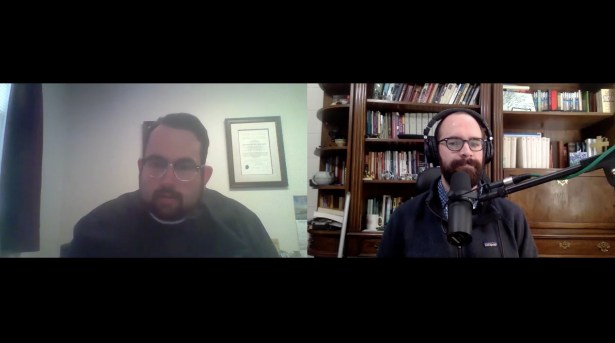
This week on the Strangely Warmed podcast I speak with Tim Ward and Sarah Locke about the readings for the Easter 2B (Acts 4.32-35, Psalm 133, 1 John 1.1-2.2, John 20.19-31). Tim is the pastor of Restoration UMC in Reston, VA and Sarah is the pastor of Christ UMC in Staunton, VA. Our conversation covers a range of topics including red Christianity, the “perfect” church, God’s agency, unity vs. uniformity, witnessing by listening, the failure of statistics, BBT’s Learning To Walk In The Dark, reclaiming Eastertide, and hanging on to sins. If you would like to listen to the episode or subscribe to the podcast you can do so here: Witnessing By Listening

Art-of-listening_v1

Three Words

1 Corinthians 15.1-11

Now I would remind you, brothers and sisters, of the good news that I proclaimed to you, which you in turn received, in which also you stand, through which also you are being saved, if you hold firmly to the message that I proclaimed to you – unless you have come to believe in vain. For I handed on to you as of first importance what I in turn had received: that Christ died for our sins in accordance with the scriptures, and that he was buried, and that he was raised on the third day in accordance with the scriptures, and that he appeared to Cephas, then to the twelve. Then he appeared to more than five hundred brothers and sisters at one time, most of whom are still alive, though some have died. Then he appeared to James, then to all the apostles. Last of all, as to one untimely born, he appeared also to me. For I am the least of the apostles, unfit to be called an apostle, because I persecuted the church of God. But by the grace of God I am what I am, and his grace toward me has not been in vain. On the contrary, I worked harder than any of them – though it was not I, but the grace of God that is with me. Whether then it was I or they, so we proclaim and so you have come to believe.

Ah, the strange and bewildering day we call Easter. All of the Bible, all of the church, all of Christianity hinges on this day: Easter, Resurrection, out of death into life. If this story were not in scripture, we would’ve thrown our bibles away a long time ago. If the Bible does not tell us this story, it tells us nothing.

Easter is the one day when all of the hopes of the past are made manifest in the present. Today we are a church unlike many of the other Sundays in the year. On Easter our pews are filled with those deeply rooted in their faith, with those filled with questions, and with those filled with doubts. So, what does one say on a day like today? How might I meet each of you where you are and provide words of truth and challenge and grace? What can I say today?

The truth: He is risen! Hallelujah!

Graveside funerals make me nervous.

If we have a funeral in the sanctuary, most things can be taken care of and are under control. We can set the temperature, clear the parking lot, and truly celebrate the many ways in which God moved in and through the person now dead.

But when you’re at the graveside, everything is out of control. You might be driving in the sunshine while in the funeral procession, but the minute you hit the cemetery the clouds roll in and the rain begins to fall. You might have your bible open to a particular passage but then the wind will blow and you’ve gone from 1 Corinthians to Exodus. Or, as has happened to me far too many times, you’ll stand over the casket with dirt in your hands and ask everyone for a few moments of silence only to hear the faint but nevertheless decisive moo of a cow from a nearby farm.

Cemeteries are often in the strangest places. I’ve buried people in perfectly manicured military compounds where you’ll never get lost because there is always a solider ready to lead you out. I’ve buried people in cemeteries stuck in the middle of residential neighborhoods, next to a playground, and across the streets from a cow farm. I’ve even buried someone’s ashes in the backyard of a beloved family member.

And because they are often in the strangest places, they can be difficult to find.

Years ago, a young pastor was asked to do a burial service for an older man from the community who had no friends, and no family. The pastor was unable to speak with anyone about the man’s life, but he wrote a decent funeral sermon nonetheless, and when the appointed day arrive he got in the car and headed out for an old country cemetery out in the middle of nowhere.

He drove and drove, and though he did not want to admit it to himself, he was lost. He tried searching for the address on his phone, and he eventually stopped at a gas station to ask for directions. When he finally pulled up he was over an hour late.

As he drove across the open and barren landscape, the hearse was nowhere in sight, but the backhoe was next to the open hole, and there was a group of men resting under the shade of a nearby tree. The young pastor parked his car and walked over to the open grave and embarrassingly discovered that the lid was already in place and dirt had been already been sprinkled across the top.

The guilt welled up within the young preacher and he opened up his bible and began preaching like he never had before. He cried out to the heavens with clenched fists, he proclaimed the promise of resurrection, and he did so with a conviction rarely found in his Sunday delivery.

After his final “amen” he returned to his car while still sweating from his passionately delivered sermon. And just before he opened the door, he overheard one of the men under the tree say to the others, “I ain’t never see nothing like that before, and I’ve been putting in septic tanks for twenty years.”

holy-week-easter-title-still

Today is Easter and it is also April Fools’ Day. This is the first time both days have fallen together in 62 years. And for months I’ve been reading articles, and listening to other pastors, expressing the importance of incorporating humor in today’s worship service. And, of course, Easter is a joke – the greatest joke God ever played on the devil. But to trivialize this day, of all days, does a disservice to the decisive change made possible by this day. It belittles the death of Jesus to graveyard jokes about septic tanks. It makes the resurrection optional instead of essential.

If God didn’t raise Jesus from the dead, if the bodily resurrection isn’t real, then we are wasting our time. It’s as simple as that. The resurrection of Jesus from the grave is the vindication of all his teaching. It is what makes the sermons and the stories intelligible, it is the light in the darkness, it is the way we follow the way.

Without the resurrection, we have no business loving our neighbors, or enemies. Without the resurrection it would be absurd to teach our children the call to turn the other cheek. Without resurrection everything in the New Testament falls apart.

The world does not recommend doing any of this Christian stuff. It is strange and bizarre to give clothes to those who are naked, and to feed those who are hungry, and to befriend the friendless. We don’t do these things as Christians not simply because God tells us to, or because it’s the right thing to do. We do them because God raised Jesus from the dead!

The empty tomb is everything. It is funnier than any joke, it is more serious than any death, it is more majestic that any mountain, it is deeper that any valley. It is everything.

Without resurrection, I’ve got nothing to say. Without Easter, nothing that Christians do makes any sense.

“He is risen!” are the three precious words found at the heart of our identity. They changed, and continue to change, everything. They are the three words handed to Paul, and Paul to the Corinthians, and eventually to us.

Some of you know that I have an annual tradition of taking this cross out of the sanctuary on Good Friday, throwing it over my shoulder, and walking through town. I started this because years ago I was struck by often we keep our crosses tucked away in our sanctuaries, hidden among the altars and rafters. And so, for the last five years, I’ve marched around town with a cross on my back, beckoning all who encounter to remember that Christ died for them, and for the world.

On Friday I made my way across our parking lot with the cross thinking, somehow, it was heavier than last year, and eventually I made it to Route 1. I began by heading north, politely waving at cars and passers by, and I think it freaked some people out. There were many open mouths and puzzled expressions in regards to a bearded young man, all dressed in black, with a cross on his back.

But I kept walking.

After about twenty minutes there was a car to my left that slowed down as it came closer, and eventually pulled in front of me and into the closest parking lot. A man quickly exited his car and started walking toward me. After 20 minutes of walking I felt like God’s was giving me the opportunity to share the gospel story. In the man’s eyes I could sense a deep need and longing, and I was just the pastor to provide. So when he stood in front of me and said, “Can I ask you a question?” I replied: “Of course, my son, ask away.” To which he asked, “Do you know where the post office is? I can’t find it.”

“Yeah,” I said, “Its back a few blocks on the left… right across the street from my church.”

Another 20 minutes of walking passed by as a few drivers kindly honked their horns in support. When all of the sudden I noticed a car full of teenagers on the other side of the road, in which they were pointing at me. The driver’s made a quick u-turn, and then they stopped in the middle of Route 1 so that half of the kids could lean out their windows to take even more pictures. As they began driving away I heard one of the girls say, “Imma put him on my Instagram!”

Eventually, after walking for more than an hour, I started heading back toward the church, wondering if carrying the cross had really made any difference. I thought about all of the people who saw the cross and whether or not it made them reflect on what Jesus did for them. I wondered about how many of them even knew what I was doing.

Shortly before I got back to the church property, I saw a young man running toward me in full workout gear. He had headphones on that were clearly pumping some serious music and he was bopping his head back and forth. I assumed that he would run right past me, but he stopped briefly on the sidewalk, gave me a double index finger point, winked, and then said, “He is risen!” and then he kept running.

He said, “He is risen!” like it was a joke.

When the event of the resurrection comes upon us, like it did Paul, when we are encountered by the living God, raised from the dead at Easter, our world is rocked and we are changed forever.

resurrection-Easter-edit[1]

It’s no joke. The resurrection is a reminder that we can never go back the same way we came. Those three words are the beginning of God’s in-breaking in the world, they are the witness to God’s unending love, they are nothing short of grace.

Easter is world shattering. It is deeply disruptive. It changes everything, now. Easter is the totality of the Good News. The story of the empty tomb is what radically reshaped Paul’s life, and, hopefully, it’s what has reshaped ours as well.

On Easter we celebrate the great power and mercy of God. In Easter we see how God took something like the cross, a sign of death to the world, and made it into the means of life. On Easter God transformed the tomb the same way that he did on Christmas in a virgin’s womb; God made a way where there was no way. On Easter God changed the world.

And all it took was three words.

So come and taste the goodness of God in the bread and in the cup. Listen for the truth of salvation in the songs we sing and the prayers we pray. Witness the power of Easter in the people in the pews next to you. Hear the Good News, the best news. Hear the three most important words you will ever hear: He is risen!

Hallelujah!

Are You Afraid Of The Dark?

Mark 16.1-8

When the Sabbath was over, Mary Magdalene, and Mary the mother of James, and Salome bought spices, so that they might go and anoint him. And very early on the first day of the week, when the sun had risen, they went to the tomb. They had been saying to one another, “Who will roll away the stone for us from the entrance to the tomb?” When they looked up, they saw that the stone, which was very large, had already been rolled back. As they entered the tomb, they saw a young man, dressed in a white robe, sitting on the right side; and they were alarmed. But he said to them, “Do not be alarmed; you are looking for Jesus of Nazareth, who was crucified. He has been raised; he is not here. Look, there is the place they laid him. But go, tell his disciples and Peter that he is going ahead of you to Galilee; there you will see him, just as he told you.” So they went out and fled from the tomb, for terror and amazement had seized them; and they said nothing to anyone, for they were afraid.

I was hiding in the tomb for what felt like hours, but in reality it had only been 30 minutes, on Easter Sunday more than a decade ago. It was the church’s Easter Sunrise service, out on the lawn, much like ours, though we had a fake tomb, with a fake stone, around which everyone had gathered.

I arrived particularly early that morning because it was my job to dress like an angel and hide in the tomb until the right moment, in which I would break down the stone and declare the resurrection of Jesus. The pastor and I had concocted this plan together, and nobody else knew.

So there I sat crumpled up in the corner while failing to keep my wings nice and clean. I hadn’t anticipated the walls being so think which made it difficult to hear the pastor, and more importantly to hear the keyword that would be my signal.

When he said something approximate to what we had agreed upon, I turned on the fog machine. You know, we wanted to create the right sort of atmosphere. But I was in a very small and tight space, and the space filled with smoke far sooner than I had anticipated, and I misheard the pastor and he was not yet ready for the theatrics.

So I did what anyone would have done, I tried to keep quiet. But the more the smoke billowed around me, the more I felt the need to cough until I could no longer hold it in, and like a drunken fool I kicked down the stone blocking the entrance, and fell into the mud, while hacking up a lung.

While the smoke dissipated, I took in the scene around me. The sun was just peaking above the tree line, a few dozen dedicated Christians were huddled together for warmth, the pastor was standing off to the side with his sermon in his hands, and all eyes were on me. I don’t know quite what I looked like, but I’m sure I looked more like a vagrant who slept in the tomb overnight than an angel prepared to make the greatest declaration in the history of the world.

For a few moments of silence I panicked – I was supposed to offer a brief monologue pertinent for the occasion, but I couldn’t remember any of it. So I just stammered something like, “He’s alive!” And then I ran.

If anyone left that day feeling anything but bewilderment, I’m sure they were afraid.

Much has been made about the women fleeing from the tomb in fear. Some say that the gospel writer did not intend to end the story this way but that he either died mid sentence, or the page was ripped at this exact place. Others have remarked that many people fear the divine in the bible, and the women are just living into the reality of what it’s like encountering something greater than yourself.

We don’t know exactly. All we know is that they left in fear.

crosses-sunrise-690x353

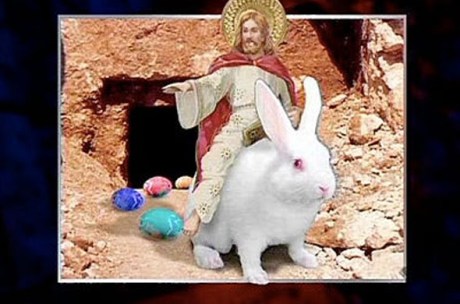
But why fear? For many of us, fear is the last thing we think about on Easter. Instead Easter is about the lilies, and the eggs, and the giant bunny. Easter is about color coordinated children, and big lunches, and the good ‘ol hymns. You know, like Christ The Lord Is Risen Today, and In The Garden. Those hymns are about joy and hope and praise and glory. Nothing about fear.

But the little we know of the first Easter, is that the very first people to experience news of the resurrection responded in terror.

We are told that in life there are only two truths: death and taxes. And if we’re honest, both of those truths scare us. Jesus tells us what to do about taxes – give unto Caesar what belongs to Caesar. But death, death is still an absolute. Or at least it was until Easter.

And that’s why the women are afraid.

If Jesus, the one crucified by colluding governmental and religious leaders, the one who had been crushed by the forces of evil, if this Jesus was now raised from the dead, now vindicated by the mighty act of God to bring new life, if God stepped in and reversed all of time and history, then the women at the tomb knew enough to know that everything in the world had been turned upside down, and that nothing would ever be the same again.

If the one truth you knew to be true was no longer true, how do you think you’d respond?

When you take the time to think about it, being met by a man who was once dead is a truly frightening proposition. It seems more like a horror movie than a polite Sunday sermon.

If Jesus was beaten, crucified, dead, buried and nothing more, then the world is right: Evil is all powerful. Violence wins. All life concludes in cemeteries.

But if Jesus is raised, if the tomb is empty, if God has the final Word, then there is reason for the women to run in fear, there is reason for all of us to be afraid. God is on the move! Everything about what we think we know to be true is wrong. He’s alive!

The frightening truth about the resurrection is that we, like the women that first Easter, will not leave the same as we arrived. Every Easter we are confronted by the scary truth: God really is in control.

That’s a frightening thing to accept because in the resurrection we discover God’s truth; that our dependence on all sorts of earthly things mean nothing. Life, beauty, security, wealth, power, our careers, property, even our families – they pale in comparison to the promise of the empty tomb.

Everything has been made new!

It is good and right for us to be here in this space at this time to celebrate Easter. Don’t get me wrong, I love worshipping in the sanctuary, but here, right now, we are participating in an even deeper truth. Jesus’ resurrection happened in the dark, when no one was around. Jesus was given new life in the tomb just like he received life in his mother’s womb. It happened in the scary mystery of darkness.

Easter was, is, and forever shall be the height of joy, it is God’s love and majesty made manifest in a new reality. Death has been defeated. We have reason to celebrate.

            But Easter is also a reminder that God has inaugurated a strange new world, one in which all of our priorities have been flipped upside down.

So the question remains: Are we afraid? If not, then perhaps we should be. Amen.

What Did Jesus Do? > What Would Jesus Do?

1 Corinthians 11.23-26

For I received from the Lord what I also handed on to you, that the Lord Jesus on the night when he was betrayed took a loaf of bread, and when he had given thanks, he broke it and said, “This is my body that is for you. Do this in remembrance of me.” In the same way he took the cup also, after supper, saying, “This cup is the new covenant in my blood. Do this, as often as you drink it, in remembrance of me.” For as often as you eat of this bread and drink the cup, you proclaim the Lord’s death until he comes.


Years ago I was in Michigan helping a church out for a summer. The church was massive in size and in ministries. They had hundreds of people in worship every week and were deeply involved in their community.

I did my best to help in every area of the church, including worship and preaching. However, they had plans for everything, including who would be preaching on what every Sunday six months in advance. So some shuffling was done, and I, the faithful intern, was given an opportunity to preach.

It so happened that I would be preaching on the first Sunday of July, and there would be communion.

holy-week

As I said, this church had everything planned out. But not only the text, and the sermon subject – they had metrics and data for worship attendance going back ten years and they used this information to provide necessary items in the sanctuary. That had it so fine-tuned that they were able to print an accurate number of bulletins +/- 10, they knew how many parking attendant workers they would need, and finally, they knew how many pieces of bread would need to be pre-cut for communion.

Here at Cokesbury we serve by intinction, in which I tear off a piece of bread from a common loaf and offer it to every person in worship. But at that church, years ago, they pre-cut every slice of bread, and had them stacked in baskets for people to pick up on their way to the altar where the single cup could be found.

And so I preached, and we moved to the table, the elements were blessed, and then the congregation was invited forward. However, no one thought to augment the numbers of bread pieces, and, as the shiny new intern, more people came to hear me preach than they anticipated.

As the gathered people lined up in the center aisle and walked forward to receive the body and blood of Jesus, it was abundantly clear that we were going to run out of Jesus. So, when the last piece was picked out of the basket, I walked back up to the altar where the actual loaf we blessed was, I ripped in in half, and I started giving Jesus so people.

And while I was standing there one of the lay leaders from the church leaned over and whispered into my ear, “Are we even allowed to do this?”

Are we even allowed to do this?

communion_elements

For I received from the Lord what I also handed on to you. So Paul writes in his letter to the church in Corinth. I gave you what was given to me. That on the night in which Jesus was betrayed he took a loaf and he took a cup and he said do this in remembrance of me.

Memory is a funny thing. It connects us to the past, in both good ways and bad. We can all reflect on those positive moments from our lives, and we can also remember the visceral pain we have experienced.

We cannot escape our memories. Memory is everything.

Paul cherished the memory he received, but he was concerned with the Corinthians ability to remember how transforming the meal was for their community. Like counting the number of bread pieces to such a degree that they no longer gave life, the Corinthian church was partaking in the meal without remembering why.

On any given Sunday, or even a Thursday night, at best the church is called to remember. Remember what God did for God’s people. Remember Jesus’ words to his disciples. Remember how God has showed up in your life.

Remembering our memories is strange, particular in the time we are living in. Many families and groups are separated in ways impossible in the past – we are separated by geography, estrangement, or even through dementia. And because of all these weird divisions, the art of memory sharing is dying. Memory, however, is the glue that keeps us together, and without it we don’t know who we are.

I’ve had to do a lot of funerals as a pastor, and whenever a family and I sit down to discuss the arrangements; I will ask questions to get the conversation going. “What was your mother passionate about?” “What stories did your grandfather tell you about his childhood.” “What’s a the story about your wife that you’ve told the most?” “How did your husband pop the question?”

And then I will sit back and listen.

And throughout all of the funerals I’ve prepared, and all of the families I’ve listened to, there are two things that have happened every single time.

No matter what the person was like, or how old they were, or even where they lived, at some point some one in the room always says, “I never knew that.”

Children make the comment about one of their parents, a brother will make the comment about his sister, and I’ve even heard a wife make the comment about her husband.

Something is shared, a deeply personal and important memory, and someone’s response is “I never knew that.”

Either we don’t remember these important things, or the memory of them was never shared. It is always a troubling and difficult moment to process in my office in which someone realizes they didn’t know the person as well as they thought they did, and now it was too late to do anything about it.

In addition to the “I never knew that” comment, there is always a moment in which someone shares a funny story about the person we are about to bury, and 99% of the time, the story takes place around a dinner table.

I don’t know what it is exactly, but there is something mysterious about the dinner table. Perhaps it’s the one place where entire families gather together for a finite period of time, maybe it’s the sharing of food that compels us to share stories, or maybe it’s just the wine that get passed around. At the table memory is shared unlike anywhere else.

Maundy-Thursday3-1080x675

As disciples of Jesus, we believe that whenever we gather at this table, or dare I say any table, Christ is with us breaking the bread and pouring the wine so that we too can be his body redeemed by his blood.

When we break bread, when we pass the cup, when we tell stories, we are connected with the signs and symbols that tell us who we are and whose we are. It is around the table the particularity of bread slices, or the shame in admitting “I never knew that,” disappear. Because at the table things begin to change.

At the table signs of memory are everywhere. In the water we remember our own baptisms, we remember the great stories of scripture where God’s people were delivered through water, we remember the living waters Jesus offers us. We see wedding bands are reminded of a couples’ promise, and God’s promise to us.

            At the table, all sorts of ordinary things become extraordinary.

We break bread, we share the cup, and we remember and retell the story of Jesus death, and resurrection. But it is more than just passing on a story – it is contemplating a mystery.

For years it has been fashionable in certain Christian circles to wear a bracelet with the acronym WWJD on them. WWJD of course meaning: What Would Jesus Do? It is used like a talisman, a final reminder of Jesus’ morality before we make a choice or a decision. And for as helpful as the WWJD reminder can be, it is also inherently problematic. It is problematic because, at the end of the day, we fundamentally can’t do what Jesus did, and that’s kind of the point.

We don’t gather to contemplate how Jesus would respond to a certain situation, we don’t wonder about what Jesus would do, instead we ask ourselves What Did Jesus Do?

Because that question, and the struggle to answer it, is at the heart of the mystery we call faith. This night, tomorrow night, Easter Sunday, every Sunday, they’re not about what we should do. It’s about what Christ did.

The Christian life is predicated on a story handed to us, a story about a poor Jewish rabbi named Jesus. It is Jesus’ story that re-narrates and re-navigates our story. We repeat it again and again and again because is not only reinforces our memory, but it also becomes a proclamation, it is a witness.

We do not gather here tonight for ourselves. We are here because at the table we discover God’s story for us, and not the other way around.

            So, what did Jesus do?

On his final night, while surrounded by his closest friends and disciples, one of whom who betray him and another would deny him, he took an ordinary loaf of bread. He gave thanks to God, and then he broke it. He looked at his friends and said, “This is my body that is for you. Do this in remembrance of me.” In the same way he then took the cup, and said, “This cup is the new covenant in my blood. Do this, as often as you drink it, in remembrance of me.”

Let us then remember…

Devotional – Psalm 118.1

Devotional:

Psalm 118.1

O give thanks to the Lord, for he is good; his steadfast love endures forever!

Weekly Devotional Image

Holy Week is easily the busiest week in the life of most churches. While the palm branches are still resting on the floor of the sanctuary, pastors and lay leaders are frantically putting together the last minutes items for Holy Week services. Meanwhile, families are frantically planning Easter Sunday meals, and making sure they have enough eggs and goodies for all the children. And because we are so busy this week, we often forget to think about, and reflect on, Jesus’ final week:

It was early in the morning when Jesus sent two of his disciples to a village atop the Mount of Olives to find a donkey. The day had come for Jesus to enter the holy city of Jerusalem during Passover, a time when the city’s population would balloon up to 200,000 people entering to celebrate. On a Sunday morning, while the crowds gathered with palm branches, Jesus entered Jerusalem. Five days later he would be killed on a cross.

holy-week

The two disciples procured a donkey and Jesus prepared to make his triumphal entry. Riding on a donkey was a richly symbolic act, one that can be traced back to the time of David. To arrive in the holy city on a donkey calls back to the prophet Zechariah who declared, “Rejoice greatly, O daughter Zion! Shout aloud, O daughter Jerusalem! Lo, your king comes to you; triumphant and victorious is he, humble and riding on a donkey.”

As he rode toward Jerusalem, droves of people arrived on the streets and they began to waves palm branches while he passed. They were so enraptured by Jesus that they took off their cloaks and placed them on the road with their palms in order to create a royal pathway for their king. They shouted things like “Blessed is he who comes in the name of the Lord!” and “Hosanna!” which means “Save us!”

At the same time, on the other side of the city, Pontius Pilate (the Roman Governor of Judea) entered Jerusalem with at least 1,000 soldiers to demonstrate the power of Rome during the Jewish celebration of the Passover. It was a show of force to prevent the people from revolting against their imperial rulers while they remembered that time when God had delivered them from captivity in Egypt.

But with Jesus, there was no show of force. Instead of armor and swords, the people took off their cloaks and waved palm branches. Instead of cowering away in fear they rejoiced in the humble man on the back of a donkey.

While the distance between the Lord and the city grew closer and closer, while the crowds were dancing and shouting, he began to cry. He looked out over the holy city and he wept for Jerusalem. He wept knowing that he was entering as the prince of peace, and within the next few days the very people who were begging for his salvation with their palm branches would reject him and call for his crucifixion.

And there was evening and there was morning, the first day.

On Monday, Jesus made his way to them Temple with countless other Jews. With the episode that had transpired the day before, all eyes were on the humble man with expectation of deliverance. As his feet walked over hallowed ground, Jesus encountered the moneylenders and changers who were taking advantage of all the Jews in Jerusalem. The prices for clean animals necessary for sacrificial rituals were vastly inflated to the benefit of the merchants and the religious elite.

Jesus, who had spent the better part of three years berating the elite for taking advantage of the poor and outcasts, Jesus, who had told the rich young ruler to sell everything he had and give it to the poor, became incensed when he saw the poor being ripped off in the name of God. He walked straight over to the tables and he lifted them off the ground and disrupted everything in the temple. He threw the merchants out of the Temple and declared that his Father’s house had been turned into a den of robbers.

The elite and powerful, who had heard about this mysterious man claiming to be the Son of Man, now had their attention on Jesus. It was one thing to have a crowd with palm branches welcoming him into the city, but to disrupt the economic scheme they had established was going too far. From this point forward, the tides began to turn against Jesus. The leaders started looking for a way to discredit him, or to remove him completely. For as long as Jesus stayed in Jerusalem, their power would be in question, and they would no longer make the money they had planned on.

And there was evening and there was morning, the second day.

On Tuesday, Jesus once again entered the Temple and he began to teach. If people were excited to see him after his entry in Jerusalem, they were now even more eager to listen to the one who had throne the merchants out of the sacred space. The Pharisees and religious leaders began to interrupt his teaching and demanded to know whom he thought he was to speak with such authority. Jesus, the one who shared parables with his disciples and followers, used parables to respond to their accusations. Over and over again he used examples to show how the powerful and lost sight of their responsibility to take care of God’s creation and he labeled them “hypocrites.”

He accused them of neglecting to practice what they preached, he called them “snakes” and a “brood of vipers” and he told them they had failed to do the one thing required of them which was to love the Lord their God with all their heart, soul, mind, and strength and to love their neighbors as themselves.

Jesus had a following, he had entered with a display of peace, but he had removed the leaders’ economic disparity, and now he had called them hypocrites. They tried to trap him in his words, but he continued to point to the love of God in all times and in all places.

And there was evening and there was morning, the third day.

On Wednesday Jesus left the arena of the Temple and continued his teaching on the Mount of Olives. Some of the disciples made comments about the beauty and the magnificence of the Temple and Jesus responded by foretelling the destruction of the temple and his own body. He revealed images of God’s cosmic plan for the world made manifest in Jerusalem and called for his disciples to stay vigilant no matter what.

He used parables to describe the call of his disciples and ended by saying that his followers would be blessed in the end if they had fed the hungry, gave water to the thirsty, welcomed the stranger, clothed the naked, cared for the sick, and visited the prisoner.

Word about Jesus continued to spread fast throughout Jerusalem and the leaders learned that he was now prophesying the end of their rule and the destruction of the temple. Gone was the joy the people felt on Palm Sunday. Fear was present with the leaders and the elite.

And there was evening and there was morning, the fourth day.

On Thursday Jesus continued to teach and gathered with his twelve disciples in the upper room for the Passover celebration. Around the table they remembered God’s great work in the delivery of the Hebrew people out of slavery in Egypt to the Holy Land; they remembered God’s actions in the lives of God’s people including themselves. But before the supper was over, Jesus did something radical. He took a loaf of bread, gave thanks to God, broke it, gave it to his friends and said, “This is my body, and I’m giving it for you.” Later, he took the cup, gave thanks to God, passed it to his friends and said, “This is my blood, and I’m pouring it out for you and for the world.” Even though he knew that in short time his disciple Judas would betray him he still shared this incredible meal and gift with his friend.

Later that evening, they arrived in the Garden of Gethsemane, and Jesus urged his disciples to keep awake while he prayed. He knelt on the ground and he communed with his Father and prayed about what was about to happen. But he ended the prayer by saying, “Lord, with you all things are possible; remove this cup from me; yet, not what I want, but what you want.” In essence he prayed, “Let thy will be done.”

When Jesus finished praying, Judas arrived with soldiers. They grabbed and arrested Jesus. The disciples fled into the distance. Jesus was dragged back into the city to be tried for blasphemy.

And there was evening and there was morning, the fifth day.

On Friday Jesus was brought to the Roman leader Pontius Pilate. The leaders demanded that he be crucified and executed, but Pilate could find no fault with Jesus. He then brought Jesus before the Jewish people and they chanted with loud and bellowing voices, “Crucify him!” The same people who had gathered on the road with palm branches yelling “Save us!” were now demanding Jesus’ death. In order to appease the crowds and the Jewish leaders, Pilate sentenced Jesus to death by crucifixion.

The soldiers whipped and beat Jesus nearly to the point of death and then, to mock him, they placed an opulent robe on his soldiers, and they made a crown of thorns for his head. They forced Jesus to carry his torture device, a cross, on his shoulders all the way to the place called The Skull. The crowds berated him on either side while he marched forward to his death. “If you really are the Messiah, save yourself!” “Where are all your disciples now?!” “Some King of the Jews you are!”

He arrived at the top of the hill and the soldiers nailed his hands and feet to the cross and hung him in the sky. For six hours Jesus’ life slowly slipped away while the crowds continued to mock him from the ground. With some of his final breaths he offered a prayer that has haunted the world ever since, “Father, forgive them, for they do not know what they are doing.” With two thieves on either side hanging on crosses, while some of his disciples watched from the distance, he died.

And there was evening and there was morning, the final week.

Jesus rode into Jerusalem on the back of a donkey proclaiming and inaugurating a time of humility and peace. Jesus rebuked the elite for preying on the poor and weak. Jesus confronted the hypocrites in leadership. Jesus called his followers to love God and neighbor. Jesus shared his final meal with the one who would betray him. Jesus was crowned with thorns and enthroned on a cross in the sky. Jesus forgave his murders from the moment of his death. And Jesus died so that we might participate in his kingdom and salvation.

Jesus is Back, Jack!

strangely-warmed-spreaker-header

This week on the Strangely Warmed podcast I speak with Teer Hardy and Jason Micheli about the readings for the Resurrection of the Lord [Year B] (Isaiah 25.1-9, Psalm 118.1-2, 14-24, 1 Corinthians 15.1-11, Mark 16.1-8). Teer serves as the associate pastor at Mt. Olivet UMC and Jason is the executive pastor of Aldersgate UMC (both in Northern Virginia). Our conversation covers a range of topics including bad impressions, shout outs to Scott Jones, bible translations, Easter as NOT the celebration of spring, God’s time, the challenges of recording live, Paul’s little Easter, female preachers, and God as an iceberg. If you would like to listen to the episode or subscribe to the podcast you can do so here: Jesus is Back, Jack

jESUS AND EASTER BUNNY


Let the Revolution Begin!

Mark 11.1-11

When they were approaching Jerusalem, at Bethpage and Bethany, near the Mount of Olives, he sent two of his disciples and said to them, “Go into the village ahead of you, and immediately as you enter it, you will find tied there a colt that has never been ridden; untie it and bring it. If anyone says to you, ‘Why are you doing this?’ just say this, ‘The Lord needs it and will send it back here immediately.’” They went away and found a colt tied near a door, outside in the street. As they were untying it, some bystanders said to them, “What are you doing, untying the colt?” They told them what Jesus had said; and they allowed them to take it. Then they brought the colt to Jesus and threw their cloaks on it, and he sat on it. Many people spread their cloaks on the road, and other spread leafy branches that they had cut in the fields. Then those who went ahead and those who followed were shouting, “Hosanna! Blessed is the one who comes in the name of the Lord! Blessed is the coming kingdom of our ancestor David! Hosanna in the highest heaven!” Then he entered Jerusalem and went into the temple, and when he looked around at everything, as it was already late, he went out to Bethany with the twelve.

While growing up in the church there were few Sundays as exciting as Palm Sunday. On Palm Sunday we, as children, always arrived a little bit earlier to church with joyful hope and anticipation for the parade of palms that would mark the beginning of worship.

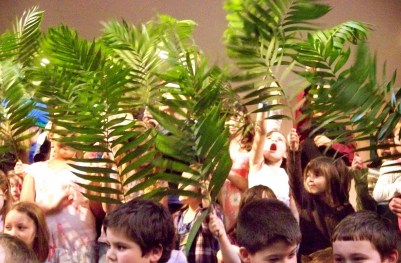
Like shepherds guiding the sheep, we were herded into a single-file line down the hallway by the narthex, we were each handed a single palm frond, and were given these detailed and explicit instructions: “You will march down the center aisle, you will wave your palms, and you WILL NOT HIT EACH OTHER.”

And so the hymn would begin in the sanctuary, and we would quickly file into the house of worship waving palm branches above our heads while all the adults shouted “Hosanna!”

That was the routine every year. Regardless of whatever was going on in the world, or even in the church, on Palm Sunday the kids got to participate in, and frankly lead, worship.

At least, that used to be the routine.

Sometime among the years, we decided that we could march down the center, we could wave our palms, but it would be far more fun if we did so while we were hitting each other with the palm branches.

It started subtlety, one young boy raised the palm branch higher than usual, and instead of waving it back and forth, he brought it down with passion on the head of the girl in front of him. To which she turned around and smacked him across the chest. And as if the message shot throughout the aisle, we all began pummeling each other until the formerly apathetic adults jumped into the pile and broke up the fight.

The was the last time they let the kids lead the parade.
palm branches

And, to be clear, I am not advocating for brawls to break out between the pews. However, that palm branch debacle was probably more faithful to the truth of Palm Sunday than any peaceful and cherubic portrayal.

This world of ours revolves around, and is perpetuated by, violence, war, and aggression. Therefore, the question remains: what does it mean to wage peace?

When we open our eyes to the brokenness of the world, we cannot ignore the immense pain, conflict, and destruction around us. On Thursday night we had a bible study here at the church and I challenged those in attendance to fill the white board with examples of problems just in our local community, and in a few minutes we completely ran out of space.

We are broken people living in a broken world.

The people in Jerusalem were crying out of deep fear, pain, and grief, when Jesus rolled into town. Like the scores of young people who marched on major cities this weekend, they saw the world around them as imperfect and they were looking for a change.

Jesus came proclaiming and promising that the kingdom of God was near, and everyone assumed they knew what that meant. Even the disciples had their own ideas about who this Messiah of theirs was. All were eager to make sure their understanding and expectations of a new beginning were met in the person of Jesus.

And so they shouted “Hosanna! Blessed is the coming kingdom!”

Palm_frond

We might hear those words and picture perfect children singing in 4 part harmony, we might even imagine the scene from Jesus Christ Superstar when a bunch of hippies surrounded a white Jesus in color coordinated liturgical dance moves. But those imagined scenes do a disservice to the truth: the crowds were looking for a revolution.

It’s hard to translate the word “Hosanna” but the closest connection might be the expression “Save us!” It is an emphatic demand, a desire for the status quo to be disrupted; it is a call of desperation.

That same phrase of “Hosanna!” was shouted in those same streets of Jerusalem 150 years before Jesus rode into town. There was a Hebrew family named the Maccabees who stirred up a violent political revolution that somehow drove the mighty Roman Empire out of their city. That family ruled after the bloody battle until, inevitably, the empire returned and reasserted their violent power.

When the crowds during that Palm Sunday shouted “Hosanna!” they were doing so with the memory of what happened the last time a revolutionary paraded into town. Their cries to be saved and delivered came with the expectation that blood would roll through the streets of Jerusalem as they took their city back.

            But, of course, by the end of the week, only Jesus’ blood would be rolling through the streets.

If this sounds difficult to process, or if your mind is having a difficult time rationalizing the fact that on Palm Sunday Jesus appeared more like Che Guevara than Mother Teresa, it’s because we’ve watered down the frightening truth of the beginning of Jesus’ final earthly week.

Parading into Jerusalem with the crowds screaming and waving was a seditious act; it was a street demonstration, one in which the Romans were probably waiting in their riot gear for the first sign of violence. It was a rally that teetered on the verse of a riot.

Jesus rode straight into the heart of the empire’s kingdom in Jerusalem, into the realm in which violence and destruction ruled the day. The people gathered and shouted and cheered him on with hopes that a revolution would begin.

And he did it all on the back of a colt, with no weapon but the Word.

Jesus was, and is, a revolutionary. But his revolution is one that begins in the heart, and transforms the world. His way is a new way, a new kingdom, a deeper covenant, in which strength is found in simplicity, wealth in generosity, and power in humility.

Palm-Passion-Sunday-wallpaper

No one’s blood would be spilled except for the revolutionary on the colt, who heard the crowds shout “Hosanna!” on Sunday and “Crucify!” on Friday.

And all the while, Jesus knows exactly what he’s doing. When we think about Palm Sunday we are mostly consumed by the images of the road, and the crowds, and the branches. But in the actual scripture, most of the passage is about the plan. Go to the village, find a colt, tell them the Lord needs it, bring it to me. The preparation is part of the plan.

And all of these elements are important because they point to the greater political ramifications of this poor Jewish rabbi upending the world.

Jesus begins at the Mount of Olives, which was the traditional location from which people expected the final battle for Jerusalem to begin. It was there that Jesus began his final campaign in the holy city. Jesus sends out the disciples for provisions, all of the items necessary for the revolution. However, the items and the situation become rather weird. The Lord does not require weapons of warfare and conflict, but a small colt (not even a full grown donkey). Jesus parades into the heart of the empire’s imperial stronghold unarmed and on the back of a small animal.

It is a parody of power.

The whole scene, from the Mount of Olives, to the crowds screaming, to arriving late in Bethany, they all show how Jesus is turning worldly notions of power upside down. It is in these things that Jesus proclaims, through his actions, that the last will be first and the first will be last. It is explosive in scope because here, in this scene, Jesus is at his most wild and political self.

It truly was the beginning of the revolution.

And yet, we portray this frightening and pivotal moment with a levity that should leave us reeling. This decisive event cannot, and should not, be limited to an opening processional where children, or even a whole congregation, are waving palm branches, with cute smiles and contentment.

We have the benefit of knowing the whole story, we know what happens at the end of the week, and still we, like the crowds and the disciples, assume we know what’s best for Jesus. We make Palm Sunday all about us and the ways we celebrate and we remember. But this day is really not about us. Save for the fact that we just as easily vacillate between asking for God to save us and shouting for God’s destruction.

Palm Sunday is focused on Jesus, on his willingness to upset that status quo, on his subverting the powers and principalities with a new revolution.

On the other side of Easter, when the earliest disciples began spreading the news of the resurrection, when the birth of church took place, rumors began to spread about these Christ people. They were strange and subversive, not because they plotted to overthrow the empire with violent means, but because they gathered together for meals and prayer, they shared all that they had, and they made sure that no one was in need.

At first they were simply called people of “The Way.” A way that seemed very strange to the world. But very quickly, as they began to grow and spread throughout the greater Mediterranean area, they we given a new name. They were called world turners, because they were charged with trying to turn the world upside down.

They believed that power, true power, was found in sacrifice and not in violence. They believed that love would always be more powerful than hate. And they believed that Jesus, the one they followed, made the impossible possible.

If any of you turned your televisions on yesterday, you saw millions of young people in this country, millions of young people all over the world marching toward the places of power. They were marching for their lives, because they believe a change needs to come.

I saw a video of one of the students from Marjory Stoneman Douglas High School in which he was asked, “What are you hoping to accomplish? What needs to change?” And he said, “I don’t care if Congress is with us or against us, change is coming.” (That sounds pretty seditious right?) He ended by finally stating, “Today the revolution begins!”

Frankly, I agree with him, and the church should be allied with those who are seeking peace in the world. However, there was one thing he said that was wrong: the revolution didn’t begin yesterday – it began on Palm Sunday. Amen.

An Exodus For The Rest Of Us

strangely-warmed-spreaker-header

This week on the Strangely Warmed podcast I speak with Teer Hardy and Jason Micheli about the readings for the The Liturgy of the Passion [Year B] (Isaiah 50.4-9a, Psalm 31.9-16, Philippians 2.5-11, Mark 14.1-15.47). Teer serves as the associate pastor at Mt. Olivet UMC and Jason is the executive pastor of Aldersgate UMC (both in Northern Virginia). Our conversation covers a range of topics including talking about ourselves as little as possible, the freedom to fail, memorizing scriptures and prayers, an accursed way to die, shame, the gospels as television channels, the nude dude, and disappearing from the story. If you would like to listen to the episode or subscribe to the podcast you can do so here: An Exodus For The Rest Of Us

J

God’s Engagement Party

strangely-warmed-spreaker-header

This week on the Strangely Warmed podcast I speak with Rev. Ben Maddison about the readings for the Fifth Sunday of Lent [Year B] (Jeremiah 31.31-34, Psalm 51.1-12, Hebrews 5.5-10, John 12.20-33). Ben is an episcopal priest who serves as the rector of Holy Trinity Episcopal church in Wenonah, NJ. Our conversation covers a range of topics including Where The Red Fern Grows, new covenants, the Law on our hearts, gifts for high school graduates, the sinfulness of email, mirrors at the altar, Jesus as priest, and the problem with loving your life. If you would like to listen to the episode or subscribe to the podcast you can do so here: God’s Engagement Party

BM2