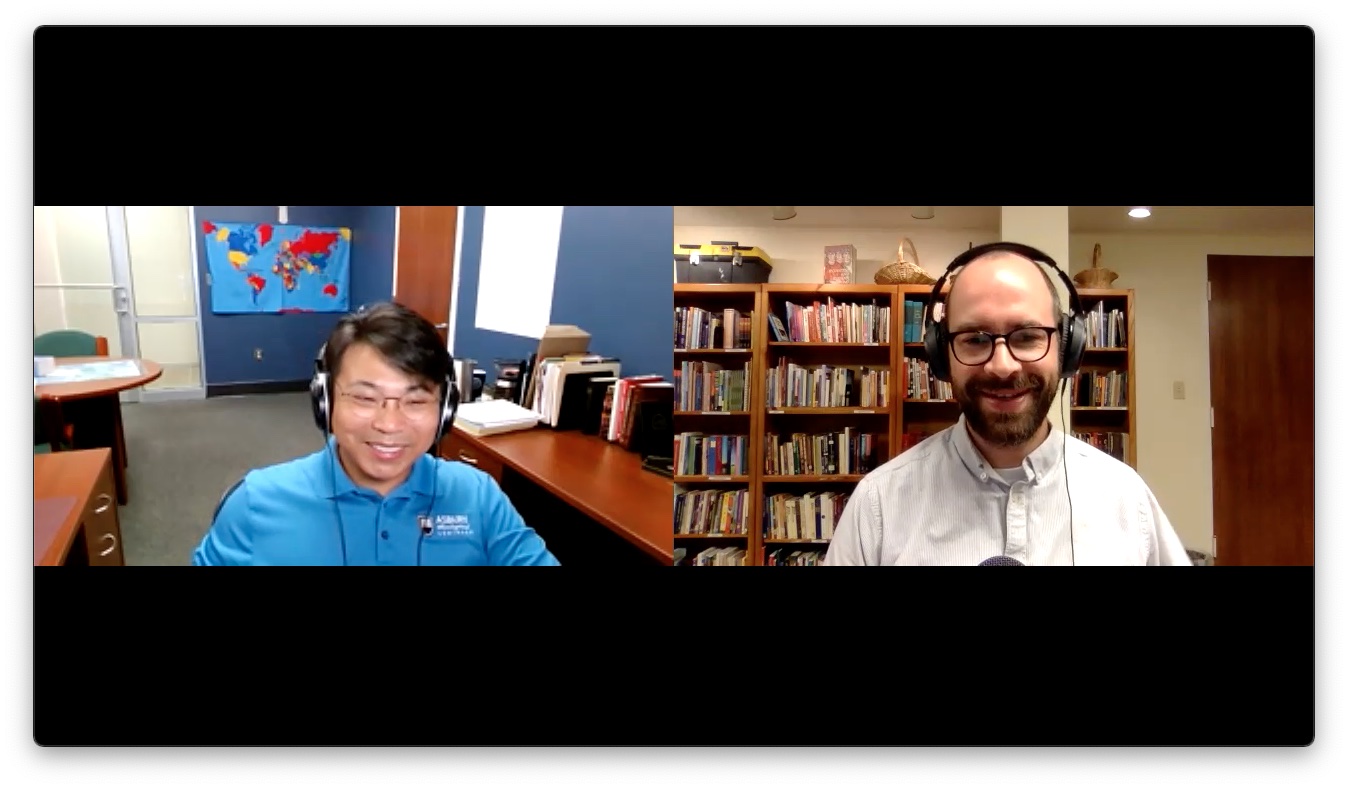
This week on the Strangely Warmed podcast I speak with Jason Micheli and Teer Hardy about the readings for the 22nd Sunday After Pentecost [B] (Job 42.1-6, 10-17, Psalm 34.1-8, Hebrews 7.23-28, Mark 10.46-52). Jason serves Annandale UMC in Annandale, VA and Teer serves Mt. Olivet UMC in Arlington, VA. Our conversation covers a range of topics including podcast statistics, popular theologians, ashy repentance, feasting on the Word, constant communion, The Holy Mountain, faithful architecture, the manifestation of mercy, and Karl Barth. If you would like to listen to the episode or subscribe to the podcast you can do so here: The Altar Is The Whirlwind
This week on the Strangely Warmed podcast I speak with Seungsoo “RJ” Jun about the readings for the 20th Sunday After Pentecost [B] (Job 23.1-9, 16-17, Psalm 22.1-15, Hebrews 4.12-16, Mark 10.17-31). Seungsoo is the Associate Director of Serving Ministries for the Virginia Conference of the UMC. Our conversation covers a range of topics including Survivor, divine anger, prayer droughts, proper terror, the spiderweb of scripture, grammatical turns, sharp swords, wealthy Christians, and the gift of salvation. If you would like to listen to the episode or subscribe to the podcast you can do so here: The Divine Yet
Now on that same day two of them were going to a village called Emmaus, about seven miles from Jerusalem, and talking with each other about all that had happened. While they were talking and discussing, Jesus himself came near and went with them, but their eyes were kept from recognizing him. And he said to them, “What are you discussing with each other while you walk along?” They stood still, looking sad. Then one of them, whose name of Cleopas, answered him, “Are you the only stranger in Jerusalem who does not know the things that have taken place there in these days?” He asked them, “What things?” They replied, “The things about Jesus of Nazareth, who was a prophet mighty in deed and word before God and all the people, and how the chief priests and leaders handed him over to be condemned to death and crucified him. But we had hope that he was the one to redeem Israel. Yes, and besides all this, it is now the third day since these things took place. Moreover, some women of our group astounded us. They were are the tomb early this morning, and when they did not find his body there, they came back and told us that they had indeed seen a vision of angels who said that he was alive. Some of those who were with us went to the tomb and found it just as the woman had said; but they did not see him.”
I haven’t been here all that long, but I have been here long enough to hear a lot of questions about why we do what we do as Christians. Perhaps we have so many questions because some of us having been coming to church for so long that we know longer know why we do what we do, or we are new enough that we just assume this is what we do without knowing why we do it.
And yet, everything we do, and I mean everything, has a purpose.
Throughout the month of October we’re going to look at some of the different things we do as disciples and we’re going to talk about why we do them. Today we begin with why we worship the way we do.
For the last 2,000 years, disciples of Jesus Christ have been gathering to worship God. From the secretive upper rooms of the first century and the time of the Acts of the Apostles, to the ornate and opulent cathedrals of Europe, to contemporary gymnasiums with folding chairs, to the comfort of our couches via the internet, worship is what we do as Christians.
Worship follows a liturgy. Liturgy comes from the Latin Liturgia which means “work of the people” and it is the work we do when we worship. You might not know it but our liturgy has four distinct parts regardless of whether we’re in the contemporary or traditional service: Gathering – Proclaiming – Responding – Sending Forth.
These four parts have connections to the ancient worship practices of the Israelites, but they can be specially connected with the story of the two disciples on the road to Emmaus.
So today, we’re breaking up the sermon into four little mini sermonettes in order to see the connections between the strange new world of the Bible and our world today.
Jesus gathered the disciples on the road, Jesus proclaimed the scriptures and interpreted them, the disciples responded by breaking bread and sharing a cup during which their eyes were opened to the presence of God, and then the disciples were sent out to proclaim what they saw and heard.
So, we begin at the beginning – Gathering.
But, when does our worship actually start? Is it when the candles are finally lit? Is it when I step up to make an announcements? Is it when the live-stream starts?
Worship, believe it or not, begins long before we even enter the building. God is actively and intimately involved in gathering us together from the moment we wake up. God is with us in our thoughts while we’re making our way to church, in our conversations in the parking lot, and even in the silence as we sit in the pews before the first note it played and before the first word is offered.
And, like the disciples on the road to Emmaus, we bring our experiences and our thoughts and even our anxieties to church. They are not meant to be left outside of our doors! They are very much a part of how we worship because speaks into our experience. That is: church is not some reprieve from the greater world even though it can be – church gives us the vocabulary to understand the greater world around us.
God then continues to gather us as the candles are lit. The light here is a reminder for us of the light of Christ that shines in the darkness, the light that came into the world in order to transform the world, a light that strengthens us in our worship and our discipleship.
Similarly, the music in our time of gathering centers us and proclaims, literally, that we have entered something different, in space and in time, than what we were doing before. The melodies and the words and even our movement are part of how God encounters us and gathers us for this work.
Because worship is work. Or, perhaps better put, worship is a habit. We do it over and over and over again to retune our minds and tone our bodies in order to be God’s people in the world.
This is how God gather us every week, just like God in Christ gathered the disciples on the road to Emmaus and changed their lives forever. So, let’s get gathered…
–
Luke 24.25-27
Then he said to them, “Oh how foolish you are, and how slow of heart to believe all that the prophets have declared! Was it not necessary that the Messiah should suffer these things and then enter into his glory?” Then beginning with Moses and all the prophets, he interpreted to them the things about himself in all the scriptures.
After Jesus gathered the disciples on the road, after Jesus listened to them ramble on and on about everything they had seen in Jerusalem, Jesus proclaimed the stories of scripture and interpreted them through his gracious work. And yet, they were still unable to recognize who he really was.
The second part of our liturgy is dedicated to Proclamation, sharing words about God’s Word. We do this because Jesus first did it on the road to Emmaus, but we also do it because God’s Word is alive and still speaks to us and our experiences today.
Our scriptures, more often than not, come to us on Sunday morning from something called the Revised Common Lectionary. The lectionary is a three year cycle of readings for every Sunday on the liturgical calendar and actually unites our local churches with all sorts of other churches – there is a very good chance that what we proclaim from the Bible on any given Sunday is also what is being read in other churches both locally and globally.
We boldly read and proclaim God’s holy scriptures in the knowledge that God will someone speak through them to us about who we are and whose we are.
However, the sermon, unlike everything else in our liturgy, is a little harder to explain. Every sermon, like every preacher, is different. Some are funny and light-hearted, some are sad and pensive, and some are bold and demanding, but they are always determined by the scriptures to which they point.
Karl Barth put it this way: the one thing preachers must do in preaching is open the eyes of their churches to the treasure of scripture that is spread before us, and then gather those treasures and pass them on to the congregation.
In other words, preachers dare to speak about God. And God, bewilderingly, chooses to speak to us through preaching.
This is how God proclaims God’s Word every week, just like God in Christ proclaimed the scriptures and interpreted them for the disciples on the road to Emmaus. So, let’s hear what God has to say to us today…
Sermon: A one-sentence sermon – God meets us on the roads of life, proclaims the Good News through likely and unlikely places, is revealed when we eat at the table, and sends us to the share Good News to all who will hear it. Amen.
–
Luke 24.28-32
As they came near the village to which they were going, he walked ahead as if he were going on. But they urged him strongly, saying, “Stay with us, because it is almost evening and the day is now nearly over.” So he went in to stay with them. When he was at the table with them, he took bread, blessed and broke it, and gave it to them. Then their eyes were opened, and they recognized him; and he vanished from their sight. They said to each other, “Were not our hearts burning within us while he was talking to us on the road, while he was opening the scriptures to us?”
Jesus was going to keep on walking, but the disciples invited him to stay with them. And, while they gathered around a table, Jesus took bread and the cup, gave thanks to God, and gave it to them. And then, and only then, were their eyes opened to the Truth in their midst. It was only in responding to the words on the road, in the breaking of the bread and the sharing of the cup, were they able to recognize how their hearts had burned within them.
The third part of our liturgy is Responding. We do this on any given Sunday by offering our tithes and our gifts back to God, we listen to an anthem or a particularly moving song, we pray and consider how we might continue to respond to what God is saying, but the fullest and most faithful way we respond is by sharing the same meal that Jesus shared with the disciples on the road.
The holy meal is worthy of its own sermon series, but suffice it to say that when we share the bread and when we share the cup – that’s what being a Christian is all about. Through the power of the Spirit we are connected in the meal to all who have come before us, and we are connected to all who will feast long after we’re gone. It is a foretaste of the heavenly banquet to which all of us are beckoned in our deaths, and it is where we are consumed by that which we consume.
This is how we respond to God’s glory in the church and in the world by offering ourselves and feasting at the table just like Jesus did with the disciples from the road. So, let’s respond to the Lord…
–
Luke 24.33-35
That same hour they got up and returned to Jerusalem; and they found the eleven and their companions gathered together. They were saying, “The Lord has risen indeed, and he has appeared to Simon!” Then they told what had happened on the road, and how he had been made known to them in the breaking of the bread.
I’ve always wondered what it must’ve been like to be one of those two disciples who sat at the table with the Lord when the fullness of the moment was revealed. But then I remember that I do know what that was like for, whenever we gather to feast, we experience the same.
In worship our eyes are opened to the power and presence of Jesus in our midst.
The disciples were so moved bye their experiences of being gathering on the road and of hearing Jesus proclaim the scriptures, and responding to the truth at the table, that they ran back to Jerusalem to share all they had seen and heard.
When we are confronted and met by the power and glory of God in worship, we can’t help but go forth to share the good news with all who will hear it.
Each week we “end” our worship with a benediction and a song but our worship doesn’t really end – instead we take what happened here with us into the world as people who live and speak the praise of God.
This is how we are sent forth week after week, just like the disciples who ran to tell their friends what they saw and heard. So, let us prepare to be sent forth into the world…
Truly I tell you, whoever does not receive the kingdom of God as a little child will never enter it.
It was a few Christmases ago when a daughter asked her father what the holiday really meant. He explained that Christmas is about the birth of Jesus and the more they talked the more she wanted to know so the father purchased a children’s Bible and began reading it to her every night.
She loved it.
They read the stories of Jesus’ birth and teachings, and the daughter would ask her father to explain some of Jesus’ sayings like, “Do unto others as you would have them do unto you.” And the father said, “Jesus teaches that we are supposed to treat people the way we want to be treated. And with each passing story, the daughter became more and more enamored with Jesus.
They were driving around town a few weeks later when they passed by a Catholic Church with an enormous crucifix on the front lawn. The giant cross and it’s dying figure were impossible to miss and the daughter quickly pointed out the window and said, “Dad… Who’s that?”
The father realized in that moment that he never told her the end of the story. So he began explaining how the person on the cross was Jesus, how he ran afoul of the Roman government because his message was so radical and they thought the only way to stop his message was to kill him, so they did.
The daughter was silent for the rest of the drive.
A few weeks went by and when his daughter had the day off from school in celebration of Martin Luther King Jr the father decided to take the day off as well and treat his girl to lunch. And while they were sitting at a table waiting for their food, his daughter reached for the local newspaper, pointed at the figure on the front-page and said, “Dad… Who’s that?”
It was Dr. King.
“Well,” the father began, “That’s Martin Luther King Jr and he’s the reason you’re not in school today. We’re celebrating his life. He was a preacher”
And she said, “For Jesus?!”
“Yes,” he said, “But there was another thing that he was famous for; he had his own message and said that people should treat one another the same no matter what they look like.”
She thought about that for a minute and said, “Well Dad, that sounds a lot like do unto others as you would have them do unto you.”
The father said, “Yeah, I never thought about it like that, but it is just like what Jesus said.”
The daughter was silent for a moment or two, and then she looked up at her father with tears in her eyes and she said, “Did they kill him too?”
–
There’s a reason Jesus said that unless we receive the kingdom like a child we will never enter it. Kids get it. If only the same could be said about us adults.
This week on the Strangely Warmed podcast I speak with Seungsoo “RJ” Jun about the readings for the 19th Sunday After Pentecost [B] (Job 1.1, 2.1-10, Psalm 26, Hebrews 1.1-4, 2.5-12, Mark 10.2-16). Seungsoo is the Associate Director of Serving Ministries for the Virginia Conference of the UMC. Our conversation covers a range of topics including church connections, Karl Barth, honesty in church, divine equity, ecclesial integrity, reminiscent places, Christology, the power of names, the difficulty of divorce, communal covenants, and porcupines. If you would like to listen to the episode or subscribe to the podcast you can do so here: The Crisis of Faith
John said to him, “Teacher, we saw someone casting out demons in your name, and we tried to stop him, because he was not following us.” But Jesus said, “Do not stop him; for no one who does a deed of power in my name will be able soon afterward to speak evil of me. Whoever is not against us is for us. For truly I tell you, whoever gives you a cup of water to drink because you bear the name of Christ will by no means lose the reward. If any of you put a stumbling block before one of these little ones who believe in me, it would be better for you if a great millstone were hung around your neck and you were thrown into the sea. If your hand causes you to stumble, cut it off; it is better for you to enter life maimed than to have two hands and to go to hell, to the unquenchable fire. And if your foot causes you to stumble, cut if off; it is better for you to enter life lame than to have two feet and to be thrown into hell. And if your eye causes you to stumble, tear it out; it is better for you to enter the kingdom of God with one eye than to have two eyes and to be thrown into hell, where the worm never dies and the fire is never quenched. For everyone will be salted with fire. Salt is good; but if salt has lost its saltiness, how can you season it? Have salt in yourselves, and be at peace with one another.”
What happened to the nice, Sunday school, version of Jesus that all of us love?
Love God and love your neighbors as yourselves, treat others as you wish to be treated, make the world a better place. Those are the slogans of our faith!
So what are we to make of this Jesus who tells us it’s better to show up for the kingdom of God with one eye, one leg, and one hand than to have our whole selves and be thrown into hell where the worm never dies and the fire is never quenched?
Just last week we were reading about how Jesus said you have to be like a child to enter the kingdom of heaven, and now Jesus is talking about hellfire and damnation.
We don’t talk much about hell. It’s not an appropriate topic for conversation among well meaning Methodists. Hell isn’t a very uplifting subject.
And yet here, in Mark 9, Jesus talks about hell.
The disciples bring to the Lord a complaint: “Excuse us, JC, but we just met someone who was doing work in your name, and we tried to stop him, honestly we tried, because he wasn’t following us.”
We are concerned, Lord. Who knows what kind of crazy stuff some people will do in your name? There has to be some kind of standard when it comes to the work we call church. Otherwise we might wind up with televangelists who fly around the world in airplanes. We might wind up with grocery store front churches that promise wealth and health to those who just have enough faith. We might wind up with churches with big columns and a pipe organ with over 1,400 pipes. So… what should we do Lord?
Jesus says, “Let them be; for if someone performs deeds of power in my name, pretty soon they’ll be on our side, if they aren’t already. The kingdom is bigger than your little minds can even imagine – there are spots at the heavenly banquet for people who wouldn’t never dare to invite. But remember – this party doesn’t belong to you. God is the host.”
And, it would have been nice if Mark, the gospel writer, could’ve left the story right there – this would be a great place for “and immediately they headed toward the next stop on the journey.”
But no. Jesus keeps going. “Listen,” says the Lord, “whenever you try to prevent others from serving in my name, you are putting stumbling blocks in the way of other disciples. And, to be fair, you can stop people all you want, but it would be better for you to put a millstone around you neck and jump into the deep end of the pool.”
But wait, there’s more – “While you’re at it – if there is anything that causes you to sin, be it your eye, your hand, your foot, whatever it is, go ahead and cut it off. It is far better to be part of the kingdom maimed than it is to burn in hell.”
This is not the meek and mild and smiling Jesus that we usually have displayed on paintings around the church – this is not the kind of story we would want to teach during vacation Bible school.
Jesus cranks it up to eleven. He paints a picture for the disciples of frightening and terrifying images – people downed by concrete, followers removing body parts as they enter the kingdom.
A little hyperbole never hurt anyone.
Perhaps Jesus is troubled knowing that his followers will mistakenly lead others astray. Maybe, with the cross growing clearer on the horizon, Jesus is tired of his disciples moving to and fro with every gust of wind and wants to stop them in their tracks. Perhaps Jesus believes that some will think his Gospel is just one of many things we can pick up whenever we want rather than a matter of life or death, heaven or hell.
To be fair – Jesus doesn’t actually call it “hell.” He uses the Aramaic name of a place called Gehenna. This was an actual place, just outside the walls of Jerusalem. We, of course, hear the word hell and we immediately conjure in our minds some version of Dante’s Inferno or some bad low budget b-movie with a tall red figure with a bifurcated tail holding a trident.
Jesus, however, is talking about Gehenna. Long before our Lord arrived on the scene it was the place of pagan idolatry and that’s how it became a place of ill repute. So much so that when Jesus addressed the disciples about the entering the kingdom, Gehenna had become the town dump. It was where rubbish and refuse was deposited, it was a fiery place because people kept throwing their garbage into it.
Therefore, Jesus says it would be better to pluck out our eyes and go into the kingdom missing some part of us than to have our whole bodies thrown into the dump called Gehenna.
Its rather odd how some things haven’t really changed over the last few millennia – we are still a throw-away society whether it’s our literal garbage, or the people we treat like garbage. If something doesn’t fit into our worldview, we are happy to cast it away without ever having to really think about it again.
That’s why we still remove unsightly elements from our lives and relegate them to the place we would call dumps.
We are content to lay our trash on the curb for someone else to come and take away (who knows where?) and we are all too comfortable with allowing prisoners to be locked up in jail without us ever having to think about their conditions, we perpetuate systems in which the poor keep getting poorer and are forced to resort to terrible actions in order to survive. On and on and on.
It’s Gehenna. It’s hellish what people are forced to go through here and now.
And Jesus says that no child of God’s good creation and love is meant for Gehenna.
It would be better for us to sacrifice what we hold so dear in order to help others, than to continue along as if the universe revolves around us.
One of the great challenges of the church today is to rid ourselves of the fallacy that we are somehow better than other people. That’s what the disciples were struggling with when they complained to the Lord about the one doing deeds in the name of Jesus. They saw themselves as right and everyone else as wrong.
Or, to put it another way – they saw themselves as saints and everyone else as sinners. But here’s the kicker: the kingdom of God is populated only and entirely by forgiven sinners.
That doesn’t mean that we can just go around doing whatever we want whenever we want. Sin has consequences here and now, but all of our sins are no match for the Lamb of God who comes to take away the sins of the world.
Jesus speak harsh words to us today because the world is a harsh place. It can even be a hellish place.
Fyodor Dostoyevsky wrote that hell is the suffering of being unable to love. Think about that for a moment – when we are unable to love, even our enemies, we create hell on earth for other and for ourselves.
Did you know that more Americans have died from COVID19 than Americans died from the 1918 flu pandemic? Despite all the medical advancements over the last 100 years we’ve buried more people this time than last time. 1 in 500 Americans have died in this crisis!
Why? We can blame the spread of misinformation, and selfishness, and failures in leadership locally and globally. But it’s also because we’ve failed to love one another.
Hell is the suffering of being unable to love.
The Apostles’ Creed is a an ancient text around which the church has centered its identity.
I believe in God the Father Almighty, maker of heaven and earth, and in Jesus Christ his only Son our Lord.
And toward the end of the Creed there is a very, very, important line. We say that Jesus suffered under Pontius Pilate, was crucified, dead, and buried, and on the third day he rose again. But originally, for centuries, Christians used to say Jesus was crucified, dead, and buried, and he descended into hell.
Jesus was constantly descending into hell. Not just when he died, in those three days before the resurrection, but throughout his earthly ministry. Jesus entered those places we avoid, he encountered those we turn away from, Jesus went to the margins.
Jesus ministered among and in the dumps of the world – Gehenna.
Again and again and again in the Gospel, we discover the oddity of God made flesh who comes to dwell among the people who feel like they’re living in hell on earth.
Because Jesus goes to hell and back for people just like us.
We live in a time in which we are told to never stop trying – there’s always more to be done, more effort we can put it. We’re fed a narrative in which if we really commit ourselves to something, we can do it. And to some degree, that’s true. There are people who are living in hell on earth right now and we can do something about it.
The church has always been called to be the kind of place that willingly goes to Gehenna, to do whatever it can to salvage lives, to literally rescue people, to remind them that they are precious lambs of Jesus Christ, that they have worth and value no matter what the world tells them, and they are not meant for the hells of life.
But when it comes to ourselves, there’s no amount of work (perfect morality, ethical observance, or even self-mutiliation) that can really fix what’s broken in us. We can’t save ourselves. At least, not on our own. We regularly do things we know we shouldn’t, and we regularly avoid doing things we know we should do.
But that’s why the work of Christ, what we in the church often call grace, is so amazing. Grace is not something we earn or deserve, it is something done to us.
All of us, no matter how we might appear to have it all together, all of us are sinners in need of grace. That’s why Jesus’ words today are so good and so terrifying – they convicts us and reminds us that only God is good alone. This passage functions as a mirror to show us the condition of our condition.
Grace, God’s grace, is what happens when, no matter how hard we’ve tried, we see ourselves for who we really are AND we discover that God does not abandon us.
In fact, God comes straight down into the muck and the mire of our lives, right smack dab in our sins, and refuses to let us go.
Later, after all who heard these words straight from the lips of the Lord abandoned him to his fate, he was nailed to a cross and lifted high upon Calvary. If he looked hard enough, Jesus would’ve been able to see Gehenna, the hell of Jerusalem, with its never-ending fire.
Jesus’ deepest experience of hell was right up on that cross.
That’s why we put crosses in our sanctuaries. Not because they are some impotent symbol of the distant past, but because the cross is death.
Jesus died, the incarnate Lord made flesh went to hell and back for us and the world.
Let us therefore never forget: if we want to meet Jesus, the first place to look for him is in hell. Amen.
This week on the Strangely Warmed podcast I speak with Todd Littleton about the readings for the 18th Sunday After Pentecost [B] (Esther 7.1-6, 9-10; 9.20-22, Psalm 124, James 5.13-20, Mark 9.38-50). Todd is the pastor of Snow Hill Baptist Church in Tuttle, OK. Our conversation covers a range of topics including the conundrum of context, Lupin, sacrificial honesty, reading between the lines, the manifestation of memory, hermeneutical tools, The Brothers Zahl, stumbling blocks, and selfishness. If you would like to listen to the episode or subscribe to the podcast you can do so here: The Story Within The Story
From there he set out and went away to the region of Tyre. He entered a house and did not want anyone to know he was there. Yet he could not escape notice, but a woman whose little daughter had an unclean spirit immediately heard about him, and she came and bowed down at his feet. Now the woman was a Gentile, of Syrophoenician origin. She begged him to cast the demon out of her daughter. He said to her, “Let the children be fed first, for it is not fair to take the children’s food and throw it to the dogs.” But she answered him, “Sir, even the dogs under the table eat the children’s crumbs.” Then he said to her, “For saying that, you may go — the demon has left your daughter.” So she went home, found the child lying in the bed, and the demon gone. Then he returned to the region of Tyre, and went by way of Sidon towards the Sea of Galilee, in the region of the Decapolis. They brought to him a deaf man who had an impediment in his speech; and they begged him to lay his hand on him. He took him aside in private, away from the crowd, and put his fingers into his ears, and he spat and touched his tongue. Then looking up to heaven, he sighed and said to him, “Ephphatha,” that is, “Be opened.” And immediately his ears were opened, his tongue was released, and he spoke plainly. Then Jesus ordered them to tell no one; but the more he ordered them, the more zealously they proclaimed it. They were astounded beyond measure, saying, “He has done everything well; he even makes the deaf to hear and the mute to speak.”
Jesus is in the wrong place at the wrong time. He sets out for the region of Tyre, Gentile territory, in which he will be a stranger in a strange land, and he doesn’t want anyone to know he’s there.
But a woman hears about him and she bows down at his feet.
Jesus is a Jew. She’s a Gentile.
Jesus wants to be alone. She wants help.
It’s here, outside the confines of Israel, beyond the realm of the covenant, out on the margins of life, Jesus is encountered by the woman’s desperation.
“Please,” she begs, “heal my daughter!”
As one outside the people Israel, she’s probably bent down at the altars of countless gods before, hoping against hope for her daughter’s sake. And somehow she hears of this Jesus, and bends down yet again.
And Jesus brushes her off. After all, he has come for the lost sheep of Israel. He’s got plenty of work to do among his own people. It wouldn’t be fair to give what belonged to God’s children to the dogs, to those outside the covenant.
“But sir,” she says, “even the dogs under the table get to eat the crumbs left by the children.”
A sly smile stretches across Jesus’ face. “Indeed,” he responds, “for saying that you may go – your daughter has been healed.”
Jesus had a way of attracting desperate people, and he had a way of loving desperate people.
Jesus miraculously reaches out beyond all the perfectly good reasons for not doing so, and brings about a new reality that we never imagined possible.
And it really is miraculous. But here’s the kicker – the so-called Syrophoenician woman, and most of the other recipients of grace for that matter, don’t receive the miracle because of what they believe. At least, not really. A miracle, by definition, is an unwarranted and undeserved gift of God. God in Christ has this knack for making outsiders into insiders, for reaching beyond beyond the boundaries of propriety, of meeting people where they are and not where they ought to be.
God meets us in our mistakes, not in our triumphs. God meets us in our sins, not in our successes.
Which is to say – the woman gets it! Her line about “even the dogs under the table” shows that she has caught a glimpse of the way grace works in the world – there’s always more than enough Jesus to go around even for those who don’t deserve him.
Because none of us deserve him.
She understands, in some way, shape, or form, that this is the way God has determined to be God – through mercy. God, with open arms and a never ending table, desires for all to receive a taste of grace in order that the world might be transformed, transfigured even.
Somehow, the woman knows that mercy might begin with Israel, but she also knows, through Jesus, that God’s mercy doesn’t end with Israel.
In other words, God likes crowded tables.
There is no sinner so great that they cannot be forgiven by God. Even the worst stinker in the world is someone for whom Christ died.
The woman has faith enough for Jesus to meet her in her desperation, and it changes everything.
But that begs the question – What, exactly, is faith?
Some might imagine that it means, first and foremost, that one says yes to a series of creedal propositions concerning who Jesus is and what Jesus did. Something like the Nicene Creed or the Apostles’ Creed. Or, perhaps, accepting Jesus as your personal Lord and Savior, whatever that might mean.
And yet, we don’t hear Jesus saying anything about any of that with the woman, nor does he put any prerequisites on the deaf man with the impediment in his speech before he heals him.
Think about the thief next to Jesus on the cross. While the crowds ridicule the Messiah with nails in his hands the thief merely says to Jesus, “Remember me.”
When God makes a New Heaven and a New Earth, when God brings about the resurrection of the dead, I’m going to find that thief. I can’t wait to ask him how it all worked out for him. Because, can’t you just imagine the other smug Christians walking around with their resurrected noses in the air looking down on the thief? Can’t you imagine them confronting him, “Well, you were never baptized, you never stood up and affirmed the creeds, you didn’t tithe to your local church… On what basis did you get in?”
And the thief says, “The man on the middle cross said I could come.”
Faith isn’t about what we do, faith is about what is done to us.
In the end, faith is really nothing more than trusting Jesus to do what he said he will do.
Why did the woman trust Jesus? We don’t know. Maybe she heard about him through the grapevine, maybe she ran into someone who had a taste of the loaves and the fishes. Scripture doesn’t tell us. But somehow she learned, and in her desperation she went looking.
The words about the Word continue to spread, even today. We have them right here in scripture, sometimes we can find the Word in sermons. The Word always finds its way onto strange paths, even to those who don’t go to church every Sunday and to those who don’t read the Bible.
There are always small crumbs falling from the rich table where God gives the bread of life.
And that’s exactly how faith works – it kind of shows up out of nowhere. It has nothing to demand, it earns nothing and deserves nothing. Faith simply says, “Lord, have mercy.” For faith, real confounding faith, knows that if Jesus helps, then it is only by grace. Grace is given only to those who stand under judgment – so it is with faith even today.
I came across a story a few years ago that has haunted me ever since.
A woman, in the early 90s, found herself in the fetal position on her dirty living room floor one night. She was strung out, hoping her husband would return home with their next fix, but also knew that if he did return, he wouldn’t share it with her. Their baby was somehow asleep in a dirty crib in the next room over and she had a terrifying moment of clarity. She was afraid that if someone found her as she really was, they would take her son away. And she was even more worried that her son needed to be taken away from her.
And so there she was, rocking back and forth on the floor and in her hands was a tiny slip of paper with a phone number on it. A few years before, her mother sent her the number through the mail for a Christian counselor to try to help her out of the hole she had dug for herself. Over the years, in moments of terror, the woman would pull out the number but she never worked up the courage to call in.
Until that night.
The phone rang and rang and eventually a man answered it, clearly having been woken up from sleep. And immediately the woman said, “I’m sorry for calling so late, but my mom gave me your number and said that you might be able to help me.”
The man said, “Tell me what’s going on.”
So she did. She admitted things to him that she hadn’t really even admitted to herself. I’m a drug addict. I’m a terrible mother. I need help.
She went on and on and the man listened. He didn’t judge, he didn’t offer advice. He just kept encouraging her to share what was on her heart and soul.
They talked on the phone until the sun rose in the morning. And the woman, now having made it through the darkest night of her life, said, “You know, I’m kind of surprised you haven’t given me any scriptures to read or prayers to pray, isn’t that what Christian counselors do?”
He brushed the comment aside but then she continued, “No, seriously. You’re really good at this. How long have you been a Christian counselor?”
And the man said, “Please don’t hang up, and listen to me for a minute. You know that number you dialed, the one your mom gave you a few years ago for a Christian counselor? Wrong number.”
She didn’t hang up, but they eventually finished their conversation. And her life didn’t change immediately. But she says that after that night, having encounter a stranger who listened just for the sake of listening, her life changed. Slowly but surely, her life changed because she discovered, for the first time, that there was unconditional love in the universe and some of it was for her.
She goes around the country now, telling her story, and this is how she always ends it: This is what I know, in the deepest darkest moments of despair and anxiety, it only takes a pinhole of light, and all of grace can come in.
Faith, obviously, teaches us a lot about the Lord, but also a lot about who we are. There’s not a way for us to encounter God without coming to grips with the condition of our condition, no matter how good we might seem on the surface.
We should want to love our enemies and never be angry with all the trouble makers and cheaters who make our lives so miserable. But we can’t do it. We don’t love our neighbors as ourselves, we are not as we ought to be. We are miserable offenders. We are not worthy to come to this table.
But that is the heart of grace.
We don’t deserve the help and the forgiveness offered to us by God.
People, since the time of Christ, have earnestly desired to follow, we’ve prayed for pure hearts and pure love and pure faith. And then, we don’t get it. Instead we wrestle with our doubts and our shames and our hurts and our pains and we realize that we are not what we can or should be. It drives us to despair and desperation. And then the unexpected happens – Jesus finds us. We cry out, “Lord, have mercy!” And we see all things anew. We can’t do what we need to do, but the Lord can through us.
God takes away our sins, not in part but the whole, nails them to the cross, and we bear them no more.
God has established a kingdom in which forgiveness never ever runs dry, and where we are always invited to the feast where even the tiniest crumbs convey the fullness of grace.
One of the strangest parts of being a Christian is coming to grips with the fact that we would not know this trust had we not, at some point, been desperate.
And that’s faith – it’s expecting the unexpected. It’s calling out for help from the one who shouldn’t help us, and yet does. Amen.
A good name is to be chosen rather than great riches, and favor is better than silver and gold.
Names are important. There are few things that warm the heart quite like someone remembering your name in a world so busy that we often forget almost everything else.
There is a huge difference between, “Oh hey, it’s so nice to see you!” and “Oh hey Taylor, it’s so nice to see you!” The difference might only be one word, but that one word makes all the difference.
Our names are so integral to who we are that they shape us and shift us around in ways that we don’t even realize. For instance: studies show that individuals who share a first initial with the first initial of a major storm are far more likely to donate money than people with other names. Therefore, Kims and Karls donated more money after hurricane Katrina than did Marys and Matthews.
The incredible importance of our names is also made evident in what’s called the Cocktail Party Effect. The idea is that, when you’re at a party even with hundreds of people in attendance, if someone mentions your name on the other side of the room you’ll hear it. Somehow your name will rise above the decibels of the room and it will float along until it catches your attention in a way that nothing else can.
A few weeks ago I was sitting in a coffee shop working on a sermon when someone, seemingly out of nowhere, shouted, “REVEREND!”
I almost fell out of my chair.
“Yes?” I stammered. The man was unfamiliar to me, but he gave me a look I can only describe as bewildered. He said, “Well I saw your Bible sitting there and I figured you had to be Reverend and I wanted to ask for your prayers, but I’ve been trying to get your for attention for a minute or so and you never responded. Are you sure you’re a Reverend?”
He had been calling my name, the one given to me by God, and I didn’t hear him at all.
I can blame it on being distracted by my work, or even the relative noise of the coffee shop, but the truth is I understand myself as a Taylor far more than I do as a Reverend.
Our parents give us our names – the ones that usually draw our attention. But God has also given each of us new names that truly define who we are. The great challenge is that sometimes we can’t hear them at all or we’ve forgotten who we actually are: children of God.
But when we remember who we are in Christ, it actually changes the way we see ourselves and the way we see others. We are given a new identity and a new community in which we are not defined by what we’ve done or left undone – Instead we are defined only by what God in Christ has done for us.
Now when the Pharisees and some of the scribes who had come from Jerusalem gathered around him, they noticed that some of his disciples were eating with defiled hands, that is, without washing them. (For the Pharisees, and all the Jews, do not eat unless they thoroughly wash their hands, thus observing the tradition of the elders; and they do not eat anything from the market unless they wash it; and there are also many other traditions that they observe, the washing of cups, pots, and bronze kettles.) So the Pharisees and the scribes asked him, “Why do your disciples not live according to the tradition of the elders, but eat with defiled hands?” He said to them, “Isaiah prophesied rightly about you hypocrites, as it is written, ‘This people honors me with their lips, but their hearts are far from me; in vain do they worship me, teaching human precepts as doctrines.’ You abandoned the commandment of God and hold to human tradition.” Then he called the crowd again and said to them, “Listen to me, all of you, and understand: there is nothing outside a person that by going in can defile, but the things that come out are what defiled. For it is from within, from the human heart, that evil intentions come: fornication, theft, murder, adultery, avarice, wickedness, deceit, licentiousness, envy, slander, pride, folly. All these evil things come from within, and they defile a person.”
It’s rather strange how God does so many ungodly things.
One would think, and perhaps hope, that God in the flesh would know better than to erase the sins held against us, that the incarnate Word would choose to spend time among more respectable persons, that the Holy One of Israel would follow the rules.
And yet, listen: The Pharisees and the scribes, that is: the good religious folk, those who tithed and showed up for worship and prayed their prayers, noticed that Jesus’s disciples were eating their food with defiled hands.
Now, the washing of hands wasn’t about hygiene – it was about pious and sacred preparation and separation – it demonstrated who was in and who was out. At the end of the day it was a public demonstration about who was living properly and who wasn’t.
So the good religious people say, “What’s the deal JC? You can’t really be the Messiah it your people aren’t following the rules!”
These Pharisees have it all together, mind you. They know their scriptures backwards and forwards, they always show up early when the fellowship hall needs some new paint, they never let the offering plate pass by without dropping something in. They want to know how Jesus, the so-called Anointed One, could get away with such irreligious behavior.
How does Jesus respond?
“Y’all are a bunch of hypocrites! You’ve let your religion become a stumbling block to those in the faith – these rules and expectations don’t make people holy and they certainly don’t make life any better, they only go to show that you think you’re better than everyone else!”
And then Jesus motions for all of the crowds to come closer because he wants everyone to hear:
“Listen up! It is not what goes into us that defiles us. It doesn’t matter what we eat and with whom. What does matter is what comes out of us. The heart is a fickle thing and leads to all sorts of suffering. Evil comes from within, and those things are what defile a person.”
It’s as if Jesus is imagining the great banquet table of the Kingdom of God, but there are only place setting for those who think they’re the best of the best and then Jesus mic drops: “There’s a place at the table for everyone but your self-righteousness keeps getting in the way.”
Contrary to how we often talk about it, and even how we live it out, Christianity isn’t a religion – if it is anything it is the declaration of the end of religion. Religion consists of all the things human beings have ever thought we have to do to get right with God. Christianity tells us that God in Christ does what we could never do in order to reconcile the world to himself.
Or, as Martin Luther memorably put it, “The law says, ‘do this.’ And it is never done. Grace says, ‘believe in this,’ and everything is already done.”
We, the church, don’t exist to wag our fingers at every little sin and indiscretion, we are not here to proclaim the Bad News that God will only think kindly upon us after we have fixed all of our mistakes.
Instead, the church exists to announce the Good News, the very best news, that “while we were yet sinners, Christ died for the ungodly.”
Christianity isn’t an arbitrary set of rules to be followed.
Christianity is an adventure in which we are always on the journey of discovering the Love that refuses to let us go.
And yet, what does that adventure ultimately lead to?
If we’re serious about transforming the world, it’s in our mission statement after all, then it has to start somewhere. Of course there is sin and evil in our corporations and in our institutions. But there’s also sin and evil in us. And its those sins that Jesus seems to be talking about with the Pharisees.
In 1905 the Daily News in London published a piece titled, “What’s Wrong With The World?” And they asked for readers to submit answers to the question. Hundreds and thousands of people replied with all sorts of responses. GK Chesterton, essayist and theologian, responded with only two words: “I am.”
We are what’s wrong with the world.
Why? Because we are consumed with our own self-interests, because we create communities in which some are in and some are out, because we knowingly and unknowingly contribute to systems that force people to the margins, on and on and on.
How can we fix what’s wrong within us?
Well, the truth is, we can’t. But there is someone who can, and does. His name is Jesus.
Jesus shows up on the scene, eating with outcasts, healing the undeserving, preaching the Good News to those who are drowning in bad news – he offers glimpses of a future not yet seen.
And while some people love it, others hate it.
Jesus warns the crowds, and us, about not becoming obsessed with the external at the expense of the internal. Remember: this is the same guy who tells us to stop looking at the splinter in someone else’s eye while ignoring the log in our own, this is the same guy who insists on dining with the wrong people, this is the same guy who, at some point, showed up in your life and my life and said nothing more than, “Follow me.”
It’s easy to point out all the problems with other people – it’s hard to look in the mirror.
Judgment comes first to the household of God, scripture says.
Perhaps we’ve forgotten that.
Basically, it doesn’t do us any good to lament the brokenness of the world if we are unwilling to confront the brokenness that’s right here in our hearts.
The Pharisees don’t like the idea of Jesus’ disciples not following the rules and so they confront the Messiah. Jesus’ rebuke of their hardheartedness, as much as it might make us smirk with religious smugness, it creates a tension for those of us who want to follow the Lord.
The tension is between the commands of God and human traditions. What is the core essence of our faith? What do we have to do to be faithful? How do we know what is what?
The church has always existed in this strange middle space, between the already but the not yet, between what the strange new world of the Bible says, and what it means to live according to those words, or better yet, the Word, today.
And maybe the tension is a good thing – it allows us to wrestle with what we’re being called to do.
There’s a reason we bristle at over-confidence in life, whether its in regard to scripture or not. Total certainty just rubs us the wrong way. There’s a fine line between confidence and self-righteousness.
Bishop Will Willimon, a teacher and friend of mine, was once asked by a newspaper about how he felt regarding LGBTQIA inclusion in the church. His response: I firmly stand by Jesus’ teachings regarding the LGBTQ community.
And, the next day, the front page of the newspaper, right at the top in big bold letters, it said, “Rev. Dr. Will Willimon affirms Jesus’ traditional teaching regarding homosexual persons.”
A small uproar ensued.
And here’s why: After they read his quote, people went looking in their Bibles to see what Jesus had to say about the LGBTQIA community and, lo and behold, he didn’t say anything.
Hmm.
And yet, Jesus does say that if our eye should cause us to sin, we should tear them out and, last I checked, we don’t have any one-eyed members of our congregation.
What, then, are we called to do?
*Ladder Demonstration*
In our little denominational corner of the world we have something we call the quadrilateral. It was developed by a man named Albert Outler who, having read through all of John Wesley’s works, posited that we have four primary modes by which we can theologically interpret what it happening and what we can do.
Those four quadrants are: Scripture, Tradition, Reason, and Experience.
Scripture says the faithful can’t eat shellfish, and there are moments within the Tradition of the church that it was somewhat prohibited, the Reason was mostly likely to identify who was among the people of Israel and who wasn’t, and my Experience tells me that shrimp tacos are really delicious so… maybe I’ll eat shrimp tacos?
The quadrilateral is, admittedly, a helpful hermeneutical tool. It gives us the means by which we can interpret how to be in the world.
And yet, it is wildly problematic at the same time.
Our Experience is fiercely unreliable, because every person’s experience of the world is different. Some of the most horrific things to happen in history have been attributed to Reason. The Tradition of the church is just as varied as our own individual experiences. And even Scripture contradicts itself all over the place.
The life of faith is always a pilgrimage, a journey, that requires humility. The adventure that is called faith encourages us to let go of the total certainty we think we have over the strange new world of the Bible because it is, in fact, always strange and always new. And yet, it is our world!
When we see faith that way, not as something to be mastered but instead as something to respond to, we will be far more likely to love one another rather than attack one another.
Despite a motto of open hearts, open minds, and open doors, the church has put a whole lot of energy into keeping certain people out rather than doing the hard work of looking inward as to why we keep wanting to draw lines in the sand.
In other words, we haven’t changed all that much over the last two thousands years. We still let petty squabbles get the better of us, we are far too inclined to drop people from our lives the moment they don’t fit into the boxes of our own creation, and the Good News really just sounds like bad news.
There is something wrong with us – we keep hurting ourselves and one another all while God is in the business of reconciliation and resurrection.
It’s really ungodly of God to keep setting the table for all of us, but that’s exactly who God is! The consummate host at the Supper of Lamb to which we are all invited even though none of us deserve it!
In the end, if anything in the Bible disagrees with Jesus, then we listen to Jesus. You have heard it was said, but I say to you… I’ve come not to abolish the law but to fulfill the law… I am the way, the truth, and the life…
Think about the Transfiguration – Moses and Elijah, all of the Law and all of the Prophets, are standing to Jesus’ left and right, and what does God say? “This is my Son. Listen to him!”
And that’s exactly what we do when we come to worship. We listen to Jesus. All of this – our prayers, our songs, our silence, our sacraments, our sermons, they are all part of the work God is doing to us and with us.
In other words: There can be no transformation of the world without a revolution of the heart. So be it. Amen.








 think and let think