Missing From The Manger

“While they were there, the time came for her to deliver her child. And she gave birth to her firstborn son and wrapped him in bands of cloth, and laid him in a manger, because there was no place for them in the inn.”

It doesn’t get a whole lot better than this: Christmas Eve! 

No matter how old or jaded we may be, regardless of whether we deserve coal in our stockings or not, Christmas Eve never fails to work its magic. 

The lights are hung in the sanctuary, the candles are burning, the poinsettias are blooming. 

And we are here! Some of us were raised in this church and wouldn’t dream of being anywhere else. Others made plans weeks ago and are here for the very first time. Some of us are here with questions, and others are just waiting to get home to finish everything else. Some of us made a last minute decision and are still wondering if we made the right choice, and others were dragged here against our will!

There are some here tonight with more Christmases ahead than behind, young parents with children, kids with long wish lists. And of course there are some for whom there are only a few Christmases left, and with each passing season we feel more nostalgic about the past.

Whoever you are, and whatever feelings, and thoughts, and questions you’ve brought tonight, it is my hope and prayer that you encounter the light of the world in Jesus Christ.
MangerScene_NoJesus

I am beside myself.

It’s one of my grandmother’s favorite things to say. And, to be honest, I’m not sure what it means. I don’t even know if she knows what it means.

And yet she says it all the time.

It can be used in both exhilarating and terrifying ways. Like when she gets a card from someone in the mail with whom she has not conversed with in years. She will pick up the phone and tell me about it, and to describe the feeling she says, “I am beside myself!”

Or like when she turns on the news and learns of yet another senseless tragedy taking place somewhere in the world, she will pick up the phone and tell me about it, and to describe the feeling she says, “I am beside myself!”

I love my grandmother with every fiber of my being, and I will contend that she decorates for holidays better than anyone on the planet. 

Who else has 76 Easter bunnies that she hides in the house for her grandchildren, and now great-grandchildren to discover every spring? 

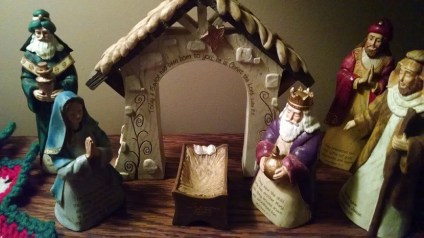
But the greatest decoration of all, her pride and joy, is her manger scene.

Every year she sets aside the time to pull out the box with every individual character wrapped in their own paper to place them perfectly in their pre-ordained spot. The camels are so life-like they look as if they could spit on the bureau where they are situated during December. The magi are so majestic I am convinced that if you opened up their tiny gift boxes you would indeed discover gold, frankincense, and myrrh. The detail in the faces of Mary and Joseph are so incredible that you can see both their excitement and their terror about the new baby boy in their lives.

But one year, when the whole family gathered at her house, she greeted us at the front door with her preferred expression from both sides of the emotional spectrum: “I am beside myself!”

I had hoped that she was beside herself in joy that her entire family was waiting by the door, but I was wrong. No, she was beside herself because baby Jesus was missing – and you can’t have Christmas without baby Jesus.

The manger appeared as perfect as planned, except there, right in the middle was the tiny feeding trough without a Jesus wrapped in swaddling clothes. 

So we looked, and we looked, and we looked looked looked looked. We checked the box where the manger scene spent the other 11 months of the year, we checked under the bureau, we even found ourselves looking in the refrigerator.

But the longer we looked the more beside herself my grandmother became.

Jesus was indeed missing.

Only later, having gone through every sock drawer, and basement box, and even the trash, did we find him.

When my grandmother set up the manger that year, she put the trough in upside down. It looked like it was empty, when in fact if you looked close enough you could see baby Jesus’ little hands and feet sticking out of the bottom, crushed under the weight of his make-shift crib, and all we had to do was flip it around.

Jesus was there the entire time.

These days the season of Christmas is filled with lots of stuff. And rather than bemoaning the commercialization and the commodification of the holiday, we can just focus on the church herself. We’ve got all sorts of decorations, we’ve got some of the best songs from the hymnal, we will even end this service under the beauty of candlelight. 

But contrary to what we see or even hear this time of year, the biblical story itself is strikingly simple, brief, and straightforward.

Jesus’ birth barely gets one verse.

According to Luke all of the clutter that might distract people like us from the profound truth of the incarnation of God in the flesh is pushed to the side. 

There are no magi in the manger, we don’t even hear about any animals nuzzled in close for warmth.

It’s just Mary, Joseph, and a baby.

However, Luke does share with us this incredibly powerful moment where the heavenly host proclaims the arrival of someone and something new to the shepherds out in the fields.

It would be one thing to expect the divine declaration about the in-breaking of the kingdom arriving in front of the emperor back in Rome, or even in the governor’s palace in Jerusalem. 

But God does something incredibly different and contrary to the systems and expectations of the world. 

candlelt

While people even today focus on the people and the places of worldly power, Luke draws our attention toward the margins.

There’s a reason the shepherds lived out in the fields – it wasn’t just the place where their livestock lived, but also because they were seen as a sub-class, not fit to even be in the cities, towns, and villages.

And that’s where the glory of the Lord shined the brightest! 

This is the sign for you – you will find a child wrapped in bands of cloth and lying in a manger – he is the Savior, the Messiah, the Lord.

Most of us have heard this story enough time that the weight of that particular proclamation no longer carries the weight it once did. The angel of the Lord announces the triumphant entry of God into the world to the least likely people – and even more outrageous is the fact that God chooses to enter through Jesus. 

How can this baby, a tiny and weak and vulnerable thing, be the Savior, Messiah, and Lord?

Only a God like ours would see if fit to transform the very fabric of reality with something tiny, weak, vulnerable. Gone are the days when militaristic might would reign supreme, no longer would economic prosperity dictate the terms of existence. God brings forth a wholeness of life in the life of God’s only Son through whom God ordains a restoring of balance to all the forces of creation and all the things that have influence over our lives.

Luke begins this story with Emperor Augustus and Governor Quirinius, but that’s not where the story ends. The birth of Jesus into the world establishes a new order in which the last will be first and the first will be last. The arrival of the Savior, Messiah, and Lord upsets all of the expectations and assumptions that we’ve foolishly made about this world.

Today we assume we know where Jesus is or, at the very least, where Jesus should be. We elevate particular politicians because we think they are on Jesus’ side, or we dismiss entire populations of people because we think Jesus is on our side. 

We relegate the incarnate Lord to our perfect manger scenes only to pack him away in a few days.

But the story of Christmas is that God cannot, and will not, be stopped.

God saw and sees the disparities of this world and makes a way where there was and is no way. God knows better than us about what is best for us. And the Lord, the one often missing from the manger scenes of our lives, arrives as Jesus Christ, perfectly vulnerable and weak to transform everything.

Because that very same baby, the one with teeny tiny toes and the one resting in the feeding trough, is the same person who walked through Galilee, who was transfigured magnificently, who feed the people abundantly, who walked on water miraculously, who suffered on the cross tragically, and rose from the grave majestically.

The womb and the tomb could not and cannot contain the grace of God, and no matter whether or not we think Jesus is missing, he is there, he is here, and he always will be. Amen. 

Fruit Of The Womb

Luke 1.39-55

In those days Mary set out and went with haste to a Judean town in the hill country, where she entered the house of Zechariah and greeted Elizabeth. When Elizabeth heard Mary’s greeting, the child leaped in her womb. And Elizabeth was filled with the Holy Spirit and exclaimed with a loud cry, “Blessed are you among women, and blessed is the fruit of your womb. And why has this happened to me, that the mother of my Lord comes to me? For as soon as I heard the sound of your greeting, the child in my womb leaped for joy. And blessed is she who believed that there would be a fulfillment of what was spoken to her by the Lord.” And Mary said, “My soul magnifies the Lord, and my spirit rejoices in God my Savior, for he has looked with favor on the lowliness of his servant. Surely, from now on all generations will call me blessed; for the Mighty One has done great things for me, and holy is his name. His mercy is for those who fear him from generation to generation. He has shown strength with his arm; he has scattered the proud in the thoughts of their hearts. He has brought down the powerful from their thrones, and lifted up the lowly; he has filled the hungry with good things, and sent the rich away empty. He has helped his servant Israel, in remembrance of his mercy, according to the promise he made to our ancestors, to Abraham and to his descendants forever.” 

636169111672408480521702275_christmasmusic

Mary was the first to carry the gospel. 

Our choir was singing those words with a particular gusto because the truth of that statement is a profound one. In Protestant circles Mary tends to be overlooked and is relegated to the side of the Advent/Christmas stories. Sure, she is the Theotokos, the God-bearer, but she was just a vessel right?

Wrong.

No. Mary is much much much more than a vessel and her role in the salvation of the world is one worthy of our time and attention.

She is a young and engaged version with the angel Gabriel shows up with supposedly good news. Imagine having to tell your fiancé that you were now pregnant with the Son of God!

And yet her faithfulness in the midst of something that appears terrible is bewildering. 

Let it be with me according to thy will…

Harmonizing with God’s purposes in the world is no easy endeavor, and in Mary’s case it sends her to relatives’ house, Elizabeth and Zechariah. 

Now, remember, this is a time before Facebook and viral pregnancy announcements, there was no gender reveal party or even an opportunity for a baby shower. Mary merely enters the house, and John the soon-to-be Baptist leaps inside his mother, Elizabeth’s, womb.

I’ve been playing the drums for a very long time and I’ve taken as many opportunities as I could to play with a variety of groups in a variety of places. I’ve played in jazz combos at bars, I’ve classical music in benefit concerts, and I’ve played jam-band music in more garages than I can count.

But my first love of drums came in worship music. I played for a contemporary Christian worship band nearly every Sunday from the time I was 16 until I was 25. And I loved it.

I loved practicing with a group during the week, I loved bonding over music, and I loved providing the rhythm for the praising of God during worship. And the people I’ve played with other the years are some of my very favorite people.

While I was living in North Carolina I practiced with a group every Tuesday night, and we would play for a worship service every Sunday evening. We would always wait until everyone arrived for practice and then we would circle up to pray before we did anything else. It became an important habit that shaped how we practiced such that we always remember for whom we were playing.

On one such night, we went around the circle sharing our concerns, when our leader, the pregnant pianist, suddenly departed for the bathroom and left us standing there holding hands.

We patiently waited for her to return until we heard her scream in the bathroom, and the girls from the band immediately ran to check on her.

Later, we found out that she was spotting and assumed that she lost the baby. The terror in her voice has haunted me ever since.

She went to the doctor the following day and, miraculously, she learned that the baby was okay. But she didn’t feel him kicking or moving around.

The doctor, the trained professional, had told her everything she could’ve possibly hoped to hear, but because of her experience, it didn’t feel real. She had to make it through day after day in that horrible tension of being told something that didn’t seem true.

Until Sunday, when she had to sit at the piano and sing to the Lord.

I can remember that Sunday evening, sitting behind the drums, playing away, and looking over at her as she stared off into the distance. She was there, but not really there. She was playing all the right notes, and singing all the right words, but her heart wasn’t into it.

But we kept playing anyway.

And then, in a way that is difficult to describe, it felt like the Holy Spirit blew through the room as I looked over at her in the middle of a song, and she was crying with a giant smile on her face. The tears were falling on the keys and she was singing in a way that none of us had ever experienced – it felt like the heavenly hosts were lifting her voice up to praise.

As soon as the song ended she looked back over her shoulder at the band and she said, “The baby started kicking along to the song, he was leaping in my womb.”

The jumping of John in his mother’s womb was enough to get Mary singing a song that Christians like us have been proclaiming and declaring for centuries. “My soul magnifies the Lord!” The Spirit moved in and through her to sing from the depth of her being that God was doing a new thing. That God refused to leave God’s people. That God would do whatever it took to rectify this world.

And so, what else can we do, but magnify the Lord with our songs? 

Impossible Possibility

strangely-warmed-spreaker-header

This week on the Strangely Warmed podcast I speak with Scott Jones about the readings for the 4th Sunday of Advent (Micah 5.2-5a, Psalm 80.1-7, Hebrews 10.5-10, Luke 1.39-55). Scott is the host of my rival lectionary podcast Synaxis. Our conversation covers a range of topics including Netflix as the cost of empire, the young Karl Barth, little towns, Caspian and the Narnians, the peace of Christ, rectification vs. forgiveness, God’s anger, looking like an idiot int he pulpit, church marquees, and the gratuitous nature of salvation. If you would like to listen to the episode or subscribe to the podcast you can do so here: Impossible Possibility

Screen Shot 2018-12-17 at 9.50.25 AM.png

Merry Christmas Ya Filthy Animal

Luke 3.7-18

John said to the crowds that came out to be baptized by him, “You brood of vipers! Who warned you to flee from the wrath to come? Bear fruits worthy of repentance. Do not begin to say to yourselves, ‘We have Abraham as our ancestor’; for I tell you, God is able from these stones to raise up children to Abraham. Even now the ax is lying at the root of the trees; every tree therefore that does not bear good fruit is cut down and thrown into the fire.” And the crowds asked him, “What then should we do?” In reply he said to them, “Whoever has two coats must share with anyone who has none; and whoever has food must do likewise.” Even tax collectors came to be baptized, and they asked him, “Teacher, what should we do?” He said to them, “Collect no more than the amount prescribed to you.” Soldiers also asked him, “And we, what should we do?” He said to them, “Do not extort money from anyone by threats or false accusation, and be satisfied with your wages.” As the people were filled with expectation, and all were questioning in their hearts concerning John, whether he might be the Messiah, John answered all of them by saying, “I baptize you with water; but one who is more powerful than I is coming; I am not worthy to untie the thong of his sandals. He will baptize you with the Holy Spirit and fire. His winnowing fork is in his hand, to clear his threshing floor and to gather the wheat into his granary; but the chaff he will burn with unquenchable fire.” So, with many other exhortations, he proclaimed the good news to the people. 

For 16 days in a row, my 2 year old son has scarfed down his food at the breakfast table with reckless abandon. Cheerios and yogurt and eggs and bread have flown from plate to mouth and to the wall and to the floor like the Tasmanian devil himself was starving. And with the final mouthful he will triumphantly declare, “I’m done!”

And then he’ll stare at the pantry with gleeful expectation.

We will, of course, reorient his demeanor and disposition to the Christmas tree advent calendar where he practices counting his numbers in order to pick a magnetic ornament to hang as we get closer to Christmas Eve, but all he really wants is The Incredibles themed chocolate Advent calendar we have hidden in the pantry.

He will sit there with his fingers twittering like a mad scientist and then his eyes will dart all across the thin cardboard box until he finds the right number and he will promptly scarf down the terrible tasting piece of chocolate all while grinning from ear to ear.

Happy Advent.

And, I’ll admit, there is something in me that just wells up with all kinds of fatherly and joyful feelings when I see the daily practice. Behind the frenetic eating patterns, and the impatience to ingest sugar at 7 in the morning, there is an anticipating, a waiting, for what is yet to come.

At least, that’s how I felt until I read something this week. 

Fleming Rutledge is, without a doubt, one of my favorite theologians and preachers. As a preacher, her sermons are the kind that make me feel like I’m terrible at what I do. 

DB0002_50bdc864-b54b-4a75-ae87-fdfa8c82d6a5_600x600

Nevertheless, I was reading through a collection of her old Advent sermons this week and I came across one on the same text that we just read. And this is how she begins the sermon: “I’ve always wanted to design an Advent calendar. You would open up one of those cute little windows and there would be John the Baptist glaring at you saying, “You brood of vipers!”

Imagine a wildly bedraggled man, smelling up to high heaven, clothed in camel’s hair, with honey stuck in his beard, jumping out at you from behind one of your favorite Christmas decorations, only to shout, “Merry Christmas ya filthy animal!”

Happy Advent.

I’m sure some of you are thinking, “John the Baptist? Again?! Didn’t we have to hear about this guy last week?”

And you’d be right. John the Baptist, the crazy prophet is back again, but this time he’s not mincing his words. You brood of vipers!

In Advent, there are plenty of other people from the Bible we might like to hear from. The angel Gabriel, or Mary, or even Joseph (though he doesn’t say much). But John is the central person of this season of being in the in between. He is the one who stands with one foot in each of the ages. He rests between how things are and how they ought to be. 

He is the last and the greatest of all the Hebrew prophets. With every new prophet the declarations about the coming Messiah increase until they reach their electrifying zenith in John who says the waiting is over!

And how does he begin his message? What are the first recorded words we have in scripture from John the Baptist? He belittles the crowds who have gathered and he exhorts them with a to do list.

I’ve said this a lot already, but Advent is a really strange time in the life of the church. It is quite a challenge to place our theological fingers on the pulse of what this season is and what it means for people like you and me.

I can’t tell you the number of churches who are spending this Advent season doing a series like “How To Find Jesus In The Peanuts” (as in Charlie Brown), or “Christmas Through The Movies” in which a church will play clips on a Sunday morning and then a preacher will exegete what the people have seen, or even something like “The Best Present Is Presence.”

Those types of things draw forth these deep waves of warmth regarding the season and the are the theological version of sitting by a cozy fire with a nice cup of hot chocolate.

And, for as interesting and exciting as they might be, like a child devouring the daily chocolate piece, they don’t really have a lot to do with Advent. 

The readings we encounter in church at this time of year don’t leave us dreaming of sugar plumbs dancing in our heads, or feeling fuzzy and familiar fantasies… John the Baptist just called us a brood of vipers!

I think it would shock those from the early church to see the cutesy versions of the angels, and the mangers, and the virgin Marys we use to decorate our homes. I think they would be baffled by the sheer number of lights and inflatable cartoon characters we put up in our yards during the coldest part of the year. Which, to be clear, I love those things about Christmas. I love driving around to look at lights and taking the time to go through every member of a manger scene.

But we’ve got to admit that our Advent and Christmas observances are pretty watered-down and sanitized. No one wants to put up an angry John the Baptist inflatable or ornament in their tree.

And yet Christmas, what we are preparing for right now, is the stark and frightening and profound transformation of the world. It is surely worthy of shouting “joy to the world” but God refuses to leave the world the way that it is.

God will redeem God’s people, because we are in need of redemption!

The Good News of this season of waiting and putting our feet in two different places isn’t just that Jesus arrives, but that Jesus’s arrival changes people like you and me.

Back to Fleming Rutledge, she says Advent forces us to look at the dark sides of ourselves.

Now, I don’t need to take the time to regale you with stories about the brokenness of the world. All of us here know how messed up things are. No matter how many sentimental decorations we have, or how many gallons of eggnog we’ve consumed, or how many carols we’ve belted out at the top of our lungs, we know that things really are as bad as they seem, and we are not innocent.

We, brood of vipers.

Spruce Tree branch on Wood Background

John sounds pretty judgmental. And we don’t like judgmental people. He spends the majority of his proclamation exhorting the people to do this, that, and the other and it is just plain exhausting: Give your coats away, repent for your sins, don’t extort people.

Doesn’t John know that we already have too much to do at this time of year?

I don’t know about you, but I certainly don’t like being called a viper, or a filthy animal. 

I don’t like feeling judged.

But here’s the rub: those of us who don’t like hearing about judgment in church are usually those ones who have reason to fear being judged. Or, to put it another way, we who protest the judgmental behavior of others usually suffer from that same disposition without really realizing it.

Advent is a time where all that has been, at that is, and all that will be is made known to God. It is the time that all of who we are is opened up to the divine: our inner thoughts, our knee-jerk reactions, our biases, our prejudices, our everything. We are laid bare and judgment is coming.

There is a new exhibit in DC at the Bible Museum that features a very interesting bound collection of scripture. The so-called “Slave Bible” was printed by the Missionary Society For the Conversion of Negro Slaves in 1808. Though labeled “Holy” on the cover, it is anything but; in order for Christian missionaries to convert enslaved African peoples to Christianity they created a bible but they removed any verse that had any references to freedom, equality, and resistance.

slavebible_use-thi_-ds2018118-40ab2693a570610452ad55e4d0507d0d35c4aa6e-s800-c85

In the end the Slave Bible is missing 90% of the Old Testament and 50% of the New Testament.

And Christians, that’s people like us, used that particular book to keep particular people in bondage. 

What were we justing singing? Come, thou long expected Jesus, born to set thy people free…

All has, is, and will be made known to God. The final reckoning is going to take place. That’s what John the Baptist is yelling about – the ax is lying at the roots of the tree!

But we’re not quite there yet. And, strangely, something has already taken place. The Judge of all things is arriving and has arrived.

His name is Jesus.

So take a moment and think, if you can stand it, about your own sins and secrets; not the sins and secrets of others, the Christians who have come before us. Think about the dark side of yourself. 

In Advent we are bombarded with the notion that one day all of us will bring those very secrets before the throne of God and the great Judge will see us for who we really are.

But here’s the craziness of the gospel: the Judge is not like what we so often fear. Our great Judge is filled with compassion and comes to us with wounds in his hands and feet.

This is a paradox befitting the faith: the judgment we hear from the lips of John has already happened. It has taken place in the very body of the Judge.

Jesus, the Judge who is to come, has already given himself to be judged in our place.

Vipers, crucifixion, judgment… It is strange to hear these words in Advent while we’d rather consider Frosty, and Rudolph, and the one who has a belly like a bowl full of jelly. But it is an even stranger thing to realize that Advent and the Cross are so intertwined that they cannot be separated.

If Advent is the time to contemplate the dark side of ourselves then this season sheds light on the truth that our sin is what nailed Jesus to the cross. We really are the unrighteous, the vipers, for whom the Son of Man was hung on a tree.

This is our Jesus; bloody and bedraggled. This is the One for whom we wait this time of year. And that’s why John the Baptist is the central figure in Advent. 

He reminds us that we were unworthy but Jesus counted us worthy. 

He reminds us that we deserved judgment but in Jesus we found mercy. 

He reminds us that we were slaves to sin and death, but that Jesus brought us to righteousness and life.

Hear the Good News! Jesus’ arrival both from the womb and from the tomb means that he will not let us remain as we are. He is the judged Judge who stands in our place. He is, in himself, the Good News. 

So, Happy Advent Ya Filthy Animals. Amen.

I Am What’s Wrong With The World

strangely-warmed-spreaker-header

This week on the Strangely Warmed podcast I speak with Scott Jones about the readings for the 3rd Sunday of Advent (Zephaniah 3.14-20, Isaiah 12.2-6, Philippians 4.4-7, Luke 3.7-18). Scott is the host of my rival lectionary podcast Synaxis. Our conversation covers a range of topics including the greatest crossover podcast of all time, Top Gun references, shaming people in church, sin as unbelief, self-justification projects, evangelism as the heart of mission, witness vs. with-ness, doing crazy things in worship, praying to baby Jesus, and John the Baptist as the OG PK. If you would like to listen to the episode or subscribe to the podcast you can do so here: I Am What’s Wrong With The World

Screen Shot 2018-12-10 at 9.50.21 AM

Stuck In The Middle With You

Luke 3.1-6

In the fifteenth year of the reign of Emperor Tiberius, when Pontius Pilate was governor of Judea, and Herod was ruler of Galilee, and his brother Philip ruler of the region of Ituraea and Trachonitis, and Lysanias ruler of Abilene, during the high priesthood of Annas and Caiaphas, the word of God came to John son of Zechariah in the wilderness. He went into all the region around the Jordan, proclaiming a baptism of repentance for the forgiveness of sins, as it is written in the book of the words of the prophet Isaiah, “The voice of one crying out in the wilderness: ‘Prepare the way of the Lord, make his paths straight. Every valley shall be filled, and every mountain and hill shall be made low, and the crooked shall be made straight, and the rough ways made smooth; and all flesh shall see the salvation of God.”

“Repent of your sins and your debauchery!” 

“Repent, for the end is near!”

The words echoed across the campus. 

He stood on a makeshift soapbox clothed in a suit and tie and was yelling through a megaphone. And yet, it seemed as with every increase in decibels, less and less people paid him any attention. His “crowds” were college students after all, and the last things any of us wanted to hear about at the time were our sins and whatever it meant to repent of them.

Day after day he would stand from his perch in the exact same place spouting off the same words of fear, and challenge, and torment. And I never once saw anyone stop to talk to him.

But we talked about him all the time – whether we were in the dining hall, hanging out in the library, or even in our classes, the “prophet” (as we called him) was a regular topic of conversation: Who was he? Where did he come from? What did he really believe? 

And, like most college students, we spent way more time wondering about the prophet than we did about our classes.

Our best guess was that he was from one of the local baptist and/or evangelical churches, that he might’ve even been the pastor, and that he foolishly believed that by yelling at college students some of them would show up at his church on Sunday mornings.

The weeks and the months went by, and he remained steadfast in his mission. In fact, he became such a permanent marker in the landscape that on the few rare occasions that he wasn’t in his usual spot I actually got worried something had happened to him. But then the next day, he’d be back.

This went on like clockwork until Advent. I went to church on Sunday morning like I always did, hanging out in the back as the one and only token college student, and someone from the church went up to read the words from the gospel according to St. Luke: “The word of God came to John son of Zechariah in the wilderness. He went into all the region around the Jordan, proclaiming a baptism of repentance for the forgiveness of sins, as it is written in the book of the words of the prophet Isaiah, “The voice of one crying out in the wilderness: ‘Prepare the way of the Lord.”

And I stopped listening to everything else. Because, for the first time, I saw the prophet on campus in a different light. Instead of assuming he was off his rocker or, at the very least, deeply flawed in his sense of evangelism, I began to see connections between the prophet, and John the Baptist.

I couldn’t stop thinking about it.

And then, the following week, I found myself walking over to him on campus while everyone was walking the other direction, and I didn’t even know what I was going to say.

maxresdefault-2

The season of Advent is all about being in the in-between; in between things the way they are and the way they ought to be. We often experience it as this time set apart that is dedicated to preparations – At home we are cleaning, and decorating, and cooking. We find the perfect Christmas tree and then stress out when all of the old lights fail to work. We pull out the box of ornaments and struggle to keep back the tears as we hold up the popsicle stick reindeer that someone made years ago.

And in the midst of our busyness and preparations, in walks the crazy prophet John the Baptist proclaiming a very different kind of preparation.

It’s important to remember that John was a PK, a preacher’s kid. He knew what he was supposed to believe, what he was supposed to say, how he was supposed to dress in front of the religious crowds – His Daddy had been preaching it his whole life. And yet, John saw a very different vision of what it meant to be faithful. 

The people believed that all of the power was held in Jerusalem – John found it in the wilderness.

The people believed that God was on their side no matter what – John knew that everyone needed to repent.

The people believed in presenting the best version of yourself in front of others – John wore camel’s hair and ate wild locusts.

A new word came to John in the wilderness – the time had come to prepare for a new way, one in which every mountain would be dropped low and every valley would be lifted up.

He was bold and crazy with his words and actions: Take a good and hard look at yourselves! Repent of your transgressions if you want to be ready to receive the one who is coming!

Repentance is not something we think about during this time we call Advent. People outside the church are spending this time stringing up lines of popcorn in their living room trees, they are humming along to Bing Crosby while waiting in elevators, and they are sipping on eggnog at night.

But here, in the church, we are listening to a very different kind of tune – the challenging words of a radical prophet who calls those with ears to hear toward a ministry of repentance.

Repentance – its’ one of those words we either avoid or we throw around without really knowing what it means. Repentance, metanoia, literally means to change one’s mind, to turn around, to be reoriented.

And, as John says, it is in the metanoia that all flesh shall see the salvation of God.

The people who scream out about the kingdom of God from the street corners of life make us very uncomfortable. We see the cardboard signs, or we see the oblong megaphone, and we start asking ourselves all sorts of questions.

They make us uncomfortable because they are pointing at a reality that we often talk about in church, but they do so in a way that confronts us and interrupts us, whereas we usually show up here already knowing what to expect.

John the Baptist makes us uncomfortable. He joins the story of expectancy at the beginning of the gospel and knows something about living in the in between. He, more than most, understands the need to truly consider the condition of our souls, of our world. He witnesses to the difficult work of looking at our wrongdoings, our regrets, the damage we’ve cause, what we’ve said and done, and what we’ve left unsaid and undone.

John’s words and ministry upset the status quo of our complacency. The kingdom earthquake is shaking all the old expectations of what we should say and what we should do. The fault lines of change are running through the middle of history and God is announcing a new order that carries with it a whole new way of seeing the world. 

John calls out to the crowds and to us through the sands of time: “Prepare the way of the Lord, make his paths straight. Every valley shall be filled, and every mountain and hill shall be made low, and the crooked shall be made straight, and the rough ways made smooth; and all flesh shall see the salvation of God.”

These are rather uncomfortable words for us to consider during the season in which we most yearn to be comforted.

I walked across the quad with a focus that I should’ve reserved for my classes, and when we were close enough to see each other’s eyes the campus prophet froze in the middle of his oration. I realized, in that moment, that I was perhaps the first person to ever approach him in the middle of his pontificating and so we both stood there in silence while starring at each other.

I finally blurted out in a way that must’ve sounded as crazy as his message: “Why are you doing this?”

He slowly lowered the megaphone and calmly replied, “We’re stuck with each other in this crazy world, and I’m just trying to save everyone.”

Xmas_lights_DC

Our repentance, our metanoia, our turning around will likely involve us taking a hard look at our own lives and the structures/systems/people of the world in new and different ways. Repentance compels us to evaluate how we are living and whether or not we are helping to build the kingdom. 

In a world and in a time where all we want it grace, we forget that we need the grace because we are sinners. Whether we actively make the wrong choice (or make no choice and therefore sin by omission) or we tacitly participate in the powers and principalities around us which profit off of the marginalized, we are all sinners in need of God’s grace.

And Advent is the wonderfully strange time in which we pause, we reflect, and then we prepare to follow the One born in the manger, hung in a tree, freed from the grace, and the One for whom we are waiting.

Repent! Turn! The prophet from the wilderness of Judea and from my college campus is screaming for those with ears to hear. 

But what does our turning accomplish? Can we hear that challenging word and respond with a repentance and walk in the light to the end of our days?

The end of all our preparing and all of our repentance for Jesus Christ inevitably leads to strange and frightening realizations:

We cannot save ourselves.

We cannot save anyone else. 

And we can never really prepare the way for Jesus. It is only God in Christ who can actually make the way ready for the arrival. 

Jesus’ entering into the world is not contingent on our worthiness or our repentance. Though that certainly doesn’t mean we shouldn’t repent. It is just a recognition that what we celebrate at Christmas, what we yearn for in the future, is not something that we can accomplish.

It is the power of God for salvation; we only get to witness it.

We are stuck with each other in the middle of time between Advent and the rectification of all things, we are in the middle of the way.

We are sinners, stuck in our sin, and even if we are strong enough to turn and repent, we eventually turn back to our own way again.

And yet we are called to metanoia, John and the campus prophet plead with us to do so. Not because it earns us anything, not because it is the prerequisite for Christmas, but simply because it is a behavior that is normative in the world inaugurated in Jesus Christ.

Repentance is simply something we do in the journey we call discipleship.

Ultimately, John is the least likely person to call us to turn. He is like the campus prophet screaming into the ether day after day. John is the type of person most of us ignore today.

A prophet in the wilderness of life, an unlikely person in an unlikely place.

We never really know from where the Word of the Lord will come, but it always does.

It might even come from a place we would never expect – like a worship service, like the middle of a college campus, or even a manger. Amen. 

The Demands of the Divine

strangely-warmed-spreaker-header

This week on the Strangely Warmed podcast I speak with Michelle Matthews about the readings for the 2nd Sunday of Advent (Malachi 3.1-4, Luke 1.68-79, Philippians 1.3-11, Luke 3.1-6). Michelle serves as the pastor of the Kingstowne Communion in Kingstowne, VA . Our conversation covers a range of topics including being obsessed with the Enneagram, burning up the excess, the whole OT in one Psalm, the God who will die, the theology of discernment, and the scandal of particularity. If you would like to listen to the episode or subscribe to the podcast you can do so here: The Demands Of The Divine

Screen Shot 2018-12-03 at 1.11.43 PM

The End Is Our Beginning

Luke 21.25-36

“There will be signs in the sun, the moon, and the stars, and on the earth distress among nations confused by the roaring of the sea and the waves. People will faint from fear and foreboding of what is coming upon the world, for the powers of the heaven will be shaken. Then they will see ‘the Son of Man coming on a cloud’ with power and great glory. Now when these things begin to take place, stand up and raise your heads, because your redemption is drawing near.” Then he told them a parable: “Look at the fig tree and all the trees; as soon as they sprout leaves you can see for yourself and know that summer is already near. So also, when you see these things taking place, you know that the kingdom of God is near. Truly I tell you, this generation will not pass away until all things have taken place. Heaven and earth will pass away, but my word will not pass away. Be on guard so that your hearts are not weighed down with dissipation and drunkenness and the worries of this life, and that day catch you unexpectedly, like a trap. For it will come upon all who live on the face of the whole earth. Be alert at all times, praying that you may have the strength to escape all these things that will take place, and to stand before the Son of Man.”

I was in Richmond for most of the week completing the final retreat in my year long leadership program. Every other month a group of clergy retreated from our churches to reflect on how we have led while praying for God to show us the right way to lead. 

On Wednesday evening, upon completing the lectures and break out sessions for the day, we gathered to worship in a small chapel on the property of the retreat center. We prayed together, we lifted up our voices together, and we listened together. I could still feel the Spirit’s presence washing over me at the end of the service when one my colleagues asked if any of us wanted to join him for a drive to go look at some Christmas lights.

If you know anything about me, after being cooped up listening to speakers and participating in self-reflection, driving around to look at blinking lights sounded light the best possible way to end the evening. So a group of us scrunched up in one car and we began our journey. 

There were plenty of homes in that part of Richmond with the requisite strand of lights hanging from a gutter, or the solitary electric candles standing starkly in every window. But there was one home that glowed in such a way that would make Clark Griswold proud, and it was our final destination. 

Across the lawn there was not a foot of space that wasn’t adorned with an inflatable character, a string of lights, or a mechanical animal. You could even tune your radio to a particular station playing Christmas music to which the lights were coordinated. The house had a hotshot driveway so that you could drive onto their property at the expected 2 miles/hour and soak it all in.

I wish I could appropriately convey in words the sheer depth and breadth of what we experienced. And remember: we were a group of trained theologians, properly educated and reserved in our beliefs, and yet all of our faces were pressed tightly against the windows.

Xmas_lights_DC

There was the giant blinking “LET IT SNOW” on the roof top, there was a projector displaying Santa Claus packing up is sleigh before the midnight departure, and there was a set of inflatable elves playing instruments in rhythm with “Rocking Around The Christmas Tree.”

There were at least 4 full sets of reindeer attached to their own respective sleighs, there was a strange assortment of Santa Clauses in every shape, size, and color, and there was a palm tree decorated as if it were a Christmas tree.

There was a section with holiday adorned characters including Mickey Mouse, Lightning McQueen, a gaggle of Minions, and a small Darth Vader, R2D2, and Yoda.

We did the loop three times.

And it was only during the final pass through, while we were all laughing and giggling with the joyful experience that I realized something strange – there in the midst of all the lights and color, all of the sounds and movement, was only one tiny manger scene tucked away in the corner, as if it was an after-thought.

It looked like they were excited about Christmas, but almost forgot about Christ.

It is strange to gather in this place and at this time with all of the expectations of the world – The Christmas carols started playing on the radio before Thanksgiving, the department stores had up the decorations even before Halloween, and some of us did our holiday shopping months ago.

And now we come to church, to finally catch up with the season we’ve been preparing for and what do we hear about from God’s word? There’s no mention of Santa, we don’t learn about a young virgin named Mary, we don’t even catch a glimpse of a cute baby all wrapped up in swaddling clothes.

No. Today we get the end instead of the beginning.

Spruce Tree branch on Wood Background

This is not the sweet Jesus away in the manger. It is the stern adult Jesus picturing the whole of the universe being shaken and turned upside down.

But what about the city sidewalks, busy sidewalks, dressed in holiday style? What happened to all the falalalalalalalalas? Where are the chestnuts roasting on an open fire?

Advent, for better or worse (mostly worse) has moved very far from what it once was. Now, we imagine it as this awful time of participating in the virtue of patience up until Christmas morning during which we get to cut loose and open up all the gifts. But thats not really what Advent is all about.

Advent it the recognition that we are people stuck in the middle – We are living in the in between.

We already know what happens on Christmas morning, we are aware of the Messiah child named Jesus and what he will do for the world, and yet we are waiting for his return. 

And we do this, as Christians, all in the midst of a horribly unpredictable world. We are certainly a people of patience, but it is a confused patience. We wait for his arrival, we wait for his return, and yet we know where he is.

It’s enough to give you a headache.

But that’s Advent! Head-scratching, incarnating, frustrating, waiting. 

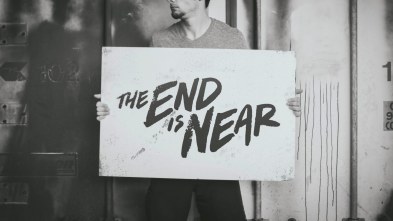
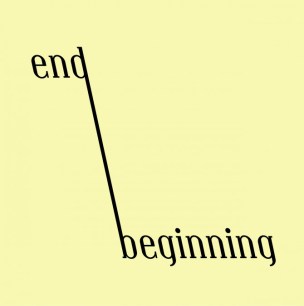
The End, whatever that may mean, is so often shrouded in fear and foreboding. The wayward person carrying around the sign “The End Is Near” is not often regarded with joy or gratitude. The End raises the hair on the back of our necks and we feel the beginnings of existential dread. 

And Jesus doesn’t sugarcoat it with the disciples – things are going to be bad. The whole of the cosmos will experience the dynamic shifting of things from the sun to the moon to the stars and to the earth itself. There will be distress among the nations and the peoples of the planet who won’t be able to make sense of the senseless changes. 

People are going to faint from fear when they begin to experience what it coming upon reality for everything will lose its sure foundation.

And then they will see the Son of Man coming on a cloud with power and great glory.

Jesus speaks to us, his disciples, throughout the gospel texts with a repeating message: “The world will fall apart around you but you need not be afraid – I have overcome the world! Be patient in your waiting, just before the dawn, because in the midst of the darkness there are strange and even redeeming events afoot.”

That’s Advent in a nutshell roasting on an open fire – Look up, pay attention, and be ready. Advent compels us to prepare ourselves for the two arrivals of God coming into our world and Jesus returning to the world at a time we do not know.

This is how we begin the Christian year – not with a moralistic lecture on making good resolutions and sticking to them and not a recap of our failures from the past and the descriptions of the new steps we need to take into the future. Instead, on this first Sunday of the year, we spend our time thinking about the end of the story. 

As Christians we are forever beginning at the end.

Jesus names and claims the truth about the end, all things will pass away, but he doesn’t leave the disciples with their tails tucked between their legs: Consider the fig trees; as soon as they sprout leaves you can see for yourself and know that summer is already near. So also, when you see these crazy and frightening things taking place, you know that the kingdom of God is near.

This prophetic and apocalyptic vision of the future is all about expectation and anticipation. Though not necessarily the types we are used to. 

You and I are living in a time where hope is limited to that which we can often imagine; we go through the motions waiting for something, but without really knowing what that something is. And so we get used to the stores having the decorations up months in advance, and we shrug our shoulders when we see the almost forgotten manger scene tucked away in the corner.

But the kind of real anticipation that Advent contains is the anticipation for the end of time, my time and your time and everything in between, AND the fulfillment of all the God has made and redeemed. 

If we imagine the end at all we often do so with such stark and negative terms, but consider this: Jesus draws the disciples’ attention to new life! Look at the fig free, look at the new budding branches, new life is the sign of the end.

How wonderfully strange!

end_beginning-670x676

Jesus is describing the anticipated and expected reign of God’s kingdom on earth, and though he speaks of the fabric of life falling apart he also does so with descriptions of summer and new beginnings, not winter and barrenness. For some strange reason we miss that beautiful and hope-filled little detail and instead we focus only on what will be destroyed and decimated.

But friends, there are plenty of things in our world that need to be destroyed. There are many things that have to be abandoned. There are plenty of things that need to be crucified.

The fear of a man who stayed inside of a UMC in North Carolina for 11 months hoping to achieve legal status before being abruptly arrested and deported last week.

The anger of parents who sit in worship on Sunday morning even though they know their church believes their child is incompatible with Christian teaching.

The hopelessness of a child who goes to sleep hungry every night wondering if anything will ever change. 

Some things need to be destroyed because the message of the Good News is that we cannot have resurrection without crucifixion, we cannot discover who we are without abandoning our false identities, and we cannot have new life without destruction.

Advent is the season we celebrate new life – Jesus’, our own, and the new reality made possible by our God. We live in a time and among those who wish to see the world fizzle out in a tiny smoldering fire, but the Lord promises to return to us in a glorious way and is already bringing us signs of new life and peace.

And so Jesus beckons us to look for the new sprouts and signs of new life. Because it is in the opening of our eyes that we how the end is in fact our beginning. Amen. 

We Have No King But Jesus

John 18.33-38

Then Pilate entered the headquarters again, summoned Jesus, and asked him, “Are you the King of the Jews?” Jesus answered, “Do you ask this on your own, or did others tell you about me?” Pilate replied, “I am not a Jew, am I? Your own nation and the chief priests have handed you over to me. What have you done?” Jesus answered, “My kingdom is not from this world. If my kingdom were from this world, my followers would be fighting to keep me from being handed over to the Jews. But as it is, my kingdom is not from here.” Pilate asked him, “So you are a king?” Jesus answered, “You say that I am a king. For this I was born, and for this I came into the world, to testify to the truth. Everyone who belongs to the truth listens to my voice.” Pilate asked him, “What is truth?”

Political signs and bumper stickers are a strange practice. I understand the fervor that’s behind people wanting to display their political hopes and affiliations, I can even appreciate the very rare but very good pun made on such signs, and in a time such as ours I get the desire to draw clear lines in the sand.

But, what are we really trying to communicate when we display those particular names, or those particular political mascots?

I mean, how many people have been persuaded to vote for someone else because of a bumper stickers or a lawn sign? Is that why we do it?

Or are we purposely trying to anger the people stuck behind us in traffic or that wayward neighbor from the other side of the aisle?

It boggles the mind that for being one of our so-called private subjects, we certainly love to air out all of our political laundry.

And what’s funnier is how long we keep those signs/stickers long after the race is over.

Just drive anywhere around the church and you’ll likely see a Make America Great Again sticker, or a wind battered “I’m With Her” sign. And if you’re looking for it, you can find some other great reminders down memory lane.

In the last week I saw three W stickers, two for Clinton/Gore, and believe it or not, I saw a Nixon/Agnew sticker on the back of a pickup truck that no longer had any business being on the road.

It’s one thing to proudly display whether we lean red or blue today, but what does it say if we are living in the far political past? I can’t tell you the number of times I’ve had conversations when someone said something like, “I wish ______ was still president.” And then he or she will lay out all of the reasons it would be better for us as a country, never mind the fact that Ford, Nixon, Regan, and JFK are all dead.

But the funniest and strangest political sticker of them all is one that I see far too often these days: Jesus for President.

Have you seen one? It has all the trappings of a normal political announcement: it is usually filled with the patriotic red, white, or blue, and with a slightly skewed angle you’ll see the words “Jesus for President” or “Jesus Christ 2020.” 

jesus

Most of them are so well done that you have to look twice before you realize they’re talking about the baby who arrives in the manger and not some political hopeful who believes he can fix everything with our country.

Friends, let me tell you something, we don’t want Jesus to be our president. 

No. No. No.

That would be a terrible idea.

Hey everyone, we’ve got to raise everyones taxes, and by everyone I mean EVERYONE, because we’ve got too many people who are hungry, cold, and suffering in the hospital.

My fellow Americans, I am proud to announce our new national initiative: “Turning Cheeks.” Yep, that’s right, from now on if someone hits you, it’s illegal to do anything in retribution except for offering the other cheek as well.

Tonight, I speak to you from the oval office with great news, every weapon in the country has been smelted or melted into plowshares so that we can all work toward a more agrarian economy. I once said that those who live by the sword will die by the sword and I meant it. But today, those who live by the plow will thrive by the plow!

Jesus would be a terrible president.

Can you imagine? He’d always disappear in the middle of something important just so that he could pray with his heavenly father in private. He’d ditch the secret service to go hang out with the homeless around the Whitehouse. And he’d probably wear a dirty robe when he gave speeches from the Rose Garden.

Jesus would be a terrible president.

But he makes a pretty good King…

Today, in churches all across the globe, we triumphantly announce that Jesus Christ is King. We boldly proclaim that our allegiance it to Christ and to Christ alone. And we remember that we, as Christians, humbly bow to no one but Jesus Christ our Lord.

This is the last Sunday in the liturgical year and we dedicate it to reminding ourselves about the lordship of Jesus. It’s not the time for a quaint little parable, or an Old Testament narrative. No, today we put it all on the line: We are either for Jesus, or we’re not. 

And its kind of funny, when you think about it… Taking one day out of the year to talk about Jesus as the King. We usually talk about Jesus in a great number of other ways. We think about Jesus as a teacher, or a healer, or a sage, or a spiritual leader. 

But a king? 

And, seeing as it’s the last day of the year for us, we do well to take stock over where we’ve been, and the one whom we have gathered to worship over the last 12 months.

Jesus was poor. He had no standing in the world. But he preached about the kingdom of God, and it attracted a lot of attention. 

It can be very difficult for people like you and I to grasp the kind of common that followed our King, because we don’t really live at all like the people did during the time of Jesus. But, for centuries, for generations, the Jews experienced nothing but trials and tribulations. They were exiled, defeated, and eventually returned to disasters. They went through various rebellions and foreign occupations, all while waiting for the promised King from the line of David. 

And then came Jesus. He shook things up. He healed people and preached about an entirely new reality. And it made people mad.

So the religious elite, and the secular authorities, took a poor Jew and they nailed him to a cross. He suffered and died in the most degrading and humiliating way possible. And pretty soon after, his former followers, people called disciples, started our from Jerusalem and spread word all over the Mediterranean that this crucified man was resurrected from the dead and was the Lord and King of the universe.

It’s hard to imagine Jesus as our president, but sometimes its even harder to imagine him being resurrected from beyond the grave. 

christ-the-king 2

But that’s the whole thing right there: Jesus was raised from the dead. That’s what makes him our king. Not because he has the right political strategy, not because he knows who to tax and who to forgive, but simply because he was raised from the dead.

Christ the King Sunday is strange and political and eternal. It pokes and prods at our expectations about what it means to be a faithful people and it leaves many of us, if not most of us, scratching our heads.

It confuses our sensibilities about life, death, and everything in between.

“Are you the King of the Jews?” Pilate is confused as well. He is stuck between a rock and a hard place. The people have delivered this poor Jew into his hands and he doesn’t know what to do. Jesus hasn’t really committed a crime, certainly nothing that warrants death, yet that’s what the people want. 

What’s a Pilate to do?

He asks questions – he wants to make sense of this senseless moment. He stands before the one man who will literally change everything. In him he encounters something that is strange and political and eternal. Jesus’ answers poke and prod at his expectations of what it means to hold power and he leaves scratching his head.

“What is truth?”

Oh what a question! It doesn’t get much better than this. For a moment, it’s like we’ve jumped into the strange new world of the Bible and we finally get a chance to ask a question! 

Jesus, what is truth? 

Pilate has the Truth standing right in front of him and he doesn’t recognize it. Perhaps he is kept from seeing the height and depth and length and breadth of God’s love in Jesus Christ on that side of the crucifixion. 

Here’s the truth, the truth that Pilate couldn’t see, but the truth made possible to people like you and me: Jesus Christ is our King because he, and he alone, has been victorious over death.

It’s that simple.

It’s that confusing.

On the cross he drew into himself all of the brokenness and all of the pain and all of the sorrow of the world, and in his resurrection he conquered it, he destroyed it, he obliterated it.

He came into this world as God in the flesh and from his resurrected dominion he rules as the living Lord of life, death, and resurrection.

Jesus is the truth!

On this Christ the King Sunday, as we re-encounter the truth, there is a question that hangs in the air, a question similar to Pontius Pilate’s: Who do we want to be the ruler of our lives? 

The answer, for many of us, is of course: We want to rule our lives. We want to be the masters of our fates, we want to be the captain of our souls. That’s the American way!

Most of us here this morning have come of age in a world and a culture in which the individual reigns supreme. We like to elevate self-made people. And we often want to put them in places of power.

But if we want to be in charge, why aren’t things going the way we hoped? Why do we bicker with the people closest to us? Why aren’t our children doing what they’re supposed to do?

Our heightened individualistic culture is not one that is familiar to our King. 

Being left to our own devices leaves us isolated, and afraid, and full or questions. 

There is no such thing as being alone in the kingdom of God: Everyone who belongs to the truth listens to my voice. 

We are not alone, nor are we meant to be alone. We belong to something and someone greater than ourselves. We belong to the Truth who is, and was, and is to come. 

Jesus is our King, not because he makes our lives easier, not because he has better solutions for all of our political problems, and not because he will protect us from the evils of this world. He is simply our King because he is the truth: For God so loved the world that he gave his only Son so that we might not perish but have eternal life.

The incarnation and the defeat of death are the only qualifications necessary for Jesus to become the Lord of our lives. 

There’s a reason that Jesus’ kingdom, to put it in his words, is not of this world. Because this world isn’t the end, it does not determine everything that happens to us, it does not hold all the power. Jesus died and rose again to usher in a new world not defined by those with power, but by the one who points toward himself and therefore at the truth.

And so, like Pontius Pilate we stand before the one born in a manger, the one who wandered Galilee, the one who died in a tree for you and me, and we get to ask the question, “What is truth?”

And what is Jesus’ answer? “I am.”

Amen. 

I Pledge Allegiance To Jesus Christ

strangely-warmed-spreaker-header

This week on the Strangely Warmed podcast I speak with Jonathan Page about the readings for the Christ the King Sunday (2 Samuel 23.1-7, Psalm 132.1-18, Revelation 1.4b-8, John 18.33-37). Jonathan serves as the pastor of Herndon UMC in Herndon, VA. Our conversation covers a range of topics including bidding farewell to Year B, the particularity of liturgical days, the Christian version of the 4th of July, the end of metaphors, generational evangelism, rebelling against the kingdom, flags in the sanctuary, and the power of lingering questions. If you would like to listen to the episode or subscribe to the podcast you can do so here: I Pledge Allegiance To Jesus Christ

Screen Shot 2018-11-19 at 9.44.46 AM