Gone Fishing (With Jesus)

Luke 5.1-2

One while Jesus was standing beside the lake of Gennesaret, and the crowd was pressing in on him to hear the word of God, he saw two boats there at the shore of the lake; the fishermen had gone out of them and were washing their nets. 

Jesus enters the town like the lone ranger. He barely receives a nod from the movers and shakers as he makes his way around. The people are good country folk, they know how to mind their own business, and someone new in town is sure to make a mess of things.

And Jesus, well, that’s exactly what he does.

He starts teaching, if that’s what we want to call it. He tells stories. He makes people laugh, he makes people think, and he makes some people mad.

Talk of the first being last and the last being first always sounds like good news to those on the bottom, but it doesn’t ring with the same kind of joy for those with all the power in the world.

Anyway, it doesn’t take long before this stranger attracts a crowd wherever he goes. At first it was just an opportunity for people to leave their lives for a moment, disappearing into the stories about good neighbors, and wandering sheep, and prodigal children. But then Jesus started the healings and the feedings. The hungry walked away with full bellies and the paralytics, well they just walked away which was miracle enough.

And it all started to get a little out of hand.

So much so that one day, while standing by the lake, the crowd had grown so large that the Lord in the flesh decided to do something about it.

Down the way, along the shore, were a few boats and the men who had been out all night fishing. They were busy cleaning their nets when Jesus walked up, hopped into a boat, and said, “Hey, what are we doing here on the shore? Let’s get out on the water.”

And without thinking twice about it, Peter pushed the boat in, and started oaring the Lord away from the crowds.

“This is perfect right here Pete,” Jesus remarked, “Now I can see everyone and everyone can hear. Keep it steady for a bit, okay?”

And then the teaching started up again. There was talk of loving enemies and praying for the people that make the world a messy place. There were stories of fig trees and lost coins. There were apocalyptic proclamations about all things being made new.

Most of it went right over Peter’s head. Literally and figuratively. 

But then Jesus looked down and said, “Pete, let’s go a little deeper and see if we can’t find ourselves some fish.”

“No offense, Lord,” Peter sheepishly replied, “But I’ve been out all night fishing. You see, fishing is what I do. And there ain’t no fish to be caught. But you seem to be on a roll today, so why not?”

Within 15 minutes they had caught more fish than could be safely get aboard the boat and they had to call for the other fishermen to help.

10 minutes later they had so many fish that the boats started sinking.

Peter saw all this happen right in front of him, with his arms giving out from hauling in all the fish, and he fell to the bottom of the boat and shouted, “Get out of here Lord! I’m not worthy of all this!”

And Jesus said, “No one is. But you don’t need to be afraid, from now on you’ll be catching people.”

And Peter, along with his partners, left everything at the shore and followed Jesus.

What a great and confounding story.

Theologically, it points to the bewildering nature of Jesus’ command over creation and how, whether we like it or not, we’re all caught up in something far greater than any of us realize. 

But practically, it’s also an awesome story about fishing.

Those who enjoy fishing inevitably know how to tell tales. For, most of the time, the fish we brag about are never quite as large in real life. The amount of effort that goes into fishing, getting the gear and the bait, finding the right water, going at the right time of day, practicing patience… It’s all a lot of work for a slippery little thing that, most of the time, you just toss back into the water anyway.

Notably, there’s a good deal of fishing in the New Testament and no one EVER catches a fish unless Jesus is with them. It’s doesn’t matter whether they’ve been doing it for years, or they have the right bait and gear, or if they’re in their lucky fishing spot – If Jesus isn’t in the boat, then there will be no fish.

And I’ve always loved how this little story ends. Luke puts all the attention and all the details on the fishing, but in the end, they leave all the fish behind to start fishing for Jesus.

It’s hard to know when it happened exactly, but somewhere along the line Jesus caught each of us. 

That’s what Jesus does – its not just the telling of tales, and the proclamation of parables, and the making of miracles. Jesus delights in gathering all of us into the great net that, in the church, we call salvation.

And Jesus is very good at what he does.

Life, as we often perceive it, is little more than going through the motions over and over again. But Jesus comes to bring us life and life abundant. That’s what Christmas is all about – the lengths to which God was willing to go to come and shake up the monotony of life, to set us free from the chains of sin and death, and to welcome us to Supper of the Lamb that never ever ends.

Jesus’ divine fishing charter is not merely about gathering in whoever he can whenever he can, but it is also all purposed to bring us to a place we could never arrive on our own.

The tall and the small, the good and the bad… Jesus’ net is wide enough for all of us.

Thanks be to God. 

Families Are Complicated

Matthew 1.1-17

An account of the genealogy of Jesus the Messiah, the son of David, the son of Abraham.

Merry Christmas!

Here we are on the other side of the manger, the presents have been opened, the zooms with families have taken place, and we find ourselves back in worship waiting on a Word from the Lord.

There’s something about this season that tends to bring out the very best, and the very worst, in families whether or not we are in a pandemic. 

In some homes, Christmastide is the blessed opportunity to be together, to rejoice in the past, present, and future of the people we are connected to. And, in other homes, Christmastide is when everyone waits anxiously for the inevitability of all the old arguments bubbling to the surface.

I can remember one particular Christmas Eve when, after the service ended, an extended family made their way up to the altar to take that perfect holiday photo with two adult brothers flanking either end of the framing with their respective families.

They hadn’t talked in 10 years but they never failed to have their families together for a picture.

Families are complicated.

And perhaps no family was and is more complicated than Jesus’.

The Gospel according to John begins with a connection to the cosmos – in the beginning was the Word. 

The Gospel according to Mark doesn’t even have an introduction and just hits the ground running with J the B out in the wilderness. 

The Gospel according to Luke gives us some authorial remarks regarding the necessity for the transmission of the Good News.

The Gospel according to Matthew gets down to earth and puts the family of Jesus in the particular context and the history of Israel. And the closer you get down to earth, the earthier it all becomes.

So, for the next 10 or so minutes, I’m going to try and bring us through the genealogy of the baby born King we were worshipping on Christmas Eve. And, hopefully, you will see that my claim of Jesus’ sordid family history is not in vain.

We begin with Abraham. We start with good ol’ Abe because everything that follows hangs on him and his faith. He is the one in whom and with whom God makes the covenant, in him the promise of blessed generations begins. Finally, near the end of his days when he was good and old, Abraham becomes the father of Isaac.

And yet, the faith of Abraham, a staple in both the Old and New Testaments, meant that, while Isaac was still a boy he nearly had his life ended by his faithful father. Nevertheless, he survived to father Jacob, a devious trickster of a kid who solidified his position in salvation history by lying and swindling his aging father.

Incidentally, Jacob was himself duped as well. He wound up sleeping with the wrong bride by mistake, and became the father of Judah.

And, because families are complicated, Judah accidentally slept with his own daughter-in-law Tamar, who pulled one over on him by dressing up as a harlot (more on them in a moment). When Judah discovered that his daughter-in-law got knocked up while a lady of the night he order her burned at the stake. He only relented when, of course, he discovered that he, himself, fathered the child in her, Perez.

And that’s just the first few generations.

Next follows a list of people we know nothing about until we get to Boaz.

Scripture tells us that Boaz was a good and honorable man and his conjugal connections with Ruth continue the family line. Notably, Ruth shows up at Boaz’s house late one night, prior to marriage, and uncovers his feet. 

If you know what the Bible means.

And this kind of behavior should not have been surprising to Boaz because his mother was Rahab, the harlot who had the sweetest little house on the edge of Jericho, who hid the agents of Joshua, and who was brought into the people Israel after the city of massacred.

Anyway, Ruth and her Bo-az (get it?) made life in Bethlehem, the little town of bread, and part of their story (at least scripturally) often shows up as a preferred text in wedding services. You know, the whole “where you go I will go, your people will be my people” bit.

I wonder how many couples who hear those words at the altar know the other parts of the story…

But back to the family – what seems to be important for Matthew’s recollection of the genealogy is that Ruth, a pagan foreigner, felt compelled to do whatever it took to carry on the family line, a line that led to David and eventually to Jesus.

Ruth gave birth to Obed, who was the father of Jesse, the father of David.

If you couldn’t tell, the first section of the genealogy focuses heavily on reproduction and the ways in which reproduction gets messy.

The next section centers around violence.

King Dave, after all the battles and all the victories, chanced upon a naked bathing woman during some afternoon peeping. He used the power at his disposal to arrange her husband’s murder, raped her, and became the father of Solomon, the one with all the wisdom.

The whole story of David is full to the brim with intrigue and murder.

A lot of murder.

In many ways, David was simply a very successful bandit who, along with the Holy Spirit, brought together a bunch of tribes and started a real kingdom.

However, Solomon’s son Rehoboam lost almost all of David’s gain through insatiable greed. He, according to the strange new world of the Bible, encouraged pagan cults and even sacred male prostitutes.

The next few names int he genealogical record aren’t much to speak of, though at least two of them had some idea about what it meant to be covenanted with the great IAM. 

Nevertheless, from Jehosophat through Joram and Ahaziah, its quite the sordid affair. Should you find some extra time on your hands, you can skim through the canon and learn about murdered sons, blood thirsty kings, assassins, and so on.

Perhaps the first Sunday after Christmas isn’t the best opportunity to take a peak behind the curtain of God’s Holy Word, but it’s all there. All the way up to, and through, the exile.

After the period of being strangers in a strange land, of wrestling between planting roots and getting plucked up, things only get marginally better for the holiest of families. But only because most of the names in Matthew’s genealogy aren’t mentioned anywhere else in scripture.

And finally, FINALLY, we make our way all the way down until we encounter the little town of Bethlehem with Joseph who Matthews describes as a just man (which must be saying something in comparison with his ancestors). And who does Joseph bring to the family village? His pregnant virgin fiancé Mary.

That’s Jesus’ family tree, in all its glory.

What should we make of it?

Well, not to put too fine a point on things, but Jesus obviously did not belong to the nice clean world of all the worst Hallmark Christmas movies, he did not belong to the reasonable, or honest, or sincere world of decency that we all too often claim for ourselves today.

Jesus belonged to a family of murderers, cheats, cowards, scoundrels, adulterers, and liars.

Jesus belonged to people like us, and he came for people like us.

No wonder God had to send his Son into the world. Jesus is the only hope we’ve got. Amen.

The World Turned Upside Down

Luke 2.1-14

In those days a decree went out from Emperor Augustus that all the world should be registered. This was the first registration and was taken while Quirinius was governor of Syria. All went to their own towns to be registered. Joseph also went from the town of Nazareth in Galilee to Judea, to the city of David called Bethlehem, because he was descended from the house and family of David. He went to be registered with Mary, to whom he was engaged and who was expecting a child. While they were there, the time came for her to deliver her child. And she gave birth to her firstborn son and wrapped him in bands of cloth, and laid him in a manger, because there was no place for them in the inn. In that region there were shepherds living in the fields, keeping watch over their flock by night. Then an angel of the Lord stood before them, and the glory of the Lord shone around them, and they were terrified. But the angel said to them, “Do not be afraid; for see — I am bringing you good news of great joy for all the people: to you is born this day in the city of David a Savior, who is the Messiah, the Lord. This will be a sign for you: you will find a child wrapped in bands of cloth and lying in a manger.” And suddenly there was with the angel a multitude of the heavenly host, praising God and saying, “Glory to God in the highest heaven, and on earth peace among those whom he favors!”

Merry Christmas!

The hopes and fears of all the years are met in Jesus Christ tonight!

There’s just something about Christmas isn’t there?

No matter how old or jaded we may be, regardless of whether or not we deserve coal in our stockings, Christmas never fails to work some magic.

Maybe its the music, or the candles, or the knowledge of what tomorrow might bring – Christmas is the difference that makes the difference.

And here we are! 

Albeit, not in the way we wanted and not in the way we would’ve imagined. We’re tuning in for Christmas worship this year unlike any other. Some of you were perhaps raised in this church and wouldn’t dream of doing anything else but sit behind your computer or phone or iPad tonight to hear what God has to say. While some of you were just scrolling through social media and decided to stop. Some of you, no doubt, are being forced to watch this against your will! Perhaps God will have something special in store for you tonight!

Whoever you are and whatever feelings, thoughts, and questions you have tonight, it is my hope and prayer that you encounter the incarnate Lord who makes his blessing flow far as the curse is found.

“Do not be afraid” the angel says, “For see — I am bringing you good news of great joy for all people: to you is born this day in the city of David a Savior, who is the Messiah, the Lord.”

Odd. 

That’s what Christmas really is.

It’s strange.

Now, it might not feel strange, with all of our sanitized nativity scenes set up throughout our homes, and our lights hanging from the gutters for the last few weeks, and Nat King Cole’s voice crooning through our bluetooth speakers.

But Christmas is, for lack of a better word, different.

And we bring to this oddest of nights all sorts of thoughts and expectations. We assume that Christmas is the time that sets everything right. You know, Christmas is the time to come home, to return to those types of memories when all was warm and bright, when everything that’s come upside down in our lives is set, at least for a few days in December, right side up.

And this year, it feels like everything is wrong. 

A global pandemic.

Economic devastation.

Gathering restrictions on how many people we can actually be with.

And so, we believe, that Christmas stands as this beacon where, in spite of whatever confusion might be happening in world, tonight things are set right.

Yet, according to the strange new world of the Bible, Christmas was the time when everything was turned upside down.

Consider – It wasn’t about a perfect mother who had the right pregnancy reveal on Instagram and subsequent photos of the color-coordinated nursery and the cutest invitations to her catered baby shower. It was about Mary, an unwed mother-to-be, pregnant in an upside down and impossible way, forced by governing authorities to relocate to a city where there was no room for her, her finance, and the Logos momentarily waiting in her womb.

Consider – The message of the incarnation, the birth of the baby born King doesn’t come through the official state sanctioned media outlet, there’s no announcement in the Jerusalem Times, there’s not even a carefully crafted and endlessly retweeted tweet. It was delivered in a song sung by angels.

Consider – The Good News came not to the learned and the powerful, not to the president or the president elect, not to the movers and the shakers. It was shared first with a bunch of dirty shepherds working the night shift.

Consider – The Word made flesh wasn’t surrounded by the best medical team with a crew of doctors ready to jump in at a moment’s notice. He was placed in a feeding trough.

Christmas isn’t when everything was right – but it’s certainly when God started really turning things upside down. It’s when God shows up in the strangest and most vulnerable of ways to reconstitute the fabric of reality not to make it the way things used to be, but to set the cosmos on a course to how things can be.

And maybe, just maybe, that’s why you find yourself watching and listening tonight. Because your world might not be all that it could be. But, be warned. It is risky coming before the babe at Bethlehem, for God delights in grabbing the rug right under our feet, and when the Lord pulls, no one knows where we’ll wind up.

O come let us adore him, we sing. We come to the manger scene expecting to meet what we have already thought before we arrive. We come expecting, and perhaps hoping, for the fulfillment of our desires, the confirmation of all our prejudices and preconceived notions. 

In some way, we want to know that Jesus is on our side, whatever that might mean.

But we are wrong.

Dead wrong.

For Jesus is like us but he is also totally unlike us. Jesus is the Lord made flesh.

Which makes our Christmases even stranger. We often present tonight as something spiritual or mystical. Or, on the other hand, we criticize others for making this time of year too materialistic. 

But Christmas really is a reminder that Christianity is inherently materialistic. God becomes material in Jesus. 

God becomes us.

Is God in Christ, then, the perfect, magnanimous, and serene figure often displayed in stained glass windows? Is he holier than thou, looking down upon us in our misery every chance he gets? Is he perennially shaking his head with regard to the disappointing efforts of human progressivism?

Or, is Jesus as Jesus is revealed in the strange new world of the Bible?

For the baby we worship tonight grows not to be very respectable at all – he breaks the sabbath, consorts with crooks and criminals, and he even insists on a public demonstration of protest by flipping over the tables in the temple.

He eats dinner with sinners. He shares wine with the last, least, lost, little, and on one memorable occasion, the recently dead.

He dies as a criminal. He becomes sin for us sinners, weak for us weaklings, lost for us losers.

And the angel says this is Good News.

What makes the Good News of Christ so good is the fact that everybody, even the worst stinker in the world, is somebody for whom Christ was born and for whom Christ died.

Contrary to how we’ve made it out in church, God isn’t born into the world to see if we are good little girls and boys, instead he comes to disturb the conventions by which we pretend to be good.

God isn’t born into the world to see if we are sorry for all of our sins, instead he already knows our repentance isn’t worth the hot air we put into it because we’ all jump back in the sinning business just as soon as we apologize for it.

God isn’t born into the world to come and count up all of our mistakes, instead he lives, he dies, and he lives again all while throwing out the ledger against us forever.

In short, Christmas turns the world upside down forever because God in Christ comes only to forgive.

For free.

For nothing.

On no basis on our part.

Because we are far too gone, and up the creek without a paddle, to do much of anything for ourselves in the first place.

Christ is our only hope. 

He, himself, is the Good News.

And in him the dawn of redeeming grace has arrived, the world turned upside down. Amen.

Start Acting Like A Child!

This week on the Strangely Warmed podcast I speak with Teer Hardy about the readings for the First Sunday After Christmas [B] (Isaiah 61.10-62.3, Psalm 148, Galatians 4.4-7, Luke 2.22-40). Teer serves at Mt. Olivet UMC in Arlington, VA. Our conversation covers a range of topics including Gift-giving, church complaints, Christmastide, loud voices, cowbell, praying for the land, the Gospel in 4 verses, public displays of piety, intergenerational ministry, outrageous grace. If you would like to listen to the episode or subscribe to the podcast you can do so here: Start Acting Like A Child!

Christmas Is Who We Are

This week on the Strangely Warmed podcast I speak with Jason Micheli and Teer Hardy about the readings for Christmas Eve [B] (Isaiah 9.2-7, Psalm 96, Titus 2.11-14, Luke 2.1-20). Jason serves at Annandale UMC in Annandale, VA and Teer serves at Mt. Olivet UMC in Arlington, VA. Our conversation covers a range of topics including simple themes, pandemic worship, sitting on the fence with Isaiah, Jesus’ titles, quoting Karl Barth, the great leveling, Sean Connery and SNL, detailed details, and true peace. If you would like to listen to the episode or subscribe to the podcast you can do so here: Christmas Is Who We Are

Give God The Verbs

This week on the Strangely Warmed podcast I speak with Ben DeHart about the readings for the Fourth Sunday of Advent [B] (2 Samuel 7.1-11, 16, Luke 1.46b-55, Romans 16.25-27, Luke 1.26-38). Ben is the Associate Rector at Calvary-St. George’s Church in NYC. Our conversation covers a range of topics including phenomenal music, the uncontrollable God, riffing on the Magnificat, Kingdom ethics, the Prayer of Humble Access, obedience, impossible possibility, Israel’s calling, Hell, and Fleming Rutledge. If you would like to listen to the episode or subscribe to the podcast you can do so here: Give God The Verbs

The (Christian) Problem with The Death Penalty or: Why “An Eye For An Eye” Leaves Everyone Blind

The Justice Department executed Brandon Bernard by lethal injection on Thursday for his part in a 1999 double murder-robbery when he was 18 years old.

Bernard was the ninth man killed by the federal government since July and he spent more than half of his life waiting on death row.

While public support for capital punishment has decreased, it is still advocated for in the Christian church and this is a problem.

Though denominations like the United Methodist Church have opinions against the death penalty clearly spelled out in governing documents like the Social Principles (“We believe the death penalty denies the power of Christ to redeem, restore and transform all human beings.”) the day to day experience and support for the death penalty is felt and experienced differently throughout the American church.

Capital punishment, killing someone in response to a crime, is as old as civilization itself. Some of the earliest archaeological discoveries of law codes contain the ramifications for shedding blood or taking someone’s life and, more often than not, it comes down to “An eye for an eye, a tooth for a tooth, a limb for a limb, a life for a life.” It’s there in Hammurabi’s code from ancient Babylon, and it is present in the Christian Bible.

The Death Penalty has been around for a very long time, and it is still employed for a lot of reasons, though it has only recently come back into practice by the Federal Government. Some advocate for the death penalty because it is the only way to guarantee that someone will never recommit a violent crime, others claim that it helps as a deterrent to influence others away from committing similar crimes, and still yet others say it brings closure to families who grieve the loss of someone murdered. 

There are roughly 2,620 people on death row right now in the United States. And the state of Virginia, where I live, has executed more prisoners than almost any other state.

And again, for Christians, this is a problem because Jesus was killed by the Death Penalty.

The main reasons that people use to justify the death penalty can just as easily be used from a different perspective. Deterrence? In the south, where 80% of all death penalty convictions occur, it is the only part of the country where crime rates continue to increase. Closure? Statistics has shown that there is benefit for the families in the short term, but in the long term they tend to experience bouts of depression and grief from another person’s death. 

And, since 1976, about 1 in every 9 death row inmates have been exonerated, usually after decades of living in a prison cell. 

And even among these statistics and facts, for Christians it is inconceivable to support the death penalty when the Lord we worship was killed by the same means.

Christians love crosses. We put them up in our sanctuaries and in our living rooms, we tattoo them on our skins and wear them around our necks. But many of us have become desensitized to what the cross means: death.

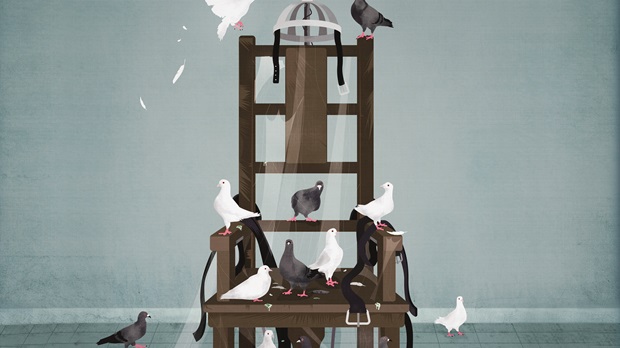
Let me put it this way: If Jesus died 100 years ago, Christians would be wearing nooses around our necks. If Jesus died 50 years ago, Christians would bow before electric chairs in our sanctuaries on Sunday mornings. If Jesus died today, Christians would hang hypodermic needles in our living rooms.

The cross was the electric chair for the Romans. The cross is like the hangman’s nooses of lynching mobs. The cross is like the lethal injections in modern prisons. It is the way people were killed by the state as a punishment for their crimes.

And, I’ll admit it, there are scriptures in the Bible that justify the practice of capital punishment. But there are also people in the Bible who committed capital crimes and God still used them for the kingdom.

We like the think about Moses talking to the burning bush, and leading God’s people to the Promised Land, but we don’t like to think about the fact that Moses murdered an Egyptian in cold blood before he met God in the wilderness.

We like to think about David defeating Goliath, and dancing in front of the Ark of the Covenant, but we don’t like thinking about the fact that David ordered one of his soldiers to die so that he could sleep with and rape his wife.

We like to think about Paul being knocked to the ground on the road to Damascus, and writing his letters to the churches by candlelight, but we don’t like thinking about the fact that Paul murdered Christians before his conversion.

One of the tenants of Christian theology is that nothing is impossible for God. But when we kill people for killing people, then we effectively remove all possibility of change in that person’s life. If we Christians really believe in the resurrection of Christ and the possibility of reconciliation coming through repentance, then the death penalty is a denial of that belief.

The beginning and the end of theology is that with God’s help and grace all things are possible. An alcoholic can kick the bottle, an atheist can discover faith, and a sinner can receive forgiveness. Why then do we keep slinging our nooses? Who do we keep sending people to the electric chair? Why do we strap people down for lethal injections? Why do we keep nailing people to crosses?

The message of Jesus’ ministry, of the cross, is mercy. And mercy triumphs over judgment.

That doesn’t mean that people who commit horrendous crimes get to walk away scot-free, nor does it mean that we should break down the walls of our prisons and let everyone run wild, but it does require us to fundamentally reshape our imagination regarding the so-called justice system. 

For centuries the death penalty was something that took place in public – crosses on a hill, nooses in a tree. The state used the death penalty to publicly frighten potential criminals from committing crimes. But now capital punishment takes place in hidden rooms with minimal witnesses. It has retreated from the public arena and can happen without disrupting our daily lives such that when Brandon Bernard was killed yesterday, it was merely a blip on the radar in terms of our collective response.

But we are murdering people for murder.

Jesus once said, “You have heard that it was said an eye for an eye and a tooth for a tooth.” Interestingly, President Trumps has made it known on more than one occasion that this is his favorite verse from the Bible. But Jesus doesn’t stop there: “But I say to you, Do not resist an evildoer. But if anyone trikes you on the right cheek turn the other also.”

Violence only begets violence.

An eye for an eye leaves everyone blind. 

God sent God’s son into the world to transform the world. Not with the ways of the world, not with power and prestige, nor with armies and aggression, but with mercy and sacrifice.

God in Christ ministered to the last, least, lost, little – people like those who are waiting for the end of their days on death row.

And Jesus carried death on his back to the top of a hill to die so that we might live.

So long as we employ the death penalty, we will deny the power of God to redeem, restore, and transform all of us. As long as we sling our nooses, and prepare our needles, we will prevent grace from making new life in those who have sinned. As long as we murder murderers, we will never give God the chance to make the impossible possible. 

ABR (Always Be Rejoicing)

1 Thessalonians 5.16-18

Rejoice always, pray without ceasing, give thanks in all circumstances; for this is the will of God in Christ Jesus for you.

My son has a penchant for exaggeration.

(He probably gets it from his Father)

We decided to get him a Lego Star Wars Advent calendar in which, every day, he gets to open a new (tiny) lego set that he gets to build after consuming his breakfast. The first week of December resulted in a miniature Razorcrest (from The Mandalorian), Poe Dameron wearing a BB-8 holiday sweater, and many more.

And this morning, after scarfing down his pancakes, he ripped through the package and put together a red Sith Trooper in 7.5 seconds and triumphantly declared, “This is the best Advent ever!” while grinning from ear to ear.

When was the last time you felt truly joyful?

It’s a worthy question for Christian reflection, particularly in a time such as ours – a global pandemic, economic uncertainty, and the familiar no longer a possible reality.

“Rejoice always!” So Paul implores the church in Thessalonica. Notably, Paul’s call to joy is not a suggestion not merely an opportunity for contemplation, it is a command.

But how can we rejoice (always) when it feels like there’s nothing to rejoice about?

Joy, as we often speak about it, is a feeling. Like my son with his legos, it is a moment of bliss or happiness that leads to some sort of physical reaction like him smiling so much his mouth started to hurt.

But joy, properly understood, is also an expression, a kind of communication. However, it  is not simply telling others that you are happy – it is a telling that is also an invitation to share in the telling.

Joy, to put it another way, is meant to be infectious.

At her best, the church is a people who invite each other to rejoice together. It’s why the covenants of marriage and baptism and not for the people getting married or baptized alone – they are a promise made by the community for the community.

We, that is the church, rejoice always, we pray constantly, and we give thanks in all circumstances. Interestingly, for Paul, joy comes first. Unless we are filled with joy we cannot pray and unless we pray we cannot give thanks.

Now, there’s (of course) a potential for a horrendous reading of this command in which Christians, “stay on the sunny side” despite all evidence of the contrary through their lives – like the meme of the dog drinking coffee in a house on fire saying “this is fine.” Rejoicing always, in that way (which is to say: improperly), can be used as the means by which we reject responsibility for others and even for ourselves.

Remember, however, Jesus did not ignore the truth and the brokenness of life – he wept for Lazarus, he turned the tables in the temple, and he was even afraid in the Garden of Gethsemane.

Christians are a people commanded to rejoice not in spite of the world, but simply because we know how the story ends. We can rejoice because we have found what was lost, ourselves. 

Our joy is in the cross – a sign to us and to all that God chose to suffer for the sake of the world.

The strange new world of the Bible reveals God’s strange and confounding love for us in spite of us – we open up the pages to discover that God had joy in being one with us and that God took on all the consequences of being one of us; God incarnated love in the person of Jesus Christ for a people not good at loving in the first. 

Our joy is inherently Adventen because it holds two seemingly-opposed things together at once – like the already but not yet, the once and future king, the cross and the empty tomb.

Joy, Christian joy, is the joy of knowing what awaits us even in death. And that joy gives us the strength to pray without ceasing and the courage to give thanks for a gift we simply do not deserve. 

We have a joy to express and to share because God is coming again, bursting onto the scene like our favorite uncle with a salami under one arm and a bottle of wine under the other with no other hope in the world other than to party (read: rejoice) forever and ever. 

This is the Good News.

Repeat The Sounding Joy

This week on the Strangely Warmed podcast I speak with Ben DeHart about the readings for the Third Sunday of Advent [B] (Isaiah 61.1-4, 8-11, Psalm 126, 1 Thessalonians 5.16-24, John 1.6-8, 19-28). Ben is the Associate Rector at Calvary-St. George’s Church in NYC. Our conversation covers a range of topics including Fleming Rutledge, figuration, bad news, righteous justice, creative imagery, true laughter, upending Advent, praying online, homiletical grammar, and bearing witness. If you would like to listen to the episode or subscribe to the podcast you can do so here: Repeat The Sounding Joy

Beginning Again

Mark 1.1-3

The beginning of the good news of Jesus Christ, the Son of God. As it is written in the prophet Isaiah, “See, I am sending my messenger ahead of you, who will prepare your way; the voice of the one crying out in the wilderness: ‘Prepare the way of the Lord, make his paths straight.’”

In Advent, we begin again. 

It’s notably strange that we, Christians, continue to repeat ourselves year after year with this bewildering season. We pull out the purple paraments, we decorate our Advent wreaths, and we start singing tunes about “ransoming captive Israel.” Advent, for better or worse, is a season all about waiting – waiting for the birth of Jesus in the manger AND waiting for his return at the end of all things. 

And, every year, we spend this season living into the tension of the already but not yet. 

It’s just the best.

And yet, Advent can feel like a drag. We hear, week after week, about preparation, but it’s not altogether clear what we are preparing for. Sure, we’ve got to get the lights up on the house and purchase all the perfect presents and send out the color-coordinated family picture, but what does any of that have to do with Jesus?

The beginning of Mark’s gospel starts with the beginning. John the Baptist is out in the wilderness preparing the way of the Lord proclaiming a baptism of repentance for the forgiveness of sins.

He, prophetically, points to the sinfulness within each of us to make sure we know what it is that Jesus is showing up for. He calls us to look into the darkness inside of us, and then points us toward the One who will rectify the cosmos, including us. 

This is no easy task.

Therefore, Advent can be a little frightening as we prepare our hearts, minds, and souls for the One who shows up to cancel out our sins. But Advent is equally a time for celebration! We celebrate because Jesus has already done the good work of rewriting reality, and we now simply wait for his return and the knitting of the new heaven and the new earth. 

Advent is a time in which we balance out both the beginning and the end all while looking straight into the darkness knowing that the dawn will break from on high. Advent is both convicting and celebratory. It is the church at her very best.

Robert Farrar Capon puts it this way: 

Advent is the church’s annual celebration of the silliness (from selig, which is German for “blessed”) of salvation. The whole thing really is a divine lark. God has fudged everything in our favor: without shame or fear we rejoice to behold his appearing. Yes, there is dirt under the divine Deliverer’s fingernails. But no, it isn’t any different from all the other dirt of history. The main thing is, he’s got the package and we’ve got the trust: Lo, he comes with clouds descending. Alleluia, and three cheers…What we are watching [waiting] for is a party. And that party is not just down the street making up its mind when to come to us. It is already hiding in our basement, banging on our steam pipes, and laughing its way up our cellar stairs. The unknown day and hour of its finally bursting into the kitchen and roistering its way through the whole house is not dreadful; it is all part of the divine lark of grace. God is not our mother-in-law, coming to see whether he wedding present-china has been chipped. God is, instead, the funny Old Uncle with a salami under one arm and a bottle of wine under the other. We do indeed need to watch [wait] for him; but only because it would be such a pity to miss all the fun!” – (Capon, The Parables of Judgment)

So here’s to the season of repentance and celebration where we begin, again! Amen.