The Hopes And Fears Of All The Years

“In that region there were shepherds living in the fields, keeping watch over their flock by night. Then an angel of the Lord stood before them, and the glory of the Lord shone around them, and they were terrified.” 

I waited until the last second to buy our communion bread for tonight, which was a mistake. I foolishly made the assumption that NO ONE would be at the grocery store on Christmas Eve and when I arrived at Giant, there was not a single available spot in the parking lot – I had to park in front of a Long John Silvers. And then, when I finally got inside, I discovered the fact that they had run out of bread!

So I had to drive to the next grocery store, Safeway. Thankfully, they had some available parking but the inside of the store was packed. But I trudged my way though to the back, procured a few loaves of bread, and then waited in line for an eternity to make my purchase.

Now, to be clear, I was wearing my clergy collar and florescently bright plaid pants, but somehow no one noticed me. Perhaps everyone else was fretting just like me. 

At least, that’s what it felt like until I felt the tap on my shoulder.

I turned around and saw an older woman with a few items in her hands staring down at the floor, and she said,“This is my first Christmas without my husband. He died a few months ago.”

I just stood there balancing the bread, and asked if she was okay.

She said, “Not really. I just needed to tell someone, because no one else has asked.”

And then I asked if I could pray with her.

I dropped the bread to the ground and we took each other’s hands while waiting in line, and we prayed.

And at the end, when I said, “Amen,” the six closest people said, “Amen,” as well.

“O little town of Bethlehem, how still we see thee lie; above thy deep and dreamless sleep the silent stars go by. Yet in thy dark streets shineth the everlasting Light. The hopes and fears of all the years are met in thee tonight.”

The hopes AND fears of all the years.
candlesHanded

Sometimes, throughout the hustle and bustle of this season, I miss the subtle details. I gloss over a profound detail in the scriptural story, or I overlook the miracles in my midst, or I sing words countless times without thinking about what I’m saying.

The hopes and fears.

On Christmas Eve, when we’re singing praises to baby Jesus, and lighting the candles, and enjoying one another, we also encounter the strange truth of our fears being met in the one born in the manger. 

While Mary and Joseph were there in Bethlehem, the time came for Mary to deliver her child. And she gave birth to her firstborn son and wrapped him in bands of cloth, and laid him in a manger, because there was no place for them in the inn. In that region there were shepherds living in the fields, keeping watch over their flock by night. Then an angel of the Lord stood before them, and the glory of the Lord shone around them, and they were terrified.

But the angel said, “Do not be afraid; for see – I am bringing you good news of great joy for all the people: to you is born this day in the city of David a Savior, who is the Messiah, the Lord.”

There is an understated wealth in the titles attributed to the baby by the angel out in the fields – Savior, Messiah, Lord. 

How can this baby, a tiny and weak and vulnerable thing, be the Savior, Messiah, and Lord?

The hopes and fears of all the years are met in Jesus Christ because something new has begun – a newness that contains a reorienting of all things where we are no longer in control of everything we wish to control.

No. A tiny and weak and vulnerable baby will change the world. 

Only a God like ours would see if fit to transform the very fabric of reality with something tiny, weak, vulnerable. Gone are the days when militaristic might would reign supreme, no longer would economic prosperity dictate the terms of existence. God brings forth a wholeness of life in the life of God’s only Son through whom God ordains a restoring of balance to all the forces of creation and all the the things that have influence over our lives.

Luke begins this story with Emperor Augustus and Governor Quirinius, but that’s not where the story ends. The birth of Jesus into the world establishes a new order in which the last will be first and the first will be last. The arrival of the Savior, Messiah, and Lord upsets all of the expectations and assumptions that we’ve foolishly made about this world.

Today we assume we know where Jesus is or, at the very least, where Jesus should be. We elevate particular politicians because we think they are on Jesus’ side, or we dismiss entire populations of people because we think Jesus is on our side. We relegate the incarnate Lord to our perfect manger scenes only to pack him away in a few days.

But the story of Christmas is that God cannot, and will not, be stopped. 

Hope and fear are brought near to us in Jesus because this is the beginning of a story that finds its greatest triumph not in a manger scene, not even in the angels singing out in the fields, but in an empty tomb.

9-the-hopes-and-fears-of-all-the-years

Christmas isn’t just about the warm and fuzzy feelings of warm fires and delicious eggnog. We can rip open the presents tomorrow morning with reckless abandon all we want. But if we take Christmas and the announcement of God as seriously as the shepherds did out in the fields then maybe our proper response is fear.

Not because God will punish us, and not because God is inherently terrifying, but simply because if God gets God’s way, then that means we might not get ours.

The God of scripture is one who finds life, hope, and promise from the margins rather than from the elite and powerful. God consistently uses the least likely of people in the least likely places to achieve the most extraordinary things. The incarnation of God in Jesus is a witness to the fact that we cannot remain as we are.

And that can be a rather terrifying prospect. 

The fears of our years are made evident by the many things we cling to that do not provide us life. For some of us it will be the presents we open tonight and tomorrow morning, for others its the paycheck that comes in ever 2 weeks, and for others its a broken relationship or a fractured family.

We put our trust and our hope in so many things these days and we are so regularly disappointed. 

We vote for the politician of change only to experience the same bureaucratic bumbling as before.

We seek out new employment opportunities only to still feel exhausted at the end of every day.

We even try out different churches hoping they will fix the problems we’re experiencing.

We might like to imagine that Christmas really is the most wonderful time of the year, but it can be equally frightening.

Particularly if its the first one without someone we love. 

And yet, as wonderfully weird as is befitting the faith, the angel declares, “Do not be afraid! I am bringing you news great joy!”

To you is born the Savior, Messiah, and Lord.

You need not be responsible for saving yourself and transforming yourself. 

You are not alone.

God is already working on you and in you through Jesus Christ! The sign is a child wrapped in swaddling clothes laying in a feeding trough. God has and will transform the very fabric of the cosmos through that baby.

God saw and sees the disparities of this world and makes a way where there was and is no way. God knows better than us about what is best for us. And the Lord, the one who can terrify us even at this time of year, arrives as Jesus Christ, perfectly vulnerable and weak to transform everything.

Because that very same baby, the one with teeny tiny toes and the one resting in the feeding trough, is the same person who walked through Galilee, who was transfigured magnificently, who feed the people abundantly, who walked on water miraculously, who suffered on the cross tragically, and rose from the grave majestically.

The womb and the tomb could not and cannot contain the grace of God. Even in the darkest moments of our lives there is an everlasting light. The hopes and fears of all the years are met in Jesus tonight. Amen. 
Missing From The Manger

“While they were there, the time came for her to deliver her child. And she gave birth to her firstborn son and wrapped him in bands of cloth, and laid him in a manger, because there was no place for them in the inn.”

It doesn’t get a whole lot better than this: Christmas Eve! 

No matter how old or jaded we may be, regardless of whether we deserve coal in our stockings or not, Christmas Eve never fails to work its magic. 

The lights are hung in the sanctuary, the candles are burning, the poinsettias are blooming. 

And we are here! Some of us were raised in this church and wouldn’t dream of being anywhere else. Others made plans weeks ago and are here for the very first time. Some of us are here with questions, and others are just waiting to get home to finish everything else. Some of us made a last minute decision and are still wondering if we made the right choice, and others were dragged here against our will!

There are some here tonight with more Christmases ahead than behind, young parents with children, kids with long wish lists. And of course there are some for whom there are only a few Christmases left, and with each passing season we feel more nostalgic about the past.

Whoever you are, and whatever feelings, and thoughts, and questions you’ve brought tonight, it is my hope and prayer that you encounter the light of the world in Jesus Christ.

MangerScene_NoJesus

I am beside myself.

It’s one of my grandmother’s favorite things to say. And, to be honest, I’m not sure what it means. I don’t even know if she knows what it means.

And yet she says it all the time.

It can be used in both exhilarating and terrifying ways. Like when she gets a card from someone in the mail with whom she has not conversed with in years. She will pick up the phone and tell me about it, and to describe the feeling she says, “I am beside myself!”

Or like when she turns on the news and learns of yet another senseless tragedy taking place somewhere in the world, she will pick up the phone and tell me about it, and to describe the feeling she says, “I am beside myself!”

I love my grandmother with every fiber of my being, and I will contend that she decorates for holidays better than anyone on the planet. 

Who else has 76 Easter bunnies that she hides in the house for her grandchildren, and now great-grandchildren to discover every spring? 

But the greatest decoration of all, her pride and joy, is her manger scene.

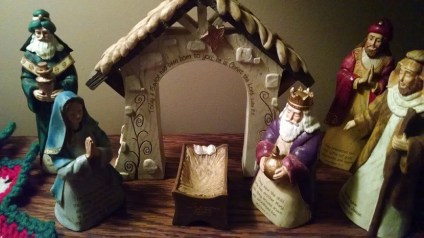
Every year she sets aside the time to pull out the box with every individual character wrapped in their own paper to place them perfectly in their pre-ordained spot. The camels are so life-like they look as if they could spit on the bureau where they are situated during December. The magi are so majestic I am convinced that if you opened up their tiny gift boxes you would indeed discover gold, frankincense, and myrrh. The detail in the faces of Mary and Joseph are so incredible that you can see both their excitement and their terror about the new baby boy in their lives.

But one year, when the whole family gathered at her house, she greeted us at the front door with her preferred expression from both sides of the emotional spectrum: “I am beside myself!”

I had hoped that she was beside herself in joy that her entire family was waiting by the door, but I was wrong. No, she was beside herself because baby Jesus was missing – and you can’t have Christmas without baby Jesus.

The manger appeared as perfect as planned, except there, right in the middle was the tiny feeding trough without a Jesus wrapped in swaddling clothes. 

So we looked, and we looked, and we looked looked looked looked. We checked the box where the manger scene spent the other 11 months of the year, we checked under the bureau, we even found ourselves looking in the refrigerator.

But the longer we looked the more beside herself my grandmother became.

Jesus was indeed missing.

Only later, having gone through every sock drawer, and basement box, and even the trash, did we find him.

When my grandmother set up the manger that year, she put the trough in upside down. It looked like it was empty, when in fact if you looked close enough you could see baby Jesus’ little hands and feet sticking out of the bottom, crushed under the weight of his make-shift crib, and all we had to do was flip it around.

Jesus was there the entire time.

These days the season of Christmas is filled with lots of stuff. And rather than bemoaning the commercialization and the commodification of the holiday, we can just focus on the church herself. We’ve got all sorts of decorations, we’ve got some of the best songs from the hymnal, we will even end this service under the beauty of candlelight. 

But contrary to what we see or even hear this time of year, the biblical story itself is strikingly simple, brief, and straightforward.

Jesus’ birth barely gets one verse.

According to Luke all of the clutter that might distract people like us from the profound truth of the incarnation of God in the flesh is pushed to the side. 

There are no magi in the manger, we don’t even hear about any animals nuzzled in close for warmth.

It’s just Mary, Joseph, and a baby.

However, Luke does share with us this incredibly powerful moment where the heavenly host proclaims the arrival of someone and something new to the shepherds out in the fields.

It would be one thing to expect the divine declaration about the in-breaking of the kingdom arriving in front of the emperor back in Rome, or even in the governor’s palace in Jerusalem. 

But God does something incredibly different and contrary to the systems and expectations of the world. 

candlelt

While people even today focus on the people and the places of worldly power, Luke draws our attention toward the margins.

There’s a reason the shepherds lived out in the fields – it wasn’t just the place where their livestock lived, but also because they were seen as a sub-class, not fit to even be in the cities, towns, and villages.

And that’s where the glory of the Lord shined the brightest! 

This is the sign for you – you will find a child wrapped in bands of cloth and lying in a manger – he is the Savior, the Messiah, the Lord.

Most of us have heard this story enough time that the weight of that particular proclamation no longer carries the weight it once did. The angel of the Lord announces the triumphant entry of God into the world to the least likely people – and even more outrageous is the fact that God chooses to enter through Jesus. 

How can this baby, a tiny and weak and vulnerable thing, be the Savior, Messiah, and Lord?

Only a God like ours would see if fit to transform the very fabric of reality with something tiny, weak, vulnerable. Gone are the days when militaristic might would reign supreme, no longer would economic prosperity dictate the terms of existence. God brings forth a wholeness of life in the life of God’s only Son through whom God ordains a restoring of balance to all the forces of creation and all the things that have influence over our lives.

Luke begins this story with Emperor Augustus and Governor Quirinius, but that’s not where the story ends. The birth of Jesus into the world establishes a new order in which the last will be first and the first will be last. The arrival of the Savior, Messiah, and Lord upsets all of the expectations and assumptions that we’ve foolishly made about this world.

Today we assume we know where Jesus is or, at the very least, where Jesus should be. We elevate particular politicians because we think they are on Jesus’ side, or we dismiss entire populations of people because we think Jesus is on our side. 

We relegate the incarnate Lord to our perfect manger scenes only to pack him away in a few days.

But the story of Christmas is that God cannot, and will not, be stopped.

God saw and sees the disparities of this world and makes a way where there was and is no way. God knows better than us about what is best for us. And the Lord, the one often missing from the manger scenes of our lives, arrives as Jesus Christ, perfectly vulnerable and weak to transform everything.

Because that very same baby, the one with teeny tiny toes and the one resting in the feeding trough, is the same person who walked through Galilee, who was transfigured magnificently, who feed the people abundantly, who walked on water miraculously, who suffered on the cross tragically, and rose from the grave majestically.

The womb and the tomb could not and cannot contain the grace of God, and no matter whether or not we think Jesus is missing, he is there, he is here, and he always will be. Amen. 

Fruit Of The Womb

Luke 1.39-55

In those days Mary set out and went with haste to a Judean town in the hill country, where she entered the house of Zechariah and greeted Elizabeth. When Elizabeth heard Mary’s greeting, the child leaped in her womb. And Elizabeth was filled with the Holy Spirit and exclaimed with a loud cry, “Blessed are you among women, and blessed is the fruit of your womb. And why has this happened to me, that the mother of my Lord comes to me? For as soon as I heard the sound of your greeting, the child in my womb leaped for joy. And blessed is she who believed that there would be a fulfillment of what was spoken to her by the Lord.” And Mary said, “My soul magnifies the Lord, and my spirit rejoices in God my Savior, for he has looked with favor on the lowliness of his servant. Surely, from now on all generations will call me blessed; for the Mighty One has done great things for me, and holy is his name. His mercy is for those who fear him from generation to generation. He has shown strength with his arm; he has scattered the proud in the thoughts of their hearts. He has brought down the powerful from their thrones, and lifted up the lowly; he has filled the hungry with good things, and sent the rich away empty. He has helped his servant Israel, in remembrance of his mercy, according to the promise he made to our ancestors, to Abraham and to his descendants forever.” 

636169111672408480521702275_christmasmusic

Mary was the first to carry the gospel. 

Our choir was singing those words with a particular gusto because the truth of that statement is a profound one. In Protestant circles Mary tends to be overlooked and is relegated to the side of the Advent/Christmas stories. Sure, she is the Theotokos, the God-bearer, but she was just a vessel right?

Wrong.

No. Mary is much much much more than a vessel and her role in the salvation of the world is one worthy of our time and attention.

She is a young and engaged version with the angel Gabriel shows up with supposedly good news. Imagine having to tell your fiancé that you were now pregnant with the Son of God!

And yet her faithfulness in the midst of something that appears terrible is bewildering. 

Let it be with me according to thy will…

Harmonizing with God’s purposes in the world is no easy endeavor, and in Mary’s case it sends her to relatives’ house, Elizabeth and Zechariah. 

Now, remember, this is a time before Facebook and viral pregnancy announcements, there was no gender reveal party or even an opportunity for a baby shower. Mary merely enters the house, and John the soon-to-be Baptist leaps inside his mother, Elizabeth’s, womb.

I’ve been playing the drums for a very long time and I’ve taken as many opportunities as I could to play with a variety of groups in a variety of places. I’ve played in jazz combos at bars, I’ve classical music in benefit concerts, and I’ve played jam-band music in more garages than I can count.

But my first love of drums came in worship music. I played for a contemporary Christian worship band nearly every Sunday from the time I was 16 until I was 25. And I loved it.

I loved practicing with a group during the week, I loved bonding over music, and I loved providing the rhythm for the praising of God during worship. And the people I’ve played with other the years are some of my very favorite people.

While I was living in North Carolina I practiced with a group every Tuesday night, and we would play for a worship service every Sunday evening. We would always wait until everyone arrived for practice and then we would circle up to pray before we did anything else. It became an important habit that shaped how we practiced such that we always remember for whom we were playing.

On one such night, we went around the circle sharing our concerns, when our leader, the pregnant pianist, suddenly departed for the bathroom and left us standing there holding hands.

We patiently waited for her to return until we heard her scream in the bathroom, and the girls from the band immediately ran to check on her.

Later, we found out that she was spotting and assumed that she lost the baby. The terror in her voice has haunted me ever since.

She went to the doctor the following day and, miraculously, she learned that the baby was okay. But she didn’t feel him kicking or moving around.

The doctor, the trained professional, had told her everything she could’ve possibly hoped to hear, but because of her experience, it didn’t feel real. She had to make it through day after day in that horrible tension of being told something that didn’t seem true.

Until Sunday, when she had to sit at the piano and sing to the Lord.

I can remember that Sunday evening, sitting behind the drums, playing away, and looking over at her as she stared off into the distance. She was there, but not really there. She was playing all the right notes, and singing all the right words, but her heart wasn’t into it.

But we kept playing anyway.

And then, in a way that is difficult to describe, it felt like the Holy Spirit blew through the room as I looked over at her in the middle of a song, and she was crying with a giant smile on her face. The tears were falling on the keys and she was singing in a way that none of us had ever experienced – it felt like the heavenly hosts were lifting her voice up to praise.

As soon as the song ended she looked back over her shoulder at the band and she said, “The baby started kicking along to the song, he was leaping in my womb.”

The jumping of John in his mother’s womb was enough to get Mary singing a song that Christians like us have been proclaiming and declaring for centuries. “My soul magnifies the Lord!” The Spirit moved in and through her to sing from the depth of her being that God was doing a new thing. That God refused to leave God’s people. That God would do whatever it took to rectify this world.

And so, what else can we do, but magnify the Lord with our songs? 

Impossible Possibility

strangely-warmed-spreaker-header

This week on the Strangely Warmed podcast I speak with Scott Jones about the readings for the 4th Sunday of Advent (Micah 5.2-5a, Psalm 80.1-7, Hebrews 10.5-10, Luke 1.39-55). Scott is the host of my rival lectionary podcast Synaxis. Our conversation covers a range of topics including Netflix as the cost of empire, the young Karl Barth, little towns, Caspian and the Narnians, the peace of Christ, rectification vs. forgiveness, God’s anger, looking like an idiot int he pulpit, church marquees, and the gratuitous nature of salvation. If you would like to listen to the episode or subscribe to the podcast you can do so here: Impossible Possibility

Screen Shot 2018-12-17 at 9.50.25 AM.png

An Old-Fashioned Christmas

Isaiah 9.2-7

The people who walked in darkness have seen a great light; those who lived in a land of deep darkness on them light has shined. You have multiplied the nation, you have increased its joy; they rejoice before you as with joy at the harvest, as people exult when dividing plunder. For the yoke of their burden, and the bar across their shoulders, the rod of their oppressor, you have broken as on the day of Midian. For all the boots of the tramping warriors and all the garments rolled in blood shall be burned as fuel for the fire. For a child has been born for us, a son given to us; authority rests upon his shoulders; and he is named Wonderful Counselor, Mighty God, Everlasting Father, Prince of Peace. His authority shall grow continually, and there shall be endless peace for the throne of David and his kingdom. He will establish and uphold it with justice and with righteousness from this time onward and forevermore. The zeal of the Lord of hosts will do this.

           Merry Christmas! There’s just something different about Christmas. No matter how young or old we may be, no matter what kind of year precedes this night, Christmas Eve never fails to brighten our spirits. I look forward to this night unlike any other night with a kind of joyful anxiety: I know this holiday carries with it more meaning than can be contained in any sermon, and yet to share the story of the incarnation is one of my greatest privileges.

But there is a question I must ask: Why are you here tonight? Some of you were raised in this church and can’t imagine being anywhere else. Some of you have come alone, and others are with large families taking up an entire pew. Some of you have been planning to be in this place at this time for weeks, and some of you decided to come on a last minute impulse. Some of you have been dragged here against your will, out of loyalty or guilt. And some of you are here perhaps for the very first time.

Some of you are young and full of hope and anticipation; most of your Christmases are still in front of you. Some of you who are older are filled with memories of Christmases past that will never come again. Some of you are looking forward to getting back to the presents and the trees, and some of you dread going home. So hear this: whoever you are, and whatever you’re feeling, I’m glad you’re here.

The people who walked in darkness have seen a great light; those who lived in a land of deep darkness on them light has shined.

_the_holy_family__nativity_scene___another_commiss_f6de659b784c8c14ecc1ee8b95fa4fa8

I ask a lot of questions, it comes with the job. But around this time of year I tend to ask the same question over and over: “What’s the best Christmas present you’ve ever received?” And the funny thing is, people have the hardest time answering. And not because they have so many gifts with which that have to weigh out and evaluate their answer, but because they just can’t remember.

For instance, can any of you remember what you opened three years ago on Christmas morning? What about last year?

Of course, there’s a better question to ask: “What’s one of your most beloved Christmas memories?” People can answer that one, and the response is almost always about spending time with a particular person; a beloved spouse, or child, or grandmother, or friend.

That’s what we remember most about Christmases past, the people we spend time with. It’s all we have to give to another, it’s all we really want to receive, and it’s what God gives to us.

Not a present under a tree, not a trite response to a prayerful need. God gives himself to us at Christmas.

There’s just something about Christmas that’s different. And there’s nothing quite like an old-fashioned Christmas. Do you know what I mean? A Christmas where all the kids actually showed up, all the presents were wrapped in time, there were no iPhones to distract us from conversations, no drones to charge before their first flight. Old-fashioned Christmases were all about the family, and the singing of carols, and feeling the warmth of the fire.

My father grew up in Germany, and his most vivid memories of old Christmases were waiting to see what would happen to the Christmas tree. Because unlike our contemporary trees filled with pre-lit LED lights that can do more than a stage production, his Christmas trees were covered in real candles. And on every Christmas Eve every candle would be painstakingly lit, and my father would sit there, like any young child would, waiting for the whole thing to catch on fire.

An old-fashioned Christmas.

There’s a church in our community that worships in a new building, but they still have the original sanctuary on the property. And all year long it just stands there off in the corner like the forgotten island of misfit toys, until Christmas Eve when they open the doors, brush off the dust, light the kerosene lanterns and have an old-fashioned Christmas service. That was the case, until a few years ago when they forgot to open a window, and the kerosene lamps sucked up all the oxygen and parishioners started passing out left and right.

But a real old-fashioned Christmas, which is to say a biblical Christmas, is altogether different. The strange new world of scripture opens up for us a scene where kings rage and wickedness rules the day, where the threat of taxation forces young couples to retreat to the comfort of their parents’ homes, and countries who think of themselves as the very best have forgotten the very least.

            You know, completely unlike today.

It’s strange how Christmas, at least the version we encounter at the mall, becomes a dream. We escape into the Christmases of the past, falsely assuming they held a tinge of perfection. But in the bible, Christmas is no dream; it is reality. And it is one that begins in the dark.

The darkness – evil, sin, suffering, distress, destruction – they are very much part of the world, even if we’re made to believe they are absent during Christmas. We live in a time of war, violence, anger, and wrongful use of power. And the darkness is not just out there, beyond the comfort of the sanctuary, it is very much here as well. The darkness of family fights, disease and death, aging parents, rebellious children, fear and guilt, loneliness, and shame.

And we have to take the darkness seriously, even when we’d rather not. We take the darkness seriously because Isaiah certainly did, because darkness is very much part of our experience, and because darkness is what the light of Christ makes it’s way into.

This time of year challenges us to search for meaning. I mean, every bad Hallmark channel movie struggles to define the reason for this season, but the closest we can get to the meaning of Christmas is right here in Isaiah: The people who walked in darkness have seen a great light.

Light is how we experience the presence of God, the arrival of grace, mercy, and peace. Light shines in the darkness.

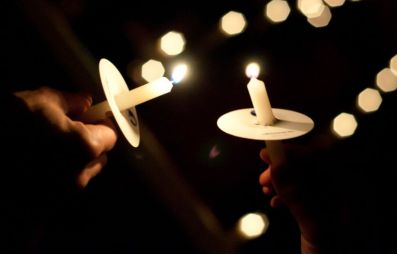
That’s why we always end Christmas Eve worship with the lighting of candles. It is a strange and beautiful thing because it begins in the dark!

Our candles, as a witness to the one Christ candle, burn as a promise, a pledge, and perhaps as an act of defiance. Our flickering candles are what the life of faith look like as it resists the evil temptations of the world.

It looks like our faith because it is fragile.

Our flames are as fragile as a new baby born into the worst circumstances.

opt-the-day-after-christmas from Life Magazine Jamie Wyeth

But new life always starts in the dark, whether it’s a seed in the ground, a baby in the womb, or Jesus in the tomb, new life starts in the dark.

It is a strange, subversive, and dynamic way to change the world. It runs counter to all our assumptions of what it means to hold power. It is fragile like a flame, like a baby born in a manger, and like our faith can be at times.

But one flame, one baby, one faithful hope can be all that it takes to spark a rebellion that changes everything.

An old-fashioned Christmas is challenging because it is truer than all of the perfect manger scenes on our mantles and inflated on our front lawns. The incarnation of God is not some spiritual and mythical concept; it is very much the totality of God taking on flesh to enter this world of ours with all its agonies and joys, sorrows and splendor.

For a fleeting moment, we might experience a time where all is calm and all is bright while we are in this place holding our candles high. But we do so with the knowledge that the world still marvels at the darkness. So come to feast at this, Christ’s table, greet one another in the love that Christ offers us, and declare your defiance of the world’s expectations through the fragile flickering flame.

Because tonight, a night unlike any other night, we join together to wonder at the mystery of God’s power embodied in the fragile flesh of a newborn baby. Tonight, we join together as God’s light that shines in the darkness. Tonight we remember what an old-fashioned Christmas really looks like. Amen.

We Start With The End

Luke 1.46-55

My soul magnifies the Lord, and my spirit rejoices in God my Savior, for he has looked with favor on the lowliness of his servant. Surely, from now on all generations will call me blessed; for the Mighty One has done great things for me, and holy is his name. His mercy is for those who fear him from generation to generation. He has shown strength with his arm; he has scattered the proud in the thoughts of their hearts. He has brought down the powerful from their thrones, and lifted up the lowly; he has filled the hungry with good things, and sent the rich away empty. He has helped his servant Israel, in remembrance of his mercy, according to the promise he made to our ancestors, to Abraham and to his descendants forever.

There’s a grocery right around the corner from my house and I go there way too often. I’d like to blame it on the strange hours of church work, or my incredible cooking skills that sends me off looking for strange and rare ingredients, but honestly having a toddler requires visiting the grocery store with regularity.

I go enough to know when not to go. For instance: Sunday afternoons are the absolute worst. They are the worst because people like me remember all the things they forget to pick up earlier in the week and decide to go at the exact same time as everyone else.

And during the holiday season, it’s all the worse.

So, of course, it was on Sunday afternoon that I found myself at the grocery store with the always wonderful assortment of necessary items in my basket: baby wipes, chocolate morsels, and deodorant.

And I was not alone: every aisle was filled with families and individuals frantically seeking out all the items on their list. Some moved at a snail’s pace checking all of the nutritional values for every single item, while others were just swiping items into their carts indiscriminately. Like all stores around this season, there were older couples smiling at babies, young couples avoiding the babies, and babies crying at everyone.

I held my requisite items and dashed as quickly as I could to the “10 Items or Less” aisle which, of course, was filled with many people with way more than 10 items. And so, I practiced my Christian virtue, and I tried being patient and non-judgmental.

And that’s when the fight broke out.

Four people up from me in the line stood a young woman having just shoved the cashier across the conveyer belt. From my vantage point I could only make out brief words and lots of loud noises. There was some disagreement about payment, and then insults started flying, and then arms started moving, and the rest of us in line just stood there doing what we do best when we go to the grocery store: we distracted ourselves with the trite headlines on bad magazines, we glanced at our watches, and rechecked our email inboxes on our phones for the third time in a row.

Eventually, after the items had been sorted and the argument came to its conclusion with the manager stepping in, the young woman began weeping. “I’m just so hungry,” she said, “please let me take something.” And the cashier politely responded, “Ma’am, if we gave you something for free we’d have to give something to everybody.” And with that, they told her to leave or they’d call the police.

And we all stood there, doing nothing.

Today is the 4th, and final, Sunday of Advent. Some of you are here because you’re eagerly awaiting tonight and tomorrow morning, some of you are probably thinking more about what’s under the tree than what’s in store for worship, some of you are waiting in deep grief thinking about how all the best Christmases are behind you, and still yet some of you are here with the hope that you will receive a little more hope.

This is the day when the pre-Christmas frenzy is at its zenith. Many of you will rush out of church this morning to take care of all the remaining items on your list because Christmas hits us like a brick wall tomorrow. And it is at this precise moment, with all the fear and fervor, that we are treated to the voice of a poor young Jewish girl with a song of praise.

Mary sings her song in declaration of the new arrival of God made manifest in her womb. She not only accepts her call to bear God in the flesh, but also marvels at God’s amazing grace that will, and perhaps already has, come to fruition in the promise in her womb.

Maria-Walks-2-1024x749

Mary’s song, her Magnificat, begins by celebrating the greatness of God: among the entirety of the world, God chose to bestow God’s favor on Mary, a lowly servant of God. Then she proclaims God’s liberating compassion for the poor. She declares that God will flip the expectations of the world upside down, and that nothing will ever be the same. Mary identifies the God growing in her womb as the God who identifies with the poor, the marginalized, and the outcast.

And, at its best, Mary’s song is just another verse in God’s great song to humanity. A song that begins with “Let there be light” that transitions to “I will be your God, and you will be my people,” and finds its chorus in, “He has brought down the powerful from their thrones, and lifted up the lowly; he has filled the hungry with good things, and sent the rich away empty.”

But the tense has changed.

            In God’s initial covenant it is all about what will come to pass, but in Mary’s song, God has already acted and changed the cosmos, prior to Jesus’ birth.

Mary sings amidst a world suffering under oppression, and even though we are far removed from the days of Mary, things can look pretty grim these days as well.

I’ve come to find that because we know the story of Jesus’ birth, Mary and Joseph’s arrival in Bethlehem, the angels and shepherds, all of it so well, that it no longer shakes us the way that it once did. Instead of being rocked by the fulfilled promises of Mary’s Magnificat, we imagine Christmas as portrayed by little children wearing bed sheets and pipe cleaner angel wings.

But the story is as real as the person sitting next to you, and it demands our attention and reaction.

On the front of your bulletin you’ll find a modern Mary and Joseph.

I am almost positive that the image will offend most of us in church this morning. But, to be frank, if you’re here in worship on a Sunday morning that also falls on Christmas Eve, you’re probably the kind of Christian who can handle the offense.

The image shows Mary and Joseph as if they were waiting outside the 7-11 down the street from our church. And the attention to detail is what shakes me when I see the image: Mary wears a Nazareth High School hoodie, reminding us that she was truly a young woman. She wears an engagement ring around her finger, given to her by Jose, otherwise known as Joseph. There’s no vacancy at Dave’s City Motel (The city of David: Bethlehem). And Mary even rests under the star, though this one is neon and serves as an advertisement for an adult beverage.

This image might come across as upsetting, and if it does, it’s only because we’ve lost sight of how offensive the Christmas story really is: God chose these people to bring the incarnation into the world. God chose these people to right all the wrongs committed by the world. God chose Mary’s womb to start the story that ends with an empty tomb.

e2055566bd428e7b78afeb573b09d0e3--advent-candles-beautiful-christmas

I am not proud to admit that we all kept standing there while the woman in the grocery store ran away out of shame, fear, embarrassment, and hunger; a hunger that I will probably never know; a hunger that most of you will probably never experience. But I’m positive it’s a hunger that Mary knew.

Mary was the “least of these,” a phrase we throw around far too often without contemplation. She, in the midst of a frightening life, perhaps among the pangs of hunger, declared that in her womb was the coming change that would reverse the doom.

She, as the favored one, saw what would be accomplished by God’s promise before it even happened. She, like us, knew the end of the story. God’s story in Christ, in Mary, is offensive simply because it is so contrary to the world’s expectations, and even our own.

If we encountered the couple on the front of our bulletin, there’s a good chance that we would treat them the same way that others and I treated that woman at the grocery store: with indifference.

We’ve got our own problems to worry about: children to feed, presents to wrap, in-laws to impress. We haven’t got time to feed the hungry when we’ve got bills to pay. It’s hard to think about bringing down the mighty when we feel so powerless.

And you know what? That’s okay. It’s okay because this transformative work is God’s business. We get to participate in this work with God for sure, but in Mary’s song she rightly points away from herself to the one who is, was, and is to come:

            God’s mercy is for those who fear him from generation to generation.

            God has demonstrated his incredible strength.

            God has scattered the proud in the thoughts of their hearts.

            God has brought down the powerful from their thrones.

            God has lifted up the lowly.

            God has filled the hungry with good things.

            God has sent the rich away empty.

            And God did, and does, all of this in Christ Jesus, his Son, our Lord.

Like Mary, we start at the end. We read the Magnificat in the knowledge that the tomb will be empty. We hear Mary’s song as a triumphant declaration about how God changed, and changes, the world in the incarnation and the resurrection. In these words we experience the past, present, and future of God’s reign.

The great challenge of following Jesus is cultivating the ability, like Mary, to see God’s promises as already having come to pass. Such that, instead of ignoring the woman at the store, or the couple on the corner, we see them as intimately involved in God’s toppling of the powers and principalities; that, instead of accepting the status quo, we recognize how all of us are works in progress; that instead of passively accepting this song, we hear it for the controversy that it truly is.

Our God is scandalous. Our God chooses an old couple in Abraham and Sarah to mark the covenant between God and humanity, a couple we might relegate to a retirement home. Our God chooses a little shepherd boy named David to bring down the mighty Goliath, a boy we might chastise in church for being too loud. Our God chooses an unwed pregnant teenager to bring about the one who will lift up the lowly and bring down the mighty, a girl that we might judge from afar without offering assistance.

We are so steeped in the world of our own making that we forget how scandalous our God truly is. This season in particular has the capacity to bring out the very best, and the very worst in us. But Mary, in her remarkable song, reminds us that wealth and power have no ultimate influence in the realm of God’s kingdom. In fact, they are used to serve the lowly.

            That’s not a popular message to bear during Christmas, but it wasn’t popular during the time of Mary either. In fact, that’s the message that got Jesus killed. But, thanks be to God, we know that what started in the womb was also there in the empty tomb. Amen.

Remembering The End At The Beginning

strangely-warmed-spreaker-header

This week on the Strangely Warmed podcast I speak with Anita Ford about the readings for the 4th Sunday of Advent [Year B] (2 Samuel 7.1-11, 16, Romans 16.25-27, Luke 1.26-38, Luke 1.46b-55). Anita is (as she puts it) a bonafide lectionary nerdling and serves at her local church as the lay leader. Additionally, Anita is a big fan of the Strangely Warmed podcast and has contributed to Voices in the Wilderness from Pupit Fiction in the past. Our conversation covers a range of topics including singing Christmas hymns during Advent, sanctuary orientation, God’s promises, the theotokos, responding to revelation, three difficult words, and magnifying the mystery. If you would like to listen to the episode or subscribe to the podcast you can do so here: Remembering The End At The Beginning

advent

Looking For Jesus In All The Wrong Places

John 20.11-18

But Mary stood weeping outside the tomb. As she wept, she bent over to look into the tomb; and she saw two angels in white, sitting where the body of Jesus had been lying, one at the head and the other at the feet. They said to her, “Woman, what are you weeping?” She said to them, “They have taken away my Lord, and I do not know where they have laid him.” When she had said this, she turned around and saw Jesus standing there, but she did not know that it was Jesus. Jesus said to her, “Woman, why are you weeping?” Whom are you looking for?” Supposing him to be the gardener, she said to him, “Sir, if you have carried him away, tell me where you have laid him, and I will take him away.” Jesus said to her, “Mary!” She turned and said to him in Hebrew, “Rabbouni!” (which means Teacher). Jesus said to her, “Do not hold on to me, because I have not yet ascended to the Father. But go to my brothers and say to them, ‘I am ascending to my Father and your Father, to my God and your God.’” Mary Magdalene went and announced to the disciples, “I have seen the Lord”; and she told them that he had said these things to her.


I love learning about different Easter traditions. Some families will insist on purchasing matching outfits for the family so they can get that perfect picture for the mantel. Others will spend weeks crafting the perfect Easter menu for the family following church. And still yet others will take time to dye Easter Eggs with the kids, and scatter them throughout the house.

In my family, we always had our Easter baskets to rummage through before church. I can vividly recall waking up as a child and experiencing the profound wonder and joy that the Easter bunny had come to my house, and left a basket full of goodies just for me.

But as I got older and wiser, apparently the Easter bunny did as well.

One year, probably toward the end of Elementary school, I came downstairs on Easter and there was no basket with my name on it. I know that I looked straight toward my mother with a look that said, “What happened?!”

She smiled and said, “Taylor I came downstairs early this morning and I discovered something new and something strange. The Easter bunny knows you’re getting older and decided to hide your Easter Basket.”

And thus began a wonderful and bewildering tradition in the Mertins household. Year after year the bunny became craftier with hiding spots. Once, after searching for a good fifteen minutes, I found my Easter basket in one of my sister’s closets, another time it was hidden outside on the picnic table, and still yet another time (after a very frustrating search) I found it in the attic.

But one year, I couldn’t find it. I looked and looked. I went out to the shed. I climbed up the magnolia tree. I even looked in the refrigerator. No Easter basket.

My mother, being the great mother she is, had already searched through the house and found it, but refused to participate. The only hint she gave me was this: “It’s in a place you never go to.”

I searched that house top-to-bottom, bathrooms, closets, hallways… I went over the same places with a fine-toothed comb multiple times, but I couldn’t find it. I was at the point where I was convinced the Easter bunny had forgotten about me. But my mother, being the great mother she is, saw me in agony, walked over to the laundry machine, opened the lid, and pulled out my Easter basket.

I had been looking in all the wrong places.

Easter-Sunday_no-time1920x1080-1073x604

Jesus was killed on a cross and then buried in a tomb. After three days Mary went to the tomb and was shocked to discover that the stone covering the entrance had been rolled away. So she ran to tell the disciples. Peter and John in turn ran back out to the tomb with Mary and found the linens that had covered Jesus’ body neatly folded in the corner. The gospel tells us that they saw this and believed, and then returned to their homes.

But not Mary… No, Mary stood weeping outside the tomb. And while weeping, she leaned into the tomb and saw two angels who asked her what in the world was she doing. She turned from the tomb and saw Jesus, though she did not recognize him. Jesus said to her, “What are you doing? Who are you looking for?” And supposing him to be the gardener, she said, “If you took him away please tell me where he is!”

And Jesus said, “Mary” and her eyes were opened to the resurrection.

Mary was looking for Jesus in all the wrong places. How many times had she heard him proclaim his death and resurrection? How many times had he told her what was to happen? What did she think he meant when he said “I will rise up again”?

The resurrection of the dead, Easter, it upsets and upends all expectations. Mary, this follower of Jesus, someone whose life was forever altered and transformed by the Lord, cannot even come close to it without hearing Jesus call her by name. She cannot fathom what it is she is looking for and even confuses Jesus for the gardener.

Mary gets a pretty bad rap in the church for confusing her Lord for the maintenance man. I mean, hadn’t she spent nearly every day with him since he saved her from the crowd ready to stone her? Wasn’t he the most important person in her life? And she supposes him the gardener?

But maybe Mary sees more than she knows, and more than we give her credit for. Maybe she really saw the Gardener. After all, God had given life to Adam in the Garden long ago and called him to take care of it. Perhaps in the resurrection Jesus has become all that God intended: He is the Gardener of God’s creation; He is new Adam. Maybe the bible has come full circle from the Garden of Eden to Jesus as the gardener through Mary.

            She sees and believes.

Many of you know that I have a Good Friday tradition of carrying the cross through Staunton. If you’ve ever been here with us on Easter you’ve heard stories about my experiences of carrying that large cross over my shoulder. You’ve heard about the countless people who have said, “God bless you.” I’ve shared with you my sadness about the people who shouted curse words as I walked passed.

I carry the cross through our town because I want the death of Christ to rattle them out of their complacency. I want them to know and remember what God was willing to do for them. I want them to see the cross and believe.

So on Friday, like I’ve done the last three years, I got to the sanctuary a little before noon, grabbed the cross, and started walking. Before I even made it to the Post Office, 5 cars had pulled over to thank me for what I was doing. From St. John’s to downtown I was blessed by a great number of people with honks, waves, and the occasional “Amen brother!”

17917415_10208431866985218_735490059141371209_o

But when I got to Beverley Street, something changed. I walked up toward the Valley Mission and then back toward Mary Baldwin, and no one so much as even looked at me. When I carried the cross for the first time people avoided me by jaywalking to the other side of the street and averting their gazes, as I got close. But this was different; it was like I wasn’t even there.

Now, to be clear, I’m not looking for attention or praise while walking around this town, but I was dressed in all black with rather large cross over my shoulder; I’m hard to miss. And this year, this Good Friday, people could not have cared less.

They kept talking with their friends. They walked hand in hand with their children. They continued to type on their phones. And the cross seemingly meant nothing to them.

We live in a strange new world; one in which the cross can be ignored and the message of resurrection can be limited to a basket, or a bunny, or some eggs.

So I kept walking, feeling a little hopeless about the power of the cross and the Good News. I got to the top of Beverley Street and walked passed Mary Baldwin and the Food Lion. I just wanted to get back to church and rest.

But then the Lee High bell rang and all the kids started leaving. “That’s just great,” I thought. “It’s one thing to be ignored by families downtown, but a one bunch of teenagers? C’mon God.”

I kept walking up the hill, and a great line of High School students were walking down right toward me. And when the first one got close, she stood right in front of me, coughed to get my attention, and then said, “That’s so cool!”

For the next 30 minutes I had conversations with just about every kid on that sloped section of Coulter Street. We talked about Jesus, the cross, and resurrection.

And, unlike many of us, their response was joyful. Many of them thanked me for doing what I was doing; a good number of them asked me more questions, and most of them walked away smiling.

Those high school students weren’t burdened with questions about how this could happen, or the theological ramifications of such an act, or who gets to be part of the resurrection from the dead. They heard the Good News, and that was enough.

How often do we go looking for Jesus in all the wrong places?

We purchase the latest self-help book assuming that it will fill the emptiness we feel. We look for him in the bottom of a bottle when we lose someone we love. We search for him in finite and material experiences in attempts to deny the inevitability of our lives.

When the truth is that Jesus is near us all the time and we regularly fail to recognize him: in the face of the hungry stranger standing in the median by the stop light; in the hopeful Word of a timely sermon; in the bread and the cup at this table, in the strange encounter with teenagers who are perhaps hearing the Easter story for the first time.

Sometimes we treat this story as if it’s the ending, like the whole Christian year leads up to this and we’re done, like the faithful life concludes with an empty tomb. I’m not sure why we do that, because the apostles and earliest Christians understood Easter not as the dramatic conclusion to the story. For them, as it should be for us, Easter is the beginning.

EVF-Easter_Header

It is the beginning of God making all things new. It is the beginning of the end for the powers and principalities that struggled to captivate the world. It is the beginning of a new time not under the dominion of death, but one that stands in the light of the glory of God.

It is the beginning of a new relationship between God and his people where, instead of looking for Jesus in all the wrong places, Jesus comes looking for us. Jesus meets us in the midst of life when we least expect it, on a hill outside of a high school, in the wave of a neighbor, in the words of a hymn, in a phone call from an old friend.

The resurrection of Jesus from the dead is the epitome of God’s power and grace. Through it we see how God took something like a cross, a means of death, and turned it into the joy of life-everlasting. On Easter God transformed the tomb in the same way that He did on Christmas in a virgin’s womb. God made a way where there was no way. On Easter, Jesus opened up a strange new world for people like you and me.

For some of us we might be hearing the story for the first time. For some of the high school students it was definitely the first time. Or maybe you’ve been to church every single Easter of your life and you’ve heard the story over and over. Perhaps it doesn’t strike you like it once did. Maybe this Easter you’re filled with more doubt than hope. Perhaps this Easter you can’t believe you even went to church. But that’s not a bad thing; the resurrection of Jesus Christ from the dead is a new beginning; a new beginning for those of us who have never been to church, haven’t been in awhile, or have always been here. This gift we call Easter is for all of us.

So open your eyes and look for Jesus. Discover him in the bread and in the cup, listen for him calling your name in the songs we sing. Witness the power of resurrection in the people in the pews next to you. Hear the Good News, the best news: He lives! And so do we!

Hallelujah! Amen.

The Humanity of God – Christmas Eve Sermon on Luke 2.1-7

Luke 2.1-7

In those days a decree went out from Emperor Augustus that all the world should be registered. This was the first registration and was taken while Quirinius was governor of Syria. All went to their own towns to be registered. Joseph also went from the town of Nazareth in Galilee to Judea, to the city of David called Bethlehem, because he was descended from the house and family of David. He went to be registered with Mary, to whom he was engaged and who was expecting a child. While they were there, the time came for her to deliver her child. And she gave birth to her firstborn son and wrapped him in bands of cloth, and laid him in a manger, because there was no place for them in the inn.

Colorful holiday lights background, defocused

Christmas Eve! No matter how old or jaded we may be, no matter what kind of year precedes this night, Christmas Eve never fails to brighten our spirits. I look forward to Christmas Eve with a kind of painful excitement: I know there are people here tonight who will not be here the rest of the year, I know this holiday carries with it more meaning than can be contained in a 15 minute sermon, and yet to share the story of salvation is one of my greatest privileges.

But then the question must be asked: Why are you here tonight? Some of you were raised in this church and can’t imagine being anywhere else. Some of you have come alone; others are with large families taking up an entire pew. Some of you have been planning to come here for weeks and some of you decided on a last-minute impulse. Some of you have been dragged here against your will, out of loyalty and guilt. And some of you are here for the first time in a very long time.

Some of you are young and are full of hope and anticipation; most of your Christmases are still in front of you. Some of you who are older are filled with memories of Christmases past that will never come again. Some of you are looking forward to getting back home to the fireplace and the presents and the tree; others dread going home. Whoever you are, and whatever you’re feeling, I’m glad you’re here tonight.


On April 26th, I woke up to the sounds of my excited wife declaring, “I think it’s happening.” The due date for our son had come and gone and each day we waited with anticipation of his coming arrival. So, being the incredible husband that I am, I started offering Lindsey all kinds of things: “Do you want me to make you breakfast? Can I massage your feet? Would you want me to call the doctor?”

She, however, was distracted from my offers by the pain she was starting to experience.

As the day progressed I must’ve checked our hospital bag no less than 42 times, I made sure we had enough clothes and snacks, I went through the 3 birthing playlists (one for calm, one for happy, one for pushing), and I asked Lindsey how she was feeling every fifteen minutes. While I was frantically going through my list over and over, Lindsey was on the couch trying to find a comfortable position to sit in until things really got going.

Mary and Joseph spent the day before their son’s birth traveling over harsh terrain while Joseph led the donkey that was carrying his pregnant fiancé. With every bump and slip, the pain Mary experienced increased and she hoped against hope they would find a place to stay in Bethlehem.

When my wife’s contractions started coming at a regular interval we called the doctor’s office and they told us to come in. Under the caring gaze of the nurses and medical staff Lindsey went through a number of tests before they told her, as kindly as they could, that it was still too early to go to the hospital, so we went home instead.

Mary’s contractions must’ve started to really ramp up as they arrived in the sleepy little town of Bethlehem. All the people they encountered were busily talking about the census that the emperor had required, how they all had to be there in Bethlehem without a choice. To the degree that no one even noticed the man escorting the pregnant woman on a donkey as they passed through the outskirts of the town.

We waited all day and finally at 9pm, the contractions we regularly occurring at such intensity that we knew the time had come. Being the good husband that I am, the car had been packed with our hospital bags for hours and all I had to do was gingerly walk Lindsey to the car and drive to the hospital with care and focus. When we were given a room time seemed to increase in speed dramatically. With every passing minute the contractions were intensifying and the nurses came in at a higher frequency to check on Lindsey and the baby.

Mary and Joseph wandered through the town at a snail’s pace hoping to find somewhere to stay, or a relative to encroach upon. But the farther they walked, the less hope they had of finding a place for the night.

At some point, my beloved wife was breathing strongly through a particularly rough contraction when the nurse said, “Honey, I think it’s time to talk about pain management.” I, watching her go through this thought to myself, “Gee, I think its time for me to have some pain management.” But, being the good husband that I am, I knew not to speak that thought out loud.

Joseph guided the donkey to their last hope, the inn, while his wife was breathing heavily through a particularly rough contraction. The innkeeper saw them walking up and went to the door to announce: “We’re full.” Being the good man that he was, Joseph then led the donkey and Mary to a stable, the only place left and helped her down into some crinkly hay.

At 7am on April 27th, Lindsey started to push. She was surrounded by a team of medical staff, machines monitoring every heartbeat and contraction, and by me trying to figure out what I could to do help.

When Mary could tell that the time had arrived, she started to push. She was surrounded by dirty animals huddled together for warmth, hay that was covered in dirt and hair from the animals, and a man who was trying to figure out what he could do to help.

And with a final push, a son was born into the world. The baby was quickly placed into his mother’s arms and for a fleeting moment nothing happened. In our hospital room the medical team waited with blankets and devices, in the stable the animals watched as the miracle of life came to fruition.

And then, with what sounded like a rush of wind, the baby sucked and breathed in air for the very first time.

From a dirty barn house to an immaculately clean hospital delivery room, the first breath of Jesus and my son Elijah highlights the fragility of this thing we call life. And don’t we take it for granted? All of us have been breathing throughout this sermon without even thinking about it, but we can only live because we can breathe.

In the beginning God’s breathed the breath of life into Adam, God breathed life into Jesus, God breathed life into my son Elijah, God breathed life into every one of you.

It is something worth celebrating because it is a miracle.

But this service, what we’re doing here tonight, is not a mere celebration of a mother and her newborn child’s arrival into the world. It is about more than the miracle of life. This is the unique story of God in the flesh. The baby placed in the manger is not us and we are not Him. He is totally other.

And yet – and this is the real mystery of Christmas – Jesus is the incarnation of the living God, but at the same time, though he is entirely other than us, he has become one of us. Nothing less than God himself has become Emmanuel, God with us.

In Jesus’ birth, God entered history in a new and strange way with the promise that in the kingdom that has no end, sadness will be turned into joy, sin will be destroyed by righteousness, and death will be defeated by resurrection.

But it all started in a tiny little stable with a couple all-alone in the world. That is the true miracle of Christmas – the fragility and humanity of God in a breath. For it is in our breathing that we constantly encounter the one thing we have to do to survive and the one thing we have from the beginning to the end of our days. And that is where God is; with every single breath we inhale the Spirit of the Lord who first breathed life into us. And in our breathing we connect with the one who breathed for the first time in the manger long ago…

And through that first breath, God emptied himself of all power and reign and might and majesty, leaving it all behind to enter our corrupted, polluted, and tragic world. Gone were the days of abandonment, gone were the times of uncertainty, and gone was the power of death. For God came into the world through a baby in a manger to save us from ourselves; to be with us in every single breath; to offer us the true gift of Christmas: God with us.

Merry Christmas. Amen.

christmascandle

Christmas Eve – Extra(Ordinary)

Luke 2.1-14

In those days a decree went out from Emperor Augustus that all the world should be registered. This was the first registration and was taken while Quirinius was governor of Syria. All went to their own towns to be registered. Joseph also went from the town of Nazareth in Galilee to Judea, to the city of David called Bethlehem, because he was descended from the house and family of David. He went to be registered with Mary, to whom he was engaged and who was expecting a child. While they were there, the time came for her to deliver her child. And she gave birth to her firstborn son and wrapped him in bands of cloth, and laid him in a manger, because there was no place for them in the inn. In that region there were shepherds living in their fields, keeping watch over their flock by night. Then an angel of the Lord stood before them, and the glory of the Lord shone around them, and they were terrified. But the angel said to them, “Do not be afraid; for see – I am bringing you good news of great joy for all the people: to you is born this day in the city of David a Savior, who is the Messiah, the Lord. This will be a sign for you: you will find a child wrapped in bands of cloth and lying in a manger.” And suddenly there was with the angel a multitude of the heavenly host, praising God and saying, “Glory to God in the highest heaven, and on earth peace among those whom he favors!”

christmascandle

Merry Christmas! O what a time to be gathered together. Christmas is just special. The way we decorate our homes with lights and manger scenes. The presents all piled up under the trees. The advent calendars filled with mediocre pieces of chocolate.

It’s hard not to get nostalgic and reminiscent during the holidays. When you pull out the favorite ornament, you remember your grandmother who crafted it with care. When you see the cracked serving platter you remember the uncle who had a little too much nog that one year and dropped it. When you finally plug in the lights on the front of the house, you remember all the years your father mumbled under his breath as he struggled to untangle all the cords.

Christmas is the best. Among the decorations, and the songs, and the gifts, we are reminded of the great story of Jesus’ birth. This is a story we have told again and again to the point that I bet you know all the details….

Joseph went from the town of Nazareth in Galilee, to the city of David called ­­­Bethlehem. He went there to be registered with Mary, to whom he was engaged and was expecting a child. And she gave birth to her firstborn son and wrapped him in bands of cloth, and laid him in a manger, because there was no place for them in the inn.

What a story, but it could have gone like this…

Mary sat in the uncomfortable airport lounge and could not believe that she could actually no longer see her feet. Everyday her body was changing with new movements, sounds, and smells. She found herself wishing for an easier pregnancy, feet that would stop swelling, and a baby that would stop kicking her in the side every time she fell asleep.

Mary was thankful for Joseph, how much he doted on her over the last 9 months, but if he made one more comment about how beautiful she looked she was going to punch him in the face. “I know I look like a cow!” she would say, “stop pretending that I’m something that I’m not.” Mary blamed the outbursts on the hormones, but sometimes it just felt nice to speak her mind.

She sat in the airport lounge, and couldn’t believe she had agreed to travel while pregnant. Joseph had been initially suspicious of the pregnancy, but he was a good man and stuck by her side. And here they were, waiting to get on the plane, and it felt like people’s eyes were magnetized to her belly.

Is it a boy or a girl?” someone asked for the thousandth time. Mary turned to her right and tried to return the smile, but her sarcasm got the better or her, and she said, “We’re just hoping it’s a human!

Are you going to try natural child birth?” someone asked for the thousandth time. Mary turned to her left and tried to return the smile, but declared, “That’s frankly none of your business!

Finally, a woman from the airline announced that anyone with medical needs could begin boarding the plane. “One of the rare perks…” thought Mary as she pushed herself up from the seat. She wobbled over to the gate like a penguin when an older woman walked up with her hand outstretched to rub Mary’s belly. Joseph quickly jumped in front to stop the arm from making contact and instead put out his arm to on a direct course to the woman’s abdomen and said, “How would you feel if a stranger tried to rub your belly?

Mary’s seat on the airplane felt smaller than usual and, try as she might, she couldn’t sleep. Joseph sat next to her with his earmarked copy of What To Expect When You’re Expecting open to the section on child-birth. And Mary cringed when she thought about what her body would be doing in the not too distant future.

By the time they finally landed, stood in line for the rental car, and finally made it out of the airport, Mary was exhausted. Her feet felt like flippers, and she was starting to feel what she thought were contractions, but she was determined to believe it was something else.

As they drove through the empty city streets late that night, the feeling grew worse and more regular until it came with such suddenness that Mary yelled at Joseph to pull the car over. In the dimly lit alley with cats meowing behind cardboard boxes and passersby ignoring the scene right in front of them, Mary gave birth to a baby boy, wrapped him in her fiancés sweater, and grinned from ear to ear.

All the pain she had felt, all the fear of how much her life would change, all the frustrations with strangers and inappropriate comments started to fade away into the darkness. Instead she saw her little baby as the light of the world. In him she saw a better and brighter future. In him she knew the world would be turned upside down. And she named him Jesus.

mary_and_baby_jesus

We know the story. We hear it year after year. We see it portrayed by children in church productions, and on the front lawns of countless homes. Mary and Joseph traveled to Bethlehem because the emperor believed that everyone needed to be registered. When they arrived there was no room at the inn, so Mary had her baby and placed him in a manger.

The text from Luke, rather than romanticizing the poverty of Mary and Joseph, invites us to see them as people much like us. The details are lacking and the narrative flows in a way that feels rather ordinary. Mary and Joseph were just two people trying to make their way in the world, like a couple traveling during the holidays. They were normal people; people who felt the pressures of the world and the judgments of others; people who were squeezed by rising taxes and governmental expectations; people who were weary from a variety of struggles including the fear of childbirth; people who were badly in need of hope.

And, as God would have it, the hope they so desperately needed came to them that night as a baby. In the ordinary ways of the world, something extraordinary happened. Jesus, the light of the world, was born to that struggling couple surrounded by the most ordinary of circumstances and changed the world forever.

The baby was extraordinary, God incarnate, capable of miracles and filled with Messianic hope. The baby, wrapped in swaddling clothes, God in the flesh, was born to guide the world in the ways that lead to life.

We are like Mary and Joseph and Jesus was born to us and for us. The story takes places in the ordinary but makes our lives extraordinary. So often we hear about how Jesus’ birth changed the cosmos and the very history of the world that we forget about how this wonderful and precious moment actually changed our individual lives as well. It changed us, people who are trying to understand our ordinary lives in light of the extraordinary news that God came as a baby for us.

If you haven’t spent much time in the Bible, this is how it works. If you haven’t experienced much of God’s presence, this is how God works. The extraordinary arises within the ordinary. The heavens break forth in the middle of a moment here on earth. What we usually see as normal and commonplace is often the realm of God’s marvelous work among us.

If you want to know God, you don’t have to go off on some high mountaintop, you don’t have to sink deep into the recesses of your ego. You just have to be in a place like Bethlehem, or an airport, or a rental car, or a church. You just need to be in the midst of trying to make your way in the world, getting along as best you can with what you’ve got. That’s when God loves to show up and change our lives forever.

When Jesus was born to Mary and Joseph the ordinary became extraordinary. In that tiny baby they would come to discover what it means to love God and neighbor in new and radical ways. In that tiny baby they would have their sins forgiven and salvation presented. In that tiny baby they would finally understand how much God loved them.

God loves to show up in the ordinary things of life. God shows up in the bread and juice offered to us at the table without cost. God shows up in the flicker of a flame as we sing silent night together. God shows up in the cry of a baby who came to change the world.

God shows up and makes our ordinary lives extraordinary. What a gift.

Merry Christmas.

gifts of god