The Life Of The Party

Luke 12.35-36

Be dressed for action and have your lamps lit; be like those who are waiting for their master to return from the wedding banquet, so that they may open the door for him as soon as he comes and knocks.

We worship an odd God.

Jesus, when the crowds push for proclamations about the kingdom, often resorts to the telling of a tale that pops every circuit breaker in the minds of those who hear what he has to say. Preachers like me, on the other hand, rejoice in providing “aha!” moments from the pulpit in which everything is tied neatly in a bow. But Jesus tells all sorts of parables that simply do not explain anything to anyone’s satisfaction. Instead, Jesus’ parables call attention to all the unsatisfactoriness of every previous explanation.

Listen to the so-called parable of the Watchful Servants: “Be dressed like those who are waiting for their master to come home from the wedding, so that you may open the door for him as soon as he arrives. The master will have you sit down to eat, and he will come and serve you.”

Jesus asks us to imagine ourselves as those waiting for a master to return from a wedding that we weren’t invited to. Stay awake and welcome the Lord’s arrival because he, apparently, is bringing the party with him.

Jesus is wild. He, again and again, contrasts the ways we so foolishly live in this world by showing how the opposite, in fact our doing not much of anything, is the only good news around.  The sooner we accept that our lives are already changed in Jesus, forever, the sooner the party walks in through the door.

Therefore, we needn’t worry about whether or not we’re invited to the party, we don’t have to lay awake night after night fearful if our popularity, goodness, or faith have been enough. Our salvation, the party incarnate, is never contingent on our ability to make it happen.

Jesus does not come to the door with sober judgments about what it takes to make it in this life and beyond, nor does Jesus come with grim requirements about what it means to make it past the bouncer at the party called the kingdom of heaven.

Instead, Jesus comes humming along to a song from the distant dance floor, perhaps with a few snacks and drinks hidden under the cover of his robe, and before we can say or do anything, he sets up the table and beckons us close.

It’s a strange parable. 

But it’s right there in the strange new world of the Bible, and it’s also right here right now.

We are blessed by the risen Lord who knocks at the door, even in our deaths, and he comes bringing the party with him. And, wildly enough, the party is not off in some different place or some different time. It is with us right now, it’s just that most of us are too stubborn to notice. We, to take the language of the parable, are so consumed by the busyness of our lives that we can’t even hear Jesus banging on the door. 

Our whole lives, the mess of our busyness, lead only toward our deaths. And it’s all okay, because in baptism we’ve already died with Christ. It is Jesus who is our life. Jesus is the one who comes for us from the wedding feat – he comes to us with the celebration under his arm and he wants nothing more than to rejoice with us. 

No wonder we call the Good News good. 

One Of Us!

This week on the Strangely Warmed podcast I speak with Peter Kwon about the readings for the 9th Sunday After Pentecost [C] (Isaiah 1.1, 10-20, Psalm 50.1-8, 22-23, Hebrews 11.1-3, 8-16, Luke 12.32-40). Peter is one of the pastors serving Annandale UMC in Annandale, VA. Our conversation covers a range of topics including the unexpected Gospel, Holes, sacrifices, Fleming Rutledge, relationships, LCD Soundsystem, singing our prayers, God’s loquaciousness, judgment, eschatological hope, Dogmatics In Outline, Sunday clothes, and preparation. If you would like to listen to the episode or subscribe to the podcast you can do so here: One Of Us

Something For Nothing

Luke 12.15-16

Jesus said to them, “Take care! Be on your guard against all kinds of greed; for one’s life does not consist in the abundance of possessions.” Then he told them a parable: “The land of a rich man produced abundantly…”

Vacation Bible School often provides plenty of sermon illustrations. Kids have this knack for pulling away the facade of mature theological interpretations with a curiosity and wonder that makes the Good News good. Case in point: Two nights ago I was trying to convey the truly wild tale of God providing manna in the wilderness to the grumbling Israelites when one of the kids asked, “Why would God be so nice when all they did was complain?”

It’s a great question.

It’s a great question not only for the wandering Israelites, but also for us.

Jesus is doing his Jesus thing when a pair of feuding brothers bring their own query to the Lord. They are fighting over the family inheritance when Jesus drops the parable of the storehouse:

“There is a man who has a field that produces abundantly, and he realizes he doesn’t have enough barns to store all of his crops, so he destroys his small barns and builds even bigger barns to hoard up all his produce. But God says to the man, ‘You fool! When you die, what good are your possessions? You can’t bring them with you.’”

This, unlike a fair number of the parables, is an easy one to, like Jesus, drop on congregations: “Do not store up for yourselves treasures on earth. You can’t take your riches with you beyond the grave. Therefore, be generous toward other people. Be generous toward God through your tithes and offering to the church.”

And maybe all of that is true and maybe that’s exactly what we should hear in church. Perhaps we are called to recognize how we have been blessed (in some way, shape, or form) to be a blessing for others.

But if that’s all this parable is for, then it might as well come from a life-coach or a non-profit. The dangling moralism at the end for a more generous way of living could come from any number of sources and mean basically the same thing.

But what makes the parable of the storehouse different is the one who tells the parable.

Robert Farrar Capon puts it this way: “Parables are told only because they are true, not because the actions of the characters in them can be recommended for imitation. Good Samaritans are regularly sued. Fathers who give parties for wayward sons are rightly rebuked. Employers who pay equal wages for unequal work have labor-relations problems. And any Shepherd who makes a practice of leaving ninety-nine sheep to chase after a lost one quickly goes out of the sheep-ranching business. The parables are true only because they are like what God is like, not because they are models for us to copy.” 

We can certainly copy the parable of the storehouse, we can give abundantly because much has been given to us. But the real reason we can do all of that, is because this is a story that Jesus tells about himself.

Jesus, rather than storing up his own life and saving it, willingly lays it down and sheds his own blood for a people undeserving.

The man in the parable has a lot, but he is missing something. He lacks grace. Because when you have grace, you begin to have an awareness of how empty all of our other possessions really are. Possessions cannot add a minute to our lives nor can they save us. The only thing that can save us is Jesus; we just can’t bring ourselves to admit that we’re in need of saving.

From the manna in the wilderness, to the cross and empty tomb, God is in the business of forgiveness, of doing something while we deserve nothing. That’s why Jesus tells the parables he tells because they point to the wild nature by which God’s grace changes the cosmos. 

The parables don’t give us examples of how to live so much as they show us how God lives, and dies, for us. 

The Good News Of Being A Burden

This week on the Strangely Warmed podcast I speak with Peter Kwon about the readings for the 8th Sunday After Pentecost [C] (Hosea 11.1-11, Psalm 107.1-9, 43, Colossians 3.1-11, Luke 12.13-21). Peter is one of the pastors serving Annandale UMC in Annandale, VA. Our conversation covers a range of topics including foolishness, church cohorts, robe wearing, books, fear, the redeemed, old sermons, the already but not yet, Jonathan Franzen’s Crossroads, the grammar of faith, and identity. If you would like to listen to the episode or subscribe to the podcast you can do so here: The Good News Of Being A Burden

Pray Like This…

Luke 11.1-4

He was praying in a certain place, and after he had finished, one of his disciples said to him, “Lord, teach us to pray, as John taught his disciples.”

When the disciples badger Jesus for a way to pray he responds, “When you pray, pray like this: Lord, you are great. Do what you need to do. Give us some bread. Forgive us, because we are trying to forgive everyone indebted to us. And keep us away from evil.”

The Lord’s Prayer according to Luke is decisively different than the one recorded in the Gospel according to Matthew. It’s shorter, it dispenses with some of the elevated liturgical language, and it cuts right to the heart of the matter.

And, even though Christians say the Lord’s prayer over and over again, we can’t help but scratch our heads with regard to how strange of a prayer it really is. Particularly when we consider how Jesus told the disciples this prayer after they requested something akin to what John gave to his disciples.

John, unlike Jesus, was living by a different paradigm, one in which people could enter what we might call “The Program of Salvation.” There are different stages and expectations of what it means to get from where you are to where you can be. You confess and repent of all your sins, you start engaging in works of piety and social justice, and then you earn your heavenly reward.

In John’s “Program of Salvation,” redemption is all about having the right ethical, religious, moral, and political beliefs in order to make something new happen in the world.

Jesus, on the other hand, sees all things differently. He, himself, is the new thing that happens to, and for, everyone. There’s no “program” to get God to do anything.

Jesus doesn’t come to show the disciples, and us, how to get our lives in order in order to get good with God. Instead, Jesus is God who comes to us.

This, admittedly, can be frustrating for the many of us who would prefer it if Jesus were clearer about what we should and shouldn’t do. And yet, the proclamation of the Good News is, indeed, good news: Jesus saves us because we are in need of saving.

The challenges comes in admitting that we are not like what we ought to be. 

The disciples, people like us, we want a program. We want salvation to be laid out nice and clear with regard to what we need to do, and say, and believe. We enjoy trite and memorable zingers of goodness like, be prepared or do a good turn daily. We love the idea of being reasonably good people getting better all the time. 

But then Jesus responds to the disciples’ request for a prayer with one that runs against our notions of what it means to be faithful. Because, according to Jesus, to be faithful doesn’t require us to do much of anything. In fact, the only thing we can do, according to the prayer, is forgive. 

The Lord’s prayer (Matthew’s and Luke’s) rejects all of our contemporary understandings of what it means to pray. It does not contain giant and lofty ideals that blanket our Sunday morning liturgies. It does not hint at ethical perfection, or dance around moral equivocation. It is just the bare necessities of keeping us together and fed so that we can finally start celebrating the wonderful and wild news that Jesus is for us, no matter what. 

Down In The Ditch

Luke 10.30

Jesus replied, “A man was going down from Jerusalem to Jericho…”

A few years ago, on July 5th, I was sitting in the church office when the church secretary called across the hallway:

“Umm,” she began. “I’m not sure how to quite put this, but, did you happen to see the woman in the bikini lying down in one of the church parking spaces on your way in this morning?”

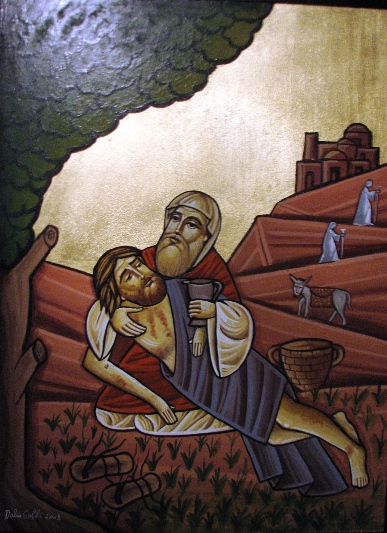
A man was going down from Jerusalem to Jericho and fell into the hands of robbers, who stripped him, beat him, and went away, leaving him half dead.

From the safety of the secretary’s office we peered through the blinds and assessed the situation. All the way in the furthest spot away from the building, the one closest to the main road, was a young woman on her back, wearing nothing but a bikini, and she wasn’t moving.

The secretary promptly elbowed me in the ribs, “You’re a pastor, aren’t you supposed to do something?”

“Of course I’m supposed to do something.” I said as I waited for someone else driving by the church to do something.

Now by chance a priest was going down the road; and when he saw him, he passed by on the other side. So likewise a Levite, when he came to the place and saw him, passed by on the other side. But a Samaritan while traveling came near him; and when he saw him, he was moved with pity. 

I felt pitiful as I reluctantly made my way across the parking lot, unsure of what was about to happen. Car after car came flying down the road while the woman was curled up on the asphalt, and not one of them slowed down to see the scandalous scene. 

As I got closer I thought about picking up a stick, in order to poke her to make sure she was still of this world, but then she slowly rolled over on to her side and looked me right in the eye. She smelled like the basement of a fraternity house, the little clothing she had on had tiny little rips and tears in it, and she looked utterly perplexed.

For a time neither of us spoke, and then I remembered my vocation so I said, “Can I help you?”

“Honey, I could use a ride,” she said with a hiccup and a twinkle in her eye.

I slowly offered her my hand, and as I picked her up from the ground she said, “You’re wondering how I got here. Well, so am I. The last thing I remember is being at the park for the 4th of July, partying, having a lot to drink, and then I woke up in someone’s yard over there. I tried to walk home, but I lost my phone, my wallet, and I think I’m still drunk, so I decided to take a nap here in this nice parking spot.”

“Okay” I said, “I’ll drive you home.”

The Samaritan went to him and bandaged his wounds, having poured oil and wine on them. Then he put him on his own animal, brought him to an inn, and took care of him. 

We wobbled across the lot arm in arm and I could feel the eyeballs of everyone in their cars silently judging me as they drove by. It took an inordinate amount of time to make it from her napping location to my car, and we had to stop no less than three times for fear that she was going to empty out what she had put in the night before.

Eventually, I struggled to get her buckled safely in and asked if she would be able to guide me to her house. To which she replied, “You should have been there last night! The lights and colors were just like illuminating.”

So I asked again, and she responded by pointing with her index finger toward the main road.

“Wonderful,” I thought, “directions by charades.”

We reversed out of the parking lot and I followed her finger across town. 

At one point, as we neared the top of a hill, she slowly raised her hands up above her head and shouted, “Woooooo I love this part of the ride!”

When we passed by the police station, she sank as deep as possible into the seat until her feet were up on the dashboard and she let forth a burp that smelled of stale beer, hotdogs, and regret.

We had a time finding her house as we went up and down streets which she either could not read or remember. But eventually, we pulled up in front of a nondescript house and she let out a sigh of acceptance.

The next day he took out two denarii, gave them to the innkeeper, and said, “Take care of him; and when I come back, I will repay you what more you spend.” 

We sat in the car in uncomfortable silence while she looked out the window at her future with a strange and detached look on her face.

“So, are you a pastor or something?”

“That’s what they call me on Sundays.”

“Do you do this kind of stuff a lot?”

“Honestly, not enough. What about you?”

“All the time.”

And with that she opened up the door and fell out of my car. She promptly picked herself up and staggered across the lawn and up to the front door all the while whistling a strange rendition of the Star Spangled Banner.

She made it to the front door, and patted down on her non-existent pockets for her keys that she didn’t have, and began banging on the door until someone let her in. 

And then I drove back to church.

For the rest of the day I felt pretty good about myself. I had been the Good Samaritan. I only later realized that I never even bothered to ask for her name. 

Which of these three, do you think, was a neighbor to the man who fell into the hands of the robbers” He said, “The one who showed him mercy.” Jesus said to him, “Go and do likewise.”

Jesus ends his parabolic encounter with this great question, “Which of these three, do you think, was a neighbor to the man who fell into the hands of the robbers?”

And immediately we know how this story is supposed to work. The Samaritan is the good neighbor, and we are supposed to be the good neighbor to our neighbors. But, who really wants to be like that?

The Samaritan is not a very good example, at least he’s one that we should be careful of imitation. He’s a fool! He wastes his good money on a no good stranger in a ditch, gives him his own ride, and then has the gall to put him up in a swanky hotel without receiving anything in return. 

Moreover, Samaritans are outcasts. He is a loser who comes to deal with another loser. His actions are crazy and reprehensible. He lays down whatever his life might’ve been for someone he doesn’t even know, simply because he, as an outcast, has found solidarity with another in the dump that life has offered him.

The loser has found his truest neighbor, another loser.

Which, incidentally, is what the whole gospel is about – Jesus came to save a lost and losing world, by becoming lost and defeated. But in this world of ours, populated by losers, all of us are hopelessly committed to a version of the world that is obsessed with winning, by being the best, by looking out for ourselves.

It would be funny if it wasn’t so tragic. But it is tragic, because grace works only in the midst of being able to recognize how badly we need it.

Or, to put it another way, if Jesus wanted to be a better motivational speaker he would’ve ended the parable thusly: Don’t be like the Samaritan; it will ruin your life. You will become a mockery among your friends, you will be a loser.

But Jesus isn’t a motivational speaker, he is the Lord.

Which brings us back to the question posed at the end of the parable: Which person was the neighbor to the man in the ditch? But what if there’s a better question… and what if that better question is this: Which person in the story is Jesus?

The central figure, contrary to just about every version of this story ever told, or ever preached, is not the Good Samaritan. The Good Samaritan is simply one of three people who actually figures out what it means to be a properly good neighbor.

Jesus in the story, the one who demands all of our focus and attention, the one to whom the three are either neighborly or not, is the one down in the ditch.

Jesus is free among the dead – He is the one who, again and again, is with the last, the least, the lost, the little, and the dead.

If we want the parable to tell us to imitate the Good Samaritan, which it certainly does, then that’s fine.

But if that’s all the Good Samaritan is good for, then it isn’t very good.

Or, as Robert Farrar Capon so wonderfully put it: “The parables are true only because they are like what God is like, not because they are models for us to copy. It is simply a fact that the one thing we dare not under any circumstance imitate is the only thing that can save us.”

Jesus is the one down in the ditch. Jesus, the Lord of lords, has condescended himself to our miserable existence and can be found in the place of our own ditch-ness and suffering.

This story is but another resounding reminder that we don’t have to go looking for Jesus, or even that we have to be like the Good Samaritan to earn Jesus.

It’s that Jesus was willing to do for us what we could not, and would not, do for ourselves or our neighbors.

Jesus has moved in next door knowing that we, his neighbors, are a bunch of losers.

And that’s Good News. 

The Necessity of Judgment

This week on the Strangely Warmed podcast I speak with Matt Benton about the readings for the 5th Sunday After Pentecost [C] (Amos 7.7-17, Psalm 82, Colossians 1.1-14, Luke 10.25-37). Matt is the pastor of Bethel UMC in Woodbridge, VA. Our conversation covers a range of topics including professional segues, We Own This City, low anthropology, the parable of the plumb line, false modesty, wickedness, comfort, grace, worthy living, holy friendships, and promises. If you would like to listen to the episode or subscribe to the podcast you can do so here: The Necessity of Judgment

Consequence Culture

This week on the Strangely Warmed podcast I speak with Matt Benton about the readings for the 4th Sunday After Pentecost [C] (2 Kings 5.1-14, Psalm 30, Galatians 6.1-16, Luke 10.1-11, 16-20). Matt is the pastor of Bethel UMC in Woodbridge, VA. Our conversation covers a range of topics including subtitles, Andy Root, sacramental theology, unnamed characters, healing, airplane confessions, inadequate prayers, poetry and prose, American Beauty, weddings, karma, James Joyce, boasting, ordination, and leadership. If you would like to listen to the episode or subscribe to the podcast you can do so here: Consequence Culture

The Freedom Of The Christian

This week on the Strangely Warmed podcast I speak with Kenneth Tanner about the readings for the 3rd Sunday After Pentecost [C] (2 Kings 2.1-2, 6-14, Psalm 77.1-2, 11-20, Galatians 5.1, 13-25, Luke 9.51-62). Ken is the pastor of Holy Redeemer in Rochester, Michigan. Our conversation covers a range of topics including the location of the Lord, mantle-passing, lament, the divine reality, Herbert McCabe, freedom, the fruit of the Spirit, Gilmore Girls, hellfire, and the seriousness of the Gospel. If you would like to listen to the episode or subscribe to the podcast you can do so here: The Freedom Of The Christian

What Are You Doing Here?

This week on the Strangely Warmed podcast I speak with Jason Micheli about the readings for the 2nd Sunday After Pentecost [C] (1 Kings 19.1-15a, Psalm 42 & Psalm 43, Galatians 3.23-29, Luke 8.26-39). Jason is the lead pastor of Annandale UMC in Annandale, VA. Our conversation covers a range of topics including proper introductions, For All Mankind, Gary Oldman, hipsterdom, Mt. Horeb, melancholia, Mockingbird, silence, journeys, perfect prayers, Martin Luther, the tonic of grace, living among the dead, and freedom. If you would like to listen to the episode or subscribe to the podcast you can do so here: What Are You Doing Here?