Devotional – Job 19.23-25

Devotional:

Job 19.23-25

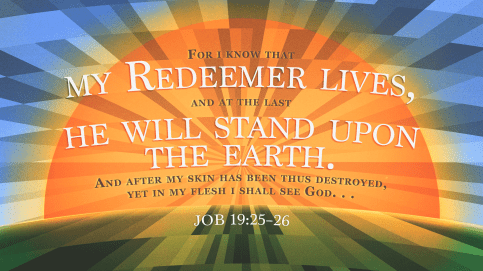
O that my words were written down! O that they were inscribed in a book! O that with an iron pen and with lead they were engraved on a rock forever! For I know that my Redeemer lives, and that at the last he will stand upon the earth.

Weekly Devotional Image

Last Thursday, while my wife, son, and I were visiting family in Alexandria, I received a phone call about one of St. John’s long-time members having died. Ruth Cassidy joined the church weeks after it formally began back in 1954 and while it was still meeting in a basement down the road. Ruth was easily one of the kindest people I ever had the chance to spend time with, and she will be greatly missed by our church community, and by her family.

A couple years ago I received a phone call about Ruth’s husband Howard, and it was clear that he was close to the end of his life. And so, I made my way over to their retirement home and when I walked into the room Ruth was sitting next to her husband, she was lovingly holding his hand in hers, and he had just taken his final breath. I, not wanting to intrude on the holiness of the moment, slowly started to back away but Ruth insisted on me sitting down with her on the couch. She immediately started asking me questions about my family and St. John’s and I was still in a state of shock; I was overwhelmed by the totality of the moment, and the fact that Howard had literally just died. Ruth continued to ask me questions, but I wanted to acknowledge what had just happened. It took a couple minutes, but I finally mustered the courage to ask: “Ruth, are you okay? I mean, Howard just died…”

She looked right into my eyes, smiled, and said, “Oh, everything is fine; I know where he really is.”

Rarely have I encountered such faith, such hope, and such love as what I regularly experienced through Ruth Cassidy. Like the biblical character of Job, she had an assurance about the way things really are. In that holy and profound moment immediately after her husband died, I could almost hear the words of scripture floating in the room with us: “I know that my Redeemer lives, and that at the last he will stand upon the earth.”

job-19-25-26

Ruth’s assurance, her blessed assurance, was one worthy of our emulation.

Do you know that your Redeemer lives? What words or thoughts would you want to engrave on a rock forever? Can you feel the Holy Spirit moving and breathing into your life? Are you filled with an assurance about who you are and whose you are?

O that my words were written down and engraved forever! I know that my Redeemer lives! And that at the last he will stand upon the earth!

Devotional – Ezekiel 27.1-2

Devotional:

Ezekiel 37.1-2

The hand of the Lord came upon me, and he brought me out by the spirit of the Lord and set me down in the middle of the valley; it was full of bones. He led me all around them; there were very many lying in the valley, and they were very dry.

Weekly Devotional Image

I love challenging couples to pick their own wedding scripture beyond the cliché of 1 Corinthians 13 (Love is patient, love is kind…). In between premarital counseling sessions, I ask them to dive deep into their bibles in order to final a passage or a verse that really speaks to them, and I have been deeply impressed with the scriptures they’ve picked. I’ve been blessed to bring couples together into holy marriage with the stories of David being anointed by Samuel, Paul’s description of what it means to be a Christian, a prayer to the church in Ephesus, and more.

The scripture passage a couple chooses for their wedding says a lot about what their relationship is like, and what their marriage will be like.

Years ago, two of my friends from Durham were married at a local Presbyterian church that was known for the preaching of the pastor. To start the wedding homily, the pastor described the sanctity of marriage and what it means for two individuals to make this covenant, but then he began shaking his head and said, “You know that these two standing before us are devoutly faithful, because when I asked them to choose their wedding scripture, they picked the valley of the dry bones from Ezekiel.”

1509747_10155231246960627_1383507341785953622_n

I can remember sitting with my back against the pew and wondering what in the world he was going to do with the text. The valley of the dry bones is a remarkably beautiful passage, but it doesn’t naturally lend itself to a wedding sermon.

So the pastor continued on with bits of wisdom and advice, he shared stories about successful marriages and what to emulate as well as terrible marriages and what to avoid. But for the better part of ten minutes, he completely avoided the Ezekiel passage. And then, out of nowhere, the Spirit start blowing and he said, “James and Jennifer, I think you two can have a good marriage, but if you think that you can do it without the help of your friends, family, and the Lord, it will never be more than a dry valley filled with old bones. Only your friends, family, and the Lord can breathe the Spirit back into those bones and give them life.”

It was a simple sermonic twist, but it’s one that I think everyone it attendance will never forget.

What does your life look like? Is it filled with vibrancy and energy? Do you feel the Spirit moving in your midst? Or is your life like a deep valley filled with dry bones?

Thanks be to God who calls us into relationship with the Spirit, with our friends, and with our families who can breathe life into the dry bones of our lives.

Devotional – Luke 19.1-2

Devotional:

Luke 19.1-2

He entered Jericho and was passing through it. A man was there named Zacchaeus; he was a chief tax collector and was rich.
Weekly Devotional Image

In a few weeks many churches will celebrate All Saints Sunday. In the United Methodist Church we use it as an opportunity to prayerfully give thanks and reflect on the lives lost in the local church over the last year. Some churches will ring bells and read off the names of the dead, others will cover their altars with belongings from the deceased, and others will invite grieving family members to come forward and offer thoughts on those who died.

But when we think of the Saints of the church, we tend to think about incredible figures from church history: Augustine, Francis of Assisi, Mother Teresa, etc. We think that to be saintly requires a life of such profound faithfulness that most of us will never come close to it. Therefore, the saints we daydream about are the ones also found in stained glass windows and famous paintings.

Saints, however, are the people who inspire us to be totally different. And more often than not, the truest saints are those who were once a lot like us, and were radically changed by an encounter with the living God.

zacchaeus-1

Zaccheaus is a beloved and often overlooked person from scripture. The wee-little tax collector, despised by the town, wanted to catch a glimpse of Jesus, so he climbed a tree. Jesus, upon seeing the man up above, called him down and invited himself over for dinner. This interaction fundamentally transformed Zacchaeus’ life and propelled him to return what he had taken “even four times as much.”

Some of God’s truest and most peculiar saints are much more like the little tax collector who recognized his weakness enough to climb a tree to catch a glimpse of the Messiah. Zacchaeus was a strange man and his interaction with Jesus was equally strange. The result of sitting together for a meal was enough to radically transform his life forever. But even in his strangeness, we catch glimpses of the truth; we begin our journeys of faith by recognizing our need, but doing something in response to that recognition, and then discover that the love and power of Jesus has transformed our lives in ways that we never could have anticipated.

Zacchaeus is the kind of saint who could inspire us to change our lives precisely because he is so much like us. If we were only inclined to confront our brokenness, climb a tree to catch a glimpse of the Lord (or walk into a church on Sunday morning), we might just hear Jesus say, “I’m going to your house today,” and our lives would be transformed.

On Suicide

Isaiah 43.1-2

But now thus says the Lord, he who created you, O Jacob, he who formed you, O Israel: Do not fear, for I have redeemed you; I have called you by name, you are mine. When you pass through the waters, I will be with you; and through the rivers, they shall not overwhelm you; when you walk through fire you shall not be burned, and the flame shall not consume you.

Romans 8.35-39

Who will separate us from the love of Christ? Will hardship, or distress, or persecution, or famine, or nakedness, or peril, or sword? As it is written, “For your sake we are being killed all day long; we are accounted as sheep to be slaughtered.” No, in all these things we are more than conquerors through him who loved us. For I am convinced that neither death, nor life, nor angels, nor rulers, nor things present, nor things to come, nor powers, nor height, nor depth, nor anything else in all creation, will be able to separate us from the love of God in Christ Jesus our Lord.

suicide


It was 2003 and I was a freshman in High School. And like most High School freshman, I spent many an evening on my computer typing to my friends on Instant Messenger. This was long before Facebook’s wild popularity, Twitter’s terse communication style was far away from coming into reality, and none of us even had cameras on our cell phones. But night after night we would sit in front of our computer screens typing away about what we thought were the most important things in the entire world.

One night in the spring, I waited for my parents to go to bed and then I snuck downstairs to get back on the computer. Most of the conversations were frivolous and limited by the speed at which our fingers could move over the keyboard. I can’t remember what the topic was that evening, but I do remember a new box appearing on the screen that changed everything.

At the time, my best friend was dating a girl and things were less than perfect. They fought about all kinds of stupid things and were the epitome of every high school relationship cliché. She, the girlfriend, was the one who sent me a message that night. All it said was, “We got in a really bad fight, he told me he was going to kill himself, and I don’t know what to do.

Suicide is ugly. It leaves families and friends reeling in whiplash, it creates guilt and unanswered questions, and it produces feelings of morbidity and fear.

Suicide is controversial in the church for a number of reasons. Many churches and Christians believe that suicide is ultimately sinful and worthy of eternal damnation. To have suicidal thoughts is to not have enough faith. Some pastors will even refuse to preside over funerals for those who have committed suicide.

If you look through the entirety of scripture, both Old and New Testaments, you will not find a passage that condemns suicide. None of the prophets, or priests, or kings have anything to say about suicide or what happens to those who commit suicide. However, Augustine (an important theologian from the early church) read the commandment “thou shall not kill” as a prohibition against suicide. And from Augustine’s reflection on the topic, suicide became the black sheep of sins in the church.

For a thousand years, suicide was a mortal sin and an affront against God’s goodness. Those who committed suicide were treated as criminals and refused Christian burials. By the 1500s those who attempted suicide were excommunicated by the church and were punished by the civil authorities.

And still today, suicide carries an awful stigma in the realm of the church and is one that is either referred to with eternal damnation or complete silence.

            That silence, the utter and complete darkness of a topic that is remarkably relevant for our time and reflection, is a controversy worth confronting.

According to the Center for Disease Control (CDC), on average, one person dies by suicide in the state of Virginia every 8 hours. It is the 11th leading cause of death in our state, and it is the 2nd leading cause of death for people ages 10-34.

Among high school students across the country, 17% seriously considered suicide in the last 12 months. And 8% attempted suicide one or more times in the last year.

If you’re like me, you tend to think about young people being the most susceptible to suicide attempts, but suicide rates are actually highest among people middle aged and older, by a lot. In fact, middle aged and older adults are nearly twice as likely to commit suicide as young people.

And right now, suicide has surged to its highest levels in thirty years.

yqecn1ygjymjb3igsiev

When I received that message on my computer back at the beginning of high school, I grabbed my things and was out the door before I even had a chance to really think about what I was doing. All I knew was that my friend would not just make an empty threat about suicide like that, and I had to do something about it. So I grabbed my bicycle out of the garage and I started riding as fast as I possibly could in the middle of the night. He lived a couple miles away and when I screeched into his driveway I was drenched in sweat.

I dumped the bike right there and I ran to the front door and started banging with my fist and I started yelling. Within a minute his parents were coming down the stairs in their pajamas with tired and angry looks on their faces. When they opened the door and saw me standing and sweating in the dark they were utterly bewildered and then I told them why I was there.

We immediately went to check on him in his bedroom, but he wasn’t there. We searched the house from top to bottom and we finally found him in the basement. He was sitting on the couch with tears in his eyes and he had just swallowed an entire bottle of ibuprofen.

They wound up taking him to the hospital and had his stomach pumped. They sat there and held their son while he cried and cried. And they saved his life.

Suicide is not the way any human life should end. The church, this church, has an obligation to see that all persons are grafted into a community of love and are cared for in the midst of isolation, depression, and despair.

Life is a gift, plain and simple. It is a gift from God and therefore we are called to be good stewards of this gift: our lives and the lives of others.

We cannot ignore this topic as if it has nothing to do with us. The statistics confront us with a stark reality about the prevalence of suicide in our culture. With the advent of the Internet and instant communication, young people are being bullied and attacked at a degree that few of us can even fathom. With an economy that moves up and down like a roller coaster, people in the middle of life are undergoing identity crises and are wondering how they can provide for their families. Older people who receive a grim diagnosis or the loss of a spouse struggle to justify living with such a horrible outlook for the days ahead.

We know that we are supposed to be present for and with one another, like being there for friends and family at a moment of tragedy. We rarely know what to say on such occasions, but we know we should be there. We, above all things, are called to be present for others in the midst of suffering and loneliness and depression that often lead to the contemplation of suicide. To be part of the faithful community requires us to be for one another.

i_m_fine_by_black_avenger-d60mqnl

We live because life is a gift. We are not our own creators. We Christians are the people who must learn to live by the fact that life is a gift. We therefore can live each and every day not as a survival technique, but through recognizing that each and every day is an opportunity to live and love in the service of our Lord.

When we talk about suicide, we say it is “the taking of one’s life.” But even the way we talk about suicide shows how much a problem we have with it. Our lives are not our own. As the Lord says through the Prophet Isaiah: “Do not fear, for I have redeemed you; I have called you by name and you are mine.” We belong to the Lord and to one another. God tells us to not be afraid because God will be with us as we pass through the waters, and the rivers of life shall not overwhelm us, we shall not be burned by the fires of frustration. Not because they won’t hurt or be terrifying, but because we belong to the Lord and the Lord is with us.

If we’re here in the sanctuary this morning, we have some sense of this in our lives. We know that God is with us, we feel God’s presence in this place and we know that we are not alone. It is through encountering the divine love of God in worship that we are given the strength to be God’s presence for others who sink under the waters of life and who feel burned by the world. It is our charge to be shaped and called by God’s love and to reach out to those who contemplate ending their days. We have the challenge of showing all people, even those who see no value to their lives, how our lives are not defined by what we have done with them, but by what God will do with them.

Six months after my friend had his stomach pumped, he attempted to commit suicide again. This time he did it with a hose running from his exhaust pipe into his car. But his little brother heard the car door close and it woke him up, and then he woke up his parents. In the strange and quiet time of the darkness of night they pulled their son out of the car and they got him help. It took a long time for him to move on. It took counselors and therapists, it took friends and family, it took the power of God’s grace to show him that his life could get better, that there was hope for the future, that there was something worth living for. And because people in his life were brave enough to confront his suicide attempts, he still lives today.

But there will always be some that we cannot reach. There will be people who feel so suffocated by the weight of the world that they will make that dreadful decision to end the life that God’s has given to them. And for them, for those who will die by their own hand, what will happen to them? For centuries the church saw suicide as an unpardonable sin, something that eternally damns those who do it. Will God abandon them for making such a choice? Will God refuse to love the people who felt no love in their lives? Will the God of mercy punish them until the end of time?

           No. In all these things we are more than conquerors through him who loved us. For I am convinced that neither death, nor life, nor angels, nor rulers, nor things present, nor things to come, nor powers, nor height, nor depth, nor anything else in all creation, will be able to separate us from the love of God in Christ Jesus our Lord. Amen.


 

Controversy Original

Devotional – Hebrews 12.1-2

Devotional:

Hebrews 12.1-2

Therefore, since we are surrounded by so great a cloud of witnesses, let us also lay aside every weight and the sin that clings so closely, and let us run with perseverance the race that is set before us, looking to Jesus the pioneer and perfecter of our faith, who for the sake of the joy that was set before him endured the cross, disregarding its shame, and has taken his seat at the right hand of the throne of God.

Weekly Devotional Image             On Saturday afternoon, by God’s will, we will gather on the front lawn of St. John’s UMC with a cohort from the community. Our third Annual Community Cook-Out will be filled with familiar and strange faces, we will have more food than we’ll know what to do with, we’ll have children jumping on bouncy houses, and we’ll even have a dunk tank set up (I’ll be the first to be knocked in!). For years and years this church has stood in the middle of the community, but for too long it has been disconnected from the lives of the people in the immediate neighborhood. Therefore, the Cook-Out is our opportunity to share Christ’s love with those who surround us.

During the last two Cook-Outs it has been a joy to see strangers becoming friends through a shared meal and fellowship, but there is always the temptation to stay where we feel comfortable and only talk to the people we know. The Cook-Out is by no means an attempt to “evangelize the neighborhood” and get everyone saved. But if we are not willing to follow the example of Christ by reaching out to strangers, then the church is failing to be the body of Christ for the world.

IMG_1642

St. John’s exists and thrives because of the great cloud of witnesses that brought us to where we are. We owe a great deal to the saints who have come before us, the ones who first invited us to discover God’s love in a place like this, and now the time has come for us to follow them on the path to Christlikeness. For it is when we humble ourselves, when we disregard the shame of embarrassment, we join together with the one who never knew a stranger, the one who came to change the world, the one who has taken his seat at the right hand of the throne of God.

To follow Jesus on the way that leads to life requires us to actually act like him here and now. It means crucifying our selfish ways and opinions so that we might encounter the other without pretense. It means laying aside every weight that prevents us from sharing the Good News. It means running the race with perseverance so that we might bless others in the same ways we that we have been blessed.

Offensive Grace

Luke 15.11-32

Then Jesus said, “There was a man who had two sons. The younger of them said to his father, ‘Father, give me the share of the property that will belong to me.’ So he divided his property between them. A few days later the younger son gathered all he had and traveled to a distant country, and there he squandered his property is dissolute living. When he had spent everything, a severe famine took place throughout that country, and he began to be in need. So he went and hired himself out to one of the citizens of that country, who sent him to his fields to feed the pigs. He would gladly have filled himself with the pods that the pigs were eating; and no one gave him anything. But when he came to himself he said, “How many of my father’s hired hands have bread enough and to spare, but here I am dying of hunger! I will get up and go to my father, and I will say to him, “Father, I have sinned against heaven and before you; I am no longer worthy to be called your son; treat me like one of your hired hands.”’ So he set off and went to his father. But while he was still far off, his father saw him and was filled with compassion; he ran and put his arms around him and kissed him. Then the son said to him, ‘Father, I have sinned against heaven and before you; I am no longer worthy to be called your son.’ But the father said to his slaves, ‘Quickly, bring out a robe – the best one – and put it on him; put a ring on his finger and sandals on his feet. And get the fatted calf and kill it, and let us eat and celebrate; for this son of mine was dead and is alive again; he was lost and is found!’ And they began to celebrate. Now his elder son was in the field; and when he came and approached the house, he heard music and dancing. He called one of the slaves and asked what was going on. He replied, ‘Your brother has come, and your father has killed the fatted calf, because he has got him back safe and sound.’ Then he became angry and refused to go in. His father came out and began to plead with him. But he answered his father, ‘Listen! For all these years I have been working like a slave for you, and I have never disobeyed your command; yet you have never given me even a young goat so that I might celebrate with my friends. But when this son of yours came back, who has devoured your property with prostitutes, you killed the fatted calf for him!’ Then the father said to him, ‘Son, you are always with me, and all that is mine is yours. But we had to celebrate and rejoice, because this brother of yours was dead and has come to life; he was lost and has been found.’”

Prodigal-Widescreen

Today marks the third part of our July Sermon Series on The Power of the Parables. A favorite rhetorical device of Jesus’, a parable is a story that illustrates a lesson or principle usually without explanation. They are simple and life-sized with familiar characters and they are supposed to drive us crazy.

Over the centuries the parables have become so watered down through the church that they no longer carry the same weight and punch that they once did. The familiar parables are beloved to us, The Feast, The Mustard Seed, The Prodigal Son, The Good Samaritan, but during the time of Jesus they were frustrating and confusing. During this month we are attempting to recover this sense of strangeness and re-encounter the power of the parables.

parables

There was a man in Staunton who had two sons. For years the family enjoyed the small town feel of the community, rejoiced in running into friends at grocery stores and the park, and celebrated the goodness of God in church every Sunday. They were always the family that every other family envied; whenever they were seen in town the sons were so well behaved, the husband and wife were always holding hands, and everything looked perfect.

   But within the safety of their home, far removed from public few, things were not as they seemed.

The father loved his sons, but he could tell that the younger resented him for being raised in a town such as this. The father knew his younger son enough to know that whenever he harshly reacted to a comment at the dinner table, or stormed out of the house, it was out of a desire to depart and start over somewhere else. But he remained patient with his son and always tried to love him the only way he knew how.

One day, while the father was sitting in his study, the younger son walked in with his fists clenched tightly by his side. The father listened as the son listed off his chief complaints and demanded his inheritance early. As the frustrations percolated, and the son kept talking about how suffocated he felt, the father was already pulling out the checkbook and signing his name. He said, “Son, I love you and I’ve known this day was coming for a long time. Just remember that you will always be welcome here.” And with that the son grabbed the check from his father’s fingers and walked out of the house, and out of his father’s life.

For a long time the father heard nothing from or about his younger son. Life continued as usual in Staunton: babies were born, older folks went on to their heavenly reward, time passed, and the father kept living his life. Little by little news would seep into dinnertime conversations from the mother or the older son about the one who was missing. Rumor had it that he had set up in Richmond and was spending money left and right on all sorts of things, including some that could not be mentioned out loud. But the father gave it no thought. The money was his son’s to do with as he pleased.

But as time passed, the rumors became fact, and the father knew his son was in trouble. The money had run out and he was working odd jobs to get by. The mother no longer even had an address to send him letters because he was either moving from house to house or living on the streets.

The days became weeks, the weeks became months, and the father eventually heard nothing about his younger son. No letters arrived in the mail, no text messages were sent, and the son even stopped updating his Facebook account. As far as the father knew, his son was gone.

And then it came to pass one afternoon, while sitting in the same study where he had given the son his inheritance, the father glanced out the window and saw a figure walking up the road. From his vantage point the father thought it might be his son, but the person was too frail, and slumped over with what looked like shame. But sure enough, the closer he came to the house, the more it looked like his son. Before he knew it the father was running out the front door and he tackled his son to the ground on the front yard. He simply could not contain himself and he began covering his younger son with kisses and the tears were flowing out his eyes.

Only then did the father hear his son say, “Dad, I’m so sorry, and I am no longer worthy to be called you son.

But the father wasn’t listening. Instead he was yelling up to the house describing preparations for the party he was about to throw. Go to the grocery store. Invite all the neighbors. Get the music ready. We are going to party tonight!

Hours later in the midst of a rather crazy party the father noticed the older son standing in the corner with what looked like an angry expression on his face. The father was filled with such merriment on the return of his one son that he walked over to the other with a smile on his face and asked what was the matter.

The father listened as his older son started listing off the complaints. But it was what he said at the end that hit him the hardest, “Dad, I’m glad that he’s home just as you are. But did you really have to throw this party? I’ve been living with you all this time while he was gone wasting his life away and you never even let me invite my friends over and now look at all this!”

And the father put his arm around the older son and said, “I love you and all that is mine is yours. But we had to party tonight because this brother of yours was dead and has come to life; he was lost and has been found!”

00033230_h

We call this the parable of the Prodigal Son. It is easily the most familiar of all of Jesus’ parables, and has been embraced by faithful and secular alike for its powerful message. We like the idea of a reconciled relationship and we sigh in affirmation whenever we hear about the wayward son returning home. But, as the church has so embraced the clichés of the story, we’ve missed out on the offensive grace that it dramatically conveys.

We call it the parable of the Prodigal Son, but we should probably call it the Parable of the Loving Father. The father is the main character of the parable and the one that Jesus identifies with. He tells this parable in response to an attack against his character for eating with sinners. He, Jesus, is the one who welcomes everyone to the table in celebration regardless of circumstances. And for as much as we enjoy hearing this story, we should really be offended by it.

The older brother has every right to be angry. I would be if one of my siblings ran off and my father treated them the way the one does in the parable. It’s fine to welcome a wayward child home. Sure, give him some clothes and some food. Let him rest at home until he can get back on his feet. But it is simply bad parenting to throw a party in the wake of so many mistakes. For years we have emphasized the moment where the prodigal son “came to himself” and we have identified with a particular moment in our lives when we turned back. But in so doing we have neglected to confront the utter strangeness and offensiveness of the father’s love.

Reading and imagining the story from the father’s perspective frustrates our understanding of justice, fairness, and grace. We want people to be punished for their mistakes, we want them to grovel when they’ve wronged us, we want payment for our suffering.

We don’t want to welcome the prodigal home. We want to be rid of the people who drive us crazy. We don’t want to waste our time on someone who might disappear again. We want to honor the good people who have been with us. We don’t want parties for sinners. We want celebrations for saints.

And then Jesus tells this story about the Loving Father and everything gets flipped upside down.

The power of this parable is not the good and warm and fuzzy feelings we have when we hear it, but in God’s love being so strong that it can offend us. God’s forgiveness and mercy is so powerful that it is beyond our ability to understand. God truly loves the unlovable, forgives the unforgivable, and welcomes us whenever we stray away.

God’s love is weird. And we would do well to remember that. Not to belittle God’s love into a line on a Hallmark card, but to be offended by how God could love the people we hate. Not to limit God’s love to the people in the pews next to us, but get angry that God even loves the people who sleep in on Sunday mornings. Not to assume that God only loves Christians, but to be offended by the truth: For God so loved the world that he gave his only begotten Son.

The parable of the Loving Father will forever frustrate and offend our sensibilities precisely because God’s grace is offered to all, and all really means all.


Responding:

We are going to try something a little weird. I want us to take a moment to think about someone that absolutely drives us crazy. It might be a neighbor who is forever frustrating our understanding of decency. Or maybe it is someone in our family that always takes everything too far. Or maybe it is one of the candidates running for president this year. Just think of someone who you can’t stand. Picture them in your mind. And then I want you to think about them walking into our sanctuary right now and pummeling them with loves and kisses. I want you to imagine grabbing them by the hand and dancing around the sanctuary in the midst of the greatest party you’ve ever attended.

Because in a moment we are going to put on some music, and we are going to dance like we’ve never danced before. We are going to break out of our pews and boogey up and down the church. And it is going to be weird and uncomfortable, it is going to upend our ideas of what church should be like, because sometimes God’s grace should be offensive.

Devotional – Galatians 6.2

Devotional:

Galatians 6.2

Bear one another’s burdens, and in this way you will fulfill the law of Christ.

Weekly Devotional Image

One of my friends has incurable cancer. He’s in his 30’s, married, has two kids, serves as a pastor, and his cancer will never go away. When he shared the news of his diagnosis, I was speechless; as far as I could tell he was in perfect health and it felt like I was smacked in the face. And then I did something that I’m ashamed of: I avoided him.

The days became weeks, and the weeks became months, and every time I picked up the phone to call him just to check in, I couldn’t muster the courage to dial the number. As a pastor, I spend time in hospitals and rehab centers almost every week with people from the church community who are suffering through cancer, or a major surgery, or depression. But when it came to Jason, I just couldn’t do it.

10471256_10202693825137758_887788040838328281_n

Maybe it was my own selfish need to believe that nothing was wrong with him; I wanted to keep the image I had of him in my head, instead of seeing his bald head and weakening body. Or perhaps his cancer hit too close to home and made me fear for my own health. Or maybe his cancer was just another frightening reminder of the fragility of life.

While I was ignoring him, my little sister was doing the opposite. When Jason needed to go for chemotherapy treatments, Laura-Paige volunteered to drive him and sit with him through the whole procedure. She told me that she never felt pressured to talk or console him, because the only thing he really needed was for someone else to be there.

Paul wrote to the church in Galatia and called for them to “bear one another’s burdens.” For by bearing the burdens of the people around us we can fulfill the law of Christ. It took me a long time to finally pick up the phone to call Jason and apologize for my lack of presence during his treatments and I still feel guilty for abandoning him in the midst of his pain. But I give thanks for my little sister and the countless others who bore his burdens during his fight against cancer.

In church we like to pretend that we’ve got everything together in our lives. So long as we can get on the right outfit, sit in the right pew, and offer the rights prayers we can appear however we want toward the people around us. The truth however, is that we are all broken and suffering through something. This week, let us take the time to reach out to just one person in our lives and start bearing their burden. Maybe we can attend an AA meeting with a friend who suffers from alcoholism, or we can sit with a neighbor going through chemotherapy, or maybe we can just ask how we can be present for someone in the midst of their life right now. And in so doing, we will fulfill the law of Christ.

Devotional – Psalm 5.1

Devotional:

Psalm 5.1

Give ear to my words, O Lord; give heed to my sighing.
Weekly Devotional Image

To breathe is to live. And yet, how often do we actually think about our breathing? Unless we’ve been sick with pneumonia, or have climbed to a high elevation, breathing in and out is something we all take for granted. All day, everyday, we take about 26,000 breaths. It happens naturally without our having to really do anything to make it happen. Yet without it, we cannot live.

A few weeks ago I was in the hospital room when my son took in his first breath. Like the rush of a mighty wind, he filled his lungs for the very first time, his skin began to change color, and the remarkable rhythm of his breathing began. I held my breath waiting for him to breathe knowing full and well how necessary it is for life. And yet, during the last 6 weeks, I have grown accustomed to his breath, and am no longer bending over to place my ear near his mouth in the middle of the night.

We all know that we cannot live without breath. Just ask anyone who has been with someone at the moment of death and they will tell you about the profound change that occurs when someone’s breathing comes to a conclusion. But in addition to breath being a necessity for life, it is also a necessity for prayer.

page_breathe

Every breath is a prayer. As the psalmist cries out, “Give ear to my words, O Lord; give heed to my sighing.” When we sigh, when we breathe, when we fill our lungs with air, we are participating in the great and cosmic birth of creation over and over again. In the beginning of scripture we learn about God breathing life into the first human and for every one of us that has ever lived since, we have received that same gift at the beginning of our lives.

If we are in a time in our lives when we do not know what to pray, if we are at a loss for words, there is comfort in knowing that every breath is a prayer. To breathe is to remember the paradox of our existence; we’ve been created in the image of God with immense beauty, power, and strength while at the same time our lives are incredibly vulnerable and fragile. Our lives hinge on our breath.

So too, our spiritual lives hinge on our breathing in and out, over and over again, remembering that every breath is a gift from God.

The Gifts of God – Grace

Philippians 1.3-11

I thank my God every time I remember you, constantly praying with joy in every one of my prayers for all of you, because of your sharing in the gospel from the first day until now. I am confident of this, that the one who began a good work among you will bring it to completion by the day of Jesus Christ. It is right for me to think this way about all of you, because you hold me in your heart, for all of you share in God’s grace with me, both in my imprisonment and in the defense and confirmation of the gospel. For God is my witness, how I long for all of you with the compassion of Christ Jesus. And this is my prayer, that your love may overflow more and more with knowledge and full insight to help you to determine what is best, so that in the day of Christ you may be pure and blameless, having produced the harvest of righteousness that comes through Jesus Christ for the glory and praise of God.

Christmas 1

From now until Christmas Eve, we will have a sermon series on the gifts of God. This is particularly fitting considering the fact that Advent is usually a time when we fret about what we will be purchasing for everyone else. However, this Advent, we will be reflecting on what God has given us. Today we continue the sermon series with God’s gift of Grace.

PowerPoint presentations were all the rage when I was in seminary. Professors would carefully craft their lectures around being able to display particular words on the screen while they talked. Some failed to use PowerPoint effectively and would just randomly throw words up on the screen without much context. But others used PowerPoint in a powerful way by displaying a piece of art and then describing how it conveys a deeper sense of faith than words alone.

In the spring semester of my first year I was in the middle of a New Testament lecture about the crucifixion when my professor began showing image after image of Jesus’ death. At the time, I was so academically invested in the words of scripture that I was treating it more like a text to be mastered rather than letting in sink into my soul.

I would go to church on Sundays but instead of listening to a sermon for my own discipleship I would think about how to change the sermon to make it more effective. I would receive communion but I would lose myself to thoughts of Eucharistic practices throughout the centuries while I chewed on the bread and juice. And I would read scripture everyday but I thought about how it applied to other people more than myself.

So there I was in the New Testament lecture and the images of Jesus’ death kept flowing across the large screen. I lost count of how many versions were displayed and at some point I stopped listening to my professor and stopped taking notes. Instead I watched my savior dying over and over again.

Some were abstract with shapes and colors conveying the cross and Christ’s body whereas others were remarkably vivid in detail with blood, cuts, and bruises. My professor continued to run through the images on the screen and let the art speak for itself. Like a merry-go-round of emotional impact, I sat in my chair observing the death of Christ until my professor stopped and said, “This is what Christ did for you.”

Overcome by the totality of the moment I jumped up from my chair and covered my tears as I walked out into the hallway. I remember breathing heavily as I tried to compose myself when my friend Wil came out of the lecture hall to check on me.

“What’s going on? Are you alright?” He asked.

I said, “I just don’t deserve it. I don’t deserve what Christ did.”

Then he looked me in the face and started to laugh. “Taylor,” he said, “That’s the whole point!”

Paul wrote his letter to the Philippians from prison. In the shackles for the crime of his faithfulness, Paul continued to embody that same discipleship in a letter to a church that he loved. The community of faith had learned about Jesus Christ, they had heard about his ways and stories, they shared bread, wine, and goods together and were living a radically different life. Their faith in the Lord God was bearing fruit in the community and Paul wrote to encourage their commitment.

This wasn’t just a “keep up the good work” note, but was a profound theological reminder of what the point of the church is supposed to be.

I thank the God of heaven and earth whenever I remember you and I pray for you constantly. I am confident that God will bring your work to completion in Jesus Christ because of your commitment to the kingdom. It is right and good for me to think this way about you, because you hold me in your heart, for all of you share in God’s grace with me.

What is God’s grace?

gracechangeseverything4-w855h425

I asked this question recently of our youth and some of our more seasoned Christians and I got a wide variety of answers: love, hope, peace, forgiveness, salvation, joy, knowledge, wisdom, food, blessing, etc. “Grace” is a buzzword in the church, one of those terms that we fling around all the time without really thinking about what it is. We say grace before we eat, we sing hymns like “Amazing Grace” and we even use it in common expressions like “there by the grace of God go I.” But what is grace?

Like my friend Wil reminding me in the hallway, Grace is love that we don’t deserve.

A few days ago I was standing on the front lawn of the church with all of our preschoolers. We were walking through the rows and rows of Christmas tree to select a few for the classrooms downstairs. Wilford Kirby generously volunteered his time to teach the children about how Christmas trees grow and how the real reason for the season isn’t the gifts under the tree but the gift of Jesus Christ for you and me. All of the kids loved it except for one, who was having a complete meltdown.

Why? I couldn’t begin to explain what was going through his mind. But for whatever reason, the moment we asked him to pick out a tree he started wailing and crying. “I don’t want a Christmas tree! NO! NO! NO!”

I tried to distract the other kids from his tears by guiding them along the trees and I could tell that the boy’s teacher was growing very tired of his outburst. Yet, while I kept an eye on her class, she went over to the boy wrapped her arms around him, and started to comfort him.

Grace is love that we don’t deserve.

Yesterday afternoon many of us gathered to remember the life of Dave Fitzgerald, a long time member of this church. We sat in our grief regarding the life that was lost, but we also faithfully proclaimed the promise of the resurrection. We got out the hymnal with our tissues and we praised God for sharing Dave’s life with us.

During the funeral I told a story about Dave that completely reshaped my understanding of the church. When I arrived at this church, Dave and his wife Pat were some of the first people I had a chance to visit outside of these walls. I hadn’t been here more than a month before I was sitting in their living room and learning about this church and all of you. They shared about why the church was important to their lives and how they had, hopefully, passed that feeling to their sons. I learned about how Dave used to butcher meat and stuff sausages in the back parking lot much to the chagrin of some older church members. And then I started to hear about all the drama from the past.

Every church has drama, arguments, and fights. After all, churches are filled with broken people like you and me. So Dave described this seemingly epic event from the past and how it made him so angry with the church and with the people in it. One man in particular. Who and why are not important. Frankly it could have been anyone about anything. But after he had finally got all of the frustration out, he said, “But just because I didn’t agree with him, it doesn’t mean that I couldn’t love him.”

Grace is love that we don’t deserve.

Gods-grace

I am fortunate to know most of you and your stories. I have been invited into your homes and precious moments. I have learned your stories, and what makes you smile. You all are good people. But if you’re anything like me, you don’t deserve God’s love. You make the wrong choice when you know what you’re really supposed to do. You turn your head away from the public arguments and bullying that you know you could stop. You hear about the problems going on in the world and though you feel bad about it, you don’t have enough energy to do anything about it.

We are so broken people, us Christians. Frankly, that’s what church is all about. This place is not supposed to be a museum of saints. It is a hospital for sinners. We fail to be obedient to the words we hear in church and read in scripture. We love the tunes of the hymns but we forget to live according to them from Monday to Saturday. And we are content to leave our discipleship in this room.

And guess what? God still loves us even through we don’t deserve it!

Can you think of anything more radical that our God could possibly do? I believe in the profound power of the resurrection from the dead, but I am still astonished by the fact that God loves me even though I don’t deserve it.

Like a prodigal son who squandered his inheritance, God will always welcome us home.

Like a crying preschooler on the front lawn, God will always surround us with love.

Like a frustrated parishioner, God will always love us even if God doesn’t agree with us.

Grace is love that we don’t deserve. Grace is a gift.

This table embodies God’s overwhelming grace. There are plenty of people in our lives that, if we did something bad enough, they would never welcome us back. Walls will be built up between us and few bridges would ever get us back. Yet God, no matter who we are or what we’ve done, always invites us to the table and to the kingdom. God’s love is so profound that even when we are at our worst, God will be here with open arms.

God’s grace is a gift. Grace is the love of God made manifest in the life of Jesus Christ who gave his life for the world. Grace is the love of God made real in a baby born in a manger to a young woman in the middle of Bethlehem. Grace is the bread and cup at this table offered to you no matter what.

Grace is love that we don’t deserve. Amen.

Devotional – Revelation 1.8

Devotional:

Revelation 1.8

“I am the Alpha and the Omega,” says the Lord God, who is and who was and who is to come, the Almighty.

Weekly Devotional Image

Services of Death and Resurrection are sacred moments in the life of the church. For a brief time we gather together in our grief, we praise God for the life of a friend or family member, and then we proclaim the hope of the resurrection. Dozens of people will fill the pews, some of who have not entered a church in years, and sing those beautiful hymns like “In the Garden” and “Blessed Assurance.”

As a pastor, it is a humbling thing to be tasked with leading the services and preaching a faithful word about God’s love and the life of the dead. I try to find the right stories and scriptures that shed light on the individual and pray for God to speak through my words so that they resonate with God’s Word. I try to lead the service in such a way that we can experience tears and laughter. And I try to ensure that the experience is one of profound holiness.

Yesterday, after concluding a Service of Death and Resurrection for a long-time member of St. John’s UMC, I gathered in the social hall with friends and family for a reception. Like a high school reunion, I saw groups of people gathered together to share stories and offer condolences. I spent some time wandering about the room in order to check on the members of the immediate family when someone stuck out his hand and asked to speak with me. I had never met the man before but he explained his connection to the man that had died and he thanked me for my words. He described his fear of funerals because they always remind him that death will come for him one day as well. But then he said, “However, my favorite thing about funerals is the fact that I learn so much more about a person I thought I knew so well.”

revelation1-8-web

Funerals do teach us so much more about the people we love. We hear from friends and family members willing to offer witness to the particular life and often we hear a pastor who is able to share a new vision of the life of someone close to us. It is in our willingness to listen that we discover something new.

Whenever I perform a funeral I am re-struck by the scripture: “I am the Alpha and the Omega.” I have said it before groups of people more times than I can count, but each time it reinforces the fact that I still have so much more to learn about God. Every day is a new opportunity to open up scripture, pray deeply to the divine, and discover the Lord’s work in other people. Similarly, it brings me great comfort to know that God is the beginning and the end, that our lives are gifts from God and that death is not the end.

This week, let us take time to learn more about the people in our lives and to learn more about the God of life. Maybe it means picking up the phone and calling a dear friend, or opening up our bibles to read a familiar passage. Maybe it means praying for the people in our local and global community, or listening for God’s still soft voice in the words of a hymn. Whatever we do, let us do so with the hope of learning more about one another and our Lord who is the beginning and the end.