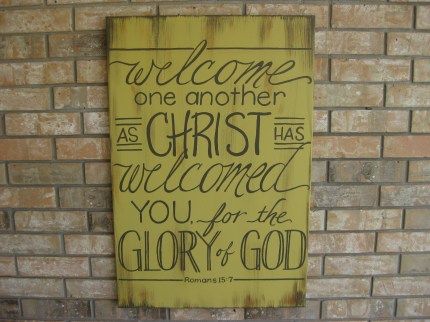
Devotional – Romans 15.7

Devotional:

Romans 15.7

Welcome one another, therefore, just as Christ has welcomed you, for the glory of God.

Weekly Devotional Image

It is hard to welcome one another, until we ourselves know what it means to be welcomed. We can imagine what we need to do and how we need to behave, we can get out the best silverware and the matching dinner sets, we can fill everyone’s cups to the brims, but until we have experienced being welcomed, we will struggle to welcome others.

I spent the last week in Orlando, Florida with my in-laws for the Thanksgiving holiday. They were forced to practice a new type of welcoming and hospitality because they hosted their 7-month old grandson for the first time. In addition to the normal preparations for people visiting, they had to procure a stroller, pack-n-play, diapers, wipes, and an assortment of other necessary items. Moreover, they had to adjust their schedules to the sleeping habits of our son and reorient all of their plans around his general disposition and mood.

And while we sat around the dinner table on Thanksgiving I was struck by how welcomed I felt throughout the week. They could have made assumptions about what we needed and then acted on it, but instead they approached us and asked what they could do to help. They could have become quickly frustrated with Elijah changing their plans but they adapted and made us feel comfortable. They could have expected us to change to fit into their way of life, but instead they changed to fit into ours.

img_9511

One of the most brilliant aspects of the Advent season is our anticipation of the way God fit into our way of life by taking on flesh and being born as a baby in a manger. Rather than giving up on humanity’s inability to repent and turn back to God, God comes down and meets us where we are. God, in Christ, welcomes us into the kingdom of God by connecting with us in ways that we can perceive and understand.

The same holds true for the life of the church, and for us as individual Christians. We welcome one another just as Christ welcomed us, for the glory of God. When we encounter those for whom the church is a strange new world, we don’t just wait for them to “catch up,” instead we adapt our ways to meet them where they are. When we welcome people into our homes for food and fellowship, we don’t dominate the conversation with whatever we want, instead we seek to invite all present to shape what we talk about. When we discover new people sitting in the pews near us, we don’t make quick judgments about who they are based on their appearance, instead we remember how the Lord welcomed us and we do the same toward others.

Devotional – Philippians 4.7

Philippians 4.7

And the peace of God, which surpasses all understanding, will guard your hearts and your minds in Christ Jesus.

Weekly Devotional Image

How do you think people would respond if there was something that, if consumed once a week, would improve mental and physical health and reduce mortality by 20-30% over a 15-year period? What if this miraculous elixir was in reach of millions of people in America and research has proven that it truly does make a tremendous difference in the lives of people who consume it? How quickly do you think it would become the most popular remedy in the country?

Last week, under the “Breaking News” tab on USA Today Online, was a story detailing the availability of this particular product and the research to back up the claims. And, believe it or not, the “miracle drug” is regular church attendance.

Generic Background Image

After 20 years of research, a group of colleagues from Harvard University published their work suggesting that regularly attending religious services brings about better physical and mental health. Regarding physical health, the researchers claim that, “Adults who attend a service at least once a week versus not at all have been shown to have significantly lower risk of dying over the next decade and a half.” Beyond physical health, participating in regular worship leads to “greater optimism and lower rates of depression.”

After reading the article, one would think that every house of worship would be filled to the brim every weekend!

However, the article begs the question: Why do people worship?

Do we gather together because we want the physical and mental health benefits? Are we so consumed by the fear of death that we will sit in uncomfortable pews once a week just so we can live longer? Do we understand and value worship the same we that we understand and value the prescriptions in our medicine cabinets?

Or, do we worship because in worship we encounter the living God? Are we so consumed by the love of God that we cannot understand a way of life without gathering together once a week? Have we been transformed by the Lord who knows us and calls us by name?

The peace of God, which surpasses all understanding, will guard our hearts and our minds in Christ Jesus. We encounter the peace of God whenever we gather together, whenever we proclaim God’s Word, whenever we respond to that Word, and whenever God’s sends us into the world to be the light that shines in the darkness.

Worship, though apparently beneficial for our mental and physical health, is not about what we get out of it. Instead, worship is about what God gets out of us.

Devotional – Genesis 32.28

Devotional:

Genesis 32.28

Then the man said, “You shall no longer be called Jacob, but Israel, for you have striven with God and with humans, and have prevailed.”

Weekly Devotional Image

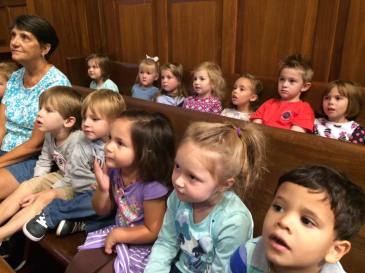
I gather in the choir loft of the sanctuary with the entirety of St. John’s Preschool every Wednesday morning at about 9:30am. By that time the children have all had an opportunity to get out most of their “wiggles” before sitting down in the stiff church pews and learning a story about God from the Bible. I generally try to start the academic year off with stories from Genesis and make my way through up to the stories of Jesus leading toward Easter Sunday.

When we learn about God making light from Creation, we turn the sanctuary lights off and on and talk about what a great gift it is to have light. When we talk about Adam and Eve hiding from God after eating from the tree of knowledge of Good and Evil, we play hide and seek in the sanctuary and talk about how God never stops looking for us even when we’re lost. And this year, when I was foolish enough to teach them about the story of Sodom and Gomorrah, we played red light green lights in attempts to reflect on how God offers us the wisdom of when to go and when to stop.

14440780_1104466649629648_5384631729784297628_n

Last week we met in the sanctuary to talk about one of my favorite stories from Genesis: Jacob wrestling by the banks of the Jabbok river. Jacob has run away from his family after stealing and tricking his brother Esau out of his birthright and blessing and is about to reencounter his brother. But before he can meet his fate in Esau, a strange man arrives in the middle of the night and wrestles Jacob until he, in a sense, learns his lesson. And from this struggle he receives a new name: Israel.

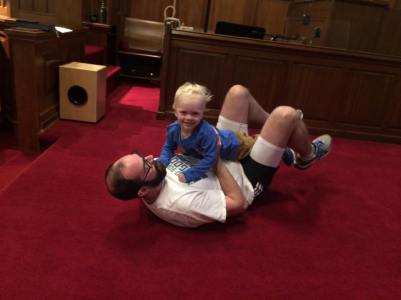
In order to bring the story to life, I had the preschoolers line up one by one and each of them were tasked with knocking me over in a wresting match. They all came forward and gave it their best shot (some were oddly more prepared for this than others) and I would pick them up and spin them around in circles. When one of our last two year olds came forward, I let him knock me to the ground, but instead of pounding on me like some of the older kids, he wrapped his arms around my neck and hugged me.

14502882_1104466592962987_8175825250906782039_n

I was then able to stand up with the boy in my arms and tell the kids the most important part of the lesson: God loves us so much that even when we’re angry, God will never let us go.

To be a Christian today almost implies a degree of struggling with God. We want to know why a hurricane, like Matthew, can wage destruction in places like Haiti, the Bahamas, and the East Coast of the US. We want to know why our presidential political system is filled with such vitriolic and hateful language. We want to know why bad things happen to good people and why good things happen to bad people. Yet, even amidst all the struggle and questions, what a blessing it is to know that God’s love is so strong that God will never let us go.

On War

Matthew 5.43-48

“You have heard that it was said, ‘You shall love your neighbor and hate your enemy.’ But I say to you, Love your enemies and pray for those who persecute you, so that you may be children of your Father in heaven; for he makes his sun rise on the evil and the good, and sends rain on the righteous and the unrighteous. For if you love those who love you, what reward do you have? Do not even the tax collectors do the same? And if you greet only your brothers and sisters, what more are you doing than others? Do not even the Gentiles do the same? Be perfect, therefore, as your heavenly Father is perfect.”

peace_war__wallpaper__by_jackth31-d55t58i

Preachers can fall into the rut of preaching on whatever keeps the congregation pleased; keep them happy and they’ll keep coming back, or something like that. This sermon series is different. Instead of falling back to the familiar narratives that keep us smiling on our way out of the sanctuary, we are confronting some of the greatest controversies facing the church. There is a better than good chance that I will say something from this pulpit during the series that you won’t agree with, and if (and when) that happens I encourage you to stay after worship, join us for lunch, and continue the conversation. We can only grow as Christians in community, and that requires some honesty and humility and dialogue. Today we continue with the topic of War.


The airfield was remarkably dark in the middle of the night so the commanding officer turned on floodlights for posterity. There were so many people wandering around on the field that the captain had to lean out the window of the aircraft to direct the bystanders out of the way of the propellers before take off. Though he did have time to offer a friendly wave to photographers before departing.

The flight lasted six hours and they flew through nearly perfect conditions. At 8:15 in the morning they finally arrived directly above their target of Hiroshima and the bomb was released. It fell for 43 seconds before it reached the perfect height for maximum destruction and was detonated. 70,000 people were killed and another 70,000 were injured.

At about the same time the bomb was detonated, President Truman was on the battle cruiser Augusta. When the first report came in about the success of the mission, Truman turned to a group of sailors and said, “This is the greatest thing in history.”

We, as American Christians, have a problem with War. Historically, the early church and Christians did not engage in war – they believed their convictions in following Christ’s commands prevented them from waging violence against others. And, frankly, they were being persecuted and killed at such a rate that they didn’t have time to think about fighting in wars, nor were militaries interested in having Christians fight for them. You know, because of the whole “praying for their enemies” thing,

But then Constantine came onto the scene, following Jesus Christ turned into Christendom, and everything changed. With Christianity as the state sanctioned religion, Rome could tell its citizens to fight, and they did.

But still, there have always been those who respond to War throughout the church differently. There are Pacifists who believe conflict is unwarranted and therefore should be avoided. There are those who believe in the Just War Theory and that there can be a moral response to war with justifiable force. And still yet there are others who believe in the “Blank Check” model where they are happy to support those in charge of the military without really questioning who they are killing and why.

We might not realize it, but most Americans believe in the “blank check” model, in that our government regularly deploys troops and drones to attack and kill people all over the world (in war zones and other places) and we rarely bat an eye. So long as we feel safe, we are happy to support those leading without question.

christianity-military-750x400

But as Christians, Jesus commands us to love our enemies and pray for the people who persecute us. Now, to be clear, this is not a nice invitation or even a call to a particular type of ministry. We like imagining the “white, blonde hair, blue eyed” Jesus with open arms who loves us and expects the minimum in return. But more often than not, Jesus commands his disciples to a radical life at odds with the status quo.

“I say to you, ‘Love your enemies and pray for those who persecute you.’ Anybody can respond to love with love, but what good does it do to only love the people who love you. Instead, be perfect as your heavenly Father in perfect.”

            This is our command.

            And it is also our dilemma.

Jesus commands us to love our enemies and love our neighbors. But what are we to do when our enemies are killing our neighbors, or vice versa? Is there really such a thing as a just war? Are we called to remain pacifists even when innocent lives are being taken? Was it okay for us to take boys from Virginia and send them to Vietnam to kill and be killed? Should we send our military to Syria to kill and be killed?

This is the controversy of War.

War, a state of armed conflict between two groups, is like an addictive drug. It gives people something worth dying and killing for. It often increases the economic wealth and prosperity in our country. It achieves for our nation all that a political ideal could ever hope for: Citizens no longer remain indifferent to their national identity, but every part of the land brims with unified life and activity. There is nothing wrong with America that a war cannot cure.

When the North and South were still economically and relationally divided after the Civil War, it was World War I that brought us back together as one country. When we were deep in the ravages of the Great Depression, it was Word War II that delivered us into the greatest economic prosperity we’ve ever experienced. When we were despondent after our failure in Vietnam (and subsequent shameful treatment of Veterans), the supposed weapons of mass destruction in Iraq gave us every reason to rally behind our country.

But we don’t like talking about death and war – that’s why the least attended worship services during the year are Ash Wednesday and Good Friday when we can do nothing but confront our finitude. But War commands and demands our allegiance, it is the fuel that turns the world, it has been with humanity since the very beginning.

And Jesus has the gall to tell us to love and pray for our enemies.

To follow Jesus, to be disciples of the living God, requires a life of pacifism. It is not just one of the ways to respond to War, it is the way. And yet, pacifism is a privilege of the powerful. It is very easy for me to stand up in this pulpit, in the beauty of the Shenandoah Valley, and preach about the virtues of pacifism. No one is dropping bombs on our picturesque community. We are not at risk for an invasion from a foreign oppressor.

It is easy to be a pacifist in America.

And we will never get anywhere near a kingdom of peace if pacifists keep perceiving themselves as superior or entitled, otherwise people in the military who return from conflict will return as those from Vietnam – to a country that did not understand.

War is complicated and ugly and addictive. It reveals our sinfulness in a way that few controversies can. War illuminates our lust for bloodshed and retribution. War offers a view into our unadulterated obsession with the hoarding of natural resources. War conveys our frightening disregard for the sanctity of human life. War is our sinfulness manifest in machine guns and atomic weapons. War is the depth of our depravity.

Even the word “War” fails to express the sinfulness of the act. We so quickly connect the word “War” with the righteous outcomes of our wars. We believe we fought the Civil War to free the slaves, when in fact it had far more to do with economic disparity. We believe we fought Word War II to save the Jews, when in fact it had more to do with seeking vengeance against the Germans and the Japanese. We believe we went to War in the Middle East with terrorism because of September 11th, but it had a lot to do with long-standing problems and an unrelenting desire for oil.

Can you imagine how differently we would remember the wars of the past if we stopped calling them wars and called them something else? Like World Massacre II, or the Vietnam Annihilation, or Operation Desert Carnage?

soldier-peace-logo

On August 6th, 1945, we dropped the first atomic bomb on the city of Hiroshima in order to end the bloodiest war the world had ever seen. With the push of a button we exterminated 70,000 people in an instant, and our president called it the greatest thing in history. Truman was a lifelong Baptist and was supported by the overwhelming majority of American Christians, most of whom expressed little misgiving about the use of the atomic bomb. But that very bomb is the sign of our moral incapacitation and the destruction of our faithful imagination.

For we Christians know, deep in the marrow of our souls, that the “greatest thing in the history of the world” is not the bomb that indiscriminately murdered 70,000 people, but the life, death, and resurrection of Jesus Christ.

Jesus Christ is, and forever will be, the greatest thing in the history of the world because Jesus broke the chains of death and sin and commands us to follow him. Jesus Christ, Son of Man and Son of God, embodied a life of non-violent pacifism that shakes us to the core of our being and convicts our sensibilities.

There is, of course, the privilege of pacifism and its ineffectiveness when combatted by the evil in the world. Pacifism pales in comparison to the immediacy of armed military conflict, but it is the closest example we have to what it means to live like Jesus. And Jesus wasn’t particularly interested in offering us the path of least resistance toward salvation. Instead, he demanded our allegiance.

So where does that leave us? What are we to do about the controversy of War?

Right now, countless innocent lives are being killed in Syria as a result and consequence of War. For years, Syrians have struggled to escape their war-torn homes and find a new beginning somewhere else, but many of them are still there. The United States has largely remained uninvolved in the conflict due to diplomatic and militaristic complications. So I thought it would be the perfect example to bring up this week in one of our bible studies regarding the moral responsibility of our country. Should we send troops into Syria in order to prevent the loss of innocent lives? Should we remain isolated from the conflict?

I turned the question on the group and asked, “What are we to do as Christians?”

“We could take in more refugees.”

“We can advocate for better responses out of our politicians.”

“We can pray about it.”

Then I said, “Well, what if the United Methodist Church announced that it was sending 5,000 missionaries to Syria? We know how to send missionaries, we do it all the time.”

And someone responded by saying, “We can’t do that; they’d be easy targets.”

I’ll admit that we can’t do that, but not because they would be easy targets. We can’t go there and do that because we no longer have a church that produces people who can do something that bold. But we once did.

God in Christ came in order to reconcile the world through the cross. The living God through the Messiah spoke difficult commands and orders to the disciples, things we still struggle with today. But God was bold enough to send his son to die in order to save us, not by storming the Temple with swords and shields, not by overthrowing the Roman Empire and instituting democracy, but with a slow and non-violent march to the top of a hill with a cross on his back. Amen.

Controversy Original

Devotional – 2 Timothy 2.8-9

Devotional:

2 Timothy 2.8-9

Remember Jesus Christ, raised from the dead, a descendant of David – that is my gospel, for which I suffer hardship, even to the point of being chained like a criminal. But the word of God is not chained.

Weekly Devotional Image

A few of my friends recently embarked on a new venture into the world of podcasting. They call themselves “Crackers and Grape Juice” and they regularly interview people about their faith in order to share the conversations with others through the Internet. One of their regular interviewees is Fleming Rutledge, a retired Episcopal priest, who truly has the gift of preaching. In a recent interview they asked Fleming about her love of scripture and her response was powerful: “If I love scripture, it is because my grandmother read me those stories when I was a child. The role of someone we love, loving us enough to read us scripture, makes all the difference.”

1200x630bf

What do we think of the bible? Is it a text that we are called to master like a subject from school? Should we memorize the facts and dates like a work of history? Should we analyze the literary techniques like a famous work from Shakespeare?

Today, in the lives of Christians, the Word of the Lord is often chained to the realm of the church. If we want our children to learn about the bible, we send them to a Sunday School classroom. If we have a friend grieving the loss of a spouse, we recommend that they go speak with a pastor. If we are unsure about how to encounter a troubling topic, we ask to hear a sermon about it in worship.

But, as Paul reminds us, the word of God is not chained! The bible demands our attention and our affection. It yearns to be read and savored. It should not be relegated to the confines of a church building and should instead sit at the heart of what it means to be a family and what it means to be a community.

Can you imagine how all children would feel about scripture if someone they loved took the time to read them the stories? Can you imagine how differently you would feel about the bible if someone took the time to read it to you when you were younger?

The call of Christians, all Christians, is to remember Jesus Christ, raised from the dead. We remember the great stories of the bible when we gather together in worship on Sundays, but that is not enough. We remember the greatness of the risen Lord whenever we share his gospel with the people we love: our families, friends, and neighbors. We remember the acts and grace of God whenever we sit down with one of our children and grandchildren to tell them about how Jesus changed our lives. We remember the resurrection when we believe the Word of God is unchained and worthy of our time.

On Suicide

Isaiah 43.1-2

But now thus says the Lord, he who created you, O Jacob, he who formed you, O Israel: Do not fear, for I have redeemed you; I have called you by name, you are mine. When you pass through the waters, I will be with you; and through the rivers, they shall not overwhelm you; when you walk through fire you shall not be burned, and the flame shall not consume you.

Romans 8.35-39

Who will separate us from the love of Christ? Will hardship, or distress, or persecution, or famine, or nakedness, or peril, or sword? As it is written, “For your sake we are being killed all day long; we are accounted as sheep to be slaughtered.” No, in all these things we are more than conquerors through him who loved us. For I am convinced that neither death, nor life, nor angels, nor rulers, nor things present, nor things to come, nor powers, nor height, nor depth, nor anything else in all creation, will be able to separate us from the love of God in Christ Jesus our Lord.

suicide


It was 2003 and I was a freshman in High School. And like most High School freshman, I spent many an evening on my computer typing to my friends on Instant Messenger. This was long before Facebook’s wild popularity, Twitter’s terse communication style was far away from coming into reality, and none of us even had cameras on our cell phones. But night after night we would sit in front of our computer screens typing away about what we thought were the most important things in the entire world.

One night in the spring, I waited for my parents to go to bed and then I snuck downstairs to get back on the computer. Most of the conversations were frivolous and limited by the speed at which our fingers could move over the keyboard. I can’t remember what the topic was that evening, but I do remember a new box appearing on the screen that changed everything.

At the time, my best friend was dating a girl and things were less than perfect. They fought about all kinds of stupid things and were the epitome of every high school relationship cliché. She, the girlfriend, was the one who sent me a message that night. All it said was, “We got in a really bad fight, he told me he was going to kill himself, and I don’t know what to do.

Suicide is ugly. It leaves families and friends reeling in whiplash, it creates guilt and unanswered questions, and it produces feelings of morbidity and fear.

Suicide is controversial in the church for a number of reasons. Many churches and Christians believe that suicide is ultimately sinful and worthy of eternal damnation. To have suicidal thoughts is to not have enough faith. Some pastors will even refuse to preside over funerals for those who have committed suicide.

If you look through the entirety of scripture, both Old and New Testaments, you will not find a passage that condemns suicide. None of the prophets, or priests, or kings have anything to say about suicide or what happens to those who commit suicide. However, Augustine (an important theologian from the early church) read the commandment “thou shall not kill” as a prohibition against suicide. And from Augustine’s reflection on the topic, suicide became the black sheep of sins in the church.

For a thousand years, suicide was a mortal sin and an affront against God’s goodness. Those who committed suicide were treated as criminals and refused Christian burials. By the 1500s those who attempted suicide were excommunicated by the church and were punished by the civil authorities.

And still today, suicide carries an awful stigma in the realm of the church and is one that is either referred to with eternal damnation or complete silence.

            That silence, the utter and complete darkness of a topic that is remarkably relevant for our time and reflection, is a controversy worth confronting.

According to the Center for Disease Control (CDC), on average, one person dies by suicide in the state of Virginia every 8 hours. It is the 11th leading cause of death in our state, and it is the 2nd leading cause of death for people ages 10-34.

Among high school students across the country, 17% seriously considered suicide in the last 12 months. And 8% attempted suicide one or more times in the last year.

If you’re like me, you tend to think about young people being the most susceptible to suicide attempts, but suicide rates are actually highest among people middle aged and older, by a lot. In fact, middle aged and older adults are nearly twice as likely to commit suicide as young people.

And right now, suicide has surged to its highest levels in thirty years.

yqecn1ygjymjb3igsiev

When I received that message on my computer back at the beginning of high school, I grabbed my things and was out the door before I even had a chance to really think about what I was doing. All I knew was that my friend would not just make an empty threat about suicide like that, and I had to do something about it. So I grabbed my bicycle out of the garage and I started riding as fast as I possibly could in the middle of the night. He lived a couple miles away and when I screeched into his driveway I was drenched in sweat.

I dumped the bike right there and I ran to the front door and started banging with my fist and I started yelling. Within a minute his parents were coming down the stairs in their pajamas with tired and angry looks on their faces. When they opened the door and saw me standing and sweating in the dark they were utterly bewildered and then I told them why I was there.

We immediately went to check on him in his bedroom, but he wasn’t there. We searched the house from top to bottom and we finally found him in the basement. He was sitting on the couch with tears in his eyes and he had just swallowed an entire bottle of ibuprofen.

They wound up taking him to the hospital and had his stomach pumped. They sat there and held their son while he cried and cried. And they saved his life.

Suicide is not the way any human life should end. The church, this church, has an obligation to see that all persons are grafted into a community of love and are cared for in the midst of isolation, depression, and despair.

Life is a gift, plain and simple. It is a gift from God and therefore we are called to be good stewards of this gift: our lives and the lives of others.

We cannot ignore this topic as if it has nothing to do with us. The statistics confront us with a stark reality about the prevalence of suicide in our culture. With the advent of the Internet and instant communication, young people are being bullied and attacked at a degree that few of us can even fathom. With an economy that moves up and down like a roller coaster, people in the middle of life are undergoing identity crises and are wondering how they can provide for their families. Older people who receive a grim diagnosis or the loss of a spouse struggle to justify living with such a horrible outlook for the days ahead.

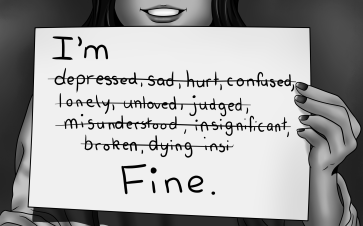
We know that we are supposed to be present for and with one another, like being there for friends and family at a moment of tragedy. We rarely know what to say on such occasions, but we know we should be there. We, above all things, are called to be present for others in the midst of suffering and loneliness and depression that often lead to the contemplation of suicide. To be part of the faithful community requires us to be for one another.

i_m_fine_by_black_avenger-d60mqnl

We live because life is a gift. We are not our own creators. We Christians are the people who must learn to live by the fact that life is a gift. We therefore can live each and every day not as a survival technique, but through recognizing that each and every day is an opportunity to live and love in the service of our Lord.

When we talk about suicide, we say it is “the taking of one’s life.” But even the way we talk about suicide shows how much a problem we have with it. Our lives are not our own. As the Lord says through the Prophet Isaiah: “Do not fear, for I have redeemed you; I have called you by name and you are mine.” We belong to the Lord and to one another. God tells us to not be afraid because God will be with us as we pass through the waters, and the rivers of life shall not overwhelm us, we shall not be burned by the fires of frustration. Not because they won’t hurt or be terrifying, but because we belong to the Lord and the Lord is with us.

If we’re here in the sanctuary this morning, we have some sense of this in our lives. We know that God is with us, we feel God’s presence in this place and we know that we are not alone. It is through encountering the divine love of God in worship that we are given the strength to be God’s presence for others who sink under the waters of life and who feel burned by the world. It is our charge to be shaped and called by God’s love and to reach out to those who contemplate ending their days. We have the challenge of showing all people, even those who see no value to their lives, how our lives are not defined by what we have done with them, but by what God will do with them.

Six months after my friend had his stomach pumped, he attempted to commit suicide again. This time he did it with a hose running from his exhaust pipe into his car. But his little brother heard the car door close and it woke him up, and then he woke up his parents. In the strange and quiet time of the darkness of night they pulled their son out of the car and they got him help. It took a long time for him to move on. It took counselors and therapists, it took friends and family, it took the power of God’s grace to show him that his life could get better, that there was hope for the future, that there was something worth living for. And because people in his life were brave enough to confront his suicide attempts, he still lives today.

But there will always be some that we cannot reach. There will be people who feel so suffocated by the weight of the world that they will make that dreadful decision to end the life that God’s has given to them. And for them, for those who will die by their own hand, what will happen to them? For centuries the church saw suicide as an unpardonable sin, something that eternally damns those who do it. Will God abandon them for making such a choice? Will God refuse to love the people who felt no love in their lives? Will the God of mercy punish them until the end of time?

           No. In all these things we are more than conquerors through him who loved us. For I am convinced that neither death, nor life, nor angels, nor rulers, nor things present, nor things to come, nor powers, nor height, nor depth, nor anything else in all creation, will be able to separate us from the love of God in Christ Jesus our Lord. Amen.


Controversy Original

On Creation vs. Evolution

Genesis 1.1-5

In the beginning when God created the heavens and the earth, the earth was a formless void and darkness covered the face of the deep, while a wind from God swept over the face of the waters. Then God said, “Let there be light”; and there was light. And God saw that the light was good; and God separated the light from the darkness. God called the light Day, and the darkness he called Night. And there was evening and there was morning, the first day.

Controversy Original

Preachers can fall into the rut of preaching on whatever keeps the congregation pleased; keep them happy and they’ll keep coming back, or something like that. This sermon series is different. Instead of falling back to the familiar narratives that keep us smiling on our way out of church, we are confronting some of the greatest controversies facing the church. There is a better than good chance that I will say something from this pulpit during the series that you won’t agree with, and if (and when) that happens I encourage you to stay after worship, join us for lunch, and continue the conversation. We can only grow as Christians in community, and that requires some honesty and humility and dialogue. Today we continue with Creation vs. Evolution.


“How old is the earth?” The fifth grader looked up from his homework assignment as if to say, “Well, dude, what’s the answer?” We were sitting inside Forest View Elementary School in Durham, North Carolina, and I was in the middle of a tutoring session. Each week we would sit in the library and go through his homework together. His class was finishing up a unit on earth sciences and his worksheet was filled with questions about the subject.

“How old is the earth?” I, of course, could not remember the answer so I promptly pulled out my cell phone to Google the answer and the young man rolled his eyes and opened up his textbook with dramatic emphasis. We flipped through the pages together looking for key words or pictures that would indicate we were on the right path and then we found it in big bold numbers on the bottom of a page: 4.54 billion years.

I waited patiently for my young tutee to copy the number down into the answer column on his worksheet, but he just kept looking at the textbook with a glazed-over look in his eyes. Then I heard him say, almost as if a whisper, “That can’t be right.”

“Well of course it’s right!” I said, “I mean its in the book, it has to be right.”

            And then he said, “But my pastor told me the earth is only 6,000 years old.”

creation-evolution-possible

In the beginning, the very beginning, there was nothing. All matter was formless. What we now know and see was a soup of nothingness, a bottomless emptiness, and inky blackness. And in the midst of this nothingness, there was something: God. And God said, “Let there be light”; and there was light. God saw that the light was good; and God separated the light from the darkness. God called the light Day, and the darkness he called Night. And there was evening and there was morning, the first day.

Perhaps no words in all of scripture have been more analyzed, prayed over, and interpreted throughout the centuries. Genesis 1 is beginning, and not just a beginning to a story, but the beginning to the story.

And it stands on the battlefield of the fight between Creation and Evolution.

Here’s the controversy: Centuries ago a man named James Ussher set out to date the earth. He dove deep into the Old Testament and, with the help of genealogies, established the exact time and date of God’s creation as 6pm on October 22nd 4004 BC. Therefore, according to Ussher, the earth is approximately 6,000 years old. However, with the advent of modern science and the likes of evolutionary biology and carbon dating, scientists have determined that the earth is 4.5 billion years old.

There is a big difference between 6,000 and 4.5 billion.

For a very long time, we humans considered the earth a relatively recent phenomenon. The Christian church established itself as the predominant leader of information distribution, and when that came into conflict with Science, the battle began.

This has manifested itself throughout the centuries in a number of ways including the fight between the Galileo and the church, Darwin and the church, and even the American Government with the church.

“How old is the earth?” It may seem like a pretty simple question without too many ramifications, but it is a big one, and the way we answer it has a lot of consequences.

A couple of years back, the state of Kansas removed questions about evolution from its standardized tests. This meant that teachers were still allowed to teach evolution, but the children would not be tested on it at the end of the year. Some Christians rejoiced in the victory Creation over Evolution, and others were concerned that children from Kansas would pale in comparison to students from other states by the time they entered college.

It would seem that the church has one answer to the question, and science has another.

I remember learning about the theory of evolution when I was in the 8th grade. With all my hormonal angst, and pimply face, and peach fuzzed mustache, I sat in my science class and learned about how all life can trace its origins back to one single cellular being: That over millions of years that first cell grew and evolved and developed new traits; how life began in the sea, and eventually developed to live on land and in the air; how humanity is one of the last developments in a tremendously long line of evolved species.

I thought it was awesome! The science-fiction nerd within me went into overdrive and I relished in learning about where we came from, how the earth has changed, and how beautifully unique we really are. And the whole time I dove into evolution I saw God’s handiwork all over the place. Who could have brought life into that first being, who could have the imagination to force molecules and atoms together in such a way that life began, who could have moved the development of species to its zenith in humanity?

But at the same time, some of my Christian friends stopped going to youth group and they stopped going to church. In learning about evolution their faith in church diminished. What they heard in the classroom became more important than what they heard in the sanctuary. When they learned that the earth was older than what they heard in church, their faith was crushed. I, however, was fortunate to have pastors and older Christians who helped me to see the similarities between science and faith. But my friends only saw the battle.

2852667_orig

The title of this sermon is Creation vs. Evolution for a reason. I titled it this way precisely because that is the way that many of us see the relationship between the two; Faith and Science represent opposite ends of the spectrum. One is archaic and illogical; the other is scientific and intellectual. One represents backward thinking; the other is forward thinking. One should be left to sanctuaries; the other is for the classroom.

The conflict between science and faith exists because of us; Christians who became defensive when scientists learned more about the world instead of rejoicing in God’s creative majesty. Christians who were quick to jump ship when we discovered there was more to the world than just what we can read about in the bible; Christians who saw scientific discovery as a work of the devil and retreated further away from the world.

But are science and faith really at odds with one another?

Young-Earth Creationists are those who believe (like Ussher) that God created the earth over 6 24 hours days 6,000 years ago. They dismiss scientific discoveries like the Dinosaurs and carbon dating as a way for God to test our faith.

However, there are other ways of looking at the biblical account of creation from Genesis 1 that harmonizes with, rather than battles against, science.

First, the word for “day” in Hebrew is “yom.” And it carries with it a number of definitions and interpretations. Yom is used in the Old Testament as a general term for time, like a time period of finite but unspecified length. We can also read in Psalm 90.4 “For a thousand years in your sight are like yesterday when it is past, or like a watch in the night.” What we understand the word “day” to mean is different than what it means in scripture. God’s time is not our time.

We could then read Genesis 1 to be that in the beginning God created light, and after light God created air, and after air God created earth and sky and sea. But how long it took God to do this is unknown. One day? One million years? Only God knows.

Genesis, and the rest of the bible, is not meant to be read like a science or history textbook. The bible, over and over again, rejects our desire to master the text and instead calls us to be servants of the Word. We might be concerned with how and when God created, but the bible only tells us who and why God created.

Then we can look at the order of creation itself and the similarities with the theory of evolution. Though it was written thousands of years before Darwin’s On the Origins of Species the order of creation parallels Darwin’s and modern evolutionary scientist’s ideas. The first thing to exist was light and energy. Then matter began to fuse together into celestial beings like stars and planets. Eventually the earth developed an atmosphere and water and land. The first life began in the sea, eventually evolved to fly in the air and crawl on the earth, and the last life to be developed, the zenith of God’s creation, was human life.

            Knowing this, countless Christians are able to hold that evolution is real, but that God set it in motion. They are able to assert that the earth is 4.5 billion years old AND God created it in the way described in Genesis. They are able to hold together science and faith in such a way that it gives glory to God’s glorious creation.

The conflict between science and religion, between creation and evolution, exists because people like us have treated the book just like every other book. We see it as our own historical textbook, or as our scientific journal, or as our genealogical record. We import the ways we read other texts into the way we read God’s great Word.

And then many of us take it up like a weapon against anyone who disagrees with us.

But the bible is fundamentally unlike anything ever written. It is historical, and scientific, and literary, and poetic, and every other form we can think of. It is beyond our ability to fully comprehend, it breaks down and exceeds the expectations we place on it, it is the living Word of the Lord.

In the beginning, the very beginning, there was nothing. All matter was formless. What we now know and see was a soup of nothingness, a bottomless emptiness, and inky blackness. And in the midst of this nothingness, there was something: God. And God said, “Let there be light”; and there was light.

           The bible is far less concerned with explaining how things happened, and is far more concerned with proclaiming God’s handiwork. It comforts us when we are afflicted, and it afflicts us when we are comfortable. It can make us laugh and it can make us cry. It can bring us to our knees and it can propel us to dance on our feet. It identifies God as creator and us as creature. It harmonizes with the marvelous developments in science. It humbles us and exalts us. It is who we are and who we aren’t. It is God Word for us. Amen.

Devotional – Philemon 1.3

Philemon 1.3

Grace to you and peace from God our Father and the Lord Jesus Christ.
Weekly Devotional Image

The beginning of Paul’s letter to Philemon contains an address that I use in nearly every communication I have with the church I serve. “Grace to you and peace from God our Father and the Lord Jesus Christ” are the words I use to begin worship on Sundays and the words I use to address all of my devotionals and epistle articles. There is something familiar and comforting about using the same words over and over regardless of how the community and the world has changed from week to week; no matter what we have going on in our lives, we are still greeted by the peace and grace of God when we communicate as a church.

The habit of using Paul’s words has shaped the way I interact with the people of St. John’s and the larger community. By beginning with these words I am transported back to almost all of Paul’s letter to individuals and communities, I am connected with the great tradition of the church, and I am reminded that I am called to point to Christ’s witness (and not my own).

The words are good and right and true, but it has been the habit of using them that has had a profound effect on the way I understand what it means to be a disciple.

Every Sunday at St. John’s we have a habit of standing together to affirm our faith using The Apostles’ Creed. The familiar words are printed in the bulletin and we all face the altar to proclaim what we truly believe. And yesterday, as individuals were lining up to leave the sanctuary, one of our youth pulled me aside to ask a question: “Why do we say we believe in the holy catholic church if we are the United Methodist Church?” In the moment I explained that the word “catholic” in the context of the Apostles’ Creed does not refer to the Catholic Church as a denomination but the “universal” church. And even though I answered him, his question stuck with me the rest of the afternoon.

How many times have we used the Apostles’ Creed in church without really thinking about what we say? Has the habit of using those words become so familiar that they no longer bear fruit in our lives? What other things do we take for granted in our worship and in our discipleship?

Habits are a good thing in their ability to shape our behavior. However, we have to be cautious against letting our habits become rote. The words we use in church and in our daily living have the power to transform us because what we believe shapes how we behave. So, we join together with the countless disciples of the past to say, “I believe in God the Father Almighty, maker of heaven and earth; and in Jesus Christ his only Son our Lord: who was conceived by the Holy Spirit, born of the Virgin Mary, suffered under Pontius Pilate, was crucified, dead, and buried; the third day he rose from the dead; he ascended into heaven, and sitteth at the right hand of God the Father Almighty; from thence he shall come to judge the quick and the dead. I believe in the Holy Spirit, the holy catholic church, the communion of saints, the forgiveness of sins, the resurrection of the body, and the life everlasting. Amen.”

0e4453898_1440084142_sermons-series-desktop-the-apostles-creed-3

On Sitting At The Reject Table – Luke 14:1, 7-14

Luke 14.1, 7-14

On one occasion when Jesus was going to the house of a leader of the Pharisees to eat a meal on the Sabbath, they were watching him closely. When he noticed how the guests chose the places of honor, he told them a parable. “When you are invited by someone to a wedding banquet, do not sit down at the place of honor, in case someone more distinguished than you has been invited by your host; and the host who invited both of you may come and say to you, ‘Give this person your place,’ and then in disgrace you would start to take the lowest place. But when you are invited, go and sit down at the lowest place, so that when your host comes, he may say to you, ‘Friend, move up higher’; then you will be honored in the presence of all who sit at the table with you. For all who exalt themselves will be humbled and those who humble themselves will be exalted.” He said also to the one who had invited him, “When you give a luncheon or a dinner, do not invite your friend or your brothers or your relatives or rich neighbors, in case they invite you in return, and you would be repaid. But when you give a banquet, invite the poor, the crippled, the lame, and the blind. And you will be blessed, because they cannot repay you, for you will be repaid at the resurrection of the righteous.

__CpSjwy


Throughout the gospels, people are forever asking Jesus about the kingdom of heaven. What does it take to get in? Who will be there? When will it happen?

And whenever Jesus is asked about the kingdom of heaven, do you know what he compares it to most often? A wedding feast.

I love weddings. I love getting to spend time with a couple as their special day gets closer and closer. I love working with families in terms of making the wedding ceremony as special and faithful as possible. I love being invited into this profoundly holy moment at the altar of marriage and bringing two people into an everlasting covenant. But more than all of that, I love weddings because they are as close as we can get to heaven on earth.

During the months leading up to a wedding, while I’m working on pre-marital counseling and the homily and the order of worship, the couple has a lot of work to do as well. They have to procure a reception location, taste test the hors d’oeuvres and the main course, and find the perfect DJ. But perhaps the most difficult and taxing requirements prior to the wedding are the guest list and the seating arrangements.

Nearly every couple I have married has struggled with who to invite and where to seat them. Does that uncle that no one has seen in years warrant an invitation? And what about your cousin’s ex-wife? Maybe we should just send her an invitation to be kind, but if she shows up where can we put her? And where in the world are we going to put the pastor and his wife?

At one wedding, I rushed through the rehearsal under the blistering sun and everyone was remarkably thankful when I stopped talking. Because the wedding was out of town, we were invited to the rehearsal dinner and upon arrival we did not know where to sit. There was clearly an area for the bridal party, so we avoided that table and decided to just sit at a table in the middle of the room. Like an awkward moment in a middle school cafeteria, we waited to see who would sit next to us, but as family members and friends entered the room, the father of the groom stood up to make a speech. He welcomed everyone and thanked the room for supporting his son and soon to be daughter-in-law, and then he pointed over at me. He said, “Now everyone, this is my pastor and the woman sitting next to him is his wife. So all you young men, you need to stay away from her tonight. Because Taylor has the power to send you to heaven, or to hell.” The room erupted in laughter at the joke, and it was pretty funny, but no one, and I mean no one, sat next to us for a long time.

Jesus was once invited to the house of a leader of the Pharisees and was being watched closely. When he arrived he noticed how particular people chose to sit in places of honor and he used the moment to teach about the kingdom of God. “When you get an invitation to a wedding, do not sit in the places of respect and honor. Someone might come up to you who is more distinguished and important and they will take your place. You will then have to disgracefully move to the reject table. Instead go and sit at the reject table from the beginning, so that when the host comes by he may call you to a grander table. For all who exalt themselves will be humbled and those who humble themselves will be exalted.”

There is always a strange moment at wedding receptions when all the guests stand in line at a poster or some other Pinterestly designed labeling system for where each of us will be sitting. At another wedding, after preaching and leading the ceremony, we got in line with everyone else to find our names and our corresponding table. As my eyes went down the list, I knew that we literally knew no one at the wedding (except the bride and groom) and I wasn’t hoping for anything special. But when my eyes finally made it to the end of the list, I knew that we were definitely assigned to the reject table.

You know the one, the table where you send the odds and ends, that strange second cousin that you had to invite and you hope he doesn’t get too rowdy, the piano teacher from a decade ago, the weird friend your mother insisted on inviting but who always drove you utterly crazy. That table.

When we made our way to the back of the room, it only took one glance to confirm our suspicions that we were at the reject table because no one was talking and none of the people knew each other. At every other table in the reception area conversations were flowing and laughter was breaking out, but at the reject table it was silent.

In the silence you could almost sense the recognition of our reject status, but the nail on the coffin was when the pastor and his wife pulled out their chairs and sat down. At a wedding, if I sit at your table, you are part of the rejects.

At first we just further perpetuated the silence by sitting there awkwardly fumbling with our cell phones and such, until I decided to break the ice and compliment the camouflage koozie that was keeping a beer cold in the hand of who I can only imagine was a distant cousin. I said something stupid like, “Man, I could barely tell you were even drinking a beer.” At first he didn’t respond, either because the joke wasn’t funny, or because he was unsure of how to speak to a pastor about beer. But when Lindsey laughed at my foolish attempt to be funny, the whole table seemed to take a collective breath and relax.

From that first, albeit strange, compliment a conversation began to percolate and eventually spilled out over the whole table. Within ten minutes we were probably the rowdiest table in the entire room and were regularly being shushed by other guests while the speeches were being made. We didn’t care that we couldn’t see the bride and groom at their table in the front, we didn’t care that we were the very last table to be called to go through the buffet line, we didn’t care that we were the misfits at the reject table. Instead, we were just happy to be there.

From the humility of the reject table we were exalted to the joy of the wedding celebration.

Jesus spoke to the people gathered together to teach them about the virtues of humility. And in telling the parable of the wedding banquet he was not just assigning them to be humble at weddings, but in all aspects of life. To live the kind of selfish and exalted life of the best table is to forget that we depend on God. It is to believe that we are in control of our lives and that we have the power to save ourselves. It is a fundamental lack of trust that the Lord will provide.

humility word in mixed vintage metal type printing blocks over grunge wood

Humility, on the other hand, is an unselfish way of living while depending on the Lord. It is to believe that our lives are not our own and that only God has the power to save us. It is a fundamental trust in the Lord’s ability to provide.

And Jesus does not leave it at that. He pushes the gathered body even further. Whenever you’re invited somewhere, live humbly. And whenever you are the host, do not invite people with the expectation that they will provide the same courtesy. Do not invite your family, and your neighbors, or your rich friends assuming they will do the same. Instead, invite the poor, the crippled, the lame, and the blind. Invite the people you would otherwise ignore. And you will be blessed precisely because they cannot repay you.

This is a tough commandment for all soon to be married couples. Most of them would never dream of omitting an invitation to family members, and friends, and rich relatives who give the best wedding gifts. They would never dream of inviting strangers and outcasts and rejects to their wedding feast and celebration.

But the marriage of Christ with Christ’s church is a wedding celebration that all of us have been invited to. We are here in the midst of worship: the wedding of God with God’s people, and none of us should have been invited. We can never repay the kindness of God’s invitation, we are unworthy of sitting in these pews, we fail to be obedient to the kind of love that we experience here. And yet we are invited. And frankly, we are all sitting at the reject table.

Jesus Christ invites us to this place to celebrate the great victory over death, the resurrection of glory, and the reconciliation of all things. And that’s different than just being included. Many churches love to claim and proclaim their inclusiveness. Inclusive has become such a buzzword in Christianity that you will find it on nearly every church website and every church bulletin you come across. We so desperately want to appear welcoming and inclusive with the hope that it will draw people into our wedding celebration called the church.

But being inclusive is lazy. Because being inclusive does not require us to do anything but sit here, stare at the doors, and hope people will show up.

            Jesus did not lead an inclusive ministry.

            What Jesus led was a ministry of invitation.

Much like being invited to a modern wedding celebration, Jesus actively went out seeking others to draw them into the party. He met them where they were and invited them to join him on the way that leads to life. His ministry was about breaking down the labels and constructs that people were isolated into, and gathering all of the so called rejects together to celebrate the glory of God.

Our Lord invites all without expectation and without assumption. God Almighty knows our sin and our failures and still sees potential. The Lord meets us where we are through the words of our worship and through our friendships. The great story of scripture, from this passage in Luke to the entire narrative, is not about God waiting for us to show up, but God’s great work to find and transform us.

Sitting at the reject table comes at a cost. It means being surrounded by people we do not know, people we probably don’t agree with, and people who might drive us crazy. It requires a tremendous amount of humility and trust and faith. But it’s also the way we got invited to this party. Amen.


00035522_h

In or Out? – Karl Barth and the Doctrine of Election

Election is a dirty word in the United Methodist Church. In this particularly problematic political season we like to keep people happy so we generally avoid talking about politics and elections. We want people to think for themselves and pray for the Spirit to guide them in such matters. Otherwise we leave the topic at arms length. However, even more divisive than American Politics has been the church’s response to the Doctrine of Election.

The topic of God’s divine election is one that we often get hung up on in our weekly Bible studies at church. We can be talking about any number of things from scripture when all of the sudden the conversation moves to whether or not God ordained a specific tragedy to occur, or why would a loving God elect some for salvation and some for damnation. Then we tend to travel down the deep rabbit hole in arguments about free will and God’s sovereignty.

To talk about election is to take steps into mystery. We like to have answers to all of our questions, we like things to be neat and orderly, and God often gives us the opposite. Only God, in God’s infinite knowledge and power, could elect certain individuals and only humanity, in our sinfulness and selfishness, could spend centuries arguing about what it means to be part of the elect.

quotescover-JPG-52-300x300

Even on the UMC’s denominational website there is a long essay about whether or not United Methodists believe “once saved, always saved” or can we “lose our salvation.” And in the essay, a good amount of space is spent address Calvin’s so called “TULIP” theological principles (Total Depravity; Unconditional Election; Limited Atonement; Irresistible Grace; and Perseverance of the Saints). For Calvin, God has chosen, based on God’s own criteria, whom to save and whom not to save, long before anyone was born. Moreover, Jesus’ act of “atonement” from the cross is efficacious only for those whom God has elected for salvation.

John Wesley however, influenced by Jacobus Arminius, believed that only God can save and God does so unconditionally for all. There is no pre-selected list in the mind of God about who will be rewarded with salvation and who will be punished with damnation. Instead God’s grace is offered preveniently to all, and humanity has the capacity to respond to this grace. We have the ability (through free will) to reject God’s grace and in so doing we remove ourselves from the equation of salvation.

These types of distinctions about divine election or rejection have been debated throughout the history of the church and have played a primary role in the propagation of the seemingly endless amount of Christian denominations. We disagree about what we believe God is up to with election and therefore we create schisms in the church that result in the mosaic of churches rather than dwelling together in unity.

Karl Barth saw the Doctrine of Election differently.

barth-bw

In Church Dogmatics II.2 Barth sets out to confront what it is that makes one “elect.” He begins with a general answer that those who are elect are elect without reference to their person or in recognition of any special attributes or achievements. There is nothing that one can do to earn their elect status. To be elect is to enter into a way of being that corresponds with election; those who are elect are what they are.

Barth then, in a profound and wonderful excursus, compares the elect and the rejected throughout the Old Testament as a means by which to point at what it means to be elect in Jesus Christ. He begins with the dualism of Cain and Abel from Genesis 4. The difference between the brothers is not based on any prior mark of distinction, but from a decision of God’s concerning them. However, even though one is clearly favored and the other is not, this does not mean that God has abandoned or rejected Cain in the way we so commonly assume. It is true that God does not accept Cain and his family for the murder of his brother, but he is not abandoned by God because of this. Instead he receives the promise that God will protect his life.

1101620420_400

Thus begins a great trajectory throughout the Old Testament of mutually intersecting differences between people. Esau is the older and favorite son of Isaac, but it is Jacob (the younger brother) who receives the birthright and the true blessing. Yet, God does not abandon him. Jacob loves Rachel more than Leah but Leah is the one the Lord makes fruitful. And yet Rachel does not remain barren and eventually gives birth to Joseph. And Joseph, though rejected by his older brothers and sold into slavery is intimately connected with the future of God’s people and the brothers (though treacherous) are not abandoned to the famine but are instead forgiven and brought into the land of Egypt.

The same holds true for the dynamic between Saul and David (Saul is actually blessed far more than David even through the Lord moves the blessing from the former to the latter), and other figures from the Old Testament scriptures. Barth demonstrates again and again that though they appear rejected by the Lord, they are in fact blessed and intimately involved in God’s great story that culminates in Jesus Christ.

And it is here where Barth shines a light on the darkness of our understanding of election. For it is precisely in the person of Jesus Christ that we discover not only the elect but also the reject. “According to His divine nature, Jesus Christ is the (elect) eternal Son who reposed in the bosom of the eternal Father, and who coming thence took our flesh upon Him to be and to offer this sacrifice, for the glory of God and for our salvation, and by taking our place to accomplish our reconciliation to God. But as such and in the accomplishment of this reconciliation He is, necessarily, the Rejected. Like the (scapegoat) He must suffer the sin of many to be laid upon Him, in order that He may bear it away… out into the darkness, the nothingness from which it came to which it alone belongs.”[1] In the humiliation of the cross, Christ was also exalted. In the rejection of the Son on the cross (who cries out ‘My God, my God, why have you forsaken me?”), Christ was also the elect who shares the beauty of reconciliation.

In Christ we discover one who is reject and elect. In the incarnation of God in the flesh we encounter the mystery of what it means to be chosen by God and what it means to respond to that call.

In the one man on the one cross (as reject and elect) we see all of the dualisms of the Old Testament, all of the people who were either elected or rejected. But through the resurrection, all who are either elect or rejected remain in Him, and in Him the Word of God conquered death which shall be proclaimed through eternity.

For Barth, it is not so much that God began the mysterious work of creation with a list of all who will be elected for salvation and all who will be rejected for damnation. Instead, God remains steadfast even with those who move away (by their choice or the Lords – only God knows), God offers the grace forever even if it is rejected over and over again, and God provides the means by which all can be saved through the life, death, and resurrection of Jesus Christ.


[1] Barth, Karl. Church Dogmatics II.2 (Peabody, Massachusetts: Hendrickson Publishers, 2004), 365.