Dying To Live

Luke 10.25-28

Just then a lawyer stood up to test Jesus. “Teacher,” he said, “what must I do to inherit eternal life?” He said to him, “What is written in the law? What do you read there?” He answered, “You shall love the Lord your God with all your heart, and with all your soul, and with all your strength, and with all your mind; and you neighbor as yourself.” And he said to him, “You have given the right answer; do this, and you will live.”

IMG_1260

Dear Logan,

When you look back on this day, when you think about what was done to you and for you in spite of you, I hope you know who to blame.

For, the obvious choice would be me. After all, I’m the one who baptized you into the death and life of Christ in the name of the Father, Son, and Spirit. I’m the one who got to wear the fancy pastoral garb and read from the Bible and preach a sermon. I held you in my arms knowing full and well what I was doing.

But don’t blame me for your new life.

You have to blame your parents for that one. They asked me to do this. They, whether they knew it or not, asked me to preside over this occasion and transformation in your life which will fundamentally set you on a course that is remarkably contrary to the rest of the world. They have invoked the power of the Spirit through their request in ways they can’t even imagine.

But the truth is, you can’t really blame your parents for all of this either.

If anyone is to blame, it’s Jesus.

However, I’m getting ahead of myself. On the occasion of your baptism I have written you this letter which I am offering as a sermon. I’m doing this because you won’t remember any of this. You won’t remember the room or the water or the people or even the preacher. You’re simply too young. Which makes baptism all the more strange – it is the most determinative thing that will happen to you, and it will happen largely in spite of you.

You don’t get a choice.

Hence the letter. My hope is that one day, years from now, when you start to piece together how much we messed up your life with this baptism, your parents can pull out this letter and give you an idea as to why we did this bewildering thing for, and to, you.

A few months ago, right around the time your parents and I started talking about all of this, I asked if they had a particular scripture passage that they wanted me to preach on for this holy moment. 

Their answer was as follows: “We trust you – you pick something.”

Logan, I’m here to tell you that your parents, whom I love and adore, made a big mistake. By the time you read this you’ll probably know that your parents make lots of mistakes, but this one was a big one. 

They could’ve picked any number of appropriate scriptures. We could’ve spent your baptismal service hearing about God’s love in Christ that cannot be separated from us no matter what. We could’ve read about Jesus’ own baptism by his cousin John in the Jordan river. We could’ve even used this time to listen to Jesus’ words about how he, as the Good Shepherd, will always go after the one lost sheep.

But instead, they trusted me.

So I picked what is both, perhaps, the most obvious and most misunderstood passage in the entirety of the Bible.

Jesus is in the middle of doing his Jesus thing. You know, healing the sick, feeding the hungry, clothing the naked, telling stories about the kingdom of God, when all of the sudden a lawyer shows up.

One day, Logan, you’ll discover that whenever a lawyer shows up, whether its in scripture or in life, something bad is about to happen.

Anyway, this lawyer shows up and mic-drops the question to end all questions: “Hey Lord, what must I do to inherit eternal life?”

In other words, “Forget all this preaching and story-telling you’ve been doing, I don’t need to see another miracle or eat another meal. All I want to know is what do I have to do to go to heaven?”

The lawyer’s question, Logan, is all of our questions. In a simple sentence the lawyer has laid out what we often lay awake at night thinking about. In the end, all of this Jesus stuff is nice and fine, but what we really want is to know the requirements – we want to know what will be on the final exam – what do we have to do.

Which means, for us, whatever Jesus says next should be of paramount importance. We can let other parts of the Bible even slip away so long as we hold on to whatever comes out of Jesus’ mouth.

And yet, Jesus, doesn’t answer the question. At least, not in the way that we would’ve hoped for. Instead, he answers the question with a question: “What is written in the law, what do you read there?”

The lawyer, being the good lawyer he is, knows the answer to the question, and so he replies perfectly: “You shall love the Lord your God with all your heart, and with all your soul, and with all your strength, and with all your minds; and your neighbor as yourself.”

That’s it Logan, right there. The whole of the gospel, Jesus says in another place, hangs on these two commandments.

baptism

It follows therefore, that in your baptism, we, all of us who gathered to mark the occasion expect this kind of behavior out of you. That no matter what you grow up to be like, why kind of sports you enjoy (though if you like anyone other than NC State, Syracuse, or the Yankees your family might disown you), or what kind of career you pursue, none of it really matters so long as you love God and you love your neighbor.

This is the kind of life you are baptized into, a life of love for the One who created you, and for the ones among whom you were created. 

What does this love look like? Some might say that to love God you need to go to church every Sunday, spend time everyday reading you Bible, give 10% of your income to the church. Other might say that to love your neighbor as yourself means to actually know who your neighbors are, regularly invite them over for meals, and never call the cops if they’re playing their music too loud late in the evening.

Whole books and careers have been made by trying to address what it means to love God and neighbor in such a way that it leads to eternal life.

But Logan, I am here to tell you something that few, if any, in the church would actually admit: you don’t have to do any of it. 

At least, you don’t have to do any of it to inherit eternal life.

Notice: When the lawyer gives Jesus his answer about loving God and neighbor Jesus doesn’t not respond by saying: “Good job, do this and you will have eternal life.”

Instead, Jesus says, “Do this and you will live.”

You see Logan, one of the truths of the faith into which you are baptized is that our salvation isn’t up to us. Jesus has, prior to your baptism, already nailed all of your sins, past-present-future, to the cross. And there’s nothing you can do about it. There’s nothing you can do in this life, for good or ill, to make God love you any more or any less. 

Eternal life is not contingent upon you or anyone else.

It’s up to Jesus.

Therefore to mark the occasion of your baptism by telling you to do this or to do that, to love this or love that, is to deny the hope of the gospel. Because our hope isn’t in us. 

Now, Logan, to be clear, I don’t want you to read this letter as a teenager and believe that you get to do whatever the flip you want without repercussions, because that’s not the way the world works. In fact, I hope you do love God with all your heart, soul, mind, and strength, and that you do love your neighbor as yourself because it will lead to life. A full life at that. 

Through that love you will come to experience the vast array of what this crazy world has to offer. 

But at the same time, I don’t want you to think for one moment that your loving God and others is a requirement for eternal life, because if it was then none of us would make the cut. Not your parents or your grandparents, not your aunts, uncles, and cousins, not even me. 

The proclamation we made and will continue to make in your baptism is that God did and does for us what we couldn’t and wouldn’t do for ourselves.

We baptize you into the death of Christ so that you can rise with Christ not because you deserve it, and not because you’ve earned it, but simply because Christ commands it. In your baptism, you have been freed from the expectations of the world to do this, that, and the other because Christ has already written the end of your story. 

You will certainly live, and have life itself, through love. 

But you will have eternal life through Christ’s love. 

In the church we call this grace – a gift offered freely to us that can never be taken away. And it takes a lifetime to come to grips with it precisely because it is so counter to everything else we think we know and believe.

The world tells us to do all we can but the Gospel tells us we’ve already received what we need.

The world tells us that winners finish first, but the Gospel tells us that Jesus came for the last.

The world tells us that we have to live, but the Gospel tells us the only thing we have to do is die.

Contrary to what you will probably hear through the rest of your life, Jesus did come come to teach the teachable, reward the rewardable, or reform the reformable. Jesus came to raise the dead.

And your baptism, the waters blessed by the Spirit, is our way of dying you with Christ in order that you might live a resurrected life here and now.

Logan, what happens to you today will fundamentally reshape everything about your life. For, instead of being told to do more and more and more, God has spoken some of the most important words any of us can hear in your baptism: “You are enough.”

So welcome Logan, welcome to the complicated and confounding life now defined by your baptism in which in spite of your worst, and even best, intentions, God loves you and there’s nothing you can do about it. Amen. 

Spooky

Revelation 21.1-6a

Then I saw a new heaven and a new earth; for the first heaven and the first earth had passed away, and the sea was no more. And I saw the holy city, the new Jerusalem, coming down out of heaven from God, prepared as a bride adorned for her husband. And I heard a loud voice from the throne saying, “See, the home of God is among mortals. He will dwell with them as their God; they will be his peoples, and God himself will be with them; he will wipe away every tear from their eyes. Death will be no more; mourning and crying and pain will be no more, for the first things have passed away.” And the one who was seated on the throne said, “See, I am making all things new.” Also he said, “Write this, for these words are trustworthy and true.” Then he said to me, “It is done! I am the Alpha and the Omega, the beginning and the end.”

I love Halloween. There’s just something about people, both young and old, getting dressed up in costumes that draws forth a feeling of frivolity that feels almost completely absent in the world today. This Halloween, in particular, felt like a great pause and retreat from the never-ending horrible news cycle; rather than having all of the same conversations about the same stuff over and over again, for one night, people put on the masks and let it all go.

And nowhere was this more present than in our parking lot for the Trunk or Treat. We had over 200 hundred children from the community make their way from trunk to trunk and our property was filled with laughter, wrappers being ripped to shreds, and the monster mash. But perhaps the thing I enjoyed most, even more than watching kids go down the Bouncey house slide, or my son dancing in his Luke Skywalker costume, was watching the parents.

I recognized a number of people from the neighborhood, and some of whom regularly gather in our lot for the Flea Market or for the food distribution, but during the trunk or treat they seemed different. Instead of the normal anxieties and frustrations, they appeared at ease. I saw smiles, and giggles, and even the occasional sleight of hand removing a Twix from a kid’s bucket for a quick treat.

IMG_4618

Halloween is awesome, and it is good for kids and adults.

Underneath the costumes and the candy, beyond the Butterfingers and the “Boos!”, Halloween contains a recognition about the complicated nature of life, and in particular that life doesn’t last forever. On Halloween both the young and old are forced to come to grips with the often avoided truth: death is real.

But for as important as Halloween is, particularly for Christians, All Saints is even more important. 

All Saints is the set apart liturgical day when we pause, remember, and give thanks for the dead. Some churches will highlight the Saints in their community, others will offer time for silent reflection, and other will simply name the dead and leave it at that.

There are lots of liturgical moves that can be made on this day, but All Saints also raises a lot of questions, in fact some of our most profound questions: Who and what are we really? Is there anything permanent in the universe? Do our lives have any meaning?

And those questions can be far more spooky and frightening than anything we might’ve encountered on Halloween.

Here’s a frightening thought to put it all in perspective: When was the last time you walked through a cemetery? What did you make of all the countless names you didn’t know or even recognize? Have you ever though about how many people will walk past your grave one day not knowing or caring at all about who you were?

Or mull on this: I have lost track of the number of families that have come to me with questions about what to do with the stuff of a person now dead. Sure, the big pieces of furniture will eventually find new homes, but what about the random box of newspaper clippings? What should we do with all the old notes and the brief sketches? Who wants all the sentimentalities that mean nothing to those who are still living?

Or still yet this: On Wednesday we drove our son to his godparents’ house so we could trick or treat with them around their neighborhood. Elijah loaded up on gobs of candy and he rejoiced in screaming “Happy Halloween” while he was still walking up the driveway before knocking on the door. But at the end of the evening, we loaded him and all of his gleanings into the car, and while driving home we encountered 5 different rescue vehicles with all of their lights and sirens blazing, all on their way to horrible accidents on what is supposed to be one of the most magical nights of the year.

Did you know that more pedestrian traffic fatalities occur on Halloween than any other day during the year? The majority of which happen to children under the age of 8…

No matter who we are, no matter what kind of life we’ve led, we all want to know the answers to some ultimate questions: Is death all there is? Do our lives have any real meaning? What happens if we die with things unresolved? Are we going to be separated forever from the very people who meant the most to us?

saints_5236c

Contrary to the Hallmark channel, or any of number of institutions and industries, the biblical view of humanity is that if we were left to our own devices, if this was all there is, then our lives would all end in emptiness and we would truly and irrevocably return to the dust from whence we came.

No amount of power, or wealth, or resources, can stop the inevitability of the end of our days.

And so it is here, from this spooky, frightening, and terrifying vantage point that I want to read our passage once more:

“Then I saw a new heaven and a new earth; for the first heaven and the first earth had passed away, and the sea was no more. And I saw the holy city, the new Jerusalem, coming down out of heaven from God, prepared as a bride adorned for her husband. And I heard a loud voice from the throne saying, “See, the home of God is among mortals. He will dwell with them as their God; they will be his peoples, and God himself will be with them; he will wipe away every tear from their eyes. Death will be no more; mourning and crying and pain will be no more, for the first things have passed away.” And the one who was seated on the throne said, “See, I am making all things new.” Also he said, “Write this, for these words are trustworthy and true.” Then he said to me, “It is done! I am the Alpha and the Omega, the beginning and the end.”

I hope it gave you some goosebumps, or at least some divine comfort made manifest physically and tangibly, particularly after thinking about graveyards, leftover items, and ambulances on Halloween.

Because the true depths of God’s promise in Revelation can only felt when we’ve actually considered the alternative. 

Revelation can appear wild and weird but it is also wonderful. In addition to visions of beasts and flaming altars, it also offers moving images of comfort and hope to people like you and me who live in troubled times.

Though, of course, what we might consider “troubled” would pale in comparison to the early Christians. John’s letter was written from a place of exile to a growing community who were experiencing horrific persecution. The letter, in different ways, claims that despite all appearances to the contrary, the Roman Empire’s power was not absolute – it is only God who reigns supreme.

The differing visions and divine battles between good and evil offer a lens into the penultimate victory of God over and against everything else. No amount of physical abuse or religious persecution, no number of graveyards, or leftover belongings, or even ambulances on Halloween have the final word.

Sure, they will sting like nothing else on earth, they might derail everything we thought we knew, they can even bring our lives to an end, but they are not the end. 

There’s a reason that this text, these words from Revelation, have been associated since ancient times with the rites involved with Christian burials. 

There’s a reason we read these words when we bury our friends, our families, and even our children.

candles-in-church-5169x3446_16787

They are words of hope for a people who feel hopeless. And, of course, it may be difficult for some of us to image what the persecution that necessitated the writing of this letter looked like – lives of fear and trembling, always on the run, always faithful, but never sure of tomorrow. It was a life of utter terror that the Roman emperor inflicted on the early Christians who passed this letter around.

They were the very first saints of the church, brothers and sisters who lived by faith, without whom we would not have these words. Those saints risked it all for one name – not the name on their emperor, but Jesus the Christ – the name above all names.

But maybe we know some of that suffering. Maybe it doesn’t come from some megalomaniacal leader who suppresses the words we read here today, perhaps we won’t ever fear for our lives because of our faith, but we’ve got plenty of things to be afraid of, we’ve got plenty of questions that keep us awake at night, we know what it means to be spooked.

And the normative response to this fear is a desire for control – we want to be the masters of our own destiny. But, to be very real, control is exactly what the Roman Empire wanted over the first Christians – it’s what led them to harm, and persecute, and even kill in the name of the country.

But the first Christians, they didn’t want control – they just wanted Jesus.

Brokenness is all around us, its in our schools, our churches, our government, our businesses, our national institutions – all of those things that we normally look to for stability, and hope, and even control… all of them fall short of the glory for which they were created.

And thus John has a vision where all things are made new.

And when he says all, he means all.

That includes the countless and unknowable bodies buried in our cemeteries.

It includes the families and friends and spouses and children that we placed in the ground.

It includes those who lives came to their end because of accidents on Halloween.

It even includes us.

To read and hear these words on a day like today is to be re-communed with every saint that has come before us, with those who risked their lives to get us these words, with every saint will will come long after we’re gone, with those who will hold onto these words in the face of as of yet unimagined persecution.

We belong to and believe in the communion of saints, past-present-future.

And so we can be afraid, we can lay awake at night asking those deep and profoundly existential questions, but being a Christian isn’t about adopting a certain set of ideas or beliefs that prevent us from ever suffering or wondering or even doubting. 

Following Jesus is instead about being included among his friends. 

In baptism we are washed with with the same water the Jesus washed his friends.

In communion we are feb by the same meal that Jesus shared with his disciples.

Our stories, whether long or short, whether filled with joy or pain, are taken up and become part of the great story that is God with God’s people. 

And it is in recognition of the great and cosmic scope of what our stories become in the person of Jesus that our lives acquire a meaning that extends far beyond us.

And, most importantly, it is at that profound moment of new discovery that we know, or at least strangely remember, the end of the story!

When we know the end, everything that appears mundane or frustrating, the trivialities that keep us awake, and even the spookiest notions of our lives are outshined by the glorious Alpha and Omega who is, and was, and is to come.

“See, the home of God is among mortals. He will dwell with them as their God; they will be his peoples, and God himself will be with them; he will wipe away every tear from their eyes. Death will be no more; mourning and crying and pain will be no more, for the first things have passed away.” Amen.

We Really Need To Talk

Mark 10.17-31

As he was setting out on a journey, a man ran up and knelt before him, and asked him, “Good Teacher, what must I do to inherit eternal life?” Jesus said to him, “Why do you call me good? No one is good by God alone. You know the commandments: ‘You shall not murder; You shall not commit adultery; You shall not steal; You shall not bear false witness; You shall not defraud; Honor your father and mother.’” He said to him, “Teacher, I have kept all these since my youth.” Jesus, looking at him, loved him and said, “You lack one thing; go, sell what you own, and give the money to the poor, and you will have treasure in heaven; then come, follow me.” When he heard this, he was shocked and went away grieving, for he had many possessions. Then Jesus looked around and said to his disciples, “How hard it will be for those who have wealth to enter the kingdom of God!” And the disciples were perplexed at these word. But Jesus said to them again, “Children, how hard it is to enter the kingdom of God! It is easier for a camel to go through the eye of a needle than for someone who is rich to enter the kingdom of God.” They were greatly astounded and said to one another, “Then who can be saved?” Jesus looked at them and said, “For mortals it is impossible, but not for God; for God all things are possible.” Peter began to say to him, “Look, we have left everything and followed you.” Jesus said, “Truly I tell you, there is no one who has left house or brothers or sisters or mother or father or children or fields, for my sake and for the sake of the good news, who will not receive a hundredfold now in this age — houses, brother and sisters, mothers and children, and fields with persecutions — and in the age to come eternal life. But many who are first will be last, and the last will be first.” 

The old pastor had a reputation for turning church finances around. Every where he went he encountered the same sorts of stories: “we’ve lost some really big givers, we’ve had to cut corners, we just don’t know what to do.”

And it was his responsibility to preach fiery sermons about the virtues of generosity such that a church would receive the kind of cash flow that could bring resurrection out of financial doom.

He wasn’t really sure where he developed the aptitude for financial sermons, but people kept calling him to fill in from time to time, particularly when the offering plates started to feel a little light.

And so it came to pass that he received a phone call from a very wealthy member at a church on the other side of the state. It didn’t take long for the old pastor to discern some of the same problems he had heard before; The church was suffocating under horrible debt that had accrued over years of bad financial management. Finally, after describing all of the problems, the wealthy church member said, “When you come to preach you are welcome to stay at my country house, my town house, or my seaside cottage.”

To which the old pastor responded, “I’m not coming.”

The rich member was incredulous, “But you have to come, we need your help! How else can we pay off our debt?” 

The pastor said, “Sell one of your homes and pay the debt yourself.” And then he hung up.

shutterstock_150954545_0

Woe to those who are rich! It’s easier for a camel to go through the eye of a needle than for a rich person to enter the kingdom of God!

Last week we spent the entire worship service addressing one of the topics Jesus spoke about all the time, a topic that for some reason we avoid in the church – divorce.

And as I stood up in this place and preached those words, I witnessed some pew squirming as the rigidity of Jesus’ proclamation landed upon our ears. Whether we’re divorced, or we know someone who is divorced, this was a place defined by a feeling of anxiety last week.

But now we have to talk about money. And if you thought people were uncomfortable last week, you should’ve seen how you all looked as the scripture today was being read!

Money! 

Presumably we all interact with money on a regular basis, and presumably most of us here wish we had more of it.

And perhaps some of us truly need more money – maybe we don’t have enough to pay our bills, or purchase groceries, or fill up our gas tanks. 

And maybe some of us have just enough – we’re able to make ends meet, save a little for the future, and splurge every once in awhile.

And still yet there may be some of us who have more than enough – we never have to think about bills because we know we have enough to cover them, we’ve can’t remember the last time we bought something used, and we are always the ones who reach for the check at the restaurant.

Money, whether we are poor or rich, is easily the thing that consumes our thoughts and desires more than anything else. 

Jesus was about to set out on a journey when a man ran up and knelt before him. In the other gospels we learn a little bit more about this man, but in Mark’s version we don’t know anything about him except that he apparently kept all of the laws and that he had a bunch of stuff.

Teacher! What must I do to inherit eternal life?

You know the commandments! Do them.

Of course I know them teacher, and I’ve kept all of them since my youth. 

And Jesus, looking at him with love, said, “You lack one thing; go, sell what you own, and give the money to the poor, and you will have treasure in heaven; then come, follow me.” 

When the man heard this, he was shocked and went away grieving, for he had many possessions.

He wanted to know what he could do to inherit the kingdom of heaven. He had apparently done a lot already, even from the time he was young. And Jesus had the gall to look him in the eye and say, “That’s not enough.”

When Jesus invites people to follow him in the gospels, they almost always drop everything right then and there to do so – but not this guy. For some reason his wealth was such that it was not something he could walk away from – whether it was the materialism of it, or the power that it created, or the comfort that he appreciated – he, unlike almost everyone else, walked away from the kingdom with grief.

And, lest we skip over the detail that stands out with strange absurdity, Jesus’ response to them man was apparently born out of love!

What kind of love compels someone to say, “you know what… the only way you can do this kingdom thing is to do exactly the thing you are not going to do.”

This is painful stuff! This is the Messiah peering into the heart of the man and naming right then and there the sin that has wrapped itself around his heart.

And to make things worse, Jesus doesn’t even wait until the man is gone before he begins regaling the crowd!

“How hard it will be for those who have wealth to enter the kingdom of God!” And the disciples were perplexed, much like us.

So, some sermons would now logically shift into a “each of us can surely take look at our own lives…” And someone like me who ask people like you to imagine what in your life is keeping you from the kingdom – an attachment, a desire, a hope – something that acts more like a shackle holding you back than a spring that pushes you forward.

I’ve heard plenty of sermons like that, in fact I know I’ve even preached some sermons like that. A sermon where the final line is something like, “just let it go.”

But what if the point isn’t about what we must give up, but that we won’t be able to?

Jesus is clear with his disciples about the impossibility of the rich man’s salvation; it would be easier for a camel to go through the eye of a needle than for a rich person to enter the kingdom of God.

And yet he also proclaims the Almighty power of God to make the impossible possible.

So… which is it?

In theological terms we call this divine tension, it is an impossible possibility. One cannot inherit eternal life in the sense that so long as you do this, this, and this it’s all yours. Time and time again the gospel, what we call the Good News, grace offered freely to us in spite of us, gets whittled down to a proposition. 

If you do this… then the kingdom is yours.

If you repent of your sins… if you pray everyday… if you sell all your possessions.

And when that becomes the defining message of the church the Good News is no longer good news. Instead, its just another version of the law whereby impossible tasks always remain impossible.

There is no such thing as “if” in the kingdom. 

And of course there are things in this life, sins and desires and temptations, that prevent us from being all that God would have us be. But when those very things become the lynchpin to everything we experience and know as disciples, then our lives will be little more than chaos.

1527686491996

We really need to talk about money and our unhealthy obsessive attachment with it – but perhaps it’s more important for us to talk about the fallacy of earning the kingdom. 

This moment with the rich man reveals the kind of righteousness we think we require to acquire the kingdom of heaven. We make it out in our minds that its even more than following the laws, its more than checking off all the boxes. We take it to dimensions of frenetic fear and imply that to acquire the kingdom its all about who we are behind closed doors, who we are when no one else is around.

And then we boldly proclaim that Jesus is waiting in the wings to ask us to drop the very thing that we know we cannot. 

Why?

Perhaps Jesus wants to suck out all of our self-righteousness. Jesus asks the rich man a question, and vicariously asks all of us a question, as a reminder that we are no better than the people maligned in the media and the people dropped because of bad drama.

Maybe Jesus asks the question because he wants us to know that we really are sinners. That its not just a noun that we throw around all the time, but really, truly, deeply, who we are.

But where is the Good News in that?

The tension of the story, that pull from what we are asked to do to what we know that we cannot do, is at the very heart of Jesus’ message to the rich man and to people like you and me: We have a job to do, and we cannot save ourselves.

That is the uncomfortable comfort and the impossible possibility of our salvation – that we worship a God who, in spite of our best and worst intentions, desires our salvation even when we cling to the things we know we should not.

God, in the midst of our chaotic and frightening dispositions, waits for us to realize that it is because we are sinners, it is because we cannot save ourselves, that we are saved.

When we read the story of the rich man, and we make it into a call for better stewardship, then it appears that none of us, poor and rich alike, none of us will inherit the kingdom. When faced with our own version of the question, we would all grieve while looking back over our shoulders.

But friends, that’s kind of the whole point – inheriting the kingdom is not up to us!

If all the Christians we know make us feel like we’re not doing enough, if every sermon leaves us feeling guilty, then we cannot call it amazing grace. 

When the gospel becomes a commodity to be propositioned – Jesus did something for you and now you have to do something for Jesus, then the cross is foolishness.

We all, the rich and poor, fail to live according to the law. If any of us were there that day, Jesus would have given us our own impossible task. That’s why the passage ends with the terrifying list of things to be abandoned for the sake of the gospel – friends, family, property.

Sure, selling our possessions to help the poor is a great thing. But it doesn’t earn us a ticket to the kingdom.

Sure, confronting a family member for their bigotry and hatred is the right thing to do. But it doesn’t earn us a spot in the resurrection.

Sure, abandoning our sinful desires that prevent us from being who God wants us to be would be a smart idea. But it doesn’t procure us anything.

Were our salvation up to us, it would be impossible.

But nothing is impossible for God. Amen. 

Mercy Precedes Judgment

strangely-warmed-spreaker-header

This week on the Strangely Warmed podcast I speak with Mikang Kim about the readings for the Trinity Sunday – Year B (Isaiah 6.1-8, Psalm 29, Romans 8.12-17, John 3.1-17). Mikang serves as the pastor of Epworth UMC on the Eastern Shore of Virginia. Our conversation covers a range of topics including Licensing School, Jacob’s ladder, instagram, strangers in a strange land, visitation as proclamation, the keys of heaven, the chaos of God, and the intimacy of the Trinity. If you would like to listen to the episode or subscribe to the podcast you can do so here: Mercy Precedes Judgment

mk

What Must We Do To Be Saved?

Psalm 111

Praise the Lord! I will give thanks to the Lord with my whole heart, in the company of the upright, in the congregation. Great are the works of the Lord, studied by all who delight in them. Full of honor and majesty is his work, and his righteousness endures forever. He has gained renown by his wonderful deeds; the Lord is gracious and merciful. He provides food for those who fear him; he is ever mindful of his covenant. He has shown his people the power of his works, in giving them the heritage of the nations. The works of his hands are faithful and just; all his precepts are trustworthy. They are established forever and ever, to be performed with faithfulness and uprightness. He sent redemption to his people; he has commanded his covenant forever. Holy and awesome is his name. The fear of the Lord is the beginning of wisdom; all those who practice it have a good understanding. His praise endures forever.

In 1962 one of the greatest theological minds of the 20th century visited the United States on a lecture tour. Karl Barth was a product of Western Theology who actively spoke against the Nazi regime and rejected their un-Christian allegiance to Adolf Hitler. His writings and influence spread throughout the world to a degree beyond his ability to comprehend, such that (for instance) I have an entire shelf in my office dedicated to his books.

But long before I heard about Barth, he toured the US in the early sixties, lecturing to both the young and old about the importance of God being God.

And for as much as I love Barth, he can be remarkably dense. During his tour he was approached by a young theologian who declared, “Professor Barth, you’re my hero! I’ve read everything you’ve ever written.” To which Barth responded, “Son, I haven’t even read everything I written.”

That particular tour had him stopping at the leading theological institutions like Princeton, the University of Chicago, and Union Theological Seminary. And after one such lecture, not doubt filled with deep theological affirmations beyond reasonable comprehension, a young woman decided to bravely ask a question.

Now, at the time, evangelical theology was beginning to take off in the US. Churches were pushing hard for “personal relationships with Jesus Christ.” Altar calls were all the rage. And every wanted to know when everybody got saved.

So, this young woman, with her hand shaking in the air, patiently waited to ask her question. Barth lectured on and on about who knows what and then he finally called on her.

She said, “Well, Professor Barth, I was wondering, when were you saved?”

After no doubt responding to questions about the immutability of God, the diminishing role of the third member of the trinity, and the self-unveiling of God who cannot be discovered by humanity, Barth was finally asked a simple question with a simple answer.

And this is what he said, “Hmm, when was I saved? Of yes, that’s easy, it was… 2,000 years ago on the cross.”

What must we do to be saved?

salvation-0

In many churches, being “saved” is equated with a moment when an individual accepts Jesus Christ as their “personal Lord and Savior.” We look at it as an item on a check-off list, an accomplishment to be met in order to get into heaven. These moments of willed salvation often take place in the midst of an altar call, that time when the pastor calls for people like you to come to the throne to give your lives to Jesus. Sometimes it takes place in baptism, when water is used to cleanse a child or an adult from their broken ways and saved them. Sometimes it takes place in the bread and cup of communion, nourishing someone’s faith to the point of everlasting reward.

In many places, being “saved” like this is worth celebrating as a total rebirth, such that individuals will celebrate two birthdays each year. Their actual birth day, and their new-birth day. Some, believe it or not, will even bring out a birthday cake and presents, for BOTH of the days.

But is that what it takes to be saved? Is that part of God’s requirements to pass through the pearly gates?

            This is what I do know: The saving of anyone is something is not within our own power, it is exclusively God’s. No one can be saved – by virtue of what he/she can do. But everyone can be saved – by virtue of what God can do.

Great are the works of God, and we delight in what God has done, is doing, and will do. God’s work is full of majesty and God’s righteousness endures forever. The psalmist covers all the bases, buttering God up with all of God’s attributes. We know of God from all of God’s wonderful deeds. The Lord is gracious and merciful. He offers and provides food to those who fear, and God is always mindful of the covenant.

But among these buttery and complimentary verses, there is one that shines bright and is somehow often overlooked: God sent redemption to God’s people.

Perhaps it’s a product of coming of age in a culture where we always hear about the need to pull yourself up by your bootstraps, that we assume salvation is up to us. We read these books about how to be the better me, thinking that if I only add this discipline, or get on this diet, that it will fix everything. We surround ourselves with people who often think like us, to embolden our own beliefs, rather than spending time with people who will challenge what we think we know.

But God sent redemption to us!

cropped-signweblogo

Can you think of a more profoundly beautiful sentence? God sent redemption to us. Not a five steps process to becoming the true you, not an outline of a daily schedule to practice piety, not a pill or product that can fix our problems. God sent redemption. To us.

We have been redeemed. But from what? In the beginning of scripture there is a story about a man and a woman who had a choice. They could have stayed within God’s loving and beautiful embrace, or they could taste the fruit, the forbidden fruit. All was theirs, and then all was lost, because they chose to govern themselves rather than obey God. They believed in the boot-strap model more than the grace-filled reality of God. They wanted power, and they received punishment.

But, God sent redemption to us.

In the United Methodist World, we call redemption grace. And it begins with prevenient grace. It is something offered to us without price or cost. It is free. And we can choose to respond to the grace, but we cannot do anything to earn it.

And then there’s God’s justifying grace, the act of Jesus’ death on the cross and resurrection from the dead that reconciled the divisions that took place in the Garden of Eden. Again, it is something God did for us, without our having earned it.

And finally there’s God’s sanctifying grace. It is the power of God’s grace working in us toward a better and more perfect understanding of who we are and whose we are. Sanctification is a life-long process where we grow daily in our Christlikeness.

We experience God’s grace through a number of means, like communion and baptism, reading scripture, daily prayer, and even sometimes through a sermon. They are the tools and mechanisms by which we are reminded what God has done, so that we might respond.

Our lives are made up of holy sanctified moments, those strange and powerful moments where the earthly and the divine come close together.

We are all in the process of sanctification. And, as someone once noted, sanctification is nothing more than getting used to our justification.

When I was in seminary learning about all the stuff pastor’s are supposed to learn, we took a class on the New Testament. Every time we gathered we looked at a different book in the New Testament and we unpacked the theology. We talked about who Jesus was, and where Jesus went, and what Jesus said. And one day, in the middle of the lecture, my professor projected an image on the board of the crucified Jesus. It looked like a painting from the Renaissance and Jesus was the perfect specimen of humanity, almost glowing while dangling without pain. But then my professor went to the next slide, and it was another crucifixion scene. This time it was more abstract with strange colors and shapes but it was still clearly Jesus on the cross. And again and again, the slides came and went with different portrayals of Jesus’ death.

And the longer it went on the more uncomfortable I felt.

Instead of looking at the images from the perspective of a student studying lines and meaning, I began looking at them like a Christian. And with each passing image I saw the immense suffering of the one we call Lord, dying on the cross. I noticed the fragility of the One born in the manger, I saw the struggle of the Savior, I experienced the labor of the Lord.

And it was too much.

Before I knew it I was walking out of the room as if I couldn’t breathe, and I sat down in the hallway by the door. One of my friends promptly followed me outside and picked me up, looked me in the eyes, and said, “What in the world is going on with you?”

I said, “I don’t deserve it. Seeing Jesus on the cross, for me, I just don’t deserve it.”

And with complete sincerity he said, “You idiot, that’s the whole point. You don’t deserve it. Neither do I. That’s why we call it grace.”

God sent redemption, to us. We did not receive God’s redemption, God’s grace, because we finally mastered the faithful life, and because we finally put all our ducks in a row, and because we finally paid off our credit card debt, and because we finally lost those ten pounds. God sent redemption to us. Period.

No matter what you do, God will never love you any more, or any less. You have been saved, and are being saved. As you get used to your justification, God is sanctifying you. There is nothing we can do to be saved because God is the one saving us.

That’s why the psalmist can say, “Praise the Lord!” Because God’s works are indeed great, God is full of majesty and righteousness. The Lord is gracious and merciful. Holy and awesome is the name of God. He has sent redemption to us.

However, lest we become “couch potato Christians”, we are not sitting around passively waiting for God to do something. God’s grace is such that it propels us to respond in ways we can scarcely imagine. We are always moving on to a greater understanding of what it means to love God and neighbor.       

God’s grace, prevenient, justifying, and sanctifying is a gift. We can receive the gift and pack it away in the closet and it will never do a thing. Or we can receive the gift and use it each and every day in the ways we commune with God, the ways we interact with our fellow brothers and sisters, and the ways we experience God’s creation.

Additionally, grace is not a get out of jail free card, nor is it a protective talisman that saves us from ever suffering. The life of God in Christ, the redemption sent to us, is the penultimate reminder that you cannot have resurrection without crucifixion. That those who wish to gain their lives must lose them. And that if we want to call ourselves disciples of Jesus, we have to take up our own crosses to follow him.

So we praise the Lord! We give thanks to Lord with our whole hearts, in the company of the congregation, because God sent redemption to us. Amen.

Billboards In The Kingdom

1 Thessalonians 5.1-11

Now concerning the times and the seasons, brothers and the sisters, you do not need to have anything written to you. For you yourselves know very well that the day of the Lord will come like a thief in the night. When they say, “There is peace and security,” then sudden destruction will come upon them, as labor pains come upon a pregnant woman, and there will be no escape! But you, beloved, are not in darkness, for that day to surprise you like a thief; for you are all children of light and children of the day; we are not of the night or of darkness. So then let us not fall asleep as others do, but let us keep awake and be sober; for those who sleep sleep at night, and those who are drunk get drunk at night. But since we belong to the day, let us be sober, and put on the breastplate of faith and love, and for a helmet the hope of salvation. For God has destined us not for wrath but for obtaining salvation through our Lord Jesus Christ, who died for us, so that whether we are awake or asleep we may live with him. Therefore encourage one another and build up each other, as indeed you are doing.

I have a love-hate relationship with church signs and billboards.

Every once in a while I’ll pass by a church with a sign that just knocks me back with laugher. I’ll never forget the time I was driving, soon after receiving my driver’s license, and I passed a local Presbyterian church with a sign that said, “The Church isn’t full of hypocrites… there’s always room for more!”

And then there are the witty signs that are biblically accurate and memorable. For instance: I was lost driving through the middle of nowhere Virginia and I saw a handwritten sign in the front yard of a very small chapel that said, “Quick, look busy, Jesus is coming!”

Or there are those that just hit a little too close to home: “Having trouble sleeping? We have sermons. Come hear one!” or the equally pastoral: “Do you know what hell is? Come hear our pastor.”

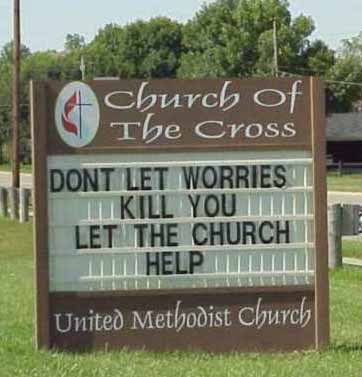
And then there’s those signs where you can’t help but wonder what led someone to put that up for everyone in the world to see. Like: “Don’t let worries kill you, let the church help” and “God answers our kneemail” and “Can’t take the heat outside? This church is prayer conditioned.”

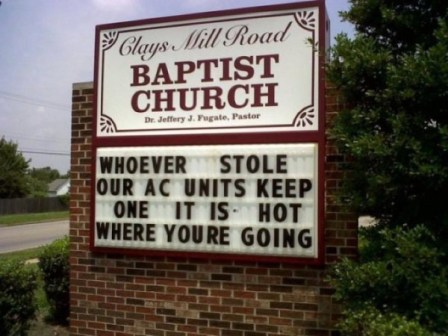
But there is one church sign that takes the cake, one sign that was so poignant that it has stuck with me over the years. In big blocky letters it said, “To whomever stole our AC unit. Keep it. You’ll need it where you’re going…”

ayFBmy2

And for every funny, and witty, and strange church sign, there are an equal number of terrible, shameful, and problematic church signs.

I can remember driving with my family years and years ago when I saw a church with a sign that said, “No gay marriage: it was Adam and Eve not Adam and Steve.”

There was quite a controversy a few years ago in a small southern community where a few teenagers died in a car accident and a local church put up a sign the next day that said: “Honk if you love Jesus! Text while driving if you want to meet him!”

And last weekend, while I was driving down to Durham, NC, we passed a huge billboard in Richmond that said, “The End is near! Accept Jesus or go to Hell.”

These billboards and church signs shout at passing cars and pedestrians about the brokenness of the world and the desperate need to change here and now. They play into our fears and frustrations, they tap into our emotions, and they make it all about us.

Notice, the signs I described, they’re almost all about our experience, and our need to change, and our sin. Very few church signs are actually about God.

How strange.

1_churchKill

And, because we take our lessons from the world around us rather than from God’s Word, we’ve let this slip off the billboards and into the church. So much of what we do on Sunday mornings has become primarily focused on our experience.

We ask questions like, “What did you get out of church today?” when it’s actually about what God gets out of us.

We preach and hear sermons that end with “let us now go and do likewise” instead of reflecting on how God is the one moving in and through us.

We make church all about us, instead of about God.

Our text from Paul’s letter to the church in Thessalonica is apocalyptic. Apocalyptism is one of the frightening words we tend to avoid at all costs. When we hear the word our minds immediately flock to frightening movie scenes, and fire raining from the sky, death and destruction all around. We think about the people wearing signs on street corners or the not-so-subtle church billboards near the highway.

But apocalyptic writing is nothing more than the revelation of God. It is an experience of the presence of the divine that breaks down every barrier for humans in the universe.

These kind of writings and reflections rise to the surface whenever Christians feel pressured by the world; when oppressive regimes like Rome, or slavery, or the system itself rises to power, they put all of life’s choices into the binary of God or the devil. And hope for God’s in breaking, God’s revelation, may be all that keeps us going when everything feels like it’s falling apart.

It should come as no surprise that considering what has taken place across the American landscape over the last year, many people, Christians in particular, believe we are in the end times.

Evangelicals feel attacked and belittled by the federal government for just about everything under the sun.

Pastors lament from the pulpit about the so-called war on Christianity or the war on Advent and they strive to frighten their people into recognizing the apocalypse at hand.

Even Roy Moore, the current Alabaman Republican candidate for a Senate seat, in light of all the accusations coming in for sexual harassment and misconduct, he has denied them vehemently and labeled them an attack on his Christian identity and virtue.

Fear is a very powerful tool. Manipulation always takes place when individual fears are tapped into.

That’s why political races are won by showing what’s wrong with the other candidate rather than addressing what a particular candidate wants to see happen.

It’s also why children are experiencing the highest levels of anxiety in modern history because they feel pressured to perform well, rather than being celebrated for what they’ve accomplished.

And it’s why churches put up big billboards with slogans like “Accept Jesus or Suffer The Consequences” rather than “Jesus loves you.”

Today, there is so much going on that there is plenty of pressure for us to forget that we are citizens of the age yet to come.

Fear is powerful.

And even here in Paul’s letter to the Thessalonicans, he appeals to their fear:

You all of all people know that the day of the Lord will come like a thief in the night. The world might seem nice and good, but that’s exactly when the sudden destruction will arrive, like labor pains in a pregnant woman, and there will be no escape!

            But unlike the billboards that speckle our American landscape, unlike the 24-hour news cycle that is almost entirely devoted to political fears, Paul raises the issue of revelation not for fear mongering, but for encouragement.

1Th5

The world might be falling apart, but we are not in darkness. We are children of the light and children of the day. We cannot become blind to who we are and whose we are, we must remember our truest identities and what has been done for us. So, let us clothe ourselves with the breastplate of faith and love, and for a helmet we shall wear the hope of salvation. For God has destined us for greater things; not for wrath, but for obtaining salvation through Jesus Christ our Lord. Therefore, do the good and right work of encouraging one another, and build up each other.

Paul, throughout the centuries, fills our ears with the very words we need to hear: Stay the course, remember we belong to the light, trust God and trust God’s promises, build the kingdom, love one another.

All of those things would be far better on a church billboard than most of the stuff we see on a regular basis.

On Sunday afternoon, shortly after most of us left the church, I received a phone call from our Secretary, Louise. Now, to be clear, Sunday afternoons are holy times for clergy people as they struggle to keep awake after struggling to keep people like you awake during church. So when I receive a phone call on a Sunday afternoon, right after being in this space with all of you, I know it’s important.

I answered my phone and Louise quickly filled me in one what had taken place right after I left… A drunk driver had crashed into our church sign.

When he came down the road he was traveling at such a high speed that when he smashed into the brick and mortar sign, it flipped the vehicle and it flew another 30 feet before it finally came to stop.

Police officers were on the scene and the driver had already been rushed in an ambulance to the hospital. He thankfully only suffered a few cuts and bruises, but when I got on the phone with the first officer he kept saying the same thing over and over again, “He’s lucky to be alive.”

IMG_1123

Thankfully, our sign that now stands broken and cracked on the corner of our property is not filled with any of the hateful rhetoric found on some other billboards. I say that with gratitude because the guy who crashed last Sunday easily could’ve died. He was going fast enough to end his life. And as I thought about what happened this week, as I read through Paul’s letter, I kept thinking about how terrible it would’ve been if those kinds of words were the last he ever saw.

Friends, life is far too short to be filled with negativity and fear and belittling attacks meant to manipulate. There is enough anxiety already in the world today. And when we think that all of this church stuff is up to us, and to us alone, we only increase the pessimism that so controls the world.

Paul writes to the church, and to us, and boldly declares that we have received a great gift in the death and resurrection of Jesus Christ. We have been awakened to God’s movements in the world, we have the privilege of living as God’s people in the light, and we get to experience the profound and wonderful mystery of resurrection here and now in and through one another.

We can, like others, spend our days worried about what will happen to us when we die. We can fall prey to the fearful signs that fill the horizons. But Christ died so that we may live.

Therefore, instead of breaking one another down, we build one another up. Instead of using fear to manipulate others, we give thanks for the love of God that has no end. And instead of cowering in the shadow of the cross, we rejoice in the light of the resurrection. Amen.

The Cost of Heaven

Matthew 13.45-46

Again, the kingdom of heaven is like a merchant in search of fine pearls; on finding one pearl of great value, he went and sold all that he had and bought it.

In my experience sermons are often very one sided. Someone like me, will stand in a place like this, and tell people like you, what God is saying. But sermons are meant to be more than a monologue, they need to be more than a lecture, they must be more than what I come up with in isolation.

So, I would like some of you to describe heaven for me. What do you think it will look like? Who will be there? What’s on the daily agenda?


There was once a man who lived a devout life and toward the end of his days God spoke to him and said, “I am so proud of the way you’ve lived that I’m going to do something I don’t usually do: I’m going to allow you to bring something with you to heaven. You may fill a briefcase with whatever you like and it shall be with you for eternity. Now remember I don’t often make this deal, so make sure you give it some thought.”

So the man did. For weeks and months he wrestled with what he would bring with him to heaven. He made pros and cons lists, he consulted his pastor (who was utterly bewildered by his question) and finally he decided on what to put in the briefcase.

Eventually the time came for the man to die and upon arriving at the Pearly Gates, St. Peter was patiently waiting to greet the man. St. Peter looked him up and down and said, “Hey man, look I’ve gotta ask: what’s in the briefcase? God never lets people bring something inside and he made an exception for you. So, can I see it?”

The man proudly opened his case and showed off 6 gold bars.

St. Peter stood there for a moment and then beckoned for the nearby angels, “Hey everybody, you’ll never believe it. God told this guy he could bring anything he wanted into heaven and he brought asphalt!”

In heaven the streets are paved with gold… Have you ever heard this before? Or maybe the image of heaven inside your mind is a cloud-like place filled with little fat cherubs floating around the air. Or maybe you think heaven is like a never-ending buffet with all of your favorite food.

the-pearl-of-great-price-daniel-bonnell

I get asked a lot of questions as a pastor. “How am I supposed to pray?” “Where is God in all of this?” “Should I tell my husband what happened?” But the question I’m asked the most, by far, is “What is heaven like?”

Today, when most of us think about heaven, the images conjured in our minds have far more to do with Hallmark than with scripture. Our hopes and dreams about our heavenly reward often reflect what movies and books describe than what the Lord describes.

I wonder if the crowds around Jesus were disappointed when he started talking about the kingdom of heaven. His parables, his long list of comparisons, contain nothing about pearly gates, or endless buffets, or even reuniting with long lost relatives.

The stories Jesus tells about the kingdom of heaven are down to earth, literally. At times he talks about the kingdom of heaven like a mustard seed. People disregard it and toss it away, but when it takes root it grows greater than any plant and won’t stop growing.

At other times he talks about the kingdom of heaven like yeast being mixed in with three measures of flour. When mixed and baked properly it would’ve been enough bread to feed hundreds of people.

At other times Jesus talks about the kingdom of heaven as a never-ending worship service. Which, to some people, sounds less like heaven and more like hell.

And more often than not, when Jesus talks about the kingdom of heaven he compares it to a wedding feast. I like the wedding feast connection because weddings are fun and full of joy and celebration. And, perhaps most importantly, there are always a couple people at the wedding who we never would’ve invited if it was our own, but God’s invitation is not like our invitation.

In today’s short passage, Jesus tells the crowds (and us) that the kingdom of heaven is like a merchant in search of fine pearls; on finding one pearl of great value, he went and sold all that he had and bought it.

Pearl of Great Price

More than a year ago I was down in Roanoke for the start of Annual Conference. Annual Conference is the once a year opportunity for United Methodist from all over Virginia to get together for prayer, worship, renewal, and church business. I arrived early last year to meet with some of my friends for breakfast, and half of us were about to be ordained in full connection. Though we had all served as pastors for a number of years, we had finally made it through the journey to kneel before the Annual Conference and would now serve the Lord as ordained elders.

And though the time at breakfast was filled with great joy and anticipation, there was also a dark cloud hovering over the gathering. The church is not what it once was and it’s hard to ignore how much it has changed. Gone are the days when one could assume that a church would grow simply by being in a neighborhood. Gone are the days when young couples and families show up on Sunday morning without an invitation. Gone are the days when the church is regarded with high esteem by the surrounding culture.

Last year, as it is now, the church is in a place where just having the doors open is not enough. The church is disproportionately skewing to an older age demographic. And the church is forever suffering under the weight of controversies like the Book of Discipline’s language about homosexuality.

So there we were at breakfast, sharing our excitement about joining the ship of Methodism in full connection, while the ship appears to flooding and without direction. We lamented the church’s current state of affairs, we offered opinions about how we might fix certain items, or how to change certain opinions, and then my friend Morgan interrupted everything.

He said, “I’ve been thinking a lot about Jesus’ parables recently, and one in particular. He tells the disciples that the kingdom is like a merchant in search of fine pearls; on finding one pearl of great value, he went and sold all that he had and bought it.” He had been looking down at the table up to this point, but then he raised his head and looked us in the eyes and said, “Do we still feel that way about the kingdom? I mean, are we willing to risk it all, to throw ourselves completely in? Or, at the very least, have we found a pearl in our churches?”

Today the church feels afraid. Few are willing to takes risks, we hold up frightening statistics as a way to guilt people into doing more, and we ask so many questions about the viability of the church going forward. But Jesus doesn’t transform life by scaring the hell out of people. No, Jesus transforms life by helping people like us see how heaven is close at hand.

Morgan’s question has haunted me for more than a year. With all the talk of negativity in the church, with all the fear and frustrations, Morgan turned it all upside down. Where is the pearl of great price in this place? What would I give up everything to possess in the kingdom?

When my son was one month old we brought him to church for the first time. I had taken 4 Sundays off to be at home with Lindsey as we adjusted to life with a newborn, but the time had come to return to the pulpit. I can’t tell you much about the service because I was so sleep deprived that most of it is a blur. But I will never forget the moment Lindsey brought him up to the front to receive communion. Without talking about it ahead of time I took the tiniest piece of bread, dipped it in the cup, and placed it in his mouth.

He has no idea what communion means or even what it is. But for the majority of his little life he has been in church every single week, learning the habits of God in worship, and receiving the body and blood of the one we call Lord. My son knows of no life outside the church. His life has been one defined by the movements not of the world, but by the liturgy.

And seeing him in church, watching him receive communion, hearing him say “amen” without even knowing what it means… I think I would sell everything to keep that.

On Thursday morning I got to church early after working on the sermon a little bit and I discovered a great crowd of people in our parking lot. There were volunteers from Cokesbury, Old Bridge UMC, and from the Salvation Army, and they were all working together to distribute food to those in need. There was no cash box at the front for community members to pay for the food, there was no expectation that they would ever repay us, and (perhaps most importantly) there was no judgment about the fact that they needed food.

I stayed toward the sides of our lot and took it all in for the first time, though I introduced myself to a handful of families patiently waiting for the food. There was one woman who kept her eyes on me while I was moving about and I eventually went up to introduce myself. As I got close she took my hand all she said was, “Thank you. This has saved my life.”

20369172_10209226181322580_3977426946611839100_o

Experiencing her salvation in our parking lot, seeing the wonder and joy in her eyes, feeling her hope… I think I would sell everything to keep that.

Tomorrow morning we are going to open our doors to all sorts of kids from the community for Vacation Bible School. Some will come from privileged families and will have been here before. Some will come from situations they won’t talk about though it will be clear that the food we offer them will be the first food they taste that day. And a few will come from somewhere in between.

Our volunteers will fill the halls with joy and hope and laughter as we do arts and crafts, as we sing and dance, and as we all learn more about the bible.

Seeing the children and volunteers working together, hearing children excited to learn more about God, seeing individuals interact with one another in a place like this… I think I would sell everything to keep that.

And all of them, from my son in worship, to the woman in the parking lot, to the children in our building will experience the grace of God and they will leave transformed without cost.

In the parable the man sells everything he has for the pearl of great value – the pearl of God’s kingdom is of such importance that merchant gives away his very livelihood to hold on to a little slice of heaven. More important than the money he uses to purchase the pearl is his willingness to trust that the gift of God’s kingdom is more important than any earthly thing.

Friends, the kingdom of heaven is at hand. It is not just some place waiting for us in the by and by, it is also something that we can experience here and now. Because the kingdom is something that God is doing, and it is to be received as a gift; a gift like the bread and the cup, a gift like food in a parking lot, a gift like vacation bible school.

The kingdom of heaven is not something that can be acquired, or earn, or purchased; it is a way of being into which we can enter.

This beautiful and brief parable from the lips of Jesus is not about the cost of heaven. It is, instead, a testament to the fact that our response to the kingdom is total, it is everything we have. To be joined up in to this kingdom of heaven on earth, the kingdom that is both here and not yet, means committing our whole beings, without reserve, and with totality.

The kingdom of heaven is a gift that transforms every bit of our lives here and now.

There is no amount of money on earth that can purchase salvation. As the old hymn goes, “Jesus paid it all.” But the parable begs us to ask ourselves the same questions that Morgan asked me, “Do we feel like the merchant? Are we willing to risk it all, and throw ourselves completely in? Or, at the very least, have we found a pearl in this place?” Amen.

Devotional – Psalm 27.4

Devotional:

Psalm 27.4

One thing I asked of the Lord, that will I seek after: to live in the house of the Lord all the days of my life, to behold the beauty of the Lord, and to inquire in his temple.

Weekly Devotional Image

Of all the questions I get asked, the one I hear the most is: “What’s heaven like?” I’ll be down in the preschool when one of the children will saunter over and randomly ask the question with their eyebrows askew. Or I’ll be sitting with a grieving family planning a funeral service when a new widow will ask the question as if she’s never really thought about it before. Or I’ll be working on a sermon in a coffee shop with my bible open on the table when a stranger will walk up to ask the question out of nowhere.

“What’s heaven like?”

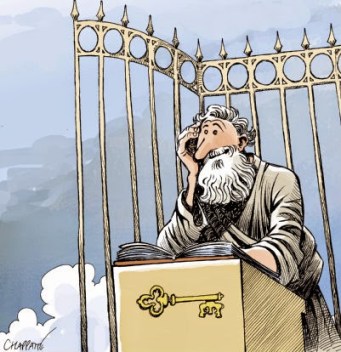
If Hallmark, the Lifetime channel, and uncles who tell bad jokes have anything to say about it, then heaven is a mysterious place in the clouds with fat little cherubic babies floating around playing harps, golden arches keeping certain people out, and Saint Peter sitting with a ledger.

st-peter-pearly-gates

If one of our preschool parents has something to say about it, then heaven (as she told her daughter) is a place filled to the brim with her favorite candy.

But if scripture has anything to say about it, then heaven is like a never-ending worship service. Which, to some people, sadly, sounds more like hell than heaven.

However, the bible is forever making connections between the worship of the Lord here and now, with the worship of the Lord in the New Kingdom. And not the announcements that always take to long to list at the beginning, and not the logistics of sitting down and then standing back up for hymns, but the beauty and wonder of encountering the beauty and wonder of the Lord.

The psalmist says the one thing worth seeking after is to live in the presence of the Lord each and every single day, to behold the beauty of the Lord, and to wonder and inquire in the house of God. In weekly worship, when we experience God’s faithful presence through a choice phrase in a prayer, or a melodic move in a hymn, or even a powerful sermon, we are catching a glimpse of heaven on earth. For when we gather in the house of the Lord, when we are confronted with God’s majesty, what could be better?

As Christians, we do well to seek out the presence of the Lord here and now as foretaste of the kingdom of heaven. We do it on Sundays when we gather together to proclaim and respond to God’s Word. We do it when we are invited to the table for communion. We do it when we sit with a friend and earnestly pray together. We do it when we hear God speak to us in the still small voice. And when we do, we receive an answer to the question, “What’s heaven like?”

Devotional – Genesis 15.6

Devotional:

Genesis 15.6

And he believed the Lord; and the Lord reckoned it to him as righteousness.
Weekly Devotional Image

“If you believe that God exists, and confess Jesus as Lord, you will go to heaven.” So said one of the staff members during our mission trip to Raleigh, NC last week. The youth were all assembled on the floor, they had shared their “Yea God” moments from the day, they had joined together for a few worship songs, they listened to a testimonial, and were now being offered a one-way ticket to glory. During the testimonial a few youth began to cry in response to the vulnerability of the young man sharing his story. The lights were dimmed to just the right degree. And then he hit them with the “If you just believe that God is real, and confess Jesus as Lord, you will go to heaven.”

However, there is a difference between believing that God exists, and believing God.

In a relatively recent poll, it was determined that 9 out of 10 American adults believe that God exists, and more than 40% of Americans say they go to church weekly. However, less than 20 % are actually in church on Sundays. In the US we have a considerably high number of people who believe that God, or some sort of universal spirit exists, but only a fraction of them believe God enough to gather with a regularly worshiping community.

tumblr_ny91sd9Df61s91yx0o1_1280

Believing that God exists is something that most people are willing to admit. When confronted with the totality of the universe they’ll confess that there might be someone, or something, behind the scenes. When they encounter a question without an answer, they are okay with assuming that “God” might be the answer.

But believing God is another story.

When Abraham was promised descendants more numerous than the stars, he did not simply believe that God exists in reality, but instead believed what God revealed to him. Abraham believed the promise.

When Moses discovered the burning bush, he did not simply believe that God was real, but instead believed what God revealed to him. Moses believed that God was going to deliver God’s people out of bondage.

When Jesus cried out from the cross, “Father forgive them, for they do not know what they’re doing”, he did not simply believe in the existence of God, but instead believed what God revealed to him. He believed in the power of God’s grace to forgive, even from the point of death.

We can believe God exists without much trouble or hesitation, because to believe God is real requires very little of us. But to believe God, to believe that God works in the world, that God makes good on God’s promises, that the Holy Spirit empowers us to serve and sacrifice, requires us to live radically different lives.

Let’s Talk About Heaven

Revelation 7.9-17

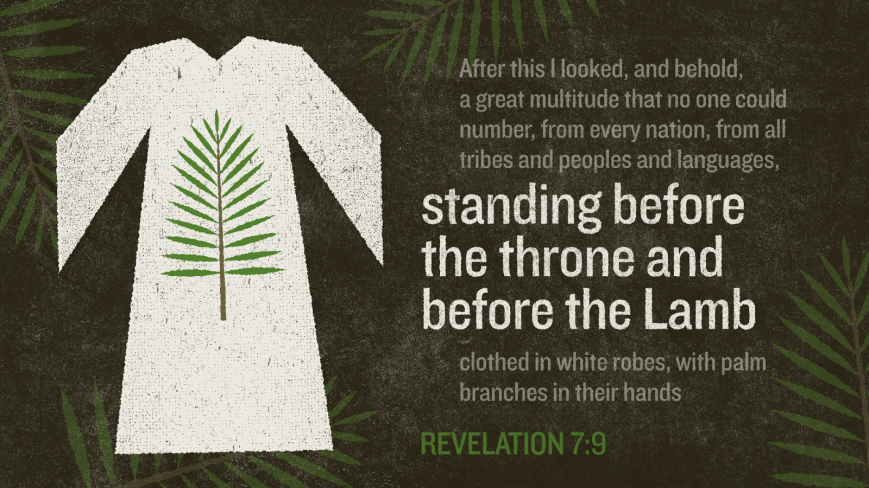
After this I looked, and there was a great multitude that no one could count, from every nation, from all tribes and peoples and languages, standing before the throne and before the Lamb, robed in white, with palm branches in their hands. They cried out in a loud voice, saying, “Salvation belongs to our God who is seated on the throne, and to the Lamb!” And all the angels stood around the throne and around the elders and the four living creatures, and they fell on their faces before the throne and worshiped God, singing, “Amen! Blessing and glory and wisdom and thanksgiving and honor and power and might be to our God forever and ever! Amen.” Then one of the elders addressed me, saying, “Who are these, robed in white, and where have they come from?” I said to him, “Sir, you are the one that knows.” Then he said to me, “These are they who have come out of the great ordeal; they have washed their robes and made them white in the blood of the Lamb. For this reason they are before the throne of God, and worship him day and night within his temple, and the one who is seated on the throne will shelter them. They will hunger no more, and thirst no more; the sun will not strike them, nor any scorching heat; for the Lamb at the center of the throne will be their shepherd, and he will guide them to springs of the water of life, and God will wipe away every tear from their eyes.”
agnus-dei-window-1024x768

The couple had recently celebrated their 60th wedding anniversary when they tragically died in a car crash. They were in relatively good health at the time, mainly due to the wife’s dedication to their diet and forcing them to both get exercise, but when the crash occurred they were immediately brought before St. Peter and the pearly gates.

After a quick check-in, much like the first minutes at a tropical resort, St. Peter volunteered to give them a tore of their heavenly abode. The mansion they would be calling home for eternity was filled with more rooms than they could count with a beautiful kitchen, swimming pool, and movie theater in the basement. As the wife squealed in delight with every passing accommodation, the husband grew skeptical and finally leaned over to Peter and asked, “So how much is this going to cost?”

Peter, flabbergasted, replied, “It’s free, this is Heaven.”

Later, they toured the endless golf course that started in their backyard. With perfect rolling hills that they could only have imagined on earth, they took in the beauty that was available whenever they wanted. The old man, again, asked Peter, “So what are the green fees?

Peter replied, “This is Heaven and you play for free.”

Finally Peter brought the couple to the clubhouse that was filled with people from their lives that they had loved and lost. The joyful reunions went on for some time until Peter motioned for the couple to go through the lavish buffet that had been prepared. The old man, still skeptical, quietly asked Peter how much the food would cost.

Peter, now growing frustrated, said, “Don’t you understand yet? This is Heaven, it’s all free!

The old man stood still and then asked, “Well where are the fat free and low cholesterol tables?”

Peter then began to lecture, “That’s the best part. You can eat as much as you like of whatever you like, and you never get fat or sick. This is Heaven!

Immediately the old man went off with a fit of anger, throwing down his hat and stomping out of the clubhouse.

Peter and the wife both tried to calm down the old man and asked what was wrong. The old man looked at his wife and said, “This is all your fault! If it wasn’t for your diet and exercise, I could have been here ten years ago!

What’s heaven like? I get asked this question on a pretty regular basis. I might be in my office with a grieving family who just lost someone they loved and someone will ask what the person is now “doing” in heaven. Or I’ll be here in the sanctuary teaching a lesson to the preschoolers when the subject of heaven comes up and one of them will say something like: My mommy told me that heaven is full of your favorite candy, and you can have as much of it as you want!

What’s heaven like? There are a decent number of times when scripture is descriptive about the beyond, but it is a far stretch from the jokes and movies many of have experienced on the subject. John caught a glimpse of the heavenly glory of God’s presence in a vision and described it like the grandest worship service to have ever occurred. Countless beings that have made it through the great tribulation surround the throne of the Lord where the Lamb is in the center. They sing with full voices and praise the Lord unceasingly for his majesty is beyond comprehension.

Rev 7v9

The problem with talking about heaven is that whatever we say, it is speculative at best. We can point to scripture where it is described, but the descriptions are made in such a way that heaven is beyond our comprehension. The whole point of heaven after all, is that it is totally other from earthly life. It is beyond life. It is glory and wisdom and thanksgiving and honor and power and might in a way that is impossible for us to understand during our earthly lives.

And even though we can only hint at what heaven might be like, it has become the pinnacle concern for many churches and Christians. What do I have to do to make it to heaven? Or what do we have to do in order to get other people to heaven? These questions dominate our thoughts and we grow anxious about whether or not we, and the people we love, will go on to our heavenly reward.

When talking about heaven, there is a strong temptation to make it so appealing with comparisons to earthly beauty that we neglect to think about the fact that we are called to exist here on earth until our deaths. But this text, this worshipful understanding of heaven, lets us know that God never promised we would not suffer. In fact the opposite is true. Suffering has always been part of our story, and even we here in the blessed region of Western civilization are not immune.

Only in death can we receive the gift of resurrection. It was only through Christ’s crucifixion that he could one day be raised again. The same holds true for us. Only when the bell tolls for us will we share in Christ’s victory over death.

And yet we still talk about it all the time. It is good and right for us to celebrate Christ’s resurrection, but when daydreams about our everlasting reward later prevent us from serving the needs of others right now it becomes cheap grace.

In many churches, like the ones most concerned about whether others are going to heaven or hell after they die seem less concerned with the hells on earth right now. Here in scripture John is confronted with the suffering of the great multitude before they arrive at the throne. They are granted a peace they did not have on earth: they will not hunger, nor thirst, the sun will not strike them, nor any scorching heat because the Lamb of God has shepherded them to the springs of life where God wipes away all tears. But before we can rejoice with the Lord in his divine kingdom, we will endure tribulations in our earthly lives.

Imagining that our lives will be free from suffering is what often leads people to leave the church when something goes wrong. I know too many people my age who were forbidden from attending funerals as children, and then when they finally attended a funeral for the first time when they were older they fell away from the church. I also know too many people who lived such perfect and sheltered lives that when they encountered true poverty for the first time they were overwhelmed by the brokenness of the world and have been unable to return to church.

The church is supposed to be the alternative to this overly rosy view of the world. We have the church to help us remember exactly what God has promised, and what God has not. The church is the place where we confront the hardships of life and rely on the people in the pews next to us to help us through the great tribulations we experience. We are not here to prance around pretending that we have perfect lives without suffering, but instead to proclaim that in trusting the Lord we will find the strength and courage to sustain us until that time when we will join Jesus in the victory over death.

The church is the means by which we combat the hells we experience on earth by attempting to give people hope and faith in something greater than earthly life can offer.

bigstock-Cross-against-the-sky-24690071-panorama

In this church, at St. John’s, we strive to help guide and nurture one another through a variety of means. We have bible studies for the young and the old to help us wrestle with how scripture can speak into our everyday experiences. We collect food and clothing and money for others who are desperately in need. We send people on mission trips to build and plant new foundations and relationships for people who really feel like they are living in hell right now.

But we also have a woman here in the church who has made it her calling to help nurture people in the midst of suffering in the best way she knows how. I believe that Dianne Wright is keeping Hallmark in business through the countless cards she sends out to the community. If you’ve been coming to this church for any regular period of time, and have had so much as a cold, you’ve probably received a card from Dianne Wright. They are always thoughtful, they are always written with purposeful words, and they are always filled with love.

I have the added benefit of not just receiving cards when I need them, but I visit enough of you and our shut-ins to know how prized these letters have become. I was visiting someone at King’s Daughters recently when I saw the familiar script sticking out of the cards adorned in a row on the window sill. The woman I visited described them as the most precious gift she had received since she went in to rehab.

Time and time again I will find myself visiting someone and the subject of Dianne’s cards will come up. They might appear to be a simple and casual gesture, but they speak volumes in the realm of how we are sustained by God’s grace through our neighbor Dianne.

As Christians, we are called to combat the countless hells on earth that plague people through our love and presence. For Dianne Wright, this has meant a ceaseless commitment to communicating through cards the love, depth, and peace of God.

Each of us, in some way shape or form, has gifts that we use to share God’s love with others. Perhaps we have the freedom to visit with people who can no longer visit us. Maybe we, like Dianne, have a penchant for penning letters. Perhaps we have been blessed with lucrative careers that allow us to give charitably to help others. Maybe God has molded us with a spirit of prayer and we can lift up the world through our clasped hands. Perhaps we have become familiar with a particular need in the world and all we need is a little nudge to start serving God by serving others. Maybe we have toyed with the idea of a calling to the ministry and we just need to take a step in faith that God can use us to spread the gospel. Perhaps we have the gift of carpentry like Jesus only we’ve been too nervous to ask someone we know if they need any repairs. Whatever our gift might be, God is calling us to use them to draw people into moments of heaven on earth.

When our time comes God will do with us what God wants. In God’s infinite wisdom and glory we will surround the throne and join in one voice with the saints who came before us, and with the saints who will come after us. We will be washed with the blood of the lamb and God will wipe away every tear from our eyes.

We know not when we will gather with the great multitude, but each day God gives us is a gift. A gift we should celebrate by being a gift for others. Amen.