Devotional – Luke 9.35


Devotional

Luke 9.35

Then from the cloud came a voice that said, “This is my Son, my Chosen; listen to him!”
Weekly Devotional Image

When I was in seminary we had all sorts of assignments that were designed to get us engaged with scripture. When I took a class on the gospel according to Mark, I was required to read all 16 chapters out loud, in my spare time, at least once a week. When I was learning about biblical Greek, I was tasked with memorizing the Lord’s Prayer in Greek and I would mutter it under my breath everywhere I walked on Duke’s campus. And when I was enrolled in a class on the art of preaching, I had to work with a group to come up with a strange and exciting way to bring a scriptural text to life.

My group broke up parts of the worship service; one person would do the call to worship, one person would lead the rest of the class in singing a few hymns, one person was responsible for all of the prayers, and I was assigned the “sermon” section. Rather than waxing lyrical about the particular text (Jesus’ Transfiguration) we agreed that I should just retell the story in an exciting and dynamic way.

I prayed over the text during the days leading up to the worship service and decided that I would tell the story of Jesus’ Transfiguration from Peter’s perspective, from the future looking back on the incredible event. Like a lot of group of assignments, it felt like everything was just thrown together, but we were confident that God could make something out of our worship.

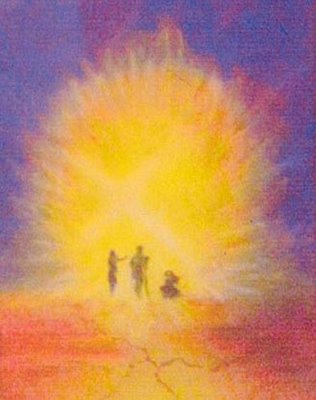
Transfiguration-3

When the day of the assignment arrived, everyone in the group nailed their respective parts and I eventually had to stand before the gathered class and give my rendition of the Transfiguration. As I went on and on as an older Peter remembering the past, I could tell that the class was starting to lose interest, so I started elevating my volume and delivery. I began building the story up through a crescendo until that pivotal moment when Jesus was clothed in white and everyone in the room went wide eyed. I, at first, thought that my command over the scripture had blown the class away, but I soon realized what had happened: While I was talking, one of my peers had slowly started to dim the lights in the room until it was rather dark (I was so focused on what I was saying that I didn’t even notice it). But then at the exact moment I described the dazzling whiteness of Jesus’ garment, she turned on the projector and I started to glow.

Transfiguration Sunday is an important event in the liturgical calendar as we bask in the glory of Christ right before we enter the season of Lent on Ash Wednesday. Important for us is a willingness to be knocked back by the dazzling power of Jesus’ life and work. We take the time to be blown away, just like Peter was, by how God’s love really knows no bounds.

This week, as we prepare to celebrate the Transfiguration, let us look for moments where God’s glory shines in our midst. We might see it in a perfect sunset, the laughter of a child, or in the still small silence of prayer. And whenever it happens, let us give thanks for the glory of the Lord.


God Is God And We Are Not – Sermon on Psalm 24

Psalm 24

The earth is the Lord’s and all that is in it, the world, and those who live in it; for he has founded it on the seas, and established it on the rivers. Who shall ascend the hill of the Lord? And who shall stand in his holy place? Those who have clean hands and pure hearts, who do not lift up their souls to what is false, and do not swear deceitfully. They will receive blessing from the Lord, and vindication from the God of their salvation. Such is the company of those who seek him, who seek the face of the God of Jacob. Lift up your heads, O gates! and be lifted up, O ancient doors! that the King of glory may come in. Who is the King of glory? The Lord, strong and mighty, the Lord, mighty in battle. Lift up your heads, O gates! and be lifted up, O ancient doors! that the King of glory may come in. Who is this King of glory? The Lord of hosts, he is the King of glory.

P-019-w_I_Am_Not_God.37205641_std

Be careful.” That’s what they kept saying when they found out I was invited to preach at a church in the heart of Detroit. I had been living in Birmingham, Michigan (a rather wealthy suburb north of Detroit) helping serve a church for the summer when I received the opportunity to fill in at another church one Sunday. And as soon as I was asked, all the warnings started coming in: “Be careful” “Park as close as possible to the church” “Keep your wallet in your front pocket.

I remember thinking these people were crippled by fear, how bad could it really be? We were talking about driving into Detroit on a Sunday morning to preach at a church…

When the morning arrived I was filled with excitement. I picked out the perfect bow tie to go with my blazer, hoping to assert my authority regardless of my young age, I had a prepared a theologically profound manuscript sermon, hoping that it would get people to shout “amen!” from the pews, and I spent the long drive down Woodward Avenue in silence, hoping to boost my holiness before the service began.

The closer I got to the church, the stranger I began to feel. I hadn’t noticed it at first, but the longer I drove, the less people I saw on the streets. The buildings went from inviting homes and businesses to abandoned shells of carpentry. The streets went from well maintained to pot holes that required a car to drive up on the sidewalk in order to avoid.

In a matter of minutes I had gone from “Pleasantville” to a post-apocalyptic movie set, and my excitement was quickly replaced by fear.

By the time I pulled in the parking lot, I realized that I hadn’t seen another human being for at least ten minutes. The streets had been largely deserted leading up to Cass UMC, and it was strangely silent when I stepped out of my car.

So here I was, standing in the heart of Detroit, in a bowtie and blazer, with a bible and sermon tucked under my arm, completely alone on a Sunday morning.

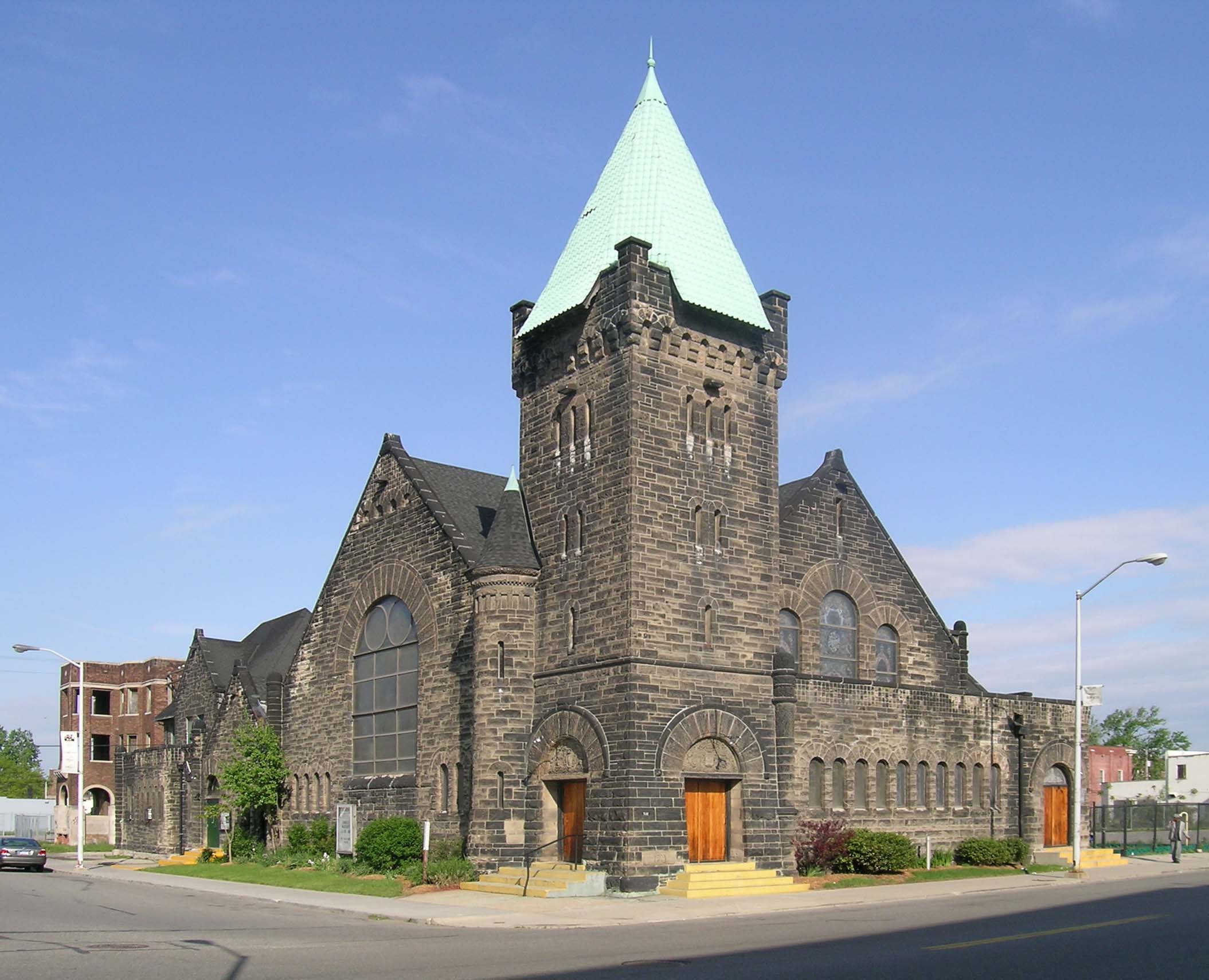
My footsteps across the concrete reverberated in echoes through the abandoned buildings flanking the church and even though it was a bright sunny day, I felt like I was walking down a dark alley in the middle of the night. The building itself was an architectural masterpiece having been built in 1883 with Tiffany’s stained glass windows, though I could tell from the street that bullet holes had cut through the once remarkable windows.

When I reached out my hand to open the doors, the height of my new fears were realized: It was locked.

Cass_Avenue_Methodist_Episcopal_Church_-_Detroit_Michigan

I knew no one from the church, I had no way to contact anyone, and all of the warnings started to really flow through my mind. But I did what any good pastor would do, I sat down on the front steps and waited for someone to open the door.

30 minutes later, a disheveled looking old man, the first person I had seen in a long time, peeked from around the corner, walked up the steps, and unlocked the front door without saying a word. I wandered around the building until I found the sanctuary, searched in vain for a worship bulletin, and resigned myself to sit down in a chair by the altar.

During the next hour, the most random assortment of people started flowing in through the sanctuary doors. The church, once renown in the heart of Detroit, was being filled with people who slept outside the night before, people who had no money to put in the offering plate, and people who were having conversations with themselves at a volume loud enough for everyone else to experience.

A group of 7 older black women arranged themselves on folding chairs near the front, and without really discussing it they all flipped their hymnals to the same page and started to sing. A man with wrinkled fingers was hunched over a piano in the corner struggling to keep up with the singing, and a young man had seated himself behind a drum-set hidden in the corner, and was wailing away to a song that only he could hear.

When the first hymn ended, the women huddled together to pick another hymn and began singing. At some point in the middle of their fourth hymn, with the pianist still planking away, and the drummer smashing the cymbals, a gentleman stood up in the middle of the sanctuary with his eyes trained on me. He walked down the main aisle slowly and deliberately until he was towering over me and then declared, “Son, if you don’t start talking, they ain’t liable to quit singing.

The earth is the Lord’s and all that is in it, from the sea to the mountains, from the rivers to the deserts, from the people to the animals; for the Lord has founded life upon the earth. Who then shall worship the Lord in holiness? And who shall stand with the Lord in the holiest of places? Only those who have clean hands, and pure hearts, those who do not lift up their souls to what is false, who do not break their promises. They will receive a blessing from the Lord, and vindication from the God of their salvation. Such is the company of those who seek the Lord.

I stood up after the end of the next hymn, and grabbed the hand held microphone to start participating in worship. I felt like a fool standing in my khakis and blazer, with my bowtie tilted just slightly to the side. I felt ridiculous with my over examined sermon under my arm, and bible in my hand. I felt like I didn’t deserve to stand before the congregation, but all of their eyes were on me. (just like all of yours are right now)

I took off the jacket and tie, rolled up my sleeves, ditched the sermon on my chair, and let the Holy Spirit go to work.

Let us pray” I began, and before I could start praying for our service, the people started shouting out their own prayers. “O Lord, help this boy to preach.” “Yes Lord, show us your mercy.”My God show me your glory!” “Remove our sins, give us your Spirit, clean our hearts!” “Your will be done!” “Have thine own way Lord!” “Help this boy preach, preach preach.

It was only after a few moments of silence that I finally said “amen” without having added any of my own prayers.

I preached on the apostle Paul’s second letter to the church in Corinth, about the new creation that comes in knowing Christ. I talked about moments that transform our lives. I said things like “there is a new life in Christ, but just because we find Christ it doesn’t mean our life will get better, but that we are called to make other lives better.” And instead of the typical, and silent, congregation I was used to, the people kept shouting at me while I preached. “Ain’t that the truth!” “Yes Lord!” “We know it, we know it” “Lord, give him strength to preach.” “Speak through him God.

When I got around to the close of the service, when I offered a benediction to the congregation, when the final amen was uttered, I heard them say in return, “Thank you Jesus.”

be-still-and-know-that-i-am-god-960x250

Lift up your heads, O gates! Open up you ancient doors! the King of glory is coming. Who is the King of glory? The Lord, strong and mighty, merciful and majestic, the Lord. Jesus Christ the author of salvation, the Good News, the Messiah. The Holy Spirit full of wisdom and truth, giver of life, and partner to our prayers. Lift up your heads, O gates! Open up you ancient doors! The King of glory is coming! Who is the King of glory? The Lord of hosts, he is the King of glory.

We can dress the part, we can read all the right books, we can memorize all the hymns and prayers, but unless we are looking for holiness in our lives, unless we are ready to bow down to the King of glory, then we are forgetting the truth: God is God and we are not.

Many of us are good Christians, we pray for our friends and family, we come to church, we put money in the plate, but there is a profound difference between believing we are holy, and wanting to be holy.

When I arrived at that church in Detroit years ago, I foolishly thought I was bringing something to them. With my well prepared outfit and sermon, I made the assumption that I was bringing God with me, nice and shiny, like a school project. I became my own main character in the story of worship, and it prevented me from seeing the King of glory.

When I stood up in the pulpit to proclaim the words, the people did not see a young man with a seminary education, they did not see some white fool trying his best to not pass out, they saw a vessel for the Lord. Their prayers were not to me, but for the Lord to work through me. The recognized the great division between God and me, and knew that Jesus was the bridge between the two.

They knew that God is God and we are not.

In our contemporary American culture, we tend to view ourselves as the center of the universe.

We assume that everything revolves around us, and that so long as our needs are being me, then everything else should be fine.

We believe that if we wear the right clothes, and get the right education, that holiness will follow accordingly.

We feel holy for giving up an hour every week to sit in a place like this and sing hymns, offer prayers, and listen to a sermon.

That church in Detroit had something that I never knew I needed: They believed that God was the center of the story, that God had the power to transform their lives, and that God really was the King of glory.

Too many of my friends have left the church because they “didn’t get anything out of it.” They might try different styles of worship and different denominations, but if they don’t get anything out of it, they will rarely return. However, church isn’t about what we get out of it, its about what God gets out of us.

Believing we are already holy limits God’s power to make us holy.

It is in the recognition of the great divide between humanity and the Lord that we can let Jesus get to work on our hearts and souls. It is in the great admission of Jesus as the King of glory we start to see ourselves, not as the center of the universe, but instruments for God’s love to be heard in the world. It is in the words of our worship that we recognize the Holy Spirit’s movement in our midst and our lives start to change.

If we remain in the assumption of our holiness, then our lives will stay the same.

But if we truly desire for the Lord to make us holy, then our lives will be transformed. Amen.

The Johns – Sermon on John 15.9-11, 1 John 2.15-17, and Revelation 21.1-5

John 15.9-11

As the Father has loved me, so I have loved you; abide in my love. If you keep my commandments, you will abide in my love, just as I have kept my Father’s commandments and abide in his love. I have said these things to you so that my joy may be in you, and that your joy may be complete.

1 John 2.15-17

Do not love the world or the things in the world. The love of the Father is not in those who love the world; for all that is in the world – the desire of the flesh, the desire of the eyes, the pride in riches – comes not from the Father but from the world. And the world and its desire are passing away, but those who do the will of God live forever.

Revelation 21.1-5

Then I saw a new heaven and a new earth; for the first heaven and the first earth had passed away, and the sea was no more. And I saw the holy city, the new Jerusalem, coming down out of heaven from God, prepared as a bride adorned for her husband. And I heard a loud voice from the throne saying, “See, the home of God is among mortals. He will dwell with them; they will be his peoples, and God himself will be with them; he will wipe away every tear from their eyes. Death will be no more; mourning and crying and pain will be no more, for the first things have passed away.” And the one who was seated on the throne said, “See, I am making all things new.” Also he said, “Write this, for these words are trustworthy and true.”

IMG_0058

“Taylor, the bishop is appointing you to St. John’s United Methodist Church in Staunton, Virginia. We believe the church fits with your gifts and graces and we are excited to see what the Holy Spirit can do through you there.” Those were the words used to let me know where I would be spending the next few years of my life. I remember how I felt with the phone next to my ear and Lindsey by my side when I found out that I would be coming here to serve this church.

Obviously, for the next few days all I could think about was the church and the community. What would you all be like? Would we enjoy living here? What would we do for fun? How would you respond to me as your pastor?

Of course I Googled the church, searched the church name in the local newspaper databases, and even looked up the address of the parsonage. And for as many things as I could discover, more questions began to develop to the point where I had to just stop and accept that this is where I was going.

However, one question remained in the back of my mind during the months leading up to my first Sunday. I was fine letting everything else go, I was content with the unknown, except for one thing: Why St. John’s?

Now I don’t mean why this church out of all the churches in the Virginia conference, though I have wondered about that at times. What I mean is this: Why is the church named St. John’s?

Do any of you know? Church naming often carries an interesting history. Like when a group of people from a Baptist church grow frustrated with another group and decide to leave and start a new church with the ironic name of Harmony Baptist.

Or like what we have here in town with 1st Presbyterian, 2nd Presbyterian, 3rd Presbyterian, etc. I would love to know the story behind that.

Anyway, why are we called St. John’s?

The story goes that a long time ago there was a particularly advantageous District Superintendent who dreamed of 4 new churches in the Staunton District. The population was booming in the valley and he believed it was time for the Methodist Church to start breaking ground and forming church homes for new people. He wanted 4 new churches and he wanted them to be named after the gospels: Matthew, Mark, Luke, and John. Though only two of them ever came to fruition: Mark and John.

Now, is that really how we got our name? I have no idea, but thats the story everyone seems to tell.

I want to know if thats the story we want to tell. That the name of this blessed house of the Lord got its name from some guy in the past who wanted to leave his mark in Staunton. Or do we want to take ownership of our name, and live into the reality of what it means to be St. John’s?

Our name is part of who we are, it is a part of our very identity, for better or worse. If we were First UMC I would expect that we were the first to break ground in Staunton, that we would be leading the community in what it means to love one another. If we were Harmony UMC I would expect a church full of people who agreed on everything all the time, no matter what. If we were Wesley UMC I would expect that John Wesley would be fundamental to our mission and work in the kingdom.

But if we call ourselves St. John’s, then who are we?

IMG_0063

On the right side of our sanctuary we have three stained glass windows that I call The Johns. We have John the Evangelist, John of Patmos, and John the Presbyter. Do they represent three different and distinct men? Are they in fact all the same person, just being shown throughout the different decades?

Early Christian tradition held that John was one of the original 12 disciples who actually lived a long life and was not killed for his faith like the others. It is believed that he was responsible for writing the gospel according to John, the letters 1-3 John, and the final book of the New Testament Revelation. Of course modern scholars debate as to the particular authorship and whether or not one man was responsible for all of these different writings.

What is important for us is the fact that we affirm all of the writing as canon and life-giving, that Christians for centuries have come to discover the living God in the words attributed to John, and that we will continue to live into our discipleship through them.

Our first window displays the young John as the Evangelist. Today when we hear the word evangelism we tend to picture people converting others to follow Christ, but in its most simple meaning, an evangelist is someone who shares the Good News, and in this case, it came through a written account of Jesus life and ministry.

We see a young John holding a chalice and the image of an eagle. The chalice serves to emphasize the importance of the sacrament, and the pouring out of Jesus blood for us. Throughout the gospel of John, Jesus’ atoning sacrifice is a particular focus and theme. Reflecting on Jesus life later, John could remember everything through the lens of the resurrection, and we see the importance of Jesus’ life here in the chalice.

The other detail, the eagle, is very interesting. In Revelation, a book we will talk about shortly, there is a brief section where John describes four winged creatures from his dream. Each of them have come to represent a specific gospel and it’s respective author: Matthew is a man with wings, or an angel; Mark is a lion; Luke is an ox; and John is the eagle.

Whenever our eyes fall to this window we are called to remember the Father’s love in Christ Jesus. Like the winged eagle flying high in the sky we look up to the kind of love that Jesus exemplified and strive to live accordingly. The great sacrifice was made so that our joy could be complete in and with one another as we look on eternity without flinching as we journey toward the goal of communing with the Lord.

John the Evangelist wrote what he did to remember for us what his master taught him: As the Father has loved me, so I have loved you; abide in my love.

Our second window, the one to the right, contains John as the Presbyter. Presbyter comes from the greek word presbuteros which means “elder.” As John grew older and continued to play an integral role in the formation of the early church, it became necessary for him to write letters concerning the faith.

In the window we see a mature John with a quill and parchment. Like we still do today, whenever we encounter the struggles of fellow disciples, we strive to help them through their trials and tribulations. For John, having lived with Christ and experienced the true power of the resurrection, he devoted himself to the early Christians and helped them to understand the importance of love.

He wrote things like: “Do not love the world or the things in the world.” Only a man speaking from a life of wisdom could make such a statement. The desires of flesh and the prides in riches only serve to destroy us because they wither away. All of the false things that we put our faith and hope in are passing away, but the love of God endures forever and ever.

Whenever we glance to this window of John as the Presbyter, we are called to remember the value of wisdom and what it means to grow together. Being Christian is not something that can be done in isolation, but instead can only be fruitful and life-giving if we disciple as a community. John wrote letters to encourage and remind the faithful what it means to be faithful. As disciples we have the responsibility to build one another up for kingdom work.

John the Presbyter wrote to Christian communities about what faithful living was all about: those who do the will of God live forever.

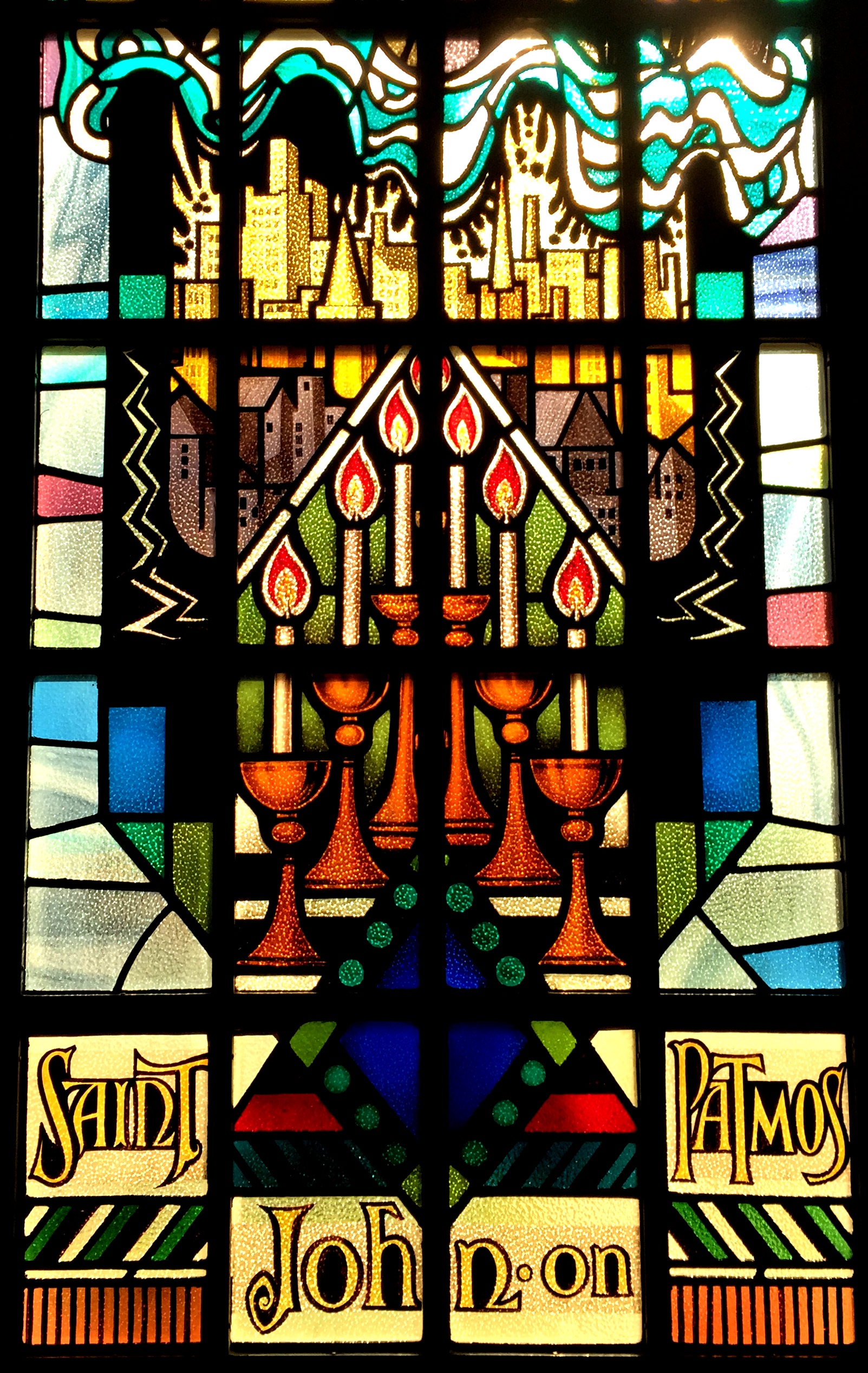
The third window, in the middle, contains John on Patmos. After a life of faith, John was exiled away to Patmos, a small Greek island in the Aegean Sea where he wrote about his visions. The book of Revelation contains fantastic imagery of the way God has, is, and will move  in the world. Our final John is older with a fiery city at his feet, and the new Jerusalem above his head with the lamb.

The Lord gave John certain visions and told him to write them down because they were trustworthy and true. Our window displays the height of the revelation when God will make all things new. A holy city, the new Jerusalem, will come down from heaven. This is where God will dwell with the people, God will wipe away all of our tears. Death will be no more; mourning and crying and pain will be no more. The first things will pass away because God will make all things new.

In our window we see the former things, the earthly passions of the world at the bottom passing away. But God has not, and will not, abandon us to our own devices. The new city at the top will reign and the kingdom will be forever. 

Whenever our eyes fall upon this window we remember that the Lord is with us now and forever. That even in our death we will come closer to the new heaven and the new earth that the Lord has promised. In the midst of our grief and suffering now we can still give thanks to the Lord for that day when he will make all things new. This window calls us to trust the Lord just like John did throughout his life.

John on Patmos wrote down the visions the Lord had provided so that others would come to know what the future holds: The Lord will dwell with us and make all things new. 

St Johns logo

Who are we? A group of Christians who get together week after week to rediscover what it means to follow Christ? A ragtag collection of disciples who need to find a little more light in our lives?

If we want to live into our name, then we need a better story than being named by a District Superintendent. If we want to be the St. John’s that God is calling us to be, then we need to reclaim what that name means for us.

We are St. John’s. That very name carries with it the history of what our church has done for this community. Wherever I go in Staunton I love to tell people that I serve as the pastor here at St. John’s because our name is immediately met with recognition; “My children went to Preschool there!” “My wife and I were married in that sanctuary.” “We buy our Christmas tree from your church every year.”

But we are also more than what we do. Our identity is firmly rooted in the name of John and we should be proud of it. We were named after a man who was called to follow Jesus, remembered the Messiah’s life for other communities, wrote to churches about faithful wisdom, and caught glimpses of future glory. 

Likewise, we are a community of faith that believes in following the Lord, in sharing God’s story with other people, in teaching those younger in the faith about what it means to love, in celebrating the coming day when God will make all things new.

St. John’s; what a perfect name. Amen.

Devotional – Luke 1.37

Devotional:

Luke 1.37

For nothing will be impossible for God.

Weekly Devotional Image

Our parsonage is beautiful. One of the many blessings of serving as a pastor for a United Methodist church is the fact that the local church often provides a parsonage for their pastor and family. I’ll freely admit that I was slightly nervous before arriving in Staunton for the first time because I would have no say about where I was living. Whereas other families can pick and choose a residence based upon their proclivities, I would be stuck with whatever St. John’s provided. However, when I began moving my belongings in, I realized how very fortunate I was.

Providing a parsonage is an incredible act of grace and generosity, one that I try to not take for granted. Whenever I pull into the driveway after a particularly stressful day at the church, I give God thanks for the people of our church community and their willingness to provide such a wonderful gift for my family. I am proud of the parsonage and I look forward to the changing seasons as an opportunity to adorn the house with different holiday elements.

Yesterday afternoon, my wife and I invited everyone from the church community for an open house at the parsonage. Part of our decision was born out of the fact that the parsonage belongs to the church, and we wanted to express our thankfulness for their generosity. (The other part of our decision was born out of the fact that Lindsey talked me into purchasing two Christmas trees this year, and she wanted to show off all of our ornaments.) We worked hard last week to clean and organize everything, prepare an abundance of food, and open our house to those near and dear to us.

Youth playing "Just Dance" during the Open House

Youth playing “Just Dance” during the Open House

At some point during the open house, I was struck by how remarkably blessed we are. In such a short amount of time Lindsey and I have been so welcomed into the local community, and to be surrounded by our church family was a humbling experience. I looked around and saw the people I have prayed with, and for, on a regular basis, I saw the children I have baptized, I saw the individuals I have counseled, and I saw God’s love manifest in the gathered people.

I have known for a long time that I felt called to be a pastor, but I never imagined that it would feel this incredible and graceful. I thought that being part of a loving community to this degree was impossible. But nothing is impossible for God.

The feelings that I experienced yesterday were only possible because of the incredible gift that God gave us in Jesus Christ. Without the impossible possibility of God coming in the form of flesh as a baby in a manger we would not have such a loving community. Without the impossible possibility of God’s unending love and grace, we would not see one another as precious gifts.

In these few remaining days of Advent, I encourage you to look around at the blessings in your life, give thanks to God for the gifts that you have been given, and remember that nothing is impossible for God.

Devotional – 1 Thessalonians 2.9

Devotional:

1 Thessalonians 2.9

You remember our labor and toil, brothers and sisters; we worked night and day, so that we might not burden any of you while we proclaimed to you the gospel of God.

Weekly Devotional Image

All Saints’ Day is a strange celebration in the worship life of church. As United Methodists, we will gather together next Sunday to remember those who have gone on to glory; we will honor their lives, deaths, and promised resurrections. For a young pastor the celebration of All Saints is one that I look forward to in order to help the still grieving families mourn appropriately, but it is also a sacred day of privileged preaching that cannot be taken lightly.

I have been a pastor for 1 year and 4 months. It has been a tremendously rewarding experience thus far, and I continually feel that I am exactly where God has called me to be, and doing what God has called me to do. Throughout the first year, no one died in our church community. (They tell you in seminary to prepare yourself for a funeral your first week in the church; but for me that did not happen) We celebrated some incredibly special moments together in worship: baptisms, professions of faith, weddings, confirmation, the Eucharist. But we did not gather together for a funeral. While so many of my clergy colleagues felt fatigued under the tidal wave of death that was striking their local churches, I felt guilty for making it through a year without having to do a funeral.

all-saints-usa

Over the last few months, however, we have lost 6 church members in quick succession. While sitting with families in the deep and dark moments of planning a funeral after the loss of a loved one, I was also worried about someone that had just entered the hospital, or received a bleak diagnosis. Death, it seemed, had caught up with us.

Church is often made out to be a place of sacred happiness where people can discover an element of joy and grace that they might not otherwise find. Yet at the same time, the church is one of the last arenas of reality. It used to be that people feared having a quick death. They did so because they feared dying without having the time to be reconciled with their enemies, who were often members of their family, the church and God. Today we fear death. They feared God.

All Saints is a time for us to remember the great promise that God made with us when Jesus was resurrected from the dead: that we are not alone and that Christ has defeated death. This does not mean that we will not die, but it means that death is not the end.

As we prepare for All Saints’ Sunday, let us remember the “labor and toil” of those who have gone on to glory, those who “worked night and day, so that we might not be burdened while we learned about the gospel of God.” Let us remember our own finitude and give thanks to God for not abandoning us. And let us praise the Lord who defeated death so that we might have life.

Devotional – Isaiah 25.1

Devotional:

Isaiah 25.1

O Lord, you are my God; I will exalt you, I will praise your name; for you have done wonderful things, plans formed of old, faithful and sure.

Weekly Devotional Image

I felt very stressed during church yesterday. When I arrived in the morning I was dismayed to discover that the boiler was not working properly and we had no heat in the sanctuary. I must’ve gone into the basement five times in order to figure out what was wrong before the worship service began. Instead of taking the proper time to be in prayer and rested for worship, I spent the morning running around with thoughts of pilot lights and water pumps rather than Psalm 19 and God’s presence. Moreover, as the service began I noticed that the sound system was not functioning and I realized I was going to have to use my big preacher voice; instead of entering the sanctuary and singing the opening hymn faithfully, I worried about the lay people who rely on hearing assisted devices that would not be working.

When our service ended I felt drained. Carrying the burden of worship is often enough on its own, but to have the added stressors yesterday was almost too much. (Both the boiler and the sound system have now been fixed, in case any of you were worried). After shaking hands with everyone as they left, my wife, Lindsey, wrapped her arms around me, and told me that she was taking me out to lunch. Without having to explain to her everything that I had been through in the morning, without even mentioning how drained I felt, she read me like a comic book and offered to take care of me.

1977132_10202693858978604_8994329491928179368_n

We all have many blessings, even when we feel like we are in one of the deep valleys of life. While Lindsey and I drove to lunch yesterday I thanked and praised God for having done so many wonderful things for me: for bringing Lindsey and I together, for appointing me to a church with such loving and caring people, for bringing us to Staunton, for being present with me even when I let the stress of church overpower me. There are times when I find myself praying for others in our church and community, and I forget to thank God for all that he has done for me. It is sad how often I take for granted the incredible grace and mercy of the Lord that has been poured onto my life and I would do better to remember the words of Isaiah while I pray: “O Lord, you are my God; I will exalt you, I will praise your name; for you have done wonderful things, plans formed of old, faithful and sure.”

What are some of the wonderful things that God has done for you? Have you thanked God today for the blessings in your life?

Let us be thankful people who praise the Lord for his faithful presence.

Eyes On The Sky – Sermon on Acts 1.6-14

Acts 1.6-14

So when they had come together, they asked him, “Lord, is this the time when you will restore the kingdom to Israel?” He replied, “It is not for you to know the times or periods that the Father has set by his own authority. But you will receive power when the Holy Spirit has come upon you; and you will be my witnesses in Jerusalem, in all Judea and Samaria, and to the ends of the earth.” When he had said this, as they were watching, he was lifted up, and a cloud took him out of their sight. While he was going and they were gazing up toward heaven, suddenly two men in white robes stood by them. They said, “Men of Galilee, why do you stand looking up toward heaven? This Jesus, who has been taken up from you into heaven, will come in the same way as you saw him go into heaven.” Then they returned to Jerusalem from the mount called Olivet, which is near Jerusalem, a sabbath day’s journey away. When they had entered the city, they went to the room upstairs where they were staying, Peter, and John, and James, and Andrew, Philip and Thomas, Bartholomew and Matthew, James son of Alphaeus, and Simon the Zealot, and Judas son of James. All there were constantly devoting themselves to prayer, together with certain women, including Mary the mother of Jesus, as well as his brothers.

MenofGalilee

I was sitting in the congregation at Trinity United Methodist Church in Lexington, VA for my first district event as a pastor. The room was filled, as you would expect, with older Christians (lay and clergy) dedicated to the kingdom of God as made manifest in the UMC. We listened to our District Superintendent discuss the challenges facing the church in our contemporary period and how similar they are to the problems that John Wesley faced in England when he initiated the Methodist movement of scriptural holiness.

All of the districts that make up our Annual Conference are required to gather annually for the purposes of restoring our souls for the adventure of doing church, and to discuss business matters as they pertain to our locality. Reports are filed annually for our review and approval as well as a new budget that needs to be considered by the body of Christ gathered together.

As far as I was concerned, the budget appeared fine. Sure, there were a few minor changes; some programs needed more money, and some programs had been receiving too much without being fruitful for the church. The only noticeable and significant change was found regarding the budgetary needs for “district youth.” I can’t remember the exact figures but it was a noticeable decline in funding for the young people of the district.

One representative present noticed this significant change and decided to make it abundantly clear to everyone how upset she was that the money had been decreased. She said, “I want to know why we lowered the district youth budget. The youth are the future of the church, and if we don’t invest in the them, the church will disappear.

youth

A worthy comment, don’t you think?

Our District Superintendent then calmly responded to her comment: “I appreciate what you are saying. We do need to invest in our youth. But I want to be clear about something; the youth are not the future of the church, they are very much a part of the church right now. The mentality that “the youth are the future of the church” prevents us from treating them as the church in the present. We will gladly restore money to the youth district budget, but for the last few years we have done nothing with and for them. I would love to hear ideas about what we can do right now for them, and then we can responsibly apply money to the District Youth.”

youth-ministry

After Jesus’ resurrection, he spent 40 days with his beloved disciples speaking about the kingdom of God. This forty day period was a great pause in the dynamic actions of God in the world; after the resurrection but before the day of pentecost, Christ had fellowship with his brothers and sisters to teach them about the coming days of ministry and service.

When they had come together after Jesus had completed his teaching, some of the disciples asked the question that was still on everyone’s mind: “Lord, is this the time that you will restore the kingdom to Israel?” Even after the resurrection, they were so caught up in the drama of Roman occupation that their vision of God’s kingdom was limited to political ramifications alone. So Jesus did what all great teachers do, he ignored their question: “It is not for you to know the times or periods that God has set by his own authority. But you will receive power when the Holy Spirit comes and you will be my witnesses in Jerusalem, in all Judea and Samaria, and to the ends of the earth.” When he had finished saying this, he was lifted up toward heaven and a cloud took him out of the disciples presence.

ascension

The disciples stood transfixed, as any of us would have, with their eyes on the sky, perhaps held is disbelief. Suddenly two men in whites robes appeared and said, “Why do you stand looking up toward heaven? This Jesus who has been taken up to heaven will return in the same way” So, the disciples returned to Jerusalem and devoted themselves to prayer.

Jesus made three promises to his disciples before he ascended into heaven: the gift of the Holy Spirit would come, they would spread their witness to the ends of the earth, and Jesus himself would eventually return. They had been given a job to do before he left: wait for the Spirit in Jerusalem and then spread the gospel, but when he was lifted up the disciples stood paralyzed with the eyes on the sky. Can you blame them? Jesus had come back from the grave, resurrected and clothed in the glory of God to teach them about the kingdom, and now he had left again. Their friend and Lord had departed, entrusting the future of the church and the kingdom to this group of uneducated, poor, and often ignorant community.

While standing with their necks craned backwards two men appear to remind the disciples of their purpose, a reminder that we need to hear as well: “Why are you looking up to the heavens?” You have a job to do. There is work to be done.

When the woman stood up to question the budget as the District Conference I could understand where she was coming from. Reducing the money from the youth budget sounds like a bad thing to do. But her notion of “youth as the future of the church” is just like the disciples stuck with their eyes on the sky. One of the greatest problems facing the present church is our inability to see the present. We become so consumed with the future of the church that we lose sight of our mission right here and now. 

It astounds me how often people ask me about the future of the church. And I don’t mean what the church will be doing next year. People want to know the long term hope for the church of the distant future. The questions I hear are regularly oriented to a future that is beyond our ability to grasp or imagine: Where are all the young people? How can we convince the millennials to attend church? How can we build 250 churches in the next 30 years? …

This is how many of us live our lives, consumed by the distant future of all things, not just the church: we think about the next war, the next financial rise or decline, the future of democracy in America and abroad, the survival of the “perfect” family model of a husband, wife, 2.5 children, a dog, and a white picket fence. We no longer look at the horizon, instead we want to look over the mountains and imagine the great fields and grasses beyond our vision.

Jesus, however, was of a different mind. Begin now! Get your eyes out of the sky and start focusing on the present. Right here and now our task is to transform the present by witnessing to Christ, to the kingdom, and to his Word. This is not to say that we are forbidden from planning for the future; we can, but not at the expense of the present. Do not worry about tomorrow, for tomorrow will bring worries of its own. Today’s trouble is enough for today.

When the angels reproved the disciples for their transfixed gaze on the heavens, how did the disciples respond? They waited and and they prayed.

In an age of activism and instant gratification, we would expect the disciples to something a little more “useful” than wait and pray. We would expect them to meet together in different committees to implement action plans like: creating contemporary worship services. To ask questions such as:“how can we build 250 churches in the next thirty years?” or “how can we convince the young people to start coming to church?” Yet, when they were told to witness to the ends of the earth, when they were tasked with spreading the Word of the Lord, their first response was prayer. While the world was ready to keep spinning, to forget about the political problem that was squashed when they crucified Jesus, ready to get back to life as usual, the disciples met in the upper room and devoted themselves to prayer.

Gathering to wait and pray are often depicted as the two primary actives of a faithful church. It amazes me how far I, and we, have fallen from this blueprint. When the church encounters a crisis we treat it as such and we immediately implement plans and programs to fix it. When I am asked about how I intend to get more people to start attending church, people want to know what I’m going to change in order to make church appealing immediately. Imagine, if you can, how people would react if, after they asked the question, I responded, “I should pray about it.

tumblr_lkmfiz50eV1qesq39o1_500

We don’t want to wait. We want things to happen immediately. Thats why people still ask, whenever I introduce myself as the Pastor of St. John’s, “how many people do you have in worship?” We want numbers, and figures, and diagrams, and growth, and tangible results as soon as possible. Christ, on the other hand, wants patience and prayer.

Waiting and praying is a heavy burden for those of us caught up in the technically impatient world of the present. We live in an age of instant everything, and so many want the church to be exactly the same way. One of the toughest tasks that will face us as a church, and I really mean us, the people of St. John’s, will be to be a people of prayer, when the world expects us to be a people of instant results.

In life, all things come and go. Where there is life there is always death, where there is love there is loss, where there is hope there is sorrow, where there is joy there is pain. So too, Jesus came to be with his people, and then he left; he ascended into heaven. Sometimes, not always, but sometimes there is an unrecognized good that comes with the going.

Jesus wants persons, not puppets. We are not here to be controlled by the great puppet master in the sky who moves us to where we are supposed to go. Instead Jesus has left us to be his body for the world, to be true and full persons who are prepared to go and be witnesses to the ends of the earth. Sometimes we have to be left on our own to really learn who we are, and whose we are.

A parent can never be there for every single thing their child ever does. If they were, the child would never learn how to grow, blossom, and mature into their true nature. A boss can never oversee everything their employees do, otherwise the business would lack the great imaginative capabilities of numerous minds, rather than a solitary and isolated vision. A pastor can never lead as a perfect disciple for everyone else to follow, because all pastors are like everyone else, sinners who have fallen short of the glory of God.

Christ ascended into heaven so that the church could become his body for the world, so they we could become his witnesses in Jerusalem, in all Judea and Samara, and to the ends of the earth.

So, how do we begin? How do we live into this call that Christ has placed on our lives? How can we start being his body for the world and have a vibrant and life-giving church?

We begin by waiting and praying.

Like the disciples, we need to be patient before we jump into “fixing” all of the “problems” that we see. Imagine a church that prayed fervently for the needs of our faith community in the hope of meeting the needs of so many on a regular basis. Imagine what this place would look like if we spent the first fifteen minutes of worship every Sunday in silence, waiting and praying to the God who calls us and knows us by name. Imagine what our family lives would look like if we spent five minutes with our children praying for them and their friends every morning before they left for school. Imagine a faith life where we prayed not just for what we want, but for the needs and hopes of the people who bother us the most.

It would be strange. For many it would be uncomfortable. Waiting and praying are no longer natural habits for the people who live in the world today. We have become so habituated into expecting “instant everything” that we rarely relish in the joy that is patience and prayer.

Today, let us become a people of waiting and prayer. As we take the steps to this table we are reminded that even though Jesus ascended to heaven, he never really left us. For he is here with us in the bread and the wine. He becomes manifest in our lives when we participate in his kingdom on earth. Do not let yourselves be burdened by the worries of the future, instead let us all get our eyes out of the sky and start doing the work of the Lord here and now, work that begins with prayer.

The End Has No End – Easter Sermon on Mark 16.1-8

Mark 16.1-8

When the sabbath was over, Mary Magdalene, and Mary the mother of James, and Salome brought spices, so that they might go and anoint him. And very early on the first day of the week, when the sun had risen, they went to the tomb. They had been saying to one another, “Who will roll away the stone for us from the entrance to the tomb?” When they looked up, they saw that the stone, which was very large, had already been rolled back. As they entered the tomb, they saw a young man, dressed in a white robe, sitting on the right side; and they were alarmed. But he said to them, “Do not be alarmed; you are looking for Jesus of Nazareth, who was crucified. He has been raised; he is not here. Look, there is the place where they laid him. But go, tell his disciples and Peter that he is going ahead of you to Galilee; there you will see him, just as he told you.” So they went out and fled from the tomb, for terror and amazement had seized them; and they said nothing to anyone, for they were afraid.

resurrection-bonnie-bruno

In the cool of the morning, when everything seems perfect and still, the three women made their way to the tomb. They were carrying spices to anoint his body and as they walked the sun began to rise and the dew held gently to the plants and flowers along the path. I imagine the women, still in shock from the crucifixion, walking silently in a single file line, all caught up in their own thoughts; “Why did he have to die?” “Where have all the other disciples gone?” “I’ve seen him save so many others, but why not himself?

At some point, however, a conversation began between them, “Who will roll away the stone for us at the entrance to the tomb?” Yet, when they arrived, the large stone had already been rolled back. Perhaps with fear already beginning to brew within their hearts, they entered the tomb to discover a young man, dressed in white, sitting off to the side; and they were afraid. The stood shaking before the young man when he said, “Do not be afraid; you are looking for Jesus of Nazareth, who was crucified. He has been raised; he is not here. Look there is the place where they laid him. But go, tell his disciples and Peter that he is going ahead of you to Galilee; there you will see him, just as he told you.” Immediately the women went out and fled from the tomb, running for their lives, because fear and amazement had seized them; and they said nothing to anyone, for they were afraid.

women-arriving-at-the-tomb_he_qi_1999

Easter is, without a doubt, my favorite day of the year. Growing up I used to look forward to the Easter Egg hunts, the gathering for a meal at my grandmother’s house, and singing those great hymns in church. At home, Easter was a big deal. The church was always immaculately decorated with lilies and flowers of all colors, the women wore their favorite spring dresses, and the men even dared to wear ties with splashes of color. During the week leading up to Easter a large tomb would be placed on the church’s front lawn so that from Good Friday to Easter Sunday two men dressed as Roman Centurions would guard the tomb as people drove by. I remember with great joy the year I was finally tall enough to wear one of the costumes and stand out front.

169_1010929804499_155_n

One year, the pastor called me before Easter and asked for my help with the Sunrise service. “Taylor, we are going to have our sunrise service on the lawn. I want you to get here before anyone else, dressed as the angel in the tomb. There will be a fog machine in there and when I say the words “He is Risen” I want you to turn it on, so that when the time comes you will exit the tomb and tell all of the people gathered that Christ has risen and gone on to Galilee before them and so on.”

I was so excited. I arrived at the tomb while it was still dark outside, clothed in white with angel’s wings attached to my back. I knelt down in the tomb and waited. I could hear people gathering outside, exchanging pleasant Easter greetings as the sun began to rise. When the sermon started I patiently waited by the Fog machine, and when I heard the words, “He is Risen” I turned it on.

The only problem was, I turned it on too early. The tomb, being small and closed, filled with smoke rather rapidly. I tried as hard as I could but I began to cough and feel claustrophobic. I can only imagine what it looked like to the people outside: a make-shift tomb that coughed and had smoke billow out from the sides.

Without the help of light I could no longer see anything as I was covered with the thick smoke, when finally the pastor knocked on the tomb and I came out. Instead of a glorious angel glowing in white robes proclaiming the resurrection of the Lord, I tumbled out of the tomb, slipped in the mud, coughed a number of times, forgot my lines, made up something about the glories of God our king, and then quickly jogged off the lawn toward the church building. I was so nervous that in ruining the sunrise service, everyone would have laughed at me and the spectacle I had made, but the truth is, they all just stared at me with bewilderment and fear.

The story of Easter is one that we tell year after year. For centuries this story among all the others is the one that has so captivated the hearts, minds, and souls of Christians. Whether proclaimed from an elegant pulpit, or with the fumbling of an angel covered in smoke, this is a message that can both excite and terrify. The beauty of the story is in the details that open our eyes to the magnificence of God’s resurrected Son, and what it means for us.

We begin with the women who show how love does not end with death. Whereas the other disciples had abandoned the great mission to serve their Lord, these three women loved Jesus beyond the end. They marched to the location of the tomb with heavy hearts, but hearts that still loved the one that had died.

They question how they can enter the tomb with the stone still blocking the entrance. Their question is not answered by earthly means, no one gathers at the entrance to roll the stone away for them. But God had an answer; God always has an answer to the impossible. When they arrive, the stone has been rolled away.

7028203zoomed

Inside they are frightened to discover a young man dressed in white who uttered three of the most powerful words to have ever been spoken: “He is risen!” Everything that followed after this proclamation, the church of Acts, the growth of Christianity throughout the centuries, even all of you gathered here this morning bear witness to the power and transformation of the resurrection itself.

Without the resurrection, all of this is meaningless. If Jesus did not break forth from the grave, if he did not return in the flesh to share bread with his friends, if he does not appear with us through the Holy Spirit than he would have died like any other human. The resurrection changed, and changes, everything.

Christ broke out of the tomb, he destroyed the chains of death, and turned the world upside down. We cannot limit what God can do, not even in death. The women’s fear is therefore perhaps the most appropriate response to this immeasurably Good News.

The tomb was empty and the body gone. This is completely contrary to what the women expected, and anticipated. The resurrection is something totally and utterly new, something all-together without precedent, something that stuns and shocks and stupefies with its inexplicable power.

The angel tells the women, “look, there is the place where they laid him. But go, tell his disciples and Peter that he going ahead of you to Galilee; there you will see him, just as he told you.” Jesus has gone before his friends and disciples to the familiar Galilee of ordinary life. For centuries people have met God in the routine of life, our God is one on the move continually searching and waiting for us. God cannot be confined to the tomb of our limited expectations, but breaks forth in an exciting and dynamic way, out there on the move, reaching the hearts and minds of countless people. Our lives have been illumined by the triune God who lived and died and lived again.

So the women went out and fled from the tomb, for terror and amazement had seized them; and they said nothing to anyone, for they were afraid. What a very strange way to end the Gospel. The news of God’s great resurrection caused the women to run away as fast as they could from the scene in fear. Many people have debated about whether or not this is the true ending, because it doesn’t feel like one. Maybe the last page of Mark’s gospel was accidentally ripped out, or he died before he could finish it. Maybe this is just an unfinished story.

However, I believe there is something profoundly wonderful about this conclusion of the story, precisely because it has no end. The Gospel of Jesus Christ, the Son of God, is always unfinished. There is an unwritten page left for each of us to write, to record the many glorious and joyful things that Jesus has done for and through us. 

2b8baa26a479d6fd19ef0caaa3e988a1

I love this ending because the end has no end! Like the women at the tomb, the young man in white has called us to look on the places where we have buried those whom we love and recognize that the end has no end. We await our joyful reunion with all who have gone on to glory because Christ’s resurrection has become our promised resurrection. God’s story is not over because we have now become characters in the narrative. We take up where Mark’s gospel stops.

Can you imagine anything more wonderful than this? Can you imagine anything more perfect or beautiful than the resurrection of the dead? Can you imagine what joy springs forth from this immeasurably gracious gift? Actually we can scarcely begin to imagine it, for it does not come from our imaginations, but from God almighty.

My friends, today we are gripped with joy and fear. God has exceeded all of our expectations by raising his Son from the dead. God has opened up a new realm of understanding, God has defeated death, God has made himself available to you and me, God has not left us to wander through life alone but is with us in everything that we do.

At this table we get a heavenly foretaste of whats to come. Here at the table we meet God and one another through the bread and the wine. This fellowship is but the beginning of our eternal relationship and participation with God. This table is where heaven and earth meet. This table is where we discover the depth of the resurrection, here we see Christ’s sacrifice and recognize that it has been done for us.

Easter isn’t perfect. For some, it creates more questions than it provides answers. For the women at the tomb it was scary and astonishing. For the church folk gathered together when I bumbled out of the fake tomb it was strange and bizarre. Easter can both excite and terrify. After all, we’re talking about the incarnate God being resurrected from the dead. Easter is all about shattering our expectations of how the world works. Easter is the incredible moment where everything changed forever. Easter is the event the opened up an entirely new realm of possibilities for God’s creation. Easter is about God making all things new.

Where are you in your life right now? Are you looking for a little more clarity about what your world is supposed to look like? Has life lost the wonderful spark that used to bring a smile to your face everyday? Are you afraid of what tomorrow might bring?

Then let the resurrection shine brilliantly in your life today. Open your eyes to the incredible wonders of God’s actions in the world. Hear the story of Christ’s resurrection and believe that this has been made possible for you, no matter who you are, no matter what you’ve done, and no matter what you will do.

Jesus came alive so that we could come alive. Don’t let Easter just be a day that you look forward to, let it be something you experience right now.

What we read today is the end of Mark’s gospel, but the resurrection means that the end has no end. That is the Good News.

He is risen! Hallelujah!


Who Is This? – Sermon on Matthew 21.1-11

Matthew 21.1-11

When they had come near Jerusalem and had reached Bethphage, at the Mount of Olives, Jesus sent two disciples, saying to them, “Go into the village ahead of you, and immediately you will find a donkey tied, and a colt with her; untie them and bring them to me. If anyone says anything to you, just say this, ‘The Lord needs them.’ And he will send them immediately.” This took place to fulfill what had been spoken though the prophet, saying, “Tell the daughter of Zion, Look, your king is coming to you, humble, and mounted on a donkey, and on a colt, the foal of a donkey.” The disciples went and did as Jesus had directed them; they brought the donkey and the colt, and put their cloaks on them, and he sat on them. A very large crowd spread their cloaks on the road, and other cut branches from the trees and spread them on the road. The crowds that went ahead of him and that followed were shouting, “Hosanna to the Son of David! Blessed is the one who comes in the name of the Lord! Hosanna in the highest heaven!” When he entered Jerusalem, the whole city was in turmoil, asking, “Who is this?” The crowds were saying, “This is the prophet Jesus from Nazareth in Galilee.”

Christ's Entry into Jerusalem by Hippolyte Flandrin c. 1842

When Jesus tells you to do something, you do it. Sometimes it takes us a long time to figure this out, but for the disciples it must have been second nature. Two disciples were told to enter the next village and there they would find the necessary transportation; a donkey and a colt. “If anyone asks what you are doing, don’t worry about it, just tell them, ‘The Lord needs them.’

So the disciples went into the village, found the animals, and brought them back to Jesus. The rest of the disciples took off their cloaks and placed them on the donkey for Jesus to sit on. As they approached Jerusalem crowds of people took off their own cloaks, gathered palms from the fields, and placed them on the road for Jesus’ donkey to trample on. The people were shouting “Hosanna (Save us now!) to the Son of David! Blessed is the one who comes in the name of the Lord! Hosanna in the highest heaven!

Finally, when he entered Jerusalem, the whole city was in turmoil, asking, “Who is this?” The crowds were saying, “This is the prophet Jesus from Nazareth in Galilee.”

Hosanna_988

This story opens up for us Jesus’ royal status in a public setting. Rather than entering the holy city with an army wielding swords and shields, this king of kings entered Jerusalem humbly and gently on the back of a donkey. This was, of course, to fulfill what had been spoken through the prophet, “Tell the daughter of Zion, Look, your king is coming to you, humble, and mounted on a donkey.” Yet, you have to wonder, what did the crowds make of this prophet entering Jerusalem the way he did?

Matthew tells us that the crowds rejoiced to such a degree that they took off their clothes to place them on the road. They were so enamored by this coming prophet that they took it upon themselves to adorn the dirty roads with their cloaks as a symbol of royalty. They shouted “Hosanna Hosanna” while waving the palms branches just as we did this morning. But, at the end of the scripture, the whole city of Jerusalem is apparently in turmoil, as if an earthquake had happened, and they begin to ask, “Who is this?

The irony that follows our particular story is tragic. Within a week’s time the crowds that were shouting “Hosanna!” began to shout “Crucify!” The disciples that were so willing to find the donkey and use their own clothing as a saddle, would fall asleep on their Lord in the garden of Gethsemane. The people who walked before Jesus announcing his triumphant entry in the holy city, would follow behind him as he dragged his own cross to the top of calvary. In Jesus’ last pilgrimage to Jerusalem, the son of David reenters David’s city, but the only throne he will find is on a cross.

Is is frighteningly easy for us to think that by celebrating Palm Sunday we are acknowledging Jesus as a king in the way that Jerusalem failed to do! We need to be constantly reminded of how easy our shouts of “Hosanna” can change to “Crucify.”

Over the course of Lent this year, our confirmation class has been gathering together every week after church to learn more and more about this thing we call discipleship. Every time we gathered we shared a meal, just like Jesus would have with his disciples, and then we jumped right into the lesson. We focused on how Jesus is the vine, and we are the branches; to follow Christ we need to bear fruit in our lives.

The weekly lesson always had activities paired with them in order to flesh out what we had been talking about. When we looked at God the Father we discussed creation, sin, and redemption. We cut out pictures from magazines that reminded us of sin and discussed ways to avoid the temptations of our lives. When we focused on the Holy Spirit we all took turns wearing blind folds and walked around the church property helping to guide one another the way that the Spirit guides us. When we talked about Paul we wrote letters to our church about things we do well, and things that we need to change. I gave the youth old dinner plates and a permanent marker, inviting them to write down any negative memories, disappointments, or frustrations, and then we took the plates into the parking lot and smashed them into a hundred pieces. The following week we used those broken pieces to adorn our cross that now stands here in the sanctuary.

IMG_1279

One of my favorite actives from confirmation this year occurred when we talked about God the Son, Jesus Christ. I invited each of the confirmands to take 10 minutes to walk around our church building and look for Jesus. They were told to find words, phrases, or pictures that reminded them of their Lord and then write it down. Once we gathered back together, we shared what we had found and then I asked them the same question that the people in Jerusalem asked after Jesus entered on the back of a donkey: “Who is Jesus?”

The room was silent. Even though they had walked around the building and shared their discoveries with one another, they were reluctant to even attempt to answer the question.

As I stood there before our confirmands, uncomfortably waiting in the silence, I realized how difficult that question is: Who is Jesus?

I have often heard people remark that the youth are the future of the church. Logically speaking, this is true. One day we will return to dust and those who are younger than us will remain. But they are also very much the church right now. So, young people, listen to me very carefully: Confirmation is just like taking those first steps into Jerusalem. All of the adults here are looking at you to save them and the church. But, be careful, because their cries of hosanna can change to crucify before you even realize it.

We all do it. We look at the promise of youth, thanking God for their lives and imaginations, but as soon as they step too far we are ready to chastise them. So, as an example, here are some of the things that our confirmands wrote to our church:

Dear St John’s… I love the way that you greet everyone when they enter church. I love how our church feels like one big family. I love the way you care about me.

All wonderful and positive affirmations about what we do. Hosanna indeed.

But each letter also had to include things that we could change, ways that we could be better:

I wish we had younger people in church on Sundays. I think that we need actually start doing something for those in need. Maybe we can start a garden and give all of the produce away. I think we should start clapping for the choir after they sing a really wonderful song, rather than just sit in silence.

Not terribly offensive, but certainly different. I imagine that these young minds have countless suggestions of how we can do church differently, how we can embody the will of God in what we do, how we can make the Word incarnate in our lives. But, if it makes us uncomfortable, if it pushes us too far, how are we going to react? Will we still look at them with “hosannas” on our mind, or will we dismiss these new innovative ideas just as Jesus was dismissed by the crowds?

So, to the more mature gathered here at St. John’s this morning: I encourage you to look on these bright young confirmands with hope and respect. Do not jump to conclusions about their ideas simply because they are young and inexperienced, they could be closer to the will of God than any of us. Their answer to the question, “Who is Jesus?” might be completely different than yours, but if you ask them, they can show you a side of our Lord that you’ve never known.

And to the confirmands I say this: Remember that Jesus entered Jerusalem in a humble way, without a sword, vulnerable to whatever his enemies wished to do to him. As Albus Dumbledore once said, “the truth is a beautiful and terrible thing, and should therefore be treated with caution.” We want to hear your ideas, we want to see the world and the church through new perspectives, but be humble in the way you share what you see with us. Be kind in your sharing, and we will return that kindness in our hearing. Their answer to the question, “Who is Jesus?” might be completely different than yours, but if you ask them, they can show you a side of our Lord that you’ve never known.

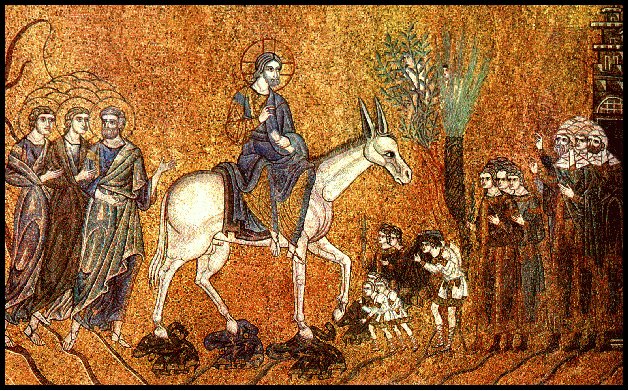
entry-into-jerusalem-12th-century-mosaic2

Today, Jesus’ triumphant entry into Jerusalem is a cautionary tale reminding us of how quickly our opinion can sway; how quickly we can be divided; how quickly we can forget that we are one body in Jesus Christ. Young or old, experienced or recent to the faith, we are in this church together. We join together for worship week after week learning to speak and act and think and live and love as Christians.

This message isn’t just for our confirmation class; its for each and every single one of us gathered here today. We have a choice, we can choose to follow our own path, ignore the needs of those who bother us, and learn to take care of ourselves alone. We can move with the crowds and let our shouts from “hosanna” quickly change to “crucify” whenever we so choose. Or, we can march up to Calvary with our Lord carrying our own crosses. We can work together to bear fruit in God’s kingdom on earth. We can love the unlovable because God loves us.

“Who is this?” the crowds asked. Who is this strange man entering into the holy city to turn the world upside down? Who is this prophet who knows our innermost desires and listens to us when we feel alone? Who is this king who sits on the throne of a cross? Who is this priest that shares his bread and wine, body and blood, with and for us? Who is this incarnate God who died for the sins of the World? Who is this man that healed the sick, fed the hungry, and clothed the naked? Who is this teacher that shares all of his parables with us? Who is this Lord that humbles himself to be just like us? Who is this Savior that is completely unlike us?

If someone asked you, “Who is this?” how would you respond?

Amen.


Clean Hearts – Homily for Ash Wednesday on Psalm 51.1-12

Psalm 51.1-12

Have mercy on me, O God, according to your steadfast love; according to your abundant mercy blot out my transgressions. Wash me thoroughly from my iniquity, and cleanse me from my sin. For I know my transgressions, and my sin is ever before me. Against you, you alone, have I sinned, and done what is evil in your sight, so that you are justified in your sentence and blameless when you pass judgment. Indeed, I was born guilty, a sinner when my mother conceived me. You desire truth in the inward being; therefore teach me wisdom in my secret heart. Purge me with hyssop, and I shall be clean; wash me, and I shall be whiter than snow. Let me hear joy and gladness; let the bones that you have crushed rejoice. Hide your face from my sins, and lot out all my iniquities. Create in me a clean heart, O God, and put a new and right spirit within me. Do not cast me away from your presence, and do not take your holy spirit from me. Restore to me the joy of your salvation, and sustain in me a willing spirit.

Ash_Wednesday

You are dust, and to dust you shall return.

For the last thousand years, these words have been traditionally used for this particular day. A priest or pastor will place a finger in the ashes, making the sign of the cross on a forehead, while whispering the words “You are dust, and to dust you shall return.”

These are frightening words. We have gathered today to be reminded of our own finitude, to mark the beginning of our forty day observance of Lent, to engage in a period of prayer and fasting. This is a solemn event in the life of our liturgical church, for today we are being asked to think about our own mortality.

When I was in seminary one of my professors told me that the hardest thing about being a pastor is that I have to remind people that they are dying when everything and everyone else tries to claim the contrary. I have been given the unenviable task of proclaiming the true and deep message of Ash Wednesday; we are dust, and to dust we shall return.

Most of us tempted to believe that we are invincible and that life will never catch up with us. We are tempted to believe that death isn’t real. Countless commercials and products are advertised with the sole purpose of prolonging our inevitable end. Even here in church, we spend so much time talking about the joy and hope of God in the resurrection from the dead, that we fail to spend adequate time reminding ourselves of our own finality.

Today, as we take our first steps into Lent with the ashes on our foreheads, we are like the psalmist who cried out, “Have mercy on me, O God, according to your steadfast love… wash me thoroughly from my iniquity, and cleanse me from my sin.” This is a time for us to deeply reflect on the ways that we can be better, the relationships to reconcile, and the new habits to cultivate. Lent is less about giving something up, and more about reorienting yourself back to God in order to use this life that has been given to you. Our desire is for God to create in us clean hearts and to put a new and right spirit within us. We have been given the greatest gift, the gift of life. The question we need to ask ourselves is this, “What are we doing with that great gift?”

In our narthex there is a plaque hanging on the wall in honor of Zig Volskis, a beloved former pastor of St. John’s. On the plaque you will find these words: “So teach us to count our days that we may gain a wise heart” (Psalm 90.12). Life is a fleeting and precious thing, one that we should not take for granted. Let us all learn to count our days, to reflect on our many blessings, rejoice in the gift of life and let our lives be fruitful for those around us.

Death is a frightening thing. Contemplating our finitude and celebrating it in worship is by far one of the strangest things we do as a church. But in the end, we do it so that we may gain wiser hearts, so that God might sustain us in the midst of our sinful lives, and above all so that we can appreciate the sacrifice of Christ on the cross and the glory of the resurrection. Let God use this Lenten season to help create in us clean hearts.

ash-wednesday-1-590x421

My friends, you are dust, and to dust you shall return. For the next forty days we will rest in the shadow of the cross, but remember this, the glory of the resurrection outshines everything, even death. 

Amen.