Be still, and know that I am God! I am exalted among the nations, I am exalted in the earth. The Lord of hosts is with us; the God of Jacob is our refuge.
Christ the King Sunday started in 1925 when Pope Pius XI instituted it through a papal encyclical. Mussolini had been in charge in Italy for three years, a certain rabble rouser named Hitler had just published his autobiographical manifesto Mein Kampf, and economic frivolity that led to the Great Depression was in full effect. And it was at that moment the Catholic Church decided they needed a Sunday, every year, to remind the Christian community that we have our own King and it is to him alone that we owe our allegiance.
Today, nearly one hundred years after the institution of Christ the King Sunday, it is usually overlooked on the liturgical calendar in order to celebrate themes of Thanksgiving. Instead of reading about the lordship of Christ, churches talk about the blessings made manifest through turkeys and potatoes. And, to be clear, that’s all good and fine. However, Christ the King Sunday is a rare and blessed opportunity for the church to be unabashed in our convictions about power, allegiance, authority, and a host of other aspects of our discipleship.
It is the perfect time to be reminded that Jesus Christ is Lord, and everything else is bologna.
The first time I traveled to Guatemala for a church mission trip, we stopped briefly in the town of Chichicastenango, known for its traditional K’iche Mayan culture. We were told to explore for a few hours before returning to the various vans that were taking us to our final destination. And, after only a few minutes of wandering down a variety of streets, I realized I was completely lost.
So I did what anyone else would do: I looked for a higher vantage point to get my bearings. Eventually I found myself on the steps of a very old church. I trudged upward and yet, before turning back to look over the town, something (read: the Holy Spirit) drew me inside the church.
The sanctuary was damp, dark, and devoid of just about anything. The ground under my feet felt like soft soil, the walls were covered with black soot from centuries of fires, and the paintings of the walls were so smudged that I couldn’t even tell what they were portraying. The smell of melted candle wax filled my nostrils and I crept closer and closer to what I imagined was the altar.
Frankly, it was one of the least churchy churches I had ever experienced.
Without the help of lighting, I stumbled over a rickety wooden pew and fell on the floor right in front of the Lord’s Table. And there, hovering above my head, was the most pristine sculpture of Jesus that I had ever seen. The Lord stood in complete contrast with everything else in the space. Jesus stood with robes draped over his shoulders, his hand was outstretched as if inviting me closer, and upon his head rested a crown of thorns.
Christ the King.
What kind of king is Jesus? In that Guatemalan church I was confronted with the stark reality of what it means to confess Jesus as Lord. For, while I was surrounded by decay, desolation, and even disregard, Christ stood firmly in front of me as the King of the cosmos. Just as the psalmist proclaimed, I was still before the Lord, and saw God’s exaltation above all things; even death.
Our King reigns from a throne not made by the blood of his enemies, but with his own blood spilled on the cross.
Our King wears a crown not of gold, but of thorns.
Our King rules not by the power of judgment, but through the gift of mercy.
On Christ the King Sunday we confess the truly Good News that our King reigns not above us, but for us, beside us, and with us. Thanks be to God.
When some were speaking about the temple, how it was adorned with beautiful stones and gifts dedicated to God, he said, “As for these things that you see, the days will come when not one stone will be left upon another; all will be thrown down.” They asked him, “Teacher, when will this be, and what will be the sign that this is about to take place?” And he said, “Beware that you are not led astray; for many will come in my name and say, ‘I am he!’ And, ‘The time is near!’ Do not go after them. When you hear of wars and insurrections, do not be terrified; for these things must take place first, but the end will not follow immediately.” Then he said to them, “Nation will rise against nation, and kingdom against kingdom; there will be great earthquakes, and in various places famines and plagues; and there will be dreadful portents and great signs from heaven. But before all this occurs, they will arrest you and persecute you; they will hand you over to synagogues and prisons, and you will be brought before kings and governors because of my name. This will give you an opportunity to testify. So make up your minds not to prepare your defense in advance; for I will give you words and a wisdom that none of your opponents will be able to withstand or contradict. You will be betrayed even by parents and brothers, by relatives and friends; and they will put some of you to death. You will be hated by all because of my name. But not a hair on your head will perish. By your endurance you will gain your souls.”
“A Modest Proposal For Peace: Let The Christians Of The World Agree That They Will Not Kill Each Other.”
The Mennonite Central Committee came up with that slogan many years ago and started printing the words on posters. My former professor Stanley Hauerwas was quite taken by the sentiment of the poster, and hung one on his office door more than twenty years ago.
He also hung it up because he likes to stir up controversy whenever possible.
For, over the last twenty years, countless students (and professors) knocked on his door with anger and frustration. Each of them, in their own way, would barge into his office and declare, “Your sign makes me so mad. Christians shouldn’t kill anyone.”
And Hauerwas would reply the same way every single time: “The Mennonites called it a modest proposal – we’ve got to start somewhere.”
The disciples were walking by the temple, like a bunch of tourists with their eyes in the sky, taking in the beauty, and the large stones, and the gifts dedicated to God. And Jesus said to them, “The days are coming when not one of these stone will be left upon another.”
And, of course, the rag-tag group of would-be followers follow Jesus’ proclamation with a question, “How will we know this is taking place? What signs should we look for?”
It’s easy to knock the disciples for their hard-headedness. They’ve had the benefit of hearing and seeing and witnessing Jesus day after day for three years and they still can’t get it through their thick skulls what he’s all about.
But we’re no better.
We’re still obsessed with signs that will clue us in so that we might catch a peek behind the curtain of the cosmos.
The ever-enduring “next thing” demands our attention and allegiance. The next politician. The next prophet. The next program. We hope that one day, the next big thing will finally get it right and set things right. We pour our trust into these fleeting and flawed figures and we are disappointed time and time again. And, worse, we are led astray.
And Jesus warned us this would happen!
Listen – Many will come in my name, Jesus says, and they will lead you away from the kingdom of God. They will tell you that the end is near. Do not listen to them. Nation will rise against nation, kingdom against kingdom; there will be great earthquakes, and famines, and pestilence, terror, and great signs from heaven.
We well-meaning Methodists are not necessarily familiar with this type of language, at least in the church. We can hear all about it on the news at night. But here, on a Sunday morning, no thank you. We’re accustomed to hearing about God’s love and the need to be a little kinder toward our neighbors. We’re used to hearing about the relative comfort of the present, rather than being concerned with the terror of the future.
But Jesus, when asked about the possibilities for the future, was upfront about the end. Stones will be thrown down, wars will be waged, famines and plagues. It’s right there in the Bible, and it’s on our televisions, and it’s in our doom scrolling on Twitter.
And we can’t look away.
Paul Zimmer was 19 when the US Army sent him to Camp Desert Rock in 1955 to do something he was totally unprepared for. He wrote about his experience with these words:
“I’d seen pictures of Hiroshima, I knew it was bad, but I thought getting to watch atomic explosions would be kind of cool, a story to interest girls. I had no special training and the first time I had no idea what to expect. We traveled by bus at night out into the desert, chain smoking until we were ordered into the trenches. We wore steel helmets, and our fatigues, but nothing else. I did not become fearful until the countdown was broadcast.
And I only became terrified when I saw the flash; a flash so bright that, even with my eyes closed, I could see the bones of my hands over my eyes. A shockwave crashed over us, and we were ordered out of the trenches. We saw the mushroom cloud, glowing purple and changing colors, rising and rising. I saw 8 atomic blasts in total. Some from the air, some from underground. Some created such massive shockwaves that we were buried in our tenches and we had to claw our way out from our own graves. When clearance was radio’d over, were were ordered to march forward into the blast area and bear witness. As far as I could tell, bearing witness was the only reason we were there. Ozone hung in the air. Maimed animals in every direction. Houses were splintered and scattered. Total devastation. We never had to write reports, nor did anyone ask us what we saw. Because, it turns out, they were watching us. They wanted to see how young men reacted to an atomic blast. Lately, I’ve begun to realize that I am one of the last people living in America to have actually experienced close up explosions of Atomic bombs. Now, in my old age, when I can conjure that brief and surreal period of my youth I try in vain to make sense of it. It has become my responsibility to share how that great flash and blast permanently reached into my young mind and heart. How the sounds still ring in my ears even today. I feel it my duty to tell of the reckless absurdity of it all. We keep threatening to use these weapons, and I am sure that one day we will. Most of us have forgotten what we are capable of, I have not.”
I heard Zimmer’s story years ago, and I haven’t been able to get it out of my mind. To have experienced what he did, to turn on the news like we do every night with nothing but bad news, it’s easy to feel like the end is near.
And yet, it isn’t.
The end isn’t near, it’s already here. Our faith is predicated on the notion that we have already seen “the end,” that the world has come to a decisive crisis in the life, death, and resurrection of Jesus.
In Jesus’ death we believe that the whole history of the cosmos reached a turning point. At that moment, as the sky turned black, as the temple curtain tore in two, as he was nailed to the cross, the conflict between life and death, good and evil, was resolved in favor of Jesus’ lordship over everything.
We know the end because we know Jesus Christ and him crucified. We read the last chapter before the introduction. We heard the postlude before the anthem.
God establishes a new kingdom through the cross and it is not dependent on us getting everything solved, or by getting the right person elected, or by finally making the world a better place.
Do you know what the mission of the church is? Our denomination says we exist to make disciples of Jesus Christ for the transformation of the world. That’s fine. But it betrays the central claim of the Gospel. God has already transformed the world in the person of Jesus Christ!
The kingdom we live in is based upon what God has done and is doing for us, rather than upon what we do.
The church doesn’t have a mission – we are the mission. Our being is based on the presumption that we are witnesses first and foremost to Christ who is the difference that makes all the difference. We bear the marks of his life that gives life to us and others. Jesus has already made us different.
We, then, don’t exist to make changes, but living in the world made possible by the cross will, naturally, lead to transformation. It will lead to transformation because we embody the joy that comes from being part of Jesus’ body. It will lead to transformation because we can’t rest easy while the world is flushed down the toilet. It will lead to transformation because we know the truth (his name is Jesus) and that peace comes through weakness, not violence.
Paul Zimmer was commanded to bear witness to the power of our self-made destruction. We spend our days bearing witness to the brokenness of the world around us. And yet, more often than not, we dare not question why things are the way they are!
Jesus tells the disciples they will be hated because of his name. I don’t know if any of us here today have ever felt hated because of our discipleship. But I can assure you, the world will hate us if we call into question the powers and the principalities. To question our wanton disregard of the environment, or our obsession with weapons of mass destruction, or our never ending political industrial complex, will put us at odds with the world.
Put another way, in order to bring it a little closer to home, Thanksgiving is coming up, that hallowed occasion to gather with family and friends over a shared meal. Imagine, while seated at the table, when you are up to your elbows in mashed potatoes, what would happen if you said, “Can we have a conversation about our nuclear arsenal?”
I don’t know if you will be hated, per se, but you might not be invited back next year. And yet, to raise such a subject would be, at the very least, faithful!
Hear the Good News: the power of Jesus’ love is such that, even though we will be hated, we will be carried by his love through life. Even in distress we can trust, even in times of fear we can rejoice, because Jesus Christ is Lord.
I heard someone on the news a few weeks ago who expressed a total lack of hope for the future. They waxed lyrical about how politicians keep failing to live up to their promises, how we spend so much money on our military might all while kids go to bed hungry at night, how we willfully ignore the devastation we are wreaking on the environment, on and on.
And I thought, “No wonder they don’t have hope.” They could only imagine their hope being in us, in our ability to make things right. Let me tell you, we are hopeless. We’ve known, for longer than we care to admit, what we should and shouldn’t do, and yet we still continue to do things we shouldn’t and we avoid doing things we know we should!
We don’t have a hope in the world, unless the hope of the world comes to dwell among us. Which is exactly what Jesus did.
Jesus says we will be hated because of his name. And yet, we should rejoice because in those moments we will be given opportunities to testify, to bear witness. Which, in the end, is nothing more than living according to the world made new in the life, death, and resurrection of the Lord.
The old hymn is right and true: Our hope is built on nothing less than Jesus’ blood and righteousness. Christ is the solid rock upon which we stand, and all other ground is sinking sand.
Wars and rumors of wars will come. Churches will be built, and churches will crumble. Families will grow, and they will fall apart. And even though the world will change, we can hold fast to the truth, we can tell the truth, because we know how the story ends.
When Christ shall come with trumpet sound, O may we then in him we will be found, dressed in his righteousness alone, faultless to stand before the throne… On christ the solid rock we stand, all other ground is sinking sand, all other ground is sinking sand. Amen.
This week on the Strangely Warmed podcast I speak with Mikang Kim about the readings for the 23rd Sunday After Pentecost [C] (Isaiah 65.17-25, Isaiah 12, 2 Thessalonians 3.6-13, Luke 21.5-19). Mikang is the pastor of Epworth UMC on the Eastern Shore of Virginia. Our conversation covers a range of topics including itinerancy, the prophet Isaiah, pandemic preaching, joy, skepticism, Pauline discomfort, deadly sins, apocalyptic imagery, ecclesial hatred, and the difference Christ makes. If you would like to listen to the episode or subscribe to the podcast you can do so here: Chosen By The Word
Do not put your trust in princes, in mortals, in whom there is no help.
Don’t mix politics with religion.
We’re told to keep these seemingly incompatible things as far away from one another as possible. Whatever political proclivities we hold and whatever we might believe are meant to remain in the private sphere and the world has no right to interfere with either.
And yet, we confuse them all the time! We put up American Flags in our sanctuaries and frighteningly blur the line between church and state, we view one another through the names on our bumper stickers rather than through “the name that is above all names,” we believe that what happens on a Tuesday in November is more important than what happens every Sunday.
Whether we like it or not, the so-called “Separation of Church and State” actually looks more like an extremely complicated marriage in which neither partner knows why they are still together.
It then becomes increasingly difficult for Christians to think and speak theologically about what it means to be Christian! Such that our faith has become so privatized that it is relegated to Sunday mornings and only Sunday mornings.
This is a rather strange proposition considering the language of faith articulated to and by Christians who confess Jesus as Lord.
Or, to put it another way, if we believe that Jesus is Lord then all of our assumptions about who we are and whose we are cannot remain the same.
The psalmist writes, “Do not put your trust in princes, in mortals, in whom there is no help.” What a wonderful word for a people who are running amok drunk on democratic idealism! I have heard, more times than I can count, that each subsequent election is the most important election in history. Well, here’s a controversial and theological statement: This is not the most important election in history – the most important election in history was Jesus electing us.
The psalmist’s words echo through time and they indict us. We worship our politicians in a way that Jesus would call idolatry and we keep believing that so long as our candidate gets elected then everything will be fine and good for us. But politicians (princes) and political ideologies have come and gone with failed promises again and again.
The democratic practices we hold so dear are fine and good, but they will not bring us salvation.
Stanley Hauerwas puts it this way: “Voting is often said to be the institution that makes democracies democratic. I think, however, this is a deep mistake. It is often overlooked but there is a coercive aspect to all elections. After an election 50.1% get to tell 49.9% what to do.”
Perhaps the proclamation from the psalmist is beckoning us to remember that our unending desire for power is but another way of falling prey to the practice of idolatry. If we take our Christian convictions seriously, then we are bound to a life of loving our neighbors just as we love God, regardless of their political affiliation. Which is just another way of saying, the Lamb is more important than the Donkey or the Elephant.
Therefore, as we continue to wrestle with what it means to be faithful, let us pray that the Lord will grant us the grace and peace necessary to bear with one another in love, knowing full and well that there is no hope in us, but that the hope of the world has come to dwell among us. That hope is named Jesus Christ whom we did not elect.
Then he looked up at his disciples and said: “Blessed are you who are poor, for yours is the kingdom of God. Blessed are you who are hungry now, for you will be filled. Blessed are you who weep now, for you will laugh. Blessed are you when people hate you, and when they exclude you, revile you, and defame you on account of the Son of Man. Rejoice in that day and leap for joy, for surely your reward is great in heaven; for that is what their ancestors did to the prophets. But woe to you who are rich, for you have received your consolation. Woe to you who are full now, for you will be hungry. Woe to you who are laughing now, for you will mourn and weep. Woe to you when all speak well of you, for that is what their ancestors did to the false prophets. But I say to you that listen, Love your enemies, do good to those who hate you, bless those who curse you, pray for those who abuse you. If anyone strikes you on the cheek, offer the other also; and from anyone who takes away your coat do not withhold even your shirt. Give to everyone who begs from you; and if anyone takes away your goods, do not ask for them again. Do to others as you would have them do to you.”
Sermons are strange things.
Someone spends a week in prayer, pouring over the text, hoping against hope for something to say. Meanwhile, everyone else sits in the pews on a Sunday morning, waiting on a Word from the Lord.
It’s a bit odd that this is one of the ways God’s speaks to us. Most of us can understand, or at the very least appreciate, God speaking through scripture. Many of us are indeed moved by God speaking through music.
But preaching?
The theologian Karl Barth famously noted that “preachers dare to talk about God.” Barth told his students that preaching is meant to be risky in order to ensure that it hasn’t lost its nerve. He dared his students to get out of the way so God could use their sermons to speak.
For, it’s not a sermon until God shows up.
Sermons come and go, some inspire and others bore, some give life while others kill. Preachers must be mindful of the words they use whenever they dare to talk about God.
Which is made all the more confounding when we jump into the strange new world of the Bible only to discover a sermon that God dares to preach about God!
Listen – shortly after choosing the 12 apostles, after word spread about his teachings and healings, Jesus stood on a level place among a great crowd and offered a Word:
“Blessed are those whose lives are an absolute mess, for God does God’s best with broken pieces.
Blessed are the humiliated, for they have been relieved from the burden of self-righteousness.
Blessed are the broken-hearted, for grace falls through the cracks.
Blessed are those who grieve, for what is grief if not love persevering?
Blessed are the last, least, lost, little, and dead, for to them the kingdom has been prepared.
Blessed are the forgivers, for, at the end of the day, what else is there?
And blessed are the forgiven, for they have nothing left to hide.”
“But woe to you who think salvation is yours to earn through power, wealth, and pride, you will be disappointed.
Woe to the fat cats and the hedonists, there will come a time when you are empty.
Woe to those who think life goes on forever and ever, for you will die.”
“Therefore, live wild and reckless lives, for in so doing you will inherit the kingdom of God. Love the unlovable. Forgive the unforgivable. If someone asks for food, invite them to your table. If someone is in need of clothing, give them the jacket off your back. None of it was ever yours in the first place.”
“Love others the way you would like to be loved.”
In the name of the Father, myself, and the Holy Spirit. Amen.
Upon first inspection, it might not seem like Jesus’ sermon dares to speak about God. In fact, it sounds a lot like it only deals with us. Blessed are you, woe to you, do this, do that, and so on.
And yet, the blessings, woes, do’s and don’ts are only made possible and intelligible by God in the flesh who proclaims these words.
Today is All Saints’ Sunday – the blessed occasion to name and remember the saints in worship, to give thanks to God for putting them in our lives, and to praise God for raising them up into the great cloud of witnesses. And yet, in so doing, we often paint pictures of the saints as being holy and perfect people.
The saints of God’s church are and were anything but perfect.
It’s all nice and fine to elevate biblical characters from the New Testament, but it’s important to remember that people like Peter and Paul were perjurers and murderers. And, for some strange reason, we can’t stop naming churches after them!
Or, to leave the Bible for a moment, do you know the story of St. Nicholas? Yes, that St. Nicholas, the one who famously provided gifts for children in the middle of the night. Well, the story goes that during the Council of Nicea in 325 a certain Christian named Arius was arguing that Jesus was not co-equal to the Father but was instead created by God. And, unable to restrain his disdain for such a theological back-step, St. Nicholas marched across the floor, and punched Arius in the face!
The saints, contrary to how we might like to imagine them, or hide them away in museum-like churches, are far more complicated, and therefore faithful, than our limited perspectives of perfection.
To put it another way, as Oscar Wilde said it, “The only difference between saints and sinners is that every saint has a past and every sinner has a future.”
Sermons, strange and daring as they are, give us the language to express the difference Jesus makes. For, we Christians are a threatening bunch to the order of things.
Just think about what Jesus preached! Love your enemies? Do good to those who hate you? Turn the other cheek? Those proclamations run against everything we’re taught about what it means to exist in the world.
And yet, Jesus proclaims this strange and even bizarre sermon not because these things work. Loving your enemies doesn’t make them disappear, just as turning the other cheek doesn’t stop us from getting hit. In fact, it usually guarantees it.
Saints exists because of a community we call church that nurtures and shapes people who, while often unfaithful, learn the story of God through Jesus’ preaching.
Jesus preaches this sermon not because it works, but because it tells us who God is.
And God changes everything.
In the book of Acts, those outside the church called the earliest followers of Jesus “world-turners” because they kept flipping things upside down. The first will be last, resurrection out of death, etc. But by the 2nd century, those outside the church described those who followed Jesus as a burial society.
Of course, the church is more than just a burial society, but we are also exactly that!
We are a burial society because we gather to mourn the dead, and yet we do so with hope because we know death is not the end! All of us experience death prior to our deaths because we are baptized. In baptism we are buried with Christ that we might rise with Christ.
How strange it is to be a Christian.
Week after week, we pull out this old book and find that it is alive and speaks into our existence here and now. We baptize the young and the old alike knowing that it incorporates us into something we might now have ever discovered on our own. We gather at the table and we are made participants in the communion of the saints. We hold fast to the truth of the gospel that only God can tell us who we are.
I remember coming forward for communion once when I was a kid. My hands were outstretched in line with everyone else. Right in front of me was an older man, and I could hear him crying as he walked forward. As soon as he stood in front of the table, our pastor looked on his tears and said, “Why are you crying?!”
And I heard him say, “I’ve been a bad man.”
And without missing a beat our preacher said, “As have we all! But take heart! You belong to God.”
Hear the Good News of the Gospel: God does not make anyone a saint who is not first a sinner, nor does God provide love to any but the wretched. God has mercy on none but the bad, and gives grace only to those who are in disgrace.
Which is why we can do the strange things we do in church. Whether its preaching, or baptizing, or serving. Whether its crying or laughing. We can even happily remember the saints, not as a denial of their deaths, but as a recognition that their deaths are not their ends.
Jesus does not say, “Bring to me your perfect lives and your perfect jobs and your perfect families.”
Instead, Jesus says, “Bring to me your burdens, and I will give you rest.”
Jesus does not look at our choices and our actions in order to weigh out whether we’ve done enough to make it through the pearly gates.
Instead, Jesus says, “I have come to save sinners and only sinners.”
Jesus does not write us off for our faults and failures.
Instead, Jesus says, “You are mine, and I am thine.”
On All Saints, we remember the Saints, all of them.
Notably, the “all” in “All Saints” is the acknowledgment by the church that we do not know the names of all who have lived and died to make possible what we are about to do: gather at the table of God.
If sermons are strange, communion is even stranger. For, when we gather at the table, we commune not just with God, but we commune with all the saints who have come before us, those who surround us now, and those who will be here long after we’re gone.
This feast stretches across time and is a foretaste of the Supper of the Lamb when we will gather with those we have lost.
Today, we bring all of our emotions to the table. The joy and gratitude for the saints, the grief and the pain that they are no longer here. And we can bring all of our feelings because Jesus says “Heaven belongs to those who cry, those who grieve and ache and wish that it wasn’t so, those who know not all is as it should be.”
In short, heaven belongs to the saints, and to us.
Now God is God not of the dead, but of the living; for to God all of them are alive.
The Sadducees ask Jesus a question. If a woman remarries 7 times, to whom will she be married in the resurrection of the dead?
Jesus has two choices in terms of an answer.
1) He could pick 1 of the 7 husbands, perhaps the first, or the last, or one in the middle, to be her husband in heaven. But none of them make for a good answer since 6 of the former husbands would be left to inherit the wind.
2) He could admit that the Sadducees have a point – If she can’t be married to one of her husbands in the resurrection, then perhaps there is no promised resurrection.
But, of course, Jesus doesn’t go with either of those options. Instead, he breaks through with an answer previously unthought of. Jesus simply asserts that the resurrection is an entirely new ballgame in which the present rules and assumptions about marriage no longer apply. Additionally, he furthers his answer with the claim that the Torah proves the resurrection since God is the God of Abraham, Isaac, and Jacob all of whom were not alive at the same time and if God is to be their God they all must be alive together in some other way.
Jesus’ answer is less about the nuts and bolts of marriage, and more about how the kingdom of God works. He asserts, in just a few verses, that the people we marry and bury in this life don’t really belong to us.
And that’s Good News.
However, for some of this this might actually sound like radically bad news; we shudder to think of a time when we will lose the people we’ve taken hold of in this life. We don’t want to imagine a moment in which someone wearing a ring is no longer bound by that ring.
But that’s exactly the kind of assumption that Jesus is overturning.
It’s why we say, “‘Till death do us part.”
Jesus changes everything. The life, death, and resurrection of the Lord obliterates all of our previous notions of possession, particularly when it comes to people. Notably, the Sadducees held to a rigid understanding that women belonged to men as if property. But then Jesus stands and offers a truly radical witness to marriage: We aren’t lesser halves or better halves until (and after) we get married. We are fully and wonderfully made by God whether we get married or not. Marriage is something that happens in this life, but in the resurrection of the dead all notions of labels fade away as we gather at the Supper of the Lamb.
It’s as if Jesus addresses the crowd and says, “Listen up! A new world is colliding with the old. Behold, I am doing a new thing, something beyond even your wildest imaginations. In this world, the world you’re so wedded to, there is death. But in the world I’m bringing there is life and life abundant. In this world, your world, people are made to feel less than whole. But in the world to come, all people are children of the living God.”
On Sunday, Christians across the globe will gather to remember the saints (unless they did so already on Tuesday). It is an occasion for us to give thanks to God for those now dead while, at the same time, rejoicing with the knowledge that they now await us at the Supper of the Lamb. Oddly enough, we can happily remember the saints, even in our grief, because we worship the God of the living.
This week on the Strangely Warmed podcast I speak with Mikang Kim about the readings for All Saints’ Sunday [C] (Daniel 7.1-3, 15-18, Psalm 149, Ephesians 1.11-23, Luke 6.20-31). Mikang is the pastor of Epworth UMC on the Eastern Shore of Virginia. Our conversation covers a range of topics including proper pronunciation, perseverance, communal reading, saintliness, the difference Christ makes, directions for singing, courage, blessings and woes, sermon introductions, and Kingdom work. If you would like to listen to the episode or subscribe to the podcast you can do so here: Praying Our Goodbyes
When he returned to Capernaum after some days, it was reported that he was at home. So many gathered around that there was no longer room for them, not even in front of the door; and he was speaking the word to them. Then some people came, bringing to him a paralyzed man, carried by four of them. And when they could not bring him to Jesus because of the crowd, they removed the roof above him; and after having dug through it, they let down the mat on which the paralytic lay. When Jesus saw their faith, he said to the paralytic, “Son, your sins are forgiven.” Now some of the scribes were sitting there, questioning in their hearts, “Why does this fellow speak in this way? It is blasphemy! Who can forgive sins but God alone?” At once Jesus perceived in his spirit that they were discussing these questions among themselves; and he said to them, “Why do you raise such questions in your hears? Which is easier, to say to the paralytic, ‘Your sins are forgiven’, or to say, ‘Stand up and take your mat and walk’? But so that you may know that the Son of man has authority on earth to forgive sins” – he said to the paralytic – “I say to you, stand up, take your mat and go home.” And he stood up, and immediately took the mat and went out before all of them; so that they were all amazed and glorified God, saying, “We have never seen anything like this!”
“They didn’t teach me that in seminary,” is a favorite line among clergy-types. When the pandemic came in earnest, I heard countless colleagues make that remark with regard to moving church online. It shows up turning denominational turns as we’re tasked with communicating bizarre elements of our polity with our laity. And it’s the go-to expression whenever something goes wrong with a church building and all the eyes turn the pastor for direction.
And yet, the irony is, there is no type of schooling that fully prepares someone for their vocation. Imagine how boring our lives would be if we knew everything we needed to know the day we graduated.
However, I must confess, the words “they didn’t teach me that in seminary” left my mouth the very first time I was tasked with a committal to the grave.
Grief counseling? Services of Death and Resurrection? Theological proclamation in Bible study? No problem. But then, after my first funeral service, I found myself driving to the cemetery without knowing what I was supposed to do.
When we all arrived, we stood around the casket of the recently departed, and all the eyes turned to me. And then, because God provides, a story from the scriptures appeared in my mind.
Listen: Jesus returned to Capernaum shortly after calling the disciples to follow him. It was reported among the community that he was home and crowds began to gather. Rumor had it that this particular son of a carpenter could make the impossible possible.
Soon, so many people arrived that they were spilling out onto the road, waiting for their turn.
And, it came to pass, that a group of friends caught word of the Word’s arrival and they put together a plan. Their friend was paralyzed, and so they carried him through the streets of Capernaum until they arrived at the house. Upon discovering the size of the crowd, the climbed up on top of the house, used shovels to dig through the roof, and they lowered their friend to the Lord.
When Jesus saw their faith… notice, not the faith of the paralytic… when he saw their faith, he said to the man, “Son, your sins are forgiven.”
If the story ended there, it would already be radical enough for the Gospel. It’s got all the markings of a remarkable tale: friendship, hope, overcoming adversity, and a delightful conclusion. And yet, Jesus forgives the man his sins.
Isn’t that strange?
If this were a proper story, Jesus would’ve reached out to the man, and healed his legs.
But instead, Jesus forgives his sins.
Of course, the story keeps going because some scribes were near by, the do-gooding religious types. Perhaps they couldn’t help but hope for a glimpse of heaven on earth, even if they didn’t really believe everything they heard. And they grumbled.
“Who does this guy think he is? It’s blasphemy I tell you! No one can forgive but God alone.”
And Jesus said, “Check this out: Which is easier, to tell him he’s forgiven or to tell him to walk. But so that you may know heaven is standing here right in front of you, I’m going to do both.”
He looked over at the forgiven paralytic and said, “Go home.” And the man stood up and left.
Everyone was amazed and glorified God, saying, “We have never seen anything like this!”
The family stood staring at me, pondering why this story, of all stories, was the one I proclaimed at the grave. And then I said, “Gathering here, we are like those friends who carry the one we love to Jesus. With our faith, we witness to the promised truth that this is not goodbye, this is, “until next time.” Until we gather together at the Supper of the Lamb that goes on without end.
And then I reached down to the dirt, laid it on the casket, and I sang: Softly and Tenderly…
It is a strange thing to be a Christian. There was a time, of course, when it was expected or assumed that Christianity was a normative experience for people. But now, today, the church is a rather radical witness to the work of God in the world. In short, we approach the throne of God with a trembling hope because we know that we cannot take any of this for granted.
To be a Christian is to know that time is now fleeting the moments are passing. It is to know that we are defined not by our mistakes but by the grace of God. It is to know the great Good News that Jesus Christ is the pioneer and perfecter of our faith.
Those descriptors might not sound strange to our ears, but to the world they are as confounding as can be. The world tells us that, so long as we purchase certain products, and dress a particular way, that we can hang around forever. The world hangs our mistakes around our necks and compels us to carry them everywhere. And the world forces us to believe that we are completely alone and can only ever depend on ourselves.
To be a Christian is to be different.
We worship a God who became one of us, who arrived in the muck and mire of our lives, to be the difference that makes us different! We follow the Lord Jesus who is not only capable of forgiving our sins, but also of raising the dead!
The fundamental difference between the world and the church, is that the world assumes we can earn or achieve everything we need, whereas the church reminds us that the everything we really need has already been finished for us in Jesus Christ.
Therefore, the church exists to mediate Christ to us through sermon, song, and sacrament. The church teaches us who we are. The church proclaims the Good News to a world drowning in bad news.
Notice, the friends from scripture today bring their friend to Jesus and they won’t let anything stand in their way. The do something wild and reckless: They trust that this 1st century rabbi can make a way where there is no way, and they’re willing to dig through a roof to see it happen!
And then, when Jesus does his Jesus thing, the crowds glorify God and say, “We have never seen anything like this!”
When the church is at her best, we all depart with those same words, either aloud or in our hearts, and we can’t help ourselves from living differently because of the Good News.
Today we’re talking about, and thinking about, witness, the final aspect of church membership. When someone joins a United Methodist Church they make a vow to support the church with their prayers, presence, gifts, service, and witness. It’s all too easy to take the theme of witness and boil it down to something like a church growth strategy.
Put another way, we often confuse witness with evangelism.
There’s a church, not too far from here, that is busting at the seams. Each week they have to pull out more and more folding chairs to make space for people. And, when the pastor was asked to what he could attribute the increase, he said, “It’s our iPad giveaway program.”
You see, at this particular church, they raffle off an iPad every single Sunday, and you receive more raffle tickets depending on the number of people you bring to church with you.
Those people are being converted to something, but I don’t think we can call it the kingdom of God.
Notably, in our denominational neck of the woods, there’s a rather sobering statistic that haunts me: Today, the average United Methodist invites someone else to worship once every 38 years.
And even so, the location of the church today is a great gift! For, it gives us the space and opportunity to rediscover how unusual it is for us, Methodists of all people, to be the church of Jesus Christ.
The early church grew, despite all the reasons it shouldn’t have, not because they gave away tablets, or went door to door, or handed out tracks in downtown Corinth.
The early church grew because the witness of Christ in the world was life-changing.
Rich Mullins, who I’ve been quoting a lot recently, once said, “I am a Christian, not because someone explained the buts and bolts of Christianity, but because there were people willing to be nuts and bolts.”
In other words, people carried him to Jesus.
The God we worship is a healer of broken things. And yet, the brokenness that God heals is not just our broken bodies. God heals broken hearts, broken spirits, broken promises.
In the cross and resurrection of Jesus we see how the one who said, “Your sins are forgiven,” had the power to do exactly that.
Notice, the paralytic did absolutely nothing to earn his forgiveness. Save for the fact that he had some good friends. And those good friends were already living according to the difference that Christ makes.
All of us this morning are here, whether we know it or not, because someone or some people carried us to Jesus. We are products of those who made Jesus real for us, those who were willing to be nuts and bolts.
And, in the end, that exactly what it means to witness. It’s living according to the Good News of God in the world as if our lives depended on it, because they do.
Whatever Christianity is, it is at least the discovery of friends we did not know we had. Friends who are possible only because Jesus has gathered us in for God’s great parable to the world we call the church. Friends who are willing to carry us to Jesus over and over again because Jesus is the difference that makes all the difference. Amen.
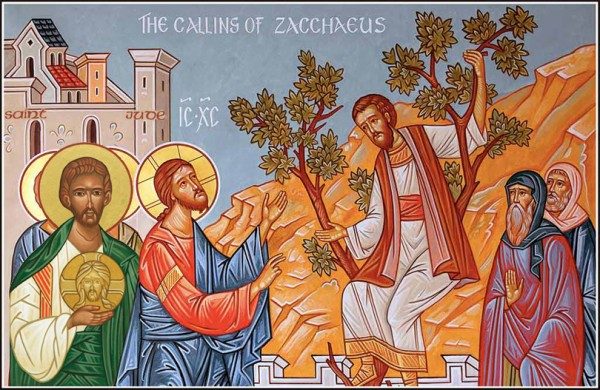
Jesus entered Jericho and was passing through it. A man was there named Zacchaeus; he was a chief tax collector and was rich.
We love the story of Zaccheaus. And by we, I mean the church. We tell Z’s story to children in Sunday school, we use it in VBS curricula, and we even have a nice little song that conveys the whole thing:
Zacchaeus was a wee little man and a wee little man was he / He climbed up in a sycamore tree for the Lord he wanted to see / And as the Savior came that way he looked up in the tree / And he said, “Zacchaeus, you come down, cause we’re going to your house today.
The song, and the ways we tell the story, make Zaccheaus out to be this smaller than life character (pun intended) who just wanted to catch a glimpse of heaven on earth, and how God in Christ chose him to be the vehicle of an internal transformation, particularly as it regards money.
But one of the things we miss, or downright ignore, is how horrible Zaccheaus was. He was a tax collector, someone who stole from his fellow Israelites and kept a fat portion for himself before passing the rest of the money up the chain. He was a traitor to his people, and to his God, and he stood for everything that was wrong during the time of Jesus.
And Jesus picks this no good dirty rotten scoundrel out from the tree and says, “Hey, let’s get something to eat.”
And, in a way that could only happen in the Gospel, Zacchaeus reacts to this strange man with an even strange proclamation. After a couple sandwiches, and a glass of lemonade on the front porch, Zacchaeus says, “Wow, the only way I know how to respond to you is to give back half of my wealth to the poor and pay back the people I cheated four time over.”
And Jesus responds, “Now that’s what salvation looks like! Let’s have a party!”
It’s a confounding story, and one that we often water down. Zacchaeus doesn’t deserve to be in the presence of God and God shows up for lunch. Zacchaeus has swindled countless people and Jesus has the gall to give him salvation.
And yet, his story is precisely why we can call the Good News good.
We are happy with a Jesus who forgives the tame sins of the nearly righteous. We are content to hear about the need to love one another a little bit more. But it’s another thing entirely to encounter the radical nature of Jesus’ proclamation of grace. Jesus’ willingness to cancel sins, big sins, is downright scandalous.
Which is why we sing of Zacchaeus but keep him at a distance. For, to approach the wee little man is to admit the truth of who we are and whose we are: Sinners in the hands of a loving God.
All of us are like Zacchaeus. We all hurt people close to us, we all ignore the needs of strangers, and we all focus on our wants, needs, and desires at the expense of others. We distance ourselves from true unabashed goodness, though we don’t mind taking a peek from the vantage point of a tree (or a pew). But be warned! All it takes is a glimpse for the Lord to see us and say, “Want to grab some lunch?”
This week on the Strangely Warmed podcast I speak with Jason Micheli about the readings for the 21st Sunday After Pentecost [C] (Habakkuk 1.1-4, 2.1-4, Psalm 119.137-144, 2 Thessalonians 1.1-4, 11-12, Luke 19.1-10). Jason is the senior pastor at Annandale UMC in Annandale, VA. Our conversation covers a range of topics including staying interested in ministry, God’s timing problem, the folly of pride, answering questions with questions, Godfather responsibilities, comedy in subtitles, VBS curricula, colluding with empire, and the unjust justice of God. If you would like to listen to the episode or subscribe to the podcast you can do so here: The Folly of Pride









 think and let think