Devotional – Jeremiah 1.9-10

Devotional:

Jeremiah 1.9-10

Then the Lord put out his hand and touched my mouth; and the Lord said to me, “Now I have put my words in your mouth. See, today I appoint you over nations and over kingdoms, to pluck up and to pull down, to destroy and to overthrow, to build and the plant.”

Weekly Devotional Image

Kurt Vonnegut Jr. once said, “Another flaw in the human character is that everybody wants to build and nobody wants to do maintenance.” His quote is remarkably indicative of what our contemporary experience is like with new projects constantly fading away into obscurity. For instance, while the world tunes in for the Olympic games in Rio, the former Olympic site in Athens, Greece is falling apart and is being used as a living area for Syrian refugees. Millions are spent on building the stadiums for the Olympics, and within a decade most of them start crumbling.

160307151339-refugees-athens-baseball-stadium-exlarge-169

In our churches this same type of behavior is common. Whenever a new opportunity for ministry pops up it garners support from the majority of congregations. Money will come in, people will volunteer their time, and the project usually bears fruit. However, after a program loses its luster it (like Olympic sites) begins to fade away from focus and fails to bear the fruit that it once did.

Moreover, the same principle holds true for our own discipleship. Whenever we encounter a new spiritual discipline, or a new bible study, it captures our initial interest and we start to grow more in our faith. We might commit to praying every morning as soon as we wake up, and for the first few weeks it is incredibly life giving. But as time passes, and the new behavior feels more like an old routine, we stop giving it our full attention and effort.

We like building, but we don’t like maintenance.

When the Lord first called Jeremiah to be a prophet, he gave him a difficult task: “I appoint you over nations and over kingdoms, to pluck up and to pull down, to destroy and to overthrow, to build and to plant.” Jeremiah’s mission would not be limited to starting new programs and building new buildings alone. Instead, he was tasked with the even harder work of maintaining the people by plucking up and pulling down practices and behaviors that were no longer bearing fruit. He had the unenviable responsibility of maintaining what the Lord had created by destroying and overthrowing whatever stood in the way of God’s will.

What kind of maintenance work are we avoiding? What do we need to pluck up and pull down in our churches for them to truly become the body of Christ for the world? What do we need to destroy and overthrow in our lives to become the disciples that God is calling us to be?

Do Not Listen To Preachers (Including Me)

Jeremiah 23.23-29

Am I a God near by, says the Lord, and not a God far off? Who can hide in secret places so that I cannot see them? Says the Lord. Do I not fill heaven and earth? Says the Lord. I have heard what the prophets have said who prophesy in my name, saying, “I have dreamed, I have dreamed!” How long? Will the hearts of the prophets ever turn back – those who prophesy lies, and who prophesy the deceit of their own heart? They plan to make my people forget my name by their dreams that they tell one another, just as their ancestors forgot my name for Baal. Let the prophet who has a dream tell the dream, but let the one who has my word speak my word faithfully. What has straw in common with wheat? Says the Lord. Is not my word like fire, says the Lord, and like a hammer that breaks a rock in pieces?

Pastor Holding Bible ca. 2000


A young preacher stands in the pulpit after a long week of parish ministry. The visits have all been made. A new budget for the coming year is finished and ready for approval. Plans for the Community Cook-Out came to fruition as people from all over the community gathered together.

The young preacher stands in the pulpit and looks out at the congregation. He sees couples that he has counseled; children that he has baptized; families that are struggling; individuals whose husbands or wives he has buried; and he even sees people he has never seen before. He looks over the bulletin one last time just to make sure that everything is listed the way it is supposed to be, and then he begins by saying, “This morning the sermon will be short and sweet”

“Hallelujah!” Someone shouts out from a pew.

“Is that for the short, or for the sweet?” says the preacher.

The congregation laughs.

The preacher sighs.

The art of preaching is a strange thing, but an even stranger thing when we consider that what we want from a sermon is something short and sweet. Some of you have been quick to say that you want a sermon that leaves you feeling good on your way out from the sanctuary. Others have said that you want a sermon that gives you something to think about during the week, or one that helps to remind you that God is love, or that Jesus wants the world to be a better place, etc.

I would classify myself as a short and sweet preacher. I fundamentally believe that if you cannot say what you’re trying to say in 15 minutes then you’re never going to say it. Additionally, I love pleasing all of you. I live for those moments in the receiving line following worship when some of you offer praise for what you heard through the sermon. I know I’m supposed to be humble, but it feels pretty good to be congratulated and praised for preaching.

In the last few years we’ve had an abundance of sweet sermons; times when I wanted all of you to leave with just one thought: “God loves you.” I’ve done my best to make you laugh and smile when thinking about the abundant glory of God’s grace. I’ve tried to cheer you up during times of domestic and international strife. I’ve worked to make this place as appealing as possible for as many people as possible.

And that is why you should not listen to preachers, including me.

“Am I close to you?” says the Lord. “Or am I far away? Who thinks they can hide in secret places so I cannot see them? I am the Lord! Do I not fill up heaven and earth? I have heard what those prophets have said who prophesy in my name saying ‘I have dreamed, I have dreamed! How long will they continue like this?”

The prophet Jeremiah lived during a time filled with false prophets, people who would ascend to places like this in front of a gathered people and make claims on behalf of the Lord. They would spout off about their visions of what the Lord was doing, and the more they said, the further they moved away from God.

God warns us against listening to false prophets, about succumbing to their visions, and about what happens when we trust them more than the Word.

False-Prophets-Media-Header-960x350

It would be easy today to make this whole sermon about the false prophets of our contemporary experience. We’ve got plenty of false prophets who use their skill to sell us on what they believe the future should hold. In fact this whole sermon could just be a warning against listening to the likes of Donald Trump and Hillary Clinton.

What kind of dreams are they selling?

“I have dreamed of a future where everyone can, and should go to college for free. Where healthcare will be free for everyone. We need to remember what made us great and start taking from the wealthy and giving it to the poor. It’s not about progress; it’s about fairness. We need to make America fair again.”

“I have dreamed of a wall unlike any other wall. This wall will fix all of our problems. It will bring wealth back to our country. We need to bomb the Middle East into oblivion to assert ourselves as the top of the world. We need to make America great again.”

Politicians have always been false prophets making promises that cannot be kept; selling a vision of the future that rarely comes to fruition. And we know this is true. That’s why we’ve grown so jaded by our political seasons and apathetic about whatever will happen.

But there are more false prophets out there than just politicians, and one of them is talking to you right now.

Through the prophet Jeremiah, God warns us against listening to people like me, people who march up to the front of the gathered church and strive to proclaim God’s faithful word. For whenever we hear a preacher go on and on about the beauty and majesty of God’s Word, whenever the Lord is watered down to a spirit of love, whenever we hear more about the preacher’s dreams than God’s will, we need to be reminded that the Word of the Lord is like fire, and like a hammer that breaks a rock into pieces.

Since we’ve been together in this strange thing called church, I’ve preached over 150 sermons. I’ve preached from Genesis to Revelation. I’ve mentioned the patriarchs and the prophets. I’ve proclaimed the possibilities of the psalms. I’ve proudly preached on the power of parables. I’ve done different series on “Why We Do What We Do” and “The Basics” and “New Beginnings” and “Strange Stories from Scripture.” I’ve even dressed up and preached not one, but TWO sermons from the perspective of a donkey.

And for what?

Has the preaching in this place challenged you to be a better disciple? And maybe not just from me, but have you ever left this church really feeling convicted by what you heard and wanted to live differently? Or has your experience been like most, and you leave feeling pretty good on Sunday afternoon?

We preachers are tempted by the practices of false prophecy. We like to be liked. We want to fill pews with people to boost our egos. We need to hear praise from lay people on their way out the door. We yearn for success. We, after years of sermon preparation and proclamation, fall prey to hearing our own voice so deeply that we no longer hear others, nor do we hear the Lord.

For the last three years I’ve had a dream about the future of this church. I have dreamed of Sunday mornings where so many people fill the pews of this sanctuary that I cannot know everyone’s names. I have imagined crowds gathered around the baptismal font in anticipation of bringing a new person into the life of our church. I have pictured people having to park on the front lawn because there are not enough spaces left in our parking lot.

IMG_1691

And because I had this dream, I preached and worked toward things like our Community Cook-Out. I implored our Church Council to use enough money to give away the food and the games and the fellowship all for free. I sent out hundreds and hundreds of post-cards to all of our neighbors so that they might join us on the front lawn.

I have dreamed, and I want the dream to become real. So I work week after week on ideas and programs and sermons that will draw people into this sanctuary on Sunday mornings until that dream becomes reality.

A couple weeks ago I was standing in our narthex right before our opening hymn. Most of you were sitting in the pews; our liturgist had gone through the pertinent announcements and necessary welcome. Rick was playing something melodic on the organ as we prepared our hearts and minds for worship when I stepped onto the carpet with our acolyte.

Without thinking much about it, I started to count the back of all your heads. I started with the front left and made my way toward the back, then my eyes moved to the front right and all the way toward the back. My lips must have been moving because our acolyte looked at me and said, “What are you doing?”

“I’m counting…” I said while trying to not lose track of the number.

And then he asked, “Why?”

Why?

In his question, in the simple raise of an eyebrow at my action, my heart caught on fire, it burned like a blaze, and I felt it crumble into ashes.

For how long have I deceived my own heart? For how long have I been so consumed by the number of people in our pews that I have forgotten the call to share the Good News? For how long have I proclaimed a God of love who is so loving that he does not expect us to live changed and transformed lives? For how long have all of us listened to false prophets who preached their own dream instead of speaking the Word of the Lord faithfully?

In his question I heard the Lord convict my heart because I have been caught up in church growth not for the sake of the kingdom, but for my own affirmation. I have wanted the front lawn to be packed with people from the community not for the sake of the kingdom, but for the pews to be filled in worship. I have preached sermons to make us feel better not for the sake of the kingdom, but for all of you to come back the next Sunday.

Sermons are a good and strange thing. After all they are the means by which the Word of the Lord is interpreted for our lives on a weekly basis. But they cannot be blindly accepted without challenge. For to only ever hear about God’s grace does a disservice to the Lord who is always calling us to live more like Christ. And, on the other hand, to only ever hear about how sinful we are neglects to reveal the light of Christ that shines in the darkness.

God cares more about spreading the Good News than about filling up the pews.

And sometimes that Good News is that we need to be better than we were when we arrived, that we are called to a life of discipleship that pins us against the world, that the Lord expects great things from us. The Good News is that God has not abandoned us to our sinful desires and devices, that God believes we can be better even if we don’t, and that we can transform the world but we first must transform ourselves.

We need good preachers, men and women who are willing to lay down their egos at the altar and faithfully proclaim God’s Word. And we need good lay people who are willing to crucify their fears and speak the truth in love toward the preachers who have fallen into the trap of false prophecy.

So, may the Word of the Lord be like a hammer that breaks our lives into pieces! Let it shatter our false identities and insecurities, let it break down all our preconceived notions and assumptions, and let it burn and blaze forever and ever. Amen.

On Evangelism or: Why The Church Needs Crucifixion

Matthew 28.19 – Go therefore and make disciples of all nations, baptizing them in the name of the Father and of the Son and of the Holy Spirit.

Evangelism

We sent out hundreds of post-cards over a month ago inviting the entire neighborhood to join us on the front lawn of the church for a free Community Cook-Out. The post-cards were well designed and inviting with all of the necessary information. For a modest price we were able to reach a whole group of people who we would otherwise miss.

This will be our third annual gathering and it has been largely successful. Half of the people in attendance are usually not from the church and we want them to know that we care about the neighborhood we are in. However, on some level, we also want them to know that we love them enough that we would love to have them join us in worship on Sunday mornings.

IMG_1642

Yet, evangelism is not the goal of our gathering. We have not specifically identified key lay people to go around asking people if Jesus Christ is their personal Lord and Savior. We have not prepared pamphlets to hand out describing the eternal fires of hell if someone does not get saved. We have not invited the neighborhood to our front lawn to get them into heaven.

Instead, we hope that by showing them our love, it will somehow draw them into church to discover where that love comes from: God.

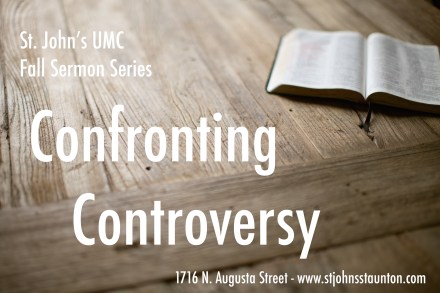
Next week we are going to send out even more post-cards to the local community about our upcoming sermon series titled “Confronting Controversy.” After speaking with a few nominal Christians from the neighborhood about what they want to hear about in church, we synthesized this series to be approachable and life-giving to people who are not currently in the church. The post-card has been well designed with a catchy image and all of the necessary information on the back. We hope that by sending them out, people from the community will join us in worship and discover that what the world thinks about the church may not be the same thing as what God thinks about the world.

controversy

Both of these ventures, a Community Cook-Out and a Controversial Sermon Series, are about trying to grow the church in some way, shape, or form. Many of us call this “evangelism.” But that’s not what evangelism means.

In David Fitch’s recent work Prodigal Christianity, he highlights a moment from his ministry where the church tried to grow and failed:

“When our church, Life on the Vine, was new, we sent out ten thousand postcards to people in our neighborhoods. We artfully displayed a collage of various depictions of Jesus (classical paintings, icons, and European, African, and Asian portrayals) with the question in bold print running across it: “Who is Jesus?” On the back, we invited the neighborhood to have a discussion with us about the question. We were playing off the cultural curiosity around Easter and hope that we could welcome a constructive conversation around the question. The card was not well received. Local “Bible-believing” Christians accused us of straying into relativism with so many different depictions of Jesus. They worried we were losing the truth of Jesus. Meanwhile many others accused us of being intolerant. Were not other religious leaders just as worthy of discussion? We got nasty phone calls asking, “Why are you focusing only on Jesus?” No one, and I mean NO ONE, came to any of our gatherings from this postcard.”[1]

Out of ten thousand postcards, no one came to any of the gatherings. I think a lot of this has to do with our false assumption that just by offering something people will show up. We believe that if we give them an interesting sermon series or bible study people are bound to show up in droves. And if we let them know about it through a postcard we can reach even more people!

These types of evangelism largely fail because we’ve confused evangelism with filling the pews instead of sharing the Good News.

I cringe whenever I encounter an “evangelist” in the midst of life who abruptly asks, “Have you confessed Jesus Christ as your personal Lord and Savior?” Because with their question is the assumption that we have the power to save ourselves, and that they are playing a fundamental role in our salvation. However, Jesus does not command the disciples to go out convincing people to confess him as Lord. Instead he tells them to go and make disciples.

Discipleship formation is primarily about relationships and less about post-cards and Main Street confessions. We become evangelists not when we beg or convince someone to confess Jesus as Lord, but when we intentionally create relationships with individuals through the love that Jesus taught us to live by. We can use sermon series and community events to first bring people into the church, but those types of things will never be enough (by themselves) to evangelize. It takes a willing and loving disciple who sees others not as pew fillers but fellow brothers and sisters in the kingdom of God.

As a gathering church we are called to be confident in God’s love for us, and for us to share that same love with others; “We love because he first loved us” (1 John 4.19). We will grow and bear fruit in the kingdom when love becomes our first priority instead of growth. We have failed to grow not because we have been doing things unworthily, but because we’ve grown bored and unhappy. With churches all across the American landscape floundering under the pressure to grow and remain sustainable, the church falls back to the common tropes of Vacation Bible Schools and Sermon Series assuming they will grow the church.

Can you imagine what the church might look like if Christians were actually happy and excited about being the church? That’s where and when evangelism happens – not in the boredom of another series or bible study, but in the community transformed by joy and sharing that joy.

Evangelism (1)

Evangelism is our call as Christians. We are commanded by the Lord to share the Good News in order to make disciples and transform the world. If we want this kind of dynamic and life-giving evangelism to take place, then we have to be willing to crucify some of our current practices and programs; you can’t have resurrection without crucifixion.

We need to crucify our boring and lifeless activities that we assume will grow the church. Is the annual Cook-Out really sharing the good news with others, or are we doing it to feel good about seeing a lot of people on our property?

We need to ask difficult questions about our programs and whether or not they are designed to evangelize. Are our monthly meetings really about branching out to the community and transforming our cultural landscape, or are we meeting to keep the people already in the church happy?

We need to confront our budgets and demand that they reflect Jesus’ mission. Are we spending our resources according to the great commission, or are we neglecting to be good stewards by wasting our resources of lifeless avenues of ministry?

We need to take a look at our own families and reflect on how we evangelize those closest to us. Are we so consumed by raising our children to choose whether to be Christian or not for their own good, or are we afraid of telling them what we really feel and believe?

What can we crucify in our hearts and in our churches to be resurrected into the kind of evangelists that God is calling us to be?


[1] Fitch, David and Geoff Holsclaw, Prodigal Christianity: Ten Signposts into the Missional Frontier (Jossey-Bass: San Francisco, 2013), 32.

Devotional – Hebrews 12.1-2

Devotional:

Hebrews 12.1-2

Therefore, since we are surrounded by so great a cloud of witnesses, let us also lay aside every weight and the sin that clings so closely, and let us run with perseverance the race that is set before us, looking to Jesus the pioneer and perfecter of our faith, who for the sake of the joy that was set before him endured the cross, disregarding its shame, and has taken his seat at the right hand of the throne of God.

Weekly Devotional Image             On Saturday afternoon, by God’s will, we will gather on the front lawn of St. John’s UMC with a cohort from the community. Our third Annual Community Cook-Out will be filled with familiar and strange faces, we will have more food than we’ll know what to do with, we’ll have children jumping on bouncy houses, and we’ll even have a dunk tank set up (I’ll be the first to be knocked in!). For years and years this church has stood in the middle of the community, but for too long it has been disconnected from the lives of the people in the immediate neighborhood. Therefore, the Cook-Out is our opportunity to share Christ’s love with those who surround us.

During the last two Cook-Outs it has been a joy to see strangers becoming friends through a shared meal and fellowship, but there is always the temptation to stay where we feel comfortable and only talk to the people we know. The Cook-Out is by no means an attempt to “evangelize the neighborhood” and get everyone saved. But if we are not willing to follow the example of Christ by reaching out to strangers, then the church is failing to be the body of Christ for the world.

IMG_1642

St. John’s exists and thrives because of the great cloud of witnesses that brought us to where we are. We owe a great deal to the saints who have come before us, the ones who first invited us to discover God’s love in a place like this, and now the time has come for us to follow them on the path to Christlikeness. For it is when we humble ourselves, when we disregard the shame of embarrassment, we join together with the one who never knew a stranger, the one who came to change the world, the one who has taken his seat at the right hand of the throne of God.

To follow Jesus on the way that leads to life requires us to actually act like him here and now. It means crucifying our selfish ways and opinions so that we might encounter the other without pretense. It means laying aside every weight that prevents us from sharing the Good News. It means running the race with perseverance so that we might bless others in the same ways we that we have been blessed.

An Example – Sermon on Luke 12.32-34

Luke 12.32-34

Do not be afraid, little flock, for it is your Father’s good pleasure to give you the kingdom. Sell your possessions, and give alms. Make purses for yourselves that do not wear out, an unfailing treasure in heaven, where no thief comes near and no moth destroys. For where your treasure is, there your heart will be also.

bible-verse-luke-1234-where-your-treasure-is-there-your-heart-will-be-also-2014-for-slideshow


Meanwhile, when the crowds gathered by the thousands to hear him talk, so many in fact that they began to trample on one another, Jesus rose to speak. He warned his disciples against hypocrisy – live honest lives. He instructed them to confess fearlessly – all who earnestly repent will be forgiven. He shared the parable of the rich fool – you can’t take your money to heaven. And then he gave them some final instructions:

“Do not be afraid little sheep! For it is God’s good pleasure to give you the kingdom. Sell your possessions, and give away your money, use your gifts to bless others here and now. For where your treasure it, there your heart will be also.”

Sometimes Christians drive me crazy. You know, the super pious ones who are forever wearing their faith on their sleeves; the ones who stand on the street corners of life blasting off about some passage or another; the ones who come knocking on your door and try to sell you on the gift of eternal life instead of the fires of hell.

Have you ever met or encountered a Christian like that? I can’t help but feel like they are the kinds of Christians that are giving the rest of us Christians a bad name. Jesus never instructed his disciples to act like the people from Westboro Baptist church who are forever picketing the funerals of people whom they believe did not live up to Christ’s expectations. Jesus never called his disciples to be racist or bigoted toward peoples of different nationalities, or race, or creed, or sexual orientation. Jesus never implored the disciples to use fear mongering to convince people to come to church or otherwise be threatened with the fires of eternal punishment. Yet, if you turn on the news, or get online, those are the kinds of Christians we hear about the most; the ones who give the rest of us Christians a bad name.

Like Hillary Clinton proudly claiming to be a Methodist over and over again, and how much her Methodism has shaped her politics. But we know that she has gone back and forth on a number of issues and made untruthful claims when the bible is pretty clear: you shall not bear false witness.

Or like Donald Trump who, when asked about his faith said that he’s never needed to pray for forgiveness and when asked about his favorite scripture was said, “An eye for an eye and a tooth for a tooth.” Except the scripture he was talking about actually goes like this: “You have heard an eye for an eye and a tooth for a tooth. But I say to you, ‘Do not resist an evildoer. But if anyone strikes you on the right cheek, turn the other also.’”

Just once I would like a good Christian to be featured for all to see; someone who has absorbed the Word throughout his or her life and has lived accordingly; someone who believes the good news is so good, that is worth sharing not to fill the pews, but to fill hearts; someone who could stand like an earthly example for the rest of us to catch a glimpse of the ways Jesus calls us to behave.

tumblr_naz1buY4JX1svej5no1_1280

This winter I was asked to be a guest preacher at Augusta Street UMC just down the road. We had a midweek and midday service and I decided to preach about how good it is when we dwell together in unity. The service was well received and we gathered in the social hall after worship for a light lunch. I walked around for a couple minutes until I found an empty chair next to Wilford Kirby who was deeply engrossed in a conversation with someone else.

Elsewhere in the room, United Methodists from all of the churches in our town were sitting with their friends from their churches. Like cliques in a high school, the Central folk were at one table, the Cherryvale folk at another, and so on. But Wilford refused to be subject to this paradigm. He was sitting with the preacher from Augusta Street, though I don’t think he knew that he was the preacher. Because I eavesdropped on the end of their conversation, and the last thing Wilford said to the preacher was: “You should come try out our church on Sundays.”

Anyway, I sat with Wilford and he was quick to make a couple comments about their church facility in comparison with ours, offered a few critiques on how my sermon could have been better, and continued to eat his soup and sandwiches. I had other things to get done that afternoon, so after I finished eating I excused myself and told Wilford that I’d see him in church on Sunday and left.

Not fifteen minutes later was my phone ringing. When I answered all I heard was: “Wilford fell, broke some ribs, on his way to the hospital.”

I immediately turned my car toward the direction of Augusta health and beat the ambulance to the Emergency Department. But because they needed to do some x-rays and have him checked out I wasn’t able to get back, and he didn’t want me to anyway.

The next day I showed up at his house and banged on his door until he slowly made his way to the front of the house and let me in. I should have been a little more compassionate and patient regarding the fact that he was walking around with a few broken ribs, but I wanted to know what happened. I wanted to make sure he was okay. I wanted to pray for him.

And as we sat down in his basement, before I could even open my mouth, he asked me how I was doing, and then went through the list of everyone he had been praying for and wanted updates since he had been out of the loop for a whole day.

Wilford Kirby is the kind of Christian that makes the rest of us Christians look better.

Wilford Kirby is an example to us all about what it means to follow Christ in this life.

Luke, in this passage about our treasures and our hearts, calls for us to put first things first. The things of the Lord are to be the most urgent and pressing priority in every Christian’s life. We are not to be afraid nor are we to succumb to the worldly distractions of wealth that constantly distract us from God’s love and care. There are no wallets, or stock portfolios, or bonds that will not wear out in time. God promises not to fill us with earthly wealth and material possessions, but instead surprises us with the gift of the kingdom.

Receiving this gift, the kingdom, makes us rich beyond our ability to comprehend. But being rich toward God is not about putting sizable sums in the offering plate during worship. What Jesus rejoices in, is our reorientation toward the whole of life as an abundant gift from a generous God – a gift that can be given away with abandon.

Wilford Kirby has given his life to the kingdom, because the kingdom was first given to him.

12347609_912278878848427_5975116725585975318_n

He has easily attended more worship services than anyone in this church over the last three years, including me (and I’m the pastor!). On Sunday mornings Wilford is the first layperson to enter the sanctuary making sure our heat is pumping in the winter, and the AC is on during the summer. He checks the lights for optimum worship participation, and he checks through the bulletins to make sure everything will go smoothly.

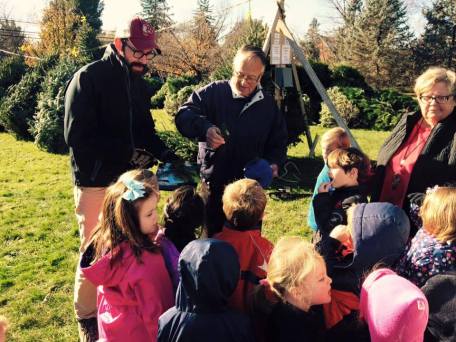
Every winter he sits out in his truck for hours on end waiting for people to come take a peek at our Christmas trees and offer them his assistance. Even though we have a giant sign advertising the times the lot will be open, Wilford believes in being present for the kind of people who ignore signs like those.

He is here an hour before our special services throughout the year like Ash Wednesday, and Good Friday, and Christmas Eve just in case anyone arrives extra early.

He is almost always the first person to show up in my office to find out how someone from our church is doing and how he can be praying for him or her.

For years he has mowed the lawn of our church and took care of the property as a volunteer. He never complained; he never sought recognition; he never wanted praise. I cannot tell you how many times I’ve been sitting in the comfort of my air-conditioned office day-dreaming about God when I’d see Wilford come flying past my window on the lawn mower with a smile hidden underneath his dust-mask.

Wilford has been here for every funeral since I arrived. Even for people he never knew. Yet he always stands in the back greeting people as they walk in, not because he was asked to, not because he was told to, be because he believes it’s the right thing to do.

For where your treasure is, there your heart will be also.

            The greatest treasure that Wilford Kirby has offered this church has been his very life, and he has given it with abandon.

But why? Wilford could be spending his precious time working with other civic organizations trying to make the world better. He could be spending his afternoons on the golf course or relaxing in the comfort of his home. He could use his life to do any number of things, but instead he has given it to this church.

My suspicion is that Wilford has given his life to the church because he knows and has experienced how the kingdom was given to him, and he wants to share that gift with others. He trusts that the Lord will provide. He humbly obeys the commands to love even the unlovable. He has seen first-hand how the kingdom of God can become manifest in other peoples’ lives. He put his treasure in this place because his heart has always been here. He wants other people to be blessed in the ways that he has been blessed. So he shows up. He prays. He cares. He loves. And he is an example to us all.

But that’s not to say that Wilford is perfect; he’s not. There are plenty of Sunday mornings when I finish a service and walk down the center aisle only to see Wilford standing in the back with his arm outstretched and his finger pulling me in as if to say, “Let me offer a suggestion.” Or there have been plenty of times that I’ve heard his footsteps walking down the hallway and I know from the texture of his tempo that he’s coming not to congratulate me on something but to complain about something that has happened in the church. But the thing is, even when Wilford is frustrated or upset it is because he believes our church can be better. He believes that we are part of the kingdom and we can’t be just like any other church. He expects excellence precisely because that’s what God expects from all of us.

Being rich toward God involves a generosity of spirit that opens our perceptions toward God’s generosity. Wilford knows how blessed he is, for the kind of life that he has had, and therefore he knows no other way to live than the way that he does.

Theses words from Jesus first meant for the crowd, and now meant for us, decisively interrupt our lives in this place and on this day calling us to focus not on the demands of the overly scheduled life, but on the Lord who comes in surprising ways to offer comfort, assurance, and love. Through these words we hear Jesus telling us that the time is now to start living a new life, not dictated by the past, but defined by God’s belief in our future. God uses people like us, people like Wilford, to make the kingdom manifest so that lasting joy will come to God’s little flock we call the church.

At this table, where Wilford has come time and time again, we receive the body and blood of Jesus Christ. In this profound moment we are offered the kingdom again even though we do not deserve it. We come forward with hands outstretched remembering this incredible gift that has been given without cost. And by receiving this gift, we cannot help ourselves but live transformed lives.

So come and see that the Lord is good. Feast at this table where heaven and earth are bound together. Join together with Wilford Kirby as he walks to the front to receive the gift of the kingdom once again. And let it change your life like it has changed his. Amen.

Babbling Grace – Karl Barth and Genesis 11.1-9

Professors in seminary can make all the difference. Some can call you into the strange new world of the bible through their passionate lectures and you will never be able to look at scripture the same way again. Some can refers to moments of history in the church that decisively reshape the way you understand the church today. And still yet others can turn your entire understanding of the kingdom of God upside down through just a few lines in one lecture.

Stanley Hauerwas is one of those professors.

Hauerwas

In 2013, I had the good fortune of participating in his last ethics class before he retired. In it, he did his best to make us Christians more Christian. By highlighting problems that the church is facing, and has faced for a long time, he helped to provide a better grammar for what it means to be a Christian in the world.

During one of his lectures on the remarkable importance of the gathering community, he briefly mentioned a sermon he once wrote on the story of the Tower of Babel from Genesis 11. At the time, the story of Babel was one that I remembered from my youth; the pictures we drew of people attempting to build a tower to God, the lesson it conveys about why there are so many languages on the earth. But I honestly hadn’t thought about it having much to do with my life as a Christian.

Dr. Hauerwas said, “The divisions at Babel are healed and reconciled at Pentecost. The language divisions were still present, but within the gathered communal identity of the church was a common Lord in Jesus Christ. Pentecost was a new day of creation, not unlike those we read about at the beginning of Genesis.”

In just a few sentences, Hauerwas jumped from Genesis 11 to Acts 2 and it blew my mind. Now it seems so obvious, that the Lord would bring together God’s people through the power of the Holy Spirit therefore redeeming what had happened at Babel. But when Hauerwas connected them in that lecture, it was like I was given a new lens by which I could read scripture.

For a time I attributed this new way of thinking and reading to Dr. Hauerwas, and it was only later that I realized he got it from Karl Barth.

barth-bw

In Church Dogmatics III.4 Karl Barth uses the story of the Tower of Babel to evaluate the problem of nationhood in the modern period. For Barth, Babel contains every bit of the human desire to remain self-reliant and focused on pride, which has resulted in our divisions as a species. It is a story, not unlike Adam and Eve’s first sin, that reminds us of the brokenness in our world.

I have always seen Babel as a kind of means by which we can teach a lesson to children or young Christians about the dangers of pride. I have seen Babel as a shadow of what the church is supposed to be. But for Barth, Genesis 11 is all about grace.

Barth is quick to note that, “A Christian people is one in which heathenism and national egoism are broken, judged, and purified by the Spirit of Christ… As we are warned in Genesis 11, rebellion against God leads to the forceful disintegration rather than the organic development of national identities.”[1] Babel should frighten us, as a people, about what happens when we rebel against the Lord to such a degree, but the story is about much more than the Lord’s “punishment” at the end.

The Tower of Babel, for Barth, contains elements of both divine wrath and divine blessing. The story begins with: “Now the whole earth had one language and the same words” (Gen. 11.1). As a unified people, they settled into the land of Shinar and decided to use bricks to make themselves a city and a tower, “otherwise we shall be scattered abroad upon the face of the whole earth” (Gen. 11.2-4). In response to this, the Lord goes down to examine the city and tower and eventually confuses humanity’s language to remind them of the divide between Creator and creature.

Tower_of_babel

Barth immediate questions the supposed sin within the story: What is inherently wrong with building a city or a tower? The constructions of such objects were not completed against God; attempts at civilization are never formally wrong.[2] For Barth, the thing itself, the object built, is not the fault but rather when a people want to create something for themselves in order to reach an attempted equality with God there lays the sin. The depth of humanity’s sin is the “arrogance of thinking that man himself can and must take himself as he takes the brick and mortar, and make himself the lord of his history, constituting the work of providence of his own work.”[3]

In light of humanity’s over-determined arrogance, God must respond with punishment. If God let humanity build the tower to completion, just as if God had let Adam and Eve stay in the Garden after eating of the tree of knowledge of good and evil, humanity would further perpetuate itself as a sinful people. The scattering of the nations at the end of the story is an example of God’s divine wrath, and usually where I would let the story finish, but for Barth (and Hauerwas) we cannot understand Babel without the rest of the Bible.

Barth sees grace at Babel through, of all things, Jesus’ parable of the sower: “The constant sowing of the seed of the divine Word will always find soil even if there is no true harvest in one place. Even in this passage we must not fail to see the Gospel in this sense. Even in the terrible decree of v. 7 (“Come let us go down, and confuse their language there, so that they will not understand one another’s speech.”) we must not miss His grace.”[4]

Important for Barth’s understanding of God’s grace in his exegesis is the fact that God could have easily used an earthquake or another divine miracle to achieve God’s condemnation. But rather than destroying creation, as had been done through the flood in Genesis 7, God merely divides humanity and confuses their language. Instead of raining destruction upon humanity, God limits the punishments to linguistics.

Additionally, God does not abandon humanity to their own devices even after their construction. Regardless of the self-righteousness employed by humanity, God will remain faithful even when we are not. Babel could have been the end of the relationship between the Creator and the creature, but God remained steadfast.

Morever, Barth’s final move regarding the babbling grace of Genesis 11 comes in the recognition that, as Christians, we are aware that God has more in store for his creatures than the end of the story in Genesis; we know what happens at Pentecost. What transpires at the end of the Babel narrative is not the ultimate decree on the matter but rather, “only a penultimate word, and that the curves of the separated ways are so ordered in advance that they will finally come together again.”[5] Here is where Barth shines the light of God’s glory the brightest: even though the main emphasis of the Tower of Babel in on how the separation and division of people was right (at the time), God’s original desire is for humanity to be in unity.

For Barth, we cannot read Genesis 11 outside of, or in spite of, Acts 2. These two different stories, separated by thousands of years, though different in form and content, contain the beginning and the next step of God’s action toward creation. God intended for humanity to remain in unity, and through our own self-righteousness were have rejected the divine unity for our own division. And yet, according to Barth, we are to remain grateful to God’s out-pouring of grace which simultaneously remaining discontent until there is a total reunification of God’s creation.

1101620420_400

Barth, time and time again throughout Church Dogmatics, refuses to read particular texts as isolated witnesses. To read the bible is to read it canonically. Narratives from different places help to inform one another and the Old Testament reads into the New just as much as the New reads into the Old. Babel and Pentecost are connected. Eden and Revelation are connected. David and Jesus are connected. Exodus and Acts are connected. And so on.

As Christians reading scripture, we have the benefit of knowing how the story “ends.” We know that in the person of Jesus Christ the previously divided nations have come together. In the Holy Spirit of Acts 2 the conclusion of Genesis 11 takes place: “The miracle of Pentecost tells the us how the decision is take to look and break out from the nations to the one people of God, how the divine disposition of Genesis 11 is rightly understood as a teleological divine purpose, and how it is recognized in the form of the corresponding orientation from the near to the distant, the narrower sphere to the wider.”[6]

Barth’s reading of scripture, and in particular his exegetical work in the excurses of Church Dogmatics has directly influenced the work of Stanley Hauerwas and a whole mosaic of theologians over the last century. To be a Christian is to read, and to read well; to look for the connections from book to book; to identify the thread that God pulls through seemingly unrelated stories; to see ourselves as characters in God’s great narrative.

And for Barth, the story of Babel is not one for us to leave for children’s Sunday School rooms and flannel-graphs. It is one that we must read with conviction knowing full and well how the story ends. Just as with the construction of Babel, humanity still consistently places brick after brick of our own presumed infallibility in direct contradiction to the One in whom we live and move and have our being. Barth’s work reminds us that we have divided ourselves against God’s original and good intentions, and to complete the end of the story we must take seriously God’s mighty acts in Jesus Christ, desiring for humanity to one day be made perfectly one.


[1] Barth, Karl. Church Dogmatics III.4. (Peabody, Massachusetts: Hendrickson Publishers, 2004), 306.

[2] Ibid., 314.

[3] Ibid., 314.

[4] Ibid., 316.

[5] Ibid., 317.

[6] Ibid., 323.

Devotional – Genesis 15.6

Devotional:

Genesis 15.6

And he believed the Lord; and the Lord reckoned it to him as righteousness.
Weekly Devotional Image

“If you believe that God exists, and confess Jesus as Lord, you will go to heaven.” So said one of the staff members during our mission trip to Raleigh, NC last week. The youth were all assembled on the floor, they had shared their “Yea God” moments from the day, they had joined together for a few worship songs, they listened to a testimonial, and were now being offered a one-way ticket to glory. During the testimonial a few youth began to cry in response to the vulnerability of the young man sharing his story. The lights were dimmed to just the right degree. And then he hit them with the “If you just believe that God is real, and confess Jesus as Lord, you will go to heaven.”

However, there is a difference between believing that God exists, and believing God.

In a relatively recent poll, it was determined that 9 out of 10 American adults believe that God exists, and more than 40% of Americans say they go to church weekly. However, less than 20 % are actually in church on Sundays. In the US we have a considerably high number of people who believe that God, or some sort of universal spirit exists, but only a fraction of them believe God enough to gather with a regularly worshiping community.

tumblr_ny91sd9Df61s91yx0o1_1280

Believing that God exists is something that most people are willing to admit. When confronted with the totality of the universe they’ll confess that there might be someone, or something, behind the scenes. When they encounter a question without an answer, they are okay with assuming that “God” might be the answer.

But believing God is another story.

When Abraham was promised descendants more numerous than the stars, he did not simply believe that God exists in reality, but instead believed what God revealed to him. Abraham believed the promise.

When Moses discovered the burning bush, he did not simply believe that God was real, but instead believed what God revealed to him. Moses believed that God was going to deliver God’s people out of bondage.

When Jesus cried out from the cross, “Father forgive them, for they do not know what they’re doing”, he did not simply believe in the existence of God, but instead believed what God revealed to him. He believed in the power of God’s grace to forgive, even from the point of death.

We can believe God exists without much trouble or hesitation, because to believe God is real requires very little of us. But to believe God, to believe that God works in the world, that God makes good on God’s promises, that the Holy Spirit empowers us to serve and sacrifice, requires us to live radically different lives.

Lost

Luke 15.1-7

Now all the tax collectors and sinners were coming near to listen to him. And the Pharisees and the scribes were grumbling and saying, “This fellow welcomes sinners and eats with them.” So he told them this parable: “Which one of you, having a hundred sheep and losing one of them, does not leave the ninety-nine in the wilderness and go after the one that is lost until he finds it? When he has found it, he lays it on his shoulders and rejoices. And when he comes home, he calls together his friends and neighbors, saying to them, ‘Rejoice with me, for I have found my sheep that was lost.’ Just so, I tell you, there will be more joy in heaven over one sinner who repents than over ninety-nine righteous persons who need no repentance.


Today marks the conclusion of our Sermon Series on The Power of the Parables. A favorite rhetorical device of Jesus’, a parable is a story that illustrates a lesson or principle usually without needing explanation. They are simple and life-sized with familiar characters and they are supposed to drive us crazy.

Over the centuries the parables have become so watered down through the church that they no longer carry the same weight and punch they once did. The familiar parables are beloved to us: The Feast, The Mustard Seed, The Prodigal Son, The Good Samaritan, The Lost Sheep. But during the time of Jesus they were frustrating and confusing. During this month we have attempted to recover this sense of strangeness and re-encounter the power of the parables.

IMG_1610

Now all the rich and broken were gathering around Jesus to listen to him. And those with power were frustrated and saying, “This guy hangs out with the nobodies, and he eats with them.” So he told them one of his parables.

“Which one of you, having a hundred children to watch during a summer camp, and losing just one of them in a museum, does not leave the ninety-nine in the lobby and go after the one that is lost until you find the kid? And when you find her, you offer her your hand and rejoice. And then when you bring the little girl back down to the lobby you call for everyone to join together to rejoice over the one who was lost. Truly I tell you, there will be more joy in heaven over one who returns, than over ninety-nine who need nothing.”

On Monday morning, after traveling to Raleigh, North Carolina immediately after church last Sunday, we woke up at 6:30 am to get the day started. We spent time preparing our breakfasts and lunches, the adults drank our coffee while the youth rubbed their eyes, we spent intentional time with God in prayer, and then we were sent off in groups to our different work sites. I was in charge of a group of 8 youth from here in Staunton and Chapel Hill, NC and we were tasked with working alongside Helping Hands, an organization that provides a camp atmosphere for underprivileged children.

While driving through Raleigh to our assigned location, we wondered aloud about what kind of work we would be doing with the kids. Perhaps we would sit down and help them with their reading comprehension, or we would gather with them inside of a gym and talk about Jesus, or any number of activities. Instead, we were asked to make sure they stayed outside in the oppressive heat, within a strict set of boundaries so that they would not wander into the road. My 7 youth had to keep track of 30 children running all over the place, and who wanted nothing more than to go exactly outside the area they were supposed to stay in.

After a few hours of running around and participating in what could only be describing as shepherding sheep, we took the kids to the Museum of Science downtown. The hope was for them to glean a little bit of information from the exhibits, but more so for them to experience air-conditioning for at least a few minutes.

However, upon arriving, the shepherding metaphor became that much more relevant. With the totality of the museum at our disposal, I had to do my best to keep an eye on our kids while they were keeping their eyes on a whole bunch of other kids. We walked and walked, we talked about things like dinosaur bones and bumblebees, we saw fish swim back and forth in a replicated ecosystem, and we even played with North Carolina Clay. At some point, while on the second floor, I was walking our group through a fictionalized version of a dark aquarium tunnel with dead dinosaurs swimming above us. Most of the kids were “ooing” and “ahhing” and as we approached the end I stood and counted off all the heads as they passed.

When I counted the last head, fear percolated through every fiber of my being; someone was missing. I begged our youth to step-up and watch over all the kids while I went back for the one that was missing, I broke the protocol of leaving church youth with summer camp youth all by themselves, but I did not know what else to do. And I went looking for the lost sheep.

I retraced our steps through the tunnel, making sure to look in every shadowed area until I found who was missing. And standing right at the entrance to the tunnel, with tears in her eyes, and her knees shaking back and forth, was a girl named Miracle.

Miracle was afraid: afraid of the strange dinosaurs floating above her head, afraid of the other whispering adults who were pointing at her while she stood by the entrance, and afraid of the fact that she was left there all alone. Before I even had a chance to do something, she reached out for my hand and immediately began to calm down. She was lost, but was now found.

img_0569

Now all the elite and prideful people were gathering around Jesus to listen to him. And those with all the influence were frustrated and saying, “This guy hangs out with people who no longer matter, and he eats with them.” So he told them one of his parables.

“Which one of you, having an entire Nursing and Rehab center filled with residents near the end of life who are completely alone, does not do everything in your power to go after them until they rediscover themselves? And when you find that opportunity, you grab them by the hand to celebrate their joy. Truly I tell you, there will be more joy in heaven over one aged person smiling in joy than over ministering over countless people in the height of life who need nothing.”

After working with Helping Hands for the first three days, we were then assigned to the Hillcrest Nursing Center. Those same youth and I traveled to the facility to help lead the activity center where residents could play bingo, exercise, and respond to trivia questions. It was quite a shock to the youth having to go from keeping track of little kids running all over the place to sitting in a room full of people with remarkably limited responses.

We tried pulling out the bingo cards and reading out the letters and numbers. I even encouraged the youth to dance around the room to get the residents involved, but most of them just stared off into space. We tried leading them through an exercise routine to the music of Michael Jackson, but most of them just stared off into space.

IMG_1604

We felt pretty worthless. Having traveled all this way to help the community of Raleigh, it was hard for the youth to feel so unsuccessful with those near the end of life. But then I saw a hymnal and I started flipping through the pages until I found “Amazing Grace.”

“Amazing grace! How sweet the sound that saved a wretch like me! I once was lost but now am found; was blind, but now I see.”

All eyes in the room, though previously locked onto the walls and the floor, had all turned to the center of the room where I stood with the hymnal in my hands.

“’Twas grace that taught my heart to fear, and grace my fears relieved; how precious did that grace appear the hour I first believed.”

The youth moved closer to me and started singing and humming along with the familiar tune that they have heard so many time before.

“Through many dangers, toils, and snares, I have already come; ‘tis grace hath brought me safe thus far, and grace will lead me home.”

The residents started perking up in their wheelchairs even the ones who had nothing to do with what we had done earlier, and some of them even started to mouth the words with us.

“The Lord has promised good to me, his word my hope secures; he will my shield and portion be, as long as life endures.”

The aides and employees who were wandering the halls started gathering in the door way to watch what was happening, and a few of them even opened up their hands and prayerfully joined in one voice.

“Yea, when this flesh and heart shall fail, and mortal life shall cease, I shall possess, within the veil, a life of hope a peace.”

            Everyone in the room was singing or humming along, every resident who was previously lost to the recesses of their mind were found by the time we all joined together for that final verse.

“When we’ve been there ten thousand years, bright shining as the sun, we’ve no less days to sing God’s praise, than when we’d first begun.”

It was abundantly clear that for many of the residents this was the first time they had participated in anything for a very long time. From the tears welling up in the eyes of the employees while watching the people they served each and every day we were caught up in the Holy Spirit bring us all together. From the smiles and wrinkles on individual faces the Lord was making good on the promises of grace to lead us home even when we are lost to our minds.

From there we continued to flip through the hymnal and joined together. Softly and Tenderly, Stand By Me, I Love to Tell the Story, O Come O Come Emmanuel, and we ended with Victory in Jesus.

In a manner of minutes we had gone from a room full of people lost to the weight of time and loneliness, to a people united together through the joy of song. With the finals words of Victory in Jesus, with fingers snapping and hands clapping, the Lord brought all of us home.

The power of this parable is in its effective portrayal of God’s love; the Lord is the one who leaves everything behind to come find us when we’re lost.

We like to think of ourselves as Jesus in the parable, going after our friends who are lost and bringing them home. When in fact, it is God who works through us to go after the lost sheep. God is the one who pushes us to find a little girl who has disappeared in a museum. God is the one who fills our lungs and sings through us in a nursing home to call people back into the faithful community. God is the one who will never rest until we are found. Amen.

The Cross in Creation – Karl Barth and Genesis 1.1-2

Genesis 1.1-2

In the beginning when God created the heavens and earth, the earth was a formless void and darkness covered the face of the deep, while a wind from God swept over the face of the waters.

barth-bw

While I was in seminary I spent one of my summers helping Bryson City UMC in Bryson City, North Carolina. Bryson City is surround by the Great Smokey Mountains and is easily one of the most beautiful places I’ve ever been in my entire life. It was an incredible experience that directly shaped the way I do ministry today.

During my time at the church I was invited to participate in a weekly lectionary group with local clergy. Every Monday morning the pastors and priests of Bryson City would get together to talk about the scripture readings for the following Sunday. We met at the large Baptist Church, ordered breakfast to be delivered, and then we would take turns reading from the bible and shared what we thought we would preach about on Sunday.

Week after week I heard from clergy of all different denominations (Presbyterian, Baptists, Catholic, Methodist, etc.) as they wrestled with God’s Word and how to proclaim it from very different pulpits to very different people.

On one hot morning in the middle of July I found myself surrounded by those familiar pastors and priests as we read the texts aloud. The lectionary always had four prepared readings for each Sunday on a three-year cycle: a reading from the Old Testament, the Psalms, an Epistle, and a Gospel. I don’t remember what the other readings were that morning, but I do remember that I was asked to read Genesis 1: In the beginning when God created the heavens and the earth…

When I finished, as was our custom, we waited for individuals to speak up about what they planned to do with the test during worship. Silence filled the room. So I decided to ask the obvious question, “I anyone planning to preach on Genesis 1?” The silence remained. I remember thinking to myself, “How strange is this? We’re talking about the first lines of scripture in the bible and no one is preaching on it in Bryson City this week.” It was obvious that most of the clergy wanted to move on to a different reading, but I felt compelled to ask another question: “Have any of you every preaching on Genesis 1?” One by one they confirmed my suspicion; not one of those pastors, priests, ministers, or preachers had ever proclaimed a sermon on the beginning of creation.

While they moved on to a different reading and a different conversation, I silently began calculating from my chair: In that room we had over 100 years of preaching represented. Over 100 years of preaching, more than 5,200 sermons, and not one of them had ever preached from Genesis 1.

Why do we ignore Genesis 1? What is it about the text that makes us afraid to bring it up in worship or in bible study?

On some level I think it is good to be afraid of God’s Word; that fear reminds us that God is God and we are not. But Genesis 1 is not something to be ignored or forgotten.

557046

Of all the writing I’ve read on Genesis 1, it is Karl Barth’s exegesis of the text that gives me hope for its return to the pulpits and congregations of our churches.

Barth, unlike so many modern theologians and pastors, rejects the fear and presumption that there is dissonance between creation as recorded in scripture and the scientific method. Instead of attempting to rationalize the theory of the Big Bang with the details of Genesis 1, and instead of struggling to line up Darwin’s Theory of Natural Selection with the order of creation in scripture, Barth rejoices in the knowledge that the earth was in a hopeless situation of chaos and utter darkness and God chose to transform reality through the Word. The “how?” and “why?” of creation is simply answered with “Word” and “love.”

Writing and reflecting from this vantage point gives Barth the ability to freely respond to the words contained in Genesis 1 with a freshness that is often lost in the church today; his exegesis of Genesis 1 is a worthy read for clergy and laity alike.

In §41.2 “Creation As The External Basis Of The Covenant” (III.1 The Doctrine of Creation in Church Dogmatics) Barth begins his exegesis with the very first words of God from the Word of God.

The first word in the Hebrew Bible is bereshith, which roughly translates to “start” or “beginning.” In English we render this as “In the beginning…” but for Barth the distinction is important. To begin with “beginning” tells us “that this history, and with it the existence and being of the world, had a beginning, i.e., that unlike God Himself it was not without a beginning, but that with this beginning it also looks to an end.”[1] There is no other word that can quite compare with the one that inaugurates God’s holy scripture. From the beginning of all things God created a beginning to have an end. The Lord did not create the world like a watchmaker and then step back to see how it would run. God was intimately involved in the creative act knowing full and well that there was a necessary end, or conclusion, to the creative act. Unlike an author who begins a story without knowing how it will come to close, God created from beginning with an ending.

For years I’ve read the creation account from Genesis 1 and thought of it just like that: an account of creation. The words were there on the page, though they hardly jumped out at me. Like those pastors in Bryson City, Genesis 1 is one of those chapters in the bible that I have not so subtly avoided because of the difficulty of rationalizing it with modern science. And yet Barth writes about the first two verses of scripture with such conviction that it challenges me to re-engage with the text and see the beauty of what God did, and is doing.

Verse 2 (the earth was a formless void…) has been similarly read with haste and overlooked for the richness it holds. Everything else, which is to say everything neutral or against God’s will, ceased to exist when time began with God’s action and accomplishment. The whole of creation was worked into being and order by God in time. In God’s freedom to create was the earth brought into meaning through God’s action and through God’s word to create.

1101620420_400

The challenge of verse 2 has vexed theologians and Christians alike for centuries regarding the chaos, whether or not God created it, and if God willed a reality of chaos into existence. This, I think, has factored into the disappearance of Genesis 1 from pulpits because we are unsure of how to speak about evil in the world, and whether or not God ordained it.

The question of God’s role in the creative act resulting in, or presupposing evil, is usually limited to two answers: God either did create the darkness and evil, or God did not.

Barth totally rejects this dualistic presumption.

Instead, Barth begins by confronting what is actually stated: “In verse 2 there is absolutely nothing as God willed and created and ordained it according to verse 1 and the continuation. There is only “chaos.” … that which is absolutely without basis or future, utter darkness… According to this phrase the situation in which the earth finds itself is the very opposite of promising. It is quite hopeless.”[2]

For Barth the question over evil and whether or not the violent and chaotic state of the world is self-originated or willed by God pales in comparison to the fact the earth was in a hopeless situation of utter darkness and God chose to transform reality through the Word. Verse 2 therefore posits a world in which the Word of God had not been uttered. The “nothingness” of creation is utterly destroyed and rendered impossible by the possibility of God in the creative act.

The ugliness of the existence prior to the Word of God did exist almost like a shadow of the actual creative act of God. And because it was like a shadow, in the freedom of humanity we can look back and return to that past and bring forth the shadow of verse 2. In so doing, by rejecting the Word of God, the past defies its own nature and becomes present and future. However, God totally and utterly rejected and rejects the shadow and speaks forth the Word to shine in the darkness.

The temptation of humanity to return to the shadow is ever present. Whenever we deny mercy to God’s creatures, we are retreating to the moment precisely before the Word of God. It is in our broken and sinful nature that we reject God’s Word and substitute our own. The shadow of darkness is around us whenever we encounter death and destruction. But no shadow can compare with the one of the cross: “This – this moment of darkness in which His own creative Word, His only begotten Son, will cry on the cross of Calvary: ‘My God, my God, why has thou forsaken me?’ – will be ‘the small moment’ of His wrath in which all that is indicated in Genesis 1.2 will become real. For all the analogy to other kinds of darkness, there is no other moment such as this.”[3]

In the death of Jesus Christ, in the shadow of the cross, humanity encounters the true and total darkness prior to God’s Word. But it is through Jesus Christ (as the Word) that God will reconcile creation to God’s self. In the one incarnate creature, at that particular moment and time in the cosmos, the Word will again become the Light over all creation. The brilliance of the empty tomb shines like the first light hovering over the darkness in Genesis 1.2.

The “old things” of creation prior to the Word have radically passed away in a dynamic and divine act of the Lord speaking the Word and through the death and resurrection of Jesus Christ.

The first two verses of scriptures contain the fullness of all God’s scripture. In beginning we see the ending. In the darkness we see the cross. In the light we see the empty tomb and resurrection. What Barth does with scripture is like what a Jazz musician does with the form of a tune; Barth improvises over the lines and draws connections to melodies that we have scarcely imagined.

To reclaim the brilliance of Genesis 1, to jump into the strange new world of the bible like Barth, will give us the strength to encounter creation and believe that it is worthy to be preached and proclaimed. But more than anything, it will give us the vision to see creation and declare, like the Lord, “it is good.”


[1] Barth, Karl. Church Dogmatics III.1 (Peabody, Massachusets: Hendrickson Publishers), 99.

[2] Ibid., 104.

[3] Ibid., 110.

Devotional – Psalm 19.1

Devotional:

Psalm 19.1

The heavens are telling the glory of God; and the firmament proclaims his handiwork.

Weekly Devotional Image

“Where do you feel God’s presence?” This is one of my favorite questions to ask whenever I gather with fellow Christians, and one that I will be asking the youth on our mission trip to Raleigh, North Carolina this week. “In your daily life, where do you feel the presence of the Lord?”

The good and faithful members of St. John’s are usually quick to say they feel God’s presence in the sanctuary whenever they gather for worship. Whether it be a particular hymn, a stained glass window, or even the rare good sermon, they feel like God is with them when they’re sitting in the pews.

Others will tell me that they experience God’s presence in the silence of the morning right after they wake up, or the moment right before they fall asleep. They can describe feeling comforted by the Lord’s presence in that moment when they are otherwise totally alone.

And still yet others tell me they regularly experience God’s presence in nature. There is something about the sounds of the woods, or the view of a sunset, that is indicative of God’s great majesty and power.

God-s-nature-god-the-creator-18227111-600-468

In the psalms we read about the earth proclaiming the handiwork of the Lord. From the smallest cell in a leaf to the great horizons of the Blue Ridge Mountains, the world around us declares the work of the Lord.

The challenge of discovering the Lord in nature is in not taking nature for granted. How often do we get in the car to drive along I-81 without taking a glance at he mountains in the distance? How often do we sit in our backyards without giving thanks for the light and subtle breeze? How often do we curse the bees flying around our heads without giving thanks for their pollinating practices?

This week, as we continue to take steps in faith, let us look for the presence of the Lord in the pines and the poplars, the plateaus and the prairies, the ponds and the puddles, the wind and the wake, the stars and the sky, the breeze and the bulbs, the fungi and the fireflies.