In the latter part of his theological career, Karl Barth would preach for the inmates in the prison of Basel, Switzerland. When the public found out that he was doing so people reacted in a variety of ways – some were amazed that a man of such academic stature would humble himself to do such a thing, while others took it as a sign of his tremendous faith.
And a few would joke that the only way to hear Karl Barth preach would be to break the law and go to jail.
In 1954 Barth delivered the Christmas sermon to the inmates. I’ve made a habit of reading the sermon every Christmas week almost like a devotional and every year I find more and more in it that just astounds me. This great man whose theology disrupted my life (in the best ways), went down to a prison on Christmas and proclaimed the Good News of Christ’s birth into the world to a group of men who felt no hope in the world at all.
Below you can find three of the most powerful paragraphs from the sermon, and as you read them I encourage you to do so while considering the context and the preacher from whom and for whom these words were preached:
“What does the word Savior convey? The Savior is he who brings us salvation, granting us all things needed and salutary. He is the helper, the liberator, the redeemer as no man, but God alone, can be and really is; he stands by us, he rescues us, he delivers us from the deadly plague. Now we live because he, the Savior, is with us.
“The Savior is also he who has wrought salvation free of charge, without our deserving and without our assistance, and without our paying the bill. All we are asked to do is to stretch out our hands, to receive the gift, and to be thankful.
“The Savior is he who brings salvation to all, without reservation or exception, simply because we all need him and because he is the Son of God who is the Father of us all. When he was made man, he became the brother of us all. To you this day is born a Savior, says the angel of the Lord. To you!”
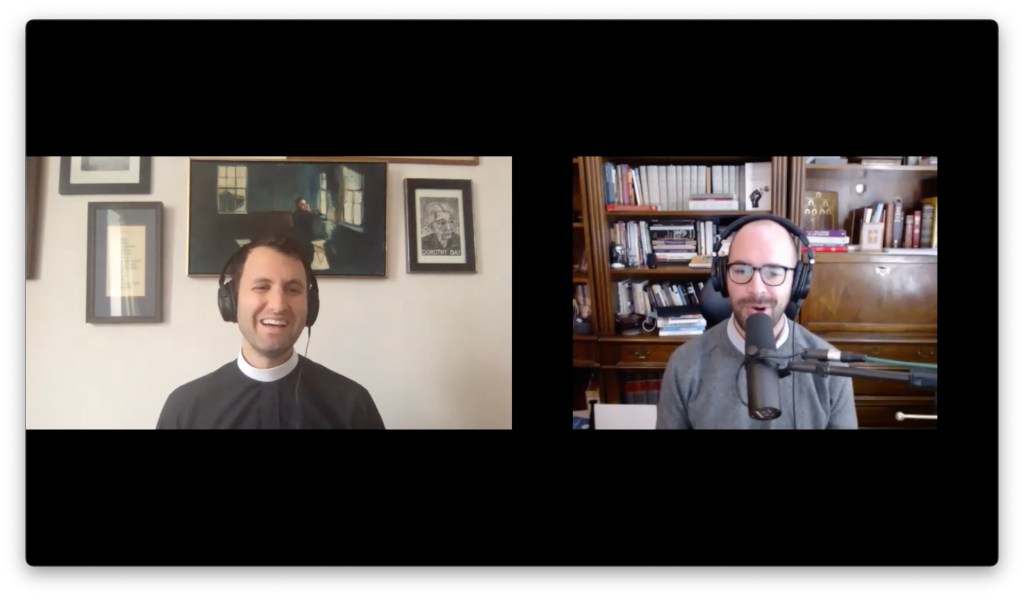
This week on the Strangely Warmed podcast I speak with Teer Hardy about the readings for the First Sunday After Christmas [B] (Isaiah 61.10-62.3, Psalm 148, Galatians 4.4-7, Luke 2.22-40). Teer serves at Mt. Olivet UMC in Arlington, VA. Our conversation covers a range of topics including Gift-giving, church complaints, Christmastide, loud voices, cowbell, praying for the land, the Gospel in 4 verses, public displays of piety, intergenerational ministry, outrageous grace. If you would like to listen to the episode or subscribe to the podcast you can do so here: Start Acting Like A Child!
This week on the Strangely Warmed podcast I speak with Jason Micheli and Teer Hardy about the readings for Christmas Eve [B] (Isaiah 9.2-7, Psalm 96, Titus 2.11-14, Luke 2.1-20). Jason serves at Annandale UMC in Annandale, VA and Teer serves at Mt. Olivet UMC in Arlington, VA. Our conversation covers a range of topics including simple themes, pandemic worship, sitting on the fence with Isaiah, Jesus’ titles, quoting Karl Barth, the great leveling, Sean Connery and SNL, detailed details, and true peace. If you would like to listen to the episode or subscribe to the podcast you can do so here: Christmas Is Who We Are
I will sing of your steadfast love, O Lord, forever; with my mouth I will proclaim your faithfulness to all generations.
The words of the dreadful Christmas song “Santa Claus Is Coming To Town” sum up perfectly how we all too-often imagine the Lord in our minds: “He’s making a list, he’s checking it twice; he’s gonna find out who’s naughty or nice…” We take those words to be Gospel truth and we believe that it will be like this into the dark night of all the tests that our broken world will never ever pass.
We do it with children this time every year with threats of the Elf On The Shelf returning to the North Pole to report certain behaviors to Mr. C.
We have it reiterated to us over and over again with movies and shows and songs asking us to discern whether or not we’ve behaved in such as way as to make it on the Nice or the Naughty list.
But Jesus (thanks be to God) ain’t Santa Claus.
Jesus will come to the world’s sin with no list to check, no test to grade, no debts to collect, and no scores to settle. He has already taken all of our sins, nailed them to the cross, and left them there forever.
Jesus saves not just the good little girls and boys, but all the stone-broke, deadbeat, sinful children of this world who He, in all of his confounding glory, sets free in his death.
Grace, as Robert Farrar Capon so wonderfully reminds us, cannot prevail until our lifelong certainty that someone is keeping score has run out of steam and collapses away forever.
But it all sounds just a little too good, doesn’t it?
In a world run by meritocracy, the Good News of grace sounds ridiculous if not inadvisable. If we don’t have eternal punishment to hold over the heads of those who follow Jesus Christ, what will possibly keep them in line?
Part of the problem stems from the fact that most of us have our theological wires crossed. We assume that we’ve got to do something in order to get God to do something for us. We believe that so long as we show up to church (or watch worship on Facebook) and read our Bibles and say a few prayers and volunteer every once in a while that it will be enough to justify life everlasting.
And yet, so many of Jesus’ parables, and teachable moments, and healing miracles have nothing AT ALL to do with the behavior of those blessed prior to their blessing.
They’re not about how we justify ourselves, but about how God in Christ justifies us.
God, in all of God’s confounding wisdom, runs out to the prodigal in the street before he has a chance to apologize, offers the bread and wine to Judas knowing full and well what he will do, and chooses to forgive (rather than condemn) the world from the cross.
We don’t strive to change ourselves to get God on our side, but we are transformed by God who chooses to be for us when we deserve it not one bit.
That’s what grace is all about – the unmerited, unwarranted, undeserved gift from God.
And, when we see grace for what it really is, then Christmas can really come into its own. Like the gifts under the tree that are (hopefully) given not as a response to good works or as an expectation that good works will come from them – we can celebrate the great gift of God in Christ Jesus who comes to do what we could not do for ourselves.
This week on the Strangely Warmed podcast I speak with Ben DeHart about the readings for the Fourth Sunday of Advent [B] (2 Samuel 7.1-11, 16, Luke 1.46b-55, Romans 16.25-27, Luke 1.26-38). Ben is the Associate Rector at Calvary-St. George’s Church in NYC. Our conversation covers a range of topics including phenomenal music, the uncontrollable God, riffing on the Magnificat, Kingdom ethics, the Prayer of Humble Access, obedience, impossible possibility, Israel’s calling, Hell, and Fleming Rutledge. If you would like to listen to the episode or subscribe to the podcast you can do so here: Give God The Verbs
The spirit of the Lord God is upon me, because the Lord has anointed me; he has sent me to bring good news to the oppressed, to bind up the brokenhearted, to proclaim liberty to the captives, and release to the prisoners; to proclaim the year of the Lord’s favor, and the day of vengeance of our God; to comfort all who mourn; to provide for those who mourn in Zion – to give them a garland instead of ashes, the oil of gladness instead of mourning, the mantle of praise instead of a faint spirit. They will be called oaks of righteousness, the plant of the Lord, to display his glory. They shall build up the ancient ruins, they shall raise up the former devastations; they shall repair the ruined cities, the devastations of many generations. For I the Lord love justice, I hate robbery and wrongdoing; I will faithfully give them their recompense, and I will make an everlasting covenant with them. Their descendants shall be known among the nations, and their offspring among the peoples; all who see them shall acknowledge that they are a people whom the Lord has blessed. I will greatly rejoice in the Lord, my whole being shall exult in my God; for he has clothed me with the garments of salvation, he has covered me with the robe of righteousness, as a bridegroom decks himself with garland, and as a bride adorns herself with jewels. For as the earth brings forth its shoots, and as a garden causes what is sown in it to spring up, so the Lord God will cause righteousness and praise to spring up before all the nations.
Two weeks ago, on the first Sunday of Advent, my family and I loaded ourselves into the car to drive around and check out the early Christmas Lights. We figured that there would either be only a handful of houses with any indication of the Holiday spirit, or because this has been the craziest year in recent memory that we would luck out with some incredible displays.
So we drove and we drove, and we saw all the staples: The LED projection of green snowflakes frantically circling around on the siding of a house, the dangling and frenetically flashing bulbs adorning the lowest limbs of trees, and we even saw a giant inflatable rainbow unicorn.
But the best house, the Clark Griswold house, was only a block away. I passed it on a run earlier in the week and knew we had to see it in all its electric, and eclectic glory. For, unlike houses with similar color schemes or even thematic connections throughout the lawn, this house had a little bit of everything.
None of the light strands matched any of the others.
There were six different Santa Clauses of every shape, size, and variety.
An inflatable Snoopy was, apparently, keeping watch over the pre-lit reindeer.
And, to cap it all off, there was a blimp floating in mid-air with penguins parachuting to the ground like they were in the middle of a holiday invasion.
And yet, even with all its glory, I couldn’t help but wonder what Isaiah, or Luke, or even John the Baptist would make of all our holiday pageantry. Because, chances are they would be horrified to see the ways we’ve trivialized the turning of the cosmos.
I don’t mean to sound too harsh, I too have lights up on the house, with a Christmas tree standing in the front window with far too many presents already wrapped and under the tree.
But we need to know, all of us, that these things, with all of their safe and sanitized renderings, may actually prevent us from seeing, hearing, knowing, and believing what the Lord has come to do.
The audience for this Advent text from Isaiah are those forced to the margins of life, the last, least, lost, little, and dead. They are, strangely enough, words of hope for people who feel no hope. They are words meant to comfort a people who feel no comfort in the world.
Even all these centuries later, this proclamation is aimed toward the afflicted, the brokenhearted, the captives, the mourners.
From those locked up in physical prisons, to those who feel imprisoned by their situations, Isaiah speaks to those who know not what tomorrow will bring.
It might feel or even seem bizarre, but this passage is also meant for people like us, those who are willing to wake up and live-stream a worship service on their phones, iPads, and computers on a Sunday morning.
Most of us move through life without giving too much thought to whatever it is we are wading through. Worship, blessedly, offers us opportunities to reflect on the here and the now, and we are challenged to imagine the not yet, the more of God’s design.
And we do this because who among us is truly content with our current circumstances?
Right now we are seeing more and more people kicked out of their homes and apartments because they simply can’t put together the money necessary because the bottom third of our economy is crumbling.
Right now parents are preparing to wake up with their children on Christmas morning without a single present under the non-existent tree.
Right now we are being warned that gatherings of more than ten people will most likely result in the most devastating of Januarys in which we will be burying more people than any of us are used to – 5 of the top 10 most deadly days in American history have all happened within the last week.
And, in the midst of all of this, most of us flock to the sentimentalities that hopefully distract us from the truth.
But when has that ever worked?
Whether we like it or not, our lives are bombarded with calls of such frightening frequency to make the best with what we’ve got that we no longer know what it is to hope.
And thus speaks Isaiah: The spirit of God is with me and I’ve been commanded to bring good news to a people drowning in bad news, to announce freedom to those who are trapped, and to break down the walls of prisons, it’s time for jubilee. We shall comfort those who mourn and give them garlands instead of ashes. They will be like tall trees for the Lord, steadfast and glorious. All the ruins shall be remade and the devastations of previous generations will be rectified. For I the Lord love justice!
God, through Isaiah, speaks to those who live in the world wondering if it has anything more to offer. It is received by those in worship who don’t know whether or not to hope for more. And, it is also spoken to those (though we know not how they will hear) who stopped coming to church long ago because they’ve given up hoping for anything else.
Listen – God has arrived; God shows up. God has taken action in the world to bring about a reality that we could scarcely come up with in our wildest dreams. And God’s work in the world is downright political – prisoners are getting released, reparations are being made to those who have been wronged, justice is for all.
It’s the time for jubilee in which debts are forgiven, punishments are lifted, and rectification reigns supreme.
God has, and is, turning the world upside down such that all of the empty streets of our too-comfortable neighborhoods are being transfigured into festivals of joy.
Why?
We were slaves in Egypt but God showed up and intervened – delivered us from bondage into the Promised land. Sure, we were content with what we had back there, at least in slavery we got three meals a day and clean water to drink and it only cost us our first born children! But God said there was more for us than Egypt-land.
We were slaves to sin and death but God showed up and intervened – delivered us from our miserable estate into salvation. Sure, we were fine with the way things were, so much so that when Jesus started talking about the first being last and the last being first we nailed him to the cross. But God said there was more for us than all of this.
God is in the business of intervention – an intrusion that will bring forth new life and halt our relentless march toward dust.
There have been many divine interventions – Exodus, Calvary, The Upper Room, The Empty Tomb.
And without those interventions of the Lord there is no hope and there is no “more.”
But God is the God of impossible possibility, who makes a way where there is no way, who delights in bringing something out of nothing.
God says through the prophet Isaiah, “Even in circumstances of the worst imaginings, captivity and imprisonment and mourning, this is not the end; there will always be more.”
Do we deserve it?
Nope.
Can we earn it?
Nope.
In the end, the gospel isn’t about being good – it’s about being rescued. It’s not about being safe – it’s about being saved.
For, there is nothing safe about the Lord. Isaiah speaks a word beyond the present, beyond the status quo, where there is actual Good News, where there is true liberty, where we wear garlands instead of ashes.
And it’s downright dangerous.
Consider the vision the Isaiah proclaims: It truly is an inversion of the ways things are for the way things should be. A world without prisons or borders or hunger or suffering.
To many that sounds more like chaos than paradise.
But, in the church we call this apocalyptic – Bible talk about the more beyond the now.
Isaiah’s apocalyptic proclamation is what taught Mary, the mother of God, how to sing:
“He has brought down the powerful from their thrones, and lifted up the lowly; he has filled the hungry with good things, and sent the rich away empty. He has helped his servant Israel, in remembrance of his mercy.”
When we come to church (even online) and are exposed to the words of Isaiah and Mary and so many others we are beckoned out beyond the world of predictability and into another world, a world of more, or risk, of gift.
In short, we’re given hope for things not yet seen.
And that hope, as noted, is a dangerous one, for good reason – just look at what happened to Jesus. Advent is the time between time in which we wait not only for the baby born in the manger, but also for the return of that baby-born-King who is the great I AM.
God is not done with this world and God is not done with us.
After all, these words of eschatological rendering don’t just describe the world – they re-create the world. It is a world made open in which the old foundations are destroyed in order for something new and something more to take their place.
Imagine – the lowliest of the low raised to the highest heights, the brokenhearted bound up in love, the captives set free, the prisoners released, no more debts, no more pain, no more suffering, no more death.
This is what God desires for us and for the world.
And, make no mistake, this is God’s work – the history of humanity has shown over and over again that we are incapable of rescuing ourselves from the forces that weigh us down. The great Good News of Isaiah’s declaration is that God will set everything right once and for all. God will end war forever.
God will bring down the mighty and raise up the last, least, lost, little, and dead.
God will overthrow the pride of the smug and the arrogant.
God will engulf the cosmos in a blaze of righteousness that will consume everything in us that needs to be burned away.
God has more in store for us than all of this.
And yet, we go forth from church (or from our couches as the case may be) and there are the same arguments around the dinner table, the same anxieties about our ever-shrinking bank accounts, the same blue Mondays will break in the morning.
We are not the world of God’s more.
At least, not yet.
For we all still sit in the shadow of sin, of our choices that result in the world looking more like our kingdom and less like God’s kingdom. We are so captivated by the ways things have been that we can scarcely imagine what they could be. We assume the world runs by debt and punishment all while God exists to show grace and mercy.
In spite of the condition of our condition, Isaiah has given us the possibility to be aware of a new world with new hope and new possibilities and new dreams and new hunger for something else, something more.
The church gives us the vision to see how watered down our versions of the Kingdom have been and it gives us the thirst for the new wine that intoxicates us with grace.
The church opens us up to the strange new world of the Bible where God exists not only with us but for us.
The church envelops us into the body of Christ where we are bound to and with one another for the sake of the already but not yet.
In short: The church gives us the Gospel, the Good News.
The very best worship services are those from which we go forth not to more of the same, but to more of the name that is above all names: Jesus the Christ. For, in him, we begin to see that the Good News really is good
A number of years ago, a rather famous theologian was in the middle of a lecture about the early church when a bright eyed and bushy tailed student raised his hand and said, “Professor, I don’t understand. If the early Christians were suffering daily, why did they stay committed to the cause?”
The professor did not hesitate before answering, “They kept the faith because the Gospel is an adventure; the Gospel is fun.”
Advent is actually an adventure – it reminds us that we are caught up in God’s great story and we have the good fortune of being characters in the epic-tale. It is an adventure because it is still unfolding, it is not over, greater things are just on the horizon.
In the Kingdom of God that is the adventure without end, there is always more to come. Amen.
The Justice Department executed Brandon Bernard by lethal injection on Thursday for his part in a 1999 double murder-robbery when he was 18 years old.
Bernard was the ninth man killed by the federal government since July and he spent more than half of his life waiting on death row.
While public support for capital punishment has decreased, it is still advocated for in the Christian church and this is a problem.
Though denominations like the United Methodist Church have opinions against the death penalty clearly spelled out in governing documents like the Social Principles (“We believe the death penalty denies the power of Christ to redeem, restore and transform all human beings.”) the day to day experience and support for the death penalty is felt and experienced differently throughout the American church.
Capital punishment, killing someone in response to a crime, is as old as civilization itself. Some of the earliest archaeological discoveries of law codes contain the ramifications for shedding blood or taking someone’s life and, more often than not, it comes down to “An eye for an eye, a tooth for a tooth, a limb for a limb, a life for a life.” It’s there in Hammurabi’s code from ancient Babylon, and it is present in the Christian Bible.
The Death Penalty has been around for a very long time, and it is still employed for a lot of reasons, though it has only recently come back into practice by the Federal Government. Some advocate for the death penalty because it is the only way to guarantee that someone will never recommit a violent crime, others claim that it helps as a deterrent to influence others away from committing similar crimes, and still yet others say it brings closure to families who grieve the loss of someone murdered.
There are roughly 2,620 people on death row right now in the United States. And the state of Virginia, where I live, has executed more prisoners than almost any other state.
And again, for Christians, this is a problem because Jesus was killed by the Death Penalty.
The main reasons that people use to justify the death penalty can just as easily be used from a different perspective. Deterrence? In the south, where 80% of all death penalty convictions occur, it is the only part of the country where crime rates continue to increase. Closure? Statistics has shown that there is benefit for the families in the short term, but in the long term they tend to experience bouts of depression and grief from another person’s death.
And, since 1976, about 1 in every 9 death row inmates have been exonerated, usually after decades of living in a prison cell.
And even among these statistics and facts, for Christians it is inconceivable to support the death penalty when the Lord we worship was killed by the same means.
Christians love crosses. We put them up in our sanctuaries and in our living rooms, we tattoo them on our skins and wear them around our necks. But many of us have become desensitized to what the cross means: death.
Let me put it this way: If Jesus died 100 years ago, Christians would be wearing nooses around our necks. If Jesus died 50 years ago, Christians would bow before electric chairs in our sanctuaries on Sunday mornings. If Jesus died today, Christians would hang hypodermic needles in our living rooms.
The cross was the electric chair for the Romans. The cross is like the hangman’s nooses of lynching mobs. The cross is like the lethal injections in modern prisons. It is the way people were killed by the state as a punishment for their crimes.
And, I’ll admit it, there are scriptures in the Bible that justify the practice of capital punishment. But there are also people in the Bible who committed capital crimes and God still used them for the kingdom.
We like the think about Moses talking to the burning bush, and leading God’s people to the Promised Land, but we don’t like to think about the fact that Moses murdered an Egyptian in cold blood before he met God in the wilderness.
We like to think about David defeating Goliath, and dancing in front of the Ark of the Covenant, but we don’t like thinking about the fact that David ordered one of his soldiers to die so that he could sleep with and rape his wife.
We like to think about Paul being knocked to the ground on the road to Damascus, and writing his letters to the churches by candlelight, but we don’t like thinking about the fact that Paul murdered Christians before his conversion.
One of the tenants of Christian theology is that nothing is impossible for God. But when we kill people for killing people, then we effectively remove all possibility of change in that person’s life. If we Christians really believe in the resurrection of Christ and the possibility of reconciliation coming through repentance, then the death penalty is a denial of that belief.
The beginning and the end of theology is that with God’s help and grace all things are possible. An alcoholic can kick the bottle, an atheist can discover faith, and a sinner can receive forgiveness. Why then do we keep slinging our nooses? Who do we keep sending people to the electric chair? Why do we strap people down for lethal injections? Why do we keep nailing people to crosses?
The message of Jesus’ ministry, of the cross, is mercy. And mercy triumphs over judgment.
That doesn’t mean that people who commit horrendous crimes get to walk away scot-free, nor does it mean that we should break down the walls of our prisons and let everyone run wild, but it does require us to fundamentally reshape our imagination regarding the so-called justice system.
For centuries the death penalty was something that took place in public – crosses on a hill, nooses in a tree. The state used the death penalty to publicly frighten potential criminals from committing crimes. But now capital punishment takes place in hidden rooms with minimal witnesses. It has retreated from the public arena and can happen without disrupting our daily lives such that when Brandon Bernard was killed yesterday, it was merely a blip on the radar in terms of our collective response.
But we are murdering people for murder.
Jesus once said, “You have heard that it was said an eye for an eye and a tooth for a tooth.” Interestingly, President Trumps has made it known on more than one occasion that this is his favorite verse from the Bible. But Jesus doesn’t stop there: “But I say to you, Do not resist an evildoer. But if anyone trikes you on the right cheek turn the other also.”
Violence only begets violence.
An eye for an eye leaves everyone blind.
God sent God’s son into the world to transform the world. Not with the ways of the world, not with power and prestige, nor with armies and aggression, but with mercy and sacrifice.
God in Christ ministered to the last, least, lost, little – people like those who are waiting for the end of their days on death row.
And Jesus carried death on his back to the top of a hill to die so that we might live.
So long as we employ the death penalty, we will deny the power of God to redeem, restore, and transform all of us. As long as we sling our nooses, and prepare our needles, we will prevent grace from making new life in those who have sinned. As long as we murder murderers, we will never give God the chance to make the impossible possible.
This week on the Strangely Warmed podcast I speak with Ben DeHart about the readings for the Third Sunday of Advent [B] (Isaiah 61.1-4, 8-11, Psalm 126, 1 Thessalonians 5.16-24, John 1.6-8, 19-28). Ben is the Associate Rector at Calvary-St. George’s Church in NYC. Our conversation covers a range of topics including Fleming Rutledge, figuration, bad news, righteous justice, creative imagery, true laughter, upending Advent, praying online, homiletical grammar, and bearing witness. If you would like to listen to the episode or subscribe to the podcast you can do so here: Repeat The Sounding Joy
Comfort, O comfort my people, says your God. Speak tenderly to Jerusalem, and cry to her that she has served her term, that her penalty is paid, that she has received from the Lord’s hand double for all her sins. A voice cried out: “In the wilderness prepare the way of the Lord, make straight in the desert a highway for our God. Every valley shall be lifted up, and every mountain and hill be made low; the uneven ground shall become level, and the rough places a plain. Then the glory of the Lord shall be revealed, and all people shall see it together, for the mouth of the Lord has spoken.” A voice says, “Cry out!” And I said, “What shall I cry?” All people all are grass, their constancy is like the flower of the field. The grass withers, the flower fades, when the breath of the Lord blows upon it; surely the people are grass. The grass withers, the flower fades; but the word of our God will stand forever. Get you up to a high mountain, O Zion, herald of good tidings; lift up your voice with strength, O Jerusalem, herald of good tidings, lift it up, do not fear; say to the cities of Judah, “Here is your God!” See the Lord God comes with might, and his arm rules for him; his reward is with him, and his recompense before him. He will feed his flock like a shepherd; he will gather the lambs in his arms, and carry them in his bosom, and gently lead the mother sheep.
“A hopeless situation.”
That’s how she described herself while sheltering against the church from the wind. Above her mask I could see a tiredness in her eyes, a tiredness that was further echoed in her story. No job, no family, no food, no money, no hope.
Meanwhile, a van full to the brim with a family drove by and, even though all the windows were up, we could still hear all of them singing at the tops of their lungs, “It’s the hap-happiest season of all!”
I handed her a bag of food, offered to pray with her, and when she walked away I couldn’t tell if it had made any difference at all.
Can you imagine anything worse than being in a situation without any hope? Being forced so strongly to the margins of life that there was no one you could call to bail you out, no family that would welcome you in?
Hopelessness can derail individuals and families. And even though, at this time of year, we light candles and string up sparkly things, and decorate Christmas trees, and talk about hope in places like this, the sting of hopelessness can still hit harder than just about anything else.
God’s people Israel knew hopelessness. During the Babylonian Exile, the time in which Isaiah speaks his confounding word of comfort, they were a people who knew no comfort.
It’s challenging for people like us, today, to imagine, at all, what that time was like for God’s people – they had lost their homes, their nation, their possessions, their worship, their status, roots, stories, identity, and just about everything else.
They were truly strangers in a strange land.
They were swallowed up by their oppressors and compelled to adopt a way of life that ran counter to all they had ever known.
They were in a hopeless situation.
And, to make matters worse, the Lord of their ancestors had commanded them again and again to take no other gods save for the Lord God. Their idolatry, their wanton disregard for the commandments resulted in an exilic punishment.
To put it plainly, they brought it upon themselves.
And they were hopeless to do anything about it.
But it is precisely here, to a hopeless people, that God speaks through Isaiah:
Comfort, O comfort my people! Speak kindly to my people, remind them that the penalty for sin has been paid. A voice is crying out – Prepare the way of the Lord! The valleys will be lifted up, the hills will be brought down, God’s divine leveling will come to fruition. God’s glory will be revealed and all will see what God can do. A voice cries out – People are like grass, they wither and float away. But God stands forever and ever! So do not fear! God is coming with might! He will feed his flock like a shepherd; he will gather the lambs in his arms and carry them in his bosom.
Chances are, some of us are familiar with at least part of this proclamation from the prophet – In the wilderness prepare the way of the Lord. We hear those words every Advent in reference to John the Baptist who, spoiler warning, prepares the way of the Lord.
And J the B, as I like to call him, was no ordinary fellow.
He is rather alarming, coming straight out of the desert dressed in animal skins while eating insects and yelling about repentance. And, according to Mark’s Gospel, its precisely J the B showing up on the scene in ancient Palestine that marks the beginning of the gospel of Jesus Christ, the Son of God.
J the B has never been fully understood, and for good reason.
He shows up out of nowhere, and before we really get to learn much of anything, he is beheaded for crimes against the state. So for two thousand years he has stood in the midst of this season, with his strange sense of fashion and bewildering diet and discomforting theology completely out of sync with his age, our age, and just about any age.
Advent, for better or worse, is a time set apart in the church when we make a conscious effort to recover some of the strangeness from the strange new world of the Bible – and John embodies it all. Because, like J the B, Advent is rather peculiar. It’s out of sync with time.
As we talked about last week, Advent is about the time between time, the already but not yet, the pause between the once and future king.
To put it in musical terms: Advent is God’s great caesura…
The best parts of Advent are those that give us the courage and the conviction to rest in the tension of who we are, and what God has done for us in spite of who we are. We take time Sunday after Sunday to look toward the darkness into which, and for which, Jesus arrives.
Advent, in a way, is actually a lot more like Lent than we often make it out to be. We take stock of who we really are in order to come to grips with what it is, exactly, that Jesus does for us.
J the B arrives, confused for Elijah, proclaiming a baptism of repentance for the forgiveness of sins. He does so, to take the hint from Isaiah, to prepare the way of the Lord. There’s something about recognizing the condition of our condition that enables God to do the work that we so desperately need because all of us, whether we like to admit it or not, are hopeless cases.
It takes quite the Christian constitution to affirm the truth of Isaiah’s words: we are like grass and flowers that wither and blow away. Sin isn’t just something we do, it’s who we are. In ways big and small we regularly (like the Israelites before us) rebel against the Law of God, we insist on laying down at the altars of countless idols, and we are forever determined to be the masters of our own destinies.
Just take a look around – Covid cases spiking yet again, economic uncertainty as jobs are not rebounding, evictions are piling up as rents can’t be paid, and there’s no sign that any of it will slow down any time soon.
Obviously, some of this is out of our control, but some of it lies squarely with us and our unwillingness to love our neighbors as ourselves.
I know it might not seem like it, but confessing our sins is actually very good news for us. There’s a reason the Catholics have been doing it for millennia. There is a documentable psychological benefit to confessing our faults and failures, we literally release endorphins in the brain when we do so. But confessing our sins also benefits us by putting us squarely in an Adventen frame of reference.
Light is only light because of the darkness it shines in.
Grace is only grace because it cancels the power of sin.
Resurrection is only resurrection because it refuses to let death be the final word.
That’s a stark and frightening thing to admit but it’s part of the Christian witness. The message of John to a hopeless people, the message of Isaiah to an exiled people, is better for us than all the trimmings and the trappings that this season usually holds. All of the advertisements and pressures and assumptions only provide a shadow version of our own reality.
That’s not who we are.
We’re Christians! We’re sinners!
We’ve come to worship today, albeit in a way none of us quite imagined back before the pandemic struck, we’ve come to worship in some part because we know we need these words from Isaiah and from John more than we need the mall, and the wrapping paper, and the light shows, and the curated Christmas playlists, and the never-ending holiday-themed Lifetime Movie marathons.
We know we need these words from the prophets because we know we need Jesus – he’s the only hope we’ve got.
Without Jesus, we’re just a people in exile stuck in a hopeless situation. But Isaiah and John show up to prepare us for the appearance of God’s own self in the person of the Messiah. They remind us that God is active in the world in ways seen and unseen and it is upon the work of the Lord that the universe hinges.
But, how might we prepare for this? It was one thing to wander around during the days of J the B and find ourselves dunked into the Jordan river repenting our sins. But we are a people stuck in Advent between the once and future king – we already know what awaits us in the manger and on the cross.
What, then, is the right response to the triumph of God showing up?
The Beyonce of the Episcopal Church, Fleming Rutledge, makes the case that, during Advent, we should keep the tune O Holy Night stuck in our gray matter because when God shows up, the only proper response is to Fall On Your Knees!
Think about it: when the reality of God breaks in on from on high, the only thing we can do is recognize the great chasm across which God chose, and chooses, to traverse for us. When we see how God is God and we are not, we can’t help ourselves but fall to our knees in reverence.
J the B stands at the edge of time. He, in himself, holds the words of the prophets while pointing to the One who transfigures the cosmos. Advent, then, looks not just to the birth of a baby in the manger, but also to the long-awaited day of the Lord when rectification reigns supreme.
In Jesus Christ, the once and future King, the new day of righteousness is made incarnate. The old age of sin and death is crumbling away and in the coming kingdom of God there is the divine shepherd who gathers the sheep into his bosom.
That’s what J the B came to declare – our deliverance is nigh!
And how shall we respond? Fall On Our Knees!
God is going to level out all things. The mountains are coming down and the valleys are moving up. Creation will be reknit and all of us along with us.
Despite the language we might hear about in church about how it’s our job to prepare the way of the Lord – God is doing this work regardless of whether or not we participate in the divine clearing project.
And, frankly, its not going to be easy for people like us. For, God’s work of divine leveling means laying ourselves open and vulnerable to a vision of reality that is God’s will be done and not necessarily our own.
It means living every moment of our lives in anticipation of God’s bringing down the mighty and lifting up the lowly.
It means relinquishing our most cherished (and therefore flawed) understanding of what we have earned and deserved.
It means being ready to give up all of our privileges and advantages in the world on behalf of those who are stuck down in the valleys of life.
Again, this isn’t going to be easy. Particularly for a people drunk on our own self-righteousness.
We don’t like admitting our faults and failures.
We don’t like confessing our privileges and advantages.
We don’t like repenting of our wrong-doings.
In the time between time, Advent, we can (with the help of the Spirit and the church) take a good hard look in the mirror and confess the condition of our condition. That’s how repentance works – it is a change of life, a reorientation, a turning back. And we can’t turn without admitting that we need to turn in the first place.
But even if we can’t bring ourselves to confess the truth. God is still in the business of making something of our nothing.
For God does not desire the immense brokenness that surrounds us. God in Christ is reconciling all things to himself. The old age of Sin and Death was run by death and division. But in God’s kingdom, what we are preparing for and are being prepared for, is run on reconciliation, grace, and mercy.
So hear the Good News: Christ died for us while we were yet sinners, not before or after, but in the midst of our sin. And this proves God’s love for us. In the name of Jesus Christ, you are forgiven. The Kingdom of God is near. Amen.
This week on the Strangely Warmed podcast I speak with Lauren Lobenhofer about the readings for the Second Sunday of Advent [B] (Isaiah 40.1-11, Psalm 85.1-2, 8-13, 2 Peter 3.8-15a, Mark 1.1-8). Lauren serves as the senior pastor at Cave Spring UMC in Roanoke, VA. Our conversation covers a range of topics including beginning again, Lauren Winner, comforting in chaos, divine reversal, unpacking peace, worship at war, Dr. Who, slowing down, divine grammar, and embodying Advent. If you would like to listen to the episode or subscribe to the podcast you can do so here: Wibbly-Wobbly Timey-Wimey












 think and let think