Devotional – Ephesians 2.10

Devotional:

Ephesians 2.10

For we are what he has made us, created in Christ Jesus for good works, which God prepared beforehand to be our way of life.

Weekly Devotional Image

In a few minutes I will leave for a local funeral home to preside over a Service of Death and Resurrection for a longtime member of Cokesbury Church. I never met Frances Tyrrell, and yet I will be the one tasked with standing before her family and friends and offering words of grace, comfort, and hope.

It is a strange and mysterious thing that we ask people to speak on behalf of the dead, particularly when the person speaking never met the person everyone has gathered to celebrate and mourn.

After meeting with the family to begin making arrangements, they graciously lent me a copy of the Woodbridge Women’s Club’s History. Frances was an original member and pioneered a lot of the volunteer work that was done throughout the community. I flipped through the interview she gave and learned all about her life, from her birth, to her marriage, to her children, to her work. But there was one particular section that stood out.

At some point the interviewer, after realizing how deeply involved Frances had been in serving other people asked Frances, “So what does your family think about all this time you’ve given and all this work you’ve done?” To which she replied, “I never asked them.”

Rare these days are the individuals who do good works simply because God created them to be that way. More often we seek to serve such that we can be seen and congratulated for the work we’ve done.

But that wasn’t the case with Frances.

Paul says, “We are who God has made us, created in Christ Jesus for good works, which God prepared before hand to be our way of life.” I can’t help but feel as if we’ve largely lost sight of the truth of this verse from Ephesians. We might think, instead, that our way of life is to earn all we can and save all we can. Or we might think our way of life is about building that perfect house, and having 2.5 children, and constructing a pristine white picket fence. Or we might think our way of life is any number of other things.

IMG_0264

But how often do we consider the fact that we have been made to serve? When was the last time we made the needs of others our priority instead of our own? How often do we help others simply because we were made this way rather than because we think God expects us to?

When we come to the end of our days, when people gather together to remember who we were and what we did, let us pray they remember us, like Frances, for our commitment to others.

Look At It And Live

strangely-warmed-spreaker-header

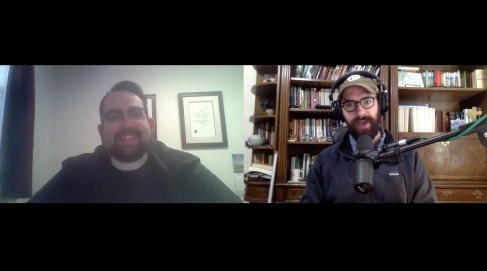
This week on the Strangely Warmed podcast I speak with Rev. Ben Maddison about the readings for the Fourth Sunday of Lent [Year B] (Numbers 21.4-9, Psalm 107.1-3, 17-22, Ephesians 2.1-10, John 3.14-21). Ben is an episcopal priest who serves as the rector of Holy Trinity Episcopal church in Wenonah, NJ. Our conversation covers a range of topics including serving a church in a post-Christian context, clergy collars, fiery serpents, the temptation of allegory, healing and scars, God’s agency, backsliding, and Fleming Rutledge’s The Crucifixion. If you would like to listen to the episode or subscribe to the podcast you can do so here: Look At It And Live

BM

Sweeter Than Honey

strangely-warmed-spreaker-header

This week on the Strangely Warmed podcast I speak with Rev. Dr. Emily Hunter McGowin about the readings for the Third Sunday of Lent [Year B] (Exodus 20.1-17, Psalm 19, 1 Corinthians 1.18-25, John 2.13-22). Emily is a teacher and scholar of religious studies and a theologian in the Anglican tradition. She has a book on evangelical family practices titled “Quivering Families” coming out in May. Our conversation covers a range of topics including the privatization of the Christian family, the most misunderstood commandment, tribalism in the decalogue, the perfection of the law, biscuits with honey, God’s foolishness, and the lens of the resurrection. If you would like to listen to the episode or subscribe to the podcast you can do so here: Sweeter Than Honey

maxresdefault (3)

Devotional – Mark 8.36

Devotional:

Mark 8.36

For what will it profit them to gain the whole world and forfeit their life?

Weekly Devotional Image

When I do pre-marital counseling sessions I have a set of questions I use to get the conversation going. I always start with “What was your last fight about?” It knocks the couple back for a second, but then very quickly they can share with me a disagreement that they recently worked through (more often than not it has to do with wedding invitations!). All couples fight about something, and so instead of advocating for no fighting, I do what I can to help them see how they already reconcile their differences, and then encourage them to work on those practices.

Later in the conversation I will ask, “Why do you want me to perform the service?” The question isn’t about me particularly, but more to the point of having a church wedding. Many couples might think they want a church wedding, but they’ll come to pastor and ask for it to happen in a church but “without the God stuff.” I am of the opinion that if a couple does not want the Lord’s blessing on their wedding, then its probably better to be done in a local courthouse than in the Lord’s house.

But of all the questions, the one that usually stumps couples the most is, “How much money is too much money?” Most respond with something like, “There’s such a thing as too much money?!” But then I’ll ask the question again. Many couples getting married are young and not quite in a position to be swimming in the dough, but a time could come in which they will make more than they need. And so I ask if they’ve ever contemplated how much money would be enough money, and what would they like to do with the rest.

61056391_31343afdc6_b

It should come as no surprise that the most prevalent reason for divorce today is money. Whether it’s hiding money in a separate account, or arguments about how much to spend on a certain item, or not saving enough for the future, or a great number of other financial disagreements – money is at the heart of divorce more often than not.

And so, as a couple prepares to embark on the strange territory that is marriage, I ask, “How much money is too much money?” I ask the question to get them thinking about finances now, and later, but also to get them to think about what their lives are all about.

We are trapped in a world where the accumulation of wealth is the end all be all, but what will it profit us to gain everything at the expense of our lives? Is the time we spend at work making money more important than the time we spend with our friends and families? What will be more important at the end of our days, the money in the bank or the people we share our lives with?

Hoping Against Hope

strangely-warmed-spreaker-header

This week on the Strangely Warmed podcast I speak with Rev. Dr. Emily Hunter McGowin about the readings for the Second Sunday of Lent [Year B] (Genesis 17.1-7, 15-16, Psalm 22.23-31, Romans 4.13-25, Mark 8.31-38). Emily is a teacher and scholar of religious studies and a theologian in the Anglican tradition. She has a book on evangelical family practices titled “Quivering Families” coming out in May. Our conversation covers a range of topics including the recent school shooting in Florida, the covenant, name changes, mutual suffering, professional Christians, the difference between trust and witness, and the obsession with safety. If you would like to listen to the episode or subscribe to the podcast you can do so here: Hoping Against Hope

EM

The Last Jedi – Spiritual or Religious?

Crackers-Banner-1

A few week ago I was able to share a conversation with Jason Micheli and Chaim Saiman for our podcast Crackers and Grape Juice about the theological dimensions of Star Wars, and in particular The Last Jedi. After seeing the most recent Star Wars film, Chaim was struck by some of the subtle (and not so subtle) religious motifs within the movie and wrote an article for The Atlantic titled, “Why The Last Jedi Is More Spiritual Than Religious.” Chaim is a law professor at Villanova and is interested in the intersection between law and faith.

church-bb-8

Our conversation covers a range of topics including Jesus and the Law, growing up in the bible belt, the First Commandment, Jesus as the proto-Christian, the religiosity of Star Wars, and how our faiths and cultures are tied together. If you would like to listen to the episode, or subscribe to the podcast, you can do so here: Fact Checking Star Wars

You Deserve To Die

Ash Wednesday tends to bring out the best, and the worst, in us. We’re forced to confront our finitude while giving thanks to God for not abandoning us to our own devices. We are marked with signs of the cross and told to not practice our piety before others. We are reminded that we are dust, and then promised that dust is not the end.

It’s a lot of fun.

And because Ash Wednesday is fun, the team from Crackers and Grape Juice got together to record a brief conversation about the liturgical holy day, and the season of Lent that Ash Wednesday inaugurates. If you would like to listen to the episode, or subscribe to the podcast, you can do so here: You Deserve To Die


The Word Made Verb

strangely-warmed-spreaker-header

This week on the Strangely Warmed podcast I speak with Johanna Hartelius and Jason Micheli about the readings for the First Sunday of Lent [Year B] (Genesis 9.8-17, Psalm 25.1-10, 1 Peter 3.18-22, Mark 1.9-15). Johanna is the host of the (Her)men•you•tics podcast where she unpacks theological terms without using stained glass language. Our conversation covers a range of topics including covenant reminders, God’s immutability, liturgical vision, Lent as Christianity’s January, and the connections between death and baptism. If you would like to listen to the episode or subscribe to the podcast you can do so here: The Word Made Verb

IMG_3586

Suffering Envy

strangely-warmed-spreaker-header

This week on the Strangely Warmed podcast I speak with Todd Littleton about the readings for Ash Wednesday [Year B] (Joel 2.1-2, 12-17, Psalm 51.1-17, 2 Corinthians 5.20b-6.10, Matthew 6.1-6, 16-20). Todd is the pastor of Snow Hill Baptist Church in Tuttle, Oklahoma and he is the host of the Patheological Podcast. Our conversation covers a range of topics including the day of the Lord, true repentance, weeping in church, hiding in the bushes, prayer in public school, and being forced to act like a Christian. If you would like to listen to the episode or subscribe to the podcast you can do so here: Suffering Envy

TL


The Case Against “Ashes To Go”

Over the last few years there has been a phenomenal rise in a liturgical practice called “Ashes to Go.” And I think it needs to end.

This is what it typically looks like: On Ash Wednesday, a pastor (or pastors) will gather in the parking lot of his/her respective local church, and a drive thru line will allow people to wait their turn for a ten second interaction where ashes are hastily smeared on a forehead while the traditional words are uttered, “You are dust and to dust you shall return.”

Or a group of clergy will gather in a public space (like a park or fast food restaurant or a coffee shop) with a simple sign encouraging people to stop in for their “Ashes to Go.” Lines will development during peak hours, people will hear the right words, and they will leave with a reminder of their mortality on their foreheads.

AshestoGo4

Now, I recognize that the current pace of our culture makes participating in an actual Ash Wednesday service challenging. I understand the difficulties of a frenetic existence where we are habitually running from one thing to the next. Moreover, I know people for whom the “Ashes to Go” is a sign of the church’s willingness to catch up with the times and start digging itself out of its ditch of irrelevancy. But offering ashes devoid of a liturgy in which the practice is made intelligible, is the equivalent of clanging cymbal without love (to steal an expression of Paul).

To those who love “Ashes to Go”: I mean no offense. I only want to call into question the faithfulness and the efficacy of doing so. I have heard about the beauty of meeting people where they are, and the reclaiming of evangelism that happens with “Ashes to Go” but I wonder if there are better occasions to share the gospel without watering down the holiness of Ash Wednesday to fit into other peoples’ schedules.

yY623rKO

Last year, my friends and I had the privilege of interviewing Fleming Rutledge for an Crackers & Grape Juice episode about Ash Wednesday and she had thoughts on the subject of “Ashes to Go” as well. This is what she said:

“It’s pathetic. I know people who do it (people I admire), but people don’t know why they’re doing it. There’s no message involved. Christianity is not just about forgiveness. Forgiveness is not enough; there has to be rectification of evil… When I grew up nobody had ashes, only the Roman Catholics did it, and we all thought it was superstitious. I personally don’t like the ashes very much unless it is done within the context of an entire worship service with a full and faithful homily. Remember: the gospel says wash your face. It’s really weird to listen to that passage on Ash Wednesday and then leave with a cross on your forehead after Jesus just told everyone to wash up.”

I agree with Fleming insofar as without taking place within a full liturgy, Ashes merely become another idol, another popular display of religious affection, and it fails to embody what the occasion is all about. Ash Wednesday is not supposed to be easy or convenient; that’s kind of the whole point. It is a disruption of our way of being, a reminder of our finitude in a world trying to convince us that we can live forever, and because the practice is not self-interpreting, it requires the context of a liturgy in which we can begin to understand what we are doing and why.

And I use the term “we” purposely. I use “we” because Ash Wednesday is not about individual introspection and reflection. It is a practice of the community we call church.

While the world bombards us with the temptation to believe we can make it out of this life alive, the world is also trying to convince us that we don’t need anyone else to make it through this life at all. According to the world, the individual triumphs. But according to the church, no one can triumph without a community that speaks the truth in love.

Therefore, for me, “Ashes to Go” completely loses its connection with Ash Wednesday and the beginning of Lent because it just becomes another individualized consumer driven model of the church rather than being the incarnational and rooted practice of joining together to remember who we are and whose we are.