Comprehending The Incomprehensible

Ephesians 3.14-21

For this reason I bow my knees before the Father, from whom every family in heaven and on earth takes its name. I pray that, according to the riches of his glory, he may grant that you may be strengthened in your inner being with power through his Spirit, and that Christ may dwell in your hearts through faith, as you are being rooted and grounded in love. I pray that you may have the power to comprehend, with all the saints, what is the breadth and length and height and depth, and to know the love of Christ that surpasses knowledge, so that you may be filled with all the fullness of God. Now to him who by the power at work within us is able to accomplish abundantly far more than all we can ask or imagine, to him be glory in the church and in Christ Jesus to all generations, forever and ever. Amen.

“Tell me about your prayer life…” has got to be some of the most ridiculous pastor lingo I’ve ever heard. I mean, who else would ask someone a question like that? I am rarely, if ever, happy about my “prayer life.” I consistently feel like I could be a better prayer, that I could spend more time in prayer, and that I could get more out of prayer than I usually do.

And, to be honest, I’m not even sure how I learned to pray in the first place. Maybe prayer is like learning to read. I know that at one point in my life I didn’t know how to read, and now I do, and I’m not really sure about the magic that made it possible.

Tell me about your prayer life… How would you feel if I asked that question, right now, right here in the sanctuary and made you stand up to answer? Exactly.

And yet, for all of the difficulty and frustration and confusion that surround prayer, it might be the most important thing the bible has to offer us.

For this reason I bow my knees before the Father and I pray. Paul here in Ephesians is no longer offering sound ethical advice, he’s not providing visions for the organization and structure of the church, he is simply describing his prayers. For the church. For us!

ephesians-1038x576

I think, like reading and so many other things, we learn how to pray by observing other people pray.

Maybe you pray like Paul… You get down on your knees and you use all the right language to elevate the divine qualities of God. You earnestly yearn for the people around you that Christ might dwell in their hearts. And that, above all, you pray for the world to know the breadth and height and depth of Christ’s love.

Or maybe you pray like my buddy Will: Woah God, how great was the weather today? Thanks! I mean, like, really awesome stuff. The way you had the clouds moving and the Sun! The Sun! It was like just bright enough but not too bright. You know what I mean? Of course you do! You’re God! Well, anyway, thanks.

There is no wrong or right way to pray, though there are certainly things that are better to pray for than others. The point isn’t so much how we pray, but that we pray at all.

Years and years ago I was helping a church in North Carolina and one of my responsibilities was visiting some of the older and retired members of the church. Many of them were what we call shut-ins, in that they could no longer make it to church for worship or fellowship, but they still felt very connected to the church.

So I would bring a copy of the latest bulletin and sit down with someone for an hour for nothing more than a conversation, and we would always end our time in prayer.

One of my regular visits was to a retired pastor, and he was easily my favorite. We got to know each other pretty quickly, and every time we got together he would offer me a sage piece of advice regarding my future vocation in the ministry. He told me story after story about his successes and failures. He told me what passages to avoid in the bible, and he even told me about the time a police officer had to drive him home after a funeral wake because he didn’t know the punch had alcohol in it.

Anyway, one afternoon I went to go visit him and our relationship had grown to such a degree that I regularly walked into his room at the retirement home without knocking. And as soon as I stepped through the threshold I saw him kneeling by his bed in a posture of prayer.

What a holy sight to behold! This man, after all the years of praying and serving the church, was still just as dedicated to communing with the divine. But the more I took in the scene the more uncomfortable I felt. I didn’t want to just leave without saying anything, and I didn’t want to just keep standing their awkwardly by the door, so after a minute or two I decided to join him by the edge of the pray and start praying too.

            I slowly crept across the room and lowered my knees to the floor and centered myself before I overheard the prayer of the retired pastor… he was snoring.

And, of course, I tried not to laugh, but then again I found myself at a loss for what to do. What would happen if he woke up while I was trying to slide out of the room? What would he do if he opened his eyes and saw me kneeling on the floor right next to him? I decided to very gently rub his back and he immediately opened his eyes and said, “Amen!”

Tell me about your prayer life…

Paul wrote to the church in Ephesus because he was filled with joy that all followers of Jesus Christ are part of God’s family. No longer is there “us” and “them.” There is no “insider” or “outsider.” All have been made part of the new family in Christ Jesus. And Paul’s response to this profound revelation is to get down on his knees and pray! He knew that trying days were ahead, that it would not be an easy thing for the church to accept, the incomprehensibility of a new family made up of all, and he knew that he could not give the church what it needed to be sustained by himself.

The church relies on God, not itself.

That’s a tall order in today’s world and in today’s culture. We are told from childhood to pull ourselves up by our bootstraps, that we can be anything we want to be, and that it’s all up to us. But the message of the gospel is in fact the opposite. You cannot pull yourself up by your bootstraps, you can’t be anything you want to be, and it is not all up to us.

We cannot do this thing we call life on our own. And we certainly cannot pray on our own.

36496-praying-together-1200.1200w.tn

Paul prays for the church to comprehend the incomprehensible. This is no easy thing! But Paul prays that we might comprehend the incomprehensible WITH the saints. It is something we can only do in community, and not in isolation.

The more time I spent with the retired pastor, the one praying in his sleep (or sleeping through his prayers), the more I learned what he was really like. Because for the first few months he was what I would call his Sunday morning self, the person he used to become on Sunday morning for everyone that once showed up at his church. He was able to keep the smile for the hour we were together and send me on my way with what felt like a benediction.

But after a couple months I saw behind the curtain and I learned about his loneliness, his broken family, his fears and failures. I encountered who he really was as I discovered his inner self. And the hardest discovery of all was learning that he felt as if he had moved beyond the love of God.

The great theme of Paul’s letter to the Ephesians is the fact that there is no nation, no tribe, no family, and no person who is beyond the love of God. This may sound obvious, but it can be very difficult to believe. Particularly if you’ve lost the community, or family, or church that helped to make that love feel manifest.

Even on our best Sundays here at Cokesbury, we, the gathered people of God, bring together a myriad of secret hurts, private humiliations, and lost hopes.

After only being here for a little more than a year I can stand behind this altar and look out at the truths many of you have shared with me. I see the broken families and the betrayals, I see the terror and fear about unknown futures, and I see the pain and loss of people who used to sit in these pews. I know so many of the secret shames and private failures that are contained in isolation and I know that the ultimate fear is about what happens if any of it gets out.

And yet we keep showing up. We keep carrying our own weights and disappointments. We put on our Sunday selves, we keep the smile for the hour we are here and then we are sent away with a benediction.

But what would happen if we revealed our truth to the church? Now, I don’t mean we take turns standing up at the front and airing out all of our dirty laundry. But think with me for a moment… how could this church change if we treated it like the church Paul prays for, rather than just a place where we hang out for an hour on Sundays?

Paul prayed for the church to know, above all else, the love of God in Christ that surpasses all knowledge. Paul prayed for Christ to so dwell in our hearts and minds that we might be filled with all the fullness of God. Paul prays for us to imagine the unimaginable, to know the unknowable, and to comprehend the incomprehensible.

If we pray for our church, if we pray for Cokesbury like Paul prayed for the Ephesians, then we do so by praying for a communal experience of the love of God in heart, soul, mind, and strength. And then we pray for the church to come to grasp the truth of grace; a truth that is utterly massive and beyond all earthly reason.

            God loves us, and there’s nothing we can do about it.

And so it is for that reason, that we bow our knees before God the Father, and we pray that according to the riches of God’s glory, God may grant that we may be strengthened in our inner beings, that Christ may dwell in all of our hearts, as we are being rooted and grounded in love. We pray for the power to comprehend, with all the saints, what is the breadth and length and height and depth, and to know the love of Christ that surpasses all knowledge, so that we may be filled with all the fullness of God.

_

We pray this so that all of us might know that no one, NO ONE, is beyond God’s love. Not even us. Amen.

Jesus’ Favorite Commandment

strangely-warmed-spreaker-header

This week on the Strangely Warmed podcast I speak with Daniel Burch about the readings for the 10th Sunday After Pentecost (2 Samuel 11.1-15, Psalm 14, Ephesians 3.12-21, John 6.1-21). Daniel is a Licensed Local Pastor in the United Methodist Church and he serves in Warsaw, VA. Our conversation covers a range of topics including cursing from the pulpit, peeping David, imperfections and temptations, happiness vs. contentedness, working toward perfection, hiding beers, wedding texts, The Crucified God, masks in church, and moving beyond the ordinary. If you would like to listen to the episode or subscribe to the podcast you can do so here: Jesus’ Favorite Commandment

d

Also – The Crackers & Grape Juice team is excited to announce our first book! I Like Big Buts: Reflections on Romans (you can find the ebook and paperback on Amazon).

The Cost of Victory

2 Samuel 5.1-5, 9-10

Then all the tribes of Israel came to David at Hebron, and said, “Look, we are your bone and flesh. For some time, while Saul was king over us, it was you who led out Israel and brought it in. The Lord said to you: It is you who shall be shepherd of my people Israel, you who shall be ruler over Israel.” So all the elders of Israel came to the king at Hebron; and King David made a covenant with them at Hebron before the Lord, and they anointed David king over Israel. David was thirty years old when he began to reign, and he reigned forty years. At Hebron he reigned over Judah seven years and six months; and at Jerusalem he reigned over all Israel and Judah thirty-three years. David occupied the stronghold, and named it the city of David. David built the city all around from the Millo inward. And David became greater and greater, for the Lord, the God of hosts, was with him.

Early in the morning on the 4th of July, a young woman and a group of friends made their way to Liberty Island where the Statue of Liberty looks out across the waters. Like countless people gathering to celebrate Independence Day, they looked like everybody else ready to enjoy the day. However, upon arrival, they quickly unfurled a banner over a railing near the base of the statue that said, “Abolish ICE!” and they boosted the young woman up onto the statue.

For nearly three hours she made her way around the statue while police attempted to bring her down. Whenever they got close she shouted out her intention, “I will stay here until all the children are released!”

But after three hours of evasion, the police eventually arrested her, and brought her down off of Lady Liberty.

A spokesperson for the protestors said the demonstration was thematically charged by the belief that Lady Liberty weeps over how the country is treating children and families at the border.

The main protestor, the young woman, was eventually identified and taken in to custody. She clearly violated a number of state and federal laws, and will be prosecuted in the not too distant future.

            So what will be the cost of her victory? Prison? Steep financial fines?

            And was she even victorious? What was she hoping to accomplish?

ICE_Protestor_Caught_After_Scaling_Statue_of_Liberty

All the tribes of Israel came together to speak with David. Echoing the profound words of their first ancestor “bone of my bones and flesh of my flesh,” they said, “Look, we are your bone and flesh. Saul was once king but you are the one who led Israel.” And they anointed David king. He was thirty years old.

After thirty years of serving the Lord, from striking down Goliath, to attending the needs of the mad king, to lamenting over his death, David finally became the king.

When you imagine David, what do you picture? Do you see the little shepherd boy with curly hair running through the fields? Do you think of David dancing before the Ark of the Covenant with nothing but a loincloth? Do you see the humble king walking among the people of God?

David is the de facto king figure of scripture. From this point forward he, even more than Moses, is the archetype for what it means to lead God’s people. Solomon will ask God to make him a leader like his father David, the prophets will remember the faithful times of David’s reign when looking out at idolatry. Even during the days of Jesus, the people of God will look for a new David to lead the revolt against the imperial power of Rome.

And we might like the version of David often handed to us: the Goliath killer, the lute player, the psalm scribers, the king who united Israel. But it all came with a cost.

            Every great victory leaves a loser in the ditch, and David is no exception.

I’ve brought this up before, but it’s helpful to know that someone like me does not pick the scriptures we use on Sunday morning at random. Years ago a group of ecumenical Christians compiled a three-year cycle of four readings for every Sunday called the revised common lectionary. It was designed to bring congregations through the great narrative of scripture without being constrained by the choice of the preacher.

Depending on the season we might spend weeks going through one of Paul’s letters, or we can jump around the psalter, or just follow the narrative of Jesus’ life from the gospel. Regardless of what we hear in church, it was almost always decided for us.

Today is no exception.

The Lectionary says that the Old Testament reading today should be 2 Samuel 5.1-5, 9-10. It’s a brilliant little vignette in David’s rise to the throne of Israel. But notice: there are three verses missing.

            Why?

Sometimes verses are omitted because we are brought to the conclusion of a story without being weighed down by superfluous details. Sometimes the narrative is interrupted and it makes logical sense to jump from one place to another.

But sometimes the lectionary omits verses because they are difficult to handle, they make people like you and me uncomfortable, and we don’t know what to do with them.

I don’t often ask you to do this, but I would like all of us to pick up a pew bible and turn to 2 Samuel 5 (OT page 218). We read earlier that all of the elders joined together, and they anointed David king. We read about how David was thirty years old when he began to reign. We read about how long he ruled. But before we jump to verse 9, where we learn he occupied Jerusalem, let’s read about what he had to do to achieve that victory…

6 – The king and his men marched to Jerusalem against the Jebusites, the inhabitants of the land, who said to David, “You will not come in here, even the blind and the lame will turn you back” – thinking, “David cannot come in here.”

7 – Nevertheless David took the stronghold of Zion, which is now the city of David.

8 – David had said on that day, “Whoever would strike down the Jebusites, let him get up the water shaft to attack the lame and the blind, those who David hates.” Therefore it is said, “The blind and the lame shall not come into the house.”

The Lectionary, which thousands of churches follow, omits those three verses. And those three verses completely change the emotional impact of the story. Because without those three verses all we learn about is David becoming king. And with the three verses, we learn what kind of king David would be.

            Victory comes with a cost.

David sent his warriors on a surprise attack into the city through the water shaft. However, they would not only sneak through to shock the enemy combatants, but David also ordered the massacre of the blind and the lame.

And after the carnage, they occupied the stronghold and named the place the city of David. A great and decisive victory for the people of God, one in which even the blind and lame were left bloodied in the streets.

Scripture is no joke my friends. In this crazy and bewildering assortment of poetry, prose, and pragmatism, we discover the incredible mountaintop moments of God’s glory, and the deep valleys of humanity’s shame.

It is said that the winners write the history books, and this is true. Where might we find the details from the Jebusites perspective? Where can we read about the plight of the blind and lame left to die in the city of David?

We can’t, because they lost.

And yet when we look back on the life of David, we know and remember that his first act as king from taking the city of Jerusalem and uniting the people called Israel. But if we follow the lectionary, we lose sight of how far he was willing to go to do so.

On Wednesday morning my family and I piled up our supplies in our Radio Flyer wagon and we made our way down to our neighborhood’s 4th of July parade. We sat in the limited shade with great anticipation as we heard the sirens and marching bands in the distance. And for more than an hour we cheered and celebrated as all sorts of people from the community walked past us in celebration of our country’s independence.

Hours later, we gathered with neighbors for a backyard barbeque and watched as our children splashed around in a kiddie pool. We exchanged stories of 4th of Julys past, and offered thoughts about future celebrations.

In the evening, I rocked my son to sleep with the faint smell of gunpowder wafting up from his hair, still holding on to the firework displays in our front yard, and the distant pops of fireworks echoed in his room.

plan-your-4th-of-july-weekend-houston-2017-696x407

It was a great day, one for which I am grateful. I love living in this place we call the United States, for the freedoms I experience to worship the God I love, and to gather with people like you to do so.

            But throughout the sea of red, white, and blue, between hot dogs and hamburgers, surrounding the bright colors in the sky was the constant and ringing reminder: What price did we pay for this?

            Or, better put, what price did others pay for this?

This country, and our love of it, flirts very closely with what Jesus called idolatry. When the country we live in becomes more important than the God who created us, when the lights in the sky on the 4th of July shine brighter than the bread and cup on this table, when we care more about what’s happening in Washington DC than what’s happening in our local community, then we have a problem.

And part of the problem is that, like David, we forget the tremendous cost of our victory.

We don’t take the time to repent for the millions of lives that have been taken in order for us to form a more perfect union. We ignore the stories and plights of the native peoples from whom we stole this land. We dismiss the broken systems of racial inequality that are still very much manifest in ways that began when black and brown bodies were stolen and forced into slave labor. We overlook how women were, and still are, mistreated and disrespected for no reason other than their difference in genitalia.

What we have here, it’s pretty good. Better than most places in the world, if not the best. But it all came with a cost.

People matter. Regardless of whether they are blind or lame, native or immigrant, black or white, male or female, people matter.

And for David, some people didn’t matter.

David occupied the city Jerusalem with the bodies of his own people, by showing up in flesh and blood and bone – By sneaking through the water shaft to kill the blind and the lame.

Centuries ago, this country was occupied with bodies by those who showed up in flesh and blood and bone – By stealing land from those who were here before, by breaking the bones of those forced to work the land, by belittling those who bore the next generations in their wombs.

David occupied Jerusalem with violence, with the threats against the blood and bones of others. So too, America is occupied with violence, with threat against the blood and the bones of others.

2dd04d97c664a4970b539f317ea19633--jesus-painting-prophetic-art

That same violence was present in the city of Jerusalem centuries after David stormed through the city, when the gathered people shouted the name of a different shepherd boy, though this time they demanded for him to be crucified on a cross. With every hammer and nail through his bones and flesh, echoes of the past, present, and future rang for everyone to hear. With his cross hanging high in the sky, all of the bodies whose blood rolled through the streets of Jerusalem, and every broken body that would pave the way for this country were also held high for all to see.

In Jesus we discover the true victory, a triumph that came at the cost of God’s own life. At this meal, in this bread and cup, we find the peace of Jesus that occupies us when we feast. In these pews, in the space between us filled by the Spirit, we experience the beginning of a new reality in which victory is defined not by violence, but by grace.

David is a far more complex character than we ever give him credit for, and America is far more complicit with the violence and brokenness of the world than we often remember, but that does not mean that both of them should be dismissed or broken down. We can still rejoice in the shepherd boy who united Israel, and we can still celebrate the country in which we live. But we cannot forget the cost of their victories, nor can we forget the blood that has been spilled in both of their names.

Because in Jesus’s life, death, and resurrection we encounter the end of sacrifices, the end of violence as a means by which we change the world. Jesus has already changed the world, Jesus occupied our place on the cross, and God is with us. Amen.

Rebelling Against King Jesus

strangely-warmed-spreaker-header

This week on the Strangely Warmed podcast I speak with Alex Joyner about the readings for the Day of Pentecost – Year B (Acts 2.1-21, Psalm 104.24-35b, Romans 8.22-27, John 15.26-17, 16.4b-15). Alex is the District Superintendent for the Eastern Shore in the Virginia Conference, and he regularly blogs on his website Heartlands. Our conversation covers a range of topics including bad puns, living off the map (literally), church birthdays, faithful diversity, the connections between Babel and Pentecost, the impermanence of land, giving voice to the voiceless, and the community in the Trinity. If you would like to listen to the episode or subscribe to the podcast you can do so here: Rebelling Against King Jesus

aj

Devotional – Psalm 23.5

Devotional:

Psalm 23.5

You prepare a table before me in the presence of my enemies; you anoint my head with oil; my cup overflows.

Weekly Devotional Image

Sometimes the more we say something the less we understand what it means. Think about the phrase, “I love you.” Perhaps you can remember the first time your spouse offered those three magical words and how your body tingled with joy and hope and expectation. But then fast-forward 20 years… Do those three words still shake you to your core? Or are they more like the bookends to a conversation?

The same holds true for particular parts of Christianity. We memorize things like the Lord’s Prayer and the Apostles’ Creed to such a degree that we can say them in church, week after week, without thinking about what we are actually saying. We grow so accustom to seeing the same phrases and announcements in the bulletin that we just gloss over them (incidentally, I jokingly told the congregation that I hid a line in the bulletin months ago saying something like “the first person to notice this sentence will receive $20” and that no one found it. Of course I didn’t actually do it, but you could tell that a number of people were disappointed they missed the opportunity to make some quick cash!)

And then you take things like beloved moments in scripture, and we accept them without reflecting on them as well.

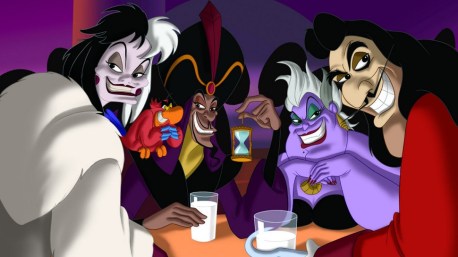
The 23rd Psalm might be the most well known passage in the entire bible, and yet somehow it contains a verse that many of us often forget. We like the idea of being lead to green pastures, and lying beside still waters, but having a table prepared for us IN THE PRESENCE OF OUR ENEMIES is another thing entirely.

Disney-Villains-jafar-2508555-1280-1024

Now, to be clear, when we think about who those “enemies” might be, we often conjure up people on the other side of the globe. However, sometimes our greatest enemies are actually the people in the pews next to us.

In God’s strange and mysterious wisdom, Christians are regularly gathered together to break bread with both allies AND enemies. We come to the table with the people we love AND hate. The table is prepared for us in the presence of those we love AND fear.

God’s table, where we encounter a little bit of heaven on earth, is the place where we begin the difficult and powerful work of being reconciled with those around us. It is because God is willing to gather us with our enemies that we are anointed for the work of discipleship in this world. Only a people who willingly gather with those we might call our enemies can also faithfully affirm that our cups runneth over.

Don’t Make Jesus Hangry

strangely-warmed-spreaker-header

This week on the Strangely Warmed podcast I speak with Teer Hardy about the readings for Easter 3B (Acts 3.12-19, Psalm 4, 1 John 3.1-7, Luke 24.36b-48). Teer is the associate pastor of Mt. Olivet UMC in Arlington, VA and he and I help share the responsibilities for editing the Crackers and Grape Juice Podcast. Our conversation covers a range of topics including tee-ball, the challenges of returning to church after paternity leave, looking at the verses before the lectionary text, offensive evangelism, the elect and the reject, MLK’s legacy, the absence of silence, hol(e)y hands, and Jesus’ immoral teaching. If you would like to listen to the episode or subscribe to the podcast you can do so here: Don’t Make Jesus Hangry

th

The Not Top 10

Exodus 20.1-17

Then God spoke all these words: I am the Lord your God, who brought you out of the land of Egypt, out of the house of slavery; you shall have no other gods before me. You shall not make for yourself an idol, whether in the form of anything that is in heaven alone, or that is on the earth beneath, or that is in the water under the earth. You shall not bow down to them or worship them; for I the Lord your God am a jealous God, punishing children for the iniquity of parents, to the third and the fourth generation of those who reject me, but showing steadfast love to the thousandth generation of those who love me and keep my commandments. You shall not make wrongful use of the name of the Lord your God, for the Lord will not acquit anyone who misuses his name. Remember the Sabbath day, and keep it holy. Six days you shall labor and do all your work. But the seventh day is a Sabbath to the Lord your God; you shall not do any work – you, your son of your daughter, your male or female slave, your livestock, or the alien resident in your towns. For in six days the Lord made heaven and earth, the sea, and all that is in them, but rested the seventh day; therefore the Lord blessed the Sabbath day and consecrated it. Honor your father and your mother, so that your days may be long in the land that the Lord your God is giving you. You shall not murder. You shall not commit adultery. You shall not steal. You shall not bear false witness against your neighbor. You shall not covet your neighbor’s house; you shall not covet your neighbor’s wife, or male or female slave, or ox, or donkey, or anything that belongs to your neighbor.

Lent is a season of repentance and introspection. However, that doesn’t mean the liturgical season encourages navel-gazing – in fact it compels us to look at our lives individually and corporately. Lent almost forces us to ask, “How have I failed, and how have we failed?”

It is not an easy season in the life of the church.

In preparing for this Lent I was struck by the theme of covenants – both biblical and otherwise, and what they have to do with our faithfulness. Almost everyone here is familiar with what a covenant is, we’ve borrowed money, or rented an apartment, or purchased a car, all under the auspices of a contract. They exist because of a fundamental distrust that we have for one another and institutions, we use them to protect ourselves should the other not hold up their end of the bargain.

Yet the truest and deepest relationships are those built on trust – when we lovingly yield ourselves to the other with vulnerability and fragility. And that is precisely what God has offered us in the covenant – the vulnerability required for true trust.

ten-commandments-set-free-to-live-free_27594_banner_img

Confession time: I am prejudiced against Sunday School.

I can’t help it really – while growing up in the church, I had far more love for what we did in a room like this, than what happened in the Sunday School rooms. Participating in Sunday School required waking up earlier than usual, it forced us to rush through the typical morning rhythm, and then we’d be deposited in classrooms in which there were old smelly couches, fading biblical posters, and an assortment of discarded bibles.

Bless the teachers’ hearts: they tried to teach us about the bible… but it never really stuck. I can remember a lesson about David and Goliath, but all we talked about was how buff David looked in the pictures and we wondered aloud how long it would take us to look similarly.

I can remember learning about Abraham and the sacrifice of Isaac, and even though I now know that God provided a ram instead, at the time I was terrified of God and didn’t want to go back to church for a few weeks.

I can even remember learning about Jesus and Mary Magdalene, but the story fell a little flat when our teacher kept referring to her as a “lady of the night” which made Mary sound more like a vampire than whatever a lady of the night is.

Beyond the lack of theological depth, the thing that really drove me crazy about Sunday School was the fact that it felt way too much like regular school. We had a teacher, who took our attendance, assigned us particular seats, gave out homework, and even presided over pop-quizzes. And I understand that theological education is important, I went to seminary after all, but the way it was done for me resulted in my studying not to hear what God had to say, but for the promise of receiving a piece of candy if, for instance, I could find the book of Isaiah before anyone else in the room.

I could fill this entire sermon with Sunday School anecdotes, but the one event I remember most vividly was the day we were quizzed on the Ten Commandments. I knew they were a thing, I was pretty sure we had an embroidered version of them hung on the wall outside the sanctuary, but I had no idea what they were.

I sat there at the table with my blank piece of paper and I stared off into the distance for a long time. What does God command us to do? I probably wrote something about loving God, and loving neighbor. I might’ve even suggested that we’re supposed give our money to God. But when the time of our quiz came to an end I turned in my poor excuse of a quiz, and I failed.

There would be no piece of candy for tween-age Taylor that day.

Do you know all of the Ten Commandments, in order? If I gave each of you a piece of paper for a quiz, would you receive your piece of candy? How many of us have memorized God’s top 10?

When I was living in Durham, NC there was a period of time when people started placing the Ten Commandments on lawn-signs in their front yards for everyone else to see. I’d be riding my bike to class, and house after house, rather than wanting me to know who they would be voting for in the next election, wanted me to know that I’m not supposed to break the Sabbath, or worship any other god, or kill anyone.

It was around that same time, as it comes up again and again, that a sizable portion of the population began advocating for the appearance of the Ten Commandments in public buildings, like schoolhouses and local courthouses.

And I couldn’t help but think that God was using the surging publicity of the Ten Commandments to make up for my failure in Sunday School.

            Somehow or another, God was going to drill these commandments into my brain!

            But then I began wondering, was this God’s work, or was it ours?

Or, to put it another way: Were the commandments being used to provide freedom, or as a weapon?

Then God spoke all these words… Through a covenant, a promise to be our God, God delivers us, sustains us, heals us, and watches over us. God only asks that we follow ten simple rules. And we can’t do it.

Every single one of us in this room has broken a commandment (some of us more than others!) And yet, our failure to hold up our end of the agreement does not affect God’s commitment. It is in knowing that we fail, God loves us.

God is the one who establishes the covenant with us, not the other way around. No response, no bargaining on our part, was required. God binds God’s self to us knowing full and well how we will respond.

And the way we talk about the commandments, the way we quiz children, or place them in our yards, or desire them in our courthouses, makes a mockery of the gift that they are.

We make them more about us, than about God.

The Ten Commandments express the purposeful will of God for God’s people. In our limited imaginations we’ve made them out to be a list of what we can and cannot do. We’ve used them like a bludgeon against those who do not follow them.

But at the heart of the commandments, at the heart of God’s covenant with us, is the freedom to love God and one another.

Of course, there is a freedom to ignore the covenants, something we do all the time. All those signs in people’s yards, they were all facing away from those who lived in the houses. It was as if they wanted others to follow what they themselves had forgotten. Quizzing children on what the commandments say is a far stretch from helping them to be implemented. Displaying them in courthouses will not make people follow them any more than a speed limit sign will on a highway.

It’s incredibly ironic that many people want the Ten Commandments up in public in a country where divorce is over 50% (you shall not commit adultery), where we have more guns than human beings (you shall not kill), where capitalism is more important than community (honor the Sabbath), and where we spend more time worshipping celebrities than Almighty God (you shall have no other gods before me).

Public displays of religious affection in the form of the Ten Commandments will not change or transform this world.

But binding ourselves to them, holding each other accountable to these strange and life-giving realities, is the seed that results in a new garden of life. If we ignore them, we do so at our own peril, not because God is waiting with a whip to punish us, but because the teachings establish a way of being.

Living outside the commandments results in a life of isolation, individiualism, and apathy.

            But living in the commandments, writing them on our hearts rather than our walls, is the beginning of a trust that transforms everything else.

We might say, “What’s the harm in a little coveting?” Our entire advertising economy is based on the principles of jealousy and envy after all. Or we might wonder about what’s so wrong with working extra hours on a Saturday morning… Our entire culture produces a narrative in which over production is an expectation.

It is in the prohibition of such things that God challenges our understanding of reality. We can give our lives over to our own commandments, but our lives will be a shallow shadow of what they could be. Living in the Ten Commandments sets us forth on a path that allows us to fully love God and one another. It is the way we become who God is calling us to be.

The Ten Commandments are God’s Top 10 rules for faithful living and, sadly, they have become a Not Top 10 list for us.

1280x720-apA

We regularly worship other gods, like the god of wealth or political power. We build up false idols in material objects. We do things in the name of the Lord that harm and destroy others. We break the commitment to rest. We reject and rebel against our parents. We live in a world fueled by war and violence. We are captivated by a highly sexualized culture that tempts us toward adultery. We steal from those without power. We lie constantly. And we believe the commercials that tell us life will be better if we just had what the person on the screen has.

But it doesn’t have to be that way. We can rediscover this Not Top 10 list for the freedom that it provides. We can bind ourselves to it, and in so doing the shackles of death will fall away. We can remember that its not a list to be memorized, or a weapon to be used, but a way of life that leads to life.

We can love God with our whole hearts, we can trust in our allegiance to the Lord, we can ask to be used by God rather than the other way around, we can find true rest, we can love our parents both biological and spiritual, we can see all people as having sacred worth, we can live into the promises we make in marriage, we can give to those in need, we can tell the truth in love, we can believe that we already have enough.

We can do all of this but God makes the impossible possible. God fills us and fuels us for lives bent not toward ourselves, but toward others. God sustains us when we are down in the valley, and uses the Spirit to push us back toward the mountaintop.

Displaying the Ten Commandments for other people to see will never bring us closer to God, but striving to live according to the them results in a profound freedom unlike anything else. Amen.

Sweeter Than Honey

strangely-warmed-spreaker-header

This week on the Strangely Warmed podcast I speak with Rev. Dr. Emily Hunter McGowin about the readings for the Third Sunday of Lent [Year B] (Exodus 20.1-17, Psalm 19, 1 Corinthians 1.18-25, John 2.13-22). Emily is a teacher and scholar of religious studies and a theologian in the Anglican tradition. She has a book on evangelical family practices titled “Quivering Families” coming out in May. Our conversation covers a range of topics including the privatization of the Christian family, the most misunderstood commandment, tribalism in the decalogue, the perfection of the law, biscuits with honey, God’s foolishness, and the lens of the resurrection. If you would like to listen to the episode or subscribe to the podcast you can do so here: Sweeter Than Honey

maxresdefault (3)

Think And Let Think’s Top 10 – 2017

I started Think And Let Think a few years ago as a way to compile my thoughts, sermons, and devotionals. After starting at my first church in 2013 it became an easy way for parishioners to access the sermons from Sunday if they were unable to attend. Over the years the scope of the blog has grown far beyond the people I serve in the local church, and 2017 saw a tremendous increase in readership. Below are the 10 most popular posts from 2017.

toptips10


  1. Open Hearts. Open Minds. Open Doors.

I preached exclusively from Romans during Lent. After reading through Barth’s Romans for the nth time, I felt like I needed to stay in the letter through a liturgical season and dragged my congregation along for the ride. This sermon was prompted by Paul’s reflections on Abraham’s righteousness and my contempt for the United Methodist Church’s slogan of open hearts, open minds, and open doors.

“We can have the perfect advertising campaign, with our slogan in big capital letters, but that does not redeem our sinful actions and behaviors. We might think we are righteous and that we are “color-blind” or “LGBTQ affirming” or “economically transparent” but we are nevertheless sinners in need of God’s grace and forgiveness. We can even leave the church doors unlocked all week long, but we will still be broken and in need of God’s redeeming love.”


  1. God Won’t Give You More Than You Can Handle

At the beginning of the year I preached through a series on Dumb Things Christians Say. One of the dumbest things Christians say on a regular basis is, “God Wont’ Give You More Than You Can Handle.” Oddly enough, it’s not true. This sermon works through the phrase and attempt to show that God doesn’t give us what we can handle, but that God helps us handle what we are given.

“Sometimes, we say things like “God won’t give you more than you can handle” because we don’t know what else to say. We encounter the shadow of suffering that is so suffocating we don’t know how to respond. So instead, we will that awful void with awful words. And we make God into a monster.”


  1. A Reminder For Those Attending Annual Conference

Annual Conference can be a time of great renewal and great cynicism. 2017 was no different. In the days leading up to the Virginia Annual Conference gathering I collected my thoughts in hopes that all of would remember that the church is primarily about God, and only secondarily about us.

“God is the one who first breathed life into John Wesley and sent him on a course that would forever reorient the fabric of the church. God is the one who breathed life into all of the churches of the Virginia Conference, who empowers the pastors to proclaim the Word from their respective pulpits, who shows up in the bread and in the cup at the table. God is the one who gathers us together for a time of holiness, who moves in the words we sing, who rests in the spaces between us when we worship, who calls us to serve the kingdom instead of serving ourselves.”


  1. The Mystery Of Marriage

I was privileged to preside over the wedding of one of my oldest friends this year and it prompted a wedding homily that gets at the heart of why getting married is such a strange act of faith.

“Love, the kind of love that will sustain your marriage, holy love, is Godly love. It is a love unlike anything else on this earth. It is beyond definition and explanation. It is deeper than the deepest ocean, and greater than the tallest mountain. It is sacrifice and resolution. It is compromise and dedication. The love that God has for you is the kind of love you are promising to one another and it is a mystery. It is only something you can figure out while you’re figuring it out.”


  1. The Church Doesn’t Exist To Make A Difference

It took five years of full time ministry before I received my first piece of anonymous hate mail. Because it was anonymous and therefore could not have a dialogue with the individual, I wrote a reflection about their complaint in hopes they would one day see it.

“Christians in America have played the political game for so long that we can almost no longer differentiate between America and God. Or, at the very least, we assume that if the church is not involved in the work of making the world a better place, than it’s not worth our time and attention. In scripture, Jesus calls this behavior idolatry.”


  1. Thoughts On The Cross Flag

In the days immediately following President Trump’s response to NFL players kneeling during the national anthem, the lectionary reading was Psalm 25.5: “Lead me in your truth, and teach me, for you are the God of my salvation; for you I wait all day long.” That week I found myself surrounded by conversations that had everything to do with politics, and nothing to do with God. And after reading the psalm, my thoughts on the Cross/Flag came flying out.

“It’s one thing for talking heads to ramble about the pros and cons of kneeling during the anthem but it’s another thing entirely when it comes to the realm of the church. These days the church seems to revolve around tweets from the White House more than the revealed Word of God. These days the church appears to spend more of it’s time debating the values of our country’s democracy than our Savior’s teachings and ethics. These days the church seems to believe that our salvation will come from Congress more than from Jesus Christ.”


  1. Ten Things I Learned From My First Week At A New Church

I moved from St. John’s UMC in Staunton, VA to Cokesbury UMC in Woodbridge, VA this year. It was my first pastoral reappointment and after finishing my first week at the new church, I put together a list of ten things I learned.

“Like being surprised, it’s important to remember that something will go wrong. On my first Sunday at St. John’s I completely forgot to give the offering plates to the ushers and they just stood by the altar patiently waiting until one of the choir members waved her hands to get my attention. For my first Sunday at Cokesbury we didn’t have anyone to play music. The long time organist retired the day before I arrived and the back up players were either out of town or don’t know how to read music. So instead of singing along to an organ or a piano or a guitar we did everything acapella and (thanks be to God) we made it through the service.”


  1. What Things?

After announcing to the church in Staunton that I was being appointed somewhere else, I discovered a tremendous freedom in my preaching (because like it or not, they were only stuck with me for a finite period of time). After reading the lectionary text for the week, Luke 24.13-19 (The Walk to Emmaus), I felt like the time had come to address a pertinent controversy in the community; naming the local High School after Robert E. Lee.

“We make so many assumptions of people without ever doing the good and difficult work of learning who they really are. We see a bumper sticker, or we hear an accent, or we observe a skin tone, or we read a Facebook post, and we let that dictate who they are to us. When truthfully, what we make of those limited observations says far more about us, than about the ones we see.”


  1. God Said It, I Believe It, That Settles It

Another sermon from the series about “Dumb Things Christians Say.” This one was based on “God Said It, I Believe It, That Settles It” with thoughts on church bathrooms, women speaking in church, and caring for refugees. (This one got me in some trouble)

“People have used this book, with understandings like “God said it, I believe it, that settles it,” to attack and belittle people for far too long. It has been used to justify the horrific practice of slavery. It has been used to subjugate and relegate women’s rights. It has been used to rationalize physical violence and aggression toward people of different religions. It has been used to incite fear and terror in those who do not believe. It has been used as a weapon again and again and again. And now we, the people of God, join together to say “no more!””


  1. On Not Looking Like A Pastor

I, apparently, don’t look, sound, or act like a pastor. And I think this is a good thing.

“We, Christians and Pastors alike, are more than how the world portrays us. We are broken people who are in need of grace. We are faithful people filled with the joy of the Spirit. We are hopeful people who believe the church is the better place God has made in the world. So I am grateful for not appearing like a pastor. I am grateful because I believe it will help me help others to see what the grace of God has done for me.”

Karl Barth and The Strange New World Within The Bible

When I was in seminary, Dr. Stephen B. Chapman told a remarkable story about a survey that had been done in past. All of the faculty and doctoral candidates at Duke Divinity School were once asked to name the top 3 books or articles that had shaped their call to ministry or academia. Though many were quick to respond with something like “The Bible” or “1 Corinthians” the survey challenged people to think more specifically about works outside of the bible that had shaped their lives.

Some of the greatest works from Christian History were all named such as Calvin’s Institutes, Aquinas’ Summa Theologica, Wesley’s Sermons, and Augustine’s Confessions. Others were quick to name works from more contemporary writers like Schweitzer, Bonhoeffer, Merton, Yoder, Hauerwas, and Nouwen. The survey demonstrated that there were an abundance of texts from a variety of traditions that had shaped the minds of those called to serve the church. However, even with all the variations of answers and all the different denominations that were represented, there was one article that was mentioned more than any other: Karl Barth’s “The Strange New World Within The Bible.”

barth-bw

Barth’s article can be found in chapter 2 of his seminal work The Word of God and The Word of Man originally written in 1928. When I read the article for the first time I underlined so many sentences that it was difficult to read it a second time. The margins are now covered with thoughts, exclamation points, and asterisks. It is nothing short of transformative.

1101620420_400

In it, Barth attempts to answers the following questions: What is there within the Bible? What sort of house is it to which the Bible is the door? And What sort of country is spread before our eyes when we throw the Bible open?

Like most of Barth’s writing, it cannot be explained but only proclaimed. The best way to experience it is by reading the thing itself. Therefore, I have attached a PDF of the chapter to end of this post for anyone to read.


But after rereading the article again this week, and looking through all my old notes and markings, I decided to write my own version of the chapter relying on Barth’s original to guide my thoughts…


The Strange New World Within The Bible

We are to attempt to find an answer to the questions, What is there within the Bible? What sort of house is it to which the Bible is the door? What sort of country is spread before our eyes when we throw the Bible open?

We are with Adam and Eve in the Garden. We hear the Lord warn them about the tree of knowledge of Good and Evil. We hear the slithering serpent calling them (and us) to rebel against the One who loves us. And Adam and Eve reach for that forbidden fruit inevitably driving them away from the Lord and into the unknown. We can feel that there is something of ourselves in these two standing at the edge of Eden looking back to what they once were and unsure of what would come in the days ahead.

We are with Noah kissing the ground after the Flood. We see the rainbow cast across the sky and we feel the colors reflecting off the pools of water around Noah’s feet. We hear the promise from the Lord to never abandon creation again. We believe that Noah is the new beginning, another chance for humanity to get things right. But then we see him tilling the ground, preparing the vines, and eventually getting drunk from the wine. In him we see the failures of the past reaching forward into the present and we know that there is something behind all of this.

We are with Abraham in a strange land. We hear a call from the Lord, which commands him to go to a land that has been prepared. We hear a promise to Abraham: “I will make of you a great nation and your descendants will be more numerous than the stars.” And we see that Abraham believed the promise! We feel the Spirit moving through the space as the story moves ever forward.

We are with Moses on a rocky hillside. We feel the warmth of a bush burning but not being consumed. We hear the voice of the Lord speak to the wandering shepherd: “Tell them I AM sent you.” We experience the calling that will forever define an entire nation of people, a delivery from slavery to Egypt, and freedom in the Promised Land. We hear these strange words and promises and we know that they are unlike anything else we have ever read. We know that it is a story, but it is a story about us.

We are with Joshua at the edge of the new land. We remember the painful journey and the years of struggle that led to this moment. We experience fear and excitement with the other sojourners, as they are about to cross the threshold into God’s promise. We hear about Rahab and what she was willing to do for God’s people and it gives the people confidence to actually be God’s people.

We are with Samuel asleep on the floor. Again we hear a call three times “Samuel, Samuel!” We see the young man run to the priest Eli to share his experience and we begin to connect this call with others. We know that Samuel has heard the Lord and that he must obey. We know the journey will not be easy, but it will be good.

We read all of this, but what do we experience? We are aware of some greater power beneath the word, a faint tremor of something we cannot know or fully comprehend. What is it about this story that makes our hearts beat with such tempo? What is opening up to us through the words on the page?

We are with David when he puts the rock into the sling and takes down the mighty Goliath.

We are with Solomon when he prays for the Lord to give him the gift of wisdom.

We are there when Isaiah feel the coal being placed on his lips.

We are with Elijah when he hears the Lord not through the wind, not the storm, nor the fire, but through the still small voice.

Then come the incomprehensible days when everything changed; that strange and bewildering moment in a manger in Bethlehem when the Word became flesh. When a man and a woman fled to save their child’s life. When that baby grew to be a man who was like no other man. His words we cause for pause and alarm and delight and fear. With unending power and resonating grace he calls out: Follow me. And they do.

Through him the blind begin to see. The lame begin to walk. The hungry are fed. The powerful are brought low. The poor are made rich. The deaf hear. The blind see.

And then we are there when the sky turns black. We hear his final words and we feel a faint echo from those first words so long ago. But that echo continues for three days until it reaches a triumphant crescendo in an empty tomb, in resurrection.

We are there with the disciples in the upper room. We watch the Holy Spirit fill their mouths with the words to proclaim. We go with them across the sea and over the dry land. We watch them use water and word to bring new disciples into the faith. We smell the bread being broken and we can taste the wine being shared at the table. We can feel the parchment of letters sent to church far away in our fingers.

And then it ends and The Bible is finished.

Open-Bible-Religious-Stock-Photos

What is it about scripture that makes it different from everything else we read? What is so important about the connections from Adam to Jesus? What are we to make of the prophets and the apostles? What do we do with statements like “In the beginning God created the heavens and the earth” and “Forgive them Father, for they do not know what they are doing”?

These are difficult and dangerous questions. It might be better for us to stay clear of the burning bush and the coal for our lips and the call to the cross. Perhaps we would do well to not ask because in our asking is the implication that The Bible has an answer to every question. Yet it does provide something just as the Lord provided for Abraham.

It is not merely a history or a genealogy.

It is neither a myth nor a fable.

What is there within The Bible? The answer is a strange, new world, the world of God.

We want The Bible to be for us. We want to mine it for all its precious metals. We want it to answer our questions. We want to become masters of the text.

But The Bible is itself and it drives us out beyond ourselves to invite us into to something totally other. We are invited regardless of our worth and our value, regardless of our sin and failures, to discover that which we can only barely comprehend: a strange new world.

Reading The Bible pushes us further through the story that has no end. In it we find the people and places and things that boggle our thoughts. We read decrees that shatter our understanding of the real. We experience moments of profound joy and profound sorrow. We find ourselves in the story when we did not know we had a story.

And it causes us to ask even more questions: Why did they travel to this place? Why did they pray this way? Why did they speak such words and live such lives? And The Bible, for all its glory, rejects answers to our Why.

The Bible is not meant to be mastered; instead we are called to become shaped by the Word. And this is so happen in a way we cannot understand. For the heroes of the book are seldom examples to us on how to live our daily lives. What do David and Amos and Peter have to teach us except to show us what it means to follow God?

The Bible is not about the doings of humanity, but the doings of God. Through the Bible we are offered the incredible and hopeful grain of a seed (as small as a mustard seed), a new beginning, out of which all things can be made new. This is the new world within the Bible. We cannot learn or imitate this type of new life, we can only let it live, grow, and ripen within us.

The Bible does not provide us with simple tools on how to live like a disciples, or what to do in a particular situation. It does not tell us how to speak to God, but how God speaks to us. Not what we need to do to find the Almighty, but how he has found they way to us through Jesus Christ. Not the way we are supposed to be in relationship with the divine, but the covenant that God has made with God’s creation.

The strange new world within the bible challenges us to move beyond the questions that so dominate our thoughts. Questions like “What is within the Bible?” and “Who is God?” Because when we enter the strange new world within the Bible, when we discover ourselves in the kingdom of God, we no longer have questions to ask. There we see, we hear, and we know. And the answer is given: God is God!


Strange+New+World