What A Difference A Day Makes

Genesis 1.1-5

In the beginning when God created the heavens and the earth, the earth was a formless void and darkness covered the face of the deep, while a wind from God swept over the face of the waters. Then God said, “Let there be light”; and there was light. And God saw that the light was good; and God separated the light from the darkness. God called the light Day, and the darkness he called Night. And there was evening and there was morning, the first day.


“How old is the earth?” The fifth grader looked up from his homework assignment as if to say, “Well, dude, you’re the tutor… what’s the answer?” We were sitting inside Forest View Elementary School in Durham, North Carolina, and I was in the middle of a tutoring session. Each week we would sit in the library and go through his homework together. His class was finishing up a unit on earth sciences and his worksheet was filled with questions about the subject.

“How old is the earth?” I, of course, could not remember the answer so I promptly pulled out my cell phone to Google it and the young man rolled his eyes as he opened up his textbook with dramatic emphasis. We flipped through the pages together looking for key words or pictures that would indicate we were on the right path and then we found it in big bold numbers on the bottom of a page: 4.54 billion years.

I waited patiently for my young tutee to copy the number down into the answer column on his worksheet, but he just kept looking at the textbook with a glazed-over look in his eyes. Then I heard him say, no louder than a whisper, “That can’t be right.”

“Well of course it’s right!” I said, “I mean its in the book, it has to be right.”

And then he said, “But my pastor told me the earth is only 6,000 years old…”

In the beginning there was nothing. All matter was formless. What we now know and see was a soup of nothingness, a bottomless emptiness, an inky blackness. And in the midst of nothingness, there was something: God. And God said, “Let there be light”; and there was light. God saw the light was good; and God separated the light from the darkness. God called the light Day, and the darkness he called Night. And there was evening and there was morning, the first day.

7606B94A-6E65-43BB-BFD4BD7A1485127F_source

I can think of few verses in scriptures that have created more problems with interpretation than those found at the very beginning of the book. These words have vexed and inspired, they have built up and they have destroyed, they have been the start of faith for some and the very end for others.

Genesis 1 is beginning, and not just a beginning to a story, but the beginning to the story.

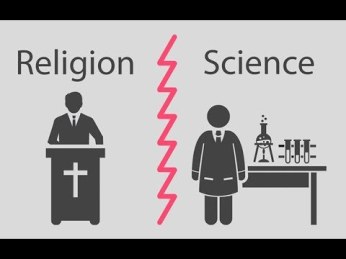
So how did this collection of sentences lead to one of the largest debates from the last few hundred years? Why are these descriptions about God’s creation at the heart of the debate between science and religion?

Centuries ago there was a man named James Ussher who set out to date the earth. He dove deep into the Old Testament and, with the help of genealogies and life spans, established the exact time and date of God’s creation as 6pm on October 22nd 4004 BC. Therefore, according to the work of Ussher, the earth is approximately 6,000 years old.

            However, with the advent of modern science, and carbon dating, and evolutionary biology, scientists have determined that the earth is rough 4.5 billion years old.

There is a huge difference between 6,000 and 4.5 billion.

For a long period of time, the Christian church established itself as the predominant distributer of information, and when that came into conflict with Science, the battle began.

The war between Science and Religion has manifested itself in a great number of ways like the fight between Galileo and the church, Darwin and the church, and even the American Government with the church.

And nowhere is the war more apparent than between the debate of creation and evolution.

            “How old is the earth?” might sound like an innocuous question without too many ramifications, but how we answer the question comes with a lot of consequences.

A couple of years back, the state of Kansas removed questions about evolution from its standardized tests. This meant that teachers were still allowed to teach evolution, but the children would not be tested on it at the end of the year. Some Christians rejoiced in the victory Creation over Evolution, and others were concerned that children from Kansas would pale in comparison to students from other states by the time they entered college.

It would seem that the church has one answer to the question, and science has another.
hqdefault

I remember learning about the theory of evolution when I was in the 8th grade. With all my hormonal angst, and pimply face, and peach fuzzed mustache, I sat in my science class and learned about how all life can trace its origins back to one single cellular being: That over millions of years that first cell grew and evolved and developed new traits; how life began in the sea, and eventually developed to live on land and in the air; how humanity is one of the last developments in a tremendously long line of evolved species.

I thought it was awesome! The science-fiction nerd within me went into overdrive and I relished in learning about where we came from, how the earth has changed, and how beautifully unique we really are. And the whole time I dove into evolution I saw God’s handiwork all over the place. Who could have brought life into that first being, who could have the imagination to force molecules and atoms together in such a way that life began, who could have moved the development of species to its zenith in humanity?

However, around that same time a number of my Christian friends stopped attending church. While learning about evolution, their faith in church disappeared. What they heard in the classroom became more important than what they heard in the sanctuary. When they learned the earth was older than what they heard from the pulpit, their faith was crushed.

            I was fortunate to have pastors and mentors who helped me to see the bonds between science and faith, but my friends saw only the battle.

A lot of you wrote questions about the relationship between science and religion. And frankly, I wasn’t surprised. The so-called war between science and religion is one that has gone on for a very long time, and frankly it’s something we rarely address in church. It’s as if we let the world of science rule our lives Monday through Saturday, and the world of faith is reserved for Sundays, and never the two shall meet.

2852667_orig

There is conflict between science and religion, and the conflict exists because of us. The fault is ours. We Christians who become defensive when scientists learn more about the world instead of rejoicing in God’s strange and creative majesty; we Christians who are too quick to jump ship when we discover there is more to the world than what we can read about in the bible; we Christians who see scientific discoveries as works of the devil, and label them as such.

But the realms of science and religion are not as mutually exclusive as we think they are.

There are Christians out there called “Young-Earth Creationists” who believe, like Ussher, that God created the earth over six 24-hr days around 6,000 years ago. They dismiss discoveries like dinosaur bones as a way for God to test our faith.

However, there are ways of looking at the biblical account of creation such that it harmonizes with science, rather than creating yet another battle.

To start, the word for “day” in Hebrew is “yom.” And it carries with it a number of definitions and interpretations. Yom is used in the Old Testament as a general term for time, like a time period of finite but unspecified length. We can also read in Psalm 90.4 “For a thousand years in your sight are like yesterday when it is past, or like a watch in the night.” What we understand the word “day” to mean is different than what it means in scripture. God’s time is not our time.

We could then read Genesis 1 to be that in the beginning God created light, and after light God created air, and after air God created earth and sky and sea. But how long it took God to do this is unknown. One day? One million years? Only God knows.

Genesis, and the rest of the bible, is not meant to be read like a science or history textbook. The bible, over and over again, rejects our desire to become masters the text and instead calls us to be servants of the Word. We might be concerned with how and when God created, but the bible only tells us the who and why of God’s creation.

Then we can look at the order of creation itself and the similarities with the theory of evolution. Though it was written thousands of years before Darwin’s On the Origins of Species the order of creation parallels Darwin’s and modern evolutionary scientist’s ideas. The first thing to exist was light and energy. Then matter began to fuse together into celestial beings like stars and planets. Eventually the earth developed an atmosphere and water and land. The first life began in the sea, eventually evolved to fly in the air and crawl on the earth, and the last life to be developed, the pinnacle of God’s creation, was us, humanity.

difference

            Knowing this, countless Christians are able to hold that evolution is real, but that God set it in motion. They are able to assert that the earth is 4.5 billion years old AND God created it in the way described in Genesis. They are able to hold together science and faith in such a way that it gives glory to God’s glorious creation.

The conflict between science and religion, between creation and evolution, exists because people like us have treated the book just like every other book. We see it as our own historical textbook, or as our scientific journal, or as our genealogical record. We import the ways we read other texts into the way we read God’s great Word.

And then many of us take it up like a weapon against anyone who disagrees with us.

But the bible is fundamentally unlike anything ever written. It is historical, and scientific, and literary, and poetic, and every other form we can think of. It is beyond our ability to fully comprehend, it breaks down and exceeds the expectations we place on it, it is the living Word of the Lord.

The bible is far less concerned with explaining how things happened, and is far more concerned with proclaiming God’s handiwork. It comforts us when we are afflicted, and it afflicts us when we are comfortable. It can make us laugh and it can make us cry. It can bring us to our knees and it can propel us to dance on our feet. It identifies God as creator and us as creature. It harmonizes with the marvelous developments in science. It humbles us and exalts us. It is who we are and whose we are. It is God’s Word for us. Amen.

There’s No Time To Waste

strangely-warmed-spreaker-header

This week on the Strangely Warmed podcast I speak with Wil Posey about the readings for the 3rd Sunday After Epiphany [Year B] (Jonah 3.1-5, 10, Psalm 62.5-12, 1 Corinthians 7.29-31, Mark 1.14-20). Our conversation covers a range of topics including Duke Divinity School, the Greek exegesis of Mark, bad nicknames, scripturally shaped imaginations, economics, the privatization of faith, the cost of discipleship, and the word that appears in the Bible more than any other word. If you would like to listen to the episode or subscribe to the podcast you can do so here: There’s No Time To Waste

WP

All Things To All People

1 Corinthians 9.19-23

For though I am free with respect to all, I have made myself a slave to all, so that I might win more of them. To the Jews I became as a Jew, in order to win Jews. To those under the law I became as one under the law (though I myself am not under the law) so that I might win those under the law. To those outside the law I became as one outside the law (though I am not free from God’s law but am under Christ’s law) so that I might win those outside the law. To the weak I became weak, so that I might win the weak. I have become all things to all people, that I might by all means save some. I do it all for the sake of the gospel, so that I may share in its blessings.

All of us have questions. We have questions about what it means to be a Christian, what the bible is all about, and how to make sense of it all in the ways we live. In November I compiled a list of questions from the congregation and created this sermon series in which I will attempt to answer some of the questions that vex us in regard to our faith. Today we continue the series with, “How do we share the Good News?”

“When did you last speak to someone about your faith?” Throughout John Wesley’s ministry, this was a question to be answered by all people within the Methodist movement. And it’s a question most of us would rather avoid today.

It we’re honest, we don’t want to appear too evangelical (whatever that means). We don’t want to be confused with the kind of bible toting people who seek to win others for Jesus. We don’t want to leave church with tracts to pass out to people in public warning them about their imminent doom unless they accept Jesus as their Lord.

And yet, that question, the one we want to avoid, the one that makes us squirm in our pews, is perhaps one of the most important questions we can ever ask.

When I was in college, I became the de facto cook for my house. There were five young men all living under the same roof, and I tried my best to make a home cooked meal once a week so that we could all sit down and break bread with one another. When we sat around the table for the first time, with our assortment of hand-me-down plates and silverware, I asked my friends to pray with me, and they just stared at me as I bowed my head and asked for God to bless the meal and us.

Week after week we sat around that table, and the longer I prayed for them, the more they adapted to it. Such that, one night, when I inexplicably forgot to pray, they stopped me from eating and said, “Aren’t you forgetting something?!”

Around that same time I was invited to guest preach at one of the local United Methodist Churches. I, of course, invited all of my roommates to attend and they all sat together in the furthest back pew.

The service was fairly typical, and the sermon was a definite B-, but then we moved to the communion table and the pastor prayed for the Holy Spirit to make the bread and cup into the body and blood of Jesus Christ. And while the whole congregation began lining up in the center aisle, my roommates did as well with bewildered looks on their faces.

I realized, as they were walking closer to me, that none of them had received communion before, nor did they have any idea what they were doing.

When they made it to the front they all stood in front of me with wide eyes and nervous ticks. I quietly whispered, “take the bread, dip it in the cup, eat it, and I’ll explain everything at home.”

And so, they did.

There was a time in the life of the church, when we could expect new people to show up on Sunday mornings no matter what. When Christianity was Christendom, which is to say, when Christianity was normative, the majority of people in a community could be found in church on Sunday morning. This meant that for generations, great scores of people were born into, and raised through a church, such that things did not have to be explained or proclaimed, and the work of evangelism was nothing more than standing in front of one’s own church to share what God had done.

But that time is long gone.

And because churches can no longer expect that, “if you build it they will come,” the work of evangelism has increased sharply. Congregations are told that they are in the business of saving souls, and that they must do everything within their power to share the Good News. But more often than not the good news sounds like bad news.

1Corinthians9.22-660x371

Fear mongering tactics with threats of hell and eternal damnation are hung over individual heads with hope that it will scare them into church.

            The bible is used as a weapon to attack people for the way they are living in order to shame them into coming to church.

            People are treated as numbers and objects to be placed on a worksheet and empty promises about heavenly rewards are used to get people to come to church.

            And people wonder why the church is shrinking…

When I asked for questions in November, a lot of people asked about ways to share the Good News. Behind those questions was the desire to grow the church. Growth is a good thing, I mean: Jesus sends the disciples out to make disciples of all nations, but growth for the sake of growth is problematic.

If we want to fill the sanctuary up every Sunday we could do raffles, and giveaways, we could provide financial incentives to get people to invite more people to church, but it wouldn’t be faithful. The only way the church grows is when we believe the church has something so incredible to offer that we’re willing to invite others to discover it.

The point is this: we can no longer just wait for people to magically appear on Sunday morning.

In addition to the questions we received about sharing the good news, there were an equal number of questions about why I participate in a podcast. For the last year and a half I’ve been working with two other United Methodist pastors to produce weekly podcasts (a podcast is a downloadable audio file that you can listen to on your phone and computer). We started it as a way to have conversations about theology and scripture, and as we made the episodes public, they started reaching a lot of people. And by a lot, I mean A LOT. By the end of the month, we should hit our 200,000th download.

But we didn’t start the podcast to become popular. We started it to reach the people who no longer felt comfortable in church. We wanted to provide conversations with zero commitment on behalf of the people listening so that they could encounter the church from a new perspective. Because for as much as this thing we do called worship is what being the church is all about, for some people it’s not enough.

DearChurch

We were taking a break from a live podcast event back in December when an older man walked across the room and stood right in front of me. He stared at me with a curious look and said, “You sound different in person.” Unsure of whether or not he meant it as a compliment, I inquired as to how. He said, “You sound a little more confident on the podcast than you did tonight. But I think that’s a good thing. I appreciate your vulnerability.”

We talked for a little bit about the guests we had that night, and the challenges of doing a live recording, and then before returning to his seat he said, “I left the church years ago because I felt burned. Too many sermons about what I had done wrong, too many people suffering without anything changing; too many pastors abusing their privileges. But then I discovered the podcast, and I started listening. And the more I listened, the more I heard God, and the more I realized I needed to give the church another chance…”

We live in an ever-changing world where people consume information so quickly that the church can appear archaic and irrelevant. But I believe this is a sad misjudgment. Rather, I believe church has the most important thing to offer of all, the Good News of Jesus Christ.

Therefore, like Paul, we do well to do whatever we can, by whatever means we can, to share the Good News of Jesus Christ. For Paul that meant being a Jew to the Jews, and outside the law to those outside the law, and all things to all people.

For us today, that might take on different meaning, we might be tasked dropping our political identities in order to reach people across the political spectrum, or crucifying our prejudices in order to reach people who do not look like us, or repenting of our judgmental attitudes in order to reach people who frighten us.

As Christians, we are necessarily evangelical. Evangelism means, by definition, sharing the Good News. So much of what we do and who we are is wrapped up in the story of Jesus, recognizing how the story has changed our lives, and the hope that it can change the lives of those around us.

            But, sadly, being evangelical these days often comes off like being a bad and annoying used car salesperson. When the tactics of fire insurance, and bombarding strangers is the best we have to offer others, when winning souls becomes more important than loving others, we cease to be evangelical, at least the way the word is meant to be used.

Last year, I drove up to Cokesbury on a Sunday afternoon to meet a handful of people from the church before it was announced that I would be your new pastor. We sat down in the conference room upstairs, exchanged pleasantries over fruit and cheese, and then we went around the table to introduce ourselves and describe how we are connected to the church. One by one I learned about some of you for the first time, how long you’ve been here, what you like, what you want to change, all of that stuff. And one of the last people to share was Emmett Wright, and all he said was, “I’m an evangelist.”

And, because being evangelical can be so misconstrued these days, all I could think was, “that’s just great [sarcasm].” So I asked him to elaborate and he said something memorable like, “just wait and see.”

On any given week Emmett will invite a score of people to come to experience God’s presence at our church. But he does not evangelize by attacking strangers with threats or empty promises. He meets people where they are and he gets to know them. He sees his evangelism first as a call to friendship, with all people, long before inviting them to church. And because he fosters friendship first, the people he invites to church always want to see what it’s all about.

Emmett is a lot like Paul in that he becomes all things to all people. He never presents the gospel in some stuffy forgotten way; it is always alive and exciting and friendly. Emmett meets people where they are, instead of sitting around waiting for them to show up.

Paul’s ministry was one of evangelism. Over and over again he won people for the sake of the gospel. Not to fill pews, not to frighten them, not to shame them, but because he believed the story of Jesus Christ was the most important story they would ever hear. He believed the message of salvation would change everything about the way they lived. He believed that following Jesus would make all the difference.

Paul became all things to all people because that’s precisely what God was willing to do for us. God became all things to all people in Jesus Christ. God humbled himself in the manger and took on flesh. Though God was free to as God pleased, God made himself a slave to all in Jesus in order to free us from slavery to sin and death.

            Evangelism always begins in friendship, in the intimacy of two people sharing life together. Evangelism takes place in the trust when listening becomes more important than talking. Evangelism comes to fruition when saving and winning others is more about them than us. Amen.

Keep The Mystery

strangely-warmed-spreaker-header

This week on the Strangely Warmed podcast I speak with Teer Hardy about the readings for the 2nd Sunday After Epiphany [Year B] (1 Samuel 3.1-10, Psalm 139.1-6, 13-18, 1 Corinthians 6.12-20, John 1.43-51). Our conversation covers a range of topics including Wesley Theological Seminary, the need for repetition, submissive liturgical postures, the rarity of the Word, mystery, metafiction, baptism, communion, sex and fornication, and the challenge of preaching on difficult passages. If you would like to listen to the episode or subscribe to the podcast you can do so here: Keep The Mystery

TH

Kicking and Screaming

Mark 1.4-11

John the baptizer appeared in the wilderness, proclaiming a baptism of repentance for the forgiveness of sins. And people from the whole Judean countryside and all the people of Jerusalem were going out to him, and were baptized by him in the river Jordan, confessing their sins. Now John was clothed with camel’s hair, with a leather belt around his waist, and he ate locusts and wild honey. He proclaimed, “The one who is more powerful that I is coming after me; I am not worthy to stop down and untie the thong of his sandals. I have baptized you with water; but he will baptize you will the Holy Spirit.” In those days Jesus came from Nazareth of Galilee and was baptized by John in the Jordan. And just as he was coming up out of the water, he saw the heavens torn apart and the Spirit descending like a dove on him. And a voice came from heaven, “You are my Son, the Beloved; with you I am well pleased.”

All of us have questions. We have questions about what it means to be a Christian, what the bible is all about, and how to make sense of it all in the ways we live. In November I compiled questions from the congregation and created this sermon series in which I will attempt to answer some of the questions that vex us in regard to faith. Today we begin the series with, “If Jesus was dunked, why do we only sprinkle?”

____


The parents stood next to me by the baptismal font, each trying desperately to keep their sons under control. Abe and Archer had never been up at the front of the church, the stained glass windows were mesmerizing, but more than anything, they just wanted to get down and run all over the place.

So I grabbed some of the water in the bowl and let it drip onto their hands as I read the words that countless Christians have heard before their baptisms. It was nothing short of God’s grace that as the water moved from hand to hand, both boys froze in their parents’ arms, and they almost prayerfully joined me in the sacrament that would change their lives forever.

I took them one after the other into my arms, lightly sprinkled water onto their heads and baptized them in the name of the Father, Son, and Holy Spirit. Afterwards, I carried them out into the middle of the sanctuary and you could hear a pin drop as the congregation took in the beloved sight of two newly baptized boys moving down the aisle. For them, the church, it was the first baptism in a very long time, and in those two boys they saw their future.

It was a beautiful baptism, and one that I will cherish till the end of my days.

Years later I stood with two different parents, one of whom is another United Methodist pastor, and two different sons, in a very different place. Instead of standing before the church in a church, we had, as the good ol’ hymn goes, gathered by the river. And by river I mean creek.

The crowd of people snuggled closer together as the wind howled through the trees. I came prepared with waders and got appropriately bundled up before stepping into the current. And the closer we came to the moment of baptism the more frightened the two boys looked about a moment that would change their lives forever.

However, I believe it was the fear of the water’s temperature that made them quake in their baptismal gowns more than the disruption the Holy Spirit was about to make real.

I grabbed the younger one first, carried him across the waters to the deepest part of the creek, and his mother and I thrust him completely under the frigid waters three times in the name of the Father, Son, and Holy Spirit. And he was kicking and screaming the entire time.

18301473_10210937077676980_3740734210783733526_n

I honestly tried to focus on the holiness of the moment, doing my best to make it right, but all I could think about was whether or not the older brother was going to hightail it out of there as soon as I tried to pick him up.

But when we made it back to the shore, I deposited the one brother for the other, took him out and did the same thing. He cried the whole way back to the shore.

It was a beautiful baptism, and one that I will cherish till the end of my days.

If Jesus was dunked, why do we only sprinkle? It’s an interesting question, and frankly one that has vexed the Christian church since nearly the beginning. In the account of Jesus’ baptism by John in Mark’s gospel, it says that Jesus was coming up out of the water when he heard the voice of God, therefore implying that he had been completely under the water. Yet, in many churches when baptism takes place it is done so with the pouring of water over someone’s head, or the sprinkling of water on the forehead.

Answering this question, the one about why we baptize, is at the heart of why there is no universal church. Just take a drive through Woodbridge and you will encounter just about every flavor of church there is and one of the things that divides us is our inability to answer the question.

Some churches believe that you can only baptize adults who have made the choice for themselves. And when they are baptized it has to be “living water” which is to say it cannot be contained in something made by human hands, and has to be in a creek, river, lake, or even the ocean.

Others say you can fully immerse someone in a pool or large baptismal font.

Some churches believe that you can baptize babies, with the consent of their parents, and can do so in a great number of ways, from dipping them in the font to sprinkling water across their foreheads.

And still yet in some churches, they believe that using water in baptism is unfaithful and will instead only baptize by the Spirit without any physical object being used.

And because we have no single answer to the question, there are an almost limitless number of Christian denominations throughout the world.

Do you want to know a secret? The amount of water used doesn’t really matter. Bring a kid to a creek, or a baby to the font, or an adult to the pool, all you want, baptism isn’t about what we do, but instead about what God does to us.

18275156_10210937077796983_8625008867195458354_n

Baptism, like communion, is what we call a sacrament. It is an outward sign of an invisible grace. It is one of the ways we experience the grace of God here and now through something we can touch, feel, and experience.

It is good for us to practice baptism as such because the whole of the gospel is done to earth, it takes place in the real, tactile, fleshy world. Whenever the Spirit is mentioned in scripture it is tied to the material – real water, real bread, real flames. The Spirit fills us in church when we gather, and sends us out from the church to be in the world.

The Spirit is not something meant for our hearts and souls without the bodily experience.

That’s why the story of Jesus’ baptism has all these great physical details… The people were gathering out in the wilderness at the behest of a radical man named John dressed in camel’s hair with a leather belt, perhaps with locusts and wild honey dripping out of the corner of his mouth. John declares that the one more powerful is coming, and that even he, John, would be unworthy to untie his sandals. And then Jesus is baptized by John in the Jordan, he comes up out of the water, still dripping with the experience, and the heavens are ripped apart as a voice says, “You are my Son, the Beloved; with you I am well pleased.”

Baptism-Jesus-4K-Wallpaper

Baptism is not some concept that we can relegate to our minds and our philosophical reflections. It is a defining act that grabs us out of who we were and pushes us into who we are.

Churches, for centuries, have fought battles and excommunicated Christians for their differing beliefs on how much water should be used for baptism. But more important than the amount of water, is the fact that baptism is a violent, disruptive, and transformative change that takes place in our lives.

When I first baptized the boys in the sanctuary, it was picturesque; it was everyone’s dream baptismal experience. But the baptism that took place in the cold creek was more in line with the theological conviction of what it means to be baptized.

            It might bother our modern sensibilities to think about children, or even adults, kicking and screaming on their way to baptism, but when we consider the truth of what we are doing to them and for them, it might be the most proper response.

Immediately following Jesus’ own baptism, the heavens were ripped apart. This was no happy-rainbow-spewing-splitting of the heavens, it was a violent rendering of the cosmos such that the earthly and the divine were coming into contact with one another. We might, in our minds, imagine a beautiful scene where sunshine broke forth from behind the clouds to surround Jesus with a glow, but the language of the gospel beckons us to imagine a scene more akin to the violent rendering of the bomb cyclone the east coast just experienced.

Baptism, whether it’s Jesus’ or our own, is a moment of profound transformation. When we baptize someone in the name of the Father, Son, and Holy Spirit, we are, as Paul puts it, baptizing them into Christ’s death so that they can be raised in new life with Christ.

That is no easy thing.

Baptism is the radical reorientation of all things. Whenever we bring someone to the water, whenever we remember our own baptisms, the heavens are torn apart again and God meets us where we are.

It is radical because in the sacrament we affirm that God’s kingdom is more powerful and life changing than anything else in existence. We proclaim that the water washes away every bit of who we were such that we can become the people God is calling us to be. We move into a way of being that is intimately connected with the life, death, and resurrection of Jesus.

I was baptized nearly thirty years ago when I was 19 days old. I have no memory of it at all. I don’t even know who was there or what was said. But it made all the difference. It made all the difference because a group of people who gave their lives to Jesus believed that in giving me to God my life would be about more than me. In baptizing me into the death of Jesus, and raising me into the new life of resurrection, I began a journey that has reshaped my understanding of the world and what it means to love God and neighbor.

Baptism doesn’t promise a perfect life. It is not a cloak of protection that we can drape over those we love. It should shake us that we do something so radical to the people we love. We baptize those whom we love because we want their lives to be about something bigger than themselves, we want them to know what it means to love God and neighbor, we want them to experience resurrection here and now.

I have brought infants, and toddlers, and even teenagers to the waters of baptism again and again because what God does through the Spirit is the most wonderfully disruptive thing that can ever take place. In those moments, God speaks from the torn open heavens, just like on the day Jesus was baptized to say, “You are my child.”

            And we are who God says we are. Amen.

The Holy Spirit Don’t Get It Wrong

strangely-warmed-spreaker-header

This week on the Strangely Warmed podcast I speak with Teer Hardy about the readings for the 1st Sunday After Epiphany [Year B] (Genesis 1.1-5, Psalm 29, Acts 19.1-7, Mark 1.4-11). Our conversation covers a range of topics including wild and wonderful West Virginia, creation as conversation, reclaiming the darkness, faith as disruption, elevating the Spirit, names with definite articles, the violence of baptism, and John as the original hipster. If you would like to listen to the episode or subscribe to the podcast you can do so here: The Holy Spirit Don’t Get It Wrong

TH

Think And Let Think’s Top 10 – 2017

I started Think And Let Think a few years ago as a way to compile my thoughts, sermons, and devotionals. After starting at my first church in 2013 it became an easy way for parishioners to access the sermons from Sunday if they were unable to attend. Over the years the scope of the blog has grown far beyond the people I serve in the local church, and 2017 saw a tremendous increase in readership. Below are the 10 most popular posts from 2017.

toptips10


  1. Open Hearts. Open Minds. Open Doors.

I preached exclusively from Romans during Lent. After reading through Barth’s Romans for the nth time, I felt like I needed to stay in the letter through a liturgical season and dragged my congregation along for the ride. This sermon was prompted by Paul’s reflections on Abraham’s righteousness and my contempt for the United Methodist Church’s slogan of open hearts, open minds, and open doors.

“We can have the perfect advertising campaign, with our slogan in big capital letters, but that does not redeem our sinful actions and behaviors. We might think we are righteous and that we are “color-blind” or “LGBTQ affirming” or “economically transparent” but we are nevertheless sinners in need of God’s grace and forgiveness. We can even leave the church doors unlocked all week long, but we will still be broken and in need of God’s redeeming love.”


  1. God Won’t Give You More Than You Can Handle

At the beginning of the year I preached through a series on Dumb Things Christians Say. One of the dumbest things Christians say on a regular basis is, “God Wont’ Give You More Than You Can Handle.” Oddly enough, it’s not true. This sermon works through the phrase and attempt to show that God doesn’t give us what we can handle, but that God helps us handle what we are given.

“Sometimes, we say things like “God won’t give you more than you can handle” because we don’t know what else to say. We encounter the shadow of suffering that is so suffocating we don’t know how to respond. So instead, we will that awful void with awful words. And we make God into a monster.”


  1. A Reminder For Those Attending Annual Conference

Annual Conference can be a time of great renewal and great cynicism. 2017 was no different. In the days leading up to the Virginia Annual Conference gathering I collected my thoughts in hopes that all of would remember that the church is primarily about God, and only secondarily about us.

“God is the one who first breathed life into John Wesley and sent him on a course that would forever reorient the fabric of the church. God is the one who breathed life into all of the churches of the Virginia Conference, who empowers the pastors to proclaim the Word from their respective pulpits, who shows up in the bread and in the cup at the table. God is the one who gathers us together for a time of holiness, who moves in the words we sing, who rests in the spaces between us when we worship, who calls us to serve the kingdom instead of serving ourselves.”


  1. The Mystery Of Marriage

I was privileged to preside over the wedding of one of my oldest friends this year and it prompted a wedding homily that gets at the heart of why getting married is such a strange act of faith.

“Love, the kind of love that will sustain your marriage, holy love, is Godly love. It is a love unlike anything else on this earth. It is beyond definition and explanation. It is deeper than the deepest ocean, and greater than the tallest mountain. It is sacrifice and resolution. It is compromise and dedication. The love that God has for you is the kind of love you are promising to one another and it is a mystery. It is only something you can figure out while you’re figuring it out.”


  1. The Church Doesn’t Exist To Make A Difference

It took five years of full time ministry before I received my first piece of anonymous hate mail. Because it was anonymous and therefore could not have a dialogue with the individual, I wrote a reflection about their complaint in hopes they would one day see it.

“Christians in America have played the political game for so long that we can almost no longer differentiate between America and God. Or, at the very least, we assume that if the church is not involved in the work of making the world a better place, than it’s not worth our time and attention. In scripture, Jesus calls this behavior idolatry.”


  1. Thoughts On The Cross Flag

In the days immediately following President Trump’s response to NFL players kneeling during the national anthem, the lectionary reading was Psalm 25.5: “Lead me in your truth, and teach me, for you are the God of my salvation; for you I wait all day long.” That week I found myself surrounded by conversations that had everything to do with politics, and nothing to do with God. And after reading the psalm, my thoughts on the Cross/Flag came flying out.

“It’s one thing for talking heads to ramble about the pros and cons of kneeling during the anthem but it’s another thing entirely when it comes to the realm of the church. These days the church seems to revolve around tweets from the White House more than the revealed Word of God. These days the church appears to spend more of it’s time debating the values of our country’s democracy than our Savior’s teachings and ethics. These days the church seems to believe that our salvation will come from Congress more than from Jesus Christ.”


  1. Ten Things I Learned From My First Week At A New Church

I moved from St. John’s UMC in Staunton, VA to Cokesbury UMC in Woodbridge, VA this year. It was my first pastoral reappointment and after finishing my first week at the new church, I put together a list of ten things I learned.

“Like being surprised, it’s important to remember that something will go wrong. On my first Sunday at St. John’s I completely forgot to give the offering plates to the ushers and they just stood by the altar patiently waiting until one of the choir members waved her hands to get my attention. For my first Sunday at Cokesbury we didn’t have anyone to play music. The long time organist retired the day before I arrived and the back up players were either out of town or don’t know how to read music. So instead of singing along to an organ or a piano or a guitar we did everything acapella and (thanks be to God) we made it through the service.”


  1. What Things?

After announcing to the church in Staunton that I was being appointed somewhere else, I discovered a tremendous freedom in my preaching (because like it or not, they were only stuck with me for a finite period of time). After reading the lectionary text for the week, Luke 24.13-19 (The Walk to Emmaus), I felt like the time had come to address a pertinent controversy in the community; naming the local High School after Robert E. Lee.

“We make so many assumptions of people without ever doing the good and difficult work of learning who they really are. We see a bumper sticker, or we hear an accent, or we observe a skin tone, or we read a Facebook post, and we let that dictate who they are to us. When truthfully, what we make of those limited observations says far more about us, than about the ones we see.”


  1. God Said It, I Believe It, That Settles It

Another sermon from the series about “Dumb Things Christians Say.” This one was based on “God Said It, I Believe It, That Settles It” with thoughts on church bathrooms, women speaking in church, and caring for refugees. (This one got me in some trouble)

“People have used this book, with understandings like “God said it, I believe it, that settles it,” to attack and belittle people for far too long. It has been used to justify the horrific practice of slavery. It has been used to subjugate and relegate women’s rights. It has been used to rationalize physical violence and aggression toward people of different religions. It has been used to incite fear and terror in those who do not believe. It has been used as a weapon again and again and again. And now we, the people of God, join together to say “no more!””


  1. On Not Looking Like A Pastor

I, apparently, don’t look, sound, or act like a pastor. And I think this is a good thing.

“We, Christians and Pastors alike, are more than how the world portrays us. We are broken people who are in need of grace. We are faithful people filled with the joy of the Spirit. We are hopeful people who believe the church is the better place God has made in the world. So I am grateful for not appearing like a pastor. I am grateful because I believe it will help me help others to see what the grace of God has done for me.”

The Gospel In 4 Verses

strangely-warmed-spreaker-header

This week on the Strangely Warmed podcast I speak with Jason Micheli and Teer Hardy about the readings for the 1st Sunday after Christmas [Year B] (Isaiah 61.10-62.3, Psalm 148, Galatians 4.4-7, Luke 2.22-40). Our conversation covers a range of topics including what gifts we should offer to Jesus, The Bachelor, incarnational theology, the importance of sermon titles, and how to keep the joy of Christmas in Christmastide. If you would like to listen to the episode or subscribe to the podcast you can do so here: The Gospel In 4 Verses

25189070_10210098781337035_4021485446077283482_o

An Old-Fashioned Christmas

Isaiah 9.2-7

The people who walked in darkness have seen a great light; those who lived in a land of deep darkness on them light has shined. You have multiplied the nation, you have increased its joy; they rejoice before you as with joy at the harvest, as people exult when dividing plunder. For the yoke of their burden, and the bar across their shoulders, the rod of their oppressor, you have broken as on the day of Midian. For all the boots of the tramping warriors and all the garments rolled in blood shall be burned as fuel for the fire. For a child has been born for us, a son given to us; authority rests upon his shoulders; and he is named Wonderful Counselor, Mighty God, Everlasting Father, Prince of Peace. His authority shall grow continually, and there shall be endless peace for the throne of David and his kingdom. He will establish and uphold it with justice and with righteousness from this time onward and forevermore. The zeal of the Lord of hosts will do this.

           Merry Christmas! There’s just something different about Christmas. No matter how young or old we may be, no matter what kind of year precedes this night, Christmas Eve never fails to brighten our spirits. I look forward to this night unlike any other night with a kind of joyful anxiety: I know this holiday carries with it more meaning than can be contained in any sermon, and yet to share the story of the incarnation is one of my greatest privileges.

But there is a question I must ask: Why are you here tonight? Some of you were raised in this church and can’t imagine being anywhere else. Some of you have come alone, and others are with large families taking up an entire pew. Some of you have been planning to be in this place at this time for weeks, and some of you decided to come on a last minute impulse. Some of you have been dragged here against your will, out of loyalty or guilt. And some of you are here perhaps for the very first time.

Some of you are young and full of hope and anticipation; most of your Christmases are still in front of you. Some of you who are older are filled with memories of Christmases past that will never come again. Some of you are looking forward to getting back to the presents and the trees, and some of you dread going home. So hear this: whoever you are, and whatever you’re feeling, I’m glad you’re here.

The people who walked in darkness have seen a great light; those who lived in a land of deep darkness on them light has shined.

_the_holy_family__nativity_scene___another_commiss_f6de659b784c8c14ecc1ee8b95fa4fa8

I ask a lot of questions, it comes with the job. But around this time of year I tend to ask the same question over and over: “What’s the best Christmas present you’ve ever received?” And the funny thing is, people have the hardest time answering. And not because they have so many gifts with which that have to weigh out and evaluate their answer, but because they just can’t remember.

For instance, can any of you remember what you opened three years ago on Christmas morning? What about last year?

Of course, there’s a better question to ask: “What’s one of your most beloved Christmas memories?” People can answer that one, and the response is almost always about spending time with a particular person; a beloved spouse, or child, or grandmother, or friend.

That’s what we remember most about Christmases past, the people we spend time with. It’s all we have to give to another, it’s all we really want to receive, and it’s what God gives to us.

Not a present under a tree, not a trite response to a prayerful need. God gives himself to us at Christmas.

There’s just something about Christmas that’s different. And there’s nothing quite like an old-fashioned Christmas. Do you know what I mean? A Christmas where all the kids actually showed up, all the presents were wrapped in time, there were no iPhones to distract us from conversations, no drones to charge before their first flight. Old-fashioned Christmases were all about the family, and the singing of carols, and feeling the warmth of the fire.

My father grew up in Germany, and his most vivid memories of old Christmases were waiting to see what would happen to the Christmas tree. Because unlike our contemporary trees filled with pre-lit LED lights that can do more than a stage production, his Christmas trees were covered in real candles. And on every Christmas Eve every candle would be painstakingly lit, and my father would sit there, like any young child would, waiting for the whole thing to catch on fire.

An old-fashioned Christmas.

There’s a church in our community that worships in a new building, but they still have the original sanctuary on the property. And all year long it just stands there off in the corner like the forgotten island of misfit toys, until Christmas Eve when they open the doors, brush off the dust, light the kerosene lanterns and have an old-fashioned Christmas service. That was the case, until a few years ago when they forgot to open a window, and the kerosene lamps sucked up all the oxygen and parishioners started passing out left and right.

But a real old-fashioned Christmas, which is to say a biblical Christmas, is altogether different. The strange new world of scripture opens up for us a scene where kings rage and wickedness rules the day, where the threat of taxation forces young couples to retreat to the comfort of their parents’ homes, and countries who think of themselves as the very best have forgotten the very least.

            You know, completely unlike today.

It’s strange how Christmas, at least the version we encounter at the mall, becomes a dream. We escape into the Christmases of the past, falsely assuming they held a tinge of perfection. But in the bible, Christmas is no dream; it is reality. And it is one that begins in the dark.

The darkness – evil, sin, suffering, distress, destruction – they are very much part of the world, even if we’re made to believe they are absent during Christmas. We live in a time of war, violence, anger, and wrongful use of power. And the darkness is not just out there, beyond the comfort of the sanctuary, it is very much here as well. The darkness of family fights, disease and death, aging parents, rebellious children, fear and guilt, loneliness, and shame.

And we have to take the darkness seriously, even when we’d rather not. We take the darkness seriously because Isaiah certainly did, because darkness is very much part of our experience, and because darkness is what the light of Christ makes it’s way into.

This time of year challenges us to search for meaning. I mean, every bad Hallmark channel movie struggles to define the reason for this season, but the closest we can get to the meaning of Christmas is right here in Isaiah: The people who walked in darkness have seen a great light.

Light is how we experience the presence of God, the arrival of grace, mercy, and peace. Light shines in the darkness.

That’s why we always end Christmas Eve worship with the lighting of candles. It is a strange and beautiful thing because it begins in the dark!

Our candles, as a witness to the one Christ candle, burn as a promise, a pledge, and perhaps as an act of defiance. Our flickering candles are what the life of faith look like as it resists the evil temptations of the world.

It looks like our faith because it is fragile.

Our flames are as fragile as a new baby born into the worst circumstances.

opt-the-day-after-christmas from Life Magazine Jamie Wyeth

But new life always starts in the dark, whether it’s a seed in the ground, a baby in the womb, or Jesus in the tomb, new life starts in the dark.

It is a strange, subversive, and dynamic way to change the world. It runs counter to all our assumptions of what it means to hold power. It is fragile like a flame, like a baby born in a manger, and like our faith can be at times.

But one flame, one baby, one faithful hope can be all that it takes to spark a rebellion that changes everything.

An old-fashioned Christmas is challenging because it is truer than all of the perfect manger scenes on our mantles and inflated on our front lawns. The incarnation of God is not some spiritual and mythical concept; it is very much the totality of God taking on flesh to enter this world of ours with all its agonies and joys, sorrows and splendor.

For a fleeting moment, we might experience a time where all is calm and all is bright while we are in this place holding our candles high. But we do so with the knowledge that the world still marvels at the darkness. So come to feast at this, Christ’s table, greet one another in the love that Christ offers us, and declare your defiance of the world’s expectations through the fragile flickering flame.

Because tonight, a night unlike any other night, we join together to wonder at the mystery of God’s power embodied in the fragile flesh of a newborn baby. Tonight, we join together as God’s light that shines in the darkness. Tonight we remember what an old-fashioned Christmas really looks like. Amen.

We Start With The End

Luke 1.46-55

My soul magnifies the Lord, and my spirit rejoices in God my Savior, for he has looked with favor on the lowliness of his servant. Surely, from now on all generations will call me blessed; for the Mighty One has done great things for me, and holy is his name. His mercy is for those who fear him from generation to generation. He has shown strength with his arm; he has scattered the proud in the thoughts of their hearts. He has brought down the powerful from their thrones, and lifted up the lowly; he has filled the hungry with good things, and sent the rich away empty. He has helped his servant Israel, in remembrance of his mercy, according to the promise he made to our ancestors, to Abraham and to his descendants forever.

There’s a grocery right around the corner from my house and I go there way too often. I’d like to blame it on the strange hours of church work, or my incredible cooking skills that sends me off looking for strange and rare ingredients, but honestly having a toddler requires visiting the grocery store with regularity.

I go enough to know when not to go. For instance: Sunday afternoons are the absolute worst. They are the worst because people like me remember all the things they forget to pick up earlier in the week and decide to go at the exact same time as everyone else.

And during the holiday season, it’s all the worse.

So, of course, it was on Sunday afternoon that I found myself at the grocery store with the always wonderful assortment of necessary items in my basket: baby wipes, chocolate morsels, and deodorant.

And I was not alone: every aisle was filled with families and individuals frantically seeking out all the items on their list. Some moved at a snail’s pace checking all of the nutritional values for every single item, while others were just swiping items into their carts indiscriminately. Like all stores around this season, there were older couples smiling at babies, young couples avoiding the babies, and babies crying at everyone.

I held my requisite items and dashed as quickly as I could to the “10 Items or Less” aisle which, of course, was filled with many people with way more than 10 items. And so, I practiced my Christian virtue, and I tried being patient and non-judgmental.

And that’s when the fight broke out.

Four people up from me in the line stood a young woman having just shoved the cashier across the conveyer belt. From my vantage point I could only make out brief words and lots of loud noises. There was some disagreement about payment, and then insults started flying, and then arms started moving, and the rest of us in line just stood there doing what we do best when we go to the grocery store: we distracted ourselves with the trite headlines on bad magazines, we glanced at our watches, and rechecked our email inboxes on our phones for the third time in a row.

Eventually, after the items had been sorted and the argument came to its conclusion with the manager stepping in, the young woman began weeping. “I’m just so hungry,” she said, “please let me take something.” And the cashier politely responded, “Ma’am, if we gave you something for free we’d have to give something to everybody.” And with that, they told her to leave or they’d call the police.

And we all stood there, doing nothing.

Today is the 4th, and final, Sunday of Advent. Some of you are here because you’re eagerly awaiting tonight and tomorrow morning, some of you are probably thinking more about what’s under the tree than what’s in store for worship, some of you are waiting in deep grief thinking about how all the best Christmases are behind you, and still yet some of you are here with the hope that you will receive a little more hope.

This is the day when the pre-Christmas frenzy is at its zenith. Many of you will rush out of church this morning to take care of all the remaining items on your list because Christmas hits us like a brick wall tomorrow. And it is at this precise moment, with all the fear and fervor, that we are treated to the voice of a poor young Jewish girl with a song of praise.

Mary sings her song in declaration of the new arrival of God made manifest in her womb. She not only accepts her call to bear God in the flesh, but also marvels at God’s amazing grace that will, and perhaps already has, come to fruition in the promise in her womb.

Maria-Walks-2-1024x749

Mary’s song, her Magnificat, begins by celebrating the greatness of God: among the entirety of the world, God chose to bestow God’s favor on Mary, a lowly servant of God. Then she proclaims God’s liberating compassion for the poor. She declares that God will flip the expectations of the world upside down, and that nothing will ever be the same. Mary identifies the God growing in her womb as the God who identifies with the poor, the marginalized, and the outcast.

And, at its best, Mary’s song is just another verse in God’s great song to humanity. A song that begins with “Let there be light” that transitions to “I will be your God, and you will be my people,” and finds its chorus in, “He has brought down the powerful from their thrones, and lifted up the lowly; he has filled the hungry with good things, and sent the rich away empty.”

But the tense has changed.

            In God’s initial covenant it is all about what will come to pass, but in Mary’s song, God has already acted and changed the cosmos, prior to Jesus’ birth.

Mary sings amidst a world suffering under oppression, and even though we are far removed from the days of Mary, things can look pretty grim these days as well.

I’ve come to find that because we know the story of Jesus’ birth, Mary and Joseph’s arrival in Bethlehem, the angels and shepherds, all of it so well, that it no longer shakes us the way that it once did. Instead of being rocked by the fulfilled promises of Mary’s Magnificat, we imagine Christmas as portrayed by little children wearing bed sheets and pipe cleaner angel wings.

But the story is as real as the person sitting next to you, and it demands our attention and reaction.

On the front of your bulletin you’ll find a modern Mary and Joseph.

I am almost positive that the image will offend most of us in church this morning. But, to be frank, if you’re here in worship on a Sunday morning that also falls on Christmas Eve, you’re probably the kind of Christian who can handle the offense.

The image shows Mary and Joseph as if they were waiting outside the 7-11 down the street from our church. And the attention to detail is what shakes me when I see the image: Mary wears a Nazareth High School hoodie, reminding us that she was truly a young woman. She wears an engagement ring around her finger, given to her by Jose, otherwise known as Joseph. There’s no vacancy at Dave’s City Motel (The city of David: Bethlehem). And Mary even rests under the star, though this one is neon and serves as an advertisement for an adult beverage.

This image might come across as upsetting, and if it does, it’s only because we’ve lost sight of how offensive the Christmas story really is: God chose these people to bring the incarnation into the world. God chose these people to right all the wrongs committed by the world. God chose Mary’s womb to start the story that ends with an empty tomb.

e2055566bd428e7b78afeb573b09d0e3--advent-candles-beautiful-christmas

I am not proud to admit that we all kept standing there while the woman in the grocery store ran away out of shame, fear, embarrassment, and hunger; a hunger that I will probably never know; a hunger that most of you will probably never experience. But I’m positive it’s a hunger that Mary knew.

Mary was the “least of these,” a phrase we throw around far too often without contemplation. She, in the midst of a frightening life, perhaps among the pangs of hunger, declared that in her womb was the coming change that would reverse the doom.

She, as the favored one, saw what would be accomplished by God’s promise before it even happened. She, like us, knew the end of the story. God’s story in Christ, in Mary, is offensive simply because it is so contrary to the world’s expectations, and even our own.

If we encountered the couple on the front of our bulletin, there’s a good chance that we would treat them the same way that others and I treated that woman at the grocery store: with indifference.

We’ve got our own problems to worry about: children to feed, presents to wrap, in-laws to impress. We haven’t got time to feed the hungry when we’ve got bills to pay. It’s hard to think about bringing down the mighty when we feel so powerless.

And you know what? That’s okay. It’s okay because this transformative work is God’s business. We get to participate in this work with God for sure, but in Mary’s song she rightly points away from herself to the one who is, was, and is to come:

            God’s mercy is for those who fear him from generation to generation.

            God has demonstrated his incredible strength.

            God has scattered the proud in the thoughts of their hearts.

            God has brought down the powerful from their thrones.

            God has lifted up the lowly.

            God has filled the hungry with good things.

            God has sent the rich away empty.

            And God did, and does, all of this in Christ Jesus, his Son, our Lord.

Like Mary, we start at the end. We read the Magnificat in the knowledge that the tomb will be empty. We hear Mary’s song as a triumphant declaration about how God changed, and changes, the world in the incarnation and the resurrection. In these words we experience the past, present, and future of God’s reign.

The great challenge of following Jesus is cultivating the ability, like Mary, to see God’s promises as already having come to pass. Such that, instead of ignoring the woman at the store, or the couple on the corner, we see them as intimately involved in God’s toppling of the powers and principalities; that, instead of accepting the status quo, we recognize how all of us are works in progress; that instead of passively accepting this song, we hear it for the controversy that it truly is.

Our God is scandalous. Our God chooses an old couple in Abraham and Sarah to mark the covenant between God and humanity, a couple we might relegate to a retirement home. Our God chooses a little shepherd boy named David to bring down the mighty Goliath, a boy we might chastise in church for being too loud. Our God chooses an unwed pregnant teenager to bring about the one who will lift up the lowly and bring down the mighty, a girl that we might judge from afar without offering assistance.

We are so steeped in the world of our own making that we forget how scandalous our God truly is. This season in particular has the capacity to bring out the very best, and the very worst in us. But Mary, in her remarkable song, reminds us that wealth and power have no ultimate influence in the realm of God’s kingdom. In fact, they are used to serve the lowly.

            That’s not a popular message to bear during Christmas, but it wasn’t popular during the time of Mary either. In fact, that’s the message that got Jesus killed. But, thanks be to God, we know that what started in the womb was also there in the empty tomb. Amen.