Blessed be the name of the Lord from this time on and forevermore.
The writer, novelist, preacher, and theologian Frederick Buechner died on August 15th at the age of 96. His works attracted those inside and outside of the church and in the wake of his death countless tributes were made on his behalf. Among his remarkable books and witness to the faith, there is one longish quote that has stayed with me ever since I first encountered it:
“After centuries of handling and mishandling, most religious words have become so shopworn nobody’s much interested anymore. But not so with grace for some reason. Mysteriously, even derivatives like gracious and graceful still have some of the bloom left. Grace is something you can never get, but only be given. There’s no way to earn it or deserve it or bring it about, anymore than you can deserve the taste of raspberries and cream or earn good looks or bring about your own birth. A good sleep is grace, and so are good dreams. Most tears are grace. The smell of rain is grace. Somebody loving you is grace. Loving somebody is grace. Have you ever tried to love somebody? A crucial eccentricity of the Christian faith is the assertion that people are saved by grace; there’s nothing you have to do, there’s nothing you have to do, there’s nothing you have to do. The grace of God means something like: Here is your life, you might never have been, but you are because the party would never have been complete without you. Here is the world, beautiful and terrible things will happen. Do not be afraid. I am with you. Nothing can ever separate us. It is for you that I created the universe. I love you. There’s only one catch: like any other gift, the gift of grace can be yours only if you reach out and take it. Maybe being able to reach out and take it is a gift too.”
The passage has come to my mind a lot recently, not only because of Buechner’s death, and not only because “grace” really is such a unique word, but also because he describes grace as a good sleep and it’s been more than a month since I’ve had a good sleep! (I’ve been on paternity leave for a month; Phoebe Wren Mertins was born August 19th, 2022) Nevertheless, Buechner’s willingness to take a “stained glass word” and bring it down to earth is, I think, one of the most important hermeneutical tools in the church today. Therefore, I had decided to offer my own spin on the prompt “Grace is…”
Grace is driving to the hospital in the middle of the night while your wife is in labor, and every person goes out of their way to make sure she makes it straight to the delivery unit. It’s nurses telling us to stop apologizing for the things we need. It’s lactation consultants and pediatricians and doctors who bend over backward to show love and patience during a decisively impatient time. Grace is coming home from the hospital to countless cards and notes from friends and strangers alike rejoicing in the arrival of our daughter. It’s food being delivered to the door and dismissing hand movements every time we try to express our gratitude. Grace is the delivery of various gift cards to grocery stores and restaurants just to make the first few weeks a little easier. It’s the way grumpy old men make fools of themselves when they see you walking around the block with a newborn baby in your arms. It’s the curiosity of wide-eyed children leaving school seeing such a tiny little person and realizing, in some way, they used to be that tiny too. Grace is returning to work after a month with nothing but gratitude and excitement. Grace is waking up in the middle of the night over and over again for yet another diaper change, only to turn the lights on and see your daughter smiling at you.
Grace is God’s disposition toward us and we cannot earn it or deserve it. The only thing we have to do is reach out and accept it. And once we do, it truly is the difference that makes all the difference.
This week on the Strangely Warmed podcast I speak with Teer Hardy about the readings for the 13th Sunday After Pentecost [C] (Jeremiah 18.1-11, Psalm 139.1-6, 13-18, Philemon 1.1-21, Luke 14.25-33). Teer is one of the pastors serving Mt. Olivet UMC in Arlington, VA. Our conversation covers a range of topics including baseball hats, Yellowstone, the theology of art, iconography, clay, patience, the posture of prayer, The Brothers Zahl, sacred worth, hymnody, familial hatred, and the depth of the Kingdom. If you would like to listen to the episode or subscribe to the podcast you can do so here: God Only Knows
This week on the Strangely Warmed podcast I speak with Teer Hardy about the readings for the 12th Sunday After Pentecost [C] (Jeremiah 2.4-13, Psalm 81.1, 10-16, Hebrews 13.1-8, 15-16, Luke 14.1, 7-14). Teer is one of the pastors serving Mt. Olivet UMC in Arlington, VA. Our conversation covers a range of topics including cafeteria tables, podcast listeners, satisfaction, the matter of words, the intersection between art and theology, daily psalms, strange hospitality, marriage, books on the parables, and the Supper of the Lamb. If you would like to listen to the episode or subscribe to the podcast you can do so here: The Doom Won’t Last Forever
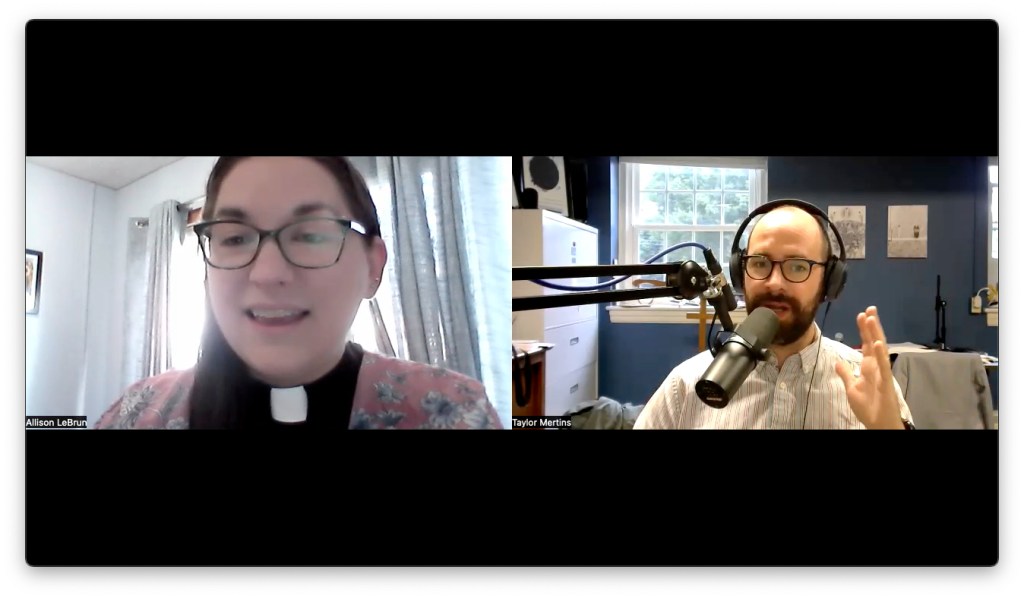
This week on the Strangely Warmed podcast I speak with Allison LeBrun about the readings for the 11th Sunday After Pentecost [C] (Jeremiah 1.4-10, Psalm 71.1-6, Hebrews 12.18-29, Luke 13.10-17). Allison serves Vermilion Grace UMC on the shores of Lake Eerie in Ohio. Our conversation covers a range of topics including dinosaurs in the New Creation, laughter, baptismal vows, Moana, Hildegard von Bingen, the power of words, divine fear, the jewishness of Jesus, acceptable worship, and true sabbath. If you would like to listen to the episode or subscribe to the podcast you can do so here: The Presence Of God Is Awful
This week on the Strangely Warmed podcast I speak with Allison LeBrun about the readings for the 10th Sunday After Pentecost [C] (Isaiah 5.1-7, Psalm 80.1-2, 8-19, Hebrews 11.29-12.2, Luke 12.49-56). Allison serves Vermilion Grace UMC on the shores of Lake Eerie in Ohio. Our conversation covers a range of topics including Twitter handles, mysteries, This Here Flesh, dinosaurs, Narnia, vineyards, the invisible church, The Chicks, good gifts, rewriting the psalms, the faith hall of fame, martyrdom, division, and James Baldwin. If you would like to listen to the episode or subscribe to the podcast you can do so here: Real Restoration
Now faith is the assurance of things hoped for, the conviction of things not seen. Indeed, by faith our ancestors received approval. By faith we understand that the worlds were prepared by the word of God, so that what is seen was made from things that are not visible. By faith Abraham obeyed when he was called to set out for a place that he was to receive as an inheritance; and he set out, not knowing where he was going. By faith he stayed for a time in the land he was promised, as in a foreign land, living in tents, as did Isaac and Jacob, who were heirs with him of the same promise. For he looked forward to the city that has foundations, whose architect and builder is God. By faith he received power of procreation, even though he was too old – and Sarah herself was barren – because he considered him faithful who had promised. Therefore from one person, and this one as good as dead, descendants were born, “as many as the stars of heaven and as the innumerable grains of sand by the seashore.” All of these died in faith without having received the promises, but from a distance they saw and greeted them. They confessed that they were strangers and foreigners on the earth, for people who speak in this way make it clear that they are seeking a homeland. If they had been thinking of the land that they had left behind, they would have had opportunity to return. But as it is, they desire a better country, that is, a heavenly one. Therefore God is not ashamed to be called their God; indeed, he has prepared a city for them.
We do a lot of looking backward in the church. And we come by it honest. We say words from ancient creeds, we sometimes sing songs written long before we were born, we sit in a room week after week constructed by people long dead, and we read from a book that has been passed down generation after generation.
Even the writer of Hebrews is quick to mention ancestors of the faith like Abraham and Sarah, and yet, we are also wonderfully reminded that faith is about looking forward, it’s about leaning toward God’s promises that have not yet come to fruition.
Consider this church for a moment…
At some point, 100 years ago, a group of people looked out at the world. A world coming out of a devastating global pandemic, teetering on the edge of a recession and depression, threats of international war hovering on the horizon, and they decided that the thing Roanoke needed most, this neighborhood in particular, was a church.
That had hope for things not yet seen.
They had hope for us.
Sometimes I’ll wander into our history room downstairs for a dose of wonder. We’ve got all the pictures and documents and we’ve even got a giant quilt, and whenever I’m surround by the stories and the people of this church, I wonder if they daydreamed about us. I wonder if they pictured us sitting in these pews singing these songs hoping these hopes.
I wonder if we day dream about those who will be here after we’re gone.
Part of the future is a relative unknowability. We do not, and cannot, know what tomorrow brings.
We only know that whatever tomorrow brings, God will be there.
And that’s faith.
Faith is such a churchy word. It’s in our scriptures and songs and prayers. It’s up on the wall of our classrooms, and it’s in our hearts. Faith is our word and yet it shows up in all sorts of unchurchy places. We talk of having faith in the economy, we hear about placing our faith in our politicians, we talk about movies being faithful to their source-text.
But what is faith?
Better put, what makes faith faithful?
I put the question out to a ton of people this week, online and in-person, churchy folk and decisively non-churchy folk. And I got a lot of answers. But I also got a lot of blank stares, and more than a few of those were from church people!
What is faith?
Faith is a five letter word that begins with f and ends with h and people use it to mean all sorts of things.
Faith is a possible wordle answer.
Faith is what keeps me going.
Faith is the gift to trust that the narrative shape of Jesus’ death and resurrection is the constitution of reality.
Faith is a genuine response to the experience of God.
Faith is accepting God’s acceptance of you.
Faith is a kind of homesickness, an inclination toward something you have not seen but you sense.
Martin Luther said that faith is often nothing more than believing God when God makes a promise.
It seems that Luther stole that from Hebrews.
Listen – By faith, by trust, Abraham responded to the call of God and traveled as a stranger in a strange land. He did not know where he was going. He only knew the One who called him to go. He stayed for a time living in tents, as did his descendants Isaac and Jacob who were also part of the promise of God.
Abraham looked forward to the city whose architect and builder is God.
Taking a step back from the strange new world of the Bible, it’s a bit odd that Abraham was so willing to march toward the unknown. When the comfort of familiarity surrounds us, why in the world would we leap into mystery? We read and read of Abraham’s faith, but his faith isn’t special, at least not really. It’s not some super gift that he had, or a blessing that was uniquely his.
What makes Abraham’s faith faith, it’s not the one who had it, but what his faith was in.
It’s like the thief on the cross next to Jesus. I’ve said this before, but I can’t wait to meet him in the resurrection of the dead. I want to ask him how it all worked out.
I can only imagine the angels whispering about his person. And then, a well-meaning delegate of the Lord steps up and says, “Excuse me, are you familiar with the doctrine of justification by faith?”
“Never heard of it.”
“Oh, well, did you tithe to the church? Were you present in worship at least 50% of the Sundays each year? Did you serve on any church committees?”
“What’s a church?”
And then finally, overwhelmed by the ridiculousness of this fellow, the angel says, “On what basis are you here?”
And he says, “The guy on the middle cross said I could come.”
From Abraham to Isaac to Jacob to Joseph to Moses, all of them died in faith without having received the promises. From a distance they saw the holy city; in faith they longed for something. Each of them, in their own way, were seeking a homeland, a place of knowing.
Faith, then, seems to be a homesickness for a home that is not yet here. A world in which the lion lays down with the lamb, where death is no more, where God wipes away all of our tears.
We catch these glimpses, every one in a while, in which our faith is made manifest in the present. It is the in-breaking of the kingdom of God, it is the assurance of things hoped for, the conviction of things not seen.
It’s the line of the faithful, marching forward to the table with hands outstretched ready to receive a gift we simply do not deserve, but the gift that is the difference that makes all the difference in the world.
It’s the kids of Vacation Bible School going buck wild singing songs about Jesus, cultivating friendship that are only possible because of the friendship of God.
It’s the man who came by the church this week, sheepishly knocking on the door, hoping for something to eat after being turned away from so many other places.
It’s the note in the song that lands so perfectly that we feel the tension easing out of our shoulders, or we find tears landing on the hymnal, or our smiles widen so much that we can’t even sing the next line.
And yet, each of those are not about what we do. When it comes to the matter of faith, we don’t bring much of anything to the table. The gospel doesn’t tell us to have faith, it gives us Jesus to place our faith in.
Again, think of the Table. When we come forward someone offers us the bread and the cup saying, “This is Jesus for you.”
There’s no talk of faith, or what we must believe, even though it’s true that everything depends on our believing in. The bread and cup, the body and blood of the Lord, direct our attention away from faith, which after all is weak and not much bigger than the size of a mustard seed. Instead of telling us to believe, it builds up our faith by giving us Jesus in the flesh.
I heard once that the church is like a beggar telling another beggar where to find bread. And perhaps there’s some truth in that. But it’s also deeply flawed. If all we can muster is the advice or the recommendation of where to find some sustenance for our bellies, then it’s not good news. If we’re really that hungry, we might not have the strength to go find the bread we’ve been directed toward.
Instead, the church is not one beggar telling another beggar where to find bread, it’s one beggar giving bread to another beggar. It’s someone standing at the front of the church and saying, “This is Jesus” and then placing it right in your hands.
The only thing you have to do, is receive it.
Faith is not a list of mental calculations that make you good enough to be part of the church. It’s not adhering to a set of doctrinal creeds that guard our theology.
Faith is merely a way of being.
And yet, the “merely” in that sentence betrays the wonderful and joyful truth of faith that changes everything.
Faith, for being the churchy word that it is, gets tossed to and fro all the time. We sing of faith, we literally have a hymnal called The Faith We Sing, we’re told to keep the faith, or that we must guard the faith.
But faith, again, isn’t about us. Faith is about Jesus.
Robert Farrar Capon, beloved grace-filled theologian, writes, “Faith doesn’t do anything.”
Talk about grabbing your audience from the first sentence.
“Faith doesn’t do anything; it simply enables us to relate ourselves to someone else who has already done whatever needs doing.”
And then he has this remarkable metaphor for faith.
Imagine you’re laid up in the hospital. There’s been an accident and your bones are broken. In time you will heal, but it will take time. And while you’re waiting for your body to get back in shape, you friend comes by to visit you upon occasion. You’re a half-decent person, you try to stay on the sunny side, but when your friend comes you can’t help but complain. The hospital food is atrocious, you don’t know if any of the hospital staff even know your name, and there are so many things you should be doing, but you can’t. Your house is a mess, the outside needs to be painted, a few of the boards on the deck need to be replaced, on and on and on.
And then, one day, your friend walks into the hospital room and says, “Listen, I hired a contractor to fix all the problems at your house. It’s all taken care of. It’s a gift from me to you.”
So what can you do?
You have two choices: you either believe your friend, or you don’t. Remember, you’re stuck in the hospital, and you can’t go inspect all the changes for yourself.
So, if you disbelieve your friend, well then you go on being a miserable bore whose no fun to be around.
But if you believe your friend, well then you have your first good day in a really long time.
This week on the Strangely Warmed podcast I speak with Peter Kwon about the readings for the 9th Sunday After Pentecost [C] (Isaiah 1.1, 10-20, Psalm 50.1-8, 22-23, Hebrews 11.1-3, 8-16, Luke 12.32-40). Peter is one of the pastors serving Annandale UMC in Annandale, VA. Our conversation covers a range of topics including the unexpected Gospel, Holes, sacrifices, Fleming Rutledge, relationships, LCD Soundsystem, singing our prayers, God’s loquaciousness, judgment, eschatological hope, Dogmatics In Outline, Sunday clothes, and preparation. If you would like to listen to the episode or subscribe to the podcast you can do so here: One Of Us
Then God spoke all these words, “I am the Lord your God, who brought you out of the land of Egypt, out of the house of slavery; you shall have no other gods before me. You shall not make for yourself an idol, whether in the form of anything that is in heaven above or that is on the earth beneath of that is in the water under the earth. You shall not bow down to them or serve them, for I the Lord your God am a jealous God, punishing children for the iniquity of parents to the third and the fourth generation of those who reject me but showing steadfast love to the thousandth generation of those who love me and keep my commandments. You shall not make wrongful use of the name of the Lord your God, for the Lord will not acquit anyone who misuses his name. Remember the Sabbath day and keep it holy. Six days you shall labor and do all your work. But the seventh day is a Sabbath to the Lord your God; you shall not do any work – you, your son or your daughter, your male or female slave, your livestock, or the alien resident in your towns. For in six days the Lord made heaven and earth, the sea, and all that is in them, but rested the seventh day; therefore the Lord blessed the Sabbath day and consecrated it. Honor your father and your mother, so that your days may be long in the land that the Lord your God is giving you. You shall not murder. You shall not commit adultery. You shall not steal. You shall not bear false witness against your neighbor. You shall not covet your neighbor’s house; you shall not covet your neighbor’s wife, male or female slave, ox, donkey, or anything that belongs to your neighbor. When all the people witnessed the thunder and lightning, the sound of the trumpet, and the mountain smoking, they were afraid and trembled and stood at a distance and said to Moses, “You speak to us, and we will listen, but do not let God speak to us, lest we die.”
It doesn’t happen often, but every once in a while I regret picking the text I picked for a Sunday morning. I will be in the middle of the week, staring at a blank work document on my computer, and I’ll wonder how God is going to show up and make something of my nothing.
Case in point, last Sunday we looked at and talked about Moses’ call from the burning bush. That would’ve been a great text for Vacation Bible School Sunday. It would’ve been fun and even easy to talk about how God shows up, and showed up, in unexpected ways and places. I could’ve pointed toward all these holy moments from the Food Truck Party and then wrapped it all up with a, “In the name of the Father, Son, and Holy Spirit.”
But no. I decided that this was the Sunday to preach the Ten Commandments.
You shall not murder.
You shall not bear false witness.
You shall not take the Lord’s name in vain.
On and on.
So I spent the early part of my week wracking my brain, praying for the Lord to give me something to say.
And then, on Monday night, I was sitting on the floor of one of our classrooms upstairs, with all our wonderful children and youth, trying my hardest to convey the story of God providing the manna in the wilderness. But, before jumping into the Bible, I wanted to get their little minds working so I asked each and every kid, “What’s your favorite breakfast?”
And I received some good answers: Pancakes, French Toast, Lucky Charms.
But then one of the kids said, “My favorite is waffles, but I hate it when my Dad makes me eat scrambled eggs.”
Alright, I thought, no need to get worked up about it.
And then another kid shouted, “Donuts!” To which another yelled, a few decibels louder, “I want her answer because I love donuts more than she does!”
And then another kid, under his breath, said, “I would give my life for a donut right now.”
Bewildered by the dramatic events unfolding before me, I took a breath, and happened to glance at the wall above their little heads and there, for everyone to see, was a poster with the ten commandments.
And I realized in that moment, the kids had broken three of the ten!
The Ten Commandments.
You shall not you shall not you shall not.
Why do we hang them up in our churches and in our houses? Why do we ask children to memorize them in Sunday school? Why does God hand them down to Moses on Mount Sinai?
Remember: Moses makes good on the call from the burning bush and leads God’s people out of slavery and captivity in Egypt to a new and strange land. They wander physically and spiritually complaining about how good they had it back in Egypt when God delivers the aforementioned manna in the wilderness.
They continue to wander under the witness of Moses until the Lord’s offers the Ten Commandments on Mount Sinai.
And, for us today, we can certainly flip to Exodus 20 in our Bibles, or we can just look up to a cross-stitched rendering in someone’s living room or Sunday school class to know what they are.
But there’s a difference between what the Ten Commandments say, and their purpose.
Because, if you read the New Testament, Jesus and Paul decisively declare that they are not rules to regulate our behavior. They are not a weapon to wield over and against those who do not follow them. They are not a code of conduct.
The primary function of the Law is to do to us what I just did by telling the story of the kids in the classroom: to accuse us.
The Law reveals the truth of who we really are. Between the big L and little l laws, between thou shall not and it would be better if you did this or that, the law reminds us that, all things considered, none of us are how we ought to be.
And yet all of us are in the business of self-deception. We’re so good at rationalizing our wandering eyes, justifying our wandering hearts, and explaining away our wanton disregard for others.
One of the more confounding parts of our behavior is our ability to know exactly what we should and shouldn’t do, from keeping up with the laundry to not looking at our phones while we drive, and we fail to do it.
We don’t need someone like me to stand up in a place like this to tell us a whole bunch of stuff we already know: you need to work on your racism, sexism, ageism, stop using so much styrofoam, go vegan, gluten free, eat locally, think globally, take precautions on your dates, live simply, practice diversity, give more, complain less, stop drinking so much.
We can have a preacher yell those things at us week after week, and we can put up the Ten Commandments all over the place, but we will still fail.
Listen: there’s another mountaintop moment in the Bible with a set of decrees. Instead of Moses this time, Jesus looks out at the gathered crowds and he says, “You have heard it said you shall not murder, but I say to you, love your enemies and pray for those who persecute you; you have heard it said you shall not commit adultery, but I say to you, even if you think about it, you’ve already guilty; unless your righteousness exceeds that of the Pharisees, of the rule followers, then you will never enter Heaven.”
And then, at the end of ratcheting up the Ten Commandments, Jesus mic drops the final line: You must be perfect as your Father in Heaven is perfect.
Apparently, in the Kingdom of God there are no trophies for participation, no A’s for effort.
Therefore, if Moses’ and Jesus’ decrees are nothing more than lists of what we must and mustn’t do, then we’re all up the creek without a paddle. We’re a bunch of losers with no hope in the world.
Thanks be to God then, that the hope of the world comes to do for us what we cannot do for ourselves.
You see, the primary purpose of the Law isn’t so much about what we’re supposed todo.
The primary purpose of the Law is what the Law does to us.
The Law is not a collection of principles on how to live an upright life.
The Law is the means by which God brings us down to our knees.
The Law, from Sinai to the instagramifcation of all things, holds up a mirror to our truest selves so that we are downright forced to come to grips with who we really are, and what we’ve done, and what we’re left undone.
In short, the function of the Law is to get to see ourselves with enough honesty and clarity that we ask ourselves, “How could God love me?”
Because when we are able to ask that question, we are close to the Good News.
God speak to us in two words, Law & Gospel, and we tend to confuse the two all the time.
And without knowing which is which, we tend to emphasize one at the expense of the other.
Be perfect. Never stop forgiving. Love your enemies. Stop your jealousy. Give away your possessions. On an on.
A church of the Law alone creates and cultivates a bunch of self-righteous people who are angry, miserable, and are never invited to the fun stuff.
It results in a cacophony of almost-Christians who are, in the end, nothing but a bunch of hypocrites. Have you ever noticed how the most judgmental people are usually the ones with the most problems?
And yet, without the word of the Law, the Gospel becomes an empty promise. It’s all good and well to come to a place like this and hear about how God loves us. I hope and pray that if you do hear anything in church, it is those words.
But what makes those words so staggering isn’t that God loves, but that God loves us.
When push comes to shove, each and every one of us, the tall and the small, we all avoid doing things we know we should do, and we all do things we know we shouldn’t.
Which is why, when Jesus riffs on the need to forgive 70 x 7 times, it’s to point us toward the witness of the God who continues to forgive us.
Jesus tells us to love our enemies not because it makes everything better, though it might, Jesus commands us to love our enemies because Jesus, himself, loves his enemies: us.
Which means, in the end, we need Law & Gospel. We need both because the first word pushes us to the second.
The Good News is not a bait and switch offer, it is not an invitation with strings attached, it is not a gift with an expectation of reciprocation.
If we leave church with more burdens than when we arrived, then grace cannot be amazing.
God knows you and me better than we know ourselves. God knows our inner thoughts and our knee-jerk reactions and our internet search histories, and God is still for us.
How odd of God to love a bunch of people who do not deserve it at all.
Being pushed from the Law to the Gospel is a truly wild and wonderful thing to do. And it is often nothing more than accepting, trusting, the incomprehensible Good News that despite all the reasons we shouldn’t be, we are indeed loved and forgiven. We are already home.
That’s the life of grace – there is therefore now no condemnation for those who are in Christ Jesus. If Jesus refused to condemn us because our goodness was actually rotten, he certainly isn’t going to flunk us because our life doesn’t measure up to the Law.
The real truth, the scandal of the faith, is that we can fail, miserably, and still live the life of grace.
Nothing, absolutely nothing, can separate us from God’s grace and love. Not our faults, not our vices, not us being brats all the time about things that don’t even really matter. Not even our doubts.
As the old hymn goes, my sin oh the bliss of this glorious thought, my sin not in part but the whole is nailed to the cross and I bear it no more praise the Lord, praise the Lord, o my soul.
One of our vacation Bible School participants, after a week of digesting the Word, approach me on our final night and said:
“So God loves me when I’m good but God still loves me when I’m bad just like Jesus loved all the people he fed with the loaves and the fishes? And God forgives me even if I do something I shouldn’t just like Jesus forgave Peter?”
“Yep. That’s the Gospel.”
“Well I don’t know what that words means, but it feels amazing.” Amen.
Moses was keeping the flock of his father-in-law Jethro, the priest of Midian; he led his flock beyond the wilderness and came to Mount Horeb, the mountain of God. There the angel of the Lord appeared to him in a flame of fire out of a bush; he looked, and the bush was blazing, yet it was not consumed. Then Moses said, “I must turn aside and look at this great sight and see why the bush is not burned up.” When the Lord saw that he had turned aside to see, God called to him out of the bush, “Moses, Moses!” And he said, “Here I am.” Then he said, “Come no closer! Remove the sandals from your feet, for the place on which you are standing is holy ground.” He said further, “I am the God of your father, the God of Abraham, the God of Isaac, and the God of Jacob.” And Moses hid his face, for he was afraid to look at God. Then the Lord said, “I have observed the misery of my people who are in Egypt; I have heard their cry on account of their taskmasters. Indeed, I know their sufferings, and I have come down to deliver them from the Egyptians and to bring them up our of that land to a good and spacious land, to a land flowing with milk and honest, to the country of the Canaanites, the Hittites, the Amorites, the Perizzites, the Hivites, and the Jebusites. The cry of the Israelites has now come to me; I have also seen how the Egyptians oppress them. Now go, I am sending you to Pharaoh to bring my people, the Israelites, out of Egypt.” But Moses said to God, “Who am I that I should go to Pharaoh and bring the Israelites out of Egypt?” He said, “I will be with you, and this shall be the sign for you that it is I who sent you: when you have brought the people out of Egypt, you shall serve God on this mountain.” But Moses said to God, “If I come to the Israelites and say to them, ‘The God of your ancestors has sent me to you,’ and they ask me, ‘What is his name?’ What name shall I say to them?” God said to Moses, “I AM WHO I AM.” He said further, “Thus you shall say to the Israelites, “I AM has sent me to you.”
God can be so frustrating.
There are times, maybe you’re better than me so you don’t know what I’m talking about, but there are times when I jump into the strange new world of the Bible and I just want to say, “C’mon God! Really?”
Moses is a good-for-nothing shepherd. And he doesn’t even have his own flock to look after. He’s working for his father-in-law. So we’ve got this guy, who needs a handout from a relative, working out and around Mt. Horeb, which means wasteland, and he encounters the burning bush.
Or, better but, the burning bush encounters him.
Does it ever surprise you that the Lord needs numbskulls to bring about God’s will?
I mean, just take a cursory glance at just about any book in the Bible and you liable to come across someone who has no business being in God’s business and yet, that’s how God runs the show.
And that’s not even mentioning who God calls upon outside of the Bible.
To bring it close to home, there are 29 portraits of pastors right underneath us and there’s a better than good chance that the vast majority of them never thought they would have their picture up on the wall of a church.
And yet, here we are.
Sometimes I wish God would start calling better people for God’s purposes. Surely, the world could do to have the best and the brightest working for the kingdom.
But, then again, if God only called the best, then I certainly wouldn’t be here, and neither would any of you.
John Calvin, who gets quoted across the street far more than here once said, “God is so great, that God is able to condescend to miserable people just like us to accomplish God’s good.”
How odd of God.
And, notably, it’s important to notice the distinction between “I found God,” and “God found me.” Throughout the strange new world of the Bible, people do, indeed, go looking for God but they usually go looking in all the wrong places whereas God shows up in the unexpected places.
Contrary to how we might like to imagine it, or even here about it in church, God is not the object of our religious journeys, waiting for us to finally have enough sense to take the right steps or read the right book or get the right job or make the right choice. God is, instead, the instigator of God’s journey to us. From Eden, to the wasteland, to Bethlehem; God finds us.
And that’s why we keep reading these stories week after week, year after year. It’s why we prepare for Vacation Bible School and read scripture at baptisms, weddings, and funerals. We keep listening to the story of how God reveals God’s self to people who otherwise would have never known who God was or is.
And (!) to further complicate the confounding nature of the God who speaks from bushes and books, particularly as it pertains to preaching, is that only God can tell us who God is. It has to be revealed to us.
Listen – All is well in Egypt until it isn’t.
God’s people grow in such size and strength that Pharaoh grows fearful and subjugates them. They are forced to work under the tyrannical rule of the empire and yet, they continue to prosper in power and number.
Pharaoh then decides to order the murder of every first born male among the Hebrew people. A young mother, fearing for her son’s life, places him in a basket and lets him float down the Nile river and, oddly enough, the basket is discovered by Pharaoh’s daughter who chooses to raise the boy and she names him Moses which means “I drew him out of the water.”
Raised in the confines, and under the protection, of Egypt’s ruler, Moses is given access to a life that none of his kinsmen will ever know. And yet, one day, he sees an Egyptian taskmaster whipping a Hebrew slave and, overcome with emotion, Moses reaches out and murders the Egyptian and hides his body in the sand.
Moses flees for his very life, already a recurring theme, and he settles in the land of Midian where he marries Zipporah, the daughter of a priest, and begins to work for his new father-in-law.
So why, why in the world does God call to Moses from the burning bush? What’s so good on his resume, what kind of references did he list while seeking out employment with the Lord?
Moses really only brings three things to the table:
He’s in the middle of his mundane work, guiding the flock in the wasteland, when he turns aside to see the sight of the burning bush. In short, Moses is curious.
That’s not much, all things considered, but to the Lord it is the difference that makes all the difference. Moses turns to take in something unexpected, and rather than lowering his head and getting back to the menial realities of life, he takes a further look.
He is like the proverbial worker surrounded by countless cubicles mindlessly typing away at a keyboard for a job that means nothing when a suddenly flickering in the window draws him up and away from his featureless desk toward the unknown.
It is good and right to maintain a healthy diet of curiosity, of keeping our eyes and ears tuned away from monotony. Be it a strange movie or meal or moment, God tends to work in the unexpected places in unexpected ways.
Or, as one of my favorite authors Haruki Murakami puts it, “If you only read the books everyone else is reading, then you can only think what everyone else is thinking.”
After Moses’ curiosity draws his gaze toward the bush, the next thing he does is wonder. The strange fiery foliage isn’t enough on its own, Moses wants to know why it burns but does not burn up. He is not content to let things be the way they are simply because they are that way, he probes further.
It is good and right to wonder about the workings of God.
It does my ego good to remember that none of you come here with the great desire to hear preachments about the Lord, but instead you are here to daydream about God, to wonder, to ask questions, and rest in whatever answers you discover.
A couple weeks ago one of you asked me, after church, about the Apostles’ Creed and why we say, “I believe in the holy catholic church.” I won’t out you, but this person said, “Why do we say that? We’re Methodists, not Catholics.” And I gave the typical response, “it’s the lower-c catholic which means universal, we’re just saying we believe in the church writ large.”
This kind of question pops up all the time, but what struck me most this time was the fact that the person then said, “I’ve wondered about that my whole life, and I’ve never had the nerve to ask.”
Faith is a strange and wondrous thing that necessities wonder. That’s why the disciples are forever asking Jesus to elaborate on the kingdom of heaven, they want to know more.
Moses is curious and Moses wonders about this strange sight in the wasteland, and when the Lord sees Moses’ curiosity and wonder the Lord says, “Moses, Moses!” And he says, “Here I am.”
In short, Moses responds.
“Kick those sandals off your feet, we’ve got holy business to attend to. I am the God of your people, and the time has come to set them free and I have just the person for the job.”
“And who might that be?”
“You, silly goose.”
“Are you out of your mind? You’re a talking bush that’s on fire! And you want me to deliver the Hebrew people from Pharaoh?”
“Have no fear Moses my dear, I will be with you.”
“Maybe you didn’t hear me fiery fig tree, or whatever it is you are, even if what you’re saying is true, no one will believe me when I tell them. I don’t even know your name.”
God says to Moses, “I AM WHO I AM.”
The rest is biblical history.
When it comes to the question of “Why Moses?” It doesn’t really matter. Sure, there are some bits to his history that make him a prime candidate for paradigm shifts, he spent time in Pharaoh’s court. In the end, who he is doesn’t matter.
The only thing that matters is that God is the one doing the calling.
You see, God does God’s best work making something of our nothing, of making a way where there is no way whatsoever, of making the impossible possible.
We, today, tend to view ourselves and one another through failures, mistakes, shortcomings. It is the negative that we carry around day after day. But to God, each and every one of us has a potentiality that can be made manifest in the kingdom of God.
Or, to use a very old adage, God doesn’t call the equipped, God equips the called.
Think about Moses! In just a few short chapters this would-be shepherd in the wasteland will be taking care of the flock of God, standing up to the tyranny of Pharaoh, delivering the Hebrew people to the banks of the sea waiting for the God of impossible possibility to do something.
It’s fun to pick on Moses, he’s an easy target. The rest of his tale paints the picture of his relationship with God like an old married couple who constantly bicker and fight and eventually reconcile. For what it’s worth, we read more about Moses than any other person in the Bible with the exception of Jesus. And yet, Moses’ story isn’t even really about Moses – it’s about the One who calls him.
I AM WHO I AM
I love how quickly Moses moves from “Here I am,” to “Who am I?” His curiosity and wonder and response are all good and fine until he hears what the Lord wants him to do. And immediately, Moses has reservations. Who am I to do all of that?
Who am I?
Who are you?
Whatever it is your experiencing in your life right now, whether you feel like you’re wandering through the wasteland or making moves on the mountaintop, God calls miserable and merry people like you and me all the time. It might not be to deliver God’s people from the oppressive rule of a dictator, it might be as simple as the nudge to call someone who needs to feel loved, or the feeling that there’s something we can do to make a difference in this community. And it might not come through a burning bush, it might be as simple as the words of a hymn, or the silence of a prayer, or any other number of possibilities.
Or, as Paige Anderson so wonderfully put it to me this week, “Sometimes all we need in life is the tiniest sign from God to remind us of our purpose.”
What makes the story of the burning bush so good is the fact that, in the end, the call of Moses is a wild and ringing reminder that we don’t have to be saints to be of use for God’s kingdom. If we need anything at all, it’s a little bit of curiosity, wonder, the tiniest smidge of faith.
Faith not in ourselves or our abilities, but faith in the God who is able to do far more than we could ever ask or imagine.
If you ever feel like you’re not good enough, that’s fine. Because God is good enough for all of us. Amen.
This week on the Strangely Warmed podcast I speak with Peter Kwon about the readings for the 8th Sunday After Pentecost [C] (Hosea 11.1-11, Psalm 107.1-9, 43, Colossians 3.1-11, Luke 12.13-21). Peter is one of the pastors serving Annandale UMC in Annandale, VA. Our conversation covers a range of topics including foolishness, church cohorts, robe wearing, books, fear, the redeemed, old sermons, the already but not yet, Jonathan Franzen’s Crossroads, the grammar of faith, and identity. If you would like to listen to the episode or subscribe to the podcast you can do so here: The Good News Of Being A Burden








 think and let think