Questions: The Old and the New – Sermon on Genesis 11.1-9 & Acts 2.1-4

Genesis 11.1-9

Now the whole earth had one language and the same words. And as they migrated from the east, they came upon a plain in the land of Shinar and settled there. And they said to one another, “Come, let us make bricks, and burn them thoroughly.” And they had brick for stone, and bitumen for mortar. Then they said, “Come, let us build ourselves a city, and a tower with its top in the heavens, and let us make a name for ourselves; otherwise we shall be scattered abroad upon the face of the whole earth.” The Lord came down to see the city and the tower, which mortals had built. And the Lord said, “Look, they are one people, and they have all one language; and this is only the beginning of what they will do; nothing that they propose to do will now be impossible for them. Come, let us go down, and confuse their language there, so that they will not understand one another’s speech.” So the Lord scattered them abroad from there over the face of the earth, and they left off building the city. Therefore it was called Babel, because there the Lord confused the language of all the earth; and from there the Lord scattered them abroad over the face of all the earth.

Acts 2.1-4

When the day of Pentecost had come, they were all together in one place. And suddenly from heaven there came a sound like the rush of a violent wind, and it filled the entire house where they were sitting. Divided tongues, as of fire, appeared among them, and a tongue rested on each of them. All of them were filled with the Holy Spirit and began to speak in other languages, as the Spirit gave them ability.

xlba-00052

Today we continue with our sermon series on “Questions.” After requesting responses from all of you regarding your questions about God, Faith, and the Church, we have, again, come to the time when I attempt to faithful respond to those questions. Last week we looked at what it means to be saved and how we can come to understand it in our own lives. Today we are talking about the relationship between the Old and New Testaments, how can we reconcile the vengefully destructive God of the Old Testament with the loving merciful God of the New.

So, here we go…

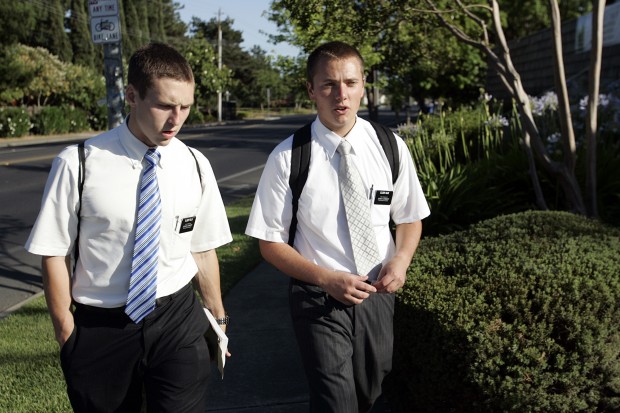
I saw the two representatives walking up and down the street, knocking on the doors of all my neighbors. Sitting at my kitchen counter, I was at home on break from JMU working on a paper for my class called “Jesus and the Moral Life.” As I sat there, Bible and computer spread before me, I eagerly awaited any distraction.

I wondered what organization or church the two men represented. It was clear that whatever they were trying to sell was not working out for them because they were moving quickly between the houses on the other side of the street. I remember trying to focus on my assignment, but my mind wandered regarding the the possibilities of the speech the pair were giving to my neighbors.

When the doorbell finally rang, I sprinted to the front door with my bible in tow.
4fda4bd3327be.preview-620

“Good afternoon sir,” they chimed simultaneously with seemingly forced smiles that almost hurt to witness. “Have you heard about our Lord and Savior Jesus Christ?” I mumbled something in response about being a Christian, but they continued as if I wasn’t really standing there.

“Are you aware of God’s impending destruction of the earth? We have failed to be obedient, and God is surely going to rain down his wrath upon all of us. There will be earthquakes, floods, and famines. Nothing can stop God’s judgement, but we can save you.”

“Tell me more,” I replied.

“Well, Satan and his demons were cast down to earth in 1914 which initiated the End Times. Over the years he has begun to take over human governments in order to create evil on earth. God will come to destroy Satan, and this entire earth with him, but if you join us, God will protect you from his armageddon.”

Now, before I continue, I urge you to remember that I was a young and foolish biblical studies student, convinced that I knew everything there was to know about God, faith, and scripture.

And so, it came to pass that after listening to these two men describe for me the fall of Satan having occurred at the beginning of the 20th century, and their ability to save me from God’s impending destruction, I could no longer contain myself…

“Where does it say that in the Bible?”

“Well, if you look at our pamphlet, it clearly outlines…”

“Where does it say that in the Bible?”

“These charts will show how natural disasters are connected to Satan…”

“Where does it say that in the Bible? I’ve got one right here, and I would love for you to show me where your facts come from.”

At that point they slowly started to step away from the door, thanked me for my time, and continued their evangelistic work to the rest of the neighborhood.

Thinking back upon that interaction, I regret the poor Christian hospitality I showed those two men. I had a predetermined commitment to scripture that blinded me from hearing them out and kindly responding to their interpretive theology. However, I believe the interaction does point to a faulty mode of reading God’s Word that has plagued the church from the beginning.

Marcion was a Christian bishop during the first century. Like many Christians, he saw discrepancies between the actions of God in the Old Testament and during the time of the New Testament. And after wrestling with the differences, Marcion proposed completely rejecting the existence of the God described in the Jewish scriptures, and also argued for omitting the sections of the New Testament that were connected with the Old. Central for Marcion’s edited bible was the idea that the teachings of Jesus were incompatible with the actions of God as found in the Hebrew Scriptures.

After numerous debates, fights, and even scandals Marcion was declared a heretic by the early church fathers and was removed from the church.

Like the two men who came knocking on my door, Marcion (and many others) had a very tunnel-visioned understanding of scripture. If it did not agree with their beliefs, they omitted it, they ignored it, and they taught in spite of it.

Without a doubt, if you read through the stories of the Old and New Testaments you will discover a number of difficulties regarding the actions of God throughout time. Wrestling with these changes has been a part of the church’s history from the very beginning and still takes place today. To fully address these differences it would take numerous sermons series and bible studies, and certainly cannot be fully proclaimed in one sermon. If this is something that you really wrestle with we can talk about doing something in greater detail down the road, but for today’s purposes we can only accomplish so much.

One of the major problems with the inconsistency of scripture is that we tend to view chapters and narratives in isolation. We take one verse from the Old Testament and compare it to one verse in the New. I am thankful for the numbering of chapters and verses for organization, but I believe they have also stratified our understanding of scripture into tiny bits that can be reorganized for our understanding. The Bible is one thing, it is the single story of God with God’s people; it may be divided into two testaments, with numerous chapters and verses regarding a plethora of people and places, but it is nevertheless one unified collection of the living Word for God’s people.

20130115_canon

Rather than reading in isolation, we are called to understand and experience God’s word canonically, which is to say we have to understand each individual narrative in light of the entire saga of scripture. Reading, preaching, and teaching canonically opens our eyes to the many ways that God runs through both testaments like a river; the water may change with the seasons, but the water always moves.

In Genesis 10 we find the story of the tower of Babel. Humanity had one language and had gathered in the plains of Shinar to settle down. There they decided to build a giant tower into the heavens in order to make a name for themselves. God witnessed the construction of this tower, recognized that this was but one domino leading inevitably to a belief that humanity did not need God, so God confused their language and scattered the people over the face of the earth.

In Acts 2 we find the story of the disciples gathered together 50 days after Jesus’ resurrection. While they were all together a great wind came from heaven filling the entire house. All of the disciples were filled with the Holy Spirit and began to speak in other languages.

Babel and Pentecost, two stories, one from the Old Testament, one from the New. These stories are often used in church to make separate points about the identity of God and what it means to be a disciple; Babel demonstrates God’s punishment of humanity for sin and Pentecost shows God’s desire for the gospel to spread amongst all nations and languages. However, they cannot be fully understood without the other. They are not two separate stories describing two different Gods, but are instead part of the greater canonical narrative of how God is God.

Babel contains every bit of the human desire to remain self-reliant and focused on pride. Like the garden, Babel exhibits that same sense of sin whereby humanity believed it no longer needed God. Though the story clearly contains examples of God’s wrath, it also contains an abundance of grace.

In striving to build a city and a tower for themselves, humanity had lost sight of the unity under which they already enjoyed from God. The true sin evident in the story is the arrogance of thinking that humanity must take itself as one takes brick and mortar, and make themselves the lord of history. In violation of the original unity of creation, in humanity’s desire to control its own destiny, the people of Genesis 11 were no longer naturally organized under the great Shepherd, but instead were brought together by the selfish desire to live in ignorance of God’s created order.

God punishes the people gathered together by confusing their language and scattering them over the earth. His wrath is evident, but his grace also lies under the surface. God could have easily used an earthquake or another divine example of control to achieve the punishment. He could have destroyed the tower and everyone in it. But rather than destroying creation, as had been done with Noah and the flood, God merely divides humanity and confuses their language. Instead of raining down death and destruction, God limits the punishment to linguistics.

We discover God’s unyielding grace in the fact that God will continue to be our shepherd regardless of our self-righteousness. God will not abandon us to our own devices but will remain faithful even when we are not.

And remember, the story of Babel does not end in Genesis 10, it continues on throughout the Old Testament and finds reflection in the New. As Christians we are aware that God has more in store for his creation than one isolated story from the past would have us believe. In the person of Jesus Christ the previously divided world finally comes back together. It is in the story of Pentecost that we are reminded again of God’s desire for humanity to rest in unity, not division.

Pentecost tells us about the miracle of the Holy Spirit coming down to help reunite the world in order to fruitfully live into God’s kingdom. God did not abandon the people of Babel, just as God has not abandoned us while we continually act as if we can make through life on our own.

The same year I met the two men who knocked on my door, I took a group of college-age Christians to Taize, an ecumenical monastery in Burgundy, France. We camped for a week on the property, gathering together with 5,000 young Christians three times a day for prayer and reflective hymns. The Christians gathered together that week came from all over the globe, representing nearly every continent. In between the worship services, we met in small groups talking about faith, scripture, and discipleship. When the last day arrived, my group sat together and I asked us to end our week by standing in a circle to pray with each other. I asked everyone to pray the Lord’s prayer together in their native tongue, and then individually pray it so that we could hear what it sounded like. For perhaps the first time in my life, Pentecost became really for me while we prayed together in that field. Though all of us had been divided across the planet we were all brought together by Jesus Christ. Though we had been previously separated we were gathered in unity by the great “I AM.”

6613_1139875468060_4836913_n

Babel and Pentecost are intimately connected but I want to be clear that the relationship between the two testaments is not that God fixes the problems of the Old Testament with the revelations of the New. God did not change himself from wrathful to graceful. The New Testament is not the band-aid for the Old.

Yet, the incarnation of God in the person of Jesus Christ changed everything. The Old Testament tells of God’s interaction with creation and the New Testament inaugurates the event where God came to dwell among us. Jesus Christ is the lens by which we are called to read scripture, both the Old and the New Testament. God’s love of creation is woven into the fabric of scripture, consistently revealed through people like Abraham, Isaac, Jacob, Moses, Isaiah, Jeremiah, Jesus, Mary, Peter, and Paul and places like Egypt, Galilee, Samaria, and Jerusalem.

This is one great cosmic story, a story that begins with God’s creation of all things declaring them good, a story that has no end because it still taking form right now.

So, how do we reconcile the God of the Old Testament with the God of the New Testament? We read scripture knowing that it does not happen in isolation, but can only be understood within the canon of both testaments. 

We read knowing that, like all great things, God is mystery unrevealed until its proper season. We read with faith knowing that God has not abandoned us, though we struggle to find meaning in the shadow of suffering, fear, and doubt, God’s plan for us is greater than we can possibly imagine. We read knowing that God does not choose us because we are good, but because he wants us to be good.

We read scripture in the light of Jesus Christ recognizing that where we find wrath, there is also grace; when we suffer we discover our hope; and when there is death there is also resurrection. Amen.
Questions: I Believe; Help My Unbelief! – Sermon on Mark 9.14-24 & Ephesians 2.8-9

Mark 9.14-24

When they came to the disciples, they saw a great crowd around them, and some scribes arguing with them. When the whole crowd saw him, they were immediately overcome with awe, and they ran forward to greet him. He asked them, “What are you arguing about with them?” Someone from the crowd answered him, “Teacher, I brought you my son; he has a spirit that makes him unable to speak; and whenever it seizes him, it dashes him down; and he foams and grinds his teeth and becomes rigid; and I asked your disciples to cast it out, but they could not do so.” He answered them, “You faithless generation, how much longer must I be among you? How much longer must I put up with you? Bring him to me.” And they brought the boy to him. When the spirit saw him, immediately it convulsed the boy, and he fell on the ground and rolled about foaming at the mouth. Jesus asked the father, “How long has this been happening to him?” And he said, “From childhood. It has often cast him into the fire and into the water, to destroy him; but if you are able to do anything, have pity on us and help us.” Jesus said to him, “If you are able! — All things can be done for the one who believes.” Immediately the father of the child cried out, “I believe; help my unbelief!”

Ephesians 2.8-9

For by grace you have been saved through faith, and this is not your own doing; it is the gift of God – not the result of works, so that no one may boast.

xlba-00052

Today we begin the first part of our sermon series on “Questions.” After requesting responses from all of you regarding your questions about God, Faith, and the Church, we have come to the time where I attempt to faithfully respond to those questions. Today we are talking about faith, being saved, and doubt. So, here we go…

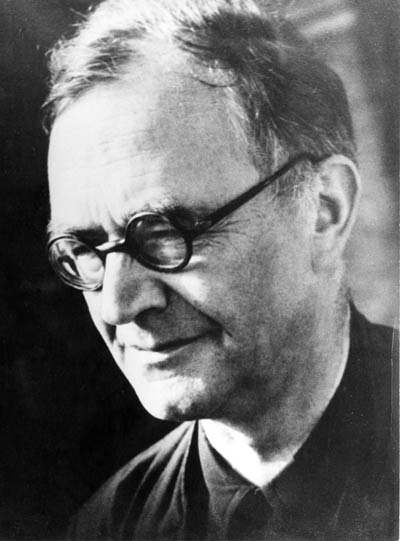
In 1962 one of the greatest theological minds of the 20th century visited the United States on a lecture tour. Karl Barth was a product of Western Theology who actively spoke against the Nazi regime rejecting their un-Christian allegiance to Adolf Hitler. His writing and influence spread throughout the world to a degree beyond his expectation.

So during the early 1960’s Barth found himself in his later years, touring around the American landscape lecturing to young, and old, Christians about the importance of God being God.

Karl Barth is my theological hero – his books line my shelves and I believe he put forth a remarkable understanding of scripture.

Karl Barth

Karl Barth

However, Barth is remarkably difficult to understand and was very longwinded in his writing. He was once approached by a young theologian declaring, “Professor Barth, you’re my hero! I’ve read everything you’ve ever written!” To which Barth replied, “Son, I haven’t even read everything I’ve written.”

Karl Barth, intellectual and as difficult to understand as any theologian I’ve ever read, lectured at Princeton, the University of Chicago, and Union Theological Seminary. After one such lecture, no doubt filled with theologisms beyond the capacity of comprehension, a young man bravely decided to ask a question.

Now, at the time, evangelical theology was beginning to take off in the United States. Churches pushed for “personal relationships with Jesus Christ.” Altar calls were all the rage. And everyone wanted to know when you got saved.

The young man, with his hand shaking in the air, waited to ask his question. I imagine that Barth was getting tired of answering the foolish questions from the audience but decided to offer one final answer. “Son, what is your question?”

“Well professor Barth, I was wondering, when were you saved?”

The young man, obviously caught up with the personal stories of individuals who accepted Jesus Christ in their hearts, moments where folk learned that they were saved, wanted to know when Barth had discovered this momentous occasion in his own life.

After responding to questions about the ineffability of God, the diminishing role of the third member of the Trinity, and the self unveiling to humanity of the God who cannot be discovered by humanity simply through its own intuition, Barth was finally asked a question with a simple answer.

“Hmm, when was I saved? Oh yes, thats easy, it was… 2,000 years ago on the cross.”

“How will I know when I’m saved?” A question I have heard time and time again. When will I know, with assurance, that heaven is my everlasting reward? How will I be able to tell that I have been saved and what happens if I ever have doubts later on, will I still go to heaven?

In many churches, being “saved” is equated with a moment when an individual accepts Jesus Christ as their “personal Lord and Savior.” We look at it as a check-off list, an accomplishment to be met in order to go to heaven. A time when they let their old self die, in order to be clothed in Christ forevermore. This often takes form in an altar call, that moment after the sermon when a preacher stands right where I am, calling out to the congregation, calling out for those who feel the call of God on their lives to come forward during the final hymn to give their lives to Jesus Christ. Sometimes it takes place in baptism, when water is used to cleanse a child or an adult from their broken ways and save them. Sometimes it takes place in the bread and wine of communion, nourishing someone’s faith in a way previously unexperienced.

In many places, being “saved” like this is worth celebrating as a rebirth, a reawakening of the soul, a definitive shift in the life of a Christian. Some of my friends celebrate their “saved” birthday every year with a cake and presents. And even though some of those people are dear to me, and even though I can trace back to a moment in my life where I committed my life to Christ, I still wonder about what it really means to be saved.

This is what I do know: The saving of anyone is something which is not within our power, but only of God. No one can be saved – by virtue of what he/she can do. Everyone can be saved — by virtue of what God can do.

After coming down from the transfiguration on the mountaintop, Jesus met back up with the disciples only to be surprised to see them arguing with scribes. Upon arrival the crowd surrounded him overcome with awe. Someone from the group stepped forward, “Teacher, I brought you my son; he has a spirit that makes him unable to speak, it makes him seize up and crash to the ground. I asked your disciples to cast it out, but they were unable.” Jesus then responded to everyone present, “You faithless generation, how much longer must I be among you? How much longer must I put up with you? Bring the boy to me.”

So the crowd brought the boy forward but he immediately began to convulse when in the presence of the Lord and he rolled on the floor foaming at the mouth. Jesus asked the father, “How long has this been happening to him?” “Its been happening since childhood,” the father responded, “but if you are able to do anything, have pity on us and help us.”

Jesus then responded, “If you are able! — All things can be done for the one who believes.” Immediately the father of the child cried out, “I believe; help my unbelief!”

unbelief

I believe; help my unbelief! The father’s reply demonstrates for us the nature of faith. It seems so paradoxical and contradictory, yet, how often has that father’s cry been the prayer on our lips? The father has shown a bit of faith by approaching Jesus in the first place, yet the move stemmed from desperation rather than confidence; “if you can do anything” shows his doubt and his faith at the same moment. The father holds his disbelief and faith in tandem with one another.

Haven’t we all had moments where, like the father, we can hold both our faith and disbelief at the same time? Periods in our life where we know that God loves us, yet our doubts begin to percolate at the same time. Perhaps confronted with a disappointment we call out to God  begging to know his ways, wondering if he’s even listening at all, yet we still call out to God. Like the father we take our burdens to God, we have enough faith to go that far, faith the size of a mustard seed, but then we struggle and limp along unsure of what God can do.

Prayer does not work like magic. Prayer is not a manipulation of God to get what we want. God does not simply grant all of our requests when we kneel and bow before him. That puts far too much power on our side of the equation. Like “knowing” we are saved because “we” have accepted Christ, it puts the burden on us to accomplish something that we cannot do on our own. If salvation can be decided on our acceptance of Christ as Lord, then God would never have had to come in the form of flesh, die on the cross, and then be raised from the dead. Prayer is more like wrestling alone in the middle of the night with a God who refuses to let go.

God is the one who saves us through Jesus Christ, God is the one who healed that father’s son through Jesus Christ. Prayer and accepting Christ is not magic, yet we are always called to pray, like that father, for more faith. We pray for more faith as trust in God’s love, grace, and power so that God in Christ can work his healing power and presence through Christ in our lives.

The story of the man bringing his son to Christ is powerful for all of us gathered here, because like that father we are fallen people incapable to saving ourselves and our loved ones. This story offers us a great glimpse of God’s glory: All things are possible to those who believe. But even greater than that is the fact that beyond our faith or prayers, God is the source of healing and salvation in our lives. Jesus is the one who calls us to brings our burdens to him, we are not left alone to try and save ourselves.

So, how do we know when we are saved? What does it mean to be saved? Are we allowed to doubt?

I like Barth’s answer to that young man, “I was saved 2,000 years ago on the cross.” I like his answer because its true and it puts the power of salvation back on God’s side of the equation. We cannot save ourselves by virtue of our own devices, but it is only God who can save us. Yet, there is something remarkably powerful about accepting Christ at the same time. Barth’s response is appropriate, but it still misses a fundamental element of what it means to follow Christ.

If being “saved” can be compartmentalized to that moment on a cross 2,000 years ago, then there is little need for us to follow Jesus in the present. Without a commitment to change our lives in accordance with the kingdom, discipleship falls to pieces. When we come to know Jesus Christ in our hearts, when we have that moment, whether its at the altar during one of our favorite hymns, or in the water of baptism, perhaps in the wine and bread of communion, its not so much they we are accepting God, but more the fact that for the first time we are realizing that God has had us the whole time. 

Faith, at its purest and deepest form, is not about “letting God into your heart” but discovering that God has been there the whole time. Being saved is not about making a choice to become a Christian, but a willingness to let God be the Lord of our lives, and not the other way around. Doubts are not something to be feared and dismissed, but to be embraced and wrestled with. Even after John Wesley felt the assurance of God’s love in his life when his heart was strangely warmed, his doubts crept back in within days.

Faith is that great dance between us and God, faith is knowing and unknowing, faith is being able to cry out “I believe; help my unbelief!”

Thats exactly why we need elements of worship such as baptism and communion. We need patterns and practices that remind us of that great event where Christ died and was risen, that incredible moment where we were saved, but we also need food and habits for our faith journeys. We need to know that we have been saved by grace through faith, not by our own doing, but by the gift of God. Yet at the same time we have to hold the mystery of salvation like the father did, we have to recognize that we continually need Christ to be the one from whom all blessings flow, we need Christ to hear our prayers and grow our faith, we need Christ to be our Lord, not just in the past but in every moment of our lives. You have been saved, and are continuing to be saved everyday.

I believe; help my unbelief!” is our confession of faith in the God who continues to breathe new life and new faith into all of us.

In a few moments we will celebrate the two great sacraments of our church. Hattie Myles Markham will be brought forth to the water to be baptized in the name of the Father, and the Son, and the Holy Spirit. She will be incorporated into God’s kingdom through the redemptive power of the trinity. And likewise all of us will then be invited to feast at Christ’s table letting the bread and the wine nourish our souls.

Here we find the gospel, in baptism and communion we find the good news of God in the world. No matter what you do, God will never love you any more, and no matter what you do God will never love you any less. God so loved the world that he gave his only son so that everyone who believes in him might not perish but have eternal life. Nothing can ever separate you from the love of God in Jesus Christ. Jesus Christ mounted the hard wood of the cross to save you and me from having to try and save ourselves. Salvation is here. Thanks be to God.

Amen.

Weekly Devotional – 1/13/14

Devotional:

John 11.27-28:

She said to him, “Yes, Lord, I believe that you are the Messiah, the Son of God, the one coming into the world. When she had said this, she went back and called her sister Mary, and told her privately, “The Teacher is here and is calling for you.”

bible

We sat around the room, uncomfortably crossing our legs occasionally while sitting in stiff chairs. The fellowship room at Asbury UMC in Harrisonburg, VA was welcoming but something was wrong with the thermostat; the heat was on full blast and the windows were open to help offset the sauna-like atmosphere. As is common in most Methodist gatherings, conversation percolated about the weather, parking in the immediate area, and church identities.

We were all there to talk about prayer. Lay and clergy alike, someone had invited each one of us to participate in this “Kindred Project” to focus on the importance of spiritual disciplines in the lives of our churches. We exchanged the typical pleasantries, identified our positions in local churches, and then entered a time of contemplative prayer.

Our leaders began to read from the 11th chapter of the gospel according to John, repeating the line: “The Teacher is here and is calling for you.” While sitting in the circle, we each looked to the person on our right and repeated the line to them, “The Teacher is here and is calling for you.” When the statement had finally made its way around the whole group, we entered a period of silence for 20 minutes.

Silence is difficult. Its hard to maintain focus without a myriad of thoughts beginning to sprout in the gray matter. I tried to keep focusing on that one sentence, but others ideas began to creep in: What am I going to preach about on Sunday? Who do I need to call this afternoon? etc. So, after a few moments of silence, unsuccessful in focusing on prayer, I removed myself from the circle, walked around the room for a minute and sat down on a rug in the corner. The silence weighed heavily on my heart as a tried to seek focus and contemplation. As I pushed my extra thoughts out of my mind the word teacher began to move through my head in a rhythmic fashion. Teacher, teacher, teacher.

When our twenty minutes were up, we shared our experiences and prayers with the rest of the group. This is what I said:

“I’ve been serving St. John’s for 6 months. I have embraced the role of teacher and preacher in a number of different ways and have thoroughly enjoyed my time so far. It often feels that I am supposed to be a master of the text (scripture) for the laity and provide for them concise and coherent reflections about how scripture continues to speak to us. However, during the last twenty minutes of silence, I realized that I’ve been looking at scripture and my calling to pastoral ministry a little backwards. I am not supposed to be a master of the text, but instead a servant of the Word. I am not called to be The Teacher, but must remember that I am still a student of God’s Word for me and my life.”

It never ceases to amaze me how God can use some of the most mundane moments to remind me what faith and discipleship is all about. For as much time as I spend in scripture to prepare sermons and bible studies, I must also remember my commitment to study the Word of the Lord in order to transform and shape my life as a Christian.

So, I encourage you to remember that “the Teacher is here and is calling for you.” It does not matter whether you have a degree in biblical theology, or you’ve never even opened a bible. Discipleship is about recognizing that we are forever students on the journey of faith. God’s Word is alive for you and me because whenever we approach it, it can speak a new word into our lives. So, if you have time this week, open your bibles to a passage of familiarity, read it aloud, read it silently, and dwell upon those words. How is God using them to speak into your life? What lesson is the great Teacher offering you right now?


Life After Christmas – Sermon on Matthew 2.13-23

Matthew 2.13-23

Now after they had left, an angel of the Lord appeared to Joseph in a dream and said, “Get up, take the child and his mother, and flee to Egypt, and remain there until I tell you; for Herod is about to search for the child to destroy him.” Then Joseph got up, took the child and his mother by night, and went to Egypt, and remained there until the death of Herod. This was to fulfill what had been spoken by the Lord though the prophet, “Out of Egypt I have called my son.” When Herod saw that he had been tricked by the wise men, he was infuriated, and he sent and killed all the children in and around Bethlehem who were two years old or under, according to the time that he had learned from the wise men. Then was fulfilled what had been spoken through the prophet Jeremiah: “A voice was heard in Ramah, wailing and loud lamentation, Rachel weeping for her children; she refused to be consoled, because they are no more.” When Herod died, an angel of the Lord suddenly appeared in a dream to Joseph in Egypt and said, “Get up, take the child and his mother, and go to the land of Israel, for those who were seeking the child’s life are dead.” Then Joseph got up, took the child and his mother, and went to the land of Israel. But when he heard that Archelaus was ruling over Judea in place of his father Herod, he was afraid to go there. And after being warned in a dream, he went away to the district of Galilee. There he made his home in a town called Nazareth, so that what had been spoken through the prophets might be fulfilled, “He will be called a Nazorean.”

22.86

A voice was heard in Ramah, wailing and loud lamentation, Rachel weeping for her children; she refused to be consoled, because they are no more.

After the magi had spent time with the baby Jesus, presenting him with gifts of gold, frankincense, and myrrh, they left. The new parents were now alone with their relatively unexplained child, forced to fend for themselves with this baby Messiah. Christmas had come and gone in that tiny village of Bethlehem and life after Christmas was starting to settle in.

One night an angel of the Lord appeared to Joseph in a dream and called him to take Mary and Jesus and flee to Egypt, because Herod was after the child. And so, following the commands of the Lord yet again, Joseph took his family and went to the land that God had called him to travel to. There he waited until Herod died.

The wise men, on their way to meet and greet the baby Jesus had shared the news of this newborn king with Herod, who asked to learn of his location and identity after they found him. Because of a dream telling them not to return, they withheld the information regarding the baby Messiah to which Herod was infuriated. He gathered together hordes of soldiers and commanded them to travel to Bethlehem in order to kill any child under the age of two in and around the village.

Later, after the death of Herod, Joseph brought his family back to the land that had been promised to his ancestors, but traveled to the area of Galilee and settled in Nazareth, which would become the boyhood home of Jesus.

When I was 17 years old, I spent a lot of time at my home church. If I wasn’t practicing drums with the worship band, then I was at a boy scout meeting, or helping with youth group, or immersed in a bible study, or running the sound system for worship services, funerals, and weddings. Every Christmas Eve the church would hold multiple services and I would sign up for multiple shifts in order to have the sound system function properly for one of the highest attended services of the year. When I was 17 I was blessed, and I mean that ironically, to run the system for the 3pm and the 11pm services.

400x400_1266205978139-AldersgateAlter

The 3 o’clock service went as well as could have been expected. It was the family friendly service with a cacophony of children all running around and climbing over their pews while their parents attempted to listen to the sermon and not lose their place while singing the hymns. The sermon was spot on about the depth of Christmas and the graceful coming of God into the world in the form of a baby in a manger.

The 11 o’clock service was the complete opposite.

Instead of families with young children, the sanctuary was filled with older adults sitting scattered throughout the dozens of pews. Instead of children climbing over pews and dropping pencils everywhere, there was a profound silence within the worshipping body; a completely different sense of reverence. The sermon was the same, though it felt a little dull with the patterns of repetition throughout the afternoon and evening, however, you could feel a sense of wonder and awe flowing throughout the people that night, as they gathered together to celebrate God’s coming into the world.

By the time I was able to leave, it was already past midnight and I was exhausted. All I wanted to do was drive home, get in my bed, wake up, and open presents. As I drove back to my house I made my way down the George Washington Parkway with the Potomac River on my right thankful for the end of another Christmas Eve.

Right after I turned off the parkway to head up my street I saw flashing red and blue lights underneath the bridge that went over the road I had just drove on. I’m not sure why, (maybe it was the eagle scout in me) but I immediately pulled my car over and ran down to the road to see if I could help.

DSC08174

The details of what I saw there on the road that night will stay with me for the rest of my life, and there were things that I should never describe from the pulpit. Suffice it to say that, before I arrived, a terribly sad man had been standing on the edge of the bridge for sometime. The drop was nothing to speak of, maybe 13 feet, so he just kept standing there, waiting. He waited until he saw a large SUV coming toward the bridge, and when he felt that it was just the right moment, he jumped.

The SUV was carrying a family on their way home from an 11 o’clock mass from one of the Catholic churches in Old Town Alexandria, a family excited for the prospect of heading home after a wonderful service to get the milk and cookies ready for santa, a family ready to go to bed in order to wake up for Christmas morning, a family whose lives would be forever changed.

I don’t know how long I stood there, but one of the police officers made his way over to me, put his hand on my shoulder and said, “Go home, and try to forget ever seeing this.”

Life after Christmas can be one of the best, and one of the worst, times of the year. Its that strange time that often never meets our expectations. After weeks of preparation, hanging all the lights, decorating the house, wrapping all the presents, planning the meals, sending all the Christmas cards, Christmas comes and goes. We wake up and before we know it the holiday has arrived and departed. And for all the prep that we do, our expectations can almost never be met perfectly. We never receive all the gifts we want, we never have the perfect interaction with our family without fights and arguments, we never get to experience God and faith exactly the way we expect and hope for.

Life after Christmas can be a real shock if we’re not ready for it. We build up this wonderful holiday moment through the songs on the radio, through the worship services of Advent, and even with the sales promotions at all of our favorite stores.

Its no wonder therefore why there are more incidents of hospitalizations for depression, and attempts at suicide during the next few weeks, than any other time during the year. For all the joy that we muster together on Christmas Eve, life after Christmas can hit hard and low.

Life after Christmas for Jesus was filled with trial and tribulation as well. In the wake of his birth in one of the most inhospitable of places, Jesus, Mary, and Joseph had to flee to Egypt in order to avoid the wrath of Herod. It is curious that we receive little detail regarding Herod’s desire to kill all of the children in Bethlehem, only that he was infuriated by the deception of the wise men. It would seem that Herod feared for the loss of his position of power and control and he then decided to eradicate any remnant of this supposed “Messiah king” that could usurp his power.

If we only read this story on the surface, hearing about the new family’s retreat to Egypt, their patient waiting for Herod’s death, and their inevitable return, then we will be stuck with the devastating imagery of Rachel weeping for the children, the imagery of Herod killing innocents babies in Jerusalem, and a family’s terrifying experience of fear and isolation. But the story contains so much more.

In Matthew’s gospel, Jesus comes to be understood as the new Moses. He will deliver a sermon on the mount with his commands for the ways we are to live our lives, just as Moses stood on the mountaintop to deliver the ten commandments to the wandering Hebrews. It is important for Jesus to be understood through a Mosaic lens because he will also deliver the people out of slavery – not slavery in Egypt to foreign pharaohs, but out of slavery to sin and death.

Here, in this story, we get the beginnings of Jesus’ connections with Moses.

During the time of Moses’ birth, the Pharaoh in Egypt had all of the young males murdered in order to maintain the reigns over the Hebrew slaves. It was during this child massacre that Moses was saved by his mother. In a similar way, Jesus was saved from Herod’s massacre of the children because of the warning from God. Just as Moses would come to lead the Hebrew slaves out of Egypt toward the Promised Land, Jesus would eventually return to Galilee from Egypt in order to begin his ministry.

I wonder what it must have felt like for Mary and Joseph to raise that baby under such circumstances; to be told to leave all that was familiar, to enter a foreign land, because a ruler wanted to see your baby murdered. I wonder what could’ve sustained them through the days, weeks, months, and years of unknowing, the periods of fear and isolation.

I wonder what it must still feel like for that family that hit the man on their way home from church. What kind of emotional roller coaster does Christmas bring for them each year? What sustains them through that time of year when joy is so intertwined with fear?

Christmas, for us, is the reflection of that great event where God came to be with us. That time of year where we attempt to set aside all of our disappointments from the past, and look forward to that new beginning that we can hopefully emulate in our own lives.

Why is life after Christmas less ecstatic than the weeks leading up to it? Why do we let ourselves fall into states of sadness and the blues when we were just singing Joy to the World, and Angels We Have Heard On High? What is it about this time that makes it so much harder to get out of bed every morning, and get back into the routines of life?

opt-the-day-after-christmas from Life Magazine Jamie Wyeth

Life after Christmas is almost never easy; not for us now, not for that family driving home, and it certainly wasn’t easy for Jesus, Mary, and Joseph. As we continue to step forward into this uncertain time let us not hold fast to the decorations, and the pomp and circumstance, and the presents, and the meals, and all the other elements that make Christmas what it appears to be, but instead let us hold fast to the hymns we sang together as a church, let us hold fast to the fact that Christ is the light of the world that shines in the darkness, let us hold fast to the faith that we have in Jesus Christ as the Lord of all.

When you really get down to it, Christmas isn’t just a day, or even a time of year that we celebrate. As a faithful community, Christmas happens every single time we gather together. Every worship service, every bible study, every quilt for a cause, every Men’s club meeting, every UMW gathering, every youth activity, every thing we do reimagines the Christmas message for us. To be the church, to be the body of Christ for the world, means that we are continuously celebrating the fact that the greatest thing that ever came to be, came to be with us.

The fact that God humbled himself to be like us, for us, and with us, surmounts everything else in the world. For all the disappointments that we might face, for all of the ways we have fallen short of God’s glory, nothing will ever compare to the love of God in Jesus Christ manifested in a man’s life who changed the world.

It is okay to feel hurt and sad during life after Christmas. It is okay to feel the emotional tide that comes and goes while we rest in the awkward time after celebration. But we must never forget that though death, and suffering, and fear are real, they do not have the final word. God’s glory and grace surpasses all things. God’s love for you is eternal, it extends beyond all things, and is present in the ways that we love one another. Jesus, our Moses, came to deliver us from the bonds of the world, to help transform the way we live, and to share with us life eternal.

And so, If we take seriously the faith that we confess in Christ, then life after Christmas should really be the most wonderful time of the year.

Amen.


Weekly Devotional – 12/30/13

Devotional:

Ephesians 1.5-6

He destined us for adoption as his children through Jesus Christ, according to the good pleasure of his will, to the praise of his glorious grace that he freely bestowed on us in the Beloved. 

734230_4212788928976_1058514452_n

Haley Mertins and Matthew Husband. Two very unique and wonderful people that will be marrying one another on Saturday. I have known Matthew since High School, when he was the kicker for the football team and recognized for his humor and jovial nature. I have known Haley since the moment she was born, I watched her grow and become the woman she is today (she is my little sister after all). Almost a year ago, Matthew asked Haley to marry him, and shortly thereafter I was asked to perform the wedding ceremony. The big day is finally approaching, and on Saturday I will stand before two of my favorite people on the planet (as well as their families and friends) and I will bring them together in holy matrimony.

Over the last months Haley and Matthew have diligently planned their wedding: sending out all the invitations, planning the menu, creating a music playlist for dancing, envisioned a worship service, etc. All of that planning and preparation will comes to fruition this coming weekend as their lives will be forever connected.

1486126_10200985093660539_1903328338_o

As Haley and Matthew’s relationship has grown over the last few years, I have particularly enjoyed seeing how each of them learned to let themselves be loved by their new families; both of them have been adopted by their soon to be in-laws. Matthew has been invited on vacations with my family, is a regular at the kitchen counter for dinner, and knows (and is responsible for) numerous inside jokes. Likewise, Haley has been adopted into the Husband family through meals, celebrations, parties, and vacations. Haley and Matthew have had to train themselves to be accepted into a new family dynamic where they will love and be loved by others.

At the beginning of his letter to the church in Ephesus, Paul wrote, “[God] destined us for adoption as his children through Jesus Christ, according to the good pleasure of his will, to the praise of his glorious grace that he freely bestowed on us in the Beloved.” In many ways, the sense of adoption that Haley and Matthew have experienced is paralleled in the ways that God has adopted all of us as children through Jesus Christ. Regardless of our familial experiences and pasts, we have all been incorporated into God’s family through the redemptive life and love of Jesus Christ. Just as Haley and Matthew will be welcomed by one another’s families, God has welcomed us in to the great and cosmic love that is the body of Christ for the world.

So, wherever you are in your life, whatever situation you’re experiencing with your family, know that God loves YOU. God has welcomed you in as a child and will love you eternally. You have been grafted in to something so much larger than yourself, something that will come to define you more than anything else. As we all prepare to take our first steps into 2014, let us rejoice in the fact that we can truly call God our Father.


The Lord Is With You – Sermon on Luke 1.26-38

In the sixth month the angel Gabriel was sent by God to a town in Galilee called Nazareth, to a virgin engaged to a man whose name was Joseph, of the house of David. The virgin’s name was Mary. And he came to her and said, “Greetings, favored one! The Lord is with you.”But she was much perplexed by his words and pondered what sort of greeting this might be. The angel said to her, “Do not be afraid, Mary, for you have found favor with God. And now, you will conceive in your womb and bear a son, and you will name him Jesus. He will be great, and will be called the Son of the Most High, and the Lord God will give to him the throne of his ancestor David. He will reign over the house of Jacob forever, and of his kingdom there will be no end.” Mary said to the angel, “How can this be, since I am a virgin?” The angel said to her, “The Holy Spirit will come upon you, and the power of the Most High will overshadow you; therefore the child to be born will be holy; he will be called Son of God. And now, your relative Elizabeth in her old age has also conceived a son; and this is the sixth month for her who was said to be barren. For nothing will be impossible with God.” Then Mary said, “Here am I, the servant of the Lord; let it be with me according to your word.” Then the angel departed from her.

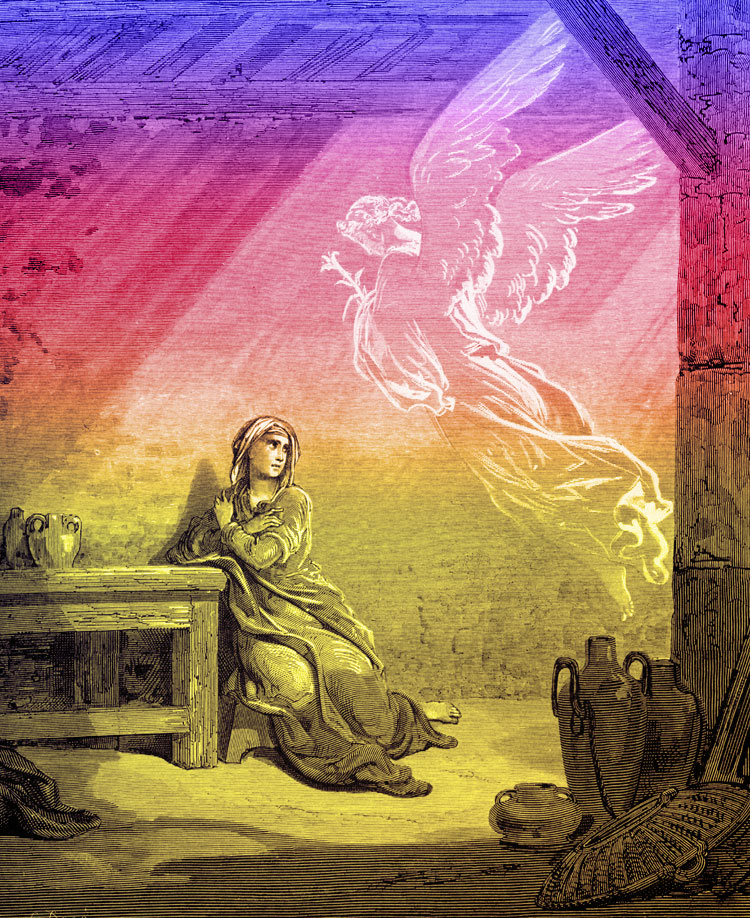
Luke-Chapter-1-The-Annunciation-to-Mary

Greetings, favored one! The Lord is with you.

In the sixth month, that is to say in the sixth month of Elizabeth’s pregnancy (from the scripture last week), the angel Gabriel was sent to another Israelite. Just as he had come to bring good news to Zechariah, Gabriel was now on a mission to find a young woman. And so it came to pass that Gabriel was sent by God to a town in Galilee called Nazareth, to a virgin engaged to a man whose name was Joseph, of the house of David. The virgin’s name was Mary.

This is a new episode in the gospel of Christ according to Luke, yet it is very clear how closely this story parallels the story of Zechariah in the Temple. Both interactions with the divine messenger are stories of God’s grace and power. Grace in that what is soon to take place will illumine God’s favor toward the world, and power in that God can work through the unable — an old childless couple, and an unmarried virgin. Both Elizabeth and Mary will become mothers because God is able, and they will have sons for our sake because God is righteous and gracious.

Gabriel said to her, “Greetings, favored one! The Lord is with you.” But Mary was much perplexed by his words and pondered what sort of greeting this might be. And the angel continued, “Do not be afraid, Mary, for you have found favor with God.”

Do you remember the story from last week? Do you remember how Zechariah was struck with fear when confronted by the angel in the most obvious of places, the innermost holy place of the Temple? Do you remember how his unbelief regarding the good news from Gabriel resulted in his becoming mute until the birth of John the baptist?

archangel-gabriel-struck-zechariah-mute-1824

Instead of a priest, one who should have been most familiar with the ways of God in the world and the stories from the past, Gabriel appears to a young unmarried virgin named Mary who does not respond in the same way.

Zechariah was overwhelmed with doubt and fear whereas Mary responded with awe and perplexity. Zechariah wanted to see a sign, wanted proof of the tidings brought by the angel, wanted to have his unbelief changed. Mary responds with curiosity. The messages from God speak into one’s insufficiencies, and brings good news of heavenly grace that must be trusted before its ways are known. There is great power in this story between the way Zechariah reacted, and the way Mary responded.

“And now Mary, you will conceive in your womb and bear a son, and you will name him Jesus. He will be great, and will be called the Son of the Most High, and the Lord God will give to him the throne of his ancestor David. He will reign over the house of Jacob forever, and of his kingdom there will be no end.”

This is good news. This is the kind of message that everyone had been waiting for. A new gift from God was going to come into the world through a young woman to be called the Son of the Most High. A new gracious leader is coming to take back the throne of David. The kingdom that God had always wanted for us is coming! And nothing will be able to stop God in all his majesty because this new kingdom will have no end!

“How can this be, since I am still a virgin?” Mary wondered. There is a difference here between doubt and curiosity. She believes the words from Gabriel, she understands that she will be bringing a child into the world. She is already preparing herself for God’s will in her life, but her curiosity regarding the fundamentals of God’s purposes come forth.

“The Holy Spirit will come upon you, and the power from the Most High will overshadow you; therefore the child to be born will be holy; he will be called Son of God. And even now, your relative Elizabeth in her old age has also conceived a son; and this is the sixth month for her who was said to be barren. For nothing will be impossible with God!

9

After explaining the elements of her coming conception, Gabriel ends his description with a final word of assurance. Gabriel recalls for Mary, and all of us, the creed behind all creeds, the very words spoken to Abraham and Sarah when they doubted the word that they were going to have a child in their old age: For with God nothing will be impossible.

And with perfect clarity, with willing submissiveness to God’s plans in the world, and with hope and joy, Mary responds to the calling of God: Here am I, the servant of the Lord; let it be with me according to your word. And then Gabriel departed from her.

How many times have you heard this story? Even for the so-called “unchurched” most people have heard, even just a sampling, of this story. The amount of art, Christmas decorations, and portrayals of Mary’s meeting with Gabriel are far and wide. This story is the source of great hope, frightening church schisms, and definitive reality shifts. Just as the prophet Isaiah told the Israelites, “Behold a virgin shall conceive a son and he will be called Immanuel,” the virgin Mary was met in the middle of the night by an angel to discover that she was to be the vessel of the Lord.

However, like the story of Zechariah in the temple, Mary’s midnight meeting has been told so many times that it is often difficult to discover something new and fresh when we approach the story. This week as I made my way through the first chapters of Luke, engaged in numerous conversations, and pondered over the heart of Advent, I began to wonder: Why Mary?

Why Mary? If God wanted to come into the world in a big way, with pomp and circumstance; If God wanted to come in the form of flesh to dwell among us as a king with power, he certainly could’ve picked a better mother. Why on earth did he choose her?

I’ve always had a hard time understanding what it is about Mary that made her highly favored in the eyes of the Lord. Remember Gabriel’s first words: “Greetings, favored one!” Really? How could she possibly be favored? Immediately following this episode she would presently go on a long and difficult journey to small town, not because she wanted to, but because the foreign rulers of her homeland forced her to go. She would be ridiculed, and judged, and even threatened for carrying a child conceived outside of normal circumstances, particularly before being married. She would give birth to this “son of the Most High” in one of the lowliest places, a stable. And after Bethlehem? Long years of obscurity and poverty with the world continually churning with its disapproval of the Jews, with the power from on high weighing down the life of the people. Her baby from Bethlehem would go on to become one of the most hated men in all of Israel and his life would increase in danger until the very end. The humble, marginalized, poor, and weak loved him, while the powerful and wealthy regarded him with hatred. Mary’s baby boy would be murdered on a cross, betrayed by the very people he came to serve. She would come to cradle her lifeless son’s body in her arms just as she did that first night in the manger. That was the favor of God?

Why Mary? Why an unwed, impoverished, and teenage girl?

Throughout the gospels Mary is portrayed as thoughtful, obedient, believing, worshipful and devoted to Jewish law. To us, and to all who knew her, she is the ideal Christian. However, none of these qualities are offered as reasons for God choosing her, God’s reasoning is tucked away from our view. We can guess, and we can come to our own conclusions, but the truth of God’s choice is known only to God in his eternal plan.

If Mary had wanted a perfect life on unbroken happiness, ease and pleasure in all things, then she certainly didn’t get it. If she had tried to measure up the favor of the Lord by the expectations of the world, then it would seem that the promise and salutation of the angel was only an illusion.

But the truth, and I mean real truth, is always deeper than it appears on the surface. 

The world would tell us, that God’s favor is to be found in ease, pleasure, and prosperity. God’s favor can be seen in a Christmas tree covered in perfect ornamentation with a plethora or present piled underneath. How many televangelists and “christian” writers make their millions and claim that God’s favor is with them, that God wanted them to be wealthy and powerful? Their messages always contain some sort of theologically problematic promise: If only you pray more, if you only read your bible more, if you only put more money in the offering plate, then God will make you healthy, happy, holy, and wealthy.

That is not the gospel.

It is a terrifying paradox, but, it is the lives which have been given something great to do and to bear, even though they may have been bruised and battered in the process, which have truly known the favor of God.

If God had wanted our discipleship to be easy then he would not have come into the world through the difficult situation of an unwed virgin. If God had wanted our faith to be easy then we would have no need for church, repentance, and forgiveness.

With Mary, and frankly with every single one of us, it comes down to obedience. Purely and humbly Mary put herself into the hands of God. She sacrificed so that God’s will could be done in the world. “Let it be with me according to your word.”

As the story continues, Mary meets with her relative Elizabeth, and when John leapt in his mother’s womb while in the presence of Jesus in Mary’s, she responds by praising God. She praises God even though the child in her womb will certainly make her life more difficult. And when we read the Magnificat it seems like Mary is continuing to praise God for the wrong reasons. Rather than celebrating God’s gifts to the proud, the powerful, and the rich, she offers joy that God has turned such values upside down.

I believe that we, myself included, are so often caught up with what the world defines as greatness, what the world defines as favor, that we lose sight of God’s kingdom right in front of us. We would all do well to join in with Mary’s song and magnify the Lord who lifts up the lowly and vulnerable in love. We would do well to open our eyes and ears to what God is doing in the world, what God wants to do through us, and respond with a resonating, “Here I am, let it be with me according to your word.

So, how is it with your soul? Where have you felt God tugging you in your life? Is there a pull or a nudge that has happened, perhaps you don’t know why, but you know that something is there? Have you seen a place in your life that you want to change but you’re unsure of whether or not you really can? Is God calling you to do something in your life and you, like Mary, are perplexed at how it would even be possible?

My guess is, we all have something. Whether large or small, grand or simple, God is always calling us to something new. To fix a broken relationship, to reach out to those marginalized in our own community, to shine a great light when it feels like the darkness is taking over.

As we prepare to make our way to Christ’s table let us all remember that with God nothing is impossible. An old childless couple can be given new life, a virgin can bear a child who came to save us, we can all be forgiven for the wrongs we have committed, death can be defeated, life after life after death is available through the grace of God, lives can be transformed, love can be discovered, and faith can be rekindled. Nothing will be impossible with God.

Amen.


Greatness – Sermon on Luke 1.5-23

Luke 1.5-23

In the days of King Herod of Judea, there was a priest named Zechariah, who belonged to the priestly order off Abijah. His wife was a descendant of Aaron, and her name was Elizabeth. Both of them were righteous before God, living blamelessly according to all the commandments and regulations of the Lord. But they had no children, because Elizabeth was barren, and both were getting on in years. Once when he was serving as priest before God and his section was on duty, he was chosen by lot, according to the custom of the priesthood, to enter the sanctuary of the Lord and offer incense. Now at the time of the incense offering, the whole assembly of the people was praying outside. Then there appeared to him an angel of the Lord, standing at the right side of the altar of incense. When Zechariah saw him, he was terrified; and fear overwhelmed him. But the angel said to him, “Do not be afraid, Zechariah, for your prayer has been heard. Your wife Elizabeth will bear you a son, and you will name him John. You will have joy and gladness, and many will rejoice at his birth, for he will be great in the sight of the Lord. He must never drink wine or strong drink; even before his birth he will be filled with the Holy Spirit. He will turn many of the people of Israel to the Lord their God. With the spirit and power of Elijah he will go before him, to turn their hearts of parents to their children, and the disobedient to the wisdom of the righteous, to make ready a people prepared for the Lord.” Zechariah said to the angel, “How will I know that this is so? For I am an old man, and my wife is getting on in years.” The angel replied, “I am Gabriel. I stand in the presence of God, and I have been sent to speak to you and to bring you this good news. But now, because you did not believe my words, which will be fulfilled in their time, you will become mute, unable to speak, until the day these things occur.” Meanwhile the people were waiting for Zechariah, and wondered at his delay in the sanctuary. When he did come out, he could not speak to them, and they realized that he had seen a vision in the sanctuary. He kept motioning to them and remained unable to speak. When his time of service was ended, he went to his home.


“Do not be afraid, Zechariah, for you prayer has been heard.”

archangel-gabriel-struck-zechariah-mute-1824

And so it came to pass in the days when King Herod ruled Judea, that a priest named Zechariah had his life turned upside down. Now Herod was a terrible king, responsible for countless atrocities, murders, and high levels of corruption. A man with frightening power ruled over a land and a people with such chaos that he dominated the attention of the masses. During his rule, a nobody priest married to a woman named Elizabeth, made his way through life.

Zechariah belonged to the priestly order of Abijah and was regularly responsible for activities around the Temple in Jerusalem. Though Zechariah and Elizabeth lived righteous lives, they had no children and were getting on in years.

One day, a day like any other, Zechariah made his way to the temple in order to perform his regular duties. As was the custom, lots were cast to decide who would enter the sanctuary and offer incense to the Most High God. While countless people gathered outside the walls, Zechariah made his way in to perform a simple task that had been done for as long as he could remember.

This is where the story gets interesting.

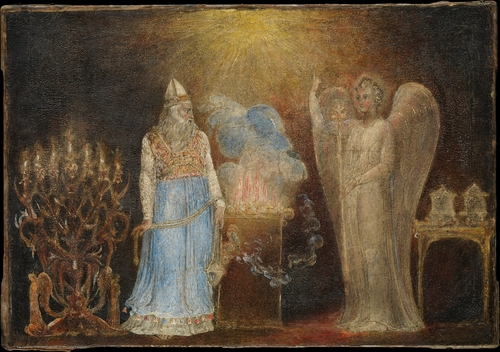
1-blake-z-and-angel

While standing within the closed room, an angel of the Lord appeared to Zechariah. We receive no description of this heavenly messenger in the biblical narrative, but the sight was enough to overwhelm and terrify Zechariah. Let your imaginations conjure up the confrontation with an angel to the degree that you would cower in fear and trembling.

Do not be afraid, Zechariah, for your prayers have been heard. Your wife Elizabeth will bear you a son, and you will name him John. You will be filled with joy and gladness and many will rejoice at his birth, for he will be great in the sight of the Lord. Take care to make sure that he never drinks wine or other strong substances, even before his birth he will be filled with the Holy Spirit. In time, he will turn the people of Israel back to the Lord their God. He will make ready a people prepared for the Lord.

And how does Zechariah react to this momentous declaration? How does he respond to the heavenly messenger carrying news of great joy?

“How will I know this is so? For I am an old man, and my wife is getting on in years.”

It’s moments like these in the scriptures that I wish I could jump into the story and smack some sense into the lives of the people experiencing the glory of God. How will you know this is so Zechariah? You fool! Don’t you know that with God all things are possible? Have you forgotten how he delivered your people from slavery and captivity in Egypt through the Red Sea to the Holy Land? Have you forgotten how the Lord provided a ram in the bushes for Abraham to sacrifice instead of his son? Have you forgotten how David was able to triumph over Goliath because the Lord was with him? Moreover, have you forgotten how many barren women the Lord has provided for? Sarah, Rebekah, Rachel, Hannah. Come on Zechariah, have a little faith. 

The angel responds to Zechariah: I am Gabriel and I stand in the presence of God. I was sent to bring you this good news, but now, because you did not believe my words, you will become mute and unable to speak until these things occur.

So Zechariah made his way out of the temple, stood before the crowds unable to speak, and eventually returned home.

Of course, thats not the end of the story, but we’ll save that for later.

What are we to make of this remarkable episode recorded at the beginning of the Gospel according to St. Luke?

God is at work here in ways familiar to us from the Old Testament: the story contains a casting of lots to make a decision, there is a vision in God’s holy Temple, a divine being appears to pass along a message, there is a promised sign, and a childless couple is given new life.

It is clear that God works in and through the normal avenues of life in the believing and faithful community. The community of faith can fall under the temptation to make God into whatever they desire for worship, but there is an important conviction present at the beginning of this New Testament: the stories of Israel are important, vital, and necessary for understanding how to be used for God’s purposes in the world.

Though this is a story from the past, doesn’t it sound familiar? Just as it is today, some horrible and frightening situation has gripped the people, a power reigns from above in order to control a community. Evil has taken root at the center of life and dominates the attention of the populace. This past week marked the one year anniversary of the shooting at Sandy Hook Elementary school and another shooting took place at a school in Colorado. You need only turn on the news or read a newspaper to be reminded how much fear and violence demands ALL of our attention.

However, in spite of all this fear and damage in the world, just as during the time of Herod, there is another sort of person, quiet, removed, and yet, more important than the powers that rule, men and women who are the core of society and give it the depth of its reality. Then and always there were and are the humble and brilliant men and women in whom the strength of the present and promise of the future lie.

Gabriel tells Zechariah that his son, John, will be great in the sight of the Lord. Sadly, according to the ways of the world, greatness has had its definition confused and reshaped. We have been told that greatness is measured in terms of selfishness rather than service, in terms of material rather than spiritual wealth, in terms of instant gratification rather than hard work and perseverance. But greatness as God sees it, the greatness that John will live into, is about being linked with the eternal purposes of redemption, about being an obedient instrument of God’s peace, and helping others to know and feel love in their lives.

But notice: the greater John will become for God, the more hostility he will arouse in those around him. Doing the will of the Lord, reaching out in love according to discipleship sends ripples through the fabric of what the world deems as “greatness.”

John is to be like the prophets from old: in light of their direct contact and experience of the divine, they drew the messages which burned within them like fire and would not rest until the decrees of God were delivered.

In every age we need the passion of people on fire for God to shout out in prophetic fervor. Our lives are so often filled with the dry wood of dull possibilities that desperately need to be rekindled by the divine spark that often comes through the words and actions of the prophets. We need to have our lives turned around and back to God in order to discover the passion that is waiting for us in our discipleship. The communion between God and the prophet allows for a divine condition to be present and the purposes of God can be realized in the world.

I love the juxtaposition of the story of Zechariah in the temple with Gabriel. It is precisely at the moment when John is being prepared to speak for God, Zechariah is struck mute for his unbelief. The typical, traditional, and tired voice of the priest, is being replaced by the fervent, fantastic, and faithful voice of the prophet.


Worship is at the center of the story. I’ve read it countless times, and heard it discussed and preached on during numerous advent services, but something fresh and new struck me this week about Zechariah’s encounter. I wondered: why was he so surprised and scared? Think about it for just a moment; Zechariah was a priest, well-versed in the stories from old about how God interacted with God’s people, a man who often found himself in the holiest of places performing the works of the Lord. What did he think would happen to him inside that holy space?

Being overwhelmed by the presence of an angel in the sanctuary of the temple is like going to McDonalds, ordering a Big Mac, and being surprised to discover beef between the bread… I mean this is how God works! God shows up, confronts us in the midst of a moment, and calls us to something. It does not need to be grand, and more often than not it occurs in the small silence in a moment we least suspect, but for Zechariah it came in a big way. He was in God’s holy temple confronted by an angelic messenger bringing the good news. So why was he so surprised? And more importantly, why did he doubt the validity of the message?

Our expectations about worship have major impacts on the way we live our lives.

What we believe shapes how we behave.

What to we think will happen to us when we gather in this space? Are we prepared to be confronted by the God who called John to greatness? Are we willing to let God dwell in our hearts and change the way we live in the world? Are we ready to take up our own crosses to follow Jesus. Are we prepared for God to show up in our lives in ways that we cannot expect or anticipate?

Unless we recognize the definitive need for real experiences and methods of discipleship which wake the whole depth of our experience, then what we do in worship will remain, as it did for Zechariah, thin and lacking. Until we prepare ourselves to be surprised by God’s desire to find us where we are, then this holy place will remain, as it did for Zechariah, boring and repetitive. Until we dare to step out into new forms of life and love, hearing the word of the Lord, and letting it become incarnate in the ways we live our lives, then faith will remain, as it did for Zechariah, dwindling and fruitless.

eucharist

What do we expect will happen when we gather together at Christ’s table? Are we repetitively entering the holy space to burn incense unaware that we are meeting God in all of his holiness? Or are we excited and nervous about the prospect of being welcomed to a table that we have no right to join? Are we so rooted in our habitual worship that we can no longer remember why we join at this table? Or are we prepared to be called forth toward greatness in the world through the redemptive and life-giving properties of God’s presence at his table?

Just as it happened with Zechariah, a heavenly voice might be trying to break out into the world. Perhaps God’s good news is striving to strike forth through the closed circle of our expectations of church, faith, and discipleship. Important for us this morning is to remember that God is always on the move, reaching out to find us and change our lives, that there is always a new message for those with ears to hear. The great need for us is to realize, as Zechariah eventually did, to not be caught up in the limited imagination of what God can do in the world which assumes that the present must always be governed by the past.

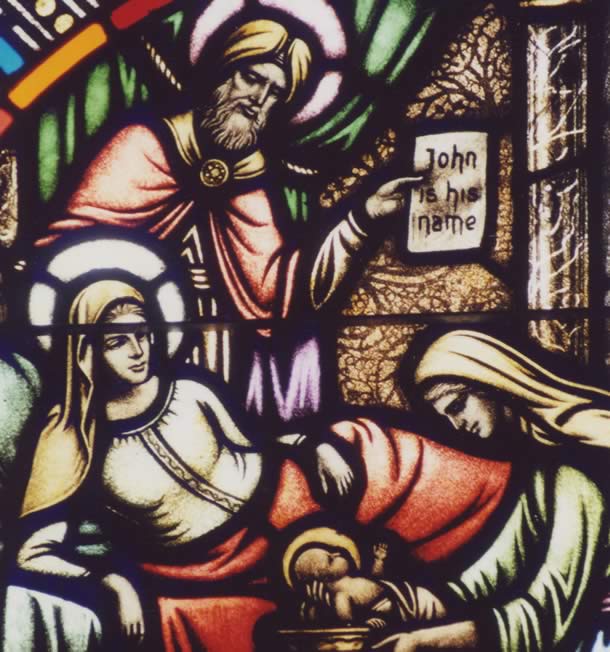
zech_eliz_john

Nine months after Zechariah was struck mute in the temple by Gabriel, his wife Elizabeth gave birth to a baby boy. When it came time to name the child, the family wanted to name him Zechariah after his father, but Elizabeth insisted that it was to be John, and after Zechariah confirmed this with writing on a tablet his mouth was freed. The plague of his disbelief had been wiped away by the miracle of his son’s birth. Now filled with the Holy Spirit Zechariah spoke these great words to his infant son: And you, child, will be called the prophet of the Most High; for you will go before the Lord to prepare his way, to give knowledge of salvation to his people by the forgiveness of their sins. By the tender mercy of our God, the dawn from on high will break upon us, to give light to those who sit in darkness and the shadow of death, to guide our feet into the way of peace.

This is one of the many places that God confronts us in our lives. Through the bread and the wine let us all be moved to live lives worthy of the greatness that God is calling us toward.

Amen.


God of the Living – Sermon on Luke 20.27-38

Luke 20.27-38

Some Sadducees, those who say there is no resurrection, came to him and asked him a question, “Teacher, Moses wrote for us that if a man’s brother dies, leaving a wife but no children, the man shall marry the widow and raise up children for his brother. Now there were seven brothers; the first married, and died childless; then the second and the third married her, and so in the same way all seven died childless. Finally the woman also died. In the resurrection, therefore, whose wife will the woman be? For the seven had married her.” Jesus said to them, “Those who belong to this age marry and are given in marriage; but those who are considered worthy of a place in that age and in the resurrection from the dead neither marry nor are given in marriage. Indeed they cannot die anymore, because they are like angels and are children of God, being children of the resurrection. And the fact that the dead are raised Moses himself showed, in the story about the bush, where he speaks of the Lord as the God of Abraham, the God of Isaac, and the God of Jacob. Now he is God not of the dead, but of the living; for to him all of them are alive.”


The Sadducees know exactly what they’re doing. They are not standing before Jesus truly desiring an answer to their question. They are not like the student whose paper is no longer decipherable because they have used their entire eraser while trying to answer a question. They are in Jesus’ presence for the purpose of embarrassment. Their aim is to argue, frustrate, and force Jesus into a particular way of thinking. The question that formed on their lips is not genuine. They are simply attempting to bait Jesus with one of their classic “what if” questions, a question on which their minds were settled long ago.

Haven’t all of us resorted to this kind of questioning at some point? The militarist asks the pacifist, “what if someone was attempting to rob you and your family, would you fight back?” or the child asks the mother, “what if the world ended tomorrow, would you really make me do my homework tonight?” or the skeptic asks the believer, “what if there is no God, would you still pray?”

“So, Jesus, Moses wrote for us about how to handle a situation if a married man dies without producing children. The wife is to remarry one of her brothers-in-law in order to have a child. But, what if this happened, and a woman remarried 7 brothers and never had any children with them, who would she be married to in the resurrection?”

resurrection


I knew a man who had a wonderful family life. He was a pastor, occasionally moved throughout his conference, but he had established roots in certain parts of the state. He enjoyed his work, but he loved coming him to his wife and children every afternoon. It was when everything seemed perfect that tragedy struck; his wife was killed in a car accident. In the wake of her death, the children were old enough to take care of themselves and when the pastor returned to work he no longer had the energy to serve the local church and so he retired. It was not for a lack of conviction or faith, but the loss of his wife struck him so deeply that he felt it would be irresponsible to try and serve others.

Time passed. The wound from his wife’s death remained open. He mourned. But after awhile he started to find a different rhythm in this new time of his life. The seasons passed and even though he still missed her, he was taking steps toward finding joy again.

He met his second wife later in life through mutual friends. It was clear that they had a connection but neither realized how deeply they cared for one another. When they married it was a joyous celebration and they spent the following decade together.

I got to know the husband and wife in their later years, visiting with them, hearing their story, and breaking bread together. They were meant for each other, and I don’t just mean finishing each others sentences kind of thing. They were adorable in their connection, in their refusal to be separated, and in their faithfulness when the former pastor developed a brain tumor.

I was unable to attend the funeral but I received a phone call from the new widow that evening. Through the abundant tears landing on the telephone I was barely able to make out her words but I could tell that something was worse than the emotions that come with attending the funeral service for your spouse. “I just don’t know what to think, Taylor,” she said while sobbing, “Today, during the service, my step-daughter, my husband’s daughter from his first marriage, delivered part of the eulogy. She stood before that crowded church and lamented the loss of her Daddy. But before she finished, she looked up in the air and said, ‘I’m so happy that Dad is back together with Mom now.”

I was silent.

“What does that mean about me?” she continued. “What will happen when I die? Will he be waiting for me?”

How could anyone speak into that situation? What could you say to help fill the void that her husband left, while remaining faithful to the God who has faith in us.

For a few moments I waited silently on the phone unsure of what to say. But then I remembered that Jesus had been asked a similar question…


Jesus was asked a question that would’ve typically elicited a pastoral response. After all, this story comes toward the end of Luke’s gospel; Jesus has already traveled all over Galilee proclaiming the Good News, healing the sick, feeding the hungry, and pastorally caring for his flock everywhere that he traveled. His answer to the Sadducee’s question is important and vital to our lives not only as Christians but also to all people who reflect on life and death.

Jesus begins his response to the Sadducees’ loaded question rather directly: “People who belong to this age marry and are given in marriage, but to those who are considered worthy of a place in that age and in the resurrection from the dead neither marry not are given in marriage. Indeed they cannot die because they are like angels and are children of God being children of the resurrection.”

In this first part of his response Jesus pointed out the inappropriateness of their question. There is a difference between this age, and the age to come. In this present age the reality of death makes marriage and the perpetuation of life essential. In order to continue the cycle of life, new lives need to be brought into the world. However, in the age to come, in the resurrection, death will be no more, death will die, and those who are blessed enough to attain the resurrection will be as children of God. There is no marriage in the resurrection because it is no longer needed, God’s purposes for life after life after death will be so glorious and inexplicably remarkable that marriage will be no more. 

heaven

There is a difference here between what we commonly imagine about heaven and life after death regarding the immortality of the soul and the resurrection. Many would have us believe that to be Christian means that we have immortal souls, but there is an important distinction between immortality and resurrection. Immortality is based on a doctrine of human nature that denies death; resurrection is based on a doctrine of God which says that even though we die, God gives life to the dead.

In the second part of his response Jesus relies on the teaching of Moses to help undermine the question from the Sadducees. The Sadducees believed that a teaching, belief, practice, or habit was not authentic unless it could be found in the Pentateuch, the first five books of the Bible, the so-called “Mosaic Law.” They would search through those books and unless it was there, it was not relevant or viable for their faith. So Jesus draws on the teaching of Moses, particularly the incident of the burning bush, to further defend his answer.

Do you remember the story? Moses, a shepherd for his father-in-law Jethro is out in the wilderness tending the flock. In the midst of his work he is confronted by a bush that is burning, but the flames refuse to consume the bush. In this interplay between human and the divine Moses is commissioned by God to deliver God’s people, the Israelites, out of slavery in Egypt to the Promised Land. Reluctant to undertake such a task, Moses questions, “Who am I to say sent me?” And God responded, “Tell them I AM sent you, I am the God of Abraham, of Isaac, and of Jacob.”

So when Jesus responds to the Sadducees he remembers this story for them. God is not a God of the dead, but of the living. What we do in the here and now is important, and God will take care of us when our time comes. You may think of Abraham, Isaac, Jacob, and Moses as being dead, but God is their God, they are alive through him.

The Sadducees, in their strict conformity to their theological persuasion were unable to comprehend that standing before them was God in the flesh, that Jesus himself was the Word, the new law, and the new covenant. He not only brought a new teaching, but he himself was the new teaching.

Just as during the time of Jesus’ interaction with the Pharisees, there has been confusion over the implications of the resurrection throughout the history of the church. Resurrection has often been understood in one of two ways: Experientially or Eschatologically.  (bear with me here)

An experiential resurrection would allow for all of us here to achieve a newness in our lives in the here and now on earth; “we have been raised to new life in Jesus Christ.” An eschatological resurrection would mean that God will give life to our bodies after we die to live and reign in the new heaven and the new earth; “Behold I am making all things new.”

What is important for us, what Christ conveyed to that crowd of doubters, is that both of these resurrections contain truth. There is a beauty in the experiential resurrection that we discover when we find ourselves caught up in the mission of God and there is an indescribable fulfillment in the eschatological resurrection that will come when God makes all things new.

Last-Judgment-(Fra-Angelico)-774816


So I stood there silent on the other end of the phone while the new widow cried out of frustration and fear. “What does that mean about me?” she pleaded “What will happen when I die?”

I took a deep breath before speaking into her reality.

“I don’t know whether or not this will bring you peace right now, but a long time ago somebody asked Jesus a really similar question about marriage in the resurrection. I can never tell you for sure what will happen, but I can tell you what Jesus says. In the next life, in the resurrection, there will be no marriage. God will wrap us up in such a way that marriage will no longer be necessary to convey the deep sense of love and connection that it does in this realm. Your husband will not be married to anyone but we will all belong to one another. I know that right now this probably isn’t the most helpful or pastoral response, but isn’t there something beautiful about the fact that when we go on to greater glory we will all be equal before everyone?”


The way Jesus confronted the question of the Sadducees is so relevant for us today as people of grace who contemplate both life and death. What will happen to us in the resurrection? Who will be belong to? Many of these questions trouble us because we are so desperately clinging to the material world here and now. In our families, marriage, and relationships we find fulfillment and purpose. If we lose someone that we root our identity in, what happens in the age to come?

God will take care of us. God will lead us through the loss of our loved ones and hold them within his warm embrace until that time that all the saints will be reunited; not as brothers, sisters, husbands, wives, but as children of God. 

Jesus’ response to the Sadducees is the way that God responds to our questions – not with answers which flatter us, or make the world simpler than it really is, but with his life given for us, that we might more fully give our lives to him.

As we prepare to go forth into the world remember that God is with you in the mundane and in the radiant. God is with you in life and in death, in marriage and divorce, in fear and joy. God is with us in all things here now and forevermore; he is not a God of the dead but a God of the living.

Amen.


Then and Now – Sermon on Ephesians 1.11-23

Ephesians 1.11-23

In Christ we have also obtained an inheritance, having been destined according to the purpose of him who accomplishes all things according to his counsel and will, so that we, who were the first to set our hope on Christ, might live for the praise of his glory. In him you also, when you had heard the word of truth, the gospel of your salvation, and had believed in him, were marked with the seal of the promised Holy Spirit; this is the pledge of our inheritance toward redemption as God’s own people, to the praise of his glory. I have heard of your faith in the Lord Jesus and your love toward all the saints, and for this reason I do not cease to give thanks for you as I remember you in my prayers. I pray that the God of our Lord Jesus Christ, the Father of glory, may give you a spirit of wisdom and revelation as you come to know him, so that, with the eyes of your heart enlightened, you may know what is the hope to which he has called you, what are the riches of his glorious inheritance among the saints, and what is the immeasurable greatness of his power for us who believe, according to the working of his great power. God put his power to work in Christ when he raised him from the dead and seated him at his right hand in the heavenly places, far above all rule and authority and power and dominion, and above every name that is named, not only in this age but also in the age to come. And he has put all things under his feet and has made him the head over all things for the church, which is his body, the fullness of him who fills all in all.

allsaintsday

Today is All Saints’ Sunday, a particular fixture in the Christian liturgical calendar, often celebrated the first Sunday of every November. All Saints is a time and opportunity to name the death of our saints over the last year. And for us, as United Methodist in particular, “saints” refers to all Christians past and present, so we celebrate the church universal as well as those we have lost. Today is a day about remembrance and honor.

Paul writes to the church in Ephesus, “In Christ we have also obtained an inheritance, having been destined according to the purpose of him who accomplishes all things according to his counsel and will, so that we, who were the first to set our hope on Christ, might live for the praise of his glory.” What is this inheritance that he is referring to?

Bob Foley. Bob Foley was a long time usher at the church where I grew up. As a kid I can remember Bob handing me some of the children’s bulletins that I doodled over throughout the church services, and I can remember him patiently waiting on Christmas Eve’s services with candles in his hands. The first time I ever talked to Bob was when I was fourteen, the first Sunday that I ever ran the sound-system for our services. Bob fulfilled his usher obligations, handing out bulletins, helping new visitors and families find a pew, when he finally stood behind me looking over my shoulder. Now imagine with me if you will, a fourteen year old standing in front of a mixing board with hundreds of knobs, lights, and volume controls, at a church with a large sanctuary with hundreds of people prepared for worship. So with fear and trepidation defining my inner struggles Bob leaned forward and whispered in my ear, “good luck.”

soundboard01_big

I’m sure I messed something up that morning, perhaps I forgot to turn off our minister’s microphone so everyone wound up hearing him horribly attempt to keep the tune to “Be Thou My Vision,” or I turned the volume too high and there was feedback in the sanctuary, or no one heard the prayer over the Tithes and Offerings because I forgot to turn the microphone back on. I’m sure I messed up, but Bob walked over to me after the service ended, shook my hand, told me to call him Bob, and smiled while telling me how proud he was.

Thus started an incredible friendship that played itself out every Sunday morning as Bob and I would joke around in the back. He was old enough to be my grandfather but he never treated me like a child; he was encouraging, and respectful, but above all he was a happy man. Whereas many people would drag themselves into church on Sunday mornings, wiping away the sleep from under the eyes and trying to find a trash can for their coffee they had just chugged, Bob was always standing by the door with a smile because he genuinely cared about the church, he loved being there, and he loved God.

When Bob passed away it crushed me. I’ll never forget the feeling in the pit of my stomach when my mother called me during college to let me know what had happened, and I’ll never forget the awful feeling of walking back into the church for the first time without having Bob there with his customary smile.

Paul talks about an inheritance from Christ, something we receive through his mighty acts in the world. There is something special about getting to share the stories of the bible with someone, young or old, to talk about what God did with God’s people, but there is something indescribable about the way God is working in the world right now.

Bob Foley was a saint in my life. But what Bob offered for me and my Christian life was more than the typical church friendship. Bob never sat me down with scripture or told me how to live my life. He never criticized my decisions or offered unwarranted advice. What Bob did for me, was demonstrate how important faith is in the now. He might’ve loved to hear those old stories from scripture, but Bob felt God living in the world in the immediate, thats why he committed to being in church and sharing his smiles with everyone else; to him there was nothing better than being a Christian because he felt God’s presence.

When we read from Paul’s letter to the Ephesians, its as if he’s saying “It is such a great thing to be a Christian!” But, I wonder if that is the first thought that comes to our minds when we think about our Christian heritage today. May it be that the joy and excitement of the gospel has grown stale for many of us? Is living out our Christianity filled with images of too many commitments and disappointments? Have we grown complacent with what it means to be the church in the world? Perhaps a lot of us here are like the elder brother from Christ’s great parable, we see our wayward younger brother return home for a celebration and we are envious. Maybe we hear the words from our Father saying, “You are always with me, and all that I have is yours,” but the thrill and glory of these words have seemed to vanish.

Why are we here? Why did we wake up this Sunday morning and come to church? What brought us, what drove us to ever join together in the first place?

All of us are here because someone loved us enough to bring us, to invite us, to nurture us. Who was that person for you? Who was that saint in your life?

Paul writes about a “love toward all the saints” present in the community in Ephesus. That same love may, in fact, be half-present today in our lives through the casual “hello” at the Food Lion, in the wave as a car drives by in the neighborhood, and in the church fellowship activities in which we participate. But there is a temptation to take all of these things for granted, to live into them everyday, and never value them for what they really are.

I’m not proud to admit that I never realized how important Bob Foley was to my life until after he died. It was only in his absence that I began to appreciate the joy that he taught me every Sunday morning. I took my relationship with Bob for granted and I wish that I had lived into our friendship more while he was still here with us.

Like our relationship, it has taken me some time to discover what made Bob’s faith so worthy of emulation. I have wondered what it was that made him excited about the church, when so many others arrived more out of obligation than expectation.

Have you ever noticed that Paul almost never writes about the actual life of Jesus in his letters? Do you find it interesting that as a leader for the blossoming church in the first century, Paul rarely referenced the exciting life of Jesus Christ? He paid little attention to the Sermon on the Mount, the parables, the miracle stories, or other moving elements from the gospels. It seems, therefore, for the first Christians, what was most important was not what had happened in the past, but how Christ was living in and through them in the present. They most certainly remembered the words and actions of Christ in their worship, but their Christianity was exciting because Christ was still moving in their world.

Paul wrote to the church, “I pray that the God of our Lord Jesus Christ, the Father of glory, may give you a spirit of wisdom and revelation as you come to know him, so that, with the eyes of your heart enlightened, you may know what is the hope to which he has called you, what are the riches of his glorious inheritance among the saints, and what is the immeasurable greatness of his power for us who believe, according to the working of his great power.” The key word in this whole passage is “power.” When the first Christians appealed for conversion to the new faith they did not just talk about what had happened on a hill outside of Jerusalem in the year 33, but they witnessed to what Christ had done for them in their own lives.

Christ is a present power, rather than simply being an admired person from history, Christ transcends time and is with us in the present; that was the paramount miracle for the early church.

On this All Saint’s Day we are called to remember the saints of our lives, the Bob Foleys of the world, to be thankful for what they did for us, but to also live in the present. Be grateful for what they did, and live out our faith today. The saints and Christ are not just some historical influences in our lives but continually live and move through us in the ways that we continue to be faithful in the world.

Do you know God? I don’t mean some sort of dense theological knowledge, but real and tangible and simple. Do you know God in your life? We cannot have knowledge of a person until we see them in action and we shall not have faith in God until we trust and experience his divine love in the world.

There is a difference between the Word of God (Jesus Christ) and the word of God (scripture). Our knowledge of God in this community rests upon God’s Word as Jesus Christ. The Bible is not a textbook in the ordinary sense as a collection of facts that need to be checked and memorized but it is instead a story. In contains the majestic drama of God’s interaction with God’s people. The climax of the story is God’s coming down to dwell among us in the form of flesh, dying for us on a cross, rising again from the grave, returning to glory, and leaving behind a people of God endowed with knowledge of him.

When we remember the saints, when we gather together to read and proclaim scripture, it is important for us to remember God’s mighty acts in the world. However, what makes church and faith compelling, what moves us toward excitement, is God’s present power in the world! Today is the day that we can celebrate the lives that we have lost while also living into the exciting faith of what it means to be Christ’s body for the world.

Today we are called to remember those saints from our lives who shaped us into the people we are now. It is the time to remember disciples like Bob Foley who lived out his faith in his relationships with others, who felt the joy of Christ in his own life and in his own heart.

We remember those who have gone on with joy and with longing, for they are being held in the arms of our great Lord and we anticipate with joy the great reunion of all the saints of the church in God’s time.

Christians are not called to be motivated by the question: “what happens to me when I die?” but rather ”what am I doing with my life right now?” What we do in the here and now, how we live out our faith in the world, is what makes being the body of Christ an exciting and wonderful thing.

Jesus Christ is not a man of the past, a person to be remembered and recorded in history. Christ is alive! Christ is with us here and now in the gifts of bread and wine. Christ continues to live and breathe and change the world because we partake of him when we gather at his table.

If you are looking to find Christ in your life, if you want your faith to move from remembrance to lived reality, and if you want to find a joy worthy of celebration, then come. Come to Christ’s table and discover the inheritance that will change your life forever.

Amen.

Communion

Weekly Devotional – 10/28/2013

Devotional:

Luke 6.27-31

“But I say to you that listen, Love your enemies, do good to those who abuse you. If anyone strikes you on the cheek, offer the other also; and from anyone who takes away your coat do not withhold even your shirt. Give to everyone who begs from you; and if anyone takes away your goods, do not ask for them again. Do to others as you would have them do to you.”

images

I have a friend in ministry who once had this passage play itself out in his life in an interesting way. Though an ordained methodist, Jason experimented one Lenten season with wearing a clergy collar out in public. He was surprised to note how many people eyed him suspiciously at the local Starbucks and many strangers were willing to talk to him about their trials and tribulations in public locations. One week, while working on a sermon at a Barnes & Noble, Jason noticed a homeless man sleeping uncomfortably in one of the seats. It was clear that the man had not bathed in some time as many of the other patrons left a quarantine zone of empty seats between themselves and the man. Like many of us, Jason was used to seeing people in need and knew that somebody else could help this man. However, the more he attempted to work on his sermon, the more he realized that most of the people in the mini restaurant were staring at him, waiting for him to do something. Remember: he was wearing a clergy collar, everyone knew he was a Christian. So Jason reluctantly made his way to the counter, purchased a sandwich, and dropped in on the table in front of the homeless man. “Gracias” muttered the man under his pile of clothes while preparing to begin eating. “What’s your name?” Jason asked. “Jesus” the man replied.

Upon later reflection Jason wondered whether or not he would have given that man food if it were not for the fact that he marked himself as a Christian and therefore strangers had expectations of what he should do in the situation.


Jesus regularly challenged his disciples to change their lives in strange and uncomfortable ways. It is not easy to live into a new reality where we are called not to react to everything but instead continually act according to the kingdom principles of love, forgiveness, and generosity.


So, the next time you’re out in public and you see someone in need, or you’re being ridiculed by someone at work, know that following Christ’s commands are not always easy. But think about how you would act differently if everyone around you knew that you were a Christian and had expectations of you according to that identity. How would you act differently?

The answer to that question is what discipleship is all about.


(You can find out more about Jason and his ministry at www.tamedcynic.org)