Holy Fertilizer

Luke 13.1-9

At that very time there were some present who told him about the Galileans whose blood Pilate had mingled with their sacrifices. He asked them, “Do you think that because these Galileans suffered in this way they were worse sinners than all other Galileans? No, I tell you; but unless you repent, you will all perish as they did. Or those eighteen who were killed when the tower of Siloam fell on them – do you think that they were worse offenders than all the others living in Jerusalem? No, I tell you; but unless you repent, you will all perish just as they did.” Then he told this parable: “A man had a fig tree planted in his vineyard; and he came looking for fruit on it and found none. So he said to the gardener, ‘See here! For three years I have come looking for fruit on this fig tree, and still I find none. Cut it down! Why should it be wasting the soil?’ He replied, ‘Sir, let it alone for one more year, until I dig around it and put manure on it. If it bears fruit next year, well and good; but if not, you can cut it down.’”

Interior coffee shop: early morning.

Rain falls steadily against a window.

An assortment of customers in various states of caffeination are spread out among the tables and chairs.

A preacher sits alone in the corner. Computer and Bible are on the table, a subpar sermon is coming along splendidly.

He tries to focus on the matter at hand, but he can’t help but overhear a conversation from a nearby table. 

“Can you believe he cheated on her?”

“Oh honey, that’s not the half of it. I heard he’s been living two lives between two houses with two different families.”

The preacher knows better than to eavesdrop, so he goes back to the flashing cursor on his computer. He’s able to jot a few ideas down, none of which will actually make it into the sermon. When, a few minutes later, he catches bits of different conversation at a different table.

“You know, the Ukrainians, they’re getting what they deserve. They elected that Zelensky and his liberal agenda. I think we would do well to have a leader like Putin here, someone tough who isn’t going to let anything get in his way.”

The preacher closes his computer and decides to leave before he overhears even more sinners talking about other sinners and their sin.

There are times when I like to think that we’ve come a long way since the time of our Lord, that we’ve progressed from some of our wandering recklessness.

And then I am reminded that, all things considered, not much has changed.

Do you think those Galileans suffered because they were worse sinners than other Galileans? No, I tell you; but unless you repent, you will die like them.

What a grace-filled and hopeful word from the Word!

Robert Farrar Capon wrote that good preachers, and I would say good Christians, should behave like bad kids. We ought to be mischievous enough to sneak in among dozing congregations and steal all their bottles of religion pills, and spirituality pills, and morality pills, and flush them all down the toilet.

Why? Because the church has drugged itself into believing that proper behavior is the ultimate pathway to God. We’re addicted to the certainty that, as bad as we might be, at least we’re not as bad as those other people over there.

There’s a reason reality TV is still such a favorite past time within and among the wider culture. We feel better about ourselves when we get to see other people behaving badly. It’s also why we’re quick to post photos of our perfect little families, even though they acted like animals while we were trying to get that perfect photo, so that everyone else will know, with certainty, that we have it all together.

But the sad truth is none of us know what we’re doing – some of us are better at pretending we know what we’re doing. But at the end of the day we’re all making it up along the way.

And yet, we can’t help ourselves from comparing ourselves to others in such a way that we are superior to their inferiority.

The crowds bring to Jesus their query; they want to know if people get punished for their sins – they want to know what it takes to be guilty.

And here’s the bottom line: if the God we worship punished us according to the sins we’ve already committed, the sins we’re currently committing, and even the sins we will commit in the future, then none of us would be around to worship in the first place.

Or, to put it another way: If every bad thing happens because God does it to punish us, then God isn’t worthy of our worship.

Over the centuries the church has been a place of guilt. Make em feel bad about their behavior, scare them about punishments in the hereafter, and they’ll show up in droves to hear about it all again next Sunday. And the same is true in our wider culture; we’re all keeping our little ledger books in our minds about who has done what to us.

But the strange new world of the Bible, the strange new world we talk about week after week, isn’t obsessed with guilt. No, if it’s obsessed with anything, it’s obsessed with forgiveness!

Christ died for us while we were yet sinners!

The Lamb of God has taken away the sins of the world!

What then, should we make of Jesus’ quip about repentance? “No, I tell you; but unless you repent you will die like them.”

Of course there should be repentance – a turning back, a return to the Lord. We’ve all wandered away from the Way. But repentance is supposed to be a joyful celebration, not a bargain chip we can cash in to get God to put up with us.

Repentance is a response to the goodness God has done, not a requirement to merit God’s goodness.

We can certainly feel guilty about our sins, and maybe we should. But feeling guilty about our sins doesn’t really do anything. In fact, the more we lob on guilt, the more likely we are to keep sinning because of our guilt.

The only thing we can ever really do about our sins, is admit them. It’s a great challenge to be able to see ourselves for who we really are, sinners in the hands of a loving God, and then take a courageous step in the direction of repentance. But if we ever muster up the gumption to do so, it will be because we live in the light of grace.

Grace works without requiring anything from us. No amount of self-help books, no number of piously repentant prayers, no perfect family, perfect job, perfect paycheck, perfect morality, perfect theology earns us anything.

Grace is not expensive. It’s not even cheap. It’s free.

And, according to the wondrous weirdness of the Lord, grace is like manure.

Or, perhaps we should call it holy fertilizer.

This is classic Jesus here. The crowds approach with their question and his answer to their question is a story, a parable.

A man has a vineyard and in the middle of the vineyard he planted a fig tree. But for three years it produced not a single fig. So one day the vineyard owner says to the gardener, “I can’t take it anymore. This fig tree is wasting my good soil. Cut it down.”

But the gardener looks at his employer and says, “Lord, let it be. Why not give it another year? I’ll spread some manure on it this afternoon and maybe next year it will have some fruit.”

Short and sweet as far as parables are concerned and yet, even in its simplicity there are a bunch of weird and notable details. 

For instance, why does the vineyard owner plant a fig trees among a bunch of grapes? Do you think he was trying to develop a new, and perhaps bizarre, variety of wine? Or maybe he was going to start the first Fig Newton distribution service in Jerusalem?

Strange. But perhaps nothing is stranger than the gardener. This gardener speaks in defense of a speechless fig tree.

And what does the gardener says, “Lord, let it alone for a year. Let me give it some manure.”

At least, that’s what it sort of says in our pew bibles.

But in Greek, the gardener says, “KYRIE, APHES AUTEN.”

Literally, “Lord, forgive it.”

Lord, forgive it!

These might be some of the most striking for from the strange new world of the Bible both because they proclaim the forgiveness of the Lord for not reason at all, and because they help us to see how little we can.

There’s a reason that, when we nail Jesus to the cross, he declares, “Lord, forgive them for they do not know what we are doing.”

Lent is the strange and blessed time to admit, we have no idea what we’re doing. That we are in need of all the grace and manure we can get.

The cross with this we adorn the sanctuary, in all of its ugliness, is a sign and testament to Jesus becoming sin for us – how Jesus goes outside the boundaries of respectability for us, how he is damned to the dump because of us, and how he ultimately becomes the manure of grace for us.

It’s wild that Jesus has the gall to tell this story at all, and that the divine gardener offers to spread some holy fertilizer on the fig tree, on us.

Only in the foolishness of God could something so nasty, so dirty, so grossly inappropriate, becomes the means by which we become precisely who we are meant to be. 

God’s grace gets dumped onto the fruitless fig trees of our lives and get co-mingled in the soil of our souls. It is messy and even bizarre, but without it we are nothing.

Jesus doesn’t give a flip whether we’ve got a fig on the tree or not. He only cares about forgiveness, a forgiveness we so desperately need because we have no idea what we’re doing. 

For, if we knew what we were doing, we would’ve solved all the world problems by now. But we haven’t.

We are fruitless fig trees standing alone in the middle of God’s vineyard. 

We are doing nothing, and we deserve nothing. 

And yet (!) Jesus looks at our barren limbs, all of our fruitless works, our sin sick souls, and he says the three words we deserve not at all: “Lord, forgive them.”

On Friday afternoon, the aforementioned Vladimir Putin addressed the people of Russia during a rally that was celebrating the 8th anniversary of the annexation of Crimea. While Russian forces attacked Kyiv and blockaded civilians in other parts of Ukraine, Putin assured his people that Russia was forced into this war into to get the Ukrainian people out of their misery.

And then he said, “And this is where the words from the scriptures come to mind, ‘There is no greater love than if someone gives his soul for his friends.’”

That a world leader used Jesus’ words to justify violence and bloodshed is not unusual. It’s been done again and again throughout the centuries. Even here in the US, it is a familiar refrain whenever violence is on the table. Presidents Trump, Obama, Bush, and Clinton each used the quote at one point or another during their years in office. 

But Jesus spoke those words before mounting the hard wood of the cross, not before going to war. Jesus laid down his life for his so-called friends who betrayed him, denied him, and abandoned him.

Jesus laid down his life for us.

And even with a crown of thorns adorning his head, and the cross over his shoulder, he still says, “Lord, forgive them.” Amen. 

The Good News(paper)

Luke 13.1

At that very time there were some present who told him about the Galileans whose blood Pilate had mingled with their sacrifices. 

“I appreciate what you’re trying to do preacher, but I don’t come to church to hear about what’s going on in the world. I come to church to hear about God.”

I received that comment after worship one Sunday many years ago and I will never forget it. I can’t remember what exactly I preached about that day, nor do I remember what hymns we were singing, but I remember that comment. 

It’s a notable one. On one hand, the admission that the church exists to proclaim who God  is and who we are in relation to God is remarkable and downright faithful. But on the other hand, the dismissal of the world in the church is a denial of the very reality of reality.

Preaching is never done in a vacuum. A time and a place are always present in a preacher’s work, but that does not mean that the preacher notices or recognizes where they are. Even preachers who try to do the work of preaching without acknowledging their time or place cannot help but reflect time and place in their work. We preachers are reflections of the world around us whether we like it or not. 

The theologian Karl Barth is known for noting that preachers should work with the Bible in one hand and the newspaper in the other. That surely sounds like good advice: what we experience helps us to understand the scriptures and the scriptures help us to understand our experiences. The only problem is the fact that the newspaper is just as likely to mislead us regarding our time and place. And that’s not even mentioning the question of which newspaper we should be reading. We, indeed, live in a strange new world, made clear to us by various headlines, but when it comes to the life of faith, the strange new world of the Bible is our world. 

An atrocity has taken place in the holy city, it’s the front page headline of the Jerusalem Times – Pilate Cuts Down Galileans In The Temple. We don’t know why they were killed, or even how they were killed, only that in their executions their blood was mixed with the sacrifices they brought to the Temple. 

You can imagine the commotion this caused among the faithful.

So much so that some in the crowd approached Jesus and demanded to know why such a thing took place among God’s chosen people: What had they done to deserve such an awful fate?

“Nothing,” Jesus says, “They were not greater sinners than any other Galileans.”

And then the Lord pulls out another headline, another catastrophe on the hearts and minds of the people. A tower had fallen in Jerusalem, in the neighborhood of Siloam, just south of the Temple. 18 people died in the incident. And Jesus says, “They were not greater sinners than others either.”

How pastoral.

The rain falls on the good and the bad alike, as do famines and other such things, Jesus says in another part of the Gospel. Which can sound like unmitigated bad news. And yet, it is strangely Good News. It is Good News because God is not keeping some great ledger book in the sky and then raining down blessings or curses accordingly. God is not a warden watching over the prisoners to see how well, or how poorly, we behave. 

If God punished us according to the choices we make, not one of us would be left around to make any choices at all. 

Instead, God arrives in the world in a totally fragile and vulnerable way so that even if a tower falls on our heads, or if our lives are taken by a dictatorial political emissary, or if we die peacefully in our sleep, that it will not be the end for us. 

What we believe shapes how we behave. The cross and empty tomb give us the freedom, here and now, to live bold and faithful lives for the Lord and for others because the most important thing in the history of the world has already taken place. No headlines, bad or good, can take us away from the Love that refuses to let us go.

So, sure, take the Bible in one hand and the newspaper in the other, but never forget that the former is far more determinative than the latter. 

The River Of Life

This week on the Strangely Warmed podcast I speak with Wayne Dickert about the readings for the Third Sunday of Lent [C] (Isaiah 55.1-9, Psalm 63.1-8, 1 Corinthians 10.1-13, Luke 13.1-9). Wayner is the pastor of Bryson City UMC in Bryson City, NC. Our conversation covers a range of topics including the Nantahala River, joy, well-digging, recreation for re-creation, praise, church meetings, the ministry of restoration, idolatry, divine challenges, and holy fertilizer. If you would like to listen to the episode or subscribe to the podcast you can do so here: The River of Life

Less Is More

This week on the Strangely Warmed podcast I speak with Chandler Ragland about the readings for the Second Sunday of Lent [C] (Genesis 15.1-12, 17-18, Psalm 27, Philippians 3.17-4.1, Luke 13.31-35). Chandler is the pastor of Black Mountain UMC in Black Mountain, NC. Our conversation covers a range of topics including strange new worlds, Encanto, covenants, righteousness, living in church, narrative preaching, memorizing scripture, waiting on the Lord, the Apostles’ Creed, Mississippi, and the status quo. If you would like to listen to the episode or subscribe to the podcast you can do so here: Less Is More

The Devil Is In The Details

Luke 4.1-13

Jesus, full of the Holy Spirit, returned from the Jordan and was led by the spirit in the wilderness, where for forty days he was tempted by the devil. He ate nothing at all during those days, and when they were over, he was famished. The devil said to him, “If you are the Son of God, command this stone to become a loaf of bread.” Jesus answered him, “It is written, ‘One does not live by bread alone.’” Then the devil led him up and showed him in an instant all the kingdoms of the world. And the devil said to him, “To you I will give their glory and all this authority; for it has been given over to me, and I give it to anyone I please. If you, then, will worship me, it will all be yours.” Jesus answered him, “It is written, ‘Worship the Lord your God, and serve only him.’” Then the devil took him to Jerusalem, and placed him on the pinnacle of the temple, saying to him, “If you are the Son of God, throw yourself down from here, for it is written, ‘He will command his angels concerning you, to protect you,’ and ‘On their hands they will bear you up, so that you will not dash your foot against a stone.’” Jesus answered him, “It is said, ‘Do not put the Lord your God to the test.’” When the devil had finished every test, he departed from him until an opportune time. 

It is a long standing tradition in the church to begin the forty days of Lent with Jesus’ forty days in the wilderness. We, in a sense, mirror the journey Jesus faced with our own attempts at wrestling with temptation while abstaining from certain items, behaviors, and practices. 

It’s not the easiest section of the church calendar.

The hymns are all a little too on the nose, the sermons call to question all of our wandering hearts, and even the scriptures reject our desire to look at anything but the cross.

We, then, can do lots of things as a church during this particular liturgical season, but at some point or another we will all raise the question we’ve had since the very beginning of the church: “Who, exactly, is this Jesus?”

It was just a few weeks ago that we were worshipping the baby born King in the manger, with little angels and shepherds wandering around the sanctuary. It’s easy to worship that Jesus because in infancy there isn’t much for us to come to grips with. We can confess the wonder of the incarnation, but we’re not entirely sure what that has to do with you or me.

But then, here in Lent, it’s like the Spirit wants to smack us over the head with the truth of the Truth incarnate.

And we start with Jesus’ temptations in the wilderness.

This vignette in the strange new world of the Bible tells us exactly who this Jesus is, and who he will be.

Oddly enough, it offers us a glimpse behind the curtain of the cosmos – it helps us see that the story of Christ will end just as it begins.

Jesus is baptized by his cousin John in the Jordan and then he is led by the spirit into the wilderness where for forty days he was tempted by the devil.

“Hey JC!” The devil begins, “If you are who you say you are, I’m gonna need to see some ID. No pockets in your robe? That’s fine. I’ll take your word for it, if you really are the Word. But, let me tell you, you look awful. I’m sure you’re hungry. Not a lot to eat out here in the wilderness. Why don’t you rustle up some bread from these stones. Who knows? That little parlor trick could come in handy down the road… what could be more holy than having mercy on the hungry and filling their bellies?”

And Jesus says, “It is written, we cannot and shall not live by bread alone.”

“So you know your scriptures!” The Devil says, “I’m impressed! And, frankly, I’m with you Son of Man. You can’t just give hungry people food for nothing. They’ll become dependent. No handouts in the Kingdom of God! But how about this? Would you like a little taste of power? And I mean, real power. Political power. Here’s the deal – I’ll give you the keys to the kingdoms here on earth, all of them. The only thing you have to do, and it’s really nothing when you think about it, I just need you to bow down and worship me.”

And Jesus says, “It is written, we shall only worship one God.”

“Okay, okay,” the Devil continues, “Don’t be such a buzzkill. So you won’t show compassion to the needy, even yourself, and you won’t go ahead and make the world a better place through political machinations. That’s fine with me. For what it’s worth, I can play the scripture game too, you know. So I’ll give you one more chance. Why don’t you leap from the top of the temple, give the people a sign of God’s power and might, for, doesn’t it say in the Psalms, ‘He will command his angels concerning you to guard you in all your ways. On their hands they will bear you up, so that you will not dash your foot against a stone.’ Just think about the kind of faith people will finally have if you show them one big miracle!”

And Jesus says, “It is written, you shall not put the Lord you God to the test.”

And then the devil leaves only to return at an opportune time.

That’s rather an ominous ending to a passage of scripture. But, no spoilers. Let stick with what we’ve got for now.

As I said at the beginning, we often use this story to give a little encouragement in resisting our own temptations. This is the time for someone like me to make a big pitch to people like you about whatever bad habit you need to drop. The time has come to shape up or ship out.

And, clearly, we’ve got plenty to work on. There are far too many people who fall asleep hungry at night, far too many children to have no bright hope for tomorrow, far too many communities that are falling prey to the devastating powers of loneliness. 

But, if that’s all this story is supposed to do, if it merely exists as a weapon to wield against sleepy and dozing congregations about being better, then Jesus certainly could’ve been a little clear about what we should or shouldn’t be going.

Put another way: If Jesus’ temptations are really about our temptations, then it would’ve been better for him to have more lines in this passage than the devil.

Scripture is always primarily about God and only secondarily about us.

But we are vain and selfish little creatures and we assume everything is always about us, and only ever about us.

Jesus’ temptations are exactly that – Jesus’ temptations. 

This isn’t a story about how we deal with our own temptations. It’s actually a story about how Jesus deals with the world – how Jesus deals with us.

Notice: the things the devil offers to the Lord, they’re all objectively good things – bread, political power, miracles

And yet, Jesus refused them. And he even used scripture to defend his refusals!

Perhaps if the devil offered Jesus an unending buffet at the golden corral, or the nuclear codes, or David Copperfield’s assortment of illusions, we could sympathize with Jesus’ dismissals. But the devil offered Jesus possibilities for transformation and Jesus said, “No, thank you.”

But here’s the real kicker, the truly wild part of this story: by the end of the Gospel Jesus will, in fact, do all of the things that the devil suggests.

Instead of turning some rocks into a nice loaf of sourdough, Jesus will feed the 5,000 with nothing more than a few slices of day old bread a handful of fresh fish.

Instead of getting caught up in all the political procedures to Make Jerusalem Great Again, Jesus reigns from the arms of the cross and eventually ascends to the right hand of the father as King of kings and Lord of lords.

Instead of pulling off a primetime Law Vegas magic special, Jesus dies, and refuses to stay dead.

For a long, long, time we’ve understood Jesus and the Devil to be figures on opposite ends of the spectrum – one good and the other bad. It even slips into out culture whenever you see a figure with an angel whispering in one ear and a red figure with a bifurcated tail whispering in the other.

And yet, at least according to this moment in scripture, the difference between the devil and Jesus isn’t the temptations themselves, but in the methods upon which those acts of power come to fruition.

And, though it might pain us to admit, the devil has some pretty decent suggestions for the Messiah – Why starve yourself Lord, when you can easily set a meal here in the wilderness? Why let these fools destroy themselves when I can give you control over everything and everyone? Why let the world continue in fear and doubt when you can prove your worth right now?

The devil, frighteningly, sounds a lot like, well, us. The devil’s ideas are some that we regularly discuss and champion.

What our community needs is another food pantry! What we need to do is make sure that we have Christians running for political offices! If only God would show us a miracle, then everyone would finally get in line and the world will finally be a better place.

But Jesus, for as much as Jesus is like us, Jesus is completely unlike us. For, in his non-answer answers he declares to the devil, and therefore to all of us, that power as we understand it doesn’t actually transform much of anything.

We can create a feeding program, but sooner or later we will introduce requirements for those who receive the food.

We can get Christians elected into the government, but at some point they will be more concerned with maintaining their power than pointing to the one from whom all things move and have their being.

We can witness miracle after miracle after miracle, but we will never be quite satisfied with what we receive.

We’ve convinced ourselves, since that fateful day with a certain fruit in a certain tree, that it’s up to us to make things come out right in the end. That, by amassing power, we can make the world a better place.

In the early days of the church, we got so cozy with the powers and the principalities that individuals were forced to be baptized in order to becomes citizens in the empire.

In the Middle Ages, the church required more and more of the resources of God’s people in order to get their loved ones out of purgatory all while cathedrals got bigger, as did the waistlines of the clergy.

And even today, our lust for power (political, theological, economic), has led to violence, familiar strife, and ecclesial schisms.

We believe, more than anything else, that if we just had a little more control, if we just won one more debate, if we could just get everyone else to be like us, that it would finally turn out for the best.

But it never does.

If we could’ve fixed the world with our goodness, we would’ve done it by now.

Or, conversely, some of the most horrific moments of history were done in the name of progress.

The devil wants to give Jesus a short cut straight to the ends that Jesus will, inevitably, bring about in his own life, death, and resurrection.

The devil wants Jesus to do what we want Jesus to do.

Or, perhaps better put: The devil wants Jesus to do what WE want to do.

But here’s the Good News, the really Good News, Jesus rejects the temptations of the devil, and our own, and instead does for us what we would not, and could not, do for ourselves.

Even at the very end, with his arms stretched out not he cross, we still tempt the Lord just as the devil did: “If you really are who you say you are, save yourself!”

And, at the end, Jesus doesn’t bother with quotes from the scriptures, nor does he provide us with a plan on how to make the world a better place, he simply dies.

Instead of saving himself, Jesus saves us. Amen.

Words About The Word

This week on the Strangely Warmed podcast I speak with Chandler Ragland about the readings for the First Sunday of Lent [C] (Deuteronomy 26.1-11, Psalm 91.1-2, 9-16, Romans 10.8b-13, Luke 4.1-13). Chandler is the pastor of Black Mountain UMC in Black Mountain, NC. Our conversation covers a range of topics including Lenten observances, first fruits, Karl Barth on time, doom and gloom, institutional identities, rocking climbing, angelology, imaging salvation, preaching anxieties, Twitter, and temptation. If you would like to listen to the episode or subscribe to the podcast you can do so here: Words About The Word

The Future Present

Luke 9.28-36

Now about eight days after these sayings Jesus took with him Peter and John and James, and went up on the mountain to pray. And while he was praying, the appearance of his face changed, and his clothes became dazzling white. Suddenly they saw two men, Moses and Elijah, talking to him. They appeared in glory and were speaking of his departure, which he was about to accomplish at Jerusalem. Now Peter and his companions were weighed down with sleep; but since they had stayed awake, they saw his glory and the two men who stood with him. Just as they were leaving him, Peter said to Jesus, “Master, it is good for us to be here; let us make three dwellings, one for you, one for Moses, and one for Elijah” — not knowing what he said. While he was saying this, a cloud came and overshadowed them; and they were terrified as they entered the cloud. Then from the cloud a voice that said, “This is my Son, my Chosen; listen to him!” When the voice had spoken, Jesus was found alone. And they kept silent and in those days told no one any of the things they had seen. 

He was a fisherman, and not even a very good one, when the Lord showed up and made him into a fisher of people.

And Pete, he’s seen some things, witnessed moments he can’t explain. First it was the teacher calling him to follow. That’s all it took. He and his coworkers, his fellow fishermen, left it all behind on the shore, including nets full of recently caught fish.

Then it was the episode with his mother-in-law. She was busy trying to meet the needs of the Teacher and his new disciples when he touched her and made her well.

And there was the time when the crowds grew so large, and stuck around so long, that they need to eat something and the Teacher turned scarcity into abundance, and everyone left with their bellies full.

And the stories! Mustard seeds and prodigal sons and wayward vineyard workers. That’s what Pete liked best, the stories.

It’s no wonder then, having seen all he’s seen and heard all he heard, that when the Teacher asked, “Who do you say that I am?” Pete was the first to shout, “The Messiah!”

But it’s also why, having confessed the truth of the incarnation, when the Teacher told him and the others that he was going to die, Pete was the first to rebuke him for saying what he said.

“JC, I don’t think you get it. The Messiah can’t die! You’re here to restore all the promises to Israel, which is something you can’t do from the grave.”

And do you know what the Teacher said to Pete? “Get behind me Satan, for your head is stuck on human things, and I’m here for heavenly things.”

And now, 8 days later, they’re walking up a mountain to pray. They arrive at the top, bending in humble adoration, lifting up their prayers to the Holy One, when the Teacher’s appearance changes drastically. His face isn’t the same and his clothes are whiter than the brightest light anyone of them can handle. 

Suddenly, two other figures appear, its Moses and Elijah and they’re talking with the Teacher. They are glorious and they talk about his coming departure in Jerusalem, his exodus for the rest of us. 

Moses and Elijah are making movements as if they’re going to leave and Pete shouts out, “Lord, it is good and right for us to be here! Let’s make dwelling places here on the mountain so that we might never leave.”

As the words leave his mouth, a cloud overshadows them completely, and the disciples are full of terror. But from the cloud comes a voice, a voice unlike any other, “This is my Son, my Chosen; listen to him!”

Suddenly they are alone again, and the Teacher says, “Say nothing to anyone about what you have seen and heard.”

The Transfiguration.

Today is a major turning point in the church year. The transfigured Jesus turns his blazing and radiant face toward a violent fate in Jerusalem at the hands of roaring crowds. This week, the church turns away from the light of Epiphany and toward the shadows of Lent.

Not all churches mark this occasion, but to ignore the Transfiguration is to miss out on the future made manifest in the present. It is a moment of transcendence that lifts the veil of all the good, true, and beautiful in the world.

The Transfiguration is part of what makes the strange new world of the Bible so new and so strange.

And it is indeed a strange story, so strange that as I referenced it with and among individuals from our church this week, more than a few confessed that they were unfamiliar with this moment in the Gospel. 

Which makes sense! This story, even among the strangeness of the Bible, is quite bizarre. Jesus has just rebuked his chief disciple for missing the mark, yet again, they go up on top of a mountain during which Jesus is flanked by two of the most important figures from Israel’s history, only to have it all stop just as soon as it started.

And, notably, this is the only instance in any of the Gospels when Jesus doesn’t respond at all to something that someone has said to him. 

He completely ignores Pete’s request for a motel franchise on top of the mountain.

There are so many things at stake in this triumph of transfiguration, but most of all it is a preview of the Gospel. It is the future present.

And we can’t really wrap our heads around it! Because, we confess, we don’t know what to make of moments that we can’t explain.

Our default mechanism for living in the world today is living in and by the natural and explainable rather than, and at the expense of, the supernatural.

The challenge of our being is that we are stuck living in an unthought way – we are addicted to certainty in a world that is inherently unstable and uncertain.

Our comprehension of events is such that we are convinced we no longer need a religious or mystical explanation for things that happen, or don’t happen. And yet, we are equally obsessed with self-justification, which is inherently a mystical adventure.

Put simply: We’re all on a journey for meaning in the world and more often than not we derive our sense of meaning out of what we can accomplish. Which, if we’re honest with ourselves, never amounts to much. But we keep trying and trying and trying anyway. We add new habits or we drop bad ones. We set out to create some permanence in a world that works only through impermanence. We try and try and try and find ourselves disappointed whether we work harder or not.

We, in some way, shape, or form, are looking for transcendence, but we can’t find it.

Which is odd when you consider how often, in church of all places, we try to take the strangeness of the gospel and turn it into something practical. We take the impossible possibility of God’s grace and we transform it into a list of three things to do to become a better version of yourself. We take the mount of Transfiguration and turn it into some form of moralism about what we should, or shouldn’t, be doing in the world today.

But the Transfiguration isn’t about what we are supposed to do – it’s about being in the presence of God.

Christian art is an endlessly fascinating phenomenon. And the Transfiguration has, for centuries, commanded the imagination of artists. 

Here is the Transfiguration as portrayed by the Renaissance painter Raphael. It was the last painting he created before his death, and it was conceived as an altar piece for a cathedral in France. 

The top of the painting depicts the scene we encounter in scripture and notably, the bottom half conveys the next part of the story when Jesus and the disciples descend from the mountain to heal a young boy. 

Notice how the light of Christ’s Transfiguration is juxtaposed with the darkness of the lower scene.

And here is a modern and abstract depiction of the Transfiguration by an artist named Jaison Cianelli. Like Raphael’s, the painting conveys a hyper focused change that is wrought with lasting consequences.

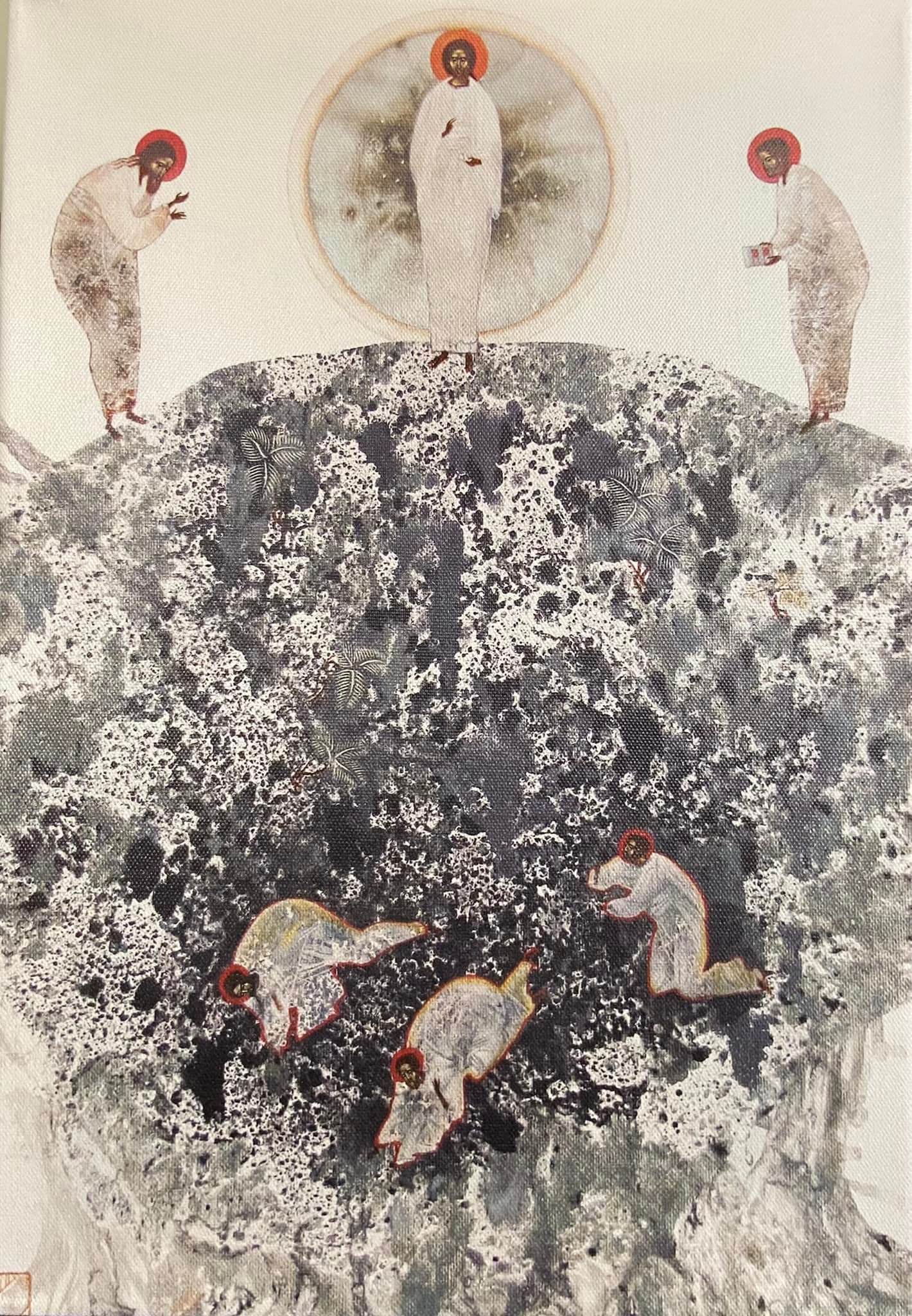
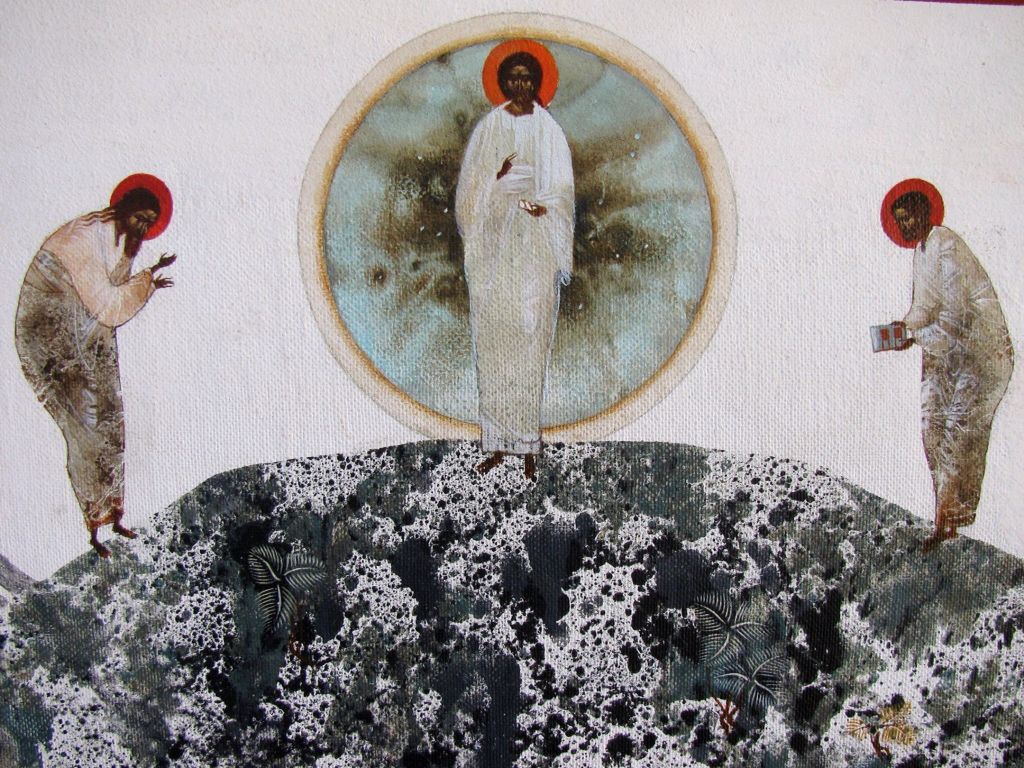
And finally, this is a modern icon created by a Ukrainian artist named Ivanka Demchuk. The cowering disciples in the bottom portion stand in for all of us, who when encountered by the One who encounter us, can’t help but tremble in fear. 

The Transfiguration is one of those moments in the Bible that we can never fully wrap our heads around. It’s one that we need art and music and other aspects of expression to help us come to grips with this bewildering proclamation. 

It is beyond our ability to explain and certainly beyond our ability to comprehend because it transcends all modes of our being.

Without the supernatural, without transcendence, without mystery, the church becomes nothing more than a country club, or the next best self-improvement clinic, or a sub par social services agency. 

And to be clear, there is nothing inherently wrong with seeking out fellowship, or trying to better one’s self, or providing needs to the last, least, lost, little, and dead. But if that’s all we have, if that’s all the church is, then we have no business calling ourselves the church.

There will always be plenty of other institutions that can bring us better friends, or help us get from where we are to where we want to be, or make substantive changes in the world. But they don’t have the one thing that we do: Jesus Christ and him crucified.

The wonderful and weird witness of the Transfiguration is that the only thing we’re told to do is listen to Jesus. From this point forward, Jesus is going to do what Jesus is going to do. He will still stir up the crowds with stories of treasure in a field, and proclamations about the signs of the times, but when push comes to shove Jesus will mount the hard wood of the cross regardless of all our goodness or lack thereof.

We can point to all these bewildering details on top of the mountain, but it’s important that we don’t miss out on the timelessness of the scene. The Transfiguration, a moment indelibly in the past, shows us a glimpse of the future.

Tell no one what you have seen or heard until the Son of Man is raised from the dead. 

This moment is made indelible only by the ending that the disciples can scarcely imagine, even though Jesus just hit them up over the head with it.

They are sworn to silence because they are not yet ready for the transcending truth. They have not made it from their reality to God’s reality. They witness something remarkable and inexplicable, but it is not yet the resurrection, the great transfiguration of all things.

Today we, like the disciples, are called to live according to the wondrous nature of the Transfiguration – we can stumble around like fools grasping out in fear for comfort – and then we will hear the words, the only words we need to hear: “This is my Son, the chosen; listen to him.”

But, and it’s a big but, if we’re honest with ourselves, we don’t want to listen to Jesus. We’d rather listen to ourselves. 

We’d rather listen to ourselves because we are downright addicted to control. Or, at least to thinking we’re in control.

Do you know how God responds to those who think they’re in control?

Laughter.

It is humbling to be laughed at by anyone, but when God’s laughs at us it’s another thing entirely. But perhaps we need to hear that laughter, particularly when we wake and sleep believing that it’s up to us to make the world turn out right.

The world has already turned out right. We know the future in the present. The tomb is empty!

We don’t have to be the hope of the world because Jesus already is. The only thing we have to do is live accordingly.

And that’s why Lent beckons us. It’s why Christians, for centuries have marked and observe the season that starts on Ash Wednesday because it reminds us of our inconvenient truth – we can’t make it out of this life alive. But, like the Lord in the tomb, God refuses to leave us that way.

We are a people desperate to be in control of our lives and we’re living in a world in which we are not in control. Moreover, we can scarcely imagine what it would look like to live in the light of Jesus’ transfiguration. It leaves us quaking and bewildered like those three disciples.

But if we do not reflect the glory of the One transfigured, then the world has no light to see that all is not darkness. Amen. 

A Chance To Feel Self-Righteous (with Fleming Rutledge)

Five years ago the Crackers & Grape Juice team had an idea for a new lectionary podcast and we have published an episode every Monday since. Our first guest was Fleming Rutledge and she knocked our socks off (as usual). We are reposting that first episode because Fleming’s thoughts and comments are just as relevant today as they were five years ago. In it she talks about what she deems the “current preaching crisis,” the desire to appear prophetic, and the call to stand under the judgment of God. If you would like to listen to the episode or subscribe to the podcast you can do so here: A Chance To Feel Self-Righteous

A Modest Proposal

2 Corinthians 3.17

Now the Lord is the Spirit, and where the Spirit of the Lord is, there is freedom. And all of us, with unveiled faces, seeing the glory of the Lord as though reflected in a mirror, are being transformed into the same image from one degree of glory to another; for this comes from the Lord, the Spirit. 

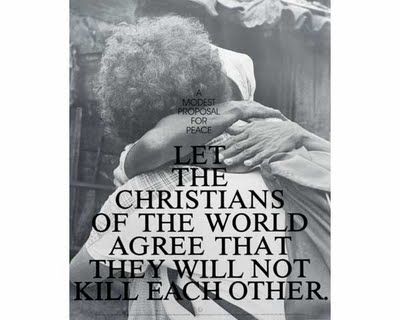
My former professor Stanley Hauerwas likes to tell the story of how he hung a poster on his office door at Duke University. The poster was published by the Mennonite Central Committee, and it displayed a haunting image of two people in grief holding one another, and underneath the image were these words: “A Modest Proposal For Peace: Let The Christians Of The World Agree That They Will Not Kill Each Other.” 

Hauerwas then explains how, for over twenty years, students (and professors) would knock on his door with anger and frustration. They would barge into his office and declare, “Your sign makes me so mad. Christians shouldn’t kill anyone.”

And Hauerwas would reply the same way every time: “The Mennonites called it a modest proposal – we’ve got to start somewhere.”

Last night Russian forces invaded Ukraine, assaulting by land, sea, and air in the biggest attack by one state against another in Europe since World War Two. Missiles rained down on Ukrainian cities and countless Ukrainian citizens are currently fleeing for their lives. 

And Christians here in the US have already floated around a bunch of possible responses from flooding the Ukrainian military with money, arms, and technology, to invading Russia to make them pay for what they’re doing, to praying for peace.

Jesus commands the disciples to “Love your enemies and pray for those who persecute you,” which looks nice on a cross-stitch hanging on the wall in your living room until you start to see images of bombs exploding and parents frantically trying to rush their children to safety.

War is always complicated, ugly, and even addictive. It reveals our sinfulness in a way that few other things can. War illuminates our lust for bloodshed and retribution. War offers a view into our unadulterated obsession with the hoarding of natural resources. Way conveys our frightening disregard for the sanctity of human life. War is our sinfulness made manifest in machine guns. War is the depth of our depravity.

Even the word “war” fails to express the frightening nature of the act. We so quickly connect the word “war” with the “righteous” outcomes of our wars. 

Can you imagine how differently we would remember and even think about wars if we called them something else? World Massacre II? The Vietnamese Annihilation? Operation Desert Carnage?

Part of the strange witness of Christianity, and an all too often overlooked aspect of the faith, is that Jesus rules in weakness. God in Christ reconciles the world through the cross. Our salvation is wrought not with the storming of the Temple with swords and shields, not by overthrowing the powers and the principalities with a mobilized military, but with a slow and non-violent march to the top of a hill with a cross on his back.

As the images continue to flood in from Ukraine, as the talking heads on every news channel tell us how we should feel and think about the images, I find myself grateful (oddly enough) for the Book of Discipline in the United Methodist Church because it already outlines how we (Methodists) think and feel about war.

Namely, that war is incompatible with Christianity.

Paragraph 165.C:

“We believe war is incompatible with the teaching and the example of Christ. We therefore reject war as an instrument of national foreign policy. We oppose unilateral/preemptive strike actions and strategies on the part of any government. As disciples of Christ, we are called to love our enemies, seek justice, and serve as reconcilers of conflict. We insist that the first moral duty of all nations is to work together to resolve by peaceful means every dispute that arises between or among them.”

It might be a modest proposal, but we have to start somewhere.

Foolishness

1 Corinthians 15.35-38, 42-50

But someone will ask, “How are the dead raised? With what kind of body do they come?” Fool! What you sow does not come to life unless it dies. And as for what you sow, you do not sow the body that is to be, but a bare seed, perhaps of wheat or of some other grain. But God gives it a body as he has chosen, and to each kind of seed it’s own body. So it is with the resurrection of the dead. What is sown is perishable, what is raised is imperishable. It is sown in dishonor, it is raised in glory. It is sown in weakness, it is raised in power. It is sown a physical body, it is raised a spiritual body. If there is a physical body, there is also a spiritual body. Thus is is written, “The first man, Adam, became a living being”; the last Adam became a life-giving spirit. But it is not the spiritual that is first, but the physical, and then the spiritual. The first man was from the earth, a man of dust; the second man is from heaven. As was the man of dust, so are those who are of the dust; and as is the man of heaven, so are those who are of heaven. Just as we have borne the image of the man of dust, we will also bear the image of the man of heaven. What I am saying, brothers and sisters, is this: flesh and blood cannot inherit the kingdom of God, nor does the perishable inherit the imperishable. 

A United Methodist Bishop received a chain saw one Christmas and quickly went to work with it. And then, on New Year’s Eve, the chainsaw slipped, grabbed ahold of his sleeve, threw him to the ground, and in a matter of seconds did some serious damage and he was rushed to the emergency room.

The bishop later reflected that, while riding in the back of the ambulance and the sirens were ringing, if he died because of blood loss, he hoped that his wife would be smart enough to tell everyone that he died chopping firewood for poor orphans.

While in reality he was really just trimming some hedges that weren’t yet in need of trimming.

However, he didn’t die.

Though at moments he wished he did.

He went through serious surgery and was stuck in the hospital for quite some time while he recovered.

And, it was during this time that a well intentioned chaplain entered the room and offered “pastoral presence.” The bishop had enough pastoral presence in his life, but he motioned for the young man to come in. The chaplain looked over the bandage wrapped around his arm and asked, “Are you a Christian?”

The bishop replied, “Sometimes.”

“Well then,” the chaplain intoned, “I suppose your accident caused you to do a lot of praying?”

And that’s when the bishop realized that throughout his whole ordeal he hadn’t felt moved to prayer in the slightest. He shared, later, that his lack of prayer was not due to a lack of faith in God’s ability to heal. The bishop was quick to note that there are scores of healing stories in scripture, that Paul considered healing a sign of God’s active grace, that the book of Acts points to the power of Christ working to heal through the disciples, and that even James the brother of Jesus calls for the people called church to pray of the sick that they might be healed.

Why then was he, a bishop in the church, so reluctant to pray?

At first he wondered if his lack of prayer could be attributed to the fact that God had better things to do with more people in need than his little chainsaw accident. But the more he thought about it, the more he thought about his aversion to the regular prayer requests he had received countless time before throughout his ministry.

That is, he was sick and tired of everyone being sick and tired in their prayers.

We’re at the tail end of what we call the season after Epiphany. Transfiguration is coming. Ash Wednesday is coming. Lent is coming. We will shortly make the journey inward to confront the condition of our own condition leading up to the cross on Good Friday, and yet, we’re still dealing with the shock of the incarnation.

Sure, most of us have packed away all the Christmas decorations weeks ago. Though, if you drive around the neighborhood around the church, you’re still likely to catch quite a few Christmas lights dangling from gutters.

But the proclamation of Christmas is one that lingers even when we move through different liturgical seasons. God, bewilderingly, refused to stay above and instead got down and dirty with us, in the flesh, and moved in next door, as it were.

Jesus, fully God and fully human, chose to be a people, a family, what we now call church.

We are the body of Christ in the world.

And how is our body faring?

Some of us we are tracking our calories constantly, or our exercising doesn’t count unless we can post it somewhere on social media. Some of us are struggling to fall asleep at night as we run through the list of things that terrify us. Some of us are making plans for the next degree, or the next job, or (heaven forbid) the next spouse.

We’re obsessed with our bodies and our physical well being. It dominates our prayers to the degree that if we ever ask someone to pray for us there’s a better than good chance that our request has to do with our, or someone else’s, body.

It dominates our waking, and sleeping life, so much so that many of us have devices strapped to our wrist that not only tell us if we move enough during the day but also if we’re getting the right kind of sleep at night.

And for those of you keeping score at home, I’m wearing one of them right now!

Our health and well being, or lack thereof, is constantly being reinforced through commercials designed to sell us on bodies that we will never have and beauty magazines that will only ever make us feel ugly.

And here’s the Christian message in the midst of all of it: it’s not up to you.

Your salvation isn’t up to you.

You can’t earn it through perfect church attendance on Sunday mornings.

You can’t earn it by giving more through the offering plate than the person next to you.

You can’t earn it from developing an 18 pack of abs.

You can’t earn your salvation because it is a gift given by the only One who can: God.

And yet, the gift of salvation, our very resurrection from the dead, means that our bodies matter today. It means that, once we come to grips with what God did and does, our being in the world changes.

The Corinthians to whom Paul writes his epistles, the Christians he derides for their foolishness, were living as if their bodies no longer mattered – they were giving in to their desires to such a degree that it was harming themselves as individuals and as a community. They were getting drunk on the wine from communion, they were trading bedfellows, they were letting their flesh and blood dictate everything about who they were.

And Paul says, “No! Listen: we’re not there yet. We’re still in our bodies in this mortal life, but the resurrected life is coming.”

Our bodies are important. As I’ve noted before – Christianity isn’t a spiritual faith, it’s an embodied one. It’s why we baptize with water, and we share bread and cup. It’s why we take seriously the needs of the hungry, and the poor, and the outcasts. And it’s why we are bold to pray for the health and well being of ourselves and others. 

But all of that is a long cry from the obsessiveness that we have with our own bodies today.

None of us have the body that we really wish we had. And if we do, we resent how much work it takes to make our bodies look and feel that way. And the older we get, the more we discover that our bodies are not as trustworthy as we thought they once were. 

Certain foods don’t sit like they used to. It’s harder to lose the holiday weight. No amount of lotions and creams can make our wrinkles disappear. And that’s not even mentioning the inability of our bodies to ward away sickness.

The bodies we are in can’t be, and won’t be, perfect.

Paul puts it this way: the flesh is weak.

That’s why he admonishes the Corinthians to not give in to each and every little desire while, at the same time, he reminds them (and us) that we need not beat ourselves up over whether or not we look and feel like we want to look and feel.

Certainly, there are moments during Jesus ministry when he healed those in need, but those moments are remarkably ambiguous. He didn’t heal every sick person in Judea, and even when he did heal he often told people to not tell anyone about it.

Whatever Jesus’ mission was, it was about more than physical restoration.

Consider: Each and every person that Jesus did heal eventually died.

Even Lazarus was raised from the dead only to die again.

Outside of scripture we should note that churches were the location for, and eventually created some of, the very first hospitals because taking care of the last, least, lost, little, and dead is part of the work of God.

But only recently has our obsession with our bodies come to dominate just about every aspect of life.

Including our prayers.

That’s not how Jesus prayed, nor it is how Jesus taught us to pray. Bread and trespasses are mentioned in the Lord’s prayer, but our illness and discomfort are not. I have heard prayers and I myself have prayed prayers about every medical diagnosis you can imagine, but I rarely pray for God’s strength to help me love my enemies, I’m not often asked to pray for someone to have the courage to actually forgive the person that harmed them. 

Prayer is, and must be, more than bringing our wish lists to Jesus, asking him for occasional help when our bodies are no longer functioning the way they are supposed to. 

Prayer, instead, is the risky attempt to let Jesus speak.

That bishop, the one who nearly cut his arm off, the one who didn’t pray in the hospital, he said he was ultimately reluctant to clasp his hands together in petition because the last thing he wanted was to risk a visit from Jesus, who usually shows up making our lives harder and not easier.

The bishop also said that one of the joys of following Jesus (and he used joy sarcastically) is that Jesus usually shows up even when we don’t pray, and sometimes because we don’t pray. 

He experienced Jesus in learning how to be dependent on someone else in his healing, something that most of us avoid at all costs – we never want to be a burden.

He experienced Jesus in the reminder of his own fragility, and his destiny to return to the dirt from which he was created.

He experienced Jesus as the only hope in the world he really had, because were his salvation up to himself, he really would be a lost cause.

There was a time when health didn’t mean just freedom from pain and physical discomfort – health meant wholeness, even holiness. And sometimes holiness is nothing more than coming to the realization that what makes the Good News good is that it isn’t up to us – it’s up to God.

Which is foolishness according to the world. The world bangs us over the head every chance it gets about the need for us to be self-made creatures, to make our own destinies, to pull ourselves up by our boot straps.

Grace, from that perspective, is complete foolishness. It is everything for nothing. It is a divine lark in the midst of overwhelming frustration. It is the only thing we need and the only thing we don’t deserve.

Our bodies will fail us, but God won’t. Maybe some of us will be fortunate enough to experience some divine healing in this life, but all of us have already received the greatest healing of all – the gift of salvation.

In the end, the only thing we have to do is trust God. And when we do that, well, then we’re living in grace and by grace.

No matter what happens to us in the course of that trust – no matter how many things we do or leave undone – if we can trust that God, by death and resurrection, has made all things new, then we can rest in our gift and relax. 

The whole diorama of all our mediocre performances (which is all we can ever really offer anyway) can’t stop the Love that refuses to let us go. If Jesus refused to condemn us because our works were rotten, then he certainly isn’t going to flunk us if our bodies aren’t perfect. 

Do you see? That means we can fail again and again and still live in the life of grace.

Because, at the very worst, all we can be is dead and for the One who is Alpha and Omega, that’s no trouble at all. Amen.