On This Generation

But to what shall I compare this generation? It is like children sitting in the marketplace and calling to one another, “We played the flute for you, and you did not dance; we wailed and you did not mourn.”

strangely-warmed-spreaker-header

This week on the Strangely Warmed podcast I was left to record by myself as half of the team from Crackers & Grape Juice were moving to new appointments in the United Methodist Church and we couldn’t get our act together. It is easily our worst episode because we thrive on dialogues and not monologues, so have mercy. The readings include Genesis 24, Zechariah 9, Romans 7, and Matthew 11. If you want to learn more about worshipping the Lord in marriage, humility in leadership, sin, and our selfish generation you can check out the episode here: Like Children In The Marketplace.

As always, if you enjoy the podcast please leave us a rating or review on iTunes, it helps us and it helps others discover the podcast. You can find out more about both of our podcasts at our website.

triumphal-entry

Devotional – Matthew 28.16-17

Matthew 28.16-17

Now the eleven disciples went to Galilee, to the mountain to which Jesus had directed them. When they saw him, they worshipped him; but some doubted.

Weekly Devotional Image

Doubt has been with the church since the very beginning. Even after the resurrection while the disciples were worshipping Jesus on the mountain in Galilee there was doubt. This is a particularly interesting note in scripture considering the fact that doubt is so ridiculed and berated in parts of the church today.

In some so-called “prosperity gospel” churches if someone gets sick or loses a job the rest of the church blames the occurrence on the doubt of the individual. In other churches you might hear a sermon that makes it plainly obvious that doubting the Lord is a sign of weakness and it needs to be dismissed from the mind (or the heart). And still yet in some churches the “d” word is never mentioned because of it’s supposed negativity.

But doubt was with the disciples from the beginning! How else could a group of finite human beings respond to the infinite wonder and grace and mercy of God made manifest in the flesh?

doubt1

Doubt is not the opposite of faith. In fact, doubt is often the prerequisite and part of the cyclical nature of faith.

Two summers ago I took a group of people from the church on a mission trip to War, West Virginia and while we were there serving the needs of the community one of our members expressed doubt in God’s love and compassion when confronting the destitute poverty of the people in the community. One afternoon, while working on the floor of a house, he said, “It’s hard to believe in a God who could let something like this happen.” At that precise moment the homeowner walked around the corner laughing and said, “Honey, you are the proof that God is not done with us yet!”

Oftentimes when we are in the midst of doubt, whether a particular event has led us to begin questioning the Lord or it comes out of nowhere, it usually takes another person to show us back to The Way. In West Virginia is took a poverty-stricken homeowner to show my friend what the grace of God really looks like. When I begin questioning aspects of the kingdom or scripture or any number of things it usually takes a word or phrase from our hymnal to knock me back into the reality of God’s reign. For some people they need a friend or relative to reach out and ask to pray together. For others it takes something close to a miracle to show how God still rules this world and is the author of our salvation.

Regardless of what we doubt, or even if we doubt, the Good News is that God is not done with us yet!

Devotional – Matthew 6.28-29

Devotional:

Matthew 6.28-29

Consider the lilies of the field, how they grow; they neither toil nor spin, yet I tell you, even Solomon in all his glory was not clothed like one of these.

Weekly Devotional Image

In a few hours I will gather with members of the community for a Service of Death and Resurrection for one of St. John’s long-time members, Gracie Jackson. During my first two months serving at St. John’s (almost 4 years ago), I tried to visit as many people as possible from the church community, particularly those who could no longer attend worship on Sundays. I want them to know that the church still cared about them and that they were in our prayers regardless of their presence.

Throughout those first months I was welcomed into a great number of homes and learned so much about Staunton and the impact St. John’s has had throughout the decades. One of my first visits was to the Jackson home where I sat and talked with Lenard and Gracie Jackson. But we didn’t sit for long. Instead, they wanted to give me the grand tour including the basement workshop and the green house in the backyard. There were plants everywhere but one in particular was striking and unlike anything I had seen before. Lenard explained that it was a Night-Blooming Cereus, and like the name implies, it only blooms at night. At the time, I casually mentioned my interest in the plant and we continued the door.

However, a couple days later Gracie told Lenard that he HAD to invite me over to witness the Night-Blooming Cereus in all it’s glory. (Lenard recently told me that in his life there were always two ways to doing things, and both of them were Gracie’s!). So at 10pm Lindsey and I drove over to the Jackson house and the four of us sat in their living room in our pajamas patiently waiting for the plant to do its magic.

When the right time arrived, we huddled in the green house with the dark sky coming through the windows and the cactus bloomed right in front of us. It produced the most exquisite scent and filled the room with its glory. And in that moment I was struck by the holy space we were sharing and was reminded of Jesus’ words from Matthew 6: “Consider the lilies of the field, how they grow; they neither toil nor spin, yet I tell you, even Solomon in all his glory was not clothed like one of these.”

6e7f0caa6dfe8f6541d5babc77c32ecf

That Night-Blooming Cereus was one of the most spectacular things I have ever seen and I never would’ve experienced if it weren’t for Gracie’s insistent invitation. Similarly, our faith is something that is offered to us as an invitation. We can read all about the Lord in Scripture, we can pray privately on our own time, but when we share our faith with another person it can bloom in the most exquisite of ways.

I am so remarkably grateful for the time I got to spend with Gracie, and for the many ways she embodied God’s grace for me.

On Working The Crowd

Matthew 21.8-9

A very large crowd spread their cloaks on the road, and other cut branches from the trees and spread them on the road. The crowds that went ahead of him and that followed were shouting, “Hosanna to the Son of David! Blessed is the one who comes in the name of the Lord! Hosanna in the highest heaven!”

Romans 8.31-39

What then are we to say about these things? If God is for us, who is against us? He who did not withhold his own Son, but gave him up for all of us, will he not with him also give us everything else? Who will bring any charge against God’s elect? It is God who justifies. Who is to condemn? It is Christ Jesus, who died, yes, who was raised, who is at the right hand of God, who indeed intercedes for us. Who will separate us from the love of Christ? Will hardship, or distress, or persecution, or famine, or nakedness, or peril, or sword? As it is written, ‘For your sake we are being killed all day long; we are accounted as sheep to be slaughtered.’ No, in all these things we are more than conquerors through him who loved us. For I am convinced that neither death, nor life, nor angels, nor rulers, nor things present, nor things to come, nor powers, nor height, nor depth, nor anything else in all creation, will be able to separate us from the love of God in Christ Jesus our Lord.


Working a crowd can be an art form. Comedians walk back and forth casually across a stage making the crowds feel relaxed and ready to laugh. Martin Luther King Jr. repeatedly punctuated and staccato’d his refrains like the rhythm of a song to get the people connected to the message. Even our President, Donald Trump, knew how to work the crowds at his rallies leading up to the election. You don’t win elections by laying out the step-by-step plans to make economic, ethical, political, and militaristic changes. You don’t win elections by calmly reflecting on the days of the past and a desire for simpler times. You don’t win elections with PowerPoint projections of pie-graphs and political policies.

We all know you win elections by firing up the people with a litany of complaints about what has gone wrong. You win elections by throwing gasoline onto the fire. You win elections by working the crowd.

And Jesus, like Donald Trump, knew how to work a crowd.

Jesus-and-Donald-800x430

You spread the word and get thousands of people outside to hear the message, you keep them on the edge of their, you know, ground area, and then wait for them to salivate with under the sun and then transform a loaf of bread and a couple of fish into a buffet the likes of which had never been seen.

You get the crowds riled up about working on the Sabbath, even quote some of the prophets from the past, and then heal a cripple man and leave everyone with a rhetorical question: Is it better to heal someone on the Sabbath or let them continue to suffer?

Walk into the middle of an angry mob about to stone a woman to death and quietly write a couple choice words in the sand to let them peer deeply into their own sinful souls and then empower the woman to live a new life.

Jesus knew how to work the crowd.

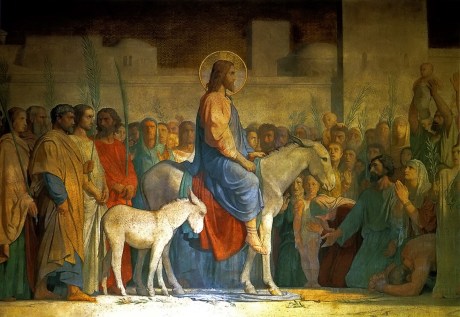
And Palm Sunday, this strange occasion where we pass out palm branches at the beginning of the service, is perhaps the best example of Jesus’ perfect political ability to work the crowd. We read that many people spread their cloaks; they literally take the clothes off their backs, and placed them on the road. And still yet others even cut down palm branches to prepare the way for the king who entered Jerusalem on the back of a donkey.

We know the story. We can imagine ourselves there on the side of the road with the dust hanging in the air. We can feel the buzz of expectation around the one who will come to change it all. We can feel within ourselves that same desire to scream out “Hosanna!” “Save us!”

Christ's Entry into Jerusalem by Hippolyte Flandrin c. 1842

But, unlike the crowd, we know how the story ends.

We know what awaits us this so-called Holy Week. We know what will happen in the temple when Jesus flips the tables. We know what kind of strange sermon Jesus will offer from the mountain. We know that Jesus will get down on the floor and wash the feet of his disciples. We know that Jesus will gather his friends around a table to share bread and wine. We know that Jesus will be betrayed, arrested, beaten, mocked, and nailed to a cross. We know that before the end of the week, Jesus will die.

And because we know how the story ends, it becomes clear to us that may not have known what we were doing by joining the crowds along the road, or by joining the crowds in a place like this one that we call church.

The crowds who gathered to sing their “hosannas” wanted a king, but the only people who continue to admire him as a king at the end of the week are the sadistic soldiers who made him a crown of thorns and drove it into his skin.

Jesus, it seems, was not the right kind of king. He was not the one they, or even we, were hoping for.

Maybe Jesus wasn’t all that gifted at working the crowd. After all, it took less than a week for the shouts to go from “Hosanna” to “crucify.”

Jesus is a King unlike any other king. Other kings, who are also at times called presidents, know they have to work and manipulate the crowd to bend them according to the desires of the powerful. Kings and Presidents may even rely on the power of the sword to control and handle the crowd to bring forth their hopes and dreams.

Such is the reality of worldly power.

But Jesus, our King, does not take advantage of the crowd’s enthusiasm. Rather than a call to arms to storm the city gates or to murder the ruling elite, Jesus suffers humiliation, abandonment, and death.

Do you still want to be part of the crowd by the side of the road? Do you want a place in Jesus’ kingdom? Do you want to follow the suffering King?

9cc

Don’t be mistaken; Jesus is as political as they come. But he rules not at the head of an army, but from an old wooden cross. He rules not by filibustering particular Supreme Court nominees or demanding democratic political policies, but by laying it all down for the ungodly. He rules not by ordering his troops to use chemical weapons against innocent civilians or even sending tomahawk missiles to destroy a military base, but mounting the cross and saying, “Forgive them Father, for they do not know what they are doing.”

In America, we pride ourselves on being the ones who can defy the whims of the crowds. Freedom! We think for ourselves! Or at least, we think we can think for ourselves. But here’s the irony: The moment we are so sure that we have thought something up for ourselves, the moment we believe we are most free, is really when we’ve been co-opted by the powerful.

I know that we like to think that if we had been there, we would’ve been good disciples and that we would’ve stayed with Jesus to the very end. I know we like to think that if we had been there in Germany all those years ago, that we would’ve protected the Jews and rallied against Hitler. I know we like to think that if we had been involved in politics at the time, we would’ve voted against going to war in Iraq and Afghanistan.

But the truth is a whole lot harder to swallow: We are easily manipulated.

Which is precisely why we sing awful songs like “Ah Holy Jesus.” God will not allow us to get away with perennial self-deception and arrogance. We killed Jesus.

Who was the guilty? Who brought this upon thee? Alas, my treason, Jesus, hath undone thee! ‘Twas I, Lord Jesus, I it was denied thee; I crucified thee.

smaller-crowd-rdc-color-hi.png

We know who we want Jesus to be. We want Jesus on our side in our petty arguments with friends and neighbors. We want Jesus on our side when it comes to disagreements in the community. We want Jesus on our side when it comes to the trajectory of our country. We want Jesus on our side when it comes to politics, and Syria, and Healthcare, and Immigration. We see ourselves as Jesus in the story of his entry into Jerusalem, when in reality we are far more like the fickle crowds on the side of the road than anyone else.

And that brings us to Romans 8.

Romans 8 is an unsettling text. Sure, we’ve heard it and used it at funerals; it offers us comfort and hope in the midst of sorrow and loss. It is important for us to declare over and over again that death will not separate us from the love of God in Christ Jesus.

We know this passage. We know it just like we know the story of Palm Sunday. In fact, if you can remember, months ago I asked the congregation to imagine what scripture you would use to comfort someone on death row, and this was the overwhelming favorite.

But these words from Paul can tempt us to forget that it is not just death that threatens to separate us from the love of God. Instead, we imagine the other things in the list to be good: life, angels, rulers, powers, things present, things to come. But all of them can threaten to come between Christ and his church; between God and us.

When we are comfortable, when we can’t imagine our faith requiring us to suffer, the list remains easily ignorable. However, we become true disciples of Jesus when we are willing to take risks, when we are prepared to go against the flow, when we resist the manipulation of those in power. And risks are called risks for a reason: following Jesus is a risky thing to do because it always involves the possibility of rejection.

Many of us know that this week marked the anniversary of the death of Martin Luther King Jr. Dr. King stood firm while the waves of the status quo crashed around him. Dr. King called out the principalities and powers for being wrong. Dr. King worked the crowds to a belief in non-violent resistance. And it got him killed.

Here in Staunton, like I said last week, we don’t feel very revolutionary, we don’t equate our faith with taking risks, and we can’t even imagine having to lay down our lives for the sake of the gospel. We can’t imagine ourselves being like Dr. King or questioning what our country is doing in Syria. But if we are serious about following Jesus, we will suffer; it’s just a less glamorous and more mundane form of suffering.

You know, like being mindful of other people; not getting stuck in our own unending bubble; asking hard questions that other people would rather ignore; acting like Jesus; sacrificing our wants and needs; calling someone in the midst of grief; showing up for a funeral when we might have other things to do.

Following Jesus in this place these days might not get us killed. But it might mean reaching out to someone who is totally unlike us. It might mean having a conversation with someone who voted for the other candidate. It might mean asking our spouses to forgive us for what we did. It might mean repenting for the way we spoke to our children or our parents. It might mean confronting our friends about their addictions. It might mean asking for help regarding our addictions.

And in so doing, we will suffer.

But nevertheless (!) nothing can separate us from the love of God in Jesus Christ! Not a bitter parent who refuses our apology; not an angry child who resents us for a past decision; not a nation who indiscriminately persecutes the poor and the marginalized; not a king or a president or a politician; not standing against the powers that be; not going against the current for a strange and more loving way of life; not anything now; not anything in the future.

We will surely suffer for the sake of the kingdom, but we will never be divided from the Lord. Amen

Jesus’ Temptation or: Who Does Government Belong To?

The team from Crackers & Grape Juice interviewed Stanley Hauerwas about the Lectionary Readings for Lent 1 (3/4/17). You can listen to our conversation here: Strangely Warmed

hauerwas

There is a temptation, during the season of Lent, to make it all about our temptations rather than Jesus’ temptation. While people today (Ash Wednesday) are embarking on the beginning of their 40 fast from the likes of chocolate, coffee, and candy, the Revised Common Lectionary forces us to confront the truth about Jesus’ temptation on the first Sunday of Lent. Our conversation with Hauerwas brought forth some interesting insights about comparing Jesus temptation by the devil with the serpent’s tempting of Eve in the Garden for both pastors and laypeople. If you’re preaching the first Sunday of Lent, or if you are interested in the connections between Genesis and Matthew, check out the episode from Strangely Warmed.

strangely-warmed-spreaker-header


Devotional – Matthew 4.1-2

Devotional:

Matthew 4.1-2

Then Jesus was led up by the Spirit into the wilderness to be tempted by the devil. He fasted forty days and forty nights, and afterwards he was famished.

Weekly Devotional Image

In a few days churches across the globe will begin the season of Lent through Ash Wednesday services. Countless disciples will have ashes in the shape of the cross on their foreheads at school, at work, at the gym, and everywhere in between. The season of Lent marks our journey with Jesus’ journey toward Jerusalem that culminates in the empty tomb on Easter.

For a long time, Lent has been a season in the life of the church focused on personal piety and repentance. It is an opportunity for Christians to confess their sins and spend a number of weeks turning back to the Lord in spite of their previous choices. And this emphasis on repentance has been made manifest in the popular decision to “give something up for Lent.”

We are told that it is good and right to give up a temptation during the season because it allows us to focus more on God and because it allows us to mirror Jesus’ temptation in the wilderness by the devil. When done faithfully, giving something up can be a truly fruitful activity; fasting has always had a place in the life of disciples. However, the season of Lent is about a lot more than personal piety, and when we limit our participation in this important season to “giving something up” we neglect to remember that Jesus’ temptation is not our temptation.

577342031dea80418edd74d681006901

When Jesus was hungry the devil challenged him to turn stones into bread and yet Jesus refused. When the devil enticed Jesus to jump from the pinnacle of the temple to put God to the test, Jesus refused. And finally, when the devil offered Jesus all the governments of the world in exchange for Jesus worshipping the devil, Jesus refused.

The devil offers things to Jesus that only the devil can offer to the Son of man. We, like Jesus, can be tempted by hunger, contractual prayers with God, and with a desire to control our lives through things like government, but they are not offered to us in the way that they are offered to Jesus. Jesus’ temptation marks the beginning of a ministry that will upset the expectations of the world and eventually result in his death on a cross. As the Son of God, Jesus is offered, and tempted, with the devil’s way out but he refuses. He refuses because he is God incarnate and cannot deviate from the path that leads to resurrection.

If we want to give something up during Lent in order to grow closer to God, by all means we can. However, perhaps a better thing to give up is not a physical and tangible item like chocolate or watching TV, but instead we can give up the false notions that we are the central characters of scripture, that we can earn our salvation, that we are more important than we really are.

Instead, maybe this Lent we give thanks to the Lord our God who came to walk among us, be tempted like us, yet be totally unlike us, and save us from sins, from death, and from ourselves.

Devotional – Matthew 5.23-24

Devotional:

Matthew 5.23-24

So when you are offering your gift at the altar, if you remember that your brother or sister has something against you, leave your gift there before the alter and go; first be reconciled to you brother or sister, and then come and offer your gift.

Weekly Devotional Image

“I want you to write down the name of someone who is currently driving you crazy.” That’s how I chose to begin a sermon more than a year ago. Each bulletin had a blank piece of paper inside, and after writing down the name I asked everyone to crumple it up and hold it in their hands until the end of the sermon.

The sermon was focused on Isaiah 6.1-8 and I talked about how Christians, for centuries, have been called by God to confront conflict. I said that to be faithful is to meet the outcasts where they are and show them love, that to be a disciple means a willingness to forgive people when they have done something wrong, and that to follow Jesus means having the courage to ask for forgiveness when we have done something wrong.

I concluded the sermon by asking everyone to look at the names crumpled up in their hands, and seriously consider making the first move to confront the conflict with that person. I warned everyone that it might not go well, and that it might blow up in our faces, but that the longer the conflict remains, the harder it would be to hear the living God speaking in our lives.

1be9b5bd635fbd64716dbb286ad38d4d

Like a lot of sermons, I preached it and hoped the people of St. John’s took the challenge seriously. Over the next few months I occasionally heard about what happened when certain individuals confronted the conflict in their lives, but a few people told me that it was too hard and they were too afraid to face the person whose name they wrote at the beginning of the sermon.

Jesus, in the Sermon on the Mount, takes the art of reconciliation very seriously: Before you bring a gift to the altar (before you place your tithe in the offering plate during worship) you need to leave; first be reconciled to your brother or sister, and then come back to offer your gift.

I’ve often thought about what this would look like in the middle of a worship service: How would people respond if we told them to leave the church right then and there to be reconciled with the people they are quarreling with before giving their gifts to the church? Would any of them come back the next Sunday? Would anyone walk straight up to me because I’m the person they’re frustrated with?

It is easy to show up to church every week as if we have everything in our lives figured out and squared away, when the truth is that we are quarreling with people in our lives and that we don’t have everything figured out. Church, however, is the place where we learn what it means to be broken, and how God is working through us to put the pieces back together.

So, if we took Jesus’ words seriously, who would we need to reconcile with before we show up to church next Sunday?

On Evangelism or: Why The Church Needs Crucifixion

Matthew 28.19 – Go therefore and make disciples of all nations, baptizing them in the name of the Father and of the Son and of the Holy Spirit.

Evangelism

We sent out hundreds of post-cards over a month ago inviting the entire neighborhood to join us on the front lawn of the church for a free Community Cook-Out. The post-cards were well designed and inviting with all of the necessary information. For a modest price we were able to reach a whole group of people who we would otherwise miss.

This will be our third annual gathering and it has been largely successful. Half of the people in attendance are usually not from the church and we want them to know that we care about the neighborhood we are in. However, on some level, we also want them to know that we love them enough that we would love to have them join us in worship on Sunday mornings.

IMG_1642

Yet, evangelism is not the goal of our gathering. We have not specifically identified key lay people to go around asking people if Jesus Christ is their personal Lord and Savior. We have not prepared pamphlets to hand out describing the eternal fires of hell if someone does not get saved. We have not invited the neighborhood to our front lawn to get them into heaven.

Instead, we hope that by showing them our love, it will somehow draw them into church to discover where that love comes from: God.

Next week we are going to send out even more post-cards to the local community about our upcoming sermon series titled “Confronting Controversy.” After speaking with a few nominal Christians from the neighborhood about what they want to hear about in church, we synthesized this series to be approachable and life-giving to people who are not currently in the church. The post-card has been well designed with a catchy image and all of the necessary information on the back. We hope that by sending them out, people from the community will join us in worship and discover that what the world thinks about the church may not be the same thing as what God thinks about the world.

controversy

Both of these ventures, a Community Cook-Out and a Controversial Sermon Series, are about trying to grow the church in some way, shape, or form. Many of us call this “evangelism.” But that’s not what evangelism means.

In David Fitch’s recent work Prodigal Christianity, he highlights a moment from his ministry where the church tried to grow and failed:

“When our church, Life on the Vine, was new, we sent out ten thousand postcards to people in our neighborhoods. We artfully displayed a collage of various depictions of Jesus (classical paintings, icons, and European, African, and Asian portrayals) with the question in bold print running across it: “Who is Jesus?” On the back, we invited the neighborhood to have a discussion with us about the question. We were playing off the cultural curiosity around Easter and hope that we could welcome a constructive conversation around the question. The card was not well received. Local “Bible-believing” Christians accused us of straying into relativism with so many different depictions of Jesus. They worried we were losing the truth of Jesus. Meanwhile many others accused us of being intolerant. Were not other religious leaders just as worthy of discussion? We got nasty phone calls asking, “Why are you focusing only on Jesus?” No one, and I mean NO ONE, came to any of our gatherings from this postcard.”[1]

Out of ten thousand postcards, no one came to any of the gatherings. I think a lot of this has to do with our false assumption that just by offering something people will show up. We believe that if we give them an interesting sermon series or bible study people are bound to show up in droves. And if we let them know about it through a postcard we can reach even more people!

These types of evangelism largely fail because we’ve confused evangelism with filling the pews instead of sharing the Good News.

I cringe whenever I encounter an “evangelist” in the midst of life who abruptly asks, “Have you confessed Jesus Christ as your personal Lord and Savior?” Because with their question is the assumption that we have the power to save ourselves, and that they are playing a fundamental role in our salvation. However, Jesus does not command the disciples to go out convincing people to confess him as Lord. Instead he tells them to go and make disciples.

Discipleship formation is primarily about relationships and less about post-cards and Main Street confessions. We become evangelists not when we beg or convince someone to confess Jesus as Lord, but when we intentionally create relationships with individuals through the love that Jesus taught us to live by. We can use sermon series and community events to first bring people into the church, but those types of things will never be enough (by themselves) to evangelize. It takes a willing and loving disciple who sees others not as pew fillers but fellow brothers and sisters in the kingdom of God.

As a gathering church we are called to be confident in God’s love for us, and for us to share that same love with others; “We love because he first loved us” (1 John 4.19). We will grow and bear fruit in the kingdom when love becomes our first priority instead of growth. We have failed to grow not because we have been doing things unworthily, but because we’ve grown bored and unhappy. With churches all across the American landscape floundering under the pressure to grow and remain sustainable, the church falls back to the common tropes of Vacation Bible Schools and Sermon Series assuming they will grow the church.

Can you imagine what the church might look like if Christians were actually happy and excited about being the church? That’s where and when evangelism happens – not in the boredom of another series or bible study, but in the community transformed by joy and sharing that joy.

Evangelism (1)

Evangelism is our call as Christians. We are commanded by the Lord to share the Good News in order to make disciples and transform the world. If we want this kind of dynamic and life-giving evangelism to take place, then we have to be willing to crucify some of our current practices and programs; you can’t have resurrection without crucifixion.

We need to crucify our boring and lifeless activities that we assume will grow the church. Is the annual Cook-Out really sharing the good news with others, or are we doing it to feel good about seeing a lot of people on our property?

We need to ask difficult questions about our programs and whether or not they are designed to evangelize. Are our monthly meetings really about branching out to the community and transforming our cultural landscape, or are we meeting to keep the people already in the church happy?

We need to confront our budgets and demand that they reflect Jesus’ mission. Are we spending our resources according to the great commission, or are we neglecting to be good stewards by wasting our resources of lifeless avenues of ministry?

We need to take a look at our own families and reflect on how we evangelize those closest to us. Are we so consumed by raising our children to choose whether to be Christian or not for their own good, or are we afraid of telling them what we really feel and believe?

What can we crucify in our hearts and in our churches to be resurrected into the kind of evangelists that God is calling us to be?


[1] Fitch, David and Geoff Holsclaw, Prodigal Christianity: Ten Signposts into the Missional Frontier (Jossey-Bass: San Francisco, 2013), 32.

Earthquake! – Easter Sermon

Matthew 28.1-10

After the Sabbath, as the first day of the week was dawning, Mary Magdalene and the other Mary went to see the tomb. And suddenly there was a great earthquake; for an angel of the Lord, descending from heaven, came and rolled back the stone and sat on it. His appearance was like lightning, and his clothing white as snow. For fear of him the guards shook and became like dead men. But the angel said to the women, “Do not be afraid; I know that you are looking for Jesus who was crucified. He is not here; for he has been raised, as he said. Come, see the place where he lay. Then go quickly and tell his disciples, ‘He has been raised from the dead, and indeed he is going ahead of you to Galilee; there you will see him.’ This is my message for you.” So they left the tomb quickly with fear and great joy, and ran to tell his disciples. Suddenly Jesus met them and said, “Greetings!” And they came to him, took hold of his feet, and worshiped him. Then Jesus said to them, “Do not be afraid; go and tell my brothers to go to Galilee; there they will see me.”

lightburst-easter-still-600x338


It was dark but I felt invincible. I was seventeen years old, with a fresh driver’s license in my wallet, and we were driving to the church in the middle of the night on Easter Eve. My friend, Will, and I had come up with a plan on how to make this particular Easter one that no one would ever forget. We were young and dumb.

For as long as I could remember, the church always set up a tomb on the front lawn of the church during holy week. It was the size of a small shed and it stood out like an oppressive eye sore to remind everyone what Easter was really about. From Good Friday through Saturday, volunteers would stand guard by the tomb wearing Roman centurion costumes and would try to look stern while also waving at people that drove by. It was the church’s attempt to reexamine the greatest moment in the history of the world, but after years of seeing the same men stand by the same tomb, it had lost its impact.

On Easter Sunday, someone was always tasked with getting over to the church before anyone else to roll back the stone on the front of the tomb. That way, while people were scrambling to find parking spots before the service started, they could remember how the stone was rolled away when the women and first disciples discovered Jesus’ resurrection on the first Easter.

But for Will and I, it was time to up the stakes and make it an Easter worth celebrating. We were tired of the same resurrection stories, we were tired of people entering and leaving much the same on Sunday, and we were tired of the familiarity that had become Easter.

So we snuck out in the middle of the night, much to the later frustration of our parents, and we drove over to the church. Under the cover of darkness we rolled back the stone that covered the entrance to the tomb, and we carried it across the church lawn to the main sanctuary entrance. There is a slanted roof above the main doors that everyone can see, and we decided it was the perfect place for the stone. Of course, we hadn’t planned on how difficult it would be to lift the wood framed faux stone that was as tall as us on to the roof, so we had to back my car up under the gutters and toss the stone up onto the shingles.

It was perfect, and I can still remember how quickly we peeled out of the parking lot with proud looks on our faces. We were going to recapture the power of Easter for our church.

Much like Christmas Eve, I couldn’t sleep. I was so excited to see the faces of all the people in worship when they noticed the stone on the roof, I couldn’t wait to hear our pastor make a comment about God’s cosmic power to roll back stones, even onto the church roof, during his sermon, but mostly I was excited to see people excited.

I arrived with my family in our perfectly coordinated outfits with a lot of expectation. I could not keep back a permanent grin on my face the whole way to the church, and when we got to the parking lot I couldn’t believe what I saw.

Nothing.

Sure enough the stone was still on the roof of the entrance, it was in clear sight for everyone to see, but not a single person had noticed it. They were all walking in and talking like it was like every other Sunday.

Even worse, during the time before the service started, I moved around the sanctuary to eavesdrop on all the conversations and not a single person mentioned the miracle on the roof. I don’t remember a word for the sermon that year because I sat disappointed in my pew with my arms across my chest.

The joy of my expectation had been replaced with frustration at the lack of reaction from the congregation.

When the service ended, my family got in line with everyone else to shake the pastor’s hand. We slowly made our way forward until I lazily offered my hand and the pastor grabbed it and pulled me close.

He said, “I was praying in the sanctuary this morning, and I heard God speak to me.”

“Oh, really?” I said dismissively.

“Oh yes, and he told me to tell you that whoever put the stone on the roof better have it back down by tomorrow morning. Happy Easter!”

Have we become so content with Easter that it no longer shakes us? Are we so entitled that we have accepted the gift of eternal life without recognizing how transformative it is? Does Easter still shock us the way that it should?

The women got up early and made their way to the tomb. They were expecting it to contain Jesus’ dead body, they were still grieving over the death of their friend, but they knew what they had to do. And suddenly there was a great earthquake! An angel of the Lord descended from heaven and rolled back the stone and sat on it. His appearance was frightening and he scared the Roman guards to such a degree that they became like dead men.

But then the angel said to the women, “Do not be afraid! I know you’re looking for Jesus, but he has been raised! Go tell his disciples the good news.” So the women made haste with great fear and joy to share the gospel and suddenly Jesus met them on the road and said, “Greetings!” The women ran to Jesus and knelt to worship at his feet, but he said, “Don’t be afraid; go and tell my brothers to go to Galilee; there they will see me.”

resurrection-Easter-edit[1]

This is shocking stuff. Jesus, dead on the cross, was placed in a grave, and three days later he rose. An angel appeared with an earthquake to roll back the stone at the tomb and proclaim God’s love through the resurrection of his Son. And at the end, the women respond in fear, joy, and worship.

Easter is an earthquake the shook the entire world, and more than that, it shook time itself. No more would God’s created beings be limited to the confines of earthly life, no more would the grace of God be limited to a particular time and place, no more would death have a sting.

This great gift of resurrection, the gift of Easter, shakes the very foundations of existence.

But does it still shake us?

We like Easter to be easy on the senses and on our consciences. Many of us like to dress up in our best clothes, and wear the right colors, and have an Easter egg hunt. Some of us are like the church of my youth who experienced Easter like any other holiday. Others are like the first disciples who were ready to get back to their lives after their Lord died, but then he showed up on Sunday and shook the world.

On Friday I came to church at about noon to take up our sanctuary cross and drag it through Staunton. This has been my holy week tradition since becoming a pastor and it always yields interesting results. The first year I carried the cross I was largely ignored; no one spoke to me or even acknowledged my presence. Last year was totally the opposite, people honked at me and waved their hands; I even had a few people yell curse words toward my direction.

This year however, I was met with reverence and ignorance. During the first hour or so I lost track of how many people rolled down their windows to shout “Amen!” or “God Bless!” When I walked up and down Beverley Street many people placed their hands into the posture of prayer, or bowed their heads, and even some people made the sign of the cross across their body. It was powerful for me to experience how much the cross was interrupting their lives. I witnessed God’s power made manifest in the cross on my shoulder as it met people and reminded them how far God was willing to go to transform the world.

But as I was getting ready to turn and start heading back, I saw a young family standing on a corner and I figured that I should keep walking. The husband and wife were cautiously sipping on their to-go coffees while their 8-year-old son was jumping to avoid cracks in the sidewalk. As I got closer they all started to notice the strange man carrying a cross on his shoulder, and they remained silent as I passed by.

I was only a few feet away when I heard the son exclaim: “Mom! That guy is carrying a giant ‘X’!”

“No honey,” The mother said, “That’s a cross.”

While I continued up the hill I couldn’t help but laugh at the episode I had just experienced. But then my laughter turned to sorrow, for I realized that young boy had no idea what Christ did for him. He had no knowledge of Christ’s magnificent sacrifice on the cross to open up the gates of heaven. He had no understanding of the earth-quaking good news of Easter.

Every year Easter interrupts ous sensibilities and behaviors. On this day we feel the earth shake beneath out feet because God has conquered death. We are jostled to and fro by the empty tomb because it radically reshapes the way we live.

The resurrection is about power and grace. In it we see how God took something like the cross, a sign of death to the world, and made it into the means of celebration. On Easter, God transformed the tomb in the same way that he did on Christmas in a virgin’ womb; God made a way where they was no way. On Easter, God changed the world.

So come and taste the goodness of God in the bread and the cup. Listen for salvation in our songs and prayers. Witness the power of resurrection in the people in the pews next to you. Hear the Good News, the best news. Hear it and let is shake your lives. He lives! Hallelujah!

Abstract-Art-Painting-Paul-Bennett-After-Night

Devotional – Matthew 6.1

Devotional

Matthew 6.1

Beware of practicing your piety before others in order to be seen by them; for then you have no reward from your Father in heaven.
Weekly Devotional Image

When I was in seminary we called the season of Lent, “The Spiritual Olympics.” For those of us enrolled in higher theological education, we loved competing with our peers regarding our public piety during a season of fasting. Whereas many Christians rightly use the season of Lent to return to God’s way by confronting their finitude, we used the season to show off how holy we thought we were.

It was not uncommon to hear subtle brags throughout the hallways of our esteemed institution: “This year I’m going to give up sweets…” “Sweets? That’s easy! I’m going to give up meat in order to honor the glory of God’s creation…” “Meat? Give me a real challenge! I’m giving up television so that my focus can remain of the Word of God…” And I was there in the thick of it, offering up my own sacrifices to demonstrate my piety for anyone with eyes to see, and ears to hear.

What made the Lenten season so ridiculous was the fact that everyone knew what everyone else was giving up because it became the forefront of our conversations. In those moments of “Spiritual Olympics” we wanted everyone to know how pious we thought we were, and we had lost contact with Jesus’ words to his disciples: “Beware of practicing your piety before others in order to be seen by them; for then you have no reward from your Father in heaven.” It was frightening how easy it was for us to turn the gospel around to be more about our own selfishness than the good news of Jesus Christ.

Beware

Resisting temptation is a powerful practice during the season of Lent. When we take the time and energy away from bad habits and give that time back to God, it gives glory to the Lord. But if we take this season as an opportunity to flaunt our piety, it bears no fruit.

This Lent let us challenge ourselves to engage in acts of piety. Perhaps we know of something in our lives that we need to give up this season, a distraction away from recognizing God’s grace in our midst. Maybe we know of a practice that we need to add into our daily rhythms like prayer or bible study. But instead of sharing what we are giving up, or adding, with everyone around us, instead of making this vulnerable season in the life of the church into “Spiritual Olympics,” let us keep our piety to ourselves.

If we can keep our piety in check, which is to say if we can be pious for God’s sake and not our own, we will begin walking down the path that Jesus’ prepared for us.