Now God is God not of the dead, but of the living; for to God all of them are alive.
The Sadducees ask Jesus a question. If a woman remarries 7 times, to whom will she be married in the resurrection of the dead?
Jesus has two choices in terms of an answer.
1) He could pick 1 of the 7 husbands, perhaps the first, or the last, or one in the middle, to be her husband in heaven. But none of them make for a good answer since 6 of the former husbands would be left to inherit the wind.
2) He could admit that the Sadducees have a point – If she can’t be married to one of her husbands in the resurrection, then perhaps there is no promised resurrection.
But, of course, Jesus doesn’t go with either of those options. Instead, he breaks through with an answer previously unthought of. Jesus simply asserts that the resurrection is an entirely new ballgame in which the present rules and assumptions about marriage no longer apply. Additionally, he furthers his answer with the claim that the Torah proves the resurrection since God is the God of Abraham, Isaac, and Jacob all of whom were not alive at the same time and if God is to be their God they all must be alive together in some other way.
Jesus’ answer is less about the nuts and bolts of marriage, and more about how the kingdom of God works. He asserts, in just a few verses, that the people we marry and bury in this life don’t really belong to us.
And that’s Good News.
However, for some of this this might actually sound like radically bad news; we shudder to think of a time when we will lose the people we’ve taken hold of in this life. We don’t want to imagine a moment in which someone wearing a ring is no longer bound by that ring.
But that’s exactly the kind of assumption that Jesus is overturning.
It’s why we say, “‘Till death do us part.”
Jesus changes everything. The life, death, and resurrection of the Lord obliterates all of our previous notions of possession, particularly when it comes to people. Notably, the Sadducees held to a rigid understanding that women belonged to men as if property. But then Jesus stands and offers a truly radical witness to marriage: We aren’t lesser halves or better halves until (and after) we get married. We are fully and wonderfully made by God whether we get married or not. Marriage is something that happens in this life, but in the resurrection of the dead all notions of labels fade away as we gather at the Supper of the Lamb.
It’s as if Jesus addresses the crowd and says, “Listen up! A new world is colliding with the old. Behold, I am doing a new thing, something beyond even your wildest imaginations. In this world, the world you’re so wedded to, there is death. But in the world I’m bringing there is life and life abundant. In this world, your world, people are made to feel less than whole. But in the world to come, all people are children of the living God.”
On Sunday, Christians across the globe will gather to remember the saints (unless they did so already on Tuesday). It is an occasion for us to give thanks to God for those now dead while, at the same time, rejoicing with the knowledge that they now await us at the Supper of the Lamb. Oddly enough, we can happily remember the saints, even in our grief, because we worship the God of the living.
This week on the Strangely Warmed podcast I speak with Mikang Kim about the readings for All Saints’ Sunday [C] (Daniel 7.1-3, 15-18, Psalm 149, Ephesians 1.11-23, Luke 6.20-31). Mikang is the pastor of Epworth UMC on the Eastern Shore of Virginia. Our conversation covers a range of topics including proper pronunciation, perseverance, communal reading, saintliness, the difference Christ makes, directions for singing, courage, blessings and woes, sermon introductions, and Kingdom work. If you would like to listen to the episode or subscribe to the podcast you can do so here: Praying Our Goodbyes
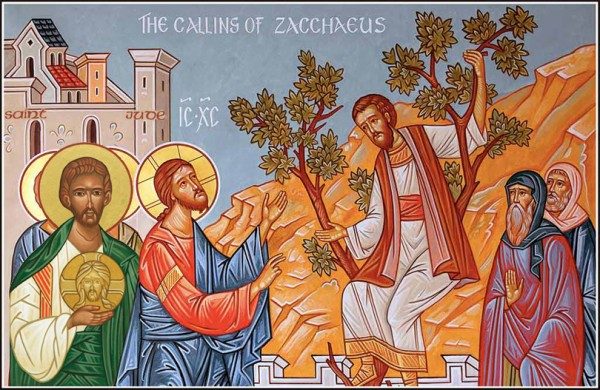
Jesus entered Jericho and was passing through it. A man was there named Zacchaeus; he was a chief tax collector and was rich.
We love the story of Zaccheaus. And by we, I mean the church. We tell Z’s story to children in Sunday school, we use it in VBS curricula, and we even have a nice little song that conveys the whole thing:
Zacchaeus was a wee little man and a wee little man was he / He climbed up in a sycamore tree for the Lord he wanted to see / And as the Savior came that way he looked up in the tree / And he said, “Zacchaeus, you come down, cause we’re going to your house today.
The song, and the ways we tell the story, make Zaccheaus out to be this smaller than life character (pun intended) who just wanted to catch a glimpse of heaven on earth, and how God in Christ chose him to be the vehicle of an internal transformation, particularly as it regards money.
But one of the things we miss, or downright ignore, is how horrible Zaccheaus was. He was a tax collector, someone who stole from his fellow Israelites and kept a fat portion for himself before passing the rest of the money up the chain. He was a traitor to his people, and to his God, and he stood for everything that was wrong during the time of Jesus.
And Jesus picks this no good dirty rotten scoundrel out from the tree and says, “Hey, let’s get something to eat.”
And, in a way that could only happen in the Gospel, Zacchaeus reacts to this strange man with an even strange proclamation. After a couple sandwiches, and a glass of lemonade on the front porch, Zacchaeus says, “Wow, the only way I know how to respond to you is to give back half of my wealth to the poor and pay back the people I cheated four time over.”
And Jesus responds, “Now that’s what salvation looks like! Let’s have a party!”
It’s a confounding story, and one that we often water down. Zacchaeus doesn’t deserve to be in the presence of God and God shows up for lunch. Zacchaeus has swindled countless people and Jesus has the gall to give him salvation.
And yet, his story is precisely why we can call the Good News good.
We are happy with a Jesus who forgives the tame sins of the nearly righteous. We are content to hear about the need to love one another a little bit more. But it’s another thing entirely to encounter the radical nature of Jesus’ proclamation of grace. Jesus’ willingness to cancel sins, big sins, is downright scandalous.
Which is why we sing of Zacchaeus but keep him at a distance. For, to approach the wee little man is to admit the truth of who we are and whose we are: Sinners in the hands of a loving God.
All of us are like Zacchaeus. We all hurt people close to us, we all ignore the needs of strangers, and we all focus on our wants, needs, and desires at the expense of others. We distance ourselves from true unabashed goodness, though we don’t mind taking a peek from the vantage point of a tree (or a pew). But be warned! All it takes is a glimpse for the Lord to see us and say, “Want to grab some lunch?”
This week on the Strangely Warmed podcast I speak with Jason Micheli about the readings for the 21st Sunday After Pentecost [C] (Habakkuk 1.1-4, 2.1-4, Psalm 119.137-144, 2 Thessalonians 1.1-4, 11-12, Luke 19.1-10). Jason is the senior pastor at Annandale UMC in Annandale, VA. Our conversation covers a range of topics including staying interested in ministry, God’s timing problem, the folly of pride, answering questions with questions, Godfather responsibilities, comedy in subtitles, VBS curricula, colluding with empire, and the unjust justice of God. If you would like to listen to the episode or subscribe to the podcast you can do so here: The Folly of Pride
He also told this parable to some who trusted in themselves that they were righteous and regarded others with contempt…
There is a man who is good and faithful. He’s not a crook, or a womanizer, or an alcoholic. He loves his wife and plays on the floor with his kids when he gets home from work. He even tithes when the offering plate comes around on Sunday morning. He is good and faithful.
And there’s another man, a legal crook, who steals from his fellow people and bleeds all the money out of them that he possibly can. He’s like a mid-level mafia boss who skims from the top before sending the rest up the chain. He’s got enough cars and boats that he can’t even keep track of where he keeps all of them.
They both show up for worship one day. The good and faithful man thanks God that he’s not like the crook and, meanwhile, the crook asks God to have mercy on him, a sinner.
The parable of the publican and the pharisee. Jesus tells this tale to his disciples and then mic-drops the ending: “I tell you, this man (the crook) went down to his home justified rather than the other; for all who exalt themselves will be humbled, but all who humble themselves will be exalted.”
It’s all wrong, right? This parable runs against the grain of how we think it’s all supposed to work.
Put another way: Which of the two would we prefer to see sitting in the pews on a Sunday morning? How would we feel if the crook was part of our church? What would we do if he took a little money out of the offering plate or showed up with a new woman on his arm every Sunday?
This parable is one of Jesus’ final declarations about the business of grace. Grace – the totally unmerited and undeserved gift from God. And here, with a resounding conclusion, Jesus tells the disciples and all of us that the whole game is unfair.
Grace is unfair because what we think is good and right and true matters little to God. Ultimately, not one of us matches up to the goodness of God and yet, instead of kicking us out of the party for being unworthy, God says, “I will make you worthy.”
Do you see what that means?
It means that the good religious work of the Pharisee is not able to justify him any more than the crazy sins of the Publican can kick him out. The whole point of the parable, of almost all the parables, is that these two are both dead in the eyes of God, their good works and their sins can’t earn them or prevent them from salvation.
In short, they have no hope in the world unless there is someone who can raise the dead.
This week on the Strangely Warmed podcast I speak with Todd Littleton about the readings for the 20th Sunday After Pentecost [C] (Joel 2.23-32, Psalm 65, 2 Timothy 4.6-8, 16-18, Luke 18.9-14). Todd is the pastor of Snow Hill Baptist Church in Tuttle, OK. Our conversation covers a range of topics including the Gospel according to Paul (McCartney), restoration, patient prayers, honesty, reading backwards, scriptural sommeliers, the Gospel diet, agency, the crown of righteousness, and the most important parable. If you would like to listen to the episode or subscribe to the podcast you can do so here: The Startling Nature of Scripture
Someone in the crowd said to him, “Teacher, tell my brother to divide the family inheritance with me.” But he said to him, “Friend, who set me to be a judge or arbitrator over you?” And he said to them, “Take care! Be on your guard against all kinds of greed; for one’s life does not consist in the abundance of possessions.” Then he told them a parable: “The land of a rich man produced abundantly. And he thought to himself, ‘What should I do, for I have no place to store my crops?’ Then he said, ‘I will do this: I will pull down my barns and build larger ones, and there I will store all my grain and my goods. And I will say to my soul, Soul, you have ample goods laid up for many years; relax, eat, drink, be merry.’ But God said to him, ‘You fool! This very night your life is being demanded of you. And the things you have prepared, whose will they be?’ So it is with those who store up treasures from themselves but are not rich towards God.”
Someone interrupted Jesus one day, “Lord, tell my brother to divide up the family inheritance.”
The man probably has just cause for his request, even though the conventions of the day dictated that the eldest son would receive the inheritance. But, don’t we agree it would be a good thing for Jesus to make everything fair?
Jesus replies, “Hey, what’s the deal? Who made me a judge over all you people?”
Apparently, Jesus has more important things to deal with than the incidental patching up of a intra-family dispute over finances.
But then Jesus does what Jesus does best – he tells a story.
There was a man who had it all. At first, he used the excess cash to fill his house with all sorts of trinkets and wares that served only one purpose: showing others how wealthy he was. It started with some paintings, until he ran out of wall space. Next he redid his wardrobe, until his closet was full. And then he bought an extra luxury car, until he realized there wasn’t enough room in the garage.
What was he to do?
And then the man had a vision! Why not tear it all down, and build an even bigger house to fit even more stuff inside?
So that’s what he did.
And it came to pass, after months of deconstruction and reconstruction, of differing architectural bids and various contractors, he looked at all he had and he said to himself, “You’ve done well old boy! Time to eat, drink, and be merry!”
Suddenly a booming voice from the heavens shatters all the new glass in the windows: “You fool! This very night your life is being demanded of you. And the things you spent your life obsessing over, whose will they be?”
Jesus sure could tell a story.
And yet, I don’t know if this story has “worked.”
And by “worked” I mean, I don’t know if we’ve changed all that much in response to this particular parable.
Throughout his earthly ministry, Jesus talked about money and possessions more than any other subject. And for good reason: we’re just as obsessed with what we have now as we were back then. Even a couple hundred years ago John Wesley was addressing wealth with the early Methodists: “In seeking happiness from riches, you are only striving to drink out of empty cups.”
There’s a great irony with Jesus’ parable of the rich fool: We all know that it’s true, and yet we live as if it isn’t.
It’s a bonafide fact that we can’t take anything with us when we die, but that hasn’t stopped us from trying. ($10,000 caskets…)
Everything in the world, and even the church at times, runs on avarice. Extreme greed for wealth and material goods. It’s the lie we were fed as children, and it’s the lie that we give to our children. It’s reinforced with every magazine cover, every instagram post, and every commercial we encounter.
Happiness is yours, if you can afford it!
And it’s all one big lie.
The world will tell us over and over and over again that we are defined by our bank accounts, and the clothes we wear, and the cars we drive. But in the kingdom of God it’s through poverty, not wealth, that God saves us.
Let the same mind be in you that was in Christ Jesus, who, though fully God, did not regard divinity as something to be exploited, but emptiedhimself, being born in human likeness, and was obedient to the point of death – even death on a cross.
Why does God do this? Because we need all the help we can get.
Whether we’re rich or poor or somewhere in between, all of us are sin-sin with our insatiable desire for more.
And not just more, but more, more more!
We clutch at all that is around us rather than opening our hands to ever being open to anything else.
We’d rather receive than give.
We lay awake at night worrying about one thing and one thing only: money.
And then Jesus has the nerve to tell us this parable!
Notice: the man in Jesus’ story does with his avarice what we all do: We congratulate ourselves on all we have accomplished.
The wealthy man sees only himself: “He thought to himself, ‘What should I do, for I have no place to store my crops?’ Then he said, ‘I will do this: I will pull down my barns and build larger ones, and there I will store all my grain and my goods. And I will say to mysoul, Soul, you have ample goods laid up for many years; relax, eat, drink, be merry.”
He’s living in a monologue.
And yet, all of the things we have in this life, all of the things we think we’ve earned or deserved, every one of them is actually a gift. We are products of what is done for us more than by what we do for ourselves.
Jesus sets up the man as the paradigm for everything we think is good, and right, and true in this life. He’s fiscally responsible after all. He’s earned his good fortune. And yet, the man is only a master of a life that is completely and radically out of his control – the rich man is nothing more than the captain of a ship that has been taking on water since it left the dock.
The man lives only for himself, talks only to himself, sees only himself, until the Lord knocks him to the ground for being a fool.
He is foolish because no matter how much he talks to himself, and congratulates himself, and rejoices in himself, he neglects to recognize that his crops, or his stock portfolio, or whatever the good thing is was always first a gift.
And gifts require givers.
The land that our food comes from, the institutions that give us the space and knowledge to grow, the families that provide our basic needs, the friends that support us in times of pain and grief, on and on and on.
And yet, we are far more possessed by what we think we possess. Our possessions possess us!
We keep acquiring more and more hoping we can control our lives or, at the very least, to make it appear like we have our lives together.
We spend most of our lives in pursuit of wealth, material and immaterial, only to come in the end to the greatest poverty of all: death.
Jesus’ parable ends with that frightening final note, one that lingers long after the Lord calls us fools: no matter how much we make, no matter how much we accumulate, we all die in the end.
John Ortberg tells this great story about how for years he and his grandmother played monopoly. She taught him the ins and the outs of the game, differing strategies, and she always always won. Until one day, after countless games, he finally beat her. And as he celebrated is victory, dancing across the living room, she said, “Don’t forget, when the game is over, it all goes back in the box.”
All the money, property, houses, hotels, they never really belonged to him. They were in the box before he started and they returned when he finished.
A challenging aspect of Christianity is our profound willingness to stare death in the face. It’s why we have crosses in our sanctuaries. We know, better than most, that time is now fleeting the moments are passing, passing from you and from me. And when the bells tolls for us, what will happen to all our stuff?
And yet, again, the “our” in “our” stuff betrays the Christian understanding that all of it, the money, possessions, talents, they are not “ours.” They are given to us by God who trust us to be good stewards of the gifts we’re given.
This church is a product of your stewardship, and the stewardship of those who came before us. Our sanctuary windows are marked with the names of those long gone who believed in God’s working in the world that they returned to God the gift they were given.
Even today, your gifts are what makes this church possible. The gifts of your time, showing up for worship and prayer and study and service. The gifts of your talents that you share with God and with one another. And, of course, the gifts of your finances.
Giving is normative in discipleship. It’s how we live into God’s mission of transforming the world.
But it’s also how we keep the lights on, and keep the building warm in the winter and cool in the summer. It’s how we are able to welcome and provide space for so many outside groups. It’s how we pay the salaries to support the livelihood of our staff and their families. It’s how we live into the strange and even foolish (at least according to the world) Gospel of Jesus Christ.
Because, in the end, the parables are stories Jesus tells about himself and Jesus is the one who doesn’t store up his life on earth and, instead, freely gives it for you and me. Rather than clinging to his own life, Jesus mounts the hard wood of the cross for people undeserving, us.
This parables stings, and it frightens, perfect for the month of October, even better for stewardship! But it is Good News!
Nothing can separate us from the love of God in Christ Jesus, not our money or lack of it, not our possessions or our minimalism, not our goodness or our badness, not our lives and not even our deaths.
We might not see it, or even believe it, but there is greater wealth in the salvation of Christ than in every bank account in the world.
And it’s ours for free.
We can’t earn it.
We don’t deserve it.
It’s not cheap, nor is it expensive.
It’s free.
It’s free for you and me and every fool the world will ever see.
–
Wesley said, “In seeking happiness from riches, you are only striving to drink out of empty cups.” Thankfully, we worship the God who never stops giving. Which is why the psalmist can sing, “our cups runneth over.” The only question is, what are we going to do with what we’ve been given?
Jesus said, “In a certain city there was a judge who neither feared God nor had respect for people. In that city there was a widow who kept coming to him and saying, ‘Grant me justice against my opponent.’ For a while he refused; but later he said to himself, ‘Though I have no fear of God and no respect for anyone, yet because this widow keeps bothering me, I will grant her justice, so that she may not wear me out by continually coming.’” And the Lord said, “Listen to what the unjust judge says.”
Jesus says that’s what God is like. Not like a widow who persistently goes looking for justice. Not like a bailiff dutifully following orders. Not even like a stenographer observing and recording every little detail of a trial.
God is like the unjust judge.
Jesus is saying to us here, in ways both strange and captivating, that God is willing to do for us what we need for no other reason than the fact that it will get all of us off of God’s back.
Jesus spins the tale and we are left with the bewildering knowledge that God is content to fix all of our mess even while we’re stuck in the midst of it.
In other words: While we were still sinners, Christ died for the ungodly.
There are few sentences in scripture as unnerving and beautiful as that one. It’s beautiful because its true and it includes all of us. But it’s unnerving precisely because it includes all of us!
We might like to imagine that God is waiting around hoping to dispense a little bit of perfection like manna from heaven if we just offer the right prayer or rack up the right amount of good works.
But Jesus’ story about the unjust judge screams the contrary. It’s as if Jesus is saying, “Do you think it makes the least bit of difference to God whether or not you are right, or if your case is just? Truly I tell you, God isn’t looking for the right, or the good, or the true, or the beautiful. God is looking for the lost, and you are all lost whether you think you are lost or not.”
Jesus tells this parable as Golgotha and the cross get clearer and clearer on the horizon. The cross is God’s mercy made most manifest. Just like the unjust judge, God hung up the ledger-keeping forever while Jesus was hung up on the cross. The cross is God, as the judge, declaring a totally ridiculous verdict of forgiveness over a whole bunch of unrepentant losers like the widow, like me, and like you.
The cross is a sign to all of us and to the world that there is no angry judge waiting to dispense a guilty verdict on all who come into the courtroom – there is therefore no condemnation because there is no condemner.
The old hymn has it right: “No condemnation now I dread; Jesus, and all in him, is mine; alive in him, my living Head, and clothed in righteousness divine, bold I approach the eternal throne, and claim the crown, through Christ my own!”
This week on the Strangely Warmed podcast I speak with Todd Littleton about the readings for the 19th Sunday After Pentecost [C] (Jeremiah 31.27-34, Psalm 119.97-104, 2 Timothy 3.14-4.5, Luke 18.1-8). Todd is the pastor of Snow Hill Baptist Church in Tuttle, OK. Our conversation covers a range of topics including the transformation of judgment, nationalism, prophetic voices, new covenants, the function of the Law, the local Gospel, self-help books, the narrative scope of scripture, baldness, evangelism, and the unjust judge. If you would like to listen to the episode or subscribe to the podcast you can do so here: The Divine Courtroom
Now every year his parents went to Jerusalem of rite festival of the Passover. And when he was twelve years old, they went up as usual for the festival. When the festival was ended and they started to return, the boy Jesus stayed behind in Jerusalem, but his parents did not know it. Assuming that he was in the group of travelers, they went a day’s journey. Then they started to look for him among their relatives and friends. When they did not find him, they returned to Jerusalem to search for him. After three days they found him in the temple, sitting among the teachers, listening to them and asking them questions. And all who heard him were amazed at his understanding and his answers. When his parents saw him they were astonished; and his mother said to him, “Child, why have you treated us like this? Look, your father and I have been searching for you in great anxiety.” He said to them, “Why were you searching for me? Did you not know that I must be in my Father’s house?” But they did not understand what he said to them. Then he went down with them and came to Nazareth, and was obedient to them. His mother treasured all these things in her heart. And Jesus increased in wisdom and in years, and in divine and human favor.
I would like everyone to close your eyes for a moment, find a comfortable posture, and I would like you to imagine the perfect church…
What does it look like?
What kind of people are in it?
What are some of the things the church does?
–
It’s a little terrifying how easy it is to imagine “the perfect church” only to open our eyes and be stuck here with each other. It’s so easy to picture a particular church in our minds because that’s what life has conditioned us to do. We usually curate everything we can to benefit our own tastes, and leanings, and hopes, and dreams.
If we don’t agree with someone else on Facebook, we can just block and unfollow them.
If we start watching a movie and within ten minutes it’s boring we can push a few buttons and watch something else.
If we’re hungry for a particular meal, we need only open an app on our phones to have it delivered right to our door, despite all the food we might already have in the pantry.
Basically, we are consumers living in a consumable world. We choose exactly what we want, take what we want, and move on with unlimited choices and unlimited speed.
And, frankly, we bring this understanding of reality to the church as well. That’s why there’s every flavor of Christian denominationalism on Grandin Road. If you encounter a church that doesn’t give you what you want, there’s always another one to try.
The only problem with that is the fact that what we want is not often what we need.
An example: We are blessed in this church to have visitors nearly every Sunday. That is something worthy celebrating, but a very strange phenomenon when taking in the scope of Christian history. Up until the last 100 years, you went to church where you could. Now we go to church where we want.
Anyway, we get a fair number of visitors here, those church shopping for a new church home. And, every once in a while, visitors come back again and again and I will meet with them to talk about what it might mean for them to join or become more involved. During that conversation I always ask about where they were attending church before.
And, more often than not, someone will describe their last church, usually somewhat local, and how they attended for years until something particular happened. A too-political sermon. A unfortunate song choice on a Sunday morning. A stinging stewardship season. And that was enough to say goodbye.
According to the world this is a normal thing that happens. We can move on over and over again.
But in the realm of the church this is downright strange.
Charles Spurgeon, 19th century preacher, put it this way:
“If I had never joined a church till I had found one that was perfect, I should never have joined one at all; and the moment I did join it, if I had found one, I should have spoiled it, for it would not have been a perfect church after I had become a member of it. Still, imperfect as it is, it is the dearest place on earth to us.”
Strangely enough, the church is where we discover the comforting gospel of Jesus Christ that leads us to live uncomfortable lives for him. Uncomfortable because, living for Jesus means living for the people in the church around us too.
When someone joins a United Methodist Church they covenant to support the church with their prayers, presence, gifts, service, and witness. To support the church by presence is literally that, it means being present.
Part of our discipleship is a willingness to be present with God and with one another. We gather week after week to remember the stories of God and to be re-membered into the body of Christ. We break bread with one another in worship, and during the Garden, as a recognition that the Christian life is one that is meant to be shared. We show up for Bible studies, and outreach programs, and all sorts of other things because, on some level, we understand that being present together is at the heart of what it means to follow Jesus.
Luke’s Gospel has all the best stories. Mark is short and brief, Matthew is theological, John is all over the place, and Luke’s got the stories. And the story of Jesus at the temple is just so good.
It’s got drama and intrigue, family strife, and youthful rebellion.
And when we read it we tend to fixate on Jesus teaching the elders. He’s a 12 year old boy and everyone is amazed at his teaching. And so people like me stand up in a place like this and say things like, “Our youth are not the future of the church, they are the church right now.” And a 3.5 minute story will usually be shared about a youth and how they understand the kingdom better than we do. And so on.
And that’s all good and fine.
Jesus does say that if we want to get into the kingdom of heaven we have to act like children.
And yet, I fear we miss something else in the story when we emphasize Jesus’ teaching in the temple alone. What we miss is the fact that this is also a story about horrible parenting!
Listen to it again: They traveled all the way to Jerusalem for Passover, a six days journey by foot, and when they were done they returned home Mary and Joseph did not know that they left their son behind.
What? How does that happen? It’s one thing to lose track of a wayward child in the grocery store, but leaving them behind in a foreign city? C’mon!
And that would be bad enough. But then it says they traveled a whole day before they noticed. AND THEN once they turned back it took them another 3 days to find him!
Jesus was in the Temple teaching and his parents were astonished and Mary said, “Child, why have you treated us like this? Look, your father and I have been searching for you in great anxiety.”
Which is the Bible’s version of, “Boy, you had us worried sick! You are grounded from now until eternity!”
And how does Jesus respond? “Why were you searching for me? Did you not know that I must be in my Father’s house?”
Must is a strong word. In life all of our must and shoulds don’t muster up to much in the kingdom of God, but Jesus’ response is notable.
It is good and right to be in the house of God. Honor and keep the sabbath, that’s 1 of the 10 commandments.
The psalmist writes, “I was glad when they said to me, let us go to the house of the Lord.”
To be in the house of God was as necessary to Jesus as it is to breathe.
And yet, there are a few more staggering details in this story that really bring it all home. The Holy Family went to Jerusalem for Passover. Some 21 years later, on Passover in the same city, Jesus will take a loaf of bread and a glass of wine and share it with his friends. He will become the Passover Lamb for the them, the exodus for the rest of us.
Mary and Joseph abandon Jesus in the city, much like the aforementioned disciples will abandon him to the cross the day after Passover.
It take Mary and Joseph three days to find their son, much like Jesus sat in the tomb for three days before the resurrection.
And notably, after the family’s confrontation in the Temple, scripture says that Jesus returned home and was obedient to his parents and Mary treasured it in her heart. Which is another way of saying that Jesus forgave his parents for what they did to him, much like Jesus returns to his abandoning and denying disciples on the other side of Easter.
A crucial eccentricity of the Christian faith is the claim that salvation does not come to us by natural inclination, by birthright, by earning, or deserving. Salvation is a gift from God. And because it is a gift it can only be received on God’s terms, not ours. The church is the witness to the gift of salvation, reminding us time and time again what we have been given even though we deserve absolutely nothing.
That’s a hard truth to swallow, the “we deserve nothing.” But it’s true. We all do things we shouldn’t, we all avoid doing things we should. We are imperfect people. We might not be the type of people who forget our children back in Jerusalem and wander around for a few days before we find them, but we do have a lot more in common with Mary and Joseph than we let on. What’s more, even though we fail to be an obedient church, even though we fail to love God and one another, God offers us grace anyway.
Therefore, the perfect church is actually an imperfect one, constantly reminding us of our imperfections and the great Good News that someone has come to help us. And that someone has a name: Jesus
Without the church how can we know that grace is given to us, how can we discover that we are caught up in Jesus’ story, how can we receive the sacraments?
We need one another, because you can’t baptize yourself no more than you can give communion to yourself. We need someone to give those gifts to us. We need the church to tell us again and again, “The world will only ever see you through your faults and failures, but God loves you.”
We need the church because it holds us together even when it feels like everything else is falling apart.
Rich Mullins once said, “Nobody goes to church because they’re perfect. If you’ve got it all together, you don’t need to go. You can go jogging with all the other perfect people on Sunday morning. Every time we go to church we’re confessing again to ourselves, our families, to the person in the pew next to us, that we don’t have it all together. That we need direction, we need accountability, we need help.”
The reason for being present in church is the strange fact that this is the only community that is consciously formed, criticized, and sustained by the truth. Which is Good News for a world that runs by lies.
Church is the last vestige of place where we willfully gather with those who are not like us, this is the fellowship of differents. And though we are different, the truth that is Jesus Christ, somehow makes us one.
I often wonder why I kept going to church throughout my life. At first I was present in church because my parents made me – they couldn’t leave me home alone as a child even though Mary and Joseph clearly would have.
But then, around my teenage years, I started running the sound system so I had to be present in church. And then I left for college, and there was a church that needed a drummer so I was still present in church. On and on and on.
And when I look back now, I know the answer to why I kept showing up for church: Jesus.
Jesus churched me. The church is how God dealt with me. I am who I am because of the church. Through sermons and sacraments, through friends and even foes, I was shaped into who I am.
God is in the business of remembering us. That is, God re-members us, puts us together, like pieces from a puzzle. And yet, have you ever pulled out a puzzle and worked away on a rainy day only to realize that one or two of the puzzle pieces we missing?
The picture isn’t complete.
The church is complete, the body of Christ is complete, when we are together. Your presence here makes the church the church. When we are present before God’s presence, we live God’s future in our present and it actually changes things.
So welcome to the perfect church! It’s perfect because God does God’s best work with imperfect people like us. Amen.







 think and let think