This week on the Strangely Warmed podcast I speak with Drew Colby about the readings for the 2nd Sunday of Advent [C] (Malachi 3.1-4, Luke 1.68-79, Philippians 1.3-11, Luke 3.1-6). Drew is the lead pastor of Grace UMC in Manassas, VA. Our conversation covers a range of topics including Advent disciplines, Handel’s Messiah, The Muppets, Christmas unicorns, Home Alone, prodigal love, J the B, the refiner’s fire, the Daily Office, darkness, God’s grace, missional moments, the Lord’s Table, and universalism. If you would like to listen to the episode or subscribe to the podcast you can do so here: Joyful Obedience
Then Pilate entered the headquarters again, summoned Jesus, and asked him, “Are you the King of the Jews?” Jesus answered, “Do you ask this on your own, or did others tell you about me?” Pilate replied, “I am not a Jew, am I? Your own nation and the chief priests have handed you over to me. What have you done?” Jesus answered, “My kingdom is not from this world. If my kingdom were from this world, my followers would be fighting to keep me from being handed over to the Jews. But as it is, my kingdom is not from here.” Pilate asked him, “So you are a king?” Jesus answered, “You say that I am a king. For this I was born, and for this I came into the world, to testify to the truth. Everyone who belongs to the truth listens to my voice.” Pilate asked him, “What is truth?”
I don’t know if any of you remember this but, a few years ago there was this very contentious presidential election. Someone named Hillary Clinton and someone named Donald Trump both really wanted to be president. More money was spent during that election than any other election in history (until the most recent presidential election). Families were divided in a way that they never had been before, or so said the talking heads on all the news channels every night.
I, myself, tried to bring some semblance of fidelity to the season by hosting a prayer service in which I sought to remind people that, through Christ, we have more in common than our political proclivities would allow us to believe. I planned to break bread with all who gathered so that, no matter what happened with the election, we would remember that we belong to the kingdom of God and that we, together, are disciples of the King of kings.
“Welcome!” I intoned from the pulpit to the crowd. “Welcome to our church for our worship service. However, before we begin, I would like all of the Republicans to sit on the right side of the sanctuary, all of the Democrats can move to the left, and anyone else can take a seat somewhere in the center aisle.”
No one laughed.
Apparently, the presidential election wasn’t funny, not even in church.
Well, when the day of the election arrived, I made my way to my voting location which just happened to be the local Seventh Day Adventist Church. I pulled into the parking lot and witnessed Red Hats screaming at Blue Shirts and Blue Shirts screaming at Red Hats. Yard signs adorned every available spot on every available yard. And I can distinctly remember all of the poll workers looking decisively dreadful.
I ascended the outdoor stairs into the church’s fellowship hall and took my place in line. I waited patiently for my opportunity to fill out my vote and did some people watching. I saw slumped shoulders, furrowed brows, fidgeting fingers, and it was as if the previous months of political vitriol had sucked the very life out of our community.
And then it was my turn.
I filled out my form, brought it over to a machine that promptly consumed it with a ding, and sighed a relief knowing that it was finally over.
Then I looked up.
And right there, stretching across the wall of the Fellowship Hall was a mural of Jesus.
It wasn’t Jesus dying on the cross.
It wasn’t even Jesus praying in the Garden of Gethsemane.
Instead it was a mural of Jesus laughing his butt off.
And it was perfect.
The disciples have betrayed, abandoned, and denied Jesus. Arrested in the Garden of Gethsemane, dragged before the High Priest and scribes, and now he stands accused before Pontius Pilate.
“Who are you exactly?” the political occupier intones. Mind you, when Jesus entered the city on the back of a donkey, surrounded by a modest crowd, Pilate was also entering the city, but he came with pomp and circumstance, imagine horses and soldiers and banners and such.
And now, a few days later, the two of them sit face to face.
“Are you the King of the Jews?” As in, “Are you a threat to my emperor’s empire?”
“Do you really want to know, or did others tell you about me?”
“Look, why do you keep answering all my questions with questions? It’s your own people who have delivered you to my throne, so tell me, what did you do?”
“My kingdom,” Jesus says, “is not from this world. If it were, my disciples would be storming the gates of your palace and doing everything in their power to take your power away. But, as it is, my kingdom is different.”
“So you are a king then?” Pilate asks.
“If you say so. But it really doesn’t matter. For this I was born, for this I came into the world. I’m here to tell the truth. And everyone who belongs to the truth listen to my voice.”
And Pilate says, “What is truth?”
That’s where the text for today ends: this unanswerable question dangling in the air.
But I want to remind all of us what happens next, for I believe it actually answers the question…
After this, Pilate goes out to the religious leaders again and tells them that he finds no case against Jesus. And yet, Pilate knows there is a custom every year on Passover during which the empire’s representative would release one person from captivity. So Pilate goes to the crowds and he says, “Do you want me to release Jesus, this so-called king of the Jews?” And they yell in response: “No! Give us the insurrectionist Barabbas instead!”
Pilate let the crowds choose who they will save, Jesus is beaten and bedraggled, he is adorned with a crown of thorns and a purple robe, he carries the instrument of his own death to the place called The Skull, and they put an inscription over him that says, “This is the King of the Jews.”
Why was Jesus killed?
That’s almost as difficult as a question to answer as, “What is truth?”
After all, wasn’t Jesus just trying to get us all to be a little kinder to one another? If the Gospel, and the ministry of the Lord, is merely, “Treat others as you wish to be treated,” then why did Jesus end up on the cross?
You don’t kill someone for asking you to be nice.
You kill someone when you can’t handle their truth.
What happens in and to Jesus is not something that is personal or private, as we sometimes water down the faith. What happens in and to Jesus is very public and political. If the authorities wanted to be rid of Jesus they could’ve taken care of it easily and tossed his body in some random alley in Jerusalem. But they wanted to make an example of him. This is what happens for those who call into question the truth of the empire.
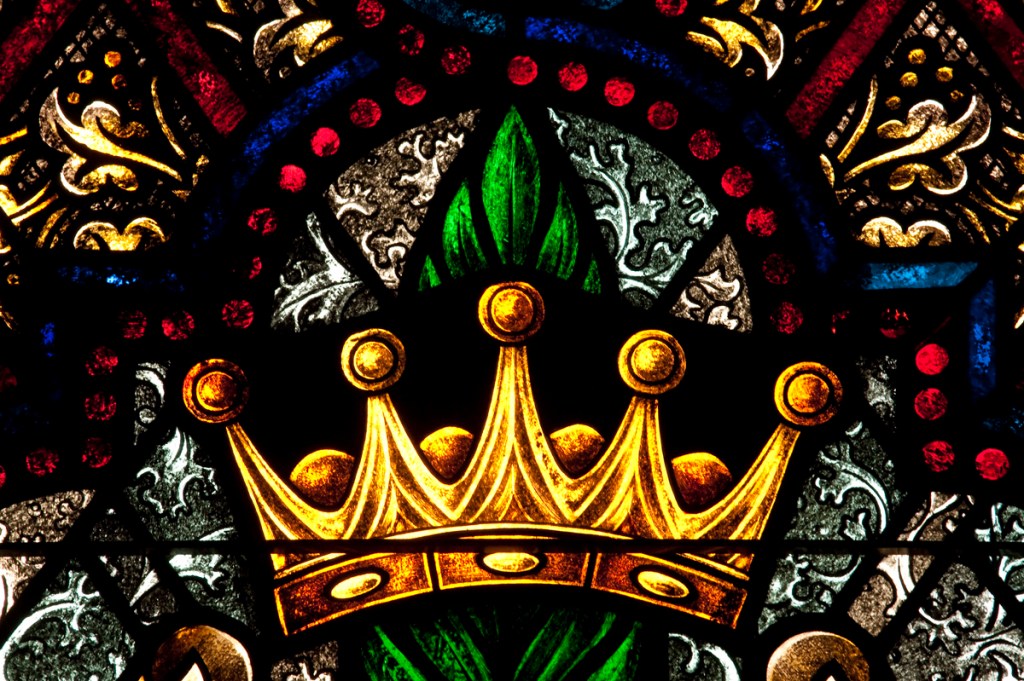
And yet, here on Christ the King Sunday, we confront the terrifying and life-giving reality that our King rules from the cross. Jesus’ throne is not built on the blood of his enemies. His throne is cruciform. The only blood it contains is his own.
Notably, Christ the King Sunday is a more recent addition to the liturgical calendar. It was established by Pope Pius XI in 1925 in large part as a response to the horrific and murderous realities of WWI and the rise of fascism all across Europe.
Celebrating the reign of Christ is but one way of proclaiming the gospel truth – If we believe that Jesus is Lord then that means something has to change about who we are and what we do.
Or, to put it simply, what we believe shapes how we behave.
The salvation wrought by cross and resurrection involves making us citizens of a time and space that is in tension with all other forms of citizenship.
The world tells us to earn all we can.
The kingdom tells us we already have what we need.
The world tells us that winners finish first.
The kingdom tells us that the last shall be first.
The world tells us that we are defined by our mistakes.
The kingdom tells us that we are defined only by our King.
It doesn’t get more political than this in church. And yet, inherent in today’s proclamation is the challenge of coming to grips with what it means to pledge allegiance to our King. We live in a democracy, we don’t know what it means to have a King.
Kings are not chosen.
So, to be clear, Jesus is not our president. And for good reason. We never would’ve picked him.
Turn the other cheek? Go the extra mile? Take up your cross and follow me?
Those don’t make for very good campaign slogans.
Contrary to how it’s been portrayed in the church or even in our wider culture, we never really pick Jesus. When all is said and done, when the King of kings and Lord of lords comes to dwell among us, we nail him to the cross.
We, to put it bluntly, pick Barabbas instead.
Which makes some of Jesus’ final words are the more powerful: “Forgive them Lord, for they do not know what they are doing.”
Jesus isn’t trying to win an election, he’s not trying to convince us of anything, he’s not offering empty promises about the next 2-4 years.
Instead, Jesus elects us to a kingdom that we would never choose on our own – he brings the future and the truth to us.
Some of us are here this morning because we can’t imagine being anywhere else. It is Sunday after all. But there’s a good chance that a whole lot of us are here because we are looking for the truth.
For as much as the kingdoms of the world are built on the blood of enemies, they are also founded on fabrications – the world is built and sold and traded on lies.
But not here.
Not in the church.
We are an outpost of the kingdom of God in foreign territory.
We are strangers in a strange land.
Many of us are suffocating under the oppressive power of deception. The powers and principalities of this world are constantly vying for our allegiances. They do everything in their power to convince us that power come through strength, that tribalism will rule the day, and that the most important animal is either a Donkey or an Elephant. It’s why so many of us now dread the Thanksgiving table because it forces us to confront that wayward uncle with the undesirable political opinion who, with every extra glass of wine, continues to say things that boil our blood.
The Donkey and the Elephant can’t and won’t save us. They, in large part, exist to instill a sense of freedom that actually results in isolation. They attempt to rid us of our baptismal identities to tell us that our political identities are more important. They promise a salvation that just leads to more division.
But here’s the Good News, the really really Good News: Our King rules from the throne of the cross, the Lamb of God who comes to take away the sins of the world, ours included.
And that’s why Jesus laughs.
Jesus laughs at our foolishness in thinking that we can save ourselves, that we can fix all the problems in the world.
You want to know what’s wrong with the world? We are!
When the bonds forged by the names on our bumpers become more determinative than the bonds that are forged in baptism, then we have fallen prey to the elephant and the donkey in the room.
But we are Jesus people! We believe that telling the truth is the beginning of a revolution of the heart. We confess Jesus as our Lord which means that the most important political animal is Lamb of God!
Jesus is the truth incarnate come to set us free. Thanks be to God. Amen.
This week on the Strangely Warmed podcast I speak with Josh Munnikhuysen about the readings for the Reign of Christ [B] (2 Samuel 23.1-7, Psalm 132.1-18, Revelation 1.4b-8, John 18.33-37). Josh serves Trinity UMC in Orange, VA. Our conversation covers a range of topics including liturgical history, DUNE, soundtracks, last words, running with the sun, the undoing of death, clean hearts, righteous clothing, atonement, the already but not yet, contrasting kingdoms, the son of the father, and lives of reflection. If you would like to listen to the episode or subscribe to the podcast you can do so here: The King of the Kingdom
This week on the Strangely Warmed podcast I speak with Josh Munnikhuysen about the readings for the 25th Sunday After Pentecost [B] (1 Samuel 1.4-20 1 Samuel 2.1-10, Hebrews 10.11-25, Mark 13.1-8). Josh serves Trinity UMC in Orange, VA. Our conversation covers a range of topics including door stoppers, double dipping, the importance of names, John Behr, the theology of death, singing the faith, prophetic calls, the “S” word, Good News, blessed assurance, Little Red Riding Hood, and apocalyptic language. If you would like to listen to the episode or subscribe to the podcast you can do so here: The Playlist of Faith
Naomi her mother-in-law said to her, “My daughter, I need to seek some security for you, so that is may be well with you. Now here is our kinsman Boaz, with whose young women you have been working. See, he is winnowing barley tonight at the threshing floor. Now wash and anoint yourself, and put on your best clothes and go down to the threshing floor; but do not make yourself known to the man until he has finished eating and drinking. When he lies down, observe the place where he lies; then, go and uncover his feet and lie down; and he will tell you what to do.” She said to her, “All that you tell me I will do.” So Boaz took Ruth and she became his wife. When they came together, the Lord made her conceive, and she bore a son. Then the women said to Naomi, “Blessed be the Lord, who has not left you this day without next-of-kin; and may his name be renowned in Israel! He shall be to you a restorer of life and a nourisher of your old age; for your daughter-in-law who loves you, who is more to you than seven sons, has borne him.” Then Naomi took the child and laid him in her bosom, and became his nurse. The women of the neighborhood gave him a name, saying, “ A son has been born to Naomi.” They named him Obed; he became the father of Jesse, the father of David.
In the days when the judges were judging, there was a famine in the land. That’s how this book in the Bible begins. It was a time of political chaos, with the Philistines pressing in on the boundaries of Israel. Sure, the Lord raised up Judges to help guide, shape, and lead the people, but by the time Ruth’s story starts, “there was no king in Israel, and everyone did what was right in their own eyes.”
What a proposition!
And it’s here against the background of nation rising up against nation, leaders failing again and again, and a famine on a massive scale, that scripture tells of a small little domestic tale with three primary people – Naomi, Ruth, and Boaz.
This is an ordinary story with ordinary people. It concerns the little hopes and dreams of a few people who easily could’ve been lost to the sands of time, and I think that’s why people gravitate to the story.
This little book shows what Karl Barth called, “the simplicity and the comprehensiveness of grace.”
Or, to put it another way, Ruth’s story is prophetic.
It is prophetic because it tells the truth of who God is in relation to God’s people.
So here’s the story:
Naomi and her husband are Hebrews from the village of Bethlehem (ever heard of it?). But when the aforementioned famine hits the land, they are forced to leave in search of food. They go into foreign territory where the Moabites lived, and during their time in Moab, their sons marry Moabite women named Orpah and Ruth.
And things are good, until they aren’. In short order all of the men are dead. Naomi is left in one of the most vulnerable conditions possible at the time – she is a childless widow with no grandchildren. Naomi believes she has been abandoned by God because of her fate and she has no hope in the world.
Before we jump to the meat of the tale, it is important to rest in the knowledge that this story begins in the dark. That is, the threats of fear, hunger, death, loom large over our people.
Naomi therefore urges her two daughters-in-law to stay in Moab because she will be returning to her homeland. Orpah agrees, and decides to stay. But Ruth, inexplicably, refuses to leave her mother-in-law.
Where you go I will go, your people will be my people, and all that.
To be clear, this doesn’t make any rational sense! Ruth chooses to align herself with hopelessness. She has every opportunity to seek out any opportunities, but instead she wills to be among those considered the last, the least, the lost, the little, and probably the dead.
The women, Naomi and Ruth, return to the land of Naomi’s people and the famine has ended, but their situation makes it such that they do no have access to the newfound abundance. And yet Ruth, living into her wild recklessness volunteers to enter the fields to glean barley. She takes on the mantel of a beggar with all of the humiliation and danger that it entails.
And then Boaz enters the story. Boaz owns the field from which Ruth seeks out sustenance. He catches her taking what has been left behind by the reapers of the harvest and he orders his men not to stop her and cast her into the darkness, instead he orders her to be protected by his men!
Why? If this were a Netflix series (which, for what’s its worth, this would be a great show), Ruth would be a beautiful young woman who catches Boaz’s wandering eye. But that’s not what scripture tells us. Boaz is not captured by her beauty, but instead by her fidelity, her faithfulness. Ruth wants to know why he is treating her so kindly and Boaz says, “I know what you have done for your mother-in-law, how you left everything you knew to become a stranger in a strange land – may the Lord bless you and keep you.”
Ruth returns to Naomi with her bountiful harvest, with tales of Boaz and when Naomi puts two and two together, she hatches a plan for the future.
“Get dressed up,” she tells Ruth, “and go down to the threshing floor where the men will be eating and drinking. Find out where Boaz lies down and go to him, uncover his feet, and lie down beside him.”
What reckless advice! Sending a young single woman into such an establishment with such instructions! And yet Ruth, as noted, is bold and daring enough on her own. So she agrees to the plan that will eventually shape an entire people.
Boaz, later, having enjoyed the fruit of the vine, lies down to sleep. Time passes and he wakes up to the young woman from the filed uncovering his feet (I’ll let you imagine what that means). The details of what transpire that night are unknown to us save for the fact that Boaz and Ruth get married, and they have a son whom they name Obed (which means worshipper).
Naomi, now a grandmother, rejoices with the other grandmothers in town as they huddle together taking turns holding this little child. “Blessed be the Lord God of Israel, for he has given you this gift! May he be to you a restorer of life!”
Obed, who became the father of Jesse, who became the father of David. The end.
What a story!
And yet, why do we tell it again and again and again? Sure, it can entertain, and it is filled with all the markers of a powerful tale. It’s got intrigue, and mystery, and love, and hope. But why do we dare to proclaim this as God’s Good News for the world?
Well, in part, we tell this story because without it there is no David, the great king of Israel, the one who defeated Goliath and the one who united the people of God.
But we also tell this story because it is a story about us.
At every turn there are choices being made that run counter to the notions of the world. Ruth chooses to remain in a hopeless situation, Boaz chooses to become a redeemer to a foreign beggar, and Ruth and Boaz together become bearers of God’s grace in a world that is otherwise run on violence, selfishness, and greed.
Our world, then and now, is full of famine and death and dereliction and a host of other evils. Often, like for Naomi and Ruth at the beginning, it can feel as if God has abandoned us. But then this story which is our story, reminds us that God’s blessing often come through the simplest, and yet the most profound, means.
When we reach out in love to help the other, it is the hand of God.
When we forgive those who have trespassed against us, it is the mercy of God.
When we are given hope in an otherwise hopeless situation, it is the power of God.
Today, there are still systems that actively reduce people to being among the last, least, lost, little, and dead. The great famines of scripture are made manifest by the powers and principalities that have no regard for our humanity.
And the church can break the mold of the world that continues to run on that devastation of destruction. The prophets, since the beginning, have been those who are willing to care for and reside among the most vulnerable. They did, and do, so because God is in solidarity with the “least of these.” The church has this blessed opportunity to provide a new image of a new community where there is space for everyone, where gifts are cherished, and where systems of oppression are called into question and rendered null and void.
The church, at her best, is a storied enterprise – that is, she exists because of the story and lives by telling the story – the story of us.
Here’s our story:
Time and time again, we reject that which is offered and given freely by God.
Paradise, rejected for the taste of a little knowledge dangling from the tree. (Creation)
Unified Community, rejected for selfish desires of power. (Babel)
So God set out to make a new people in a new land through Abraham and covenant. It is God’s hope to draw all people into this new people.
But Israel, like us, will have none of it! She is just as rebellious and foolish as we are. She worships at the altars of other gods, moving from one bit of idolatry to the next. And yet, even in the midst of ruin, Israel receives the very greatest gift of all – God in the flesh.
Jesus Christ, the incarnate One, fully God and full human, becomes all that God ever hoped for from God’s people – the obedient and faithful child, called out of Egypt, the new cornerstone of a new community made possible by peace, grace, and mercy, the Davidic king who exists to protect the poor and the vulnerable.
But we will have none of that either! On a tree in a place called The Skull, we nail God in the flesh, rejecting the elected One. He is buried dead and a tomb – utterly forsaken and abandoned.
But then, three days later, God gives him back to us. Jesus raises victorious not only over death, but also over all of our prideful attempts to become the center of our own universes.
That is the story that is worth repeating because it is a story that repeats itself. We reject God and God is determined to elect us. We destroy ourselves and God is determined to bring about resurrection. We get all sorts of lost and God is determined to find us over and over again.
In the end, that’s what prophets do – they tell the story, they tell the truth. They open our eyes to who and whose we are. And Jesus, the greatest prophet of all, is, in himself, the story for a people who have no story.
Therefore, when we read and encounter Naomi, Ruth, and Boaz, we do so not as people to emulate literally. Leaving to go be a stranger in a strange land, getting dolled up for the threshing floor, is maybe not the best advice in the world.
And yet, we cannot help from identifying with these people.
Perhaps you’re like Naomi insofar as you feel like you have been abandoned and that you have no hope in the world. Maybe God is proclaiming this story for you today such that you would be encouraged to reach out for help, or at the very least, accept the help that might be offered to you by others.
Or perhaps you’re like Ruth insofar as you have a little boldness in you but don’t know where to direct it. Maybe God is proclaiming this story for you today such that you will take that first step toward someone in your life, and become the hope for them that they so desperately need.
Or perhaps you’re like Boaz insofar as you have been blessed to be a blessing to others. Maybe God is proclaiming this story for you today such that you can open your eyes to the people in your life for whom you can be their restorer of life.
Or perhaps you don’t identify with any of them right now. But chances are, you will someday. That’s the beauty of story, we can return to the same story again and again and discover something new each time we do.
In the end, we worship an odd God. Consider: God chooses to align things such that Ruth, a foreigner with no hope in the world, became the great-grandmother of the great King David. And, how odd, that in the fullness of time, God chose to take on flesh in that same little town of Bethlehem, through Jesus Christ, the greater restorer of life, the ancestor of Ruth.
All that we are rests on the story found in the strange new world of the Bible. It is a story we recount week after week, year after year, because through it we discover who we are and whose we are. We must tell this story in order to know and to receive the Good News.
Ours is a storied faith.
So, like the prophets before us, like the prophet that is Jesus Christ, let us tell the story. Let us tell the story when we are up and when we are down, when all is well and when all is hell. Let us tell the story when we are received and when we are nowhere believed. Let us tell the story until sinners are justified, until the devil is terrified, until Jesus is magnified, and until God is satisfied! Amen.
This week on the Strangely Warmed podcast I speak with Joanna Paysour about the readings for the 24th Sunday After Pentecost [B] (Ruth 3.1-5; 4.13-17, Psalm 127, Hebrews 9.24-28, Mark 12.38-44). Joanna serves at Trinity UMC and Greene Memorial UMC in Roanoke, VA. Our conversation covers a range of topics including coaching connections, problematic relationship advice, Reba McEntire, pots and pans, letter writing, priests, sin removal, eager waiting, cultures of call, anti-stewardship, and power cocoons. If you would like to listen to the episode or subscribe to the podcast you can do so here: Beware The Preacher
This week on the Strangely Warmed podcast I speak with Joanna Paysour about the readings for the 23rd Sunday After Pentecost [B] (Ruth 1.1-18, Psalm 146, Hebrews 9.11-14, Mark 12.28-34). Joanna serves at Trinity UMC and Greene Memorial UMC in Roanoke, VA. Our conversation covers a range of topics including cheesy novels, the tenacity of human relationships, relevance, wedding texts, biblical agency, praise, faithful children, bloody hymns, at-one-ment, the words of life, and the end of questions. If you would like to listen to the episode or subscribe to the podcast you can do so here: God Goes Buck Wild
This week on the Strangely Warmed podcast I speak with Jason Micheli and Teer Hardy about the readings for the 22nd Sunday After Pentecost [B] (Job 42.1-6, 10-17, Psalm 34.1-8, Hebrews 7.23-28, Mark 10.46-52). Jason serves Annandale UMC in Annandale, VA and Teer serves Mt. Olivet UMC in Arlington, VA. Our conversation covers a range of topics including podcast statistics, popular theologians, ashy repentance, feasting on the Word, constant communion, The Holy Mountain, faithful architecture, the manifestation of mercy, and Karl Barth. If you would like to listen to the episode or subscribe to the podcast you can do so here: The Altar Is The Whirlwind
This week on the Strangely Warmed podcast I speak with Jason Micheli and Teer Hardy about the readings for the 21st Sunday After Pentecost [B] (Job 38.1-7, Psalm 104.1-9, 24, 35c, Hebrews 5.1-10, Mark 10.35-45). Jason serves Annandale UMC in Annandale, VA and Teer serves Mt. Olivet UMC in Arlington, VA. Our conversation covers a range of topics including reunions, graphic novels, preconceived notions, agency, majestic clothing, parodic embodiment, political projections, the theology of worship, and John Howard Yoder. If you would like to listen to the episode or subscribe to the podcast you can do so here: Lift High The Priest
This week on the Strangely Warmed podcast I speak with Seungsoo “RJ” Jun about the readings for the 20th Sunday After Pentecost [B] (Job 23.1-9, 16-17, Psalm 22.1-15, Hebrews 4.12-16, Mark 10.17-31). Seungsoo is the Associate Director of Serving Ministries for the Virginia Conference of the UMC. Our conversation covers a range of topics including Survivor, divine anger, prayer droughts, proper terror, the spiderweb of scripture, grammatical turns, sharp swords, wealthy Christians, and the gift of salvation. If you would like to listen to the episode or subscribe to the podcast you can do so here: The Divine Yet




 think and let think