What’s Right With The Church?

Psalm 84

How lovely is your dwelling place, O Lord of hosts! My soul longs, indeed it faints for the courts of the Lord; my heart and flesh sing for joy to the living God. Even the sparrow finds a home, and the swallow a nest for herself, where she may lay her young, at your altars, O Lord of hosts, my King and my God. Happy are those who live in your house, ever singing you praise. Happy are those whose strength is in you, in whose heart are the highways to Zion. As they go through the valley of Baca they make it a place of springs; the early rain also covers it with pools. They go from strength to strength; the God of gods will be in Zion. O Love God of hosts, hear my prayers; give ear, O God of Jacob! Behold our shield, O God; look on the dace of your anointed. For a day in your courts is better than a thousand elsewhere. I would rather be a doorkeeper in the house of my God than live in the tents of wickedness. For the Lord God is a sun and shield; he bestows favor and honor. No good thing does the Lord withhold from those who walk uprightly. O Lord of hosts, happy is everyone who trusts in you. 

What’s right with the church?

That’s what it said at the top of a word document on my laptop this week while I was working on this very sermon in a coffee shop.

The flashing cursor mocked me with every passing second as I sought to answer my own question: What’s right with the church?

Because, of course, all I could think about was what’s wrong with the church.

It’s archaic, it doesn’t meet my needs, it’s not relevant, it’s full of hypocrites. 

Or so I’ve been told.

There’s this statistic that haunts me, and I shared it with this congregation on my first Sunday – The average person in a Methodist Church invites someone else to worship once every 38 years. Now, there are plenty of reasons why that’s the case. It’s not easy inviting someone to church, it can feel uncomfortable, we don’t want others to think we’re making assumptions about them. But I think it’s also uncomfortable because we’ve become consumed by what’s wrong even though we, who are here right now, are the very people who go to church.

Anyway, I was sitting in the coffee shop, staring at my non-existent sermon, when I overheard behind me the beginnings of a conversation about, of all things, what’s wrong with the church!

Now, I tried to be a good person, a good Christian, and mind my own business, but they were talking about my business so I made it my business to hear more about their business.

Here’s the first thing I heard: “Can you believe he had the nerve to say something like that, from the pulpit? And he calls himself a preacher!”

Friends, I prayed it that moment, “Lord, please don’t let them be mine!”

And, thanks be to God, when I looked over my shoulder I didn’t recognize them.

So I tried to refocus, get back to the sermon, but I was hooked.

“And the people are so judgmental,” the other person responded, “They only care about themselves and their own problems.”

It went on like that for some time and eventually they went outside to sit at their own table.

I tried, I promise, I tried to work on this sermon but I couldn’t get their words out of my head and before I knew what I was doing, I packed up my things, walked out the door, and went straight over to their table.

I said, “I apologize, I shouldn’t have been listening to your conversation. But I’m a pastor myself and I just have to ask: If there are so many things wrong with the church, then why do you keep going?”

And without missing a beat one of them said, “Because it’s where I hear Jesus.”

What’s right with the church? It’s a far more interesting question than what’s wrong. All of us have examples of what’s wrong – a time we’ve been hurt, a sermon that went too far, on and on. 

The church is broken because it is filled with broken people. 

And yet, listen to the psalmist – How lovely is your dwelling place, O Lord! My heart and flesh sing for joy to the living God! Blessed are those who sing to the Lord. I would rather be a doorstop in the house of God than live in the land of wickedness!

There must be something right with the church, otherwise none of us would be here.

I never really had a choice about being a Christian. My earliest memories are synced up with the rhythms of church life from standing on pews during worship, to dressing up for Christmas pageants, to hunting for Easter eggs on the lawn.

As a kid, my answer to the question at hand would have been: The church is fun! Where else do we get to spend time on a regular basis hearing about the remarkable stories of God with God’s people? Where else will adults willingly make fools of themselves for the sake of sharing the Good News? For me, the church has always been the nexus of faith and joy in which I learned about who and whose I am in ways that were fun and exciting.

I am a product of the church. That is, I am who I am because of the liturgies and the scriptures and the songs and the prayers and the people who make the church what it is. The continued presence of the church in my life, and its influence over my actions and my choices is an ever present reminder that the choices made for us and in spite of us are often of more lasting consequences than the choices made by us.

In other words, we like to think that we choose God, when in fact God is the one who chooses us.

The church is the place where people discover the truth that God is on the move searching in the bushes of life for those who are lost. Which, to be clear, includes each and every one of us. Sure, we might experience the divine in all sorts of other spaces and places, but it is here where we learn the language to articulate those experiences. 

It might take one Sunday, it might take a lifetime of Sundays, but at some point we realize that God is the one who found us, and not the other way around.

As I got older, I might’ve answered the question about what’s right with the church by saying: the music! We’re Methodists! We sing our faith! The words and the melodies of our music are transcendent and they tune us into God’s frequencies in the world. It is a rare Sunday that I am not bowled over by some part of church music whether its because I’m connected to a memory of the past or I’m casting vision of a future in which whether or not I’m around these songs will endure.

Music gives us the space to experience what we believe and how we pray when we don’t know how to put those things into words – music gives us the opportunity to feel whatever it is that we are feeling without feeling like we’re not allowed to feel what we feel. 

Recently, my answer might’ve been something along the lines of how the church is an alternative community in and for the world. We’re different. We’re different because we believe God’s future, what we call the kingdom, is already intermingling with the present and we’re different because we believe we’ve been given a new past in which we are no longer defined by what we’ve done or by what has been done to us.

But most of all we are different in terms of story. The story called Gospel is not something we own, or control, or earn, but is simply a gift we’ve received. The Gospel tells us we’re more than our mistakes and that there’s more in store because we know how the story ends.

But if you asked me today, “What’s right with the church?” My answer would be: Jesus.

Jesus is what’s right with the church.

It is because of Jesus that we have hope and we have community. And hope and community are rather counter-cultural words and ideas these days. They might not seem very different, but the world provides us with the opposites: doom and isolation.

The pandemic has only furthered our division from one another, while terrifying us about whatever might come around the corner next, while we sequestered ourselves into bubbles.

But, in Jesus, we are given hope and community because the church embodies hope and community.

We call the Good News good because it is, in fact, Good News. Despite a rather sordid history, the church doesn’t exist to wag its finger at Christians for doing certain things or not doing certain things enough. 

The church exists to tell the truth! God, author of the cosmos, came to dwell among us through the least likely of families, in order to teach and live and heal and preach and provide a vision of a new reality that, when push came to shove, led to our rejection of the truth through the cross, but then Jesus was given back to us three days later and his resurrection is now our promised resurrection.

That truth gives us both the courage and the conviction to live not for ourselves, but for the sake of others. When we consider God’s humility (read: humiliation) for us, it starts to change the way we see and interact with each other. We start to do all sorts of strange things like give away food to people who are hungry, and provide friendships to the lonely, and hope to the hopeless. 

The church can be, and is, the place for life-altering blessings because the church is Jesus Christ’s body for the world.

We, today, have the blessed and remarkable opportunity to be what we’ve always been called to be: different. We, the church, model God’s future in the present. We don’t see one another through the lens of cultural controversies but instead through the mercy, grace, and love of God. 

We can do this because we have the scriptures and the songs and the psalms and even the sermons that do not exist as a brief reprieve from the harsh realities of life but instead they make our lives intelligible in the first place. 

In short, the church is called to be a community of ordinary virtues – that is, we live by grace. 

Thus, we are not just a group of people who get together for an hour once a week who happen to believe in love, and peace, and liberation, or any other abstraction. 

Instead, we are a complicated people complicated by a complicated story of a young Jesus from Nazareth who lived, taught, suffered, died, and rose for us and for the world.

Church, contrary to how we might imagine it, isn’t a noun – it’s a verb. Church is something we do and it is something done to us.

What’s right with the church? In spite of all its weaknesses and shortcomings, it is the church where we get to hear Jesus remind us about the love of God that refuses to let us ago, about the waves of mercy that never stop coming, about the grace to flourish into who God has called us to be.

This is the place where we hear Jesus tell us the things we need to hear most of all: You have value – you have worth – you are more than your mistakes – you are forgiven.

So, to those of you who love the church – make more room for it, bring to it your best and highest devotion. Pray fervently for its renewal and commitment toward being Christ’s body in the world. In short, love because you are loved.

And to those of you are still unsure about the church – we are not yet what we can be without you. Help us make the church better. Encourage us to open our eyes to the ways in which God is living and moving and speaking in the so that we can really be the church God is calling us to be. 

How lovely is the dwelling place of the Lord of hosts! My soul longs, indeed it faints for the courts of the Lord; my heart and flesh sing for joy to the living God because this is where we hear Jesus! Amen.


The Unholy Club

This week on the Strangely Warmed podcast I speak with Josh Munnikhuysen about the readings for the 14th Sunday After Pentecost [B] (Song of Solomon 2.8-13, Psalm 45.1-2, 6-9, James 1.17-27, Mark 7.1-8, 14-15, 21-23). Josh is the pastor of Trinity UMC in Orange, VA. Our conversation covers a range of topics including Karl Barth, uncomfortable texts, Ted Lasso, bald prophets, the BCP, honesty, sin sniffing, the brother of the Lord, church graffiti, and table fellowship. If you would like to listen to the episode or subscribe to the podcast you can do so here: The Unholy Club

Making Melody

Ephesians 5.15-20

Be careful then how you live, not as unwise people but as wise, making the most of the time, because the days are evil. So do not be foolish, but understand what the will of the Lord is. Do not get drunk with wine, for that is debauchery; but be filled with the Spirit, as you sing psalms and hymns and spiritual songs among yourselves, singing and making melody to the Lord in your hearts, giving thanks to God the Father at all times and for everything in the name of our Lord Jesus Christ. 

The priest sat in the deep of the ship as the storm raged above. He tried his best to remain steady as the ship rocked back and forth with every gust of wind and the waves were relentless. Supplies and cargo rolled in every direction and panic was grabbing hold of the passengers.

A nearby mother with a tiny infant nestled in her arms begged the priest to baptize her baby right then and there in fear that they would not survive the storm. Everywhere he looked all he saw was terror and fear.

And then, strangely enough, he heard singing coming from a group of Moravians, German Christians. Meanwhile the main mast split in two but the sound of the tiny little choir reverberated and resonated deeply in the wooden hull of the ship.

Days later, when the sun finally returned in the sky, the priest found the group of singers and asked why they were not more afraid during the storm.

They replied, “We are not afraid to die. We are prepared because we know God will never let us go.”

Afterward the priest was deeply moved and wrote in his journal: This was the most glorious day that I have yet seen.

It was 1736 and the priest’s name was John Wesley.

Music had always been a part of Wesley’s life but something in him changed that day. Today, the people called Methodists are those who know what it means to sing our faith in large part because of what took place on a ship long ago.

Music is a truly remarkable thing. It can make us laugh, it can make us cry, it can bring forth emotions we didn’t even know we had access to.

If someone puts on the Vince Guaraldi Trio I am immediately transported to Christmas Time Is Here, Charlie Brown, and all the other things that make that season the most wonderful time of the year.

If someone starts spinning some Supertramp or Queen or Fleetwood Mac then my entire extended family will start flipping tables and chairs until we’ve made enough space for a dance floor.

Even Karl Barth, the great Swiss theologian of the 20th century, when asked by a student what he learned after an entire career in theology he responded: “Jesus loves me this I know for the Bible tells me so.”

Music is powerful stuff, and Paul tells us that being filled with the Spirit necessarily results in the making of melody.

Years ago, while on a mission trip to New Orleans, I was tasked with spending the afternoon in a nursing home and proctoring a session of Bingo. The youth and I tried our best to liven up the place a little bit but the whole thing was tragic. Residents of the memory care unit were staring off into space, using the laminated cards to fan themselves, and totally unconnected from just about anything.

Until we found a forgotten and worn out hymnal on a shelf in the corner. I pulled the youth close and we started singing all the great hymns we knew without even really needing to look at the hymnal.

By the time we made it halfway through The Old Rugged Cross, every eye in the room was on us, and when we rounded the second to last verse of Amazing Grace some of the residents were singing with us, and when we landed the last note of Great Is Thy Faithfulness, more than a few people had tears in the eyes.

Including the orderlies and assistants who later told us that it was the first time they heard many of the residents actually say anything at all.

The science is all there about how our neural pathways change, literally rewrite themselves, whenever music is performed or consumed. Music changes things and gives us access to things we otherwise wouldn’t have.

But this is nothing new.

Again and again in the strange new world of the Bible we discover how music rests at the heart of what it means to be connected with the divine. Moses and the Hebrew people sing songs of praise after being delivered from slavery to the Promised Land, David plays the lyre in order to calm the anxieties of King Saul, and Paul and Silas are in the middle of singing when an earthquake sets them free from captivity.

Music is often the gateway to unanticipated blessings.

Paul writes near the conclusion of his letter to the church in Ephesus about being careful about how they live and to make most of the time they’ve been given. This is not merely a call to “seize the day” but more a recognition that life is a gift and that we have much to be grateful for. 

When the Moravians were singing on the boat – they weren’t being fools living in denial of the situation they found themselves in, they were not naive. Instead they held fast to the promise made to them in Christ that nothing in this life, not even a storm upon the sea, can ever separate us from the love of God.

It’s all too easy to take most of Paul’s letters and turn them into an exhortative exercise. As in, someone like me will stand in a place like in order to get people like you to start behaving yourselves. Which is all good and fine, but that’s not actually what the letter is doing.

Paul doesn’t tell the Ephesians to do this that and the other in order to be Christians, but rather he tells them to do all these things because they are Christians. And that’s an important distinction. Paul urges them to make the most of their time, and put away foolishness, and sing with one another not to become Christians but because they are Christians.

All of the stuff we do as Christians, from praying to singing to serving isn’t to get somewhere with God, or to earn God’s favor; we do these things because, in Christ, we already belong to God. Living like this is just what kind of happens when grace grabs hold and refuses to let go; we can’t help but make melody together.

So lets do it…

The first music was percussive. Drums were used to tell stories and eventually communicate over distances of space and time. But somewhere along the line, it was discovered that if you changed the tightness of a drum it would create different pitches – pitches that could eventually become a melody.

Strictly speaking, a melody is a sequence of single notes that are musically satisfying. What makes the connection between the notes satisfying is how they relate to one another, something we might call harmony – which is exactly what we’re going to try to produce right now…

[We broke the sanctuary into four quadrants and gave each section a note to sing C-E-G-C in order sing a harmonic chord)

As we come to the conclusion of our series on Paul’s letter to the Ephesians, it’s notable that Paul didn’t start that particular church. In fact, they were strangers to one another when he shows up in the book of Acts.

In other words, they didn’t pick him.

Sound familiar?

And yet, what wildly wonderful good news! God delights in gathering together people who otherwise have nothing in common save for the fact that Jesus calls them friends. Paul reminds us again and again and again that we, with all our differences, can actually make melody and harmony together because God is in the business of making something of our nothing. 

In many ways, God is the great conductor of an orchestra we call the church in which we are all given instruments to play however we see fit, all while God keeps us in rhythm with each other. When we begin to see, and to hear, how we make music together, it starts to reshape everything else about our lives. 

Strangers become sisters and others become brothers.

We, who were once far off are brought near by the life, death, and resurrection of Jesus Christ.

We, who have no business being close to God at all, are incorporated into Christ’s body to be Christ’s body for the world.

And it’s because of all this work done by God for us that we can give thanks to God the Father at all times and for everything in the name of our Lord Jesus Christ. 

Gratitude, like music, changes things.

We can certainly go about day to day complaining about particular individuals who drive us crazy, we can lament the need to mow our lawns, we can even grumble about having to help our kids with their homework.

Or, with gratitude, we can reframe it such that we get to be connected with the strange and wondrous and confounding human beings around us, we get to spend time outside communing with creation, and we get to sit down with our kids and watch their minds grow and change before our very eyes.

Music and gratitude are not distractions from the harsh truths of life. Instead, they give us the means by which we can experience all that life offers knowing all the while that God is, in fact with us. 

In the end, Paul is right – it is not only possible, but even necessary, that we should “always and for everything” give thanks. God transforms the darkest night and the most frightening storms into glorious day and beautiful seas. 

God can even take a ragtag group of people called church and make a melody. Amen. 

Forgiven To Forgive

Ephesians 4.25-5.2

So then, putting away falsehood, let all of us speak the truth to our neighbors, for we are members of one another. Be angry but do not sin; do not let the sun go down on your anger, and do not make room for the devil. Thieves must give up stealing; rather let them labor and work honestly with their own hands, so as to have something to share with the needy. Let no evil talk come out of your mouths, but only what is useful for building up, as there is need, so that your words may give grace to those who hear. And do not grieve the Holy Spirit of God, with which you were marked with a seal for the day of redemption. Put away from you all bitterness and wrath and anger and wrangling and slander, together with all malice, and be kind to one another, tenderhearted, forgiving one another, as God in Christ has forgiven you. Therefore, be imitators of God, as beloved children, and live in love, as Christ loved us and gave himself up for us, a fragrant offering and sacrifice to God. 

I am convinced that the crucible of Sunday morning worship doesn’t actually happen in this space, but takes place in the 5-10 minutes immediately following the service, and the email inbox on Monday mornings.

Yes, what we do in our hour together is powerful and faithful and transformative. We gather, we proclaim, we respond, we are sent forth. That’s all good and fine.

But it’s in the time after our time in here that really shows what happened during our time together.

The Sunday morning debrief, otherwise known as the receiving line following worship, is  wonderful, bewildering, and terrifying.

More often than not someone will make a comment about the weather or about lunch plans. A few of you have noted, as of recent, that it hasn’t rained since I arrived in town, so thanks for trying to pin that on me. Good stuff.

Occasionally I’ll hear something profound like, “I really heard God speak today” or, “You really gave me something to think about.” Good stuff.

But every once in a while I hear a comment that cuts through all the rest. Someone, usually waiting until most people clear out, will step forward and say something like, “I didn’t like it. But I’m not sure which part I enjoyed less, the sermon or the scripture.”

And, frankly, I can’t blame those who feel that way. Have you read the Bible? Be careful! There’s some wild stuff in there.

Two female bears descend from the wilderness and maul 42 young boys for making fun of a bald headed prophet (2 Kings 2).

A preacher goes on a little too long while a young man dozes in a window and then he falls out of said window to his death (Acts 20).

God commands a prophet to walk around naked for three years as a sign against foreign nations (Isaiah 20).

And those are just the first three that come to mind!

But even Jesus has a penchant for strange stories.

God is like a shepherd with 100 sheep. And, when one sheep goes missing, the Good Shepherd delights in leaving the 99 behind in order to find the one who is lost.

That’s a quaint little story, one we teach to our children. But you know what happens when you leave the flock behind to go in search of the one missing? It only guarantees 99 more lost sheep! That’s no way to run a shepherding business.

God is like a sower who sows seeds all over the place regardless of the soil upon which the seeds land. 

That’s another nice one, it’s good imagery for those who enjoy gardening. Except, if you ask anyone who has spent any time with agriculture, that’s no way to do it. It’s a tremendous waste of seeds if you toss them onto the sidewalk and what about tiling the soil and moisture management? God, apparently, doesn’t have a very green thumb. 

Or how about this one: 

Two men enter a temple to pray, one a Pharisee – a man committed to the word of the Law, attentive to the demands of scripture, he gave a tenth of all he had to the poor and needy, prayed, fasted, and kept himself clean. He could’ve run for office without fear of anyone finding a skeleton in his closet. He was proud of being who he was.

The other man was a reprehensible tax collector, a publican, taking money from his own people and giving it to the empire, a political traitor, he was dirty. The kind of man no one made eye contact with. 

And that day the Pharisee saw the good for nothing tax collector and declared, in prayer, “Lord, thank you that I am not like him!” Meanwhile, the tax collector, with fear and trembling, prayed, “Please God, have mercy on me, a sinner.” And the tax collector walked away forgiven, justified.

I mean, Jesus, what kind of ship are you running? That’s not fair! You keep telling stories like that and no one will want to do any of this religious stuff. It’s irresponsible. The parable of the publican and the pharisee is all wrong. It’s the Pharisee that should walk away forgiven, he’s done all the right things. And the the publican, he should’ve been thrown in jail, or at the very least, kicked out of town by the very people he swindled.

You know, two weeks ago I decided to retell the parable of the prodigal and one of you came up to me after the service and said, with good intentions I think, “Well, I can’t believe you said the F word in church.”

Friends, I confess that for the briefest of moments I had to think back – Did I, a preacher of the Word, use such a word in my sermon?

But before I had a chance to respond this person said, “Forgiveness. What a dangerous word: forgiveness.”

Paul writes to the budding church in Ephesus about the positive and negative consequences of the great shadow that God casts upon the lives of disciples. When God grabs hold of us, everything changes whether we want it to or not. Somewhere along the line we discover that God, bewilderingly, has given us a sacred and indestructible trust – we are stuck with the body of Christ. 

It’s not easy being stuck with people, especially with pharisees and tax collectors. It’s a challenge to be among such individuals, and yet here we are, surrounded by sinners and scoundrels alike. 

But it is when discipleship becomes challenging that we know the mercy of God is at work in our lives. The weight of all these weighty expectations that Paul drops on us: put away all your wrath and bitterness and slander and malice, be kind and tenderhearted, forgiving one another as God has forgiven you – the call to this kind of life is for those who know they stand in and on God’s grace alone.

Put another way – It’s only the Spirit of freedom that give us the freedom to forgive.

Why does the publican walk away forgiven while the Pharisee doesn’t? We can try to insert reasons – perhaps the publican was a man of the people, maybe he was kind in spite of all his tax collecting. And maybe the pharisee was a religious bigot, a viper, a terror to the community.

But Jesus doesn’t provide an answer to those sorts of questions. 

Forgiveness is an odd thing, and I don’t need to tell you that most of us don’t believe in it. Give us the good ol time religion, we’ll read with kids, and purchase school supplies, and feed the hungry, and all sorts of stuff. But forgive the one who has wronged us?

No thank you.

That’s irresponsible behavior! You can’t just let people get away with stuff, we can’t be too soft on sin!

What makes forgiveness so difficult?

Once, when Jesus was teaching, the disciples said, “Wait a minute JC. What you’re saying is too much for us. We need you to increase our faith!”

And what was the topic of conversation? Going the extra mile? Turning the other cheek? Praying for our enemies? No. Jesus was talking about forgiveness.

So Peter speaks up, “Lord, perhaps we should put some limits on this whole forgiveness thing. How does 7 times sound?”

“No,” the Lord replies, “I tell you: 70 times 7 times.”

And Peter, the rock of the church, says something like, “But Jesus, if we forgive that many times, then we’ll go to our grave forgiving.”

“Right,” Jesus says, “You’ll go to your grave forgiving.”

We can’t do it Lord, increase our faith!

Forgiveness comes at a cost – a cost for the one offering forgiveness and for the one receiving. To offer forgiveness implies a willingness to truly see those who have wronged us as fellow sheep in need of a shepherd. And to receive forgiveness implies a willingness to admit that we are people who have wronged the other sheep in the fold.

Jesus routinely criticized the religious leaders of his day for all sorts of nonsense. They were hypocrites and slanderers and thieves and they kept heaping sins upon the backs of those who kept the faith. And then Jesus, God in the flesh, kept passing out forgiveness to those who asked for it and even for those who didn’t know they needed it!

Why then, do we insist on holding our grudges, big and small, when our Lord, the Good Shepherd, is forever out and about beating the bushes of life looking for some lost sheep, some tax collector, and even a pharisee to bring them back in?

Forgiveness is hard.

And yet, it negates and fulfills all righteousness.

In the end, we’re all publicans and pharisees. We facilitate between lives of honesty and lives of denial. We hold on to our anger toward one another and we also foolishly assume that no one could ever be angry at us.

The worst kind of lostness is not knowing how lost we are at all.

The worst kind of sin is to believe that we are without sin.

The worst kind of unforgiveness is to presume that we don’t need forgiveness.

But we are lost, each and every one of us. We’re stuck in the bushes of life, far removed from our shepherd, for the things we’ve done and the things we’ve failed to do. And yet, God keeps insisting meeting us where we are, in the midst of our sins, and never ever stops.

Forgiveness is dangerous stuff, but it gets even wilder because God forgives us before we even have a chance to repent. 

Consider the sheep, it’s probably going to get lost again and again and again. The sheep doesn’t say, “Oh my shepherd, I will never ever get lost again so long as you rescue me.” The sheep just says “Baa!” and the shepherd comes.

Consider the sower, scattering seeds this way and that before the soil has a chance to get itself in shape to receive the seeds that are the Word and God never stops sowing.

Consider the publican, he walks away forgiven but we don’t hearing anything about whether or not he mended his ways. He could go back day after day, 70 times 7 days, and he would walk away forgiven each and every time.

Forgiveness surrounds us in the church, it beats down upon our lives. It’s in the strange new world of the Bible, its in the prayers we pray and the songs we sing, its in the water with which we baptize and it’s in the bread and the cup that we share.

If we ever confess, it is only ever a confession to waking up to what we already have.

In other words, we are forgiven not because we make ourselves forgivable, but only because we have a Forgiver.

And because we have a Forgiver, the only One who can really offer it in the first, we can do impossible things. We can, to borrow the language from Ephesians, put away all malice and anger and strife and fear because we are members of one another, we are one body, we are Christ’s body. 

Look at us! We’re different people from different places with different faces – we are unique from one another in unfathomable ways and yet, we are all equal in this – we are sinners who have been forgiven.

In the end, the sheep who stray happen to be all of us, pharisees and publicans alike. Each and every single one of us here are in need of forgiveness, and each and every single one of us have someone we need to forgive.

It isn’t easy – it might even be dangerous. But there is something much much worse than forgiveness – a life of hatred, resentment, and selfishness.

It’s outrageous stuff, forgiveness. It just also happens to be the way Jesus runs the kingdom. Amen.

The Jesus Business

John 6.28-29

They said to him, “What must we do to perform the works of God?” Jesus answered them, “This is the work of God, that you believe in him whom he has sent.” 

I know of a Bishop (thankfully from another denomination) who used to be in charge of recruiting candidates for a local seminary. He would seek out those who felt called to ministry and he would end each and every single interview the same way: with a role play.

He would say, “Pretend I’m not someone from the seminary, but that everything else about my life is true – I’m a 50 something, over-educated, occasionally kind, straight white male. Now… tell me why I should go to church…”

Throughout the years every candidate would mention something about the value of community. But the Bishop would say, “I attend AA and I have all the community support I need.”

Then the candidates would bring up something about reaching out to those in need. But the Bishop would say, “I’m an active member of Rotary and I already help the needy.”

Finally the candidates would make a comment about the power and priority of music in the church. But the Bishop would say, “I have season tickets to the local symphony.”

He recruited for a long time and not a single candidate ever mentioned anything, specifically, about Jesus.

Contrary to how we might imagine it, the church is not in the business of societal rearrangement, we are not the paragons of community service, and we certainly don’t hoard all of the community’s musical prodigies. We may have those gifts, but if we’re serious about being the church then we really only have one thing to offer at all: God’s grace in Jesus Christ.

Which is just another way of saying: the only thing we have to do is trust (believe) Jesus. 

If the church is a business, then it is in the Jesus business. That is: we exist to proclaim the Good News, frankly the best news, that God has seen fit to rectify all we have wronged, that we are loved in spite of all the reasons we shouldn’t be, and that, in the end, we know how the story ends.

And that last claim is important. For, if we already know how the story ends, then we are freed from whatever fears and faults that terrify us. 

We are not the main thing in the church. The main thing is Jesus Christ and him crucified, God in the flesh born to live, die, and live again. And Jesus comes to do for us what we can’t, and won’t, do on our own.

It’s why we can call the Good News good. Thanks be to God.

The Mystery of Christ

Ephesians 3.14-21

For this reason I bow my knees before the Father, from whom every family on earth takes its name. I pray that, according to the riches of his glory, he may grant that you may be strengthened in your inner being with power through his Spirit, and that Christ may dwell in your hearts through faith, as you are being rooted and grounded in love. I pray that you may have the power to comprehend, with all the saints, what is the breadth and length and height and depth, and to know the love of Christ that surpasses knowledge, so that you may be filled with all the fullness of God. Now to him who by the power at work within us is able to accomplish abundantly far more than all we can ask or imagine, to him be glory in the church and in Christ Jesus to all generations, forever and ever. Amen. 

For this reason I bow my knees to the Father.

For what reason, Paul?

This is one of the challenges with lifting up these discrete passages of scripture on Sunday mornings and declaring “The Word of God for the people of God… Thanks be to God.”

That’s all good and fine, but what’s the reason Paul feels compelled to his knees?

We can, of course, flip back in our Bibles to earlier parts of the letter to the Ephesians and we can read about God delighting in bringing those who were far and those who we near together through the blood of the Lamb, we can read about the riches of God’s mercy, we can even read about the proclamation of peace made possible in Christ, but here’s the real zinger: by grace you have been saved.

By grace you have been saved.

Paul calls this the mystery of Christ.

And what, exactly makes it so mysterious? That God, author of the cosmos, would come to dwell among us, to live, and die, and live again that we might do the same – that’s confounding stuff.

Notice, too, the language – by grace you have been saved – it’s done and decided, without us having to do much of anything save trusting that it is true.

That profound promise, that decisive declaration, is enough to get Paul down on his knees in humble adoration. He’s filled to the brim with joy and gratitude, his cup runneth over as it were, because God has done what we could not have even imagined.

That might be a little tough for us to come to grips with today, with 2,000 years of church history of knowing how the story ends. But during the time of Christ, no one expected the resurrection – not the crowds, not the religious elites, not even the disciples. And yet, Easter is the transformation of all things – death no longer has dominion over us.

By grace you have been saved.

Put simply – The work of God in Christ has made it such that there is no nation, clan, family, or even an individual who is beyond the love of God.

Or, in even simpler terms: even the worst stinker in the world is someone for whom Christ died. 

Now, I know that seems like an obvious thing for someone like me to say in a place like this, but it’s a rather inconvenient truth for us to swallow. For, it implies that we don’t deserve what we’ve received. And boy do we enjoy the language of fairness.

Well, for those of you unaccustomed, God is downright unfair.

God lifts up the lowly and bring down the mighty.

God has compassion for the poor and sends the rich away empty.

God takes brokenness and turns it in value.

God looks at sin and sees redemption.

And yet, God’s unfairness is riotously Good News! 

Listen – despite how well we might strive to appear on Sunday morning, each of us bring a myriad of secret hurts, private shames, and lost hopes to worship. Our exteriors may display something different, but on the inside we’re all struggling under the weight of the world, and the weight of expectations (those we place ourselves and those placed on us).

And yet, this is what God has to say today: By grace you have been saved! Bring your pain and your shame, bring your fears and your frustrations. By grace you have been saved! It’s not up to you to ascend the mountaintop of morality. It’s not up to you to earn your way through the pearly gates. By grace you have been saved! 

This is the whole of the Bible in a sentence. Whatever else we do, praying or singing, it’s all a response to this profound and mysterious word spoken to us by the Lord.

And in order to hear this Word, really hear it deep in every fiber of our being, we need what we call the church – the great company of those who are willing to listen together – to hear it and receive it. 

It’s not something we can just believe on our own – we need it spoken to us over and over again because, of course, it sounds too good to be true. 

And that’s exactly why we gather together, and pray together, and sing together, and laugh together, and weep together, it’s all so that we might hold fast to the only really Good News we can ever receive.

It’s therefore in the knowledge of the Good News that Paul is drawn to his knees in prayer – in prayer for us.

I pray that, according to the wonderful bounty of God’s glory, you may be strengthened with power through the Spirit, and that Christ may dwell in your hearts through faith as you are being reminded of the love that meets you where you are. 

I pray that you may have the power to comprehend the breadth, length, height, and depth, and to know the love of Jesus that surpasses knowledge. 

And so to him, who is able to accomplish far more than we can ever ask for or imagine, to him be glory in the church forever and ever. 

Paul prays, across the generations of the church, that we might come to know the immense and bewildering and mysterious nature of God’s love for us.

Remember: the God we see revealed in Jesus is what God is really like, deep down, which is also to say that the God we see in Christ is what God has always been like and will always be like.

What better way can we know what God’s love is like, then, by listen to a story that Jesus tells about himself?

Listen – There was a man who had two sons.

The family business had been good to the family – the little grocery store was passed from generation to generation and the father worked hard for the store and for his sons.

And one day the younger son walks in the back office and says, “Dad, I want my share of the property right now.”

In other words, “Drop dead.”

And, strangely enough, the father responds by dividing up his assets between his boys: to the elder hegiras the property and the responsibility of the family business – to the younger he cashes in on some investments in order to hand over his half in cash.

Only a few days pass before the younger son blows all of the money in Atlantic City. The more he spent the more he lost and the more he lost the more he spent, on women, on booze, and more gambling.

His fall from grace happens so fast that he starts begging the casino owner for work.

“Sure,” the owner says, we’ve got an opening in janitorial services.

The younger son spends the days emptying trash can after trash can and even thinks about sneaking a few pieces of food from the bottom of the bags because he’s so hungry.

And eventually he comes to himself – he realizes that even the employees back at his father’s grocery store have food to eat and roofs over their head. So he packs up the little that he has, and he heads home.

The father is sitting by the front window in the grocery store, listening to his older son bark out orders to his former employees from the back room when, all of the sudden, he catches a glimpse of his younger son walking up the street. And he immediately runs out the door, tackles his boy to the ground, and starts kissing him all over his matted hair.

“Dad,” the boy struggles to say, “I am no longer worthy to be called your son.”

“Would you shut up!” The father yells, “We’re gonna close the store for the rest of the day and throw a party!”

He lifts his boy off the ground, pulls him into the store, and starts barking out orders of his own, “Murph, would you mind locking the front door?” “Hey Jim, do me a favor, find me the nicest rack of lam we’ve got and start roasting it out back” “Everyone, it’s time to celebrate, this son of mine was dead and is alive again, he was lost and now is found!”

The beer caps start flying, the radio in the corner gets turned all the way up, and everyone starts rejoicing in the middle of the afternoon.

Meanwhile, the older son is sitting in the back office pouring over the inventory and the payroll, when he starts to hear commotion down the hall. He looks up in the door frame and catches a glimpse of Jim with foamy beer stuck to his mustache while humming a tune and carrying what looks like a nice leg of lamb and the older brother shouts, “What is going on?”

Jim hiccups and says, “It’s your baby bro, he’s home, and your Dad’s throwing him a party.”

The older brothers fists tightens into a knot and he slams the door in Jim’s face.

With every passing minute his frustration and anger increases. He evens throws the older ledger book across the office, and then he hears a little knock on the door.

His dad steps into the office and says, “What are you doing back here? You’re missing the celebration!”

The older son is incredulous: “I’m doing my job Dad, in case you’ve forgotten. Look, I’ve been working like a slave for you and I’ve never missed a day of work. And yet, you’ve never thrown a party for me! But this prodigal son of your returns home, having wasted all of your money, and you’re roasting him a leg of lamb!”

The father doe-eyed happiness disappears for a moment, he grabs his older son by the collar, and says, “You idiot. I gave you all of this. You haven’t been working for me. You’ve been working for yourself! I gave your brother cash and I gave you the family business and what does your life have to show for all of it? You’re so consumed by doing what you think you’re supposed to do that you’ve lost sight of what matters.”

“But Dad…”

“Don’t you ‘But Dad’ me right now! I’m on a roll. Listen – all the matters is that your brother is finally alive again. And you? You’re hardly alive at all. Listen to the music! The only real reason you haven’t come to join us out front is because you refuse to die to all of these dumb expectation that you’ve placed on yourself. We’re all dead and having a great time, and you’re alive and miserable. Do yourself a favor, son of mine, forget about your so-called life, and come have some fun.”

The parable of the prodigal.

A story we might call unfair…

This story shows us the mystery of Christ – The father chooses to die for us, to give away his whole career and future in the parable, whether we deserve it or not. Like the younger son we don’t even have to apologize before our heavenly Father is tackling us in the streets of life to shower us with love. And like the older son, we don’t have to do anything to earn an invitation to the party, save for ditching our self-righteous snobbery.

The mystery of Christ, contrary to how we often present it in church, is that Jesus came to save sinners.

And notice: Jesus didn’t say he came to judge sinners, or even turn them into non-sinners, he said he came to save us.

The whole of the New Testament, from the parables to the epistles, makes it abundantly clear that Jesus’ salvation work only by grace through faith – not by frightening people into getting their acts together.

If the Gospel is about anything – it is about how God meets us where we are, not where we ought to be.

In the end, it’s a mystery. It also happens to be the only Good News around. Amen.

Beyond Belief

Ephesians 2.11-22

So then, remember that at one time you Gentiles by birth, called “the uncircumcision” by those who are called “the circumcision” — a physical circumcision made in the flesh by human hands — remember that your were at that time without Christ, being aliens from the commonwealth of Israel, and strangers to the covenants of promise, having no hope and without God in the world. But now in Christ Jesus you who were far off have been brought near by the blood of Christ. For he is our peace; in his flesh he had made both groups into one and has broken down the dividing wall, that is, the hostility between us. He has abolished the law with it commandments and ordinances, that he might create in himself one new humanity in place of the two, thus making peace, and might reconcile both groups to God in one body through the cross, thus putting to death that hostility through it. So he came and proclaimed peace to you were far off and peace to those who were near; for through him both of us have access in one Spirit to the Father. So then you are no longer strangers and aliens, but you are citizens with the saints and also members of the household of God, built upon the foundation of the apostles and prophets, with Christ Jesus himself as the cornerstone. In him the whole structure is joined together and grow into a holy temple in the Lord; in whom you also are built together spiritually into a dwelling place for God. 

It was a warm summer night in Washington DC. Eight friends gathered around a table in the backyard of one of their homes, there was wine and appetizers, and toasts were being made back in forth in celebration of all the good things they had going for them.

“We didn’t want the evening to end,” one of them remarked later.

But around 10pm the festivities came to a screeching halt.

A strange man wandered into the backyard with a gun, he raised it to the head of one of the guests, and demanded money.

He kept shouting for them to empty their pockets and his screaming got louder and louder.

But there was a problem.

No one had any cash.

Again, they were friends gathering in a backyard.

But their pleas for understanding only further aggravated the assailant and they all grew fearful that something terrible, truly terrible, was about to happen.

But then one of the women at the table said, rather casually, “You know, we’re celebrating here. Why don’t you have a glass of wine and join us?”

It was like a switch was flipped in the backyard and everything changed.

All of the sudden, the look on the man’s face transformed dramatically.

He sat down at the table, a class of wine was placed in front of him and he took a sip. He remarked about how good the wine was and then he reached for some bread, and before long he put the gun in his pocket.

They gathered back around the table, with one extra guest, and they continued their evening.

After some time the man said, “I think I’ve come to the wrong place.” 

They all sat in silence, listening to the insects chirping in the air.

And then he said something that no one was expecting: “Can I get a hug?”

One by one, the friends stood up and eventually they were all embracing in the backyard.

Later, the man apologized for what he had done and walked back out onto the street, still carrying the glass of wine as though it was now a part of who he was.

I first heard this story on an episode of the podcast Invisibilia, and the hosts of the pod were quick to cite this backyard encounter as an example what psychologists call noncomplementary behavior. Basically, the idea is that people naturally try to mirror one another so if someone is acting really hostile and someone is very calm, one of them will change to match the other, for good or for ill.

But in the church, we call what happened in that backyard faith.

Because faith isn’t just something we have, faith is something done to us.

Put another way: faith is a gift.

Later, when one of the backyard guests was sharing the story with the hosts of Invisibilia, he said, “We had no idea that words – an invitation to celebration – could grasp hold of someone and change them. It was like a miracle.”

It was like a miracle.

Why are you here? Some of you are here because you’ve gone to church for as long as you can remember and you can’t really imagine being anywhere else. Some of you are here because you have questions that you want answered. Some of you are here because life has dealt you a raw hand and you’re hoping to hear some Good News. And still yet, some of you are here against your will! Someone else brought you, or dragged you here.

Well, no matter why you’re here, hear this:

Remember that at one time you were without Jesus, you were strangers to the covenant of promise. Remember that at one time you had no hope whatsoever and you were without God in the world.

But now. But now! In Christ Jesus you who were far off have been brought near by the blood of Christ.

What Paul writes to the church in Ephesus, what we proclaim as the Good News in church today about what God has done to us, it should shock us. 

That we, the church, with all of our disparate ideas and ideologies, that we exist is almost beyond belief.

I mean, take a look around, consider even those who are worshipping with us online, we come from different places with different backgrounds, we are different ages and we make different wages. That such a group can gather together to worship God is, in fact, beyond belief, because we do not have to believe in something that we can see.

Even amidst all of our warts and bruises, all of our faults and failures, it matters that we are here.

It matters because we are what God has done.

We don’t know much about the circumstances regarding Paul’s letter to the Ephesians. However, it doesn’t take much sleuthing to deduce that the community addressed was struggling with the stunning and, perhaps unbelievable, revelation that even Gentiles were included in kingdom of God. 

Two hostile groups, Jews and Gentiles, have been brought together by the amazing grace of Jesus Christ.

And, notice the language – have been brought together.

It’s already done and decided.

Imagine, if you can, how shocking and bewildering it must’ve been to receive this Good News. That people, namely Gentiles, who had no business and standing whatsoever with the God of Abraham, Isaac, and Jacob, were now incorporated into the promise. 

It cannot be underscored enough how outside the realm of possibilities this was. It was one thing for a first century carpenter turned rabbi to be the Messiah, God in the flesh, the long awaited One. But it’s another thing entirely that by the blood of that One who came to live, and die, and live again that peace could really reign supreme.

We, today, might think that being Christian merely means that we come to church on Sundays. But Paul seems to have a much greater and deeper vision for what the Ekklesia is, and can be. 

Our existence here and now is already radically related to God’s beyond and all that we do and experience is redefined in the light of God’s future because of God’s past.

Hear it again – There were people in the world without promise, without hope, and without God.

We were those people!

But now we are no longer those people because we belong to God. And not just us! God delights in drawing all things and all people into the new reality we call the Gospel.

All of these distinctions between them and us, Gentile and Jew, Pharisee and Publican, unbelievers and believers, outsiders and insiders, they are all upended in the One who is our peace. 

Contrary to how we often act, or believe, we can only become part of God’s family through adoption. No one comes to Christianity naturally – it runs so counter to everything the world teaches us. Christians, as the early church leader Tertullian put it, are made, not born.

Christianity, at its best, is a system of habits and practices that teach us, over and over again, who we are and whose we are. And it really is we. We, who at one time were not part of the gathering, of the ekklesia, received an undeserved inheritance. We had no hope in the world but now we’re heirs to the great fortune we call salvation.

And, again, notice how all the verbs are passive. That is: they convey the completion of God’s action.

Which is rather notable!

Paul doesn’t say we decided to join this gathering, or that we made a commitment to God, but instead he says we were built, we were joined together.

All of this isn’t something we do. It’s something done to us. 

In the church we call it grace.

In the end, we wouldn’t necessarily choose to live this way on our own. And I don’t just mean the fact that we wake up on Sunday mornings to hang out with people we share little in common with except that Jesus calls us friends. But the act of the discipleship, of following Jesus, it comes not when we decide to take a step toward him, but when we realize that he stepped toward us first. 

For a long time it was just assumed that people became Christians simply by virtue of growing up in a place like this. 

Those days are long gone.

We are now strangers in a strange land, navigating the murky waters of an unknown time for the church. And yet, this is Good News! It is Good News because we have the blessed opportunity to really reflect on what it actually means to be the church and who God is calling us to be. 

Being a Christian isn’t natural. It runs counter to the ways of the world. Turn the other cheek? Love your enemies? Pray for those who persecute you? We are different.

However, we have often tried to avoid the differences that make us different. We don’t want to appear strange, or evangelical, or like those other kinds of Christians (whoever they may be). We’ve been content to let our faith be something that happens on Sundays and only on Sundays. But because we have tried so hard to not seem different, it’s been unclear why anyone would want to be like us.

Jesus is the difference who makes us different. 

And he is the One who makes it such that we can be here together even though we are different. 

I said in the beginning that some of you might be here because you’re looking for something, but maybe you’re actually here because something (or rather someone) was looking for you.

Again, our text from Ephesians is full to the brim with God’s actions. 

It is God who has called us here. It is God who has made the impossible possible. It is God who has incorporated all of us into something we would never choose on our own. It is God who has destroyed every dividing wall. And it is God who has established bountiful avenues of connection.

Being here, being part of God church, is only possible because God made it so.

I hope you hear those words as a tremendous comfort because, in the end, our relationship with God is not predicated on how we feel, or what we say, or how we act. Our relationship with God is based entirely on what God in Christ has already done!

I know I haven’t been here long, but I have been here long enough to know that not all of us act like perfect Christians all the time. But that’s not the point! The point is that God, who chose us before the foundation of all things, has called us to be part of the unbelievable gathering we call church.

And it is through the church that we come to know peace.

I mean, that’s a stunning claim! In addition to God’s strange desire to bring a motley crew together like us, Paul writes that we can know peace, that we can really know peace because we know Jesus who is our peace.

It happens to all of us, at one point or another. We think we can go about our merry way doing whatever we want whenever we want when, all of the sudden, Jesus grabs hold of us. 

For some, the grabbing comes like the end of a shepherd’s staff yanking us away from our own foolishness.

For others, the grabbing comes through a particular prayer, or person, or proclamation, in a particular moment.

And still yet, for some of us, the grabbing comes through the offer at a table, to sit down and enjoy the bread and the cup because we’re got something to celebrate. 

In the end, part of the witness of the church is to a set of words – an invitation to celebration – that can grab hold of us and change us. It’s like a miracle. And we’re the proof. Amen. 

Look Up!

Mark 6.30-31

The apostles gathered around Jesus, and told him all that they had done and taught. He said to them, “Come away to a deserted place all by yourselves and rest a while.” For many were coming and going, and they had no leisure even to eat. 

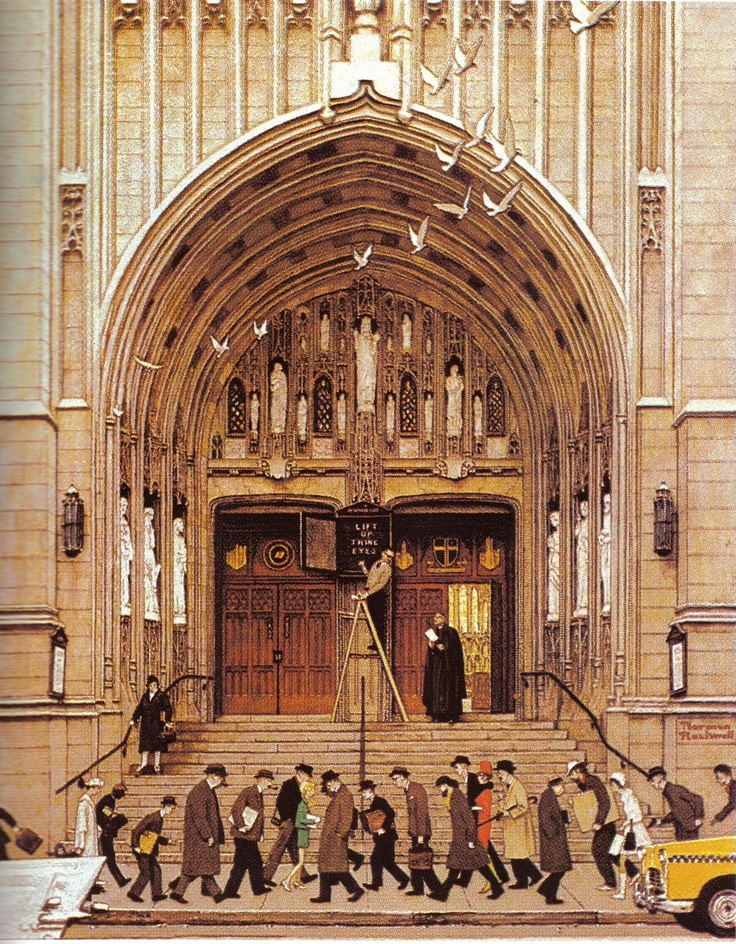
Have you ever seen Norman Rockwell’s 1957 painting “Lift Up Thine Eyes”? It portrays the sidewalk outside of a cathedral in a busy city in which all of the passersby have their heads bowed not in reverence but in distraction.

You can see the burdens of the world in their posture and in their gaze but behind them, up toward the doors to the sanctuary, a solitary church figure is replacing the letters on a small sign that says “Lift Up Thine Eyes” and no one seems to be getting the message.

The painting haunts me.

It haunts me because life, it seems, has done its worst to the people passing by. Shuffling to and fro they carry the burden of their burdens – some are on their way to work, other are perhaps looking for work, and all of them can only see what’s right in front of them: a dirty sidewalk trample upon by countless footsteps.

And yet, what haunts me most is the fact that even though the painting was completed 64 years ago, it is still just as relevant today! Simply put a smart phone or an iPad in every person’s hand and you’ve got a modern Rockwell for 2021.

It should come as no surprise that many of us have spent far more time on devices over the last year and a half than we ever had before. The pandemic cloistered us away from one another such that the only way we could really interact was through a phone (that most people no longer even use as a phone!). This dramatic increase in usage has led to the dramatically ironic arrival of Zoom webinars on “Zoom Fatigue”, silent meditations apps only accessible as podcasts, and week-long digital conferences on the dangers of devices.

I was talking with someone the other day and she casually remarked about how hungry she was, and when I asked what she had for lunch she responded: “I was so busy on my computer that I forgot to eat.”

And it’s not just our addiction to our devices – getting rid of them, or hiding them away for a few hours a day, doesn’t rid of of the weight of the world that we carry around all the time. We carry the expectations we place on ourselves and the expectations the world places on us. We carry the sins and the shames of our past (and our present). We carry the terror of tomorrow and the fear of the future. 

And yet, when we return to Rockwell’s painting – the majority of the scene is in reference (and reverence) to something more. The top portion of the painting displays doves (a sign of the Holy Spirit) almost floating in the air, the saints of the cathedral stand in defiance to the burdens of life, and the church door stands awkwardly open barely beckoning anyone to discover what’s on the other side.

Perhaps what the people in the painting need is an interruption – a person who can meet them where they are and who can show them where they can be, a person who can break into their brokenness to bring relief, healing, and even joy.

Thanks be to God, then, that that’s exactly what we get in the person of Jesus Christ. For, God looked down upon our sins and our shames and chose to become one of us in order to redeem and rectify us. God still looks down upon our imperfections and our shortcomings and calls for us to lift up our eyes not to unattainable achievements or superior morality or continued suffering, but instead God calls for our attention to be lifted to the Cross, to the One who lifts us out of our navel-gazing and into the strange new world made possible by God.

Beginning Again

Ephesians 1.3-14

Blessed be the God and Father of our Lord Jesus Christ, who has blessed us in Christ with every spiritual blessing in the heavenly places, just as he chose us in Christ before the foundation of the world to be holy and blameless before him in love. He destined us for adoption as his children through Jesus Christ, according to the good pleasure of his will, to the praise of his glorious grace that he freely bestowed on us in the Beloved. In him we have redemption through his blood, the forgiveness of our trespasses, according to the riches of his grace that he lavished on us. With all wisdom and insight he has made known to us the mystery of his will, according to the good pleasure that he set forth in Christ, as a plan for the fullness of time, to gather up all things in him, things in heaven and things on earth. In Christ we have also obtained an inheritance, having been destined according to the purpose of him who accomplishes all things according to his counsel and will, so that we, who were the first to set out hope on Christ, might live for the praise of his glory. In him you also, when you had heard the word of truth, the gospel of your salvation, and had believed in him, were marked with the seal of the promised Holy Spirit; this is the pledge of our inheritance toward redemption as God’s own people, to the praise of his glory. 

You learn, after a little while, not to tell people that you’re a preacher.

It doesn’t really matter where the interaction takes place or with whom, the responses are generally the same.

I’ll be at a BBQ and when the beans get spilled everyone starts hiding their beers behind their backs, or I’ll strike up a casual conversation in a grocery store and when the truth gets out the person across from me will confess they haven’t been to church in a very long time, or a fellow parent at a soccer practice, having seen me in my collar, will begin to list off a litany of complaints about the church he/she grew up in.

Right before the pandemic I was introduced to someone as a pastor and the person responded: “Good for you, but I don’t need to go to church.”

I was hooked.

“What do you mean you don’t need to go to church?”

“Well,” he began, “I don’t need someone like you to tell me how I’m supposed to be living my life. I’m a good person already.”

Is that what the church is for? Do we exist to make people into better versions of themselves? Is all of this designed to bring about better moral and ethical behavior?

We put a lot, and by a lot I mean A LOT, of emphasis on self help these days. The pandemic saw immense spike in the sales of Pelotons, designed to make our bodies look the way we really want them to, Diet Programs, designed to make our bellies look the way we want them to, and a whole slew of “How To Be The Best You” books, designed to make us look, think, act, and speak the way we want to.

We like to imagine ourselves as “self-made” individuals and we regularly lift up those who have done so in the greater and wider culture.

And yet Paul, in his letter to the church in Ephesus, speaks not of what we must do, but instead begins by only addressing what God does. And, to really hit the nail on the head, it’s all in the past tense – It’s all already done and decided.

Listen – God has blessed us by choosing us in Jesus Christ. He has made us holy and blameless by bringing us out of bondage to sin and death by the price of his own blood – That’s what redemption means. 

Our holiness, whatever it may be, is only because of Christ’s own righteousness. Jesus’ perfect life under the Law has been transferred and credited to us as our own. The Judged judge has come to be judged in our place.

God has done all of this and has made us his children. Children by adoption with an inheritance.

Now, consider – Paul doesn’t say this is all something we must earn by our doing or by our faith – he says its already ours, gifted to us unconditionally and irrevocably by way of Jesus.

This is all God’s work from before the foundation of the world.

And that’s just the first bit of our scripture today!

Paul is emphatic that God is the one who acts, so much so that he strings this entire passage together as one rather long run-on sentence in the Greek. In fact, it’s the longest single sentence in the entire New Testament, and God is the subject of all it’s verbs.

Put simply: It’s all about God.

And yet, we can’t help ourselves, at times, from making church all about us.

Sermons and Sunday school curricula all join the mighty chorus of self-help programs.

We start by telling everyone that God loves them, but before too long we starting dropping lists of expectations if people want God to keep loving them. 

We say things like, “God commands us to love our neighbors as ourselves so, you might want to write all of this down because it’s important, you all need to work on your racism, sexism, classism, ageism, ethnocentrism, STOP USING STYROFOAM, go vegan, gluten-free, eat locally, think globally, fight against gentrification, DON’T DRINK SO MUCH, practice civility, mindfulness, inclusiveness, take precautions on dates, keep the sabbath, live simply, practice diversity, do a good deed daily, give more, complain less, and while you’re at it, STOP DRINKING SO MUCH.”

If people have ever been evangelized by fear mongering or higher moral standards, they might be converted away from something, but not to the Gospel.

To be clear: that long list is, undoubtedly, filled with good things, things we should all probably work on, but Jesus comes not to make us struggle under the weight of additional expectations, he doesn’t wait up on the cross until we’ve righted all of our wrongs, he doesn’t hide behind the stone in the tomb until we have enough faith. 

Jesus does what Jesus does for us without us having to do much of anything AT ALL.

Last week, after worship, a lot of you said a lot of things to me. But one of you said something I haven’t been able to get out of my head: “It’s good to know that God is still God no matter who stands in the pulpit.”

That’s some pretty good theology!

And, to be clear, I didn’t actually say that in my sermon, nor was it said in any other part of the service. But if that’s what was conveyed, well then “Thank you Holy Spirit!”

You see, we’re not the Good News. Not pastors, not lay people, not even the church.

It’s actually very Good News that we’re not the good news, because if we were then we’d be doing a terrible job.

We’re not the Good News. We all do things we know we shouldn’t and we all avoid doing things we know we should. 

But here’s where the Good News gets really good: we’re the objects of it.

That is: God does for us what we could never, and would never, do on our own. 

God, bewilderingly, chooses to come to us, and not the other way around. 

Sure, there are plenty of people in scripture who seek the Lord, but not a one of em deserved anything the Lord gave em.

Have you heard about the wee little man up in a tree? The one who stole money from the likes of you and me? Well, Jesus invites himself over to lunch at Zacchaeus’ house and transforms his life forever.

Do you know about the crowds who were hungry after listening to Jesus preach for an entire afternoon? Well, he multiplies some loaves of bread and a handful of fish without even taking the time to discern whether or not the people were really worthy of such a miracle.

Again and again in the strange new world of the Bible, God meets the people of God in the midst of their sins, down in the muck of life, and offers grace.

And grace, as Robert Farrar Capon so wonderfully puts it, grace isn’t cheap or even expensive, its free. 

God says to us, “Look, I don’t care what the world has told you about who you are. That’s not who you are! You are mine and I am thine!”

The thing that makes the church different than any other organization, different from political parties or rotaries or corporations is the Gospel.

The Gospel is what God has chosen to do, from before time!

For us, by the cross.

And through us, by the Spirit. 

In the end, we don’t really bring much of anything to church. Sure, we can sing and we can pray, we can even drop some money in the offering plate when it comes around, but all of the pales in comparison to what God has already done for us.

If we bring anything here, week after week, we bring our brokenness in hopes and anticipation that God will make something of our nothing.

Do you see it? Church isn’t about what we do – it’s about being reminded, again and again, of what God has done for us.

And then, and only then, in the knowledge of what is already done, we get to take steps into the adventure that is called faith.

There was a man in one of my churches who I just couldn’t stand. 

Now, I know that’s not very pastoral, but I’m a sinner in need of grace just like the rest of you.

Everything about this guy drove me crazy. He was older than dirt, he treated people like dirt, he was extremely racist, and he always felt it necessary to drive over to the church once a week to tell me how I, and the entire church, were failing to do what we were supposed to do.

He was regarded similarly by nearly about everyone I met. Just about once a week some poor soul would stumble into my office having been ripped a new one by the man in question.

I even tried to work the Gospel on him when I had the chance, but it never worked. He stuck to his well-worn path of belittling everyone within earshot, scoffed at the thought of ever needing to change any of his opinions, and rested comfortably knowing he was always the smartest, wisest, and all around best person to ever walk on the face of this earth.

And then he died, and I had to do his funeral.

In the days leading up to the service I lamented the fact that we would have a nearly empty sanctuary for his funeral. Even though he drove me wild, no one should be laid to rest without a church to worship in the midst of it all.

And so it came to pass that I stood at the doors of the church, ready to begin the service for a small gathering of people when, all of the sudden, cars started steaming into our parking lot. I could hardly believe my eyes when, one by one, church members who had been so wronged by the now dead man made their way into the sanctuary.

The last person to cross the threshold was a fiery old woman who was a regular target of the dead man’s insults and I grabbed her my the arm and said, “What are you doing here? I thought you hated the man.”

“Preacher,” she said, “Aren’t you the one who said we have to love our enemies and pray for those who persecute us?”

“Well, yeah I’m sure I said…”

“And didn’t you also say that even the worst stinker in the world is someone for whom Christ died?”

“Well, that’s certainly one way…”

“And didn’t you declare from the pulpit just last week that nothing, literally nothing, can get between us and the love of God in Christ Jesus?”

“Uhh, that might’ve been…”

“Well then so be it!”

And with that she marched right into the sanctuary to worship.

Our forgiveness, offered before the foundation of the cosmos, is the beginning to which we return to over and over again. It’s what we need to be reminded of throughout our lives lest we fall prey to the temptation of believing that we have to save ourselves. And it runs so counter to everything we think we know because it doesn’t make any earthly sense. 

But that’s why God is God, and we are not. 

We’re told, in ways big and small, that we have to do it all.

The Gospel tells us that it’s all already done.

Paul beckons our attention to the truth of our condition in that God willed our blessing before ALL things. 

Put another way, before God said “Let there be light,” God’s first words were, “Let there be Gospel.”

That’s why, as my parishioner so vividly reminded me, Paul can proclaim in another letter that nothing, literally nothing, can get between us and the love of God in Christ Jesus because God’s love for us precedes all things. 

Which is all just another way of saying, God loves you and there ain’t nothing you can do about it. Amen. 

We Are The Stories We Tell

Romans 12.1-2

I appeal to you therefore, brothers and sisters, by the mercies of God, to present your bodies as a living sacrifice, holy and acceptable to God, which is your spiritual worship. Do not be conformed to this world, but be transformed by the renewing of your minds, so that you may discern what is the will of God – what is good and acceptable and perfect.

Years ago there was a young man, still early in his ministry, who was appointed to serve a new church. 

At least, it was new to him.

He had gone to the right seminary, and studied all the right books, and prayed all the right prayers, and served in the right ways, and was excited about this next step in the adventure that is faith.

So with eager anticipation, he packed his bags and got in the car to go check out John Wesley UMC somewhere in Georgia.

This preacher was so excited, in fact, that when he arrived in town, before he unpacked his bags, he drove to the church. He typed the requisite address and admired the different varieties of trees planted perfectly along the road, but when came to his destination, he saw no church.

So he turned around, drove down the road once more and, again, no church to be found.

Finally, he got out of the car, and walked along the sidewalk for a closer inspection until he eventually found the church and he discovered why he missed it so many times: there was one of the oldest and most decrepit looking trees he had ever seen stretching all over the grounds with roots exposed and the church sign, plus the majority of the building, were hidden behind the tree’s long branches. 

The preacher stood awkwardly on the front lawn of the church taking in the sight of the godforsaken tree, and decided he was going to do something about it.

So he drove back to his house, found the box containing his chainsaw, and then he set out to cut the tree down. He made short work of it, moving methodically from branch to branch (he was a Methodist after all) until, before long, he took a step back to admire his work.

The sign and the building were now completely visible from the road and he thought, rather proudly, that maybe just a few extra people would be in church on Sunday morning. 

A few days later, as the pastor sat down to continue chipping away at his first sermon for the church, he received a call from his District Superintendent: “I hope you haven’t finished unpacking yet,” the DS said, “because you’re being reappointed.” 

You see, the church was named John Wesley UMC for a reason. 

John Wesley himself had stood on the roots of that tree nearly 300 hundred years ago and preached to that community. Afterward, the gathered people decided to build a church right next to the tree in honor of the man who started a revolution of the heart, and that young pastor chopped it down.

Stories are remarkably important. Put another way: We are the stories we tell.

They contain and convey just about everything regarding who we were, who we are, and who we can be. Stories held by and within a community help to shape the ways we interact with one another, and how we obtain the collective memories of the past. We tell stories to make people laugh, to teach lessons, and to share what it ultimately means to be human.

Today we live in a time of competing narratives in which every television show, every streaming service, every website, and every social media platform are vying for our allegiance and our attention. We are constantly bombarded, whether we like it or not, with information that attempts to tell us who we really are, what we really need, and where we are really going.

We live in a time in which more people recognize the golden arches of McDonald’s than they do the cross of Jesus Christ. We live in a time in which people spend more time debating where they see the best view of fireworks, or what’s really going on in Loki, or which politician is finally going to set things right than they will consider the children in their community who have nothing to eat. We live in a time in which plenty of us would rather store up all of our treasures on earth without thinking at all about how every gift first comes from the Lord.

Right now, the world is telling us what is important and it’s not easy to discern between the voice of the world, and the voice of God.

But listen to St. Paul: Do not be conformed to this world, but be transformed by the renewing of your minds. Do not listen to the powers and principalities that try to define you. Do not diminish God’s ability to radically transform your life and the world around you. Open your eyes to the beauty of the strange new world made possible by Jesus Christ and him crucified. 

Whenever people like us gather like this we are bound together in loyalty to a story that once was not our story. But, through God’s wonderful and confounding actions in the world, that story is now our story. It is a story of cross and resurrection, of the first being last and the last being first, of undeserving people being forgiven.

That story will always but us at odds with the world.

And, according to the ways of the world, the church is between a rock and a hard place. People are no longer regularly attending worship and that started long before a pandemic kept us in our houses on Sunday mornings. Christianity has lost its status in the public arena, we are becoming frighteningly illiterate (biblically speaking), and young people are almost nowhere to be seen when it comes to the body of Christ.

Did you know that the average age of a United Methodist is 58?

That means I still have 25 years to go before I’m average!

Did you know that the average person in a United Methodist Church invites someone to worship once every 38 years?

The world will tell us that the church is dead, that we have to do whatever we can, however we can, to get people in our building, that we need to cut down every tree (real or otherwise) that is blocking the church from the street, that we need to abandon the past in order to embrace the future because the church is dead.

Thanks be to God then, that we worship the Lord who works in the business of resurrection, of making a way where there is now way, of impossible possibility. 

We don’t have to conform to the ways of the world, but instead we get to be transformed by the renewing of our minds! 

While others might shrink away or wail in fear regarding the statistics I just mentioned, imagine what would happen if we embraced them and saw them as an opportunity for transformation? How would the church change if we took seriously the radical nature of God’s grace? What would happen if we embraced the trees and traditions of the church to reclaim the story that has already changed the world?

We are the stories we tell.

Here’s part of mine: 

I am a cradle Methodist – I was baptized when I was 19 days old at Aldersgate UMC in Alexandria VA, where I was raised and confirmed. I ran the sound system for worship as a tweenager, played for two of our worship bands, and spent even more time at the church because it was where my boy scout troop met every week. As a teenager one of my dearest friends died tragically in a car accident and I found myself ministering to friends and family using words that were not my own, but words that had been habituated into my life because of the church and the Spirit.

I began feeling like this might be what God was calling me to do with my life and when I told the senior pastor at my church his response was, “You wanna preach in a few weeks?”

I went to JMU to study religion, I went to Duke for my Masters in Divinity, met my now wife Lindsey while I was in North Carolina and we have a remarkable 5 year old named Elijah Wolf. 

My first appointment was to St. John’s UMC in Staunton, my last appointment was to Cokesbury UMC in Woodbridge.

I love the church, I always have and I always will. For me, the church is the last vestige of a place where people willfully gather with people they have nothing else in common with save for the fact that Jesus has called them his friends.

I also love the church because I believe it is the better place God has made in the world. When we pray, when we break bread, when we baptize, we are all getting foretastes of the Supper of the Lamb that goes on and on forever.

Here’s what I know of your story:

I know that the church has been a beacon of the Gospel in Roanoke for 100 years. I know that you care deeply about the Word, about worship, and about mission. I know that you pride yourselves on your hospitality, something my family and I have been the beneficiaries of over the last few weeks. I know that you believe in the work of the Kingdom and are ready for the next 100 years. 

And now God has seen fit to string and knit our stories together.

Being a Christian is all about being brought into another story, a different telling of where we have come from and where we are going, a story that we call the Gospel – The Good News. 

And the stories from the strange new world of the Bible really do shape us – they speak greater truths than simple facts and statistics, they tell us who we are and, more importantly, whose we are. That’s why Jesus never really simply explains anything to anyone, but instead is forever going on and on telling stories, stories we call parables. 

At the heart of the church is a willingness to share and to learn the art of story-telling. We learn one another’s stories by gathering for worship, or studying God’s Word, or serving the local and global community. We tell stories and receive stories so that we can cherish the roots of our foundations while, at the same time, looking to the future because God makes all things new.

The story of Raleigh Court United Methodist Church is entering into a new chapter. God is stirring things up in Roanoke. God is bombarding us with the grace that we don’t deserve but we surely need. And God is doing this not because there is a new pastor in town, and God is doing this not because the church is looking forward to the next hundred years – God is doing this simply because that’s who God is.

All of this, the church, the community of faith, grace, it’s all one remarkable gift. It’s the gift of a new past, in which the mistakes we’ve made are healed and the damage we’ve done is redeemed. We call it forgiveness. In the church and in the kingdom of God we are more than what we have failed to do, we are what God has done for us.

But it is all also a gift of a new future, in which the fear of punishment is annihilated and the terror of nothingness is obliterated – we’ve been promised resurrection. 

The Church is a new past, present, and future – it is a way of life made possible by Jesus in anticipation of God doing what God does best.

The world might tell us that the church is in a difficult place. But I look out from this pulpit to all of you gathered here in person, and to all of you gathered online, and I’m not worried about what the world has to say. I’m not worried about anything because my hope isn’t in me or even in any of you, my hope is built on nothing less than Jesus’ blood and righteousness – I dare not trust the sweetest frame but wholly lean on Jesus’ name!

Christ is the solid rock upon which this church stands; all other ground is sinking sand, all other ground is sinking sand. Amen.