Devotional – Ephesians 5.14

Ephesians 5.14

Therefore it says, “Sleeper, awake! Rise from the dead, and Christ will shine on you.”

Weekly Devotional Image

On April 4th, 1742 Charles Wesley, the musically inclined younger brother of John Wesley, was invited to preach at St. Mary’s in Oxford. It was his first, and last, occasion for preaching there. His text was Ephesians 5.14 (“Sleeper, awake! Rise from the dead, and Christ will shine on you.”), and his message most likely caused a significant amount of resentment among those in attendance.

Throughout the sermon, Charles Wesley interprets the “sleep” from Ephesians as the natural state of humanity; it is the place where we are in light of Adam’s sin that has passed on to the world. But God calls each human to wake up from this dreadful sleep, repent, and live into the fullness of holiness made possible through the life, death, and resurrection of Jesus Christ.

In a sense, it did what all sermons are supposed to do: it faithfully proclaimed God’s revealed word in a way that was applicable and approachable to all with ears to hear. However, Charles made plain the point that those in attendance, the religious elite of the day, had fallen asleep to God’s commands and that it was time for them to wake up.

airbnb_wake_up_call_0

To paraphrase: “In what state is your soul? If God required you to die right now for the sake of the Gospel, would you be ready? Have you fought the good fight and kept the faith? Have you put off the old life and put on the new? Are you clothed with Christ? Do you have oil in your lamp and grace in your heart? Do you love the Lord your God with all your heart, with all your soul, with all your mind, and with all your strength? Do you believe that God is moving in a through you in all that you do? Are you really a Christian? If any of these questions offend you, be assured that you are not a Christian, nor do you desire to be one. The time has come to wake up!”

It’s no wonder he was never invited back to preach.

However, Charles’ questions still ring through the centuries and resonate in our hearts today. Are we alive to our faith? Are we clothed with Christ? Do we really love God and neighbor? Are we Christians at all?

Lent is the time to confront our true natures and ask if we have fallen asleep in our faith, or if we have been raised from the old life into the new. For Christ, the one in whom we live and move and have our being, is calling us to wake up. Christ compels us to leave the old life behind, the life defined by death and sin. Instead, Christ pushes us to clothe ourselves in our baptisms, live into the reality of resurrected life here and now, and wake up!

The Most Hipster Passage From The Old Testament

strangely-warmed-spreaker-header

The team from Crackers & Grape Juice went down to Durham, NC a couple weeks ago to interview Stanley Hauerwas for our lectionary podcast Strangely Warmed. During our time together we talked about the readings for the fourth Sunday of Lent during year A from the Revised Common Lectionary and Dr. Hauerwas gave us a lot to chew on. If you want to hear the conversation, and learn about the most hipster passage from the Old Testament, you can check out the podcast here: Year A – Lent 4

hauerwas


Christian-Hipster1

Devotional – Ephesians 4.29

Devotional:

Ephesians 4.29

Let no evil talk come out of your mouths, but only what is useful for building up, as there is need, so that your words may give grace to those who hear.

Weekly Devotional Image

A few weeks ago Gwen Hammer, a wonderful member of St. John’s, came into my office with a gift. She and her family had been on vacation and she said they found something I “just had to have.” So with eager anticipation and excitement I opened up the package to discover one of the funniest signs I’ve ever read, a sign that is now hanging in my office for everyone to see: “Live your life so that the preacher won’t have to lie at your funeral.”

Whenever I meet with families and friends to prepare for a funeral, I hear wonderful stories about the person who has died. Without having to ask questions, I quickly learn about what it was like to grow up with the person, how they met their spouse, what it meant to them to be a parent, and a slew of other details. I hear the funny stories that have been told and retold countless times at family gatherings. I start to see how God’s grace developed in the person’s life and led them to live the way they did.

IMG_0264

But at some point, stories pop up that I would not want to share from the pulpit; disappointments regarding a grudge that was never settled, failures to communicate what was really happening, and frustrations over choices with larger implications. I always do my best to sit and listen patiently, knowing that it is important for the friends and family to experience their grief in different ways. But when it comes time to craft the words that will be shared at the funeral, I do my best to include the truth about the person’s life, while emphasizing the details that help to build up the community of faith.

Paul wrote to the church in Ephesus about what it means to live in community: “Let no evil come out of your mouths, but only what is useful for building up, as there is need, so that your words may give grace to those who hear.” As human beings we tend to emphasize and remember our problems, but as Christians we are called to speak in a way that benefits the people around us. In our everyday lives we have opportunities to share kind words toward others such as complimenting their work or affirming their character. Whatever we can do to live in such a way that we build others up, rather than breaking them down, will allow us to fully live into God’s kingdom.

This week, let us speak in such a way that our words may give grace to those who hear, and live in such a way so that the preacher won’t have to lie at our funeral.

How The Dishwasher Taught Me To Pray – Sermon on Ephesians 3.14-21

Ephesians 3.14-21

For this reason I bow my knees before the Father, from whom every family in heaven and on earth takes its name. I pray that, according to the riches of his glory, he may grant that you may be strengthened in your inner being with power through his Spirit, and that Christ may dwell in your hearts through faith, as you are being rooted and grounded in love. I pray that you may have the power to comprehend, with all the saints, what is the breadth and length and height and depth, and to know the love of Christ that surpasses knowledge, so that you may be filled with all the fullness of God. Now to him who by the power at work within us is able to accomplish abundantly more than all we can ask or imagine, to him be glory in the church and in Christ Jesus to all generations, forever and ever. Amen.

pray

I loved my college roommates. Some of us knew each other from high school, and others were grafted in along the way, but nevertheless, when we lived together it felt like a little family. We tried our best to communicate needs within the domicile, we kept it quiet when someone had a midterm the next morning, and we quickly learned to share common appliances for the betterment of the entire living situation.

Between us we would come to earn Bachelor degrees in Philosophy, Religion, Biology, Communications, and History. I always kind of imagined that we would be a awesome group Jeopardy team with the wealth of knowledge spread between us. Living together in college was great, but it wasn’t always easy.

There was the time we discovered mice in the house. We did our best to keep the kitchen clean, and spread mouse traps throughout the house, but during the cold winter months they came back like clockwork.

There was the time a huge snow storm came through, trapping all of our cars, and we ran out of heating oil to keep the house warm.

There was the time that we all contracted swine flu at different intervals. As one person became sicker and sicker, those of us who were well shared the responsibility of caretaker, until we started displaying our own symptoms.

Part of the beauty of living with other people was the sharing of life experiences. We celebrated each others successes, and grew to really rely on one another. Part of the challenge of living with other people was learning how to change our habits and needs based upon the habits and needs of other people.

Ephesians 3.14-21 is a prayer. Paul is writing to this new faith community in the hopes that his prayers will be answered by the Lord of hosts. He prays for the congregation because he knows that he cannot give them what they need in order to grow, but through prayer the church will learn to fully rely upon God.

The beginning of the prayer establishes the main focus: Paul prays for the church to be strengthened in its inner being, from the inside out, by the power of God. He hopes that the individuals that make of the community will see the vital importance of letting Christ into their lives and then change accordingly.

If Christ dwells in the hearts of the people, if they are rooted and grounded in love, then they may have the power to comprehend what is the breadth and length and height and depth of Christ’s love that surpasses all knowledge.

During college, I was the only person from the house that went to church. While my roommates enjoyed the comfort of their beds on Sunday mornings, I was making my way out the door to worship the Lord. I learned to accept their priorities, and on some level they learned to accept mine.

For instance: I made them pray with me whenever we ate dinner that I had prepared. I felt that if I was willing to go through all of the steps necessary to make a dinner for all of us, then they could bow their heads with me in prayer. So once a week, we would sit in our living room, eating on paper plates with plastic silverware, and they would listen to me pray.

prayer (1)

It is difficult for many of us to hear about God’s unending love, particularly a group of college-age men who just wanted to eat. It may seem so obvious to us that it no longer strikes at the core of our being. We hear “God is love,” and “love is patient, love is kind,” and “Love you neighbor as yourself,” and “God’s love knows no bounds” and instead of that love becoming clearer, it just floats around in the air.

Faithful love is even harder to grasp for those of us who do come to church because we hear about all these beautiful and wonderful things, we look around at a church filled with people who appear to have their lives figured out, when in reality we are all struggling with a myriad of secrets, private disappointments, lost hopes, and frustrations.

It’s hard to hear about love, when we don’t feel love in our lives.

Paul’s prayer for the church in Ephesus is all about letting Christ in to change lives: I pray that, according to the riches of his glory, he may grant that you may be strengthened in your inner being with power through his Spirit, and that Christ may dwell in your hearts through faith, as you are being rooted and grounded in love.

Letting Christ into our hearts is like moving in with a new roommate. At first, we spend a lot of joyful time getting to know one another, discovering common likes and interests. We do a great job putting all the dishes away and keeping the house clean, but then we have to start making compromises, whether we want to or not.

I learned about this type of faithful living the right way through my wife Lindsey. When we were dating, and I was getting ready to ask her to marry me, I dreamed about what it would be like to live together. I imagined the way we would set up our living room, where we would put the record player, and even where we would dance to all of our old jazz 33s.

After the wedding, while we were still giddy from the honeymoon, we decided to tackle the challenge of combining all of our possessions in the kitchen. We debated the value of keeping our plates in one cabinet versus putting the coffee cups near the coffee pot. We worried about the safety of keeping our knives in a drawer or right on the counter top. And we experimented with the location of the microwave in relation to the toaster and whether or not we would blow the fuse if they were both on at the same time.

praying_hands_clean_dirty_dishwasher_magnet-rcfdd698c86904ddaa1e6594a1d17e547_x7qgu_1024

The real challenge came to the precipice over the dishwasher. I was of the opinion that it did not matter where dishes and cups were placed in the dishwasher, so long as we could fit as many things as possible. Lindsey was not of the same opinion. For the first few weeks, whenever I put a plate away, she would come behind me and rearrange the dishwasher. It got to a point that I started purposely putting items wherever I wanted because I didn’t think it mattered, but sweet Lindsey would watch me live out my frustration, and then when I left the room, she would bring order to the dishwasher.

I don’t know how long this continued, but I do know when it stopped. Lindsey was working late one night, and the dishwasher was almost full. I saw my opportunity to prove that the dishwasher works fine no matter where the dishes are placed. So with a mischievous grin on my face I rearranged the order into chaos, I started the dishwasher. I couldn’t wait to see her face when she got home, I imagined the apology she would offer me regarding her wrong interpretation of dishwasher etiquette, it was going to be something beautiful.

But when the dishwasher cycle finished, I knew I was in trouble.

How could this have happened? Whenever Lindsey ran the dishwasher, everything came out all nice and clean and ready to use. But this time, there was still food on a few of the dishes, and some of the utensils looked worse than when I put them in!

I was wrong, and I learned to change. Now I will freely admit that sometimes I still place something in the wrong place, but after my passive-aggressive experiment, I have learned to alter my focus because Lindsey was right.

prayer_2014_02_07-13

The incident with the dishwasher taught me that prayer is about change. When I forced my roommates to pray in college, was I doing it because I was concerned about them, or was I doing it because I thought I was better than them? Did I earnestly pray to the Lord during that time, or did I just want them to hear the sound of my voice?

The beauty of prayer comes to fruition when we let Christ in to change us, and when we are willing to give up some of our space for the Lord. The dishwasher taught me that if prayer is only about myself, that if I am only concerned with my thoughts and actions, then I am neglecting to let God in to make some important changes.

Faithful living is about giving up those habits and behaviors that are no longer fruitful, reprioritizing and reorganizing our lives, so that God can make us clean.

In a few moments we are going to end our service not here in the sanctuary, but outside on the front lawn. We are going to gather in a group and we are going to pray.

First we will pray for God to give us the strength to give up some room, and let Christ in. That instead of focusing on just our needs and wants that we will begin to comprehend the love of Christ and the fullness of God.

Then we will face the sanctuary and we are going to pray for our church. So many of us, myself included, get caught up in such a tunnel-visioned view of prayer that we neglect to pray, like Paul did, for the community of faith.

And finally we will turn to face the community around us and pray once more. Prayer is not just about you and me, and it is not just about the church, prayer is about communing with the Lord about the very fabric of life.

If we want our lives to change, if we want our church to change, if we want to let God’s love reign, then we have to be willing to give up some space. We have to learn to rearrange the dishwashers of our lives so that everything can be made clean.

Amen.

Devotional – Ephesians 3.16

Ephesians 3.16

I pray that, according to the riches of his glory, he may grant that you may be strengthened in your inner being with power through his Spirit.

Weekly Devotional Image

Pre-marital counseling is the best. It is one of the few places where I am actually allowed to ask the questions I have racing in my head: What was your last fight about? How do you feel about your soon-to-be in-laws? Why do you deserve to marry each other? Similarly, it is one of the few places I feel comfortable being completely candid about the church’s role in marriage and how the covenant is not just between the couple, but it also incorporates the gathered body and the Lord.

At some point during the pre-marital counseling, I challenge each couple to go back to scripture and pick a passage that reflects their relationship for the wedding ceremony. My one caveat is that (unless they can demonstrate how necessarily important it is to them) they are not allowed to pick the part in 1st Corinthians about love being patient and kind, nor are they allowed to pick the part from Ephesians about wives being subject to their husbands. So it is with those few directions that couple have been forced to go back to their bibles and find something indicative of their relationship.

A few months ago I had the privilege of bringing together Chris and Chelsea Frumkin into the joy of marriage. I challenged them to pick their scripture and they quickly replied with Ephesians 3.16: “I pray that, according to the riches of his glory, he may grant that you may be strengthened in your inner being with power through his Spirit.” This verse had a particularly special meaning to the couple, because Chris has Ephesians 3.16 etched into the inside of Chelsea’s engagement ring.

11221675_10204258142484714_1762300626060138752_o

What a dynamic and perfect scripture for a wedding ceremony! When we stood together before their family, friends, and the Lord I made mention of the fact that their relationship had led to such a beautiful wedding precisely because they had prayed for one another. As a couple they were not content with the status quo. Instead, they consistently went to the Lord to discover renewed strength in their relationship.

The longer I spend time in ministry, the more I realize that scripture no longer holds the great value that it once did. Instead of a people defined by the Word of the Lord, many of us are content with knowing a handful of verses that make us smile, or would be worthy of a print that we could hang on our wall or Facebook page.

As we prepare to take steps into a new week, let us reflect on the great gift that scripture is for us: What stories from the bible have shaped who we are? Is reading the bible a priority in our lives, or a last resort? If we had to pick a verse that defined our character, what would it be and why?

monkimage

You Cannot Save Yourself – Sermon on Ephesians 2.1-10

Ephesians 2.1-10

You were dead through the trespasses and sins in which you once lived, following the course of this world, following the ruler of the power of the air, the spirit that is now at work among those who are disobedient. All of us once lived among them in the passions of our flesh, following the desires of flesh and senses, and we were by nature children of wrath, like everyone else. But God, who is rich in mercy, out of the great love with which he loved us, even when we were dead through our trespasses, made us alive together with Christ – by grace you have been saved – and raised us up with him and seated us with him in the heavenly places in Christ Jesus, so that in the ages to come he might show the immeasurable riches of his grace in kindness toward us in Christ Jesus. For by grace you have been saved through faith, and this is not your own doing; it is the gift of God – not the result of works, so that no one may boast. For we are what he has made us, created in Christ Jesus for good works, which God prepared beforehand to be our way of life.

Screen Shot 2013-06-30 at 10.08.16 AM

Our series on “Back to the Basics” continues this morning by looking at the topic of salvation. We started this series in light of the fact that many of us are deeply rooted in our faith, but some of the basics have perhaps become so routined that we no longer understand what they mean. We began with a call to return to the basics, then we looked at the Ten Commandments and today we are talking about salvation. Here we go.

My friend Josh loved the Christian camp. Every summer he looked forward to returning to the familiar space with young people all growing in their faith. From tubing on the lake, to hiking around the compound, and even just praying at night with his friends, the camp was a place unlike any other; at camp he could be fully Christian without the world judging him for his discipleship.

By the time I met Josh, camp was long in the past though he remembered most of it fondly. Having never gone to a specifically Christian camp I was fascinated by the idea of being immersed in an intentional faith community with other young people and I regularly asked him questions about his experiences. After all, it was at camp where he met his future wife, and it was years later that he made a scavenger hunt at the camp in order to propose.

As a young Christian my faith was largely formed and nurtured by my home church. I was blessed to grow up around a number of people who took their commitment to raising me in the faith seriously. Josh, however, learned a lot about what it meant to be Christian from the counselors at camp, which, like many things, can be a blessing and a curse.

The young adult counselors embodied how you could still be cool and Christian. They made faith so appealing because they regularly demonstrated what God had done for them in their lives. They made efforts to make faith approachable and were able to share the love of God with campers every summer.

Yet, some of them deeply believed it was their chief responsibility to save others and did whatever they could to make that happen.

It would come at the end of an incredible week of building new relationships and ideas when one of the counselors who begin talking about the Roman Road and I imagine it went something like this:

“Have you accepted Jesus Christ as your personal Lord and Savior? Your life might feel pretty good right now, you might have a kind family and some nice friends, but what about your eternal life? Do you want to spend life after death burning in the fires of hell? Or do you want to be saved?

“Imagine that you are standing on the edge of a cliff. Being a good person isn’t enough to save you. You can see salvation on the other side of the divide, but the only way you can get there is through Jesus Christ. Try to picture the cross being a bridge for you to safely get to the other side. You have the power to decide your everlasting fate. What’s it going to be?”

5520158

When Josh explained these experiences to me I could sense the amount of manipulation that went into the dialogues. As the summers passed at camp, the conversations remained the same only the stakes became higher: What are you doing to save the people around you? Have you explained the Roman Road to your friends?

My friends, we are now alive though we were dead. Until the great gift of God in Jesus Christ we existed like lifeless bodies wandering around. Part of this came to be because we were guilty of sinfulness though we were also victims of our environment – people and organizations who told us we can save ourselves. But God, rich in mercy, saved us.

In the early church they did not spend their time going around trying to convince people with the Roman Road argument. They did not waste time going through the in and outs of theological proofs of Christ’s divinity and resurrection. Instead the church pointed at itself to prove the miracle. Want to know about death, the cross, and the resurrection? Here they are.

The budding Christian community grew not because it’s leaders were particularly articulate in their ability to save others through words, but because they believed in the Lordship of Jesus Christ. With the new family that was created in community they experienced a new kind of life with God at the core, a new opportunity that came with the Spirit.

While the early disciples went throughout their surrounding regions, their cries of evangelism did not begin with “Save yourselves!” Instead they, like Ephesians, triumphantly declared, “God saved you, come live your new life!

If we are anything we are a people of resurrection. Not a country club of like-minded individuals, not a political organization, not a club of devoted fans, but a people of resurrection.

Since the time of Christ, those who followed him have found new life, resurrected life, with God. New life has come by many ways – repenting for the wrongs of our lives, being forgiven by God and our friends, experiencing an assurance of the eternal dimension of God’s love and care, and by a number of other life events, even hearing about the Roman Road from camp counselors. However, we must be careful when putting too much emphasis on our power in salvation. Yes, God has opened the door and we must be the ones to walk through it, but the greater act came in the opening of the door and not our power to go through it.

Resurrected life is something that will come when Jesus returns but we can also experience it here and now. Whenever I’m asked about miracles I can quickly describe some of the incredible things I have witnessed, events I attribute to God’s grace. But some of the most powerful miracles, to me, are right here in our midst. I can look out from this pulpit and see people’s lives who have been turned around through Christ’s love. I see and remember stories about things that have happened to you, sinful desires that suffocated your ability to live fully, when God offered you a new resurrected life.

I heard someone once describe their days as lifeless. They went through the familiar motions but it all felt repetitious, pointless, and directionless. This went on and on until someone invited them to a church community. Suddenly people began to care about him without knowing anything about him or his past. It was like he was being seen and treated through God’s perspective. Through a simple invitation and a new opportunity he felt resurrected from the dead, and began living again. 

Salvation is not about receiving a perfect grade that allows us to make the cut into God’s heavenly kingdom. Who among us fulfills all of the laws from the Old and New Testaments? Loving our enemies, turning the other cheek, giving away our possessions? Even the greatest commandment to love God and neighbor with our hearts, souls, minds, and strengths is incredibly difficult.

romansRd31

If salvation was about getting the right grade, I’m sad to say that most of us would be failing. It’s as if the closer we get to visions of God’s glory, the more we realize our unholiness.

We pray to God before our meals and while we look out on the feast before us we are reminded of the many who have no food to eat. We kneel in a makeshift structure in Guatemala being served food by people who have nothing in terms of our materiality but have faith that we could never imagine. We sit on the stoops of a front porch in West Virginia after painting all day and we realize we could be doing so much more.

We were dead through the sins of our lives and we have been victims of our environment. The good news amidst this unholiness is that, by the grace of God, we have been saved. That through God’s incredible act of selflessness, our sinfulness has been forgiven.

Not a forgiveness as a nice plus added to a grade for our performance as Christians, but forgiveness as a completely unearned gift – a gift extended to a prodigal son who squandered his inheritance, a gift extended to a tax collector who only cared about himself, a gift extended to a thief who hung on a cross to die, a gift extended to you, or to me.

By grace we have been saved. 

Grace is like friendship. Josh, the one who shared with me his experiences of Christian camp, is my best friend and was the best man at my wedding. I did nothing to earn his friendship.  If it had been initiated over an exchange of goods (I will be your friend if you do this for me) it would never have become the true friendship that it is today. Friendship, and I mean true friendship, is an act of faith. Learning to trust the other knowing that they could hurt you.

I know that Josh will be there for me at a moment’s notice. He will listen to me and do whatever he can to help. I also know that he doesn’t expect anything in return. That is the meaning of true friendship; a willingness to give because the well-being of someone else matters more to you than your own. My friendship with Josh is an act of faith, but one that I am remarkably thankful for.

Salvation, for us, is the beginning of a covenant of friendship between us and God; between the divine and a sinner. Grace is another way of describing an incredible love story between God and his creation.

We cannot save ourselves. We cannot save other people. No matter what the commercials, advertisements, and camp counselors tell us. Only the Lord has the power to save. Thanks be to God that he came in the form of flesh in Jesus Christ to open up the gates of heaven to people like us.Thanks be to God that we are not called to save others, but merely help them to see what God has already done, and continues to do, in their lives.

We were dead but have been made alive through the greatest gift ever given. The question for us, then, should not be, “Am I saved?” Instead we should be asking, “What am I doing with this resurrected life?

Amen.

basics

Devotional – Ephesians 5.10-14

Devotional:

Ephesians 5.10-14

Try to find out what is pleasing to the Lord. Take no part in the unfruitful works of darkness, but instead expose them. For it is shameful even to mention what such people do secretly; but everything exposed by the light becomes visible, for everything that becomes visible is light. Therefore it says, “Sleeper, awake! Rise from the dead, and Christ will shine on you.”

Weekly Devotional Image

As I sat here this morning typing the devotional scripture out on my computer, 5006 customers lost power in Staunton, including St. John’s UMC; a particularly fitting moment for reflection on a scripture that discusses visibility, light, and darkness! Everything in my office, the hallway, and the entire church shut off except for my laptop computer (on battery power). Though light was coming in the window, the only thing illuminated within the office was God’s Word staring back at me on the screen: “everything exposed by the light becomes visible, for everything that becomes visible is light.”

the-cross

Instead of staying in my office to write out some narratival reflection on light and darkness, I made my way down the halls to the other part of the building in order to check on our secretary, our teachers, and students in the Pre-School. 

The 4 year-olds thought the power outage was the funniest thing in the world (thats because they think anything can become the funniest thing in the world) and I was greeted with a uproar of laughter when I opened the door to their room. Sensing that my presence was not needed, I went across the hallway to the 2 year-old room; they were having a very different experience. 

The room was silent and dark with the students all huddled together with their teacher in the middle of the room. Because the blinds were drawn, a very limited amount of light was streaming through and it was clear that some of the kids were on the verge of fear. “Pastor Taylor,” one of them began, “Is there a storm outside?” 

Darkness can be a frightening thing. Even though those students had been outside only minutes before, walking in with their parents, the darkness that entered the room brought forth a sense of fear for them. Darkness can envelop us. Darkness can pierce through the deepest core of our souls, because darkness is the unknown.

In Paul’s letter to the church in Ephesus, he cautioned the gathered body to expose the darkness, and do what is pleasing to the Lord. For you, the darkness might not be as obvious as it was to the 2 year-olds this morning, your darkness might be entirely different and difficult to discover, but the darkness is something that waits for each of us. The unknown can instill in us a sense of fear, often appearing insurmountable; the loss of a job or loved one, the inability to communicate with your children, the loss of independence as you grow older, falling short of parental expectations, etc. 

But friends, Christ’s light shines in the darkness. When the power came back on in the building, the lights in the Pre-School shined brilliantly, bringing a sense of calm back to the students. In the same way, Christ’s light brings brilliance to our lives, reminding us of who we are and whose we are.

So, as you go forth into the world today, I encourage you to try and discover what is pleasing to the Lord, pray for God to deliver from any darkness in your life, and know that Christ’s light shines on, and through, you.

Questions: I Believe; Help My Unbelief! – Sermon on Mark 9.14-24 & Ephesians 2.8-9

Mark 9.14-24

When they came to the disciples, they saw a great crowd around them, and some scribes arguing with them. When the whole crowd saw him, they were immediately overcome with awe, and they ran forward to greet him. He asked them, “What are you arguing about with them?” Someone from the crowd answered him, “Teacher, I brought you my son; he has a spirit that makes him unable to speak; and whenever it seizes him, it dashes him down; and he foams and grinds his teeth and becomes rigid; and I asked your disciples to cast it out, but they could not do so.” He answered them, “You faithless generation, how much longer must I be among you? How much longer must I put up with you? Bring him to me.” And they brought the boy to him. When the spirit saw him, immediately it convulsed the boy, and he fell on the ground and rolled about foaming at the mouth. Jesus asked the father, “How long has this been happening to him?” And he said, “From childhood. It has often cast him into the fire and into the water, to destroy him; but if you are able to do anything, have pity on us and help us.” Jesus said to him, “If you are able! — All things can be done for the one who believes.” Immediately the father of the child cried out, “I believe; help my unbelief!”

Ephesians 2.8-9

For by grace you have been saved through faith, and this is not your own doing; it is the gift of God – not the result of works, so that no one may boast.

xlba-00052

Today we begin the first part of our sermon series on “Questions.” After requesting responses from all of you regarding your questions about God, Faith, and the Church, we have come to the time where I attempt to faithfully respond to those questions. Today we are talking about faith, being saved, and doubt. So, here we go…

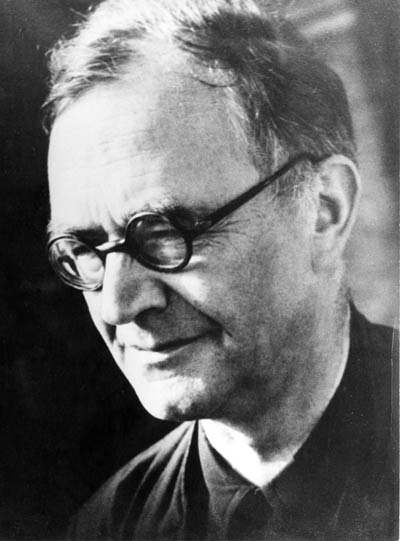
In 1962 one of the greatest theological minds of the 20th century visited the United States on a lecture tour. Karl Barth was a product of Western Theology who actively spoke against the Nazi regime rejecting their un-Christian allegiance to Adolf Hitler. His writing and influence spread throughout the world to a degree beyond his expectation.

So during the early 1960’s Barth found himself in his later years, touring around the American landscape lecturing to young, and old, Christians about the importance of God being God.

Karl Barth is my theological hero – his books line my shelves and I believe he put forth a remarkable understanding of scripture.

Karl Barth

Karl Barth

However, Barth is remarkably difficult to understand and was very longwinded in his writing. He was once approached by a young theologian declaring, “Professor Barth, you’re my hero! I’ve read everything you’ve ever written!” To which Barth replied, “Son, I haven’t even read everything I’ve written.”

Karl Barth, intellectual and as difficult to understand as any theologian I’ve ever read, lectured at Princeton, the University of Chicago, and Union Theological Seminary. After one such lecture, no doubt filled with theologisms beyond the capacity of comprehension, a young man bravely decided to ask a question.

Now, at the time, evangelical theology was beginning to take off in the United States. Churches pushed for “personal relationships with Jesus Christ.” Altar calls were all the rage. And everyone wanted to know when you got saved.

The young man, with his hand shaking in the air, waited to ask his question. I imagine that Barth was getting tired of answering the foolish questions from the audience but decided to offer one final answer. “Son, what is your question?”

“Well professor Barth, I was wondering, when were you saved?”

The young man, obviously caught up with the personal stories of individuals who accepted Jesus Christ in their hearts, moments where folk learned that they were saved, wanted to know when Barth had discovered this momentous occasion in his own life.

After responding to questions about the ineffability of God, the diminishing role of the third member of the Trinity, and the self unveiling to humanity of the God who cannot be discovered by humanity simply through its own intuition, Barth was finally asked a question with a simple answer.

“Hmm, when was I saved? Oh yes, thats easy, it was… 2,000 years ago on the cross.”

“How will I know when I’m saved?” A question I have heard time and time again. When will I know, with assurance, that heaven is my everlasting reward? How will I be able to tell that I have been saved and what happens if I ever have doubts later on, will I still go to heaven?

In many churches, being “saved” is equated with a moment when an individual accepts Jesus Christ as their “personal Lord and Savior.” We look at it as a check-off list, an accomplishment to be met in order to go to heaven. A time when they let their old self die, in order to be clothed in Christ forevermore. This often takes form in an altar call, that moment after the sermon when a preacher stands right where I am, calling out to the congregation, calling out for those who feel the call of God on their lives to come forward during the final hymn to give their lives to Jesus Christ. Sometimes it takes place in baptism, when water is used to cleanse a child or an adult from their broken ways and save them. Sometimes it takes place in the bread and wine of communion, nourishing someone’s faith in a way previously unexperienced.

In many places, being “saved” like this is worth celebrating as a rebirth, a reawakening of the soul, a definitive shift in the life of a Christian. Some of my friends celebrate their “saved” birthday every year with a cake and presents. And even though some of those people are dear to me, and even though I can trace back to a moment in my life where I committed my life to Christ, I still wonder about what it really means to be saved.

This is what I do know: The saving of anyone is something which is not within our power, but only of God. No one can be saved – by virtue of what he/she can do. Everyone can be saved — by virtue of what God can do.

After coming down from the transfiguration on the mountaintop, Jesus met back up with the disciples only to be surprised to see them arguing with scribes. Upon arrival the crowd surrounded him overcome with awe. Someone from the group stepped forward, “Teacher, I brought you my son; he has a spirit that makes him unable to speak, it makes him seize up and crash to the ground. I asked your disciples to cast it out, but they were unable.” Jesus then responded to everyone present, “You faithless generation, how much longer must I be among you? How much longer must I put up with you? Bring the boy to me.”

So the crowd brought the boy forward but he immediately began to convulse when in the presence of the Lord and he rolled on the floor foaming at the mouth. Jesus asked the father, “How long has this been happening to him?” “Its been happening since childhood,” the father responded, “but if you are able to do anything, have pity on us and help us.”

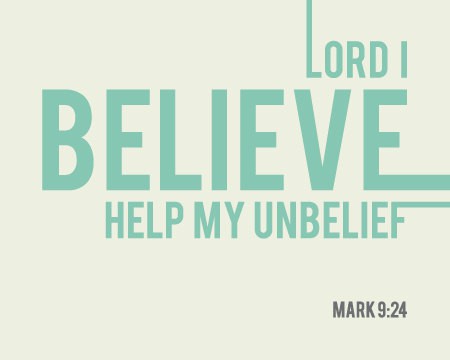
Jesus then responded, “If you are able! — All things can be done for the one who believes.” Immediately the father of the child cried out, “I believe; help my unbelief!”
unbelief

I believe; help my unbelief! The father’s reply demonstrates for us the nature of faith. It seems so paradoxical and contradictory, yet, how often has that father’s cry been the prayer on our lips? The father has shown a bit of faith by approaching Jesus in the first place, yet the move stemmed from desperation rather than confidence; “if you can do anything” shows his doubt and his faith at the same moment. The father holds his disbelief and faith in tandem with one another.

Haven’t we all had moments where, like the father, we can hold both our faith and disbelief at the same time? Periods in our life where we know that God loves us, yet our doubts begin to percolate at the same time. Perhaps confronted with a disappointment we call out to God  begging to know his ways, wondering if he’s even listening at all, yet we still call out to God. Like the father we take our burdens to God, we have enough faith to go that far, faith the size of a mustard seed, but then we struggle and limp along unsure of what God can do.

Prayer does not work like magic. Prayer is not a manipulation of God to get what we want. God does not simply grant all of our requests when we kneel and bow before him. That puts far too much power on our side of the equation. Like “knowing” we are saved because “we” have accepted Christ, it puts the burden on us to accomplish something that we cannot do on our own. If salvation can be decided on our acceptance of Christ as Lord, then God would never have had to come in the form of flesh, die on the cross, and then be raised from the dead. Prayer is more like wrestling alone in the middle of the night with a God who refuses to let go.

God is the one who saves us through Jesus Christ, God is the one who healed that father’s son through Jesus Christ. Prayer and accepting Christ is not magic, yet we are always called to pray, like that father, for more faith. We pray for more faith as trust in God’s love, grace, and power so that God in Christ can work his healing power and presence through Christ in our lives.

The story of the man bringing his son to Christ is powerful for all of us gathered here, because like that father we are fallen people incapable to saving ourselves and our loved ones. This story offers us a great glimpse of God’s glory: All things are possible to those who believe. But even greater than that is the fact that beyond our faith or prayers, God is the source of healing and salvation in our lives. Jesus is the one who calls us to brings our burdens to him, we are not left alone to try and save ourselves.

So, how do we know when we are saved? What does it mean to be saved? Are we allowed to doubt?

I like Barth’s answer to that young man, “I was saved 2,000 years ago on the cross.” I like his answer because its true and it puts the power of salvation back on God’s side of the equation. We cannot save ourselves by virtue of our own devices, but it is only God who can save us. Yet, there is something remarkably powerful about accepting Christ at the same time. Barth’s response is appropriate, but it still misses a fundamental element of what it means to follow Christ.

If being “saved” can be compartmentalized to that moment on a cross 2,000 years ago, then there is little need for us to follow Jesus in the present. Without a commitment to change our lives in accordance with the kingdom, discipleship falls to pieces. When we come to know Jesus Christ in our hearts, when we have that moment, whether its at the altar during one of our favorite hymns, or in the water of baptism, perhaps in the wine and bread of communion, its not so much they we are accepting God, but more the fact that for the first time we are realizing that God has had us the whole time. 

Faith, at its purest and deepest form, is not about “letting God into your heart” but discovering that God has been there the whole time. Being saved is not about making a choice to become a Christian, but a willingness to let God be the Lord of our lives, and not the other way around. Doubts are not something to be feared and dismissed, but to be embraced and wrestled with. Even after John Wesley felt the assurance of God’s love in his life when his heart was strangely warmed, his doubts crept back in within days.

Faith is that great dance between us and God, faith is knowing and unknowing, faith is being able to cry out “I believe; help my unbelief!”

Thats exactly why we need elements of worship such as baptism and communion. We need patterns and practices that remind us of that great event where Christ died and was risen, that incredible moment where we were saved, but we also need food and habits for our faith journeys. We need to know that we have been saved by grace through faith, not by our own doing, but by the gift of God. Yet at the same time we have to hold the mystery of salvation like the father did, we have to recognize that we continually need Christ to be the one from whom all blessings flow, we need Christ to hear our prayers and grow our faith, we need Christ to be our Lord, not just in the past but in every moment of our lives. You have been saved, and are continuing to be saved everyday.

I believe; help my unbelief!” is our confession of faith in the God who continues to breathe new life and new faith into all of us.

In a few moments we will celebrate the two great sacraments of our church. Hattie Myles Markham will be brought forth to the water to be baptized in the name of the Father, and the Son, and the Holy Spirit. She will be incorporated into God’s kingdom through the redemptive power of the trinity. And likewise all of us will then be invited to feast at Christ’s table letting the bread and the wine nourish our souls.

Here we find the gospel, in baptism and communion we find the good news of God in the world. No matter what you do, God will never love you any more, and no matter what you do God will never love you any less. God so loved the world that he gave his only son so that everyone who believes in him might not perish but have eternal life. Nothing can ever separate you from the love of God in Jesus Christ. Jesus Christ mounted the hard wood of the cross to save you and me from having to try and save ourselves. Salvation is here. Thanks be to God.

Amen.

Weekly Devotional – 12/30/13

Devotional:

Ephesians 1.5-6

He destined us for adoption as his children through Jesus Christ, according to the good pleasure of his will, to the praise of his glorious grace that he freely bestowed on us in the Beloved. 

734230_4212788928976_1058514452_n

Haley Mertins and Matthew Husband. Two very unique and wonderful people that will be marrying one another on Saturday. I have known Matthew since High School, when he was the kicker for the football team and recognized for his humor and jovial nature. I have known Haley since the moment she was born, I watched her grow and become the woman she is today (she is my little sister after all). Almost a year ago, Matthew asked Haley to marry him, and shortly thereafter I was asked to perform the wedding ceremony. The big day is finally approaching, and on Saturday I will stand before two of my favorite people on the planet (as well as their families and friends) and I will bring them together in holy matrimony.

Over the last months Haley and Matthew have diligently planned their wedding: sending out all the invitations, planning the menu, creating a music playlist for dancing, envisioned a worship service, etc. All of that planning and preparation will comes to fruition this coming weekend as their lives will be forever connected.

1486126_10200985093660539_1903328338_o

As Haley and Matthew’s relationship has grown over the last few years, I have particularly enjoyed seeing how each of them learned to let themselves be loved by their new families; both of them have been adopted by their soon to be in-laws. Matthew has been invited on vacations with my family, is a regular at the kitchen counter for dinner, and knows (and is responsible for) numerous inside jokes. Likewise, Haley has been adopted into the Husband family through meals, celebrations, parties, and vacations. Haley and Matthew have had to train themselves to be accepted into a new family dynamic where they will love and be loved by others.

At the beginning of his letter to the church in Ephesus, Paul wrote, “[God] destined us for adoption as his children through Jesus Christ, according to the good pleasure of his will, to the praise of his glorious grace that he freely bestowed on us in the Beloved.” In many ways, the sense of adoption that Haley and Matthew have experienced is paralleled in the ways that God has adopted all of us as children through Jesus Christ. Regardless of our familial experiences and pasts, we have all been incorporated into God’s family through the redemptive life and love of Jesus Christ. Just as Haley and Matthew will be welcomed by one another’s families, God has welcomed us in to the great and cosmic love that is the body of Christ for the world.

So, wherever you are in your life, whatever situation you’re experiencing with your family, know that God loves YOU. God has welcomed you in as a child and will love you eternally. You have been grafted in to something so much larger than yourself, something that will come to define you more than anything else. As we all prepare to take our first steps into 2014, let us rejoice in the fact that we can truly call God our Father.


Then and Now – Sermon on Ephesians 1.11-23

Ephesians 1.11-23

In Christ we have also obtained an inheritance, having been destined according to the purpose of him who accomplishes all things according to his counsel and will, so that we, who were the first to set our hope on Christ, might live for the praise of his glory. In him you also, when you had heard the word of truth, the gospel of your salvation, and had believed in him, were marked with the seal of the promised Holy Spirit; this is the pledge of our inheritance toward redemption as God’s own people, to the praise of his glory. I have heard of your faith in the Lord Jesus and your love toward all the saints, and for this reason I do not cease to give thanks for you as I remember you in my prayers. I pray that the God of our Lord Jesus Christ, the Father of glory, may give you a spirit of wisdom and revelation as you come to know him, so that, with the eyes of your heart enlightened, you may know what is the hope to which he has called you, what are the riches of his glorious inheritance among the saints, and what is the immeasurable greatness of his power for us who believe, according to the working of his great power. God put his power to work in Christ when he raised him from the dead and seated him at his right hand in the heavenly places, far above all rule and authority and power and dominion, and above every name that is named, not only in this age but also in the age to come. And he has put all things under his feet and has made him the head over all things for the church, which is his body, the fullness of him who fills all in all.

allsaintsday

Today is All Saints’ Sunday, a particular fixture in the Christian liturgical calendar, often celebrated the first Sunday of every November. All Saints is a time and opportunity to name the death of our saints over the last year. And for us, as United Methodist in particular, “saints” refers to all Christians past and present, so we celebrate the church universal as well as those we have lost. Today is a day about remembrance and honor.

Paul writes to the church in Ephesus, “In Christ we have also obtained an inheritance, having been destined according to the purpose of him who accomplishes all things according to his counsel and will, so that we, who were the first to set our hope on Christ, might live for the praise of his glory.” What is this inheritance that he is referring to?

Bob Foley. Bob Foley was a long time usher at the church where I grew up. As a kid I can remember Bob handing me some of the children’s bulletins that I doodled over throughout the church services, and I can remember him patiently waiting on Christmas Eve’s services with candles in his hands. The first time I ever talked to Bob was when I was fourteen, the first Sunday that I ever ran the sound-system for our services. Bob fulfilled his usher obligations, handing out bulletins, helping new visitors and families find a pew, when he finally stood behind me looking over my shoulder. Now imagine with me if you will, a fourteen year old standing in front of a mixing board with hundreds of knobs, lights, and volume controls, at a church with a large sanctuary with hundreds of people prepared for worship. So with fear and trepidation defining my inner struggles Bob leaned forward and whispered in my ear, “good luck.”

soundboard01_big

I’m sure I messed something up that morning, perhaps I forgot to turn off our minister’s microphone so everyone wound up hearing him horribly attempt to keep the tune to “Be Thou My Vision,” or I turned the volume too high and there was feedback in the sanctuary, or no one heard the prayer over the Tithes and Offerings because I forgot to turn the microphone back on. I’m sure I messed up, but Bob walked over to me after the service ended, shook my hand, told me to call him Bob, and smiled while telling me how proud he was.

Thus started an incredible friendship that played itself out every Sunday morning as Bob and I would joke around in the back. He was old enough to be my grandfather but he never treated me like a child; he was encouraging, and respectful, but above all he was a happy man. Whereas many people would drag themselves into church on Sunday mornings, wiping away the sleep from under the eyes and trying to find a trash can for their coffee they had just chugged, Bob was always standing by the door with a smile because he genuinely cared about the church, he loved being there, and he loved God.

When Bob passed away it crushed me. I’ll never forget the feeling in the pit of my stomach when my mother called me during college to let me know what had happened, and I’ll never forget the awful feeling of walking back into the church for the first time without having Bob there with his customary smile.

Paul talks about an inheritance from Christ, something we receive through his mighty acts in the world. There is something special about getting to share the stories of the bible with someone, young or old, to talk about what God did with God’s people, but there is something indescribable about the way God is working in the world right now.

Bob Foley was a saint in my life. But what Bob offered for me and my Christian life was more than the typical church friendship. Bob never sat me down with scripture or told me how to live my life. He never criticized my decisions or offered unwarranted advice. What Bob did for me, was demonstrate how important faith is in the now. He might’ve loved to hear those old stories from scripture, but Bob felt God living in the world in the immediate, thats why he committed to being in church and sharing his smiles with everyone else; to him there was nothing better than being a Christian because he felt God’s presence.

When we read from Paul’s letter to the Ephesians, its as if he’s saying “It is such a great thing to be a Christian!” But, I wonder if that is the first thought that comes to our minds when we think about our Christian heritage today. May it be that the joy and excitement of the gospel has grown stale for many of us? Is living out our Christianity filled with images of too many commitments and disappointments? Have we grown complacent with what it means to be the church in the world? Perhaps a lot of us here are like the elder brother from Christ’s great parable, we see our wayward younger brother return home for a celebration and we are envious. Maybe we hear the words from our Father saying, “You are always with me, and all that I have is yours,” but the thrill and glory of these words have seemed to vanish.

Why are we here? Why did we wake up this Sunday morning and come to church? What brought us, what drove us to ever join together in the first place?

All of us are here because someone loved us enough to bring us, to invite us, to nurture us. Who was that person for you? Who was that saint in your life?

Paul writes about a “love toward all the saints” present in the community in Ephesus. That same love may, in fact, be half-present today in our lives through the casual “hello” at the Food Lion, in the wave as a car drives by in the neighborhood, and in the church fellowship activities in which we participate. But there is a temptation to take all of these things for granted, to live into them everyday, and never value them for what they really are.

I’m not proud to admit that I never realized how important Bob Foley was to my life until after he died. It was only in his absence that I began to appreciate the joy that he taught me every Sunday morning. I took my relationship with Bob for granted and I wish that I had lived into our friendship more while he was still here with us.

Like our relationship, it has taken me some time to discover what made Bob’s faith so worthy of emulation. I have wondered what it was that made him excited about the church, when so many others arrived more out of obligation than expectation.

Have you ever noticed that Paul almost never writes about the actual life of Jesus in his letters? Do you find it interesting that as a leader for the blossoming church in the first century, Paul rarely referenced the exciting life of Jesus Christ? He paid little attention to the Sermon on the Mount, the parables, the miracle stories, or other moving elements from the gospels. It seems, therefore, for the first Christians, what was most important was not what had happened in the past, but how Christ was living in and through them in the present. They most certainly remembered the words and actions of Christ in their worship, but their Christianity was exciting because Christ was still moving in their world.

Paul wrote to the church, “I pray that the God of our Lord Jesus Christ, the Father of glory, may give you a spirit of wisdom and revelation as you come to know him, so that, with the eyes of your heart enlightened, you may know what is the hope to which he has called you, what are the riches of his glorious inheritance among the saints, and what is the immeasurable greatness of his power for us who believe, according to the working of his great power.” The key word in this whole passage is “power.” When the first Christians appealed for conversion to the new faith they did not just talk about what had happened on a hill outside of Jerusalem in the year 33, but they witnessed to what Christ had done for them in their own lives.

Christ is a present power, rather than simply being an admired person from history, Christ transcends time and is with us in the present; that was the paramount miracle for the early church.

On this All Saint’s Day we are called to remember the saints of our lives, the Bob Foleys of the world, to be thankful for what they did for us, but to also live in the present. Be grateful for what they did, and live out our faith today. The saints and Christ are not just some historical influences in our lives but continually live and move through us in the ways that we continue to be faithful in the world.

Do you know God? I don’t mean some sort of dense theological knowledge, but real and tangible and simple. Do you know God in your life? We cannot have knowledge of a person until we see them in action and we shall not have faith in God until we trust and experience his divine love in the world.

There is a difference between the Word of God (Jesus Christ) and the word of God (scripture). Our knowledge of God in this community rests upon God’s Word as Jesus Christ. The Bible is not a textbook in the ordinary sense as a collection of facts that need to be checked and memorized but it is instead a story. In contains the majestic drama of God’s interaction with God’s people. The climax of the story is God’s coming down to dwell among us in the form of flesh, dying for us on a cross, rising again from the grave, returning to glory, and leaving behind a people of God endowed with knowledge of him.

When we remember the saints, when we gather together to read and proclaim scripture, it is important for us to remember God’s mighty acts in the world. However, what makes church and faith compelling, what moves us toward excitement, is God’s present power in the world! Today is the day that we can celebrate the lives that we have lost while also living into the exciting faith of what it means to be Christ’s body for the world.

Today we are called to remember those saints from our lives who shaped us into the people we are now. It is the time to remember disciples like Bob Foley who lived out his faith in his relationships with others, who felt the joy of Christ in his own life and in his own heart.

We remember those who have gone on with joy and with longing, for they are being held in the arms of our great Lord and we anticipate with joy the great reunion of all the saints of the church in God’s time.

Christians are not called to be motivated by the question: “what happens to me when I die?” but rather ”what am I doing with my life right now?” What we do in the here and now, how we live out our faith in the world, is what makes being the body of Christ an exciting and wonderful thing.

Jesus Christ is not a man of the past, a person to be remembered and recorded in history. Christ is alive! Christ is with us here and now in the gifts of bread and wine. Christ continues to live and breathe and change the world because we partake of him when we gather at his table.

If you are looking to find Christ in your life, if you want your faith to move from remembrance to lived reality, and if you want to find a joy worthy of celebration, then come. Come to Christ’s table and discover the inheritance that will change your life forever.

Amen.

Communion