Devotional – Psalm 103.8

Devotional:

Psalm 103.8

The Lord is merciful and gracious, slow to anger and abounding in steadfast love.

Weekly Devotional Image

16 years ago I was sitting in my 8th grade band class when an announcement came over the PA system that I was needed at the main office. I walked down the hallway wondering why in the world they needed me in the main office of my middle school when I saw my father standing outside the doors beckoning me to hurry up. We quickly dashed toward the car where my sisters were already waiting and all I remember my dad saying was, “So many people have already died.”

It was September 11, 2001 and my father somehow got us out of school before they went under lockdown. I spent the entire day sitting on the living room floor at my parents’ house watching the World Trade Centers fall to the ground over and over again. And I was angry.

sept-11-Brigitte

Thinking back on that day 16 years ago, I can remember the anger I felt, but I can’t tell you who or what that anger was directed toward. The television contained images of violence I never thought possible in the world and it created in me a frustration and an anger that remained for a long time.

It was only years later that I came across a prayer written by one of my professors 30 minutes after the destruction of the World Trade Center. Dr. Hauerwas’ words articulate a feeling that I believe most Americans felt 16 years ago, but he was also bold enough to speak the truth in a time of fear, anger, and violence. This is the prayer he wrote 16 years ago today:

“Vulnerable – we feel vulnerable, God, and we are not used to feeling vulnerable. We are Americans. Nor are we used to anyone hating us this much. Such terrible acts. Killing civilians. We are dumbfounded. Lost. We are good people. We are a nation of peace. We do not seek war. We do not seek violence. Try to help us remember that how we feel may be how the people of Iraq have felt while we have been bombing them. It is hard for us to acknowledge the “we” in “We bombed them.” What are we to do? We not only feel vulnerable, but we also feel helpless. We are not sure what to feel except shock, which will quickly turn to anger and even more suddenly to vengeance. We are Christians. What are we to do as Christians? We know that anger will come to us. It does us not good for us to tell ourselves not to be angry. To try not to be angry just makes us all the more furious. You, however, have given us something to do. We can pray, but we wonder for what we can pray. To pray for peace, to pray for the end of hate, to pray for the end of war seem platitudinous in this time. Yet, of course, when we pray you make us your prayer to the world. So, Lord of peace, makes us what you will. This may be one of the first times we have prayed that prayer with an inkling of how frightening prayer is. Help us.” (Dr. Stanley Hauerwas – Disrupting Time)

So today, 16 years later, we still pray for God’s will to be done. We pray that we might become God’s prayer for the world. And, perhaps most boldly, we remember that while the world is consumed by fear and terror, we worship the God who is merciful and gracious, slow to anger, and abounding in steadfast love.

Devotional – Matthew 6.28-29

Devotional:

Matthew 6.28-29

Consider the lilies of the field, how they grow; they neither toil nor spin, yet I tell you, even Solomon in all his glory was not clothed like one of these.

Weekly Devotional Image

In a few hours I will gather with members of the community for a Service of Death and Resurrection for one of St. John’s long-time members, Gracie Jackson. During my first two months serving at St. John’s (almost 4 years ago), I tried to visit as many people as possible from the church community, particularly those who could no longer attend worship on Sundays. I want them to know that the church still cared about them and that they were in our prayers regardless of their presence.

Throughout those first months I was welcomed into a great number of homes and learned so much about Staunton and the impact St. John’s has had throughout the decades. One of my first visits was to the Jackson home where I sat and talked with Lenard and Gracie Jackson. But we didn’t sit for long. Instead, they wanted to give me the grand tour including the basement workshop and the green house in the backyard. There were plants everywhere but one in particular was striking and unlike anything I had seen before. Lenard explained that it was a Night-Blooming Cereus, and like the name implies, it only blooms at night. At the time, I casually mentioned my interest in the plant and we continued the door.

However, a couple days later Gracie told Lenard that he HAD to invite me over to witness the Night-Blooming Cereus in all it’s glory. (Lenard recently told me that in his life there were always two ways to doing things, and both of them were Gracie’s!). So at 10pm Lindsey and I drove over to the Jackson house and the four of us sat in their living room in our pajamas patiently waiting for the plant to do its magic.

When the right time arrived, we huddled in the green house with the dark sky coming through the windows and the cactus bloomed right in front of us. It produced the most exquisite scent and filled the room with its glory. And in that moment I was struck by the holy space we were sharing and was reminded of Jesus’ words from Matthew 6: “Consider the lilies of the field, how they grow; they neither toil nor spin, yet I tell you, even Solomon in all his glory was not clothed like one of these.”

6e7f0caa6dfe8f6541d5babc77c32ecf

That Night-Blooming Cereus was one of the most spectacular things I have ever seen and I never would’ve experienced if it weren’t for Gracie’s insistent invitation. Similarly, our faith is something that is offered to us as an invitation. We can read all about the Lord in Scripture, we can pray privately on our own time, but when we share our faith with another person it can bloom in the most exquisite of ways.

I am so remarkably grateful for the time I got to spend with Gracie, and for the many ways she embodied God’s grace for me.

Devotional – Job 19.23-25

Devotional:

Job 19.23-25

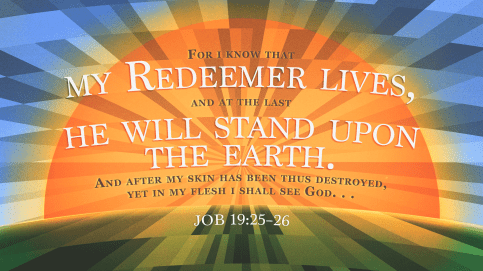
O that my words were written down! O that they were inscribed in a book! O that with an iron pen and with lead they were engraved on a rock forever! For I know that my Redeemer lives, and that at the last he will stand upon the earth.

Weekly Devotional Image

Last Thursday, while my wife, son, and I were visiting family in Alexandria, I received a phone call about one of St. John’s long-time members having died. Ruth Cassidy joined the church weeks after it formally began back in 1954 and while it was still meeting in a basement down the road. Ruth was easily one of the kindest people I ever had the chance to spend time with, and she will be greatly missed by our church community, and by her family.

A couple years ago I received a phone call about Ruth’s husband Howard, and it was clear that he was close to the end of his life. And so, I made my way over to their retirement home and when I walked into the room Ruth was sitting next to her husband, she was lovingly holding his hand in hers, and he had just taken his final breath. I, not wanting to intrude on the holiness of the moment, slowly started to back away but Ruth insisted on me sitting down with her on the couch. She immediately started asking me questions about my family and St. John’s and I was still in a state of shock; I was overwhelmed by the totality of the moment, and the fact that Howard had literally just died. Ruth continued to ask me questions, but I wanted to acknowledge what had just happened. It took a couple minutes, but I finally mustered the courage to ask: “Ruth, are you okay? I mean, Howard just died…”

She looked right into my eyes, smiled, and said, “Oh, everything is fine; I know where he really is.”

Rarely have I encountered such faith, such hope, and such love as what I regularly experienced through Ruth Cassidy. Like the biblical character of Job, she had an assurance about the way things really are. In that holy and profound moment immediately after her husband died, I could almost hear the words of scripture floating in the room with us: “I know that my Redeemer lives, and that at the last he will stand upon the earth.”

job-19-25-26

Ruth’s assurance, her blessed assurance, was one worthy of our emulation.

Do you know that your Redeemer lives? What words or thoughts would you want to engrave on a rock forever? Can you feel the Holy Spirit moving and breathing into your life? Are you filled with an assurance about who you are and whose you are?

O that my words were written down and engraved forever! I know that my Redeemer lives! And that at the last he will stand upon the earth!

On Why We Need The Passion On Palm Sunday

strangely-warmed-spreaker-header

The team from Crackers & Grape Juice recently spent an afternoon interviewing the one and only Dr. Eric Hall (Archbishop Raymond G. Hunthausen Professor of Peace and Justice at Carroll College) for our lectionary podcast Strangely Warmed. During our time together we talked about the readings for Palm Sunday during year A from the Revised Common Lectionary and Eric gave us a lot to think about particularly regarding Jesus’ triumphal entry in Jerusalem. If you want to hear the conversation, and learn more about Jesus Christ Superstar, the parody of the passion, and the average lifespan of a donkey, you can check out the podcast here: Palm Sunday – Year A


eric-snow

Palm-Passion-Sunday-wallpaper


On Using Bad Words In Church

Romans 6.1-11

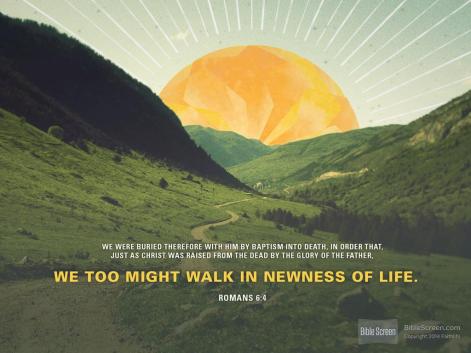
What then are we to say? Should we continue in sin in order that grace may abound? By no means! How can we who died to sin go on living in it? Do you not know that all of us who have been baptized into Christ Jesus were baptized into his death? Therefore we have been buried with him by baptism into death, so that, just as Christ was raised from the dead by the glory of the Father, so we too might walk in newness of life. For if we have been united with him in a death like his, we will certainly be united with him in a resurrection like his. We know that our old self was crucified with him so that the body of sin might be destroyed, and we might no longer be enslaved to sin. But if we have died with Christ, we believe that we will also live with him. We know that Christ, being raised from the dead, will never die again; death no longer has dominion over him. The death he died, he died to sin, once for all; but the life he lives, he lives to God. So you also must consider yourselves dead to sin and alive to God in Christ Jesus.


What’s the worst word you can imagine hearing from the pulpit? In a world where you can get away with saying and doing just about anything, is the church still a sacred place untainted by the desires of the world? There are plenty of strange and difficult and downright awful stories from scripture that we can read from the lectern, but don’t you think the pulpit should remain nice and clean?

During the season of Lent, we confront our finitude, our sinfulness, and our total dependence on the Lord. It is a tough time for us comfortable Christians, because these are exactly the types of things that many of us would rather avoid.

Gone are the days when we could expect to hear about sin and be challenged and convicted out of it. Gone are the days when we could affirm our finite lives without needing the stark reminder of ashes on our foreheads once a year.

Today, God has been reduced to a bumper-stickered and hallmarked version of love. Nothing more, nothing less, nothing else.

Today, church is not the place for judgment and for talk about sin. Regardless of their primacy in scripture, we would all be happier if we could avoid them.

The same holds true for foul language.

Right?

ec5f5b7006dc9af1fb22b9c190f5bcbb_social-etiquettepptx-on-emaze-swear-words-clipart_846-422

This is definitely not the place for someone like me to stand in front of people like you and use words that are forbidden from the radio and are relegated to rated-R movies.

As I heard someone say recently, “Preacher, there are just some things you don’t talk about it church.”

There is a seemingly endless list of things not to talk about in church; things like politics, abortion, divorce, war, sex, taxes, just to name a few. But foul language, language that results in soap-in-the-mouth discipline, is a particularly poignant thing to avoid in church.

And I have a friend in ministry who has completely ignored this accepted fact.

He loves to use foul language from the pulpit. Whether it’s the Christmas Eve sermon and the church is filled with young families who only show up for one worship service a year, or an Ash Wednesday service where only the die-hard Christians come out, he’s known for his colorful language. He’ll tell you that he uses those particular words in order to enhance the sermon in such a way that it will become more memorable and hit closer to home.

And a lot of the people at his church can’t stand it.

“Why does he feel like he has to resort to such awful language?” “The church deserves better than this.” “Does he talk to his mother that way?”

And, I think, they have a point. When the language used becomes more memorable or more important than what is being proclaimed, something has fallen a part. For instance: His recent Ash Wednesday sermon was titled “God Doesn’t Give A @#$%” I read it and listened to it online, it was phenomenal. The theology and the proclamation were remarkably faithful to the One who is faithful to us. But a few of the people from the church called me afterward and couldn’t even begin to express what the sermon was about at all; they were still hung up on the title.

However, there is a value to using some bad words in church.

During the season of Lent, this time after Epiphany but before Easter, there is a specific word that we avoid at all costs. It’s really bad. The word is… well, I’m not supposed to say it. Um, how can I do this…

Okay, there’s this great song by Ray Stevens called the Mississippi Squirrel Revival, maybe you’ve heard it, and part of it goes like this: The day the squirrel went berserk // In the First Self-Righteous Church // In the sleepy little town of Pascagoula // It was a fight for survival // That broke out in revival // They were jumpin’ pews and shoutin’ @#$%^&*!”

You know the word I’m talking about? You might not have even noticed it, but we have not said the “H” word in worship since before Ash Wednesday. It has not been read from the lectern, it has not been hidden in one of the verses from our hymns, and I certainly haven’t used it from the pulpit.

We purposely avoid the word during Lent so that when we shout it out on Easter it will mean all that much more. We specifically deprive ourselves of this important and powerful word to create a longing for the realization of all that the life, death, and resurrection of Jesus promises to us and to the world.

And there’s another bad “H” word that we need to talk about: Hell.

I don’t mean the place filled with fire and a red-toned, frighteningly tall, horned figure with a trident and a bifurcated tail. I mean using “hell” as an expression.

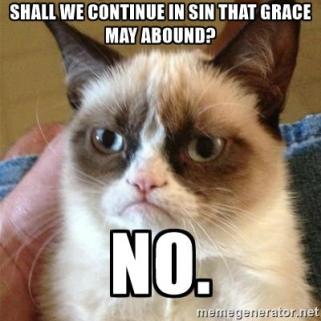
Paul writes: “What then are we to say? Should we continue in sin in order that grace may abound? By no means!” Now, what I’m about to say will probably get me in trouble, but so be it. That little ending, the “by no means” just doesn’t cut it. In Greek the expression is “me genotio” and it is way more emphatic than “by no means.” Some translations have it as “God forbid” or “Definitely not” but even both of those miss the mark.
37475703

In what we read last week, Paul wrote: “When sin increased, grace abounded all the more.” And it’s as if Paul knew that people would hear those words and say, “Dude, that’s awesome! If grace abounds all the more when sin increases, then lets keep the sins rolling!”

And here is Paul’s response: “Should we continue to sin in order that grace may abound? HELL NO!

Our lives have changed forever. We can’t just retreat to the ways of the past because grace abounds. God in Christ has made in us a new creation! The gift of God in Christ on the cross was, and is, such that we are forever freed from the tyranny of sin and death. Should we continue to sin in order that grace may abound? HELL NO!

But that’s not the last bad word we’re going to talk about today. No, we still need to talk about “Sin” and “Death.” Perhaps two of the worst words that can ever be used in church. And you can tell they’re bad word precisely because of how rarely they are used in a place like this.

We need to talk about these bad words, not because they are normal parts of human experience, but because they are false powers that rule over us. That’s how Paul understood them: Sin reigns, Death has dominion.

You need only turn on the television for five minutes in the evening to see how true this really is: The nighty News hour is filled to the brim with the failures and faults and sins of other people; The Republican Party failed to procure their dream for American Healthcare. Left Wing activists went on a violent strike in another major city. Augusta County citizen receives life sentence for horrible crime. North Korea has another failed missile test but they are getting closer to developing their own weapons of mass destruction. The market fluctuated with each tweet from our president. Test scores have fallen in local school leading to speculation that it will close… All of them are negative.

And then when they go to a commercial break we are bombarded by products designed to make us believe that we can and will live forever; Use this cream and your wrinkles will disappear. Invest in this company and you will never have to worry about money. Go on this vacation and you will feel happy and healthy like the people running on the beach or tanning by the pool.

We live under the tyranny of sin and death. But Paul says this should not be so!
Ro6

We who have been baptized into Christ have been crucified with Christ. Our sinful selves are put to death on the Cross so that we will no longer be slaves to the bad words of Sin and Death.

Long ago, we would have known this without Paul having to remind us. Baptisms, long ago, were all about death. That’s where the Baptists beat us today, I’m sorry to say. When the Baptists baptize, they fully submerge people under water. And, depending on the faithfulness of the pastor, the soon-to-be-new Christian might be held under for quite a long time.

You would’ve missed the baptism to death if you were with us in Alexandria when Elijah was baptized. No, we didn’t hold him under a tub of water to embody the death to sin. No, we didn’t give him some old and tattered gown to wear. Elijah looked perfect in his little khakis, and button-up shirt, and bow-tie, and mustard-colored cardigan. Elijah was sprinkled with water, and the perfectly portioned amount of holy oil was smeared in the shape of the cross on his forehead. And, he was carried out to the congregation and held up high by the same preacher who curses too much.

We miss the death to sin in our baptisms. But we have a member of our lectionary bible study who really gets it. Judy had avoided church for decades before God grabbed her by the heart and said, “Follow me.” She brought her questions and her doubts to her preacher, and after a time she felt her heart strangely warmed and felt moved to be baptized.

Unlike babes in the United Methodist Church, Judy marched up to the giant baptismal font and prepared to jump into the all-too-cold water. And outside, through the multicolored stained glass windows, a thunderstorm was brewing.

Judy slowly descended into the water, and with cracks of thunder in the distance the preacher plunged her into the depths of death to sin. I like to imagine that if she opened her eyes underwater, even for the briefest of moments, she would have seen a flash of lighting that illuminated the entire congregation. The whole moment felt as if the rule of Sin and Death, the dominion of the devil himself, was making one final dash to keep her under their control. But alas, the grace of Jesus Christ abounded all the more, and she arose from the water dead to sin and death.

Are we to continue in sin that grace may abound? HELL NO!

God has changed us! Not just through the waters of our baptisms, not just through the bread that we break and the cup from which we drink, but also through the death of Jesus on the cross. It changes everything! This gift transforms our very lives to the point that we should feel compelled not to fall back into the old ways, to the old self, ruled by Sin and Death.

But we know the truth: we do fall back. We know that those who are sent to prison for horrible crimes have an all too high likelihood of returning one day. We know that those caught in adultery tend to habitually cheat for the rest of their lives. We know that even the strongest member of an AA group can fall off the wagon.

We know that we fall back.

We say “never again” to so many thing only to have them come right back around. We say never again to the anger, to the cigarette, to the bottle, to the cheating, to the lying, to the hatred, to the racism, to the homophobia, to the elitism, to the narcissism, to defeatism, to a great number of things.

            They never stop.

            The fact that they never stop is evidence of the power of Sin in this world, which reigns in Death.

But our lives have been changed! God has wiped away the old self and clothed us with the new. God washed away our insecurities and insufficiencies and said, “My grace is enough.” God was nailed to the hard wood of the cross to die a death that we might die in our baptism. God was raised from the dead as we were brought forth from the water to live a resurrected and holy life.

            The death Jesus died, he died to sin, once for all; but the life he lives, he lives to God. So we also must consider ourselves dead to sin and alive to God in Christ Jesus our Lord.

Should we continue in sin in order that grace may abound? HELL NO! Amen.

The Elephant In The Room

Romans 5.1-11

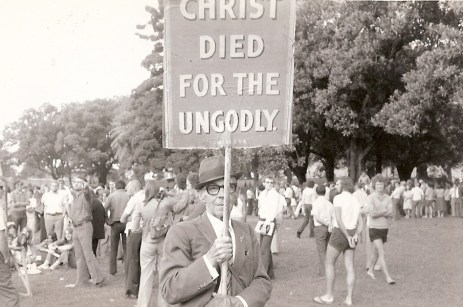
Therefore, since we are justified by faith, we have peace with God through our Lord Jesus Christ, through whom we have obtained access to this grace in which we stand; and we boast in our hope of sharing the glory of God. And not only that, but we also boast in our sufferings, knowing that suffering produces endurance, and endurance produces character, and character produces hope, and hope does not disappoint us, because God’s love has been poured into our hearts through the Holy Spirit that has been given to us. For while we were still weak, at the right time Christ died for the ungodly. Indeed, rarely will anyone die for a righteous person – though perhaps for a good person someone might actually dare to die. But God proves his love for us in that while we still were sinners Christ died for us. Much more surely then, now that we have been justified by his blood, will we be saved through him from the wrath of God. For if while we were reconciled to God through the death of his Son, much more surely, having been reconciled, will we be saved by his life. But more than that, we even boast in God through our Lord Jesus Christ, through whom we have now received reconciliation.


Sometimes I’ll be running at the gym, or walking the dog, or just sitting in my office when an idea will pop into my head. The idea starts like seed and then it germinates throughout my mind into sermon topics and bible studies and blog posts. The idea grows and grows and before it disappears into the gray matter of my brain I make sure to write it down.

And, (would you believe it?) an idea is coming to me right now! But I don’t have any paper up here so I need you all to write this stuff down (seriously).

Okay, we are justified by faith, God’s faith in us. That’s what we talked about last week. And because we are justified by faith, we have peace with God through Jesus. And, I mean, not only that, but we are bold to boast of God’s grace in our worst moments, because we know that our suffering leads to endurance, and endurance leads to character, and character leads to hope.

Yeah, that’s good.

We arrive at hope because God’s love has been poured into our hearts through the Spirit. And we know that God loves us because while we were still weak, Christ died for the ungodly. Right? Like, how often will someone die for a righteous person? Though, I guess for a good person someone might actually dare to die. But God proves his love to us in that while we were sinners Christ died for us!

Still with me?

Okay, and its even more than that, now that we have been justified by Christ’s blood we will be saved from the wrath of God. Through Jesus’ death we were reconciled back to God, and through Jesus’ life we will be saved! This is worth boasting about!

Did you get all of that?

Let me try to simplify in case I lost any of you: We are justified by God’s faith in us. Suffering leads to endurance, endurance to character, and character to hope. We arrive at this hope because we know God loves us. And we know God loves us because Christ died for us while we were yet sinners…

domain117

Paul is hard to take from the pulpit. Give me one of the stories of Jesus’ healings, or any of the parables; they preach themselves. Sometimes I even think it would be better to just read the scripture and not preach anything at all. But with Paul it takes on a new and strange and difficult dimension. Paul, in his letter to the Romans, writes in a form of rhetoric almost lost to the sands of time. In our current age of 140 character tweets from our President, frenetic television shows, and fast-paced YouTube videos, we no longer have the minds, nor the time to hear Paul’s theology.

A theology that was probably dictated to someone else to write down while Paul was thinking it up.

You can almost hear that in the reading can’t you? It’s like he remembered something from a few sentences back and wants to clarify it.

The Epistle to the Romans is not a perfectly crafted sermon meant for pulpit proclamation. Instead, it’s practical theology dictated from the greatest missionary the world has ever known.

Paul begins this section by addressing suffering; it’s the part of the passage that is most often mentioned. And he’s not just talking about some esoteric understanding of suffering. Paul is talking from experience! At the time of this letter, Paul was not a young, pre-maturely balding, healthy pastor standing in a pulpit telling his worn and suffering congregation to keep their chins up. No, this is entirely different. Paul suffered for the gospel, was arrested and persecuted, and yet he continued on. That’s why he can say that suffering leads to hope. For Paul it’s not a false and empty promise, it’s what he has experienced.

And then we come to the section about dying for others.

maxresdefault (3)

Dying for others, for one’s country, for our families, these stories captivate our hearts and our emotions. The thought of all the firefighters courageously rushing into the World Trade Center buildings on September 11th, or the countless volunteers who went to the other side of the world to fight in World War II, or just hearing about a mother who sacrifices herself to save her children, these stories really pull our heart strings.

But here, in Paul’s letter to the Romans, this is even more radical than any of those stories. We have to try to put aside the emotional waves of grief and reverence for the stories of modern sacrifice for one’s friends, family, or country. Paul does not say that Jesus died for his friends or his family or even his country.

            Christ died for the ungodly!

Paul says that Christ died for us while we were his enemies!

Talk about an elephant in the room… While we were yet sinners, Christ died for us. We hear it in Romans, we hear it every time we come to the table for communion, but do we believe it?

We don’t like talking about sin, we good Christian folk. We want to hear about love, peace, joy, hope, and happiness.

Only the converted, those whose lives have been truly captivated by Christ, think of themselves as sinners. Others won’t have anything to do with it. That, my friends, is why we so seldom read from Paul’s letters in worship; we don’t like the idea of ourselves as sinners, as ungodly.

“Preacher, can’t you just give us a little more grace and love from the pulpit? Nobody wants to come to church to hear about sins!” And yet, we enjoy reading in the gossip columns and watching TMZ to learn about other people’s sins, but that’s their problem.

We don’t like admitting our shortcomings, our faults, and our helplessness. We reject that gospel and substitute our own, one we talked about a couple weeks ago. We’d rather believe the American gospel: God helps those who help themselves. Actually, Paul tells us quite the opposite: When we could not help ourselves, when we were stuck in the shadow of sin, Christ died for us.

73d8be39b92edf6031d5a129be633895

In our current age of tweets, twenty-minute TV shows, and traffic filled websites, we want everything compartmentalized as much as possible. Instead of reading a newspaper we want a short and brief email every morning that tells us only what we need to know. Instead of buying the latest hit book and spending an afternoon in our favorite chair, we read a summary online so we can talk about it with our friends. And instead of coming to church for an hour a week to experience the presence of God, people read the sermon online and check off the box on the Christian list of to-dos.

We, whether we admit it or not, are consumed by a desire to compress as much as possible into something as small as possible. Paul completely rejects this desire and notion that we can limit the gospel to any particular sentence or paragraph. The Gospel, the Good News, is nothing less than the life, death, and resurrection of Jesus Christ, Son of Man, and Son of God.

But, if we cannot resist the temptation, if we have to have something small, something we can keep with us at all times to know what the gospel is, this might work: While we were still sinners, Christ died for the ungodly.

            This is crazy stuff people! Our Lord and Savior, the one in the stained glass window behind me, he died for the ungodly!

Who is the ungodliest person you can think of right now? I know some of you will immediately think of the members of ISIS who are terrorizing regions under their control. Others of you will immediately think of the leaders in North Korea who are trying their best to develop nuclear weapons of mass destruction. Some of you might think of Donald Trump and the seemingly endless Executive Orders streaming out of the Oval Office these days. Some of you might even be thinking about the person sitting in the pew next to you.

If it’s too hard to think of someone ungodly, just think about one person you’re angry with right now…

Jesus died for that person. Whoever you’re thinking of, whoever that completely backwards and horrible and disappointing person is that’s bouncing around in your mind right now, Jesus died for them.

That’s the real elephant in the room. Jesus died precisely for the sort of person that would crucify him and mock him while they were doing it. People like us.

These things we call faith and discipleship are not very religious in the sense of being pretty and easy to handle. They are not something we can carry around in our pockets during the week only to show up when we need them. The cross of Christ is far too offensive to be religious.

The cross and the death of Christ shatter our expectations given to us by the world. They, in all their strangeness, reorient us back toward the radical nature of God’s love. The offensive and scandalous cross is our paradoxical hope and joy. Because in and through the cross, God did something that none of us would do.

            As the old hymn goes, the immortal God hath died for me.

God’s love in Christ is so comprehensive and so bewildering that it is able to wash away even the greatest of sins.

We started this sermon with a dictation, an imaginative way to reimagine the writing of Paul’s letter to the Romans. If you wrote down anything I hope you wrote this: While we were yet sinners God died for the ungodly, for us.

Now I want you to write down the name of the person you thought of just a moment ago, the person who you’re angry with. Write his or her name at the top as if you meant to send this letter to them.

Now you know that I’m going to ask you to send it. And I know that you probably won’t. You won’t for the same reason I wouldn’t; it’s offensive and it’s uncomfortable. We won’t send this affirmation of God’s unnerving love to someone else because it would force us into an area we’d rather avoid; we don’t want to come off as too evangelistic, or too churchy. We don’t want to admit our sin.

Can you imagine the shock on the person’s face if they received your dictated letter from the adapted words of the apostle Paul? Can you picture how bewildered they would be by something Christians say all the time? Can you imagine how it would change the way you look at them for the rest of your days?

While we were still weak, Christ died for the ungodly. In our weakness we reject the challenge to confront our sins and we reject the forgiving nature of God’s love for the world. We forget that Christ died for our shame and our sin and our sadness. We forget that Christ died for our disappointment and our degenerate derelictions and our deficiencies. We forget that Christ died for us and for the people whose names’ are at the top of our letters.

And yet Christ still died for us! What wondrous love in this that that caused the Lord of bliss to bear the dreadful curse for my soul! To God and to the Lamb who is the great I am, we shall sing! And when from death we’re free, and through eternity, we shall sing.

For while we were yet sinners, Christ died for us.

Amen.

The End Of The Beginning – Ash Wednesday

Genesis 3.19

By the sweat of your face you shall eat bread until you return to the ground, for out of it you were taken; you are dust, and to dust you shall return.

If you’re here in this place, with these people, on this occasion right now, you are blessed. You are blessed because you understand, you grasp, what the church is really all about. We are a people called church, who follow Jesus and take upon ourselves the sins of the world.

However, we don’t take upon the sins of the world in the way Jesus did. We are told to take up our own crosses, but we don’t drag them up to a place called The Skull, and we don’t wait for people to nail us to them. We take upon the sins of the world in confession, a confession that God is our judge and has every right to be. Because we have failed to be the people God has called us to be over and over and over again.

The United Methodist Church has a document to help us whenever we gather together. The Book of Worship outlines the ways to serve the Lord for just about every occasion, including funerals.

The Service of Committal is brief and is reserved for the graveside. And in our Book of Worship you can find these directions for clergy: “Stand at the head of the coffin and while facing it, cast earth upon it as it is lowered into the grave. The pastor then says, ‘Almighty God, into your hands we commend your son/daughter, in sure and certain hope of resurrection to eternal life through Jesus Christ our Lord. This body we commit to the ground, earth to earth, ashes to ashes, dust to dust.’”

The last time I did a graveside burial, I held the Book of Worship in my hands like I’ve done too many times before, I read the all too familiar words, and when it came time to cast dirt upon the coffin, I couldn’t find any. I frantically looked at the area around the hole, and they had covered it with a frighteningly sharp bright green carpet of AstroTurf. So I bent down in my robe onto my knees, and I started ripping up the perfectly manicured grass on the edge of the fabricated lawn. I needed some dirt. I needed to dirty this pristine and picturesque committal service because death is ugly and disruptive. I clawed the ground and threw the grass to the side until I scraped enough bare earth with my hands to have a solid mound to drop onto the coffin.

It was a holy thing.

dirt-placeholder

I took my dirt covered hands and placed them on the coffin, I prayed the words from the Book of Worship, and then I slowly walked away giving the family time to grieve before leaving. And just as I began backing away, the funeral director motioned for the pall bearers to come forward. But they did not bend down to the hole in the ground I had just revealed. No, they took roses, the boutonnieres, from their lapels and laid them silently on the recently dirt covered coffin.

It is, of course, much nicer to throw roses than dirt. But like almost everything in the tradition of the church regarding worship, the dirt has important theological significance.

I wound venture to guess that many Christians, though they hear the words about ashes to ashes and dust to dust at funerals and at Ash Wednesday services, they have no idea where those words come from. But you do. You know where they come from because you just heard it. It is the final announcement from God to Adam and Eve as they are kicked out of the Garden of Eden.

By the sweat of your face you shall eat bread until you return to the ground, for out of it you were taken; you are dust, and to dust you shall return.

            For us humans, this is the end of the beginning.

Much has been made about the Genesis story of eating from the tree of knowledge of Good and Evil. The slithering serpent who manipulates Eve’s desire; Eve’s treachery through inviting Adam to join her in the prohibited act; Adam hiding his shame and nakedness from God when the Lord returns to the Garden. And its all pretty harsh.

By this act sin was brought into the world. Because of our ancestors’ choice, we were banished from the paradise of God’s created order and were punished. Women must suffer through childbirth. Humans must work and sweat over the earth in order to glean enough produce to survive. Families are torn apart by an individual’s choice that has ramifications far greater than they can ever imagine.

And then we come to a place like this to have ashes smeared across our foreheads in an effort to remember what happened long ago, and what will happen to all of us one day.

We will die.

But we’re content with spending the rest of our days prettying everything that we can. We bring roses to place on the coffins at graveyards. Politicians bump up statistics to make things appear better than the actually are. We do our best to cover our scars, both physical and emotional, as if they were never there. And some churches spend Ash Wednesday not in sanctuaries confessing their sins with their brothers and sisters in faith, but in their parking lots presenting “Ashes to God with a cup of Joe.”

We would rather cover the harsh realities of truth than look at them in the eye.

God’s pronouncement to Adam and Eve, that terrifying moment when they were expelled and told that they will suffer until they return to the ground, that strange and all too familiar expression you are dust and to dust you shall return, they strike fear in the hearts of us mortals.

Sometimes its good to be afraid because it reminds us what a tremendous blessing it is to be alive at all. Sometimes its good to get down on our knees and confess our sins before the Lord because it reminds us that we are not God. And sometimes we need to catch a glimpse of ourselves in the mirror on Ash Wednesday to remember who we are, and whose we are.

This day, this Ash Wednesday, is a moment for us to confess our sins, and for all the sins of the people who are not here. We bow our heads and are adorned with a sign of death, not just as a reminder to us and to others that we will die, but that God will not let death be the final Word.

And here is the hope, my brothers and sisters, the hope we need on a day like today. We know how the story ends. We know that the pronouncement at the edge of the Garden was not the final word. We know the final word is not suffering, nor death, nor dirt, nor even dust. We know that the final Word is Jesus Christ.

The ashes that will soon be on our skin are not our crosses to bear, but Christ’s who carried it to The Skull and was nailed to it for the world. Jesus Christ is God’s greatest and final Word because in him the fullness of the Lord was pleased to dwell. In Him the sin of Adam and Eve were reconciled unto the Lord. In Him we are brought back into the dwelling of God’s grace where the light always shines in the darkness.

So wear the ashes with fear and trembling, let them dirty your lives a little bit, but also remember the hope that has been available to us in the one who hung on the cross, and rose again. Amen.

maxresdefault-2

God Won’t Give You More Than You Can Handle

Mark 2.1-5

When he returned to Capernaum after some days, it was reported that he was at home. So many gathered around that there was no longer room for them, not even in front of the door; and he was speaking the word to them. Then some people came, bringing to him a paralyzed man, carried by four of them. And when they could not bring him to Jesus because of the crowd, they removed the roof above him; and after having dug through it, they let down the mat on which the paralytic lay. When Jesus saw their faith, he said to the paralytic, “Son, your sins are forgiven.”


On the day of the funeral, everything felt too familiar. The pews were filling up with the same people who were here the week before, the same family was waiting in the narthex, and our organist was even playing some of the same music as people were walking in.

I stood right here in front of the gathered congregation and asked everyone to stand for the family. Leading the profession were two daughters who were about to bury their father after burying their mother the week before. Their grief and pain and anger were palpable as they slowly walking down the center aisle, and everyone watched them as they passed.

And we did what we do for a service of death and resurrection. We prayed. We opened up the hymnals and proclaimed God’s faithfulness through song. We listened. We grieved. We cried.

As we finished, I watched the pallbearers stand up and surround the coffin. With hands shaking in nervousness and fear they carried their friend’s body out of the church and put him in the hearse.

And we did what we do when travel to a cemetery. We got in our cars and turned on our hazard lights. We followed one another through the streets of Staunton. We watched cars slow down and pull over out of respect for what we were doing. We drove. We listened. We grieved. We cried.

After arriving at the cemetery, I watched the same pallbearers carry the coffin to the grave over uncertain soil. With sweat perspiring on their foreheads they lowered their friend to the ground and stood beside the family.

And we did what we do by the graveside. We prayed. We listened. We placed dirt on the coffin. We said what we needed to say. We listened. We grieved. We cried.

After the final “Amen” I waited by the grave with a few others, making sure the family was comforted. I overheard familiar and charming anecdotes about the man we just gathered to bury. I witnessed family members reach out to one another for the first time in many years. I saw a lot of tissues filled with tears wadded up in clenched fists.

And then I saw something I’ll never forget. A man, unknown to me, walked right over to one of the daughters devastated by the loss of both her parents. He placed his hand on her shoulder and said, “Don’t worry, God won’t give you more than you can handle.” And with that he turned around and walked away.

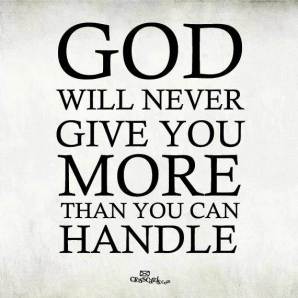
God won’t give you more than you can handle.

635787512482303409305489483_29f1979c65db2aa1627169bad37391df-imgopt1000x70

I’m sure that all of us here have heard this statement, or some form of it, in our lives. It is part of that trite and cliché Christian-lingo that we use to fill uncomfortable silences when we don’t know what else to say. And it’s not true.

Let’s start with the beginning: God won’t give you… We’ve talked about it with every sermon of this series so far; God doesn’t give us our sufferings. God is not some sadist who delights in our trials and tribulations. God is not some architect of divine destruction. God is not sitting up in heaven plotting away about what terrible things to send for us to handle.

Can you imagine going to a devastated neighborhood in Chicago to families whose sons have been killed by gunfire and saying, “Don’t worry God won’t give you more than you can handle”?

Can you imagine going to a young mother recently diagnosed with breast cancer and saying, “Don’t worry, God won’t give you more than you can handle”?

Can you imagine going to the millions of people in this country who are terrified of losing their healthcare coverage in the next few months and saying, “Don’t worry, God won’t give you more than you can handle?”

God did not kill those families’ sons, God did not give that woman breast cancer, and God is not responsible for the arguments about whether or not to eradicate the Affordable Care Act.

Sometimes, we say things like “God won’t give you more than you can handle” because we don’t know what else to say. We encounter the shadow of suffering that is so suffocating we don’t know how to respond. So instead, we will that awful void with awful words. And we make God into a monster.

The problem is that when we use trite and cliché words like the ones we are confronting this morning, we imply that God chooses to make people suffer.

Jesus, God incarnate, had been on the road for a while, going from town to town, synagogue to synagogue, proclaiming the Good News, teaching about the kingdom of God, and healing those on the margins of society. Word about his ministry spread pretty vast, and he returned to Capernaum for a few days, perhaps to rest. But so many people knew where he was that they surrounded his house and Jesus spoke the Word to them.

Some friends heard about what was happening, so they went to their paralyzed friend and carried him on a mat to Jesus. When they could not bring him to the Messiah because of the crowd, they carried him to the roof, dug through the ceiling, and lowered their friend to Jesus. And when Jesus saw the faith of the friends, he looked at the paralytic and said, “Son, your sins are forgiven.”

What a strange and beautiful story. Friends with such profound faith were willing to carry their friend, and dig through a roof, just so he could encounter the living God.

I often wonder about the tradition of pallbearers at funerals. Did it start of out a practical necessity? Is there strong theological purpose behind it? Is it a unique Christian behavior?

But on the day I buried a husband after burying his wife the week before, the day I saw a man dismissively respond to the daughter’s suffering, I saw the connection between pallbearers, and the friends who carried the paralytic to Jesus.

When we cannot handle what’s happening in our lives, we need people who can carry us, and the ones we love, to Jesus.

We will face adversity in our lives. We will experience hardships. We, or someone we love, may struggle with debilitating depression or suicidal thoughts or grief so heavy it feels like someone is sitting on our chest. We might give in to the temptation of an addiction and lose contact with the people we need most. We may fall into a pit of financial debt that feels impossible to climb out of.

If we are like most human beings, at some point we will absolutely face things that are more than we can handle.

So here’s a corrective. It’s not that God won’t give you more than you can handle, but that God will help you handle all that you’ve been given.

6fa0c8a00d809d23761dfaa71b6b542a

This acknowledges that trials and tribulation will occur in our lives, and it promises that when we go through the muck and grime of life, God will be present.

When we’re walking through hard times, whether they were given to us by the random chance of life, or they’re a result of our own brokenness, or they’re signs of our captivity to the powers and principalities, it’s okay and good to admit, “I can’t handle this by myself, and I need help.” There are times when we need a doctor, or a therapist to carry us. More often, we need family, friends, pastors, neighbors, and brothers and sisters in our church family to come alongside us to carry us through.

God does not give us more than we can handle. God gives us Jesus Christ so that we can handle what life gives us.

For a lot of people, what happened on Friday in Washington DC was more than they could handle. Whether it was the pent up frustration with the political rhetoric that overflowed over the last 18 months, or witnessing a billionaire place his hands on Abraham Lincoln’s bible, or experiencing the great swing of the pendulum from one political ideology to another, it felt overwhelming. Some responded with violent protests and destroyed shop windows and attacked the police. Others responded with peaceful demonstrations making sure their voices were not stomped out among all the shouting debauchery. There were the political talking heads offering their opinions about who was right and who was wrong. There were smug smiles and there were frightening frowns. The inauguration, for some, was more than they could handle.

For others, the last eight years has been more than they could handle. Whether it was the constant feeling like the country was slipping out of their fingers, or the realization that the American dream is not what it once was, or the rise of oppositional and divisive voices, it felt overwhelming. Some responded with protests and boycotts of particular institutions, others responded by focusing inwardly and praying for change, and still yet others waited patiently for a new direction. For eight years there were plenty of talking heads offering their unsolicited opinions about who was right and who was wrong. The last eight years, for some, was more than they could handle.

Some say the time has come for all of us to just get along. A couple weeks ago I even told you that we, as a church, should have a collective New Year’s resolution to be more kind.

Kindness and getting along are good and nice. But there are people around us, people in our lives, who need more than kindness and getting along. There are people desperately clinging to the hope of their healthcare coverage completely unsure of what it about to happen. There are people who are hopeless when confronting their joblessness and economic futures. There are people shaking and quaking about their faith and whether or not they are going to be forced to register themselves because they wear a particular piece of cloth on their heads. There are people who see police officers as enemies and not community protectors.

There are people in our community; there are people in our church, who have more than they can handle right now.

We need people, like the friends who carried the paralytic to Jesus, to carry others who have more than they can handle. We need people who can look us in the eye and tell us we have a problem. We need people who will call their friends every night just to get them through a profound period of loss. We need people like all the women who marched in solidarity all across the world yesterday. We need people with eyes wide open to the horrible suffering of the people around us so that it does not go on unnoticed. We need people who are unafraid of the consequences for questioning the status quo. Right now, we need people who are brave enough to carry us to Jesus. Amen.


dumb-things-christians-say-sermon-series-idea

On Suicide

Isaiah 43.1-2

But now thus says the Lord, he who created you, O Jacob, he who formed you, O Israel: Do not fear, for I have redeemed you; I have called you by name, you are mine. When you pass through the waters, I will be with you; and through the rivers, they shall not overwhelm you; when you walk through fire you shall not be burned, and the flame shall not consume you.

Romans 8.35-39

Who will separate us from the love of Christ? Will hardship, or distress, or persecution, or famine, or nakedness, or peril, or sword? As it is written, “For your sake we are being killed all day long; we are accounted as sheep to be slaughtered.” No, in all these things we are more than conquerors through him who loved us. For I am convinced that neither death, nor life, nor angels, nor rulers, nor things present, nor things to come, nor powers, nor height, nor depth, nor anything else in all creation, will be able to separate us from the love of God in Christ Jesus our Lord.

suicide


It was 2003 and I was a freshman in High School. And like most High School freshman, I spent many an evening on my computer typing to my friends on Instant Messenger. This was long before Facebook’s wild popularity, Twitter’s terse communication style was far away from coming into reality, and none of us even had cameras on our cell phones. But night after night we would sit in front of our computer screens typing away about what we thought were the most important things in the entire world.

One night in the spring, I waited for my parents to go to bed and then I snuck downstairs to get back on the computer. Most of the conversations were frivolous and limited by the speed at which our fingers could move over the keyboard. I can’t remember what the topic was that evening, but I do remember a new box appearing on the screen that changed everything.

At the time, my best friend was dating a girl and things were less than perfect. They fought about all kinds of stupid things and were the epitome of every high school relationship cliché. She, the girlfriend, was the one who sent me a message that night. All it said was, “We got in a really bad fight, he told me he was going to kill himself, and I don’t know what to do.

Suicide is ugly. It leaves families and friends reeling in whiplash, it creates guilt and unanswered questions, and it produces feelings of morbidity and fear.

Suicide is controversial in the church for a number of reasons. Many churches and Christians believe that suicide is ultimately sinful and worthy of eternal damnation. To have suicidal thoughts is to not have enough faith. Some pastors will even refuse to preside over funerals for those who have committed suicide.

If you look through the entirety of scripture, both Old and New Testaments, you will not find a passage that condemns suicide. None of the prophets, or priests, or kings have anything to say about suicide or what happens to those who commit suicide. However, Augustine (an important theologian from the early church) read the commandment “thou shall not kill” as a prohibition against suicide. And from Augustine’s reflection on the topic, suicide became the black sheep of sins in the church.

For a thousand years, suicide was a mortal sin and an affront against God’s goodness. Those who committed suicide were treated as criminals and refused Christian burials. By the 1500s those who attempted suicide were excommunicated by the church and were punished by the civil authorities.

And still today, suicide carries an awful stigma in the realm of the church and is one that is either referred to with eternal damnation or complete silence.

            That silence, the utter and complete darkness of a topic that is remarkably relevant for our time and reflection, is a controversy worth confronting.

According to the Center for Disease Control (CDC), on average, one person dies by suicide in the state of Virginia every 8 hours. It is the 11th leading cause of death in our state, and it is the 2nd leading cause of death for people ages 10-34.

Among high school students across the country, 17% seriously considered suicide in the last 12 months. And 8% attempted suicide one or more times in the last year.

If you’re like me, you tend to think about young people being the most susceptible to suicide attempts, but suicide rates are actually highest among people middle aged and older, by a lot. In fact, middle aged and older adults are nearly twice as likely to commit suicide as young people.

And right now, suicide has surged to its highest levels in thirty years.

yqecn1ygjymjb3igsiev

When I received that message on my computer back at the beginning of high school, I grabbed my things and was out the door before I even had a chance to really think about what I was doing. All I knew was that my friend would not just make an empty threat about suicide like that, and I had to do something about it. So I grabbed my bicycle out of the garage and I started riding as fast as I possibly could in the middle of the night. He lived a couple miles away and when I screeched into his driveway I was drenched in sweat.

I dumped the bike right there and I ran to the front door and started banging with my fist and I started yelling. Within a minute his parents were coming down the stairs in their pajamas with tired and angry looks on their faces. When they opened the door and saw me standing and sweating in the dark they were utterly bewildered and then I told them why I was there.

We immediately went to check on him in his bedroom, but he wasn’t there. We searched the house from top to bottom and we finally found him in the basement. He was sitting on the couch with tears in his eyes and he had just swallowed an entire bottle of ibuprofen.

They wound up taking him to the hospital and had his stomach pumped. They sat there and held their son while he cried and cried. And they saved his life.

Suicide is not the way any human life should end. The church, this church, has an obligation to see that all persons are grafted into a community of love and are cared for in the midst of isolation, depression, and despair.

Life is a gift, plain and simple. It is a gift from God and therefore we are called to be good stewards of this gift: our lives and the lives of others.

We cannot ignore this topic as if it has nothing to do with us. The statistics confront us with a stark reality about the prevalence of suicide in our culture. With the advent of the Internet and instant communication, young people are being bullied and attacked at a degree that few of us can even fathom. With an economy that moves up and down like a roller coaster, people in the middle of life are undergoing identity crises and are wondering how they can provide for their families. Older people who receive a grim diagnosis or the loss of a spouse struggle to justify living with such a horrible outlook for the days ahead.

We know that we are supposed to be present for and with one another, like being there for friends and family at a moment of tragedy. We rarely know what to say on such occasions, but we know we should be there. We, above all things, are called to be present for others in the midst of suffering and loneliness and depression that often lead to the contemplation of suicide. To be part of the faithful community requires us to be for one another.

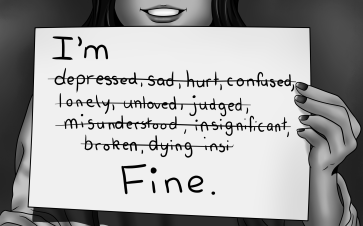
i_m_fine_by_black_avenger-d60mqnl

We live because life is a gift. We are not our own creators. We Christians are the people who must learn to live by the fact that life is a gift. We therefore can live each and every day not as a survival technique, but through recognizing that each and every day is an opportunity to live and love in the service of our Lord.

When we talk about suicide, we say it is “the taking of one’s life.” But even the way we talk about suicide shows how much a problem we have with it. Our lives are not our own. As the Lord says through the Prophet Isaiah: “Do not fear, for I have redeemed you; I have called you by name and you are mine.” We belong to the Lord and to one another. God tells us to not be afraid because God will be with us as we pass through the waters, and the rivers of life shall not overwhelm us, we shall not be burned by the fires of frustration. Not because they won’t hurt or be terrifying, but because we belong to the Lord and the Lord is with us.

If we’re here in the sanctuary this morning, we have some sense of this in our lives. We know that God is with us, we feel God’s presence in this place and we know that we are not alone. It is through encountering the divine love of God in worship that we are given the strength to be God’s presence for others who sink under the waters of life and who feel burned by the world. It is our charge to be shaped and called by God’s love and to reach out to those who contemplate ending their days. We have the challenge of showing all people, even those who see no value to their lives, how our lives are not defined by what we have done with them, but by what God will do with them.

Six months after my friend had his stomach pumped, he attempted to commit suicide again. This time he did it with a hose running from his exhaust pipe into his car. But his little brother heard the car door close and it woke him up, and then he woke up his parents. In the strange and quiet time of the darkness of night they pulled their son out of the car and they got him help. It took a long time for him to move on. It took counselors and therapists, it took friends and family, it took the power of God’s grace to show him that his life could get better, that there was hope for the future, that there was something worth living for. And because people in his life were brave enough to confront his suicide attempts, he still lives today.

But there will always be some that we cannot reach. There will be people who feel so suffocated by the weight of the world that they will make that dreadful decision to end the life that God’s has given to them. And for them, for those who will die by their own hand, what will happen to them? For centuries the church saw suicide as an unpardonable sin, something that eternally damns those who do it. Will God abandon them for making such a choice? Will God refuse to love the people who felt no love in their lives? Will the God of mercy punish them until the end of time?

           No. In all these things we are more than conquerors through him who loved us. For I am convinced that neither death, nor life, nor angels, nor rulers, nor things present, nor things to come, nor powers, nor height, nor depth, nor anything else in all creation, will be able to separate us from the love of God in Christ Jesus our Lord. Amen.


Controversy Original

On The Death Penalty

Mark 10.26-27

They were greatly astounded and said to one another, “Then who can be saved?” Jesus looked at them and said, “For mortals it is impossible, but not for God; for God all things are possible.”

Luke 23.44-47

It was now about noon, and darkness came over the whole land until three in the afternoon, while the sun’s light failed; and the curtain of the temple was torn in two. Then Jesus, crying with a loud voice, said, “Father, into your hands I commend my spirit.” Having said this, he breathed his last. When the centurion saw what had taken place, he praised God and said, “Certainly this man was innocent.”

Controversy Original

Preachers can fall into the rut of preaching on whatever keeps the congregation pleased; keep them happy and they’ll keep coming back, or something like that. This sermon series is different. Instead of falling back to the familiar narratives that keep us smiling on our way out of church, we are confronting some of the greatest controversies facing the church. There is a better than good chance that I will say something from this pulpit during the series that you won’t agree with, and if (and when) that happens I encourage you to stay after worship, join us for lunch, and continue the conversation. We can only grow as Christians in community, and that requires some honesty and humility and dialogue. Today we continue with The Death Penalty.


He was sitting with his friends when the police rushed in. Everything moved in a blur while tables were overturned, bodies were thrown to the floor, and he was placed under arrest. The journey to jail and to the courthouse was strangely quiet, but he kept his head down and his mouth shut. Others came and went, he received strange and knowing looks, and he wondered if any of his friends were arrested as well.

When they dragged him in front of the judge, the courtroom was packed and people kept screaming from the back. The judge waited for everyone to calm down and the whole proceeding came down to one question, “Did you do it?” The man replied, “If I tell you what happened, you won’t believe me, and if I ask you a question, you won’t answer.” Again the judge asked, “Did you do it?” And the man replied, “You say that I did.”

In response, the judge smacked his gavel onto the wood and declared, “What further testimony to do we need? We’ve heard it ourselves from his own lips.” And with that, the man was condemned to death.

The courtroom erupted into celebration as the gathered people shouted “Kill him! Kill him! Kill him!” What made everything worse was the fact that the dead-man walking recognized some of the people who were shouting for his death, but nothing could stop the inevitable.

Time passed, and eventually he found himself walking to his own demise; walking down death row. With every footstep he thought about what had led him to this, he thought about his family and friends that had abandoned him at the end, he thought about how this would be the last time he’d feel the ground beneath his feet.

The executioners were ready to begin the moment he arrived. They took off his clothes, and laid him down. Only then did he notice that two other men were about to be executed as well. Their faces held grave expressions of fear, guilt, and sorrow. But just like with the man, they were on a path that had only one outcome- death.

It was about noon when everything started moving quickly, and the man noticed that it was strangely turning dark outside. They strapped him down until he could barely breathe and then they stood back and waited. With each moment he felt his life slipping away, his chest heaved for air that ceased to fill his lungs, his vision went blurry, and then he died.

His name was Jesus and he was executed by the state.

Image processed by CodeCarvings Piczard ### FREE Community Edition ### on 2016-05-12 18:53:36Z | http://piczard.com | http://codecarvings.comÿÿÿ–j¬+

Capital punishment, killing someone in response to a crime, is as old as civilization itself. Some of the earliest archeological discoveries of law codes contain the ramifications for shedding blood or taking someone’s life, and more often than not it comes down to this: “An eye for an eye, a tooth for a tooth, a limb for a limb, a life for a life.” It’s there in Hammurabi’s code from ancient Babylon, and we have it in the Old Testament in our Bibles.

The Death Penalty has been around for a very long time, and we still employ it for a number of reasons. To kill someone for committing a crime is the only way to guarantee they will never recommit the same crime. It works and functions as a deterrence to influence others to not commit the crime. It helps bring closure to a family who is grieving the loss of someone who was murdered. And it saves the state a lot of money from having to keep someone in prison year after year after year.

In the United States, there are roughly 3,000 people on death row right now, and the death penalty takes place primarily through lethal injections – a poison is injected into someone’s blood stream that brings a quick and painless death, but many states still let people choose between the electric chair and lethal injection. The state of Washington however, still uses a noose to kill those who have been convicted. Across the county at least 56% of Americans support the death penalty.

And the state of Virginia, where we live, has executed more prisoners than any other state.

So why are we talking about the Death Penalty in church? Why is this a controversy that we need to confront?

Because Jesus was killed by the Death Penalty.

The main reasons that people often sight to justify the death penalty can just as easily be argued from a different perspective. The death penalty often fails to work as a deterrence because in the south where 80% of all death penalty convictions occur is the only part of the country where crime rates continue to increase. The closure that families experience in the short-term is present, but in the long-term they tend to experience more guilt and depression in a response to another person’s death. It actually costs the state a lot more money to put someone to death because of the required appeals process and the amount of time and resources that it necessitates. And, this is a very important ‘and’, since 1976 about 1 in every 9 death row inmates have been exonerated, usually after decades of living in a prison cell.

But all of the statistics and the facts, all of the psychology and the economics, are dwarfed by the fact that Christians still support the death penalty, even when the Lord we worship was killed by the same means.

We Christians love our crosses. We put them up in our sanctuaries and in our living rooms, we tattoo them on our skin and we wear them around out necks, I even carry one over my shoulder all over Staunton every Good Friday. But we have become desensitized to what the cross means: death.

Let me put it this way: If Jesus died 100 years ago, then we’d be wearing nooses around our necks instead of crosses. If Jesus died 50 years ago, then we’d be bowing before an electric chair in the sanctuary instead of a cross. And if Jesus died today, then we’d hang up hypodermic needles in our living rooms instead of crosses.

The cross was the electric chair for the Romans. The cross is like the hangman’s nooses of lynching mobs. The cross is like the lethal injection of modern prisons. It is the way people were killed by the state as a punishment for their crime.

The fact that 1 in 9 death-row inmates have been exonerated should be enough to give us pause. The fact that the state has murdered innocent people just like Jesus was murdered should give the church reason to repent. But if that’s not enough, then maybe this is: With God nothing is impossible.

And I’ll admit, there are scriptures in the Old Testament that justify the practice of capital punishment. But there are also people in the Old Testament and the New Testament who committed capital crimes and God still used them for the kingdom.

We like to think about Moses’ encountering the burning bush, we like to imagine Moses leading God’s people to the Promised Land, but we don’t like thinking about the fact that Moses murdered an Egyptian in cold blood before he met God in the wilderness.

            We like to think about David approaching Goliath on the battlefield, we like to imagine him dancing in front of the Ark of the Covenant, but we don’t like thinking about the fact that David ordered one his soldiers to die so that he could sleep with his wife.

            We like to think about Paul being knocked to the ground by God on the road to Damascus, we like to imagine him writing letters to the churches by candlelight, but we don’t like thinking about the fact that Paul murdered countless Christians before his conversion.

christians-and-the-death-penalty-views-on-both-sides

            With God nothing is impossible.

That’s the beginning and the end of theology, that with God’s help and grace all things are possible. An alcoholic can kick the drink, an atheist can discover faith, and a sinner can receive forgiveness. Why then do we keep slinging out our nooses? Why do we keep sending people to the electric chair? Why do we keep strapping them down for a lethal injection? Why do we keep hanging people on crosses?

The message of Jesus’ ministry, of the cross, is mercy. Mercy for an adulteress woman who was about to be stoned by the crowd, mercy for short tax collector who preyed on the poor, mercy for a criminal who hung on a cross right next to Jesus. Mercy triumphs over judgment.

That doesn’t mean that people who commit horrendous crimes get to walk away without consequences, it doesn’t mean that we should break down the walls of our prisons and let everyone run wild, but it does require us to fundamentally reshape our imagination regarding the justice system.

For centuries the death penalty was something that took place in public – crosses on a hill, nooses in a tree. The state used the death penalty to publicly frighten potential criminals from committing the same crime. But now capital punishment takes place in hidden rooms with minimal witnesses. It has retreated from the public arena and can continue to take place without disrupting our daily lives.

But people are being murdered for murder.

Jesus once said, “You have heard that it was said, ‘An eye for an eye and a tooth for a tooth.’ But I say to you, Do not resist an evildoer. But if anyone strikes you on the right cheek, turn the other also.” To retaliate murder for murder will only ever beget more violence, or as Martin Luther King Jr. said, “An eye for an eye leaves everyone blind.

God sent his son into the world to transform the world. Not with the ways of the world, not with power and prestige, not with armies and aggression, but with mercy and sacrifice. God sent his son to walk among us in order that we might catch glimpses of the kingdom. God in Christ ministered to the last, the least, and the lost, people like those who are waiting for the end of their days on death row. And God sent his son to carry death on his back to the top of a hill to die, so that we might live.

So long as we employ the death penalty, we will deny the power of God to redeem, restore, and transform all human beings. As long as we sling our nooses, and prepare our needles, we will prevent true repentance and new life from taking place in those who have fallen prey to evil. As long as we murder murderers, we will never give God the chance to make the impossible possible. Amen.