Christmas With Karl Barth

In the latter part of his theological career, Karl Barth would preach for the inmates in the prison of Basel, Switzerland. When the public found out that he was doing so people reacted in a variety of ways – some were amazed that a man of such academic stature would humble himself to do such a thing, while others took it as a sign of his tremendous faith. And a few would joke that the only way to hear Karl Barth preach would be to break the law and go to jail.

In 1954 Barth delivered the Christmas sermon to the inmates. I’ve made a habit of reading the sermon every Christmas Eve almost like a devotional and every year I find more and more in it that just astounds me. This great man whose theology disrupted my life (in the best ways), went down to a prison on Christmas and proclaimed the Good News of Christ’s birth into the world to a group of men who felt no hope in the world at all. 

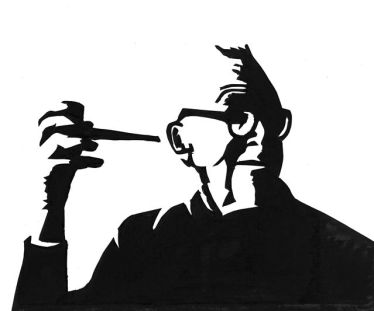
karl-barth-smoking

Below you can find some of the three most powerful paragraphs from the sermon, and as you read them I encourage you to do so while considering the context and the preacher from whom and for whom these words were preached:

“What does the word Savior convey? The Savior is he who brings us salvation, granting us all things needed and salutary. He is the helper, the liberator, the redeemer as no man, but God alone, can be and really is; he stands by us, he rescues us, he delivers us from the deadly plague. Now we live because he, the Savior, is with us.

“The Savior is also he who has wrought salvation free of charge, without our deserving and without our assistance, and without our paying the bill. All we are asked to do is to stretch out our hands, to receive the gift, and to be thankful.

“The Savior is he who brings salvation to all, without reservation or exception, simply because we all need him and because he is the Son of God who is the Father of us all. When he was made man, he became the brother of us all. To you this day is born a Savior, says the angel of the Lord.”

Merry Christmas

barth-bw

Knowing The End At The Beginning

Devotional: 

Isaiah 9.6 

For a child has been born for us, a son given to us; authority rests upon his shoulders; and he is named Wonderful Counselor, Mighty God, Everlasting Father, Prince of Peace. 

Weekly Devotional Image

A father was with his four year old daughter last Christmas and it was the first time she ever asked about the holiday and why it was something they celebrated. The father explained that Christmas is all about the birth of Jesus, and the more they talked about it the more she wanted to know about Jesus so he bought a illustrated Bible and began reading to her every night.

And she loved it.

They read the stories of Jesus’ birth and his teaching, and the daughter would ask her father to explain some of the sayings from the Lord like “Do unto others as you would have them do unto you.” So the father would share thoughts about how Jesus teaches his followers to treat people the way they want to be treated. They read and the they read and at some point the daughter simply declared, “Dad, I really like this Jesus.”

Right after Christmas, they were driving around town and they passed by a Catholic Church with an enormous crucifix right out on the front lawn. The giant cross was impossible to miss as was the figure nailed to it. The daughter pointed out the window and said, “Dad, who’s that?”

The father realized in that moment that he never told his daughter the end of the story. So he began explaining how the man on the cross was Jesus, how he ran afoul of the Roman government because is message was so radical, and that they thought the only way to stop his was to kill him. And they did.

The daughter was silent.

A few weeks later, after going through the whole story of Christmas, the Preschool where his daughter attended was closed for Martin Luther King Jr. day and the father decided to take the day off and treat his daughter to a day of play and they went out to lunch together. When they were sitting at the table waiting for their food at the restaurant, the daughter saw the front page of the local newspaper laying across the next table with a picture of MLK’s face on it. And the daughter pointed at the picture and said, “Dad, who’s that?” 

“Well,” he began, “That’s Martin Luther King Jr. and he’s the reason you’re not in school today. We’re celebrating his life. He was a preacher.”

She said, “For Jesus?”

The father replied, “Yeah, for Jesus. But there was another thing he was famous for; he had his own message and said that people should treat everyone fairly no matter what they look like.”

She thought about it for a minute and said, “Dad, that sounds a lot like du unto others as you would have them do unto you.”

The father laughed and said, “Yeah, you’re right. I never thought about it like that but it’s just like what Jesus said.”

The young girl lowered her gaze to the table and then she looked up at her father with tears in her eyes and said, “Dad, did they kill him too?”

Away-In-A-Manger

Kids get it. They make connections that we’re supposed to make. And even though 2019 has been a strange and rough years with all the political rhetoric and partisanship, with all the suffering of individuals and communities across the world, kids still get it.

The baby in the manger is the same person who hangs on the cross. 

That’s a difficult and challenging word for those of us who like our Christmases unblemished, who want to think only of the precious new born child without having to confront what will be done to him at the end of his days. But he was a child born for us, who came to make a way where there was no way, and his story has changed our stories forever. 

Or, to put it another way, we cannot make sense of the beginning without knowing the end. 

Unsettled

strangely-warmed-spreaker-header

This week on the Strangely Warmed podcast I speak with Teer Hardy about the readings for the 1st Sunday After Christmas [A] (Isaiah 63.7-9, Psalm 148, Hebrews 2.10-18, Matthew 2.13-23). Our conversation covers a range of topics including fools for Christ, Christmas gifts, the podcast team as Toy Story characters, Crazy Talk, braving testimonies, Christology, forced socialization, quoting Gandalf, and the end of the story. If you would like to listen to the episode or subscribe to the podcast you can do so here: Unsettled

opt-the-day-after-christmas from Life Magazine Jamie Wyeth


Like A Virgin

I was a young and naive pastor. In fact I still am. But at the time it was worse than it is now. I decided to dedicate a sermon series to doubt and encouraged the congregation, anonymously, to submit anything they were wrestling with regarding their faith. The idea was to compile the doubts and preach a series on the respective topics in such a way that people could sit in and with their questions, rather than trying to make their doubts vanish into thin air.

I prepared myself for some of the doubts that would no doubt come across my desk. I assumed there would be questions about the resurrection from the dead, and the walking on the water, and the miraculous feeding of the five thousand. And I got a few of those, including some questions about whether heaven was real and debates about the existence of the devil. But as the doubts came in, and I started tallying them all up, there was one biblical component that people struggled with more than anything else, by a long shot – The Virgin Birth.

photo-1546718876-2d05e6e23046

In the sixth month the angel Gabriel was sent by God to a town in Galilee called Nazareth, to a virgin engaged to a man whose name was Joseph, of the house of David. The virgin’s name was Mary. 

Mary will receive unbelievable news from the divine messenger that she, of all people, will be the one to bring the Lamb of God into the world and that she will do so as a virgin. Thus the incarnation of God takes place in a virgin’s womb against all odds and against all the rules of the universe.

We don’t hear much about the virgin birth in the mainline protestant church today, perhaps out of fear of sounding too Catholic. We’ve relegated Mary to being a bystander throughout the whole ordeal and though we might lift up her Magnificat, she is not the main character in the story as we tell it. But her birthing the Messiah into the world as a virgin is biblical, it is true, and it makes all the difference.

Years ago, Stanley Hauerwas was invited to preach at a wedding during the season of Advent. As someone committed to the great breadth of scripture, Hauerwas preached on the assigned lectionary texts for the following Sunday which included Mary’s remarkable “Here am I” to the news from Gabriel. 

BFFF9D60-A4DA-46D2-A1A7-3DF022255F83

In it Hauerwas says, “When I first began to think about this sermon, I kept thinking, ‘If I am to be true to the text I ought to start with an announcement: Scott, old buddy, I have some astounding news – you are pregnant, and Demery is going to take care of you anyway.’ Not a bad way for us to begin, if we are to have some slight appreciation of what it meant for Mary to say, ‘Here I am.’” (Hauerwas, “How The Virgin Birth Makes Marriage Possible” Disrupting Time)

In this rather jarring remark Hauerwas points to that which is essential, particularly for those of us for whom the virgin birth is something we don’t want to think about or even believe – Mary shouldn’t have believed it either! It’s impossible for a virgin to become pregnant, and even more so for one of the least of these to be the one to bring God’s Son into the world! And yet, Mary doesn’t receive the news as such. Instead she, without having any real reason to, believes that God does God’s best work in the realm of impossibilities.

Again Hauerwas notes, “For us, that is, us moderns, the virgin birth is often used as a test case for how far we are willing to go in believing what most people think is unbelievable.” 

This is a strange and notable case to make considering the fact that the Bible is one big impossible reality: God makes everything out of nothing. God floods the earth and then promises never to do it again. God guarantees an elderly woman that she will finally have a son, and then she does. God divides the sea to save the people Israel. God brings victory to a nation time and time again even though they should’ve lost. And that’s just a sampling from the Old Testament. Time and time again, God does what we could not and would not do and it comes to a beautiful and wondrous fruition in the womb of Mary. 

The one knit together in her impossible belly is the one whose life will be defined by impossibility – he will preach and teach and heal and save in ways that people couldn’t wrap their heads around. And then, in the end, he will do the most impossible thing of all – rise from the dead. 

The resurrection of Jesus Christ from the dead is the foundation upon which everything else is made intelligible about our faith. If Jesus is not raised from the dead then we are wasting our time and we are fools. But we Christians, each and every one of us, are tiny testaments to the power of the resurrection for our lives have been changed forever and we had nothing to do with it.

Which is all to say, if God could raise Jesus from the dead then God could certainly make a virgin pregnant. God loves to work in the realm of impossible possibilities and upend everything we thought we knew. So perhaps the best way to approach the virgin birth isn’t by making scientific claims or qualifications, it’s not about pointing to differing translations about what it all really means. Instead, maybe we do as Hauerwas notes in another place, we come to the virgin birth in silence. For “by learning to be silent we have learned to be present to one another and the world as witnesses to the God who has made us a people who once were no people – such a people have no need to pretend we know more about our God than we do.” (Hauerwas, “The Sound of Silence” Preaching Radical & Orthodox) 

In the end, the best news of all is that the virgin birth is not contingent on our believing it. Even if we struggle with the idea, even if we doubt its rationality, God is in the business of making a way where there is no way. Like a virgin who brings a baby into the world, God raises Jesus from the dead, and that’s the best news of all. 

Grace Is Ridiculous

strangely-warmed-spreaker-header

This week on the Strangely Warmed podcast I speak with Tim Tate about the readings for the 4th Sunday of Advent [A] (Isaiah 7.10-16, Psalm 80.1-7, 17-19, Romans 1.1-7, Matthew 1.18-25). Our conversation covers a range of topics including working out for Advent, setting the church on fire, baptismal remembrances, testing the Lord, Mary’s knowledge, The One Thing Needful, the bread of tears, having a Roman holiday, Christmas trees, and the simplicity of scripture. If you would like to listen to the episode or subscribe to the podcast you can do so here: Grace Is Ridiculous

Screen Shot 2019-12-16 at 9.56.16 AM

The Cross In The Manger

Romans 8.1-2

There is therefore now no condemnation for those who are in Christ Jesus. For the law of the Spirit of life in Christ Jesus has set you free from the law of sin and death. 

There are quite a few passage in scripture that just really sing. I mean, I can be in the midst of something with my attention focused elsewhere, and words from the Bible will begin humming in my head and they just get stuck there. 

Over the last few days I’ve been thinking a lot about some of the words from the Holy Scriptures, and in particular some of Jesus final words: Father, forgive them, for they do not know what they are doing.

I’ve been thinking about those words because I believe Jesus to be true – we need forgiveness because we have no idea what we’re doing.

Here’s just a sampling of a few cultural moments that took place since last we met:

A United Methodist Church in California set up their customary and traditional manger scene on their front lawn though they did so with a little twist. Instead of Mary and Jospeh huddling together over the baby Jesus like proud beaming parents, the three figures have been sequestered and separated into their own respective cages lined with barbed wire. The church has publicly affirmed that they did so to call into question the family separation practices that are currently taking place on our southern border since, according to the Bible, Jesus and his family had to flea Bethlehem shortly after his birth as refugees.

One church in one part of the country chose to make a statement with their display and it, of course, made its way into the national discourse with a great number of threats being made against the pastor and the church for daring to make a political statement with baby Jesus.

And while the talking heads on the news, online, and in churches argued and bickered over a church display, a group of doctors showed up with free flu shots to administer them to children being held in detention and were turned away. 

And while they were packing up their free flue shots, meant for some of the most vulnerable people of all, angry groups of people all across the state of Virginia were meeting in their respective localities begging their elected representatives to classify their counties as 2nd Amendment Sanctuaries out of fear that the VA state government is going to come take away their firearms.

And to make matters all the more prescient, in each of those three situations, people on every side – those for the cages and against the cages, those for the flu shots and against the flu shots, those for 2nd amendment sanctuaries and those against them articulated that they did what they did because they felt it was the faithful thing to do.

Lord, forgive us, for we have no idea what we’re doing.

There is a dissonance in our faith that is difficult to get around. Which makes these things the perfect thing to talk about during Advent. Advent, after all, is the most dissonant time of year for Christians as we vacillate between the Good News of Jesus Christ and the religious sentimentality that is never sharper during the year than it is right now.

Advent-2017

I was talking to a friend of mine last week and he told me about how when he was a child, he and his kid brother were playing near the family Christmas tree when his little brother noticed a particular ornament that portrayed a manger scene. In it Mary and Joseph were cradling baby Jesus while all the respective animals waited patiently in the corners. And as his little brother took in the scene he raised and eyebrow and shouted out, “Mom! Why isn’t there a cross in the manger?” Their mother then came into the room and tried to make some sort of sense out of the question but before she could get anywhere the little brother said, “Oh, never mind. I forgot that everyone still liked him when he was a baby.”

That’s a dark and difficult word from a child in the midst of a scene that always feels so precious. It’s like the dissonance of a church display, rejected flu shots, or fights about gun rights. Its leaves us feeling a little bewildered about what it all means.

But here, in Advent, we are compelled to look at the dark. Which, of course, is not what we often expect to hear so close to Christmas, and we might even find it offensive. But the gospel is offensive, it strikes a particularly poignant nerve, and once it gets stuck in our hearts and minds it refuses to let go. That’s what Advent is all about – its about taking a peak behind the curtain of God’s acts in the world, its about trying to muffle our ears from all of the incessant happiness in the Christmas songs on the radio, its about recognizing that there is a cross in the manger.

I don’t know if you know this but, a life of faith is a strange one. Only Christians are willing to wake up on Sunday morning to sit in a room surrounded by people with whom they have nothing in common expect Jesus. Only Christians find comfort in walking down the aisle in a sanctuary to receive a piece of flesh and then dip it in blood. Only Christians can stand and sing songs about never ceasing streams of mercy and know that they are the ones who need mercy.

But perhaps we are at our strangest when we confess the dissonance of two Biblical truths: All have sinned and fallen short of the glory of God AND there is therefore now no condemnation for those who are in Christ Jesus.

In other words, all of us are sinners AND Jesus saves us anyway.

That we confess “Jesus saves us anyway” is why we can call the Good News good. God does for us what we could not do for ourselves. There is therefore now no condemnation for those who are in Christ Jesus.

No+Condemnation+Message+Slide

But it’s not perfect and it comes with a cost. That’s why during Advent we are reminded week after week that its not really Christmas if all we’re thinking about is a nice little baby. That baby will grow up, raise hell against the powers and principalities, and all the violence of the world will expend itself upon his broken, bloody, and naked body. 

Yes the light shines in the darkness, but that doesn’t mean the darkness disappears.

As I said before, even in the manger there is the shadow of the cross.

The cross is a wicked sign of our salvation. It stands as a frightening beacon about the cost of our dismissed condemnation. The cross screams a dissonant message about the beauty of sacrifice. 

And the cross comes with judgment.

Judgment is not a word we like to come across in any moment of our lives, and definitely not at church. It is such a distasteful word that we seldom hear about it unless it is blanketed around something like, “judge not lest ye be judged.”

But we’re all going to be judged. That’s an ever present reminder in scripture that, try as we might, it cannot be ignored.

In the last day of the Lord, just as the new heaven and the new earth are preparing to reign supreme, King Herod and Pontius Pilate are going to be judged. The crowds who shouted, “Crucify!” are going to be judged. President Trump will be judged. The House Intelligence Committee will be judged.” The pastor who put Mary, Joseph, and Jesus in cages will be judged. The border agents who turned away the doctors with flu vaccines will be judged. The pro-gun rights activists will be judged. America is going to be judged.

And, whether we like it or not, you and I are going to be judged as well. The innermost secrets of our hearts, all of the things we’ve done and the things we’ve left undone will be laid bare before the altar of God. 

We have good reason to fear judgment and to leave it’s being mentioned out of church gatherings. 

Because each of us, in ways big and small, know we lived in such a way that deserves judgment. I tried to cover at least a few controversial subjects in our current cultural climate so that we could fidget enough in our pews about whose side we are on depending on the issue. And however we feel about those things, however we might act regarding them, will be judged by the Lord who is the beginning and the end.

But something has already happened. It started in the manger and it ended up on the cross. The world has been turned upside down and no act on our part will ever flip it back around. The Judge has come but not as we might’ve expected. You see, the judge we all fear was born in that manger and died on that cross. The judge rules from the bench with holes in his hands and a crown of thorns on his head.

And when we begin to see how strange it all is, we realize that the judgment has already happened and it happened in Jesus. The judged Judge came to be judged in our place, he took away our deserved condemnation and he nailed it to the cross instead.

advent_2015_screen

This is the Good News of the Christian faith – but it is also a dissonant one. We are sinners and we have been freed from sin. There has been an invasion of the divine from on high and we can no longer be what we once were. The life, death, and resurrection of Jesus Christ has changed everything. 

There is no longer any room for self-deception, for excuses, or denials, or ignorance. We are not imperfect people who need improvement, we are rebels who must give way to the change that Christ is already making in our hearts, minds, and souls.

There two remarkably powerful verses from Paul in the middle of his letter to Rome, they compel us to ask ourselves, “Are we ready to change? Are we ready to start treating each other with dignity, love, and respect? Are we ready to let Christ rule our lives?”

And the truth is, we’re not ready to change. We’d rather hold on to the old resentments and prejudices. We’re content to keep the other at bay and surround ourselves with people who already hold the same opinions that we do.

And you know what. That’s okay. It’s okay because God is going to change us anyway. God will take our weapons, weapons of personal and communal destruction and God will obliterate them forever. God will keep beckoning us to his table even though we don’t deserve it and we might come into contact with our enemies around it. God will keep pouring out grace upon grace because God will never ever give up on us.

Ultimately, here’s the rub of our faith, this is where the dissonance is most profound: Even if we believe that there is no condemnation for those who are in Christ Jesus, we are still going to be bound together with those who think there still is condemnation. Condemnation for those who use the manger the wrong way, or want to pass out flu shots, or have gun rallies. 

And in God’s strange and infinite wisdom, we who believe there is no condemnation are forever stuck at the party called salvation with people who think other people shouldn’t be at the party. 

It’s strange. It’s like finding a cross in the manger. It’s like feasting with enemies. 

It’s the Gospel. Amen. 

Advent Is A Little Lent

strangely-warmed-spreaker-header

This week on the Strangely Warmed podcast I speak with Tim Tate about the readings for the 3rd Sunday of Advent [A] (Isaiah 35.1-10, Psalm 146.5-10, James 5.7-10, Matthew 11.2-11). Our conversation covers a range of topics including relational leadership, Advent Hymns, highlighting tension, tempering the holidays, divine reversal, the Bible on a bumper sticker, opening prisons, The Wesleyan Covenant Prayer, burning Christmas trees, and churchy expectations. If you would like to listen to the episode or subscribe to the podcast you can do so here: Advent Is A Little Lent

Screen Shot 2019-12-09 at 10.08.31 AM.png

Christmas Ruins Advent

Waiting is a dirty word, at least to the ears of most Christians (in America). After all, we are a people of action. We are not comfortable to sit idly by while something could be taken care of. In the world of United Methodism, this is inherently part of our DNA as John Wesley is the one who first said, “Never leave anything till tomorrow, which you can do today. And do it as well as possible.”

It is therefore strange and uncomfortable to arrive at church during the Advent season to hear all about the virtues of waiting.

BFFF9D60-A4DA-46D2-A1A7-3DF022255F83

In many ways we blindly stagger toward the word of waiting with connections to waiting to open what is under the tree more than waiting on Jesus. It functions as a trite and helpful little analogy that resonates with parents and children alike. And so long as we’re all patient, we’ll get that for which we hope on Christmas morning.

But, if we’re honest with ourselves, none of us want to wait around for anything, let alone presents, the birth of the Savior, or his promised return.

Or, to put it another way, if God isn’t going to bring us the kingdom, we’ll bring it ourselves. That’s the American way.

In his sermon “Waiting” from Minding the Web Stanley Hauerwas laments our inability to wait during a season all about waiting:

“Advent is a time, and time is at the heart of what it means for us to be a people who have learned to wait. Therefore at Advent, we think it important to at least act as if we are waiting… we play at being Jews for a few weeks, but we do so as if we are in a drama with designated roles for us to play. However, once the play is over, we have no reason to play the roles associated with waiting.”

There’s a reason that many in the mainline church avoid the early Pauline corpus in worship – it’s too apocalyptic. All that talk of Jesus returning again sounds like what people in crazy churches talk about. We are far more sensible. We are helping people become better people. We are taking care of business. 

And we do so because we have been habituated this way. Our bodies and our minds are shaped by practices and rituals that start to form us such that we no longer know how we wound up this way. Pay attention the next time you’re in church, notice how many times you hear the words “should” and “ought” and “must.” The church today has taken upon itself the burden of responsibility and habituates it into the people through the words and practices of worship that leave us feeling like we have to do something no matter what that something might be.

Consider how we treat the presents under the tree as children (and to some degree as adults). We were once encouraged to ask for particular things from Santa, or from friends and family, all under the auspices of possibly receiving those very gifts so long as we behaved accordingly. This is all the more relevant today with the meteoric popularity of the “Elf on the Shelf.” We are always making new ledgers to keep others in line.

But part of the message of the Gospel is that God has thrown out the ledger books forever! As Paul wrote, “And when you were dead in your trespasses and the uncircumcision of your flesh, God made you alive together with him, when he forgave us all our trespasses, erasing the record that stood against us with its legal demands. He set this aside, nailing it to the cross.” (Colossians 2)

The songs we sing (He’s making a list, checking it twice) and the traditions we practice (Elves hiding on shelves) form us into people who are afraid that our behavior will remove blessings (presents) from our lives. And for as much as we’d like to consider ourselves beyond these silly theological ramblings as adults – habits formed in childhood are very hard to break.

Which leaves us far more comfortable with waiting for a baby in a manger who appears innocuous and unable to judge us, than waiting for the Son of Man who comes to judge both the living and the dead. For, we know in our heart of hearts, we’ve done things for which we should rightly be judged.

We no longer know how to wait. We want to skip to Easter Sunday without having to confront Good Friday and we want Christmas without Advent. And yet all of them, both the comfortable and the uncomfortable, point us to something beyond ourselves: The judged judged has come to be judged in our place. Jesus’ crucifixion, made possible by his incarnation, has accomplished that for which it was purposed. 

Hauerwas puts it this way: “Jesus’ crucifixion rattled the very constitution of the universe because death could not hold him. Three days later he is raised. He walks with two former followers on the road to Emmaus, teaching them how to read Scripture. Such instruction was required, because they found it difficult to understand how the one to liberate Israel could end up on a cross.” 

Today, it seems we are a people who find it difficult to believe that God would choose to die for us. We’d rather hear about all the things we can do to earn God’s favor than to believe that God favors us regardless of our behavior. 

We are not particularly good at waiting because we want to take matters into our own hands. And yet part of the message of Advent is that if it were all up to us, we would fail. We need a savior who can come and do for us what we could not do for ourselves. In the end the only thing we have to do is wait, because the rest is up to God. 

Wake Up!

Romans 13.11-14

Besides this, you know what time it is, how it is now the moment for you to wake from sleep. For salvation is nearer to us now than when we became believers; the night is far gone, the day is near. Let us then lay aside the works of darkness and put on the armor of light; let us live honorably as in the day, not in reveling and drunkenness, not in debauchery and licentiousness, not in quarreling and jealousy. Instead, put on the Lord Jesus Christ, and make no provision for the flesh, to gratify its desires. 

Oh the times they are a-changin’ 

Words immortalized by the great Bob Dylan, conveying a sentiment we all know all too well. Time, by definition, is always in a state of flux. And no matter who we are, and no matter what we’ve experienced, we seem to agree that we all want more of it. Time that is.

It can be said that those of us here today live under the oppressive tyranny of time. It hovers over us in every moment, reminding us how much more we still have to do as a nearly silent clicking in our minds forces us to realize that we are running out of time. Today the demands on our time are overwhelming – homes have to accommodate for multiple work schedules, children have to balance manifold school responsibilities, extra-curricular activities are scheduled with no end in sight, doctors appointments are made months in advance with the hope we’ll actually be able to be seen on time, on and on and on. 

In our family we tried to make it work with a physical and central calendar upon which we could keep in all together, but it quickly lost its ability to keep us in line and in time. Now, we rely heavily on a digital calendar on our phones that syncs up automatically so we know who is doing what when. 

Advent-2017

And then we add the Advent season on top of all of that. Advent, for many of us, is the break-neck race between Thanksgiving and Christmas in which we have to (re)decorate the house, find all the perfect presents (and find time to wrap them), get the kids to the Christmas concert practice, actually go to the Christmas concert, coordinate schedules with in-laws about who is coming and when, and then make it to the Advent services on Sunday morning all while making it appear that we are not overwhelmed by everything else in our lives.

And then we can even add how our rapid fire sense of communication has really ramped up over the last decade such that we can communicate with anyone, at anytime, instantaneously. It has left us feeling like we should be, or have to be, connected with one another 24-7 and we measure our successes based on the number of likes on a photo or the number of retweets on a quippy line we thought up while zoning out on Tryptophan at the Thanksgiving table.

This was made very apparent to me this last week when I checked in on a particular church member to ask how they were doing and they responded by saying, “Well, as you know, we’ve been really overwhelmed since returning from vacation.” To which I kindly remarked, “Oh, where did you go?” And instead of just telling me where they went, they said, “Didn’t you see the pictures we posted on Facebook?”

Oh the times they are a-changin’.

And it is here, while completely overwhelmed by our lack of time, that Paul shows up to say, “You know what time it is.”

Do we?

I’m not sure that I do. For, I too fall prey to the nagging sensation that life is just ticking by and I’m always behind. I grow frustrated behind the red lights of traffic lamenting the things I won’t be able to get done at home. I sigh as my son drags his feet while making his way, late, to bed. And I tap my toes behind families and individuals at the grocery store as they fumble around in the wallets to pay for their items so that the rest of us can do the same.

I don’t know about you, but I find myself resenting time and the lack of it.

And Paul thinks we know what time it is?

Of course, for Paul, the time he speaks of is not the tyrannical ruler so many of us experience today. Time, for Paul, is not the fear of getting everything done between Thanksgiving and Christmas. Time, for Paul, is nothing less that the transformation of the world in the person of Jesus Christ. 

Did you notice the qualifier he puts into the sentence? You know what time it is, how it is now the moment for you to wake from sleep! 

If we’re honest with ourselves, we’re not sure we like the tone Paul has for us. I mean, who does he think he is telling us to wake up? Doesn’t he know how hard we try, how much effort we put to this crazy thing called life? You would think that he’d maybe have a little more respect for us than to tell us to wake up.

But, we do need to wake up. All of us. 

opt-the-day-after-christmas from Life Magazine Jamie Wyeth

And not just to wake up out of the craziness the world has told us to experience this time of year, though we should wake up from that, but to wake up from the lie we’ve fed ourselves about who we are and what we are doing with our lives. 

Paul, here, hits us over the head, as is often the case, with the fact that the coming of Christ into the world, his crucifixion by the powers and principalities, his Resurrection from the dead, and his returning in the future, have overturned ALL previous perspectives placed on human life in the world.

He has this great line that we often gloss over far too quickly: For salvation is nearer to us now than when we became believers. For many of us, that moment of becoming believers came with a catch – if we believe this, then God will do this. Or if we lay aside our sins, then God will give us eternal life as our everlasting reward. Or if we promise to love God with our whole hearts, souls, minds, and strengths, then God will love us back.

But there is no such thing as “if” in the kingdom of God.

A few days ago I was speaking with an acquaintance about his experience of church. Years ago he had felt the call of God on his life to plant a new church and did so using the tools of the trade that were passed onto him – basically that people need to understand how bad they’ve been in order to change and to get God to love them.

And for awhile, it worked. This church planter was able to find people near the rock-bottom of their lives and convince them to turn around so that God could finally make something of their nothing. Years passed and the church plateaued with those early converts beginning to revert back to lifestyles of their prior selves.

Until one day when the church planter gathered down by the local river with a few new disciples. He was baptizing them one by one in the name of the Father, Son, and Holy Spirit. And then the town drunk showed up.

It was a small enough town that everyone knew he was the town drunk, and there in front of God and a whole bunch of witnesses, the drunk walked knee-deep into the river and asked the pastor to baptize him.

The pastor said, “Bill, are you ready to give up the bottle and give your life to Jesus?”

He thought for a moment, and with whiskey on his breath he said, “I don’t think I can Pastor.”

And then the pastor turned him away. 

In the days that followed, the pastor received congratulatory affirmations from his congregation. His email inbox filled up with messages about how much his people respected him for standing up for holiness. People waited in line on Sunday morning to express their gratitude for the example he was setting in the community. 

Meanwhile the pastor felt ashamed. 

He denied the means of grace to a man who was seeking it on the basis of a moral absolute. He refused the gift of God to a man unless he was willing to prove how committed he was to the cause. He believed that only the man’s improvement would warrant the baptism made possible in the person of Jesus Christ.

And the pastor felt ashamed because he couldn’t get a line out of his head, a line from the lips of Jesus, “I’ve come to call not the righteous, but sinners.”

In many ways the world tells us over and over again that we have to do something to earn something. But grace is different. In fact, it could not be more different. God shows up and says, I’m giving this to precisely because you haven’t and you’re never going to deserve it!

It was that realization that led the church planter to leave the church and start over – he had grown weary with making people feel weary for not being enough. The moralisms and calls to perfection were resulting in even greater examples of self-righteousness, all while people like the town drunk were being turned away from the grace of God!

We know what time it is – time for us to wake up! It’s not going to be easy, but we all have to kick the addiction we’ve grown far too comfortable with – and not necessarily the addictions we might be thinking about. We’ve got to do whatever it takes to flush all of our religion and morality pills down the toilet, we’ve got to pour out our bottles of self-righteousness and judgment. Why? Because God’s grace is bigger than our finger-wagging and is never contingent on our ability to do much of anything. In fact, it is exactly our inability to do much of anything that makes grace necessary in the first place!

Salvation is nearer to us now than when we first became believers. It is on this side of discovering God’s unending love and grace for us, in spite of our deservings and earnings, that we can start to live differently. Our desires to be better, even though they might ultimately fail, only ever come as a response to what God has done and never as a prerequisite. 

That’s why Paul can call upon us to live honorably, not in reveling and drunkenness, not in debauchery and licentiousness, not in quarreling and jealousy. He can do so not because doing so warrants God’s love, but because God’s love is such that we can’t be what we once were.

All the while remembering that even if we are quarreling or jealous or drunk or licentious, it will never remove what God has already made possible, for us, in Jesus.

Today is the first Sunday of Advent, the beginning of a new year in the life of Christians. Our time has been changed. And it might seem strange to start on such a strange note, but it might be the note we need the most. That we need it is indicated by the ways in which we are struggling to keep our necks above water under the tyranny of time, or the temptations to compare ourselves and our worth based on our perceived notions of other people and their worth. 

Instead, Paul points us to something different. We’ve trapped ourselves in a nightmare of our own making, and its time to wake up, to force ourselves to destroy the systems and expectations that drive us away from one another instead of toward each other. The time has come, as he puts it, to put on the Lord Jesus, to remember our baptisms, and ultimately to remember who we are and whose we are. 

There is no hope in us. If it were all up to us, we all would fail. Thanks be to God then that our hope doesn’t have to be put in us. Our hope is in Jesus Christ. Amen. 

The Hopes And Fears Of All The Years

“In that region there were shepherds living in the fields, keeping watch over their flock by night. Then an angel of the Lord stood before them, and the glory of the Lord shone around them, and they were terrified.” 

I waited until the last second to buy our communion bread for tonight, which was a mistake. I foolishly made the assumption that NO ONE would be at the grocery store on Christmas Eve and when I arrived at Giant, there was not a single available spot in the parking lot – I had to park in front of a Long John Silvers. And then, when I finally got inside, I discovered the fact that they had run out of bread!

So I had to drive to the next grocery store, Safeway. Thankfully, they had some available parking but the inside of the store was packed. But I trudged my way though to the back, procured a few loaves of bread, and then waited in line for an eternity to make my purchase.

Now, to be clear, I was wearing my clergy collar and florescently bright plaid pants, but somehow no one noticed me. Perhaps everyone else was fretting just like me. 

At least, that’s what it felt like until I felt the tap on my shoulder.

I turned around and saw an older woman with a few items in her hands staring down at the floor, and she said,“This is my first Christmas without my husband. He died a few months ago.”

I just stood there balancing the bread, and asked if she was okay.

She said, “Not really. I just needed to tell someone, because no one else has asked.”

And then I asked if I could pray with her.

I dropped the bread to the ground and we took each other’s hands while waiting in line, and we prayed.

And at the end, when I said, “Amen,” the six closest people said, “Amen,” as well.

“O little town of Bethlehem, how still we see thee lie; above thy deep and dreamless sleep the silent stars go by. Yet in thy dark streets shineth the everlasting Light. The hopes and fears of all the years are met in thee tonight.”

The hopes AND fears of all the years.

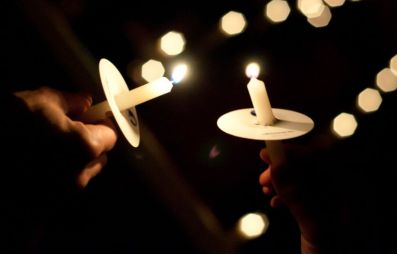
candlesHanded

Sometimes, throughout the hustle and bustle of this season, I miss the subtle details. I gloss over a profound detail in the scriptural story, or I overlook the miracles in my midst, or I sing words countless times without thinking about what I’m saying.

The hopes and fears.

On Christmas Eve, when we’re singing praises to baby Jesus, and lighting the candles, and enjoying one another, we also encounter the strange truth of our fears being met in the one born in the manger. 

While Mary and Joseph were there in Bethlehem, the time came for Mary to deliver her child. And she gave birth to her firstborn son and wrapped him in bands of cloth, and laid him in a manger, because there was no place for them in the inn. In that region there were shepherds living in the fields, keeping watch over their flock by night. Then an angel of the Lord stood before them, and the glory of the Lord shone around them, and they were terrified.

But the angel said, “Do not be afraid; for see – I am bringing you good news of great joy for all the people: to you is born this day in the city of David a Savior, who is the Messiah, the Lord.”

There is an understated wealth in the titles attributed to the baby by the angel out in the fields – Savior, Messiah, Lord. 

How can this baby, a tiny and weak and vulnerable thing, be the Savior, Messiah, and Lord?

The hopes and fears of all the years are met in Jesus Christ because something new has begun – a newness that contains a reorienting of all things where we are no longer in control of everything we wish to control.

No. A tiny and weak and vulnerable baby will change the world. 

Only a God like ours would see if fit to transform the very fabric of reality with something tiny, weak, vulnerable. Gone are the days when militaristic might would reign supreme, no longer would economic prosperity dictate the terms of existence. God brings forth a wholeness of life in the life of God’s only Son through whom God ordains a restoring of balance to all the forces of creation and all the the things that have influence over our lives.

Luke begins this story with Emperor Augustus and Governor Quirinius, but that’s not where the story ends. The birth of Jesus into the world establishes a new order in which the last will be first and the first will be last. The arrival of the Savior, Messiah, and Lord upsets all of the expectations and assumptions that we’ve foolishly made about this world.

Today we assume we know where Jesus is or, at the very least, where Jesus should be. We elevate particular politicians because we think they are on Jesus’ side, or we dismiss entire populations of people because we think Jesus is on our side. We relegate the incarnate Lord to our perfect manger scenes only to pack him away in a few days.

But the story of Christmas is that God cannot, and will not, be stopped. 

Hope and fear are brought near to us in Jesus because this is the beginning of a story that finds its greatest triumph not in a manger scene, not even in the angels singing out in the fields, but in an empty tomb.

9-the-hopes-and-fears-of-all-the-years

Christmas isn’t just about the warm and fuzzy feelings of warm fires and delicious eggnog. We can rip open the presents tomorrow morning with reckless abandon all we want. But if we take Christmas and the announcement of God as seriously as the shepherds did out in the fields then maybe our proper response is fear.

Not because God will punish us, and not because God is inherently terrifying, but simply because if God gets God’s way, then that means we might not get ours.

The God of scripture is one who finds life, hope, and promise from the margins rather than from the elite and powerful. God consistently uses the least likely of people in the least likely places to achieve the most extraordinary things. The incarnation of God in Jesus is a witness to the fact that we cannot remain as we are.

And that can be a rather terrifying prospect. 

The fears of our years are made evident by the many things we cling to that do not provide us life. For some of us it will be the presents we open tonight and tomorrow morning, for others its the paycheck that comes in ever 2 weeks, and for others its a broken relationship or a fractured family.

We put our trust and our hope in so many things these days and we are so regularly disappointed. 

We vote for the politician of change only to experience the same bureaucratic bumbling as before.

We seek out new employment opportunities only to still feel exhausted at the end of every day.

We even try out different churches hoping they will fix the problems we’re experiencing.

We might like to imagine that Christmas really is the most wonderful time of the year, but it can be equally frightening.

Particularly if its the first one without someone we love. 

And yet, as wonderfully weird as is befitting the faith, the angel declares, “Do not be afraid! I am bringing you news great joy!”

To you is born the Savior, Messiah, and Lord.

You need not be responsible for saving yourself and transforming yourself. 

You are not alone.

God is already working on you and in you through Jesus Christ! The sign is a child wrapped in swaddling clothes laying in a feeding trough. God has and will transform the very fabric of the cosmos through that baby.

God saw and sees the disparities of this world and makes a way where there was and is no way. God knows better than us about what is best for us. And the Lord, the one who can terrify us even at this time of year, arrives as Jesus Christ, perfectly vulnerable and weak to transform everything.

Because that very same baby, the one with teeny tiny toes and the one resting in the feeding trough, is the same person who walked through Galilee, who was transfigured magnificently, who feed the people abundantly, who walked on water miraculously, who suffered on the cross tragically, and rose from the grave majestically.

The womb and the tomb could not and cannot contain the grace of God. Even in the darkest moments of our lives there is an everlasting light. The hopes and fears of all the years are met in Jesus tonight. Amen.