BFD

strangely-warmed-spreaker-header

This week on the Strangely Warmed podcast I speak with Benson McGlone about the readings for Easter 6B (Acts 10.44-48, Psalm 98, 1 John 5.1-6, John 15.9-17). Benson is currently planting a church in Northern Virginia, and is one of the hosts of the Free Range Church Podcast. Our conversation covers a range of topics including house churches, quantity vs. quality, starting in the middle of a story, reckless singing, breaking chains, difficult commandments, and being conquered by God. If you would like to listen to the episode or subscribe to the podcast you can do so here: BFD

BM

Love Loves To Love Love

strangely-warmed-spreaker-header

This week on the Strangely Warmed podcast I speak with Alan Combs about the readings for Easter 5B (Acts 8.26-40, Psalm 22.26-40, 1 John 4.7-21, John 15.1-8). Alan is the Lead Pastor at First UMC in Salem, VA. Our conversation covers a range of topics including interruptions in worship, King’s Hawaiian Bread with Welch’s Grape Juice, coffee communion, the need for discipled guidance, ambiguity in the psalms, choosing scriptures, theologically problematic hymns, the cosmic Jesus, and growing by subtraction. If you would like to listen to the episode or subscribe to the podcast you can do so here: Love Loves To Love Love

AC

Dear Church…

1 John 3.16-24

We know love by this, that he laid down his life for us – and we ought to lay down our lives for one another. How does God’s love abide in anyone who has the world’s goods and sees a brother or a sister in need and yet refuses help? Little children, let us love, not in words or speech, but in truth and action. And by this we will know that we are from the truth and will reassure our hearts before him whenever out hearts condemn us; for God is greater than our hearts, and he knows everything. Beloved, if our hearts do not condemn us, we have boldness before God; and we receive from him whatever we ask, because we obey his commandments and do what pleases him. And this is his commandment, that we should believe in the name of his Son Jesus Christ and love one another, just as he has commanded us. All who obey his commandments abide in him, and he abides in them. And by this we know that he abides in us, but the Spirit that he has given us.

Since Easter Sunday we, as a congregation, have been reading through 1 John. Every worship service, every scripture reading, every sermon, even the hymns have all been based on this one letter written centuries ago.

And it is important to remember that 1 John was, and is, a letter. It is a document written by a wise, old, veteran Christian leader who continues to help those who are in the midst of their faith journeys by addressing the challenges of discipleship.

For John, following Jesus was all about love… We know love by this, that Jesus laid his life down for us, and we ought to do the same for one another. Let us not love with words or speech, but in truth and action. And we shall do all of this because God is greater than our hearts.

Now, to be abundantly clear, I am not like John. I am not a mature Christian leader; seriously, I made you all play around with crayons, balancing blocks, and play-dough last week! I don’t have decades of experience to rely upon when addressing the marks of following Jesus. The well of my wisdom is shallow compared to the deep insight that John shares in his letter.

I am not like John. In fact, I’m the kind of person that John wrote this letter to in the first place. It was a written communication designed to sustain people like me, and you, in the midst of this strange and beautiful thing we call faith.

During the time of John letters were carefully crafted, parchment/papyrus were expensive and rare, reading and writing was uncommon. A lot of thought went into a letter before it was sent out. And this was even more particular in the realm of the early church when letters were shared with more than one gathering. They were sacred pieces of text that were treated with the utmost care.

DearChurch (1)

Today, however, we communicate in a variety of different forms. Sure, some of us still take the time to write our thoughts by hand, and then send it through the mail. But many of us, if not all of us, are versed in the instantaneous forms of email, text messaging, Facebooking, Tweeting, Instragramming, and even snap-chatting.

One of the biggest differences in the way we communicate today, as compared to the time of John, is that many of us offer our opinions and weigh into debates without really taking time at all to think about what we are offering. It is so easy to type a few lines, or click the share button, or take a picture on our cell phones that we do it without even realizing what we’re doing.

Today there exists computer programs designed to test whether information being shared in true, fair, and accurate. The fact that we need those things, because we simply don’t have the time to look into ourselves, is absurd.

But, when you consider how much is being produced, how much content is being created, we need something to help us sift through everything. Believe it or not, we, as a species, create as much content in 2 days as we did from the dawn of humanity through 2003.

            That’s craziness.

If you talk to a writer or a poet, they’ll tell you that if they got a paragraph together in one day, then it was a very good day. Sometimes all they can muster is a single sentence. But that’s because they take the time to weigh out what they’re trying to say.

dear-church

On the other side of the spectrum, most of us try to get out what we’re saying as quickly as possible with as little effort as possible. We don’t like our time wasted so we just throw words out and hope something sticks.

And so, while recognizing that I am not like John, and that we are bombarded with so much information, I reached out to a number of people this week. I asked a simple question: “If you could say anything to your/the church, without consequences, what would you say?”

It was my attempt to get people to think like John and speak the truth about what the condition of the church is like.

And, like seasoned and faithful Johns, a number of people put together their ideas about love and discipleship for our benefit. Whether it was on Facebook, email, Twitter, or YouTube, insight rained down upon our church office, and now you will be blessed to receive those same messages.

Fair warning: some of this will be hard to hear. It will be hard to hear because at times the messages can be convicting, just like John was. Some of them are short and to the point, some of them are a little longwinded and introspective, some will leave us scratching our heads, some will make us lift our chins with pride, and some will make us droop our heads in shame.

But that’s the thing about communication today – sometimes we say what we’re thinking without thinking about how it will be received. And maybe that’s okay…


Dear Church,

One of the best things about our church is the way we love each other. I can’t think of a Sunday when I came to worship without someone checking in on me. And that’s what I really care about. It doesn’t matter if the sermon falls flat, or if one of the hymns is too hard to sing, when I worship I feel loved.


Dear Church,

Life can be really difficult. But when it’s hard we have a choice, we can lay down and take whatever comes or we can get up and work on solving the problem. The choice is up to us.


Dear Church,

We should be doing God’s will, not power-hungry people’s will.


Dear Church,

What the church does is all about sharing the good news. And the good news is the fact that God loves sinners. And all of us are sinners. All of us.


Dear Church,,

I don’t care what church it is; if I have to hear another political sermon I’m going to lose my mind! The gospel is not about creating strong political opinions or calling people to march in protest. Jesus doesn’t share the Good News so that we know what political party to join, or which candidate to support. So many preachers today sound like wannabe politicians and I just can’t stand it anymore!

Following Jesus is not about whose political sign is in your yard or on your bumper; it’s a call for the people who have the resources and goods to open their hearts to people who have need. Love is about action, yes. But love is not a doctrine, or a sermon, or a political persuasion.

It is what you do, not what you think.


Dear Church,

I’ve been worshipping here for a while now, and I don’t think anyone knows my name.


Dear Church,

Love is more than a word.


Dear Church,

How can any church call itself a church when it refuses to help, or ignores altogether, people in need? This is why the church is dying. Not because it’s boring. Not because it’s old fashioned. The church is dying because it is hypocritical.


Dear Church,

Speaking up for the good of people is risky. You can lose your job, relationships, money, and even your life for living by the kind of love we talk about at church. But isn’t that what Jesus was willing to risk?


Dear Church,

Laying down your life for someone is different than dying for them. When push come to shove, many of us would consider sacrificing ourselves for the good of those we love. But laying down one’s life, laying aside your goals and priorities and dreams for the betterment of someone else, that’s entirely different. We need not die for anyone, but we certainly must lay aside our needs for others.


Dear Church…


After receiving these comments, and many more, I thought long and hard about what I might say. I pondered about what kind of letter I would write to this church, or any church, about what is really at stake. I prayed about what kind of shocking wisdom we might need to hear in this place.

And yet, rather than pontificating from the pulpit, I’d like to hear from you. I know this is uncomfortable, perhaps even worse that having to spend 15 minutes with playdough like last week, but if you could say anything to the church about what it really means to follow Jesus, what it really means to love, what would you say?

Imagine, if you can, that this was your final communication to the church, and that you had the opportunity to speak some truth into the midst of all of our lives, perhaps about what’s gone well and what’s gone poorly – What would you say?

_

We can open up forums on the church website. We can solicit responses from people all over the Internet. We can even listen to the people in the pews next to us.

And we can also listen to John, speaking through the centuries, about the wisdom of loving and being loved:

We know love by this, that he laid down his life for us – and we ought to lay down our lives for one another. How does God’s love abide in anyone who has the world’s goods and sees a brother or a sister in need and yet refuses help? Little children, let us love, not in words or speech, but in truth and action. And by this we will know that we are from the truth and will reassure our hearts before him whenever out hearts condemn us; for God is greater than our hearts, and he knows everything.” Amen.

You Are NOT The Good Shepherd

strangely-warmed-spreaker-header

This week on the Strangely Warmed podcast I speak with Alan Combs about the readings for Easter 4B (Acts 4.5-12, Psalm 23, 1 John 3.16-24, John 10.11-18). Alan is the Lead Pastor at First UMC in Salem, VA. Our conversation covers a range of topics including the beauty and wonder of Twitter, bad television, preaching Acts during Eastertide, breaking down stained glass language, sacrificial/sanctified love, knowing the sheep, and pastor shopping. If you would like to listen to the episode or subscribe to the podcast you can do so here: You Are NOT The Good Shepherd

AC

Godly Play

1 John 3.1-3

See what love the Father has given us, that we should be called children of God; and that is what we are. The reason the world does not know us is that it did not know him. Beloved, we are God’s children now; what we will be has not yet been revealed. What we do know is this: when he is revealed, we will be like him, for we will see him as he is. And all who have this hope in him purify themselves, just as he is pure.

Families are complicated. There was a time when “the family” meant a husband and wife, 2.5 children, a dog, and a white picket fence. But frankly, that time never really existed. Regardless of Leave It To Beaver and the Andy Griffith Show, the family has never been normative for everyone, and it certainly isn’t today.

Families have, and always will, constitute a difficult and confusing set of relationships. There are families with children and without children. There are families with two dads and two moms. There are families that represent different races, different languages, and different cultures. The family is anything but ordinary.

And somehow we believe that we become a new family as the church.

godly-play

We might spend most of our lives debating who is in and who is out, whether its in regard to our family units, or our communities, or even our country. But here in 1 John we are offered a corrective: in the church we are all children of God, regardless of our community or culture or race or ethnicity or sexual orientation or just about anything else. Here in this place we are family.

We are in the middle of Eastertide; that time when the glory of Easter is still shining bright. And we have scriptural texts all about how to be in relationship with people we do not know in addition to the people we do know – we are God’s children. But that doesn’t mean it’s easy.

Particularly when we say things like, “our church is a family” while we all act like we’re the adults and we forget what it means to be children.

The images of children are pervasive in scripture. And for good reason! Children live and work and play together with energy. They are not consumers sitting in pews waiting for something to happen. They are drawing in their bulletins, climbing over the pews, wandering around the altar area.

And even outside of the church, in the schoolyards and playgrounds, that’s where children live out their identities. They learn to communicate when something has gone wrong, they joyfully tug at one another, they make up new games, and they play.

Everything children do is about navigating a world in which their identities are still being formulated. They are not content with being labeled and placed in any kind of box. They live lives based on a fluidity that most of us have lost.

For some reason, as we mature into adulthood, our joyful play begins to fade and for some of us it completely stops. We just accept things the way they are, we make peace with the labels placed on us by society, we accept the love we think we deserve. We do all of this without ever asking, “Why?”

We are comfortable with our current relationships instead of forging new ones. We come home most evenings not with thoughts of what went well, but instead with thoughts about how everything fell apart. And, more often than not, we’d rather relax than play.

But not today.

The children of God, that’s us, work out their identities and relationships with energy and commitment and patience and intensity. They do it through play.

1 John 3, the text read for us this morning, compels and encourages us to see one another as children. It begs us to imagine a world in which we are still those joyful playful versions of ourselves.

So, I could fill this sermon with stories of how children play and come to inaugurate new visions of reality. I could call on each of you to remember your childhood games and imaginations. I could even ask us to think about the importance of being inclusive in the midst of playing with other and end with some sort of egalitarian vision of the church.

            Or, we could just play…

(For the next fifteen minutes everyone in worship had the option to play with play-dough, percussion instruments, blocks, coloring books, and an assortment of other activities.)

Don’t Make Jesus Hangry

strangely-warmed-spreaker-header

This week on the Strangely Warmed podcast I speak with Teer Hardy about the readings for Easter 3B (Acts 3.12-19, Psalm 4, 1 John 3.1-7, Luke 24.36b-48). Teer is the associate pastor of Mt. Olivet UMC in Arlington, VA and he and I help share the responsibilities for editing the Crackers and Grape Juice Podcast. Our conversation covers a range of topics including tee-ball, the challenges of returning to church after paternity leave, looking at the verses before the lectionary text, offensive evangelism, the elect and the reject, MLK’s legacy, the absence of silence, hol(e)y hands, and Jesus’ immoral teaching. If you would like to listen to the episode or subscribe to the podcast you can do so here: Don’t Make Jesus Hangry

th

Walking The Walk

1 John 1.1-2.2

We declare to you what was from the beginning, what we have heard, what we have seen with our eyes, what we have looked at and touched with our hands, concerning the word of life – this life was revealed, and we have seen it and testify to it, and declare to you the eternal life that was with the Father and was revealed to us – we declare to you what we have seen and heard so that you also may have fellowship with us; and truly our fellowship is with the Father and with his Son Jesus Christ. We are writing these things so that our joy may be complete. This is the message we have heard from him and proclaim to you, that God is light and in him there is no darkness at all. If we say that we have fellowship with him while we are walking in darkness, we lie and do not do what is true; but if we walk in the light as he himself is the light, we have fellowship with one another, and the blood of Jesus his Son cleanses us from all sin. If we say that we have no sin, we deceive ourselves, and the truth is not in us. If we confess our sins, he who is faith and just will forgive us our sins and cleanse us from all unrighteousness. If we say that we have not sinned, we make him a liar, and his word is not in us. My little children, I am writing these things to you so that you may not sin. But if anyone does sin, we have an advocate with the Father, Jesus Christ the righteous; and he is the atoning sacrifice for our sins, and not for ours only but also for the sins of the whole world.

Here, on the other side of Easter, I’ve been doing some thinking. On Easter we were singing the hymns, and praising the Lord; we were on the mountaintop. But here on the other side, though we still walk in the light, we have to confront reality. And as I’ve been thinking, and confronting, I’ve come to realize some essential truths.

Our country is pretty messed up.

We can listen to the talking heads talk about how politically divided we are, and how we just need to reach across the aisle, and all that sort of stuff. But I’m talking about brokenness on an entirely different level.

We are so obsessed with financial gains and economic prosperity, that we’ve allowed capitalism to become our religion. It is what we worship. And the evils of capitalism, of which there are many, are as real as the evils of militarism and the evils of racism.

As a nation, we spend more money on national defense each and every year than we do on programs of social uplift, which is surely a sign of our imminent spiritual doom.

We perpetuate a culture in which 1 out of every 3 black men can expect to go to prison at some point in their lives. The price that we must pay for the continued oppression of black bodies in this country is the price of our own destruction.

There is so much injustice in this country: racial injustice, economic injustice, gender injustice. And they cannot be solved without a radical redistribution of political and economic power.

            Something must change.

Pause: how do you feel about all that I just said? Do you agree? Do you disagree? Are you clenching your fists in anger about the problems we have and are ready to do something about it? Are you clenching your fists because you’re angry that I’ve criticized our country and our culture?

            Most of what I just said did not come from me, but from another preacher, one by the name of Dr. Martin Luther King Jr. And it was because he was willing to say things like what I just said that he was murdered.

martin_luther_king_jr-_and_lyndon_johnson_large

This past week saw the 50th anniversary of Dr. King’s assassination. 5 decades have come and gone since he stood on the balcony of his motel and was gunned down. 5 decades of wondering whether his dream will ever become a reality. 5 decades spent holding up his quotes and remembering his speeches.

But what do we actually remember?

Perhaps the two most remembered passages from Dr. King’s great collection of speeches and addresses are his “I Have A Dream” speech which he offered in Washington DC, and the quote that I saw again and again this week: “Darkness cannot drive out darkness; only light can do that. Hate cannot drive out hate; only love can do that.”

It’s a great quote. And it fits perfectly with out scripture today: “This is the message we have heard from him and proclaim to you, that God is light and in him there is no darkness at all. If we say that we have fellowship with him while we are walking in darkness, we lie and do not do what is true; but if we walk in the light as he himself is the light, we have fellowship with one another, and the blood of Jesus his Son cleanses us from all sin.”

There’s a nice and easy sermon there in which you can use Dr. King’s witness, and his quote about darkness and light, to describe and point toward the kingdom of heaven. But that sermon would leave us walking out of here with our chins held high, and perhaps would encourage us to pat ourselves on the back.

But Dr. King’s life and witness was about a whole lot more than one quote or one speech or even one issue. Just as Jesus’s life was about far more than just being kind to everyone.

Here in 2018 it’s hard to remember that a year before Dr. King was killed, he was one of the most hated men in the entire country. Contrary to what we see displayed every January when we celebrate his legacy, when King died he was not an icon of freedom and equality. In 1987 a poll revealed that almost 75% of Americans had a favorable rating of Dr. King, and Americans named him as the person they admired and respected more than any other person in the country’s history. And yet shortly before his death, in late 1966, 63% of Americans were vocally opposed to his words and work.

It’s hard to remember this, or even acknowledge it, because today everybody loves Dr. King. We celebrate his transformative work in documentaries and school projects. But it’s easier to celebrate someone when they’re no longer challenging, and upsetting, the status quo.

It’s easier to love a hero when they’re dead.

Dr. King was not only an activist for the Civil Rights movement, but was also a frustrating voice (to the powers and principalities) in regard to the Vietnam War, capitalism, and poverty. In fact he was shot the night after deliver a now infamous speech, not on securing the right to vote for black individuals, not on dismantling Jim Crow Laws, but on establishing a union for sanitation workers in Memphis, Tennessee.

We have so sanitized the legacy of his life that we forget he was once one of the most hated men in the country, we forget that he pushed an entire nation into places of discomfort; we forget that he was killed for challenging the way things were.

martin-luther-king-jr---mini-biography

Our sinfulness overwhelms our ability to remember and to be rational. We hear about godlessness and we immediately pull to our minds all those we believe who have fallen away, we encounter the challenges of God in scripture and immediately think about people in our lives who need to hear those words, and in so doing we forget that we are broken people, and that we need to hear those words as well.

If we say that we have no sin, we deceive ourselves, and the truth is not in us. We continually participate in a world in which people are battered, broken, and bruised over and over again. We, to use the language from our hymnal, do terrible things, and we leave things undone that we should’ve changed.

We hear about a young black boy in California who was shot for holding a cell phone, and we think there’s nothing we can do about it and after a few weeks we stop thinking about it all together.

We see images of families being literally ripped apart as mothers and fathers are sent back to countries they fled from and are forced to leave children here to fend for themselves. And we feel bad, but if don’t see it happening to our families, or in our neighborhoods, we just move on.

We drive by people in our community standing on the street corners begging for financial assistance, pleading for food, yearning for help, and we roll up our windows and lock our doors.

But the light of the resurrection shines out of the darkness of the cross and the tomb! That light pushes us into realms of discomfort as we are forced to reckon with our on sin and say, “no more!”

Talk of sin makes us uncomfortable particularly because we are far too comfortable in our sins. We don’t want our boats rocked; we don’t want to wrestle with what needs to change. And yet we worship a God who was nailed to a cross for challenging the expectations of the world.

All of this, the church, the faith, they exist because they have been handed down to us. Just as they were handed to Dr. King. His life was a testament and witness to the power of Jesus’ resurrection from the dead, it is what gave him the confidence to say and believe that something needed to change.

He walked the walk.

When we remember Dr. King, just as we remember Jesus, we celebrate their convictions and challenges, and we give thanks for their joy. But we must not forget the scars they bore for us. Dr. King was repeatedly beaten and arrested and eventually murdered. Jesus was berated, arrested, and eventually murdered.

We are here on the Sunday after Easter, the banners are still raised high, the “hallelujahs” still feel fresh on our tongues, and we are getting back to our routine, whatever that is. And we are reminded here in the glory of Eastertide, in the words of 1 John, in the witness of Dr. King, that we all sin. If we say we are without sin, we are contradicted by the reality of sin.

However, we also receive forgiveness in the risen Lord, a forgiveness experienced by the very first disciples who struggled under the weight of a new world in which God gave life to the dead. They, the disciples, heard, saw, and touched the Word. And in so doing they began the delicate walk of faith in which they recognized their sin and their forgiveness together.

The sinfulness to which we are so bound is made present in our individual lives, in our communities, and in our institutions. No person, no gathering, no organization is without sin. Which makes it all the more vitally important to remember the truth of Jesus’ life, to remember his words of conviction, and to remember that he died for both the godly and the ungodly so that we, all of us, may not sin.
1-John-Web

One of my professors loved to tell a story about his roommate from college. They were going to school in South Carolina during the height of the Civil Rights movement when my professor’s friend decided to travel to Washington DC in order to participate in a Civil Rights March. Upon returning back to school, the friend relayed what had happened during the trip:

He described that everything was about as normal as you could imagine. he arrived, met up with the people he needed to, marched where he was supposed to, handed out flyers. By the time it was over he was exhausted while waiting for his plane to bring him home. As he sauntered onto the airplane, he sat down in my seat and, you’ll never believe this, he was sitting next to Martin Luther King Jr.

It was the craziest thing. He had gone all the way to DC and here he was, sitting on an airplane, next to his hero.

“So,” my professor asked, “what happened?!” Well, he got so nervous, and he was sweating, and fidgeting, and rehearsing what he might say, but there was a small problem. Martin Luther King Jr. was asleep. I mean what was he going to do? Wake up the leader of the Civil Rights movement? So he just waited, sitting there, staring at him, watching him sleep. After the flight had nearly reached its destination, he finally opened his eyes. “Dr. King I don’t know what to say. You are my hero. I just traveled all the way to DC to help march for Civil Rights, you are such an inspiration, I am so impressed with…” “Thank you. God Bless.” he interrupted, seemingly ending the conversation.

But the young man was undeterred. “Dr. King you don’t understand, you have changed my life, you have opened my eyes to the many opportunities that are not available to others… “I appreciate your kind words son.” Dr King interrupted again. However he was was not finished, “Dr. King, you don’t understand. My father is a racist. I left home because of him and his prejudice. He offered to pay for my college, but I have cut all ties with him. We have not exchanged a word in years because of his racial bigotry.” At this point Dr. King’s eyes widened, he turned his body to face this young college student and he reached out and grabbed him by the collar, “You have got to love your father. Whether hes racist or not, loving him is the only thing you can do.” And with that he let go, closed his eyes, and promptly fell back asleep.

All of us, particularly those of us with a self-righteous leaning, are sinners in need of God’s grace. From the racists to those who abandon their racist family members.

One of the harshest realities this side of Easter is that most of us believe we are without sin, and we deceive ourselves.

Here at the table God invites us into fellowship. At this place the truth is laid bare; we are sinners in need of grace. But God does not just invite me, or you… God invites all into community with God and with one another. If we walk alone, then we walk in darkness, but if we walk together with God, then we walk in the light. Amen.

Witnessing By Listening

strangely-warmed-spreaker-header

This week on the Strangely Warmed podcast I speak with Tim Ward and Sarah Locke about the readings for the Easter 2B (Acts 4.32-35, Psalm 133, 1 John 1.1-2.2, John 20.19-31). Tim is the pastor of Restoration UMC in Reston, VA and Sarah is the pastor of Christ UMC in Staunton, VA. Our conversation covers a range of topics including red Christianity, the “perfect” church, God’s agency, unity vs. uniformity, witnessing by listening, the failure of statistics, BBT’s Learning To Walk In The Dark, reclaiming Eastertide, and hanging on to sins. If you would like to listen to the episode or subscribe to the podcast you can do so here: Witnessing By Listening

Art-of-listening_v1

A One Hundred and Fifty-Fold Cord

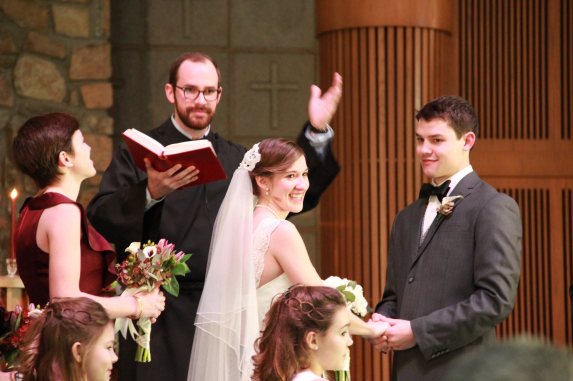
4 years ago, today, I presided over one of my first weddings, and it was for my sister and my (now) brother-in law. I don’t know if I’ve ever been more nervous leading worship than I was that day (so nervous that I forgot to invite my then fiancé (now wife) to offering one of the scripture readings), but we all made it through to the other side. I am grateful for my sister and her husband, I am grateful they asked me to participate in their holy ceremony, and I am grateful that God has so blessed their marriage. Below is the homily I offered 4 years ago…

1 John 4.9-12

God’s love was revealed among us in this way: God sent his only Son into the world so that we might live through him. In this is love, not that we loved God but that he loved us and sent his Son to be the atoning sacrifice for our sins. Beloved, since God loved us to much, we also ought to love one another. No one has ever seen God; if we love one another, God lives in us, and his love is perfected in us.

Ecclesiastes 4.9-12

Two are better than one, because they have a good reward for their toil. For if they fall, one will lift up the other; but woe to one who is alone and falls and does not have another to help. Again, if two lie together, they keep warm; but how can one keep warm alone? And though one might prevail against another, two will withstand one. A threefold cord is not quickly broken.

1498071_10151977138149016_1228625660_o

28 years. 28 years ago my parents, JT and Sarah Lynn Mertins, stood in the same position as both of you. Haley, I don’t know if you will remember all of this, but we used to watch their wedding VHS tape when we were growing up. Truly I tell you, it is a miracle that the wedding ceremony happened at all. When we would watch the tape, it appeared as if the cameraman had decided to smother vaseline all over the lens in order to achieve some sort of effect that left the viewers nauseous and confused. As my Aunt Laura made her way up the steps toward the altar she stepped on, and ripped, her dress. My uncle Bill Hanff and a friend stood over by piano the prepared to sing a wonderful rendition of “On the Wings of Love” though the pianist started the song in the wrong key and uncle Bill had to match accordingly. And then there was the hair and the dresses. There must have been enough hair spray in this church to light the whole thing on fire, but somehow, by the grace of God, our mother and father were married on this exact day 28 years ago.

And here we are now, ready for the two of you to enter into the holy state of matrimony. As I have looked back over the totality of your relationship, and all of the little steps that led you to this altar on this day, I am convinced that I will never marry a couple that I know as well as both of you for the rest of my life. So before I continue I want to show you something.

(Turn around, look out at the sanctuary. Gathered together in this room are the people who have made you, you. Family, friends, both the foolish and the fun, but more importantly, when you look out I hope you see faith. So soak up this view for a moment, you rarely get to see anything as glorious as this)

Faith, the people gathered together today are indicative of the kind of faith-lives that both of you are living. Everyone here has faith in both of you as individuals, and also as the married couple you are about to become. They have been there for you in every aspect of your lives, and today two families are joining together as a testament to the faith that you have in each other. They say a threefold cord in not quickly broken? Well neither is a one hundred and fifty fold cord.

However, for as much as everyone gathered together in this room are responsible for your relationship, no one can take more credit than God.

21427285_10209512982332426_5944900731650115605_o

When I found out that Matthew was moving to Africa for a year, I knew that the only thing that would be able to sustain your relationship was a resounding faith in the triune God. I know it wasn’t easy. Even with the notebook Matthew left behind, even with the commitment to read through the entire bible while you were apart, even with the advantages of technological communications such as Skype and email, you would not be standing here today unless you had tremendous faith in God, but more importably God has faith in you.

1490681_600936009974464_683923270_o

One of the things that I love most about you two is that, even with all the planning and the suits and dresses and decorations, today will not be the greatest day of your lives. Both of you strive to discover all of the joy in life and share it with one another. You earnestly love the lives that God has given to you, and you hope to share that love with everyone with ears to hear and eyes to see. Thats what it means when we say, “If we love one another, God lives in us.” The two of you have made a commitment to loving one another so that God abides and manifests himself in the world.

Matthew Logan, I have waited 23 years for a brother, and today I’m finally getting one! You are a remarkable man with compassion, faith, and hope. I have been privileged to watch you grow up, in a way, I’ve seen the way that you create and nurture friendships, I’ve seen the way that you have selflessly served others, and I have seen the many ways that you have committed yourself to my sister. Marriage will not be easy. There will be mornings that you wake up and wonder how such a beautiful woman can drive you so crazy. There will come a time when all the love that Haley can give you will not be enough, but you will never be alone. Beyond the multitudes that have gathered here today, God almighty is with you in all that you do. As a husband, literally, you have been called to love Haley with all that you are, live into the life that God is calling you toward, and to have your relationship shine as a beacon of hope and love to all the world. I have nothing but profound respect, enduring faith, and unending love for you, my brother.

Haley Lynn, precious sister of mine, you are a beautiful woman who has truly come into her own. I have been privileged to watch you mature into your truest self as you now prepare to enter into marriage with Matthew. I love how your willingness to serve others is so central for understanding who you are and what you do. Whether its helping out your students at school, or volunteering your time and energy for church, or helping your idiot brother match his clothing when we were in high school, serving and loving others is what you do. What a blessing you are to all of us, and what a blessing you will be to all the lives you touch in the future. Marriage will not be easy. There will be mornings when you wake up and wonder how such a funny man can drive you so crazy. There will come a time when all the love that Matthew can give you will not be enough, but you will never be alone. Your family, your friends, and your father in heaven are with you in all that you do. As a wife, you have been called to love Matthew with all that you are, to live into the life that God is calling you toward, and to have your relationship shine a beacon of hope and love to all the world. I have nothing but immeasurable respect, enduring hope, and unending love for you, my sister.

Matthew and Haley, God’s love was revealed to all of us through the incarnation in Jesus Christ. In his willingness to take on human flesh, God humbled himself to be just like us, in order to help transform us. God did not mount the hard wood of the cross because we loved him, but instead he came to die and live because he first loved us. Above all things, your marriage should, and will be, a testament to God’s love in the world through the redemptive acts in our Lord Jesus Christ.

In giving yourselves to each other, you are mirroring that great act of God coming to be with us.

And so, as you prepare to take these first steps into wedded life, I call both of you to hold fast to the people that love and support your relationship, hold fast to the faith and hope that you have in one another, but most importantly, hold fast to the good God whose joy knows no bounds, whose grace extends beyond our imaginations, and whose love was made known to all of us in the gift of his Son.

The Johns – Sermon on John 15.9-11, 1 John 2.15-17, and Revelation 21.1-5

John 15.9-11

As the Father has loved me, so I have loved you; abide in my love. If you keep my commandments, you will abide in my love, just as I have kept my Father’s commandments and abide in his love. I have said these things to you so that my joy may be in you, and that your joy may be complete.

1 John 2.15-17

Do not love the world or the things in the world. The love of the Father is not in those who love the world; for all that is in the world – the desire of the flesh, the desire of the eyes, the pride in riches – comes not from the Father but from the world. And the world and its desire are passing away, but those who do the will of God live forever.

Revelation 21.1-5

Then I saw a new heaven and a new earth; for the first heaven and the first earth had passed away, and the sea was no more. And I saw the holy city, the new Jerusalem, coming down out of heaven from God, prepared as a bride adorned for her husband. And I heard a loud voice from the throne saying, “See, the home of God is among mortals. He will dwell with them; they will be his peoples, and God himself will be with them; he will wipe away every tear from their eyes. Death will be no more; mourning and crying and pain will be no more, for the first things have passed away.” And the one who was seated on the throne said, “See, I am making all things new.” Also he said, “Write this, for these words are trustworthy and true.”

IMG_0058

“Taylor, the bishop is appointing you to St. John’s United Methodist Church in Staunton, Virginia. We believe the church fits with your gifts and graces and we are excited to see what the Holy Spirit can do through you there.” Those were the words used to let me know where I would be spending the next few years of my life. I remember how I felt with the phone next to my ear and Lindsey by my side when I found out that I would be coming here to serve this church.

Obviously, for the next few days all I could think about was the church and the community. What would you all be like? Would we enjoy living here? What would we do for fun? How would you respond to me as your pastor?

Of course I Googled the church, searched the church name in the local newspaper databases, and even looked up the address of the parsonage. And for as many things as I could discover, more questions began to develop to the point where I had to just stop and accept that this is where I was going.

However, one question remained in the back of my mind during the months leading up to my first Sunday. I was fine letting everything else go, I was content with the unknown, except for one thing: Why St. John’s?

Now I don’t mean why this church out of all the churches in the Virginia conference, though I have wondered about that at times. What I mean is this: Why is the church named St. John’s?

Do any of you know? Church naming often carries an interesting history. Like when a group of people from a Baptist church grow frustrated with another group and decide to leave and start a new church with the ironic name of Harmony Baptist.

Or like what we have here in town with 1st Presbyterian, 2nd Presbyterian, 3rd Presbyterian, etc. I would love to know the story behind that.

Anyway, why are we called St. John’s?

The story goes that a long time ago there was a particularly advantageous District Superintendent who dreamed of 4 new churches in the Staunton District. The population was booming in the valley and he believed it was time for the Methodist Church to start breaking ground and forming church homes for new people. He wanted 4 new churches and he wanted them to be named after the gospels: Matthew, Mark, Luke, and John. Though only two of them ever came to fruition: Mark and John.

Now, is that really how we got our name? I have no idea, but thats the story everyone seems to tell.

I want to know if thats the story we want to tell. That the name of this blessed house of the Lord got its name from some guy in the past who wanted to leave his mark in Staunton. Or do we want to take ownership of our name, and live into the reality of what it means to be St. John’s?

Our name is part of who we are, it is a part of our very identity, for better or worse. If we were First UMC I would expect that we were the first to break ground in Staunton, that we would be leading the community in what it means to love one another. If we were Harmony UMC I would expect a church full of people who agreed on everything all the time, no matter what. If we were Wesley UMC I would expect that John Wesley would be fundamental to our mission and work in the kingdom.

But if we call ourselves St. John’s, then who are we?

IMG_0063

On the right side of our sanctuary we have three stained glass windows that I call The Johns. We have John the Evangelist, John of Patmos, and John the Presbyter. Do they represent three different and distinct men? Are they in fact all the same person, just being shown throughout the different decades?

Early Christian tradition held that John was one of the original 12 disciples who actually lived a long life and was not killed for his faith like the others. It is believed that he was responsible for writing the gospel according to John, the letters 1-3 John, and the final book of the New Testament Revelation. Of course modern scholars debate as to the particular authorship and whether or not one man was responsible for all of these different writings.

What is important for us is the fact that we affirm all of the writing as canon and life-giving, that Christians for centuries have come to discover the living God in the words attributed to John, and that we will continue to live into our discipleship through them.

Our first window displays the young John as the Evangelist. Today when we hear the word evangelism we tend to picture people converting others to follow Christ, but in its most simple meaning, an evangelist is someone who shares the Good News, and in this case, it came through a written account of Jesus life and ministry.

We see a young John holding a chalice and the image of an eagle. The chalice serves to emphasize the importance of the sacrament, and the pouring out of Jesus blood for us. Throughout the gospel of John, Jesus’ atoning sacrifice is a particular focus and theme. Reflecting on Jesus life later, John could remember everything through the lens of the resurrection, and we see the importance of Jesus’ life here in the chalice.

The other detail, the eagle, is very interesting. In Revelation, a book we will talk about shortly, there is a brief section where John describes four winged creatures from his dream. Each of them have come to represent a specific gospel and it’s respective author: Matthew is a man with wings, or an angel; Mark is a lion; Luke is an ox; and John is the eagle.

Whenever our eyes fall to this window we are called to remember the Father’s love in Christ Jesus. Like the winged eagle flying high in the sky we look up to the kind of love that Jesus exemplified and strive to live accordingly. The great sacrifice was made so that our joy could be complete in and with one another as we look on eternity without flinching as we journey toward the goal of communing with the Lord.

John the Evangelist wrote what he did to remember for us what his master taught him: As the Father has loved me, so I have loved you; abide in my love.

Our second window, the one to the right, contains John as the Presbyter. Presbyter comes from the greek word presbuteros which means “elder.” As John grew older and continued to play an integral role in the formation of the early church, it became necessary for him to write letters concerning the faith.

In the window we see a mature John with a quill and parchment. Like we still do today, whenever we encounter the struggles of fellow disciples, we strive to help them through their trials and tribulations. For John, having lived with Christ and experienced the true power of the resurrection, he devoted himself to the early Christians and helped them to understand the importance of love.

He wrote things like: “Do not love the world or the things in the world.” Only a man speaking from a life of wisdom could make such a statement. The desires of flesh and the prides in riches only serve to destroy us because they wither away. All of the false things that we put our faith and hope in are passing away, but the love of God endures forever and ever.

Whenever we glance to this window of John as the Presbyter, we are called to remember the value of wisdom and what it means to grow together. Being Christian is not something that can be done in isolation, but instead can only be fruitful and life-giving if we disciple as a community. John wrote letters to encourage and remind the faithful what it means to be faithful. As disciples we have the responsibility to build one another up for kingdom work.

John the Presbyter wrote to Christian communities about what faithful living was all about: those who do the will of God live forever.

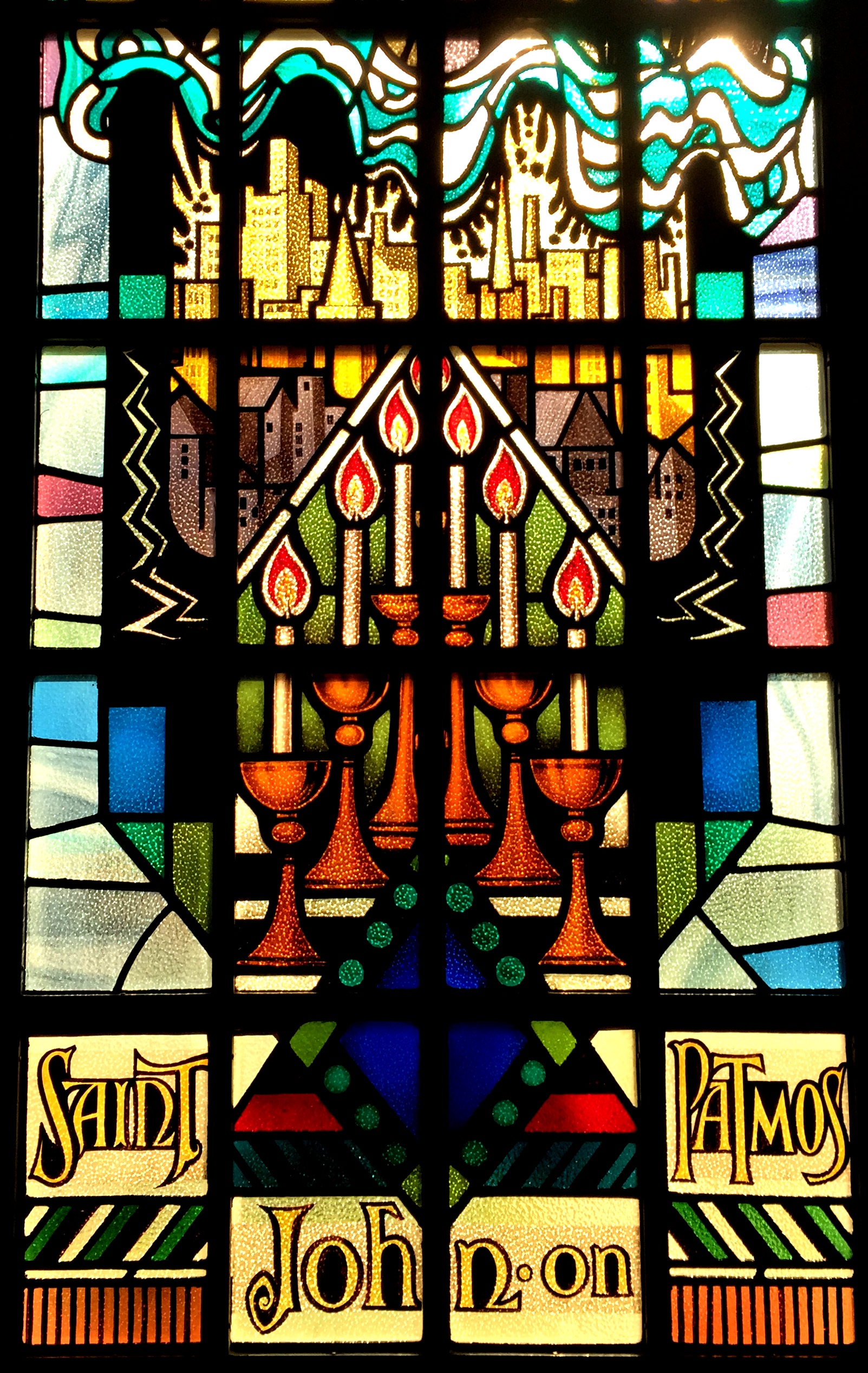
The third window, in the middle, contains John on Patmos. After a life of faith, John was exiled away to Patmos, a small Greek island in the Aegean Sea where he wrote about his visions. The book of Revelation contains fantastic imagery of the way God has, is, and will move  in the world. Our final John is older with a fiery city at his feet, and the new Jerusalem above his head with the lamb.

The Lord gave John certain visions and told him to write them down because they were trustworthy and true. Our window displays the height of the revelation when God will make all things new. A holy city, the new Jerusalem, will come down from heaven. This is where God will dwell with the people, God will wipe away all of our tears. Death will be no more; mourning and crying and pain will be no more. The first things will pass away because God will make all things new.

In our window we see the former things, the earthly passions of the world at the bottom passing away. But God has not, and will not, abandon us to our own devices. The new city at the top will reign and the kingdom will be forever. 

Whenever our eyes fall upon this window we remember that the Lord is with us now and forever. That even in our death we will come closer to the new heaven and the new earth that the Lord has promised. In the midst of our grief and suffering now we can still give thanks to the Lord for that day when he will make all things new. This window calls us to trust the Lord just like John did throughout his life.

John on Patmos wrote down the visions the Lord had provided so that others would come to know what the future holds: The Lord will dwell with us and make all things new. 

St Johns logo

Who are we? A group of Christians who get together week after week to rediscover what it means to follow Christ? A ragtag collection of disciples who need to find a little more light in our lives?

If we want to live into our name, then we need a better story than being named by a District Superintendent. If we want to be the St. John’s that God is calling us to be, then we need to reclaim what that name means for us.

We are St. John’s. That very name carries with it the history of what our church has done for this community. Wherever I go in Staunton I love to tell people that I serve as the pastor here at St. John’s because our name is immediately met with recognition; “My children went to Preschool there!” “My wife and I were married in that sanctuary.” “We buy our Christmas tree from your church every year.”

But we are also more than what we do. Our identity is firmly rooted in the name of John and we should be proud of it. We were named after a man who was called to follow Jesus, remembered the Messiah’s life for other communities, wrote to churches about faithful wisdom, and caught glimpses of future glory. 

Likewise, we are a community of faith that believes in following the Lord, in sharing God’s story with other people, in teaching those younger in the faith about what it means to love, in celebrating the coming day when God will make all things new.

St. John’s; what a perfect name. Amen.