The Gifts of God – Peace

Micah 5.2-5a

But you, O Bethlehem of Ephrathah, who are the one of the little clans of Judah, from you shall come forth for me one who is to rule in Israel, whose origin is from of old, from ancient days. Therefore he shall give them up until the time when she who is in labor has brought forth; then the rest of his kindred shall return to the people of Israel. And he shall stand and feed his flock in the strength of the Lord, in the majesty of the name of the Lord his God. And they shall live secure, for now he shall be great to the ends of the earth; and he shall be the one of peace.


IMG_8605-5843

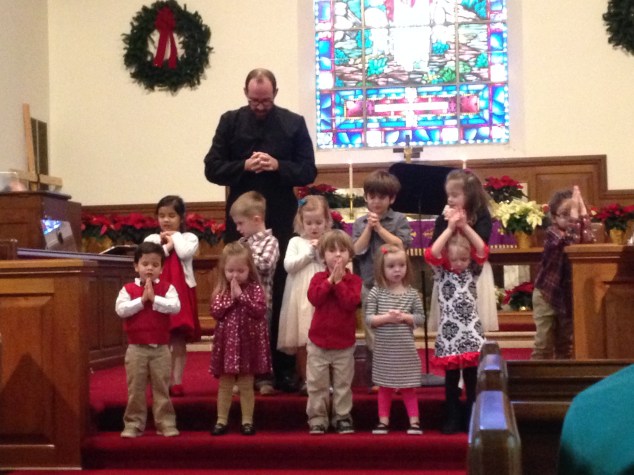
The children looked perfect in their Christmas pageant costumes. One by one they entered the chancel area in preparation for proclaiming their individual lines. The shepherds came first, watching over their sheep. Then the animals of the manger came forth, including a cow, a bird, and a mouse. They all made it to their spots and sat perfectly still as a donkey, Mary, and Joseph walked up to the microphone and exclaimed that a baby would soon be born, but they would need to find a place to stay.

Then the angelic cherubs boldly walked down the center aisle in the dark each holding an electric candle. The lead angel walked up to the microphone and frightening declared: “Do not be afraid! I bring joy to everyone!” The wise men and a camel followed the star to the manger where they presented the baby Jesus with their gifts of gold, frankincense, and myrrh.

I had the best vantage point of the entire production from up here in the pulpit. I could see all of the children with their costumes and I could also look out at the faces of all the parents, families, and friends that had gathered for this spectacular performance. I was honestly beaming while I stood up here on Tuesday evening because the kids had all done such a great job, they all nailed their lines, and were standing perfectly still in their spots.

Except for one of our shepherds.

Throughout the weeks of practice we had purposely withheld the shepherd staffs from the children knowing full and well that they would play with them too much. And during the actual performance most of them were being wonderful, but one of the shepherds could not overcome the desire to do something.

At first he just twirled the staff around in his hands like trying to start a fire on the carpet. Later, he swung it from side to side like a microphone at a rock and roll concert. I tried my best to whisper powerfully for him to stop, and though he would for a moment or two, he would then start up with something new.

As we were nearing the end of the performance, nearly all of the characters and animals from the manger scene were in place; the little shepherd grabbed his staff and started lifting it into the air. I, of course, immediately thought of Moses lifting up his staff in the wilderness to strike the rock for water. I, of course, immediately thought of how theological our young shepherd was being as he lifted the staff into the air, but then I realized he was about to bash somebody on the top of the head!

Breaking character from the pulpit, I quickly reached down and stopped the staff in mid arch. My eyes went down the shaft of the staff to the little hand, to the arm, to the face of the young shepherd, and instead of seeing a repentant and apologetic look; he had the biggest and proudest grin on his face.

IMG_0610

We lean toward violence. From Preschoolers picking up shepherd staffs, to fights in high school, to international and political disagreements, we lean toward violence. There is a power that comes with violence and demonstrates our importance and opinion. Violence has been at the forefront of some of the most important historical moments in the entirety of human existence and still captivates our attention. The movies that make the most money, the stories that garner the most attention, the moments we can’t tear our eyes away from usually contain violence.

As I have found myself saying too often from this pulpit: just turn on the TV or get online and you will be immediately bombarded with the violence in the world and the local community. Even this season of Advent and preparation for the holidays tends to bring out the worst in us. We have short tempers with the people ahead of us in line while we are buying gifts. We mutter inappropriate comments about drivers that are just driving too slowly. And we secretly expect to receive as many good gifts as we give.

Our lives and the world are filled with aggression, anger, and violence.

Yet, the prophet tells us about the one who will come with peace.

Micah spoke during a time of considerable unrest. The situation was grim with corrupt political leaders. There were fearful enemies on the horizon. Internal disputes were pinning people against one another. (Sound familiar?) And while the people saw no hope, Micah saw the promise of peace. Micah looked beyond the present circumstances, he looked beyond the news headlines and the talking heads, he looked beyond the broken and tarnished community to what God was promising to do.

From the little town of Bethlehem will come one who will rule the world. From a back road town of insignificance will come the one who will lead his flock in the way that leads to life and peace.

Many of us have a hard time imaging that an impressive hero can come from such a small town and such a fragile beginning. We, instead, look to politicians and presidents, magistrates and ministers, to fix all of our problems. But from the words of scripture this morning, Micah is jumping up and down and waving his arms to move us in an entirely different direction. He is pointing not at the towering leaders of the world on CNN. He is not drawing us to the political buildings in Washington DC. Instead he is pushing us to a small, out of the way, little place called Bethlehem.

55f81b353eaa23507d83b12e70adb998

Jesus is the one of peace, the one who comes as a light in the darkness, the one who will stand and lead like a shepherd. Jesus came from humble beginnings and changed the world.

One of the things that the bible loves to show us is that true power and peace often comes from unexpected people in unexpected places. Many of us have heard the Christmas story so many times that we are desensitized to the insignificance of Bethlehem in the most significant story ever told.

Yet, important babies that change the world can be born just about anywhere. Bethlehem is proof of that. Every baby has the potential to help remind us of the way that leads to peace. Jesus is proof of that.

This week, our little neck of the woods made national news. A local geography teacher landed in the hot seat for an assignment where her students were required to copy a text in Arabic from the Quran. The purpose was to demonstrate the beauty and power of calligraphy and, in a sense, teach students to appreciate people who have differing beliefs and opinions. However, when a particular parent found out that the text in Arabic said, “There is no god but Allah. Muhammad is the messenger of Allah” everything came to a head.

In the days that followed, a community meeting was held at a local church for concerned parents who were outraged by the assignment. Augusta County rightly started to step up security measures in order to maintain the peace, but the longer the situation percolated the more frightening it became. On Thursday morning there were armed guards at Riverheads elementary school. And on Thursday afternoon, every student in Augusta County was ordered to leave their respective school and the buildings were to go on lockdown. Lastly, Friday’s classes were completely canceled.

Augusta County received so many threats by phone and mail that they believed they could not guarantee the safety of their students and decided to cancel an entire day of school.

There are so many facets to the story that we don’t have enough time to address all of them, but suffice it to say, it is sad. It is a sad that a teacher did not take the time to re-evaluate what text she was having the students copy. It is sad that an entire community responded immediately out of fear and hatred. It is sad that such a tremendous amount of people were filled with rage to the point that Augusta County had to cancel school. It is sad.

While Fox News picked up the story for the nation to learn about what was going on here, I felt God’s Word calling me to listen to the Bethlehem-like voices. Instead of reading news article after news article from talking heads, I went to the local youth of our community and listened.

This is what one of them said: “Religion is not the problem. Religion does not breed terrorism. Ignorance breeds terrorism. Lack of education breeds terrorism. Failure to see the world around you breeds terrorism. Incompetence breeds terrorism. The inability to accept one’s wrongs breeds terrorism. The inability to connect and empathize and understand your fellow human beings is what breeds terrorism.”

I don’t know how to fix or change what happened in Augusta County this week, but if we continue to treat everyone who is different from us with nothing but suspicion and fear, then we have lost our connection to the one who comes in peace. If we make the self-righteous assumption that everyone should look like us, think like us, and talk likes us, then we have stopped following Jesus.

For too long we have lived with a culture that teaches us to defeat our enemies so that only our friends will be left. But that’s not what Jesus calls us to do! Jesus, the one born in a manger in Bethlehem, Jesus the one who shall be our peace, Jesus the one who we worship on Christmas Eve and every Sunday of our lives, tells us to love our enemies! Jesus calls us to pray for those who persecute us. Jesus tells us to live our lives in the way that leads to peace.

God’s peace in Christ is a gift; a gift with strings attached. God gives us peace, but we are to be instruments of God’s peace on earth. We know that peace is not easy. It requires a willingness to sacrifice and be vulnerable with people who differ from us. Peace is uncomfortable. Peace is strange. Peace is difficult because it is so contrary to the ways of the world.

Peace is hard, but so is following Jesus. Amen.

Devotional – Luke 1.52

Devotional:

Luke 1.52

He has brought down the powerful from their thrones, and lifted up the lowly.

Weekly Devotional Image

Some sermons stick with us, while others fade away. I can remember interactive sermons from the church where I grew up that required congregational participation for the message to hit home. I can remember specific lines from the church I attended in college that continued to resonate in my relationships and activities. And I can definitely remember a preacher from seminary who connected the hymns in worship with the sermon better than anyone else.

After preaching steadily for the last few years, I have noticed how much I miss listening to sermons. I enjoy the art of crafting words to proclaim God’s Word in worship, but I also need to have words preached toward me as well. I will often listen to, or read, sermons online but they are no substitute for the depth of experiencing a sermon in worship.

Last advent, Clayton Payne, one of my clergy peers from Staunton, preached for a community advent service. I served as the liturgist for the service, welcoming the congregation, announcing the hymns, praying when necessary, and introducing the speaker. And then Clayton walked up in to the pulpit and brought the Word.

He preached from Mary’s Magnificat, Luke 1.46-55, a song of praise that she delivered after meeting with Elizabeth. The beginning of the sermon was striking because Clayton specifically confronted how joyful Christmas is for us, and how Mary’s song should really put us in our place. Mary proclaims that God will bring down the powerful from their thrones, and lift of the lowly. Clayton then made it very clear that most of us are not the lowly that God will be raising up. We who rest in comfort, we who have presents piled under the Christmas tree, we who always know that we will have another meal, are like the powerful that God needs to bring down from our thrones of privilege.

I remember thinking that Clayton was mighty brave for preaching such a convicting sermon, and then I realized how right he was. Christmas should be a time of great joy and celebration, but it should also be a time when we take a hard look in the mirror and recognize our place of privilege. The words of scripture around the first Christmas are filled with hope for the lowly, but they are also filled with terror for the powerful.

the-virgin-mary-cared-for-her-child-jesus-with-simplicity-and-joy-elizabeth-wang-

Some sermons stick with us, while others fade away. Though it still makes me uncomfortable, I am grateful for Clayton’s words that helped me to see another angle of the great story of God coming to change the world.

This week, as we prepare for Christmas, let us reflect on the sermons from the past that have stayed with us. Let us give thanks to the preachers who faithfully proclaimed God’s Word. And let us remember our place in the story.

The Gifts of God – Hope

Isaiah 12.2-6

Surely God is my salvation; I will trust, and will not be afraid, for the Lord God is my strength and my might; he has become my salvation. With joy you will draw water from the wells of salvation. And you will say in that day: Give thanks to the Lord, call on his name; make known his deeds among the nations; proclaim that his name is exalted. Sing praises to the Lord, for he has done gloriously; let this be known in all the earth. Shout aloud and sing for joy, O royal Zion, for great in your midst is the Holy One of Israel.

hope-hero

Over the last few weeks we have been going through a sermon series on The Gifts of God. This has been particularly fitting considering the fact that Advent is usually a time when we fret about what we will be purchasing for everyone else. However, this Advent, we have been reflecting on what God has given us. Today we continue the sermon series with God’s gift of Hope.

When I was a kid, even when I was as young as some of our preschoolers, I loved Star Wars. We had the old VHS versions of “A New Hope” “The Empire Strikes Back” and “Return of the Jedi.” The covers were so worn from use that you could barely read the writing, and the film inside the VHS tapes was starting to crackle from excessive usage. But I loved them nonetheless.

Some of the themes were lost on me as a child but I loved the light saber fights, the fundamental battle of Good vs. Evil (The Darkside vs. The Light), and that a kid from a Tatooine moisture farm could go from bulls-eyeing womp rats in T-16 to saving the entire galaxy.

Star Wars taught me that, with the right cause, even the weak could triumph. Star Wars taught me that we are not defined by our past and are given opportunities to change. And Star Wars taught me about hope.

In the beginning of Episode IV, aptly titled “A New Hope”, the galaxy is in disarray and the evil Empire continues to exert its power over the powerless. For a generation, people of all shapes and sizes cowered under the rule of the emperor and started to forget the way things used to be. However, a group of people held onto the hope of a new future, they called themselves The Rebel Alliance, and they believed that things could change.

Isaiah 12 is about hope for the future. Like the rebels from the Star Wars universe, Isaiah fundamentally believed that a day would come when everything would be turned upside down and salvation would be delivered.

With confidence, Isaiah declared a profound trust in the Lord, a trust without fear. With hope, Isaiah envisioned that future day when all of God’s people would give thanks to the Lord and make God’s deeds known among the nations. With joy, Isaiah could hear the songs of the future praising the mighty works of the Lord, for he would have done gloriously.

And on that day, God’s people will draw water from the wells of salvation.

IMG_4568

The man felt empty; like something was missing from his life. He had parents who loved him, he had gone to the right school, he had a good job, but things didn’t feel right. Whenever the holiday seasons came around he did not have the energy the call his parents, he resented the happy families at department stores purchasing gifts, and he abstained from the holiday radio channels.

He couldn’t explain it but one day he lost his patience with his family when they kept asking him about whether or not he was happy. One day at work he screamed at a customer after losing his patience. And one night, while he sat in his apartment, he realized how empty and lonely he felt.

He continued like this for some time. Living a dry and empty life, until he met her. She was everything he could have hoped for; smart, pretty, funny. They immediately hit it off, and in her he believed he found the solution for his emptiness, in her he thought he found the one thing that could fill him again.

The beginning of their marriage was wonderful; they saw the world with hope and expectation. They both were not filled, but they had more than they had in a long time. But it started to fade. Arguments with the in-laws, shouting matches in the living room, and nights spent sleeping in other rooms emptied them of the joy and hope they once felt.

They were at a crossroads in their relationship and were unsure of how to move forward. Both of them were too proud to try counseling, and definitely too proud to apologize, so they just continued with the thinly veiled frustration with one another. But then they had an idea: “Maybe if we have a child, it will fix all our problems, it will bring us closer together.”

They had some stability after the first, but when things reverted back to the pre-baby days, they decided to have a second child, and then a third. What they didn’t know, but what many of should know, is that even the perfect child cannot fill the emptiness within us. No child should be expected to make up for our baggage, and no child should be expected to heal our brokenness.

But this habit and rhythm in the family didn’t stop. After the kids, the parents tried to fill themselves with experiences and material possessions. They went on vacations they couldn’t afford, they took out a loan on a house they could never pay back, and every Christmas had to be better (and filled with more gifts) than the last. But all of these things failed to fill the emptiness they felt.

And on that day, God’s people will draw water from the wells of salvation.

IMG_4571

Jesus once met a woman at a well and confronted her emptiness. She had attempted to fill her life with man after man and yet there was something missing. Jesus said to her, “Everyone who drinks of this water will be thirsty again, but those who drink of the water that I give them will never be thirsty. The water that I will give will become in them a spring of water gushing up to eternal life.

Many of us are broken. Actually, the truth is, we are all broken. Most of us just don’t want to admit it. We have good days, but there are times that we feel dry and empty inside. We seek out the wrong objects to validate our lives: a spouse, a career, a child. And none of those things are strong enough to hold our identity together.

Yet, God offers us this living water, water from a well that never runs dry. When we start to see the hope that God has given us, when we rest our identity on the fact that we are first a child of God, when we drop our buckets into God’s well of salvation things starts to change.

God knows our thoughts and minds. God witnesses our brokenness and sinfulness. And God still loves us anyway. God’s love is truly unconditional. God’s love is unmerited. God’s love is filled with hope for our futures.

I’ve only been doing this whole pastor thing for two and a half years, but two and a half years is long enough to know that most of us, if not all of us, are looking for love and validation in all the wrong places. We expect our children to makes our lives better, we expect the presents under the tree to make our lives fuller, and we expect our spouses to fix all of our problems.

Jesus offers us something totally and wonderfully different. Jesus offers us hope from the well of salvation. A hope in a future not defined by our past. A future not limited by the mistakes we make here and now. A future not corrupted by the powers of death.

Jesus offers us hope, a hope unlike any other, a hope that can truly fill us.

An-so-Lord-where-do-it-put-my-hope

When we find our hope in the Lord, we can stand up to the intolerance and injustice in our midst because we know God’s sees the world differently.

When we find our hope in the Lord, the presents under the tree will not leave us looking for the next fix because we will know that the greatest gift we’ve ever received is Jesus.

When we find our hope in the Lord, we can confront the brokenness in the world and know that life here on earth is not the end.

Isaiah had hope, hope for a day when God would show up, hope for a time when God would make all things new. Isaiah prayed for a future where people would sing praises for the glorious power of the Lord. Isaiah dreamed about a day when God would offer the wells of salvation to the world.

That hope became real on the first Christmas, and that hope is still real and available to you and to me.

Jesus calls to each of us today and says, “I can fill you. I can fill you with the living water that never runs dry. I can bring you to the well of salvation. I can fill you with hope, and love, and validation. I can fill you with joy, and peace, and purpose. I can fill you and turn your life around.

Amen.


(With thanks to the Tamed Cynic, Jason Micheli, for inspiring parts of this sermon)

Devotional – Philippians 4.4

Devotional:

Philippians 4.4

Rejoice in the Lord always, again I will say, Rejoice.

Weekly Devotional Image

Advent is a strange time for Christians. While we patiently wait through the weeks leading up to Christmas, people around us are moving at remarkable speeds to get anything and everything they need for the holiday. I was at Target yesterday and I saw a couple arguing about how many gifts they should be purchasing for their respective in-laws. In the parking lot I witnessed a man struggling to fit his bags of presents into the back of his car. And while I was leaving the shopping center I saw someone blow through a red light and the immediate response of one driver screaming obscenities from her car.

Advent is a strange time for Christians. While we strive for patience, the world rushes on. And while we strive to remember the reason for the season, we get caught up with the anger and impatience the holiday brings with it.

Children, on the other hand, are somehow able to maintain the sense of joy that comes this time of year.

This morning, shortly after the preschoolers arrived, we gathered in the sanctuary to practice for the upcoming Christmas pageant. For weeks the students have worked on memorizing their lines and delivering them clearly into a microphone, their costumes have been altered and cleaned, and they have learned to keep from fidgeting while standing in place.

After we went through the theatrical side of the production, we then reorganized the kids to practice singing six songs about the real meaning of Christmas. Our Preschool director quieting counted “1-2-3” in order to start the song and then they started to belt out the words to “We Wish You A Merry Christmas.” It was loud and powerful. They took in as much air as possible to sing with full gusto, they had accompanying hand motions to mirror the words, and every one of them had a huge smile on their face. In fact, they were so loud that our secretary left her office just to make sure that everything was okay in the sanctuary.

IMG_0566

Near the end of his letter to the Philippians, Paul commands the disciples of Jesus to “Rejoice in the Lord always, against I will say, Rejoice.” There are plenty of Sundays in worship when it really feels like we are rejoicing in the Lord, but many of them pale in comparison to the joy I heard echoing from our Preschoolers this morning. They believe in rejoicing in the Lord always.

This week, let us strive to rejoice in this season rather than resent it. Let us pray for God to give us patience while we prepare for the holiday. And let us recapture the joy of this time in the same spirit as preschool-age children.


The Gifts of God – Grace

Philippians 1.3-11

I thank my God every time I remember you, constantly praying with joy in every one of my prayers for all of you, because of your sharing in the gospel from the first day until now. I am confident of this, that the one who began a good work among you will bring it to completion by the day of Jesus Christ. It is right for me to think this way about all of you, because you hold me in your heart, for all of you share in God’s grace with me, both in my imprisonment and in the defense and confirmation of the gospel. For God is my witness, how I long for all of you with the compassion of Christ Jesus. And this is my prayer, that your love may overflow more and more with knowledge and full insight to help you to determine what is best, so that in the day of Christ you may be pure and blameless, having produced the harvest of righteousness that comes through Jesus Christ for the glory and praise of God.

Christmas 1

From now until Christmas Eve, we will have a sermon series on the gifts of God. This is particularly fitting considering the fact that Advent is usually a time when we fret about what we will be purchasing for everyone else. However, this Advent, we will be reflecting on what God has given us. Today we continue the sermon series with God’s gift of Grace.

PowerPoint presentations were all the rage when I was in seminary. Professors would carefully craft their lectures around being able to display particular words on the screen while they talked. Some failed to use PowerPoint effectively and would just randomly throw words up on the screen without much context. But others used PowerPoint in a powerful way by displaying a piece of art and then describing how it conveys a deeper sense of faith than words alone.

In the spring semester of my first year I was in the middle of a New Testament lecture about the crucifixion when my professor began showing image after image of Jesus’ death. At the time, I was so academically invested in the words of scripture that I was treating it more like a text to be mastered rather than letting in sink into my soul.

I would go to church on Sundays but instead of listening to a sermon for my own discipleship I would think about how to change the sermon to make it more effective. I would receive communion but I would lose myself to thoughts of Eucharistic practices throughout the centuries while I chewed on the bread and juice. And I would read scripture everyday but I thought about how it applied to other people more than myself.

So there I was in the New Testament lecture and the images of Jesus’ death kept flowing across the large screen. I lost count of how many versions were displayed and at some point I stopped listening to my professor and stopped taking notes. Instead I watched my savior dying over and over again.

Some were abstract with shapes and colors conveying the cross and Christ’s body whereas others were remarkably vivid in detail with blood, cuts, and bruises. My professor continued to run through the images on the screen and let the art speak for itself. Like a merry-go-round of emotional impact, I sat in my chair observing the death of Christ until my professor stopped and said, “This is what Christ did for you.”

Overcome by the totality of the moment I jumped up from my chair and covered my tears as I walked out into the hallway. I remember breathing heavily as I tried to compose myself when my friend Wil came out of the lecture hall to check on me.

“What’s going on? Are you alright?” He asked.

I said, “I just don’t deserve it. I don’t deserve what Christ did.”

Then he looked me in the face and started to laugh. “Taylor,” he said, “That’s the whole point!”

Paul wrote his letter to the Philippians from prison. In the shackles for the crime of his faithfulness, Paul continued to embody that same discipleship in a letter to a church that he loved. The community of faith had learned about Jesus Christ, they had heard about his ways and stories, they shared bread, wine, and goods together and were living a radically different life. Their faith in the Lord God was bearing fruit in the community and Paul wrote to encourage their commitment.

This wasn’t just a “keep up the good work” note, but was a profound theological reminder of what the point of the church is supposed to be.

I thank the God of heaven and earth whenever I remember you and I pray for you constantly. I am confident that God will bring your work to completion in Jesus Christ because of your commitment to the kingdom. It is right and good for me to think this way about you, because you hold me in your heart, for all of you share in God’s grace with me.

What is God’s grace?

gracechangeseverything4-w855h425

I asked this question recently of our youth and some of our more seasoned Christians and I got a wide variety of answers: love, hope, peace, forgiveness, salvation, joy, knowledge, wisdom, food, blessing, etc. “Grace” is a buzzword in the church, one of those terms that we fling around all the time without really thinking about what it is. We say grace before we eat, we sing hymns like “Amazing Grace” and we even use it in common expressions like “there by the grace of God go I.” But what is grace?

Like my friend Wil reminding me in the hallway, Grace is love that we don’t deserve.

A few days ago I was standing on the front lawn of the church with all of our preschoolers. We were walking through the rows and rows of Christmas tree to select a few for the classrooms downstairs. Wilford Kirby generously volunteered his time to teach the children about how Christmas trees grow and how the real reason for the season isn’t the gifts under the tree but the gift of Jesus Christ for you and me. All of the kids loved it except for one, who was having a complete meltdown.

Why? I couldn’t begin to explain what was going through his mind. But for whatever reason, the moment we asked him to pick out a tree he started wailing and crying. “I don’t want a Christmas tree! NO! NO! NO!”

I tried to distract the other kids from his tears by guiding them along the trees and I could tell that the boy’s teacher was growing very tired of his outburst. Yet, while I kept an eye on her class, she went over to the boy wrapped her arms around him, and started to comfort him.

Grace is love that we don’t deserve.

Yesterday afternoon many of us gathered to remember the life of Dave Fitzgerald, a long time member of this church. We sat in our grief regarding the life that was lost, but we also faithfully proclaimed the promise of the resurrection. We got out the hymnal with our tissues and we praised God for sharing Dave’s life with us.

During the funeral I told a story about Dave that completely reshaped my understanding of the church. When I arrived at this church, Dave and his wife Pat were some of the first people I had a chance to visit outside of these walls. I hadn’t been here more than a month before I was sitting in their living room and learning about this church and all of you. They shared about why the church was important to their lives and how they had, hopefully, passed that feeling to their sons. I learned about how Dave used to butcher meat and stuff sausages in the back parking lot much to the chagrin of some older church members. And then I started to hear about all the drama from the past.

Every church has drama, arguments, and fights. After all, churches are filled with broken people like you and me. So Dave described this seemingly epic event from the past and how it made him so angry with the church and with the people in it. One man in particular. Who and why are not important. Frankly it could have been anyone about anything. But after he had finally got all of the frustration out, he said, “But just because I didn’t agree with him, it doesn’t mean that I couldn’t love him.”

Grace is love that we don’t deserve.

Gods-grace

I am fortunate to know most of you and your stories. I have been invited into your homes and precious moments. I have learned your stories, and what makes you smile. You all are good people. But if you’re anything like me, you don’t deserve God’s love. You make the wrong choice when you know what you’re really supposed to do. You turn your head away from the public arguments and bullying that you know you could stop. You hear about the problems going on in the world and though you feel bad about it, you don’t have enough energy to do anything about it.

We are so broken people, us Christians. Frankly, that’s what church is all about. This place is not supposed to be a museum of saints. It is a hospital for sinners. We fail to be obedient to the words we hear in church and read in scripture. We love the tunes of the hymns but we forget to live according to them from Monday to Saturday. And we are content to leave our discipleship in this room.

And guess what? God still loves us even through we don’t deserve it!

Can you think of anything more radical that our God could possibly do? I believe in the profound power of the resurrection from the dead, but I am still astonished by the fact that God loves me even though I don’t deserve it.

Like a prodigal son who squandered his inheritance, God will always welcome us home.

Like a crying preschooler on the front lawn, God will always surround us with love.

Like a frustrated parishioner, God will always love us even if God doesn’t agree with us.

Grace is love that we don’t deserve. Grace is a gift.

This table embodies God’s overwhelming grace. There are plenty of people in our lives that, if we did something bad enough, they would never welcome us back. Walls will be built up between us and few bridges would ever get us back. Yet God, no matter who we are or what we’ve done, always invites us to the table and to the kingdom. God’s love is so profound that even when we are at our worst, God will be here with open arms.

God’s grace is a gift. Grace is the love of God made manifest in the life of Jesus Christ who gave his life for the world. Grace is the love of God made real in a baby born in a manger to a young woman in the middle of Bethlehem. Grace is the bread and cup at this table offered to you no matter what.

Grace is love that we don’t deserve. Amen.

Devotional – Luke 1.78-79

Devotional:

Luke 1.78-79

By the tender mercy of our God, the dawn from on high will break upon us, to give light to those who sit in darkness and in the shadow of death, to guide our feet into the way of peace.

Weekly Devotional Image

It was on my first day in seminary when a preacher said, “We spend so much time talking about Jesus that we forget to talk to Jesus.” It was a convicting truth that would come to fruition over the following months and I knew I needed to do something about it. Days would pass and, though I had been deep in scripture for particular class, I realized that I had not taken the time to pray to the Lord who was being revealed to me in the scripture. It was at that point when I committed to attend Morning Prayer in Goodson Chapel with all of the Anglicans and Episcopalians.

I was one of the token Methodists with a few of my denominational colleagues and we tried to keep up with our peers as they bowed their heads at particular times during the liturgy, as they made the sign of the cross across their bodies, and as they drank from a common cup when we had communion. It was difficult to assimilate during those first few weeks; many of the people in attendance did not even need to look at a Book of Common Prayer to say all of the right words at the right time. However, after a few months passed, I started to realize that I no longer needed to look at the book because the words and habits of Morning Prayer had sunk deep into my soul.

books-of-common-prayer

I don’t remember when it happened, but one morning while we were proclaiming the words from “The Song of Zechariah” (Benedictus Dominus Deus) the young man next to me changed some of the words. Instead of speaking in the plural, he spoke individually: “By the tender mercy of my God, the dawn from on high will break upon me, to give light to me as I sit in darkness and in the shadow of death, to guide my feet into the way of peace.” His willingness to proclaim God’s faithful words for himself, has stuck with me ever since.

During this season of Advent, it is good and right for us to recognize that God made good on his promise “to give light to those who sit in darkness and in the shadow of death” when he came in the form of flesh as a baby in a manger. We spend these weeks patiently waiting, just like the Israelites did so long ago, for the light that will shine in the darkness. But this isn’t just something that God did in the past; every Advent is an opportunity to embark on a new way of life where God’s tender mercy will guide our feet into the way of peace.

This week, let us take time to proclaim the words from The Song of Zechariah personally. Whether in the morning when we wake up, or at night before we fall asleep, or whenever we feel called to during the day, let us proclaim: “By the tender mercy of my God, the dawn from on high will break upon me, to give light to me as I sit in darkness and in the shadow of death, to guide my feet into the way of peace.”


The Gifts of God – Truth

Psalm 25.1-10

To you, O Lord, I lift up my soul. O my God, in you I trust; do not let me be put to shame; do not let my enemies exult over me. Do not let those who wait for you be put to shame; let them be ashamed who are wantonly treacherous. Make me to know your ways, O Lord; teach me your paths. Lead me in your truth, and teach me, for you are the God of my salvation; for you I wait all day long. Be mindful of your mercy, O Lord, and of your steadfast love, for they have been from of old. Do not remember the sins of my soul or my transgressions; according to your steadfast love remember me, for your goodness’ sake, O Lord! Good and upright is the Lord; therefore he instructs sinners in the way. He leads the humble in what is right, and teaches the humble his way. All the paths of the Lord are steadfast love and faithfulness, for those who keep his covenant and his decrees.

Christmas 1

Happy New Year! As I mentioned last week, today is the beginning of our year as Christians. We have reset the calendar to rediscover the love of God in our lives and in this place. From now until Christmas Eve, we will have a sermon series on the gifts of God. This is particularly fitting considering the fact that Advent is usually a time when we fret about what we will be purchasing for everyone else. However, this Advent, we will be reflecting on what God has given us. Today we begin the sermon series with God’s gift of truth.

Make me to know you ways, O Lord; teach me your paths. Lead me in your truth, and teach me, for you are the God of my salvation; for you I wait all day long.


One of God’s greatest gifts to us is truth. God provides for us a way and a path for Christian living and they all point to the truth. The psalmist confesses the beauty of this truth and pleads for God to maintain the truth in all times and in all places.

Advent is a wonderful and strange time for us Christians. In four short weeks we, as a church, are expected to make time and space to prepare our lives for God’s indwelling. All the while, many of us want to quickly break out the carols to accompany the dizzying whirl of parties and purchasing the usually precede Christmas. We want Christmas morning to be here so badly, that we forget about the anticipation of Advent.

True confession: My Christmas lights were up three weeks ago. We had a particularly balmy day and I decided that I might as well get outside and string up the lights, even if I was wearing shorts and a tee shirt. I have almost purchased all of my Christmas presents. I keep a notebook with me throughout the year and whenever Lindsey makes mention of something she likes, I make a note of it so that I will be prepared for Christmas. And even this morning, while I was praying in our sanctuary and on the front lawn, I caught sight of a particularly beautiful Christmas tree that I will probably bring home this afternoon.

I am impatient. I get so excited about a particular time and event that I often lose sight of the time leading up to it, precious time to be savored and enjoyed. But here’s a truth that God provides for us impatient people: the anticipation is just as important as the thing itself.

If couples went from engagement immediately to the wedding they would not have the important time of really learning what their in-laws are like.

            If young people were given a driver’s license without having a learner’s permit for nine months there would be a tremendous amount of fender benders in Robert E. Lee’s parking lot.

            If we jumped straight from Thanksgiving to Christmas morning then we would believe Christmas is more about gifts under the tree than God’s gift of Jesus for you and me.

The anticipation is just as important as the thing itself.

The psalm describes a profound trust in the Lord, a trust in the Lord’s paths, ways, and truths. God reminds us of these truths through different people and events, and when we confront them we can’t help but admit how true they really are.

The psalm also proclaims an important truth that we all need to hear right now: God is the God of our salvation.

In our contemporary culture, people often use the language of salvation when referring to politicians. President Roosevelt was considered by many to be a savior as was Kennedy and Reagan. Today we still look at our politicians with a messianic lens.

I was walking down Beverley street a few weeks ago when I overheard a couple in front of me discussing Donald Trump’s political astuteness. One of them said, “If only he was president, he would fix all the problems that the democrats started!” I couldn’t help but laugh when I heard what they had to say and I kept on walking. But then when I got in the car and started to drive back to church I heard someone call into NPR to claim that Hillary Clinton has the power to unite all people and will bring us, as in Americans, to the Promised Land. And then I got an email from someone who asked me to use the pulpit as a means by which to convey to all of you that Ben Carson was handpicked by God to bring about infinite prosperity and a return to Christendom here in the United States. And then someone sent me a picture that said, “We should elect Bernie Sanders as a socialist Jew, because we worship another socialist Jew every Sunday in church.”

political_saviors

In a matter of hours, I heard about how four different political candidates would bring about a peace and wholeness in America that sounds impossible. Politicians cannot save us. They can advocate for us, they can institute law that can help us, but they cannot save us. Donald Trump cannot save us. Hillary Clinton cannot save us. Ben Carson cannot save us. Bernie Sanders cannot save us. Only Jesus saves.

This is one of God’s truths: only God can save. Yet, we all fall to the temptation of believing that political leaders are like messiahs who should be the ultimate objects of our trust and allegiance. Just drive around Staunton for an hour and look at all the political bumper stickers and yard signs covered in red white and blue. Countless Americans will contribute untold sums of money to political campaigns, they will use their precious free time to attend rallies and knock on doors, and they will jump at the first chance to get into an argument with someone who has a difference in political opinion.

Can you imagine what our community would be like if we actually worshipped Jesus like we worship our politicians? Can you picture what Staunton would look like if we put crosses on our cars (letting everyone know what we are supposed to act like) instead of political bumper stickers? Can you imagine what it would be like if we put up mangers in our front yards letting everyone know we worship the kings of kings instead of political banners?

We need politicians for our country. But we only need God for salvation.

That’s what God’s truths are like. On some fundamental level we know them to be true, but life tries to convince us otherwise. Getting excited about Christmas isn’t a bad thing; it’s only when we let the material become more important than the spiritual that God needs to remind us of the truth. Wanting politicians to make substantial and important changes isn’t a bag thing; it’s only when we start worshipping politicians like we are supposed to worship Jesus that God needs to remind us of the truth.

On Thursday evening I was sitting around the table at my parents house in Alexandria, VA for Thanksgiving. Family members had worked all day to get the food exactly the way we wanted, decorations had been set up across the house, and we were finally about to go around the table and share what we were thankful for this year. One of my cousins got the waterworks flowing as he shared that he was thankful for the new life that Lindsey and I will be bringing into the family in April. Both of my sisters expressed thankfulness for our family that has supported them throughout their lives. But then my grandmother started to share.

She told us about a family that lives across the street who has been through the ringer over the last few years: Divorce, unruly children, uncertain employment, etc. The mother of the family has grown close with my grandmother and they were out in the street talking a few weeks ago. The woman asked my grandmother what she would be doing for Thanksgiving and she described the very feast and fellowship that we were currently enjoying. The woman listened patiently to all the things my grandmother described and then said, “Do you know how blessed you are?

My grandmother began to cry and she exclaimed how she takes so many of her blessings for granted: Good health, a family that loves one another, food on the table, her faithfulness. The joy and exuberance of the day quickly transformed into a brief time of silence as we all pondered about the blessings that we take for granted.

Want to know one of God’s truths that we miss the most? We are blessed. Amidst spinning truths and impending threats we have a God who loves us more than we can possibly imagine. Amidst all of our fears and frustrations we have a savior who was willing to die on a cross to save us. Amidst all of the uncertainties and hypocrisies we have a Spirit that breathes new life into us each and every day. We are blessed.

blessed-main-image

Good and upright is our God. He patiently instructs us through his Word in the way that leads to salvation. God leads the humble in what is right and teaches each of us the path to follow. All of the Lord’s ways are steadfast love and faithfulness so long as we remember the truth.

In a moment I’m going to invite us to encounter and confront one of these truths. Some of us will still wish it was Christmas day today, some of us will still worship politicians like we should worship Jesus Christ, but one of the things all of us can do is be thankful for the blessings in our lives. I would like each of us to pair up with someone in the church, someone that we don’t normally spend time with, and I want us to just have a conversation about how God has blessed us this year. Take a few moments to share, perhaps like you did on Thanksgiving, what you are thankful for right now.

One of the gifts of God this advent is the truth. The truth of God’s love made manifest in a baby born in a manger, a baby that embodied the Good News, a baby that carries the promise of transformation of life from sin to salvation, from slavery to freedom, from injustice to peace, and from death to resurrection. We are blessed. Amen.

Devotional – 1 Thessalonians 3.12

Devotional:

1 Thessalonians 3.12

And may the Lord make you increase and abound in love for one another and for all, just as we abound in love for you.

Weekly Devotional Image

God loves to surprise us. We will be worried about a particular event in our lives when God will use a friend or family member to speak a word of hope that we need to hear. We will have anxiety over a relationship when God will speak through the words of scripture to remind us about what we are called to do. We will be afraid about a current event when God will use a pastor to proclaim bold words about the power of God’s grace and mercy. God loves to surprise us.

As I was preparing for worship last week I knew that I needed to make an announcement about the importance of inviting someone to discover God’s love at St. John’s. We have embraced this as a congregational goal for the year and I put little inserts in the bulletin that anyone could use to invite someone to church. But on Saturday afternoon, I did not know how I would share this endeavor with the church, short of holding up the insert and asking people to invite others. And then when I was walking the dog on Saturday night, she got out of her harness and bolted into the darkness.

I went home to grab the flashlight, hiking boots, and a fleece cap and went searching. I looked and looked all over the neighborhood, I got in the car and combed the surrounding blocks, and I called out her name with as much love as I could muster. When I finally found her behind a neighbor’s house I quickly grabbed her and (because I forgot the leash) I carried her all the way home.

God loves to surprise us. As I carried the dog in my arms I was struck by how God loves me the same way. God will never stop searching for me when I am lost, God will use others to redirect me to the right path, and God will always be ready to carry me home. When I finally got home and the dog nuzzled up next to me on the couch I realized that I had my illustration for inviting others to discover God’s love.

IMG_0432

Paul wrote to the church in Thessalonica and prayed for the Lord to “make [them] increase and abound in love for one another and for all.” It is a good and right thing to grow the church because it allows us to bear fruit in the world and seek out the lost. If we believe the church has done some remarkable and transformative things in our lives then we should naturally want to share that gift with everyone around us.

This week, let us pray for God to give us the strength and courage to invite someone to discover the love of God in church. Let us seek out the lost and offer to bring them home. And let us increase and abound in love for one another and for all.


What Is Truth?

John 18.33-38

Then Pilate entered the headquarters again, summoned Jesus, and asked him, “Are you the King of the Jews?” Jesus answered, “Do you ask this on your own, or did others tell you about me?” Pilate replied, “I am not a Jew, am I? Your own nation and the chief priests have handed you over to me. What have you done?” Jesus answered, “My kingdom is not from this world. If my kingdom were from this world, my followers would be fighting to keep me from being handed over to the Jews. But as it is, my kingdom is not from here.” Pilate asked him, “So you are a king?” Jesus answered, “You say that I am a king. For this I was born, and for this I came into the world, to testify to the truth. Everyone who belongs to the truth listens to my voice.” Pilate asked him, “What is truth?”

During the celebration of holy mass in the chapel of the Carmelite Monastery 6 members of the OCDS community made promises to the Order.  Dr. Jason Bourgeois and Judy Hawkins professed their temporary vows for 2 years and David Travers, Suzie Megown, Kathryn Theobald and Wendy Corbella professed their Difinitive Promise to the Secular Order.  Fr. Lawrence Herzog, OCD celebrated the mass which was attended by the Carmelite Nuns and families of the OCDS community.


Christ the King Sunday is the New Year’s Eve of the Christian calendar. Many of us might celebrate the New Year beginning on January 1st, but in the church the season of Advent is the beginning of our year as we wait for the coming of the Lord on Christmas. For centuries the church has celebrated this rhythm where we start a new year in anticipation of Jesus’s birth, we proclaim Jesus’ life and teachings, and we mark his death and resurrection with Holy Week. Then we look forward to the celebration of Pentecost when God’s Spirit was poured out on the first disciples, and we have a long season of what we call ordinary time to learn more about the stories from scripture.

The Christian year is built the way it is so that we retell the greatest story ever told, every year.

But just like with the celebration of New Years Eve we need a big party to mark the end of our year, we need to pull out all the stops and look back over where we’ve been, and get excited about where we’re going. We need our New Years Eve, but for us we call it Christ the King Sunday.

Since the foundation of the early church, disciples have worshipped Christ in his three offices: Prophet, Priest, and King.

Throughout the Christian year we learn about Jesus as Prophet whenever he shared a lesson with the disciples, whenever he told a parable, and whenever he spoke out against the injustices of the world. Like a true Prophet Jesus spoke the truth in love. He went out to the last, least, and lost and helped to speak words that gave them value. Jesus confronted the hypocrisy of society and challenged the world to behave according to the way God would have us to behave.

Throughout the Christian year we learn about Jesus as Priest whenever he healed the sick, fed the hungry, and clothed the naked. Like a true and holy Priest Jesus shared his final meal with his friends and told them he was offering his body and blood for their sake and for others.

Jesus atoned for the sins of the world by sacrificing himself and dying a terrible death on a cross.

Throughout the Christian year we learn about Jesus as King whenever we hear about the kingdom of God, whenever we discuss what it means to take up our cross to follow him, and whenever we confess Jesus as Lord. Like a true King Jesus watched out for the people of his community, fed the multitudes and offered a new way of life. But perhaps one of the greatest insights into what it means to worship Christ as King comes from Jesus’ interaction with Pontius Pilate.

It was early in the morning when the Jewish elders brought Jesus to Pilate with death on their minds. Of course, according to the Law, they could not kill him but they knew that the Roman leader could. So Pilate entered the headquarters and asked Jesus, “Are you the King of the Jews?” Jesus answered, “Are you asking because you want to know, or did other people tell you about who I am?” Pilate replied, “I’m not Jewish! Your people, your chief priests, your nation handed you over to me. So, what have you done?”

Jesus answered, “My kingdom is not from this world. If it were from this world, my followers would be fighting to the death to keep me from being handed over. But as it is, my kingdom is not from here.” Pilate asked, “So you are a king?” Jesus answered, “You say that I am a king. For this purpose I was born, and for this I came into the world, to testify to the truth. Everyone who belongs to the truth listens to my voice.” Pilate asked him, “What is truth?

truthianm

What is truth?

Pilate wanted to know. Christians have wanted to know. And if we’re honest with ourselves, we want to know as well. What is truth?

Seeing as how today is our New Year’s Eve, I thought we would do well to look back over the last year and examine what we have learned to be true…

In Advent we learned about how everyone is given a new beginning in Jesus Christ. That when God came into the world it changed everything, and when you discover Jesus in your heart it changes everything. It changes the way you think, the way you speak, and the way you act.

During the winter we asked tough questions about are faith like “Is it better to be cremated or buried?” and “Is it appropriate to have an American Flag in our sanctuary?” We talked about how being a Christian means sacrifice, how food will not bring us closer to God, and how God strengthens the weak.

During Lent we spent the season praying for God to cleanse us of our sins, and heal our brokenness. We got back to the basics of our faith by looking at the Ten Commandments, admitting that we cannot save ourselves, and that God is God (and we are not).

During Holy Week we went from the joy of the last supper with a foot washing on Maundy Thursday, to the shadow of the cross on Good Friday, to the glory of the resurrection on Easter Sunday.

Before Pentecost we looked to the stained glass windows in our sanctuary to learn about the faith attested in the Good Shepherd, the Methodists, and the Johns. On Pentecost we listened to two of our youth proclaim that the church is not a building but a people.

Throughout the summer we retold some of the greatest and strangest stories from the Old Testament, we even had a donkey preach one of the sermons, and we spent time praying for one another.

And this fall we addressed why we do what we do. Why we worship, why we give, why we serve, and why we pray. (All of them bring us closer to God)

What is truth? Every Sunday that we gather in this sanctuary is an attempt to answer that very question. Every sermon, every prayer, every hymn is all geared toward discovering the truth in our lives.

As we look forward to a new year in the Christian calendar we anticipate more services attempting to answer Pontius Pilate’s question and the question that rests in our hearts. We will have sermon series and bible studies, we will have prayer vigils and fellowship events, we will have baptisms, and we will have funerals, all striving to answer “What is truth?

For us today, sitting here in this worship service, Jesus has a simple and profound answer: My kingdom is not of this world.

In the wake of the tragic terrorist attacks in Paris, the French community continues to mourn and grieve over the fragility of life. For days, Parisians have gathered from across the city to place flowers and light candles in memory of all the innocent people who lost their lives.

A French interviewer recently caught sight of a father and son who were kneeling by the flowers and the interviewer asked the boy if he understood what had happened. The four year old said, “bad guys who were very mean did something very bad. We need to be very careful and my family has to move out of France.” The father quickly interrupted and said that they did not need to leave because France was their home but the son, with a quiver in his lip reminded his father about the bad guys who have guns and can shoot us because they’re really mean.

The father took a moment to think about what his son said, and then he replied, “Yes. They have guns. But we have flowers.”

The son was incredulous, “But flowers don’t do anything!”

“Of course they do,” said the father, “look, everyone is putting flowers here. It’s to fight against guns.”

“It’s to protect us?” “Exactly”

Then the son asked, “And the candles too?” “Yes. The candles are to remember all the people who are gone.”

The boy, who had clearly been distraught the whole time, finally began to smile as he took in the abundance of flowers and candles in the square and looked right at the interviewer to say, “The flowers and the candles are here to protect us.”

We live in a remarkably tumultuous world that feels like it’s on the brink of something terrible. Just turn on the television or open a newspaper and you are immediately bombarded by tragedy after tragedy. But when a young boy discovers the power of a flower, something dismissed by so much of the world, we are reminded that Jesus’ kingdom is not of this world.

It is not easy thing to be a Christian, to live our lives in such a way that Jesus is our king. Because our king asks us to do some strange things like: pray for our enemies, turn the other cheek, and give away our clothing and possessions to help those in need. But Jesus’s kingdom is not of this world, it does not harmonize with the expectations of the world.

The world tells us to gain all we can.

            Jesus tells us to give all we can.

            The world tells us to seek vengeance.

            Jesus tells us to seek forgiveness

            The world tells us to destroy our enemies.

            Jesus tells us to love our enemies as ourselves.

            The world tells us that we are the center of the universe.

            Jesus tells us that God is the center of all things.

            The world tells us ignore the weak.

            Jesus tells us that the meek shall inherit the earth.

            The world tells us that death is the end.

            Jesus tells us that death is the beginning.

What is truth? The answer to the question is our collective effort to know who we are and whose we are, to remember the stories of scripture so that they shape our lives, to live out the incarnation so that the world can be transformed.

The whole Christian year is the attempt to answer: “What is truth?

But today Jesus gives us one response: “My kingdom is not of this world.

Thanks be to God. Amen.

christ-the-king 2

Devotional – Revelation 1.8

Devotional:

Revelation 1.8

“I am the Alpha and the Omega,” says the Lord God, who is and who was and who is to come, the Almighty.

Weekly Devotional Image

Services of Death and Resurrection are sacred moments in the life of the church. For a brief time we gather together in our grief, we praise God for the life of a friend or family member, and then we proclaim the hope of the resurrection. Dozens of people will fill the pews, some of who have not entered a church in years, and sing those beautiful hymns like “In the Garden” and “Blessed Assurance.”

As a pastor, it is a humbling thing to be tasked with leading the services and preaching a faithful word about God’s love and the life of the dead. I try to find the right stories and scriptures that shed light on the individual and pray for God to speak through my words so that they resonate with God’s Word. I try to lead the service in such a way that we can experience tears and laughter. And I try to ensure that the experience is one of profound holiness.

Yesterday, after concluding a Service of Death and Resurrection for a long-time member of St. John’s UMC, I gathered in the social hall with friends and family for a reception. Like a high school reunion, I saw groups of people gathered together to share stories and offer condolences. I spent some time wandering about the room in order to check on the members of the immediate family when someone stuck out his hand and asked to speak with me. I had never met the man before but he explained his connection to the man that had died and he thanked me for my words. He described his fear of funerals because they always remind him that death will come for him one day as well. But then he said, “However, my favorite thing about funerals is the fact that I learn so much more about a person I thought I knew so well.”

revelation1-8-web

Funerals do teach us so much more about the people we love. We hear from friends and family members willing to offer witness to the particular life and often we hear a pastor who is able to share a new vision of the life of someone close to us. It is in our willingness to listen that we discover something new.

Whenever I perform a funeral I am re-struck by the scripture: “I am the Alpha and the Omega.” I have said it before groups of people more times than I can count, but each time it reinforces the fact that I still have so much more to learn about God. Every day is a new opportunity to open up scripture, pray deeply to the divine, and discover the Lord’s work in other people. Similarly, it brings me great comfort to know that God is the beginning and the end, that our lives are gifts from God and that death is not the end.

This week, let us take time to learn more about the people in our lives and to learn more about the God of life. Maybe it means picking up the phone and calling a dear friend, or opening up our bibles to read a familiar passage. Maybe it means praying for the people in our local and global community, or listening for God’s still soft voice in the words of a hymn. Whatever we do, let us do so with the hope of learning more about one another and our Lord who is the beginning and the end.