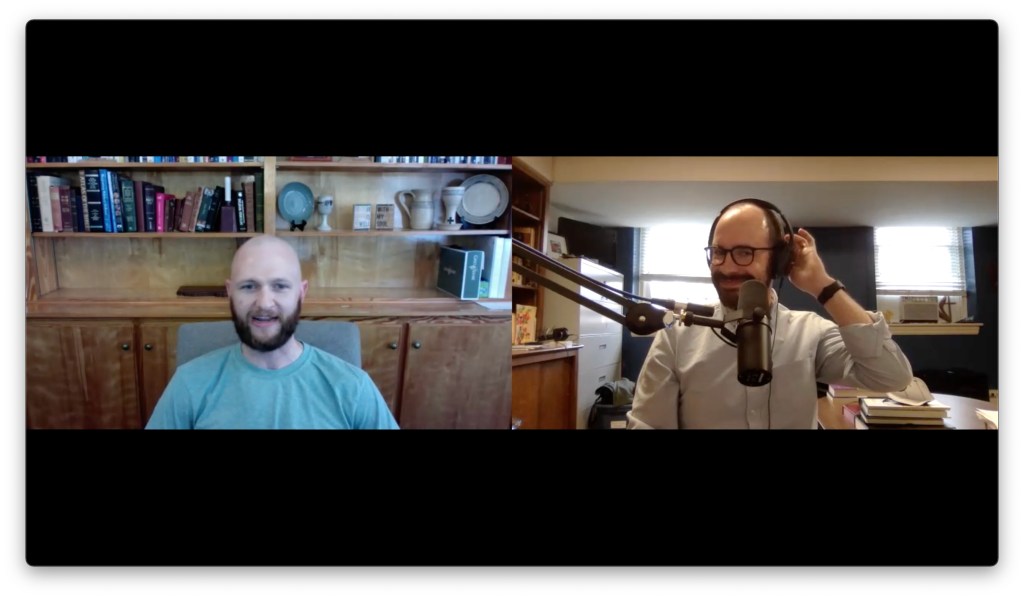
This week on the Strangely Warmed podcast I speak with Wayne Dickert about the readings for the Fourth Sunday of Lent [C] (Joshua 5.9-12, Psalm 32, 2 Corinthians 5.16-21, Luke 15.1-3, 11b-32). Wayner is the pastor of Bryson City UMC in Bryson City, NC. Our conversation covers a range of topics including fresh expressions, summer internships, stones, dis-grace, mighty waters, praying by listening, new creations, ambassadors for Christ, prodigals, and Robert Farrar Capon. If you would like to listen to the episode or subscribe to the podcast you can do so here: Don’t Be A Jerk
This week on the Strangely Warmed podcast I speak with Wayne Dickert about the readings for the Third Sunday of Lent [C] (Isaiah 55.1-9, Psalm 63.1-8, 1 Corinthians 10.1-13, Luke 13.1-9). Wayner is the pastor of Bryson City UMC in Bryson City, NC. Our conversation covers a range of topics including the Nantahala River, joy, well-digging, recreation for re-creation, praise, church meetings, the ministry of restoration, idolatry, divine challenges, and holy fertilizer. If you would like to listen to the episode or subscribe to the podcast you can do so here: The River of Life
This week on the Strangely Warmed podcast I speak with Chandler Ragland about the readings for the Second Sunday of Lent [C] (Genesis 15.1-12, 17-18, Psalm 27, Philippians 3.17-4.1, Luke 13.31-35). Chandler is the pastor of Black Mountain UMC in Black Mountain, NC. Our conversation covers a range of topics including strange new worlds, Encanto, covenants, righteousness, living in church, narrative preaching, memorizing scripture, waiting on the Lord, the Apostles’ Creed, Mississippi, and the status quo. If you would like to listen to the episode or subscribe to the podcast you can do so here: Less Is More
They tested God in their heart by demanding the food they craved. They spoke against God saying, “Can God spread a table in the wilderness?”
Jesus spends the afternoon feeding 5,000 through his divine mercy. And, when all is said and done, bellies full to the brim, a crowd gathers to question the behavior of this God in the flesh.
Jesus’ response – “You all are looking for me but for the wrong reasons. I delight in giving you food to eat, but I also have something else to offer.”
“What must we do?” The crowds intone.
“Believe” Jesus answers.
“Okay, we get that, but how do we really know you can make good on your promise? Can you rain down from manna from heaven for us like Moses did?”
And then Jesus says, “Moses didn’t give you the manna! It was God who gave the good gift!”
“Sure,” they say, “That’s fine. We’d like some of that bread from heaven please.”
And Jesus answers them, “Have you not heard anything I’ve said? I am the bread!”
What wondrous good news it is that, when Jesus showed up proclaiming the beginning of God’s new kingdom, he did so not with sermons about the Trinity, or the atonement, or justification, or any other big and abstract theological mishmash. Instead, Jesus began by pointing right at our stomachs, to that gnawing, unsatisfied, emptiness within and then invited us to dinner.
Jesus feeds the hungry – that’s who Jesus is.
Think of the crowds during the days of Moses and during the days of Jesus, imagine how they felt while eating the bread.
Did they deserve it? Did they earn it?
No!
The Psalmist reminds us that they had done everything but deserve it! God’s wrath was kindled against them and yet God gave them the bread anyway. The 5,000 didn’t have to lay out all their good works before Jesus delighted in filling their bellies.
This is grace.
Grace plus Nothing.
Just when we, the people of God, expect to be clobbered with guilt – “You didn’t listen in the wilderness!” “You haven’t loved your neighbors enough!” – we actually get clobbered by grace.
And, when that happens, we begin to realize that whenever we’ve gone looking for peace or happiness by doing this, that, and the other we’ve actually overlooked the God who has always been looking for us.
The One who offers us the gift we simply don’t deserve.
The heart of Christianity is this – We don’t have to give or say or pay anything – In Christ it has all been given, said, and paid for us.
It is by grace and only by grace that we are accepted by God.
Can God spread a table in the wilderness?
That question is often still our question. We look at the wildness of our lives, we spend more time looking backward than forward, and whenever we encounter our own disappointments and shortcomings, we wonder if God can really do anything about it.
Frankly, it’s why some of us keep showing up to church week after week, in-person or online – we want an answer to our question. Can God make something of our nothing? Can God spread a table in the wilderness?
And the answer is, quite simply, yes.
God can and God does all the time. God is the Good Shepherd who goes after the one lost sheep, God is the Prodigal Father who rushes out to find us in the street even before we have a chance to apologize, God is the One who, rather than leaving us to our own devices, comes to dwell in the muck and mire of this life to offer us Grace plus Nothing. Amen.
Have mercy on me, O God, according to your steadfast love; according to your abundant mercy blot out my transgressions. Wash me thoroughly from my iniquity, and cleanse me from my sin. For I know my transgressions, and my sin is ever before me. Against you, you alone, have I sinned, and done what is evil in your sight, so that you are justified in your sentence and blameless when you pass judgment. Indeed, I was born guilty, a sinner when my mother conceived me. You desire truth in the inward being; therefore teach me wisdom in my secret heart. Purge my with hyssop, and I shall be clean; wash me, and I shall be whiter than snow. Let me hear joy and gladness; let the bones that you have crushed rejoice. Hide your face from my sins, and blot out all my iniquities. Create in me a clean heart, O God, and put a new and right spirit within me. Do not cast me away from your presence, and do not take your holy spirit from me. Restore to me the joy of your salvation, and sustain in me a willing spirit. Then I will teach transgressors your ways, and sinners will return to you. Deliver me from bloodshed, O God, O God of my salvation, and my tongue will sing aloud of your deliverance. O Lord, open my lips, and my mouth will declare your praise. For you have no delight in sacrifice; if I were to give a burnt offering, you would not be pleased. The sacrifice acceptable to God is a broken spirit; a broken and contrite heart, O God, you will not despise.
In the strange new world of the Bible the greatest triumph, the pinnacle of all moments, is Jesus’ resurrection from the dead. Easter. But Easter is not the “happy ending” of a fairytale. It’s not, “despite all the effort of the powers and the principalities, everyone lives happily ever after.”
There’s no resurrection without crucifixion.
But that’s also why there are far more people in church on Easter than on Ash Wednesday and Good Friday.
Easter, for all of its wonder and all of its joy, is only the beginning of a new reality in which the entry point is, in fact, suffering.
Contrary to the cliche aphorisms of the so-called property gospel – if you pray hard enough, God will make you healthy and wealth – struggle is deeply embedded in the faith. It’s why Jesus warns about the cost of discipleship, constantly. It’s why Paul writes about suffering, constantly.
Struggles are present in the life of faith because, when push comes to shove, we usually look out for ourselves at the expense of our neighbors. Paul puts it this way: None of us is righteous. No, not one.
We simply can’t keep the promises we make, let alone the promises that God commanded us to keep. It doesn’t take much of a glance on social media or on the news to see, example after examples, of our wanton disregard for ourselves and even for ourselves.
The old prayer book refers to us, even the do gooders who come to an Ash Wednesday service, as miserable offenders.
And yet (!), God remains steadfast with us in the midst of our inability to be good.
That’s one of the most profound miracles of the strange new world of the Bible, and it is a miracle. That ragtag group of would be followers we call the apostles, who betray, abandon, and deny Jesus, they fail miserably and it is to them that the risen Jesus returns in the resurrection.
They were transfigured by the Transfigured One, and their journey of faith began in failure.
And so it is with us, even today. It is through our brokenness, our shattered souls, that God picks up the pieces to make something new – something even more beautiful than who were were prior to the recognition of our brokenness.
There is an ancient Japanese art form that will be shaping our Lenten observance this year at the church – Kintsugi. The story goes that, centuries ago, a disagreement broke out among an emperor and one of his servants which led to a tea pot being smashed into pieces. The emperor threatened to punish the servant but an artisan intervened and promised to make something of the nothing.
A gold binding agent was used by the artist to restore the broken vessel, and in so doing the artist brought to a new newness.
On the front of your bulletins you can see an example of this art form that was made with a broken cross – the gold ribbon brings the cross back together and it becomes more than it was prior to its cracks and fissures.
Like the Kintsugi master, Jesus renders us into a new newness. Jesus comes not to fix us, but to admire us in our potential and to help us recognize beauty even in, and precisely because of, our brokenness.
In church speak we call it redemption.
Psalm 51 had marked the season of Lent for as long as Christians have observed this particular season. It is a penitential psalm – a psalm that expresses sorrow for sin.
And yet, the psalm does not begin with a confession of sin – it begins with a request for forgiveness: “Have mercy on me, O God, according to your steadfast love; according to your abundant mercy, blot out my transgressions.”
That might not seem like much of a distinction, but it implies that the psalmist knows they have something worth confessing and that if the psalmist is to be helped at all then the sins must be taken away completely but someone else.
It means the psalmist really knows the condition of their, and our, condition. We all do things we know we shouldn’t do, and we all avoid doing things we know we should do.
Some us are are pretty good at pushing that all aside and rationalizing the things we do or leave undone. But at some point or another the guilt begins to trickle in and we lay awake at night unable to do much of anything under the knowledge of who we really are.
But the psalmist sees it all quite differently.
Somehow, the psalmist knows that forgiveness has come even before the sin occurred.
The psalmist knows that God is the God of mercy.
For us, people entering the season of Lent, we are compelled to proclaim the truth that we are justified not after we confess our sins, but right smack dab in the middle of them. At the right time Christ died for the ungodly, God proves God’s love toward us that, while we were yet sinners, Christ died for us. There is therefore now no condemnation for those who are in Christ Jesus, which includes everyone since Jesus has taken all upon himself in and on the cross.
The challenge then, for us, isn’t about whether or not God will forgive us.
The challenge is whether or not we can confess the condition of our condition.
That’s why Ash Wednesday is so important and so difficult. It is a time set apart to begin turning back to God who first turned toward us. It is a remarkable opportunity to reflect on what we’re doing with our lives right now and how those lives resonate with the One who makes something beautiful out of something broken.
Therefore, Ash Wednesday inaugurates the season of honesty:
We are dust and to dust we shall return.
We are broken and are in need of the divine potter to do for us that which we cannot do for ourselves.
Judgment comes first to the household of God, so wrote Peter in an epistle to the early church. We, then, don’t exist to show how wrong the world is in all its trespassed, but instead we exist to confess that we know the truth of who we are all while knowing what the Truth incarnate was, and is, willing to do for us.
We can’t fix ourselves. In any other place and in an other institution and around any other people that is unmitigated bad news. But here, in the church, it’s nothing but Good News. It’s good news because nobody, not the devil, not the world, not even ourselves can take us away from the Love that refuses to let us go.
Even the worst stinker in the world is someone for whom Christ died.
Even the most broken piece of pottery can be made into something new by the divine potter.
I wonder, this Lent, what kind of church we would become if we simply allowed broken people to gather, and did not try to fix them, but simply to love them and behold them, contemplating the shapes that broken pieces can inspire?
I wonder, this Lent, what might happen if we truly confessed who we are all while knowing whose we are?
I wonder, this Lent, what kind of new newness we might discover through the One who comes to make all things new?
You and me, we’re all dust, and to dust we shall return. But dust is not the end. Amen.
This week on the Strangely Warmed podcast I speak with Chandler Ragland about the readings for the First Sunday of Lent [C] (Deuteronomy 26.1-11, Psalm 91.1-2, 9-16, Romans 10.8b-13, Luke 4.1-13). Chandler is the pastor of Black Mountain UMC in Black Mountain, NC. Our conversation covers a range of topics including Lenten observances, first fruits, Karl Barth on time, doom and gloom, institutional identities, rocking climbing, angelology, imaging salvation, preaching anxieties, Twitter, and temptation. If you would like to listen to the episode or subscribe to the podcast you can do so here: Words About The Word
Five years ago the Crackers & Grape Juice team had an idea for a new lectionary podcast and we have published an episode every Monday since. Our first guest was Fleming Rutledge and she knocked our socks off (as usual). We are reposting that first episode because Fleming’s thoughts and comments are just as relevant today as they were five years ago. In it she talks about what she deems the “current preaching crisis,” the desire to appear prophetic, and the call to stand under the judgment of God. If you would like to listen to the episode or subscribe to the podcast you can do so here: A Chance To Feel Self-Righteous
But someone will ask, “How are the dead raised? With what kind of body do they come?” Fool! What you sow does not come to life unless it dies. And as for what you sow, you do not sow the body that is to be, but a bare seed, perhaps of wheat or of some other grain. But God gives it a body as he has chosen, and to each kind of seed it’s own body. So it is with the resurrection of the dead. What is sown is perishable, what is raised is imperishable. It is sown in dishonor, it is raised in glory. It is sown in weakness, it is raised in power. It is sown a physical body, it is raised a spiritual body. If there is a physical body, there is also a spiritual body. Thus is is written, “The first man, Adam, became a living being”; the last Adam became a life-giving spirit. But it is not the spiritual that is first, but the physical, and then the spiritual. The first man was from the earth, a man of dust; the second man is from heaven. As was the man of dust, so are those who are of the dust; and as is the man of heaven, so are those who are of heaven. Just as we have borne the image of the man of dust, we will also bear the image of the man of heaven. What I am saying, brothers and sisters, is this: flesh and blood cannot inherit the kingdom of God, nor does the perishable inherit the imperishable.
A United Methodist Bishop received a chain saw one Christmas and quickly went to work with it. And then, on New Year’s Eve, the chainsaw slipped, grabbed ahold of his sleeve, threw him to the ground, and in a matter of seconds did some serious damage and he was rushed to the emergency room.
The bishop later reflected that, while riding in the back of the ambulance and the sirens were ringing, if he died because of blood loss, he hoped that his wife would be smart enough to tell everyone that he died chopping firewood for poor orphans.
While in reality he was really just trimming some hedges that weren’t yet in need of trimming.
However, he didn’t die.
Though at moments he wished he did.
He went through serious surgery and was stuck in the hospital for quite some time while he recovered.
And, it was during this time that a well intentioned chaplain entered the room and offered “pastoral presence.” The bishop had enough pastoral presence in his life, but he motioned for the young man to come in. The chaplain looked over the bandage wrapped around his arm and asked, “Are you a Christian?”
The bishop replied, “Sometimes.”
“Well then,” the chaplain intoned, “I suppose your accident caused you to do a lot of praying?”
And that’s when the bishop realized that throughout his whole ordeal he hadn’t felt moved to prayer in the slightest. He shared, later, that his lack of prayer was not due to a lack of faith in God’s ability to heal. The bishop was quick to note that there are scores of healing stories in scripture, that Paul considered healing a sign of God’s active grace, that the book of Acts points to the power of Christ working to heal through the disciples, and that even James the brother of Jesus calls for the people called church to pray of the sick that they might be healed.
Why then was he, a bishop in the church, so reluctant to pray?
At first he wondered if his lack of prayer could be attributed to the fact that God had better things to do with more people in need than his little chainsaw accident. But the more he thought about it, the more he thought about his aversion to the regular prayer requests he had received countless time before throughout his ministry.
That is, he was sick and tired of everyone being sick and tired in their prayers.
We’re at the tail end of what we call the season after Epiphany. Transfiguration is coming. Ash Wednesday is coming. Lent is coming. We will shortly make the journey inward to confront the condition of our own condition leading up to the cross on Good Friday, and yet, we’re still dealing with the shock of the incarnation.
Sure, most of us have packed away all the Christmas decorations weeks ago. Though, if you drive around the neighborhood around the church, you’re still likely to catch quite a few Christmas lights dangling from gutters.
But the proclamation of Christmas is one that lingers even when we move through different liturgical seasons. God, bewilderingly, refused to stay above and instead got down and dirty with us, in the flesh, and moved in next door, as it were.
Jesus, fully God and fully human, chose to be a people, a family, what we now call church.
We are the body of Christ in the world.
And how is our body faring?
Some of us we are tracking our calories constantly, or our exercising doesn’t count unless we can post it somewhere on social media. Some of us are struggling to fall asleep at night as we run through the list of things that terrify us. Some of us are making plans for the next degree, or the next job, or (heaven forbid) the next spouse.
We’re obsessed with our bodies and our physical well being. It dominates our prayers to the degree that if we ever ask someone to pray for us there’s a better than good chance that our request has to do with our, or someone else’s, body.
It dominates our waking, and sleeping life, so much so that many of us have devices strapped to our wrist that not only tell us if we move enough during the day but also if we’re getting the right kind of sleep at night.
And for those of you keeping score at home, I’m wearing one of them right now!
Our health and well being, or lack thereof, is constantly being reinforced through commercials designed to sell us on bodies that we will never have and beauty magazines that will only ever make us feel ugly.
And here’s the Christian message in the midst of all of it: it’s not up to you.
Your salvation isn’t up to you.
You can’t earn it through perfect church attendance on Sunday mornings.
You can’t earn it by giving more through the offering plate than the person next to you.
You can’t earn it from developing an 18 pack of abs.
You can’t earn your salvation because it is a gift given by the only One who can: God.
And yet, the gift of salvation, our very resurrection from the dead, means that our bodies matter today. It means that, once we come to grips with what God did and does, our being in the world changes.
The Corinthians to whom Paul writes his epistles, the Christians he derides for their foolishness, were living as if their bodies no longer mattered – they were giving in to their desires to such a degree that it was harming themselves as individuals and as a community. They were getting drunk on the wine from communion, they were trading bedfellows, they were letting their flesh and blood dictate everything about who they were.
And Paul says, “No! Listen: we’re not there yet. We’re still in our bodies in this mortal life, but the resurrected life is coming.”
Our bodies are important. As I’ve noted before – Christianity isn’t a spiritual faith, it’s an embodied one. It’s why we baptize with water, and we share bread and cup. It’s why we take seriously the needs of the hungry, and the poor, and the outcasts. And it’s why we are bold to pray for the health and well being of ourselves and others.
But all of that is a long cry from the obsessiveness that we have with our own bodies today.
None of us have the body that we really wish we had. And if we do, we resent how much work it takes to make our bodies look and feel that way. And the older we get, the more we discover that our bodies are not as trustworthy as we thought they once were.
Certain foods don’t sit like they used to. It’s harder to lose the holiday weight. No amount of lotions and creams can make our wrinkles disappear. And that’s not even mentioning the inability of our bodies to ward away sickness.
The bodies we are in can’t be, and won’t be, perfect.
Paul puts it this way: the flesh is weak.
That’s why he admonishes the Corinthians to not give in to each and every little desire while, at the same time, he reminds them (and us) that we need not beat ourselves up over whether or not we look and feel like we want to look and feel.
Certainly, there are moments during Jesus ministry when he healed those in need, but those moments are remarkably ambiguous. He didn’t heal every sick person in Judea, and even when he did heal he often told people to not tell anyone about it.
Whatever Jesus’ mission was, it was about more than physical restoration.
Consider: Each and every person that Jesus did heal eventually died.
Even Lazarus was raised from the dead only to die again.
Outside of scripture we should note that churches were the location for, and eventually created some of, the very first hospitals because taking care of the last, least, lost, little, and dead is part of the work of God.
But only recently has our obsession with our bodies come to dominate just about every aspect of life.
Including our prayers.
That’s not how Jesus prayed, nor it is how Jesus taught us to pray. Bread and trespasses are mentioned in the Lord’s prayer, but our illness and discomfort are not. I have heard prayers and I myself have prayed prayers about every medical diagnosis you can imagine, but I rarely pray for God’s strength to help me love my enemies, I’m not often asked to pray for someone to have the courage to actually forgive the person that harmed them.
Prayer is, and must be, more than bringing our wish lists to Jesus, asking him for occasional help when our bodies are no longer functioning the way they are supposed to.
Prayer, instead, is the risky attempt to let Jesus speak.
That bishop, the one who nearly cut his arm off, the one who didn’t pray in the hospital, he said he was ultimately reluctant to clasp his hands together in petition because the last thing he wanted was to risk a visit from Jesus, who usually shows up making our lives harder and not easier.
The bishop also said that one of the joys of following Jesus (and he used joy sarcastically) is that Jesus usually shows up even when we don’t pray, and sometimes because we don’t pray.
He experienced Jesus in learning how to be dependent on someone else in his healing, something that most of us avoid at all costs – we never want to be a burden.
He experienced Jesus in the reminder of his own fragility, and his destiny to return to the dirt from which he was created.
He experienced Jesus as the only hope in the world he really had, because were his salvation up to himself, he really would be a lost cause.
There was a time when health didn’t mean just freedom from pain and physical discomfort – health meant wholeness, even holiness. And sometimes holiness is nothing more than coming to the realization that what makes the Good News good is that it isn’t up to us – it’s up to God.
Which is foolishness according to the world. The world bangs us over the head every chance it gets about the need for us to be self-made creatures, to make our own destinies, to pull ourselves up by our boot straps.
Grace, from that perspective, is complete foolishness. It is everything for nothing. It is a divine lark in the midst of overwhelming frustration. It is the only thing we need and the only thing we don’t deserve.
Our bodies will fail us, but God won’t. Maybe some of us will be fortunate enough to experience some divine healing in this life, but all of us have already received the greatest healing of all – the gift of salvation.
In the end, the only thing we have to do is trust God. And when we do that, well, then we’re living in grace and by grace.
No matter what happens to us in the course of that trust – no matter how many things we do or leave undone – if we can trust that God, by death and resurrection, has made all things new, then we can rest in our gift and relax.
The whole diorama of all our mediocre performances (which is all we can ever really offer anyway) can’t stop the Love that refuses to let us go. If Jesus refused to condemn us because our works were rotten, then he certainly isn’t going to flunk us if our bodies aren’t perfect.
Do you see? That means we can fail again and again and still live in the life of grace.
Because, at the very worst, all we can be is dead and for the One who is Alpha and Omega, that’s no trouble at all. Amen.
This week on the Strangely Warmed podcast I speak with Andrew Whaley about the readings for Transfiguration Sunday [C] (Exodus 34.29-35, Psalm 99, 2 Corinthians 2.12-4.2, Luke 9.28-43a). Andrew is the lead pastor of Raleigh Court Presbyterian Church in Roanoke, VA. Our conversation covers a range of topics including Sufjan Stevens, Because Of Winn-Dixie, theological sunburns, the necessity of community, rediscovering the sacred, freeing freedom, stained glass language, Transfiguration challenges, and dissonance. If you would like to listen to the episode or subscribe to the podcast you can do so here: Lost In A Cloud
And he kissed all his brothers and wept upon them; and after that his brothers talked with him.
Last week I paced through the “seasonal” aisle at the grocery store looking for the right Valentines. Was I searching for the items that would perfectly convey my love for my wife? No. Instead, I was trying to find appropriate cards/items that my son could distribute during his celebration of the holiday in his kindergarten class.
Tucked away behind the heart shaped boxes of chocolate varieties was a solitary box of Mandalorian Valentines, and I knew that Elijah would delight in giving them to all his friends.
And this morning, as I walked him to school, I asked him if he knew why he was bringing Valentines to school and he said, “I’m sure it has something to do with Jesus.”
And he wasn’t wrong!
Valentine’s Day is a particularly striking holiday because of the juxtaposition from how it started to what it looks like today.
There were numerous Christians in the early church named Valentine and many of them were martyred for their faith. That is, their commitment to the kingdom of God was such that the powers and principalities believed the only way to stop them was to kill them.
But perhaps the most famous Valentine was Valentine the Bishop of Terni during the 3rd century. The story goes that he was put under house arrest by Judge Asterius for evangelizing and the two of them eventually struck up a conversation about Jesus. The judge wanted to put Valentine’s faith to the test and brought in his blind daughter and asked for her to be healed. If Valentine was successful, the judge agreed to do whatever he asked.
Valentine, then, placed his hands on the girl’s blind eyes and her vision was restored.
Overcome by the miracle, the judge agreed to get baptized and freed all of the Christian inmates under his authority.
Later, Valentine was arrested (again) for his continued attempts to share the Good News and was sent before the Roman Emperor Claudius II. Valentine attempted to convince the Claudius to convert to the faith, but then Valentine was condemned to death unless he renounced his own faith.
Valentine refused and was beheaded on… (wait for it)… February 14th, 269.
Later additions to the story proclaim that, shortly before his execution, Valentine wrote a letter to the young girl he once healed and he signed it, “from your Valentine” which is said to have inspire the holiday we now enjoy.
So, what does a beheaded Christian martyr have to do with boxes of chocolate and bouquets of roses?
The book of Genesis is full of family betrayals and deceits. Particularly dreadful is the story of Jacob being sold into slavery by his brothers because they couldn’t handle their own jealousy. Jacob makes a name for himself in Egypt and eventually reconciles with the very brothers who abandoned/betrayed him when they come looking for food to eat.
Jacob’s love for his brothers was such that, even though they ruined his life, he “kisses them and weeps upon them.”
Love is awful like that. It can make us do crazy and bewildering things. At least, they are crazy and bewildering according to the world.
But consider what we do on Valentine’s Day: we throw away gobs of money on trivial and fleeting items. The flowers will eventually fade and the chocolate will expire.
But others will say that St. Valentine’s willingness to die for his faith, and Jacob’s willingness to forgives his brothers, is even crazier.
Love is a crazy thing.
It also happens to be how God feels about us.
God, in Christ, full of hope and grace and mercy mounts the hard wood of the cross to die for us. And then, three days later, God gives him back to us.






 think and let think