Are We Able?

Mark 10.35-45

James and John, the sons of Zebedee, came forward to him and said to him, “Teacher, we want you to do for us whatever we ask of you.” And he said to them, “What is it you want me to do for you?” And they said to him, “Grant us to sit, one at your right hands and one at your left, in your glory.” But Jesus said to them, “You do not know what you are asking. Are you able to drink the cup that I drink, or be baptized with the baptism that I am baptized with?” They replied, “We are able.” Then Jesus said to them, “The cup that I drink you will drink; and with the baptism with which I am baptized, you will be baptized; but to sit at my right hand or at my left is not mine to grant, but it is for those for whom it has been prepared.” When the ten heard this, they began to be angry with James and John. So Jesus called them and said to them, “You know that among the Gentiles those whom they recognize as their rulers lord it over them, and their great ones are tyrants over them. But it is not so among you; but whoever wishes to become great among you must be your servant, and whoever wishes to be first among you must be slave of all. For the Son of Man came not to be served but to serve, and to give his life a ransom for many.”

“Love” has got to be one of the most overused and therefore underwhelming words that we use on a regular basis. What was once reserved for the intimate connection between individuals, and for the divine, is now the word we use to describe any affection toward anything.

I tried to keep track this week of how many times I heard the word and I lost count rather quickly. I heard of the love of our fall weather, the love of a certain gritty Star Wars Disney + series, and even, I kid you not, the love of Taco Bell.

Even in the church, we drop the “l” word all the time. We talk about loving God and loving neighbor, we sing of the gift of love, we participate in missional work in the name of love.

To quote a popular movie from a season that is just around the corner, “Love actually is all around.”

And yet, if love is actually all around, what difference does it make?

Notably, according to the strange new world of the Bible, love is not found in affection, or hallmark cards, or Romantic Comedies. Instead, love is found in service.
I love the thunder brothers: James and John. Peter is often seen as our proxy in the New Testament, always rushing in and saying more than he knows, but the thunder brothers are the perfect paragons of pathetic performance.

Jesus teaches his disciples about the mysteries of the Gospel, he offers them miraculous food when they see nothing but scarcity, he even spells out the whole death-and-resurrection business, the exodus for the rest of us, as literally as he can, and the thunder brothers still don’t get it.

They approach Jesus and demand cabinet positions in the kingdom of God.

They want power while God in the flesh has just told them, moments before, that glory comes in weakness. For the third time.

Perhaps we should give them the benefit of the doubt – maybe, confronted with bad news, you know the whole “the son of man will be handed over to the chief priests, he will be condemned to death, and they will murder him” thing, maybe the thunder brothers would prefer to stay on the sunny side of things.

“Excuse us Jesus, it’s all nice to hear all about the Son of Man stuff, but can we talk about what it will be like when this is all over and you’re finally in charge? We have some ideas we’d like to share with you. We think we’d be good for positions in upper management. What do you think?”

And Jesus, ever the good rabbi, answers their question with his own:

“Are you able to drink the cup that I drink, or be baptized with the baptism that I am baptized with?”

“Lord, we are able! Our spirits are thine!

“Okay, okay, you don’t need to sing it. But let’s be sure we’re all on the same page. Remember, I’m in the death and resurrection business. I’m here to turn the world upside down. So, for God’s sake, literally, pay attention as I say this one more time: if you want to be first, you have to be last. If you want to great, you have to be the least. For the Son of Man came not to be served, but to serve, and to give his life a ransom for many. Got it?”

Are you able? Are we able?

It’s a great question. And the answer is yes, and no.

We are able to follow the Lord, but we do not know where following the Lord will take us.

The thunder brothers want glory, power, prestige. In short, they want what we all want. They want the easiest way to the top in the shortest about of time with the least amount of resistance.

But glory, real faithful glory, isn’t what we often imagine it to be. We might picture the corner office, or the perfect stock portfolio, or the kids going to the right colleges, or going to seminary so that people will call you Reverend one day.

But this is how Jesus describes glory: service.

And Jesus serves the sinful who seek glory by the wrong means for the wrong reasons. You know, people like us.

Discipleship, which is just another word for following Jesus, is a strange and wondrous thing. It is strange because we really have no idea where we’re going, and it is wondrous because we do know that God in Christ is with us for the ride.

Contrary to how we might imagine the faith, it is not made up of theological propositions or lists of righteous behaviors. The marks of the Christian can actually be summed up rather simply: Are we following Jesus or not?

And yet, the simplicity of that question betrays the magnitude of discipleship.

Whatever our faith may be, whatever it may look like, it is found in the following. In the end, discipleship is often nothing more than stumbling behind the Lord on the roads of life, going from one adventure to the next, with the knowledge that Jesus is leading the way.

Which means, oddly enough, we never really choose to be Christians.

Discipleship is something done to us.

I’ve never not been a Christian, I’ve only known this life. Credit to my parents, church has always been part of my reality. But even to those who come to faith later in life, we do so not by choice. We do so because something happens to us and we eventually finds ourselves in a place like this. 

That something is named Jesus Christ.

Jesus gathers people like us in on a journey that we might not have ever chosen on our own, and Jesus drags us places we might not have ever discovered on our own.

And, more often than not, service is the crucible of discipleship.

Put another way, following Jesus eventually brings us toward opportunities to serve, and to be served.

However, serving others, putting the needs of others before our own, doesn’t actually make us righteous. Service is not a salve and it definitely doesn’t earn us any reward in heaven. No amount of good works can make up for our lack of goodness. The only thing service does is rightly orders our disordered lives. 

Rich Mullins poignantly put it this way: “Christianity is not about building an absolutely secure little niche in the world where you can live with your perfect family and your perfect little house where you never encounter anyone with any problems. Christianity is about learning to love like Jesus and Jesus loved the poor and Jesus loved the broken.”

Jesus says to his disciples, then and now, “Take up your cross and follow me.” And Jesus spends his time among the last, least, lost, little, and dead.

Notice, Jesus rightly rebukes the thunder brothers and their request. Even after all the miracles and the parables and the public displays of religious affection, they still don’t get it. And yet, Jesus also makes them a promise in this moment! Jesus’ promises them, and all of us, that we need not live in fear, we need not worry about what tomorrow might bring, we need not even scheme to accrue as much power as possible. Jesus doesn’t promise protection, safety, or power. Jesus promises us the cross!

Jesus’ ministry, from beginning to end, was not about power, or at least not about power as defined by the world. Again and again throughout the gospels we are bombarded by Jesus’ work of bearing the suffering that always comes as a result of caring for the weak and putting the last first.

Flannery O’ Connor once said, “Most people come to the Church by means the church does not allow, else there would be no need their getting to her at all.”

Which is just another way of saying that Jesus meets us where we are, not where we ought to be. But then Jesus takes us somewhere else. 

That journey might look like spending a week helping out with Vacation Bible School showing love and grace to kids who might not know what those words even mean. Or it might look like working hard in the kitchen week after week to make sure bellies are full here at the church and in the community, particularly for those who do not know what it feels like to have a full belly. Or it might look like serving in worship whether singing, or reading, or praying, helping others experience God’s profound mercy. Or it might look like contributing to the financial aspects of the church, making a way for ministries where there is no way.

Or it might look like something we haven’t even thought of yet! If it is guided by grace, or moved with mercy, or filled with faith, then it is probably some part of the journey we call discipleship. 

To love is to serve. To serve is to love.

And yet, at the same time, to receive love is to receive service.

This is often an under-discussed part of our faith. It’s all good and fine to talk about all the things we can do, all the differing ways we can serve the needs of our community, and so forth. It’s another thing entirely to put ourselves in the position of receiving service. Of mustering of the humility to recognize that we, ourselves, need help.

But we do. All of us. No matter how much we like to pretend we have it all figured out, the truth is we’re all making it up as we go and we can all use all the help we can get. 

Thankfully, God chooses to become weak in order to dwell among us, God chooses to serve a people undeserving, and God gives God’s life as a random for many, including us.

If, and when, we serve, it is only ever because God first served us.

Put another way: we love because God first loved us.

Discipleship is an adventure – there’s always more to do and more to receive. Which, in the end, it what makes it so much fun. Amen. 

No Condemnation Now I Dread

Luke 18.2-6

Jesus said, “In a certain city there was a judge who neither feared God nor had respect for people. In that city there was a widow who kept coming to him and saying, ‘Grant me justice against my opponent.’ For a while he refused; but later he said to himself, ‘Though I have no fear of God and no respect for anyone, yet because this widow keeps bothering me, I will grant her justice, so that she may not wear me out by continually coming.’” And the Lord said, “Listen to what the unjust judge says.”

Jesus says that’s what God is like. Not like a widow who persistently goes looking for justice. Not like a bailiff dutifully following orders. Not even like a stenographer observing and recording every little detail of a trial.

God is like the unjust judge.

Jesus is saying to us here, in ways both strange and captivating, that God is willing to do for us what we need for no other reason than the fact that it will get all of us off of God’s back. 

Jesus spins the tale and we are left with the bewildering knowledge that God is content to fix all of our mess even while we’re stuck in the midst of it.

In other words: While we were still sinners, Christ died for the ungodly.

There are few sentences in scripture as unnerving and beautiful as that one. It’s beautiful because its true and it includes all of us. But it’s unnerving precisely because it includes all of us! 

We might like to imagine that God is waiting around hoping to dispense a little bit of perfection like manna from heaven if we just offer the right prayer or rack up the right amount of good works. 

But Jesus’ story about the unjust judge screams the contrary. It’s as if Jesus is saying, “Do you think it makes the least bit of difference to God whether or not you are right, or if your case is just? Truly I tell you, God isn’t looking for the right, or the good, or the true, or the beautiful. God is looking for the lost, and you are all lost whether you think you are lost or not.”

Jesus tells this parable as Golgotha and the cross get clearer and clearer on the horizon. The cross is God’s mercy made most manifest. Just like the unjust judge, God hung up the ledger-keeping forever while Jesus was hung up on the cross. The cross is God, as the judge, declaring a totally ridiculous verdict of forgiveness over a whole bunch of unrepentant losers like the widow, like me, and like you. 

The cross is a sign to all of us and to the world that there is no angry judge waiting to dispense a guilty verdict on all who come into the courtroom – there is therefore no condemnation because there is no condemner.

The old hymn has it right: “No condemnation now I dread; Jesus, and all in him, is mine; alive in him, my living Head, and clothed in righteousness divine, bold I approach the eternal throne, and claim the crown, through Christ my own!”

Thanks be to God.

The Perfect Church

Luke 2.41-52

Now every year his parents went to Jerusalem of rite festival of the Passover. And when he was twelve years old, they went up as usual for the festival. When the festival was ended and they started to return, the boy Jesus stayed behind in Jerusalem, but his parents did not know it. Assuming that he was in the group of travelers, they went a day’s journey. Then they started to look for him among their relatives and friends. When they did not find him, they returned to Jerusalem to search for him. After three days they found him in the temple, sitting among the teachers, listening to them and asking them questions. And all who heard him were amazed at his understanding and his answers. When his parents saw him they were astonished; and his mother said to him, “Child, why have you treated us like this? Look, your father and I have been searching for you in great anxiety.” He said to them, “Why were you searching for me? Did you not know that I must be in my Father’s house?” But they did not understand what he said to them. Then he went down with them and came to Nazareth, and was obedient to them. His mother treasured all these things in her heart. And Jesus increased in wisdom and in years, and in divine and human favor.

I would like everyone to close your eyes for a moment, find a comfortable posture, and I would like you to imagine the perfect church…

What does it look like?

What kind of people are in it?

What are some of the things the church does?

It’s a little terrifying how easy it is to imagine “the perfect church” only to open our eyes and be stuck here with each other. It’s so easy to picture a particular church in our minds because that’s what life has conditioned us to do. We usually curate everything we can to benefit our own tastes, and leanings, and hopes, and dreams.

If we don’t agree with someone else on Facebook, we can just block and unfollow them.

If we start watching a movie and within ten minutes it’s boring we can push a few buttons and watch something else.

If we’re hungry for a particular meal, we need only open an app on our phones to have it delivered right to our door, despite all the food we might already have in the pantry.

Basically, we are consumers living in a consumable world. We choose exactly what we want, take what we want, and move on with unlimited choices and unlimited speed.

And, frankly, we bring this understanding of reality to the church as well. That’s why there’s every flavor of Christian denominationalism on Grandin Road. If you encounter a church that doesn’t give you what you want, there’s always another one to try. 

The only problem with that is the fact that what we want is not often what we need.

An example: We are blessed in this church to have visitors nearly every Sunday. That is something worthy celebrating, but a very strange phenomenon when taking in the scope of Christian history. Up until the last 100 years, you went to church where you could. Now we go to church where we want.

Anyway, we get a fair number of visitors here, those church shopping for a new church home. And, every once in a while, visitors come back again and again and I will meet with them to talk about what it might mean for them to join or become more involved. During that conversation I always ask about where they were attending church before. 

And, more often than not, someone will describe their last church, usually somewhat local, and how they attended for years until something particular happened. A too-political sermon. A unfortunate song choice on a Sunday morning. A stinging stewardship season. And that was enough to say goodbye.

According to the world this is a normal thing that happens. We can move on over and over again.

But in the realm of the church this is downright strange. 

Charles Spurgeon, 19th century preacher, put it this way:

“If I had never joined a church till I had found one that was perfect, I should never have joined one at all; and the moment I did join it, if I had found one, I should have spoiled it, for it would not have been a perfect church after I had become a member of it. Still, imperfect as it is, it is the dearest place on earth to us.”

Strangely enough, the church is where we discover the comforting gospel of Jesus Christ that leads us to live uncomfortable lives for him. Uncomfortable because, living for Jesus means living for the people in the church around us too.

When someone joins a United Methodist Church they covenant to support the church with their prayers, presence, gifts, service, and witness. To support the church by presence is literally that, it means being present

Part of our discipleship is a willingness to be present with God and with one another. We gather week after week to remember the stories of God and to be re-membered into the body of Christ. We break bread with one another in worship, and during the Garden, as a recognition that the Christian life is one that is meant to be shared. We show up for Bible studies, and outreach programs, and all sorts of other things because, on some level, we understand that being present together is at the heart of what it means to follow Jesus.

Luke’s Gospel has all the best stories. Mark is short and brief, Matthew is theological, John is all over the place, and Luke’s got the stories. And the story of Jesus at the temple is just so good.

It’s got drama and intrigue, family strife, and youthful rebellion.

And when we read it we tend to fixate on Jesus teaching the elders. He’s a 12 year old boy and everyone is amazed at his teaching. And so people like me stand up in a place like this and say things like, “Our youth are not the future of the church, they are the church right now.” And a 3.5 minute story will usually be shared about a youth and how they understand the kingdom better than we do. And so on.

And that’s all good and fine. 

Jesus does say that if we want to get into the kingdom of heaven we have to act like children.

And yet, I fear we miss something else in the story when we emphasize Jesus’ teaching in the temple alone. What we miss is the fact that this is also a story about horrible parenting!

Listen to it again: They traveled all the way to Jerusalem for Passover, a six days journey by foot, and when they were done they returned home Mary and Joseph did not know that they left their son behind.

What? How does that happen? It’s one thing to lose track of a wayward child in the grocery store, but leaving them behind in a foreign city? C’mon!

And that would be bad enough. But then it says they traveled a whole day before they noticed. AND THEN once they turned back it took them another 3 days to find him!

Jesus was in the Temple teaching and his parents were astonished and Mary said, “Child, why have you treated us like this? Look, your father and I have been searching for you in great anxiety.”

Which is the Bible’s version of, “Boy, you had us worried sick! You are grounded from now until eternity!” 

And how does Jesus respond? “Why were you searching for me? Did you not know that I must be in my Father’s house?”

Must is a strong word. In life all of our must and shoulds don’t muster up to much in the kingdom of God, but Jesus’ response is notable.

It is good and right to be in the house of God. Honor and keep the sabbath, that’s 1 of the 10 commandments. 

The psalmist writes, “I was glad when they said to me, let us go to the house of the Lord.”

To be in the house of God was as necessary to Jesus as it is to breathe.

And yet, there are a few more staggering details in this story that really bring it all home. The Holy Family went to Jerusalem for Passover. Some 21 years later, on Passover in the same city, Jesus will take a loaf of bread and a glass of wine and share it with his friends. He will become the Passover Lamb for the them, the exodus for the rest of us.

Mary and Joseph abandon Jesus in the city, much like the aforementioned disciples will abandon him to the cross the day after Passover.

It take Mary and Joseph three days to find their son, much like Jesus sat in the tomb for three days before the resurrection.

And notably, after the family’s confrontation in the Temple, scripture says that Jesus returned home and was obedient to his parents and Mary treasured it in her heart. Which is another way of saying that Jesus forgave his parents for what they did to him, much like Jesus returns to his abandoning and denying disciples on the other side of Easter.

A crucial eccentricity of the Christian faith is the claim that salvation does not come to us by natural inclination, by birthright, by earning, or deserving. Salvation is a gift from God. And because it is a gift it can only be received on God’s terms, not ours. The church is the witness to the gift of salvation, reminding us time and time again what we have been given even though we deserve absolutely nothing.

That’s a hard truth to swallow, the “we deserve nothing.” But it’s true. We all do things we shouldn’t, we all avoid doing things we should. We are imperfect people. We might not be the type of people who forget our children back in Jerusalem and wander around for a few days before we find them, but we do have a lot more in common with Mary and Joseph than we let on. What’s more, even though we fail to be an obedient church, even though we fail to love God and one another, God offers us grace anyway. 

Therefore, the perfect church is actually an imperfect one, constantly reminding us of our imperfections and the great Good News that someone has come to help us. And that someone has a name: Jesus

Without the church how can we know that grace is given to us, how can we discover that we are caught up in Jesus’ story, how can we receive the sacraments?

We need one another, because you can’t baptize yourself no more than you can give communion to yourself. We need someone to give those gifts to us. We need the church to tell us again and again, “The world will only ever see you through your faults and failures, but God loves you.”

We need the church because it holds us together even when it feels like everything else is falling apart.

Rich Mullins once said, “Nobody goes to church because they’re perfect. If you’ve got it all together, you don’t need to go. You can go jogging with all the other perfect people on Sunday morning. Every time we go to church we’re confessing again to ourselves, our families, to the person in the pew next to us, that we don’t have it all together. That we need direction, we need accountability, we need help.”

The reason for being present in church is the strange fact that this is the only community that is consciously formed, criticized, and sustained by the truth. Which is Good News for a world that runs by lies.

Church is the last vestige of place where we willfully gather with those who are not like us, this is the fellowship of differents. And though we are different, the truth that is Jesus Christ, somehow makes us one.

I often wonder why I kept going to church throughout my life. At first I was present in church because my parents made me – they couldn’t leave me home alone as a child even though Mary and Joseph clearly would have. 

But then, around my teenage years, I started running the sound system so I had to be present in church. And then I left for college, and there was a church that needed a drummer so I was still present in church. On and on and on.

And when I look back now, I know the answer to why I kept showing up for church: Jesus.

Jesus churched me. The church is how God dealt with me. I am who I am because of the church. Through sermons and sacraments, through friends and even foes, I was shaped into who I am.

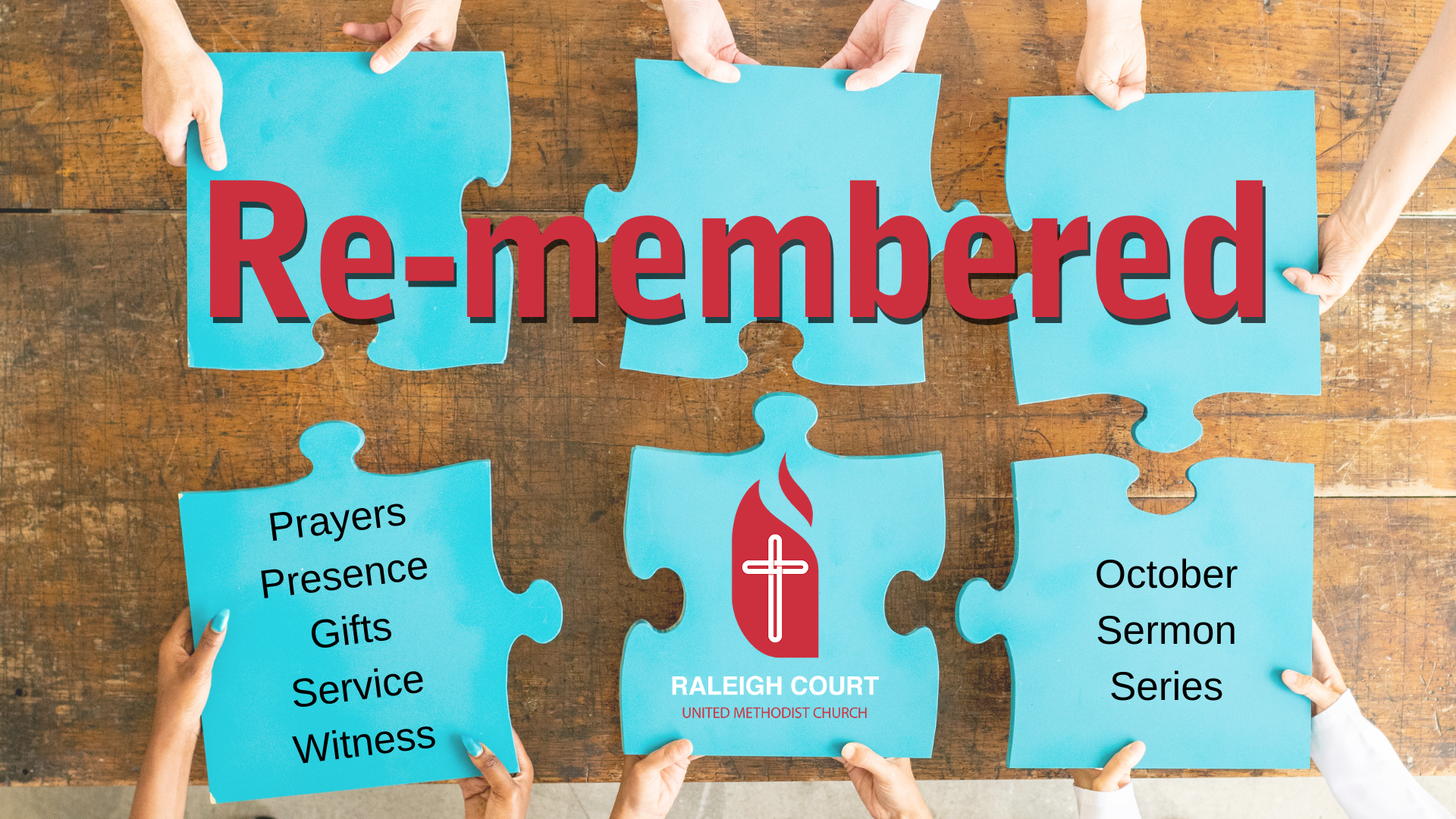
God is in the business of remembering us. That is, God re-members us, puts us together, like pieces from a puzzle. And yet, have you ever pulled out a puzzle and worked away on a rainy day only to realize that one or two of the puzzle pieces we missing?

The picture isn’t complete.

The church is complete, the body of Christ is complete, when we are together. Your presence here makes the church the church. When we are present before God’s presence, we live God’s future in our present and it actually changes things. 

So welcome to the perfect church! It’s perfect because God does God’s best work with imperfect people like us. Amen. 

The First Resort

James 5.13-18

Are any among you suffering? They should pray. Are any cheerful? They should sing songs of praise. Are any among you sick? They should call for the elders of the church and have them pray over them, anointing them with oil in the name of the Lord. The prayer of faith will save the sick, and the Lord will raise them up; and anyone who has committed sins will be forgiven. Therefore confess your sins to one another, and pray for one another, so that you may be healed. The prayer of the righteous is powerful and effective. Elijah was a human being like us, and he prayed fervently that it might not rain, and for three years and six month it did not rain on the earth. Then he prayed again, and the heaven gave rain and the earth yielded its harvest.

It was a typical Sunday morning with the typical Sunday crowd. We read, we sang, we listened, we gave, we received.

I announced the final hymn and we all started singing. 

Over the horizon of my hymnal I took a glance at God’s church. I saw the woman who had recently confessed to me that she was about to divorce her husband, who was standing and singing right next to her. There was the teenage girl who was accepted to every college she applied for and was currently experiencing the paralysis of analysis as she had to make a decision about which one to attend. And I saw one of the ushers dart out the back door for a cigarette, a habit he shared that he was trying desperately to drop.

But before we had a chance to make it to the second verse, Don keeled over in his pew with a loud thud.

There was a panicked moment as everyone turned toward the pew in question. I ran from the altar, and gathered around the man with a few others. We, thankfully, had a few nurses in attendance that morning and they went quick to work – one of them checked his pulse, another stretched him out to help open his airway, and other was on the phone with the rescue squad.

I leaned close and asked if there was anything I could do, and one of the nurses shot me a quick glance and declared, a little louder than I would’ve liked, “You could start praying preacher.”

And so I did.

Right then and there I closed my eyes and feel to my knees and I started praying. Soon I felt fingers wrapping around my own on both sides, and when I opened my eyes at the end of the prayer, the rest of the church had joined in a large circle and all of us were praying together for Don.

The rescue squad arrived with my amen, and they took Don to the hospital.

And then we did the only thing we could, we finished the hymn.

An hour or so later I drove to the hospital to check on him and when I walked into his room he, miraculously, treated me with a big toothy smile and he said, “I learned my lesson preacher, no more skipping breakfast before church.”

For as long as I can remember, I have been my family’s designated pray-er. Whenever we get together, and the timing is appropriate, all eyes will shift in my general direction and I am expected to lift something up to Someone, namely God.

Going into the ministry only made it worse.

But, let me confess, I’ve never found prayer to be an “easy thing.” I’m not even fully sure how I learned to do it other than picking up the language while spending so much time in and around church. Over the years I have come to find the prayers of the church, that is those written on behalf of the body of Christ, to be absolutely necessary to the fiber of my being. I find great solace in offering words to God that have been offered by so many so many times before. And yet, to stand in this place week after week leading us in prayers is just as bewildering as praying in this room day after day when none of you are here.

What I’m trying to say is this: Prayer is at the heart of what it means to follow Christ and yet we so rarely talk and think about what prayer actually is.

James, the brother of the Lord, writes of prayer almost as if a foregone conclusion. If you’re suffering you should pray. If you’re cheerful, you should pray. If anyone is sick, they should ask for prayers. It’s as if the community called church to which James writes knows nothing except a life of prayer.

And yet, for many of us, myself included at times, we view prayer as a last resort. 

When push comes to shove, we are far more inclined to take matters into our own hands, than we are to lay them before the throne of God. If we are the masters of our own destiny, who wants to bring God into the situation and run the risk of messing everything up?

And yet, prayer is about more than just offering up a laundry list to God.

Prayer is the expression of a relationship, it is (to use a seminary word) a dialectic. It is the back and forth between Creator and creature. Prayer is where Christianity becomes practical. Prayer is something we do. It is, oddly enough, who we are. We, the church, are God’s prayer for the world. Prayer is what separates us from any other communal organization. 

But perhaps that’s getting a little too heady.

On a fundamental level, there are three types of prayers that can be summarized with three words: Help, Thanks, and Wow.

Prayer happens when we cry out for aid when there seems to be no aid around at all, it is the plea for help when we can no longer help ourselves. 

Prayer also happens when we are able to take a look around and realize how amazingly blessed we are, it is the communication of gratitude toward the One through whom all blessing flow.

And prayer also happens in those remarkable moment of awe. The Wow prayer is more than thanks. It is more like, “I can’t believe what God was able to do considering the circumstances.”

Sometimes prayers are made possible through a lot of work and reflection. And sometimes they billow forth without us even really thinking about what it is we are doing when we are praying. 

Karl Barth believed that to be a Christian and to pray were one and the same thing. Prayer is as necessary to a Christian as it is for a human being to breathe. 

Faithful prayers are those that offer us up to possibility because prayer is the ultimate recognition that we are not in charge. Prayer deconstructs all of our preconceived notions about what is, and isn’t possible. 

And, frustratingly, prayer teaches us what it means to be patient. Nobody likes being patient but life isn’t possible without it. Our world is based on speed but prayer is based on patience. Prayer is the reminder that God’s time is not our time, that God is God and we are not.

Put another way: Prayer is not about getting what we want, but what God wants. 

I spent a lot of time this week asking people from the church and the community about answered prayers. And, wonderfully, every single person had an answer. I heard of job searches, and relationships, and children, and parents, and homes, and healings. On and on.

To me, this church is an answer to prayer…

The Good News of prayer is that God listens, God answers. Sometimes it occurs in ways we cannot know for a long long time. Sometimes God doesn’t answer our prayers, at least not the way we want. But this community is constituted by our prayers. Prayers is the fuel that makes the church the church. 

But why continue talking about prayer when we can do it instead?

In just a few moments we are going to pray for one another. I know this won’t be easy, or comfortable, for a lot of us, but the church that prays together is, indeed, God’s church for the world. So we’re going to do it.

As you are able, I encourage you to find someone else in the church, you don’t have to wander too far, but find someone that is not part of your normal church orbit. And, if we have an odd number, whoever is left will have to pray with me, so that should encourage you to pair off speedily.

Once you find a prayer partner, I would like each person to have an opportunity to share something they need prayers for. There are absolutely other people in other places experiencing other things who need our prayers, but for the moment I would like us to be more personal. It doesn’t have to be an ultimate confessional moment, maybe the thing you need is more patience with your job or children, or maybe you feel confused about a decision and you could use some discernment. 

Whatever the thing it, I want you to share it, and the person who hears it will pray about it. The prayer can be as simple as, “Lord, in your mercy, hear our prayer.” Or it can be filled with other words.

The point is, I want every person here to pray and to be prayed for today.

I know this is uncomfortable, but sometimes the most faithful things we do as disciples are born out of discomfort. So, let us pray…

The 2nd Hardest Parable

Luke 16.19-31

There was a rich man who was dressed in purple and fine linen and who feasted sumptuously every day. And at his gate lay a poor man named Lazarus, covered with sores, who longed to satisfy his hunger with what fell from the rich man’s table; even the dogs would come and lick his sores. The poor man died and was carried away by the angels to be with Abraham. The rich man also died and was buried. In Hades, where he was being tormented, he looked up and saw Abraham far away with Lazarus by his side. He called out, “Father Abraham, have mercy on me, and send Lazarus to dip the tip of his finger in water and cool my tongue; for I am in agony in these flames.’ But Abraham said, ‘Child, remember that during your lifetime you received your good things, and Lazarus in like manner evil things; but now he is comforted here, and you are in agony. Besides all this, between you and us a great chasm has been fixed, so that those who might want to pass from here to you cannot do so, and no one can cross from there to us.’ He said, ‘Then, father, I beg you to send him to my father’s house – for I have five brothers – that he may warn them, so that they will not also come into this place of torment.’ Abraham replied, ‘They have Moses and the prophets; they should listen to them.’ He said, ‘No, father Abraham; but if someone goes to them from the dead, they will repent.’ He said to him, ‘If they do not listen to Moses and the prophets, neither will they be convinced even if someone rises from the dead.’”

The man was running out of room in his garage for all of his stuff. Sometimes he thought it was all rather extravagant, the five cars, the jet skies, and now the boat. But, he admitted, it was fun having so many things to play with.

So it came to pass that the man stood in his yard, daydreaming about an expansion to his already expanded garage when he spied his tormentor.

Larry.

Larry stood outside the rich man’s property each and every day, walking back and forth on the grass at the edge of the yard, grass that the rich man paid a small fortune to keep the right length and the perfect shade of green. And there was Larry with his little cardboard sign pleading for money and food. And day after day, people would roll down the windows in their cars, and pass Larry a few dollars, or a spare half-eaten muffin. And it was driving the rich man crazy.

He did everything he could think of to rid himself of the parasitic Larry. He called the police, but they explained that the edge of the lawn actually belonged to the city and there was nothing they could do about Larry’s presence. Then the rich man proposed a new city ordinance banning panhandlers like Larry from asking for assistance, even on public property, but too many do gooders railed against him. The rich man even tried blasting extremely loud and annoying music through his expensive stereo system to try to drive Larry off, but nothing worked.

Day after day, week after week, month after month, Larry drove the rich man crazy.

Until, one day, the rich man woke up and began his normal routine only to discover that Larry was gone. His little spot on the corner of the lawn was vacant. The rich man was worried it was too good to be true until he flipped to the obituaries and saw Larry’s picture.

The man danced around his kitchen sliding across the marble floors.

His problem was finally over!

He was so excited, in fact, that he bounced down the hallways in his mcmansion and was about to run into his in-home movie theater to tell his wife the good news when he felt a stabbing pain in his chest and he fell to the ground dead.

Sometime later the rich man realized he was in hell. The flames of fire were lapping all around him and there was nothing he could do to abate the pain. And yet, over the edge of the flame, if he strained his eyes just enough, he could see Larry and he seemed to be standing next to what looked like an angel. 

“Hey!” The rich man shouted while waving his arms, “Could you send Larry over here with a Campari on the rocks – it’s getting a little hot!”

The angel replied, “You had good things your whole life. And Larry here, Larry had nothing. Here he is comforted and you are in agony. Also – notice, you can’t come over to us and neither can we come over to you.”

The rich man raised his voice, “Well, the least you could do is send Larry to my brothers, that he might warn them about this place so they don’t have to suffer with me.”

“Nope,” replied the angel, “They have the scriptures – they need only trust what they read.”

“You don’t understand!” The rich man screamed, “That’s not enough. They need someone to return to them from the dead for them to believe.”

And the angel replied with a rather matter-of-fact tone, “If they don’t already trust, neither will they be convinced even is someone rises from the dead.”

Here endeth the parable.

Thanks for this one Jesus – the second hardest parable.

The wealthy and the powerful in this life will burn in torment forever and ever, and those who are weak and poor now will be comforted in the beyond. Therefore, do what you can while you can – Give away your wealth! And, in order to help you help yourselves, I’d like to invite the  ushers to come forward and receive our gifts!

Just kidding.

Sort of…

Plenty of pastors have stood in front of congregations like this and made that pitch/plea/proclamation. I’ve done it too. We’ll take the story of Lazarus and the rich man only to dangle it over the heads of our dozing congregations in order to fill up the offering plates a little more than the week before. And, sometimes, it works!

Guilt can be an incredible motivator.

So can fear.

And is there anything in this life that we are more afraid of, than the question of money, and whether we have enough of it?

For as much as we might like the idea of money never being addressed in church it is a great challenge to read the whole of the gospel and not walk away with the understanding that our relationship with and to money is at the heart of our discipleship.

Or, to be a little more on the nose about it: It seems that you can’t be wealthy and a Christian at the same time.

Listen – It’s easier for a camel to go through the eye of a needle than for a rich person to enter the kingdom. The rich young ruler asks Jesus what more he must do and the Lord replies, “Sell all you possessions and give the proceeds to the poor.” Jesus addresses the gathered crowds with, “Do not store up for yourselves treasures on earth.”

And yet, this parable, the story of the rich man and Lazarus, is is about more than mere money alone. Each and every one of us in this room came of age in a world in which those with the largest bank accounts are considered first, best, powerful, etc. And those with little to no wealth are tossed aside, belittled, or used as a warning to everyone else.

We use money to determine worth beyond money.

This is a parable about power and identity and wealth. 

Which runs counter to Jesus proclamation that the first are last and the last are first.

But that hasn’t stopped us, that is Christians, from leaving behind that particular proclamation all together.

We elevate the wealthy constantly – we are far more likely to elect wealthy politicians than poor politicians, we devour books from supposedly self-made millionaires in hope that the same will happen to us, and we fear offending those with more money than we do those who have the same as us.

And here’s the real kicker: For all of our fascination and obsession and even worship of those with lots of money, they’ve done little good with it. Think about it: If the world could’ve been fixed by good living and good earning, then everything would be perfect by now.

Or, consider this as an example: In most book stores the largest section is the collection of self-help books. And yet, if those books were true to their genre, we would no longer need them!

Instead of a world better off because of the wealthy, the wealthy achieve and maintain their wealth on the backs of the last, least, lost, little, and dead.

In the name of progress, or at the very least “making things better,” the wealthy get and stay wealthy by shunning the sick, locking the poor in poverty, segregating according to skin tone, and we’re now stuck with a world in which the rich keep getting richer and the poor keep getting poorer.

Jesus starts his parable thusly: There was a rich man who dressed well and ate all the best foods. And at his gate lay a poor man, covered with wounds, who yearned to eat what the rich man threw away in his trash can.

Jesus told that story 2,000 years ago and he just as easily could’ve told it today about people in Roanoke, VA!

Every once in a while, someone will ask me, “Pastor Taylor, do you believe in hell?”

And I’ll say, “Believe in it? I’ve seen it!”

I’ve seen it.

Hell, according to Jesus, isn’t a place God’s sends people. Hell is us holding onto our freely chosen and false identities. 

Or, put another way, we spend so much time worrying about whether or not we’ll go to hell when we die that we’ve lost sight of how many people are living in hell right now, and that we can do something about it.

Ourselves included.

But, back to the parable… The rich man finds himself in hell, and he is tormented. But notice, when he first speaks, he doesn’t ask to get out of Hell, he doesn’t ask for forgiveness, he doesn’t try to make amends. Instead he asks for Lazarus. Which means the rich man knows the poor man’s name! To the rich man Lazarus is not some nameless homeless and hungry beggar among other homeless and hungry beggars. He knows him by name. And that makes it even worse! Because even in Hell, the rich man doesn’t believe Lazarus is worth his time, or his wealth.

He says to the angel, “Send Lazarus over with some water.” The rich man treats Lazarus like an object, as a means to get something, as the means to better his life, or whatever is left of it. He wants to be served!

Even among the fires of Hell, the rich man can’t see past his own worked up version of himself. He still believes himself better than Lazarus, and more deserving.

Sadly, the rich man never comes to his senses. He expresses concern for his brothers, but it’s as if he’s so stuck in the materiality of things that he can’t fathom any other version of reality.

In short: he refuses to die to his backward notion of how things work according to the Lord.

And in the kingdom of God, the Gospel can only make alive those whom the law has killed. The little “l” laws that tell us who we are supposed to be and what we’re supposed to do and what we’re supposed to earn. Only when we die to the never-ending demands of the law, what the world tells us to be, can the Gospel set us free.

In the end, this is a scary parable, and it’s the 2nd hardest parable that Jesus tells. And sometimes it’s good to be frightened by God. And in this story what’s most terrifying isn’t the fire and the flame, it’s the way Jesus ends it. He ends it with a warning that we can believe more in the worth of material things than we believe in what God finds worth in.

Jesus suggests, through the parable, that we can get so caught up in ourselves, in the rat race of life, in our possessions and bank accounts and social media presence, that not even a message from someone who died and rose again will get us to change.

Jesus came to raise the dead. He did not come to reward the rewardable, or improve the improvable, or correct the correctible. Jesus came simply to be the resurrection and the life for those who need all the help they can get. Namely: all of us. 

Notice: Jesus does not begin the story with a disclaimer that this is exactly what will happen to every rich and every poor person, nor does he command the listeners to “go and be like Lazarus” as a conclusion.

Oddly enough, then, it seems as if Jesus is saying that it is possible to be wealthy and a Christian at the same time. However, if the pursuit of power and the accumulation of wealth is more important and constitutive of our identity than the free gift of God’s love and grace in Jesus Christ, then our lives are liable to be miserable.

There will always be more to earn, and enough will never ever be enough.

Some might even call that hell. 

But there is Good News. The Good News is that no matter what the world might tell us it takes to win, no matter what we think we need to do to get God to love us or forgive us or save us, it’s already done. All of our sins, past, present, future – they are nailed to Jesus cross and we bear them no more.

The only thing we *have* to do, is trust that it is true. Amen. 

Too Blessed To Be Stressed

This week on the Strangely Warmed podcast I speak with Sara Keeling and Teer Hardy about the readings for the 17th Sunday After Pentecost [C] (Lamentations 1.1-6, Psalm 137, 2 Timothy 1.1-14, Luke 17.5-10). Sara and Teer both serve Mt. Olivet UMC in Arlington, VA. Our conversation covers a range of topics including boldness, the transformation of the church, ecclesial lament, The Melodians, honesty, The Brothers Zahl, rekindled gifts, shame, increased faith, the business of forgiveness, and mustard seeds. If you would like to listen to the episode or subscribe to the podcast you can do so here: Too Blessed To Be Stressed

The Church Of Tomorrow

Hebrews 11.29-12.2

By faith the people passed through the Red Sea as if it were dry land, but when the Egyptians attempted to do so they were drowned. By faith the walls of Jericho fell after they had been encircled for seven days. By faith Rahab the prostitute did not perish with those who were disobedient, because she had received the spies in peace. And what more should I say? For time would fail me to tell of Gideon, Barak, Samson, Jephthah, of David and Samuel and the prophets – who through faith conquered kingdoms, administered justice, obtained promises, shut the mouths of lions, quenched raging fire, escaped the edge of the sword, won strength out of weakness, became mighty in war, put foreign armies to flight. Women received their dead by resurrection. Others were tortured, refusing to accept release, in order to obtain a better resurrection. Others suffered mocking and flowing, and evens chairs and imprisonment. They were stoned to death, they were sawn in two, they were killed by the sword; they went about in skins of sheep and goats, destitute, persecuted, tormented — of whom the world was not worthy. They wandered in deserts and mountains, and in caves and holes in the ground. Yet all these, though they were commended for their faith, did not receive what was promised, since God had provided something better so that they would not, apart from us, be made perfect. Therefore, since we are surrounded by so great a cloud of witnesses, let us also lay aside every weight and the sin that clings so closely, and let us run with perseverance the race that is set before us, looking to Jesus the pioneer and perfecter of our faith, who for the sake of the joy that was set before him endured the cross, disregarding its shame, and has taken his seat at the right hand of the throne of God. 

Few, if any, of us plan to come to church in order to be astonished. Sure, we might be moved to tears or clapping by a song, there might be a line in a prayer that lingers in our hearts, we might ooh and ahh over the wayward comment of a kid during the children’s message. We might even say “amen” out loud in the midst of a sermon.

Miracles do happen after all.

But astonishment?

No thank you.

We don’t have time for astonishment in our manicured machinations on Sunday morning. We like our church, just like we like our God, within our control. We appreciate boundaries and expectations and predicability.

And yet, we come to church today, we gather before the throne of God, we open up and the good book, and what do we find?

“By faith Rahab the prostitute did not perish with those who were disobedient, because she had received the spies in peace.”

How dare the writer of Hebrews! We’ve got the young, and the restless, present in worship. This isn’t the place for such vulgarities!

Other translations soften the blow by calling Rahab a harlot, which is what my grandmother would call her. Whereas other translations up the ante by calling her a, well, I can’t even bring myself to say that word. 

But there it is. Clear as day in the strange new world of the Bible: Rahab the prostitute and her faith.

Gideon, Barak, Samson, Jephthah, David, Samuel, they’re all good and fine, we can handle their stories and we can even understand their faith.

But Rahab?

Do you know her story?

Listen: Joshua has guided the people Israel to the edge of the Promised Land. He sends two spies into occupied territory to assess the situation. They approach Jericho, big city, and they wind up, of all places, at Rahab’s in the red light district.

I wonder why they went there…

Anyway, the king receives word that foreign spies have infiltrated his domain, and he dispatches some rough and tough foot soldiers to weed them out. They knock on Rahab’s door, she knows everyone after all, and she lies right to their faces.

“Sure,” she says, “I saw some fellas like you’re describing, but they paid their tabs and left.”

Meanwhile, our little hardworking harlot has actually hidden the spies within the thatch of her roof. She returns to them and says, “I’ve heard of your God and I would appreciate a little mercy begin flung my way when the walls come down.”

She hangs a scarlet thread from her window as a reminder to the spies and their people and, sure enough, when Joshua and the army of God enter Jericho, the red threaded house in the red light district is the only one spared in the entire city.

So, to be clear, Rahab is a prostitute, a lair, and a traitor to her own people.

And the writer of Hebrews includes her in the faith hall of fame!

It’s downright astonishing!

But maybe it isn’t. At least, not really. Because if you spend even the slightest among of time in the strange new world of the Bible you quickly discover that Rahab’s story isn’t unique. Noah gets naked, Abraham abandons, Moses murders, David deceives, Peter perjures, on and on and on.

Apparently, faith is the recognition, oddly enough, that no matter what we’ve done or left undone in the past, God can still use us now and in the future. 

The writer of Hebrews is calling to our attention the astonishing fact that if someone like Rahab can be used for the purposes of the Kingdom, just imagine what God can do with someone like you, or even like me.

But then everything shifts. We read of these heroes from the faith, some of whom don’t really seem like heroes in the first place, we read about the abject terror and suffering that the faithful experienced in their response to God, we read of extremely serious and staggering details of the cost of discipleship and and then they all vanish into the great cloud of witness. 

We are addressed. Across the great centuries of the church, the writer address us. You and me. 

Yet all these, though they were commended for their faith, did not receive what was promised, since God had provided something better so that they would not, apart from us, be made perfect.

Their stories come to fruition in us. We are the fruit of the seeds planted long ago. 

Look to Jesus, the pioneer and perfecter of our faith, who mounted the hard wood of the cross on our behalf, and who now rules at the right hand of God.

In short: you and me, we’re not alone.

We are bound to those from the past, those in the present, and those in the future in ways we can scarcely imagine. We are caught up in the triumph of the Trinity and are no longer defined by our sins and our shortcomings, but only by the grace and peace made manifest in the person of Jesus Christ. 

All these verses in Hebrews, the faith hall of fame, they ring out for everyone to hear: our faith is not in us.

What rotten luck it would be if our faith was in us.

Have you watched the news recently? Paul is right, none of us is righteous, no, not one. 

We are not the pioneers and perfecters of the faith. Jesus is.

And what wondrous Good News it is to hear of Jesus as our pioneer and perfecter. Particularly at a time when we spend most of our time thinking about, talking about, going backward.

Jesus is ahead of us, beckoning us into a new and astonishing reality. 

What we might call, the church of tomorrow.

Christianity, contrary to how we might understand it, isn’t actually a religion. Religions are systems of beliefs and rituals that get the divine to do something for us. Whereas Christianity is the story of the God who does the unimaginable for us without us having to do anything in return.

The Lord is not waiting with arms crossed until we get our acts together. Instead, God condescends to our miserable estate and gathers us together and says, “follow me.”

To be the church in the world today is a strange endeavor. If we find ourselves concerned only with matters of life after death, or if we are consumed only by thoughts of holy figures and sacred rituals, we are not the church. We may be and do those things, but to be the church means being part of an alternative way of being in the world right now. 

Put simply: we’re different.

We’re different in terms of space because we are geared in an outward matter. We are different in terms of story because we understand who we are not as something we earn or achieve, but instead a gift received. And we are different in terms of time because we believe God’s future is already overlapping with the present.

We are people who have received new pasts, in which our faults and failures no longer define who we are, and we have receive new future in which impossible possibilities rain down for nothing. 

We are different. We are like Rahab: with the tiniest pinch of faith, we step into a future, God’s future, and everything is changed.

It’s too easy, at times, to lose sight of how weird it is to be part of the church. For many years we have endeavored to appear as appealing as possible to those outside. Whereas the real test of whether or not the church is the church is if we are sufficiently unacceptable to the world. 

We are not yet another club or social gathering that provides a needed distraction from all that is wrong in the world.

We are the body of Christ for the world – we model God’s future in the present.

We live, oddly enough, by grace. We practice trust and honesty and forgiveness in the midst of a time in which those things sound like fairytales.

The church is God’s parable for the world.

We are the wild and weird story for a time and place that is desperate for a new narrative, albeit one that leaves people scratching their heads.

The kingdom of God is like a woman walking down the hallway at the hospital in the middle of the night, having just received word that her husband needs emergency surgery in order to survive. And as she walks, all alone, and the terror of the moment starts to sink in, she steps into the waiting room with nothing but fear, until she realizes the room is full to brim with the people from church who have come out in the middle of the night, simply to make sure she knows she’s not alone. 

The kingdom of God is like a parent in the midst of Vacation Bible School who approaches a certain bald and bearded pastor, incredulous that the church would be willing not only to watch her children for a week, but that we would also love them, feed them, and teach them about Jesus for free.

The kingdom of God is like the man who shuffled down the center aisle last week, and approached the aforementioned pastor, with tears streaming down his face and his hands outstretched for the gifts of God. The same man who, when the pastor approached him after worship to make sure he was okay, declared, “Tears of joy. They were tears of joy!” 

I don’t know if you knew what you were getting into when you walked into the church. Whether you’ve been here for decades or this is your first Sunday. The truth is, none of us really knows what’s in store once we hear the call of God.

The Gospels make it wonderfully clear that the disciples had not the foggiest idea of what was going to happen next. With a simple, “follow me” Jesus invites ordinary, if not awful, people to come out and be part of an adventure, a journey, that astonishes at every turn.

You and me, we’re not alone. We are all surrounded by the great cloud of witnesses, people like Rahab, who brought us to where we are right now. And because we are caught up in their story, because it is being perfected in us, we can do wild and wonderful things, we can cast away the works of darkness, we can be the place where loneliness is eradicated, we can befriend the friendless and love the loveless, we can do all these things because the grace of Jesus Christ really is the difference that makes all the difference. 

Welcome to the church of tomorrow – it’s astonishing. Amen. 

Real Restoration

This week on the Strangely Warmed podcast I speak with Allison LeBrun about the readings for the 10th Sunday After Pentecost [C] (Isaiah 5.1-7, Psalm 80.1-2, 8-19, Hebrews 11.29-12.2, Luke 12.49-56). Allison serves Vermilion Grace UMC on the shores of Lake Eerie in Ohio. Our conversation covers a range of topics including Twitter handles, mysteries, This Here Flesh, dinosaurs, Narnia, vineyards, the invisible church, The Chicks, good gifts, rewriting the psalms, the faith hall of fame, martyrdom, division, and James Baldwin. If you would like to listen to the episode or subscribe to the podcast you can do so here: Real Restoration

Faith Doesn’t Paint Houses

Hebrews 11.1-3, 8-16

Now faith is the assurance of things hoped for, the conviction of things not seen. Indeed, by faith our ancestors received approval. By faith we understand that the worlds were prepared by the word of God, so that what is seen was made from things that are not visible. By faith Abraham obeyed when he was called to set out for a place that he was to receive as an inheritance; and he set out, not knowing where he was going. By faith he stayed for a time in the land he was promised, as in a foreign land, living in tents, as did Isaac and Jacob, who were heirs with him of the same promise. For he looked forward to the city that has foundations, whose architect and builder is God. By faith he received power of procreation, even though he was too old – and Sarah herself was barren – because he considered him faithful who had promised. Therefore from one person, and this one as good as dead, descendants were born, “as many as the stars of heaven and as the innumerable grains of sand by the seashore.” All of these died in faith without having received the promises, but from a distance they saw and greeted them. They confessed that they were strangers and foreigners on the earth, for people who speak in this way make it clear that they are seeking a homeland. If they had been thinking of the land that they had left behind, they would have had opportunity to return. But as it is, they desire a better country, that is, a heavenly one. Therefore God is not ashamed to be called their God; indeed, he has prepared a city for them. 

We do a lot of looking backward in the church. And we come by it honest. We say words from ancient creeds, we sometimes sing songs written long before we were born, we sit in a room week after week constructed by people long dead, and we read from a book that has been passed down generation after generation.

Even the writer of Hebrews is quick to mention ancestors of the faith like Abraham and Sarah, and yet, we are also wonderfully reminded that faith is about looking forward, it’s about leaning toward God’s promises that have not yet come to fruition.

Consider this church for a moment…

At some point, 100 years ago, a group of people looked out at the world. A world coming out of a devastating global pandemic, teetering on the edge of a recession and depression, threats of international war hovering on the horizon, and they decided that the thing Roanoke needed most, this neighborhood in particular, was a church. 

That had hope for things not yet seen.

They had hope for us.

Sometimes I’ll wander into our history room downstairs for a dose of wonder. We’ve got all the pictures and documents and we’ve even got a giant quilt, and whenever I’m surround by the stories and the people of this church, I wonder if they daydreamed about us. I wonder if they pictured us sitting in these pews singing these songs hoping these hopes.

I wonder if we day dream about those who will be here after we’re gone.

Part of the future is a relative unknowability. We do not, and cannot, know what tomorrow brings.

We only know that whatever tomorrow brings, God will be there.

And that’s faith.

Faith is such a churchy word. It’s in our scriptures and songs and prayers. It’s up on the wall of our classrooms, and it’s in our hearts. Faith is our word and yet it shows up in all sorts of unchurchy places. We talk of having faith in the economy, we hear about placing our faith in our politicians, we talk about movies being faithful to their source-text.

But what is faith?

Better put, what makes faith faithful?

I put the question out to a ton of people this week, online and in-person, churchy folk and decisively non-churchy folk. And I got a lot of answers. But I also got a lot of blank stares, and more than a few of those were from church people!

What is faith?

Faith is a five letter word that begins with f and ends with h and people use it to mean all sorts of things.

Faith is a possible wordle answer.

Faith is what keeps me going.

Faith is the gift to trust that the narrative shape of Jesus’ death and resurrection is the constitution of reality.

Faith is a genuine response to the experience of God.

Faith is accepting God’s acceptance of you.

Faith is a kind of homesickness, an inclination toward something you have not seen but you sense.

Martin Luther said that faith is often nothing more than believing God when God makes a promise.

It seems that Luther stole that from Hebrews. 

Listen – By faith, by trust, Abraham responded to the call of God and traveled as a stranger in a strange land. He did not know where he was going. He only knew the One who called him to go. He stayed for a time living in tents, as did his descendants Isaac and Jacob who were also part of the promise of God. 

Abraham looked forward to the city whose architect and builder is God. 

Taking a step back from the strange new world of the Bible, it’s a bit odd that Abraham was so willing to march toward the unknown. When the comfort of familiarity surrounds us, why in the world would we leap into mystery? We read and read of Abraham’s faith, but his faith isn’t special, at least not really. It’s not some super gift that he had, or a blessing that was uniquely his. 

What makes Abraham’s faith faith, it’s not the one who had it, but what his faith was in.

It’s like the thief on the cross next to Jesus. I’ve said this before, but I can’t wait to meet him in the resurrection of the dead. I want to ask him how it all worked out. 

I can only imagine the angels whispering about his person. And then, a well-meaning delegate of the Lord steps up and says, “Excuse me, are you familiar with the doctrine of justification by faith?”

“Never heard of it.”

“Oh, well, did you tithe to the church? Were you present in worship at least 50% of the Sundays each year? Did you serve on any church committees?”

“What’s a church?”

And then finally, overwhelmed by the ridiculousness of this fellow, the angel says, “On what basis are you here?”

And he says, “The guy on the middle cross said I could come.”

From Abraham to Isaac to Jacob to Joseph to Moses, all of them died in faith without having received the promises. From a distance they saw the holy city; in faith they longed for something. Each of them, in their own way, were seeking a homeland, a place of knowing.

Faith, then, seems to be a homesickness for a home that is not yet here. A world in which the lion lays down with the lamb, where death is no more, where God wipes away all of our tears. 

We catch these glimpses, every one in a while, in which our faith is made manifest in the present. It is the in-breaking of the kingdom of God, it is the assurance of things hoped for, the conviction of things not seen.

It’s the line of the faithful, marching forward to the table with hands outstretched ready to receive a gift we simply do not deserve, but the gift that is the difference that makes all the difference in the world.

It’s the kids of Vacation Bible School going buck wild singing songs about Jesus, cultivating friendship that are only possible because of the friendship of God.

It’s the man who came by the church this week, sheepishly knocking on the door, hoping for something to eat after being turned away from so many other places.

It’s the note in the song that lands so perfectly that we feel the tension easing out of our shoulders, or we find tears landing on the hymnal, or our smiles widen so much that we can’t even sing the next line.

And yet, each of those are not about what we do. When it comes to the matter of faith, we don’t bring much of anything to the table. The gospel doesn’t tell us to have faith, it gives us Jesus to place our faith in. 

Again, think of the Table. When we come forward someone offers us the bread and the cup saying, “This is Jesus for you.”

There’s no talk of faith, or what we must believe, even though it’s true that everything depends on our believing in. The bread and cup, the body and blood of the Lord, direct our attention away from faith, which after all is weak and not much bigger than the size of a mustard seed. Instead of telling us to believe, it builds up our faith by giving us Jesus in the flesh.

I heard once that the church is like a beggar telling another beggar where to find bread. And perhaps there’s some truth in that. But it’s also deeply flawed. If all we can muster is the advice or the recommendation of where to find some sustenance for our bellies, then it’s not good news. If we’re really that hungry, we might not have the strength to go find the bread we’ve been directed toward.

Instead, the church is not one beggar telling another beggar where to find bread, it’s one beggar giving bread to another beggar. It’s someone standing at the front of the church and saying, “This is Jesus” and then placing it right in your hands.

The only thing you have to do, is receive it.

Faith is not a list of mental calculations that make you good enough to be part of the church. It’s not adhering to a set of doctrinal creeds that guard our theology.

Faith is merely a way of being.

And yet, the “merely” in that sentence betrays the wonderful and joyful truth of faith that changes everything.

Faith, for being the churchy word that it is, gets tossed to and fro all the time. We sing of faith, we literally have a hymnal called The Faith We Sing, we’re told to keep the faith, or that we must guard the faith.

But faith, again, isn’t about us. Faith is about Jesus.

Robert Farrar Capon, beloved grace-filled theologian, writes, “Faith doesn’t do anything.”

Talk about grabbing your audience from the first sentence.

“Faith doesn’t do anything; it simply enables us to relate ourselves to someone else who has already done whatever needs doing.”

And then he has this remarkable metaphor for faith.

Imagine you’re laid up in the hospital. There’s been an accident and your bones are broken. In time you will heal, but it will take time. And while you’re waiting for your body to get back in shape, you friend comes by to visit you upon occasion. You’re a half-decent person, you try to stay on the sunny side, but when your friend comes you can’t help but complain. The hospital food is atrocious, you don’t know if any of the hospital staff even know your name, and there are so many things you should be doing, but you can’t. Your house is a mess, the outside needs to be painted, a few of the boards on the deck need to be replaced, on and on and on.

And then, one day, your friend walks into the hospital room and says, “Listen, I hired a contractor to fix all the problems at your house. It’s all taken care of. It’s a gift from me to you.”

So what can you do?

You have two choices: you either believe your friend, or you don’t. Remember, you’re stuck in the hospital, and you can’t go inspect all the changes for yourself.

So, if you disbelieve your friend, well then you go on being a miserable bore whose no fun to be around.

But if you believe your friend, well then you have your first good day in a really long time.

Do you see? Faith doesn’t do anything.

Faith doesn’t paint houses. Painters do. Faith doesn’t fix the deck. Carpenters do.

Faith isn’t some special gadget that makes the impossible possible. Faith is just a trust in a person who can actually makes the impossible possible.

Faith doesn’t save us. Jesus does. Amen.

The Life Of The Party

Luke 12.35-36

Be dressed for action and have your lamps lit; be like those who are waiting for their master to return from the wedding banquet, so that they may open the door for him as soon as he comes and knocks.

We worship an odd God.

Jesus, when the crowds push for proclamations about the kingdom, often resorts to the telling of a tale that pops every circuit breaker in the minds of those who hear what he has to say. Preachers like me, on the other hand, rejoice in providing “aha!” moments from the pulpit in which everything is tied neatly in a bow. But Jesus tells all sorts of parables that simply do not explain anything to anyone’s satisfaction. Instead, Jesus’ parables call attention to all the unsatisfactoriness of every previous explanation.

Listen to the so-called parable of the Watchful Servants: “Be dressed like those who are waiting for their master to come home from the wedding, so that you may open the door for him as soon as he arrives. The master will have you sit down to eat, and he will come and serve you.”

Jesus asks us to imagine ourselves as those waiting for a master to return from a wedding that we weren’t invited to. Stay awake and welcome the Lord’s arrival because he, apparently, is bringing the party with him.

Jesus is wild. He, again and again, contrasts the ways we so foolishly live in this world by showing how the opposite, in fact our doing not much of anything, is the only good news around.  The sooner we accept that our lives are already changed in Jesus, forever, the sooner the party walks in through the door.

Therefore, we needn’t worry about whether or not we’re invited to the party, we don’t have to lay awake night after night fearful if our popularity, goodness, or faith have been enough. Our salvation, the party incarnate, is never contingent on our ability to make it happen.

Jesus does not come to the door with sober judgments about what it takes to make it in this life and beyond, nor does Jesus come with grim requirements about what it means to make it past the bouncer at the party called the kingdom of heaven.

Instead, Jesus comes humming along to a song from the distant dance floor, perhaps with a few snacks and drinks hidden under the cover of his robe, and before we can say or do anything, he sets up the table and beckons us close.

It’s a strange parable. 

But it’s right there in the strange new world of the Bible, and it’s also right here right now.

We are blessed by the risen Lord who knocks at the door, even in our deaths, and he comes bringing the party with him. And, wildly enough, the party is not off in some different place or some different time. It is with us right now, it’s just that most of us are too stubborn to notice. We, to take the language of the parable, are so consumed by the busyness of our lives that we can’t even hear Jesus banging on the door. 

Our whole lives, the mess of our busyness, lead only toward our deaths. And it’s all okay, because in baptism we’ve already died with Christ. It is Jesus who is our life. Jesus is the one who comes for us from the wedding feat – he comes to us with the celebration under his arm and he wants nothing more than to rejoice with us. 

No wonder we call the Good News good.