Love Hurts

John 13.31-35

When he had gone out, Jesus said, “Now the Son of Man has been glorified, and God has been glorified in him. If God has been glorified in him, God will also glorify him in himself and will glorify him at once. Little children, I am with you only a little longer. You will look for me; and as I said to the Jews so now I say to you, ‘Where I am going, you cannot come.’ I give you a new commandment, that you love one another. Just as I have loved you, you also should love one another. By this everyone will know that you are my disciples, if you have love for one another.”

2012-04_LT-TrueLoveHurts


Two weeks ago I stood before all of you and preached about love. I said, “Here we are, just like the disciples, a few weeks on the other side of Easter. For us the normalcy of life has returned. The shadow of the cross has crept back into our daily lives. We turn on the television and we want to know why we live in such a broken world. We confront people who drive us crazy. We grow tired of the seemingly endless race for the White House. We clench our fits with frustration over our lack of control. We worry about our bank accounts, and our children, and our futures.

“And then Jesus has the nerve to show up in our lives and ask, “Do you love me?If we love Jesus, then we have to love one another.”

I think the message was pretty straightforward. Jesus loves us so we should love each other. In fact, none of you complained about the service while shaking hands afterwards, I received zero emails regarding the content of the sermon, and after singing the hymn “Lord, I Want To Be a Christian” most of us left with smiles on our faces.

Today we are here in church reading about another example of Jesus calling us to love. We love this story. It repeats for us our assumption that whatever it means to be Christian, whatever creeds we affirm, whatever beliefs we proclaim, it at least means we are supposed to be nice and loving toward other people.

The fact that we often boil Jesus down to a guy preaching love makes sense. Jesus talks about love all the time in the gospels, toward all people regardless of circumstances. Love, in fact, seems to be what Jesus is all about. And in this story, during his final night with his friends, in his concluding remarks, he tells them to love one another just as he loved them.

Loving one another like Jesus sounds pretty nice. Don’t you think the world really would be a better place if we could all just get along?

Love is lovely, but it also gets us into trouble. If Jesus really was all about love in the Hallmark sense of the word, if we can whittle the entirety of the gospel down to “love one another” then why did Jesus have to die? Why would you put someone to death who is recommending that we love each other?

Jesus says, “I give you a new commandment, that you love one another. Just as I have loved you, you also should love one another.”

loveoneanother

Just as I have loved you…

A couple months ago I was sitting at a coffee shop downtown working on a sermon. As I often do, I was wearing a clergy collar and sitting near the door with a cup of coffee and my computer. For the overwhelmingly majority of my sermon writing coffee shop experiences, everyone ignores the pastor in the corner, but not this day.

A guy walked in, looking pretty disheveled, and immediately bee-lined over to me. His eyes were locked onto my collar and, before I knew what he was doing, he fell to his hands and knees and started to kiss my feet. Embarrassed, I tried to get him to stop, and when he could tell that everyone was staring at us, he asked to speak to me outside.

We sat down on a bench and he began to tell me about his troubles. He was down on his luck, no money, no job, no home. He had been kicked out of a couple local homeless shelters, but heard a rumor that he could get better help in Charlottesville. As he went on I caught myself preparing my response in my head rather than really listening to his dilemma. And as I often do I offered him a few dollars and suggested that he try SACRA or any number of other places in town.

He looked at me blankly and said, “Man, I just need a ride to Charlottesville.”

I don’t remember exactly what I said in response but I’m sure that I made excuses about how much work I had to do, or that I really needed to get back to the church. And as I went on listing my justifications he stood up while I was talking and he left me there sitting on the bench. My voice trailed off as he walked away, and before he turned the corner he said, “A man was going down from Jerusalem to Jericho…

Jesus loved people so much, that he was willing to correct them when they were wrong. When Peter tried to tell him that he was not supposed to die on a cross, Jesus quickly replied, “Get behind me Satan, for you are setting your mind not on divine things, but on human things.” Jesus was unwilling to sit idly by while people continued to miss signs of the kingdom and regularly corrected others when necessary.

And once, while I sat stunned on a bench, Jesus lovingly used the words from the story of the Good Samaritan through a homeless man to correct my understanding of what I was doing. That’s the kind of love that Jesus had for people, correcting them with love when they fell from the path

Just as I loved you…

A friend of mine was vexed when someone from his church continued to cheat on his wife. They all lived in a small community where everyone knew everyone’s business. And this particular man would get in his truck, drive to the other side of town, and cheat on his wife. Of course, the wife remained faithful and steadfast, even through she was traumatized by his infidelity.

Friends tried to convince the man that he needed to stop, and he even admitted that he knew what he was doing was wrong and against God’s will, but he couldn’t help himself. They tried getting him in therapy, they tried calling him everyday to remind him to remain faithful, but no matter what they did, it continued.

One day my friend grew so frustrated with the infidelity of the man that he showed up at his house and demanded the keys to the truck. He said, “It doesn’t seem like you can stop yourself, but you’ll have a hard time getting over there without your truck.”

And you know what? It worked.

Jesus loved people so much, that he was willing to disrupt their lives and sensibilities when they were wrong. He once gathered people together and said, “If your arm causes you to sin, cut it off. If your eye causes you to stumble, tear it out.” Jesus was unwilling to sit idly by while people committed horrendous sins against other people and neglected to honor God through their behavior.

And once, through a demand for car keys, Jesus lovingly disrupted a man’s adulterous tendencies. That’s the kind of love that Jesus had for people, disrupting them with love when they fell from the path.

Just as I loved you…

Back in June a young white man entered Emanuel AME Church in Charleston, South Carolina for bible study. The group gathered together to study God’s Word, and the man listened while they discussed scripture. However, when they bowed their heads in prayer, he took out a gun and killed nine of them.

After he was arrested, the family members of the nine victims were able to speak directly to the shooter during his first court appearance. One by one, each person addressed the murderer and offered him forgiveness.

“I acknowledge that I am very angry,” said the sister of one of the deceased. “But one thing my sister taught me what that we are the family that love built and we don’t have no room for hating, so we have to forgive. I pray for God to have mercy on you.”

“I forgive you,” said the daughter of one of the deceased. “You took something very precious from me. I will never talk to her again. I will never, ever hold her again. But I forgive you. May God have mercy on your soul.”

Near the end, the granddaughter of one of the victims stood up and said, “Although my grandfather and the other victims died at the hands of hate, this is proof, everyone’s plea for your soul, is proof that they lived in love and their legacies will live in love. So hate won’t win.”

Jesus loved people so much, that he was willing to forgive their faults and transgressions even at the point of his death. While the crowds gathered at the foot of the cross, while the crown of thorns dug into his skin, while he felt his life slipping away he prayed, “Forgive them Father, for they do not know what they are doing.” Jesus was unwilling to let anger, and aggression, and hatred get the better of him. He witnessed the abandonment of his disciples and followers, he experienced the people’s movement from “hosanna” to “crucify” and he still forgave them.

And once, while a murderer sat in a courtroom surrounded by the families of his victims, Jesus lovingly forgave him through their willingness to forgive. That’s the kind of love that Jesus had for people, forgiving them with love when they fell from the path.

Jesus didn’t get killed for loving too much. At least not in the way that many of us belittle the kind of radical love Jesus had for the people around him. Jesus got killed because his way of loving challenged the status quo and upset sensibilities. Jesus got killed because his love hurt.

On his final night with his friends, the very people that would be responsible for continuing his message of salvation and love, Jesus offered them a final commandment. “You have to love one another. Just as I loved you, you also should love one another.”

Jesus loved people so much that he was willing to confront others in the midst of their wayward behavior. He knew that time is a fleeting thing and that love, God’s love, demands confrontational action when we act selfishly rather than selflessly.

He was also willing to disrupt actions and attitudes that led to brokenness and abuse. He saw all people for their fundamental worth and he challenged others to seek holiness in every way, shape, or form.

And Jesus was convinced by the power of forgiveness when he was betrayed, broken, and even killed. He lived his life as God in the flesh to point others toward the power of grace and mercy.

To love like Jesus will hurt. It will put us in positions we would rather avoid, it will call our kind of behaviors and practices into question, and it will force us to confront the brokenness in one another. But this is the way everyone will know that we are his disciples, if we love each other just as he loved us. Amen.


Devotional – Psalm 148.1

Devotional:

Psalm 148.1

Praise the Lord! Praise the Lord from the heavens; praise him in the heights!

Weekly Devotional Image

I met Rev. Alan Combs for the first time at Annual Conference when I was in college. I was a lay representative for my home church and was preparing to start applying to seminary so I spent time wandering around the display areas to learn more about the United Methodist affiliated seminaries. I was standing in front of the Duke Divinity School display when Alan walked over and introduced himself. He was wearing a black clergy shirt with a white collar, he had a ponytail and a goatee, and he had a Chrome messenger bag slung over his shoulder. To put it simply: he looked cool.

Alan

Rev. Alan Combs

Years later I was sitting in a classroom while Alan was leading us through the art of Wesleyan preaching. The room was filled with novice pastors and Alan was trying to steer us in the right direction to avoid falling into common preaching ditches. I remember still thinking he looked cool, but his dedication to the vocation and to the church quickly overshadowed his physical appearance.

Alan guided us through some of Wesley’s sermon, he had us break into groups to talk about our own preaching styles, and he asked for us to share examples of how we plan and prepare sermons. But at the end of the class he offered some advice that has stayed with me ever since: Avoid “lettuce” sermons. There is a strong temptation to take text, pray over it, and then offer a sermon with a conclusion that starts with “let us…” For Alan, the desire to transform every bit of God’s Word into an applicable life lesson only perpetuates the worship focus on the people worshipping rather than on God. The people sitting in the pews have been conditioned to ask, “What is in this for me?” and if we use “lettuce” sermons, we will continue to spend time wrapped up in our own little worlds.

The entirety of Psalm 148 is a faithful reminder, like Alan’s advice, that it is good and right for us to take the focus off of ourselves. The psalm calls all who hear it to praise the Lord with actions that draw our focus toward all that the Lord has done instead of our little bubbles. It is a powerful proclamation that God is God and we are not. It cautions us against believing that the bible is about us, and forces us to confront the fact the bible is actually about God.

The powerful gift of scripture is the fact that it can speak into our lives. We can pick up our bibles to read, or be sitting in a pew during worship, and believe that those words were meant for us to hear. But our desire to make scripture into our own guidebook (in addition to the many ways we twist God’s Word around to fit our own agendas) is reason enough for us to remember to praise the Lord, and not ourselves.

Let’s Talk About Heaven

Revelation 7.9-17

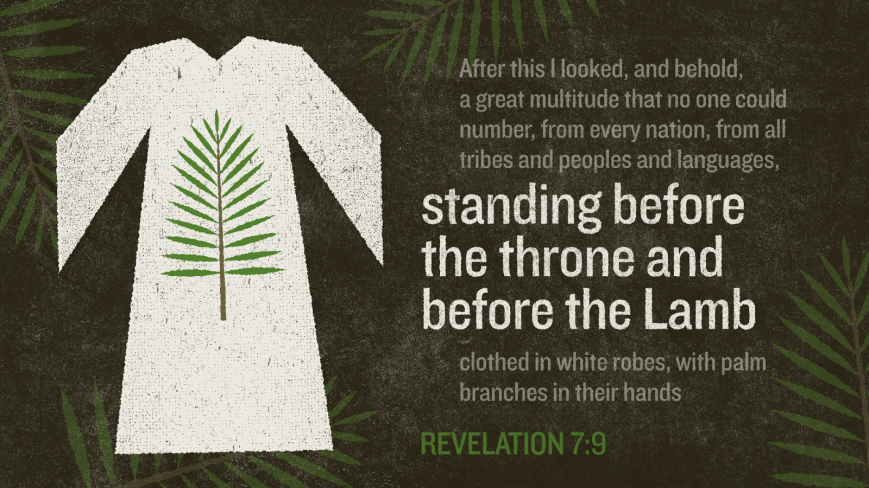
After this I looked, and there was a great multitude that no one could count, from every nation, from all tribes and peoples and languages, standing before the throne and before the Lamb, robed in white, with palm branches in their hands. They cried out in a loud voice, saying, “Salvation belongs to our God who is seated on the throne, and to the Lamb!” And all the angels stood around the throne and around the elders and the four living creatures, and they fell on their faces before the throne and worshiped God, singing, “Amen! Blessing and glory and wisdom and thanksgiving and honor and power and might be to our God forever and ever! Amen.” Then one of the elders addressed me, saying, “Who are these, robed in white, and where have they come from?” I said to him, “Sir, you are the one that knows.” Then he said to me, “These are they who have come out of the great ordeal; they have washed their robes and made them white in the blood of the Lamb. For this reason they are before the throne of God, and worship him day and night within his temple, and the one who is seated on the throne will shelter them. They will hunger no more, and thirst no more; the sun will not strike them, nor any scorching heat; for the Lamb at the center of the throne will be their shepherd, and he will guide them to springs of the water of life, and God will wipe away every tear from their eyes.”
agnus-dei-window-1024x768

The couple had recently celebrated their 60th wedding anniversary when they tragically died in a car crash. They were in relatively good health at the time, mainly due to the wife’s dedication to their diet and forcing them to both get exercise, but when the crash occurred they were immediately brought before St. Peter and the pearly gates.

After a quick check-in, much like the first minutes at a tropical resort, St. Peter volunteered to give them a tore of their heavenly abode. The mansion they would be calling home for eternity was filled with more rooms than they could count with a beautiful kitchen, swimming pool, and movie theater in the basement. As the wife squealed in delight with every passing accommodation, the husband grew skeptical and finally leaned over to Peter and asked, “So how much is this going to cost?”

Peter, flabbergasted, replied, “It’s free, this is Heaven.”

Later, they toured the endless golf course that started in their backyard. With perfect rolling hills that they could only have imagined on earth, they took in the beauty that was available whenever they wanted. The old man, again, asked Peter, “So what are the green fees?

Peter replied, “This is Heaven and you play for free.”

Finally Peter brought the couple to the clubhouse that was filled with people from their lives that they had loved and lost. The joyful reunions went on for some time until Peter motioned for the couple to go through the lavish buffet that had been prepared. The old man, still skeptical, quietly asked Peter how much the food would cost.

Peter, now growing frustrated, said, “Don’t you understand yet? This is Heaven, it’s all free!

The old man stood still and then asked, “Well where are the fat free and low cholesterol tables?”

Peter then began to lecture, “That’s the best part. You can eat as much as you like of whatever you like, and you never get fat or sick. This is Heaven!

Immediately the old man went off with a fit of anger, throwing down his hat and stomping out of the clubhouse.

Peter and the wife both tried to calm down the old man and asked what was wrong. The old man looked at his wife and said, “This is all your fault! If it wasn’t for your diet and exercise, I could have been here ten years ago!

What’s heaven like? I get asked this question on a pretty regular basis. I might be in my office with a grieving family who just lost someone they loved and someone will ask what the person is now “doing” in heaven. Or I’ll be here in the sanctuary teaching a lesson to the preschoolers when the subject of heaven comes up and one of them will say something like: My mommy told me that heaven is full of your favorite candy, and you can have as much of it as you want!

What’s heaven like? There are a decent number of times when scripture is descriptive about the beyond, but it is a far stretch from the jokes and movies many of have experienced on the subject. John caught a glimpse of the heavenly glory of God’s presence in a vision and described it like the grandest worship service to have ever occurred. Countless beings that have made it through the great tribulation surround the throne of the Lord where the Lamb is in the center. They sing with full voices and praise the Lord unceasingly for his majesty is beyond comprehension.

Rev 7v9

The problem with talking about heaven is that whatever we say, it is speculative at best. We can point to scripture where it is described, but the descriptions are made in such a way that heaven is beyond our comprehension. The whole point of heaven after all, is that it is totally other from earthly life. It is beyond life. It is glory and wisdom and thanksgiving and honor and power and might in a way that is impossible for us to understand during our earthly lives.

And even though we can only hint at what heaven might be like, it has become the pinnacle concern for many churches and Christians. What do I have to do to make it to heaven? Or what do we have to do in order to get other people to heaven? These questions dominate our thoughts and we grow anxious about whether or not we, and the people we love, will go on to our heavenly reward.

When talking about heaven, there is a strong temptation to make it so appealing with comparisons to earthly beauty that we neglect to think about the fact that we are called to exist here on earth until our deaths. But this text, this worshipful understanding of heaven, lets us know that God never promised we would not suffer. In fact the opposite is true. Suffering has always been part of our story, and even we here in the blessed region of Western civilization are not immune.

Only in death can we receive the gift of resurrection. It was only through Christ’s crucifixion that he could one day be raised again. The same holds true for us. Only when the bell tolls for us will we share in Christ’s victory over death.

And yet we still talk about it all the time. It is good and right for us to celebrate Christ’s resurrection, but when daydreams about our everlasting reward later prevent us from serving the needs of others right now it becomes cheap grace.

In many churches, like the ones most concerned about whether others are going to heaven or hell after they die seem less concerned with the hells on earth right now. Here in scripture John is confronted with the suffering of the great multitude before they arrive at the throne. They are granted a peace they did not have on earth: they will not hunger, nor thirst, the sun will not strike them, nor any scorching heat because the Lamb of God has shepherded them to the springs of life where God wipes away all tears. But before we can rejoice with the Lord in his divine kingdom, we will endure tribulations in our earthly lives.

Imagining that our lives will be free from suffering is what often leads people to leave the church when something goes wrong. I know too many people my age who were forbidden from attending funerals as children, and then when they finally attended a funeral for the first time when they were older they fell away from the church. I also know too many people who lived such perfect and sheltered lives that when they encountered true poverty for the first time they were overwhelmed by the brokenness of the world and have been unable to return to church.

The church is supposed to be the alternative to this overly rosy view of the world. We have the church to help us remember exactly what God has promised, and what God has not. The church is the place where we confront the hardships of life and rely on the people in the pews next to us to help us through the great tribulations we experience. We are not here to prance around pretending that we have perfect lives without suffering, but instead to proclaim that in trusting the Lord we will find the strength and courage to sustain us until that time when we will join Jesus in the victory over death.

The church is the means by which we combat the hells we experience on earth by attempting to give people hope and faith in something greater than earthly life can offer.

bigstock-Cross-against-the-sky-24690071-panorama

In this church, at St. John’s, we strive to help guide and nurture one another through a variety of means. We have bible studies for the young and the old to help us wrestle with how scripture can speak into our everyday experiences. We collect food and clothing and money for others who are desperately in need. We send people on mission trips to build and plant new foundations and relationships for people who really feel like they are living in hell right now.

But we also have a woman here in the church who has made it her calling to help nurture people in the midst of suffering in the best way she knows how. I believe that Dianne Wright is keeping Hallmark in business through the countless cards she sends out to the community. If you’ve been coming to this church for any regular period of time, and have had so much as a cold, you’ve probably received a card from Dianne Wright. They are always thoughtful, they are always written with purposeful words, and they are always filled with love.

I have the added benefit of not just receiving cards when I need them, but I visit enough of you and our shut-ins to know how prized these letters have become. I was visiting someone at King’s Daughters recently when I saw the familiar script sticking out of the cards adorned in a row on the window sill. The woman I visited described them as the most precious gift she had received since she went in to rehab.

Time and time again I will find myself visiting someone and the subject of Dianne’s cards will come up. They might appear to be a simple and casual gesture, but they speak volumes in the realm of how we are sustained by God’s grace through our neighbor Dianne.

As Christians, we are called to combat the countless hells on earth that plague people through our love and presence. For Dianne Wright, this has meant a ceaseless commitment to communicating through cards the love, depth, and peace of God.

Each of us, in some way shape or form, has gifts that we use to share God’s love with others. Perhaps we have the freedom to visit with people who can no longer visit us. Maybe we, like Dianne, have a penchant for penning letters. Perhaps we have been blessed with lucrative careers that allow us to give charitably to help others. Maybe God has molded us with a spirit of prayer and we can lift up the world through our clasped hands. Perhaps we have become familiar with a particular need in the world and all we need is a little nudge to start serving God by serving others. Maybe we have toyed with the idea of a calling to the ministry and we just need to take a step in faith that God can use us to spread the gospel. Perhaps we have the gift of carpentry like Jesus only we’ve been too nervous to ask someone we know if they need any repairs. Whatever our gift might be, God is calling us to use them to draw people into moments of heaven on earth.

When our time comes God will do with us what God wants. In God’s infinite wisdom and glory we will surround the throne and join in one voice with the saints who came before us, and with the saints who will come after us. We will be washed with the blood of the lamb and God will wipe away every tear from our eyes.

We know not when we will gather with the great multitude, but each day God gives us is a gift. A gift we should celebrate by being a gift for others. Amen.

Naked and Afraid

John 21.1-17

After these things Jesus showed himself again to the disciples by the Sea of Tiberias; and he showed himself in this way. Gathered there together were Simon Peter, Thomas called the Twin, Nathanael of Cana of Galilee, the sons of Zebedee, and two other of his disciples. Simon Peter said to them, “I am going fishing.” They said to him, “We will go with you.” They went out and got into the boat, but that night they caught nothing. Just after daybreak, Jesus stood on the beach; but the disciples did not know that it was Jesus. Jesus said to them, “Children, you have no fish, have you?” They answered him, “No.” He said to them, “Cast the net to the right side of the boat, and you will find some.” So they cast it, and now they were not able to haul it in because there were so many fish. That disciple whom Jesus loved said to Peter, “It is the Lord!” When Simon Peter heard that it was the Lord, he put on some clothes, for he was naked, and jumped into the sea. But the other disciples came in the boat, dragging the net full of fish, for they were not far from the land, only about a hundred yards off. When they had gone ashore, they saw a charcoal fire there, with fish on it, and bread. Jesus said to them, “Bring some of the fish that you have just caught.” So Simon Peter went aboard and hauled the net ashore, full of large fish, a hundred fifty-three of them; and though there were so many, the net was not torn. Jesus said to them, “Come and have breakfast.” Now not of the disciples dared to ask him, “Who are you?” because they knew it was the Lord. Jesus came and took the bread and gave it to them, and did the same with the fish. This was now the third time that Jesus appeared to the disciples after he was raised from the dead. When they had finished breakfast, Jesus said to Simon Peter, “Simon son of John, do you love me more than these?” He said to him, “Yes, Lord; you know that I love you.” Jesus said to him, “Feed my lambs.” A second time he said to him, “Simon son of John, do you love me?” He said to him, “Yes, Lord; you know that I love you.” Jesus said to him, “Tend my sheep.” He said to him the third time, “Simon son of John, do you love me?” Peter felt hurt because he said to him the third time, “Do you love me?” And he said to him, “Lord, you know everything; you know that I love you.” Jesus said to him, “Feed my sheep.”

do-you-love-me-pic


Jesus asks, “Do you love me?”

On the first Easter Sunday, Jesus rose from the dead. The angel at the tomb shared the Good News with the disciples and with the Marys, and later that day Jesus appeared in the room with the disciples. He commanded them to “Go” and spread the Good News to all the earth. But Thomas was not there. Thomas doubted his friends, and their stories about the risen Lord. So a week later Jesus appeared again before the disciples and offered his hands and his side to Thomas to prove the resurrection. He concluded the moment by saying: “Blessed are those who have not seen and yet have come to believe.”

After these incredible moments of resurrected existence, Jesus revealed himself to the disciples for a third time at the sea of Galilee when they returned to their former lives. What a fitting reading for the second Sunday after Easter. Just two weeks ago we were gathered in this sanctuary shouting “Hallelujah!” and praising the Lord for Jesus’ resurrection from the grave. We were living in the light of the resurrection, and boy was it bright! The scent of blooming lilies punctuated the air and invaded our nostrils. No matter what was happening in our lives, God bombarded us with the Good News, death defeated, and we left church feeling filled by the Spirit to be Christ’s hands and feet for the world.

And here we are two weeks later. The lilies are gone, the hallelujahs are still are our lips but they don’t have the same power, and the darkness of life has crept back in. Every year we experience Easter like a mountaintop, but at some point we have to travel back down to the valley of existence.

The disciples, after literally witnessing the resurrected Christ, decide to return to their old lives. Peter says to the boys, “I’m goin’ fishing!” and they reply, “We’re coming with you.”

Do you love me?

It seems strange from our vantage point that the disciples should return to their former occupations, even though Jesus told them to go and spread the news. It feels bizarre to hear about them going back to their boats and nets after their friend transformed the meaning of life and death. Yet, this is how people usually respond to an emotional overload. In the weeks after a baby is born, the new parents wonder about when they will be able to sleep again. After a wife loses her husband she wonders when it will be okay to laugh again. When something deeply and fundamentally transformative occurs, it is only natural to ponder about life before the change.

This story of a reunion by the sea is a reminder that there is no escape from the Lord. Wherever the disciples went, and wherever we go, Jesus is with us.

They were out all night fishing but didn’t catch a thing. Jesus stood on the beach watching the disciple row in to shore, but they did not recognize him. He commanded them to cast out their nets one more time and promised they would catch something. Three years earlier he had said the same thing to Peter and Andrew while they were fishing before they left everything to follow him.

They immediately caught so many fish that they were unable to haul in the net because it was so heavy. In that moment, as the pieces finally came together, Peter recognized who was standing on the shore, put on some clothes and jumped into the sea.

There are many details in this epilogue to John’s gospel: the mention of a charcoal fire draws us back to the charcoal fire around which Peter denied Jesus. The appearance of fish and bread to feed the disciples hunger propels us back to the time when Jesus fed the multitudes with bread and fish. Jesus even asks Peter three times, “Do you love me?” which connects with the three times he denied Jesus.

But this simple note that Peter was naked on the boat while catching fish, and decides to put his clothes on before swimming to Jesus, really stands out. It would have been easier to fish under the oppressive heat of the climate without the baggage of clothing, but instead of immediately jumping in (as he had done once before) Peter puts on clothes before he see the resurrected Lord for a third time.

Peter was naked and afraid. Not just physically naked without clothing, but maybe he was afraid of making himself completely vulnerable to Jesus. Perhaps he did not want to address the emotional denial of Jesus prior to his death. Maybe he didn’t want to admit his fallibility, or he did not want his life to be altered. But the resurrection changes everything.

Like we all do when we feel vulnerable, we put on the armor of denial and ignorance in order to protect ourselves from others. Afraid of the inevitable confrontation we sweep things under the rug and pretend that everything has gone back to normal. And then Jesus shows up with his question:

Do you love me?

Sure I do Jesus! I come to church nearly every Sunday, I listen to the pastor up in the pulpit, and I even try to sing the hymns in harmony.

Feed my lambs.

Do you love me?

Of course I do Jesus! I wear a cross around my neck, I always have my check written and ready for the offering, and I post pictures of prayers on Facebook for everyone to see.

Tend my sheep.

Do you love me?

Jesus, you’re making me a little uncomfortable… you know everything and you know that I love you. I’m a good person, I pay my taxes, I give a little money to charity, I try to pray before I eat my meals… what more could you want?

Feed my sheep.

Most of us have probably never faced a time like Peter did when he denied Jesus outright. We’ve never really had to suffer for our faith, and we’ve never really been afraid for following Jesus. But all of us have had moments where we denied him; we just might not realize it.

We might be in our car driving down the road, and perhaps we’re even listening to a Christian radio station, when we stop at a red light and we see someone standing in the median right next to us with a sign asking for money. Perhaps we reach out our hands to lock our doors, or we make judgments about how they got themselves into whatever trouble their in, and before we know it the light turns green and we are able to get on with our lives without being bothered by the panhandlers.

Jesus asks, “Do you love me?”

We might be having a cup of coffee with a friend and the topic of the recent Panama Papers comes up in conversation. We can feel our fists tightening as we complain about the ultra wealthy evading the taxes that all the rest of us have to pay. Perhaps we start drawing connections between the economically elite with criminals who prey on the weak and underprivileged and we wish someone would do something about it. But before too long the conversation moves on to another topic and we finally feel the tension start to slip away as we talk about something else.

Jesus asks, “Do you love me?”

We might be having dinner with our family when someone goes on a tirade about a particular political party. We keep our mouths shut because we’ve heard them go off like this but we can’t help but shake our heads in disappointment over their opinion. How could someone be so backward in their thinking? If they believe their candidate can fix all of our problems, then they are going to be sorely mistaken…

Jesus asks, “Do you love me?”

The conclusion to John’s gospel is like epilogue in its willingness to address many of the elements that made Jesus’ ministry what it was. As we read it, as we smell the fish cooking on the open fire, and we try to dry ourselves off after swimming in the sea, and as we listen to Jesus’ questions it reminds us of darkness.

do-you-love-me

Through this text we are forced to confront the darkness of our hunger for meaning in our lives, or our failure to recognize Jesus in our midst, or the fact that we have denied him by denying others. But at the same time, this story reminds us that none of the darkness has overcome the light. Christ still died for us while we were yet sinners. God still sent his Son into this broken world to start putting the pieces back together. The Holy Spirit still moves among us and calls us to love one another even when it feels impossible.

Christianity, at its best, is not about what we think or feel about Jesus – it’s about what Jesus does to us. Not a technique for how we can use him to accomplish our goals, but rather his plans for using people like us to transform the world by feeding and tending to the sheep.

Here we are, just like the disciples, a few weeks on the other side of Easter. For many of us, the normalcy of life has returned. The darkness of the cross has crept back into our daily lives. We turn on the television and we want to know why we live in such a broken world. We confront people who drive us crazy. We grow tired of the seemingly endless race for the White House. We clench our fits with frustration over our lack of control. We worry about our bank accounts, and our children, and our futures.

            And then Jesus has the nerve to show up in our lives and ask, “Do you love me?”

If we love Jesus, then we have to start loving one another. Which means that we have to feed Jesus’ sheep by encountering the person on the side of the road asking for money. And not by just addressing their financial situation, but also by treating them with worth and respect. It means that we have to tend to Jesus sheep by helping those trapped by the power of greed to see how their greed affects all of God’s creation. It means that we have to feed Jesus’ sheep when they argue and bicker about politics by listening and loving rather than ignoring and judging.

It is here at the lakeshore of life, that we discover what a strange Messiah we follow. A man who came and was hung on a cross only to forgive his murders; a man who went back to the friends who betrayed him, and ate breakfast with them by the sea; a man who got killed for calling people to serve the last, least, and the lost; a man who expects us to love him by loving others. Amen.

With A Little Help From My Friends

John 20.19-29

When it was evening on that day, the first day of the week, and the doors of the house where the disciples had met were locked for fear of the Jews, Jesus came and stood among them and said, “Peace be with you.” After he said this, he showed them his hands and his side. Then the disciples rejoiced when they saw the Lord. Jesus said to them again, “Peace be with you. As the Father has sent me, so I send you.” When he had said this, he breathed on them and said to them, “Receive the Holy Spirit. If you forgive the sins of any, they are forgiven them; if you retain the sins of any, they are retained.” But Thomas (who was called the Twin), one of the twelve, was not with them when Jesus came. So the other disciples told him, “We have seen the Lord.” But he said to them, “Unless I see the mark of the nails in his hands, and put my finger in the mark of the nails and my hand in his said, I will not believe.” A week later his disciples were again in the house, and Thomas was with them. Although the doors were shut, Jesus came and stood among them and said, “Peace be with you.” Then he said to Thomas, “Put your finger here and see my hands. Reach out your hand and put it in my side. Do not doubt but believe.” Thomas answered him, “My Lord and my God!” Jesus said to him, “Have you believed because you have seen me? Blessed are those who have not seen and yet have come to believe.”

img_1433


Before I became your pastor, I was a pulpit-filler. If a pastor became sick, or was otherwise unavailable to preach, I was tapped on to come up with something to say from the pulpit. A phone call would arrive in the middle of a week, or even on Sunday morning, and I would have to whip something together right quick. For years I took the ”undesirable” Sundays: Memorial Day, Labor Day, Thanksgiving Sunday, and the Sunday after Easter; those Sundays when the regular pastor needed a break.

Every time I was tasked with preaching was an opportunity to grow in my faith while attempting to articular the faith for others.

When I was in college I got the phone call one week to preach for a Sunday evening service. I was fairly familiar with the context because I played the drums for the church every week, but this time they wanted me to come out from behind the drum set to proclaim God’s Word.

At the time I was living with a couple of roommates, but of course none of them went to church. Week after week they would rib me for waking up early on Sunday morning, they would jokingly mock me with questions about God’s presence, and they made sure I knew they thought there were better things I could be doing with my time.

So I thought this would be the perfect opportunity to get them to church.

It was on a Sunday night, so they couldn’t complain about sleeping in. We would be playing contemporary Christian rock songs, so they couldn’t complain about the music. And I was supposed to preach, so they couldn’t complain about it being archaic or a waste of time (I hoped).

I casually invited them to worship while we were having dinner one night; I shared that I was the preacher and that it would be a relatively short sermon, and I made sure to mention that it would really mean a lot to me if they would come.

Under the weight of my communal invitation and guilt, they all came to church that night and sat together in a pew near the back.

The service went well; the music balance was good, and the sermon was short and to the point, and then we moved to the communion table. Our resident pastor began talking about how whenever Jesus gathered with his friends he would breathe new life into them through his words and his presence. And on his final night he took bread, broke it, gave it to his friends and said, “Take. Eat. This is my body.” And then he took the cup and shared it with his friends saying: “Take. Drink. This is my blood.

One by one every person in the sanctuary gathered in the center aisle and started walking forward for communion. The pastor stood next to me holding the bread, and I stood next to her holding the cup and for each person that came forward we said, “The body of Christ given for you.” Or: “The blood of Christ shed for you.” Hands were outstretched penitently while people feasted on the Lord, and then the end of the line came forward, with my roommates.

Unsure of what was actually taking place, they stood up like everybody else and came forward without knowing what to do next. As they stood in front of us, and in front of the whole congregation, the pastor’s eyes darted back and forth between myself, and the ragtag roommates standing in front of us. Her eyes screamed, “Do something!”

So I did what anyone in my position would do. I whispered to my friends as quickly as possible: “I know this will sound weird… But you need to take a piece of bread, dip it in the grape juice, and eat it. Don’t worry I’ll explain it to you later.” And with that they all feasted on the body and blood of our Lord, and returned to their pews confused and bewildered.

On the day of Jesus’ resurrection, after appearing to Mary Magdalene and calling her by name, Jesus appeared before the disciples. They were locked away in a room full of fear and trembling when Jesus said, “Peace be with you.” Perhaps they were afraid of being crucified like he was by the Jews, or they were afraid of how the crowds would taunt them when they came out of hiding, or they were afraid of seeing their risen friend in their midst. But Jesus found it fitting to speak words of peace in the midst of their terror.

And immediately Jesus outlined what they were supposed to do: “Go. As the Father sent me, now I send you.” With his proclamation, Jesus empowered his friends to proclaim the Good News for everyone to hear.

But Thomas, one of the disciples, was not there to experience the resurrected Jesus. The disciples tried to explain what they had seen, heard, felt, and experienced. Yet, their eyes and fingers were not enough for Thomas. He did not trust his friends. He wanted to see and touch Jesus for himself.

09b

Sure enough, a week passed, and Jesus showed up again before the disciples and Thomas. Again Jesus greeted them by saying, “Peace be with you.” And he told Thomas to feel the scars on his hands and side, but before Thomas could even reach out he declared, “My Lord and my God!” And thus Jesus concluded the moment by saying, “Have you believed because you have seen me? Blessed are those who have not seen and yet have come to believe.

Thomas gets a pretty bad rap. Every year we follow Easter Sunday with this reading about doubting Thomas. He is the one disciple who gets a qualifier in front of his name. We don’t refer to eager Peter, or betraying Judas, but we do say doubting Thomas. For years pastors like me have used this Sunday and this story to call people like you to learn from the example of Thomas, to not doubt the Lord, to believe without seeing.

But the real problem with Thomas is not his lack of faith in the Lord, but his lack of faith in his friends. For three years he had traveled with this ragtag group of disciples, shoulder-to-shoulder they had watching Jesus perform countless miracles, and now when they tell him the Gospel, he does not believe them.

After the episode of my friends confusedly attending worship and receiving communion, I avoided the topic of church. I knew they had a strange experience through their lack of addressing the service in any way shape or form, and they stopped mocking me for going to church. At the time, I thought they thought I was nuts.

A few weeks passed and the topic of faith was still avoided like the plague until one morning I walked down the stairs and discovered one of my roommates crying on the couch. He had just received a phone call from a long time friend of ours whose father had died. The man was a staple in our community, regularly coached little league sports, and was another father figure for most of us. And when my roommate received the news, it devastated him.

I slowly made my way across the room and sat down next to him. For the longest time neither of us spoke. Finally my roommate looked up from his tears and he said, “I want you to pray for me.

I sat shocked. I didn’t know what to say. But he continued: “You know I don’t know much about God or church. But I know it’s important to you. When you were standing up before us in church I could tell that you really believed. I don’t know what I believe. And I can’t describe it, but I really feel like you need to pray for me.”

So I did.

When Thomas heard the news of the risen Lord through his friends, he didn’t believe them. Even though they were some of the people he should’ve trusted the most, he refused to accept their words.

When my friend felt the sting of death and loss, he didn’t know what to believe. But, for better or worse, he trusted me. Even though he had every reason to be suspicious and weirded out by what he had experienced in worship, he believed in God’s presence through prayer.

Thomas’ kind of radical suspicion of his friends still takes place in our lives today. We view church as a private thing, something we do on the weekends and don’t need to bring up during the week. We might know people in our lives that are suffering or are alone, but we assume that God will send them to us when they’re ready.

SnapshotImage

If we want to be faithful followers of Jesus, then me must stop distrusting our friends and neighbors. At the very least, we should stop questioning motives or thinking the worst in others when they express a difference of opinion.

To be faithful followers of Jesus requires a willingness to be sent by God to people who do not know God. It requires us to be vulnerable and uncomfortable while inviting others to discover God’s love in a place like this. It requires us to be the agents of belief for people who have not yet seen.

All of us are here because we are the product of someone influencing our faithfulness. Whether a parent or a friend or even a stranger, we were once invited to discover God through the power of church.

Friends, I promise you that the days of people showing up to church because a church is in their neighborhood are long gone. Today, people discover God’s presence, they begin to believe what they see and see what they believe when people like us are brave enough to invite them to church.

Because, for us, this table is the closest we can get to the presence of Christ. In the bread and the cup God invites us into the upper room when Christ shared the meal with his friends. When we feast on his body and blood we receive the grace necessary to be Christ’s body in the world.

This thing we call communion, whether at the table or just gathering in worship, has transformed my life. If you’re here in church, it’s probably changed your life too. So, may the God of grace and glory give us the courage to invite others to be transformed as well. Amen.

Earthquake! – Easter Sermon

Matthew 28.1-10

After the Sabbath, as the first day of the week was dawning, Mary Magdalene and the other Mary went to see the tomb. And suddenly there was a great earthquake; for an angel of the Lord, descending from heaven, came and rolled back the stone and sat on it. His appearance was like lightning, and his clothing white as snow. For fear of him the guards shook and became like dead men. But the angel said to the women, “Do not be afraid; I know that you are looking for Jesus who was crucified. He is not here; for he has been raised, as he said. Come, see the place where he lay. Then go quickly and tell his disciples, ‘He has been raised from the dead, and indeed he is going ahead of you to Galilee; there you will see him.’ This is my message for you.” So they left the tomb quickly with fear and great joy, and ran to tell his disciples. Suddenly Jesus met them and said, “Greetings!” And they came to him, took hold of his feet, and worshiped him. Then Jesus said to them, “Do not be afraid; go and tell my brothers to go to Galilee; there they will see me.”

lightburst-easter-still-600x338


It was dark but I felt invincible. I was seventeen years old, with a fresh driver’s license in my wallet, and we were driving to the church in the middle of the night on Easter Eve. My friend, Will, and I had come up with a plan on how to make this particular Easter one that no one would ever forget. We were young and dumb.

For as long as I could remember, the church always set up a tomb on the front lawn of the church during holy week. It was the size of a small shed and it stood out like an oppressive eye sore to remind everyone what Easter was really about. From Good Friday through Saturday, volunteers would stand guard by the tomb wearing Roman centurion costumes and would try to look stern while also waving at people that drove by. It was the church’s attempt to reexamine the greatest moment in the history of the world, but after years of seeing the same men stand by the same tomb, it had lost its impact.

On Easter Sunday, someone was always tasked with getting over to the church before anyone else to roll back the stone on the front of the tomb. That way, while people were scrambling to find parking spots before the service started, they could remember how the stone was rolled away when the women and first disciples discovered Jesus’ resurrection on the first Easter.

But for Will and I, it was time to up the stakes and make it an Easter worth celebrating. We were tired of the same resurrection stories, we were tired of people entering and leaving much the same on Sunday, and we were tired of the familiarity that had become Easter.

So we snuck out in the middle of the night, much to the later frustration of our parents, and we drove over to the church. Under the cover of darkness we rolled back the stone that covered the entrance to the tomb, and we carried it across the church lawn to the main sanctuary entrance. There is a slanted roof above the main doors that everyone can see, and we decided it was the perfect place for the stone. Of course, we hadn’t planned on how difficult it would be to lift the wood framed faux stone that was as tall as us on to the roof, so we had to back my car up under the gutters and toss the stone up onto the shingles.

It was perfect, and I can still remember how quickly we peeled out of the parking lot with proud looks on our faces. We were going to recapture the power of Easter for our church.

Much like Christmas Eve, I couldn’t sleep. I was so excited to see the faces of all the people in worship when they noticed the stone on the roof, I couldn’t wait to hear our pastor make a comment about God’s cosmic power to roll back stones, even onto the church roof, during his sermon, but mostly I was excited to see people excited.

I arrived with my family in our perfectly coordinated outfits with a lot of expectation. I could not keep back a permanent grin on my face the whole way to the church, and when we got to the parking lot I couldn’t believe what I saw.

Nothing.

Sure enough the stone was still on the roof of the entrance, it was in clear sight for everyone to see, but not a single person had noticed it. They were all walking in and talking like it was like every other Sunday.

Even worse, during the time before the service started, I moved around the sanctuary to eavesdrop on all the conversations and not a single person mentioned the miracle on the roof. I don’t remember a word for the sermon that year because I sat disappointed in my pew with my arms across my chest.

The joy of my expectation had been replaced with frustration at the lack of reaction from the congregation.

When the service ended, my family got in line with everyone else to shake the pastor’s hand. We slowly made our way forward until I lazily offered my hand and the pastor grabbed it and pulled me close.

He said, “I was praying in the sanctuary this morning, and I heard God speak to me.”

“Oh, really?” I said dismissively.

“Oh yes, and he told me to tell you that whoever put the stone on the roof better have it back down by tomorrow morning. Happy Easter!”

Have we become so content with Easter that it no longer shakes us? Are we so entitled that we have accepted the gift of eternal life without recognizing how transformative it is? Does Easter still shock us the way that it should?

The women got up early and made their way to the tomb. They were expecting it to contain Jesus’ dead body, they were still grieving over the death of their friend, but they knew what they had to do. And suddenly there was a great earthquake! An angel of the Lord descended from heaven and rolled back the stone and sat on it. His appearance was frightening and he scared the Roman guards to such a degree that they became like dead men.

But then the angel said to the women, “Do not be afraid! I know you’re looking for Jesus, but he has been raised! Go tell his disciples the good news.” So the women made haste with great fear and joy to share the gospel and suddenly Jesus met them on the road and said, “Greetings!” The women ran to Jesus and knelt to worship at his feet, but he said, “Don’t be afraid; go and tell my brothers to go to Galilee; there they will see me.”

resurrection-Easter-edit[1]

This is shocking stuff. Jesus, dead on the cross, was placed in a grave, and three days later he rose. An angel appeared with an earthquake to roll back the stone at the tomb and proclaim God’s love through the resurrection of his Son. And at the end, the women respond in fear, joy, and worship.

Easter is an earthquake the shook the entire world, and more than that, it shook time itself. No more would God’s created beings be limited to the confines of earthly life, no more would the grace of God be limited to a particular time and place, no more would death have a sting.

This great gift of resurrection, the gift of Easter, shakes the very foundations of existence.

But does it still shake us?

We like Easter to be easy on the senses and on our consciences. Many of us like to dress up in our best clothes, and wear the right colors, and have an Easter egg hunt. Some of us are like the church of my youth who experienced Easter like any other holiday. Others are like the first disciples who were ready to get back to their lives after their Lord died, but then he showed up on Sunday and shook the world.

On Friday I came to church at about noon to take up our sanctuary cross and drag it through Staunton. This has been my holy week tradition since becoming a pastor and it always yields interesting results. The first year I carried the cross I was largely ignored; no one spoke to me or even acknowledged my presence. Last year was totally the opposite, people honked at me and waved their hands; I even had a few people yell curse words toward my direction.

This year however, I was met with reverence and ignorance. During the first hour or so I lost track of how many people rolled down their windows to shout “Amen!” or “God Bless!” When I walked up and down Beverley Street many people placed their hands into the posture of prayer, or bowed their heads, and even some people made the sign of the cross across their body. It was powerful for me to experience how much the cross was interrupting their lives. I witnessed God’s power made manifest in the cross on my shoulder as it met people and reminded them how far God was willing to go to transform the world.

But as I was getting ready to turn and start heading back, I saw a young family standing on a corner and I figured that I should keep walking. The husband and wife were cautiously sipping on their to-go coffees while their 8-year-old son was jumping to avoid cracks in the sidewalk. As I got closer they all started to notice the strange man carrying a cross on his shoulder, and they remained silent as I passed by.

I was only a few feet away when I heard the son exclaim: “Mom! That guy is carrying a giant ‘X’!”

“No honey,” The mother said, “That’s a cross.”

While I continued up the hill I couldn’t help but laugh at the episode I had just experienced. But then my laughter turned to sorrow, for I realized that young boy had no idea what Christ did for him. He had no knowledge of Christ’s magnificent sacrifice on the cross to open up the gates of heaven. He had no understanding of the earth-quaking good news of Easter.

Every year Easter interrupts ous sensibilities and behaviors. On this day we feel the earth shake beneath out feet because God has conquered death. We are jostled to and fro by the empty tomb because it radically reshapes the way we live.

The resurrection is about power and grace. In it we see how God took something like the cross, a sign of death to the world, and made it into the means of celebration. On Easter, God transformed the tomb in the same way that he did on Christmas in a virgin’ womb; God made a way where they was no way. On Easter, God changed the world.

So come and taste the goodness of God in the bread and the cup. Listen for salvation in our songs and prayers. Witness the power of resurrection in the people in the pews next to you. Hear the Good News, the best news. Hear it and let is shake your lives. He lives! Hallelujah!

Abstract-Art-Painting-Paul-Bennett-After-Night

Why The Cross? – Good Friday Homily

John 19.28-30

After this, when Jesus knew that all was now finished, he said (in order to fulfill the scripture), “I am thirsty.” A jar full of sour wine was standing there. So they put a sponge full of the wine on a branch of hyssop and held it to his mouth. When Jesus had received the wine, he said, “It is finished.” Then he bowed his head and gave up his spirit.


ethereal-finished-still-p3

I get asked a lot of questions. I’ll be in a bible study when the conversation moves to an area of confusion and all eyes will turn to me and someone will inevitably say, “What does this mean?” Or I’ll be in my office and someone will walk in to share about all of the trials and tribulations they’ve experienced and finish by asking, “So where is God in all of this?” Or, like after the atrocity in Brussels this week, I’ll receive an email that says, “How could God let this happen?” People are looking for answers.

On Wednesday morning I gathered all the little preschoolers into the sanctuary to talk about the cross. I wanted to show them the cross we have here in the sanctuary and eventually have them march outside in a line while I carried the cross. For most of them, Easter is about the bunny and the candy so anything I can do to make it more about Jesus is important.

They were all sitting nice and quiet in the pews as I explained Jesus’ final week, and that he died on a cross to help us get to heaven, and most of the kids nodded along. But one sat in the back pew with her eyebrows in an expression of “huh?” I tried to keep moving us forward but I could tell it wasn’t connecting with her so when I saw her shoot her hand up with a question I wasn’t surprised.

She asked, “But why did he have to die on a cross?”

In the moment I tried to answer her question in a way that only a four year old could understand, but the question has stayed with me nonetheless. Why did Jesus have to die on a cross?

Well, he had to die on a cross because that’s the way the Romans executed those who they regarded as a threat. Today we have drones and missiles that we can fire from far away in order to remove ourselves from death, but during the time of Jesus, they were hung high in the air so that all could see what happened when you challenged Rome. The cross was a sign of death and fear.

But that answer is not good enough for those, few, of us who gather in a place like this on Good Friday. If you’re here right now, you get that discipleship is more than just Easter. You get that Jesus was more than just a nice guy. You get that there is something more to this cross than symbolic remembrance.

Jesus died on a cross to reveal the heart of God.

The cross is where God’s grace crosses our life to create a new way of living.

We’ve got crosses everywhere and sometimes we forget how terrifying they were and should be. It is our central icon and we have them displayed in our sanctuary, some of us have crosses around our necks, and some of us even have them tattooed on our bodies. But notice: our crosses are empty. It would disrupt our Protestant sensibilities to have a murdered and graphic Jesus hanging on the cross for everyone to see. We would rather have the clean empty cross to remind us of the resurrection. But if we lose sight of the fright and discomfort of the crucifixion, the empty grave becomes cheap grace.

So, to be here on Good Friday implies a willingness on our part to confront the cross and we also want it explained. We want to know ‘why.’

But Jesus doesn’t offer us an explanation.

Whenever the religious elite, or the crowds, or his disciples questioned him, he would respond in cryptic parables that left them more confused than in the beginning. Jesus doesn’t offer simple explanations. Instead he offers love.

Explanations will never calm our anxieties in regard to suffering and tragedy. The people who try to explain the death of a young child by saying that “God wanted another angel in heaven” transform God into a murderer for the sake of an explanation. The people who try to explain a disabled child as “God’s way of punishing the mistakes of the parents” make God in a torturer for the sake of explanation. The people who try to rationalize terrorist attacks with “God is using them to show us its time to go to war” morph God into a selfish, violent, and manipulative entity for the sake of explanation.

Love, not explanation, is required when we are faced with tragedies. Instead of telling a grieving mother that God wanted her baby, we are supposed to show up with love and not answers. Instead of blaming sinful or faithless behavior for the disabilities in a child, we are supposed to love them with every fiber of our being. Instead of dropping bombs and sending drones to wipe out the Middle East we are supposed to see them as our brothers and sisters.

To be Christian is to enter into suffering. We do not look away from tragedies, we do not abandon those who are alone, and we do not isolate ourselves from the ways of the world. Instead, because of the cross, we are tasked with showing up for others when there is literally nothing we can do to save ourselves from suffering.

So, we could take the time to outline the connections between Jesus hanging on a tree with the first sin of Adam and Eve taking fruit from the tree of knowledge of good and evil. We could go deep into rationalizing the cross through theories like God used Jesus as bait to hook the devil from hell. But the truest response to the cross, the way we are called to go forth from Good Friday, is to look at the cross and take up our own to follow Jesus. Amen.

12042644_10205705206780417_2916230849357888646_n

Why Remember? – Maundy Thursday Homily

Mark 14.22-25

While they were eating, he took a loaf of bread, and after blessing it he broke it, gave it to them, and said, “Take; this is my body.” Then he took a cup, and after giving thanks he gave it to them, and all of them drank from it. He said to them, “This is my blood of the covenant, which is poured out for many. Truly I tell you, I will never again drink of the fruit of the vine until that day when I drink it new in the kingdom of God.”

Maundy-Thursday1

Why is this night different from all other nights?; A worthy question for any of us who took the time to gather in this place to remember Jesus’ final night. But the question is also asked of Jewish children who gather together for the celebration of Passover. Why is this night different from all other nights?

In the beginning God created the heavens and the earth. God brought forth all forms of life, which culminated in the creation of humankind. God made a covenant with Abraham to be his God, and for his descendants to be more numerous than the stars in the sky. Abraham eventually fathered Isaac who grew to father Jacob. Jacob wrestled with an angel of the Lord on the banks of the Jabbok river and was renamed Israel, which means: “you have struggled with God and prevailed.” Israel fathered Joseph who was sold into slavery in Egypt by his other brothers. But during his time in Egypt he became prosperous and eventually brought the gathering of Abraham descendants to live in the new and strange place.

At first everything was great in Egypt, the Hebrews lived comfortably, they had food to eat, homes to live in, and opportunities abounded. But over time, as it happens, the Egyptians grew jealous of the Hebrews and began to subjugate them. They were forced into labor, and eventually every male child born to a Hebrew woman was killed for fear that they would grow to rebel against the Egyptians.

Moses was born during this time and was saved by his mother by placing him in a basket to float down the Nile River. Moses grew in strength and wisdom and was called by God to lead God’s people out of captivity in Egypt to the Promised Land.

God commanded Moses to have the people to slaughter lambs and use the blood to mark their doors; this was to be a sign for the Lord to pass over their homes while slaughtering the firstborn males of Egypt. While waiting in the night, God implored the people to gird their loins and prepare to depart because their time of delivery had come near.

Passover is a night different from all other nights because it is a time set aside to remember the sacred and holy moment when God delivered God’s people out of slavery.

Jesus had gathered in the upper room with his friends to celebrate Passover. They sat around the table to remember what God had done long ago and be thankful. While they were eating Jesus took a loaf of bread, and after blessing it he broke it, gave it to them, and said, “Take; this is my body.” Then he took a cup, and after giving thanks he gave it to them, and all of them drank from it. He said to them, “This is my blood of the covenant, which is poured out for many.”

While they were remembering God’s actions from the past, Jesus said, “I am doing a new thing. I am delivering my body and my blood for you and the world.”

He took the Passover celebration, and assigned it to the great sacrifice he was about to make. Not only would the meal be a remembrance of God’s mighty acts, but also a testimony to God’s actions in Jesus Christ. The disciples would remember God delivering the people out of bondage in Egypt, and would now remember Jesus delivering the people out of bondage to sin and death. Whereas God brought the people into the holy land through the waters, God was now about to bring the people into resurrection through Christ’s sacrifice.

bread-and-wine

This is Good News for us, but it is also heavy news. Many of us buckle under the weight of knowing that Christ would give his life for us, but then we remember that Peter and Judas were at the table that night as well. We remember that in short time, the disciples who received the bread and cup would abandon Jesus to his cross and death. But he gave his life for them and us anyway.

So here we are, millennia later, remembering Jesus’ give of body and blood in the bread and cup. We remember God’s mighty acts of deliverance for the Hebrew people. But God’s power is not limited to the distant past. It is made available to each of us here and now.

At our tables, we are going to remember what God has done for us before we feast. With the people next to you I want you to discuss the following questions: What has God done for you? How have you seen God at work in your life recently? And what has God delivered you from?


I have seen God at work with our youth. Each week the youth of our church gather for an hour to share communion, fellowship, and bible study. We have examined some of the great moments from both the Old and New Testaments, we have learned about one another’s lives, and we always take time to remember Jesus’ final night with his disciples. Over the last year I have seen the youth transformed by the grace of God. Whereas they began meeting sheepishly and nervous to share about their lives, we now know each other well enough to check in on everyone without have to be prompted. Whereas they might have giggled during the first time we celebrated communion, they now respectfully and faithfully outstretch their hands to receive the bread and the cup.

Through the work of this church, God has delivered our youth from lives of selfishness to lives of appreciation. They have been delivered out of isolation into a community that genuinely cares about their well-being. They have experienced God’s love and it will stay with them forever.

Whenever we gather at God’s table, and particularly on Maundy Thursday, it is a time for us to confess where we have fallen short, recognize our forgiveness, share peace with one another, and give thanks to God for our deliverance. We remember where God has showed up in our lives, and the lives of others, because it retunes us into God’s frequency. We remember Jesus sharing the bread and the cup because he has shared it with the world. We remember in order to transform the world. Amen.

The Final Week

Mark 11.7-10

Then they brought the colt to Jesus and threw their cloaks on it; and he sat on it. Many people spread their cloaks on the road, and others spread leafy branches that they had cut in the fields. Then those who went ahead and those who followed were shouting, “Hosanna! Blessed is the one who comes in the name of the Lord! Blessed is the coming kingdom of our ancestor David! Hosanna in the highest heaven!”

holy-week

It was early in the morning when Jesus sent two of his disciples to a village atop the Mount of Olives to find a donkey. The day had come for Jesus to enter the holy city of Jerusalem during Passover, a time when the city’s population would balloon up to 200,000 people entering to celebrate. On a Sunday morning, while the crowds gathered with palm branches, Jesus entered Jerusalem. Five days later he would be killed on a cross. This is what happened during the final week.

The two disciples procured a donkey and Jesus prepared to make his triumphal entry. Riding on a donkey was a richly symbolic act, one that can be traced back to the time of David. To arrive in the holy city on a donkey calls back to the prophet Zechariah who declared, “Rejoice greatly, O daughter Zion! Shout aloud, O daughter Jerusalem! Lo, your king comes to you; triumphant and victorious is he, humble and riding on a donkey.”

As he rode toward Jerusalem, droves of people arrived on the streets and they began to waves palm branches while he passed. They were so enraptured by Jesus that they took off their cloaks and placed them on the road with their palms in order to create a royal pathway for their king. They shouted things like “Blessed is he who comes in the name of the Lord!” and “Hosanna!” which means “Save us!

At the same time, on the other side of the city, Pontius Pilate (the Roman Governor of Judea) entered Jerusalem with at least 1,000 soldiers to demonstrate the power of Rome during the Jewish celebration of the Passover. It was a show of force to prevent the people from revolting against their imperial rulers while they remembered that time when God had delivered them from captivity in Egypt.

But with Jesus, there was no show of force. Instead of armor and swords, the people took off their cloaks and waved palm branches. Instead of cowering away in fear they rejoiced in the humble man on the back of a donkey.

Palm_frond

While the distance between the Lord and the city grew closer and closer, while the crowds were dancing and shouting, he began to cry. He looked out over the holy city and he wept for Jerusalem. He wept knowing that he was entering as the prince of peace, and within the next few days the very people who were begging for his salvation with their palm branches would reject him and call for his crucifixion.

And there was evening and there was morning, the first day.

On Monday, Jesus made his way to them Temple with countless other Jews. With the episode that had transpired the day before, all eyes were on the humble man with expectation of deliverance. As his feet walked over hallowed ground, Jesus encountered the moneylenders and changers who were taking advantage of all the Jews in Jerusalem. The prices for clean animals necessary for sacrificial rituals were vastly inflated to the benefit of the merchants and the religious elite.

Jesus, who had spent the better part of three years berating the elite for taking advantage of the poor and outcasts, Jesus, who had told the rich young ruler to sell everything he had and give it to the poor, became incensed when he saw the poor being ripped off in the name of God. He walked straight over to the tables and he lifted them off the ground and disrupted everything in the temple. He threw the merchants out of the Temple and declared that his Father’s house had been turned into a den of robbers.

The elite and powerful, who had heard about this mysterious man claiming to be the Son of Man, now had their attention on Jesus. It was one thing to have a crowd with palm branches welcoming him into the city, but to disrupt the economic scheme they had established was going too far. From this point forward, the tides began to turn against Jesus. The leaders started looking for a way to discredit him, or to remove him completely. For as long as Jesus stayed in Jerusalem, their power would be in question, and they would no longer make the money they had planned on.

  And there was evening and there was morning, the second day.

On Tuesday, Jesus once again entered the Temple and he began to teach. If people were excited to see him after his entry in Jerusalem, they were now even more eager to listen to the one who had throne the merchants out of the sacred space. The Pharisees and religious leaders began to interrupt his teaching and demanded to know whom he thought he was to speak with such authority. Jesus, the one who shared parables with his disciples and followers, used parables to respond to their accusations. Over and over again he used examples to show how the powerful and lost sight of their responsibility to take care of God’s creation and he labeled them “hypocrites.

He accused them of neglecting to practice what they preached, he called them “snakes” and a “brood of vipers” and he told them they had failed to do the one thing required of them which was to love the Lord their God with all their heart, soul, mind, and strength and to love their neighbors as themselves.

Jesus had a following, he had entered with a display of peace, but he had removed the leaders’ economic disparity, and now he had called them hypocrites. They tried to trap him in his words, but he continued to point to the love of God in all times and in all places.

And there was evening and there was morning, the third day.

On Wednesday Jesus left the arena of the Temple and continued his teaching on the Mount of Olives. Some of the disciples made comments about the beauty and the magnificence of the Temple and Jesus responded by foretelling the destruction of the temple and his own body. He revealed images of God’s cosmic plan for the world made manifest in Jerusalem and called for his disciples to stay vigilant no matter what.

He used parables to describe the call of his disciples and ended by saying that his followers would be blessed in the end if they had fed the hungry, gave water to the thirsty, welcomed the stranger, clothed the naked, cared for the sick, and visited the prisoner.

Word about Jesus continued to spread fast throughout Jerusalem and the leaders learned that he was now prophesying the end of their rule and the destruction of the temple. Gone was the joy the people felt on Palm Sunday. Fear was present with the leaders and the elite.

  And there was evening and there was morning, the fourth day.

On Thursday Jesus continued to teach and gathered with his twelve disciples in the upper room for the Passover celebration. Around the table they remembered God’s great work in the delivery of the Hebrew people out of slavery in Egypt to the Holy Land; they remembered God’s actions in the lives of God’s people including themselves. But before the supper was over, Jesus did something radical. He took a loaf of bread, gave thanks to God, broke it, gave it to his friends and said, “This is my body, and I’m giving it for you.” Later, he took the cup, gave thanks to God, passed it to his friends and said, “This is my blood, and I’m pouring it out for you and for the world.” Even though he knew that in short time his disciple Judas would betray him he still shared this incredible meal and gift with his friend.

Later that evening, they arrived in the Garden of Gethsemane, and Jesus urged his disciples to keep awake while he prayed. He knelt on the ground and he communed with his Father and prayed about what was about to happen. But he ended the prayer by saying, “Lord, with you all things are possible; remove this cup from me; yet, not what I want, but what you want.” In essence he prayed, “Let thy will be done.

When Jesus finished praying, Judas arrived with soldiers. They grabbed and arrested Jesus. The disciples fled into the distance. Jesus was dragged back into the city to be tried for blasphemy.

And there was evening and there was morning, the fifth day.

On Friday Jesus was brought to the Roman leader Pontius Pilate. The leaders demanded that he be crucified and executed, but Pilate could find no fault with Jesus. He then brought Jesus before the Jewish people and they chanted with loud and bellowing voices, “Crucify him!” The same people who had gathered on the road with palm branches yelling “Save us!” were now demanding Jesus’ death. In order to appease the crowds and the Jewish leaders, Pilate sentenced Jesus to death by crucifixion.

The soldiers whipped and beat Jesus nearly to the point of death and then, to mock him, they placed an opulent robe on his soldiers, and they made a crown of thorns for his head. They forced Jesus to carry his torture device, a cross, on his shoulders all the way to the place called The Skull. The crowds berated him on either side while he marched forward to his death. “If you really are the Messiah, save yourself!” “Where are all your disciples now?!” “Some King of the Jews you are!”

He arrived at the top of the hill and the soldiers nailed his hands and feet to the cross and hung him in the sky. For six hours Jesus’ life slowly slipped away while the crowds continued to mock him from the ground. With some of his final breaths he offered a prayer that has haunted the world ever since, “Father, forgive them, for they do not know what they are doing.” With two thieves on either side hanging on crosses, while some of his disciples watched from the distance, he died.

And there was evening and there was morning, the final week.

Jesus rode into Jerusalem on the back of a donkey proclaiming and inaugurating a time of humility and peace. Jesus rebuked the elite for preying on the poor and weak. Jesus confronted the hypocrites in leadership. Jesus called his followers to love God and neighbor. Jesus shared his final meal with the one who would betray him. Jesus was crowned with thorns and enthroned on a cross in the sky. Jesus forgave his murders from the moment of his death. And Jesus died so that we might participate in his kingdom and salvation. Amen.

Hosanna_988

Unity in the UMC

Psalm 133

How very good and pleasant it is when kindred live together in unity! It is like the precious oil on the head, running down upon the beard, on the beard of Aaron, running down over the collar of his robes. It is like the dew of Hermon, which falls on the mountains of Zion. For there the Lord ordained his blessing, life forevermore.

12495241_10153458160651297_8700736706336599235_n

I love meeting people in our community and introducing myself as a pastor for the United Methodist Church. I love doing this because I never know what people will say in return.

“Oh, you must be that pastor who encouraged his church to start wearing hardhats to worship because God has a knack for tearing down walls…”

“No, you’re thinking of Clayton Payne at Cherryvale UMC.”

“Oh, you must be the pastor who loves shouting things like ‘Mercy!’ and ‘Praise the Lord!’ in the pulpit”

“No, you’re thinking of Bryson Smith at St. Paul’s UMC

“Oh, you must be the pastor who is forever mentioning apple butter and its many uses and applications.”

“No, you’re thinking of Sarah Locke at Christ UMC.”

“Oh, you must be the pastor who is absolutely obsessed with the Washington Redskins and even had the office painted burgundy and gold.”

“No, you’re thinking of Bob Sharp from Marquis Memorial UMC. Though I wish my office looked like his.”

“Oh, you must be the pastor who loves using objects in sermons, like handing out mirrors for people to remember the need to shine Jesus’ light.”

“No, you’re thinking of Janet Knott at Jollivue UMC.”

“Oh, well you don’t look Korean…”

“No, you’re thinking of Won Un at Central UMC.”

“Oh, you must be the pastor everyone raves about with a particular gift for preaching, handsome features, and can get congregations to shout ‘Amen!’ with feeling.”

(Sigh) “No, you’re thinking of John Benson at Augusta Street UMC.

“Oh, well then who are you?”

All of us pastors, and all of our churches are known for a variety of things. We’re known for our community engagement: Fish Fries, Apple Days, and Christmas Tree Sales. We’re known for the ways that our pastors like to preach and pray. We are known for a variety of things. We are known for how different we are from one another.

But the one thing I wish all people in Staunton knew about the United Methodist Church is that we love and worship the living God.


How very good and pleasant it is when kindred live together in unity!

The psalmist is right. We all know, on some level, the beauty of a community in unity. When we are working in one accord, when we harmonize with one another, it is very good and pleasant. But then we grimace at the way the psalmist talks about the beauty of unity. Can you imagine what would happen if I pulled John Benson up to the front of the sanctuary and poured extra virgin olive oil all over his head? And what is it about heavy dew that it supposed to elevate the blessing of unity?

Well, in the world of the psalmist, oil and dew were signs of God’s blessing. Like manna in the wilderness and the anointing of the prophets, these images speak to something greater at work than mere mortals. Yet, we are so removed from the time of the psalmist that these images no longer carry the weight they once did. Perhaps we need a new way of imagining the beauty of unity in community.

About a year ago, we started putting plans together for a community wide Trunk-or-Treat. Many of our churches had participated in some sort of Halloween celebration over the last few years, but we began imagining how much of an impact we could have if we worked together.

By the time October came around, all of the pieces were set and we were ready to host the Trunk-or-Treat at Gypsy Hill Park. On the day of the event I arrived super-early with hopes of setting the area up and organizing volunteers. We really had no idea how many people would show up but we were prepared for whatever would happen.

We handed out extra candy to all of the trunks, we set up safe areas for children to wander around, and we passed out orange vests to volunteers. The whole afternoon honestly felt like a whirlwind as we were trying to get everything together.

At the height of our preparations I noticed a small family off to the side of the parking lot watching us run around. They must’ve been standing there for ten minutes when I finally walked over to introduce myself.

What are you all doing?” the mother asked while keeping her three young boys close.

I said, “We’re calling it a Trunk-or-Treat, it’s a safe way to celebrate Halloween. We’ll be finished setting up in about an hour and we’d love it if you’d come through.” And with that she smiled shyly smiled and left the park.

Hours later, after 3,500 people came through the Trunk-or-Treat I was exhausted. Some of the last families were making their way through the few trunks that still had candy when I noticed the small family from earlier standing by the edge of the lot. The boys were not wearing costumes, but each of them held a bag full of candy with huge grins across their faces. I started walking over to find out if they had enjoyed themselves, but as I got closer I realized that even though the children were smiling, the mother was crying.

Is everything okay?” I asked.

With a wipe of her sleeve she tried to cover her tears and then said, “My boys have never had a Halloween before. All these people gave them candy and talked to us and asked us questions and they don’t even know us. You invited us to come earlier and you don’t even know us.

I replied, “You’re right. I don’t know you. But God does. And God loves you.

12182395_10204873871677559_710633466728393275_o (1)

How very good and pleasant it is when kindred live together in unity. It is like a mother all on her own, trying to raise her boys, who is treated with love and dignity by a strange community called the church. It is like the tears of a young mother rolling down her cheeks in recognition that she is not alone, and that she is loved no matter what.

How very good and pleasant it is when kindred live together in unity. It is like a group of people striving to be Christ’s body for the world through acts of grace and mercy. It is like volunteers giving out candy to countless children for no other reason than the fact that they too are children of God.

How very good and pleasant it is when kindred live together in unity. It is like a church that no longer treats other churches as competition, but instead sees them as brothers and sisters in Christ. It is like a group of people who believe that need trumps greed, that there can be unity in community, and that by the power of God’s grace the world can be transformed.

How very good and pleasant it is when kindred live together in unity. Amen.