Practice Resurrection – Easter Sunrise Sermon

Mark 16.1-8

When the Sabbath was over, Mary Magdalene, and Mary the mother of James, and Salome bought spices, so that they might go and anoint him. And very early on the first day of the week, when the sun had risen, they went to the tomb. They had been saying to one another, “Who will roll away the stone for us from the entrance to the tomb?” When they looked up, they saw that the stone, which was very large, had already been rolled back. As they entered the tomb, they saw a young man, dressed in a white robe, sitting on the right side: and they were alarmed. But he said to them, “Do not be alarmed; you are looking for Jesus of Nazareth, who was crucified. He has been raised; he is not here. Look, there is the place they laid him. But go, tell his disciples and Peter that he is going ahead of you to Galilee; there you will see him, just as he told you.” So they went out and fled from the tomb, for terror and amazement had seized them; and they said nothing to anyone, for they were afraid.
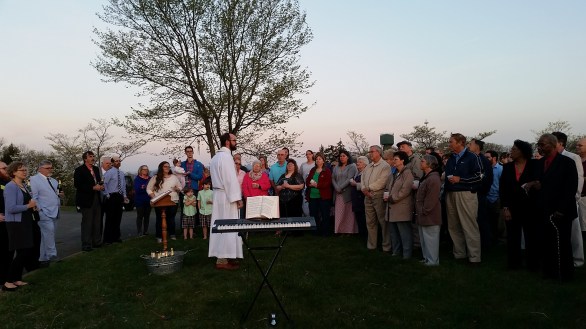
17966886_10206879248298323_4940910702880605006_o


Hallelujah! Hallelujah! Hallelujah! Man it feels good to say that word! In the church I serve, we have purposely avoided saying “Hallelujah” since before Ash Wednesday. No hymns, no prayers, no sermons contained the word. And now we can shout it out with all the pent-up gusto we’ve been holding in throughout Lent. Hallelujah! He is risen!

NT Wright is quite a famous theologian and he has said on numerous occasions that on Easter Christians should break out the champagne! But, we’re good United Methodists, so we’re stuck with Welsh’s Sparkling Grape Juice, plus it’s 6:30 in the morning and a bunch of us have other church services to go to after this!

But nevertheless, it’s time to pop some bottles and celebrate! I’ve passed out bottles to all the clergy so just go to the closest pastor to receive your cup. It’s time to shout out some Hallelujah and drink some Methodist champagne!

A Toast: To the God of Grace and Glory who broke forth from the tomb; Hallelujah!

Easter: What is this day all about? For centuries people like you and me have gathered like this to remember the first Easter. But, has Easter changed throughout the centuries?

We have a lady at St. John’s who, I believe, is keeping Hallmark in business. Whenever I visit people from our church community there is a better than good chance that I will see a card from Dianne on a refrigerator, or on a countertop, just to brighten someone’s day. And, wanting to be more like Dianne, I started looking through the greeting cards at Rite-Aid the other day in the section titled, “Easter.”

I flipped through a handful, looking for something appropriate, but then I couldn’t stop myself. And before I knew it I had gone through every single Easter card. They were all filled with nice words like “renewal” and “rebirth” and “revival.” They had colorful pictures of butterflies, lilies, and baby bunnies. But not one of them contained the right word: Resurrection.

easter-sunday1120-1024x576

Easter is not the celebration of spring.

This is important! While we are bombarded with images and messages about spring being the season of rebirth and renewal, the resurrection is something entirely different.

I can assure you that the women who walked to the tomb that first Easter were not captivated by the birds singing in the air, or the new buds bursting from the trees. They, as Mark so eloquently puts it, were afraid.

But we are far removed from the strange new world of the bible, and instead we like to make Easter about the egg hunts, the bunny who comes like a thief in the night, and the rebirth of nature. Maybe then, we are actually just like the women who fled from the tomb; the message and power of the resurrection is such that we can barely bring ourselves to say anything about it at all.

I, or any of the fine preachers from Staunton, could stand before you this morning and talk all about the change of seasons, the wonder of the birds chirping as the sun rises, the call to a new life. But does any of that actually grab you? Does it terrify you? Does it fill you with such hope that you would stand against the tyranny of the Roman Empire?

Easter is not about spring. Easter is resurrection.

Resurrection is God’s penultimate Word to us, His creatures. And frankly, it should make us tremble and consider running in the other direction because recognizing this new truth and new reality means that we will, sooner or later, have to give up our dependence upon the things that the world tells us we need: beauty, security, wealth, power, careers, out loved ones, even our lives.

But since you’re here at the crack of dawn to worship the living God, you must surely get it already. You’re here because your lives have been transformed by the power of the resurrection and you can’t go back. Or maybe, just maybe, you’re like me and you’ve heard this story so many times before that you’ve become a little numb to the Good News of God bursting from the tomb. Perhaps we need to be shocked or afraid like the women who ran away. Maybe resurrection isn’t supposed to make us smile and grin. Perhaps resurrection is supposed to make us run away in bewilderment.

Resurrection changes everything.

Just shy of a year ago, my wife gave birth to our son Elijah. And at first it was terrifying. I’ll never forget pushing him in his little basinet down to the recovery room and Lindsey finally getting to rest after the draining ordeal of childbirth. My beautiful wife was sleeping soundly, and our beautiful baby boy was asleep at the foot of her bed. It was a profoundly holy moment. And then Elijah started choking.

At first I looked around for a nurse or a doctor to do something, and then remembered that we were all alone. So I got up, rushed to him, used a suction cup to clear his throat, and he promptly nuzzled into my neck.

Having a baby changed everything.

Eventually we made it home and started figuring out how to exist with another tiny little human being in the house. We got into a good rhythm. And, I decided to start reading to him every night.

He was barely a month old when I picked up my collection of the Chronicles of Narnia and began with The Lion, The Witch, and The Wardrobe. Every night I would flip through the old and worn pages that called us into the strange new land of Narnia. And, of course, it meant nothing to him, but it meant everything to Lindsey and me.

We read the entire collection in just over a month and the very last paragraph of the very last book goes like this: And for us, this is the end of all stories… But for them, it was only the beginning of the real story. All their life in this world and all their adventures in Narnia had only been the cover and the title page: now at last they were beginning chapter one of the Great Story, which no one on earth has read: which goes on forever: in which every chapter is better than the one before.

narnia1

The end of Mark’s gospel, this wonderful bit about the women running away afraid, is no ending at all. It is a great ellipsis in which the story continues through us. The women were afraid because the resurrection was unlike anything this earth had ever known. They could not comprehend the sheer magnitude of God’s dynamic and reality-altering gift in his Son breaking free from the chains of death.

But their story, and our story, does not end with the written gospel. Their story, and our story, is resurrection. The gospel of Jesus Christ, the Son of God, is always unfinished. There is an unwritten page left for each of us to write, in which we record the many glorious, joyful, and even frightening things that God has done for and through us.

Easter, resurrection, isn’t perfect like a hallmark card. We cannot contain the inexplicability of God raising Jesus from the dead in pastel colors with a simple quote about renewal. It’s strange, and complicated, and scary.

For some of us Easter creates more questions than it provides answers. For the women at the tomb it was frightening and astonishing. For all of you it probably feels uncomfortable as we passed around out Methodist champagne with shouts of Hallelujahs while gathering in a place like this: a cemetery.

Easter can be downright terrifying.

But’s its not the end of the story. Jesus came alive so that we could come alive. The resurrection forces us to not experience Easter as just a day when the seasons change, but the very life-altering, earth shaking, cosmically confusing, moment of transformation of all things.

This, what we’re doing here, is our witness to the fact that we do not know what will happen next. We do not know when the bell will toll for us. And, if we’re truly honest with ourselves, this frightens us.

But hear the Good News: resurrection is the beginning of a new story, which goes on forever, in which every chapter is better than the one before. Jesus’ story, our story, has no end.

Hallelujah! Amen.

Devotional – Matthew 6.28-29

Devotional:

Matthew 6.28-29

Consider the lilies of the field, how they grow; they neither toil nor spin, yet I tell you, even Solomon in all his glory was not clothed like one of these.

Weekly Devotional Image

In a few hours I will gather with members of the community for a Service of Death and Resurrection for one of St. John’s long-time members, Gracie Jackson. During my first two months serving at St. John’s (almost 4 years ago), I tried to visit as many people as possible from the church community, particularly those who could no longer attend worship on Sundays. I want them to know that the church still cared about them and that they were in our prayers regardless of their presence.

Throughout those first months I was welcomed into a great number of homes and learned so much about Staunton and the impact St. John’s has had throughout the decades. One of my first visits was to the Jackson home where I sat and talked with Lenard and Gracie Jackson. But we didn’t sit for long. Instead, they wanted to give me the grand tour including the basement workshop and the green house in the backyard. There were plants everywhere but one in particular was striking and unlike anything I had seen before. Lenard explained that it was a Night-Blooming Cereus, and like the name implies, it only blooms at night. At the time, I casually mentioned my interest in the plant and we continued the door.

However, a couple days later Gracie told Lenard that he HAD to invite me over to witness the Night-Blooming Cereus in all it’s glory. (Lenard recently told me that in his life there were always two ways to doing things, and both of them were Gracie’s!). So at 10pm Lindsey and I drove over to the Jackson house and the four of us sat in their living room in our pajamas patiently waiting for the plant to do its magic.

When the right time arrived, we huddled in the green house with the dark sky coming through the windows and the cactus bloomed right in front of us. It produced the most exquisite scent and filled the room with its glory. And in that moment I was struck by the holy space we were sharing and was reminded of Jesus’ words from Matthew 6: “Consider the lilies of the field, how they grow; they neither toil nor spin, yet I tell you, even Solomon in all his glory was not clothed like one of these.”

6e7f0caa6dfe8f6541d5babc77c32ecf

That Night-Blooming Cereus was one of the most spectacular things I have ever seen and I never would’ve experienced if it weren’t for Gracie’s insistent invitation. Similarly, our faith is something that is offered to us as an invitation. We can read all about the Lord in Scripture, we can pray privately on our own time, but when we share our faith with another person it can bloom in the most exquisite of ways.

I am so remarkably grateful for the time I got to spend with Gracie, and for the many ways she embodied God’s grace for me.

On Using Bad Words In Church

Romans 6.1-11

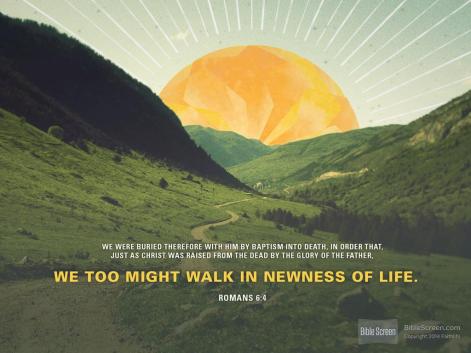
What then are we to say? Should we continue in sin in order that grace may abound? By no means! How can we who died to sin go on living in it? Do you not know that all of us who have been baptized into Christ Jesus were baptized into his death? Therefore we have been buried with him by baptism into death, so that, just as Christ was raised from the dead by the glory of the Father, so we too might walk in newness of life. For if we have been united with him in a death like his, we will certainly be united with him in a resurrection like his. We know that our old self was crucified with him so that the body of sin might be destroyed, and we might no longer be enslaved to sin. But if we have died with Christ, we believe that we will also live with him. We know that Christ, being raised from the dead, will never die again; death no longer has dominion over him. The death he died, he died to sin, once for all; but the life he lives, he lives to God. So you also must consider yourselves dead to sin and alive to God in Christ Jesus.


What’s the worst word you can imagine hearing from the pulpit? In a world where you can get away with saying and doing just about anything, is the church still a sacred place untainted by the desires of the world? There are plenty of strange and difficult and downright awful stories from scripture that we can read from the lectern, but don’t you think the pulpit should remain nice and clean?

During the season of Lent, we confront our finitude, our sinfulness, and our total dependence on the Lord. It is a tough time for us comfortable Christians, because these are exactly the types of things that many of us would rather avoid.

Gone are the days when we could expect to hear about sin and be challenged and convicted out of it. Gone are the days when we could affirm our finite lives without needing the stark reminder of ashes on our foreheads once a year.

Today, God has been reduced to a bumper-stickered and hallmarked version of love. Nothing more, nothing less, nothing else.

Today, church is not the place for judgment and for talk about sin. Regardless of their primacy in scripture, we would all be happier if we could avoid them.

The same holds true for foul language.

Right?

ec5f5b7006dc9af1fb22b9c190f5bcbb_social-etiquettepptx-on-emaze-swear-words-clipart_846-422

This is definitely not the place for someone like me to stand in front of people like you and use words that are forbidden from the radio and are relegated to rated-R movies.

As I heard someone say recently, “Preacher, there are just some things you don’t talk about it church.”

There is a seemingly endless list of things not to talk about in church; things like politics, abortion, divorce, war, sex, taxes, just to name a few. But foul language, language that results in soap-in-the-mouth discipline, is a particularly poignant thing to avoid in church.

And I have a friend in ministry who has completely ignored this accepted fact.

He loves to use foul language from the pulpit. Whether it’s the Christmas Eve sermon and the church is filled with young families who only show up for one worship service a year, or an Ash Wednesday service where only the die-hard Christians come out, he’s known for his colorful language. He’ll tell you that he uses those particular words in order to enhance the sermon in such a way that it will become more memorable and hit closer to home.

And a lot of the people at his church can’t stand it.

“Why does he feel like he has to resort to such awful language?” “The church deserves better than this.” “Does he talk to his mother that way?”

And, I think, they have a point. When the language used becomes more memorable or more important than what is being proclaimed, something has fallen a part. For instance: His recent Ash Wednesday sermon was titled “God Doesn’t Give A @#$%” I read it and listened to it online, it was phenomenal. The theology and the proclamation were remarkably faithful to the One who is faithful to us. But a few of the people from the church called me afterward and couldn’t even begin to express what the sermon was about at all; they were still hung up on the title.

However, there is a value to using some bad words in church.

During the season of Lent, this time after Epiphany but before Easter, there is a specific word that we avoid at all costs. It’s really bad. The word is… well, I’m not supposed to say it. Um, how can I do this…

Okay, there’s this great song by Ray Stevens called the Mississippi Squirrel Revival, maybe you’ve heard it, and part of it goes like this: The day the squirrel went berserk // In the First Self-Righteous Church // In the sleepy little town of Pascagoula // It was a fight for survival // That broke out in revival // They were jumpin’ pews and shoutin’ @#$%^&*!”

You know the word I’m talking about? You might not have even noticed it, but we have not said the “H” word in worship since before Ash Wednesday. It has not been read from the lectern, it has not been hidden in one of the verses from our hymns, and I certainly haven’t used it from the pulpit.

We purposely avoid the word during Lent so that when we shout it out on Easter it will mean all that much more. We specifically deprive ourselves of this important and powerful word to create a longing for the realization of all that the life, death, and resurrection of Jesus promises to us and to the world.

And there’s another bad “H” word that we need to talk about: Hell.

I don’t mean the place filled with fire and a red-toned, frighteningly tall, horned figure with a trident and a bifurcated tail. I mean using “hell” as an expression.

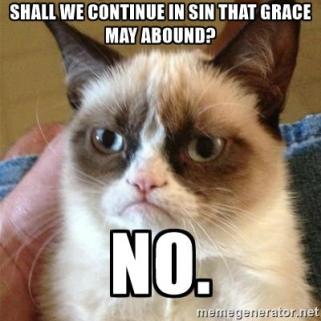
Paul writes: “What then are we to say? Should we continue in sin in order that grace may abound? By no means!” Now, what I’m about to say will probably get me in trouble, but so be it. That little ending, the “by no means” just doesn’t cut it. In Greek the expression is “me genotio” and it is way more emphatic than “by no means.” Some translations have it as “God forbid” or “Definitely not” but even both of those miss the mark.

37475703

In what we read last week, Paul wrote: “When sin increased, grace abounded all the more.” And it’s as if Paul knew that people would hear those words and say, “Dude, that’s awesome! If grace abounds all the more when sin increases, then lets keep the sins rolling!”

And here is Paul’s response: “Should we continue to sin in order that grace may abound? HELL NO!

Our lives have changed forever. We can’t just retreat to the ways of the past because grace abounds. God in Christ has made in us a new creation! The gift of God in Christ on the cross was, and is, such that we are forever freed from the tyranny of sin and death. Should we continue to sin in order that grace may abound? HELL NO!

But that’s not the last bad word we’re going to talk about today. No, we still need to talk about “Sin” and “Death.” Perhaps two of the worst words that can ever be used in church. And you can tell they’re bad word precisely because of how rarely they are used in a place like this.

We need to talk about these bad words, not because they are normal parts of human experience, but because they are false powers that rule over us. That’s how Paul understood them: Sin reigns, Death has dominion.

You need only turn on the television for five minutes in the evening to see how true this really is: The nighty News hour is filled to the brim with the failures and faults and sins of other people; The Republican Party failed to procure their dream for American Healthcare. Left Wing activists went on a violent strike in another major city. Augusta County citizen receives life sentence for horrible crime. North Korea has another failed missile test but they are getting closer to developing their own weapons of mass destruction. The market fluctuated with each tweet from our president. Test scores have fallen in local school leading to speculation that it will close… All of them are negative.

And then when they go to a commercial break we are bombarded by products designed to make us believe that we can and will live forever; Use this cream and your wrinkles will disappear. Invest in this company and you will never have to worry about money. Go on this vacation and you will feel happy and healthy like the people running on the beach or tanning by the pool.

We live under the tyranny of sin and death. But Paul says this should not be so!

Ro6

We who have been baptized into Christ have been crucified with Christ. Our sinful selves are put to death on the Cross so that we will no longer be slaves to the bad words of Sin and Death.

Long ago, we would have known this without Paul having to remind us. Baptisms, long ago, were all about death. That’s where the Baptists beat us today, I’m sorry to say. When the Baptists baptize, they fully submerge people under water. And, depending on the faithfulness of the pastor, the soon-to-be-new Christian might be held under for quite a long time.

You would’ve missed the baptism to death if you were with us in Alexandria when Elijah was baptized. No, we didn’t hold him under a tub of water to embody the death to sin. No, we didn’t give him some old and tattered gown to wear. Elijah looked perfect in his little khakis, and button-up shirt, and bow-tie, and mustard-colored cardigan. Elijah was sprinkled with water, and the perfectly portioned amount of holy oil was smeared in the shape of the cross on his forehead. And, he was carried out to the congregation and held up high by the same preacher who curses too much.

We miss the death to sin in our baptisms. But we have a member of our lectionary bible study who really gets it. Judy had avoided church for decades before God grabbed her by the heart and said, “Follow me.” She brought her questions and her doubts to her preacher, and after a time she felt her heart strangely warmed and felt moved to be baptized.

Unlike babes in the United Methodist Church, Judy marched up to the giant baptismal font and prepared to jump into the all-too-cold water. And outside, through the multicolored stained glass windows, a thunderstorm was brewing.

Judy slowly descended into the water, and with cracks of thunder in the distance the preacher plunged her into the depths of death to sin. I like to imagine that if she opened her eyes underwater, even for the briefest of moments, she would have seen a flash of lighting that illuminated the entire congregation. The whole moment felt as if the rule of Sin and Death, the dominion of the devil himself, was making one final dash to keep her under their control. But alas, the grace of Jesus Christ abounded all the more, and she arose from the water dead to sin and death.

Are we to continue in sin that grace may abound? HELL NO!

God has changed us! Not just through the waters of our baptisms, not just through the bread that we break and the cup from which we drink, but also through the death of Jesus on the cross. It changes everything! This gift transforms our very lives to the point that we should feel compelled not to fall back into the old ways, to the old self, ruled by Sin and Death.

But we know the truth: we do fall back. We know that those who are sent to prison for horrible crimes have an all too high likelihood of returning one day. We know that those caught in adultery tend to habitually cheat for the rest of their lives. We know that even the strongest member of an AA group can fall off the wagon.

We know that we fall back.

We say “never again” to so many thing only to have them come right back around. We say never again to the anger, to the cigarette, to the bottle, to the cheating, to the lying, to the hatred, to the racism, to the homophobia, to the elitism, to the narcissism, to defeatism, to a great number of things.

            They never stop.

            The fact that they never stop is evidence of the power of Sin in this world, which reigns in Death.

But our lives have been changed! God has wiped away the old self and clothed us with the new. God washed away our insecurities and insufficiencies and said, “My grace is enough.” God was nailed to the hard wood of the cross to die a death that we might die in our baptism. God was raised from the dead as we were brought forth from the water to live a resurrected and holy life.

            The death Jesus died, he died to sin, once for all; but the life he lives, he lives to God. So we also must consider ourselves dead to sin and alive to God in Christ Jesus our Lord.

Should we continue in sin in order that grace may abound? HELL NO! Amen.

The Cross in Creation – Karl Barth and Genesis 1.1-2

Genesis 1.1-2

In the beginning when God created the heavens and earth, the earth was a formless void and darkness covered the face of the deep, while a wind from God swept over the face of the waters.

barth-bw

While I was in seminary I spent one of my summers helping Bryson City UMC in Bryson City, North Carolina. Bryson City is surround by the Great Smokey Mountains and is easily one of the most beautiful places I’ve ever been in my entire life. It was an incredible experience that directly shaped the way I do ministry today.

During my time at the church I was invited to participate in a weekly lectionary group with local clergy. Every Monday morning the pastors and priests of Bryson City would get together to talk about the scripture readings for the following Sunday. We met at the large Baptist Church, ordered breakfast to be delivered, and then we would take turns reading from the bible and shared what we thought we would preach about on Sunday.

Week after week I heard from clergy of all different denominations (Presbyterian, Baptists, Catholic, Methodist, etc.) as they wrestled with God’s Word and how to proclaim it from very different pulpits to very different people.

On one hot morning in the middle of July I found myself surrounded by those familiar pastors and priests as we read the texts aloud. The lectionary always had four prepared readings for each Sunday on a three-year cycle: a reading from the Old Testament, the Psalms, an Epistle, and a Gospel. I don’t remember what the other readings were that morning, but I do remember that I was asked to read Genesis 1: In the beginning when God created the heavens and the earth…

When I finished, as was our custom, we waited for individuals to speak up about what they planned to do with the test during worship. Silence filled the room. So I decided to ask the obvious question, “I anyone planning to preach on Genesis 1?” The silence remained. I remember thinking to myself, “How strange is this? We’re talking about the first lines of scripture in the bible and no one is preaching on it in Bryson City this week.” It was obvious that most of the clergy wanted to move on to a different reading, but I felt compelled to ask another question: “Have any of you every preaching on Genesis 1?” One by one they confirmed my suspicion; not one of those pastors, priests, ministers, or preachers had ever proclaimed a sermon on the beginning of creation.

While they moved on to a different reading and a different conversation, I silently began calculating from my chair: In that room we had over 100 years of preaching represented. Over 100 years of preaching, more than 5,200 sermons, and not one of them had ever preached from Genesis 1.

Why do we ignore Genesis 1? What is it about the text that makes us afraid to bring it up in worship or in bible study?

On some level I think it is good to be afraid of God’s Word; that fear reminds us that God is God and we are not. But Genesis 1 is not something to be ignored or forgotten.

557046

Of all the writing I’ve read on Genesis 1, it is Karl Barth’s exegesis of the text that gives me hope for its return to the pulpits and congregations of our churches.

Barth, unlike so many modern theologians and pastors, rejects the fear and presumption that there is dissonance between creation as recorded in scripture and the scientific method. Instead of attempting to rationalize the theory of the Big Bang with the details of Genesis 1, and instead of struggling to line up Darwin’s Theory of Natural Selection with the order of creation in scripture, Barth rejoices in the knowledge that the earth was in a hopeless situation of chaos and utter darkness and God chose to transform reality through the Word. The “how?” and “why?” of creation is simply answered with “Word” and “love.”

Writing and reflecting from this vantage point gives Barth the ability to freely respond to the words contained in Genesis 1 with a freshness that is often lost in the church today; his exegesis of Genesis 1 is a worthy read for clergy and laity alike.

In §41.2 “Creation As The External Basis Of The Covenant” (III.1 The Doctrine of Creation in Church Dogmatics) Barth begins his exegesis with the very first words of God from the Word of God.

The first word in the Hebrew Bible is bereshith, which roughly translates to “start” or “beginning.” In English we render this as “In the beginning…” but for Barth the distinction is important. To begin with “beginning” tells us “that this history, and with it the existence and being of the world, had a beginning, i.e., that unlike God Himself it was not without a beginning, but that with this beginning it also looks to an end.”[1] There is no other word that can quite compare with the one that inaugurates God’s holy scripture. From the beginning of all things God created a beginning to have an end. The Lord did not create the world like a watchmaker and then step back to see how it would run. God was intimately involved in the creative act knowing full and well that there was a necessary end, or conclusion, to the creative act. Unlike an author who begins a story without knowing how it will come to close, God created from beginning with an ending.

For years I’ve read the creation account from Genesis 1 and thought of it just like that: an account of creation. The words were there on the page, though they hardly jumped out at me. Like those pastors in Bryson City, Genesis 1 is one of those chapters in the bible that I have not so subtly avoided because of the difficulty of rationalizing it with modern science. And yet Barth writes about the first two verses of scripture with such conviction that it challenges me to re-engage with the text and see the beauty of what God did, and is doing.

Verse 2 (the earth was a formless void…) has been similarly read with haste and overlooked for the richness it holds. Everything else, which is to say everything neutral or against God’s will, ceased to exist when time began with God’s action and accomplishment. The whole of creation was worked into being and order by God in time. In God’s freedom to create was the earth brought into meaning through God’s action and through God’s word to create.

1101620420_400

The challenge of verse 2 has vexed theologians and Christians alike for centuries regarding the chaos, whether or not God created it, and if God willed a reality of chaos into existence. This, I think, has factored into the disappearance of Genesis 1 from pulpits because we are unsure of how to speak about evil in the world, and whether or not God ordained it.

The question of God’s role in the creative act resulting in, or presupposing evil, is usually limited to two answers: God either did create the darkness and evil, or God did not.

Barth totally rejects this dualistic presumption.

Instead, Barth begins by confronting what is actually stated: “In verse 2 there is absolutely nothing as God willed and created and ordained it according to verse 1 and the continuation. There is only “chaos.” … that which is absolutely without basis or future, utter darkness… According to this phrase the situation in which the earth finds itself is the very opposite of promising. It is quite hopeless.”[2]

For Barth the question over evil and whether or not the violent and chaotic state of the world is self-originated or willed by God pales in comparison to the fact the earth was in a hopeless situation of utter darkness and God chose to transform reality through the Word. Verse 2 therefore posits a world in which the Word of God had not been uttered. The “nothingness” of creation is utterly destroyed and rendered impossible by the possibility of God in the creative act.

The ugliness of the existence prior to the Word of God did exist almost like a shadow of the actual creative act of God. And because it was like a shadow, in the freedom of humanity we can look back and return to that past and bring forth the shadow of verse 2. In so doing, by rejecting the Word of God, the past defies its own nature and becomes present and future. However, God totally and utterly rejected and rejects the shadow and speaks forth the Word to shine in the darkness.

The temptation of humanity to return to the shadow is ever present. Whenever we deny mercy to God’s creatures, we are retreating to the moment precisely before the Word of God. It is in our broken and sinful nature that we reject God’s Word and substitute our own. The shadow of darkness is around us whenever we encounter death and destruction. But no shadow can compare with the one of the cross: “This – this moment of darkness in which His own creative Word, His only begotten Son, will cry on the cross of Calvary: ‘My God, my God, why has thou forsaken me?’ – will be ‘the small moment’ of His wrath in which all that is indicated in Genesis 1.2 will become real. For all the analogy to other kinds of darkness, there is no other moment such as this.”[3]

In the death of Jesus Christ, in the shadow of the cross, humanity encounters the true and total darkness prior to God’s Word. But it is through Jesus Christ (as the Word) that God will reconcile creation to God’s self. In the one incarnate creature, at that particular moment and time in the cosmos, the Word will again become the Light over all creation. The brilliance of the empty tomb shines like the first light hovering over the darkness in Genesis 1.2.

The “old things” of creation prior to the Word have radically passed away in a dynamic and divine act of the Lord speaking the Word and through the death and resurrection of Jesus Christ.

The first two verses of scriptures contain the fullness of all God’s scripture. In beginning we see the ending. In the darkness we see the cross. In the light we see the empty tomb and resurrection. What Barth does with scripture is like what a Jazz musician does with the form of a tune; Barth improvises over the lines and draws connections to melodies that we have scarcely imagined.

To reclaim the brilliance of Genesis 1, to jump into the strange new world of the bible like Barth, will give us the strength to encounter creation and believe that it is worthy to be preached and proclaimed. But more than anything, it will give us the vision to see creation and declare, like the Lord, “it is good.”


[1] Barth, Karl. Church Dogmatics III.1 (Peabody, Massachusets: Hendrickson Publishers), 99.

[2] Ibid., 104.

[3] Ibid., 110.

Offensive Grace

Luke 15.11-32

Then Jesus said, “There was a man who had two sons. The younger of them said to his father, ‘Father, give me the share of the property that will belong to me.’ So he divided his property between them. A few days later the younger son gathered all he had and traveled to a distant country, and there he squandered his property is dissolute living. When he had spent everything, a severe famine took place throughout that country, and he began to be in need. So he went and hired himself out to one of the citizens of that country, who sent him to his fields to feed the pigs. He would gladly have filled himself with the pods that the pigs were eating; and no one gave him anything. But when he came to himself he said, “How many of my father’s hired hands have bread enough and to spare, but here I am dying of hunger! I will get up and go to my father, and I will say to him, “Father, I have sinned against heaven and before you; I am no longer worthy to be called your son; treat me like one of your hired hands.”’ So he set off and went to his father. But while he was still far off, his father saw him and was filled with compassion; he ran and put his arms around him and kissed him. Then the son said to him, ‘Father, I have sinned against heaven and before you; I am no longer worthy to be called your son.’ But the father said to his slaves, ‘Quickly, bring out a robe – the best one – and put it on him; put a ring on his finger and sandals on his feet. And get the fatted calf and kill it, and let us eat and celebrate; for this son of mine was dead and is alive again; he was lost and is found!’ And they began to celebrate. Now his elder son was in the field; and when he came and approached the house, he heard music and dancing. He called one of the slaves and asked what was going on. He replied, ‘Your brother has come, and your father has killed the fatted calf, because he has got him back safe and sound.’ Then he became angry and refused to go in. His father came out and began to plead with him. But he answered his father, ‘Listen! For all these years I have been working like a slave for you, and I have never disobeyed your command; yet you have never given me even a young goat so that I might celebrate with my friends. But when this son of yours came back, who has devoured your property with prostitutes, you killed the fatted calf for him!’ Then the father said to him, ‘Son, you are always with me, and all that is mine is yours. But we had to celebrate and rejoice, because this brother of yours was dead and has come to life; he was lost and has been found.’”

Prodigal-Widescreen

Today marks the third part of our July Sermon Series on The Power of the Parables. A favorite rhetorical device of Jesus’, a parable is a story that illustrates a lesson or principle usually without explanation. They are simple and life-sized with familiar characters and they are supposed to drive us crazy.

Over the centuries the parables have become so watered down through the church that they no longer carry the same weight and punch that they once did. The familiar parables are beloved to us, The Feast, The Mustard Seed, The Prodigal Son, The Good Samaritan, but during the time of Jesus they were frustrating and confusing. During this month we are attempting to recover this sense of strangeness and re-encounter the power of the parables.

parables

There was a man in Staunton who had two sons. For years the family enjoyed the small town feel of the community, rejoiced in running into friends at grocery stores and the park, and celebrated the goodness of God in church every Sunday. They were always the family that every other family envied; whenever they were seen in town the sons were so well behaved, the husband and wife were always holding hands, and everything looked perfect.

   But within the safety of their home, far removed from public few, things were not as they seemed.

The father loved his sons, but he could tell that the younger resented him for being raised in a town such as this. The father knew his younger son enough to know that whenever he harshly reacted to a comment at the dinner table, or stormed out of the house, it was out of a desire to depart and start over somewhere else. But he remained patient with his son and always tried to love him the only way he knew how.

One day, while the father was sitting in his study, the younger son walked in with his fists clenched tightly by his side. The father listened as the son listed off his chief complaints and demanded his inheritance early. As the frustrations percolated, and the son kept talking about how suffocated he felt, the father was already pulling out the checkbook and signing his name. He said, “Son, I love you and I’ve known this day was coming for a long time. Just remember that you will always be welcome here.” And with that the son grabbed the check from his father’s fingers and walked out of the house, and out of his father’s life.

For a long time the father heard nothing from or about his younger son. Life continued as usual in Staunton: babies were born, older folks went on to their heavenly reward, time passed, and the father kept living his life. Little by little news would seep into dinnertime conversations from the mother or the older son about the one who was missing. Rumor had it that he had set up in Richmond and was spending money left and right on all sorts of things, including some that could not be mentioned out loud. But the father gave it no thought. The money was his son’s to do with as he pleased.

But as time passed, the rumors became fact, and the father knew his son was in trouble. The money had run out and he was working odd jobs to get by. The mother no longer even had an address to send him letters because he was either moving from house to house or living on the streets.

The days became weeks, the weeks became months, and the father eventually heard nothing about his younger son. No letters arrived in the mail, no text messages were sent, and the son even stopped updating his Facebook account. As far as the father knew, his son was gone.

And then it came to pass one afternoon, while sitting in the same study where he had given the son his inheritance, the father glanced out the window and saw a figure walking up the road. From his vantage point the father thought it might be his son, but the person was too frail, and slumped over with what looked like shame. But sure enough, the closer he came to the house, the more it looked like his son. Before he knew it the father was running out the front door and he tackled his son to the ground on the front yard. He simply could not contain himself and he began covering his younger son with kisses and the tears were flowing out his eyes.

Only then did the father hear his son say, “Dad, I’m so sorry, and I am no longer worthy to be called you son.

But the father wasn’t listening. Instead he was yelling up to the house describing preparations for the party he was about to throw. Go to the grocery store. Invite all the neighbors. Get the music ready. We are going to party tonight!

Hours later in the midst of a rather crazy party the father noticed the older son standing in the corner with what looked like an angry expression on his face. The father was filled with such merriment on the return of his one son that he walked over to the other with a smile on his face and asked what was the matter.

The father listened as his older son started listing off the complaints. But it was what he said at the end that hit him the hardest, “Dad, I’m glad that he’s home just as you are. But did you really have to throw this party? I’ve been living with you all this time while he was gone wasting his life away and you never even let me invite my friends over and now look at all this!”

And the father put his arm around the older son and said, “I love you and all that is mine is yours. But we had to party tonight because this brother of yours was dead and has come to life; he was lost and has been found!”

00033230_h

We call this the parable of the Prodigal Son. It is easily the most familiar of all of Jesus’ parables, and has been embraced by faithful and secular alike for its powerful message. We like the idea of a reconciled relationship and we sigh in affirmation whenever we hear about the wayward son returning home. But, as the church has so embraced the clichés of the story, we’ve missed out on the offensive grace that it dramatically conveys.

We call it the parable of the Prodigal Son, but we should probably call it the Parable of the Loving Father. The father is the main character of the parable and the one that Jesus identifies with. He tells this parable in response to an attack against his character for eating with sinners. He, Jesus, is the one who welcomes everyone to the table in celebration regardless of circumstances. And for as much as we enjoy hearing this story, we should really be offended by it.

The older brother has every right to be angry. I would be if one of my siblings ran off and my father treated them the way the one does in the parable. It’s fine to welcome a wayward child home. Sure, give him some clothes and some food. Let him rest at home until he can get back on his feet. But it is simply bad parenting to throw a party in the wake of so many mistakes. For years we have emphasized the moment where the prodigal son “came to himself” and we have identified with a particular moment in our lives when we turned back. But in so doing we have neglected to confront the utter strangeness and offensiveness of the father’s love.

Reading and imagining the story from the father’s perspective frustrates our understanding of justice, fairness, and grace. We want people to be punished for their mistakes, we want them to grovel when they’ve wronged us, we want payment for our suffering.

We don’t want to welcome the prodigal home. We want to be rid of the people who drive us crazy. We don’t want to waste our time on someone who might disappear again. We want to honor the good people who have been with us. We don’t want parties for sinners. We want celebrations for saints.

And then Jesus tells this story about the Loving Father and everything gets flipped upside down.

The power of this parable is not the good and warm and fuzzy feelings we have when we hear it, but in God’s love being so strong that it can offend us. God’s forgiveness and mercy is so powerful that it is beyond our ability to understand. God truly loves the unlovable, forgives the unforgivable, and welcomes us whenever we stray away.

God’s love is weird. And we would do well to remember that. Not to belittle God’s love into a line on a Hallmark card, but to be offended by how God could love the people we hate. Not to limit God’s love to the people in the pews next to us, but get angry that God even loves the people who sleep in on Sunday mornings. Not to assume that God only loves Christians, but to be offended by the truth: For God so loved the world that he gave his only begotten Son.

The parable of the Loving Father will forever frustrate and offend our sensibilities precisely because God’s grace is offered to all, and all really means all.


Responding:

We are going to try something a little weird. I want us to take a moment to think about someone that absolutely drives us crazy. It might be a neighbor who is forever frustrating our understanding of decency. Or maybe it is someone in our family that always takes everything too far. Or maybe it is one of the candidates running for president this year. Just think of someone who you can’t stand. Picture them in your mind. And then I want you to think about them walking into our sanctuary right now and pummeling them with loves and kisses. I want you to imagine grabbing them by the hand and dancing around the sanctuary in the midst of the greatest party you’ve ever attended.

Because in a moment we are going to put on some music, and we are going to dance like we’ve never danced before. We are going to break out of our pews and boogey up and down the church. And it is going to be weird and uncomfortable, it is going to upend our ideas of what church should be like, because sometimes God’s grace should be offensive.

Devotional – Luke 9.57

Devotional:

Luke 9.57

As they were going along the road, someone said to him, “I will follow you wherever you go.”

Weekly Devotional Image             It sounds easy. Jesus is walking along the road with his disciples and someone says, “I will follow you wherever you go.” In a sense, this is the same declaration we make each and every Sunday that we gather for worship; we want to follow Jesus wherever he goes. But do we really?

If we assume that Jesus is revealed to us in the sanctuary then it makes sense that we will follow him there. Sunday morning worship is a comfortable arena where we can feel good about our Christian identities; we can sing together from the hymnal, we can pray for the world to be a better place, and we can hear a sermon that makes us laugh and reminds us that God is love. But what about the end of the service? Are we willing to follow Jesus wherever he goes between worship services?

If Jesus walked into a Hillary Clinton rally to demand more honesty from our politicians, would we follow him? If Jesus wandered into a Donald Trump rally to demand an end to racism and bigotry, would we follow him? If Jesus marched against the NRA to boldly request better gun control laws, would we follow him? If Jesus made his way into the Pulse Nightclub in Orlando to spend time with a marginalized community, would we follow him? If Jesus asked us to take up our own cross and follow him to Calvary, would we follow him?

To follow Jesus is a radical thing. It means putting the needs of others before our own. It means seeking out the last, least, and lost in addition to the people who make us comfortable. It means we need to strive for mercy instead of sacrifice, communion instead of correctness, and Kingdom instead of nation. It means following him into the places of life that we would otherwise avoid.

maxresdefault

Many of us have grown comfortable with our Christianity because it does not ask much of us. So long as we can be present for an hour on Sundays, we believe we are covering our spiritual bases. In turn, the church has become another civic organization and no longer the life-giving arena of grace, mercy, and love.

And honestly, this makes sense. Throughout the gospel narratives Jesus’s followers and disciples continued to grow in number until he set his face toward Jerusalem. The closer he came to the cross, the more the people started to fall away. As the expectations and costs increased, the level of commitment dwindled.

At the end, while he was hanging on the cross with only a few faithful disciples remaining, it was a thief who wanted to follow Jesus wherever he went. And Jesus said, “Truly I tell you, today you will be with me in Paradise.”

Following Jesus comes with a cost, but the reward is beyond all measure.

Devotional – Psalm 23

Devotional:

Psalm 23.1

The Lord is my shepherd, I shall not want.
Weekly Devotional Image

I’ve done a lot of funerals. In my short time as a pastor I have presided over more services of death and resurrection than baptisms and weddings combined. And every funeral, much like every baptism and wedding, is contextual and different. Some families come in with a service already planned out in their minds with specific hymns and scriptural texts, and some families come in with their eyes glossed over and have no idea what they want the funeral to look like. I’ve read scripture from the recently deceased’s bible, I’ve been handed a tear stained eulogy to read aloud because the emotional strain was too high, and I’ve even been asked to sing a solo during a service. But one thing that has united every single funeral I’ve participated in has been the reading of Psalm 23.

Unlike other readings during funeral services, we print out the entirety of the 23rd Psalm in bold in the bulletins. When the time comes, I ask everyone gathered together to read the beloved words out loud and as we take a collective breath we begin, “The Lord is my shepherd, I shall not want…” An amazing thing happens when this psalm is read out loud in the context of grief and loss. You can audibly hear the anxiety in the air as the first words are read aloud; people read at different tempos and take breaths at different moments. But as the psalm progresses, so do the voices. It is as if the entire congregation, through the psalm, is able to take a collective breath of fresh air and release a profound sigh of comfort. The 23rd Psalm is a beautiful reminder of the powerful presence of the Lord in the midst of death, and encourages those of us who remain to live as faithfully as the person we have gathered to remember.

This week, no matter what we have going on, let us take a moment to faithfully proclaim the words to the 23rd Psalm with the knowledge that even after we’re gone, people will use these words to mark our Services of Death and Resurrection:


Psalm 23

The Lord is my shepherd, I shall not want. He makes me lie down in green pastures; he leads me beside still waters; he restores my soul. He leads me in right paths for his name’s sake. Even through I walk through the darkest valley, I fear no evil; for you are with me; your rod and your staff – they comfort me. You prepare a table before me in the presence of my enemies; you anoint my head with oil; my cup overflows. Surely goodness and mercy shall follow me all the days of my life, and I shall dwell in the house of the Lord forever.


h6bg5t5

The Politics of Easter: A Reflection

Matthew 28.3-5

His appearance was like lightning, and his clothing white as snow. For fear of him the guards shook and became like dead men. But the angel said to the women, “Do not be afraid.”
6818680928_cd412c2345

A few weeks ago I told the church I serve about my experience of voting during the Virginia Primary. When I arrived at my voting location I was disappointed with the limited number of participants. But by the time I left, the parking lot was starting to fill rapidly.

When I got into the building I went over to the table to receive my instructions and eventually got set up with a machine to cast my vote. While my wife finished registering and voting I stood off to the side.

I really try not to eavesdrop, but sometimes it feels impossible. When people walk into a building and starting shouting things, it’s hard not to notice.

The first man came in wearing bib overalls, dirt all over his boots, with his hair going every direction. When he arrived at the table the volunteer asked, “What party will you be voting for?” The man stared blankly back and then declared, “Well, I ain’t no socialist so I’ll be voting Republican.

The second man came in wearing a perfectly pressed suit, with a tie clip, and an expensive looking watch on his wrist. When he arrived at the table the volunteer asked, “What party will you be voting for?” Without taking time to think about his answer he said, “I can’t trust Hillary but I’m still voting Democrat.

The first woman came in wearing a completely coordinated outfit, her hair and makeup looked perfect, and her heels were so high they started giving me vertigo. When she arrived at the table the volunteer asked, “What party will you be voting for?” I don’t think the woman was really paying attention because she filled the next few minutes trying to convince the volunteer that our country is in a mess and the only good option we have left is the Christian Ted Cruz.

The next woman came in wearing a sweat suit, with spit-up on her shoulder, while making a comment about her baby waiting in the car. She was clearly in a rush so when the volunteer asked, “What party will you be voting…” She interrupted and yelled, “Anyone but Trump!

It didn’t take long for me to notice that all of the people coming in to vote were doing so out of fear. None of them were particularly satisfied with any of the candidates, they represented different walks of life, and the one thing that united them was fear.

The two most well known stories of the New Testament bookend Jesus’ life. The two most well attended church services in the year similarly reflect these bookends: Christmas and Easter. As a pastor, I’ll be the first to admit that there are some of the hardest services to plan and preside over. And honestly, I feel guilty about how much they stress me out. They’re supposed to be the most joyful and incredible worship services in the year, and they leave me feeling anxious.

Part of the problem is the fact that a whole lot of people show up on Christmas and Easter who otherwise never attend church. That means that we’ve got one hour to show them how powerful regular worship can be in the hope of getting them to attend worship between the major holidays.

The other problem is the fact that most of the people who attend on Christmas and Easter already know the story. It has been told for two millennia and a 15-minute sermon from a pulpit is unlikely to shine a new light on either narrative.

But the biggest problem with Christmas and Easter is the fact that many of us read ourselves into the story as the wrong characters.

On Christmas Eve we hear about the angel Gabriel visiting Mary and Joseph to share with them the Good News that they will be bring God in the flesh into the world. They, of course, are terrified by this news but the angel says, “Do not be afraid.” We like to stop the story there because it fits well with our sensibilities. We like to think about being afraid of starting something new and God showing up to reassure us.

But the story goes on to talk about Herod’s fear. Herod heard about a messiah possibly being born in Bethlehem. Out of fear that this child will one day usurp his power, he ordered all of the babies born in Bethlehem to be murdered. Obviously, this is not a popular topic for Christmas Eve. But it is important. It is important because most of us have never, nor will we ever be in a position like a Mary and Joseph. We have families and a government that support our way of life. We know we have people to count on, we know that there is money in our bank accounts. Many of us will never know the fear that Mary and Joseph experienced on that Christmas Eve.

But many of us can connect with Herod’s fear about people in a faraway place whose existence threaten our power and way of life. (Think Syrian Refugees or ISIS)

On Easter we hear about Mary Magdalene and the other Mary going to the tomb expecting to find Jesus’ dead body, and instead they experience an earthquake and an angelic presence. The angel says to the women, “Do not be afraid.” But he scares the Roman guards nearly to the point of death. We like the story to focus on God’s power over death and Jesus’ resurrection from the grave. We like to hear about how Jesus’ victory over death opens up the gates of heaven for people like us.

But the story specifically sets up a distinction between the women at the tomb, and the guards at the tomb. And if we’re honest, most of us are like the guards in the story; we’re Caesar’s people. We might know about loss and suffering, we might’ve experienced the awful power of death in a loved one or friend, but we’ve never had to tread lightly for fear that our political system will murder us for speaking out, we’ve never known what it’s like to watch someone die on a cross and then be placed in a grave, we’ve never had to guard our political opinions because we live in the land of freedom.

But what we do know is that most of our lives are pretty good. Many of us have the right skin color, the right passport, the right education, the right sexual orientation, and the right amount of wealth to be rewarded in our society.

And Jesus, the guy Christians claim to worship on Christmas, Easter, and every Sunday in between, came to make the first last and the last first.

So maybe we should be afraid. We should be afraid because God raised his Son from the dead and calls us to sacrifice our own lives for people who betray us. Maybe we should be afraid because we’re told to take up our cross and follow Jesus. Maybe we should be afraid because Jesus tells us to love our enemies, whether they support Bernie Sanders or Hillary Clinton or Ted Cruz or Donald Trump.

When angels show up in scripture, but in particular at Christmas and Easter, they come to people who have every reason to be afraid and they bring words of comfort: Your Son will be God in the flesh; Jesus has been raised from the dead. God speaks to the outcasts, to the last, least, and lost and brings them Good News.

We, who have nothing to fear, we who are so comfortable and content in our lives… Maybe it’s time to recognize that following Jesus’ will disrupt the comfort and the contentment we feel. Maybe it’s time to start praying for and acting on behalf of people who are belittled and broken by our political system. Maybe it’s time for us to stop ignoring everyone with a different way of life, particularly if have a different skin color, a different passport, a different education, a different sexual orientation, or a different socio-economic status. Maybe it’s time to hear the Good News of Jesus Christ and let it shake our lives.


(with thanks to Jason Micheli for inspiring parts of this reflection)

Earthquake! – Easter Sermon

Matthew 28.1-10

After the Sabbath, as the first day of the week was dawning, Mary Magdalene and the other Mary went to see the tomb. And suddenly there was a great earthquake; for an angel of the Lord, descending from heaven, came and rolled back the stone and sat on it. His appearance was like lightning, and his clothing white as snow. For fear of him the guards shook and became like dead men. But the angel said to the women, “Do not be afraid; I know that you are looking for Jesus who was crucified. He is not here; for he has been raised, as he said. Come, see the place where he lay. Then go quickly and tell his disciples, ‘He has been raised from the dead, and indeed he is going ahead of you to Galilee; there you will see him.’ This is my message for you.” So they left the tomb quickly with fear and great joy, and ran to tell his disciples. Suddenly Jesus met them and said, “Greetings!” And they came to him, took hold of his feet, and worshiped him. Then Jesus said to them, “Do not be afraid; go and tell my brothers to go to Galilee; there they will see me.”

lightburst-easter-still-600x338


It was dark but I felt invincible. I was seventeen years old, with a fresh driver’s license in my wallet, and we were driving to the church in the middle of the night on Easter Eve. My friend, Will, and I had come up with a plan on how to make this particular Easter one that no one would ever forget. We were young and dumb.

For as long as I could remember, the church always set up a tomb on the front lawn of the church during holy week. It was the size of a small shed and it stood out like an oppressive eye sore to remind everyone what Easter was really about. From Good Friday through Saturday, volunteers would stand guard by the tomb wearing Roman centurion costumes and would try to look stern while also waving at people that drove by. It was the church’s attempt to reexamine the greatest moment in the history of the world, but after years of seeing the same men stand by the same tomb, it had lost its impact.

On Easter Sunday, someone was always tasked with getting over to the church before anyone else to roll back the stone on the front of the tomb. That way, while people were scrambling to find parking spots before the service started, they could remember how the stone was rolled away when the women and first disciples discovered Jesus’ resurrection on the first Easter.

But for Will and I, it was time to up the stakes and make it an Easter worth celebrating. We were tired of the same resurrection stories, we were tired of people entering and leaving much the same on Sunday, and we were tired of the familiarity that had become Easter.

So we snuck out in the middle of the night, much to the later frustration of our parents, and we drove over to the church. Under the cover of darkness we rolled back the stone that covered the entrance to the tomb, and we carried it across the church lawn to the main sanctuary entrance. There is a slanted roof above the main doors that everyone can see, and we decided it was the perfect place for the stone. Of course, we hadn’t planned on how difficult it would be to lift the wood framed faux stone that was as tall as us on to the roof, so we had to back my car up under the gutters and toss the stone up onto the shingles.

It was perfect, and I can still remember how quickly we peeled out of the parking lot with proud looks on our faces. We were going to recapture the power of Easter for our church.

Much like Christmas Eve, I couldn’t sleep. I was so excited to see the faces of all the people in worship when they noticed the stone on the roof, I couldn’t wait to hear our pastor make a comment about God’s cosmic power to roll back stones, even onto the church roof, during his sermon, but mostly I was excited to see people excited.

I arrived with my family in our perfectly coordinated outfits with a lot of expectation. I could not keep back a permanent grin on my face the whole way to the church, and when we got to the parking lot I couldn’t believe what I saw.

Nothing.

Sure enough the stone was still on the roof of the entrance, it was in clear sight for everyone to see, but not a single person had noticed it. They were all walking in and talking like it was like every other Sunday.

Even worse, during the time before the service started, I moved around the sanctuary to eavesdrop on all the conversations and not a single person mentioned the miracle on the roof. I don’t remember a word for the sermon that year because I sat disappointed in my pew with my arms across my chest.

The joy of my expectation had been replaced with frustration at the lack of reaction from the congregation.

When the service ended, my family got in line with everyone else to shake the pastor’s hand. We slowly made our way forward until I lazily offered my hand and the pastor grabbed it and pulled me close.

He said, “I was praying in the sanctuary this morning, and I heard God speak to me.”

“Oh, really?” I said dismissively.

“Oh yes, and he told me to tell you that whoever put the stone on the roof better have it back down by tomorrow morning. Happy Easter!”

Have we become so content with Easter that it no longer shakes us? Are we so entitled that we have accepted the gift of eternal life without recognizing how transformative it is? Does Easter still shock us the way that it should?

The women got up early and made their way to the tomb. They were expecting it to contain Jesus’ dead body, they were still grieving over the death of their friend, but they knew what they had to do. And suddenly there was a great earthquake! An angel of the Lord descended from heaven and rolled back the stone and sat on it. His appearance was frightening and he scared the Roman guards to such a degree that they became like dead men.

But then the angel said to the women, “Do not be afraid! I know you’re looking for Jesus, but he has been raised! Go tell his disciples the good news.” So the women made haste with great fear and joy to share the gospel and suddenly Jesus met them on the road and said, “Greetings!” The women ran to Jesus and knelt to worship at his feet, but he said, “Don’t be afraid; go and tell my brothers to go to Galilee; there they will see me.”

resurrection-Easter-edit[1]

This is shocking stuff. Jesus, dead on the cross, was placed in a grave, and three days later he rose. An angel appeared with an earthquake to roll back the stone at the tomb and proclaim God’s love through the resurrection of his Son. And at the end, the women respond in fear, joy, and worship.

Easter is an earthquake the shook the entire world, and more than that, it shook time itself. No more would God’s created beings be limited to the confines of earthly life, no more would the grace of God be limited to a particular time and place, no more would death have a sting.

This great gift of resurrection, the gift of Easter, shakes the very foundations of existence.

But does it still shake us?

We like Easter to be easy on the senses and on our consciences. Many of us like to dress up in our best clothes, and wear the right colors, and have an Easter egg hunt. Some of us are like the church of my youth who experienced Easter like any other holiday. Others are like the first disciples who were ready to get back to their lives after their Lord died, but then he showed up on Sunday and shook the world.

On Friday I came to church at about noon to take up our sanctuary cross and drag it through Staunton. This has been my holy week tradition since becoming a pastor and it always yields interesting results. The first year I carried the cross I was largely ignored; no one spoke to me or even acknowledged my presence. Last year was totally the opposite, people honked at me and waved their hands; I even had a few people yell curse words toward my direction.

This year however, I was met with reverence and ignorance. During the first hour or so I lost track of how many people rolled down their windows to shout “Amen!” or “God Bless!” When I walked up and down Beverley Street many people placed their hands into the posture of prayer, or bowed their heads, and even some people made the sign of the cross across their body. It was powerful for me to experience how much the cross was interrupting their lives. I witnessed God’s power made manifest in the cross on my shoulder as it met people and reminded them how far God was willing to go to transform the world.

But as I was getting ready to turn and start heading back, I saw a young family standing on a corner and I figured that I should keep walking. The husband and wife were cautiously sipping on their to-go coffees while their 8-year-old son was jumping to avoid cracks in the sidewalk. As I got closer they all started to notice the strange man carrying a cross on his shoulder, and they remained silent as I passed by.

I was only a few feet away when I heard the son exclaim: “Mom! That guy is carrying a giant ‘X’!”

“No honey,” The mother said, “That’s a cross.”

While I continued up the hill I couldn’t help but laugh at the episode I had just experienced. But then my laughter turned to sorrow, for I realized that young boy had no idea what Christ did for him. He had no knowledge of Christ’s magnificent sacrifice on the cross to open up the gates of heaven. He had no understanding of the earth-quaking good news of Easter.

Every year Easter interrupts ous sensibilities and behaviors. On this day we feel the earth shake beneath out feet because God has conquered death. We are jostled to and fro by the empty tomb because it radically reshapes the way we live.

The resurrection is about power and grace. In it we see how God took something like the cross, a sign of death to the world, and made it into the means of celebration. On Easter, God transformed the tomb in the same way that he did on Christmas in a virgin’ womb; God made a way where they was no way. On Easter, God changed the world.

So come and taste the goodness of God in the bread and the cup. Listen for salvation in our songs and prayers. Witness the power of resurrection in the people in the pews next to you. Hear the Good News, the best news. Hear it and let is shake your lives. He lives! Hallelujah!

Abstract-Art-Painting-Paul-Bennett-After-Night

Devotional – Holy Week

Devotional:

Psalm 118.1

O give thanks to the Lord, for he is good; his steadfast love endures forever!

Weekly Devotional Image


Prayers for Holy Week:

Maundy Thursday

O Lord, we confess that when we pray before meals, we do so out of habit rather than faith. We look out over out tables filled with food and we forget to remember those for whom such a meal is rare. We feel the presence of our friends and families in the seats next to us and we forget to remember people who are alone. We eat our fill and we are content. God of Life, afflict our comfort in our meals so that we will really remember that all of these gifts come from you. Work in our hearts to remember that whenever we eat, and whenever we drink, we are called to give thanks for the great gift of your Son so that we can be more like him between our meals. Use the bread and cups of our tables to make us appreciate the Bread and the Cup at your table. Amen.

Maundy-Thursday1


Good Friday

Great God, why did Jesus have to die on a cross? Why do bad things happen to good people, and why do good things happen to bad people? What will happen to us when we die? Where are you in the midst of the suffering in our lives and in the world? We ask questions like this, O God, because we want explanations. We see our churches like courtrooms and we want to hear your justification. We believe that we are entitled to know the ‘why?’ to every question we could possibly ask. So Lord, replace our selfish desires for explanation with ears to hear proclamation. That instead of looking for the meaning behind every little thing, we might be content with giving thanks for what you have done whether we can understand it or not. After all, how could we possibly comprehend, with our finite minds, the infinite wonder of your grace? Amen.

ethereal-finished-still-p3


Easter Sunday

God of Grace and God of Glory, we give thanks to you for you are good, and your steadfast love endures forever. We remember this day that you have not abandoned us to our own devices, you have not abandoned us in the midst of trials and tribulations, and you have not abandoned us in death. Through the resurrection of your Son, Jesus Christ, we see a glimpse of our future resurrection with you in the new kingdom. So Lord, as we gather with friends and strangers alike to celebrate your victory over death in Jesus, give us glad and generous hearts to rejoice in the knowledge that your love truly knows no bounds. Shake our sensibilities like you shook the earth when the tomb was opened. And resurrect us here and now to walk in the ways of Jesus and transform the world. Amen.

resurrection-Easter-edit[1]