Psalm 29
Ascribe to the Lord, O heavenly beings, ascribe to the Lord glory and strength. Ascribe to the Lord the glory of his name; worship the Lord in holy splendor. The voice of the Lord is over the waters; the God of glory thunders, the Lord, over mighty waters. The voice of the Lord is powerful; the voice of the Lord is full of majesty. The voice of the Lord breaks the cedars; the Lord breaks the cedars of Lebanon. He makes Lebanon skip like a calf, and Sirion like a young wild ox. The voice of the Lord flashes forth flames of fire. The voice of the Lord shakes the wilderness; the Lord shakes the wilderness of Kadesh. The voice of the Lord causes the oaks to whirl, and strips the forest bare; and in his temple all say, “Glory!” The Lord sits enthroned over the flood; the Lord sits enthroned as king forever. May the Lord give strength to his people! May the Lord bless his people with peace!
Imagine, if you can, that I was a middle student and I came to your office one day and asked you to explain the Trinity. What would you say?
I was sitting at a table surrounded by pastors and lay people from the Virginia Conference of the United Methodist Church and they were evaluating whether or not I had been effective in my first three years of ministry. This was one of the last requirements to be fully ordained, and get to wear a stole like this one.
So I was sitting there at the table having already fielded an hour’s worth of theological questions when I was asked to explain the nature of the Trinity to a hypothetical middle schooler.
What would you say?
The three most popular analogies for the Trinity are as follows:
The Trinity is like an egg. At one moment it is three distinct things – a shell, a yolk, and an egg white. Without all three it ceases to be an egg. However this fails to justice to the Trinity because it cannot be divided into parts, but the egg can.
Another analogy is that the Trinity is like water. Water, depending on external temperature, can be a gas, a liquid, or a solid. And regardless of what state it is in, the chemical composition remains the same. However, this too fails to do justice to the Trinity because water can change into gas, or vice versa, but the Father does not become the Son or the Spirit.
Finally, there’s the analogy of the shamrock. St. Patrick was once said to have picked up a shamrock and say, just as there are three leaves, but there is one plant – so it is with the Trinity. However, this falls apart with the fact that the shamrocks have different parts and that is not true for the Trinity.
Pretend I’m a middle schooler and I wanted to know about the Trinity. What would you say?

Today is Trinity Sunday. It always falls on the Sunday immediately following Pentecost and it is a time for us to confront our three-in-one God. It continues us throughout the period we call Ordinary Time until Advent. Many churches use this day as a teaching moment to help illuminate church doctrine about what it means to be Trinitarian. They might break out some water, or eggs, or shamrocks and do what they can to help all in attendance to understand what we believe just a little bit better.
But here’s the thing – For as much as our God is a present and revealing God, our God is also incomprehensibly and uncontainably complex.
Ascribe to the Lord, O heavenly beings! The voice of the Lord thunders, it breaks the cedars, the Lord shakes the wilderness, the Lord flashes forth like flames of fire!
The psalmist conveys to us images of the divine that have far more to do with destruction and devastation than with eggs, water, and shamrocks. Here we discover a God who causes the oaks to whirl, and strips the forest bare, such that all the people in God’s temple say, “Glory!”
Most of us have come of age in a world where the God of scripture has been conveyed to us through analogy after analogy, where professional Christians like me have endeavored to bring people like you closer to the divine, when the truth of the matter is that we cannot describe God, and God is the One who encounters us.
Our God cannot be contained by metaphors and analogies for middle school students – our God is as overwhelming as a windstorm leaving a forest bare, as frightening as a voice that can shake the wilderness, and as bewildering as flames of fire flashing forth.

The church, the Bible, the Trinity, they are all confusing, and we can blame it on God. God reveals God’s self in ways we cannot imagine or rationalize, and choose to be God for us as Father, Son, and Spirit in such a way that it is beyond our ability to comprehend or describe.
And so, with all this confounding confusion, what can we say about our God?
Perhaps, we can say that God is whoever raised Jesus from the dead having first raised Israel out of Egypt. We can say this because God chose to reveal God’s self to us in the person and incarnation of Jesus of Nazareth. And Jesus, like God, is anything but simple.
In Jesus, God got physical, explicit, and peculiar. God came close to us, too close for comfort for many. Jesus is God in action. Jesus is God refusing to remain an abstract idea removed to a far off place. Jesus is God breaking forth from the shackles of God’s own divinity.
But, lest we fall into a day-dream version of God in Jesus through the lens of sentimentality… God is still the God of the psalm flashing forth flames of fire.
I once heard that God is at least as nice as Jesus, but the same holds true that Jesus is at least as frightening as God.
And then we’re left with another question: Who is God’s peace for?
After describing the destructive power of the Lord, the psalm ends with a call for God to give strength to God’s people and for them to be blessed with peace. What about those who are not part of God’s people? What does this peace actually look like? Does God take sides?
The answers to those questions are as confusing an as ambiguous as the Trinity itself.
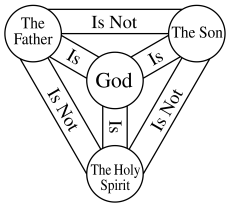
The Lord blesses the sons and daughters of Abraham but they live in a time of famine.
They are rescued by Joseph only to become slave in Egypt.
Led by Moses they escape bondage to wander in the wilderness for forty years.
Joshua delivers them to the Promised Land but they are never really at peace.
There are wars after wars and the so-called “chosen people” lose just as often as they win. They are taken into exile, or forced to wait for loved ones to return home. And when they are reconciled, if ever, peace is the last thing on their minds.
We can read these stories over and over again in the Old Testament, we can encounter those elected and rejected by God, but we don’t have to look far to know that it is true – we war among ourselves all the time; father against son, mother against daughter, brother against brother, sister against sister. And then we still ask, “Are we going to encounter the God of earthquakes, flames of fire, and whirling winds – Is God on our side?” Or, perhaps better put, “When will the Lord finally bless us with peace?”
Psalm 29, the doctrine of the Trinity, they both raise more questions than they provide answers. People like you and me have been struggling with these words and ideas for centuries, we’ve been tugged between the tension and ambiguity of God’s nature in the world and in our very lives.
We worship a God who blesses, but we live in a world where bad things happen to good people nonetheless. There is no easy and satisfying answer to the question of whether or not God takes sides, just as there is no easy and simple analogy for the Trinity.
We may never be able to avoid the confusing nature of faith completely. So much of what we do is based on a premise of mystery – we just happen to live in a world hell-bent on having an answer for everything.
If all this talk of trinitarianism and God’s frightening power seems a bit overwhelming, you are not alone. There are plenty of churches and communities that make this easier on the brain with simple analogies and ignorant assumptions. But there is no way for us to do justice to the marvelous complexity, the community in unity of the divine, without believing in the three-in-one God. We cannot worship God in faith without struggling and wrestling with the question of God’s preferences.
John Wesley, the founder of the Methodist movement struggled with his knowledge of God. He read all the right books and went to the right school, and even became a priest in the Church of England without believing in the faith he preached. He struggled and struggled to the point that when he asked one of his mentors what to do about leading a church without faith his mentor said, “preach until you get it.”
And it was 280 years ago this week that John Wesley wrote something rather remarkable in his diary: “In the evening I went very unwillingly to a society on Aldersgate Street, where one was reading Luther’s preface to the Epistle to the Romans. About a quarter before nine, while he was describing the change which God work in the heart through faith in Christ, I felt my heart strangely warmed. I felt I did trust in Christ, Christ alone, for salvation; and an assurance was given me that He had taken away my sins, even mine, and saved me from the law of sin and death.”
Wesley had spent most of his life looking for God, when in the end God was the one who found him and warmed his heart. That moment changed everything, that society meeting on Aldersgate is largely responsible for the existence of the United Methodist Church today.
God comes to us, all of us, at any time and at any place, as Father-Son-Spirit. For some God flashes forth like flames of fire, and for others God’s flame is found in the warmth of our hearts. God finds us and, contrary to what we might want, God doesn’t answer all of our questions. Yet when God encounters we discover an assurance that this God is with us.
When the far-off One who has been brought near is us, when the wall that has been destroyed is the wall we build in a vain attempt to keep God out of our lives and off our backs, that’s when we start to know the Trinity.
Faith, however, will always remain a mystery. We will find ourselves confused by the God who finds us. Because, in the end, it may simply be too frightening to think about God’s peace, whatever that is. It might be too overwhelming to think that God is not on our side, or worse: God might be on their side.
So on this Trinity Sunday, as we leave scratching our heads, we do so with the hope that God will bless us with true peace – not as we know peace or wish to know peace; a peace that is always defined on our terms. No, this Trinity Sunday, we pray for the peace, the perfect peace, that is known and shared within the Trinity – Father, Son, and Spirit.
And, we may be so bold so pray, that God might warm our hearts in the process. Amen.








 think and let think