Lying Naked On The Floor

strangely-warmed-spreaker-header

This week on the Strangely Warmed podcast I speak with Lindsey Baynham about the readings for the 21st Sunday After Pentecost (Job 23.1-9, 16-17, Psalm 22.1-15, Hebrews 4.12-16, Mark 10.17-31). Lindsey is an ordained elder for the United Methodist Church in the Virginia Conference and currently serves as the Associate Director for Call, Candidacy & Discernment in the office of Clergy Excellence. Our conversation covers a range of topics including the value of vacation, hippos and Harry Potter, vulnerable churches, the divine “yet”, being comforted in isolation, the narrative of salvation history, being bold, talking about $$$ in church, and believing what God can do. If you would like to listen to the episode or subscribe to the podcast you can do so here: Lying Naked On The Floor

Screen Shot 2018-10-08 at 1.49.06 PM

https://www.spreaker.com/user/crackersandgrapejuice/21st-sunday-b

We Need To Talk

Mark 10.2-16

Some Pharisees came, and to test him they asked, “Is it lawful for a man to divorce his wife?” He answered them, “What did Moses command you?” They said, “Moses allowed a man to write a certificate of dismissal and to divorce her.” But Jesus said to them, “Because of your hardness of heart he wrote this commandment for you. But from the beginning of creation, ‘God made them male and female.’ ‘For this reason a man shall lead his father and mother and be joined to his wife, and the two shall become one flesh.’ So they are no longer two, but one flesh. Therefore what God has joined together, let no one separate.” Then in the house the disciples asked him again about this matter. He said to them, “Whoever divorces his wife and marries another commits adultery against her; and if she divorces her husband and marries another, she commits adultery.” People were bringing little children to him in order that he might touch them; and the disciples spoke sternly to them. But when Jesus saw this, he was indignant and said to them, “Let the little children come to me; do not stop them; for it is to such as these that the kingdom of God belongs. Truly I tell you, whoever does not receive the kingdom of God as a little child will never enter it.” And he took them up in his arms, laid his hands on them, and blessed them.

She was almost 8 months pregnant. Her ankles were constantly swollen, the fatigue was nearly unbearable, but every kick she felt made it worth it. She and her husband had prayed and prayed and prayed for this baby, and in a month the baby would finally arrive.

Her parents lived states away, and she and her husband decided she should fly home for a quick weekend, one last chance to spend time with her parents before she herself became a parent.

The airports were challenging as she carried around a bunch of extra weight, but every eye that darted to her belly, and every strangers’ smile was enough to keep her moving forward.

Her parents enveloped their baby girl in their arms knowing that soon they would be grandparents and that their prayers had been answered as well. The time at home was destined to be a joyful reunion filled with the hope of the coming days, weeks, and months.

The day before she was set to fly home to her husband, she sat at the breakfast table with her parents. She held her mother’s hand on top of her belly, hoping for a quick kick that would surely bring forth a tear of unadulterated happiness, when the door bell rang.

In walked a young professional looking man, who walked straight over to hand her a large manilla envelope. But as his eyes moved to her belly, he froze in the middle of the kitchen. He muttered a barely audible, “I’m so so sorry,” deposited the parcel, and walked out of the house.

The parents and soon-to-be-parent slowly opened up the envelope.

Divorce papers.

She was almost 8 months pregnant.

1527686491996

Marriage is weird. Out of all the people in the world, among all of the possible conversations and interactions, some of us are brought together in a way that we believe we should make a covenant to be together for the rest of our lives.

It’s pretty strange when you take a step back to think about it.

I had a professor who loved to say that we always marry the wrong person. Not because there’s anything inherently wrong with the individuals we marry, but that we don’t really know who we are marrying or what marriage really is until we do it.

Marriage is the weird and wild journey of discovering the stranger to whom you find yourself married.

And, for as many marriages as I’ve been blessed to preside over, I can’t help but wonder why people get married at all; particularly today. I’ve heard all of the reasons: “We love each other, “It’s the next logical step in our relationship,” “I can’t imagine marrying anyone else.”

But is that what marriage really is? 

Love and logic ain’t enough.

A successful marriage, whatever that means, will never be contingent on the whims, or the romantic feelings, or the love, of those who are married. Love, as strong as it can be, is not enough to sustain couples in the midst of great tribulation. Love cannot make up for horrible lapses in judgment, terrifying domestic violence, or disturbing amounts of adultery.

Marriage is always about more than love. Marriage requires endurance, patience, hope, conversion, renewal, forgiveness, sacrifice, and reconciliation.

Marriage isn’t easy.

And that’s why more than half of all marriage end in divorce.

In the US the top three reasons for divorce have to do with money, children, and ironically enough, church itself.

All of these particular hangups stem from poor, or totally absent, communication. A couple disagrees about how to budget their money, or one of them gambles it all away without telling the other.

A couple disagrees about how to discipline a child or whether or not to have children at all.

A couple disagrees about the role the church should play in their relationship or their religious convictions can no longer harmonize with each other.

In our country there is one divorce every 36 seconds. That’s nearly 2,400 per day, 16,800 per week, and 876,000 per year.

Divorce is one of the most remarkably prevalent occurrences in our culture and society to the degree that most of us have become numb to it, and we almost never talk about it in church. 

We don’t take it very seriously.

Many are quick to end their marriage whenever the first hiccups are experienced, but as Christians we are called to hear what Jesus had to say about divorce, which can be a bitter pill to swallow.

So, for just a moment, imagine if you were standing up here with me looking out at everyone else. If the church is at all average, half of the married people in the room either have already been divorced, or will be by the end of their days.

Le divorce

That is a frightening reality considering Jesus’ words. 

Some Pharisees tried to test him regarding the law on divorce because Moses allowed men to write certificates of dismissal to divorce their wives. And during the time of Moses, and Jesus, receiving that certificate was just about the worst thing that could happen to a married woman because she would effectively lose all of her rights. She could easily find herself on the street begging for food or prostituting her body for income. 

Jesus was deeply deeply concerned with the marginalized people within his community, and in this particular case women who were handed a signature that destroyed their lives.

Of course, we can all admit that things have certainly changed since the days of Jesus – but maybe they haven’t changed enough.

Jesus’ response to the Pharisees that day is one that still casts a great shadow over families, churches, and communities: “Because of your hardness of heart Moses wrote this commandment for you. But from the beginning of creation, ‘God made them male and female.’ ‘For this reason a man shall lead his father and mother and be joined to his wife, and the two shall become one flesh.’ So they are no longer two, but one flesh. Therefore what God has joined together, let no one separate.”

Jesus talked about this kind of stuff A LOT, and yet we in the church often avoid it at all costs. Probably because half the people in the church have, in all probability, experienced divorce.

But let us at least consider something Jesus said that is of paramount importance: “What God has joined together, let no one separate.”

God is the one who does the joining; we are the ones who do the separating. 

Or maybe a better way to put it is this: Divorce is certainly not what God intends or hopes for, but there are times when there might not be another option. Times of horrific physical abuse, or traumatic adultery, can be nearly impossible to move through, but plenty of people get divorced for some of the most mundane reasons:

“Our interests have grown apart.” “We no longer communicate effectively.” “I’m not in love anymore.”

As long as we are human beings, divorce will be a reality. Which is to say, as long as we are sinners we will sin against each other. However, we worship a God of impossible possibilities who believes in us even when we do not. We follow a first-century Jew who believed in the sanctity of covenants even when we do not live according to them. We are empowered by a Spirit of truth, and renewal, and reconciliation.

Marriage is a strange and serious thing – it is perhaps one of the most strangely serious thing that any of us will ever do.

And we know the strangely serious dimension of marriage because it is one of the preferred metaphors for the relationship between God and God’s people.

Marriage is not normative for Christian people, and is certainly not the expectation. If any us discover someone in whom we believe God can keep us covenanted with, well then good for us. If we find ourselves moving through life without ever coming to altar to make that particular covenant, then good for us too.

But marriage, whether we experience it or not, is something we are all called to know because God has covenanted to remain with us. 

God stands before us again and again knowing full and well how we have failed to respond to the promise. We regularly pursue our own desires, we sin against neighbors, friends, and strangers, and we forget what God was willing, and is will, to do for us.

Jesus was able to speak with such ferocious certainty and conviction about the virtues of marriage because Jesus is the one who holds fast to the covenant even when we do not. It was in holding on to the promise that Jesus found himself nailed to the hard wood of the cross while abandoned by the bride which is the community we call the church.

Marriage is a strange and serious thing. And so is divorce. Which is why we need to talk about it.

In every marriage there is the strange discovery of realizing we don’t really know the person we married. We move through tragedies and hardships, we experience mountaintops of joy and deep valleys of sorrow, and if we are still married in the end it is because we found the true nature of the God of covenant and hope. 

Marriage, though we sometimes forget, is a radical and countercultural endeavor. Jesus subverted the expectations of marriage with the Pharisees because he believed married couples should exists in plains of equity. No longer would the patriarchal norms in which women had no autonomy be present in something like marriage (though we clearly still have work to do).

Marriage has to be more than something that can be ended with a simple piece of paper. But as long as that option remains (as it should in some circumstances) the church is the place where that broken covenant can be redeemed.

After she opened the envelope, it felt like a tornado ran through the house. Every part of her hopes, and dreams, and expectations felt shattered and annihilated. 

The covenant was broken.

She moved back in with her parents for the remainder of the pregnancy, and when the time came to go to the hospital she was surrounded not by her husband, but by her parents and friends. 

Every bit of her life felt lifeless until she held her baby girl for the first time. And though it certainly hasn’t been easy, and she still feels the sting of pain and betrayal and hurt on a regular basis, every time she looks into the eyes of her daughter she discovers something beautiful that came out of the darkness.

Weddings take place in the church because the church is strange compared with the rest of the world. While others might ebb and flow like a kite in the wind, the church stands for something that resists our subjectivity. The church is a willing witness to the sanctity of marriage, particularly in light of Christ’s willingness to beckon us back to the throne over and over again.

The church is where married couples learn what is means to remain faithful to something that they never really could’ve imagined.

The church is where divorced individuals discover a community that will remain steadfast even if their partner didn’t.

The church is also where the sinful partner can one day find a new home and hope of redemption on the other side of repentance.

The church is where single people who never feel called to the covenant of marriage embody similar covenants with their brothers and sisters in Christ.

The church is where the virtues of marriage and the destructive nature of divorce can be laid on the throne because being together is never really about us; it’s about God. Amen. 

We Are What We Eat

John 21.9-17

When they had gone ashore, they saw a charcoal fire there, with fish on it, and bread. Jesus said to them, “Bring some of the fish that you have just caught.” So Simon Peter went aboard and hauled the net ashore, full of large fish, a hundred fifty-three of them; and though there were so many, the net was not torn. Jesus said to them, “Come and have breakfast.” Now none of the disciples dared to ask him, “Who are you?” Because they knew it was the Lord. Jesus came and took the bread and gave it to them, and did the same with the fish. This was now the third time that Jesus appeared to the disciples after he was raised from the dead. When they had finished breakfast, Jesus said to Simon Peter, “Simon son of John, do you love me more than these?” He said to him, “Yes, Lord; you know that I love you.” Jesus said to him, “Feed my lambs.” A second time he said to him, “Simon son of John, do you love me?” He said to him, “Yes, Lord; you know that I love you.” Jesus said, “Tend my sheep.” He said to him the third time, “Simon son of John, do you love me?” Peter felt hurt because he said to him the third time, “Do you love me?” And he said to him, “Lord, you know everything; you know that I love you.” Jesus said to him, “Feed my sheep.”

My first Sunday at Cokesbury felt like a whirlwind. I remember being extremely nervous and trying desperately hard to remember every name that I heard. I remember praying out in the narthex that God would make something of my nothing. I remember worrying about whether or not all of you would laugh when I made a joke about being closer in age to the youth than to almost everyone else.

But I also remember feeling like I blinked and the worship service was over and all of the sudden I was upstairs sitting at a table with my wife and son, wondering what had just happened. People were milling about, waiting to eat their food, when someone motioned for me to stand up and pray, so I did.

I don’t remember exactly what I said, but it was probably something like, “Lord, bless the food we are about to receive that it might nourish our bodies for your service. We are grateful for the land that it came from and the lives that were sacrificed for it. Please help us be mindful of those who do not have food like this, and friends like these. Amen.”

And like the words implies, with the “amen” everyone promptly dug into all of their food.

Food_Spread_jpg_1509425743

But, anyway, after eating there was some time for questions and answers. I don’t remember any of them. Though I do remember that after all was said and done, somebody came up to me and asked, “Are you going to pray like that before every meal?”

I wasn’t sure how to respond, but I asked if I misspoke during the prayer, after all it was a rather overwhelming day. And they said, “I don’t like thinking about things dying just so I can eat.”

When we eat, we are doing something remarkably profound. It is always more than satiating the hunger in our bellies, it is always more than moving our mandibles to chew, it is always more than a perfunctory necessity. For us to eat – others have to die.

But many of us, including that person my first Sunday, don’t like confronting the profound reality of our eating and our food. We’ve grown content with the ultra-commodification of our eating whereby we can get anything we want, whenever we want it. 

And we don’t have to think twice about where it came from, or what it took to get to us.

Food is important! No only because without it we die, but because our food, and how we eat it, says so much about who we are, what we believe, and what we value.

Just about every religious system in the world have some sort of rituals, or rules, or expectations about food. In Buddhism vegetarian diets are desired, in Hinduism beef is prohibited, in Islam and Judaism the consumption of pork is not allowed, and in Christianity, we believe Jesus is the bread of life.

Food is important!

And yet here, in America, our connection with and to our food is one that has altogether lost its sacredness.

20% of all American meals are eaten in car. That means the average American eats at least one meal in the car every other day. And the overwhelming majority of those meals are consumed alone.

1 out of every 5 children will go hungry, multiple days without eating, at least once a year. And among Black and Latino children the rate is 1 in 3.

And somehow (!) we throw away more than 40% of our food every year – a waste of $165 billion annually. 

We have such little respect for the food we eat, and don’t eat apparently, that we rarely even think about it. And those who hold the power and economic dominance in food production have convinced us that we should prefer food that is already prepared. Countless companies will grow, deliver, and cook food for us (just like out mothers) and convince us to eat it. That they do not yet offer to insert it, pre-chewed, into our mouths is only because they have found no profitable way to do so.

Food, though theologically and biologically important, has become just another chore on our never-ending to-do lists and with every passing year our kitchens more and more resemble filling stations, just as our homes more and more resemble motels.

Eating food is one of the most primal and basic and simple ways we learn to delight in each other, and in the goodness of God’s creation. 

Eating with other people is without a doubt one of the most important and practical ways by which we overcome the barriers of ignorance that separate us from one another.

We are what we eat.

Or, perhaps a better way to put it would be: we are consumed by what we consume.

0e1403179_sermon-series-header-simple

It was on the other side of Easter when the disciples were out fishing one night, and when they returned to the shore in the dim morning light, they saw a man standing by a charcoal fire. They know, or maybe they don’t know, that its the resurrected Jesus, and he has decided to make them breakfast on the flames – bread and fish.

We know that they ate, but we know nothing of what they talked about during the breakfast chatter – but when the food was finally consumed, Jesus asked Peter three times about his love.

Three times in order to redeem the three denials of Jesus prior to his crucifixion.

And as Peter’s frustration grows with the persistent line of investigation, Jesus’ resolve remains steadfast – Feed. My. Sheep. 

The food by the shore is simple, it is local, it is fresh. And it is after consuming the food that Peter is in the place to be redeemed – to be turned back to the Lord from his wanderings. It is in the call to feed the sheep, to feed the disciples, perhaps both literally and figuratively, that Peter returns to the fold of discipleship.

This story, this little vignette by the charcoal fire, is a prelude to what we do at this table, God’s table, when we commune with one another and the Lord. As we break bread we are being warmed by the fire lit by Jesus, we are filled with the bread of life to do the work of God in the world, and we are made right in our willingness to answer Jesus’ question.

Jesus knew that one of the quickest ways to our hearts is through our bellies. And there is a vulnerability, strangely enough, that comes with food and with gathering around a table together. Taking the time to make a meal, whether simple or complex, shows a deep love for whomever we are cooking.

I imagine that many of us can remember profound moments from our lives, little windows of profound change and discovery, that came around a table with food.

And yet, we are eating around the table with others less and less. We see our eating and our food as another notch on the check-list instead of the life-giving and transformative moment by the seashore.

Because this table, in this sanctuary, is not the only table where we break bread and discover the presence of the Lord. This table extends far beyond the confines of our church and is available and manifest whenever we gather to eat.

As I noted at the beginning of the sermon, and every sermon this month, we have been taking time to encounter the simple qualities of complex realities, but we have also been leaving each Sunday with a challenge.

This week we are encouraging everyone to invite someone over to eat.

The meal can be as simple as cold cut sandwiches or as complicated as a five-course meal, it doesn’t really matter (though the more intentional you are with the food the more your guest will feel the love). But we are asking everyone to consider a person, family, neighbor, co-worker, whatever and invite them over for a meal. 

That might sound overly simple but that’s kind of the point. We want everyone to consider how their tables are an echo of this table right here and how gathering at home for food with others is a foretaste of the new heaven and the new earth.

And so you can leave it right there, invite someone over for a meal, or you can take it a step further by going through all of the food you currently have – in the fridge, in the freezer, in the pantry – remove anything that is expired, and donate everything you know you won’t actually eat. And then map out all of your meals for the following week. Instead of resigning yourself to picking up a prepared meal, imagine taking the time and energy to make a least one meal a day. 

And finally, if you want all the extra credit you can muster, having already invited someone to your table and then reimagining all the food you have, invite someone to eat at God’s table. It can be the person, or family you invited to you house, or someone completely different. But if we believe that what we do at this table is absolutely transformative and all powerful, then find one person to invite next Sunday when we will gather at this table yet again.

Because here, around the bread and the cup, we are truly consumed by what we consume. As we feast we are not individuals daydreaming about our own salvation, in communion we are absorbed into something much larger than our individual identities.

gwb69HQ2Th65lhyMqck8_Communion-JT-Blog-Image 

This is something we do, together.

As Christians, strangely enough, we believe that through eating we become the body of Christ and that entails a willingness to be food for others. 

Just as we are fed, so too we feed those around us.

This table, any table, is an opportunity to meet the risen Lord by the fire beckoning us to another meal in which we become what we eat. Amen. 

Good Job Jesus

strangely-warmed-spreaker-header

This week on the Strangely Warmed podcast I speak with Peter Kwon about the readings for the 20th Sunday After Pentecost (Job 1.1, 2.1-10, Psalm 26, Hebrews 1.1-4, 2.5-12, Mark 10.2-16). Peter is one of the associate pastors at Annandale UMC in Annandale, VA. Our conversation covers a range of topics including being single and ready to mingle, shout outs to staff, the authority of God in Job, reading canonically, tests, looking for Moses in the New Testament, the absence of angels, and talking about divorce in the church. If you would like to listen to the episode or subscribe to the podcast you can do so here: Good Job Jesus

Screen Shot 2018-10-01 at 10.07.29 AM

Please, Just Don’t Do That

strangely-warmed-spreaker-header

This week on the Strangely Warmed podcast I speak with Peter Kwon about the readings for the 19th Sunday After Pentecost (Esther 7.1-6, 9-10; 9.20-22, Psalm 124, James 5.13-20, Mark 9.38-50). Peter is one of the associate pastors at Annandale UMC in Annandale, VA. Our conversation covers a range of topics including what its like to work with the Tamed Cynic, Esther’s faithfulness, going ham, God playing favorites, divine intervention on a tennis court, sharing the work of the kingdom, and Jesus’ use of hyperbole. If you would like to listen to the episode or subscribe to the podcast you can do so here: Please, Just Don’t Do That

pk


Just Do It

Matthew 6.9-13

Pray then in this way: Our father in heaven, hallowed be your name. Your kingdom come. Your will be done, on earth as it is in heaven. Give us this say our daily bread. And forgive us our debts, as we also have forgiven our debtors. And do not bring us to the time of trial, but rescue us from the evil one. 

For the month of September we’re keeping things simple – though, when in the church is anything simple? When in our lives is anything simple? Well, we’re going to try and bring some simplicity in the midst of all our complexities each Sunday till the end of the month.

The whole series is focused on the materially simple life that Jesus led, taught, and exemplified. And, each week, we’re going to have a challenges that accompany our worship.

The first week we were challenged to spend time every day being grateful for our time. The second week we had a clean out challenge where we reflected on what really matters in our lives. And last week we were asked to take a look at our finances and imagine ways to be more faithful with our money. 

Today we’re moving on to the subject of prayer. 

The bible spends a lot of time addressing a great number of topics, but time, possessions, money, prayer, and food are the topics that Jesus talked about the most. And, when Jesus addressed these issues for the people of his days, he came at all of them with an air of simplicity that is often lost in the church today.

0e1403179_sermon-series-header-simple

There was a time before I was your pastor.

I spent a summer in Detroit Michigan helping a church and I was asked one Sunday to be the guest worship leader and preacher at a church downtown.

My answer was, “Yes! I’m 23 years old and I have no idea what I’m doing!”

I wrote a perfect 2,000 word sermon, and when the Sunday arrived I put on a suit and a bow tie.

The church was a gothic-like cathedral with massive stained glass windows made by Tiffanys. When I reached for the door it was locked and I had to wait for someone to show up and let me in.

No one spoke to me, there was no bulletin, so I just sat down by the altar.

I realized quickly that this church was no how I imagined it would be. Not only was I the most over-dressed person there, I was also the only white person.

A group of women joined me by the altar and they just started singing a hymn. And when they finished they started a second. And when they finished that one they started singing a third. 

An older gentleman slowly made his way to me down the center aisle and shouted, “Son, if you don’t say something, they ain’t gonna stop singing.”

I had never been to a black church before and it was a very difficult experience. In the white church I grew up in, the expectation was silence while the preacher preached. But in the black church this is quite the opposite.

So I pulled out my sermon, and I tried to preach it the way I thought sermons were meant to be preached: “The Lord has gathered us here today for his most divine Word, that it might dwell in our soul.”

And a lady in the front row shouted, “Lord!”

And I thought, wow, I’m pretty good at this preaching thing – so I kept it up.

“The God above has been so good to us.”

“Lord!” She shouted again.

And I just kept preaching like a fool until she said, “Lord! Please help this young man!”

She was praying. For me! And I needed it.

So with her final and desperate prayerI took off my suit jacket, untied my bow tie, threw the sermon off the pulpit, walked down into the midst of the people and I said, “My name is Taylor, and I want to tell you about a story from the Bible that changed my life.” And then I did.

At the end, when I said “amen,” they all did too.

2-Reasons-Why-Prayer-is-a-Waste-of-Time

Prayer is at the heart of the Christian life. It is something Jesus consistently did throughout the gospels, it is something we do here every single week, and I would venture to guess that most of us here, in a variety of ways, pray every day.

But prayer, with all of its prevalence in the church is something we don’t really talk about. Sure, we might do it, but what is the it we are doing?

Prayer is simply communication with God, though it can take place in a variety of ways – They can be spontaneous, or read entirely from a text, or it can just be silence. It is time apart from the regular movements of life to commune with the Lord is such a way that our needs, desires, and hopes are expressed while recognizing the immense wonder of God through whom we receive our blessings.

Prayer is the powerful means by which we discover who we are and whose we are.

For as long as I can remember I have been the de facto pray-er at all of my family functions, and this began long before I was a pastor. I’m not sure what granted me this responsibility, but it has surely been mine. And frankly, I don’t feel like I’m all that good at it.

Even though it is at the heart of so much of what I do, I still feel like being asked to pray is like being asked to be pious for just 30 seconds, and I can’t help but feel like sometimes it falls flat.

How would any of you feel right now if I asked you to stand and pray on behalf of the whole church? Where would you begin? 

For many of us prayer feels like the burden of pretending to be more faithful than we really are. We supplement words in our prayers that we would never otherwise use, and when we’re done we can’t help but wonder where all of that actually came from. 

Praying off the cuff is no easy thing because we’re often made to feel like it has to be a certain way, or at least sound a certain way, when the truth of prayer is that it is nothing more that learning to speak with, to, and about God.

God doesn’t need our protection, nor does God need our deception. God can take us and our prayers just as they are because God can handle us. We don’t need to curtail how we are feeling, or defer from the truth of our reality, we can be more honest with God than anyone else. 

Just read some of the psalms, they don’t hold their punches.

God does not want us to come to the altar, or clasp our hands together, differently than from how we live the rest of our lives – the truest and holiest prayers are those that sound like we’re talking to a friend.

And yet, for some of us, this will still be a challenge. Confronted by the sheer and stark reality of being in a space all alone, talking to God who might feel far away or silent, we don’t quite no what to say.

And that’s okay.

Because even though prayer is at the heart of what it means to be a disciple, that doesn’t mean we have to do it on our own, or off the cuff – some of the most important and life-giving prayers are those written long before we arrived.

We can pray like first disciples: Our Father, who art in heaven, hallowed be thy name…

Or pray like St. Francis: “Lord, make me an instrument of your peace. Where there is hatred, let me sow love. Where there is injury, pardon. Where there is doubt, faith. Where there is despair, hope. Where there is darkness, light. Where there is sadness, joy. O Divine Master, grant that I may not so much seek to be consoled as to console, not so much to be understood as to understand, not so much to be loved, as to love; for it is in giving we receive, it is in pardoning we are pardoned, it is in dying that we are awake to eternal life.”

Or we can even pray like Jesus: “Father, for you all things are possible; remove this cup from me; yet, now what I want, but what you want.” Or, to put it another way, “Let thy will be done.”

We, like countless Christians before us, can rely on the prayers of the saints to give voice to our feelings and needs that are difficult to articulate. We can lean on them, because they leaned on the Lord to pray the prayers they prayed.

But, of course, we can also pray our own prayers, and by we I really mean we. Notice, the Lord’s Prayer, the text read for us today and the prayer we pray in this room every week is not, “My Father who art in heaven.” It is, “Our Father.” The language of the prayer is decisively communal and met to be prayed as such.

And that’s exactly what we’re going to do right now. 

In just a moment I’m going to break us up into small groups here in the sanctuary, and each group will be responsible for writing a prayer together, a simple prayer that could be prayed by anyone in the group. And once we’ve all had the time to work together and come up with something, each group will need to select a pray-er who will stand and pray the prayer on behalf of the group…

Amen. As I noted at the beginning the sermon, each Sunday this month we are taking the time to encounter the simple qualities of complex realities, but we will also have challenges that accompany our worship. And I know, that for many of you, what we just did was enough of a challenge, but we’re going to keep the theme going.

This week we are encouraging everyone to pray daily.

You may take the prayer that you just wrote with your group, or you may write your own, or you may use another prayer like the Lord’s Prayer or any other and we would like you to pray that prayer at least twice a day: when you wake up and before you fall asleep.

That might sound overly simplistic, but that’s the point. We want to consider how different our days would feel and become if we began and ended them in prayer, knowing that even if the words are not our own, they may at least convey some sense of who we are, and whose we are.

And so you can leave it right there, praying a simple prayer at least two times a day, or you can take it one step farther, and find at least one person this week, and ask how you might pray for them. Listen to their concerns or joys, and then rather than praying about it when you get home, take them by the hand and pray right then and there. Because the truth of prayer is that sometimes people need people like us who can pray on their behalf when they do not have the strength, nor the words, to do it on their own.

And, if you want serious extra credit, find at least one person this week, and ask them to pray for you. For many of us, the call to pray for someone else is good and fine, but the hardest thing of all is admitting that we need to be prayed for as well. So find someone who love and trust, and humbly ask them to pray for you.

And now, let us pray, Our Father…

Charm Is Deceitful

strangely-warmed-spreaker-header

This week on the Strangely Warmed podcast I speak with Alan Layman about the readings for the 18th Sunday After Pentecost (Proverbs 31.10-31, Psalm 1, James 3.13-4.3, 7-8a, Mark 9.30-37). Alan serves as the pastor of Grace UMC in Parksley, VA. Our conversation covers a range of topics including pastoral titles, staying connected in a global movement, senior superlatives, wicked advice, true prosperity, faithful habits, visions of the kingdom, the absence of the devil, and hot dogs with popsicles. If you would like to listen to the episode or subscribe to the podcast you can do so here: Charm Is Deceitful 

allll

In God We Trust

Mark 12.38-44

As he taught, he said, “Beware of the scribes, who like to walk around in long robes, and to be greeted with respect in the marketplaces, and to have the best seats in the synagogues and places of honor at banquets! They devour widows’ houses and for the sake of appearance say long prayers. They will receive the greater condemnation.” He sat down opposite the treasury, and watched the crowd putting money into the treasury. Many rich people put in large sums. A poor widow came and put in two small copper coins, which are worthy a penny. Then he called his disciples and said to them, “Truly I tell you, this poor widow has put in more than all those who are contributing to the treasury. For all of them have contributed out of their abundance; but she out of her poverty has put in everything she had, all she had to live on.”

For the month of September we’re keeping things simple – though, when in the church is anything simple? When in our lives is anything simple? Well, we’re going to try and bring some simplicity in the midst of all our complexities each Sunday till the end of the month.

The whole series is focused on the materially simple life that Jesus led, taught, and exemplified. And, each week, we’re going to have a challenges that accompany our worship.

The first week we were challenged to spend time every day being grateful for our time. Last week we had a clean out challenge where we reflected on what really matters in our lives.

Today we’re moving on to the subject of money. 

The bible spends a lot of time addressing a great number of topics, but time, possessions, money, prayer, and food are the topics that Jesus talked about the most. And, when Jesus addressed these issues for the people of his days, he came at all of them with an air of simplicity that is often lost in the church today.

Truly I tell you, this poor widow has put in more than all those who are contributing to the treasury. For all of them have contributed out of their abundance; but she out of her poverty has put in everything she had, all she had to live on.

0e1403179_sermon-series-header-simple

The church was in the midst of a stewardship drive and the finance committee could not stop arguing. Every Sunday they bickered in the hallways and in the narthex fighting about who they could hit up for more money this year, about how much they would need to raise in order to buy new candlestick holders for the altar, and about whether the pastor should know who gives and how much.

Finally they called for a formal meeting on a Sunday evening and after 3 hours of more shouting, disagreeing, and even some belittling, they ended only to have the frustrations spill out into the parking lot as everyone was preparing to leave.

However, sitting outside the front doors of the church was a homeless man holding out a styrofoam cup hoping for donations. He had been there for most of the afternoon, hopeful for any gift, and he could not help from overhearing the church folk arguing inside and out the parking lot.

After some time has passed, the man stood up from his spot and he meandered over to one of the older women with her hand placed perfectly on her hips, he reached out for her hand, dumped the few dollars and space change he had received, and said, “You clearly need this more than I do.”

69374

Money! Everyone’s favorite subject in church! In ranks up their with politics and sexuality! I can tell that you all have just been on the edge of your pews all morning waiting to hear what I have to say like a bunch of kids on Christmas morning.

Money! The American Dream! So many of us came of age in a world, in a culture, that told us this dream was possible – a desire for achieving material possessions and deeper bank accounts. We hope to pursue more than we have, to gain more than we have, and to save more than we have.

And, importantly, most of us tend to measure our success based on the number in our bank accounts.

But, and this is a big but, for a lot of us the American Dream feels like the American Nightmare.

For as much hope as we might have for a day in the future when all of our finances will be taken care of, there’s plenty in the present to worry us. There was a study recently that noted at least 80% of Americans are stressed about the economy and their personal finances – more than half are worried about being able to provide for their family’s basic needs, 56% are worried about job security, and 52% report lying away at night thinking about their bank accounts.

That might not sound all that surprising to any of us here, because honestly, who among us hasn’t worried about money?

How about this then – in 1990 the average credit card debt in America was $3,000 and today it is well over $9,000. And that doesn’t include mortgages, student loans, or medical debt.

For many of us The American Dream has become The American Nightmare when it comes to money and finances. So so so many of us are unwilling to delay gratification and we use tomorrow’s money to finance today’s lifestyle. Few us us save money appropriately because we keep thinking that tomorrow won’t come. 

But then it does.

Over and over again.

Jesus was teaching in the temple when he warned everyone with ears to hear about the religious elite. 

“Watch out for those scribes and priests – you know, the ones who like to walk around in long robes and get all the respect in public, the preachers who like to gets the seats of privilege. They are the type of people who prey on the widows and the poor and for the sake of appearances will fill their prayers with big and long words. Watch out for them.”

Then Jesus immediately gathered the crowd around the treasury and they watched as people filed in line to drop of their donations. Many rich people proudly walked ahead to make the donation as public as possible, but then a poor widow shuffled over and put two small coins in the treasury, two coins that amounted to a penny. 

Jesus pulled his disciples close and said, “That poor widow put in more than all the rest who are contributing to the treasury. The rest of them gave out of their abundance; but she out of her poverty has put in everything she had: her whole life.”

In life, few of us have any use for hypocrites. Those people who are pretentious and show off their status only to draw more attention to themselves at the expense of the less fortunate – like politicians making great sums of money while complaining that it’s not enough to live on – like pastors urging their congregations to make financial commitments while they themselves offer nothing.

Today we’re obviously talking about money, and the text makes it quite difficult to make a case for giving it to church. 

Because we can take the story of the widow at face value – she truly sacrifices. She is the example upon which Jesus makes a theological claim. But let us not forget that her gift is considered far greater than greater sums of money not because of the amount but because of her generosity.

umns12_099_1-606x388

And that’s why we have to sit with something rather uncomfortable before we jump to the simplicity of money, which of course is no simple thing. It is good and right for us to rest in the tension of the text read for us today because this is about more than just encouraging extravagant generosity – it is an indictment, plain and simple, against any institution (including our own) that results in a poor widow giving all she has so that the leaders can continue to live lives of wealth, comfort, and power.

We might leave church today feeling guilty about the money we give (or don’t give), we might feel apathetic about what our contributions can really do for our church or for our community. But perhaps the most appropriate feeling might be outrage; outrage toward any system that appropriates the property of the poor and near-destitute in order to perpetuate wealth for the elite.

Ask any pastor and they’ll tell you the best givers in the church are almost always the poorest. It’s those on limited and fixed incomes who are usually the first to tithe, but the wealthy and elite, those with gifts to share, have a harder time with it.

Maybe you’ll be surprised to hear, or maybe you won’t, that there are more than 950 billionaires in the world and yet the percentage of giving among the majority of the billionaires does not rise above the single digits.

By the time Jesus encountered this scene by the treasury, the whole religious apparatus was perverted. The operators lived privileged lives, and the poor, widowed, orphaned, and marginalized were no longer protected.

And today, sadly, some things haven’t changed.

I was out of the office for two days this week between clergy meetings and hospital visits, and when I checked the church voicemail on Thursday morning we had over twenty messages, twenty messages in two days, from people in our immediate community who needed financial help – a rent payment, a overdue electricity bill, grocery money.

And I wish, I wish, that we could give money to every single person who called. I wish that my days were primarily filled with making sure that people could stay in their homes, that those homes could keep the lights on, and that the refrigerators were well stocked. 

But we can only use what we are given.

And so, from this story of Jesus and the widow, from the reflections on the church’s, and any institution’s, temptations to prey on the weak, it’s quite difficult and problematic for someone like me, part of the religious elite, standing in my long robe, to build a case for why the church is worthy of the gifts of its givers.

The church is only worthy when we use the gifts as Jesus commands.

As I noted last week and at the beginning of this sermon, each Sunday this month we are taking the time to encounter the simple qualities of complex realities, but we will also have challenges that accompany our worship.

This week we are encouraging everyone to budget their money.

For a long time there’s been an 80-10-10 focus on finances in which you spend 80% of your money on what you need to live, you save 10% for the future and unanticipated emergencies, and 10% is given away. So the challenge is to sit down with your finances and start thinking about what it would take to break it all down into something close to the 80-10-10 model.

But, of course, tithing is really hard. It simply may not be possible for you to give 10% away. However, it is helpful to think about your generosity in terms of a total value instead of an occasional offering. As in, what does 2% look like for you? Or even 5%?

And you can leave it right there, a relatively simple thought experiment, or you can take it one step farther and take a good look at whatever debt you might have and make a plan to repay it. If you are anywhere near the average $9,000 in credit card debt, and you only make the minimum payment every month, it will take something like 200 years before it will all go away. So look at what is owed, and make a budgetary plan to star chipping away at it so than it no longer grips your around your soul like a shackle, so that you never wander over to the offering plate and have to give away your entire life at the value of a penny. 

And, if you want serious extra credit, you can bring back a commitment card next week (found in your bulletin). It is something to prayerfully consider and fill out, a commitment of giving to the church so that no widow in our community will be forced to give away her very life at the expense of her life being ignored.

A lot of us have a warped understanding of what faithful giving looks like. We think that if we give, then God will give more back to us. But that is not how it works. We do not give to God in order to get something in return. 

Do you think the widow at the treasury believed that if she just kept giving everything that she would one day wake up with an overflowing bank account? 

We give to God simply because God has given to us. We believe that when we give it blesses not us, but others. And then, of course, it is in the blessing of others that we are blessed.

The church is not perfect. After all, it’s filled with broken people like you and me. 

But we believe in having transparency in our finances and we are committed to serving those in need. 

We believe in the power of the blessings God has given us to bless others. 

And we believe that by returning to God what belongs to God, we take steps toward making the kingdom incarnate on earth. Amen. 

Enough Already!

Matthew 6.19-21

Do not store up for yourselves treasures on earth, where moth and rust consume and where thieves break in and steal; but store up for yourselves treasures in heaven, where neither moth nor rust consumes and where thieves do not break in and steal. For where your treasure is, there your heart will be also.

For the month of September we’re keeping things simple – though, when in the church is anything simple? When in our lives is anything simple? Well, we’re going to try and bring some simplicity in the midst of all our complexities each Sunday till the end of the month.

The whole series is focused on the materially simple life that Jesus led, taught, and exemplified. And, each week, we’re going to have a challenges that accompany our worship.

The bible spends a lot of time addressing a great number of topics, but time, possessions, money, prayer, and food are the topics that Jesus talked about the most. And, when Jesus addressed these issues for the people of his days, he came at all of them with an air of simplicity that is often lost in the church today.

The man lived a good and faithful life. He had a loving family, a lucrative career, and he was in church nearly every single Sunday.

As he got closer to the end of his life, he heard God speak to him one day. “You have been good and faithful” boomed the voice from beyond, “and though I don’t usually do this, I’m going to grant you a special dispensation. When you die you may bring a briefcase full of whatever you want to heaven.

The man was overwhelmed by the generous act of God, but the more he thought about it, the more he realized he had an incredibly difficult decision to make. Most night he laid awake staring at the ceiling running through his possessions in his mind until, after months of deliberation, he came to a decision.

When his days came to an end, he found himself standing in line outside the pearly gates with a great assortment of people. Though, unlike anyone else, he held a briefcase in his hand. The whispers and stares followed him all the way through the line until he stood right before St. Peter.

The first disciple asked, “What’s that in your hand?”

The man proudly retorted that he and God had come to an agreement and that he was able to bring a briefcase to heaven.

Peter jumped up off his cloud, and clasped his hands to his mouth. “So you’re the one! The angels and I have been talking about you for a long time, and we’ve got a pretty good pool going about what’s inside. So, do you mind? Can I take a peak?”

The man beamed with bride as he laid the briefcase on the ground and opened it up.

Gold bars.

MW-FP824_gold07_20170706203004_ZH

Of all the things the man could’ve picked, among all his possessions, he decided to bring a few gold bars.

He looked up at Peter excited to see the look on his face, but Peter just raised an eyebrow and said, “Asphalt?”

Because, you know, in heaven the streets are paved with gold…

Do not store up for yourselves treasures on earth! Friends, Jesus is speaking to us throughout the centuries and the time has come for all of us to close our bank accounts, empty out all of our garages and attics, and start saving in heaven!

Right?

We’re going to spend more time talking specifically about money next week, but today we are talking about possessions, and specifically how possessed we are by our possessions. 

Check this out: Did you know that here in the United States there are more self-storage facilities than Starbucks and McDonalds combined!?!?

Think about that for just a moment, think about how you can’t go anywhere around here without the coffee seller or the golden arches, and yet there are more self-storage facilities!

The amount of space in our self-storage facilities is so ridiculously large in fact, that we could fit every man, woman, and child inside of them with room to spare.

And of the people who own a storage unit, the majority of them have both attic space and garage space at home.

Possessions

I joked months ago that this church has a storage problem because we simply had too much stuff. And so we decided to take a day to go through most of the items we had stored just to start clearing things out – Friends we had more ziplock bags full of dried out markers than I could count – we had Vacation Bible School materials from 20 years ago – we have copies of every bulletin this church has ever used. EVER.

The church is not immune to the problem of possessions.

Jesus’ little vignette in which he lays out the dilemma is one that I’m sure most of us are familiar with – but there’s some subtle wordplay that we miss. Because, in English, we translate Jesus’ words as, “Do not store up for yourselves treasures on earth.” But in Greek it reads more like, “Do not treasure up your treasures.”

But why not? What’s so wrong with working hard to accumulate possessions? What’s the problem with running out of space to store all of our stuff? 

Well, Jesus would have us remember that treasuring up all of that treasure ultimately leads to its demise. Moths, rust, and thieves will consume all that we save is we treasure it away. 

And we’ve got to hand it to Jesus on this one – he’s right. The more we accumulate, the more we store, the more we possess, the more the dust accumulates, the more we run out of space, the more we can’t even really remember what’s in the bottom of that box on the far side of the garage.

But Jesus is also pushing us to a different understanding as well. He’s not just gathering the disciples around for a little advice on how to be mindful of the fragility of our possessions, but its also a lesson in the theological ramifications of treasuring up our treasures.

It, the struggle with possessions, runs throughout the scriptures. Abraham desperately wants a son, someone to pass his possessions on to. The Hebrews are delivered from slavery in Egypt only to think back on all the stuff they left back in Egypt. After entering the Promised Land, the people of God habitually lament losing the thing they care about most over and over again – not their relationship with God, but all of their stuff back in Jerusalem.

Even in the New Testament, the rich young ruler, James and John, Ananias and Sapphira, they all experience the loss (or potential loss) of worldly goods and it just about undoes them. 

Having stuff, accumulating possessions, isn’t a sin. Our things can be used for both good and evil. It’s when the love of our stuff, when we feel an intense desire to lock it up and away, that we become blind from other things in our lives. And, God forbid, we start encroaching on a slippery slope that seems to never end.

First we possess something we truly desire – but then when we see what other people have and we start doing whatever it takes to get it. It’s why the line for new iPhones every fall stretches far beyond every Apple Store.

Then, whenever we acquire the item that was pulling at our heart strings, we intensely desire something else or more of the original item and we are less inclined to share what we have. It’s why we find ourselves trading in a car for the updated model when nothing is really wrong with out current mode of transportation.

And finally we just keep consuming one thing after another, even when we are beyond full. It’s why the self-storage business is a multi-billion dollar industry and we wind up buying space just to have room for all of our stuff.

But don’t we have enough already? Are we so discontented by our stuff that the only remedy is more of it? Do we possess our possessions, or are we possessed by our possessions?

Here’s a dose of some hard truth – at the end of our days, everything goes into a box. A box that’s about 7 feet long and 2 feet wide. And we can’t take anything else with us.

Do not treasure up your treasures on earth, but treasure up your treasures in heaven. Some will say that Jesus is pleading with his followers across the sands of time to treasure up our treasures in heaven by giving money to the church. And, though you can take it that way, I think Jesus is being a little more subtle. As the King of the Kingdom, as the one inaugurating the new way, Jesus knows that when we treasure up our treasures on earth, they no longer make a difference, and they start to weigh us down.

But by treasuring up our treasures in heaven, by knowing what really matters and what really doesn’t, we are freed from the tyranny of sinful accumulation and we start to see and know that we are God’s treasure.

Because, God’s heart is with us.

As I noted last week and at the beginning of this sermon, each Sunday this month we are taking the time to encounter the simple qualities of complex realities, but we will also have challenges that accompany our worship. Last week we were tasked with taking time everyday to be grateful by our time. This week we have a clean out challenge.

0e1403179_sermon-series-header-simple

We are asking that everyone set aside some time this week to get rid of some stuff. In my house we have a drawer that has a little bit of everything in it, and maybe you have one like that, and perhaps thats the project you want to tackle. Take out the drawer, go through every item, and really ask yourself whether you need it or not. If the items you discard can be used by someone else, then take them to a local goodwill or salvation army, if they can be recycled then recycle them.

Pick one drawer, one box, one closet – it doesn’t matter what it is, but go through it and get ride of some of your possessions. That might sound overly simplistic, but that’s kind of the point.

With the crazy and ridiculous ways that we are accumulating far more items than we could ever possibility need, too many us us are are focusing on earthly things instead of heavenly things.

So you can keep it as simple as cleaning out one place, one depository of items. Or you can take it a step farther and clean out an entire room – going through every drawer, every box, every shelf while asking what of all the items are actually giving you life, and which are holding you back.

Or you can even take it one step farther and pick out individuals whom you know would be blessed by some of your possessions. Instead of taking it to a local donation place, bring them to someone you know would love it and let them experience something that used to bring you life and joy. 

As we hear about the perennial struggle with possessions, as we begin to imagine that space in our homes that is overrun with stuff, we might become so bogged down in our worry and fear and attachment that we forget how God was willing to part with God’s greatest possession.

Because, strangely enough, God’s greatest possession, God’s beloved, is Jesus Christ. And, in God’s great and perplexing wisdom, God chose not to treasure up God’s greatest treasure but instead decided to give it away on our behalf. 

We know where God’s heart is because we know Jesus Christ and him crucified. 

We know how much of a challenge this will be because we find ourselves surrounded by mountains of stuff that shackle us to limited visions of reality. 

We know the frightening dimension of giving away our possessions because as Christians we regularly encounter the knowledge of God’s profound generosity in the gift of his only begotten Son.

Do not store up for yourselves treasures on earth, where moth and rust consume and where thieves break in and steal; but store up for yourselves treasures in heaven, where neither moth nor rust consumes and where thieves do not break in and steal. For where your treasure is, there your heart will be also. Amen. 

Unbelievable – A Wedding Homily

Mark 12.28-34

One of the scribes came near and heard them disputing with one another, and seeing that he answered them well, he asked him, “Which commandment is the first of all?” Jesus answered, “The first is, ‘Hear, O Israel: the Lord our God, the Lord is one; you shall love the Lord your God with all your heart, and with all your soul, and with all your mind, and with all your strength.’ The second is this, ‘You shall love your neighbor as yourself.’ There is no other commandment greater than these.” Then the scribe said to him, “You are right, Teacher; you have truly said that ‘he is one, and beside him there is no other’, and ‘to love him with all the heart, and with all the understanding, and with all the strength,’ and ‘to love one’s neighbor as oneself,’ – this is much more important than all the whole burnt offerings and sacrifices.” When Jesus saw that he answered wisely, he said to him, “You are not far from the kingdom of God.” After that no one dared to ask him any question.

40684568_10212376518199726_3208500454564560896_n

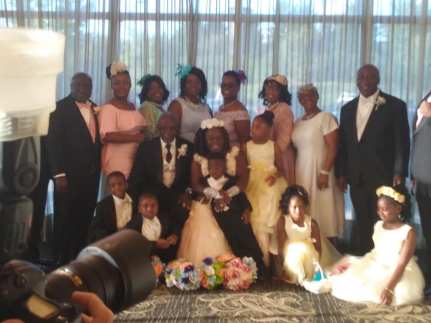
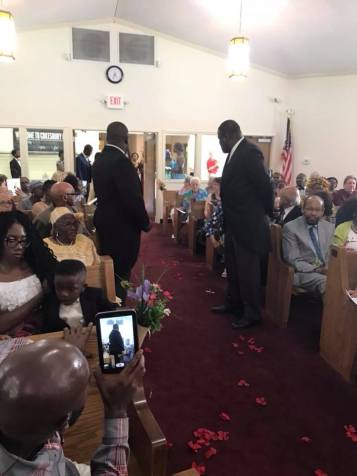
I can’t believe you two are getting married! Don’t get me wrong – I think you should get married, I am grateful to be here for your wedding, it’s just kind of hard for me to believe that it’s actually happening.

Why is it so hard for me to believe? When I was sent here as the pastor over a year ago, one of the first things you ever said to me, Marian, was that you needed prayer because you had a man who wanted to marry you and you hadn’t answered him. 

I thought I misheard you. There was man, who wanted to marry you, you didn’t answer him, and he was still hanging around? 

I can’t believe you two are getting married. When I saw you two sitting in church together, or upstairs in the fellowship hall, or outside in the parking lot after worship, and I observed your body language, and joyful expressions, I assumed that you were already married.

I can’t believe you two are getting married. When you finally told me the whole story, and I discovered that you dated thirty years ago in Liberia only to come together now after decades and other marriages, it sounds unbelievable.

And for as unbelievable as it might appear to me, and maybe even to some people here this evening, there is someone who truly and deeply believes in your getting married – God.

So, let’s paint a picture shall we? Like a movie, the scene opens with a young Liberian man and woman who are quite smitten with one another. They go on little dates, they continue to flirt back and forth, some of their friends even think that eventually they’ll get hitched. 

But, as it turns out, the teenage boy likes the company of other teenage girls. A lot of girls. So many, in fact, that Marian eventually say, “no no no, I can’t go for that.” And the relationship ends.

And again, like a movie, the next scene is thirty years later, in Atlanta, at a funeral.

The once young teenage boy now sees his old girlfriend across the room, and when he goes to shake her hand, she doesn’t recognize him! Thirty years have passed, and other relationships, and children, and yet there is something there. They get reacquainted with one another, John even has the gall to invite Marian over for dinner at his house.

The next scene is the interior of John’s kitchen where, for some time, he’s cooked all his food on the weekends so that he can have copious amounts of leftovers during the week, and he decides to serve Marian some old soup.

Marian takes note and decides to take some initiate.

The next scene is back in Virginia in Marian’s kitchen where she is cooking food just to send it all the way to Georgia for John to eat, and thus she wrapped him around her finger yet again! 

We then jump ahead in time to when the old love birds have rekindled their relationship, John asks Marian to be his wife, and she says nothing! Time passes and she remains steadfastly stubborn until she inexplicably comes to the realization that yes, YES, she wants to marry this crazy man!

And now here you two are. 

40939146_10212929149124152_5915867483696267264_n

You can see, from the story I told, and all the in between that will remain untold, for this marriage to work, you two are going to need a lot of help! Don’t take that as a statement against your individual abilities to be a married couple, but marriage is hard – it is complicated, it is messy, and it is confusing.

But, of course, that’s why all of us are here! We have been gathered by God to pledge our presence and our help. You two are about to make unconditional promises to each other, and we are going to hold you accountable to those promises. It is in the making of those promises, yours and ours, that we become the full vision of the church God has for us.

Because, our help, no matter how good willed and well-intentioned, would be futile if we were just another human gathering. But we are not just any ordinary gathering. We are the church of Jesus Christ!

We are a people whose stories have been given new meaning in the life, death, and resurrection of a 1st century Jew who was God in the flesh. And your story, that strange decades long dance of being brought together, pushed apart, and brought together again is what we, in the church, call grace.

A few weeks ago the three of us sat down for some premarital counseling, and I hope you appreciated the irony of a thirty year old pastor offering bits of wisdom to two people who have known each other longer than I’ve been alive! But toward the end, I asked you to consider what marriage really means to both of you. Not the churchy definition, not what other people think, but what do you think marriage is.

Marian you said marriage is a commitment, it is an eternal bond making the other feel connected to a new way of being. And John, you said marriage is simply loving the other as you love yourself.

Jesus was once doing his Jesus thing and arguing with a bunch of the Jewish leaders when a scribe stepped forward and asked about the greatest commandment. And Jesus replied, “You shall love the Lord you God with all your heart, soul, mind, and strength. And you shall love your neighbor as yourself.” 

The scribe took in the answer and realized that what Jesus said was more important than all of the sacrifices and laws described in the Old Testament. And Jesus, seeing the scribe’s new understanding, said, “You are not far from the kingdom of God.”

40764775_10212929147204104_4437373572423352320_n

When I asked you about what marriage really looks like, you responded like Jesus! For according to the two of you, marriage, at its best, is what we might otherwise call discipleship.

You see, when we can truly love the other as ourselves, when we can see that person standing before us and know that they deserve every bit of love, and joy, and hope that we do, then we begin to see each other the way God sees us. And that, is what makes the unbelievable covenant of marriage believable.

Marian, you are a deeply caring individual, not just toward John but toward all people. And your ideas and intellect are what draw people like John, and the rest of us, closer and closer to you. You give so freely of yourself to other people that it becomes infectious and people want to start living like you. And even though you can be downright feisty and stubborn, I think, in a weird way, it’s what John loves most about you. In you he encounters the joy of the dance that he doesn’t even know he is doing!

John, your love and passion for Marian is exactly what she needs. As someone who can too often fall under the temptation to believe she is not as wonderful as she really is, you help to reminder her day after day that she is truly worthy of love. And, in a paradoxical way, she provides the same to you. We all accept the love we think we deserve, and you deserve so much more than you have experienced, until Marian walked back into your life and showed you a new reality of your existence. 

And, John, you know I have to say it. You are also a deeply patient man, to a fault! Let’s be real for a moment, after asking her to marry you, some other men would have walked away after the non-answer, but you remained steadfast! But your patience in the relationship really is a beautiful thing. While all of us try to keep up with the frantic and frenetic pace of the world, you will often wait up in the late night hours just to greet Marian when she comes home from work. 

Now, I know you two are lovingly looking at me, and hanging on every word that I say, but I want you to turn around for just a moment and take in the scene before you. So much of weddings are focused forward such that the bride and groom don’t get a chance to take in the view that I have. Because for as much as I can attest to the love you share the commitment you hold for one another, these people can too. Look at all these people smiling back at you. They believe in the unbelievable thing you are about to do. 

But now look back at me for a moment, because God believes in you too. There is a reason that Jesus’ response about the greatest commandment begins with the love of God before the love of one another, because it is in loving God we learn what it means to love our neighbors, including the ones we marry. 

God’s love for us, in spite of us, is the paradigm through which the marriage of two people becomes intelligible. God looks at each and every one of us, with all of our faults and failures, and says, “You are my beloved.” And it is then, in the recognition of God’s unbelievable love for us, that we may begin to take steps to a place like this, by the altar, and look someone in the eye and say those unbelievable words, “I will.”

I can’t believe you two are getting married. Your story is just too good to believe. Your love for one another is just too good to believe. All of these people here on your behalf is just too good to believe. 

But it doesn’t really matter what I believe, or even what you believe, but that God believes in you.

So may the believing God, the one in whom we live and move and have our being, the one who came to show us the greatest commandment, bless you and your marriage such that you can truly love the other as you love yourself. Amen.