Devotional – Psalm 5.1

Devotional:

Psalm 5.1

Give ear to my words, O Lord; give heed to my sighing.
Weekly Devotional Image

To breathe is to live. And yet, how often do we actually think about our breathing? Unless we’ve been sick with pneumonia, or have climbed to a high elevation, breathing in and out is something we all take for granted. All day, everyday, we take about 26,000 breaths. It happens naturally without our having to really do anything to make it happen. Yet without it, we cannot live.

A few weeks ago I was in the hospital room when my son took in his first breath. Like the rush of a mighty wind, he filled his lungs for the very first time, his skin began to change color, and the remarkable rhythm of his breathing began. I held my breath waiting for him to breathe knowing full and well how necessary it is for life. And yet, during the last 6 weeks, I have grown accustomed to his breath, and am no longer bending over to place my ear near his mouth in the middle of the night.

We all know that we cannot live without breath. Just ask anyone who has been with someone at the moment of death and they will tell you about the profound change that occurs when someone’s breathing comes to a conclusion. But in addition to breath being a necessity for life, it is also a necessity for prayer.

page_breathe

Every breath is a prayer. As the psalmist cries out, “Give ear to my words, O Lord; give heed to my sighing.” When we sigh, when we breathe, when we fill our lungs with air, we are participating in the great and cosmic birth of creation over and over again. In the beginning of scripture we learn about God breathing life into the first human and for every one of us that has ever lived since, we have received that same gift at the beginning of our lives.

If we are in a time in our lives when we do not know what to pray, if we are at a loss for words, there is comfort in knowing that every breath is a prayer. To breathe is to remember the paradox of our existence; we’ve been created in the image of God with immense beauty, power, and strength while at the same time our lives are incredibly vulnerable and fragile. Our lives hinge on our breath.

So too, our spiritual lives hinge on our breathing in and out, over and over again, remembering that every breath is a gift from God.

Devotional – Galatians 1.13

Devotional:

Galatians 1.13

You have heard, no doubt, of my earlier life in Jerusalem. I was violently persecuting the church of God and was trying to destroy it.
Weekly Devotional Image

“Would you ever prevent someone from receiving communion?” The probing question was asked during a clergy-training event I attended a few years ago. The discussion leader pushed the question back to each of our tables for debate before offering his answer. At my table an older woman made it clear to all of us that children should not be able to receive communion because “they can’t understand it.” A middle-aged man declared that he would not give communion to anyone living in sin, particularly if they were gay. And a younger man shyly offered that he didn’t think it was his responsibility to allow, or prevent, anyone from coming to God’s table.

Each of the tables debated who should be able to receive communion, and the longer we discussed… the louder the room became. Theological and scriptural references were flung back and forth regarding the power clergy hold over God’s table; stories were shared about the merits of refusing to serve communion and the power of offering it to everyone; relational bridges were broken and walls were erected.

The leader let us duke it out amongst ourselves for some time before patiently raising his hand for silence. After waiting for a moment for our attention to move from our argumentative vantage points he said, “Remember this: Even Peter perjured and Paul murdered. God’s love knows no bounds.”

Do we get so caught up with Paul’s letters and his travels that we forget how horrible he was before he encountered Christ on the road? Do we respect his theology so much that it blinds us to the vital narrative of his life?

In his letter to the church in Galatia, Paul specifically addresses his sordid past in order to demonstrate the power of God’s revelation. Only in the transformative and redemptive power of God’s divine love could a man like Paul be moved from murdering Christians to baptizing Christians.

lord__s_supper_by_bclary-d37hhzp

All of us are broken by the powers of sin and selfishness; no one is free from the temptations to take the easy path and neglect to follow the road that Jesus prepared for us. Therefore, it is vital for all of us to remember that church is meant to a hospital for sinners. No matter who we are, and no matter what we’ve done, there will always be a space for us at God’s table. The challenge is to remember that beautiful and graceful truth when we encounter people we deem less than worthy.

A Letter To My Son

Galatians 1.1-10

Paul an apostle – sent neither by human commission nor from human authorities, but through Jesus Christ and God the Father, who raised him from the dead – and all the members of God’s family who are with me, To the churches of Galatia: Grace to you and peace from God our Father and the Lord Jesus Christ, who gave himself for our sins to set us free from the present evil age, according to the will of our God and Father, to whom be the glory forever and ever. Amen. I am astonished that you are so quickly deserting the one who called you in the grace of Christ and are turning to a different gospel – not that there is another gospel, but there are some who are confusing you and want to pervert the gospel of Christ. But even if we or an angel from heaven should proclaim to you a gospel contrary to what we proclaimed to you, let that one be accursed! As we have said before, so now I repeat, if anyone proclaims to you a gospel contrary to what you received, let that one be accursed! Am I now seeking human approval, or God’s approval? Or am I trying to please people? If I were still pleasing people, I would not be a servant of Christ.

Galatians_692

Months ago, while I was planning all of our worship services for the year ahead, I read this text from Galatians for the last Sunday of May and I thought it was perfect. I knew that Lindsey was pregnant and that, if the timing worked out, this would be the first Sunday and opportunity to preach after the birth of our son. All of you would have listened to other preachers for four weeks, and then I would be standing up here proclaiming God’s faithful Word from Galatians.

The text is so fitting for today because Paul, having worked with the Galatian churches for some time, has been absent from the community and catches wind about their lack of faithfulness. Perhaps after the community listened to a group of different preachers for four Sundays in a row, Paul felt inclined to write to them about the true gospel.

Now, keep in mind, most of Paul’s letters are filled with elevated language complimenting the community from the conception. Galatians begins in a very different way. Far from kind and pastoral, Paul’s tone is irritated and cranky. Paul whips through the customary pleasantries and gets right to the point: “I am astonished that you are so quickly deserting the one who called you in the grace of Christ and are turning to a different gospel!”

So, here we are. I’ve been gone for about a month. I tried to keep away from my phone and email, I even attempted to avoid driving near the church on Sunday mornings, but I’ve heard through the grapevine about what’s really taken place. Our District Superintendent had the nerve to break four of his ribs shortly before preaching and called upon Larry Kreamer to fill in as best he good. Chris Markham had the nerve to get up here in the pulpit and preach about Mary Magdalene, calling all of us to recognize how quickly we lift proverbial stones to cast at one another, in particular toward people of a different sexual identity. Rick Maryman had the nerve to boldly call the church to remember the role of the Holy Spirit and never lose sight of the importance of Pentecost. And then Eric Fitzgerald stood up here last week and talked about how God’s ways are not our ways, and that there really is a time for everything; whether we recognize it or not.

I can’t believe it! I’ve only been gone four weeks and you all have fallen away from the gospel. You’ve listened to those who would rather distort the gospel of Jesus Christ and who offered something contrary to what has been offered previously! I knew I needed to pray for you in my absence but I didn’t know I needed to pray that much!

Of course, I am only joking. I am grateful for the witness and willingness of our gifted laity who faithfully proclaimed the gospel over the last four Sundays. It brings me a sense of peace that words cannot describe to know that, unlike the Galatians, all of you have held fast to the Good News and have continued to be servants of Jesus Christ.

For the sermon today, I decided to write a letter in the vein of Paul. Though instead of writing it to a wayward church in Galatia, I wrote it to my son Elijah. This passage is one that is easy to avoid, after all we’re reading a letter meant for somebody else’s church. We can write it off as a personal matter between Paul and the Galatians – except for the fact that this is God’s Word for us. Similarly, it is my hope that in the words I have written for my son, you will hear God speaking to you as well.

Transformed


Dear Elijah,

You are loved beyond your ability to comprehend. You mother and I eagerly awaited your arrival, we prepared by purchasing everything we thought we could possibly need, we read books on how to raise a child, we sought out advice from friends, family, and at times even strangers. You are the first grandson in the family, and in your short month of life, your grandparents have become completely obsessed with you.

And more than the family, there is an entire community who knows nothing about you other than your existence, and yet you are loved. Preschoolers from the church have bombarded me with questions about you, and what you look like, and how you’re sleeping, and a slew of other inquiries. Members from the church have flooded my email inbox wanting to know if we need anything to take care of you. And for as long as we’ve known that you were joining our family, the entire community has lifted you up in prayer.

You are loved beyond your ability to comprehend. But more than this church, and even more than your parents, God loves you with reckless abandon.

Over the years you will come to know more about God’s unending love through the stories of scripture that will be shared in worship. You will hear about God’s creative majesty in the foundation of the world, God’s calling of the people Israel to a new beginning, God’s persistence when the people fell away from the path, and even God’s grace made manifest in a manger.

In time you will experience the power and might of Jesus Christ. God in the flesh, born in a humble abode, who walked the roads of life with friends and strangers, healed the sick, fed the hungry, clothed the naked, broke the law, fulfilled the scriptures, died on a cross, and rose from the grave.

Elijah, the church will strive to share with you the radical message of Jesus Christ in such a way that it transforms your life forever. The people in the pews will gather you in, proclaim God’s Word, respond to it, and send you forth week after week to be Christ’s body for the world. No small task.

SeraPetrasPhotography_EWM-23

And Elijah, you will live and move and have your being in a world that few of us can even imagine…

As you become the person God is calling you to be, you will live in a world where the church is no longer the status quo for everyone. Christianity as Christendom has fallen away. You will be judged for your strange faith, rather than commended as many of us once were.

You will live in a world where homosexuality is normative. You will encounter couples that have otherwise been called incompatible with Christian teaching, but for you they will be perfectly compatible with Christian teaching. You will interact with people from such a wide plethora of diversity that you will want the world to be the mosaic it is, rather than hoping for birds of a feather to flock together.

Sadly, you will never know what it means to live into the mystery of life and faith. There will always be an answer for every one of your questions at just the click of a button. You will have to work harder to experience the profound wonder of God’s presence because you will rarely have to struggle for clarity.

And, I’m sad to say, you will never know of a life prior to September 11th. You will grow up in a world cowering in fear to the seemingly endless threat of international and domestic terrorism. You will be raised with the words Jesus gave to his disciples about striving for peace, while countless men and women are called to give their lives for the freedoms we hold so dear. Son, the world we live in is broken; we often succumb to the power of sin that pushes us to believe that violence and power control our destinies, and that death carries a strong sting.

Elijah, in time you will struggle and wrestle between the call of competing narratives and gospels that vie for your allegiance. Even though your mother and I, and your friends, and the church will do everything we can to hold fast to the gospel that was shared with us, at some point you will fall away. Whether through doubt, disillusionment, or some other reason, there will come a time when you will grow frustrated with this thing called church.

Elijah, it might happen when you start to understand the pressure that is constantly placed on churches to increase attendance, to raise the budget, to fill the pews, to do whatever it takes to improve the market share. You will see how many of us care more about being nice, or funny, or unassuming, that we make the church more about us than about God.

And on the other side, you will meet people who subvert the gospel to mean whatever they want it to mean; people who will use scripture like a weapon to attack others for their way of life and it will leave you feeling frustrated.

But Elijah, I want you to try to remember one thing: Jesus is Lord, and everything else is secondary.

Wherever you are led throughout your life, wherever the Spirit calls you to go, you will encounter Christians at both ends of the spectrum. Christians who will do whatever it takes, even at the expense of watering down the gospel, to make it as appealing as possible. And Christians who will take up the bible like a sword to mow down their enemies.

But Jesus, the one in whom we live and move and have our being, was not concerned seeking the approval of his fellow human beings. He did not belittle the immense and profound qualities of God’s love to being something easy and trite. Jesus pushed his followers into uncomfortable arenas of love and respect in order to transform the world.

And at the same time Jesus, the one in whom we live and move and have our being, was not concerned with attacking people for their differences and ostracizing them from the community. He did not use scripture to condemn the world. Instead, Jesus went out to the people that most of us would rather ignore and he told them that they deserved to be loved just as much as anyone else.

Elijah, God’s love in Jesus Christ is a mystery. Thanks be to God that there is not an easy and simple answer to that question of faith. Unlike almost everything else you will experience, it cannot be explained at the click of a button. Instead, you can only know the love of God through the table at which the church gathers, through the breaking of bread and the sharing of the cup. Only when God invites you to the table will you begin to enter the light from the darkness. Only in the sharing of communion will the competing narratives and false gospels begin to fade away. Only when you experience this little bit of heaven on earth, will you begin to rejoice in the mystery that is the grace of Jesus Christ.

Elijah, I love you. Your family loves you. The church loves you. But more importantly, God loves you.

-Dad


Amen.

Love Hurts

John 13.31-35

When he had gone out, Jesus said, “Now the Son of Man has been glorified, and God has been glorified in him. If God has been glorified in him, God will also glorify him in himself and will glorify him at once. Little children, I am with you only a little longer. You will look for me; and as I said to the Jews so now I say to you, ‘Where I am going, you cannot come.’ I give you a new commandment, that you love one another. Just as I have loved you, you also should love one another. By this everyone will know that you are my disciples, if you have love for one another.”

2012-04_LT-TrueLoveHurts


Two weeks ago I stood before all of you and preached about love. I said, “Here we are, just like the disciples, a few weeks on the other side of Easter. For us the normalcy of life has returned. The shadow of the cross has crept back into our daily lives. We turn on the television and we want to know why we live in such a broken world. We confront people who drive us crazy. We grow tired of the seemingly endless race for the White House. We clench our fits with frustration over our lack of control. We worry about our bank accounts, and our children, and our futures.

“And then Jesus has the nerve to show up in our lives and ask, “Do you love me?If we love Jesus, then we have to love one another.”

I think the message was pretty straightforward. Jesus loves us so we should love each other. In fact, none of you complained about the service while shaking hands afterwards, I received zero emails regarding the content of the sermon, and after singing the hymn “Lord, I Want To Be a Christian” most of us left with smiles on our faces.

Today we are here in church reading about another example of Jesus calling us to love. We love this story. It repeats for us our assumption that whatever it means to be Christian, whatever creeds we affirm, whatever beliefs we proclaim, it at least means we are supposed to be nice and loving toward other people.

The fact that we often boil Jesus down to a guy preaching love makes sense. Jesus talks about love all the time in the gospels, toward all people regardless of circumstances. Love, in fact, seems to be what Jesus is all about. And in this story, during his final night with his friends, in his concluding remarks, he tells them to love one another just as he loved them.

Loving one another like Jesus sounds pretty nice. Don’t you think the world really would be a better place if we could all just get along?

Love is lovely, but it also gets us into trouble. If Jesus really was all about love in the Hallmark sense of the word, if we can whittle the entirety of the gospel down to “love one another” then why did Jesus have to die? Why would you put someone to death who is recommending that we love each other?

Jesus says, “I give you a new commandment, that you love one another. Just as I have loved you, you also should love one another.”

loveoneanother

Just as I have loved you…

A couple months ago I was sitting at a coffee shop downtown working on a sermon. As I often do, I was wearing a clergy collar and sitting near the door with a cup of coffee and my computer. For the overwhelmingly majority of my sermon writing coffee shop experiences, everyone ignores the pastor in the corner, but not this day.

A guy walked in, looking pretty disheveled, and immediately bee-lined over to me. His eyes were locked onto my collar and, before I knew what he was doing, he fell to his hands and knees and started to kiss my feet. Embarrassed, I tried to get him to stop, and when he could tell that everyone was staring at us, he asked to speak to me outside.

We sat down on a bench and he began to tell me about his troubles. He was down on his luck, no money, no job, no home. He had been kicked out of a couple local homeless shelters, but heard a rumor that he could get better help in Charlottesville. As he went on I caught myself preparing my response in my head rather than really listening to his dilemma. And as I often do I offered him a few dollars and suggested that he try SACRA or any number of other places in town.

He looked at me blankly and said, “Man, I just need a ride to Charlottesville.”

I don’t remember exactly what I said in response but I’m sure that I made excuses about how much work I had to do, or that I really needed to get back to the church. And as I went on listing my justifications he stood up while I was talking and he left me there sitting on the bench. My voice trailed off as he walked away, and before he turned the corner he said, “A man was going down from Jerusalem to Jericho…

Jesus loved people so much, that he was willing to correct them when they were wrong. When Peter tried to tell him that he was not supposed to die on a cross, Jesus quickly replied, “Get behind me Satan, for you are setting your mind not on divine things, but on human things.” Jesus was unwilling to sit idly by while people continued to miss signs of the kingdom and regularly corrected others when necessary.

And once, while I sat stunned on a bench, Jesus lovingly used the words from the story of the Good Samaritan through a homeless man to correct my understanding of what I was doing. That’s the kind of love that Jesus had for people, correcting them with love when they fell from the path

Just as I loved you…

A friend of mine was vexed when someone from his church continued to cheat on his wife. They all lived in a small community where everyone knew everyone’s business. And this particular man would get in his truck, drive to the other side of town, and cheat on his wife. Of course, the wife remained faithful and steadfast, even through she was traumatized by his infidelity.

Friends tried to convince the man that he needed to stop, and he even admitted that he knew what he was doing was wrong and against God’s will, but he couldn’t help himself. They tried getting him in therapy, they tried calling him everyday to remind him to remain faithful, but no matter what they did, it continued.

One day my friend grew so frustrated with the infidelity of the man that he showed up at his house and demanded the keys to the truck. He said, “It doesn’t seem like you can stop yourself, but you’ll have a hard time getting over there without your truck.”

And you know what? It worked.

Jesus loved people so much, that he was willing to disrupt their lives and sensibilities when they were wrong. He once gathered people together and said, “If your arm causes you to sin, cut it off. If your eye causes you to stumble, tear it out.” Jesus was unwilling to sit idly by while people committed horrendous sins against other people and neglected to honor God through their behavior.

And once, through a demand for car keys, Jesus lovingly disrupted a man’s adulterous tendencies. That’s the kind of love that Jesus had for people, disrupting them with love when they fell from the path.

Just as I loved you…

Back in June a young white man entered Emanuel AME Church in Charleston, South Carolina for bible study. The group gathered together to study God’s Word, and the man listened while they discussed scripture. However, when they bowed their heads in prayer, he took out a gun and killed nine of them.

After he was arrested, the family members of the nine victims were able to speak directly to the shooter during his first court appearance. One by one, each person addressed the murderer and offered him forgiveness.

“I acknowledge that I am very angry,” said the sister of one of the deceased. “But one thing my sister taught me what that we are the family that love built and we don’t have no room for hating, so we have to forgive. I pray for God to have mercy on you.”

“I forgive you,” said the daughter of one of the deceased. “You took something very precious from me. I will never talk to her again. I will never, ever hold her again. But I forgive you. May God have mercy on your soul.”

Near the end, the granddaughter of one of the victims stood up and said, “Although my grandfather and the other victims died at the hands of hate, this is proof, everyone’s plea for your soul, is proof that they lived in love and their legacies will live in love. So hate won’t win.”

Jesus loved people so much, that he was willing to forgive their faults and transgressions even at the point of his death. While the crowds gathered at the foot of the cross, while the crown of thorns dug into his skin, while he felt his life slipping away he prayed, “Forgive them Father, for they do not know what they are doing.” Jesus was unwilling to let anger, and aggression, and hatred get the better of him. He witnessed the abandonment of his disciples and followers, he experienced the people’s movement from “hosanna” to “crucify” and he still forgave them.

And once, while a murderer sat in a courtroom surrounded by the families of his victims, Jesus lovingly forgave him through their willingness to forgive. That’s the kind of love that Jesus had for people, forgiving them with love when they fell from the path.

Jesus didn’t get killed for loving too much. At least not in the way that many of us belittle the kind of radical love Jesus had for the people around him. Jesus got killed because his way of loving challenged the status quo and upset sensibilities. Jesus got killed because his love hurt.

On his final night with his friends, the very people that would be responsible for continuing his message of salvation and love, Jesus offered them a final commandment. “You have to love one another. Just as I loved you, you also should love one another.”

Jesus loved people so much that he was willing to confront others in the midst of their wayward behavior. He knew that time is a fleeting thing and that love, God’s love, demands confrontational action when we act selfishly rather than selflessly.

He was also willing to disrupt actions and attitudes that led to brokenness and abuse. He saw all people for their fundamental worth and he challenged others to seek holiness in every way, shape, or form.

And Jesus was convinced by the power of forgiveness when he was betrayed, broken, and even killed. He lived his life as God in the flesh to point others toward the power of grace and mercy.

To love like Jesus will hurt. It will put us in positions we would rather avoid, it will call our kind of behaviors and practices into question, and it will force us to confront the brokenness in one another. But this is the way everyone will know that we are his disciples, if we love each other just as he loved us. Amen.


 

Devotional – Psalm 148.1

Devotional:

Psalm 148.1

Praise the Lord! Praise the Lord from the heavens; praise him in the heights!

Weekly Devotional Image

I met Rev. Alan Combs for the first time at Annual Conference when I was in college. I was a lay representative for my home church and was preparing to start applying to seminary so I spent time wandering around the display areas to learn more about the United Methodist affiliated seminaries. I was standing in front of the Duke Divinity School display when Alan walked over and introduced himself. He was wearing a black clergy shirt with a white collar, he had a ponytail and a goatee, and he had a Chrome messenger bag slung over his shoulder. To put it simply: he looked cool.

Alan

Rev. Alan Combs

Years later I was sitting in a classroom while Alan was leading us through the art of Wesleyan preaching. The room was filled with novice pastors and Alan was trying to steer us in the right direction to avoid falling into common preaching ditches. I remember still thinking he looked cool, but his dedication to the vocation and to the church quickly overshadowed his physical appearance.

Alan guided us through some of Wesley’s sermon, he had us break into groups to talk about our own preaching styles, and he asked for us to share examples of how we plan and prepare sermons. But at the end of the class he offered some advice that has stayed with me ever since: Avoid “lettuce” sermons. There is a strong temptation to take text, pray over it, and then offer a sermon with a conclusion that starts with “let us…” For Alan, the desire to transform every bit of God’s Word into an applicable life lesson only perpetuates the worship focus on the people worshipping rather than on God. The people sitting in the pews have been conditioned to ask, “What is in this for me?” and if we use “lettuce” sermons, we will continue to spend time wrapped up in our own little worlds.

The entirety of Psalm 148 is a faithful reminder, like Alan’s advice, that it is good and right for us to take the focus off of ourselves. The psalm calls all who hear it to praise the Lord with actions that draw our focus toward all that the Lord has done instead of our little bubbles. It is a powerful proclamation that God is God and we are not. It cautions us against believing that the bible is about us, and forces us to confront the fact the bible is actually about God.

The powerful gift of scripture is the fact that it can speak into our lives. We can pick up our bibles to read, or be sitting in a pew during worship, and believe that those words were meant for us to hear. But our desire to make scripture into our own guidebook (in addition to the many ways we twist God’s Word around to fit our own agendas) is reason enough for us to remember to praise the Lord, and not ourselves.

Let’s Talk About Heaven

Revelation 7.9-17

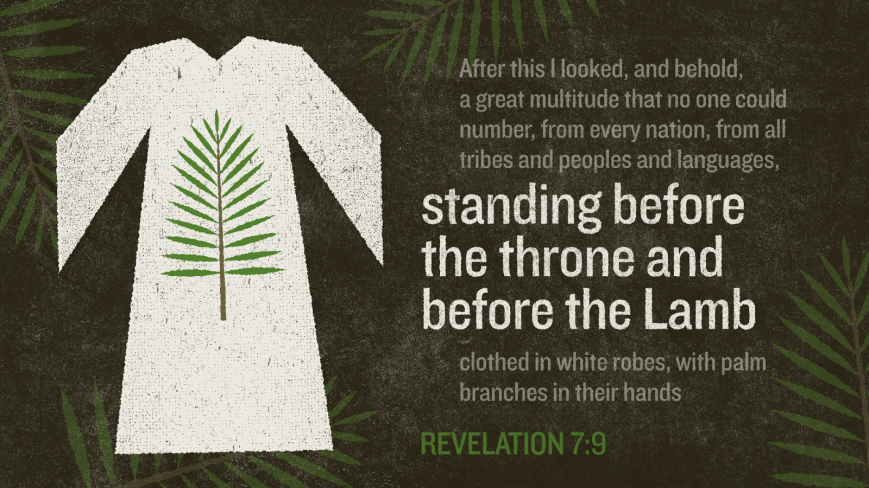
After this I looked, and there was a great multitude that no one could count, from every nation, from all tribes and peoples and languages, standing before the throne and before the Lamb, robed in white, with palm branches in their hands. They cried out in a loud voice, saying, “Salvation belongs to our God who is seated on the throne, and to the Lamb!” And all the angels stood around the throne and around the elders and the four living creatures, and they fell on their faces before the throne and worshiped God, singing, “Amen! Blessing and glory and wisdom and thanksgiving and honor and power and might be to our God forever and ever! Amen.” Then one of the elders addressed me, saying, “Who are these, robed in white, and where have they come from?” I said to him, “Sir, you are the one that knows.” Then he said to me, “These are they who have come out of the great ordeal; they have washed their robes and made them white in the blood of the Lamb. For this reason they are before the throne of God, and worship him day and night within his temple, and the one who is seated on the throne will shelter them. They will hunger no more, and thirst no more; the sun will not strike them, nor any scorching heat; for the Lamb at the center of the throne will be their shepherd, and he will guide them to springs of the water of life, and God will wipe away every tear from their eyes.”
agnus-dei-window-1024x768

The couple had recently celebrated their 60th wedding anniversary when they tragically died in a car crash. They were in relatively good health at the time, mainly due to the wife’s dedication to their diet and forcing them to both get exercise, but when the crash occurred they were immediately brought before St. Peter and the pearly gates.

After a quick check-in, much like the first minutes at a tropical resort, St. Peter volunteered to give them a tore of their heavenly abode. The mansion they would be calling home for eternity was filled with more rooms than they could count with a beautiful kitchen, swimming pool, and movie theater in the basement. As the wife squealed in delight with every passing accommodation, the husband grew skeptical and finally leaned over to Peter and asked, “So how much is this going to cost?”

Peter, flabbergasted, replied, “It’s free, this is Heaven.”

Later, they toured the endless golf course that started in their backyard. With perfect rolling hills that they could only have imagined on earth, they took in the beauty that was available whenever they wanted. The old man, again, asked Peter, “So what are the green fees?

Peter replied, “This is Heaven and you play for free.”

Finally Peter brought the couple to the clubhouse that was filled with people from their lives that they had loved and lost. The joyful reunions went on for some time until Peter motioned for the couple to go through the lavish buffet that had been prepared. The old man, still skeptical, quietly asked Peter how much the food would cost.

Peter, now growing frustrated, said, “Don’t you understand yet? This is Heaven, it’s all free!

The old man stood still and then asked, “Well where are the fat free and low cholesterol tables?”

Peter then began to lecture, “That’s the best part. You can eat as much as you like of whatever you like, and you never get fat or sick. This is Heaven!

Immediately the old man went off with a fit of anger, throwing down his hat and stomping out of the clubhouse.

Peter and the wife both tried to calm down the old man and asked what was wrong. The old man looked at his wife and said, “This is all your fault! If it wasn’t for your diet and exercise, I could have been here ten years ago!

What’s heaven like? I get asked this question on a pretty regular basis. I might be in my office with a grieving family who just lost someone they loved and someone will ask what the person is now “doing” in heaven. Or I’ll be here in the sanctuary teaching a lesson to the preschoolers when the subject of heaven comes up and one of them will say something like: My mommy told me that heaven is full of your favorite candy, and you can have as much of it as you want!

What’s heaven like? There are a decent number of times when scripture is descriptive about the beyond, but it is a far stretch from the jokes and movies many of have experienced on the subject. John caught a glimpse of the heavenly glory of God’s presence in a vision and described it like the grandest worship service to have ever occurred. Countless beings that have made it through the great tribulation surround the throne of the Lord where the Lamb is in the center. They sing with full voices and praise the Lord unceasingly for his majesty is beyond comprehension.

Rev 7v9

The problem with talking about heaven is that whatever we say, it is speculative at best. We can point to scripture where it is described, but the descriptions are made in such a way that heaven is beyond our comprehension. The whole point of heaven after all, is that it is totally other from earthly life. It is beyond life. It is glory and wisdom and thanksgiving and honor and power and might in a way that is impossible for us to understand during our earthly lives.

And even though we can only hint at what heaven might be like, it has become the pinnacle concern for many churches and Christians. What do I have to do to make it to heaven? Or what do we have to do in order to get other people to heaven? These questions dominate our thoughts and we grow anxious about whether or not we, and the people we love, will go on to our heavenly reward.

When talking about heaven, there is a strong temptation to make it so appealing with comparisons to earthly beauty that we neglect to think about the fact that we are called to exist here on earth until our deaths. But this text, this worshipful understanding of heaven, lets us know that God never promised we would not suffer. In fact the opposite is true. Suffering has always been part of our story, and even we here in the blessed region of Western civilization are not immune.

Only in death can we receive the gift of resurrection. It was only through Christ’s crucifixion that he could one day be raised again. The same holds true for us. Only when the bell tolls for us will we share in Christ’s victory over death.

And yet we still talk about it all the time. It is good and right for us to celebrate Christ’s resurrection, but when daydreams about our everlasting reward later prevent us from serving the needs of others right now it becomes cheap grace.

In many churches, like the ones most concerned about whether others are going to heaven or hell after they die seem less concerned with the hells on earth right now. Here in scripture John is confronted with the suffering of the great multitude before they arrive at the throne. They are granted a peace they did not have on earth: they will not hunger, nor thirst, the sun will not strike them, nor any scorching heat because the Lamb of God has shepherded them to the springs of life where God wipes away all tears. But before we can rejoice with the Lord in his divine kingdom, we will endure tribulations in our earthly lives.

Imagining that our lives will be free from suffering is what often leads people to leave the church when something goes wrong. I know too many people my age who were forbidden from attending funerals as children, and then when they finally attended a funeral for the first time when they were older they fell away from the church. I also know too many people who lived such perfect and sheltered lives that when they encountered true poverty for the first time they were overwhelmed by the brokenness of the world and have been unable to return to church.

The church is supposed to be the alternative to this overly rosy view of the world. We have the church to help us remember exactly what God has promised, and what God has not. The church is the place where we confront the hardships of life and rely on the people in the pews next to us to help us through the great tribulations we experience. We are not here to prance around pretending that we have perfect lives without suffering, but instead to proclaim that in trusting the Lord we will find the strength and courage to sustain us until that time when we will join Jesus in the victory over death.

The church is the means by which we combat the hells we experience on earth by attempting to give people hope and faith in something greater than earthly life can offer.

bigstock-Cross-against-the-sky-24690071-panorama

In this church, at St. John’s, we strive to help guide and nurture one another through a variety of means. We have bible studies for the young and the old to help us wrestle with how scripture can speak into our everyday experiences. We collect food and clothing and money for others who are desperately in need. We send people on mission trips to build and plant new foundations and relationships for people who really feel like they are living in hell right now.

But we also have a woman here in the church who has made it her calling to help nurture people in the midst of suffering in the best way she knows how. I believe that Dianne Wright is keeping Hallmark in business through the countless cards she sends out to the community. If you’ve been coming to this church for any regular period of time, and have had so much as a cold, you’ve probably received a card from Dianne Wright. They are always thoughtful, they are always written with purposeful words, and they are always filled with love.

I have the added benefit of not just receiving cards when I need them, but I visit enough of you and our shut-ins to know how prized these letters have become. I was visiting someone at King’s Daughters recently when I saw the familiar script sticking out of the cards adorned in a row on the window sill. The woman I visited described them as the most precious gift she had received since she went in to rehab.

Time and time again I will find myself visiting someone and the subject of Dianne’s cards will come up. They might appear to be a simple and casual gesture, but they speak volumes in the realm of how we are sustained by God’s grace through our neighbor Dianne.

As Christians, we are called to combat the countless hells on earth that plague people through our love and presence. For Dianne Wright, this has meant a ceaseless commitment to communicating through cards the love, depth, and peace of God.

Each of us, in some way shape or form, has gifts that we use to share God’s love with others. Perhaps we have the freedom to visit with people who can no longer visit us. Maybe we, like Dianne, have a penchant for penning letters. Perhaps we have been blessed with lucrative careers that allow us to give charitably to help others. Maybe God has molded us with a spirit of prayer and we can lift up the world through our clasped hands. Perhaps we have become familiar with a particular need in the world and all we need is a little nudge to start serving God by serving others. Maybe we have toyed with the idea of a calling to the ministry and we just need to take a step in faith that God can use us to spread the gospel. Perhaps we have the gift of carpentry like Jesus only we’ve been too nervous to ask someone we know if they need any repairs. Whatever our gift might be, God is calling us to use them to draw people into moments of heaven on earth.

When our time comes God will do with us what God wants. In God’s infinite wisdom and glory we will surround the throne and join in one voice with the saints who came before us, and with the saints who will come after us. We will be washed with the blood of the lamb and God will wipe away every tear from our eyes.

We know not when we will gather with the great multitude, but each day God gives us is a gift. A gift we should celebrate by being a gift for others. Amen.

Devotional – Psalm 23

Devotional:

Psalm 23.1

The Lord is my shepherd, I shall not want.
Weekly Devotional Image

I’ve done a lot of funerals. In my short time as a pastor I have presided over more services of death and resurrection than baptisms and weddings combined. And every funeral, much like every baptism and wedding, is contextual and different. Some families come in with a service already planned out in their minds with specific hymns and scriptural texts, and some families come in with their eyes glossed over and have no idea what they want the funeral to look like. I’ve read scripture from the recently deceased’s bible, I’ve been handed a tear stained eulogy to read aloud because the emotional strain was too high, and I’ve even been asked to sing a solo during a service. But one thing that has united every single funeral I’ve participated in has been the reading of Psalm 23.

Unlike other readings during funeral services, we print out the entirety of the 23rd Psalm in bold in the bulletins. When the time comes, I ask everyone gathered together to read the beloved words out loud and as we take a collective breath we begin, “The Lord is my shepherd, I shall not want…” An amazing thing happens when this psalm is read out loud in the context of grief and loss. You can audibly hear the anxiety in the air as the first words are read aloud; people read at different tempos and take breaths at different moments. But as the psalm progresses, so do the voices. It is as if the entire congregation, through the psalm, is able to take a collective breath of fresh air and release a profound sigh of comfort. The 23rd Psalm is a beautiful reminder of the powerful presence of the Lord in the midst of death, and encourages those of us who remain to live as faithfully as the person we have gathered to remember.

This week, no matter what we have going on, let us take a moment to faithfully proclaim the words to the 23rd Psalm with the knowledge that even after we’re gone, people will use these words to mark our Services of Death and Resurrection:


Psalm 23

The Lord is my shepherd, I shall not want. He makes me lie down in green pastures; he leads me beside still waters; he restores my soul. He leads me in right paths for his name’s sake. Even through I walk through the darkest valley, I fear no evil; for you are with me; your rod and your staff – they comfort me. You prepare a table before me in the presence of my enemies; you anoint my head with oil; my cup overflows. Surely goodness and mercy shall follow me all the days of my life, and I shall dwell in the house of the Lord forever.


h6bg5t5

Why The Cross? – Good Friday Homily

John 19.28-30

After this, when Jesus knew that all was now finished, he said (in order to fulfill the scripture), “I am thirsty.” A jar full of sour wine was standing there. So they put a sponge full of the wine on a branch of hyssop and held it to his mouth. When Jesus had received the wine, he said, “It is finished.” Then he bowed his head and gave up his spirit.


ethereal-finished-still-p3

I get asked a lot of questions. I’ll be in a bible study when the conversation moves to an area of confusion and all eyes will turn to me and someone will inevitably say, “What does this mean?” Or I’ll be in my office and someone will walk in to share about all of the trials and tribulations they’ve experienced and finish by asking, “So where is God in all of this?” Or, like after the atrocity in Brussels this week, I’ll receive an email that says, “How could God let this happen?” People are looking for answers.

On Wednesday morning I gathered all the little preschoolers into the sanctuary to talk about the cross. I wanted to show them the cross we have here in the sanctuary and eventually have them march outside in a line while I carried the cross. For most of them, Easter is about the bunny and the candy so anything I can do to make it more about Jesus is important.

They were all sitting nice and quiet in the pews as I explained Jesus’ final week, and that he died on a cross to help us get to heaven, and most of the kids nodded along. But one sat in the back pew with her eyebrows in an expression of “huh?” I tried to keep moving us forward but I could tell it wasn’t connecting with her so when I saw her shoot her hand up with a question I wasn’t surprised.

She asked, “But why did he have to die on a cross?”

In the moment I tried to answer her question in a way that only a four year old could understand, but the question has stayed with me nonetheless. Why did Jesus have to die on a cross?

Well, he had to die on a cross because that’s the way the Romans executed those who they regarded as a threat. Today we have drones and missiles that we can fire from far away in order to remove ourselves from death, but during the time of Jesus, they were hung high in the air so that all could see what happened when you challenged Rome. The cross was a sign of death and fear.

But that answer is not good enough for those, few, of us who gather in a place like this on Good Friday. If you’re here right now, you get that discipleship is more than just Easter. You get that Jesus was more than just a nice guy. You get that there is something more to this cross than symbolic remembrance.

Jesus died on a cross to reveal the heart of God.

The cross is where God’s grace crosses our life to create a new way of living.

We’ve got crosses everywhere and sometimes we forget how terrifying they were and should be. It is our central icon and we have them displayed in our sanctuary, some of us have crosses around our necks, and some of us even have them tattooed on our bodies. But notice: our crosses are empty. It would disrupt our Protestant sensibilities to have a murdered and graphic Jesus hanging on the cross for everyone to see. We would rather have the clean empty cross to remind us of the resurrection. But if we lose sight of the fright and discomfort of the crucifixion, the empty grave becomes cheap grace.

So, to be here on Good Friday implies a willingness on our part to confront the cross and we also want it explained. We want to know ‘why.’

But Jesus doesn’t offer us an explanation.

Whenever the religious elite, or the crowds, or his disciples questioned him, he would respond in cryptic parables that left them more confused than in the beginning. Jesus doesn’t offer simple explanations. Instead he offers love.

Explanations will never calm our anxieties in regard to suffering and tragedy. The people who try to explain the death of a young child by saying that “God wanted another angel in heaven” transform God into a murderer for the sake of an explanation. The people who try to explain a disabled child as “God’s way of punishing the mistakes of the parents” make God in a torturer for the sake of explanation. The people who try to rationalize terrorist attacks with “God is using them to show us its time to go to war” morph God into a selfish, violent, and manipulative entity for the sake of explanation.

Love, not explanation, is required when we are faced with tragedies. Instead of telling a grieving mother that God wanted her baby, we are supposed to show up with love and not answers. Instead of blaming sinful or faithless behavior for the disabilities in a child, we are supposed to love them with every fiber of our being. Instead of dropping bombs and sending drones to wipe out the Middle East we are supposed to see them as our brothers and sisters.

To be Christian is to enter into suffering. We do not look away from tragedies, we do not abandon those who are alone, and we do not isolate ourselves from the ways of the world. Instead, because of the cross, we are tasked with showing up for others when there is literally nothing we can do to save ourselves from suffering.

So, we could take the time to outline the connections between Jesus hanging on a tree with the first sin of Adam and Eve taking fruit from the tree of knowledge of good and evil. We could go deep into rationalizing the cross through theories like God used Jesus as bait to hook the devil from hell. But the truest response to the cross, the way we are called to go forth from Good Friday, is to look at the cross and take up our own to follow Jesus. Amen.

12042644_10205705206780417_2916230849357888646_n

Devotional – Holy Week

Devotional:

Psalm 118.1

O give thanks to the Lord, for he is good; his steadfast love endures forever!

Weekly Devotional Image


Prayers for Holy Week:

Maundy Thursday

O Lord, we confess that when we pray before meals, we do so out of habit rather than faith. We look out over out tables filled with food and we forget to remember those for whom such a meal is rare. We feel the presence of our friends and families in the seats next to us and we forget to remember people who are alone. We eat our fill and we are content. God of Life, afflict our comfort in our meals so that we will really remember that all of these gifts come from you. Work in our hearts to remember that whenever we eat, and whenever we drink, we are called to give thanks for the great gift of your Son so that we can be more like him between our meals. Use the bread and cups of our tables to make us appreciate the Bread and the Cup at your table. Amen.

Maundy-Thursday1


Good Friday

Great God, why did Jesus have to die on a cross? Why do bad things happen to good people, and why do good things happen to bad people? What will happen to us when we die? Where are you in the midst of the suffering in our lives and in the world? We ask questions like this, O God, because we want explanations. We see our churches like courtrooms and we want to hear your justification. We believe that we are entitled to know the ‘why?’ to every question we could possibly ask. So Lord, replace our selfish desires for explanation with ears to hear proclamation. That instead of looking for the meaning behind every little thing, we might be content with giving thanks for what you have done whether we can understand it or not. After all, how could we possibly comprehend, with our finite minds, the infinite wonder of your grace? Amen.

ethereal-finished-still-p3


Easter Sunday

God of Grace and God of Glory, we give thanks to you for you are good, and your steadfast love endures forever. We remember this day that you have not abandoned us to our own devices, you have not abandoned us in the midst of trials and tribulations, and you have not abandoned us in death. Through the resurrection of your Son, Jesus Christ, we see a glimpse of our future resurrection with you in the new kingdom. So Lord, as we gather with friends and strangers alike to celebrate your victory over death in Jesus, give us glad and generous hearts to rejoice in the knowledge that your love truly knows no bounds. Shake our sensibilities like you shook the earth when the tomb was opened. And resurrect us here and now to walk in the ways of Jesus and transform the world. Amen.

resurrection-Easter-edit[1]

The Final Week

Mark 11.7-10

Then they brought the colt to Jesus and threw their cloaks on it; and he sat on it. Many people spread their cloaks on the road, and others spread leafy branches that they had cut in the fields. Then those who went ahead and those who followed were shouting, “Hosanna! Blessed is the one who comes in the name of the Lord! Blessed is the coming kingdom of our ancestor David! Hosanna in the highest heaven!”

holy-week

It was early in the morning when Jesus sent two of his disciples to a village atop the Mount of Olives to find a donkey. The day had come for Jesus to enter the holy city of Jerusalem during Passover, a time when the city’s population would balloon up to 200,000 people entering to celebrate. On a Sunday morning, while the crowds gathered with palm branches, Jesus entered Jerusalem. Five days later he would be killed on a cross. This is what happened during the final week.

The two disciples procured a donkey and Jesus prepared to make his triumphal entry. Riding on a donkey was a richly symbolic act, one that can be traced back to the time of David. To arrive in the holy city on a donkey calls back to the prophet Zechariah who declared, “Rejoice greatly, O daughter Zion! Shout aloud, O daughter Jerusalem! Lo, your king comes to you; triumphant and victorious is he, humble and riding on a donkey.”

As he rode toward Jerusalem, droves of people arrived on the streets and they began to waves palm branches while he passed. They were so enraptured by Jesus that they took off their cloaks and placed them on the road with their palms in order to create a royal pathway for their king. They shouted things like “Blessed is he who comes in the name of the Lord!” and “Hosanna!” which means “Save us!

At the same time, on the other side of the city, Pontius Pilate (the Roman Governor of Judea) entered Jerusalem with at least 1,000 soldiers to demonstrate the power of Rome during the Jewish celebration of the Passover. It was a show of force to prevent the people from revolting against their imperial rulers while they remembered that time when God had delivered them from captivity in Egypt.

But with Jesus, there was no show of force. Instead of armor and swords, the people took off their cloaks and waved palm branches. Instead of cowering away in fear they rejoiced in the humble man on the back of a donkey.

Palm_frond

While the distance between the Lord and the city grew closer and closer, while the crowds were dancing and shouting, he began to cry. He looked out over the holy city and he wept for Jerusalem. He wept knowing that he was entering as the prince of peace, and within the next few days the very people who were begging for his salvation with their palm branches would reject him and call for his crucifixion.

And there was evening and there was morning, the first day.

On Monday, Jesus made his way to them Temple with countless other Jews. With the episode that had transpired the day before, all eyes were on the humble man with expectation of deliverance. As his feet walked over hallowed ground, Jesus encountered the moneylenders and changers who were taking advantage of all the Jews in Jerusalem. The prices for clean animals necessary for sacrificial rituals were vastly inflated to the benefit of the merchants and the religious elite.

Jesus, who had spent the better part of three years berating the elite for taking advantage of the poor and outcasts, Jesus, who had told the rich young ruler to sell everything he had and give it to the poor, became incensed when he saw the poor being ripped off in the name of God. He walked straight over to the tables and he lifted them off the ground and disrupted everything in the temple. He threw the merchants out of the Temple and declared that his Father’s house had been turned into a den of robbers.

The elite and powerful, who had heard about this mysterious man claiming to be the Son of Man, now had their attention on Jesus. It was one thing to have a crowd with palm branches welcoming him into the city, but to disrupt the economic scheme they had established was going too far. From this point forward, the tides began to turn against Jesus. The leaders started looking for a way to discredit him, or to remove him completely. For as long as Jesus stayed in Jerusalem, their power would be in question, and they would no longer make the money they had planned on.

  And there was evening and there was morning, the second day.

On Tuesday, Jesus once again entered the Temple and he began to teach. If people were excited to see him after his entry in Jerusalem, they were now even more eager to listen to the one who had throne the merchants out of the sacred space. The Pharisees and religious leaders began to interrupt his teaching and demanded to know whom he thought he was to speak with such authority. Jesus, the one who shared parables with his disciples and followers, used parables to respond to their accusations. Over and over again he used examples to show how the powerful and lost sight of their responsibility to take care of God’s creation and he labeled them “hypocrites.

He accused them of neglecting to practice what they preached, he called them “snakes” and a “brood of vipers” and he told them they had failed to do the one thing required of them which was to love the Lord their God with all their heart, soul, mind, and strength and to love their neighbors as themselves.

Jesus had a following, he had entered with a display of peace, but he had removed the leaders’ economic disparity, and now he had called them hypocrites. They tried to trap him in his words, but he continued to point to the love of God in all times and in all places.

And there was evening and there was morning, the third day.

On Wednesday Jesus left the arena of the Temple and continued his teaching on the Mount of Olives. Some of the disciples made comments about the beauty and the magnificence of the Temple and Jesus responded by foretelling the destruction of the temple and his own body. He revealed images of God’s cosmic plan for the world made manifest in Jerusalem and called for his disciples to stay vigilant no matter what.

He used parables to describe the call of his disciples and ended by saying that his followers would be blessed in the end if they had fed the hungry, gave water to the thirsty, welcomed the stranger, clothed the naked, cared for the sick, and visited the prisoner.

Word about Jesus continued to spread fast throughout Jerusalem and the leaders learned that he was now prophesying the end of their rule and the destruction of the temple. Gone was the joy the people felt on Palm Sunday. Fear was present with the leaders and the elite.

  And there was evening and there was morning, the fourth day.

On Thursday Jesus continued to teach and gathered with his twelve disciples in the upper room for the Passover celebration. Around the table they remembered God’s great work in the delivery of the Hebrew people out of slavery in Egypt to the Holy Land; they remembered God’s actions in the lives of God’s people including themselves. But before the supper was over, Jesus did something radical. He took a loaf of bread, gave thanks to God, broke it, gave it to his friends and said, “This is my body, and I’m giving it for you.” Later, he took the cup, gave thanks to God, passed it to his friends and said, “This is my blood, and I’m pouring it out for you and for the world.” Even though he knew that in short time his disciple Judas would betray him he still shared this incredible meal and gift with his friend.

Later that evening, they arrived in the Garden of Gethsemane, and Jesus urged his disciples to keep awake while he prayed. He knelt on the ground and he communed with his Father and prayed about what was about to happen. But he ended the prayer by saying, “Lord, with you all things are possible; remove this cup from me; yet, not what I want, but what you want.” In essence he prayed, “Let thy will be done.

When Jesus finished praying, Judas arrived with soldiers. They grabbed and arrested Jesus. The disciples fled into the distance. Jesus was dragged back into the city to be tried for blasphemy.

And there was evening and there was morning, the fifth day.

On Friday Jesus was brought to the Roman leader Pontius Pilate. The leaders demanded that he be crucified and executed, but Pilate could find no fault with Jesus. He then brought Jesus before the Jewish people and they chanted with loud and bellowing voices, “Crucify him!” The same people who had gathered on the road with palm branches yelling “Save us!” were now demanding Jesus’ death. In order to appease the crowds and the Jewish leaders, Pilate sentenced Jesus to death by crucifixion.

The soldiers whipped and beat Jesus nearly to the point of death and then, to mock him, they placed an opulent robe on his soldiers, and they made a crown of thorns for his head. They forced Jesus to carry his torture device, a cross, on his shoulders all the way to the place called The Skull. The crowds berated him on either side while he marched forward to his death. “If you really are the Messiah, save yourself!” “Where are all your disciples now?!” “Some King of the Jews you are!”

He arrived at the top of the hill and the soldiers nailed his hands and feet to the cross and hung him in the sky. For six hours Jesus’ life slowly slipped away while the crowds continued to mock him from the ground. With some of his final breaths he offered a prayer that has haunted the world ever since, “Father, forgive them, for they do not know what they are doing.” With two thieves on either side hanging on crosses, while some of his disciples watched from the distance, he died.

And there was evening and there was morning, the final week.

Jesus rode into Jerusalem on the back of a donkey proclaiming and inaugurating a time of humility and peace. Jesus rebuked the elite for preying on the poor and weak. Jesus confronted the hypocrites in leadership. Jesus called his followers to love God and neighbor. Jesus shared his final meal with the one who would betray him. Jesus was crowned with thorns and enthroned on a cross in the sky. Jesus forgave his murders from the moment of his death. And Jesus died so that we might participate in his kingdom and salvation. Amen.

Hosanna_988