Have Yourself A Merry Little Apocalypse

strangely-warmed-spreaker-header

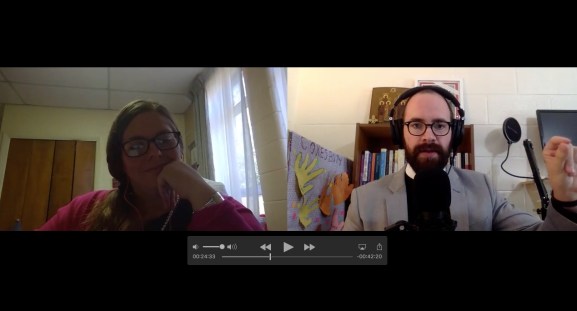
This week on the Strangely Warmed podcast I speak with Jason Micheli and Scott Jones about the readings for the 1st Sunday of Advent [Year B] (Isaiah 64.1-9, Psalm 80.1-7, 17-19, 1 Corinthians 1.3-9, Mark 13.24-37). Jason is the Executive Pastor of Aldersgate United Methodist Church in Alexandria, VA and Scott is the host of the Give and Take Podcast. The conversation covers a range of topics including clip-on bowties, looking for the next Advent, weak church confessions, singing in minor keys, Apple Watches, meditating on our deliverance, and kitten videos. If you would like to listen to the episode or subscribe to the podcast you can do so here: Have Yourself A Merry Little Apocalypse

Taylor Scot Jason

God Is God And We Are Not

strangely-warmed-spreaker-header

This week on the Strangely Warmed podcast I speak with Rev. Matt Hambrick about the readings for the Christ The King Sunday (Ezekiel 34.11-16, 20-24, Psalm 95.1-7a, Ephesians 1.15-23, Matthew 25.31-46). Matt is the pastor of Trinity UMC in San Diego, California. The conversation covers a range of topics including hipster churches, opt-in preschool chapel time, Caesar vs. The Shepherd, the hypostatic union, and Christians not liking other Christians. If you would like to listen to the episode or subscribe to the podcast you can do so here: God Is God And We Are Not

HipsterJesus

Billboards In The Kingdom

1 Thessalonians 5.1-11

Now concerning the times and the seasons, brothers and the sisters, you do not need to have anything written to you. For you yourselves know very well that the day of the Lord will come like a thief in the night. When they say, “There is peace and security,” then sudden destruction will come upon them, as labor pains come upon a pregnant woman, and there will be no escape! But you, beloved, are not in darkness, for that day to surprise you like a thief; for you are all children of light and children of the day; we are not of the night or of darkness. So then let us not fall asleep as others do, but let us keep awake and be sober; for those who sleep sleep at night, and those who are drunk get drunk at night. But since we belong to the day, let us be sober, and put on the breastplate of faith and love, and for a helmet the hope of salvation. For God has destined us not for wrath but for obtaining salvation through our Lord Jesus Christ, who died for us, so that whether we are awake or asleep we may live with him. Therefore encourage one another and build up each other, as indeed you are doing.

I have a love-hate relationship with church signs and billboards.

Every once in a while I’ll pass by a church with a sign that just knocks me back with laugher. I’ll never forget the time I was driving, soon after receiving my driver’s license, and I passed a local Presbyterian church with a sign that said, “The Church isn’t full of hypocrites… there’s always room for more!”

And then there are the witty signs that are biblically accurate and memorable. For instance: I was lost driving through the middle of nowhere Virginia and I saw a handwritten sign in the front yard of a very small chapel that said, “Quick, look busy, Jesus is coming!”

Or there are those that just hit a little too close to home: “Having trouble sleeping? We have sermons. Come hear one!” or the equally pastoral: “Do you know what hell is? Come hear our pastor.”

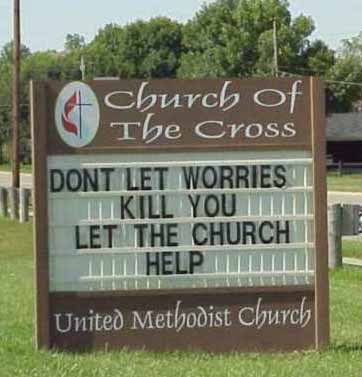
And then there’s those signs where you can’t help but wonder what led someone to put that up for everyone in the world to see. Like: “Don’t let worries kill you, let the church help” and “God answers our kneemail” and “Can’t take the heat outside? This church is prayer conditioned.”

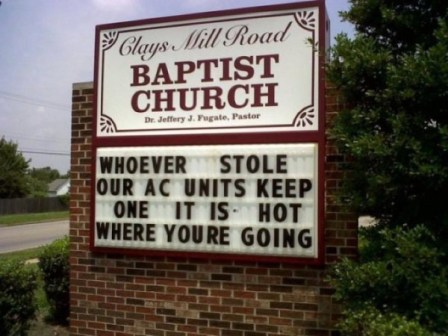
But there is one church sign that takes the cake, one sign that was so poignant that it has stuck with me over the years. In big blocky letters it said, “To whomever stole our AC unit. Keep it. You’ll need it where you’re going…”

ayFBmy2

And for every funny, and witty, and strange church sign, there are an equal number of terrible, shameful, and problematic church signs.

I can remember driving with my family years and years ago when I saw a church with a sign that said, “No gay marriage: it was Adam and Eve not Adam and Steve.”

There was quite a controversy a few years ago in a small southern community where a few teenagers died in a car accident and a local church put up a sign the next day that said: “Honk if you love Jesus! Text while driving if you want to meet him!”

And last weekend, while I was driving down to Durham, NC, we passed a huge billboard in Richmond that said, “The End is near! Accept Jesus or go to Hell.”

These billboards and church signs shout at passing cars and pedestrians about the brokenness of the world and the desperate need to change here and now. They play into our fears and frustrations, they tap into our emotions, and they make it all about us.

Notice, the signs I described, they’re almost all about our experience, and our need to change, and our sin. Very few church signs are actually about God.

How strange.

1_churchKill

And, because we take our lessons from the world around us rather than from God’s Word, we’ve let this slip off the billboards and into the church. So much of what we do on Sunday mornings has become primarily focused on our experience.

We ask questions like, “What did you get out of church today?” when it’s actually about what God gets out of us.

We preach and hear sermons that end with “let us now go and do likewise” instead of reflecting on how God is the one moving in and through us.

We make church all about us, instead of about God.

Our text from Paul’s letter to the church in Thessalonica is apocalyptic. Apocalyptism is one of the frightening words we tend to avoid at all costs. When we hear the word our minds immediately flock to frightening movie scenes, and fire raining from the sky, death and destruction all around. We think about the people wearing signs on street corners or the not-so-subtle church billboards near the highway.

But apocalyptic writing is nothing more than the revelation of God. It is an experience of the presence of the divine that breaks down every barrier for humans in the universe.

These kind of writings and reflections rise to the surface whenever Christians feel pressured by the world; when oppressive regimes like Rome, or slavery, or the system itself rises to power, they put all of life’s choices into the binary of God or the devil. And hope for God’s in breaking, God’s revelation, may be all that keeps us going when everything feels like it’s falling apart.

It should come as no surprise that considering what has taken place across the American landscape over the last year, many people, Christians in particular, believe we are in the end times.

Evangelicals feel attacked and belittled by the federal government for just about everything under the sun.

Pastors lament from the pulpit about the so-called war on Christianity or the war on Advent and they strive to frighten their people into recognizing the apocalypse at hand.

Even Roy Moore, the current Alabaman Republican candidate for a Senate seat, in light of all the accusations coming in for sexual harassment and misconduct, he has denied them vehemently and labeled them an attack on his Christian identity and virtue.

Fear is a very powerful tool. Manipulation always takes place when individual fears are tapped into.

That’s why political races are won by showing what’s wrong with the other candidate rather than addressing what a particular candidate wants to see happen.

It’s also why children are experiencing the highest levels of anxiety in modern history because they feel pressured to perform well, rather than being celebrated for what they’ve accomplished.

And it’s why churches put up big billboards with slogans like “Accept Jesus or Suffer The Consequences” rather than “Jesus loves you.”

Today, there is so much going on that there is plenty of pressure for us to forget that we are citizens of the age yet to come.

Fear is powerful.

And even here in Paul’s letter to the Thessalonicans, he appeals to their fear:

You all of all people know that the day of the Lord will come like a thief in the night. The world might seem nice and good, but that’s exactly when the sudden destruction will arrive, like labor pains in a pregnant woman, and there will be no escape!

            But unlike the billboards that speckle our American landscape, unlike the 24-hour news cycle that is almost entirely devoted to political fears, Paul raises the issue of revelation not for fear mongering, but for encouragement.

1Th5

The world might be falling apart, but we are not in darkness. We are children of the light and children of the day. We cannot become blind to who we are and whose we are, we must remember our truest identities and what has been done for us. So, let us clothe ourselves with the breastplate of faith and love, and for a helmet we shall wear the hope of salvation. For God has destined us for greater things; not for wrath, but for obtaining salvation through Jesus Christ our Lord. Therefore, do the good and right work of encouraging one another, and build up each other.

Paul, throughout the centuries, fills our ears with the very words we need to hear: Stay the course, remember we belong to the light, trust God and trust God’s promises, build the kingdom, love one another.

All of those things would be far better on a church billboard than most of the stuff we see on a regular basis.

On Sunday afternoon, shortly after most of us left the church, I received a phone call from our Secretary, Louise. Now, to be clear, Sunday afternoons are holy times for clergy people as they struggle to keep awake after struggling to keep people like you awake during church. So when I receive a phone call on a Sunday afternoon, right after being in this space with all of you, I know it’s important.

I answered my phone and Louise quickly filled me in one what had taken place right after I left… A drunk driver had crashed into our church sign.

When he came down the road he was traveling at such a high speed that when he smashed into the brick and mortar sign, it flipped the vehicle and it flew another 30 feet before it finally came to stop.

Police officers were on the scene and the driver had already been rushed in an ambulance to the hospital. He thankfully only suffered a few cuts and bruises, but when I got on the phone with the first officer he kept saying the same thing over and over again, “He’s lucky to be alive.”

IMG_1123

Thankfully, our sign that now stands broken and cracked on the corner of our property is not filled with any of the hateful rhetoric found on some other billboards. I say that with gratitude because the guy who crashed last Sunday easily could’ve died. He was going fast enough to end his life. And as I thought about what happened this week, as I read through Paul’s letter, I kept thinking about how terrible it would’ve been if those kinds of words were the last he ever saw.

Friends, life is far too short to be filled with negativity and fear and belittling attacks meant to manipulate. There is enough anxiety already in the world today. And when we think that all of this church stuff is up to us, and to us alone, we only increase the pessimism that so controls the world.

Paul writes to the church, and to us, and boldly declares that we have received a great gift in the death and resurrection of Jesus Christ. We have been awakened to God’s movements in the world, we have the privilege of living as God’s people in the light, and we get to experience the profound and wonderful mystery of resurrection here and now in and through one another.

We can, like others, spend our days worried about what will happen to us when we die. We can fall prey to the fearful signs that fill the horizons. But Christ died so that we may live.

Therefore, instead of breaking one another down, we build one another up. Instead of using fear to manipulate others, we give thanks for the love of God that has no end. And instead of cowering in the shadow of the cross, we rejoice in the light of the resurrection. Amen.

It’s About God, Stupid.

strangely-warmed-spreaker-header

This week on the Strangely Warmed podcast I speak with Rev. Sarah Locke about the readings for the 23rd Sunday after Pentecost (Joshua 24.1-3a, 14-25, Amos 5.18-24, 1 Thessalonians 4.13-18, Matthew 25.1-13). Sarah is the pastor of Christ United Methodist Church in Staunton, Virginia. The conversation covers a range of topics including the idol of being perfect, short term memory loss, being “for” God, and the possibility of God growing tired with all our words. If you would like to listen to the episode or subscribe to the podcast you can do so here: It’s About God, Stupid. 

15356757_10154146502701297_8666134507242876920_n

Donkeys, Elephants, and The Lamb

Revelation 7.9-17

After this I looked, and there was a great multitude that no one could count, from every nation, from all tribes and peoples and languages, standing before the throne and before the Lamb, robed in white, with palm branches in their hands. They cried out in a loud voice, saying, “Salvation belongs to our God who is seated on the throne, and to the Lamb!” And all the angels stood around the throne and around the elders and the four living creatures, and they fell on their faces before the throne and worshiped God, singing, “Amen! Blessing and glory and wisdom and thanksgiving and honor and power and might be to our God forever and ever! Amen.” Then one of the elders addressed me, saying, “Who are these, robed in white, and where have they come from?” I said to him, “Sir, you are the one that knows.” Then he said to me, “These are they who have come out of the great ordeal; they have washed their robes and made them white in the blood of the Lamb. For this reason they are before the throne of God, and worship him day and night within his temple, and the one who is seated on the throne will shelter them. They will hunger no more, and thirst no more; the sun will not strike them, nor any scorching heat; for the Lamb at the center of the throne will be their shepherd, and he will guide them to springs of the water of life, and God will wipe away every tear from their eyes.”

What is the most important thing in America? As in, if you could take a step back from it all, what do you think has the greatest priority in this country?

Some might say, after a week like the one we just had, that the World Series is the most important thing in America. Baseball is, after all, the great American pastime. Or at least, drinking a beer while eating a hot dog at the World Series is what being an American is all about.

Or maybe the greatest thing in America is the willingness to fight against tyranny and terrorism. This week there was yet another attack against innocent civilians in New York City and the response in condemning the attack was universally accepted.

What’s the most important thing in America? I would make a case, that for Americans freedom is the most important thing in America. Think about it for just a moment: freedom to chose, freedom to speak, freedom to worship, freedom to vote. Nothing is more important to Americans on the political left and right than maintaining the freedom of the individual. We hear about our freedom all the time.

As such, we’ve created a culture where privacy is sought more than community, where no one should be asked to suffer for anyone else, and where we get to say whatever we want, and others can say whatever they want, so long as it doesn’t offend us too much.

In a strange and weird way, our bondage to political realities and political choices has resulted in our bondage to freedom.

When we moved here a handful of months ago, after we finally unpacked most of the house, we set up our TV and signed up for cable. It took a long time to get used to watching commercials again after not seeing them for the majority of the last seven years while I was at my first appointment and while I was in seminary.

I liked watching a narrative from start to finish without interruption, and because the commercials were now interrupting my viewing I started paying more attention to them. During the first two months of cable television, just about every single advertisement had to do with bodies. If you take this pill your body will feel stronger, if you use this cream you will look ten years younger, if you use this shampoo you will get the man of your dreams, if you use this deodorant you will get the woman of your dreams.

And whenever I saw two middle age individuals holding hands while sitting in separate bathtubs, or just being overly affectionate with one another, I didn’t even need to listen to the voiceover to know what they were selling.

But then something changed.

Almost without warning, there was a not a single commercial break without an ad for the gubernatorial race that comes to its fruition this Tuesday. And the more I witnessed the ads the more I realized something bizarre: I never saw an ad describing what either candidate stood for. Instead every ad was dedicated to attacking the other.

At this point, I’m sad to say, I can tell you far more about what’s wrong with both candidates than I can tell you something constructive about what each of them are hoping to accomplish.

Freedom.

img_mouseover3 (1)

Today we celebrate the saints of God. Since nearly the beginning, the church has set aside a day to remember the great cloud of witnesses who have gone on before us in the faith, stretching across the centuries and all around the world. We take time to read their names and pause for a moment of praise to the Lord for the many ways those saints shaped our faith even here and now.

And we don’t get to choose our saints, much like we don’t get to choose our politicians. I mean we do in the sense that we get to vote on them, but more often that not we just get the politicians we deserve.

Today, our culture has been separated into two divided categories: Donkeys and Elephants. Just about every fabric of our lives can be whittled down to one of the two dominant political ideologies such that we can’t watch TV, or read a newspaper, or get online, or even drive down the road without being bombarded by one of the two political animals. The suffocating political atmosphere of today is oppressive and often forces us to identify what camp we’re in.

And, sadly, because we have total and ultimate freedom, the thing we hold dear, we can surround ourselves with people who look like us, think like us, and perhaps most importantly, vote like us.

But saints are the people who gave their lives not to a donkey, and not to an elephant, but to the Lamb.

Revelation is one of the weirder books in the bible, and one not often read in church. In it you can find the kind of stuff that some people shout from the street corners of life. In it we can read about beasts and dragons and lambs. And, often times, it is used by those of a more fundamentalist leaning to detail the coming wrath and destruction of God in such a way that it scares faith into people.

But for as much as Revelation is about a time yet to come, it is also about what the faithful life is like here and now.

The vision contains a great multitude that no one could count, people from every nation, every tribe, every people, and every language standing before the throne and before the Lamb, robed in white, with palm branches in their hands. And they’re singing!

This group that is beyond all groups is gathered around the one Lamb at the throne. They are the ones who have come out of the great ordeal and have washed their robes and made them white in the blood of the Lamb.

            In God’s time, all people will be washed by the blood of the Lamb; through the death of Christ on the cross salvation has entered existence.

Here and now, we are washed through the waters of baptism, something that gives us more identity than any donkey or elephant ever can, something that frees us more than any declaration of independence ever can, and something that saves us better than any politician ever can.

Baptism is the beginning of the journey that leads to sainthood. Because in baptism we enter into the revolution of God where the Lamb at the throne determines our lives more than anything else. Where we can find a unity through the waters that is almost completely absent in every other part of existence.
saints_5236c

Church, thanks be to God, is one of the last remaining places where we willingly gather with people who don’t think, look, act, and vote like us. Church is the place where we believe our baptismal identities are more important and more determinative than the political sign in our front yard and the person whose name we choose in the voting booth.

Whenever we gather in this space, we are brought before the throne with the Lamb at the center. This thing we call worship is our best chance to be reminded that God is the One guiding us to springs of water, and that God is the One invested in the work of wiping every tear from our eyes. Church is where we come to meet the saints with hope that someone might call us saints when we’re gone.

We live between the Alpha and the Omega, the first and the last. We rest in the time between when we hear the beautiful tones of God’s final Word that stretches into eternity and reaches back into the farthest moments of time itself.

            And, like the saints of Revelation, we sing.

The music of the saints, the very music of salvation, gives a different sound and understanding to what we prioritize in this life. When we sing with the great cloud of witnesses from the past, present, and future, we boldly proclaim that it is always the Lord and not the empire that liberates. When we lift our voices to the sky we do so in declaration that the Lamb is more important than a donkey and an elephant.

It is through the music of God, the sounds of the saints, that we receive the endurance necessary to make it through whatever trouble springs up in our lives.

That heavenly choir of revelation, a choir that we harmonize with here on earth, invites the revolution of God that will not let division have the final word.

Almost a year ago I woke up and drove down the road from the parsonage to the local Seventh Day Adventist church, which was my polling station for the presidential election. For the better part of two years, with billions of dollars raised and spent by both campaigns, the time had come for the country to decide who would be our next president.

I pulled into the parking lot before the Sun had peaked over the horizon, and with a coffee mug in my hand and my clergy collar around my neck, I walked into the fellowship hall to cast my vote.

I remember the polling operators looking dreadful and depressed, as if the previous months had sucked the very life out of them, and I walked passed to my booth.

There before me on the table was a piece of paper that countless individuals have fought to protect. There, with big fonts and circles to fill in, was the very freedom our country was founded on. I filled in my circle and walked over to the machine, which ate my decision, and rang a little bell for completion.

And then I looked up. On the wall above the voting machine was a giant painting of Jesus. Not Jesus dying on the cross, nor was it Jesus praying in the garden, nor was it any of the miracles Jesus performed through his ministry. No, it was a giant painting of Jesus laughing his butt off.

            And it was perfect.

Salvation belongs to God alone. Even though all nations, and races, and creeds, and languages are pictured in the divine vision of revelation, salvation does not belong to any of them. All of them are guilty of promising something to a particular group while damning another.

The donkeys and the elephants can’t and won’t save us. They exist to instill a sense of freedom that isolates us from one another rather than binding us to one another. They attempt to rid us of our baptismal identities to tell us that our political identities are more important. They promise salvation that only brings division.

But the Lamb of God is at the center of the throne. The saints of God, those who came before, those who are with us now, and those who are yet to come sing with one voice, “Salvation belongs to our God who is seated on the throne, and to the Lamb!” Amen.

Urging & Encouraging

strangely-warmed-spreaker-header

This week on the Strangely Warmed podcast I speak with Rev. Sarah Locke about the readings for the 22nd Sunday after Pentecost (Joshua 3.7-17, Micah 3.5-12, 1 Thessalonians 2.9-13, Matthew 23.1-12). Sarah is the pastor of Christ United Methodist Church in Staunton, Virginia. The conversation covers a range of topics including Old Testament references to baptism, what its like to be “hangry”, the power of telling the truth, and why everyone likes being thanked. If you would like to listen to the episode or subscribe to the podcast you can do so here: Urging & Encouraging

SL

Why Do We Serve?

Matthew 22.34-40

When the Pharisees heard that he had silenced the Sadducees, they gathered together, and one of them, a lawyer, asked him a question to test him. “Teacher, which commandment in the law is the greatest?” He said to him, “You shall love the Lord your God with all your heart, and with all your soul, and with all your mind. This is the greatest and the first commandment. And a second is like it: ‘You shall love your neighbor as yourself.’ On these two commandments hang all the law and the prophets.

Love loves to love love. Love, in my opinion, is one of the most over-used and (therefore) underwhelming words that we use on a regular basis. We teach our children to be careful with their hearts and affections unless they are in love. We wait to value a romantic relationship as something with a future only when we love and feel loved by the other. We spend way too much money in February every year in attempts to declare our love through chocolate, cards, and other frivolous items.

Love.

In the church, sadly, the call to love God and neighbor has become so routined that we have become numb to it, or we view it superficially. When we hear something like how we are called to love God and neighbor, we worry more about who are neighbors are, than we actually spend time thinking about loving God in such a way that it spills out to our neighbors.

In a time when the word “love” is greatly abused, it is important to remember that the fundamental component of biblical love is not affection or hallmark cars, but service.

To love is to serve.

servesearch

When I was 14 years old I was sitting in church on a typical Sunday morning and I was flipping through the bulletin rather than listening to whatever was coming from the pulpit. We were an almost every Sunday family and I don’t have many memories of my life without church in it, but that doesn’t mean that I always loved the church.

I used to get so bored that I would doodle all over the bulletin with images of planes, robots, and destruction. I even got to the point where I was so bored that I would pick up the bible out of the pew rack and would flip to a random passage and start reading.

            But that Sunday, when I was 14, I read something in the bulletin that truly changed my life forever: “Soundboard operator needed. Training begins next Sunday.”

The next Sunday I showed up early for worship and stood awkwardly by the sound system until Bud Walker arrived. For the next month he stood behind me every Sunday, looking over my shoulder, and whispered directions into my ear about what to do… this knob controls this… you have to press both buttons to record the service… make sure to hit mute before the hymn begins.

And after my month of training, the responsibility was mine.

My faithfulness today is largely a result of learning to serve the church as the soundboard operator as a teenager. Up until then my understanding of church was limited to the place we went to for an hour a week, but serving the church opened my eyes to so much more.

And, of course, it wasn’t without its strange moments… There were plenty of Sundays when I forgot to mute the microphones in time and everyone got to hear one of our preachers sing something that I would hesitate to even call a melody. There were the many Saturdays that I was needed to run the board for a wedding service and I got to witness the stumbling and hung-over groomsmen struggling to keep up with the perfectly coordinated bridesmaids. And there were the dozens of funerals for both young and old Christians, funerals for people I knew and for people I never met, funerals that taught me what being a Christian is really about.

Running the soundboard was one of the most important decisions of my life because it taught me to listen to worship carefully. Instead of doodling in the bulletin I had to focus on the sermons and the hymns and they took on a whole new meaning for me.

My service to God through the church resulted in my loving the church.

But why do we serve? We could just say something like the Son of Man came not to be served but to serve and end the sermon right there. But service, at least Christian service, is about more than simply copying Jesus.

Or we could talk about how Jesus says to the crowds, “Just as you have done unto the least of these so you have done unto me.” But even then, service is about more than serving the hidden Jesus in our midst.

We serve, because in serving we learn what it means to love.

f0e651fd6aac05640a4daa2d474fe3e3--ministry-leadership-leadership-is

The Pharisees wanted to test Jesus, but what they really wanted was to trap him. A lawyer came forward and said, “Teacher, which commandment is the greatest?” Jesus answers by first quoting the Shema, the centerpiece of morning and evening Jewish prayer services, “You shall love the Lord your God with all your heart, with all your soul, and with all your mind.” But he doesn’t stop there. Jesus reinterprets the greatest commandment in scripture to include, from Leviticus, “You shall love your neighbor as yourself.” These two commandments, according to Jesus, are what the entirety of the law and the prophets hang on.

            Or, to put it another way, the greatest commandment is to love God and neighbor.

            Or, still yet another way to put it, you can’t love God without loving your neighbor, and you can’t love your neighbor without loving God.

This little bit of wisdom from Jesus came on the Monday of Holy Week. Between the tension of the palms waving frantically on Sunday and the hardwood of the cross waiting on Friday, this is what Jesus chose to share with the people of God.

            The greatest thing we can do in this life is love.

And there can be no love without service.

For some reason, in the church, we read this passage and all we ever really emphasize is the call to love our neighbors. We produce programs designed to break down the walls between us and them, we host events and gatherings designed to bridge the gaps between us and them, and then whenever we feel like we “love” our neighbors we check off the box and move on to the next item.

And for sure, we would do well to have some more love for our neighbors. I asked our Sunday School class last week about what sounds annoy them the most, and just about every person in the room complained about a noise that comes from their literal neighbors. Whether it’s the loud music shaking the windows, or the backyard dogs that won’t stop barking, or the cars that rev their engines as the peel out of the neighborhood.

And I wonder if our neighbors would annoy us if we ever offered to serve them dinner. Imagine, if you can, walking up to the neighbor you know the least, the one who frustrates you the most, and asking if they’d like to come over for dinner some time.

Serving someone in that intimate of a setting is the equivalent of the scales falling from Paul’s eyes so that he could see clearly again. Serving a neighbor something as simple as a meal is the beginning of a journey that leads them away from being a neighbor, into the realm of being a friend.

But we’ve all heard sermons like that before. We’ve all left church at some point with the challenge to be a little more friendly or kind to the people around us. For some reason we whittle this passage down in such a way that all we think about is loving our neighbor, and we’ve almost done so at the expense of loving God.

            Do we love God?

I mean, we talk a lot about how much God loves us, but do we feel love for God? There was a Christian many centuries ago who said that he wanted to love God in such a way that he would be so completely seized by that love that all the desires of his heart and all the actions, affections, thoughts, and decisions which flow from them would be directed toward God. Is that what we feel?

Instead of thinking about and exploring ways that we might love God, we’re stuck in realm of thinking and exploring ways on how to handle the person who lives next door.

But, at the core of what it means to follow Jesus, loving God and loving neighbor cannot be separated from one another.

Loving God results in loving our neighbors, and loving our neighbors results in loving God. Or, maybe, serving God allows us to serve our neighbors, and serving our neighbors allows us to serve God.

So instead of asking, “Do we love God?” perhaps the real question is, “How are we serving God?”

In each of your bulletin you will find an insert with details about ways to serve God here at Cokesbury. By no means is this list totally comprehensive, but it presents a sampling of any number of ways we can love God by serving God in this place (and frankly, outside of this place).

My life changed because I read about a need in a bulletin 15 years ago. It was through the work of serving the church at the soundboard that I fell in love with the God who was revealed to me in worship. The soundboard became a launch pad toward other areas of the church where I spent even more time in service of God and neighbor. I spent nights sleeping at Rising Hope in their hypothermia shelter, I joined a praise band that led worship, I went on mission trips all over Virginia and all over the world. And I can honestly say that all of it happened because I saw the request in the bulletin.

111d27e1caf4453c066b9ab44b4b0977

So here’s your list. From joining our missions committee, to reading scripture in worship on Sunday, to helping with our monthly food distribution, there is a place for everyone in this room to plug in and serve God. And maybe as you skim over the list you feel like there isn’t something for you, perhaps you have a new idea about how we can serve God together as a church. If so, tell somebody about it, tell me, and let’s make it a reality.

For friends, it is in the service of God that we learn what it means to love God. And when we learn what it means to love God we begin the work of loving our neighbors. And then we live into the greatest commandment made manifest in Jesus.

Because, after all, that’s really why we serve. We serve because we have been served.

In all of God’s majesty and mystery, God chose to descend into the world of our brokenness and shame to take on our flesh as a baby born in a manger. God served us in Christ through words, and acts, and miracles. God served us by mounting the hard wood of the cross to die and rise again three days later.

We worship a God of service and action, One who does not remain high and far away, One who is not absent from the perils of this world, but One who believes in moving in and through our being as we take steps in this life.

We worship a God who serves, and that’s why we serve.

Or, better yet, we worship a God who loves, and that’s why we love. Amen.

The End of Questions

strangely-warmed-spreaker-header

This week on the Strangely Warmed podcast I speak with Kenneth Tanner about the readings for the 21st Sunday after Pentecost (Deuteronomy 34.1-12, Leviticus 19.1-2, 15-18, 1 Thessalonians 2.1-8, Matthew 22.34-46). Ken pastors the Church of the Holy Redeemer in Rochester Hills, Michigan and is a good friend of the podcast. The conversation covers a range of topics including the role of the theologian-pastor, why we should think about Moses when we think about MLK Jr., thoughts on the awesomeness of the BCP, and why we should spend less time trying to please people. If you would like to listen to the episode or subscribe to the podcast you can do so here: The End of Questions

books-of-common-prayer

God’s Backside

strangely-warmed-spreaker-header

This week on the Strangely Warmed podcast I speak with Kenneth Tanner about the readings for the 20th Sunday after Pentecost (Exodus 33.12-23, Isaiah 45.1-7, 1 Thessalonians 1.1-10, Matthew 22.15-22). Ken pastors the Church of the Holy Redeemer in Rochester Hills, Michigan and is a good friend of the podcast. The conversation covers a range of topics including how God responds to prayer, reflections on people worshipping the nation more than the living God, why the old hymns are the good hymns, and thoughts about David Bentley Hart’s new translation of the New Testament. If you would like to listen to the episode or subscribe to the podcast you can do so here: God’s Backside 

KT

Why Do We Study?

Philippians 3:4b-14

If anyone else has reason to be confident in the flesh, I have more: circumcised on the eighth day, a member of the people of Israel, of the tribe of Benjamin, a Hebrew born of Hebrews; as to the law, a Pharisee; as to zeal, a persecutor of the church; as to righteousness under the law, blameless. Yet whatever gains I had, these I have come to regard as loss because of Christ. More than that, I regard everything as loss because of the surpassing value of knowing Christ Jesus my Lord. For his sake I have suffered the loss of all things, and I regard them as rubbish, in order that I may gain Christ and be found in him, not having a righteousness of my own that comes from the law, but one that comes through faith in Christ, the righteousness from God based on faith. I want to know Christ and the power of his resurrection and the sharing of his sufferings by becoming like him in his death, if somehow I may attain the resurrection from the dead. Not that I have already obtained this or have already reached the goal; but I press on to make it my own, because Christ Jesus has made me his own. Beloved, I do not consider that I have made it my own; but this one thing I do: forgetting what lies behind and straining forward to what lies ahead, I press on toward the goal for the prize of the heavenly call of God in Christ Jesus.

Fred Craddock is widely regarded as one of the greatest preachers of recent history. His command of scripture is evident in his sermons, and he regularly captivated those with ears to hear. But before he became a great preacher, he was a normal Christian just like you and me.

During the height of the Civil Rights movement, Craddock found himself driving across the country. He was making his way through northern Mississippi early one morning and needed to stop for a cup of coffee and some breakfast. He found a no name diner in the middle of a no-name town and decided to pop in. It was early enough in the morning that Craddock was alone in the diner with the cook and he ordered his food and coffee. While Craddock was sitting at the counter, a black man entered and sat down a couple stools away and ordered a coffee. The cook promptly turned around, looked at the man in the face and said, “Get out! We don’t serve your kind here!

The man patiently responded, “My money is just as good as his” while pointing over at Craddock. But the cook continued to point at the door and said, “The sign says ‘Whites Only’ so get out before I put you out!

And with that the black man sighed and slowly removed himself from the stool and the diner.

Craddock continued to finish his meal, he paid, and then he left. But right before he was about to get back into his car, in the still and quiet of the early morning, he heard a rooster crow in the distance.

This is where I pause for a moment.

Do any of you feel chills? Some of you will undoubtedly appreciate the story for its timely reminder about problematic race relations in this country, but for some of you this story hits even harder. Craddock, after sitting and witnessing the racism and bigotry a few feet away realized, in the rooster’s crow, that he had just denied Jesus as Peter did right before his crucifixion.

The story of Craddock’s experience becomes powerful particularly in its connection to scripture. For, if Craddock was unfamiliar with the stories of God, he could’ve heard that rooster in the distance, drove off, and never think about the experience at all.

But Craddock knew his bible; he had studied it well enough to know the ways God works in the world. Such that when he heard the rooster, it changed his life forever.

Bible Hands STOCK PAID

This whole month we’re diving deep into why we do what we do as Christians. Last week we talked about why we worship, and today we’re looking at why we study. To put it rather simply: we study God’s Word because this story is our story. It’s like opening up the pages to discover our family history, our quirks and idiosyncrasies, our triumphs and our failures.

Whenever we open the scriptures and study we are entering into the strange new world of the bible, one that shines a light on what our lives really look like even today.

When Paul wrote to the church in Philippi, he got really personal. We preachers are taught to do the opposite. Rather than standing before a group of people like you and share how we are trying to follow Jesus, we’re supposed to point away from ourselves to Jesus. And I believe that’s wise counsel; there is far too much temptation for preachers to make ourselves into the Jesus figure of our congregations and instead of saying, “follow Jesus” we say, “follow me.”

But Paul got personal. He laid it all out for this small and budding church. I have every reason to boast in the world: I was the Jew of all Jews, I followed the law, I was blameless in everything I did. I even persecuted the church. Yet whatever I gained in the world, I have come to regard as loss because of Christ.

Paul’s story is a powerful one, but it’s only powerful when we know the whole story. We can read the letters he wrote to different communities, we can reflect on his theology and declarations, but when we study the bible, when we know who Paul was before he encountered Jesus on the road to Damascus, everything he writes comes into a new light.

Paul was so zealous in his Jewishness, he was so righteous, that he murdered Christians in the years following Jesus’ resurrection. The earliest disciples feared him. And, in God’s strange wisdom, the greatest persecutor of the church became her greatest missionary.

We study God’s Word because this story is our story.

large_your-only-bible-reading-duty-is-delight-3vbwjrol

Years ago I was sitting in a coffee shop working on a sermon while wearing a clergy collar. And, most days, people ignore the pastor sitting in the corner supping on coffee and scratching his head. But not that day.

A guy walked in, looking pretty disheveled, and immediately bee-lined over to me. His eyes were locked onto my collar, and before I knew what he was doing, he fell to his hands and knees and started kissing my feet. Embarrassed, I tried to get him to stop, and when he could tell that everyone was staring at us, he asked to speak with me outside.

We sat down on a nearby bench and he began telling me about all his troubles. He was down on his luck with no job and no home. He had been kicked out of a couple local homeless shelters, but he recently heard that he could get some actual help in Richmond.

As he went on and on I caught myself preparing a response in my head rather than actually listening to him. And, as I often do, I offered him a few dollars and suggested that he seek out some organizations in town to help support his needs.

He stared at me blankly and said, “Man, I just need a ride to Richmond.”

I don’t remember exactly what I said in response, but I’m sure that I made some excuses about how much work I had to do, or that I really needed to get back to the church. And as I went on listening off my justifications, he stood up while I was talking and he just left me there sitting on the bench. My voice tailed off as he walked away, and before he turned the corner I heard him say, “A man was going down from Jerusalem to Jericho…”

That moment has haunted me in the years since. Because, as soon as he said those words, I felt my heart burning within me because I had failed to live into my baptismal identity. He, in a few choice words, had initiated the story of the Good Samaritan, and I was the priest who failed to help the man on the side of the road.

If I hadn’t known Jesus’ parable that the man quoted, I might’ve let it roll off my back like any number of other interactions, but because I knew the story, that moment has haunted me.

On Monday morning I was sitting my office here at the church when a man walked in covered in sweat and asking to talk to the preacher. I invited him into the office and I watched and listened to him share his story. Down on his luck, no job, no home. And immediately, I started sensing a gulf developing between us as I began rehearsing my response in my mind. We get calls here every day from people in the community looking for help; late on rent, overdue on an electric bill, no food in the refrigerator. And we try to help as many as we can, or at least direct them in such a way that they can be helped, but it’s hard not to be suspicious. It’s hard to prevent that sinful side of myself from bubbling to the surface and ignoring the person in need.

Anyway, the man was sharing his story, and before I was able to respond with the same sorts words I’ve used hundreds of times he said, “I just need a ride to Charlotte, NC. I want to start over and my daughter lives there and she’s going to put me up for awhile.”

I apologized and said that I would be unable to drive him myself, but the church would be more than happy to buy him a bus ticket.

He beamed.

I ordered him a ticket for a Megabus leaving that afternoon and then we got in my car and I drove him to a nearby VRE station so that he could get into the city to catch the bus. We talked during the car ride about the change in weather and about Virginian hospitality and a number of other subjects. And when we got to the station I got out of the car to open his door and wish him well, and then he asked to pray for me. Let me say that again, he asked to pray for me, not the other way around. So he wrapped his arms around me and prayed.

After the “amen” he looked at me in the eyes and said, “As you have done onto the least of these, so you have done unto me.” And with that he turned around and walked away.

When I came into work on Tuesday morning there was a message on our answering machine. He had made it to his daughter’s house and wanted to thank the church for its generosity.

I’m not proud of what I did. Sure, I’m happy he made it, and I’m glad that we could offer him some grace, but I’m not proud of what I did; because I didn’t want to do it. I only did it because I knew the story of scripture, and then that man turned it around and left those words resonating in my ears as he walked away.

We study God’s Word because God is always talking to us, only if we have ears to hear. When we know the story that is our story, we become attuned to God’s frequency in the world, we hear the rooster, we see the man in need, and it changes our lives just as God changed the lives of the people we read about in the bible.

If you’re anything like me, if you’re anything like Paul, you want to know Christ and the power of his resurrection. We catch a glimpse of that power and experience it here and now when we study the Word and encounter it in our daily living. We need to study the Word because all of us, sinners and saints, preachers and laypeople, we’re all works in progress. We press on to make Christ’s resurrection our own, because Christ has made us his own.

Beloveds of Cokesbury, I have not made it to perfection, in fact I am far from it, but there is one thing I know for sure: when we know the story that is our story, when we study God’s Word, we can hear God calling to us in Christ Jesus. Amen.

October