Hoping Against Hope

strangely-warmed-spreaker-header

This week on the Strangely Warmed podcast I speak with Rev. Dr. Emily Hunter McGowin about the readings for the Second Sunday of Lent [Year B] (Genesis 17.1-7, 15-16, Psalm 22.23-31, Romans 4.13-25, Mark 8.31-38). Emily is a teacher and scholar of religious studies and a theologian in the Anglican tradition. She has a book on evangelical family practices titled “Quivering Families” coming out in May. Our conversation covers a range of topics including the recent school shooting in Florida, the covenant, name changes, mutual suffering, professional Christians, the difference between trust and witness, and the obsession with safety. If you would like to listen to the episode or subscribe to the podcast you can do so here: Hoping Against Hope

EM

The Word Made Verb

strangely-warmed-spreaker-header

This week on the Strangely Warmed podcast I speak with Johanna Hartelius and Jason Micheli about the readings for the First Sunday of Lent [Year B] (Genesis 9.8-17, Psalm 25.1-10, 1 Peter 3.18-22, Mark 1.9-15). Johanna is the host of the (Her)men•you•tics podcast where she unpacks theological terms without using stained glass language. Our conversation covers a range of topics including covenant reminders, God’s immutability, liturgical vision, Lent as Christianity’s January, and the connections between death and baptism. If you would like to listen to the episode or subscribe to the podcast you can do so here: The Word Made Verb

IMG_3586

What We Believe Shapes How We Behave

Mark 1.29-39

As soon as they left the synagogue, they entered the house of Simon and Andrew, with James and John. Now Simon’s mother-in-law was in bed with a fever, and they told him about her at once. He came and took her by the hand and lifted her up. Then the fever left her, and she began to serve them. That evening, at sundown, they brought to him all who were sick or possessed with demons. And the whole city was gathered around the door. And he cured many who were sick with various diseases, and cast out many demons; and he would not permit the demons to speak, because they knew him. In the morning, while it was still very dark, he got up and went out to a deserted place, and there he prayed. And Simon and his companions hunted for him. When they found him, they said to him, “Everyone is searching for you.” He answered, “Let us go on to the neighboring towns, so that I may proclaim the message there also; for that is what I came out to do.” And he went throughout Galilee, proclaiming the message in their synagogues and casting out demons.

After a month of answering your questions during our January sermon series, I am happy to be moving on. Don’t get me wrong, I enjoy tackling different topics, but I always look forward to getting back to the rhythms of scripture in worship. The problem with taking time every week to answer specific questions from a biblical perspective is the temptation to do what we pastors call “proof-texting.” It is the practice of taking verses or passages out of context and re-appropriating them in whatever way helps to craft the argument.

Perhaps the best, and by best I mean worst, example of this is from Ephesians 5.22: “Wives, be subject to your husbands, as you are to the Lord.” As soon as those words just left my mouth, the women perked up and the men grew smug smiles on their faces. But this verse has been used again and again to subordinate women in terrible and horrific ways. And what makes it all the worse is that we take it out from the whole of the bible and use it like a weapon.

But the verse immediately before “Wives be subject to your husbands,” says, “[Everyone] be subject to one another out of reverence for Christ.” And just three verses later we can read “Husbands, love your wives, just as Christ loves the church and gave himself up for her.” The love that Paul writes about is not the Hallmark version of love, Paul isn’t saying that husbands need to buy flowers and chocolate for their wives every once in awhile (though it’s a good idea), but that husbands must sacrifice, even their very lives, for their wives just as Christ gave up his life for us.

But we don’t get that when we just pick and choose the verses we want to use.

The beginning of today’s scripture is another prime example: “As soon as they left the synagogue, they entered the house of Simon and Andrew, with James and John.” Wait, what do you mean, “as soon as they left the synagogue”? What were they doing there? What happened? Is that important to know?

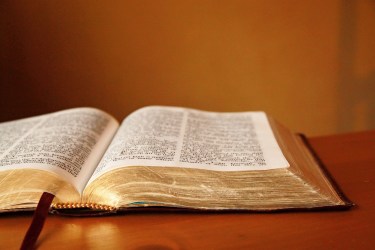
Dividing the bible into discrete units is a pretty strange practice. However, it’s hard to imagine it as strange, because we’ve been doing it all our lives, but we don’t do it with any other text. Think about your favorite book for a moment, perhaps you could repeat a really moving line but can you remember what chapter it was in, or what page it is on? Probably not, but I bet if I asked you what your favorite passage from the bible is, you could not only quote it, but also provide the book, chapter, and verse.

Open-Bible-Religious-Stock-Photos

So here were are with this incredible story. It’s a day in the life of Jesus. After leaving the synagogue they go to Peter’s mother-in-law’s house, Jesus makes her whole, he cures everyone who gathers around the door, then he retreats to a deserted place for prayer, and finally they all depart for the next town to do it all again.

But what happened before?

Jesus brought his first disciples to the synagogue, and he taught as one having authority. While he was there, a man with an unclean spirit cried out, and Jesus made the man whole again. And his fame began to spread through Galilee.

What has that got to do with the healing of Simon’s mother-in-law, and the curing of many people, and praying in a deserted place, and moving on to the next town?

            Jesus’ teaching cannot be separated from his healing.

            He practiced what he preached.     

            What he believed shaped how he behaved.

Last Sunday I stood right here and I invited the congregation to stand for our final hymn, My Hope Is Built. We were coming to the conclusion of our service after spending an hour reflecting on how God is the one who saves us, not the other way around. The first notes began to harmonize throughout this space and I did what I usually do, I closed my eyes and listened. It’s a beloved hymn of mine and I love hearing the faithful sing it together. But for some reason, as we neared the final verse I opened my eyes, and I looked out at all of you.

In the short amount of time it took to get through the last verse, one of our congregants collapsed and was clearly not doing well. I walked forward while most continued to sing, and immediately two of the nurses from our church rushed over to check on him. The words were still bouncing off the walls as we checked on him together, and one of them ran out to call for an ambulance.

When the song ended I offered a rushed benediction, in order to clear out the sanctuary as quickly as possible and I went into what I call “boy scout” mode. I assigned tasks to different people and tried to encourage others to give him space as we waited for the ambulance to arrive. Once the room was mostly cleared, I looked out our doors to see the ambulance and fire truck pull into our lot, and I walked back into the sanctuary to pray for him before he left.

But as I walked into the room, a group of eight people from the church were already huddled over him with hands touching his head and shoulders praying fervently to the Lord.

And it stopped me right in my tracks.

No one asked any of them to pray, they were not ordered to do so, and it was as natural to them as just about anything else.

By the time I got over the holiness of the moment I witnessed, I walked over and he was smiling while a group of women were fanning him with their bulletins. I said, “I know these beautiful women are making you feel like a king right now, but try to not let it go to your head.” And with that he chuckled, and winked at me.

Friends, I felt God’s presence in our worship last week as surely as I ever have. Through the hands and the prayers that surrounded Don, I experienced a moment of profound holiness where what we believe shaped how we behaved. It was powerful, and it was faithful.

For what its worth, Don is doing well, and he and his family are grateful for all of the support and prayers.

There is a healing power in touch and in intimacy. Over and over again in the bible we read about Jesus bringing restoration to people through his willingness to meet them where they were and offer them a new way. Jesus is an intimate Messiah who found individuals in the muck of their lives, who finds us in the moments of our deepest frustrations, and says, “follow me.”

00026846

From the very beginning of scripture, up through the end, we see again and again that it is not right for human beings to be alone. We are at our best when we join together even while all the odds are stacked against us. We are the truest form of God’s dream for us when we gather together rather than trying to do it all by ourselves. We are the faithful vision when we congregate as a congregation.

No one can do it all on their own.

And when you’ve had a taste of what the healing power of community can do, it changes you forever.

Jesus took Simon’s mother-in-law by the hand and lifted her up. Then the fever left her, and she began to serve them. I’ve seen depictions of this scene from the beginning of Mark’s gospel where the mother-in-law is feverishly sweating under a blanket, with a thermometer sticking out of her mouth, but after receiving the touch of the Lord, she pulls our a pitcher of lemonade to make sure all the men are refreshed. But that portrayal of the scene diminishes the truth of what happened.

We read that she served them, but a better translation might be she ministered to them. Not unlike what the pastor is supposed to do for a church, gathering them together attending to their needs, challenging them to be better. In some churches we call this the work of a deacon, a service ministry to the community.

In many senses, Simon’s mother-in-law is the first deacon. She was touched, and it changed everything. Not only did it restore her to health, not only did it bring about a sense of wholeness in her being, it propelled her to minister to those nearby.

She was given a job to do.

This is exactly how Jesus lived his life, it’s what he called his followers to do, and I caught a glimpse of it last Sunday here in the sanctuary.

Fair warning: “practicing what you preach” is no easy thing. There will come times when the last thing we want to do is gather with the people whom we call the church. Whether it’s because they stand for different political realities, or they speak the truth in love (and it hurts), or they simply remind us too much of whom we really are, it is not easy being a faithful community together. Even Jesus needed time alone.

Prayer-can-Heal-yes-or-no__82367

After the episode with Simon’s mother-in-law, word quickly spread through the town and the first disciples brought to Jesus all who were sick or possessed with demons. And the whole city was gathered around the door (a reminder that all are struggling whether we can see it on the surface or not).

But in the morning, while it was still very dark, Jesus got up and went out to a deserted place, and there he prayed. After emptying himself to others, Jesus had to empty himself to God before he could go to the next town to do it all over again. It’s a dance of being filled by the Spirit, to share the Spirit, to need the Spirit again. And in this wonderful story, a story beyond the scripture we read this morning, we experience a day in the life of the Lord, a day like any other day, a day perhaps like today.

When I was ordained, the bishop placed his hands on my head and shoulder and said, “Take thou authority. Go and comfort the afflicted, and afflict the comfortable.” It’s not an easy task, but it’s one we all get to experience right now. In just a second I’m going to invite all of us to comfort someone in the church who is afflicted, and it’s going to be so uncomfortable that you’re going to feel afflicted while you’re comforting. It’s so much easier to pray for someone than to ask someone to pray for you. To say, “I am broken, I need help, I am not the whole vision God has for me.”

But if we can’t do that for each other as the church then we are not the church. So… sorry that I’m not sorry. Go find someone you don’t know, and pray for each other.

Shiny

strangely-warmed-spreaker-header

This week on the Strangely Warmed podcast I speak with Tommie Marshell about the readings for Transfiguration Sunday [Year B] (2 Kings 2.1-12, Psalm 50.1-6, 2 Corinthians 4.3-6, Mark 9.2-9). Tommie recently started the Backsliding Podcast which seeks to produce lay drive conversations about theology and faith (it’s really good and you should subscribe here: Backsliding). Our conversation covers a range of topics including womanist theology, mentorship, covenant separation, naked prophets, giving voice to the voiceless, the positivity of fire, Moana, the blindness of unbelievers, lightning bugs, and the Messianic Secret. If you would like to listen to the episode or subscribe to the podcast you can do so here: Shiny

TM

It’s A Curse To Speak Without Some Regard

strangely-warmed-spreaker-header

This week on the Strangely Warmed podcast I speak with Josh Munnikhuysen about the readings for the 5th Sunday After Epiphany [Year B] (Isaiah 40.21-31, Psalm 147.1-11, 20c, 1 Corinthians 9.16-23, Mark 1.29-39). Our conversation covers a range of topics including the folly of using metaphors for God, functional atheism, church democracies, living east of Eden, the “meaning” of scripture, the Avett Brothers, arresting verses, and women serving the Lord. If you would like to listen to the episode or subscribe to the podcast you can do so here: It’s A Curse To Speak Without Some Regard

HeatherPhoto2

Wasting Time With God

strangely-warmed-spreaker-header

This week on the Strangely Warmed podcast I speak with Wil Posey about the readings for the 4th Sunday After Epiphany [Year B] (Deuteronomy 18.15-20, Psalm 111, 1 Corinthians 8.1-13, Mark 1.21-28). Our conversation covers a range of topics including gift-giving, the terrible responsibility of preaching, You-Who prayers, temptation, and how food CAN bring us closer to God. If you would like to listen to the episode or subscribe to the podcast you can do so here: Wasting Time With God

230865_3866247818098_342475955_n


There’s No Time To Waste

strangely-warmed-spreaker-header

This week on the Strangely Warmed podcast I speak with Wil Posey about the readings for the 3rd Sunday After Epiphany [Year B] (Jonah 3.1-5, 10, Psalm 62.5-12, 1 Corinthians 7.29-31, Mark 1.14-20). Our conversation covers a range of topics including Duke Divinity School, the Greek exegesis of Mark, bad nicknames, scripturally shaped imaginations, economics, the privatization of faith, the cost of discipleship, and the word that appears in the Bible more than any other word. If you would like to listen to the episode or subscribe to the podcast you can do so here: There’s No Time To Waste

WP

Kicking and Screaming

Mark 1.4-11

John the baptizer appeared in the wilderness, proclaiming a baptism of repentance for the forgiveness of sins. And people from the whole Judean countryside and all the people of Jerusalem were going out to him, and were baptized by him in the river Jordan, confessing their sins. Now John was clothed with camel’s hair, with a leather belt around his waist, and he ate locusts and wild honey. He proclaimed, “The one who is more powerful that I is coming after me; I am not worthy to stop down and untie the thong of his sandals. I have baptized you with water; but he will baptize you will the Holy Spirit.” In those days Jesus came from Nazareth of Galilee and was baptized by John in the Jordan. And just as he was coming up out of the water, he saw the heavens torn apart and the Spirit descending like a dove on him. And a voice came from heaven, “You are my Son, the Beloved; with you I am well pleased.”

All of us have questions. We have questions about what it means to be a Christian, what the bible is all about, and how to make sense of it all in the ways we live. In November I compiled questions from the congregation and created this sermon series in which I will attempt to answer some of the questions that vex us in regard to faith. Today we begin the series with, “If Jesus was dunked, why do we only sprinkle?”

____


The parents stood next to me by the baptismal font, each trying desperately to keep their sons under control. Abe and Archer had never been up at the front of the church, the stained glass windows were mesmerizing, but more than anything, they just wanted to get down and run all over the place.

So I grabbed some of the water in the bowl and let it drip onto their hands as I read the words that countless Christians have heard before their baptisms. It was nothing short of God’s grace that as the water moved from hand to hand, both boys froze in their parents’ arms, and they almost prayerfully joined me in the sacrament that would change their lives forever.

I took them one after the other into my arms, lightly sprinkled water onto their heads and baptized them in the name of the Father, Son, and Holy Spirit. Afterwards, I carried them out into the middle of the sanctuary and you could hear a pin drop as the congregation took in the beloved sight of two newly baptized boys moving down the aisle. For them, the church, it was the first baptism in a very long time, and in those two boys they saw their future.

It was a beautiful baptism, and one that I will cherish till the end of my days.

Years later I stood with two different parents, one of whom is another United Methodist pastor, and two different sons, in a very different place. Instead of standing before the church in a church, we had, as the good ol’ hymn goes, gathered by the river. And by river I mean creek.

The crowd of people snuggled closer together as the wind howled through the trees. I came prepared with waders and got appropriately bundled up before stepping into the current. And the closer we came to the moment of baptism the more frightened the two boys looked about a moment that would change their lives forever.

However, I believe it was the fear of the water’s temperature that made them quake in their baptismal gowns more than the disruption the Holy Spirit was about to make real.

I grabbed the younger one first, carried him across the waters to the deepest part of the creek, and his mother and I thrust him completely under the frigid waters three times in the name of the Father, Son, and Holy Spirit. And he was kicking and screaming the entire time.

18301473_10210937077676980_3740734210783733526_n

I honestly tried to focus on the holiness of the moment, doing my best to make it right, but all I could think about was whether or not the older brother was going to hightail it out of there as soon as I tried to pick him up.

But when we made it back to the shore, I deposited the one brother for the other, took him out and did the same thing. He cried the whole way back to the shore.

It was a beautiful baptism, and one that I will cherish till the end of my days.

If Jesus was dunked, why do we only sprinkle? It’s an interesting question, and frankly one that has vexed the Christian church since nearly the beginning. In the account of Jesus’ baptism by John in Mark’s gospel, it says that Jesus was coming up out of the water when he heard the voice of God, therefore implying that he had been completely under the water. Yet, in many churches when baptism takes place it is done so with the pouring of water over someone’s head, or the sprinkling of water on the forehead.

Answering this question, the one about why we baptize, is at the heart of why there is no universal church. Just take a drive through Woodbridge and you will encounter just about every flavor of church there is and one of the things that divides us is our inability to answer the question.

Some churches believe that you can only baptize adults who have made the choice for themselves. And when they are baptized it has to be “living water” which is to say it cannot be contained in something made by human hands, and has to be in a creek, river, lake, or even the ocean.

Others say you can fully immerse someone in a pool or large baptismal font.

Some churches believe that you can baptize babies, with the consent of their parents, and can do so in a great number of ways, from dipping them in the font to sprinkling water across their foreheads.

And still yet in some churches, they believe that using water in baptism is unfaithful and will instead only baptize by the Spirit without any physical object being used.

And because we have no single answer to the question, there are an almost limitless number of Christian denominations throughout the world.

Do you want to know a secret? The amount of water used doesn’t really matter. Bring a kid to a creek, or a baby to the font, or an adult to the pool, all you want, baptism isn’t about what we do, but instead about what God does to us.

18275156_10210937077796983_8625008867195458354_n

Baptism, like communion, is what we call a sacrament. It is an outward sign of an invisible grace. It is one of the ways we experience the grace of God here and now through something we can touch, feel, and experience.

It is good for us to practice baptism as such because the whole of the gospel is done to earth, it takes place in the real, tactile, fleshy world. Whenever the Spirit is mentioned in scripture it is tied to the material – real water, real bread, real flames. The Spirit fills us in church when we gather, and sends us out from the church to be in the world.

The Spirit is not something meant for our hearts and souls without the bodily experience.

That’s why the story of Jesus’ baptism has all these great physical details… The people were gathering out in the wilderness at the behest of a radical man named John dressed in camel’s hair with a leather belt, perhaps with locusts and wild honey dripping out of the corner of his mouth. John declares that the one more powerful is coming, and that even he, John, would be unworthy to untie his sandals. And then Jesus is baptized by John in the Jordan, he comes up out of the water, still dripping with the experience, and the heavens are ripped apart as a voice says, “You are my Son, the Beloved; with you I am well pleased.”

Baptism-Jesus-4K-Wallpaper

Baptism is not some concept that we can relegate to our minds and our philosophical reflections. It is a defining act that grabs us out of who we were and pushes us into who we are.

Churches, for centuries, have fought battles and excommunicated Christians for their differing beliefs on how much water should be used for baptism. But more important than the amount of water, is the fact that baptism is a violent, disruptive, and transformative change that takes place in our lives.

When I first baptized the boys in the sanctuary, it was picturesque; it was everyone’s dream baptismal experience. But the baptism that took place in the cold creek was more in line with the theological conviction of what it means to be baptized.

            It might bother our modern sensibilities to think about children, or even adults, kicking and screaming on their way to baptism, but when we consider the truth of what we are doing to them and for them, it might be the most proper response.

Immediately following Jesus’ own baptism, the heavens were ripped apart. This was no happy-rainbow-spewing-splitting of the heavens, it was a violent rendering of the cosmos such that the earthly and the divine were coming into contact with one another. We might, in our minds, imagine a beautiful scene where sunshine broke forth from behind the clouds to surround Jesus with a glow, but the language of the gospel beckons us to imagine a scene more akin to the violent rendering of the bomb cyclone the east coast just experienced.

Baptism, whether it’s Jesus’ or our own, is a moment of profound transformation. When we baptize someone in the name of the Father, Son, and Holy Spirit, we are, as Paul puts it, baptizing them into Christ’s death so that they can be raised in new life with Christ.

That is no easy thing.

Baptism is the radical reorientation of all things. Whenever we bring someone to the water, whenever we remember our own baptisms, the heavens are torn apart again and God meets us where we are.

It is radical because in the sacrament we affirm that God’s kingdom is more powerful and life changing than anything else in existence. We proclaim that the water washes away every bit of who we were such that we can become the people God is calling us to be. We move into a way of being that is intimately connected with the life, death, and resurrection of Jesus.

I was baptized nearly thirty years ago when I was 19 days old. I have no memory of it at all. I don’t even know who was there or what was said. But it made all the difference. It made all the difference because a group of people who gave their lives to Jesus believed that in giving me to God my life would be about more than me. In baptizing me into the death of Jesus, and raising me into the new life of resurrection, I began a journey that has reshaped my understanding of the world and what it means to love God and neighbor.

Baptism doesn’t promise a perfect life. It is not a cloak of protection that we can drape over those we love. It should shake us that we do something so radical to the people we love. We baptize those whom we love because we want their lives to be about something bigger than themselves, we want them to know what it means to love God and neighbor, we want them to experience resurrection here and now.

I have brought infants, and toddlers, and even teenagers to the waters of baptism again and again because what God does through the Spirit is the most wonderfully disruptive thing that can ever take place. In those moments, God speaks from the torn open heavens, just like on the day Jesus was baptized to say, “You are my child.”

            And we are who God says we are. Amen.

The Holy Spirit Don’t Get It Wrong

strangely-warmed-spreaker-header

This week on the Strangely Warmed podcast I speak with Teer Hardy about the readings for the 1st Sunday After Epiphany [Year B] (Genesis 1.1-5, Psalm 29, Acts 19.1-7, Mark 1.4-11). Our conversation covers a range of topics including wild and wonderful West Virginia, creation as conversation, reclaiming the darkness, faith as disruption, elevating the Spirit, names with definite articles, the violence of baptism, and John as the original hipster. If you would like to listen to the episode or subscribe to the podcast you can do so here: The Holy Spirit Don’t Get It Wrong

TH

Be Afraid, Be Very Afraid

strangely-warmed-spreaker-header

This week on the Strangely Warmed podcast I speak with Jason Micheli and Scott Jones about the readings for the 2nd Sunday of Advent [Year B] (Isaiah 40.1-11, Psalm 85.1-2, 8-13, 2 Peter 3.8-15a, Mark 1.1-8). Jason is the Executive Pastor of Aldersgate United Methodist Church in Alexandria, VA and Scott is the host of the Give and Take Podcast. The conversation covers a range of topics including manscaping, Isaiah as Socialist, resuscitation vs. resurrection, how God isn’t white, the need to revisit our sin, and the beauty of the already but not yet. If you would like to listen to the episode or subscribe to the podcast you can do so here: Be Afraid, Be Very Afraid

14581480_10154811561604789_967400924124218630_n

Scott Jones