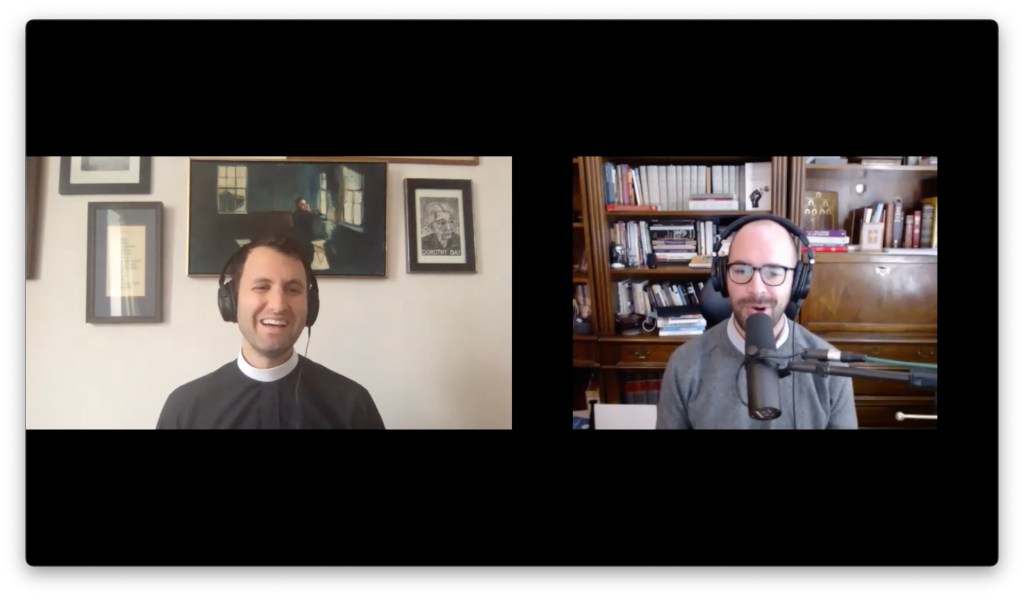
This week on the Strangely Warmed podcast I speak with Ben DeHart about the readings for the Fourth Sunday of Advent [B] (2 Samuel 7.1-11, 16, Luke 1.46b-55, Romans 16.25-27, Luke 1.26-38). Ben is the Associate Rector at Calvary-St. George’s Church in NYC. Our conversation covers a range of topics including phenomenal music, the uncontrollable God, riffing on the Magnificat, Kingdom ethics, the Prayer of Humble Access, obedience, impossible possibility, Israel’s calling, Hell, and Fleming Rutledge. If you would like to listen to the episode or subscribe to the podcast you can do so here: Give God The Verbs
Rejoice always, pray without ceasing, give thanks in all circumstances; for this is the will of God in Christ Jesus for you.
My son has a penchant for exaggeration.
(He probably gets it from his Father)
We decided to get him a Lego Star Wars Advent calendar in which, every day, he gets to open a new (tiny) lego set that he gets to build after consuming his breakfast. The first week of December resulted in a miniature Razorcrest (from The Mandalorian), Poe Dameron wearing a BB-8 holiday sweater, and many more.
And this morning, after scarfing down his pancakes, he ripped through the package and put together a red Sith Trooper in 7.5 seconds and triumphantly declared, “This is the best Advent ever!” while grinning from ear to ear.
When was the last time you felt truly joyful?
It’s a worthy question for Christian reflection, particularly in a time such as ours – a global pandemic, economic uncertainty, and the familiar no longer a possible reality.
“Rejoice always!” So Paul implores the church in Thessalonica. Notably, Paul’s call to joy is not a suggestion not merely an opportunity for contemplation, it is a command.
But how can we rejoice (always) when it feels like there’s nothing to rejoice about?
Joy, as we often speak about it, is a feeling. Like my son with his legos, it is a moment of bliss or happiness that leads to some sort of physical reaction like him smiling so much his mouth started to hurt.
But joy, properly understood, is also an expression, a kind of communication. However, it is not simply telling others that you are happy – it is a telling that is also an invitation to share in the telling.
Joy, to put it another way, is meant to be infectious.
At her best, the church is a people who invite each other to rejoice together. It’s why the covenants of marriage and baptism and not for the people getting married or baptized alone – they are a promise made by the community for the community.
We, that is the church, rejoice always, we pray constantly, and we give thanks in all circumstances. Interestingly, for Paul, joy comes first. Unless we are filled with joy we cannot pray and unless we pray we cannot give thanks.
Now, there’s (of course) a potential for a horrendous reading of this command in which Christians, “stay on the sunny side” despite all evidence of the contrary through their lives – like the meme of the dog drinking coffee in a house on fire saying “this is fine.” Rejoicing always, in that way (which is to say: improperly), can be used as the means by which we reject responsibility for others and even for ourselves.
Remember, however, Jesus did not ignore the truth and the brokenness of life – he wept for Lazarus, he turned the tables in the temple, and he was even afraid in the Garden of Gethsemane.
Christians are a people commanded to rejoice not in spite of the world, but simply because we know how the story ends. We can rejoice because we have found what was lost, ourselves.
Our joy is in the cross – a sign to us and to all that God chose to suffer for the sake of the world.
The strange new world of the Bible reveals God’s strange and confounding love for us in spite of us – we open up the pages to discover that God had joy in being one with us and that God took on all the consequences of being one of us; God incarnated love in the person of Jesus Christ for a people not good at loving in the first.
Our joy is inherently Adventen because it holds two seemingly-opposed things together at once – like the already but not yet, the once and future king, the cross and the empty tomb.
Joy, Christian joy, is the joy of knowing what awaits us even in death. And that joy gives us the strength to pray without ceasing and the courage to give thanks for a gift we simply do not deserve.
We have a joy to express and to share because God is coming again, bursting onto the scene like our favorite uncle with a salami under one arm and a bottle of wine under the other with no other hope in the world other than to party (read: rejoice) forever and ever.
This week on the Strangely Warmed podcast I speak with Ben DeHart about the readings for the Third Sunday of Advent [B] (Isaiah 61.1-4, 8-11, Psalm 126, 1 Thessalonians 5.16-24, John 1.6-8, 19-28). Ben is the Associate Rector at Calvary-St. George’s Church in NYC. Our conversation covers a range of topics including Fleming Rutledge, figuration, bad news, righteous justice, creative imagery, true laughter, upending Advent, praying online, homiletical grammar, and bearing witness. If you would like to listen to the episode or subscribe to the podcast you can do so here: Repeat The Sounding Joy
Comfort, O comfort my people, says your God. Speak tenderly to Jerusalem, and cry to her that she has served her term, that her penalty is paid, that she has received from the Lord’s hand double for all her sins. A voice cried out: “In the wilderness prepare the way of the Lord, make straight in the desert a highway for our God. Every valley shall be lifted up, and every mountain and hill be made low; the uneven ground shall become level, and the rough places a plain. Then the glory of the Lord shall be revealed, and all people shall see it together, for the mouth of the Lord has spoken.” A voice says, “Cry out!” And I said, “What shall I cry?” All people all are grass, their constancy is like the flower of the field. The grass withers, the flower fades, when the breath of the Lord blows upon it; surely the people are grass. The grass withers, the flower fades; but the word of our God will stand forever. Get you up to a high mountain, O Zion, herald of good tidings; lift up your voice with strength, O Jerusalem, herald of good tidings, lift it up, do not fear; say to the cities of Judah, “Here is your God!” See the Lord God comes with might, and his arm rules for him; his reward is with him, and his recompense before him. He will feed his flock like a shepherd; he will gather the lambs in his arms, and carry them in his bosom, and gently lead the mother sheep.
“A hopeless situation.”
That’s how she described herself while sheltering against the church from the wind. Above her mask I could see a tiredness in her eyes, a tiredness that was further echoed in her story. No job, no family, no food, no money, no hope.
Meanwhile, a van full to the brim with a family drove by and, even though all the windows were up, we could still hear all of them singing at the tops of their lungs, “It’s the hap-happiest season of all!”
I handed her a bag of food, offered to pray with her, and when she walked away I couldn’t tell if it had made any difference at all.
Can you imagine anything worse than being in a situation without any hope? Being forced so strongly to the margins of life that there was no one you could call to bail you out, no family that would welcome you in?
Hopelessness can derail individuals and families. And even though, at this time of year, we light candles and string up sparkly things, and decorate Christmas trees, and talk about hope in places like this, the sting of hopelessness can still hit harder than just about anything else.
God’s people Israel knew hopelessness. During the Babylonian Exile, the time in which Isaiah speaks his confounding word of comfort, they were a people who knew no comfort.
It’s challenging for people like us, today, to imagine, at all, what that time was like for God’s people – they had lost their homes, their nation, their possessions, their worship, their status, roots, stories, identity, and just about everything else.
They were truly strangers in a strange land.
They were swallowed up by their oppressors and compelled to adopt a way of life that ran counter to all they had ever known.
They were in a hopeless situation.
And, to make matters worse, the Lord of their ancestors had commanded them again and again to take no other gods save for the Lord God. Their idolatry, their wanton disregard for the commandments resulted in an exilic punishment.
To put it plainly, they brought it upon themselves.
And they were hopeless to do anything about it.
But it is precisely here, to a hopeless people, that God speaks through Isaiah:
Comfort, O comfort my people! Speak kindly to my people, remind them that the penalty for sin has been paid. A voice is crying out – Prepare the way of the Lord! The valleys will be lifted up, the hills will be brought down, God’s divine leveling will come to fruition. God’s glory will be revealed and all will see what God can do. A voice cries out – People are like grass, they wither and float away. But God stands forever and ever! So do not fear! God is coming with might! He will feed his flock like a shepherd; he will gather the lambs in his arms and carry them in his bosom.
Chances are, some of us are familiar with at least part of this proclamation from the prophet – In the wilderness prepare the way of the Lord. We hear those words every Advent in reference to John the Baptist who, spoiler warning, prepares the way of the Lord.
And J the B, as I like to call him, was no ordinary fellow.
He is rather alarming, coming straight out of the desert dressed in animal skins while eating insects and yelling about repentance. And, according to Mark’s Gospel, its precisely J the B showing up on the scene in ancient Palestine that marks the beginning of the gospel of Jesus Christ, the Son of God.
J the B has never been fully understood, and for good reason.
He shows up out of nowhere, and before we really get to learn much of anything, he is beheaded for crimes against the state. So for two thousand years he has stood in the midst of this season, with his strange sense of fashion and bewildering diet and discomforting theology completely out of sync with his age, our age, and just about any age.
Advent, for better or worse, is a time set apart in the church when we make a conscious effort to recover some of the strangeness from the strange new world of the Bible – and John embodies it all. Because, like J the B, Advent is rather peculiar. It’s out of sync with time.
As we talked about last week, Advent is about the time between time, the already but not yet, the pause between the once and future king.
To put it in musical terms: Advent is God’s great caesura…
The best parts of Advent are those that give us the courage and the conviction to rest in the tension of who we are, and what God has done for us in spite of who we are. We take time Sunday after Sunday to look toward the darkness into which, and for which, Jesus arrives.
Advent, in a way, is actually a lot more like Lent than we often make it out to be. We take stock of who we really are in order to come to grips with what it is, exactly, that Jesus does for us.
J the B arrives, confused for Elijah, proclaiming a baptism of repentance for the forgiveness of sins. He does so, to take the hint from Isaiah, to prepare the way of the Lord. There’s something about recognizing the condition of our condition that enables God to do the work that we so desperately need because all of us, whether we like to admit it or not, are hopeless cases.
It takes quite the Christian constitution to affirm the truth of Isaiah’s words: we are like grass and flowers that wither and blow away. Sin isn’t just something we do, it’s who we are. In ways big and small we regularly (like the Israelites before us) rebel against the Law of God, we insist on laying down at the altars of countless idols, and we are forever determined to be the masters of our own destinies.
Just take a look around – Covid cases spiking yet again, economic uncertainty as jobs are not rebounding, evictions are piling up as rents can’t be paid, and there’s no sign that any of it will slow down any time soon.
Obviously, some of this is out of our control, but some of it lies squarely with us and our unwillingness to love our neighbors as ourselves.
I know it might not seem like it, but confessing our sins is actually very good news for us. There’s a reason the Catholics have been doing it for millennia. There is a documentable psychological benefit to confessing our faults and failures, we literally release endorphins in the brain when we do so. But confessing our sins also benefits us by putting us squarely in an Adventen frame of reference.
Light is only light because of the darkness it shines in.
Grace is only grace because it cancels the power of sin.
Resurrection is only resurrection because it refuses to let death be the final word.
That’s a stark and frightening thing to admit but it’s part of the Christian witness. The message of John to a hopeless people, the message of Isaiah to an exiled people, is better for us than all the trimmings and the trappings that this season usually holds. All of the advertisements and pressures and assumptions only provide a shadow version of our own reality.
That’s not who we are.
We’re Christians! We’re sinners!
We’ve come to worship today, albeit in a way none of us quite imagined back before the pandemic struck, we’ve come to worship in some part because we know we need these words from Isaiah and from John more than we need the mall, and the wrapping paper, and the light shows, and the curated Christmas playlists, and the never-ending holiday-themed Lifetime Movie marathons.
We know we need these words from the prophets because we know we need Jesus – he’s the only hope we’ve got.
Without Jesus, we’re just a people in exile stuck in a hopeless situation. But Isaiah and John show up to prepare us for the appearance of God’s own self in the person of the Messiah. They remind us that God is active in the world in ways seen and unseen and it is upon the work of the Lord that the universe hinges.
But, how might we prepare for this? It was one thing to wander around during the days of J the B and find ourselves dunked into the Jordan river repenting our sins. But we are a people stuck in Advent between the once and future king – we already know what awaits us in the manger and on the cross.
What, then, is the right response to the triumph of God showing up?
The Beyonce of the Episcopal Church, Fleming Rutledge, makes the case that, during Advent, we should keep the tune O Holy Night stuck in our gray matter because when God shows up, the only proper response is to Fall On Your Knees!
Think about it: when the reality of God breaks in on from on high, the only thing we can do is recognize the great chasm across which God chose, and chooses, to traverse for us. When we see how God is God and we are not, we can’t help ourselves but fall to our knees in reverence.
J the B stands at the edge of time. He, in himself, holds the words of the prophets while pointing to the One who transfigures the cosmos. Advent, then, looks not just to the birth of a baby in the manger, but also to the long-awaited day of the Lord when rectification reigns supreme.
In Jesus Christ, the once and future King, the new day of righteousness is made incarnate. The old age of sin and death is crumbling away and in the coming kingdom of God there is the divine shepherd who gathers the sheep into his bosom.
That’s what J the B came to declare – our deliverance is nigh!
And how shall we respond? Fall On Our Knees!
God is going to level out all things. The mountains are coming down and the valleys are moving up. Creation will be reknit and all of us along with us.
Despite the language we might hear about in church about how it’s our job to prepare the way of the Lord – God is doing this work regardless of whether or not we participate in the divine clearing project.
And, frankly, its not going to be easy for people like us. For, God’s work of divine leveling means laying ourselves open and vulnerable to a vision of reality that is God’s will be done and not necessarily our own.
It means living every moment of our lives in anticipation of God’s bringing down the mighty and lifting up the lowly.
It means relinquishing our most cherished (and therefore flawed) understanding of what we have earned and deserved.
It means being ready to give up all of our privileges and advantages in the world on behalf of those who are stuck down in the valleys of life.
Again, this isn’t going to be easy. Particularly for a people drunk on our own self-righteousness.
We don’t like admitting our faults and failures.
We don’t like confessing our privileges and advantages.
We don’t like repenting of our wrong-doings.
In the time between time, Advent, we can (with the help of the Spirit and the church) take a good hard look in the mirror and confess the condition of our condition. That’s how repentance works – it is a change of life, a reorientation, a turning back. And we can’t turn without admitting that we need to turn in the first place.
But even if we can’t bring ourselves to confess the truth. God is still in the business of making something of our nothing.
For God does not desire the immense brokenness that surrounds us. God in Christ is reconciling all things to himself. The old age of Sin and Death was run by death and division. But in God’s kingdom, what we are preparing for and are being prepared for, is run on reconciliation, grace, and mercy.
So hear the Good News: Christ died for us while we were yet sinners, not before or after, but in the midst of our sin. And this proves God’s love for us. In the name of Jesus Christ, you are forgiven. The Kingdom of God is near. Amen.
The beginning of the good news of Jesus Christ, the Son of God. As it is written in the prophet Isaiah, “See, I am sending my messenger ahead of you, who will prepare your way; the voice of the one crying out in the wilderness: ‘Prepare the way of the Lord, make his paths straight.’”
In Advent, we begin again.
It’s notably strange that we, Christians, continue to repeat ourselves year after year with this bewildering season. We pull out the purple paraments, we decorate our Advent wreaths, and we start singing tunes about “ransoming captive Israel.” Advent, for better or worse, is a season all about waiting – waiting for the birth of Jesus in the manger AND waiting for his return at the end of all things.
And, every year, we spend this season living into the tension of the already but not yet.
It’s just the best.
And yet, Advent can feel like a drag. We hear, week after week, about preparation, but it’s not altogether clear what we are preparing for. Sure, we’ve got to get the lights up on the house and purchase all the perfect presents and send out the color-coordinated family picture, but what does any of that have to do with Jesus?
The beginning of Mark’s gospel starts with the beginning. John the Baptist is out in the wilderness preparing the way of the Lord proclaiming a baptism of repentance for the forgiveness of sins.
He, prophetically, points to the sinfulness within each of us to make sure we know what it is that Jesus is showing up for. He calls us to look into the darkness inside of us, and then points us toward the One who will rectify the cosmos, including us.
This is no easy task.
Therefore, Advent can be a little frightening as we prepare our hearts, minds, and souls for the One who shows up to cancel out our sins. But Advent is equally a time for celebration! We celebrate because Jesus has already done the good work of rewriting reality, and we now simply wait for his return and the knitting of the new heaven and the new earth.
Advent is a time in which we balance out both the beginning and the end all while looking straight into the darkness knowing that the dawn will break from on high. Advent is both convicting and celebratory. It is the church at her very best.
Robert Farrar Capon puts it this way:
“Advent is the church’s annual celebration of the silliness (from selig, which is German for “blessed”) of salvation. The whole thing really is a divine lark. God has fudged everything in our favor: without shame or fear we rejoice to behold his appearing. Yes, there is dirt under the divine Deliverer’s fingernails. But no, it isn’t any different from all the other dirt of history. The main thing is, he’s got the package and we’ve got the trust: Lo, he comes with clouds descending. Alleluia, and three cheers…What we are watching [waiting] for is a party. And that party is not just down the street making up its mind when to come to us. It is already hiding in our basement, banging on our steam pipes, and laughing its way up our cellar stairs. The unknown day and hour of its finally bursting into the kitchen and roistering its way through the whole house is not dreadful; it is all part of the divine lark of grace. God is not our mother-in-law, coming to see whether he wedding present-china has been chipped. God is, instead, the funny Old Uncle with a salami under one arm and a bottle of wine under the other. We do indeed need to watch [wait] for him; but only because it would be such a pity to miss all the fun!” – (Capon, The Parables of Judgment)
So here’s to the season of repentance and celebration where we begin, again! Amen.
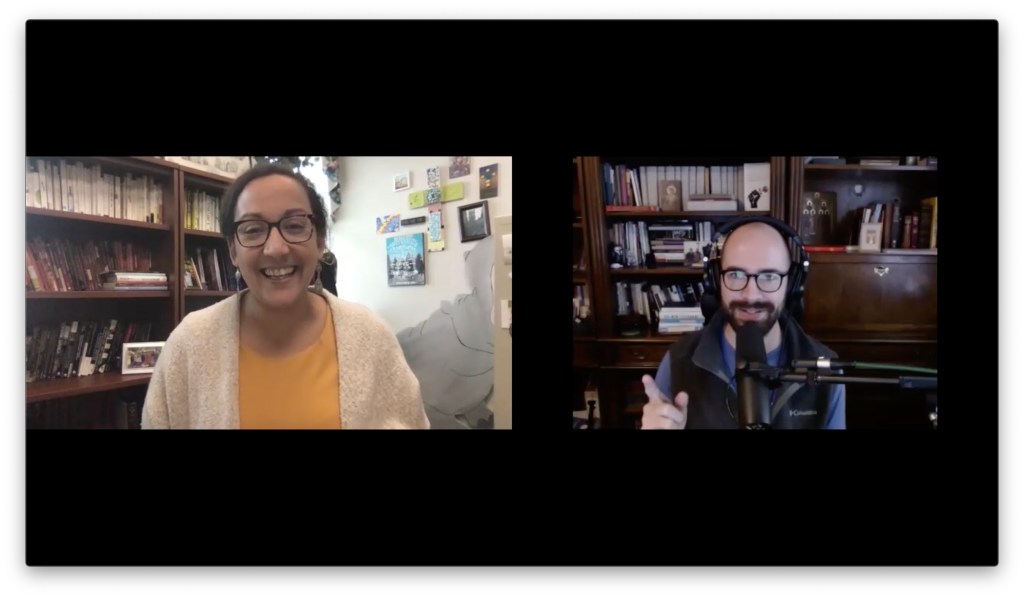
This week on the Strangely Warmed podcast I speak with Lauren Lobenhofer about the readings for the Second Sunday of Advent [B] (Isaiah 40.1-11, Psalm 85.1-2, 8-13, 2 Peter 3.8-15a, Mark 1.1-8). Lauren serves as the senior pastor at Cave Spring UMC in Roanoke, VA. Our conversation covers a range of topics including beginning again, Lauren Winner, comforting in chaos, divine reversal, unpacking peace, worship at war, Dr. Who, slowing down, divine grammar, and embodying Advent. If you would like to listen to the episode or subscribe to the podcast you can do so here: Wibbly-Wobbly Timey-Wimey
O that you would tear open the heavens and come down, so that the mountains would quake at your presence — as when fire kindles brushwood and the fire causes water to boil — to make your name known to your adversaries, so that the nations might tremble at your presence! When you did awesome deeds that we did not expect, you came down, the mountains quaked at your presence. From ages past no one has heard, no ear has perceived, no eye has seen any God besides you, who works for those who wait for him. You meet those who gladly do right, those who remember you in your ways. But you were angry, and we sinned. Because you hid yourself we transgressed. We have become like one who is unclean, and all our righteous deeds are like a filthy cloth. We all fade like a leaf, and our iniquities, like the wind, take us away. There is no one who calls on your name, or attempts to take hold of you; for you have hidden your face from us, and have delivered us into the hand of our iniquity. Yet, O Lord, you are our Father; we are the clay, and you are our potter; we are all the work of your hand. Do not be exceedingly angry, O Lord, and do not remember iniquity forever. Now consider, we are all your people.
In most churches there are two types of people:
There are those who, seeing the purple paraments and the tree and the wreath and hearing the scriptures about sin, judgment, and wrath think to themselves, “Thank God! It’s finally Advent again!”
And there are those who, seeing and hearing the same things think to themselves, “What is happening? Where’s the Christmas spirit? I thought this was supposed to be the most wonderful time of the year…”
Advent, for better or worse, is a habit. And it takes a whole lot of courage and consideration to get used to this season.
Because outside of the Christian community, Advent is just an excuse to speed up toward Christmas – the decorations have been on sale since before Halloween, Black Friday begins before Friday, and just about every online retailer is constantly bombarding all of us with reminder to purchase our presents now before its too late!
Advent, in the church at least, teaches us to delay Christmas in order to rejoice in it fully when it finally arrives.
Advent habituates us into seeing how the message of Christmas vanishes if we are not willing to walk toward the shame and pain that is all around us.
Advent reminds us that we need the light of the world because we’re stuck in the darkness.
Which is why Advent always begins in the dark…
Isaiah, appropriately, depicts the stark nature of this liturgical season with a perceived absence of God.
God, can’t you just come down here and start shaking things up! We could do for some trembling mountains and boiling rivers! We remember the mighty deeds with which you delivered us from the snares of death. And yet, for years and years no one has heard or seen or experienced anything divine except for you, and work in and through those who know what it means to wait. But you were angry with us and our miserable estate. You looked down upon our sinfulness, our wanton disregard for the last, least, lost, little, and dead. We’re unclean. All of our supposedly good deeds are like a filthy rag. Yet, O Lord, you are the Father; we are the clay, and you are our potter. We are the work of your hand. So don’t be exceedingly angry with us Lord, and do not remember our sins forever. We belong to you.
The language in our appointed scripture passage is not for the faint of heart, and it is certainly not what most of us are used to this time of year. We’d prefer to hear about hope, and love, and joy or maybe reflect on the theological value of The Grinch, It’s A Wonderful Life, and Home Alone.
And, to be fair, even though it’s not what we would necessarily prefer, the words of Isaiah are already echoed in our living in the world…
Tables were set this week for Thanksgiving with empty seats either because people could not travel in light of the Coronavirus, or because they are part of the quarter of million people who have died in this country because of the pandemic. Our holidays have the potential to both bring out our gratitude and our anger. We can be thankful for what we have while, at the same time, be filled with rage because of how the world continues to spin while we suffer.
In spite of travel restrictions and warnings about gatherings with too many people, airports across the country swelled as they always do during this time of year which has led many epidemiologists to intone – “It’s fine to have a big family gathering right now so long as your prepared to bury someone by Christmas…”
And it’s not just the pandemic that brings all these things into focus. More people suffer from depression at this time of year, more people end their own lives at this time of year, more couples get divorced at this time of year, more car accidents happen at this time of year, I could go on and on and on.
So here, in the midst of a world drowning in bad news, it’s not hard to imagine raising our clenched fist to the sky and shouting, “God! Where the hell are you?”
That is an Advent question.
It is perhaps the Advent question.
This isn’t the easiest stuff to contemplate and mull over at this time of year. I rejoice in setting up the lights on my house, and tuning the radio to the old familiar Christmas hits, and quoting along with all my favorite holiday movies. And yet, to so engage in this festive atmosphere can be a denial of the reality of this life.
Advent, fortunately or unfortunately depending on how you look at it, requires us to look straight into the heart of darkness. Particularly when we are afraid that we might see ourselves in the darkness.
Isaiah reminds us today that even the best of us are distorted and unclean – all that we do can be compared to a filthy old rag. We, all of us, chose to do things we know we shouldn’t and we avoid doing things we know we should. Whether it’s leaving a nasty comment on social media, or dropping a scathing critique of a family member, to avoiding the apology and reconciliation we know, deep in our bones, that we need to do.
To confess the condition of our condition requires a constitution made possible only by the community called church in which we are reminded who we are over and over again.
We are, of course, beloved children of God, crafted in the image of the divine, fearfully and wonderfully made. And, at the same time, we, all of us, are sinners desperately in need of grace.
That is why we begin the church year with Advent, a season that begins in darkness. We, unlike the crowded ways of life, know the truth of ourselves, that there is nothing good in us, that we all fade away like leaves.
Therefore, the authentically hopeful Advent spirit is not looking away from the darkness, it is not filling our lives with fluff in order to deny the truth.
It is, instead, praying for Holy Spirit to give us the courage and the conviction to look straight into the muck and mire of this life.
For, in the end, that’s exactly where God chose, and still chooses, to show up for us.
Jesus Christ, for whom our hearts long for and are prepared for, is the One who identifies not with the people who’ve got it all figured out, and have the perfect decorations on the house, and have all the presents already wrapped under the tree.
Jesus comes for the last, least, lost, little, and dead. Who, if we’re honest, also includes all the people who seem like they have it all together on the surface. But under our masks, we are all the same – sinners in need of grace.
Jesus, thanks be to God, comes to take on our shame and pain by being born into this world, he shows up in the midst of our darkness, and gives himself up to die the brutal and dehumanizing death of a slave.
There’s a reason Jesus spent his earthly ministry among the marginalized, because they were those who had been crying out for rectification.
There’s a reason we nailed Jesus to the tree after all his healing and teaching – no one wants to be told they’re a sinner.
So we killed God, or at least we thought we did. Despite our best efforts, the grave could not contain the Lord, and he rose on the third day in order to save us from ourselves. He taught the disciples about the way, the truth, and the life, and then ascended to the right hand of the Father.
But that is not the end of the story. In fact, it is the beginning of the end. For as much as we are Easter people, we are also Advent people. The church lives in Advent and we are stuck in it. We are a people between, and out of, time. We worship the once and future King Jesus Christ. We live in the light of his resurrection while anticipating his return to transfigure the cosmos into a new heaven and a new earth.
We, to put it bluntly, are a people who know what it means to wait.
We are ripe with bad news in the world right now. Between the never-ending political in-fighting and civil unrest and an extremely communicable virus, there’s plenty of horrible things happening. And it always seems to coincide with this season we call Advent. But we also have the benefit of knowing the story behind the story. When we pick up the paper, or flip through the news, or doom-scroll on Twitter, we can rightly observe, “No wonder God had to send his Son into the world.”
Because Jesus is the only hope we’ve got.
Our hope won’t come from the world. It will never come from the next political candidate, or the next policy initiative, or the next fiscal plan, or the next diet, or the next pharmaceutical breakthrough. If our hope could come from the world it would’ve happened a long long time ago. We don’t have the power on our own to fix what is in us, despite what every commercial tries to sell us.
No peloton, no diet, no queer eye makeover can transform us into our dream-selves.
No job, no paycheck, no material possession can fill the hole we feel in the depths of our souls.
No gift under the tree, no light on the house, no curated Christmas carol playlist can cover up the truth about who we really are.
The comfort we so need and seek must come from somewhere else – in a burst of power breaking upon us from beyond us altogether.
The joy of Advent then comes from a different place. It comes from the Lord who chose to do the inexplicable for a people undeserving. It comes from the Son who chose to live by forgiveness rather than vengeance. It comes from the Spirit who chooses to move in and through us even though we’re nothing but a bunch of filthy rags.
God will come again, God’s justice will prevail over all that is wrong in this life, God will fully destroy evil and pain forever and ever.
Advent, this blessed and confounding season in the church, is all about looking straight into the darkness, its about seeking solidarity with those whose lives are nothing but darkness, all while living in the unshakable hope of those who expect the dawn to break in from on high.
To follow Jesus it to recognize that we are a people stuck in Advent, and the only way out is through the Lord who delights in making a way where there is no way. Amen.
This week on the Strangely Warmed podcast I speak with Lauren Lobenhofer about the readings for the First Sunday of Advent [B] (Isaiah 64.1-9, Psalm 80.1-7, 17-19, 1 Corinthians 1.3-9, Mark 13.24-37). Lauren serves as the senior pastor at Cave Spring UMC in Roanoke, VA. Our conversation covers a range of topics including Advent(ures), the Theotokos, liturgical purity, parental love, divine ceramics, repetitive prayers, the audience of worship, the Flying V, spiritual gifts, eschatological contemplation, and Wendell Berry. If you would like to listen to the episode or subscribe to the podcast you can do so here: People Look East!
This week on the Strangely Warmed podcast I speak with Lindsey Baynham about the readings for Christ The King Sunday [A] (Ezekiel 34.11-16, 20-24, Psalm 100, Ephesians 1.15-23, Matthew 25.31-46). Lindsey serves as the Director of the Center for Clergy Excellence in the Virginia Annual Conference of the United Methodist Church. Our conversation covers a range of topics including eschatology, RBG, liturgical history, preludes to Advent, stubborn creatures, joyful noises, John Wesley’s preaching, hope at the end of the year, and the King of the least. If you would like to listen to the episode or subscribe to the podcast you can do so here: I Pledge Allegiance To The Lord
This week on the Strangely Warmed podcast I speak with Lindsey Baynham about the readings for the 24th Sunday After Pentecost [A] (Judges 4.1-7, Psalm 123, 1 Thessalonians 5.1-11, Matthew 25.14-30). Lindsey serves as the Director of the Center for Clergy Excellence in the Virginia Annual Conference of the United Methodist Church. Our conversation covers a range of topics including talented theology, judging Judges, transformed leadership, reoriented posture, Advent all the time, problematic language, ecclesial encouragement, paradoxical parables, and justice in the Kingdom. If you would like to listen to the episode or subscribe to the podcast you can do so here: Like A Thief In The Night









 think and let think