Who Are You? – Sermon on James 1.17-27

James 1.17-27

Every generous act of giving, with every perfect gift, is from above, coming down from the Father of lights, with whom there is no variation or shadow due to change. In fulfillment of his own purpose he gave us birth by the word of truth, so that we would become a kind of first fruits of his creatures. You must understand this, my beloved: let everyone be quick to listen, slow to speak, slow to anger; for your anger does not produce God’s righteousness. Therefore rid yourselves of all sordidness and rank growth of wickedness, and welcome with meekness the implanted word that has the power to save your souls. But be doers of the word, and not merely hearers who deceive themselves. For if any are hearers of the word and not doers, they are like those who look at themselves in a mirror; for they look at themselves and, on going away, immediately forget what they were like. But those who look into the perfect law, the law of liberty, and persevere, being not hearers who forget but doers who act — they will be blessed in their doing. If any think they are religious, and do not bridle their tongues but deceive their hearts, their religion is worthless. Religion that is pure and undefiled before God, the Father, is this: to care for orphans and widows in their distress, and to keep oneself unstained by the world.

who-am-i


The small town sheriff was frustrated when he received a phone-call from the station that interrupted his Sunday supper. A report had come in that a group of young boys were throwing water balloons at strangers walking along Main Street. Reluctantly, the sheriff changed out of his Sunday best into his uniform and went to find the hooligans.

Just as the report noted, a group of young boys were standing on a street corner with a bucket of water balloons and were striking anyone within distance. As he approached in his patrol car, he expected to hear the boys laughing and hollering, but they were rather silent as he inched his way forward. He recognized all the boys from his local church, and dreaded the phone calls he would be making to all of their parents, but he knew their behavior had to stop.

The boys were smart enough not to throw a balloon at the police car, but the sheriff was still nervous to roll down his window in case a wayward throw made it inside. “What do you think you’re doing?” he yelled to the boys. In unison they all solemnly replied, “we’re working for the Lord.” He was mystified by their response, after all how could throwing water balloons at strangers be equated with the almighty? So the sheriff sat in his car with one eyebrow raised and motioned for them to explain.

The ringleader then stepped forward and said, “Didn’t you hear the preacher this morning sheriff? He told us to go out baptizing in the name of the Father, Son, and Holy Spirit. We’ve got Holy Water Balloons and we’ve done already made 45 Christians.”

Every good thing in our lives, every generous act of giving, every perfect gift, every blessing, every compliment, is from above.

Throughout our days, the Lord nurtures, guides, and provides all that we need. More often than not, God uses the people around us to do so, but nevertheless God supplies the goodness in our lives.

The letter of James is beautiful, and it begins with a quick assessment of the discipled life and what it means to live into this identity.

James knew how to notice the small things, because the small acts of life are the nuts and bolts of existence. It is the little things, the small actions and the tiny compliments, that hold together the fabric of our lives and give us the power to build and shape community. What we say and how we act are more important than we can possibly imagine.

The Lord has given us new life by the Word of truth and the power of scripture so that we would become a kind of first fruits. We have been given the great blessings of God’s presence, scripture, and Jesus Christ and now we have the responsibility to let those blessings bear fruit in our lives, and in the lives around us.

We must understand this, children of God, we should be quick to listen, slow to speak, and slow to anger, because our anger does not produce God’s righteousness. How many times have we jumped to a conclusion, or said something without thinking it through and immediately regretted it? How valuable is James’ advice: be quick to listen, slow to speak, and slow to anger?

Our contemporary conversations are filled with “uhhs” “buts” “likes” and other verbal bridges because we are afraid of silence. Rather than actually listening to others, or at least giving them the chance to speak, we fill up every ditch between our words out of fear that someone else will jump in with something else to say. Imagine how much our relationships would change if we only heeded James’ words in our conversations? Can you picture how different our identities would be if we were quick to listen, slow to speak, and slow to anger?

If we have the strength to change the way we converse, then we will begin to welcome with meekness the implanted word that has the power to change the world. Instead of relying on our own words at all times and places, with patience we can remember the great Word of God in Jesus Christ and put all our trust in him. Instead of believing that we are alone in the world and in our situations, we will come to see that God is with us, and has carried God’s people through this before and will again.

But it’s not just about the words we use and speak, as Christians we are invited to be doers of the Word and not merely hearers who deceive themselves.

Have you ever departed from church on a Sunday morning, after hearing a particularly convicting message, only to believe that it had nothing to do with you? Have you ever picked up the bible and started reading only to think about the other people the scripture should apply to instead of you?

For if we are hearers of the word and not doers, then we are like those who look at a mirror and as soon as we walk away immediately forget who we are. Our identities are rooted in the scriptures we read, and in the water of our baptism. But too often, we leave from church, or we put down the bible, or the water dries from our hair, and we immediately forget who we are and whose we are.

If church is supposed to accomplish anything on a regular basis, it is to act like a giant mirror so that we catch a glimpse of who God is calling us to be, and then never forget what we have seen.

who-am-i-1024x575

It was New Year’s Eve 1999 and Javier was afraid. For months news pundits and writers speculated about the “end of the world” coming with the year 2000. In addition to some strange and warped biblical prophecies, technologically proficient workers warned about the change that might come with the digits 99 changing to 00 and the blackouts that could ensue. For weeks people throughout the world prepared for the worst, and the rhetoric about the end times increased.

So Javier found himself getting ready to attend a worship service with his family and friends in El Salvador on the eve of the new millennium and he was afraid. The service itself was fine; it proclaimed the word of God’s faithfulness in spite the warnings about the new millennium, yet Javier could not rid himself of the fear that was shaking him to his core. Before the service came to a close, Javier stood up, walked to the front and asked to be baptized. He did not know what the New Year would bring, he did not know what would happen to the world, but he figured that a little water on his head couldn’t hurt.

Except, that simple affirmation that God was bigger than himself, that simple humbled moment of reverence to God’s power to save was enough to change Javier’s life forever. Of course, the year 2000 did not bring about the end of the world, but it did bring about Javier’s new identity in Jesus Christ. From that night forward he saw himself as a disciple and has lived into that ever sense.

My own baptism took place when I was 19 days old. Other than some strange blurry photographs of my mother and father standing at the front of the church, I have no idea what it was like or what happened. But it came to shape my very identity. The people who were present in worship that day 27 year ago took seriously the commitment to raise me in faith, and helped me hold on to my identity in Jesus.

The Sunday before I became the pastor at St. John’s I stood before my home congregation and thanked them for nurturing me in the faith all these years and said goodbye. But while I stood in the narthex shaking hands after the service, a much older woman came up with a very worn bible in her hands. Without saying much she turned to the back inside cover and showed me my name and the date of my baptism. For decades she had written down the name and date of every person baptized in her presence and made a point to pray for every single one of them, every single day. Her prayers shaped me into who I am.

Those of us to look in the mirror and remember who we are when we walk away, those of us who are doers of the word will be blessed in our actions. Our religion is pure when we, like the disciples from long ago, actually live into the Word of God and start caring about the people in our midst. Our religion is pure when we clasp our hands together and pray for the world. Our religion is pure when we remember our baptisms and are thankful.

tumblr_m8lkq3H8zQ1rqn80jo1_500

Who are you?

What defines your identity?

Perhaps we’ve forgotten who we are and whose we are. Instead of seeing disciples of Jesus Christ in the mirror, we only see fathers, mothers, brothers, sisters. Instead of holding on the image of God in our hearts, we turn away from the mirror of church and we immediately forget what God is speaking into our lives.

Do you remember your baptism? Can you recall the details of what eventually led you to yearn for the water of a new identity? Were you, like Javier, led to baptism out of fear? Were you, like me, led to baptism before you even had a chance to know what was happening?

Baptism is not about quantity; we’re not interested in throwing Holy Water Balloons at everyone within distance. Baptism is instead about discovering our fullest identity in Christ through a covenant by water and the Spirit.

Today, we are all invited to remember our baptisms and be thankful. In a few moments I will pray over our baptismal font, and everyone may come forward to remember and give thanks. The mirror behind the water is there for us to take a good look, so that when we turn around we will not forget who we are.

Disciples of Jesus Christ: Remember that every good thing is from above, that God has given us the word of truth so that we may bear fruit in our lives. Remember to be quick to listen, slow to speak, and slow to anger. Remember that we are called to be doers of the Word. Remember your baptism and be thankful. Remember who you are. Amen.
Strange Stories From Scripture: A Week In The Word – Sermon on Judges 3.12-23

Judges 3.12-23

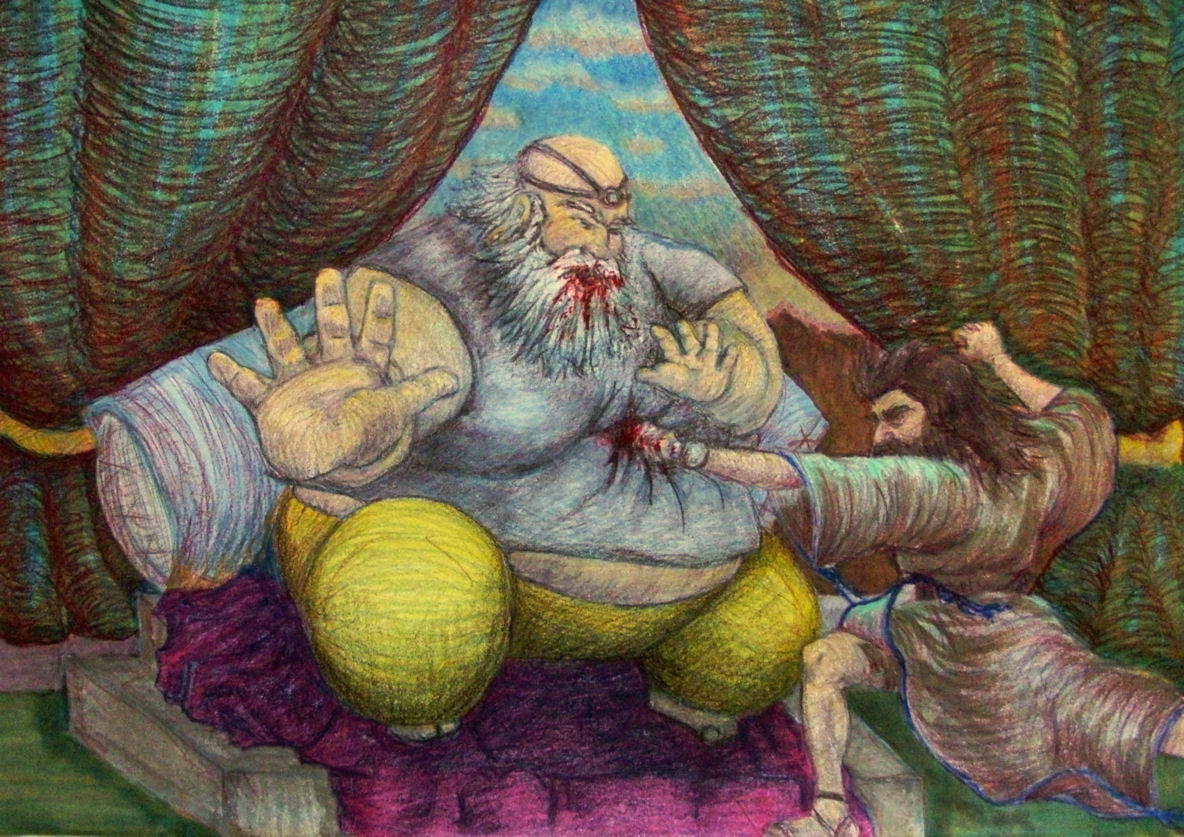
The Israelites again did what was evil in the sight of the Lord; and the Lord strengthened King Eglon of Moab against Israel, because they had done what was evil in the sight of the Lord. In alliance with the Ammonites and the Amalekites, he went and defeated Israel; and they took possession of the city of palms. So the Israelites served King Eglon of Moab eighteen years. But when the Israelites cried out to the Lord, the Lord raised up for them a deliverer, Ehud son of Gera, the Benjaminite, a left-handed man. The Israelites sent tribute by him to King Eglon of Moab. Ehud made for himself a sword with two edges, a cubit in length; and he fastened it on his right thigh under his clothes. Then he presented the tribute to King Eglon of Moab. Now Eglon was a very fat man. When Ehud had finished presenting the tribute, he sent the people who carried the tribute on their way. But he himself turned back at the sculptured stones near Gilgal, and said, “I have a secret message for you, O king.” So the king said, “Silence!” and all his attendants went out from his presence. Ehud came to him, while he was sitting alone in his cool roof chamber, and said, “I have a message from God for you.” So he rose from his seat. Then Ehud reached with his left hand, took the sword from his right thigh, and thrust it into Eglon’s belly; the hilt also went in after the blade, and the fat closed over the blade, for he did not draw the sword out of his belly; and the dirt came out. Then Ehud went out into the vestibule, and closed the doors of the roof chamber on him, and locked them.

Today marks the second part of our series on Strange Stories from Scripture. As a church we are taking time to look at those wonderful moments from the bible that they never talked about during Sunday school. These are the stories that make us blush, raise our eyebrows, and leave us scratching our heads.

Many of us are familiar with the well-known stories of Moses leading the Israelites through the wilderness, we know all about King David and his kingdom, we can even recall the miracles of Jesus, but the bible is also full of tales that are just begging to be used in worship and our daily lives.

Our first story was from the book of Numbers regarding the foolish prophet Balaam and his talking donkey. We explored how the donkey attempted to steer Balaam in the right direction, and pondered about the donkeys in our lives.

Today we are talking about Ehud and King Eglon from the book of Judges.

Ehud-and-Eglon (1)

Monday.

I’m sitting in my office, going over the emails from the weekend when I pull out the list of all the scriptures from now until Christmas Eve. I reread the plan for the sermon series on Strange Stories from Scripture, I wonder if people felt convicted by the sermon on Balaam and his donkey yesterday. I check the email once again to see if anyone took the time to send me a complaint about the sermon. The only one I receive makes a comment about seeing such a “smart… donkey” in the pulpit, but I file it away for later.

The A.C. is pumping out cold air, and I open up my bible to Judges 3 to read the scripture for Sunday. The story of Ehud and Eglon. As the words flow past my eyes, I can’t help myself from giggling in the office: Ehud stabs him in the belly, and Eglon was so fat that the blade disappeared and the dirt came out. I quickly scan through a number of other translations to see what they do with the vague “dirt” description. Some call it dirt, most call it dung, but at least one calls it poop.

When I see the word poop in the bible, it just makes me laugh.

I wonder if people will let me get away with saying poop from the pulpit on Sunday morning. I quickly make a note to pray about it during the week, before deciding whether or not to put “poop” in the sermon.

This has got to be one of the funniest and strangest stories in the bible, but before I dive into sermon writing, I decide to leave the word document open on my computer, and get to some of my other daily tasks before returning.

Tuesday.

The screen stares back at me empty. So I decide to get the mental juices flowing and rewrite the story in my own words:

The Israelites messed up again. Whether they were grumbling for more food, or worshipping false idols, they messed up, and the Lord decided to raise up King Eglon of Moab against God’s people, because they were continually messing up. King Eglon, with the help of God, went and defeated Israel and ruled over God’s people for 18 years.

But then, of course, the Israelites started to cry out to the Lord for delivery, perhaps they had seen the error of their ways, so God decided to provide their savior, Ehud, a left-handed man.

The Israelites, at the time, were in the habit of sending their taxes to King Eglon, and Ehud used this delivery to make his attack. He fashioned himself a double-edged sword, and attached it to his thigh under his clothes.

King Eglon was a very fat man.

ehud2

When Ehud finished delivering the money, he sent his compatriots away, and teased the King with the promise of a secret message from God. Eglon sent away all of the people from his inner court and invited Ehud to share this secret. But as Ehud leaned in to deliver the precious secret, he removed the hidden dagger and thrust it into Eglon’s belly.

Strangely enough, the further Ehud pushed, more of Eglon fat rolled over the blade until it disappeared from view, and Eglon’s poop came out. Then Ehud snuck out of the chamber and locked the doors behind him.

I rewrite the story, looking for sermonic inspiration that would drop down from heaven like manna in the wilderness, but I just sit in my office wondering what in the world God is trying to say through the text. Throughout the day the phone and doorbell continue to ring at church, and I welcome the distractions.

Wednesday.

I pull out some commentaries on the text, and decide to see what other people think God was saying. A few of them go into remarkable detail about the significance of Ehud being left-handed, while others address how detailed the descriptions were, and a few even propose a sexually metaphorical interpretation.

The more I read, the less the story makes me laugh. Instead of looking at the story like a cartoon with poop on the floor, I see human beings driven by enough anger and fear to conquer a nation, and murder a king.

Reluctantly, I start searching online for other sermons about Ehud and Eglon. Do people preach about this? What in the world do they say?

One of the sermons is titled, “Lefty vs. Hefty” and it is all about the differences between the two central characters. The writer emphasizes Ehud’s cunning against Eglon’s girth.

One of the sermons is titled, “Salvation” and it goes into profound detail regarding how, supposedly, God ordains the killing of people even today who get what they deserve. The preacher calls for the people to commit themselves to a radical system of justice, where they take matters into their own hands, just like Ehud did.

One of the sermons is titled, “The Power of Praise” and it focuses on how Ehud was able to trick Eglon into giving him the opportunity to strike. It ends with a reminder for the listeners to be careful about the promises they hear and the compliments offered their way, because a dagger might be lurking in the corner.

The more I read from God’s Word and from other sermons the more I regret picking the scripture for the series:

Eglon, the fat king, is now less a caricature, and more like the punishment God ordained for the people for messing up.

Ehud, the people’s deliverer, is now less a righteous judge, and more like a murderer.

Months ago I thought it would be perfect and hilarious to use this text during a series on Strange Stories, but now I worry about what I will actually say about it when the time comes.

Thursday.

Sitting in a coffee shop in attempts to begin crafting a sermon, I continue to stare at a blank screen. I have started at least three different sermons but before I am able to start really crafting a deep response to the Word, I highlight the text and pressed “delete.” Nothing feels good enough, all of the attempts feel flat.

How is this story speaking anything into our world today? What does the death of Eglon at the hand of Ehud have anything to do with the life of St. John’s and the community of disciples?

I close the computer and grab a nearby newspaper in hopes to distract myself from the seemingly endless flicker of the cursor on my computer. The top article says “US drops Atomic Bomb on Japan 70 years ago today.

1945-08-07-New-York-Times-headline

Before I realize it, I am sucked into the article, and the sermon floats away from the forefront of my mind. The writer has reproduced the original texts used the Associated Press the day the Atomic Bomb was first reported:

“An atomic bomb, hailed as the most terrible destructive force in history and as the greatest achievement of organized science, has been loosed upon Japan… The atomic bomb destroyed more than 60 percent – 4.1 square miles – of Hiroshima, city of 343,000 and radio Tokyo reported “practically every living thing” there was annihilated… Secretary of War Henry Stimson said, “If they do not now accept our terms, they may expect a rain of ruin from the air the like of which has never been seen on this earth.” (From the original AP article http://bigstory.ap.org/urn:publicid:ap.org:3fd267ba7b3c40479382189c99172d61)

I read the article and tears begin to form and fall down my face. Normally I would hide my face from the other patrons, but I am so struck by the words that I forget where I am and what I’m doing. 70 years ago we dropped the most powerful weapon we had ever created on a nation and virtually wiped out an entire city in a matter of seconds.

I start to remember where I am, and the sermon that needs to be written. The connections between the article and the scripture start to form:

Did Ehud leave the sword in Eglon because he wanted the effects to be devastating? Did he want to leave his mark in such a way that death was not the only consequence? Was the Atomic Bomb our sword that we had hidden under our clothes? Did we attack Japan in such a way that death was only the beginning of what we wanted to accomplish?

I wonder what people will think if I try to draw a connection between the anniversary of the Atomic Bomb with the death of Eglon at the hand of Ehud. Did Ehud do the right thing? Did we do the right thing? I have no idea where the sermon is heading.

Friday

I sigh deeply in front of my computer. Picking the Ehud and Eglon story was a bad idea. I explore an idea about dressing up like Ehud with a sword in church but it feels trite, impractical, and vaguely irreligious. I start writing a poem about how the Lord calls people to do extraordinary things during extraordinary times, but then it feels like I’m telling people its okay to murder and steal.

I sit in silence with my hands outstretched praying for the Lord’s will to be done, and for the sermon to be written. And I wait.

Saturday

The Community Cook-Out is going well; children are running around, adults are being fed, and conversations are flowing all over the place. I am thankful for the distraction the cook-out has provided, though I’m also worried about tomorrow morning. What will I say when the time comes? What is God’s Word speaking into our lives right now?

I watch the community in action. Not just the church, but all the people who make Staunton what it is and I think about Jesus. I remember the call to live radically transformed lives based on love and forgiveness, not on fear and retribution. I see people breaking bread for the first time, and I see Jesus in the midst of the people providing hope, the Holy Spirit giving life to our words and relationships, and God making new and lasting connections.

I think about Jesus and the new life he invites his disciples to experience. I think about the lengths God was willing to go to to respond to the cries of God’s people, raising up prophets and judges. I think about God finally offering the most precious gift he ever could, his Son, to die for all the people out on the front lawn of the church, and for the world.

I wonder if the story of Ehud and Eglon isn’t so much about how we react when the world pushes us into a corner, but about the trajectory of God’s gifts to the world. That at one time God would raise up a judge to save Israel, but that now God raised up his Son to save us from ourselves and from death.

Sunday

I stand in the sanctuary before disciples hungry for the Word of God and I say: I offer this to you in the name of the Father, and the Son, and the Holy Spirit. Amen.

The Upside-Down Kingdom – Sermon on Mark 6.30-34

Mark 6.30-34

The apostles gathered around Jesus, and told him all that they had done and taught. He said to them, “Come away to a deserted place all by yourselves and rest a while.” For many were coming and going, and they had no leisure even to eat. And they went away in the boat to a deserted place by themselves. Now many saw them going and recognized them, and they hurried there on foot from all the towns and arrived ahead of them. As he went ashore, he saw a great crowd and he had compassion for them, because they were like sheep without a shepherd; and he began to teach them many things.

251121425_640

Last Sunday our mission team gathered in the parking lot after worship, prayed together, and then set out for the beautiful bounty of West Virginia. I don’t know how the rest of the team felt as we made our way west, but I was excited; we were committing ourselves to a community, we were going to be Christ’s hands and feet, and we were going to experience God’s upside-down kingdom.

McDowell County, West Virginia is nothing short of beautiful. While the roads twist back and forth and the topography ebbs and flows, you are constantly bombarded by the beauty of God’s creation. Sitting behind the wheel, the scenery flies past the window and all evidence of humanity’s presence is gone except for the occasional roadside house and the road beneath the wheels.

By the time we finally made it to Welsh, WV we were ready to work, and we were ready to get out of the cars. But the scenery had drastically changed from the journey; when we arrived in Welsh it felt as if time had stopped. At one time Welch was one of the ten most populated places in the United States. More coal has been found and produced in McDowell County than nearly every other coal mining venture in the rest of the country. The community grew rapidly as the industry boomed, but now it is a ghost town.

IMG_0228

The final moments as we drove up to where we would be staying for the week were met with silence as we absorbed our surroundings. Countless empty buildings littered the streets, handwritten signs adorned the windows begging people and businesses to consider renting the space, and for the longest time we drove without seeing another human being.

The apostles, those first ragtag disciples, had gathered all around their teacher to share with him all they had done and taught. They went on and on about the lives they had changed, the miracles they were able to perform, and moments they had experienced God’s presence. But then Jesus said to them, “Come away to a deserted place all by yourselves and rest awhile.” For many were coming and going, and they had no leisure even to eat.

Our mission team had arrived in our deserted place, but we would find little rest. Our church team was divided into two different work groups; the first would be working in a local food pantry, helping them to organize different donations before the weekly distribution on Saturday, the other would be working on painting the floors of house in the small town of War. The time before and after working would be spent in prayer, bible study, fellowship building, and learning about the local community.

From the Food Pantry group we learned that 100% of the children in McDowell County are on Free/Reduced lunch and that more than 50% of the children are considered homeless. From a former coal miner we learned that for a long time McDowell County was one of the wealthiest in the nation thanks to their coal mining, but that now the mines are being shut-down, and more and more people are without work and purpose.

11145167_10204335886108256_7977281946266719389_o

It would have been easy to show up in McDowell, roll up our sleeves, work hard, and leave feeling good about the work we had done. It would have been easy to make a few friendships, pray for the people we met, and return to our lives in Staunton. It would have been easy to return to the pace of life here without being affected by what we had seen and experienced, but Jesus calls us to live in the Upside-Down Kingdom where our lives are flipped around.

When the crowds were gathering to see this special man named Jesus, many were coming and going and the had no leisure even to eat; what a perfect description of the lives that many people are living today. Far too many of us rush through the mundane aspects of daily living without taking the time to reflect on what we are actually doing.

Kids grab Pop-tarts on their way out the door in the morning, young professionals order the same cup of coffee with urgency before their daily commute, families sit down at a communal table to eat but each member has their nose down in a smart phone in order to connect with others, while actually disconnecting from the people in their midst.

Many of us Christians spend our faith lives just like the crowds so long ago. We treat church not like the precious gift that it is, but like any other commodity in our lives. Instead of seeing it as a vital and life-giving space, we see it as another item on the never-ending check-list of existence. Some of us have so much to do, that church has become an occasional venture, rather than a regular necessity. So many of us are coming and going at such a tremendous speed that we no longer have the time to feast on God’s Word in prayer and in worship.

The mission team, however, abandoned the fast pace regularity of life, and were forced to adjust to God’s schedule. Every morning we woke up to eat and begin our devotions; How were we experiencing God’s Upside-Down Kingdom? Where had we seen brokenness in the community? What is God trying to do through us this week? We began and ended every single activity with prayer, and we devoted ourselves to the people we were serving.

PPT-UpsideDownKingdom

Now many saw the disciples and Jesus, so they hurried there on foot from all the nearby towns and arrived ahead of them. As Jesus went ashore, he saw a great crowd and had compassion for them, because they were wandering like sheep without a shepherd; and he began to teach them many things.

Jesus loved to teach people about the kingdom of God, and he did so with parables. The Kingdom of God is like a mustard seed; though tiny and small, it grows into one of the greatest plants providing shade and offering life. The Kingdom of God is like a wedding-feast where the least of society are invited to eat at the head table. The Kingdom of God is like a sower who goes out to sow, he knows not how the seeds grow but provides rich soil for the seeds to settle in.

While we settled into the rhythms of mission work in McDowell County, we started to  experience what God’s Upside-Down Kingdom is really like.

The Kingdom of God is like a group of privileged folk from Staunton, Virginia who gave up a week of their lives to serve a community of people they had never met. Time and time again they were questioned by the people about their work. No one could understand why a group such as ours would give up their precious time, give up their vacation, to get down on their hands and knees to change a person’s life. We did not go in order to earn our own salvation, we did not go to make ourselves feel better about our faith, we went because God’s Kingdom is one that has been flipped upside-down by the work of Christ, one that compels us to go and love when the world stands bewildered at our actions.

The Kingdom of God is like a house with plywood floors. Rough around the edges, with splintered pieces jutting out all over the place, in need of a few good coats of paint. The pieces of plywood met in different angles and sizes with the grain of the wood running in different directions, requiring dedicated attention while painting. God invites all to participate in this Kingdom, and we are not meant to be all alike. In fact God calls us to celebrate the things that separate us, so that we can learn to live in harmony with one another in the midst of differing grains.

The Kingdom of God is like a child laughing while running around a tiny yard in the middle of West Virginia with a 6 week old puppy. While adults slaved away in the house painting the floors, young children were laughing in a way that helped us to remember why God called us here in the first place; not to just help someone with their material needs, but share in the joy that comes with recognizing God’s grace in something as simple as a puppy, or as profound as a young family moved to tears because of our sacrifice.

The Kingdom of God is like a foot-washing the night before Jesus died, and the last night of a mission trip. Each of us took a turn in the chair and were prayed over by the rest of the church group. Every person was lifted up to God and we gave thanks for all that they had given, praised God for the witness they were discovering in their life, and asked God to be with them as they were sent forth into new places. Each person was valued, appreciated, and celebrated. In God’s Upside-Down Kingdom, even the smallest of servants, even the tiniest bits of effort, are embraced and lifted up for the true value they contain.

The Kingdom of God is like leaving a mission field, to return home only to realize that everywhere we go is a mission field. That whether we are serving the needs of a community in West Virginia, or living into a new reality of love right here in Staunton, God’s Upside-Down Kingdom is everywhere.

The people we served in West Virginia we hungry for something greater than themselves. Though desperately in need of things like food, clothing, and shelter, they actually hungered for something much more precious: value and worth.

The challenge of the story of Jesus with the crowds, is that we read about a people who were hungry while so many of us are full. We are not like the people who gathered to discover Jesus, we are not like the desperate crowds rushing to meet the Lord ahead of the disciples. Nobody here is so eager to find God that they beat me to this sanctuary on Sunday mornings.

For many of us, church is just one of the many activities that fills our modern lives, rather than the one place where we discover lives worth living.

11745349_10207136174344490_769335585716666659_n

Like many mission trips, I think we got more out of it than the people we served. We thought we were going to help them in the midst of suffering, only to discover that we needed to be healed just as much. We needed to stop viewing ourselves as better than the people we were serving, we needed to learn to love them in spite of their behavior and past experiences, we needed to start looking at them the ways God looks at the world: with love.

We went all the way to West Virginia to learn about God’s Upside-Down Kingdom only to realize that we are part of it as well.

When the crowds gathered at the feet of Jesus, when he had compassion on them because they were like sheep without a shepherd, he taught them about things like the Kingdom of God. When we get together every week for worship, we are just like those crowds resting at the feet of the Lord eager and ready to learn. It is through our prayers and hymns, through the people in the pews next to us, and through the words of scripture and a sermon that we discover ourselves in the midst of God’s Upside-Down Kingdom, and we begin living accordingly.

What a blessing to know then, that every day is an opportunity to serve God’s kingdom from the beauty of McDowell, West Virginia to the beauty of Staunton, Virginia. We are called to be Christ’s hands and feet for the world, so let’s get out there and do it. Amen.

God Is God And We Are Not – Sermon on Psalm 24

Psalm 24

The earth is the Lord’s and all that is in it, the world, and those who live in it; for he has founded it on the seas, and established it on the rivers. Who shall ascend the hill of the Lord? And who shall stand in his holy place? Those who have clean hands and pure hearts, who do not lift up their souls to what is false, and do not swear deceitfully. They will receive blessing from the Lord, and vindication from the God of their salvation. Such is the company of those who seek him, who seek the face of the God of Jacob. Lift up your heads, O gates! and be lifted up, O ancient doors! that the King of glory may come in. Who is the King of glory? The Lord, strong and mighty, the Lord, mighty in battle. Lift up your heads, O gates! and be lifted up, O ancient doors! that the King of glory may come in. Who is this King of glory? The Lord of hosts, he is the King of glory.

P-019-w_I_Am_Not_God.37205641_std

Be careful.” That’s what they kept saying when they found out I was invited to preach at a church in the heart of Detroit. I had been living in Birmingham, Michigan (a rather wealthy suburb north of Detroit) helping serve a church for the summer when I received the opportunity to fill in at another church one Sunday. And as soon as I was asked, all the warnings started coming in: “Be careful” “Park as close as possible to the church” “Keep your wallet in your front pocket.

I remember thinking these people were crippled by fear, how bad could it really be? We were talking about driving into Detroit on a Sunday morning to preach at a church…

When the morning arrived I was filled with excitement. I picked out the perfect bow tie to go with my blazer, hoping to assert my authority regardless of my young age, I had a prepared a theologically profound manuscript sermon, hoping that it would get people to shout “amen!” from the pews, and I spent the long drive down Woodward Avenue in silence, hoping to boost my holiness before the service began.

The closer I got to the church, the stranger I began to feel. I hadn’t noticed it at first, but the longer I drove, the less people I saw on the streets. The buildings went from inviting homes and businesses to abandoned shells of carpentry. The streets went from well maintained to pot holes that required a car to drive up on the sidewalk in order to avoid.

In a matter of minutes I had gone from “Pleasantville” to a post-apocalyptic movie set, and my excitement was quickly replaced by fear.

By the time I pulled in the parking lot, I realized that I hadn’t seen another human being for at least ten minutes. The streets had been largely deserted leading up to Cass UMC, and it was strangely silent when I stepped out of my car.

So here I was, standing in the heart of Detroit, in a bowtie and blazer, with a bible and sermon tucked under my arm, completely alone on a Sunday morning.

My footsteps across the concrete reverberated in echoes through the abandoned buildings flanking the church and even though it was a bright sunny day, I felt like I was walking down a dark alley in the middle of the night. The building itself was an architectural masterpiece having been built in 1883 with Tiffany’s stained glass windows, though I could tell from the street that bullet holes had cut through the once remarkable windows.

When I reached out my hand to open the doors, the height of my new fears were realized: It was locked.

Cass_Avenue_Methodist_Episcopal_Church_-_Detroit_Michigan

I knew no one from the church, I had no way to contact anyone, and all of the warnings started to really flow through my mind. But I did what any good pastor would do, I sat down on the front steps and waited for someone to open the door.

30 minutes later, a disheveled looking old man, the first person I had seen in a long time, peeked from around the corner, walked up the steps, and unlocked the front door without saying a word. I wandered around the building until I found the sanctuary, searched in vain for a worship bulletin, and resigned myself to sit down in a chair by the altar.

During the next hour, the most random assortment of people started flowing in through the sanctuary doors. The church, once renown in the heart of Detroit, was being filled with people who slept outside the night before, people who had no money to put in the offering plate, and people who were having conversations with themselves at a volume loud enough for everyone else to experience.

A group of 7 older black women arranged themselves on folding chairs near the front, and without really discussing it they all flipped their hymnals to the same page and started to sing. A man with wrinkled fingers was hunched over a piano in the corner struggling to keep up with the singing, and a young man had seated himself behind a drum-set hidden in the corner, and was wailing away to a song that only he could hear.

When the first hymn ended, the women huddled together to pick another hymn and began singing. At some point in the middle of their fourth hymn, with the pianist still planking away, and the drummer smashing the cymbals, a gentleman stood up in the middle of the sanctuary with his eyes trained on me. He walked down the main aisle slowly and deliberately until he was towering over me and then declared, “Son, if you don’t start talking, they ain’t liable to quit singing.

The earth is the Lord’s and all that is in it, from the sea to the mountains, from the rivers to the deserts, from the people to the animals; for the Lord has founded life upon the earth. Who then shall worship the Lord in holiness? And who shall stand with the Lord in the holiest of places? Only those who have clean hands, and pure hearts, those who do not lift up their souls to what is false, who do not break their promises. They will receive a blessing from the Lord, and vindication from the God of their salvation. Such is the company of those who seek the Lord.

I stood up after the end of the next hymn, and grabbed the hand held microphone to start participating in worship. I felt like a fool standing in my khakis and blazer, with my bowtie tilted just slightly to the side. I felt ridiculous with my over examined sermon under my arm, and bible in my hand. I felt like I didn’t deserve to stand before the congregation, but all of their eyes were on me. (just like all of yours are right now)

I took off the jacket and tie, rolled up my sleeves, ditched the sermon on my chair, and let the Holy Spirit go to work.

Let us pray” I began, and before I could start praying for our service, the people started shouting out their own prayers. “O Lord, help this boy to preach.” “Yes Lord, show us your mercy.”My God show me your glory!” “Remove our sins, give us your Spirit, clean our hearts!” “Your will be done!” “Have thine own way Lord!” “Help this boy preach, preach preach.

It was only after a few moments of silence that I finally said “amen” without having added any of my own prayers.

I preached on the apostle Paul’s second letter to the church in Corinth, about the new creation that comes in knowing Christ. I talked about moments that transform our lives. I said things like “there is a new life in Christ, but just because we find Christ it doesn’t mean our life will get better, but that we are called to make other lives better.” And instead of the typical, and silent, congregation I was used to, the people kept shouting at me while I preached. “Ain’t that the truth!” “Yes Lord!” “We know it, we know it” “Lord, give him strength to preach.” “Speak through him God.

When I got around to the close of the service, when I offered a benediction to the congregation, when the final amen was uttered, I heard them say in return, “Thank you Jesus.”

be-still-and-know-that-i-am-god-960x250

Lift up your heads, O gates! Open up you ancient doors! the King of glory is coming. Who is the King of glory? The Lord, strong and mighty, merciful and majestic, the Lord. Jesus Christ the author of salvation, the Good News, the Messiah. The Holy Spirit full of wisdom and truth, giver of life, and partner to our prayers. Lift up your heads, O gates! Open up you ancient doors! The King of glory is coming! Who is the King of glory? The Lord of hosts, he is the King of glory.

We can dress the part, we can read all the right books, we can memorize all the hymns and prayers, but unless we are looking for holiness in our lives, unless we are ready to bow down to the King of glory, then we are forgetting the truth: God is God and we are not.

Many of us are good Christians, we pray for our friends and family, we come to church, we put money in the plate, but there is a profound difference between believing we are holy, and wanting to be holy.

When I arrived at that church in Detroit years ago, I foolishly thought I was bringing something to them. With my well prepared outfit and sermon, I made the assumption that I was bringing God with me, nice and shiny, like a school project. I became my own main character in the story of worship, and it prevented me from seeing the King of glory.

When I stood up in the pulpit to proclaim the words, the people did not see a young man with a seminary education, they did not see some white fool trying his best to not pass out, they saw a vessel for the Lord. Their prayers were not to me, but for the Lord to work through me. The recognized the great division between God and me, and knew that Jesus was the bridge between the two.

They knew that God is God and we are not.

In our contemporary American culture, we tend to view ourselves as the center of the universe.

We assume that everything revolves around us, and that so long as our needs are being me, then everything else should be fine.

We believe that if we wear the right clothes, and get the right education, that holiness will follow accordingly.

We feel holy for giving up an hour every week to sit in a place like this and sing hymns, offer prayers, and listen to a sermon.

That church in Detroit had something that I never knew I needed: They believed that God was the center of the story, that God had the power to transform their lives, and that God really was the King of glory.

Too many of my friends have left the church because they “didn’t get anything out of it.” They might try different styles of worship and different denominations, but if they don’t get anything out of it, they will rarely return. However, church isn’t about what we get out of it, its about what God gets out of us.

Believing we are already holy limits God’s power to make us holy.

It is in the recognition of the great divide between humanity and the Lord that we can let Jesus get to work on our hearts and souls. It is in the great admission of Jesus as the King of glory we start to see ourselves, not as the center of the universe, but instruments for God’s love to be heard in the world. It is in the words of our worship that we recognize the Holy Spirit’s movement in our midst and our lives start to change.

If we remain in the assumption of our holiness, then our lives will stay the same.

But if we truly desire for the Lord to make us holy, then our lives will be transformed. Amen.

10 Things I Learned From My Second Year Of Ministry

Last year my friend, peer, colleague, and theological-hero Jason Micheli (The Tamed Cynic) asked me to write a post on ten things I learned my first year of ministry. Next week marks the beginning of my third year as a United Methodist pastor so I decided to write another post on ten things I learned during year two.

10872995_835432513146512_7937253830158410370_o

1.       The Church Is Huge

How do you measure the size of a church? Is the church as large as the Sunday worship attendance? The membership role? Throughout the last two years I have realized that the church is almost always larger than I think it is. I’ll be out somewhere with my wife when a stranger will ask if I am the pastor of St. John’s. Between our preschool and missional involvement, the community of faith (also known as the church) has connections with people all over the place. It is always important for me to remember that I have been called to serve the needs of the community, which is usually larger than I think it is.

2.       Praying Is As Important As Breathing

The Bishop for the Virginia Annual Conference, Young Jin Cho, is known for saying “No spiritual vitality, no vital congregations.” And he’s right. Prayer, and other spiritual disciples, are immensely important for the work of ministry and the local church. I strive to begin every morning in the sanctuary with time dedicated to prayer. If I neglect this discipline it has a negative impact on the rest of my day. Like feeling short of breath, I am not as active nor am I as attuned to the Spirit’s work in my midst. Regular prayer is as important to discipleship as breathing is to living.

3.       Collaboration > Competition

There are a lot of churches in the community I serve (I can see four different steeples from my front yard). I have heard on a number of occasions that there are more churches in Staunton per capita than anywhere in the United States. I have no way to confirm whether or not this is true, but just driving around town leads me to believe that it could be true. Over the last two years I have had the privilege of working with other pastors to help live into the kingdom of God here on earth. When we work in collaboration, and stop seeing each other as competition, we participate in Jesus final prayer: “I in them and you in me, that they may become completely one, so that the world may know that you have sent me and have loved them even as you have loved me.” (John 17.23) If the church wants to thrive, then we need to realize that we are all in this together, regardless of our denominational affiliations.

4.       Weddings Are Hard

Compared to some of my colleagues I have done a high number of weddings during my short time in ministry. At the age of 27 I meet a lot of people who are nearing their wedding and I am often asked to officiate. I love celebrating the covenant of marriage, but it can be very hard. What an average person experiences during a wedding is a beautiful thing, but it requires a tremendous amount of planning and work to go well. Not only do I have to take the time to meet with the couple ahead of time for premarital counseling, but I want to make sure that I give them all that I can to make their day worthy of God’s blessing. The metaphor of a shepherd with sheep finds its fullest meaning during weddings when I feel like I am primarily a people-mover. Weddings are great, but they can be hard.

5.       Funerals Are Harder

I once heard a pastor say, “I would take a funeral over a wedding any day.” That comment confused me when I heard it for the first time, and still confuses me to this day. During my first year of ministry no one passed away within the community of faith, and I therefore was not required to preside over a funeral. During my second year of ministry I had 14 funerals. Most of the people had lived long and full lives, but that does not diminish the amount of grief that our community has experienced over the last year. It is such a privilege to be invited into the midst of such uncertainty in people’s lives, but it is also incredibly difficult. I spend a tremendous amount of time preparing for every funeral because I believe in the incredible importance of celebrating every life, death, and resurrection.

6.       Trust Happens

Over the last two years I have lost track of how many times I have heard someone say, “You’re the first person I’ve ever shared that with.” It happens on a regular basis that an individual will come to my office, share a vulnerable story, and then slowly realize that they had never shared that with anyone. Regardless of what I say of Sunday mornings, or even how I pray, people trust the office of pastor. There is an acceptance of confidentiality and a comfort of confession that takes place in my office that I am rarely prepared for. Trust happens all the time and it is at the heart of what it means to be in relationship with others.

7.       Change Happens

11070416_10203768021631999_8256385505868925548_n

Just because something worked the first year, it doesn’t mean that it will work the second. And just because something failed the first year, it doesn’t mean that it won’t succeed during the second. For example: During my first Good Friday I carried a cross on my shoulder through the greater Staunton community and received almost no response. People avoided me on the streets, averted their eyes, and acted as if I was invisible. This year I did the same thing on Good Friday and people would not stop talking to me! People wanted to know what I was doing, offered to pray with me, and I even shared the story of Jesus with a woman who started crying when she saw me on the street. Change happens in ministry and that is a good thing! If doing church was just about maintaining the status quo year after year, we would cease to be fruitful for God’s kingdom.

8.       I Am My Own Worst Enemy

I know of few vocations where someone has to produce something on such a regular basis and is met with immediate feedback. In two years I have written and preached more than 104 sermons. Every Sunday, within 30 minutes of preaching, everyone lines up to shake my hand and tell me what they thought. I have discovered that the sermons I worried about the most are the ones that were the most life-giving to the congregation, and the sermons I was most confident about meant very little to the gathered body. I am my own harshest critic when it comes to ministerial responsibilities and I have to constantly remind myself of who I am, and whose I am. If I put too much weight on my inner-monologue, I neglect to remember that I am working for the kingdom, and not for myself.

9.       Numbers Are Important [And Dangerous]

Every week churches in United Methodism are required to log their statistical data and send it along to the conference. Though I actively worry about how the measuring of statistical data is negatively affecting God’s church, it is important because numbers represent people. Whether we like to admit it or not, Jesus commanded his disciples to “go and make disciples.” If we are serious about being disciples of Jesus Christ, then we have to be willing to go outside of our comfort zones to welcome people into our church and help to grow the kingdom. However, even though numbers are important, they are also dangerous. I have caught myself, on a number of Sunday mornings, counting the number of heads in worship before the opening hymn. And sometimes I let that number have too much of an impact of what takes place after the opening hymn (both positively and negatively). Doing ministry is about living in the tension between growing the vineyard, and nurturing the vines. Numbers are important, but they are also dangerous.

10.   I Still Have The Best Job In The World

Stanley Hauerwas once said that “doing ministry is like being nibbled to death by ducks.” There are days in ministry that affirm his comment, but most of the time it is the greatest job in the world. Where else could I spend time deep in God’s Word? What job would give me the opportunity to preside over something as precious as the water dripping on a child’s head in baptism or breaking off a piece of bread for a faithful disciple? What vocation would bring me to the brink of life and death on such a regular basis? It is a privilege to serve God’s kingdom as the pastor of St. John’s and more rewarding than I could have ever imagined.

Confronting Conflict – Sermon on Isaiah 6.1-8

Isaiah 6.1-8

In the year that King Uzziah died, I saw the Lord sitting on a throne, high and lofty; and the hem of his robe filled the temple. Seraphs were in attendance above him; each had six wings: with two they covered their faces, and with two they covered their feet, and with two they flew. And one called to another and said: “Holy, holy, holy is the Lord of hosts; the whole earth is full of his glory.” The pivots on the thresholds shook at the voices of those who called, and the house filled with smoke. And I said: “Woe is me! I am lost, for I am a man of unclean lips, and I live among a people of unclean lips; yet my eyes have seen the King, the Lord of hosts!” Then one of the seraphs flew to me, holding a live coal that had been taken from the altar with a pair of tongs. Then seraph touched my mouth with it and said: “Now that this has touched your lips, your guilt has departed and your sin is blotted out.” Then I heard the voice of the Lord saying, “Whom shall I send, and who will go for us?” And I said, “Here am I; send me!”

6292687510_a9b81d37f4_z

Tell me about your last fight.” So began one of my recent premarital counseling sessions. The couple danced around the question for a few moments, claiming they couldn’t remember the last time they had a fight, but when I started to ask more specific questions the answers started pouring out. Their conflict could be boiled down to a lack of communication, and when I sat there with them I saw them begin to share things with one another for the very first time. Before we went on, I couldn’t help myself from asking, “Why haven’t you talked about this stuff before?”

The woman sat in my office with her head hung low. It took her a few minutes to muster the courage to begin telling her story, and when she started it came out like the floodgates were opening. She felt invisible to her husband, no matter what she did, he would brush it off and continue to focus on the task before him. She was afraid that she had done something wrong and didn’t know where else to turn so she came to me. We talked together about her situation, but I couldn’t help myself from wondering, “Why hasn’t she told her husband how he makes her feel?

We were sitting on the edge of a property in West Virginia after nearly a week on our mission trip. The young boy was from a different church, but I could tell something had sent him over the edge. His tears fell slowly and deliberately as he confided in me about his struggles. He could not longer stand being treated like an infant or a child. He had important ideas and things to share but everyone brushed him aside instead of treating him with worth. Rather than being supported in his discipled journey, he felt like he was all alone and he was worried. I listened, but I also knew that when the end of the trip arrived he would be going home to a different community and a different church so I asked, “Is there someone from home that you can share all of this with?” And he said, “I don’t know, I’m afraid.

In each of your bulletins you will find a piece of paper about the size of an index card and I would like you to hold it in your hand. We’re going to have some time for silence, and during that time I want everyone to write down the name of one person that you are currently in conflict with.

Maybe your mother-in-law has been driving you crazy with her relentless need to tell you how to raise your family. Perhaps your boss continues to heed your advice, but then takes all the credit when things go right. Maybe your son has made some poor choices and you can’t remember the last time you had a decent conversation about anything. Perhaps one of your best friends is letting their backwards political opinions isolate them from what it means to be a decent human being. Maybe your pastor has been preaching all sorts of sermons that you definitely do not agree with.

So take a moment, and write down a name. No one will see it but you. When you’ve finished, I want you to hold the card in your hand for the rest of the sermon.

In the year King Uzziah died, Isaiah saw the Lord sitting on a throne. God encountered the soon-to-be prophet in the midst of something important. Uzziah was an arrogant ruler, and his arrogance led to his death. Even though his reign brought economic prosperity, he neglected to respect the temple and the worship of God. It was at this particular time, in the wake of Uzziah’s death that Isaiah was called to speak.

The call is frightening. The Lord is high and lofty with the hem of his robe filling up the entirety of the temple. Seraphs, winged creatures, were flying above the Lord, each with six wings. One of them called out to another and declared, “Holy, holy, holy, is the Lord of hosts; the whole earth is full of his glory!

Everything around Isaiah began to shake and tremble and the room filled with smoke. Only then does Isaiah muster up the courage to say anything at all, “Woe is me! I am lost, for I am a man of unclean lips, and I live among a people of unclean lips; yet my eyes have seen the King, the Lord of hosts!

Isaiah was confronted with the utter and radical holiness of the Lord. With wind spinning, floors shaking, and voices trembling, Isaiah is struck with the realization of his own unworthiness and the unworthiness of his people. Have you ever felt unworthy when confronted by something greater than yourself?

When I saw my wife Lindsey walking down the aisle at my home church to meet me at the altar for the covenant of marriage, I felt completely unworthy. When I held Archer and Abram Pattie in my arms above the baptismal font and brought them into the fold of God’s kingdom, I felt completely unworthy. Every month when I serve communion here at the front of the church, I am met with eyes of Christians who have lived far more faithfully than I ever will, and I feel completely unworthy.

God’s majesty, whether through the beauty of creation, a call vision, or the people in our lives often leaves us feeling pretty feeble. When we discover the divine we can only feel that much more mortal. When we encounter the infinite, we are reminded of our finitude. When we meet the living God, we can’t help but wonder about the lives that he gave to us.

God’s call is frightening. God calls the young and old, men and women, to abandon their former and sinful ways to live fully in Christ. God called a young prophet to speak harsh truths to a community that had grown far too complacent. God continues to call all of his children to be prophetic with our words and our actions.

The call is frightening and scary enough. But when we respond, when we answer the call, the real trouble begins.

hereami2

Then one of the seraphs flying high above the Lord came down to Isaiah with a live coal that had been taken from the altar with a pair of tongs. The seraph touched his mouth with the burning coal and said, “Now that this has touched your lips, your guilt has departed and your sin is blotted out.” Then Isaiah heard the voice of the Lord saying, “Whom shall I send, and who will go for us?” and Isaiah said, “Here am I; send me!

Isaiah was dramatically changed through his encounter. The flaming coal not only cleansed him, but it also gave the him the power to speak on behalf of the Lord. In a matter of moments he went from crying out, “Woe is me! I am lost” to “Here am I; send me!

This whole story about Isaiah’s call is a lot like what we do in worship. We come together to praise the almighty God, we pray and confess our unworthiness, and then seek forgiveness. We pray for God to give us the grace and strength to hear the Word with faith so that we can respond accordingly.

How we worship matters because it shapes us into the disciples we are called to be. Every Sunday is like Isaiah’s call. We meet the Lord in the words from scriptures, prayers, hymns, and our brothers and sisters. Through that encounter we are called to live out our faith as soon as we depart in a way that will make God’s kingdom reign. All of these things that we do on a weekly basis, they are done to attune us to the voice of God who speaks into our lives.

Isaiah’s call, this dramatic and overpowering moment in the temple, reminds us that when we encounter the living God, there is not way to know God without being changed. Like a coal coming from the altar to our lips, we are tasked with speaking words like fire. Like a frightened prophet we are given the power to cry out “Here am I; send me!

The prophet was called to speak during a particular time, to sinners in the midst of sin. If we hear something from God’s Word today it should be a similar call. We should not be afraid to names the sins of our time, just as Isaiah did when he confronted the people’s political arrogance, spiritual pride, and economic injustice.

Abraham had to confront the Lord who promised to make his descendants more numerous than the stars. Jacob had to confront his twin brother Esau who sought to kill him for stealing his blessing. David had to confront King Saul who was jealous of the Lord’s favor. Isaiah had to confront a people who neglected to thank God for being the source of all their blessings. Jesus had to confront a religious elite who no longer practiced what they preached. Peter had to confront the gentiles and welcome them into the fold of the church. Paul had to confront his own sinfulness and call others to do the same.

Christians, for centuries, have been called by God to confront the conflict in their lives. To be faithful is to meet the outcasts where they are and show them love. To be a disciple means a willingness to forgive people when they have done something wrong. To follow Jesus means having the courage to ask for forgiveness when we have done something wrong.

What situation are you in right now that God is calling you to confront? I believe the holy Lord of hosts is personally addressing each and every one of us in the scripture today. Who do we need to call out? Where are the conflicts in our lives?

In each of our hands we have a name that represents a conflict in our life. Some of them can be confronted with a phone call or a conversation. Some of them can be confronted with our willingness to forgive a wrong that was done toward us. Some of them can be confronted with the simplest of gestures.

It might not go well. If we take the first step to confront one of our conflicts, it might blow up in our faces. But the longer we let these names stay on paper, the longer the conflict will keep us from fully living out our identities as disciples. The longer we let the conflict simmer, the longer we will be people of unclean lips living amidst unclean lips. The longer the conflicts remain, the harder it will be to hear the living God speaking into our lives.

The voice of the Lord is saying to all of us, “Whom shall we send, who will go for us to confront the conflict?” Our answer should be the same as Isaiah’s, “Here am I, send me!” Amen.

00021958_h

We Are The Church – Pentecost Sermon on Acts 2.43-47

This Pentecost we celebrated the outpouring of the Holy Spirit by handing over our worship service to the youth. The following sermon was proclaimed by Clinton Fitzgerald & Danielle Hammer.

Acts 2.43-47

Awe came upon everyone, because many wonders and signs were being done by the apostles. All who believed were together and had all things in common; they would sell their possessions and goods and distribute the proceeds to all, as any had need. Day by day, as they spent much time together in the temple, they broke bread at home and ate their food with glad and generous hearts, praising God and having the goodwill of all the people. And day by day the Lord added to their number those who were being saved.

Pentecost-2015

Clinton: Would you please pray with us?

Danielle: May the words of our mouths, and the meditations of our hearts, be acceptable in thy sight, O Lord, our Rock and our Redeemer. Amen.

Clinton: Honestly, preaching a sermon on Youth Sunday, on Pentecost, is really intimidating. For years, I have sat in this sanctuary and listened to countless people describe what it means to be faithful in the world, and now I am one of those people. What does it even mean to preach in the first place? Why do we gather in a place such as this week after week? We spend so much time talking about what the church should be doing, that we rarely talk about what the church is in the first place.

Danielle: Yet here we are. For one reason or another God has called us to be here in this place on this day. We have faith that regardless of what we say, the Lord will use our words in spite of ourselves to share something life-giving with everyone in worship. Which makes preaching all the more strange: Clinton and I are here to tell you what God is saying to us this day. We are both far more used to being the ones sitting in the pews, than being the ones standing in the pulpit, but we’re going to preach anyway.

Clinton: When Taylor asked us to preach, we suspected that he had something up his sleeve, but if you want to know the truth… he’s just lazy and wanted to spend this Sunday listening from the pews.

Danielle: We’re not even really sure if he’s cut-out for this whole “being a pastor thing.” We’ve heard him preach a lot of sermons and offer a lot of prayers… we keep praying for him to get better, but he kinda just does the same thing every week. The poor guy always looks so nervous while he rocks back and forth from one foot to the other while he’s preaching.

Clinton: And have you noticed that he never really knows what to do with his hands? They kind of wander all over the pulpit, and sometimes it looks like the pulpit is the only thing holding him up at all. But hopefully, with enough prayer, we can make him into a good pastor one day.

Danielle: Emphasis on “hopefully”

Clinton: Anyway, we’re not here to bash Taylor. Even if it is fun to make fun of him.

Danielle: We are here to proclaim what it means to be the church, what it means to celebrate Pentecost, and explore how we can be better disciples in the world. In preparation for this sermon, Taylor began polling certain people within the church about why they come to church.

Clinton: Many of the adults had wonderful responses to his question. They described how much they love coming to a sanctuary on Sunday mornings that has such beautiful stained glass windows. Others said that the minute they saw the exposed wood in the sanctuary they knew they would worship here for the rest of their lives.

Danielle: Some of the adults went on and on about how much they loved knowing that we sing traditional hymns in a traditional service. They described how the words of the old hymns reconnect them with the Lord and so long as the church used the hymnal, it would be the church for them. Others shared reflections about how St. John’s has always put an emphasis on prayer in worship. They attend and support this church because they believe in the importance of communing with the Lord.

Descent-of-the-Holy-Spirit-at-Pentecost

Clinton: Pretty good responses. But did you notice something missing? Taylor didn’t even notice until he started asking the youth what we love about St. John’s. The adults all described physical and worshipful aspects of our church whereas the youth focused primarily on the people. Now, don’t get us wrong, we like the way this church looks, and we like the things we do in worship. But we love this church because of you.

Danielle: In Sunday School last week, this is how some of us described our love for St. John’s: I love coming to this place because it is God’s house. Sometimes we don’t take the time to pray in our own lives, but the people here encourage me to be a better Christian during the week when we’re apart. I love the fellowship with others. When we read the bible on our own we often have questions that we can’t answer on our own, but here, in this community, I know I have people that can help me.

Clinton: I love this church because the people give me strength. I have a hard time standing up for what is right, but when I’m here I learn that God gives me all the strength I need to be faithful. All of the people here are so nice, how could I not love it? They notice me, they care about me, they ask me questions about what’s going on in my life, they make me feel important and significant. I love the people and how they care about me.

Danielle: What is the church? The church is the body of Christ for the world, which means we are the church! We could have the most beautiful building in the world, we could have the best music in the world every Sunday, but without people, this church would be nothing. Shepherds are nothing without their sheep, and churches are nothing without their people.

Clinton: Personally speaking, St. John’s has played a pivotal role in my life, from the moment I was baptized till right now. I have seen how we support each other through trials and tribulations. Our church is one that, rather than raising our voices or becoming defensive, sits back and listens in the midst of questions and challenges. We leave room for God’s light to shine through us so that we may be more compassionate Christians.

Danielle: While the world continues to spin with competing narratives and organizations vying for our attention, this church with it’s love, support, and community continues to amaze us. In Acts chapter 2, when we learn about the birth of the church, there are no descriptions about the size of sanctuaries, they don’t talk about the order of worship for Sunday mornings, they don’t list out what hymns should be used at what time. It’s all about the people, God’s people, spending time together.

be-the-church-650

Clinton: Awe came upon everyone, because many wonders and signs were being done by the apostles. Every Sunday we confront the same kind of wonders and signs the first apostles’ witnessed. We see friends and family who have carried us through the hard moments. We see people who have left their failures of the past to discover new lives in Christ.

Danielle: All who believed were together and had all things in common. We share our life experiences at St. John’s. Whether talking in the narthex or on the front lawn or during the passing of the peace, we share what we can with one another. They would sell their possessions and goods and distribute the proceeds to all, as any had need. When we pass the plates for the offering, we are redistributing our goods so that those who are in need will receive.

Clinton: Day by day, as they spent time together in the temple, they broke bread at home and ate their food with glad and generous hearts. Throughout our lives we have seen this church change with new people coming, and old friends going on to be with the Lord. When we spend our time together, when we break bread and feast during communion, we are living into the reality of what it means to be the church today.

Danielle: And day by day, the Lord added to their number those who were being saved. You might not know it, or even believe it, but each of you have contributed to our mission to be God’s church. Whether this is the first time you’ve entered our doors, or you’ve been coming here your whole life, when we are together, we are the church. Through our relationships with the people in the pews next to us, we become Christ’s body for the world.

Clinton: Danielle and I are who we are because of the tremendous witness this church has been to Christ’s love. We love this building and we love Sunday mornings, but what we really love are the people. We give God thanks for putting you in our lives, and putting us in yours.

Danielle: It is truly a blessing to be standing here before all of you proclaiming God’s Word this day. But it is an even greater privilege to know that we are the church together. We offer this to you in the name of the Father, the Son, and the Holy Spirit, One God now and forever. Amen.

The Problem With Kids Today – Sermon on John 10.11-18

John 10.11-18

“I am the good shepherd. The good shepherd lays down his life for the sheep. The hired hand, who is not the shepherd and does not own the sheep, sees the wolf coming and leaves the sheep and runs away – and the wolf snatches them and scatters them. The hired hand runs away because a hired hand does not care for the sheep. I am the good shepherd. I know my own and my own know me, just as the Father knows me and I know the Father. And I lay down my life for the sheep. I have other sheep that do not belong to this fold. I must bring them also, and they will listen to my voice. So there will be one flock, one shepherd. For this reason the Father loves me, because I lay down my life in order to take it up again. No one takes it from me, but I lay it down of my own accord. I have power to lay it down, and I have power to take it up again. I have received this command from my Father.”

IMG_0088

Happy Preschool Sunday! This morning we conclude our sermon series on our stained glass. These sermons were born out of a desire to recapture the importance of our windows and how the continue to speak into our lives. We began with The Methodists to my right: Susanna Wesley, John Wesley, and Francis Asbury. Last week we looked at The Johns: John the Evangelist, John the Presbyter, and John on Patmos. We now finish with the window behind me above the altar: Jesus as the Good Shepherd.

pg-iamshepherd-570x194

Why St. John’s?” I asked. We were sitting in the living room and going over our respective histories when I finally turned to one of my favorite questions: “Why St. John’s?” With the overwhelming abundance of churches in our community what made you choose this one?

Her answer was familiar and sounded similar to the other responses I had heard: It was where all our friends were going; it was the closest church to our neighborhood; it just made sense; it was a place our kids felt welcome. But then her answer took on a life of it’s own in a way I didn’t expect.

“But we haven’t always been here,” she said. “There was a time that we no longer wanted to come to St. John’s.” Of course my curiosity was caught and I wanted to know all the details behind their departure, but as if she was reading my mind she continued, “The ‘why’ is not important. What is important is how we came back.

“We were invited back for a particular Sunday, and though it hurt me to enter the doors of the sanctuary, I reluctantly sat down in one of the back pews. Before I knew it my mind was  flooded with all of the friendships that we cultivated in the sanctuary, all the children I had vowed to raise in the faith during their baptisms, all of the good sermons and all of the bad. But at the same time my mind was flooded with all the old arguments, the disagreements, and the frustrations.”

“But then something happened. I looked up and I saw the Good Shepherd window and everything felt right. It was like all of my worry started to slowly dissipate, and I knew that I had to come back. This was my home, because this is where I discover how the Good Shepherd watches over me.”

People and situations had driven her away. The old arguments were enough for her to leave the church behind. But miraculously enough it wasn’t people that brought her back, there were no justifications or rationalizations that would have changed her opinion. It was this window. It was Jesus as the Good Shepherd that brought her back, and it is the Good Shepherd who watches over all of us.

More often than not, the Good Shepherd stained glass window is the first thing that people notice when they enter our sanctuary. Its colors and vibrancy draw our attention and captivate us even when the sermons make us want to sleep.

It shows Jesus at his finest: leading, nurturing, and loving. The sheep are at peace knowing their shepherd is there to guide them through life. Even the abundance of blue helps to convey the deep sense of calm that comes with Jesus’s presence.

Whenever our eyes fall upon this window we are called to remember how much the Good Shepherd loves us. It shows how comforting it is to know that the Lord will hold us, and protect us, when necessary. The window exemplifies the power of the one who gave all that he had for his friends and for strangers.

Yet, even for as much as this window conveys the faith, it also muddies the waters. During the time of Jesus’ life the role of a shepherd was anything but picturesque. Shepherds were often the outcasts of society and were ignored by the masses. Jesus saying, “I am the good shepherd” would have bewildered the religious elite and the powerful. It had a certain edge to it.

This week I gathered all of our preschoolers into the choir loft to teach them about Jesus as the Good Shepherd. Like we all do, they noticed how beautiful Jesus looks in the image and how he cares for the sheep. “The sheep is like a baby” one of the kids yelled out. I remember thinking: “Yes yes, thats all good and true, but there is so much more to what it means to shepherd.”

I-am-Series_Shepherd

When describing himself as the good shepherd Jesus uses the hired hand as a comparison. The hired hand is someone who is only concerned with monetary gains, expends the minimum amount of work necessary, and will not risk life or limb for the sake of others. The hired hand is like the person who is so selfish that they ignore the needs of others.

Jesus, however, lays down his life for the sheep and promises to never let them, us, go. His voice will always draw us back because we belong to him. 

I love our preschoolers and this time of the year is always bittersweet for me. We are preparing for the end of year program, and our eldest class will be heading off to kindergarten in the fall. I spend enough time with them in the basement that I know the ins and outs of their little personalities, I know who to separate during chapel time for optimal focus, I know what jokes they will laugh at, and I know what to do and what to say to stop them from crying. I love them and I believe that I would be willing to lay my life down for them. I would do whatever it takes to protect them because each of them is a child of God.

But then I wonder if I would do the same thing for the adults in my life… I mean I love all of you too, but there’s just something about the desire to protect children that makes us stronger and braver than we normally are. For some reasons we value them as being more important than those who are older, and we prioritize their needs over others. We would do things for children that we would never do for others.

The problem with kids today, is that they are better than us.

After we looked at the window this week, I brought the preschoolers outside to demonstrate what it means to be a shepherd. I gathered a group in the middle of the yard, and I pulled four kids out to be the shepherds. I explained that I would be a wolf trying to get at the sheep in the middle, and the shepherds had to do whatever they could to protect the sheep.

It worked brilliantly. Every time I rushed forward the shepherds converged on me and pushed me back, and when I tried to run around and juke them they rearranged and protected their friends; no matter what I did, the little shepherds were going to do whatever they could to protect the sheep.

But that’s when I noticed something remarkable: The group of sheep in the middle had been holding hands the entire time. Now let me be clear, I did not instruct them to hold hands or to watch out for each other, but they did it on their own. Even more remarkable is the fact that the older kids placed the younger ones in the middle to protect them even more while they held hands. It was easily one of the most beautiful things I have ever seen.

The problem with kids today, is that they are better than us.

In our little preschool rooms, and in our community, kids are the ones who are acting more like Jesus than the adults. While we complain and groan about those who are different than us, people who do not look, think, and talk like us, kids are going out to meet them where they are. Jesus sought out the lost, the ones who needed to be rescued, the ones who are forgotten in our society. In our preschool rooms the children do whatever they can to involve everyone and show them they are loved.

11209625_10203918612636680_1355383082406316117_n

If you want to know what Jesus was really like, spend just 5 minutes with one of our preschoolers. During snack time they are willing to give up their food for the person who mentions they are still hungry. When they are playing with different objects in different stations they will include everyone in the activity no matter what. When they work on art projects they pay one another the nicest compliments regardless of how well the finger painting actually turns out. And when we were outside this week, the shepherds took care of the sheep while the sheep took care of one another.

The problem with kids today, is that they are better than us. 

We should start looking to them more often about what it means to be faithful, than expecting them to learn everything from us.

We all hunger to know and be known. Many of us (adults) create virtual communities on the internet because forming real and authentic connections is hard work. It requires face to face intimacy, a willingness to listen, and vulnerability all at the same time in a way that a phone and computer screen can never allow. Kids don’t have the benefit of social networking to create friendships, they have to do it the old fashioned way, and they’re better at it than we are.

God’s community is open and inclusive. Jesus not only cares for the sheep but gathers them into the flock. Those who are curious about what it means to be a disciple are invited into Jesus’ community no matter what: the door is always wide open to the outcasts: You know, the people whose lives are messy, whose families are not the perfect “husband-wife-2.5-children” scenario, who live in fear between paychecks, and who wonder if anyone knows how they really feel.

Today Jesus is still welcoming and inviting people who are often excluded based on the standards of our time. Kids don’t have the benefit of immediately recognizing someone’s socio-economic status, they aren’t concerned with where their parents went to college or even if they didn’t, they aren’t worried about the color of their skin or the shape of their bodies: they just want to love and be loved. 

So how can we create an authentic and life-giving community? We begin by following the example of our kids…

Imagine, if you can, what it would look like if we stopped excluding people based on our warped standards: wealth, status, race, sexual orientation, and physical condition. What if we started treating people with respects regardless of who they were and what they had done? What do you think would happen if we really started to take care of one another without judgment or expectation of reciprocation?

It wouldn’t be easy, but it would be more like the kingdom than the way we are living right now. Amen.

The Shadow of the Cross – Good Friday Homily on Luke 23.32-46

Luke 23.32-46

Two others also, who were criminals, were led away to be put to death with him. When they came to the place that is called The Skull, they crucified Jesus there with the criminals, one of his right and one on his left. Then Jesus said, “Father, forgive them; for they do not know what they are doing.” And they cast lots to divide his clothing. And the people stood by, watching; but the leaders scoffed at him, saying, “He saved others; let him save himself if he is the Messiah of God, his chosen one!” The soldiers also mocked him, coming up and offering him sour wine, and saying, “If you are the King of the Jews, save yourself!” There was also an inscription over him, “This is the King of the Jews.” One of the criminals who were hanged there kept deriding him and saying, “Are you not the Messiah? Save yourself and us!” But the other rebuked him, saying, “Do you not fear God, since you are under the same sentence of condemnation? And we indeed have been condemned justly, for we are getting what we deserve for our deeds, but this man has done nothing wrong.” Then he said, “Jesus, remember me when you come into your kingdom.” He replied, “Truly I tell you, today you will be with me in Paradise.” It was now about noon, and darkness came over the whole land until three in the afternoon, while the sun’s light failed; and the curtain of the temple was torn in two. Then Jesus, crying with a loud voice, said, “Father, into your hands I commend my spirit.” Having said this, he breathed his last.

8812217-good-friday

Religious people aren’t supposed to fail, or suffer, or get arrested. They’re not supposed to hang out with vagrants, and criminals, and failures. Religious people are supposed to live good lives, surrounded by good people, doing good things. They’re supposed to have life all figured out, to be content, and to be filled with joy.

Jesus was beaten, dirtied, and was marched to his death with two criminals. While they walked along the way, the few disciples who had yet to abandon him must’ve lost all their hope; their Messiah was carrying a cross to the place called The Skull where he was to be crucified. Yet while the crowds screamed and threw their complaints into the air, Jesus calmly forged ahead with his eyes on the ground and the cross digging into his shoulder.

When they arrived on the hill, the guards nailed Jesus and the two thieves to their crosses and hung them in the air. The crowds must have grown larger the closer they came to the place and they hurled insults at the man in the air, ridiculing him for all that he had said and done. With the chaos erupting around him, Jesus bowed his head to speak with his Father: “Forgive them, for they don’t know what they’re doing.” 

In the entirety of the Christian year, Ash Wednesday and Good Friday are the least attended services. Christmas Eve and Easter are big days in the life of the church because we celebrate the incarnation and Jesus’ resurrection from the dead. But Ash Wednesday and Good Friday are all about death; “You are dust and to dust you shall return,” “Father, into your hands I commend my spirit.”

We don’t want to talk about death, we don’t want to talk about our own suffering, we don’t want to “bring other people down.

One of the things that surprises me most about funerals is our inability to confront death. When I preside over services of death and resurrection I am tasked with talking about, and affirming, the one thing that most people are afraid of: death being real. The juxtaposition between a funeral and the reception afterwards is sometimes nauseating.

Here in the sanctuary we speak the truth about death, we begin the process of grieving, we talk about what the person did with their lives and we acknowledge the void we now feel. But then I go to a reception and everyone wants to talk about everything else: March Madness brackets, the latest movies, new restaurants, and children’s activities. I’m not saying that we need to wallow in the sadness of death, but it is clear that we want to avoid death because it stinks.

goodfriday

By the time Jesus made it to the cross, the disciples had all cleared out. They had abandoned him for the same reasons that we avoid death today, it is too frightening, too heavy, and too sad.

The people began to mock the messiah in the tree: “he saved others; let him save himself if he really is the Messiah!” The soldiers taunted him with sour wine and scream out: “If you are the King of the Jews, save yourself.” And above his head they hung a sign containing his conviction: “This is the King of the Jews.”

Verbal attacks kept pouring in from the ground, but the scene now moves to the air. One of the criminals rebuked Jesus: “If you are the Messiah, save yourself and us!” But the other criminal spoke up, “we are getting what we deserve, but this man has done nothing wrong. Jesus please remember me when you come into your kingdom.

Jesus replied, “Truly I tell you, today you will be with me in paradise.

For the next three hours darkness came over the whole land and the temple curtain was town in two. Then Jesus, crying out with a loud voice, said, “Father, into your hands I commend my spirit.And he died.

For a long time I always inserted myself into the story as the forgiven criminal. I believed that even at the end I would’ve understood what Jesus was doing. As I grew older I started seeing myself as one of the disciples who abandoned the Lord and was nowhere to be found. I recognized that my faith isn’t as strong as I would like it to be, and that I would’ve been more concerned with my safety than with Jesus on the cross. But now, now I see myself as one of the bystanders who was there on Palm Sunday screaming “Hosanna” and then quickly began to scream “crucify!” a few days laters.

We sinners are lousy and fall short of God’s glory. We avoid people who are not like us, we want to shy away from common criminals, we want our lives to be perfect, and organized, and clean, and comfortable. And more often than not we enjoy witnessing the suffering of others.

But there is no shade in the shadow of the cross.

It is vitally important for us to remember that Jesus Christ was executed as a criminal among criminals! His death was made real on a cross because it warned the people about crimes agains the state and it added shame, pain, and public ridicule.

From the cross Jesus had no anger, only peace. He did not save himself, instead he saved a criminal. He did not thrash about with frustration, instead he was filled with serenity. He did not doubt God’s presence, he only trusted and kept faith.

Death is messy and ugly. I have been in enough hospitals, and stood over enough caskets to know how frightening death can be. Jesus’ death was likewise ugly. It was filled with shame and embarrassment. How did this prophetic Messiah go from the crowds cheering his name to being killed on a cross? How did he go from having faithful disciples to spending his finals moments with two criminals?

Jesus’ crucifixion was dirty and shameful. Yet, the hardest thing to comprehend is his willingness to forgive. More than the physical suffering and his literal death, his forgiving spirit is what stops us in our tracks when we read these words from so long ago.

From the cross Jesus announces forgiveness – this is the heart of the Gospel, it is the crux of the story, and it is what we are called to do if we are to follow him.

Last year I asked us to look at the cross and live. I implored us to give thanks to God for dying in Christ on our behalf to save us. I handed out crosses so that we might ponder the kind of divine love that was made real for us. I asked us to look at the cross and live.

This year I want to ask us to look at the cross and forgive. If Jesus was willing to use some of his final breaths to forgive the crowds for betraying him and bringing him to the cross, why are we so unwilling to forgive? If Jesus was so filled with love, shouldn’t we do the same?

Being a Christian is messy, ugly, and frightening if we are willing to follow Jesus. If we really want to be like him, then we have to start by forgiving others, and forgiving ourselves.

Amen.

unnamed

“A Stick, A Carrot & String”

In preparation for Holy Week…

mewithoutyou – “A Stick, A Carrot & String”

The horse’s hay lay beneath His head our Lord was born to a manger bed, that all whose wells run dry could drink of his supply.

To keep Him warm the sheep drew near, so grateful for His coming here: You come with news of grace, come to take my place!

The donkey whispered in His ear: Child, in thirty-some-odd years, You’ll ride someone who looks like me (untriumphantly).

While the cardinals warbled a joyful song: He’ll make right what man made wrong, bringing low the hills, that the valleys might be filled!

Then Child, asked the birds, well, aren’t they lovely words we sing? The tiny Baby lay there without saying anything.

As a distance stood a mangy goat with crooked teeth and a matted coat, weary eyes and worn, chipped & twisted horns.

Thinking: Maybe I’ll make friends some day with the cows in the pens and the Rambouillet, but for now I’ll keep away – I got nothin’ smart to say.

But there’s a sign on the barn in Cabbagetown: “WHEN THE RAIN PICKS UP AND THE SUN GOES DOWN, SINNERS COME INSIDE! WITH NO MONEY, COME AND BUY. NO CLEVER TALK NOR GIFT TO BRING REQUIRES OUR LOWLY, LOVELY KING. COME YOU EMPTY-HANDED, YOU DON’T NEED ANYTHING.

And the night was cool and clear as glass with the sneaking snake in the garden grass, as Deep cried out to Deep, the disciples fast asleep.

And the snake perked up when he heard You ask: If You’re willing that this cup might pass we could find our way back home, maybe start a family all our own… but does not the Father guide the Son? Not my will but Yours be done! What else here to do? What else me but You?

And the snake who’d held the world, a stick, a carrot and a string, was crushed beneath the Foot of Your not wanting anything.