Make the Church Great Again

Psalm 146

Praise the Lord! Praise the Lord, O my soul! I will praise the Lord as long as I live; I will sing praises to my God all my life long. Do not put your trust in princes, in mortals, in whom there is no help. When their breath departs, they return to the earth; on that very day their plans perish. Happy are those whose help is the God of Jacob, whose hope is in the Lord their God, who made heaven and earth, the sea, and all that is in them; who keeps faith forever; who executes justice for the oppressed; who gives food to the hungry. The Lord sets the prisoners free; the Lord opens the eyes of the blind. The Lord lifts up those who are bowed down; the Lord loves the righteous. The Lord watches over the strangers; he upholds the orphan and the widow, but the way of the wicked he brings to ruin. The Lord will reign forever, your God, O Zion, for all generations. Praise the Lord!

Psalms-Series-graphic


In the beginning, we met in people’s homes. The church wasn’t even called the church; it was called “ecclesia” which means a gathering. The earliest disciples of Jesus gathered together in homes to retell the story, break bread together, and engage in prayer.

As the centuries passed and the Good News spread across the world, gathering spaces called churches were erected in certain communities. Through this period, we met for worship in whatever church was closest. In didn’t matter if we didn’t agree with what the person at the front said, or even if we hated the people in the pews next to us, we only really had one option for church and it was good enough.

Today, in the American context, we have every possible flavor of church you could ever want. In our town alone there are at least 87 different churches within the city limits. We are no longer bound to attend church based on proximity; instead we attend church based on denominational affiliation, pastoral performance, and opportunities for youth. Whereas we once gathered as a truly diverse community of faith, we now tend to gather with people who make us comfortable and appear just like us. Whereas we used to be stuck with the church in our neighborhood, now there are websites dedicated to church reviews and helping people find the church that fits them best.

This week, I got online and I started reading church reviews from all over the country. After all, it could only help to see what people think of other churches to get an idea about what many of you might think about St. John’s. And, I’ve got to be honest; most of them are awful…

“Absolutely doumbfounded. Checked this church out for the first time today, and really wish I had read some of the other reviews first. It was creepy how strangers kept smiling and maintaining eye contact even after the service started. I lost track after 15 people introduced themselves. And the sermon was about nothing more than tithing. The ushers passed around cards talking about a “90 day challenge” … giving 10% of your income to that church for three months, but that’s not all folks, it said, “if you don’t feel blessed after those 90 days, there is a money back guarantee!!!” It felt more like an infomercial than a worship service. But they did share how they are giving away a free cruise on Father’s day weekend… The thing I regret most is not walking out of there in the middle of the service.

“Young people ruined the church. God used to be the foundation of our community and members got to know each other until they came and everything went downhill. The new young families came in wearing blue jeans and tee shirts; they were disrespectful of what it means to be holy. My heart is heavy that my church has become just another soulless generic space in hipsterland.”

“This was the worst restaurant ever. First of all, their bread was terribly sweet, and they make you literally stand in line for it. Then, you wait in line to dip your bread into a cup of what tastes like decades old grape juice. There was no main course. I sat in a stiff wooden bench for an hour before I was able to eat and there was a man wearing a dress who shouted the whole time. It was free however, though they asked for donations near the end and passed around a plate. I give it 1 star, and do not recommend it to anyone.”

However, I found one review that was so positive that I had to share it:

“In my life, I have never been with a group of people who were so fired up to make positive changes in the world. The entire experience was surreal, in the best way possible. There was a lady near me who came up at the beginning and wanted to know all about me. I honestly didn’t know it could be this exciting. I loved that the speaker didn’t need to use notes while he was talking. It felt genuine and meaningful and he even encouraged us to shout back when we felt the need to do so. Other people might make comments about how the parking lot was crowded but I think that’s a good thing! I’ve gone to gatherings like this my whole life, and for the first time I feel like we’re moving in the right direction and I left feeling charged up for action. It’s time to make America great again!”

15154070

That last review was a mash-up of descriptions from two recent political rallies centered on presidential candidates Hillary Clinton and Donald Trump. After reading negative church reviews for an hour, it shocked me that gatherings in support of the next president of the United States were garnering better reviews than households of God. And even more than their positive language, what they described appears like a perfect worship service; except for the fact that they are worshipping politicians rather than almighty God.

From the beginning we have looked for other people to take care of our needs. Whether it was in the Garden, or just the other day in Staunton, it is part of our human condition to rely on the “other” to help us. This is even more prevalent when it comes to our modern days “princes” otherwise known as politicians.

Now there isn’t anything inherently wrong with politicians: they stand before us and tell us what they will do for us. We vote for them and they represent our interests. Our failure is in our tendency to look for politicians to be our saviors.

The psalmist knew this basic fact of the human condition. The Hebrew people wanted kings just like all the other gatherings of people and so they got what they wanted. But in raising political leaders to be saviors they committed the ultimate sin that we still commit today: believing that we can save ourselves.

Praise the Lord! Do not put your trust in politicians, in feeble and broken individuals. When their breath departs, when their days come to an end, their plans perish. However, the Lord endures forever. Happy are those whose hope is in the Lord, who keeps faith forever, who executes justice for the oppressed; who gives food to the hungry.

God is the one from whom our help will come. God is a nurse who opens the eyes of those who refuse to see. God is a social worker who lifts up those who are bowed down under the weight of the world. God is a political activist who sets the prisoners free and watches over all foreigners. God is the one who reigns and remains steadfast forever.

The question for us, the question the psalm begs us to ask is this: Who do we really worship?

A few weeks ago the General Conference of the United Methodist Church met in Portland, Oregon, and among other things, they voted on a global annual budget. From now until 2020 the global United Methodist church projects needing and spending $604 million dollars. This money will be used in a variety of ways to support the denomination’s mission of making disciples of Jesus Christ for the transformation of the world.

The number, I’ll admit, is staggering. However, it pales in comparison to the 1 billion dollars that has been raised and spent in the 2016 presidential race. Add that to the countless hours we have spent glued to the television during debates, or the infinite number of Internet articles that support the candidate of our choosing, or just the mind-boggling number of bumper stickers and yard signs in Staunton alone and you will start to realize who we really worship.

The-Church-and-Politics-Sermon-Title-sm-535x428

It’s time to make the church great again. Not by going back to the days of old to be what we once were, but to look boldly to the future and believe that God can save us, not politicians, not public leaders, not even pastors. Can you imagine how much good the church could do if it was supported like a presidential campaign? Can you picture how many lives could be changed for the better if we worshipped the Lord the way we worship our politics?

God can use politicians to bring about God’s will on earth, but there is a limit to what they can accomplish. Moreover, the longer we wait for our politicians to save us, the longer we pass the buck on to someone else, the longer we will prevent God from using people like us to make the kingdom come here on earth. Believe it or not, God uses people like us to work for justice, feed to the hungry, love the outcasts; watch over strangers, orphans, and widows. As disciples of Jesus Christ our work is to act like Jesus.

If you get online and search for reviews of St. John’s, you won’t find any. Trust me, I looked. Either we haven’t offended people enough, or we haven’t inspired people enough to write a review of a “worship experience.” But maybe, just maybe, there are no reviews of St. John’s because we know the church is not something to be done and reviewed. We know the church isn’t like a restaurant or business that we can experience at our leisure. We know the church isn’t like a political party that makes promises that cannot be kept. We, after worshipping in these pews – offering these prayers – eating this bread and drinking from this cup, we understand that church isn’t about what we get out of it, but instead it’s about what God gets out of us.

If we really want to make the Church great again, then we need not look further than this table and the meal that has been prepared for us. For it is here, where heaven and earth meet for a brief moment, where we confess and are reconciled, that we remember how the Lord is the one who lifts us up when we’re down; how the Lord opens our eyes when we are blinded by the world; how the Lord reigns forever. Praise the Lord! Amen.

Love Hurts

John 13.31-35

When he had gone out, Jesus said, “Now the Son of Man has been glorified, and God has been glorified in him. If God has been glorified in him, God will also glorify him in himself and will glorify him at once. Little children, I am with you only a little longer. You will look for me; and as I said to the Jews so now I say to you, ‘Where I am going, you cannot come.’ I give you a new commandment, that you love one another. Just as I have loved you, you also should love one another. By this everyone will know that you are my disciples, if you have love for one another.”

2012-04_LT-TrueLoveHurts


Two weeks ago I stood before all of you and preached about love. I said, “Here we are, just like the disciples, a few weeks on the other side of Easter. For us the normalcy of life has returned. The shadow of the cross has crept back into our daily lives. We turn on the television and we want to know why we live in such a broken world. We confront people who drive us crazy. We grow tired of the seemingly endless race for the White House. We clench our fits with frustration over our lack of control. We worry about our bank accounts, and our children, and our futures.

“And then Jesus has the nerve to show up in our lives and ask, “Do you love me?If we love Jesus, then we have to love one another.”

I think the message was pretty straightforward. Jesus loves us so we should love each other. In fact, none of you complained about the service while shaking hands afterwards, I received zero emails regarding the content of the sermon, and after singing the hymn “Lord, I Want To Be a Christian” most of us left with smiles on our faces.

Today we are here in church reading about another example of Jesus calling us to love. We love this story. It repeats for us our assumption that whatever it means to be Christian, whatever creeds we affirm, whatever beliefs we proclaim, it at least means we are supposed to be nice and loving toward other people.

The fact that we often boil Jesus down to a guy preaching love makes sense. Jesus talks about love all the time in the gospels, toward all people regardless of circumstances. Love, in fact, seems to be what Jesus is all about. And in this story, during his final night with his friends, in his concluding remarks, he tells them to love one another just as he loved them.

Loving one another like Jesus sounds pretty nice. Don’t you think the world really would be a better place if we could all just get along?

Love is lovely, but it also gets us into trouble. If Jesus really was all about love in the Hallmark sense of the word, if we can whittle the entirety of the gospel down to “love one another” then why did Jesus have to die? Why would you put someone to death who is recommending that we love each other?

Jesus says, “I give you a new commandment, that you love one another. Just as I have loved you, you also should love one another.”

loveoneanother

Just as I have loved you…

A couple months ago I was sitting at a coffee shop downtown working on a sermon. As I often do, I was wearing a clergy collar and sitting near the door with a cup of coffee and my computer. For the overwhelmingly majority of my sermon writing coffee shop experiences, everyone ignores the pastor in the corner, but not this day.

A guy walked in, looking pretty disheveled, and immediately bee-lined over to me. His eyes were locked onto my collar and, before I knew what he was doing, he fell to his hands and knees and started to kiss my feet. Embarrassed, I tried to get him to stop, and when he could tell that everyone was staring at us, he asked to speak to me outside.

We sat down on a bench and he began to tell me about his troubles. He was down on his luck, no money, no job, no home. He had been kicked out of a couple local homeless shelters, but heard a rumor that he could get better help in Charlottesville. As he went on I caught myself preparing my response in my head rather than really listening to his dilemma. And as I often do I offered him a few dollars and suggested that he try SACRA or any number of other places in town.

He looked at me blankly and said, “Man, I just need a ride to Charlottesville.”

I don’t remember exactly what I said in response but I’m sure that I made excuses about how much work I had to do, or that I really needed to get back to the church. And as I went on listing my justifications he stood up while I was talking and he left me there sitting on the bench. My voice trailed off as he walked away, and before he turned the corner he said, “A man was going down from Jerusalem to Jericho…

Jesus loved people so much, that he was willing to correct them when they were wrong. When Peter tried to tell him that he was not supposed to die on a cross, Jesus quickly replied, “Get behind me Satan, for you are setting your mind not on divine things, but on human things.” Jesus was unwilling to sit idly by while people continued to miss signs of the kingdom and regularly corrected others when necessary.

And once, while I sat stunned on a bench, Jesus lovingly used the words from the story of the Good Samaritan through a homeless man to correct my understanding of what I was doing. That’s the kind of love that Jesus had for people, correcting them with love when they fell from the path

Just as I loved you…

A friend of mine was vexed when someone from his church continued to cheat on his wife. They all lived in a small community where everyone knew everyone’s business. And this particular man would get in his truck, drive to the other side of town, and cheat on his wife. Of course, the wife remained faithful and steadfast, even through she was traumatized by his infidelity.

Friends tried to convince the man that he needed to stop, and he even admitted that he knew what he was doing was wrong and against God’s will, but he couldn’t help himself. They tried getting him in therapy, they tried calling him everyday to remind him to remain faithful, but no matter what they did, it continued.

One day my friend grew so frustrated with the infidelity of the man that he showed up at his house and demanded the keys to the truck. He said, “It doesn’t seem like you can stop yourself, but you’ll have a hard time getting over there without your truck.”

And you know what? It worked.

Jesus loved people so much, that he was willing to disrupt their lives and sensibilities when they were wrong. He once gathered people together and said, “If your arm causes you to sin, cut it off. If your eye causes you to stumble, tear it out.” Jesus was unwilling to sit idly by while people committed horrendous sins against other people and neglected to honor God through their behavior.

And once, through a demand for car keys, Jesus lovingly disrupted a man’s adulterous tendencies. That’s the kind of love that Jesus had for people, disrupting them with love when they fell from the path.

Just as I loved you…

Back in June a young white man entered Emanuel AME Church in Charleston, South Carolina for bible study. The group gathered together to study God’s Word, and the man listened while they discussed scripture. However, when they bowed their heads in prayer, he took out a gun and killed nine of them.

After he was arrested, the family members of the nine victims were able to speak directly to the shooter during his first court appearance. One by one, each person addressed the murderer and offered him forgiveness.

“I acknowledge that I am very angry,” said the sister of one of the deceased. “But one thing my sister taught me what that we are the family that love built and we don’t have no room for hating, so we have to forgive. I pray for God to have mercy on you.”

“I forgive you,” said the daughter of one of the deceased. “You took something very precious from me. I will never talk to her again. I will never, ever hold her again. But I forgive you. May God have mercy on your soul.”

Near the end, the granddaughter of one of the victims stood up and said, “Although my grandfather and the other victims died at the hands of hate, this is proof, everyone’s plea for your soul, is proof that they lived in love and their legacies will live in love. So hate won’t win.”

Jesus loved people so much, that he was willing to forgive their faults and transgressions even at the point of his death. While the crowds gathered at the foot of the cross, while the crown of thorns dug into his skin, while he felt his life slipping away he prayed, “Forgive them Father, for they do not know what they are doing.” Jesus was unwilling to let anger, and aggression, and hatred get the better of him. He witnessed the abandonment of his disciples and followers, he experienced the people’s movement from “hosanna” to “crucify” and he still forgave them.

And once, while a murderer sat in a courtroom surrounded by the families of his victims, Jesus lovingly forgave him through their willingness to forgive. That’s the kind of love that Jesus had for people, forgiving them with love when they fell from the path.

Jesus didn’t get killed for loving too much. At least not in the way that many of us belittle the kind of radical love Jesus had for the people around him. Jesus got killed because his way of loving challenged the status quo and upset sensibilities. Jesus got killed because his love hurt.

On his final night with his friends, the very people that would be responsible for continuing his message of salvation and love, Jesus offered them a final commandment. “You have to love one another. Just as I loved you, you also should love one another.”

Jesus loved people so much that he was willing to confront others in the midst of their wayward behavior. He knew that time is a fleeting thing and that love, God’s love, demands confrontational action when we act selfishly rather than selflessly.

He was also willing to disrupt actions and attitudes that led to brokenness and abuse. He saw all people for their fundamental worth and he challenged others to seek holiness in every way, shape, or form.

And Jesus was convinced by the power of forgiveness when he was betrayed, broken, and even killed. He lived his life as God in the flesh to point others toward the power of grace and mercy.

To love like Jesus will hurt. It will put us in positions we would rather avoid, it will call our kind of behaviors and practices into question, and it will force us to confront the brokenness in one another. But this is the way everyone will know that we are his disciples, if we love each other just as he loved us. Amen.


Devotional – Psalm 148.1

Devotional:

Psalm 148.1

Praise the Lord! Praise the Lord from the heavens; praise him in the heights!

Weekly Devotional Image

I met Rev. Alan Combs for the first time at Annual Conference when I was in college. I was a lay representative for my home church and was preparing to start applying to seminary so I spent time wandering around the display areas to learn more about the United Methodist affiliated seminaries. I was standing in front of the Duke Divinity School display when Alan walked over and introduced himself. He was wearing a black clergy shirt with a white collar, he had a ponytail and a goatee, and he had a Chrome messenger bag slung over his shoulder. To put it simply: he looked cool.

Alan

Rev. Alan Combs

Years later I was sitting in a classroom while Alan was leading us through the art of Wesleyan preaching. The room was filled with novice pastors and Alan was trying to steer us in the right direction to avoid falling into common preaching ditches. I remember still thinking he looked cool, but his dedication to the vocation and to the church quickly overshadowed his physical appearance.

Alan guided us through some of Wesley’s sermon, he had us break into groups to talk about our own preaching styles, and he asked for us to share examples of how we plan and prepare sermons. But at the end of the class he offered some advice that has stayed with me ever since: Avoid “lettuce” sermons. There is a strong temptation to take text, pray over it, and then offer a sermon with a conclusion that starts with “let us…” For Alan, the desire to transform every bit of God’s Word into an applicable life lesson only perpetuates the worship focus on the people worshipping rather than on God. The people sitting in the pews have been conditioned to ask, “What is in this for me?” and if we use “lettuce” sermons, we will continue to spend time wrapped up in our own little worlds.

The entirety of Psalm 148 is a faithful reminder, like Alan’s advice, that it is good and right for us to take the focus off of ourselves. The psalm calls all who hear it to praise the Lord with actions that draw our focus toward all that the Lord has done instead of our little bubbles. It is a powerful proclamation that God is God and we are not. It cautions us against believing that the bible is about us, and forces us to confront the fact the bible is actually about God.

The powerful gift of scripture is the fact that it can speak into our lives. We can pick up our bibles to read, or be sitting in a pew during worship, and believe that those words were meant for us to hear. But our desire to make scripture into our own guidebook (in addition to the many ways we twist God’s Word around to fit our own agendas) is reason enough for us to remember to praise the Lord, and not ourselves.

Devotional – Psalm 30.4

Devotional:

Psalm 30.4

Sing praises to the Lord, O you his faithful ones, and give thanks to his holy name.

Weekly Devotional Image

How often are we really thankful for the people God has placed in our lives? Sadly, it usually takes a profound moment of loss or grief before we are able to recognize how fortunate we were to spend time with them. I can’t tell you the number of times I’ve sat with a family while planning a funeral when someone breaks down in tears as they begin to wrestle with how shaped they were by the person now dead. It is a frightening moment when we recognize how blessed we were to have them, and their loss leaves a gaping hole.

On Saturday night I received an email from my home church containing the news that a man by the name of Bud Walker had passed away. As my eyes read over the lines in the email it was impossible to not let my emotions get the better of me as I realized that one of the greatest men I’ve ever been privileged to call my friend is now gone.

I met Bud Walker on a Sunday morning when I was 13 years old. I was responding to a volunteer opportunity from the church bulletin about learning how to run the sound system for Sunday services and Bud was going to teach me how it worked. For a month he stood behind me and looked over my shoulder as I twisted nobs and raised levels so that the whole congregation could hear the choir and the pastors, and for that whole month I was terrified of messing up. And yet, even after I passed my training month, Bud continued to stand with me at the back of the church before and after worship just to talk. I learned about his life and his family, I heard stories from his youth, and I saw what it meant to be faithful. During those incredibly formative years of my youth, I learned about God from the sermons, but I learned what it meant to follow Jesus from Bud Walker.

20120730-f0002-D8

At the time, my experience of church was that the adults got to do their thing and the youth got to do their thing. We might all sit in the same sanctuary on Sunday mornings, but there was a clear divide between our activities. Bud never saw that divide. He was one of the first people who pushed me to pursue a calling to the ministry, and he always made me feel like I mattered. And now he’s gone.

Today I sing praises to our Lord for having placed Bud Walker in my life; I am a better person for having spent time with him. As we continue to take steps on the path that leads to following Jesus, let us not take for granted the people God has given to us. Let us find the time this week to reach out to the people who helped to shape us and, if they are no longer living on earth, let us sing praises for the time we had with them.

Calming the (Political) Storm

Mark 4.35-41

On that day, when evening had come, he said to them, “Let us go across to the other side.” And leaving the crowd behind, they took him with them in the boat, just as he was. Other boats were with him. A great windstorm arose, and the waves beat into the boat, so that the boat was already being swamped. But he was in the stern, asleep on the cushion; and they woke him up and said to him, “Teacher, do you not care that we are perishing?” He woke up and rebuked the wind, and said to the sea, “Peace! Be still!” Then the wind ceased, and there was a dead calm. He said to them, “Why are you afraid? Have you still no faith?” And they were filled with great awe and said to one another, “Who then is this, that even the wind and the sea obey him?”

160221104601-donald-trump-hillary-clinton-ted-cruz-marco-rubio-bernie-sanders-composite-exlarge-tease1


On Tuesday morning, Lindsey and I woke up early to hit the polls before work. We were expecting long lines so we made sure to plan for enough time and double check our voting location. When we arrived, we were both a little shocked to discover the limited number of participants but we walked into the building with excitement.

I went over to the table to receive instructions and eventually went over to the machine to cast my vote. Lindsey, however, was forced to reregister because of a filing error, so I stood off to the side and waited patiently.

I really try not to eavesdrop, but sometimes it feels impossible. When people walk into to a building and start shouting things, it’s hard not to notice.

The first man came in wearing bib overalls, dirt all over his boots, with his hair going every direction. When he arrived at the table the volunteer asked, “What party will you be voting for?” The man stared blankly back and then declared, “Well, I ain’t no socialist so I’ll be voting Republican.

The second man came in wearing a perfectly pressed suit, with a tie clip, and an expensive looking watch on his wrist. When he arrived at the table the volunteer asked, “What party will you be voting for?” Without taking time to think about his answer he said, “I can’t trust Hillary but I’m still voting Democrat.

The first woman came in wearing a completely coordinated outfit, her hair and makeup looked perfect, and her heels were so high they started giving me vertigo. When she arrived at the table the volunteer asked, “What party will you be voting for?” I don’t think the woman was really paying attention because she filled the next few minutes trying to convince the volunteer that our country is in a mess and the only good option we have left is the Christian Ted Cruz.

The next woman came in wearing a sweat suit, with spit-up on her shoulder, while making a comment about her baby waiting in the car. She was clearly in a rush so when the volunteer asked, “What party will you be voting…” She interrupted and yelled, “Anyone but Trump!

It didn’t take long for me to notice that all of the people coming in to vote were doing so out of fear. None of them were particularly satisfied with any of the candidates, they represented different walks of life, and the one thing that united them was fear.

On that day, when the evening had come, Jesus said, “Let us go across to the other side.” As the sun was setting in the distance, darkness was hovering over the waters, and Jesus suggested that it was time to go across the Sea of Galilee. And this was no simple journey; Jesus had been ministering to the Jews in the Jewish territory, but now he wanted his disciples to go across to the other side, to the gentiles.

This is probably Jesus’ first foray into dangerous territory, his first opportunity to proclaim a sense of inclusion that still mystifies most of us today.

And while they were out on the water, making the journey from their side to the other side, a great windstorm arose, smashing waves against the boat so hard that it was being swamped with water. But Jesus was asleep! So the disciples woke him up and asked, “Teacher, do you not care that we are going to die?

Jesus woke up, rebuked the wind, and said to the sea, “Peace! Be still!” and there was a dead calm. He turned to his disciples and said, “Why are you afraid? Have you no faith?

They were definitely afraid; afraid of the wind and the waves crashing against the boat, afraid about the journey to the other side, afraid for their very lives.

And notice that Jesus does not say, “There’s nothing to be afraid of.” There are plenty of things for Jesus’ disciples then, and now, to be afraid of: isolation, pain, illness, losing one’s job, money problems, failure, death. Instead, he asks, “Why are you afraid?”

            Why are you afraid for your lives when I’m here on the boat with you?

            Why are you afraid of rejection and failure when I’m here with you in life?

            Why are you afraid of death when you know that I rose from the grave?

What a fitting text for this political season in our lives. While many of us grow tired of the countless fights and arguments that break out on the news, while the chain of endless debates rattle with sound bite after sound bite, while people go to the polls to vote against someone rather than for someone, Jesus asks, “Why are you afraid?”

029-james-ensor-theredlist

We are afraid. We are afraid of the wind and the waves that assail our fragile ships. We are afraid for our lives, our church, our cities, our politics, our country, our world. We fear disapproval, rejection, failure, meaninglessness, illness, death… We are held captive by the power of fear.

And perhaps our greatest fear is of anything that differs from us. We are so contented in life that we fear death. We are so rooted in our Republicanism that we fear Democrats, or we are so Liberal that we fear Conservatism. We are so constantly surrounded by white middle-class Christian America, that we fear anyone who is black, or Hispanic, or Muslim, or Atheist. We are so used to seeing the traditional family unit of a husband and wife with 2.5 children that we are afraid of anyone who is lesbian or gay.

And Jesus is the one telling us its time to go to the other side. Jesus is the one who knows, even better than us, that there is plenty to be afraid of, but those things do not have the final word.

What we fail to remember and realize, is that we were once the outsiders that Jesus welcomed in. We were the gentiles waiting on the other shore for an incredible Messiah to show up and graft us in. If it were not for the incredible inclusiveness of Jesus’ ministry, none of us would be here in this place, none of us would have been blessed with grace, and none of us would have received the gift of the cross.

And now we face a time with other outsiders, people for whom many of us are afraid of, people who will rock our boats. And as we get closer, as the scales begin to fall from our eyes, as we begin to see others as brothers and sisters instead of enemies, that’s precisely when the storms start billowing in, playing toward our fears.

“If we start working with the Republicans, we will lose everything we once deemed sacred…”

“If we let another Democrat into the White House, God only knows what kind of terrible things will happen to us…”

“If we start changing what we do on Sunday mornings, the church will die…”

“If we start affirming their relationships, the traditional family will die…”

“If we start opening our borders, our country will die…”

Jesus knows best of all, that we cannot have resurrection without crucifixion.

The call to not be afraid bookends the gospel. It is there at the beginning when the angel Gabriel shares the news of the coming Messiah with Mary, and it is there at the end when the disciples encountered the angels on the first Easter. Not because there are no fearsome things on the seas of our days, not because there are no storms, but rather, because God is with us.

That night on the Sea of Galilee, Jesus brought peace in the midst of the storm. This kind of thing happens all the time when people are willing to look past their fear and remember that Jesus is in the boat with us.

Painting184B

It may be at the polls while people are arguing about the fate of our country, it may be at General Conference when people are arguing about homosexual relationships, it may be in our own families when people are arguing about anything under the sun.

We will face strong winds and huge waves in the middle of a storm. Jesus wants us to remember that he will always be in the boat with us; that we can rely on his strength and mercy when ours runs out; that the prince of peace will always calm the waters.

On Wednesday night I had the youth of our church read the story of Jesus’ calming the storm. We discussed the types of storms that we have witnessed in our lives and then we started to talk about fear. I gave each of them a permanent marker and a plate with the instructions to write down their deepest and truest fears. I promised them that whatever they wrote was between them and God, but they also talked about fears they felt comfortable sharing…

“I’m afraid of death.”

“I’m afraid of our government.”

“I’m afraid of being alone.”

Then we went out into the back parking lot and we smashed the plates into tiny pieces. After we collected all of our broken fears, we started to glue them back together in the shape of the cross (you can see it right here).

Christ’s cross shatters our fears, it breaks down the moments that haunt us, and remind us over and over again that we are not alone. To wear a cross around our necks, to see one in the sanctuary, is a witness to the fact that the cross shatters our fears. The cross is a reminder that God is with us; with us in on the seas of life, with us in our most frightened moments, with us when we need him.

This part of the sanctuary is called the nave. The word comes from the Latin navis, which means “ship.” If you look up at the ceiling, it looks like the inside of a boat. In this place we are bombarded with images of the cross and the ship on the sea as a reminder of how God is with us.

Every week we gather here into this boat, with Christ as the captain, calming the wind and the waves of our fears.

Every week we hear scriptures, and hymns, and prayers that help to remind us who is our real hope and salvation while the world feels like it’s falling apart.

Every week we gather in the boat to remember that Jesus promised to be with us always, even to the end of the age.

Don’t be afraid. Amen.

Devotional – Psalm 63.3

Devotional:

Psalm 63.3

Because your steadfast love is better than life, my lips will praise you.
Weekly Devotional Image

When we saw the article in the newspaper we knew we had to do something; the local Valley Mission was in desperate need of items for young children and babies. They were thankful for all of the food and adult clothing they had received over the years, but what they really needed were diapers, toys for toddlers, and an assortment of other items.

Two couples at St. John’s are currently pregnant and we decided to harness the excited energy the church is feeling about new life and channel it into blessing the children at the mission. For weeks we have talked about the items needed during worship, we have sent out email reminders, and it has been an integral part of our prayers. Yesterday was the conclusion of the “baby shower” drive and we encouraged everyone to bring their items into the social hall and enjoy some food and fellowship as we prayed over the items before dropping them off.

Honestly, when we make pleas like this from the pulpit, they can often fall flat. It’s not that the congregation is unwilling to bless others; it just falls in among the many needs the community faces. When we hear about how much someone needs something on a weekly basis, it is very easy to just assume that someone else will take care of it.

Therefore, when I entered the social hall after worship yesterday and saw the tremendous amount of items donated I was shocked: Diapers were falling off the tables, crayons and coloring books were stacked on the floor, baby clothes were neatly arranged, in addition to all the other things that were brought in. It was a holy moment seeing all of the material that had been generously donated to bless others.

IMG_0783

When we can connect a need with something tangible, (when we see pregnant women in the sanctuary and imagine how badly other people might need baby supplies) it encourages a profound generosity within us. When we can remember how badly we needed those types of items for our children, it encourages us to do more than usual. When we can truly proclaim that God’s steadfast love has changed our lives, it encourages us to use our lips and our lives to change others.

God’s steadfast love is revealed in the people around us. Whenever we need something and a friend steps up to help out, that is God’s love in action. But God’s steadfast love is also revealed in scripture through the life, death, and resurrection of his Son Jesus Christ. This week, as we continue on the way that leads to life, let us look for ways to act like Jesus so that others may experience God’s steadfast love through us.

Baptism and Temptation

Mark 1.9-13

In those days Jesus came from Nazareth in Galilee and was baptized by John in the Jordan. And just as he was coming up out of the water, he saw the heavens torn apart and the Spirit descending like a dove on him. And a voice came from heaven, “You are my Son, the Beloved; with you I am well pleased.” And the Spirit immediately drove him out into the wilderness, and he was in the wilderness forty days, being tempted by Satan.

baptism (1)

This morning is the first Sunday in the season of Lent. Christians throughout the world will use this season to repent of past sins, and seek renewal in their commitment to follow Jesus Christ. Throughout this season we are going to explore and examine Jesus’ life from baptism to resurrection by walking in his footsteps on the way that leads to life. We are using Adam Hamilton’s book The Way to guide our weekly services, because it follows Jesus’ life in a way that is important for us to rediscover during Lent. We begin with Jesus’ baptism and temptation.


Before I became your pastor, I helped a number of churches with their ministries. One such church is nestled in the Great Smokey Mountains in the far reaches of western North Carolina. Bryson City United Methodist Church has a beautiful building right in the center of town. They have services every Sunday that are often interrupted by the sound of motorcycles during the summer. They have a dynamic choir that rivals choral groups from cathedrals. And it is within walking distance of one of my favorite restaurants: Bojangles.

I spent an entire summer doing everything I could for the church, but honestly they didn’t have many expectations – so long as I showed up on Sunday morning with something to say and checked in on people during the week, I was encouraged to spend my time exploring the local area by hiking and whitewater rafting. (It was a great summer).

I will never forget some of the characters that would show up on Sunday mornings. There was Ralph, the church organist and music minister, who had a ponytail and always wanted to talk more about fly fishing than the hymns we would use during a worship service. There was Mr. Outlaw who knew his bible better than the seminarian that had shown up for the summer. And there was Ben Bushyhead. I will never forget Ben Bushyhead, not just for his incredible last name, but because after I preached for the first time he walked right up to me and said (rather declaratively), “Son, you using too many of them big seminary words.”

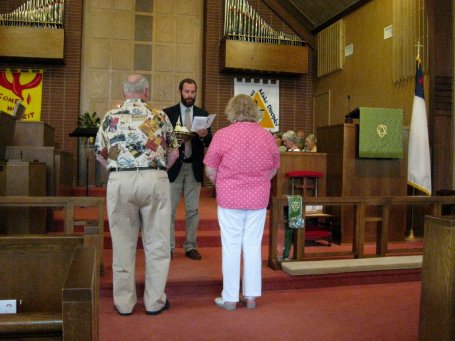
On one particular Sunday morning, toward the end of my time at the church, they were going to have their first baptism in a long time. A member of the church’s grandson was visiting and they all thought it was the right time and the right place to have him baptized. The excitement in the congregation that morning buzzed through the pews. This was what the church was all about: Welcoming visitors with signs of affection and love; returning to the great sacrament of baptism; and seeing young people standing near the altar.

The service built up toward the baptism at the end and the pastor invited the family to join him around the baptismal font. He spoke with conviction about how God had moved across the waters in creation to bring order out of chaos, he reminded us of the Israelites’ journey through the water on their way out of Egypt, and he even compared this sacrament to the baptism that John shared with his cousin Jesus at the Jordan River.

It was a holy moment seeing the congregation preparing for the baptism and a few of the older members were doing their best to cover up the tears that were slowly falling down their faces.

The pastor then motioned for the baby. He held the young boy with one hand, took of the top off the font with the other, and his eyes went wide. The beautifully and intricately carved baptismal font was empty; there was no water for the baptism.

The pastor looked up from the font and we locked eyes in the middle of the sanctuary. Without being told what needed to be done, I jumped up from my spot and ran to the kitchen. I frantically searched for any vessel that could hold water and settled on an old and chipped coffee mug. Using the sink, I filled the cup to the brim and then ran back to the sanctuary spilling a fair amount of water on the way.

While I stood in front of the congregation, I tried to make it look as liturgically appropriate as possible as I poured the water into the font, and the baptism went on as planned.

Bryson City UMC

Bryson City UMC

The beginning of the Good News of Jesus Christ. John was preaching and proclaiming in the wilderness when Jesus arrived to be baptized. This important and sacred event revealed the voice of the Lord identifying Jesus as the Beloved, while also setting in motion Jesus’ earthly ministry.

Jesus, as the Son of God, did not need to be baptized to be cleansed from his sins, but in going down to the water with the masses, he demonstrated his willingness to identify with sinful people. Jesus believed in doing ministry with others, rather than for others. In this scene we see God, in Christ, starting to bridge the great chasm between the earthly and the divine to inaugurate a new reality.

Yet, just as the baptismal scene comes to its conclusion, the Spirit of the Lord drives Jesus out to the wilderness where Satan tempted him for forty days.

During this time Jesus fasted from food and spent most of his time in prayer, though Satan was not inclined to leave him alone. He tempted Jesus with bread, with praise, and power. And Jesus remained steadfast; he resisted the temptations, and came out on the other side of the forty days strengthened and ready to begin his public ministry.

Again, in the temptations, we see Jesus’ willingness to identify with sinful people. All of us have moments where we wrestle with the devil.

We might feel helpless to resist the call of abundant and unhealthy foods. While countless people die of starvation everyday, few of us actively work to end hunger in the world.

We might feel helpless to the temptation of empty relationships and abusive power dynamics. We settle for the easy route so long as it benefits us completely, and few of us live selflessly instead of selfishly.

We might feel helpless to resist the urge to spend money on lottery tickets, or we cheat on our taxes, or we pretend to be something we’re not in order to further our quest for financial gain.

All of us are tempted one way or another. But chief among our temptations, is the temptation to forget what it means to be baptized.

In the small church in the Great Smokey Mountains, they had lost sight of the value of baptism; it had been so long since anyone was baptized that the font was empty and held no water! When we let the wells of baptism run dry in our churches and in our souls, we forget who we are and whose we are. When the identity we receive in baptism is forgotten, we quickly fall prey to the devil’s many temptations.

Baptism is a defining act. Through the sacrament of baptism God claims us, we are anointed with the Spirit, and we are set aside for God’s purposes. During baptisms in worship, the entire congregation makes a public commitment and covenant to raise the baptized person in the faith and become a new family. In baptism we receive the power of God’s Spirit to resist temptations through unending grace.

But when we forget who we are, when we forget how far God was willing to go for our sakes, our baptismal identity fades from our minds and is replaced with insatiable desires and temptations.

On Wednesday, many of us were reminded of our baptismal identities while ashes in the sign of the cross were marked on our foreheads. Wherever we went on Wednesday we were met with strange looks regarding the smudges on our skin, and whenever we glanced at our appearance in the mirror, we came face to face with our baptismal identities. But if you take a quick glance around the congregation, you will notice that all of the ashes have faded away.

Like empty baptismal fonts, and clear foreheads, we can fall to the temptation of forgetting who we really are.

In a few minutes all of us will be invited to remember our baptisms. We will use similar words just like the ones that have been used for centuries, we will pray over the water, and we will ask God to give us the strength to remember who we are each and every day. Whether we can vividly remember the moment we felt the water on our skin long ago, or it was done to us while we were babies, we will take time to give thanks for the people who surrounded us in those moments. We will give thanks for the congregations that promised to raise us in the faith, and do the same for others.

modern-artwork

But just in case this baptismal remembrance is not enough, we are going to take it one step further. After I take water and mark your forehead with the sign of the cross, you will receive a little plastic card with these words: “Lord, as I was my hands, I remember my baptism. Cleanse me by your grace. Fill me with your Spirit. Renew my soul. Amen.” Our challenge is to take these cards and place them near a sink in our homes. That way, whenever we go to wash our hands we can offer this prayer to God and remember who we are. That way, the baptismal font of our souls will never run dry. That way, we can resist the temptation to forget our baptisms.

Remember your baptism and resist temptation. Remember your baptism and receive strength. Remember your baptism and be thankful. Amen.

Transfigured Moments

Luke 9.28-36

Now about eight days after these sayings Jesus took with him Peter and John and James, and went up on the mountain to pray. And while he was praying, the appearance of his face changed, and his clothes became dazzling white. Suddenly they say two men, Moses and Elijah, talking to him. They appeared in glory and were speaking of his departure, which he was about to accomplish at Jerusalem. Now Peter and his companions were weighed down with sleep; but since they had stayed awake, they saw his glory and the two men who stood with him. Just as they were leaving him, Peter said to Jesus, “Master, it is good for us to be here; let us make three dwellings, one for you, one for Moses, and one for Elijah” – not knowing what he said. While he was saying this, a cloud came and overshadowed them; and they were terrified as they entered the cloud. Then from the cloud came a voice that said, “This is my Son, my chosen; listen to him!” When the voice had spoken, Jesus was found alone. And they kept silent and in those days told no one any of the things they had seen.

sunrise-over-the-mountains


On Monday morning, before I departed for my ordination interviews, I came by the church to print off my papers and spend some time in prayer. Full disclosure: I was very anxious. Months of effort and focus had led to up to this week. Many of you have been here throughout this whole ordination process: you have endured sermons that went into my papers and some of you were here when we had to record an entire worship service. A number of you participated in the bible study I wrote on the book of James and offered feedback about what went well and where it could’ve been better.

The sanctuary was nice and quiet when I first entered to pray for God’s will to be done over the following days, but the longer I prayed, the louder the preschoolers were down in the basement. I continued to lift up my concerns to God until I felt that I had fully expressed myself, and then I went downstairs to say “hello” to the kids.

Like most of you, they were also aware of the interviews I would have this week. Yet, even knowing this, I was not prepared for what happened when I entered the first classroom. The teacher quickly motioned to the kids and while I was trying to kneel to speak with one of them they promptly surrounded me in a circle, grasped hands, and started to sing: “Thank you God for giving us Pastor Taylor, thank you God for giving us Pastor Taylor, thank you God for giving us Pastor Taylor, right where are. Amen.

The Transfiguration is an important moment in the life of Christ, and it really bears witness to the identity of the Messiah. Up to this point in scripture, Jesus has performed lots of miracles; he has healed the unwell, embraced the outcasts, preached in the synagogues, and started a revolutionary movement. But all of these particular moments were a crescendo to the brilliance on the mountaintop.

Jesus took with the inner circle of disciples up to the peak to pray. And while Jesus was in the depth of his prayers his face began to change and his clothes became dazzling white. Suddenly, the disciples saw two men standing on either side of Jesus, one of them was Elijah, and the other was Moses. The disciples listened intently as the three shining men talked about Jesus’ departure that would soon take place in Jerusalem.

After they had discussed this for some time, and the two men started to depart from Jesus, Peter interrupted and begged Jesus to let them build three dwellings for this holy moment. He wanted to establish a degree of permanence in this brilliantly shining experience. But he, as scripture tells us, had no idea what he was talking about.

Then a cloud came and overshadowed all of them on the mountain and they were utterly terrified. But a voice cried out from the cloud saying, “This is my Son; my chosen. Listen to him!” When the voice finished, the disciples noticed that they were alone with Jesus, and they did not speak about this moment for a long time.

Shortly before this passage in scripture Peter was able to confess Jesus as the Christ; he understood that Jesus was the Messiah that the Hebrew people had heard about for centuries. Yet, this story of the Transfiguration is a reminder that even those disciples in the inner circle had gaps in their understanding. Professing deep and true faith requires something more than just knowing the stories from the past and connecting the dots. Professing deep and true faith requires transfigured moments that change everything.

transfiguration-abstract-e1360464424741

While the preschoolers sang their prayer around me, I felt like I was up on the mountaintop of Transfiguration. In their tiny voices and clasped hands I experienced the profound power of prayer in their willingness to lift me up in a holy moment. And like Peter, I didn’t want to the moment to end. Like Peter, I thought about setting up a dwelling place in that space to stay happy and comfortable.

When the kids finally shouted “Amen!” to conclude the prayer they immediately sprinted into the middle of the circle and started hugging me to the point that I fell over on the floor. It was a transfigured moment while I collapsed to the ground under the weight of laughing preschoolers, but I knew that I would have to eventually leave the mountaintop and make my way down to the valley of ordination interviews.

The next 24 hours were a blur. I made it to Blackstone, I spent the night, I woke up and interviewed all morning, and before I knew it I was back in my car heading west toward Staunton. The entire car ride was filled with more anxiety than before the interviews because now all I could do was wait. I spent far too much time rehashing questions in my mind and coming up with better answers than the ones I offered. But now the only thing I could do was pray patiently.

By the time our youth meeting rolled around on Wednesday evening, I had spent most of the day checking my phone every 5 minutes waiting for the call about whether I had been approved or not. I tried to be as present for the youth at the Circle but I know that my thoughts were elsewhere. With every minute that passed it felt like my heart rhythm was increasing one beat per minute. But still the call did not come.

I eventually brought the youth into the social hall and had them sit by the fireplace. I got a fire going and handed each of them a palm branch from our last Palm Sunday service and I explained our activity.

I said, “Every year churches take their used and dried-out palm branches and burn them. We do this in order to collect the ashes and use them for Ash Wednesday. Lent, which starts on Ash Wednesday, is a time to reflect on ways we could be better. It is a whole season for us to confront the mistakes we’ve made and start living like disciples of Jesus. I want each of you to take a couple minutes to think about one mistake you made in the past year, a moment you wish you could take back. I want you to imagine that failure as you throw your palm branch into the fire. And while you watch it burn, I want to you to remember that God can take our mistakes and make them into something holy. These palm branches will become the ashes that mark our foreheads next week. We will walk around with ashes signifying for everyone to see that we are broken people in need of grace. These ashes are a reminder that even though we mess up, God still loves us.

One by one we each took a turn throwing our palms into the fire and we watched them burn. We took our mistakes and watched them become ashes. We concluded by praying for God to make things new in our lives, to use the season of Lent to transfigure us into better disciples of his Son. When we said the final “Amen” I looked up and saw our District Superintendent standing in the room with a giant smile across his face and he told me that I passed my interviews.

Transfiguration-3

The Transfiguration is such a powerful moment because it is about transformation. Yes Jesus is changed into a glowing figure in dazzling white clothes, yes the appearance of Moses and Elijah reshaped the narrative of Jesus’ journey toward the cross, but when the disciples had to walk back down from the mountain their lives were forever changed.

Whereas they might’ve understood their friend to be a powerful speaker and leader, they were now confronted with the fact that he really was divine. Whereas they might’ve believed he was special, they were now confronted with the fact that he had real power. Whereas they might’ve believed he was capable of great things, they were now confronted with the fact that he was the Son of God. Jesus’ transfiguration transfigured their lives.

Standing by the fire on Wednesday night, as I let the knowledge that I will be ordained sink into my soul, and the youth started to jump around and yelp in celebration, I was reminded of how powerful those transfigured moments in life can be. I thought about how blessed we are to have a God who is so merciful and forgiving of our mistakes. I thought about how blessed we are to be surrounded by people in this church who pray for us and care about us. That moment by the fire reshaped my understanding of ministry and the church. In that transfigured moment I felt God’s love moving in this church through all of the connections we have made.

Transfigured moments always remind us how dependent we are on one another and the divine. When we encounter the true glory of the Lord it leaves us staggering in comparison. But God did not abandon the disciples on that mountaintop, and God has not abandoned us here and now. Instead God spoke through the cloud, and speaks to us today: “Jesus is the Son of God, listen to him!”

So what does it mean for us to listen to God’s Son here at St. John’s?

Do you feel loved? In your daily lives do you experience moments of joy that you can only equate with feeling loved? Do you have friends and family that care about who you are and what you’re experiencing? Are you connected with individuals you make you laugh and thankful for the gift of life?

This week, for me, has been an experience of love. Love of God and neighbor through all of you in this church.

In this church we have listened to Jesus speak to us, and we have responded to his command: “Love one another.” We have covenanted through baptism to love and support all those around us in the pews. We have gathered together to mourn during funerals and reach out to remind individuals of their worth. We have met here at God’s table to partake in the bread and the cup as a reminder that God’s love knows no bounds. We have opened our eyes and ears to the great witness of scripture that points toward God’s unfailing love for people like us.

So hear this from Jesus, and embrace it in your lives: “You are loved.”

No matter what you are currently experiencing, no matter how far you feel divided from the people around you, no matter how afraid you might be, you are loved. God has gathered all of us here in this place to build a new community of love.

When we lift up our hymnals to sing our faith we do so as a complete community in harmony with our relationship and our voices.

When we pray from our pews we do so as a new family who can faithfully say God is OUR Father.

When we are invited to this table to receive the bread and the cup we are invited as a community to a feast. There is a spot for us at God’s table where we can grow closer to the people in church next to us while growing closer with the Lord.

This is the place of transfigured moments that cut through the monotony of life. This is the place where we encounter the revealed Lord. This is the place where we hear Jesus saying to us, “You are loved.” Amen.

What Are Angels?

Hebrews 13.1-3

Let mutual love continue. Do not neglect to show hospitality to strangers, for by doing that some have entertained angels without knowing it. Remember those who are in prison, as though you were in prison with them; those who are being tortured, as though you yourselves were being tortured.

xlba-00052

This morning marks the beginning of our sermon series on Questions. After polling all of you about your queries regarding faith, scripture, and the church, I compiled three of the most prevalent questions: What Are Angels? What Does The Bible Say About Divorce? And How Can We Be Biblically Wise? Though there are no simple, black and white, answers to any of these questions, we will strive over the next few weeks to bring clarity to our wonder. This morning we begin with “What Are Angels?”

Close your eyes. Seriously. Close your eyes. Picture, if you can, an angel. What do you see? Think about the movies you’ve watched, or the stories you’ve read about angels and try to picture one in your mind. What do you see? If you’re anything like the people I encountered this week, people who tried to picture an angel in their mind, you would describe the vision like so: “Angels are clothed in white and might be glowing.” “All angels have halos hovering above their heads.” “You can’t be an angel without wings.” “When we lose someone we love, they come back to us as angels.”

If we want to know what angels are, then we should begin with what they look like. And if we want to know what they look like, we should begin with scripture.

Angels are mentioned 273 times in the Bible. That’s a lot. They appear in both the Old and New Testaments. They appear to prophets and paupers. They minister to the wealthy and the weak.

I know many of us like the image of an angel with a halo, during our Preschool Pageant all of the angels had pipe cleaner halos hanging above their heads, but halos are never mentioned in scripture. Angels, when they do appear, are oftentimes described as having a particular shine or brightness, but they don’t have floating discs above their heads.

Some passages describe angels having wings, but others just describe them as looking like human beings. Zechariah is in the temple when an angel, who looked like a man, appeared and told him about his son John the Baptist. After Jesus was born, an angel appeared in Joseph’s dream and warmed him to get the child out of Bethlehem. Even when the disciples went to the tomb after Jesus’ crucifixion they saw two men in shining garments who told them about Jesus’ resurrection from the dead.

Well then, what do angels do? They report to God, they observe God’s people (us), they announced the birth of Jesus to the shepherds in the fields, they help God’s people when they are in need, and they rejoice in God’s creation and offering of salvation.

The descriptions and stories of angels in scripture vary and are all over the place. They certainly exist and work for God’s purposes, but that doesn’t make them any easier to understand or grasp. However, there is one thing that connects most of the angels in the bible, and it’s the way people react to their presence: fear.

the_ministry_of_angels_in_the_lives_of_believers

Before I came to St. John’s, I spent a year working as an on-call chaplain for Duke University Hospital in Durham, North Carolina. Every week I gathered with other chaplains to talk about grief, death, and suffering. We worked through our own issues with the brokenness in the world, and we were responsible for visiting people in need throughout the community.

I often met with people near the end of life who were tasked with making decisions about the way they wanted to die. Throughout my time in chaplaincy I became well versed in the topics of Do-Not-Resuscitate, Advanced Directives, and Power of Attorney. I was invited into some of the darkest moments of peoples lives and while everyone else would tell someone that they were going to be okay, that they would get better, I was one of the few people tasked with telling the truth: no one makes it out of this life alive.

During my year of chaplaincy, I had multiple 24-hour shifts at the hospital. I would put on my overly large white lab coat and respond to particular patients and their needs. More often that not I would be called to a room for someone who was lonely and just wanted another human being to be present with them. But every once in a while, I would be called to a room with a patient who needed something more.

It was 4 am, and I had been running around the hospital for my entire shift. Every time I thought I would have a moment to rest, a patient would die and I would have to meet with the grieving family. At 4am I received a page to a particular unit on the other side of the hospital with the words: We Need You.

Outside of the patient’s room I learned from the doctor and nurses that the patient was about to die; there was nothing else they could do to prolong her life and they wanted me to sit with her. Normally one of the nurses would stay in the room but they were so swamped with other patients that they could not spare another nurse. Of course, I asked about any family member that would want to be present and the staff just looked back at me with empty eyes and said, “She’s all alone.”

They left me standing there in the hallway, so I said a brief prayer and then walked right in.

Something about the hospital room was different. Whereas most are filled with machines making lots of noises, this room was quiet and peaceful. And strangely enough, I remember it being very warm; warm enough that I had to take off my lab coat and roll up my sleeves. The woman was lying in the hospital bed and was going in and out of consciousness. So I pulled up a chair and started to hold her hand.

For thirty minutes I sat there looking at the wrinkles on her skin wondering about her life, wondering about why no one else was there with her at the end, and if I should say anything. Instead, I just sat and held her hand at the minutes went by. I couldn’t even imagine the kind of pain and hurt I would’ve felt if I was in a room all by myself at the end of my life, and if I’m honest, the thought of it made me cry while I sat there holding her hand.

I don’t know how long I had been there when she started to move around a little bit more and opened her eyes to look right at me. We held one another in sight for some time when I felt like I needed to explain why I was there, so I said, “I’m the chaplain and I didn’t want you to be alone.”

            In response, she smiled her so slightly and said, “I’m not alone.”

After that holy moment, we continued holding hands in silence until her breathing started to fade away, until her heart stopped beating, until she died.

That night at the hospital, when I was afraid of the power of loneliness, when that woman was facing her final earthly moments, I believe there was an angel in the room with us. I couldn’t see it, but as soon as she told me that she wasn’t alone, I knew it was true.

If and when God sends angels to us, we are either very afraid, or are about to be afraid by their presence. It is a humbling and powerful thing to be attended to by the likes of an angel and it really puts us in our place. I have asked countless people form our church if they have ever seen or experienced an angel and I was shocked, in a good way, by how many people said yes.

I heard things like: “My grandfather had just passed away and my brother and I were driving around Staunton when we saw a man who looked exactly like our grandfather walking down the street, wearing the same type of clothes, who took out a comb just like our grandfather did to comb his hair, and we knew that even though he died, he was still with us.”

“My sister was driving in her car when she felt asleep at the wheel and veered off the road. She woke up while the car was flipping over and she said she felt time slow down and arms wrap around her to protect her. While the car tumbled and tumbled she was held tight and only after the car stopped moving did she feel the protective arms let go and she was okay.”

Big and small, dramatic and simple, angels have showed up in our lives. The writer of Hebrews tells us to be faithful in our hospitality toward others because we never know when an angel will show up in our midst. Whether it’s in a hospital room, or driving through town, or even in church, angels show up.

When I first felt God calling me to ministry I was afraid. I was afraid of how my family would respond, and what my friends would think. I was afraid of whether or not I had what it would take to be a pastor. I was afraid of how much it would change my life.

And then at 16, while walking down Ft. Hunt road in Alexandria, VA I felt pulled to my knees and I prayed and prayed. I didn’t see an angel near me, or hear an angel speak to me, but I felt an angel’s presence with me as I prayed for God’s will to be done in my life, and not my own.

I can only articulate that experience of an angel in my life and in that hospital room because the church has given me the vocabulary of divine intercession. I can only look back and say that an angel was with me, because the church taught me how to open my eyes to the ways that God actually works in the world. Others might talk about a bizarre feeling they had or a strange movement in their midst. The church taught me to understand those experiences as angelic and holy moments.

What are angels? Angels are God’s way of helping us to see and experience God’s will in our lives. Angels are God’s way of pushing and nudging us in the right direction. Angels are God’s way of bringing us peace when we feel the depth of fear. Angels are God’s way of reuniting the heavens and the earth in profound and holy moments. Angels are God’s way of rescuing us from ourselves. Angel’s are God’s way of reminding us that we are never alone.

I conclude with these words from the hymn that we will sing in a few moments. I offer these words so that they might help us to recognize and experience the angels in our midst. O Lord, Open my eyes that I may see, glimpses of truth though hast for me. Open my ears that I may hear, voices of truth thou sendest clear. Open my mouth and let me bear, gladly the warm truth everywhere. Silently now I wait for thee, ready, my God, thy will to see. Open my eyes, illumine me, Spirit divine. Amen.

Praise The Lord!

Psalm 150

Praise the Lord! Praise God in his sanctuary; praise him in his mighty firmament! Praise him for his mighty deeds; praise him according to his surpassing greatness! Praise him with trumpet sound; praise him with lute and harp! Praise him with tambourine and dance; praise him with strings and pipe! Praise him with clanging cymbals; praise him with loud clashing cymbals! Let everything that breathes praise the Lord! Praise the Lord!

00033674_h


I am a creature of habit. I like routines, I like order, and I like preparation. I asked Lindsey to give me three examples of how I am a creature of habit and her response was: “only three?” I like my coffee a certain way, I enjoy sitting in a particular chair to read books, and I have rhythms for most of the events in my life. Sundays are no exception.

Most Sundays I arrive here in the sanctuary hours before some of you are even awake. Of course I start with the practical things like turning on the lights and unlocking the doors, but then I make my way back to the sanctuary to prepare for worship. First I pray on my knees from the third pew on the right hand side and confess where I have fallen short and how I have sinned. I pray for God’s forgiveness, and ask God to show up in my words in worship, even if I don’t deserve it. I then make my way up to the altar and praise God for the mighty acts revealed in scripture and in my life.

When I turn around I walk down the center aisle and I pray over every single pew asking for God to turn them into avenues of connection rather than walls of division. My hand touches every pew and I pray for God transform all of the people who will inhabit them through our worship.

From the Narthex I pray for the ways that we greet people on their way into the church, and I even go out onto the front lawn to give thanks for Staunton, and ask for God to send to us all who need to feel God’s love.

All in all it takes some time to prayerfully prepare for worship, but it’s worth it. When I finish praying, I make my way into the pulpit and read over the bulletin one last time. I check to make sure that the theme of worship is present throughout the entire worship service and, before I read my sermon out loud, I pull out my hymnal.

Like I said, I am a creature of habit. Every Sunday before any of you get here, I pray in this sanctuary and I sing through the hymns by myself. When I’m alone in the church I can belt out the hymns without the deep sighs from our organist Rick in response to me not keeping the pitch, I can let my emotions get the best of me without being judged by some of you from the pews, and I can just be myself up here jamming.

One Sunday, after going through my whole prayer routine, I stood up in the pulpit and looked at the bulletin to the hymn number for “Have Thine Own Way, Lord.” And I did what I always do. And I got really into it: (sing Have Thine Own Way)

Of course, when I sing, I often close my eyes and just let the words flow. So here I was singing from the top of the lungs from the pulpit, and you can imagine my surprise and terror when I finished the last note and someone shouted, “sounds okay from back here!

A visitor to the church had arrived hours early, walked in through the narthex, picked up a bulletin, and sat down in the farthest back pew, and was listening to my solo. I stood up here in shock without knowing what to say and I fumbled through trying to explain myself when the man raised his hand to stop me and said, a little too sarcastically, “I’m sure other pastors do this kind of stuff all the time.”

I am a creature of habit and, even though I was embarrassed that one morning, I still sing all the hymns before you get here. Singing the hymns and reading over the lyrics is incredibly important, because when we sing from this hymnal, we are articulating our faith. When we sing from this hymnal we are reentering the world of scripture. When we sing from this hymnal we are praising the Lord.

So let’s go to that hymn that I embarrassingly belted from the pulpit; number 382 Have Thine Own Way, Lord. (Sing together.)

Is this a familiar tune for you? Can you remember singing it when you were younger? Maybe you’ve heard the version that Johnny Cash performed. This is a beautiful hymn. The words quote Jeremiah 18.6 about clay in the potter’s hand. The tune is easy to follow and the theology behind it is great: It is an honest and prayerful desire for God’s will to be done in our lives.

I have always enjoyed singing this hymn, but when I learned the story behind the hymn it became that much more precious. If you look to the bottom left hand corner of the page, you will see that Adelaide Pollard wrote the hymn in 1902. The story goes that Adelaide was going through a rough period in her life and was unsuccessful in raising enough funds to make a trip to Africa for missionary work. In the depth of her struggle, she went to a tiny prayer meeting one night for the local community. She listened to person after person make their prayer requests for medical issues, material possessions, and a slew of other things when an old woman stood up to make her prayer request. Bucking with the trend of the evening the old woman simply said, “Have thine own way with me, Lord.” Impressed by the faith of the old woman, Adelaide went home that night and wrote the words to the hymn.

Psalm 150, the final one of the entire psalter, compels us to praise the Lord through music. Praise God with trumpets, lutes, harps, tambourines, dance, strings, pipes, and cymbals. Toward the beginning of the hymnal, we can find John Wesley’s directions for singing, that pair so well with Psalm 150:

“Above all sing spiritually. Have an eye to God in every word you sing. Aim at pleasing him more than yourself, or any other creature. In order to do this attend strictly to the sense of what you sing, and see that your heart is not carried away with the sound, but offered to God continually; so shall your singing be such as the Lord will approve here, and reward you when he cometh in the clouds of heaven.”

So we are going to follow the words of Psalm 150 and the words of John Wesley, we are going to praise the Lord. I would like all of us to take out our hymnal and turn to our favorite song. When you find the one you love shout out the number and we will sing the first verse. (We’ll probably do this for five hymns) Together we will praise the Lord. And as we do, take the time to soak up the words and the let the tune flow over you so that the Lord will approve our singing and reward us when God comes in the clouds of heaven. Amen.