Devotional – Luke 17.5

Devotional:

Luke 17.5

The apostles said to the Lord, “Increase our faith!”

 Weekly Devotional Image

4 years ago I received the phone call about being appointed to St. John’s. And over the last 4 years I learned what it really means to love God through the people of St. John’s. Through every rolled sleeve to clean dishes, through every casserole provided for a family in grief. Through every committee meeting, bible study, and Circle gathering. Through every mission trip, hospital visit, and church picnic.

St. John’s UMC has increased my faith.

While here I have watched people who were spiritually dead be resurrected into new life through the faithfulness of the church. I have seen people surrounded in the midst of sorrow and grief when they needed it most. I have seen tears spilt over the precious sacrament of baptism, and in recognition of the incredible gift of communion.

In the United Methodist Church clergy people like me make a vow to go where the Spirit leads us. When I was finishing seminary I lived into the promise when I received the phone call about coming here and I embraced it. I came to St. John’s not knowing what it would look like, how it would feel, or whether or not it would be fruitful.

And I can say today that serving St. John’s has been the greatest privilege of my life.

PC_grownupnew

But the Spirit is moving. Over the last few months the leadership of the church and I have been praying for God’s will to be done and we have discerned that the time has come for me to respond to the Spirit yet again in a new place, and that the Spirit is calling a new pastor to serve St. John’s. And in response to that prayer and discernment, our Bishop has projected to appoint me to serve as the Pastor of Cokesbury UMC in Woodbridge, VA at the end of June.

I am grateful beyond words for the community of Staunton, VA and for the people of St. John’s for increasing my faith. I have nothing but hope and faith that the church will continue to pour out God’s love onto the last, the least, and the lost. I rejoice in the knowledge that our God makes all things new.

This is a time of new life for St. John’s: a new pastor, a new chapter, and new beginning.

In the coming weeks of transition I ask that you please keep my family in your prayers and I encourage you to continually seek out new ways to increase the faith of the people around you like you’ve done for me.

Now What?

1 Peter 1.3-9

Blessed be the God and Father of our Lord Jesus Christ! By his great mercy he has given us a new birth into a living hope through the resurrection of Jesus Christ from the dead, and into an inheritance that is imperishable, undefiled, and unfading, kept in heaven for you, who are being protected by the power of God through faith for a salvation ready to be revealed in the last time. In this you rejoice, even if now for a little while you have had to suffer through various trials, so that the genuineness of your faith – being more precious than gold that, though perishable, is tested by fire – may be found to result in praise and glory and honor when Jesus Christ is revealed. Although you have not seen him, you love him; and even though you do not see him now, you believe in him and rejoice with an indescribable and glorious joy, for you are receiving the outcome of your faith, the salvation of your souls.

The existence of the church is a miracle. We live in a world so steeped in the need for scientific, historical, and verifiable fact that the existence of a community based on a person we have never seen is nothing short of a miracle. Blessed be the God and Father of our Lord Jesus Christ indeed!

However, this profound miracle is not limited to our contemporary world’s desire for things seen and observed.

According to the New Testament, only a scattering of people ever saw the resurrected Jesus after the first Easter. The disciples in the upper room, a smallish crowd heard his teachings, a handful of people saw the ascension. And from them, from their witness, the church was born.

They were filled by the power of the Spirit to live out the resurrection in their lives and it shined brightly wherever they went. They went on to tell their friends and families what they had experienced. They wrote letters to different communities. They traveled around sharing the Good News.

And today, I am sure that each of us can think about someone in our lives who was like those first disciples; we can remember someone whose faith shined brightly wherever they went. It is in large part because of them that people like you and me are receiving the outcome of our faith, the salvation of our souls.

Today is a strange day in the life of the church; Clergy and church folk often call today “Low Sunday.” It is a terrible name. People refer to it as such because, traditionally, the first Sunday after Easter has the lowest attendance of any Sunday in the year. And there is almost an unavoidable feeling of lowness after the highness of a packed church on Easter only to be filled with the likes of us one week later.

The resurrection of Jesus was not like that. No, it grabbed hold of people in a way never seen before. The inexplicable, unexplainable, and uncontainable event of the resurrection resulted in glorious joy. Like dancing in the streets, laughing on the floor, tears in the eyes kind of joy; a contagious joy that forever changed the fabric of our reality.

now what


Years ago I read a book by Donald Miller titled Blue Like Jazz and in it he describes his relationship with jazz music: “I never liked jazz music because jazz music doesn’t resolve. But I was outside a theater in Portland one night when I saw a man playing the saxophone. I stood there for fifteen minutes and he never opened his eyes. After than I loved jazz music. Sometimes you have to watch somebody love something before you can love it yourself. It’s as if they are showing you the way.”

Sometimes you have to watch somebody love something before you can love it yourself.

Similarly, I love jazz music. To me, there are few things as wonderful as sitting down and listening to an old Dave Brubeck LP. But I used to hate jazz. I hated how confusing it was, how unmelodic it could be, and how indefinable it was. I hated jazz until I started playing jazz.

12 year ago my high school jazz band needed a drummer and I signed up. I played Christian rock songs every Sunday for my church and I thought, “How hard could it be to play jazz?”

It was hard.

But every day I sat behind the drum-kit until my fingers were blistered and calloused. I watched my peers hold back smiles while blowing into their horns and while their fingers were flying over the keys. In response to their love for the craft I started listening to jazz in my spare time and tapped along on my thighs and countertops. I immersed myself into the strange new world of jazz, and before long I fell in love. I fell in love with the wonderful solo runs that were never the same, I fell in love with the strange time signatures and rhythms, I fell in love with the genre of music I hated because I watched others love it.

How many things in life are like that? How many of our hobbies and cultural obsessions were born out of someone else’s love and obsession?

More than four years ago I received the phone call about coming here. I was with Lindsey in New York visiting my, at the time, soon-to-be sister-in-law when a familiar voice on the other side of the phone said, “The bishop has discerned that your gifts and graces will be most fruitful at St. John’s UMC in Staunton, VA.” To which I said, “I think it’s pronounced STAUNton.

I never made that mistake again.

So I looked up the website, searched for any information I could find on Google, and started praying. And I’ll admit, after checking the statistical data and other relevant materials I thought, “How am I going to love these people? I don’t know anything about Staunton, the community, or the church.”

And then at the end of June in 2013 I showed up for my first Sunday. I smiled at all of you and led us through worship, I almost forgot to take up the offering, and when I walked down the aisle after my first benediction I let out an unnecessarily loud and deep sigh.

I knew nothing about what it meant to be a pastor, or even what it meant to serve God in this place. But then I started watching you. Like a saxophone player on the street corner, I watched you close your eyes and make beautiful music in your lives.

I saw your love of God through Marshall Kirby bear-hugging every person that walked into this church, whether they wanted it or not. Through Pam Huggins’ never-ending, and forever-repeating, stories about how God has showed up in her life. Through Alma Driver’s limitless knowledge of who came to this church, where they sat, and what they were like. Through George Harris’ insistence on standing next to me after church to say goodbye to everyone as if he were the associate pastor. Through Dianne Wright keeping Hallmark in business by sending people cards for no reason other than the fact that she wants them to know that God loves them. Through Grace Daughtrey spilling grape juice all over herself while attempting to serve communion. Through Rick Maryman’s brilliant use of timing and rhythms through the hymns we sing and the anthems we hear. Through Dick Pancake’s joining the church after refusing to become a United Methodist for decades. Through Jerry Berry’s theologically probing comments offered after nearly every sermon. Through Ken Wright crawling on his hands and needs to pick the weeds. Through Eric Fitzgerald and Mike Hammer’s willingness to be dressed up like fools for a children’s message. Through Sue Volskis’ continued calls to make sure that everything was going well. Through Leah Pack’s pats on the back after the good, and the bad, sermons. Through Bob Pack mocking me from the back every week. Through Dave Fitzgerald offering to preach a better sermon than I have ever offered.

Through every rolled sleeve to clean dishes; through every casserole provided for a family in grief. Through every committee meeting, every bible study, every Circle gathering. Through every mission trip, hospital visit, and picnic.

I literally could go on and on with the myriad of ways that I’ve seen God’s love through your love but I would break my rule of keeping sermons under fifteen minutes.

What I’m trying to say is this: I learned what it means to love God through all of you. For the last four years I have been blown away by your remarkable capacity to love one another and the Lord.

All of you are the reason that, even though I have not seen Jesus, I love him, because I see his love manifest in you. That is why I rejoice with an indescribable and glorious joy. You practice resurrection daily, you are receiving the outcome of your faith, and salvation is here.

17861909_10208403916446472_6677489642886390845_n

You have taught me what it means to be Easter people. As Easter people there is a “not yet” to the fullness of God’s salvation, but there is also a “now” to the anticipation and joy of that fullness. That alone is reason enough for us to sing and praise the Lord. That alone is reason enough to be filled with a hope that does not disappoint. That alone is reason enough to believe that God truly does make all things new.

By the Lord’s great mercy he has given us a new birth into a living hope through the resurrection of Jesus Christ from the dead, and into an inheritance that is imperishable, undefiled, and unfading.

In the last four years I have watched people who were spiritually dead be resurrected into new life through your faithfulness. I have seen you surrounded people in the midst of sorrow when they needed it most. I have witnessed your faith through all the crazy things I’ve asked you to do in responding to the Word, like reconciling with people with whom you were angry, like burning palm branches as a commitment to leaving behind our broken identities, like even dancing in the pews to a Justin Timberlake song in anticipation of the joy of our promised resurrection.

God has brought this church back to life through you. Blessed be the God and Father of our Lord Jesus Christ!

In the United Methodist Church clergy people like me make a vow to go where the Spirit leads us. When I was finishing seminary I lived into that promise when I received that phone call about coming here and I embraced it. I came here not knowing what it would look like, how it would feel, or whether or not it would be fruitful.

And I can say to you today with joy that serving this church has been the greatest privilege of my life.

But the Spirit is moving. Over the last few months the leadership of the church and I have been in prayer and we have discerned the time has come for me to respond to the Spirit yet again in a new place, and that the Spirit is calling a new pastor to serve St. John’s. And in response to that prayer and discernment, our Bishop has projected to appoint me to different church at the end of June: Cokesbury UMC in Woodbridge.

I am grateful beyond words for the many ways you have showed me how to love God, and that I get to share your love of God in a strange new place. I have nothing but hope and faith that this church will continue to pour out God’s love on the last, the least, and the lost, because that is who you are. I rejoice in the knowledge that God is doing a new thing for this community.

By the Lord’s great mercy he has given us a new birth into a living hope through the resurrection of Jesus Christ from the dead. This is a time of new birth for St. John’s; a new pastor, a new chapter, a new beginning. On this side of the resurrection we are bold to proclaim our joy in God making all things new. Amen.

Devotional – John 20.19

Devotional:

John 20.19

When it was evening on that day, the first day of the week, and the doors of the house where the disciples had met were locked for fear of the Jews, Jesus came and stood among them and said, “Peace be with you.”

Weekly Devotional Image

The doors were locked because the disciples were afraid. Jesus broke forth from the chains of death in the morning, but by the evening the disciples were locked up at the house. And John is quick to tell us that they did so for fear of the Jews. Perhaps the disciples were afraid that the fate of crucifixion was coming for them next, or at the least they would be attacked and driven from the city. But nevertheless, the Word become flesh is resurrected and the closest followers of Jesus are hidden in a room.

Were they really afraid of the Jews? Or was there something else that drove them to lock the doors and cower in the corner?

I think that the disciples were certainly afraid of the Jewish leaders, particularly in light of what they had done to Jesus, but I also think the disciples were afraid of the risen Jesus. These disciples, these followers of the Messiah, had all abandoned him at the end, they had denied him, and now he’s back! I would be hiding too.

How often do we fail our friends only to cower in fear as we wait for their response? I know far too many people (myself included) who will ignore that email, text message, or phone call from a particular individual not because of anything he/she did, but because of what we did.

Thanks be to God that Jesus did not leave the disciples hiding in fear behind locked doors. Thanks be to God that the gospel was too important to remain hidden. Thanks be to God that Jesus came in, stood among them, and said, “Peace be with you.”

682086_1_e9135b

Do we believe that Jesus could show up in our lives when we are ashamed for something we’ve done? How often do we hide (literally or figuratively) behind locked doors when we have failed our friends or families? What would it look like to live like we believed in the resurrection of Jesus from the dead?

As Easter people we are committed to practicing resurrection here and now in anticipation of our promised resurrection. This means that we cannot take the people around us for granted, it means we cannot stay hidden in shame, it means that we have to be brave and courageous people willing to say “peace be with you” to the people with whom we feel no peace.

On Rediscovering Joy At Easter

strangely-warmed-spreaker-header

The team from Crackers & Grape Juice recently spent an afternoon interviewing Brian Zahnd (founder and lead pastor of Word of Life Church, a nondenominational congregation in St. Joseph, Missouri) for our lectionary podcast Strangely Warmed. During our time together we talked about the readings for the season of Easter during year A from the Revised Common Lectionary. For the first Sunday of Easter, Brian challenged us to make it all about joy while the world struggles under the weight of the current political climate. If you want to hear the conversation and learn more about heresy, the paradox of Easter, and destroying lilies in worship, you can check out the podcast here: Easter 1 – Year A


Brian-Zahnd

Devotional – Matthew 6.28-29

Devotional:

Matthew 6.28-29

Consider the lilies of the field, how they grow; they neither toil nor spin, yet I tell you, even Solomon in all his glory was not clothed like one of these.

Weekly Devotional Image

In a few hours I will gather with members of the community for a Service of Death and Resurrection for one of St. John’s long-time members, Gracie Jackson. During my first two months serving at St. John’s (almost 4 years ago), I tried to visit as many people as possible from the church community, particularly those who could no longer attend worship on Sundays. I want them to know that the church still cared about them and that they were in our prayers regardless of their presence.

Throughout those first months I was welcomed into a great number of homes and learned so much about Staunton and the impact St. John’s has had throughout the decades. One of my first visits was to the Jackson home where I sat and talked with Lenard and Gracie Jackson. But we didn’t sit for long. Instead, they wanted to give me the grand tour including the basement workshop and the green house in the backyard. There were plants everywhere but one in particular was striking and unlike anything I had seen before. Lenard explained that it was a Night-Blooming Cereus, and like the name implies, it only blooms at night. At the time, I casually mentioned my interest in the plant and we continued the door.

However, a couple days later Gracie told Lenard that he HAD to invite me over to witness the Night-Blooming Cereus in all it’s glory. (Lenard recently told me that in his life there were always two ways to doing things, and both of them were Gracie’s!). So at 10pm Lindsey and I drove over to the Jackson house and the four of us sat in their living room in our pajamas patiently waiting for the plant to do its magic.

When the right time arrived, we huddled in the green house with the dark sky coming through the windows and the cactus bloomed right in front of us. It produced the most exquisite scent and filled the room with its glory. And in that moment I was struck by the holy space we were sharing and was reminded of Jesus’ words from Matthew 6: “Consider the lilies of the field, how they grow; they neither toil nor spin, yet I tell you, even Solomon in all his glory was not clothed like one of these.”

6e7f0caa6dfe8f6541d5babc77c32ecf

That Night-Blooming Cereus was one of the most spectacular things I have ever seen and I never would’ve experienced if it weren’t for Gracie’s insistent invitation. Similarly, our faith is something that is offered to us as an invitation. We can read all about the Lord in Scripture, we can pray privately on our own time, but when we share our faith with another person it can bloom in the most exquisite of ways.

I am so remarkably grateful for the time I got to spend with Gracie, and for the many ways she embodied God’s grace for me.

Devotional – Job 19.23-25

Devotional:

Job 19.23-25

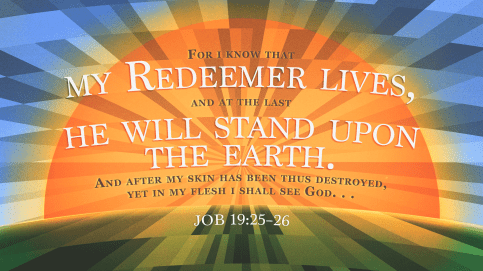
O that my words were written down! O that they were inscribed in a book! O that with an iron pen and with lead they were engraved on a rock forever! For I know that my Redeemer lives, and that at the last he will stand upon the earth.

Weekly Devotional Image

Last Thursday, while my wife, son, and I were visiting family in Alexandria, I received a phone call about one of St. John’s long-time members having died. Ruth Cassidy joined the church weeks after it formally began back in 1954 and while it was still meeting in a basement down the road. Ruth was easily one of the kindest people I ever had the chance to spend time with, and she will be greatly missed by our church community, and by her family.

A couple years ago I received a phone call about Ruth’s husband Howard, and it was clear that he was close to the end of his life. And so, I made my way over to their retirement home and when I walked into the room Ruth was sitting next to her husband, she was lovingly holding his hand in hers, and he had just taken his final breath. I, not wanting to intrude on the holiness of the moment, slowly started to back away but Ruth insisted on me sitting down with her on the couch. She immediately started asking me questions about my family and St. John’s and I was still in a state of shock; I was overwhelmed by the totality of the moment, and the fact that Howard had literally just died. Ruth continued to ask me questions, but I wanted to acknowledge what had just happened. It took a couple minutes, but I finally mustered the courage to ask: “Ruth, are you okay? I mean, Howard just died…”

She looked right into my eyes, smiled, and said, “Oh, everything is fine; I know where he really is.”

Rarely have I encountered such faith, such hope, and such love as what I regularly experienced through Ruth Cassidy. Like the biblical character of Job, she had an assurance about the way things really are. In that holy and profound moment immediately after her husband died, I could almost hear the words of scripture floating in the room with us: “I know that my Redeemer lives, and that at the last he will stand upon the earth.”

job-19-25-26

Ruth’s assurance, her blessed assurance, was one worthy of our emulation.

Do you know that your Redeemer lives? What words or thoughts would you want to engrave on a rock forever? Can you feel the Holy Spirit moving and breathing into your life? Are you filled with an assurance about who you are and whose you are?

O that my words were written down and engraved forever! I know that my Redeemer lives! And that at the last he will stand upon the earth!

Long Live The Revolution!

Romans 8.12-17

So then, brothers and sisters, we are debtors, not to the flesh, to live according to the flesh – for if you live according to the flesh, you will die; but if by the Spirit you put to death the deeds of the body, you will live. For all who are led by the Spirit of God are children of God. For you did not receive a spirit of slavery to fall back into fear, but you have received a spirit of adoption. When we cry, ‘Abba! Father!’ it is that very Spirit bearing witness with our spirit that we are children of God, and if children, then heirs, heirs of God and joint heirs with Christ – if, in fact, we suffer with him so that we may also be glorified with him.


I love going home to visit family. There is just something special about visiting the old haunts and showing off a baby to make me really nostalgic for the past. Last week Lindsey and I spent some time up in Alexandria with my family, and it felt like nothing, and everything, had changed. For instance: When I went to the grocery store I bumped into a couple people I used to go to church with, but then when I drove out on Route 1 all the old buildings were gone and were replaced with town homes. Time, like a river, moves and though it looks the same, everything changes.

But perhaps the thing I enjoy most about going home is spending time with my grandmothers; Gran and Omi, both of whom are now great-grandmothers to Elijah. I know I’m biased, but I do have the best grandmothers in the world. One represents all the good southern hospitality that Petersburg, VA has ever had to offer and the other represents the refined qualities of old Europe with her charm and presence. They could not be more different from one another, and yet they are incredibly close.

Anyway, whenever I head home, whether it’s for a day or a week, I always plan on swinging by both of their homes unannounced. And last week was no exception.

Both visits were similar – we had the usual chit chat, we caught up on all the other family members, we shared stories about Staunton, and then we watched Elijah crawl all over the place. During our time together we learned about different health concerns, new aches and pains, and were unable to confront the reality that one day, perhaps not for some time, but nevertheless one day, they will no longer be here.

Each visit ended with both of them asking us to stay longer, while Elijah fussed for food or for a nap. And both visits ended with the exact same words from both of my grandmothers: “I just wish I had something to give you.” To which one looked around the room as if to give us something off the coffee table, and the other went upstairs and literally took a painting off the wall and put it in our hands.

I just wish I had something to give you.

“When we cry, ‘Abba! Father!’ it is that very Spirit bearing witness with our spirit that we are children of God, and if children, then heirs, heirs of God and joint heirs with Christ.”

Inheritance, being an heir, is always a complex matter. I wish it wasn’t true, but I’ve helped families prepare for funerals when more of the conversation around the table was focused on who was receiving what than what hymns or scripture would their now dead loved one want in their Service of Death and Resurrection. At the moment when a family needs to be together almost more than ever, they were already marking the territory of their hopeful inheritance.

Most of the time, we can’t choose what we inherit. Our parents or grandparents might think something has special significance for us, and therefore leave that item for us in the will, but rare are the times that we get to declare what we shall receive.

And there are others things that we have no choice about inheriting. We get the good and the bad, the responsibility and the privilege, the shame and the pride.

Frankly, three of things that determine our lives more than anything else come to us without a choice at all: We do not choose the family we are born into, we do not choose the color of our skin, and we do not choose the economic status of our families. We inherit all three without any action of our own, and those three things set us on a trajectory that we can rarely alter.

And of course there are things we inherit through the sands of time that we’d rather erase; like the celebrities who get their DNA tested for television shows about genealogy only to discover that their ancestors were part of the Nazi regime, or were slave owners, or participated in the near-eradication of the indigenous peoples in this country.

Inheritance is a complicated and confusing thing. Are we nothing more than the genes and the history we inherit? Can we break from the tyranny of expectation and what it means to be an heir? Who are we really?

St. Paul says that we are children and heirs of God!

Our inheritance, unlike that which we receive from our families, is totally different from anything that has ever existed. Moths and rust do not corrupt it; thieves cannot break in and steal it. It cannot be lost in the fall of the stock market, or burned in the night, or taken by the government in the so-called death tax.

Our inheritance is our hope while everything else appears to fail. It promises a future when we cannot imagine there being anything left for us in this life.

            It is nothing short of the glory of the Lord.

However, and this is a big however, there is more to this inheritance than smiles and rainbows and resurrection. It comforts AND it afflicts.

We receive something so remarkable and inexplicable as heirs with Christ, but it also comes with a cost. Receiving this gift puts at risk our financial security, our reputation, our social position, our friends, our family, our everything.

This is the revolution of faith.

o-REVOLUTION-FIST-facebook

We are fellow heirs with Jesus Christ, we shall receive resurrection, but we also suffer with the Lord.

The time is coming, and is indeed here, when the mighty will be brought low and the lowly will be raised high. Seek ye first the kingdom of God and do not put your trust in things that will fade away with the blowing of the wind. You need only faith the size of a mustard seed. Ask you shall receive. Those who lose their lives for the sake of the gospel will live.

Have you ever heard anything more revolutionary in your lives?

Everything about our existence changes with the inheritance of the Lord: Our finances change when we realize that all we receive first comes from the Lord. Our families change when we realize that all who do the will of God are our mothers, fathers, brothers, and sisters. Our worldviews change when we realize that God is contending against the powers and principalities here and now.

All that we held so near and dear before will wash away when the tide of life comes in. Moths will eat away at the fabric of our perspectives, thieves will steal the wealth that we think determines everything, but there is one thing that endures forever: Jesus Christ.

This is nothing short of revolutionary. And to be honest, it’s gotten a lot of people killed throughout the centuries, including the One in whom we lie and move.

That’s one of the things we struggle to remember, here in our comfortable Christianity; Jesus was a revolutionary. He was not killed for loving too much. He was killed for calling into question who was really in charge, for confronting the elite about not taking care of the poor and the marginalized, and for telling the truth.

Jesus was a revolutionary and calls us to join the revolution.

            But here in Staunton, we don’t feel very revolutionary.

We like what we have: good schools, perfectly manicured lawns, children that come home to visit, vacations, golf courses, solid retirement portfolios. We can’t imagine being called to leave our families, or go to prison, or even lose our lives for the sake of the gospel. Why do we need to risk anything when we already have everything we want?

We, the people who have this remarkable inheritance through the Lord, can take all kinds of risks that the rest of the world fears. We know where all of our gifts really come from and that we can give them away, we know that our time is a fleeting and precious thing that we can give away, we know that even our lives are worth giving away because they were first given to us.

We can, and should, be reckless with our lives because we can afford to be. We’ve been given the greatest inheritance in the history of the world. Why aren’t we doing anything with it?

There was an uncle who had amassed a great fortune throughout his life, he started his own business and invested wisely, but had no children to leave his wealth to. However, he did have a couple nieces and nephews who patiently waited with baited breath for him to die so they could reap the benefits of the inheritance. While they should have been committing themselves to their educations and their careers, they just daydreamed about what they would do with the money as soon as their uncle died.

And then he did.

The siblings all met with the family lawyer after the funeral, trying their best to appear mournful while hiding smiles of utmost glee. The lawyer took his time reading through the important legal jargon until he came to the inheritance: To my nieces and nephews I leave… they gripped the leather chairs with anticipation… my library.

“Library?” they all thought silently though one of them accidentally shouted it out loud. “What about our money?!?!”

They all left in a storm of rage angered beyond belief, but the youngest nephew waited behind, and he signed for the inheritance library, and gave the lawyer the address of his house.

For days he unpacked box after box of books and started stacking them wherever he could. It began feeling like the books were becoming the new wallpaper, and for years they just sat their collecting dust. And the longer they remained, the more the man resented the books.

His life continued on, he got married, had a few kids, got divorced, lost the job, and started spending all his time at home. As he aged he felt like the books were there to taunt him, mocking him from every corner. And then one day, it a fit of built-up rage, he ran to the nearest stack, grabbed the top-most book and threw it across the room.

WHAM! The hardback left a perfect rectangular indentation in the wall from the force of the throw while the aging man breathed heavily with his hands clenched tightly together. He then slowly walked over to the wall to pick up the remaining remnants of the book to throw them away when he noticed something strange on the floor: a couple $100 bills.

It only took a moment, the slightest measure of time, before he realized what he had just discovered. The missing fortune of his uncle was in the library of books, hidden in between the covers, hundreds of thousands of dollars.

Revolution

When we cry, ‘Abba! Father!’ it is that very Spirit bearing witness with our spirit that we are children of God, and if children, then heirs, heirs of God and joint heirs with Christ – if, in fact, we suffer with him so that we may also be glorified with him.

We are joint heirs with Christ, and have received an everlasting inheritance that is our present and future glory! Are we letting this inheritance gather dust on the bookshelves of our lives? Do we know what we’ve received?!

God is bold and generous with reckless abandon to the point of giving his only begotten Son so that we might have eternal life. God is concerned with the cries of the needy and plight of the marginalized. God brings down the mighty and raises the lowly.

And so should we.

            Long live the revolution! Amen.

On Using Bad Words In Church

Romans 6.1-11

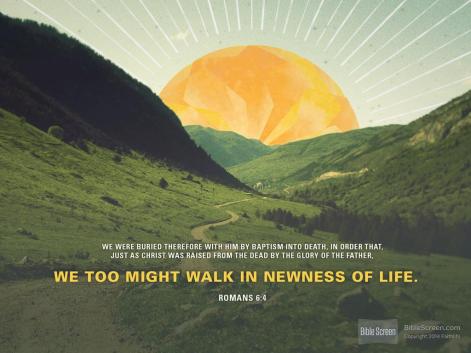
What then are we to say? Should we continue in sin in order that grace may abound? By no means! How can we who died to sin go on living in it? Do you not know that all of us who have been baptized into Christ Jesus were baptized into his death? Therefore we have been buried with him by baptism into death, so that, just as Christ was raised from the dead by the glory of the Father, so we too might walk in newness of life. For if we have been united with him in a death like his, we will certainly be united with him in a resurrection like his. We know that our old self was crucified with him so that the body of sin might be destroyed, and we might no longer be enslaved to sin. But if we have died with Christ, we believe that we will also live with him. We know that Christ, being raised from the dead, will never die again; death no longer has dominion over him. The death he died, he died to sin, once for all; but the life he lives, he lives to God. So you also must consider yourselves dead to sin and alive to God in Christ Jesus.


What’s the worst word you can imagine hearing from the pulpit? In a world where you can get away with saying and doing just about anything, is the church still a sacred place untainted by the desires of the world? There are plenty of strange and difficult and downright awful stories from scripture that we can read from the lectern, but don’t you think the pulpit should remain nice and clean?

During the season of Lent, we confront our finitude, our sinfulness, and our total dependence on the Lord. It is a tough time for us comfortable Christians, because these are exactly the types of things that many of us would rather avoid.

Gone are the days when we could expect to hear about sin and be challenged and convicted out of it. Gone are the days when we could affirm our finite lives without needing the stark reminder of ashes on our foreheads once a year.

Today, God has been reduced to a bumper-stickered and hallmarked version of love. Nothing more, nothing less, nothing else.

Today, church is not the place for judgment and for talk about sin. Regardless of their primacy in scripture, we would all be happier if we could avoid them.

The same holds true for foul language.

Right?

ec5f5b7006dc9af1fb22b9c190f5bcbb_social-etiquettepptx-on-emaze-swear-words-clipart_846-422

This is definitely not the place for someone like me to stand in front of people like you and use words that are forbidden from the radio and are relegated to rated-R movies.

As I heard someone say recently, “Preacher, there are just some things you don’t talk about it church.”

There is a seemingly endless list of things not to talk about in church; things like politics, abortion, divorce, war, sex, taxes, just to name a few. But foul language, language that results in soap-in-the-mouth discipline, is a particularly poignant thing to avoid in church.

And I have a friend in ministry who has completely ignored this accepted fact.

He loves to use foul language from the pulpit. Whether it’s the Christmas Eve sermon and the church is filled with young families who only show up for one worship service a year, or an Ash Wednesday service where only the die-hard Christians come out, he’s known for his colorful language. He’ll tell you that he uses those particular words in order to enhance the sermon in such a way that it will become more memorable and hit closer to home.

And a lot of the people at his church can’t stand it.

“Why does he feel like he has to resort to such awful language?” “The church deserves better than this.” “Does he talk to his mother that way?”

And, I think, they have a point. When the language used becomes more memorable or more important than what is being proclaimed, something has fallen a part. For instance: His recent Ash Wednesday sermon was titled “God Doesn’t Give A @#$%” I read it and listened to it online, it was phenomenal. The theology and the proclamation were remarkably faithful to the One who is faithful to us. But a few of the people from the church called me afterward and couldn’t even begin to express what the sermon was about at all; they were still hung up on the title.

However, there is a value to using some bad words in church.

During the season of Lent, this time after Epiphany but before Easter, there is a specific word that we avoid at all costs. It’s really bad. The word is… well, I’m not supposed to say it. Um, how can I do this…

Okay, there’s this great song by Ray Stevens called the Mississippi Squirrel Revival, maybe you’ve heard it, and part of it goes like this: The day the squirrel went berserk // In the First Self-Righteous Church // In the sleepy little town of Pascagoula // It was a fight for survival // That broke out in revival // They were jumpin’ pews and shoutin’ @#$%^&*!”

You know the word I’m talking about? You might not have even noticed it, but we have not said the “H” word in worship since before Ash Wednesday. It has not been read from the lectern, it has not been hidden in one of the verses from our hymns, and I certainly haven’t used it from the pulpit.

We purposely avoid the word during Lent so that when we shout it out on Easter it will mean all that much more. We specifically deprive ourselves of this important and powerful word to create a longing for the realization of all that the life, death, and resurrection of Jesus promises to us and to the world.

And there’s another bad “H” word that we need to talk about: Hell.

I don’t mean the place filled with fire and a red-toned, frighteningly tall, horned figure with a trident and a bifurcated tail. I mean using “hell” as an expression.

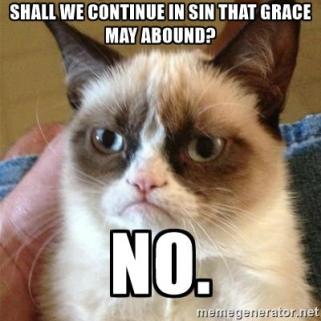
Paul writes: “What then are we to say? Should we continue in sin in order that grace may abound? By no means!” Now, what I’m about to say will probably get me in trouble, but so be it. That little ending, the “by no means” just doesn’t cut it. In Greek the expression is “me genotio” and it is way more emphatic than “by no means.” Some translations have it as “God forbid” or “Definitely not” but even both of those miss the mark.

37475703

In what we read last week, Paul wrote: “When sin increased, grace abounded all the more.” And it’s as if Paul knew that people would hear those words and say, “Dude, that’s awesome! If grace abounds all the more when sin increases, then lets keep the sins rolling!”

And here is Paul’s response: “Should we continue to sin in order that grace may abound? HELL NO!

Our lives have changed forever. We can’t just retreat to the ways of the past because grace abounds. God in Christ has made in us a new creation! The gift of God in Christ on the cross was, and is, such that we are forever freed from the tyranny of sin and death. Should we continue to sin in order that grace may abound? HELL NO!

But that’s not the last bad word we’re going to talk about today. No, we still need to talk about “Sin” and “Death.” Perhaps two of the worst words that can ever be used in church. And you can tell they’re bad word precisely because of how rarely they are used in a place like this.

We need to talk about these bad words, not because they are normal parts of human experience, but because they are false powers that rule over us. That’s how Paul understood them: Sin reigns, Death has dominion.

You need only turn on the television for five minutes in the evening to see how true this really is: The nighty News hour is filled to the brim with the failures and faults and sins of other people; The Republican Party failed to procure their dream for American Healthcare. Left Wing activists went on a violent strike in another major city. Augusta County citizen receives life sentence for horrible crime. North Korea has another failed missile test but they are getting closer to developing their own weapons of mass destruction. The market fluctuated with each tweet from our president. Test scores have fallen in local school leading to speculation that it will close… All of them are negative.

And then when they go to a commercial break we are bombarded by products designed to make us believe that we can and will live forever; Use this cream and your wrinkles will disappear. Invest in this company and you will never have to worry about money. Go on this vacation and you will feel happy and healthy like the people running on the beach or tanning by the pool.

We live under the tyranny of sin and death. But Paul says this should not be so!

Ro6

We who have been baptized into Christ have been crucified with Christ. Our sinful selves are put to death on the Cross so that we will no longer be slaves to the bad words of Sin and Death.

Long ago, we would have known this without Paul having to remind us. Baptisms, long ago, were all about death. That’s where the Baptists beat us today, I’m sorry to say. When the Baptists baptize, they fully submerge people under water. And, depending on the faithfulness of the pastor, the soon-to-be-new Christian might be held under for quite a long time.

You would’ve missed the baptism to death if you were with us in Alexandria when Elijah was baptized. No, we didn’t hold him under a tub of water to embody the death to sin. No, we didn’t give him some old and tattered gown to wear. Elijah looked perfect in his little khakis, and button-up shirt, and bow-tie, and mustard-colored cardigan. Elijah was sprinkled with water, and the perfectly portioned amount of holy oil was smeared in the shape of the cross on his forehead. And, he was carried out to the congregation and held up high by the same preacher who curses too much.

We miss the death to sin in our baptisms. But we have a member of our lectionary bible study who really gets it. Judy had avoided church for decades before God grabbed her by the heart and said, “Follow me.” She brought her questions and her doubts to her preacher, and after a time she felt her heart strangely warmed and felt moved to be baptized.

Unlike babes in the United Methodist Church, Judy marched up to the giant baptismal font and prepared to jump into the all-too-cold water. And outside, through the multicolored stained glass windows, a thunderstorm was brewing.

Judy slowly descended into the water, and with cracks of thunder in the distance the preacher plunged her into the depths of death to sin. I like to imagine that if she opened her eyes underwater, even for the briefest of moments, she would have seen a flash of lighting that illuminated the entire congregation. The whole moment felt as if the rule of Sin and Death, the dominion of the devil himself, was making one final dash to keep her under their control. But alas, the grace of Jesus Christ abounded all the more, and she arose from the water dead to sin and death.

Are we to continue in sin that grace may abound? HELL NO!

God has changed us! Not just through the waters of our baptisms, not just through the bread that we break and the cup from which we drink, but also through the death of Jesus on the cross. It changes everything! This gift transforms our very lives to the point that we should feel compelled not to fall back into the old ways, to the old self, ruled by Sin and Death.

But we know the truth: we do fall back. We know that those who are sent to prison for horrible crimes have an all too high likelihood of returning one day. We know that those caught in adultery tend to habitually cheat for the rest of their lives. We know that even the strongest member of an AA group can fall off the wagon.

We know that we fall back.

We say “never again” to so many thing only to have them come right back around. We say never again to the anger, to the cigarette, to the bottle, to the cheating, to the lying, to the hatred, to the racism, to the homophobia, to the elitism, to the narcissism, to defeatism, to a great number of things.

            They never stop.

            The fact that they never stop is evidence of the power of Sin in this world, which reigns in Death.

But our lives have been changed! God has wiped away the old self and clothed us with the new. God washed away our insecurities and insufficiencies and said, “My grace is enough.” God was nailed to the hard wood of the cross to die a death that we might die in our baptism. God was raised from the dead as we were brought forth from the water to live a resurrected and holy life.

            The death Jesus died, he died to sin, once for all; but the life he lives, he lives to God. So we also must consider ourselves dead to sin and alive to God in Christ Jesus our Lord.

Should we continue in sin in order that grace may abound? HELL NO! Amen.

Devotional – Psalm 32.5

Devotional:

Psalm 32.5

Then I acknowledged my sin to you, and I did not hide my iniquity; I said, “I will confess my transgressions to the Lord,” and you forgave the guilt of my sin.

 Weekly Devotional Image

I want you to take both hands and squeeze them into fists as tightly as possible (seriously). They need to be tight enough that you actually feel strained as you do so. Keep them squeezed and think about something you’ve done recently that could be qualified as a sin. It could be as simple as getting really frustrated when that person cut you off at the grocery store for the line marked “Ten Items Or Less” and it was clear that they had at least 40 items in their cart; or the anger you experienced when your child brought home that less-than-stellar report card; or the shame you felt when you caught yourself flirting with someone while you were currently in a relationship with someone else. Just think of a recent sin.

Now: Quickly release the tension in your left hand. But don’t let go with your right; keep that one tight. You’ll notice that your left hand might have a little tingling sensation from being held tightly for a few moments, but otherwise it should feel relatively normal.

Yet, the longer you continue to hold your right hand clenched in a fist, the more it will start to hurt. At first it was fine, maybe even comfortable, but now you can feel the little aches in all the tiny muscles, you can even feel the blood struggling to flow where it needs to go.

But don’t let go.

Clenched Fist

Think about that same sin again. What did you do with it? Did you let it percolate and grow into something much bigger? Did you confess your sin to the Lord? Did you share your struggle with anyone else and ask for help?

Keep that right hand tight for just a little bit longer.

And now release the tension slowly.

It’s going to hurt. As your fingers gradually stretch back out you will feel stabs of pain in the muscles as your hand regains it’s feeling. And, once you finally flex them all the way out, they’ll probably start curling back into a fist without you trying to do so.

Sin is like our clenched fists. We all sin, every single one of us. From the four-year-old preschool student, to the life-long Sunday school teacher, to the Mom or Dad just trying to make sure the kids have their lunches ready before they leave for school. We all sin.

We can, like our left hand, release the tension of our sins quickly. In the moment we can recognize where we have fallen short of God’s glory and, as the psalmist puts it, we can confess and repent of our transgressions to the Lord and be forgiven. However, most of us are more likely to treat our sins the way we treated our right hand; we let them simmer and boil for far too long so that by the time we actually confess it hurts all the more, and the more likely we are to descend back into that kind of behavior.

The Lord will forgive our sins, but we have to confess them first.


Devotional – Genesis 12.1

Devotional:

Genesis 12.1

Now the Lord said to Abram, “Go from your country and your kindred and your father’s house to the land that I will show you.”

 Weekly Devotional Image

And that’s how it all began. The Lord said to Abram, “Go.” In the entirety of the Old Testament, there are few passages as important and theologically profound as God’s calling of Abram to go to a strange new place. We can talk about Jacob wrestling with the emissary from God by the banks of the Jabbok river, we can talk about Joseph saving the Egyptian people from certain starvation, we can even talk about Moses’ trials and tribulations with the Hebrew people in the wilderness, but this moment with Abram, this call, sets in motion the great narrative of God with God’s people.

The sheer magnitude of such a call cannot be overlooked. During the time of Abram’s life, almost everything was dependent on staying in one’s country and with one’s family. Most people spent their entire lives, from birth to death, within a handful of miles and rarely explored anything outside the normal and comfortable dwelling of “home.” And yet God had the audacity, the boldness, and the faithfulness to call Abram to do the unthinkable: go to a strange new place and leave it all behind.

This, in a sense, is akin to the call of all Christians. We might not be asked to leave our home country, we might not be asked to leave our families, but we are certainly compelled to enter into strange relationships and moments around us. It is easy to stay within a certain bubble throughout our lives and never stretch too far into the unknown. We can develop rhythms and habits that actively prevent us from encountering anything out of the ordinary. But God is extraordinary.

go

Lent is a time for us to reflect and repent. We reflect on the many ways God’s has so graced us, and we repent for the many ways we have failed to positively respond to that grace. Lent is a time for us to all recognize the Abram within us, and wonder where God is calling us to go. What place are we avoiding because it makes us uncomfortable? What relationship have we let fall apart because it just felt like too much work? What frustrating behavior in a friend or a spouse or a child have we let percolate for far too long?

In some way, shape, or form God is calling each and every one of us to “go.” God calls us to “go” because our God is a God on the move. God cannot be relegated to a sanctuary on Sunday mornings at 11am, God is not absent until we pray for God’s presence, God is not sitting on a throne up in heaven watching us through a telescope. God moves, and so should we.