Devotional – Genesis 25.29-31

Devotional:

Genesis 25:29-31

Once when Jacob was cooking a stew, Esau came in from the field, and he was famished. Esau said to Jacob, “Let me eat some of that red stuff, for I am famished!” Jacob said, “First sell me your birthright.”

 Weekly Devotional Image

Communicating the stories of scripture to young children is a challenge. Ask any young person even remotely familiar with the bible about their favorite story and you’re likely to hear something about Noah’s ark, Jonah and the Big Fish, or David and Goliath. But the bible is so much more than those stories and they need to be shared with all people.

During Chapel Time with the preschool students at my last church I would often try to come up with different and imaginative ways to tell the story. Long ago flannel-graph representations of characters and objects would be enough to impart the story in a young person’s mind, but today, with the advent of social media and youtube, different means are necessary.

Every year I would guide the children through the bible and whenever we came to the story of Jacob and Esau I asked the children to join me in the church kitchen. All of the ingredients were prepared ahead of time and each student was able to add a portion of the ingredients to make some “red stuff” (chili). They would stand there mystified as the ground beef mixed with the tomatoes and the black beans and the spices and they all struggled to stir the giant pot with a large wooden spoon. When it was ready to cook I would put it on the stove and let the kids return to their classes for a few hours.

84f04419-a405-4436-84f4-3e772b5fab25

At the end of the day, right before they were dismissed, I would bring the chili downstairs and each child was offered their own bowl. While we ate together I would tell them the story of Jacob and Esau and how Esau was willing to get rid of something so wonderful and so precious for a bowl of red stuff. The kids would stare into their empty bowls and contemplate the greater blessing of a full stomach or the blessing of almighty God and then we would pray together.

I loved teaching the lesson every year, but what I didn’t anticipate was how well the younger children would remember it with each passing year. Because by the time the 2 year olds became 4 year olds they refused to even taste the chili for fear that God would remove the blessing from them!

The stories of scripture offer us a window into the divine. The bible is a strange new world that we enter whenever we open the book, and stays with us whenever we put it down. In the world today we are offered all kinds of things to quench our thirst and satisfy our hunger whether its literal liquid and food or relationships or experiences. But all of them are fleeting when compared to the immense blessing of God in Jesus Christ.

A Sower Went Out To Sow

strangely-warmed-spreaker-header

This week on the Strangely Warmed podcast I speak with Jason Micheli about the readings for the 6th Sunday after Pentecost (Genesis 25, Isaiah 55, Romans 8, Matthew 13). The conversation covers a range of topics including wrestling in the womb, drinking with church people, difficult soil, and the problem with “I think therefore I am.” If you would like to listen to the episode or subscribe to the podcast you can do so here: A Sower Went Out To Sow.

sower

If you enjoy the episode or the podcast (or our other podcast Crackers & Grape Juice) leave us a rating and a review on iTunes; it helps us and it helps others discover the podcasts.

On This Generation

But to what shall I compare this generation? It is like children sitting in the marketplace and calling to one another, “We played the flute for you, and you did not dance; we wailed and you did not mourn.”

strangely-warmed-spreaker-header

This week on the Strangely Warmed podcast I was left to record by myself as half of the team from Crackers & Grape Juice were moving to new appointments in the United Methodist Church and we couldn’t get our act together. It is easily our worst episode because we thrive on dialogues and not monologues, so have mercy. The readings include Genesis 24, Zechariah 9, Romans 7, and Matthew 11. If you want to learn more about worshipping the Lord in marriage, humility in leadership, sin, and our selfish generation you can check out the episode here: Like Children In The Marketplace.

As always, if you enjoy the podcast please leave us a rating or review on iTunes, it helps us and it helps others discover the podcast. You can find out more about both of our podcasts at our website.

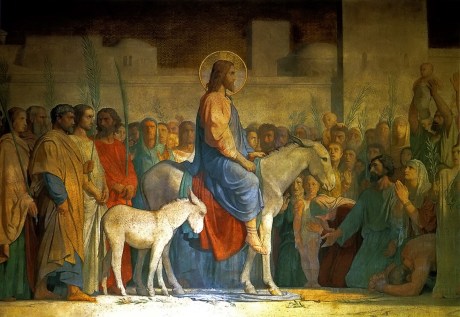
triumphal-entry

Stuck In The Bushes

Romans 5.12-21

Therefore, just as sin came into the world through one man, and death came through sin, and so death spread to all because all have sinned – sin was indeed in the world before the law, but sin is not reckoned when there is no law. Yet death exercised dominion from Adam to Moses, even over those whose sins were not like the transgression of Adam, who is a type of the one who was to come. But the free gift is not like the trespass. For if the many died through the one man’s trespass, much more surely have the grace of God and the free gift in the grace of the one man, Jesus Christ, abounded for the many. And the free gift is not like the effect of the one man’s sin. For the judgment following one trespass brought condemnation, but the free gift following many trespasses brings justification. If, because of the one man’s trespass, death exercised dominion through that one, much more surely will those who receive the abundance of grace and the free gift of righteousness exercise dominion in the life through the one man, Jesus Christ. Therefore just as one man’s trespass led to condemnation for all, so one man’s act of righteousness leads to justification and life for all. For just as by the one man’s disobedience the many were made sinners, so by the one man’s obedience the many will be made righteous. But law came in, with the result that the trespass multiplied; but where sin increased, grace abounded all the more, so that, just as sin exercised dominion in death, so grace might also exercise dominion in death, so grace might also exercise dominion through justification leading to eternal life through Jesus Christ our Lord.

I take a lot of pride in my ability to communicate with people of different age groups. On any given week I will spend time explaining theology to five year olds in our preschool, fifteen year olds in our youth group, 50 year olds in our bible study, and then the rest of you on Sunday morning. It is definitely a challenge taking ideas from the likes of Paul and proclaiming them in a way that can be appreciated for the here and now for the young and old.

But sometimes, I fail.

Like the time I tried to address the moral and ethical dilemmas of Capital Punishment to our youth group one night, to the times I’ve tried to proclaim the strange complexity of confronting our finitude on Ash Wednesday to our preschoolers, to the times I’ve told some of our much older adults that one must have the faith of a child to inherit the kingdom of God.

Communicating the gospel, sharing the Good News, is a challenge, and I definitely failed once when we were on our mission trip to West Virginia a couple summers back. Picture it, if you can: It is hotter than blazes outside, and I’m stuck in a tiny kitchen surrounded by teenagers who would rather be instagramming and snap chatting one another than cleaning a floor or painting a ceiling. And it was silent.

So I did what I do: I started asking questions…

“What’s your favorite story from the bible?”

One of our boys immediately said something about David defeating Goliath. The Davidic story will forever rest in the hearts of prepubescent boys who struggle with how rapidly the girls are growing while they remain the same.

A boy from another church said, “Well, I kinda like the one about, you know, Jesus feeding people?” while saliva poured out of his mouth as he stared at the cooler in the corner filled with our lunches.

A girl from a different church said, “I’ve always been rather captivated by Jesus turning water into wine at the wedding at Cana in Galilee.” To which I made a mental note to bring this up with her youth group later in the evening. No sensible teenage girl should be thinking about water turning into wine, and certainly not when Jesus has anything to do with it.

We went on and on, and then it was my turn to answer. “Well” I said, “It’s not my favorite story, but I’ve always loved this little detail at the beginning of the bible, in the book of Genesis. Adam and Eve were placed in the Garden of Eden with a choice. They could choose to live in perfect harmony with God and God’s creation, with each other, free from sin and free from death. But Adam and Eve made the wrong choice, they wanted to be like God, and as soon as they tasted the fruit from the tree of knowledge of Good and Evil, their eyes were opened, and they knew they were naked.

“But here’s the part that gets me every time. Almost as soon as they sin, they heard the sound of God walking in the garden and they both sprinted for the bushes. But God called out, ‘Where are you Adam? Where are you Eve?’ After waiting for a few moments, Adam popped his little head out of the bushes, and told God that he was hiding because he was naked and afraid.”

To which God said, ‘Who told you that you were naked?’

“Isn’t that hilarious?” – The teenagers had all stopped working while I was sharing the story, and now they were all staring at me with eyebrows askew. I could hear the paint dripping off their brushes onto the floor as if even the crickets were too concerned to chirp. One of the boys finally broke the silence to say, “Um… I don’t think it’s very funny. If I were naked and God came looking for me, I’d run for the bushes too!”

Do we know this old, old, story? Do we know what sin is? Do we know what happened to Adam and Eve in the Garden of Eden?

What kind of stories and habits and beliefs do we want to pass on to the coming generations? I feel like I am forever hearing about the good ol’ days when “we knew our bibles” and “we would’ve gone to school with snow like this when I was a kid” and “we entertained ourselves with our imaginations and not a screen in our pockets.”

Do we wish that things could go back to the way they were? Are we worried about the future that we are handing to our children?

We can talk and talk about what we want to pass on, what we hope to engender, but if we don’t know our story, if we don’t know where we came from, how in the world can we even hope to take a step in the right direction?

tumblr_nfzluvor3q1sk7sreo1_500

Just as sin came into the world through one man… Paul assumes that we know the story, that we know the details of the Garden. He does not waste lines in his letter rehashing the characters and the questions, he gets right to the point: Sin came into the world through Adam and Eve. They, and therefore we, broke the covenant with God. The transition from God’s rule to the rule of sin and death came into the world because of our rebellious and disobedient desires.

This is our condition. There is no going back. Fear and shame and anger and disappointment are our lives. We are, in a sense, stuck in the bushes for good, hoping that God will not come looking for us.

We are in the bushes. And Lent is a great time to ask the question: Why? Which of the commandments have we broken? Did we work on the Sabbath? Have we hated our mothers or our fathers? Did we covet something that did not belong to us? An object, a job, or God forbid, a person?

How would we respond if we heard God walking toward us in the middle of our sin? We, like Adam and like that boy on the mission trip, would run for the bushes.

Paul assumes that we know the story of Adam and Eve in the Garden because it is OUR story! Adam’s sin is our sin, and it not only divided us from God, but also brought death into the world, which spread like a disease. This is Paul’s point, and he says it in these few verses over and over again.

We are trapped in sin and death and we are stuck in the bushes. That’s the story of the Garden. Is this what we want to pass on?

Truly I tell you, we cannot know who we are to be, if we do not know our story. This inexhaustible, unexplainable, indescribable moment from the beginning is who we are. It is the story of how the life of order fell into disorder. But, thanks be to God, it is not the end of the story.

Adam brought the entirety of humanity down, down to the depths of death and destruction. Jesus, however, is the new way who is able to create a new humanity.

The promise of a good and remade and hopeful future comes from the old story that is forever new. The story of our death, and then the death that freed us from sin and death.

In Jesus Christ our stories are made new; God, as the author of salvation, takes up the pen and starts a new chapter through the life, death, and resurrection of his son. This is the story that those who are coming, the one who will follow us, need to hear. This is the story we need to share. We need to pray for the courage to shout this story from the rooftops as if our lives depended on it, because they do.

The only way to victory, the way to upend what was done in the Garden, is through the cross. We might think of a different way, a more efficient and less taxing way, but the way of the cross is the WAY that Christ defeated death.
08687e2b32757ff3722238f19cd727cd

But this is not an easy story to tell. The message and value of the cross comes with a cost. It is difficult, it is selfless, and frankly it is un-American. Today, we would rather surround the young with lessons that teach very different values: get the job, earn as much as you can, find the right spouse, buy the car, lose the weight, invest in the right companies, bring 2.5 children into the world, purchase the perfect house, and you will be free and life will be perfect.

That’s the story we tell. And it’s a lie! It’s all a lie! None of these things can give life. They cannot give us the identity and purpose and hope we so desire. The job will change, the money will disappear, the spouse will grow old, the body will too, the companies will falter, the car will rust, the children will not listen; Sin and Death corrupt them all.

But there is nevertheless Good News, there is a way out of the bondage that was brought into the world by the one we call Adam. We are freed through the one we call Christ.

We are stuck in the bushes of our own sin and shame. But Christ comes to us in the Garden of our own demise without a question, but a call. Jesus does not ask us who told us we were sinning, Jesus says follow me. Follow me to Galilee, follow me to Gethsemane, follow me to Calvary.

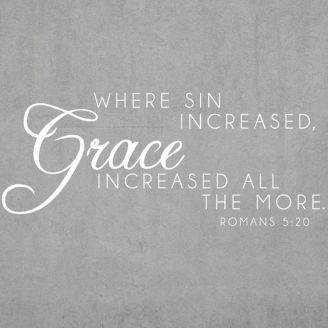
Jesus is the way and the truth and the life. Sin has increased in this world and in our lives, but God’s grace in Jesus Christ has abounded all the more.

The story, our story, began in the Garden, but it did not end there. It continued through the strange and wild wilderness in the days of Abraham, weaved through the journey to Egypt and back again in Jacob and Joseph. It rose through the power of David and Solomon, and fell through the failure of God’s people worshipping idols. It danced through the prophets who remained faithful to the Lord, it endured droughts and famines, it saw suffering and sadness. It connected the lives of the powerful with the powerless, it brought down the high and lifted up the lowly.

It was born again in a manger in a small town called Bethlehem; it trudged through the towns of Galilee and sailed over the sea. It walked through the streets of Jerusalem and turned over the tables at the Temple. It was dragged before the council and the ruling elite. It was marched up to a hill and nailed to a cross. It was silent in a tomb for three days. And it broke free from the chains of sin and death.

That is the story. It is a story worth telling over and over again; because in it we discover who we are and whose we are. In it we see ourselves stuck in the bushes being beckoned by Jesus to follow him. And in it we realize that it is not just a story, nor even our story, but THE story. Amen.


romans_feature-01

Devotional – Genesis 12.1

Devotional:

Genesis 12.1

Now the Lord said to Abram, “Go from your country and your kindred and your father’s house to the land that I will show you.”

 Weekly Devotional Image

And that’s how it all began. The Lord said to Abram, “Go.” In the entirety of the Old Testament, there are few passages as important and theologically profound as God’s calling of Abram to go to a strange new place. We can talk about Jacob wrestling with the emissary from God by the banks of the Jabbok river, we can talk about Joseph saving the Egyptian people from certain starvation, we can even talk about Moses’ trials and tribulations with the Hebrew people in the wilderness, but this moment with Abram, this call, sets in motion the great narrative of God with God’s people.

The sheer magnitude of such a call cannot be overlooked. During the time of Abram’s life, almost everything was dependent on staying in one’s country and with one’s family. Most people spent their entire lives, from birth to death, within a handful of miles and rarely explored anything outside the normal and comfortable dwelling of “home.” And yet God had the audacity, the boldness, and the faithfulness to call Abram to do the unthinkable: go to a strange new place and leave it all behind.

This, in a sense, is akin to the call of all Christians. We might not be asked to leave our home country, we might not be asked to leave our families, but we are certainly compelled to enter into strange relationships and moments around us. It is easy to stay within a certain bubble throughout our lives and never stretch too far into the unknown. We can develop rhythms and habits that actively prevent us from encountering anything out of the ordinary. But God is extraordinary.

go

Lent is a time for us to reflect and repent. We reflect on the many ways God’s has so graced us, and we repent for the many ways we have failed to positively respond to that grace. Lent is a time for us to all recognize the Abram within us, and wonder where God is calling us to go. What place are we avoiding because it makes us uncomfortable? What relationship have we let fall apart because it just felt like too much work? What frustrating behavior in a friend or a spouse or a child have we let percolate for far too long?

In some way, shape, or form God is calling each and every one of us to “go.” God calls us to “go” because our God is a God on the move. God cannot be relegated to a sanctuary on Sunday mornings at 11am, God is not absent until we pray for God’s presence, God is not sitting on a throne up in heaven watching us through a telescope. God moves, and so should we.

The End Of The Beginning – Ash Wednesday

Genesis 3.19

By the sweat of your face you shall eat bread until you return to the ground, for out of it you were taken; you are dust, and to dust you shall return.

If you’re here in this place, with these people, on this occasion right now, you are blessed. You are blessed because you understand, you grasp, what the church is really all about. We are a people called church, who follow Jesus and take upon ourselves the sins of the world.

However, we don’t take upon the sins of the world in the way Jesus did. We are told to take up our own crosses, but we don’t drag them up to a place called The Skull, and we don’t wait for people to nail us to them. We take upon the sins of the world in confession, a confession that God is our judge and has every right to be. Because we have failed to be the people God has called us to be over and over and over again.

The United Methodist Church has a document to help us whenever we gather together. The Book of Worship outlines the ways to serve the Lord for just about every occasion, including funerals.

The Service of Committal is brief and is reserved for the graveside. And in our Book of Worship you can find these directions for clergy: “Stand at the head of the coffin and while facing it, cast earth upon it as it is lowered into the grave. The pastor then says, ‘Almighty God, into your hands we commend your son/daughter, in sure and certain hope of resurrection to eternal life through Jesus Christ our Lord. This body we commit to the ground, earth to earth, ashes to ashes, dust to dust.’”

The last time I did a graveside burial, I held the Book of Worship in my hands like I’ve done too many times before, I read the all too familiar words, and when it came time to cast dirt upon the coffin, I couldn’t find any. I frantically looked at the area around the hole, and they had covered it with a frighteningly sharp bright green carpet of AstroTurf. So I bent down in my robe onto my knees, and I started ripping up the perfectly manicured grass on the edge of the fabricated lawn. I needed some dirt. I needed to dirty this pristine and picturesque committal service because death is ugly and disruptive. I clawed the ground and threw the grass to the side until I scraped enough bare earth with my hands to have a solid mound to drop onto the coffin.

It was a holy thing.

dirt-placeholder

I took my dirt covered hands and placed them on the coffin, I prayed the words from the Book of Worship, and then I slowly walked away giving the family time to grieve before leaving. And just as I began backing away, the funeral director motioned for the pall bearers to come forward. But they did not bend down to the hole in the ground I had just revealed. No, they took roses, the boutonnieres, from their lapels and laid them silently on the recently dirt covered coffin.

It is, of course, much nicer to throw roses than dirt. But like almost everything in the tradition of the church regarding worship, the dirt has important theological significance.

I wound venture to guess that many Christians, though they hear the words about ashes to ashes and dust to dust at funerals and at Ash Wednesday services, they have no idea where those words come from. But you do. You know where they come from because you just heard it. It is the final announcement from God to Adam and Eve as they are kicked out of the Garden of Eden.

By the sweat of your face you shall eat bread until you return to the ground, for out of it you were taken; you are dust, and to dust you shall return.

            For us humans, this is the end of the beginning.

Much has been made about the Genesis story of eating from the tree of knowledge of Good and Evil. The slithering serpent who manipulates Eve’s desire; Eve’s treachery through inviting Adam to join her in the prohibited act; Adam hiding his shame and nakedness from God when the Lord returns to the Garden. And its all pretty harsh.

By this act sin was brought into the world. Because of our ancestors’ choice, we were banished from the paradise of God’s created order and were punished. Women must suffer through childbirth. Humans must work and sweat over the earth in order to glean enough produce to survive. Families are torn apart by an individual’s choice that has ramifications far greater than they can ever imagine.

And then we come to a place like this to have ashes smeared across our foreheads in an effort to remember what happened long ago, and what will happen to all of us one day.

We will die.

But we’re content with spending the rest of our days prettying everything that we can. We bring roses to place on the coffins at graveyards. Politicians bump up statistics to make things appear better than the actually are. We do our best to cover our scars, both physical and emotional, as if they were never there. And some churches spend Ash Wednesday not in sanctuaries confessing their sins with their brothers and sisters in faith, but in their parking lots presenting “Ashes to God with a cup of Joe.”

We would rather cover the harsh realities of truth than look at them in the eye.

God’s pronouncement to Adam and Eve, that terrifying moment when they were expelled and told that they will suffer until they return to the ground, that strange and all too familiar expression you are dust and to dust you shall return, they strike fear in the hearts of us mortals.

Sometimes its good to be afraid because it reminds us what a tremendous blessing it is to be alive at all. Sometimes its good to get down on our knees and confess our sins before the Lord because it reminds us that we are not God. And sometimes we need to catch a glimpse of ourselves in the mirror on Ash Wednesday to remember who we are, and whose we are.

This day, this Ash Wednesday, is a moment for us to confess our sins, and for all the sins of the people who are not here. We bow our heads and are adorned with a sign of death, not just as a reminder to us and to others that we will die, but that God will not let death be the final Word.

And here is the hope, my brothers and sisters, the hope we need on a day like today. We know how the story ends. We know that the pronouncement at the edge of the Garden was not the final word. We know the final word is not suffering, nor death, nor dirt, nor even dust. We know that the final Word is Jesus Christ.

The ashes that will soon be on our skin are not our crosses to bear, but Christ’s who carried it to The Skull and was nailed to it for the world. Jesus Christ is God’s greatest and final Word because in him the fullness of the Lord was pleased to dwell. In Him the sin of Adam and Eve were reconciled unto the Lord. In Him we are brought back into the dwelling of God’s grace where the light always shines in the darkness.

So wear the ashes with fear and trembling, let them dirty your lives a little bit, but also remember the hope that has been available to us in the one who hung on the cross, and rose again. Amen.

maxresdefault-2

Jesus’ Temptation or: Who Does Government Belong To?

The team from Crackers & Grape Juice interviewed Stanley Hauerwas about the Lectionary Readings for Lent 1 (3/4/17). You can listen to our conversation here: Strangely Warmed

hauerwas

There is a temptation, during the season of Lent, to make it all about our temptations rather than Jesus’ temptation. While people today (Ash Wednesday) are embarking on the beginning of their 40 fast from the likes of chocolate, coffee, and candy, the Revised Common Lectionary forces us to confront the truth about Jesus’ temptation on the first Sunday of Lent. Our conversation with Hauerwas brought forth some interesting insights about comparing Jesus temptation by the devil with the serpent’s tempting of Eve in the Garden for both pastors and laypeople. If you’re preaching the first Sunday of Lent, or if you are interested in the connections between Genesis and Matthew, check out the episode from Strangely Warmed.

strangely-warmed-spreaker-header


Devotional – Genesis 32.28

Devotional:

Genesis 32.28

Then the man said, “You shall no longer be called Jacob, but Israel, for you have striven with God and with humans, and have prevailed.”

Weekly Devotional Image

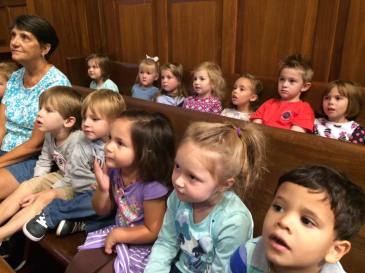
I gather in the choir loft of the sanctuary with the entirety of St. John’s Preschool every Wednesday morning at about 9:30am. By that time the children have all had an opportunity to get out most of their “wiggles” before sitting down in the stiff church pews and learning a story about God from the Bible. I generally try to start the academic year off with stories from Genesis and make my way through up to the stories of Jesus leading toward Easter Sunday.

When we learn about God making light from Creation, we turn the sanctuary lights off and on and talk about what a great gift it is to have light. When we talk about Adam and Eve hiding from God after eating from the tree of knowledge of Good and Evil, we play hide and seek in the sanctuary and talk about how God never stops looking for us even when we’re lost. And this year, when I was foolish enough to teach them about the story of Sodom and Gomorrah, we played red light green lights in attempts to reflect on how God offers us the wisdom of when to go and when to stop.

14440780_1104466649629648_5384631729784297628_n

Last week we met in the sanctuary to talk about one of my favorite stories from Genesis: Jacob wrestling by the banks of the Jabbok river. Jacob has run away from his family after stealing and tricking his brother Esau out of his birthright and blessing and is about to reencounter his brother. But before he can meet his fate in Esau, a strange man arrives in the middle of the night and wrestles Jacob until he, in a sense, learns his lesson. And from this struggle he receives a new name: Israel.

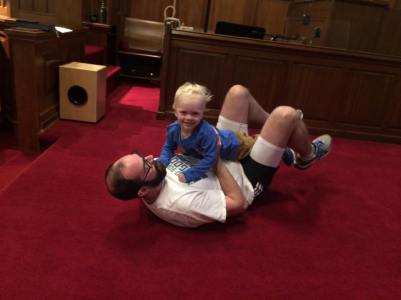
In order to bring the story to life, I had the preschoolers line up one by one and each of them were tasked with knocking me over in a wresting match. They all came forward and gave it their best shot (some were oddly more prepared for this than others) and I would pick them up and spin them around in circles. When one of our last two year olds came forward, I let him knock me to the ground, but instead of pounding on me like some of the older kids, he wrapped his arms around my neck and hugged me.

14502882_1104466592962987_8175825250906782039_n

I was then able to stand up with the boy in my arms and tell the kids the most important part of the lesson: God loves us so much that even when we’re angry, God will never let us go.

To be a Christian today almost implies a degree of struggling with God. We want to know why a hurricane, like Matthew, can wage destruction in places like Haiti, the Bahamas, and the East Coast of the US. We want to know why our presidential political system is filled with such vitriolic and hateful language. We want to know why bad things happen to good people and why good things happen to bad people. Yet, even amidst all the struggle and questions, what a blessing it is to know that God’s love is so strong that God will never let us go.

On Creation vs. Evolution

Genesis 1.1-5

In the beginning when God created the heavens and the earth, the earth was a formless void and darkness covered the face of the deep, while a wind from God swept over the face of the waters. Then God said, “Let there be light”; and there was light. And God saw that the light was good; and God separated the light from the darkness. God called the light Day, and the darkness he called Night. And there was evening and there was morning, the first day.

Controversy Original

Preachers can fall into the rut of preaching on whatever keeps the congregation pleased; keep them happy and they’ll keep coming back, or something like that. This sermon series is different. Instead of falling back to the familiar narratives that keep us smiling on our way out of church, we are confronting some of the greatest controversies facing the church. There is a better than good chance that I will say something from this pulpit during the series that you won’t agree with, and if (and when) that happens I encourage you to stay after worship, join us for lunch, and continue the conversation. We can only grow as Christians in community, and that requires some honesty and humility and dialogue. Today we continue with Creation vs. Evolution.


“How old is the earth?” The fifth grader looked up from his homework assignment as if to say, “Well, dude, what’s the answer?” We were sitting inside Forest View Elementary School in Durham, North Carolina, and I was in the middle of a tutoring session. Each week we would sit in the library and go through his homework together. His class was finishing up a unit on earth sciences and his worksheet was filled with questions about the subject.

“How old is the earth?” I, of course, could not remember the answer so I promptly pulled out my cell phone to Google the answer and the young man rolled his eyes and opened up his textbook with dramatic emphasis. We flipped through the pages together looking for key words or pictures that would indicate we were on the right path and then we found it in big bold numbers on the bottom of a page: 4.54 billion years.

I waited patiently for my young tutee to copy the number down into the answer column on his worksheet, but he just kept looking at the textbook with a glazed-over look in his eyes. Then I heard him say, almost as if a whisper, “That can’t be right.”

“Well of course it’s right!” I said, “I mean its in the book, it has to be right.”

            And then he said, “But my pastor told me the earth is only 6,000 years old.”

creation-evolution-possible

In the beginning, the very beginning, there was nothing. All matter was formless. What we now know and see was a soup of nothingness, a bottomless emptiness, and inky blackness. And in the midst of this nothingness, there was something: God. And God said, “Let there be light”; and there was light. God saw that the light was good; and God separated the light from the darkness. God called the light Day, and the darkness he called Night. And there was evening and there was morning, the first day.

Perhaps no words in all of scripture have been more analyzed, prayed over, and interpreted throughout the centuries. Genesis 1 is beginning, and not just a beginning to a story, but the beginning to the story.

And it stands on the battlefield of the fight between Creation and Evolution.

Here’s the controversy: Centuries ago a man named James Ussher set out to date the earth. He dove deep into the Old Testament and, with the help of genealogies, established the exact time and date of God’s creation as 6pm on October 22nd 4004 BC. Therefore, according to Ussher, the earth is approximately 6,000 years old. However, with the advent of modern science and the likes of evolutionary biology and carbon dating, scientists have determined that the earth is 4.5 billion years old.

There is a big difference between 6,000 and 4.5 billion.

For a very long time, we humans considered the earth a relatively recent phenomenon. The Christian church established itself as the predominant leader of information distribution, and when that came into conflict with Science, the battle began.

This has manifested itself throughout the centuries in a number of ways including the fight between the Galileo and the church, Darwin and the church, and even the American Government with the church.

“How old is the earth?” It may seem like a pretty simple question without too many ramifications, but it is a big one, and the way we answer it has a lot of consequences.

A couple of years back, the state of Kansas removed questions about evolution from its standardized tests. This meant that teachers were still allowed to teach evolution, but the children would not be tested on it at the end of the year. Some Christians rejoiced in the victory Creation over Evolution, and others were concerned that children from Kansas would pale in comparison to students from other states by the time they entered college.

It would seem that the church has one answer to the question, and science has another.

I remember learning about the theory of evolution when I was in the 8th grade. With all my hormonal angst, and pimply face, and peach fuzzed mustache, I sat in my science class and learned about how all life can trace its origins back to one single cellular being: That over millions of years that first cell grew and evolved and developed new traits; how life began in the sea, and eventually developed to live on land and in the air; how humanity is one of the last developments in a tremendously long line of evolved species.

I thought it was awesome! The science-fiction nerd within me went into overdrive and I relished in learning about where we came from, how the earth has changed, and how beautifully unique we really are. And the whole time I dove into evolution I saw God’s handiwork all over the place. Who could have brought life into that first being, who could have the imagination to force molecules and atoms together in such a way that life began, who could have moved the development of species to its zenith in humanity?

But at the same time, some of my Christian friends stopped going to youth group and they stopped going to church. In learning about evolution their faith in church diminished. What they heard in the classroom became more important than what they heard in the sanctuary. When they learned that the earth was older than what they heard in church, their faith was crushed. I, however, was fortunate to have pastors and older Christians who helped me to see the similarities between science and faith. But my friends only saw the battle.

2852667_orig

The title of this sermon is Creation vs. Evolution for a reason. I titled it this way precisely because that is the way that many of us see the relationship between the two; Faith and Science represent opposite ends of the spectrum. One is archaic and illogical; the other is scientific and intellectual. One represents backward thinking; the other is forward thinking. One should be left to sanctuaries; the other is for the classroom.

The conflict between science and faith exists because of us; Christians who became defensive when scientists learned more about the world instead of rejoicing in God’s creative majesty. Christians who were quick to jump ship when we discovered there was more to the world than just what we can read about in the bible; Christians who saw scientific discovery as a work of the devil and retreated further away from the world.

But are science and faith really at odds with one another?

Young-Earth Creationists are those who believe (like Ussher) that God created the earth over 6 24 hours days 6,000 years ago. They dismiss scientific discoveries like the Dinosaurs and carbon dating as a way for God to test our faith.

However, there are other ways of looking at the biblical account of creation from Genesis 1 that harmonizes with, rather than battles against, science.

First, the word for “day” in Hebrew is “yom.” And it carries with it a number of definitions and interpretations. Yom is used in the Old Testament as a general term for time, like a time period of finite but unspecified length. We can also read in Psalm 90.4 “For a thousand years in your sight are like yesterday when it is past, or like a watch in the night.” What we understand the word “day” to mean is different than what it means in scripture. God’s time is not our time.

We could then read Genesis 1 to be that in the beginning God created light, and after light God created air, and after air God created earth and sky and sea. But how long it took God to do this is unknown. One day? One million years? Only God knows.

Genesis, and the rest of the bible, is not meant to be read like a science or history textbook. The bible, over and over again, rejects our desire to master the text and instead calls us to be servants of the Word. We might be concerned with how and when God created, but the bible only tells us who and why God created.

Then we can look at the order of creation itself and the similarities with the theory of evolution. Though it was written thousands of years before Darwin’s On the Origins of Species the order of creation parallels Darwin’s and modern evolutionary scientist’s ideas. The first thing to exist was light and energy. Then matter began to fuse together into celestial beings like stars and planets. Eventually the earth developed an atmosphere and water and land. The first life began in the sea, eventually evolved to fly in the air and crawl on the earth, and the last life to be developed, the zenith of God’s creation, was human life.

            Knowing this, countless Christians are able to hold that evolution is real, but that God set it in motion. They are able to assert that the earth is 4.5 billion years old AND God created it in the way described in Genesis. They are able to hold together science and faith in such a way that it gives glory to God’s glorious creation.

The conflict between science and religion, between creation and evolution, exists because people like us have treated the book just like every other book. We see it as our own historical textbook, or as our scientific journal, or as our genealogical record. We import the ways we read other texts into the way we read God’s great Word.

And then many of us take it up like a weapon against anyone who disagrees with us.

But the bible is fundamentally unlike anything ever written. It is historical, and scientific, and literary, and poetic, and every other form we can think of. It is beyond our ability to fully comprehend, it breaks down and exceeds the expectations we place on it, it is the living Word of the Lord.

In the beginning, the very beginning, there was nothing. All matter was formless. What we now know and see was a soup of nothingness, a bottomless emptiness, and inky blackness. And in the midst of this nothingness, there was something: God. And God said, “Let there be light”; and there was light.

           The bible is far less concerned with explaining how things happened, and is far more concerned with proclaiming God’s handiwork. It comforts us when we are afflicted, and it afflicts us when we are comfortable. It can make us laugh and it can make us cry. It can bring us to our knees and it can propel us to dance on our feet. It identifies God as creator and us as creature. It harmonizes with the marvelous developments in science. It humbles us and exalts us. It is who we are and who we aren’t. It is God Word for us. Amen.

Babbling Grace – Karl Barth and Genesis 11.1-9

Professors in seminary can make all the difference. Some can call you into the strange new world of the bible through their passionate lectures and you will never be able to look at scripture the same way again. Some can refers to moments of history in the church that decisively reshape the way you understand the church today. And still yet others can turn your entire understanding of the kingdom of God upside down through just a few lines in one lecture.

Stanley Hauerwas is one of those professors.

Hauerwas

In 2013, I had the good fortune of participating in his last ethics class before he retired. In it, he did his best to make us Christians more Christian. By highlighting problems that the church is facing, and has faced for a long time, he helped to provide a better grammar for what it means to be a Christian in the world.

During one of his lectures on the remarkable importance of the gathering community, he briefly mentioned a sermon he once wrote on the story of the Tower of Babel from Genesis 11. At the time, the story of Babel was one that I remembered from my youth; the pictures we drew of people attempting to build a tower to God, the lesson it conveys about why there are so many languages on the earth. But I honestly hadn’t thought about it having much to do with my life as a Christian.

Dr. Hauerwas said, “The divisions at Babel are healed and reconciled at Pentecost. The language divisions were still present, but within the gathered communal identity of the church was a common Lord in Jesus Christ. Pentecost was a new day of creation, not unlike those we read about at the beginning of Genesis.”

In just a few sentences, Hauerwas jumped from Genesis 11 to Acts 2 and it blew my mind. Now it seems so obvious, that the Lord would bring together God’s people through the power of the Holy Spirit therefore redeeming what had happened at Babel. But when Hauerwas connected them in that lecture, it was like I was given a new lens by which I could read scripture.

For a time I attributed this new way of thinking and reading to Dr. Hauerwas, and it was only later that I realized he got it from Karl Barth.

barth-bw

In Church Dogmatics III.4 Karl Barth uses the story of the Tower of Babel to evaluate the problem of nationhood in the modern period. For Barth, Babel contains every bit of the human desire to remain self-reliant and focused on pride, which has resulted in our divisions as a species. It is a story, not unlike Adam and Eve’s first sin, that reminds us of the brokenness in our world.

I have always seen Babel as a kind of means by which we can teach a lesson to children or young Christians about the dangers of pride. I have seen Babel as a shadow of what the church is supposed to be. But for Barth, Genesis 11 is all about grace.

Barth is quick to note that, “A Christian people is one in which heathenism and national egoism are broken, judged, and purified by the Spirit of Christ… As we are warned in Genesis 11, rebellion against God leads to the forceful disintegration rather than the organic development of national identities.”[1] Babel should frighten us, as a people, about what happens when we rebel against the Lord to such a degree, but the story is about much more than the Lord’s “punishment” at the end.

The Tower of Babel, for Barth, contains elements of both divine wrath and divine blessing. The story begins with: “Now the whole earth had one language and the same words” (Gen. 11.1). As a unified people, they settled into the land of Shinar and decided to use bricks to make themselves a city and a tower, “otherwise we shall be scattered abroad upon the face of the whole earth” (Gen. 11.2-4). In response to this, the Lord goes down to examine the city and tower and eventually confuses humanity’s language to remind them of the divide between Creator and creature.

Tower_of_babel

Barth immediate questions the supposed sin within the story: What is inherently wrong with building a city or a tower? The constructions of such objects were not completed against God; attempts at civilization are never formally wrong.[2] For Barth, the thing itself, the object built, is not the fault but rather when a people want to create something for themselves in order to reach an attempted equality with God there lays the sin. The depth of humanity’s sin is the “arrogance of thinking that man himself can and must take himself as he takes the brick and mortar, and make himself the lord of his history, constituting the work of providence of his own work.”[3]

In light of humanity’s over-determined arrogance, God must respond with punishment. If God let humanity build the tower to completion, just as if God had let Adam and Eve stay in the Garden after eating of the tree of knowledge of good and evil, humanity would further perpetuate itself as a sinful people. The scattering of the nations at the end of the story is an example of God’s divine wrath, and usually where I would let the story finish, but for Barth (and Hauerwas) we cannot understand Babel without the rest of the Bible.

Barth sees grace at Babel through, of all things, Jesus’ parable of the sower: “The constant sowing of the seed of the divine Word will always find soil even if there is no true harvest in one place. Even in this passage we must not fail to see the Gospel in this sense. Even in the terrible decree of v. 7 (“Come let us go down, and confuse their language there, so that they will not understand one another’s speech.”) we must not miss His grace.”[4]

Important for Barth’s understanding of God’s grace in his exegesis is the fact that God could have easily used an earthquake or another divine miracle to achieve God’s condemnation. But rather than destroying creation, as had been done through the flood in Genesis 7, God merely divides humanity and confuses their language. Instead of raining destruction upon humanity, God limits the punishments to linguistics.

Additionally, God does not abandon humanity to their own devices even after their construction. Regardless of the self-righteousness employed by humanity, God will remain faithful even when we are not. Babel could have been the end of the relationship between the Creator and the creature, but God remained steadfast.

Morever, Barth’s final move regarding the babbling grace of Genesis 11 comes in the recognition that, as Christians, we are aware that God has more in store for his creatures than the end of the story in Genesis; we know what happens at Pentecost. What transpires at the end of the Babel narrative is not the ultimate decree on the matter but rather, “only a penultimate word, and that the curves of the separated ways are so ordered in advance that they will finally come together again.”[5] Here is where Barth shines the light of God’s glory the brightest: even though the main emphasis of the Tower of Babel in on how the separation and division of people was right (at the time), God’s original desire is for humanity to be in unity.

For Barth, we cannot read Genesis 11 outside of, or in spite of, Acts 2. These two different stories, separated by thousands of years, though different in form and content, contain the beginning and the next step of God’s action toward creation. God intended for humanity to remain in unity, and through our own self-righteousness were have rejected the divine unity for our own division. And yet, according to Barth, we are to remain grateful to God’s out-pouring of grace which simultaneously remaining discontent until there is a total reunification of God’s creation.

1101620420_400

Barth, time and time again throughout Church Dogmatics, refuses to read particular texts as isolated witnesses. To read the bible is to read it canonically. Narratives from different places help to inform one another and the Old Testament reads into the New just as much as the New reads into the Old. Babel and Pentecost are connected. Eden and Revelation are connected. David and Jesus are connected. Exodus and Acts are connected. And so on.

As Christians reading scripture, we have the benefit of knowing how the story “ends.” We know that in the person of Jesus Christ the previously divided nations have come together. In the Holy Spirit of Acts 2 the conclusion of Genesis 11 takes place: “The miracle of Pentecost tells the us how the decision is take to look and break out from the nations to the one people of God, how the divine disposition of Genesis 11 is rightly understood as a teleological divine purpose, and how it is recognized in the form of the corresponding orientation from the near to the distant, the narrower sphere to the wider.”[6]

Barth’s reading of scripture, and in particular his exegetical work in the excurses of Church Dogmatics has directly influenced the work of Stanley Hauerwas and a whole mosaic of theologians over the last century. To be a Christian is to read, and to read well; to look for the connections from book to book; to identify the thread that God pulls through seemingly unrelated stories; to see ourselves as characters in God’s great narrative.

And for Barth, the story of Babel is not one for us to leave for children’s Sunday School rooms and flannel-graphs. It is one that we must read with conviction knowing full and well how the story ends. Just as with the construction of Babel, humanity still consistently places brick after brick of our own presumed infallibility in direct contradiction to the One in whom we live and move and have our being. Barth’s work reminds us that we have divided ourselves against God’s original and good intentions, and to complete the end of the story we must take seriously God’s mighty acts in Jesus Christ, desiring for humanity to one day be made perfectly one.


[1] Barth, Karl. Church Dogmatics III.4. (Peabody, Massachusetts: Hendrickson Publishers, 2004), 306.

[2] Ibid., 314.

[3] Ibid., 314.

[4] Ibid., 316.

[5] Ibid., 317.

[6] Ibid., 323.