Incompatible

Ephesians 4.1-16

I therefore, the prisoner in the Lord, beg you to lead a life worthy of the calling to which you have been called, with all humility and gentleness, with patience, bearing with one another in love, making every effort to maintain the unity of the Spirit in the bond of peace. There is one body and one Spirit, just as you were called to the one hope of your calling, one Lord, one faith, one baptism, one God and Father of all, who is above all and through all and in all. But each of us was given grace according to the measure of Christ’s gift. Therefore it is said, “When he ascended on high he made captivity itself a captive; he gave gifts to his people.” (When it says, “He ascended,” what does it mean but that he had also descended into the lower parts of the earth? He who descended is the same one who ascended far above all the heavens, so that he might fill all things.) The gifts he gave were that some would be apostles, some prophets, some evangelists, some pastors and teachers, to equip the saints for the work of ministry, for building up the body of Christ, until all of us come to the unity of the faith and of the knowledge of the Son of God, to maturity, to the measure of the full stature of Christ. We must no longer be children, tossed to and fro and blown about by every wind of doctrine, by people’s trickery, by their craftiness in deceitful scheming. But speaking the truth in love, we must grow up in every way into him who is the head, into Christ, from whom the whole body, joined and knit together by every ligament with which it is equipped, as each part is working properly, promotes the body’s growth in building itself up in love.

Can’t we all just get along?

So asks the woman in her Sunday school class, so asks the friend of his neighbor wearing the Make America Great Again hat, so asks the father of his children fighting in the back seat of the car.

Can’t we all just get along?

You don’t need to hear it from me to know that, at our cores, we can’t really get along. We resent our neighbors for the dumbest reasons, we berate our children for raising their voices after we first raised our voices at them, and we drive through town day after day with clenched fists as we hear the news over the radio.

Sure, getting along in the world might be a forlorn possibility. Maybe our differences in opinion, our polarized political proclivities, and our desire to speak more than to listen will always prevent unity in the world.

But the church should surely be a place of unity, right? If nothing else, can’t we be the place where we just get along?

I passed 15 different churches on my way here this morning. 15! That alone answers the question of whether or not we can get along.

This part of Paul’s letter to the church in Ephesus is absolutely breath taking: One body, one spirit, one calling, one Lord, one faith, one baptism, one God and Father of all. I can hear Paul crescendo-ing these words in the locker room we call the church. It is the pep talk of all pep talks about what it means to be who we are.

But the more I read it this week, the more I wondered, when has the church ever felt like this? I can’t speak toward what this church was like before I arrived, but I don’t know if I’ve ever experienced a church that felt like what Paul’s talking about. What Paul describes sounds more like a wedding, or a giant party, focused on one particular thing where great pluralities of people can join together in oneness.

In contrast, the church often feels like the place where we are supposed to gather for one, but the plurality is precisely what holds us back.

Most of us tend to think we know best, we insist on our own way, and we are intolerant of others’ quirks and weaknesses. We stand on pedestals of our own making looking down on just about everyone else. And even if we are “tolerant” of the differences, that’s because we are the ones with power! No one wants to be tolerated! We want to be loved and heard and cherished and respected.

Do you all remember the time Jesus traveled into town and gathered everyone together to hear his earth-shattering proclamation? “The kingdom of God is near, and the time has come for toleration!”

Yeah, me neither.

Unity-Ephesians-4-1-3-1080x608

Paul does not say the mission of the church is to tolerate the behaviors of others.

            Paul says the church is called to be one.

But can’t we all just get along? Can’t we be one by just being nicer to each other?

There is a tremendous difference between loving one another (like Christ), and being nice. Being nice often means being quiet, and not calling out the behavior of others. Loving like Jesus however, often means speaking up and actually calling someone out.

            Easier said than done.

Paul pokes and prods our human tendency toward division and schism by using the word “one” seven times in two verses. We can all imagine the divisive energy that must have been present in Ephesus for Paul to write these words, because those types of arguments are still very much a part of the church today.

The sevenfold emphasis on oneness is at the heart of the great challenge we call the church. How do we find unity in our plurality? Unity, to be clear, is not uniformity. Jesus does not want the church to be a factory where random parts are brought in and perfectly congruent products are shipped out.

And so, as the church struggles toward, or around, the kind of unity that God has already created in the church through Jesus Christ, a unity made possible by the three-in-oneness of the trinity, a question arises: Where have we dug our trenches so deep that we are no longer able to experience this God-given unity?

The line that forms after worship is one of my favorite, and least favorite, things about the church. I love the intimacy that can be found in our narthex as I overhear conversations about the prayers, and the hymns, and even the sermon. I relish in the opportunities to hear feedback about what we all experienced together. And every once in a while I receive the greatest compliment a pastor can ever hear: “I heard God speak to me today.”

But, of course, the narthex can also harbor the resentments that percolated during the service. A wrong word, or phrase, or reading, or hymn can stick with us and boil over when we finally have a chance to let it go. I see the same arguments and disagreements manifest over and over again in small and subtle ways.

A few months back I was observing the strange space that is the narthex following worship, when a new family walked up to shake my hand. They had recently moved to the Woodbridge area and were looking for a new home church. They expressed their joy with our worship and how welcomed they felt. And though we talked about a great number of things, our conversation ended with the father saying, “But we really need to know your opinion about homosexuality, and this church’s opinion about homosexuality.”

Since then, it’s happened three more times with three different families.

And in every one of the conversations it was abundantly clear that however I answered the question would determine whether the family would come back the following week or not.

000 (1)

As it stands the United Methodist Church believes the practice of homosexuality is incompatible with Christian teaching. In some churches this means that pastors prevent openly gay individuals or couples from becoming members of the church. In some churches this means that pastors refuse to baptize or offer communion to anyone who is openly gay. And it means that in all churches an openly gay individual is not supposed to be a pastor, and that pastors may not preside over same sex unions.

As it stands the United Methodist Church believes the practice of homosexuality is incompatible with Christian teaching.

There are, of course, some churches within the UMC who ignore the language and do whatever they can to welcome those who are gay, and because we, as a church, are not united in our theological convictions about those who are gay, the church is struggling to find a way forward.

There are those who want the language to remain and for stiffer penalties to be enacted against any pastor or conference who violates the tenants of the incompatibility of homosexuality.

Maybe they want uniformity.

And there are those who want the language to disappear all together and to be fully inclusive of anyone who is gay.

Maybe they want uniformity too, just of a different flavor.

And there are those who wish to remain in the middle, they want a church where people who believe it is incompatible, and those who believe it is compatible, are able to sit down in the pews together to worship the living God.

            Maybe they just want everyone to get along…

The language surrounding the incompatibility of a human being in Christian teaching is strange and wrong. To say that who someone is makes him or her incompatible with what we do as the church is oxymoronic in a way that is indescribable. So much of Jesus’ ministry, and Paul’s too, was founded upon finding people who were once told they were out and showing them how God in Christ brings them in. The message of Jesus is one where we are made one, regardless of any other identification.

And the incompatibility of Christians, at least the way some use the language, is now also applied to those who believe that individuals are incompatible. Some will use places of power and privilege to say that those who are gay are incompatible. But others will use similar places of privilege to say that if you believe someone is incompatible, then you are now the one who is incompatible with Christian teaching!

The infighting within our denomination about identity such that some are in and some are out, that some are compatible and other are incompatible, is antithetical to the Good News made manifest in Jesus Christ.

            Friends, no one is incompatible with Christian teaching. No one.

            Or, perhaps better put, we are all actually incompatible with Christian teaching. Not because of our sexual orientation, not because of who we love, but because we are all sinners in need of God’s grace. Paul begs, truly begs, us to live lives worthy of the calling to which we were called. And we will never be worthy. None of us.

We, like Paul writes, are so tossed to and fro and blown about by every wind of doctrine, we are moved by trickery. We look out at whatever the other is, and we are so quick to pull out the label of incompatibility.

            But it is in using that label we become the thing we so label!
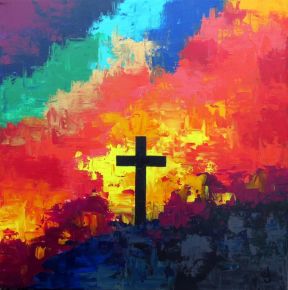
2dd04d97c664a4970b539f317ea19633--jesus-painting-prophetic-art

Here is the truth spoken in love. You and I, all of us here, we are broken and battered disciples. We are incompatible with the one born in the manger and delivered from the tomb. We have grown apart and ignored the call to grow into him who is the head, into Christ. It is Christ who joins all of our incompatibilities and knits together every ligament of our greed and our sinfulness and our judgments and builds us up in love.

Hear Jesus as he speaks to us throughout the centuries, hear his voice in the songs we sing and the prayers we pray. He is not just being nice and asking us to be a little kinder, though it certainly wouldn’t hurt. Jesus didn’t get killed for saying we ought to love one another. Jesus got hung on a cross for calling out the sinfulness of the world and the sinfulness in you and me; The shouts of “crucify!” came because the crowds knew that the message of Jesus would disrupt the power dynamics in which they were most comfortable.

Even today, Jesus speaks to us and disrupts what we think we know about who is in and who is out. Because the truth, the hard truth, is that none of us should be in. None of us.

And yet, this meal, what we call Christ’s communion, is offered to all, as surely as Christ is for all, as surely as all of us are not divided in him, but all of us belong together and brothers and sisters.

All of us are poor sinners and all of us are rich through Christ’s mercy. In our incompatibility, we are made one. Amen.

Pedestals Are Meant To Be Broken

strangely-warmed-spreaker-header

This week on the Strangely Warmed podcast I speak with Chenda Innis Lee about the readings for the 11th Sunday After Pentecost (2 Samuel 11.26-12.13a, Psalm 51.1-12, Ephesians 4.1-16, John 6.24-35). Chenda is an ordained elder in the United Methodist Church and she serves as one of the pastors at Annandale UMC in Annandale, VA. Our conversation covers a range of topics including crumbs at the table, putting God in God’s place, the underrated prophet, losing agency, sharing passwords, reconciliation, Paul’s lack of gentleness, equipping the saints, being lost, and breaking pedestals. If you would like to listen to the episode or subscribe to the podcast you can do so here: Pedestals Are Meant To Be Broken

c

Comprehending The Incomprehensible

Ephesians 3.14-21

For this reason I bow my knees before the Father, from whom every family in heaven and on earth takes its name. I pray that, according to the riches of his glory, he may grant that you may be strengthened in your inner being with power through his Spirit, and that Christ may dwell in your hearts through faith, as you are being rooted and grounded in love. I pray that you may have the power to comprehend, with all the saints, what is the breadth and length and height and depth, and to know the love of Christ that surpasses knowledge, so that you may be filled with all the fullness of God. Now to him who by the power at work within us is able to accomplish abundantly far more than all we can ask or imagine, to him be glory in the church and in Christ Jesus to all generations, forever and ever. Amen.

“Tell me about your prayer life…” has got to be some of the most ridiculous pastor lingo I’ve ever heard. I mean, who else would ask someone a question like that? I am rarely, if ever, happy about my “prayer life.” I consistently feel like I could be a better prayer, that I could spend more time in prayer, and that I could get more out of prayer than I usually do.

And, to be honest, I’m not even sure how I learned to pray in the first place. Maybe prayer is like learning to read. I know that at one point in my life I didn’t know how to read, and now I do, and I’m not really sure about the magic that made it possible.

Tell me about your prayer life… How would you feel if I asked that question, right now, right here in the sanctuary and made you stand up to answer? Exactly.

And yet, for all of the difficulty and frustration and confusion that surround prayer, it might be the most important thing the bible has to offer us.

For this reason I bow my knees before the Father and I pray. Paul here in Ephesians is no longer offering sound ethical advice, he’s not providing visions for the organization and structure of the church, he is simply describing his prayers. For the church. For us!

ephesians-1038x576

I think, like reading and so many other things, we learn how to pray by observing other people pray.

Maybe you pray like Paul… You get down on your knees and you use all the right language to elevate the divine qualities of God. You earnestly yearn for the people around you that Christ might dwell in their hearts. And that, above all, you pray for the world to know the breadth and height and depth of Christ’s love.

Or maybe you pray like my buddy Will: Woah God, how great was the weather today? Thanks! I mean, like, really awesome stuff. The way you had the clouds moving and the Sun! The Sun! It was like just bright enough but not too bright. You know what I mean? Of course you do! You’re God! Well, anyway, thanks.

There is no wrong or right way to pray, though there are certainly things that are better to pray for than others. The point isn’t so much how we pray, but that we pray at all.

Years and years ago I was helping a church in North Carolina and one of my responsibilities was visiting some of the older and retired members of the church. Many of them were what we call shut-ins, in that they could no longer make it to church for worship or fellowship, but they still felt very connected to the church.

So I would bring a copy of the latest bulletin and sit down with someone for an hour for nothing more than a conversation, and we would always end our time in prayer.

One of my regular visits was to a retired pastor, and he was easily my favorite. We got to know each other pretty quickly, and every time we got together he would offer me a sage piece of advice regarding my future vocation in the ministry. He told me story after story about his successes and failures. He told me what passages to avoid in the bible, and he even told me about the time a police officer had to drive him home after a funeral wake because he didn’t know the punch had alcohol in it.

Anyway, one afternoon I went to go visit him and our relationship had grown to such a degree that I regularly walked into his room at the retirement home without knocking. And as soon as I stepped through the threshold I saw him kneeling by his bed in a posture of prayer.

What a holy sight to behold! This man, after all the years of praying and serving the church, was still just as dedicated to communing with the divine. But the more I took in the scene the more uncomfortable I felt. I didn’t want to just leave without saying anything, and I didn’t want to just keep standing their awkwardly by the door, so after a minute or two I decided to join him by the edge of the pray and start praying too.

            I slowly crept across the room and lowered my knees to the floor and centered myself before I overheard the prayer of the retired pastor… he was snoring.

And, of course, I tried not to laugh, but then again I found myself at a loss for what to do. What would happen if he woke up while I was trying to slide out of the room? What would he do if he opened his eyes and saw me kneeling on the floor right next to him? I decided to very gently rub his back and he immediately opened his eyes and said, “Amen!”

Tell me about your prayer life…

Paul wrote to the church in Ephesus because he was filled with joy that all followers of Jesus Christ are part of God’s family. No longer is there “us” and “them.” There is no “insider” or “outsider.” All have been made part of the new family in Christ Jesus. And Paul’s response to this profound revelation is to get down on his knees and pray! He knew that trying days were ahead, that it would not be an easy thing for the church to accept, the incomprehensibility of a new family made up of all, and he knew that he could not give the church what it needed to be sustained by himself.

The church relies on God, not itself.

That’s a tall order in today’s world and in today’s culture. We are told from childhood to pull ourselves up by our bootstraps, that we can be anything we want to be, and that it’s all up to us. But the message of the gospel is in fact the opposite. You cannot pull yourself up by your bootstraps, you can’t be anything you want to be, and it is not all up to us.

We cannot do this thing we call life on our own. And we certainly cannot pray on our own.

36496-praying-together-1200.1200w.tn

Paul prays for the church to comprehend the incomprehensible. This is no easy thing! But Paul prays that we might comprehend the incomprehensible WITH the saints. It is something we can only do in community, and not in isolation.

The more time I spent with the retired pastor, the one praying in his sleep (or sleeping through his prayers), the more I learned what he was really like. Because for the first few months he was what I would call his Sunday morning self, the person he used to become on Sunday morning for everyone that once showed up at his church. He was able to keep the smile for the hour we were together and send me on my way with what felt like a benediction.

But after a couple months I saw behind the curtain and I learned about his loneliness, his broken family, his fears and failures. I encountered who he really was as I discovered his inner self. And the hardest discovery of all was learning that he felt as if he had moved beyond the love of God.

The great theme of Paul’s letter to the Ephesians is the fact that there is no nation, no tribe, no family, and no person who is beyond the love of God. This may sound obvious, but it can be very difficult to believe. Particularly if you’ve lost the community, or family, or church that helped to make that love feel manifest.

Even on our best Sundays here at Cokesbury, we, the gathered people of God, bring together a myriad of secret hurts, private humiliations, and lost hopes.

After only being here for a little more than a year I can stand behind this altar and look out at the truths many of you have shared with me. I see the broken families and the betrayals, I see the terror and fear about unknown futures, and I see the pain and loss of people who used to sit in these pews. I know so many of the secret shames and private failures that are contained in isolation and I know that the ultimate fear is about what happens if any of it gets out.

And yet we keep showing up. We keep carrying our own weights and disappointments. We put on our Sunday selves, we keep the smile for the hour we are here and then we are sent away with a benediction.

But what would happen if we revealed our truth to the church? Now, I don’t mean we take turns standing up at the front and airing out all of our dirty laundry. But think with me for a moment… how could this church change if we treated it like the church Paul prays for, rather than just a place where we hang out for an hour on Sundays?

Paul prayed for the church to know, above all else, the love of God in Christ that surpasses all knowledge. Paul prayed for Christ to so dwell in our hearts and minds that we might be filled with all the fullness of God. Paul prays for us to imagine the unimaginable, to know the unknowable, and to comprehend the incomprehensible.

If we pray for our church, if we pray for Cokesbury like Paul prayed for the Ephesians, then we do so by praying for a communal experience of the love of God in heart, soul, mind, and strength. And then we pray for the church to come to grasp the truth of grace; a truth that is utterly massive and beyond all earthly reason.

            God loves us, and there’s nothing we can do about it.

And so it is for that reason, that we bow our knees before God the Father, and we pray that according to the riches of God’s glory, God may grant that we may be strengthened in our inner beings, that Christ may dwell in all of our hearts, as we are being rooted and grounded in love. We pray for the power to comprehend, with all the saints, what is the breadth and length and height and depth, and to know the love of Christ that surpasses all knowledge, so that we may be filled with all the fullness of God.

_

We pray this so that all of us might know that no one, NO ONE, is beyond God’s love. Not even us. Amen.

Jesus’ Favorite Commandment

strangely-warmed-spreaker-header

This week on the Strangely Warmed podcast I speak with Daniel Burch about the readings for the 10th Sunday After Pentecost (2 Samuel 11.1-15, Psalm 14, Ephesians 3.12-21, John 6.1-21). Daniel is a Licensed Local Pastor in the United Methodist Church and he serves in Warsaw, VA. Our conversation covers a range of topics including cursing from the pulpit, peeping David, imperfections and temptations, happiness vs. contentedness, working toward perfection, hiding beers, wedding texts, The Crucified God, masks in church, and moving beyond the ordinary. If you would like to listen to the episode or subscribe to the podcast you can do so here: Jesus’ Favorite Commandment

d

Also – The Crackers & Grape Juice team is excited to announce our first book! I Like Big Buts: Reflections on Romans (you can find the ebook and paperback on Amazon).

Good Fences Make Bad Neighbors

Ephesians 2.11-22

So then, remember that at one time you Gentiles by birth, called “the uncircumcision” by those who are called “the circumcision” – a physical circumcision made in the flesh by human hands – remember that you were at that time without Christ, being aliens from the commonwealth of Israel, and strangers to the covenants of promise, having no hope and without God in the world. But now in Christ Jesus you who once were far off have been brought near by the blood of Christ. For he is our peace; in his flesh he has made both groups into one and has broken down the dividing wall, that is, the hostility between us. He has abolished the law with its commandments and ordinances, that he might create in himself one new humanity in place of the two, thus making peace, and might reconcile both groups to God in one body through the cross, thus putting to death that hostility through it. So he came and proclaimed peace to you who were far off and peace to those who were near; for through him both of us have access in one Spirit to the Father. So then you are no longer strangers and aliens, but you are citizens with the saints and also members of the household of God, but upon the foundation of the apostles and prophets, with Christ Jesus himself as the cornerstone. In him the whole structure is joined together and grows into a holy temple in the Lord; in whom you also are built together spiritually into a dwelling place for God.

It was still cool in the early morning when the man prepared to mow his lawn. He looked forward to being able to drive back and forth over the grass before the sun made it too hot, and it was an opportunity for him to escape from all the busyness of the world. The hum of the machine below his legs was barely audible over his ear protection and he continued to mow until the lawn was immaculate.

As he maneuvered the mower toward the garage, he hopped off to inspect the machine when out of nowhere BAM he was tackled to the ground. The two men rolled down the hill grappling each other until they came to a stop, and the fighting really began.

Hours later the mowing man was in the hospitable with six broken ribs wondering what had led him to all of this.

That man, as it turns out, was Rand Paul, a senator from the state of Kentucky. And for months the media speculated as to why the fight broke out. Was the assailant an opponent of Paul’s political ideologies? Was he so moved by debates on Capitol Hill that he felt violence was the only solution? Was Paul involved with some nefarious characters and now we were seeing behind the curtain?

Not since 1856 had a sitting senator been so beaten and sent to a doctor. It was a frightening moment for law-makers all across the country as they began wondering if it could happen to them too.

Months later, when the assailant was finally brought before a judge, the truth came out. The attacker was Rand Paul’s neighbor, and he was tired of Paul’s lawn clippings getting blown into his yard.

I’m not making this up people! While a great sum of people assumed that Paul’s political persuasion was to blame for the attack, while the media continued to stir the pop as much as possible, it was all about a neighborhood squabble.

Though this one left a man in the hospital with 6 broken ribs.

ephesians-1038x576

Remember that you were once without Christ, being aliens from the commonwealth of Israel, and strangers to the covenant of the promise, having no hope and without God in the world. But now in Christ Jesus you who once were far off have been brought near by the blood of Christ. He is our peace! In his flesh he has made both groups into one and has broken down the dividing wall, that is, the hostility between us.

Have you ever been mad at a neighbor? Maybe they kept playing their music too loud into the early morning hours, or perhaps they kept parking their car in front of your driveway, or maybe they kept blowing their lawn clippings on to your property…

Robert Frost once famously wrote that good fences make good neighbors. And one could make the argument that strong walls make for better peace. There’s a reason the Vatican is surrounded by walls, and the White House, and even the Temple in Jerusalem.

            Every child that has had to share a room knows the value of a wall (though in this case a figurative one).

            There’s a reason we have to go through security before we got on an airplane.

            But good walls also make for bad neighbors.

During the initial hearing after the lawn mower battle, it came to light that Rand Paul and his neighbor had not exchanged a word with one another for over ten years. Tens years of frustration about lawn clippings boiled over to the point that violence came forth. That’s a pretty tremendous wall to share with a neighbor, a wall of hostility that’s stronger than any bit of chain, any concentration of concrete, or any fabricated fence.

The higher we build the walls around us, both the real and the imagined, the higher the hostility tends to be. Every year more and more gated communities are completed. Year after year new boundary lines are drawn for schools, for taxable business, and a whole slew of other items. Year after year we tend to spend more time with people who look like us and think like us and talk like us than ever before.

And yet Paul is bold, some might say foolish, to proclaim that Christ has broken down the dividing wall, that Christ has eradicated the hostility between us.

One need not drive around for very long, or turn on the television, or simply swipe on a phone, to know that hostility is still very real, and that new walls are being constructed each and every day.

However, in the blood and cross of Christ, Jesus’ peace has been made possible for us.

And this is where the struggle between building walls and erasing hostility really comes into focus. It is far too easy to read a passage like this from Ephesians and then make some sort of declaration about current realities like the proposed wall at the southern border with Mexico, or furthering divides within our local community. And for as much as that might be true, those are walls and hostilities and visions of peace defined by our terms, and not necessarily by Jesus.

When we think of peace, we might imagine a time and place where everyone will just get along, or at least where people will just start being nice with one another.

But Jesus, the Lord of lords, he doesn’t have a lot to say about being nice. Sure, feed the hungry, clothe the naked, minister to the sick… those are all nice things. Doing all of that might make the world a little more peaceful.

But Jesus’ peace, a divine peace, also looks like turning the tables over in the temple, it looks like calling to task the political and religious elite for making such a mockery of the kingdom, it looks like abandoning the people closest to you if it means making God’s new reality manifest on earth.

And sometimes Jesus’ peace doesn’t jive with our version of peace.

Unity-Ephesians-4-1-3-1080x608

One of the greatest challenges of being a Christian today is that many of us simply cannot resonate with the deep and profound truth that we were once far off and have now been brought near by the blood of Jesus. If we’ve grown up in the church, or can’t remember a time when the church was not pivotal in our life, we make the assumption that we have always been near. But all of us here are gentiles, we were far from the Lord and were only brought close because of Jesus.

And when we recognize our far-off-ness, when we recognize the immense chasm that has been joined in the blood of Jesus between us and God, it makes the peace of Jesus a whole lot more interesting.

Jesus’ peace is different than our peace, and is only possible because of his peace. We are no longer stranger and aliens to one another, but instead we are citizens of the household of God. This is the best news my friends! Whatever divisions and hostilities we might imagine between us, they have been wiped away! The cross stands as the great unifier between all of God’s people, including us.

            Jesus’ peace is greater than any earthly vision we could possibly imagine. It is more powerful than any political policy, it is mightier than any magistrate’s order, it is more life giving than any piece of legislation.

            Jesus’ peace is revolutionary.

And Jesus’s peace is nothing short of Jesus himself. In the life, death, and resurrection of the incarnate Lord we discover not just a way to live differently, but also the way that makes a way where there was no way. Jesus destroyed, and continues to destroy, the walls and the hostility between us, because we have been made one in the blood.

Now, of course, there is the temptation to treat the church like the unique place of peace, a one-hour a week reprieve from the madness of the world. Church, what we are doing here right now, is not the place where we pretend peace is possible by sitting next to people whom we might otherwise ignore during the week. The church, as the body of Christ, is a new peace, one in which a different power from the cross redefines the ways of the world.

Does this mean that we need to leave from this building and start tearing down our backyard fences? Should we go to our country’s southern border and protest the construction of a giant wall? Is this text compelling us to destroy every boundary that has ever existed?

Destroying walls does not in itself create peace. We still live in a very broken world in which our sinful desires compel us to make choices we know we should not make. Peace, Jesus’ peace, only comes by eliminating the hostility behind the dividing walls, and that’s not something within our own power.

Rather than building walls that separate us and keep us safe, rather than trying to become our own Gods and destroying new walls, Paul pushes us to let ourselves be built upon the cornerstone of Christ into a temple where God dwells.

And friends, this is no easy task. To do so requires humility all but lost in the world today. It requires a willingness to say that I cannot do this on my own, that I have failed to love my fellow brothers and sisters, that I have ignored the power of Jesus blood.

To be built upon the cornerstone of Christ, rather than building our own walls, is to fundamentally commit ourselves to Jesus instead of trying to commit Jesus’ to whatever we want.

            It is nothing short of letting our lives embody the words we pray each and every week, “let thy will be done.”

When each of you entered the sanctuary this morning you were handed a Lego piece. I asked you to hold it and consider your piece in the kingdom. I did this because each of us has a piece to play in peace.

But it’s not our responsibility alone.

As Paul so rightly puts it, Jesus came and proclaimed peace to us! We were far off and through Jesus we have been united with one another in one Spirit to the Father.

We are no longer strangers and aliens; all has been made new! We are citizens with fellow saints and members of the household of God. We have been built about the foundation of those who came before, with Christ himself as the cornerstone.

In Jesus the entire structure of reality is joined together and it continues to grow in the holy temple in the Lord. Our oneness, the destruction of our hostility, is the beginning of the dwelling place for God.

And so we hold our piece that is part of Jesus’ peace. But we are not alone. In just a moment, each of us will be invited forward to connect our piece to Jesus’ peace. We will be built upon the cornerstone that is Jesus the Christ, the one who is our peace. We will see our connected and stuck we each other we really are. And we will remember that Christ has already destroyed the walls between us and erased the hostility. Amen.

Reimagining the Church

strangely-warmed-spreaker-header

This week on the Strangely Warmed podcast I speak with Daniel Burch about the readings for the 9th Sunday After Pentecost (2 Samuel 7.1-14a, Psalm 89.20-37, Ephesians 2.11-22, Mark 6.30-34, 53-56). Daniel is a Licensed Local Pastor and he serves in Warsaw, VA. Our conversation covers a range of topics including cracking foundations, getting outside the church, movements vs. institutions, unrealized hope, footprints in the sand, Johnny Appleseed, citizenship, and refilling the cup. If you would like to listen to the episode or subscribe to the podcast you can do so here: Reimagining the Church

db

Also – The Crackers & Grape Juice team is excited to announce our first book! I Like Big Buts: Reflections on Romans (you can find the ebook and paperback on Amazon).

No One Is Illegal On Stolen Land

strangely-warmed-spreaker-header

This week on the Strangely Warmed podcast I speak with Kenneth Tanner about the readings for the 8th Sunday After Pentecost (2 Samuel 6.1-5, 12b-19, Psalm 24, Ephesians 1.3-14, Mark 6.14-29). Ken pastors the Church of the Holy Redeemer in Rochester Hills, Michigan and is a good friend of the podcast. Our conversation covers a range of topics including biblical beards, The Apostles’ Creed, the awful fonts Comic Sans and Papyrus, losing yourself in church, worshiping with more than one congregation, multiracial realities, weddings as heaven on earth, and heads on a platter. If you would like to listen to the episode or subscribe to the podcast you can do so here: No One Is Illegal On Stolen Land

Also – The Crackers & Grape Juice team is excited to announce our first book! I Like Big Buts: Reflections on Romans (you can find the ebook and paperback on Amazon).

k

https://www.spreaker.com/user/crackersandgrapejuice/8th-sunday-b


Devotional – Ephesians 2.10

Devotional:

Ephesians 2.10

For we are what he has made us, created in Christ Jesus for good works, which God prepared beforehand to be our way of life.

Weekly Devotional Image

In a few minutes I will leave for a local funeral home to preside over a Service of Death and Resurrection for a longtime member of Cokesbury Church. I never met Frances Tyrrell, and yet I will be the one tasked with standing before her family and friends and offering words of grace, comfort, and hope.

It is a strange and mysterious thing that we ask people to speak on behalf of the dead, particularly when the person speaking never met the person everyone has gathered to celebrate and mourn.

After meeting with the family to begin making arrangements, they graciously lent me a copy of the Woodbridge Women’s Club’s History. Frances was an original member and pioneered a lot of the volunteer work that was done throughout the community. I flipped through the interview she gave and learned all about her life, from her birth, to her marriage, to her children, to her work. But there was one particular section that stood out.

At some point the interviewer, after realizing how deeply involved Frances had been in serving other people asked Frances, “So what does your family think about all this time you’ve given and all this work you’ve done?” To which she replied, “I never asked them.”

Rare these days are the individuals who do good works simply because God created them to be that way. More often we seek to serve such that we can be seen and congratulated for the work we’ve done.

But that wasn’t the case with Frances.

Paul says, “We are who God has made us, created in Christ Jesus for good works, which God prepared before hand to be our way of life.” I can’t help but feel as if we’ve largely lost sight of the truth of this verse from Ephesians. We might think, instead, that our way of life is to earn all we can and save all we can. Or we might think our way of life is about building that perfect house, and having 2.5 children, and constructing a pristine white picket fence. Or we might think our way of life is any number of other things.

IMG_0264

But how often do we consider the fact that we have been made to serve? When was the last time we made the needs of others our priority instead of our own? How often do we help others simply because we were made this way rather than because we think God expects us to?

When we come to the end of our days, when people gather together to remember who we were and what we did, let us pray they remember us, like Frances, for our commitment to others.

Look At It And Live

strangely-warmed-spreaker-header

This week on the Strangely Warmed podcast I speak with Rev. Ben Maddison about the readings for the Fourth Sunday of Lent [Year B] (Numbers 21.4-9, Psalm 107.1-3, 17-22, Ephesians 2.1-10, John 3.14-21). Ben is an episcopal priest who serves as the rector of Holy Trinity Episcopal church in Wenonah, NJ. Our conversation covers a range of topics including serving a church in a post-Christian context, clergy collars, fiery serpents, the temptation of allegory, healing and scars, God’s agency, backsliding, and Fleming Rutledge’s The Crucifixion. If you would like to listen to the episode or subscribe to the podcast you can do so here: Look At It And Live

BM

God Is God And We Are Not

strangely-warmed-spreaker-header

This week on the Strangely Warmed podcast I speak with Rev. Matt Hambrick about the readings for the Christ The King Sunday (Ezekiel 34.11-16, 20-24, Psalm 95.1-7a, Ephesians 1.15-23, Matthew 25.31-46). Matt is the pastor of Trinity UMC in San Diego, California. The conversation covers a range of topics including hipster churches, opt-in preschool chapel time, Caesar vs. The Shepherd, the hypostatic union, and Christians not liking other Christians. If you would like to listen to the episode or subscribe to the podcast you can do so here: God Is God And We Are Not

HipsterJesus